Profanazione (1924; It.; Eugenio Perego)
A ripe melodrama from Italy: after her brother Alfredo secretly steals her husband’s money, Giulia (Leda Gys) must ask help from Roberto, who obliges but then forces himself upon her; after Giulia has a second child, her husband Luciano suspects that the daughter growing up in their house is not his…
At last, a bad film! For the sake of my time and fingers, I’m relieved that I don’t have to write or think as much of Profanazione as previous films. That said, it is only an hour long and packs enough unexpected (which is to say, clumsily inserted) twists to give one enough of a reason to stick with it.
But the problems are manifest from the start. The performances are not bad, as such, but rather obvious: when drama strikes, eyes begin to bulge and hands begin to ascend towards heads and faces. The camera is almost inert, though there are enough neat compositions to ward off aesthetic hunger. What disappoints most is the way that the intertitles do too much work, substituting text for visual imagination.
When Giulia visits her rich admirer Roberto, we read: “Before she crosses the threshold of his house, she feels all the anguish of the sacrifice of her woman’s pride.” [N.B. The original word “orgoglio“ (“pride”) is mistranslated as “watch” in the available subtitles on the stream.] All that we see, with only a second or two to linger, is Giulia closing her eyes outside the gates.

Elsewhere, text invokes complex emotions that widening eyes and static poses cannot. “She seeks comfort for her pain in the love of her children, but in vain”, says a title. We see Giulia in her chair. Another explanatory title. Cut back to Giulia in the same chair. And so on, and so on, and so on…
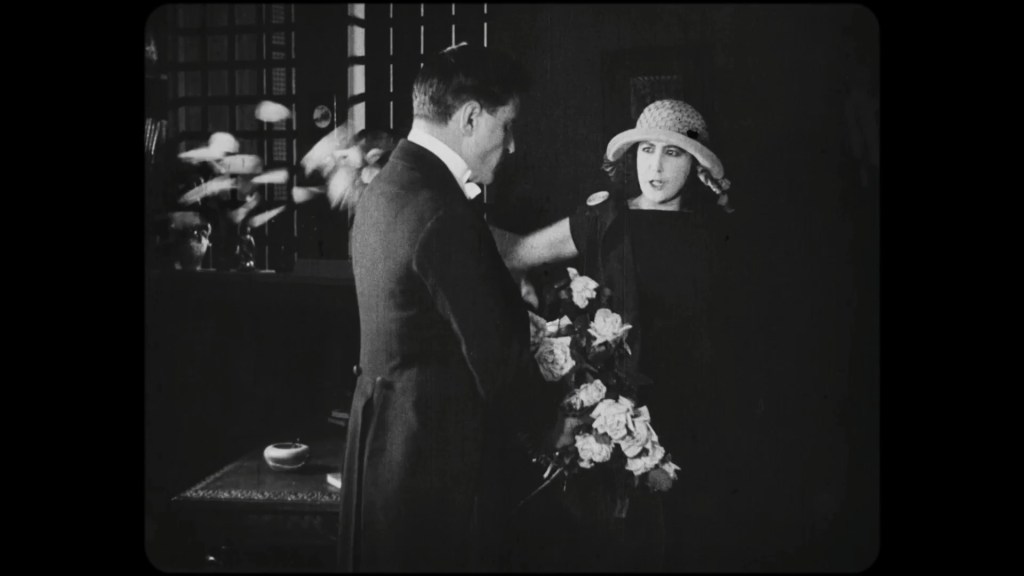
What keeps the film failing completely is the sheer brutality and narcissism of all its male characters, who bully, ignore, abuse, and exploit Giulia and (later) her two daughters. It isn’t sophisticated fare, but it stops you falling asleep. Faced by Roberto’s brutal advances, Giulia fights with her gun and then with her teeth, then (after she has been violated off-screen) takes the flowers Roberto gives her and thrashes his face with them. It’s an extraordinary set-up, but somehow the crudeness of the surrounding film bled dry the feeling it should have invoked. This film was released in 1924. If it had been an Italian film made ten years earlier, I can’t imagine it being this lacking in atmosphere, feeling, texture. It’s a world away from the great “diva” films of the 1910s.

In Profanazione, the male violence keeps coming. A few years later (how time flies!), Roberto threatens to come to Giulia’s house and see “his” daughter. Giulia drives out of town to ward him off. She breaks down. “How fate is against her…” Yes, and the screenwriters too. For Roberto arrives from the other direction and they drive back together. At home, Giulia’s children (dressed in ridiculously frilly tea cosies) play and crash their toy car: cue the inexplicable sight of Giulia and Roberto plunging off a cliff.
The husband, Luciano, arrives at the scene. The best thing he can do to his insensate wife is grab her and shake her arms. (Weirdly, he’s gentler to Roberto, lying on the other bed.) But wait—Luciano has contracted a rare eye-bulging condition. A stroke? No, he is suspicious! As Luciano is refreshing himself on the details of the plot through various bits of incriminating paperwork wrested from the unconscious bodies, Giulia awakes—and it’s her turn for bulging eyes. (It’s contagious.) Luciano acts “like a madman” and searches documents for evidence. (Not only do his eyes bulge, but his neck apparently swells too much for his collar; perhaps he has a parchment allergy?)
Bits of the film fly by in-between cuts inflicted by time, others by design. Is anger leeching from the frame, between the frames? Is the melodrama so potent it’s causing the celluloid to buckle, break, flee? The film breaks itself into numbered parts, most of the transitions between parts occurring mid-scene. Thus: we see Giulia sitting. End of Part 3. Part 4: Giulia is still sitting! Oh dear, her eyes are closing. The next day. Luciano is pacing. A telegram. Giulia is havering in the doorway again. Roberto is in a wheelchair, too feeble for Luciano to slap him about. “I will wait for you to answer until I die!” The nurse (a nun, by the looks of her) says: “If he has sinned, God will punish him—not you.” Roberto lies about which is his child: he says it’s Mimì to protect his real child (I must have missed her name) from wrath. So Luciano goes home to embrace “his” own child and hits the innocent Mimì. “I’ll keep my child, you keep his!” he screams at Giulia. Great stuff, Luciano.


(I’ve already written too much on the film, but I’ve come this far…)
Giulia stomachs this for a scene, then tells Luciano everything: we see again Giulia hitting Roberto with roses, but no more. (How one longs for the film to do something, anything, visually imaginative with memory, feeling, subjectivity etc.) Does Luciano believe his wife or Roberto? But news just in: Roberto is dead. Giulia’s eyes bulge and she walks slowly away. Upstairs, Mimì “falls into an uncontrollable fit of weeping”. Oh dear, oh dear, oh dear. Giulia lifts her arms and prays; her pose dissolves onto an image of the Virgin Mary. It’s one of the film’s few attempts at complex visual design, and all it can reach for is cheap Catholic tat.


The images of birds in a cage, the children superimposed over them, is so obvious that even Luciano gets the message. He finally forgives everyone. And, complete with a duff subtitle translation that somehow suits the lazy sentiment, we read: “The heart wants what its want” [sic]. Now Alfredo returns from his travels (he buggered off early on in proceedings, having caused Giulia’s predicament in the first place) and confesses his role. It’s a shame that Luciano has now recovered his cool so doesn’t vent some rage on Alfredo, who (for my money) has eased his way undeservingly through all trouble.
The film’s last title waves goodbye with a breezy note: “THE END / Good evening, thank you!” It’s as if it senses that we’ll be in a hurry to leave at the end. I certainly was.
Paul Cuff

 The Realm of Silence