By the start of the 1920s, Ernst Lubitsch was not yet thirty years old and he stood at the top of the list of German directors. He was working with extraordinary speed and skill, producing seven films in 1919 and a further five in 1920. He was making shorter comedies, longer fantasies, historical epics. One month, he was working with a small cast on location in the Alps. The next month, he was constructing elaborate sets in the studio, or herding hundreds of extras through parkland. He was trying his hand at everything—and succeeding. In July 1920, he embarked on “A historical drama in six acts”. The script was by his regular collaborators Hanns Kräly and Norbert Falk, the cast was led by Emil Jannings and Henny Porten—both of whom had starred in Lubitsch’s various productions of the last year. With the aid of UFA’s clout, enormous sets—a tournament ground, palatial exteriors, half a cathedral—were constructed in Berlin-Tempelhof. Kurt Richter and Ferdinand Bellan took charge of the designs, Hans Poelzig the props, Ali Hubert the costumes. Four thousand extras—mostly unemployed—were gathered to populate the scenes. The budget was 8,500,000DM. We can glimpse Lubitsch on set thanks to the trade press, which followed this huge production with interest. Thus can we see him, shirtsleeves rolled up in the summer heat, standing on a pile of timber, presiding over the rising walls of his sets. And there he is, observing the arrival of Friedrich Ebert—President of Germany; Jannings and Porten gather for a photo, but Lubitsch keeps his eyes on the volatile crowd he has assembled—will they start a riot? (Kreimeier, The Ufa Story, 58-59) Evidently, Weimar politics is seething at the fringes of this film; but the film itself, its vision of distant history, foreign history—what lies therein?

Anna Boleyn (1920; Ger.; Ernst Lubitsch)
Opening titles. The colour is c.1920 green and the font is c.1530 gothic.

We are at sea. A marvellous close-up: Anna bobs up into frame, then down out of it again. The motion of the sea is comic, but unsettling. The cabin throws Anna around, has her at its mercy. (And of course the first close-up detaches Anna’s head from her body, something that prefigures her fate; it contains the beheading that the last scene of the film denies us.)
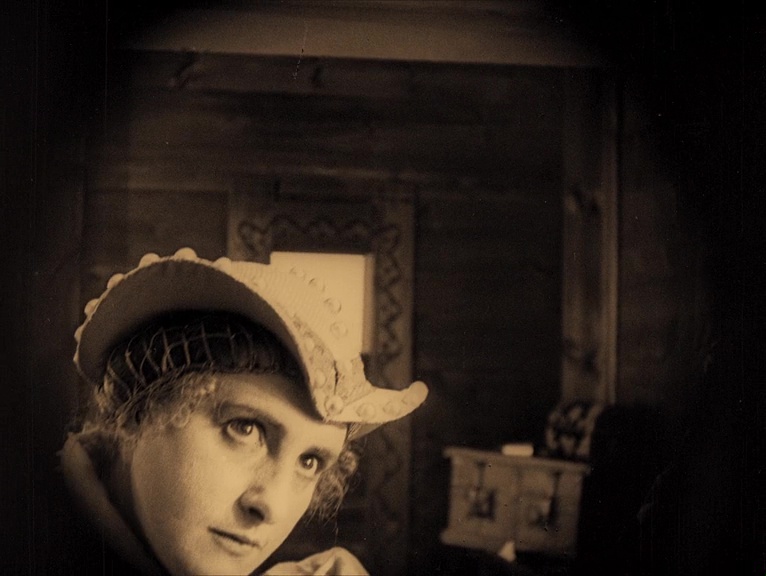
Henry Norris greets her at Dover. We are ashore, with fine sets, fine crowds, glimpses of masts. The courtyard of the Norfolks’s house is full of texture, the house with paintings. Anna is kissing Henry Norris, who dashes off, leaving her at the window, still happy and untroubled.


At court, chez Queen Catherine and Princess Marie. A room of stern women, impeccably dressed. They await the King, the prospect of whom produces looks of fear on the women’s faces.
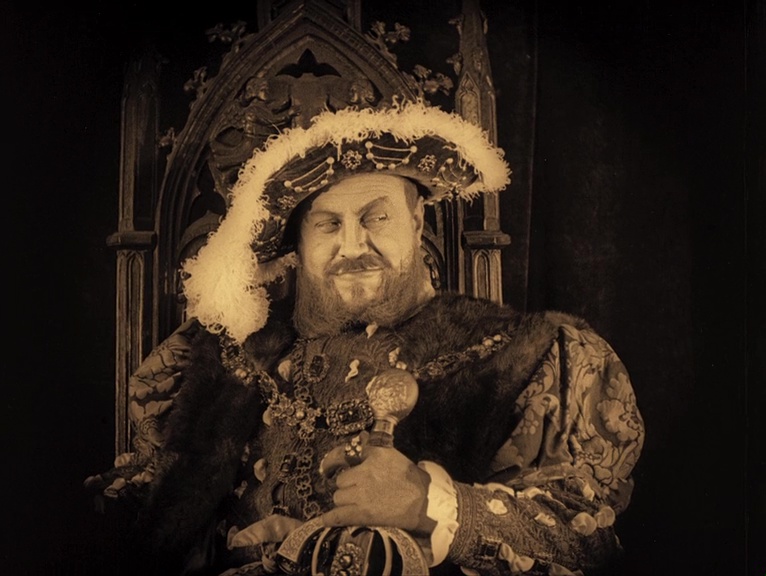
Henry VIII: Emil Jannings, cutting up a great slab of meat. (I thought of making a joke about this first appearance of a “giant ham” on screen, but decided against it; you can make your own.) And this is as perfect a piece of casting as you could want. As a performer, Jannings is ambition personified, appetite exteriorized. He’s utterly uninhibited. Look at how well fitted he is to this costume, to this part. Look at him drink from that enormous flagon of ale. Look at him feed his jester. (Paul Biensfeldt plays sidekick to Jannings here, as he does in the same way in Das Weib des Pharao; he’s all camp obeisance, playful subservience.) See the look of angry boredom that comes on his face to hear of the queen. And look at the enormous pie, out of which comes a white-clad wench for Henry to carry off.


The throne room is coldly formal. Banners, halberds, windows shaped like blades. The king must be summoned. The jester does his part, singing a comic song about poor Catherine (as Henry kisses his pie-wench). Biensfeldt has a marvellous turn, his face going from smug self-satisfaction at his witty song to mortal terror as the king takes the joke badly. He’s whipped and left whimpering as Henry storms out.

Enter the king into the queen’s room. He rolls his eyes at her chastisement, but then sees the tail of a dress caught in a door: it is Anna. He opens the door. Anna retreats, bows. The king looks over his shoulder. The roomful of ladies-in-waiting look back at him. He slams shut the massive door. He’s all smiles, now, as he approaches Anna—and Anna can’t help but smile a little, too. Nor can we, as Henry flirts with her, for Jannings’ performance is so winningly—how to put it?—apparent. It’s very Lubitsch, in fact, this transparency of desire, this delight in open expression of appetite. “Is the lady afraid of me?” She demurs. “You won’t run away from me again, then?” Henry kisses her hand, opens the door for her to leave. “My niece”, Norfolk explains. “A beautiful niece”, says Henry. Lubitsch ends the scene with black masking that descends from the top of the frame. It’s like the camera itself is winking. What can I say, other than that the scene makes me smile, that Jannings makes me smile, and that a “historical drama” film that can make you smile like this has something about it?


Exterior scenes. Henry with the queen but his eyes are roving elsewhere. Look at him strum his knee impatiently. Anna plays ball in the park. She accidentally hits the ball too far: it hits Henry, who comes over. “You would have lost your head— —if it wasn’t so beautiful”. Note the double extended hyphen. I’ve talked about punctuation in silent titles before, and here is another example of the way it functions to emphasize the intonation of speech we cannot hear. Henry starts with a threat, only to offer a complement. It’s the whole film in a sentence, in a grammatical pause. Henry is a comic flirt and a deadly threat. His smile carries this double meaning. So Henry plays ball with Anna. The ball goes into a bush. Anna runs to the bush, Henry too. (And pause here to observe how beautiful the greenery looks on screen: bright, eye-popping detail of sunlight amid the dark leaves.) The king steals a kiss. (Just now, the jester pops up from the bushes as a witness. He functions for the film as he does in court: to appear and offer an ironic commentary. Here his knowing look is a kind of nod to the audience, as if to say: “we all know what’s afoot here!”) The pair emerge; the queen faints; Anna is shunned.


Norris writes to Anna that he will come to her that night, in a black cloak. So Anna waits. A black-cloaked figure climbs in through a window. It’s the king! Anna recoils. Henry’s smile is eager but threatening. (Look how he’s framed: the sculpture around the recess is of fruit. You can see a pear and grapes in the corner of the frame. It’s a visual nod to hunger, appetite.) Anna pushes him away. The king purses. He will have her, he says, even if it costs him his crown. Norris sees the king slink away, and though Anna begs him to stay he runs away. Norris’s readiness to think ill of her goes against him. Anna takes against him, says all she’d have to do to be queen of England is say: “Ja!”
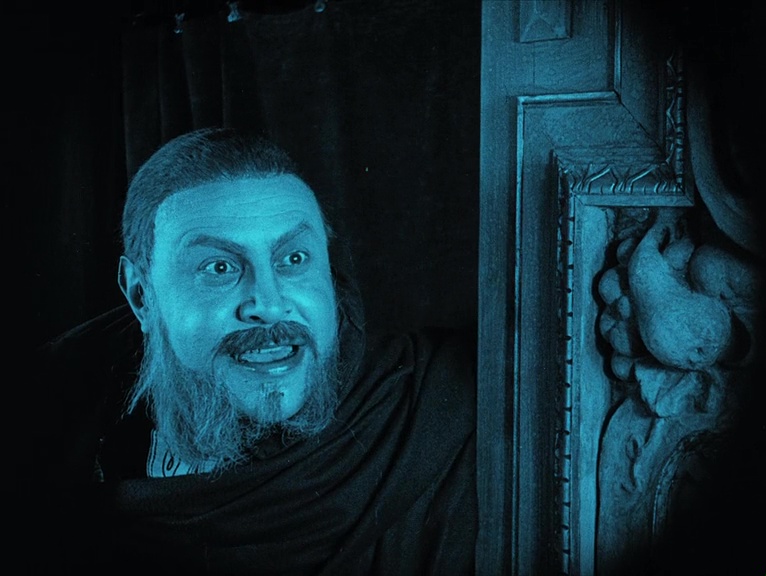

The king tries to write a love letter but cannot get past the first line. He screws up the paper and storms out. When we next see his handwriting, it is a letter to Catherine saying that he will divorce her. The royal couple argues. He thrashes the table. The queen sees Anna, motions her away. I wish Henny Porten were better able to move me. For despite the pressure from the King and her uncle—their faces either side of her shown in an uncomfortably close masked shot—her performance doesn’t win my heart. But perhaps it isn’t all her fault. Does Lubitsch give her enough time alone on screen? Does he give her an extended close-up? She needs time alone on screen to show a subtler, deeper range of emotion. Without this, she must endlessly swoon, bow her head, close her eyes, go limp. But these are theatrical devices. They might catch my attention in the back rows, but on film they are indicators of emotion, not emotion itself. She is told she must take the crown, that her duty is to provide England with an heir to the throne.

A sinister, beaky priest announces the divorce. But a fatter priest, emissary of the Pope, comes to spoil Henry’s plan. Henry is comically bored by Catherine’s entreaties (he leans back in his chair, in splendid isolation, isolated further by the circular masking). And he stands proud, defiant, against the anxious faces of the court.


Norris hears the news. It is too late. (And neither his performance nor Polten’s in their shared, brief moment of mutual grief are moving—and this is a problem for the film.)

The wedding day. Guards ensure the crowd cheers. Huge castle walls. Sinister forests of pikes. It’s a threateningly full world on screen. As the King descends, the crowd cheers—then falls silent for Anna. The soldiers motion. The crowd cheers. Henry raises an eyebrow in triumph and turns to Anna: “See how they cheer you?” It’s another moment when we delight in the performance, here a double kind of performance—for the king knows as well as us, as Anna must too, that he’s lying through his teeth. And we can admire the crowds, and the jumble of houses, the cobbled streets, the sunlight and shadow. Look how Lubitsch frames the approach to the cathedral, and the interior itself: it’s painterly, symmetrical, austere. A riot breaks out as the wedding takes place. Princess Marie enters and shouts abuse at the new queen.


Anna is unhappy, and she carries her visible distress into the wedding feast. Henry eats, then looks to his bride and whispers something in her ear. There is no title to spell it out, but the next scene takes place in the bedroom. In fact, the bed we first cut to is Norris’s. He has been wounded in the riot, but now the jester brings a gift to him and says that Queen Anna wishes him a speedy recovery. Only after this glimpse of the bed she would rather share does Lubitsch cut back to the bed Anna is obliged to occupy: the King’s. Henry awaits. He’s all smiles. He asks her if she’s happy. “After all, I’m the Queen of England”, she says. But she looks terrified. We know why, and the awfulness of what she must go through is implied well enough. But I don’t think it’s reticence or the worry with tone that prevents Lubitsch going further. There are no telling close-ups of Anna or Henry: their scene plays out a single mid shot, and Henny Porten gives us all the signals of distress. But it’s not as affecting, nor as chilling, a scene as it might be, should be, and it’s the limitations of the film—of Lubitsch, at this point in time, in this genre—that make it so.


The next day, Henry flirts with Anna in front of his male courtiers by approaching her with a dagger and surreptitiously cutting her thread as she works on her needlework. They laugh at her surprise, but it’s a marvellously sinister scene. Smeaton reads a poem to Anna; the jester gurns in disgust; the king kicks him aside. Norris enters but Henry bids him leave. Smeaton observes Anna’s look toward Norris, and the jester warns Anna to beware of Smeaton.


Outside, Smeaton tempts the king to hold a spring festival to lift his spirits. The king kicks the ground, until the idea of women in scanty costumes seems to appeal. His face contorts into a comically grotesque grin. And when the festival takes place, the king amuses himself with one of the female dancers. Smeaton tries to seduce the queen, who faints and is carried back by the king (who has unceremoniously dumped his dancer to the floor).

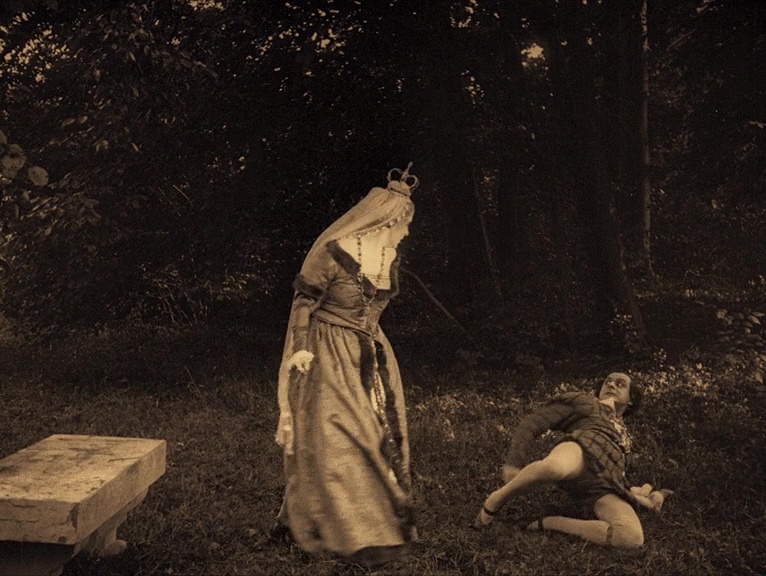

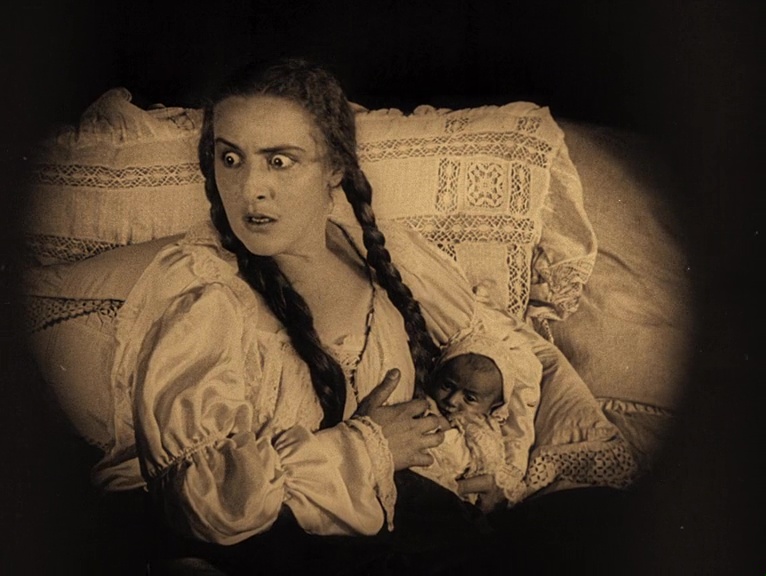
Anna is pregnant, and the look on Henry’s face when he is told is one of immense self-satisfaction. (But even while all this is going on, I feel the film has already played its hand. It has nothing more to add to what’s already been shown. The look and feel are of an impeccable, traditional staging. It’s what you might see on stage, or at the opera, but without the benefit of singing. If only this film was given an orchestral score for its Blu-ray/DVD release. The piano score is entirely inadequate to the scale of the production. More elaborate music would surely help.)


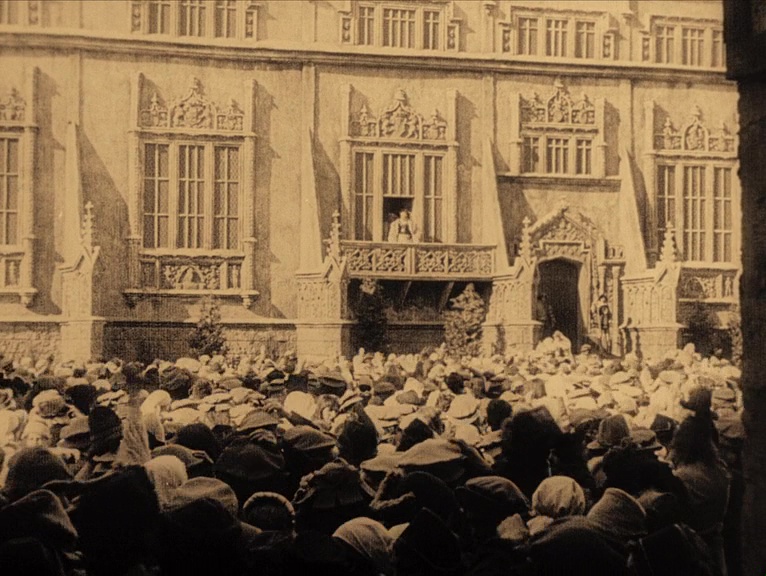
But… it’s “——— ein Mädchen ———” You thought the double extended hyphen was significant? Well check out these bad boys: no less than six double extended hyphens! Now that’s what I call emphasis. It’s a nice little detail amid the extraordinary scenes around it: the crowds, the exteriors overlooked by enormous place walls. The design is simply exquisite: everything looks so real, so weighty, so textured. But the king is furious at the news of a girl, and orders the cheering crowds to be sent to the devil. Anna herself swoons at the king’s reaction, swoons in a way that is entirely gestural, superficial, unmoving. She doesn’t get to have any fun. Unlike Emil Jannings, whom we see now flirting with a lady-in-waiting, Lady Jane, then being gloved and booted by four servants simultaneously (a delightful image, the king spreadeagled, the servants bustling around him). And the king leaves his child to cry while he flirts with lady Jane again. Anna is goaded by her uncle, who says she must fight to maintain her position.



The hunt. Wide open spaces, horses everywhere. (But not a patch on the menace, the strangeness of the hunting scene in Der Student von Prag (1913).) The king at rest. The woods are so beautifully photographed, it’s a shame the drama itself is less enticing. Anna encounters Jane, whom the king believed her to be when she kissed him.

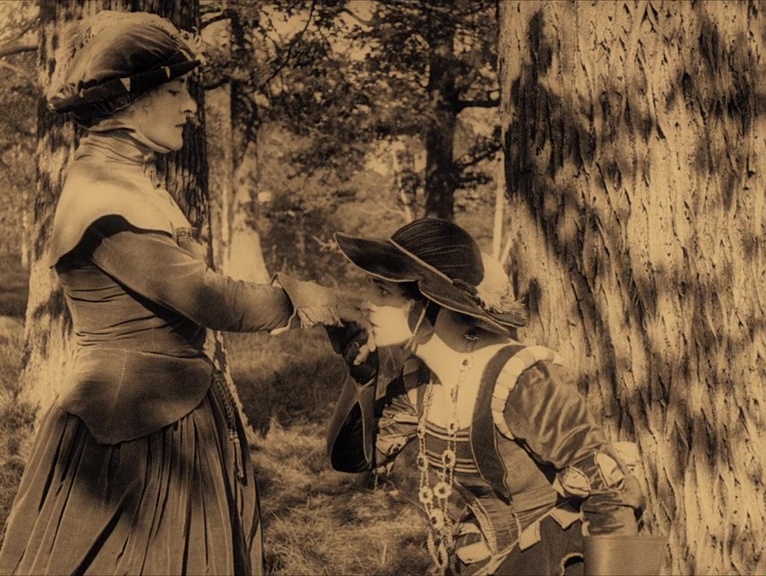
Smeaton goads Norris before the king, and then sings a taunting song before them both. Norris fights Smeaton, but Smeaton takes his revenge by telling the king of Norris’s love for Anna—and lying to say that they are still lovers. The King goes to look at his infant and asks Jane if the child bears him any resemblance. Anna breaks the pair up just as Henry is getting touchy-feely with Jane, but Jane says she’s only serving her as Anna served Catherine. (The film makes Jane the pushy, manipulative, ambitious counterpart to the innocent Anna.)
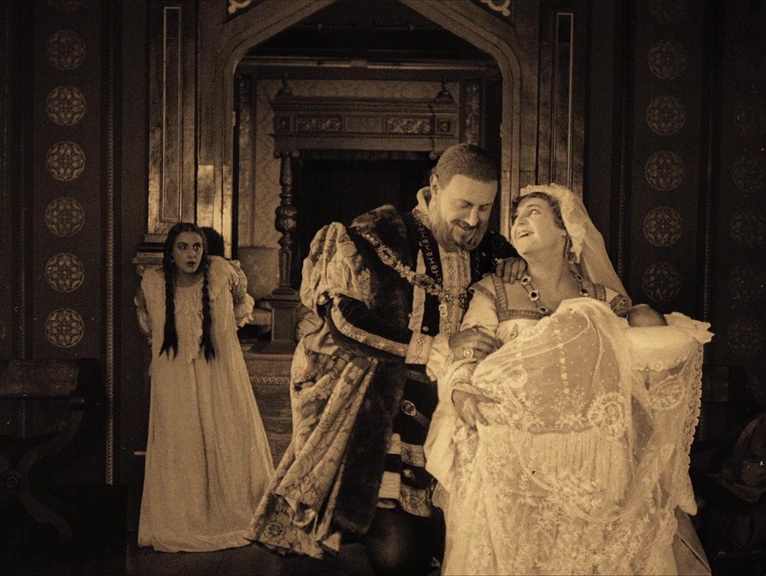
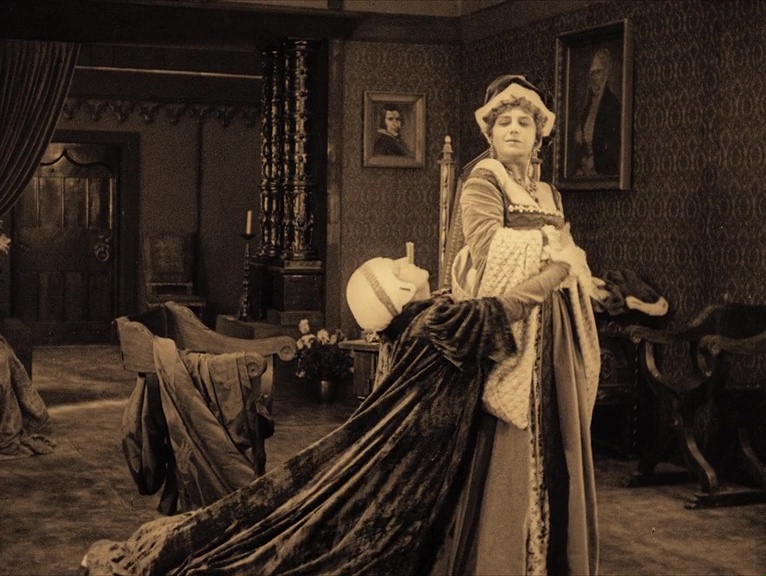
A joust, and yet more fabulous set design: the jousting courtyard a kind of pit overlooked from all sides by huge galleries. There is a plot to kill Norris in the joust, and Anna’s reaction to his being struck convinces the king of her guilt. It’s all very… unmoving, uninvolving.

So Henry takes up with Jane, and makes her uncle assist in getting Anna to confess her guilt. Her uncle, it should be said, is fantastically sinister: a permanent scowl, narrowed eyes, lank greying hair. At the trial, Smeaton accidentally indicts himself and is taken away for torture. There’s a brilliant shot, looking down a dark corridor, as Smeaton is led to the chamber: the huge doors open, and his destination is illuminated, as are all the tools of torture on the wall. Smeaton confesses and is then dragged away. And when Anna demands Smeaton confess before her, her own doors are flung open to reveal the hanging body of Smeaton at the back of the scene. These two moments—of the torture doors opening, and now of Anna’s doors revealed the hanged man—are the most concise, chilling moments in the film. There should be more of them!


Anna awaits her fate. She swoons, falls into the arms of a priest, bangs at the doors. And it’s all less moving than those two shots of Smeaton’s torture and death. Anna is led away by men in black hoods, and the film ends as she walks off screen to her the block. ENDE.

Reviewing this film was a strange experience. I had seen it once, many years ago, and never felt a particular urge to revisit it. But I remembered Jannings’ smile, that hungry smile, which spelled desire and fortune and death all in one. It wasn’t until I found myself invited onto the wonderful How Would Lubitsch Do It? podcast that I returned to the film, and it was both a pleasant surprise and a mild disappointment. A pleasant surprise because Jannings’ smile was still there waiting for me, and a mild disappointment because I had forgotten what a trudge are large portions of the film.
What’s lacking—I feel, now—is an emotional vent for the film’s melodrama. Preparing for the podcast, I relistened to Donizetti’s Anna Bolena (1830). The main protagonists—Anne, Henry, Jane (Anna, Enrico, Giovanna in the Italian)—undergo the same historical crisis as in Lubitsch’s film. Anna is likewise an innocent victim of scheming, though Jane is a slightly more complex character in the opera. And Henry is given much less time in the limelight, and (unlike Jannings) he cannot raise a laugh—even an ambiguous one. The setting of Act 3, scene 3 (the last in the opera), is the Tower of London. Outside is the noise of crowds cheering King Henry and his new bride, Jane Seymour. Inside, Anna appears. She is in a state of delusion, imagining that today is her wedding day to the King, and that the cheering is for their marriage. It’s a scene of extraordinary coloratura singing, one in which all the pent-up rage, fear, and longing pours out of Anna and fills the auditorium. Where is there anything like this in Lubitsch’s film?
This question reminded me of something that Andrew Britton wrote about melodrama and “the woman’s film” (“A New Servitude”, 24-63). He describes the mode of such films: dramas centred on women, where “the excess of the heroine’s intensity” becomes the dominant subject (37). Thus, he draws a direct comparison between film melodrama and the historical operas of Donizetti. “[T]he metaphor of persecution” in film melodrama is a direct inheritor of “the classical operatic theme of the heroine’s decline into madness and delusion”:
the echoes of the convention of the ‘mad scene’ are especially pronounced in D.W. Griffith’s melodramas with Lillian Gish, which are in themselves one of Hollywood’s main links to the nineteenth century. Gish’s hysteria in the closet in Broken Blossoms (1919) and the baptism of the dying child in Way Down East (1920) are, in effect, mad scenes, and in the famous sequence with the bouquet of flowers in A Woman of Affairs (1928), the convention passes from Gish to Garbo. (39)
All of which is to say that this “mad scene”—per Donizetti or Griffith—is precisely what’s missing from Lubitsch’s film. Lubitsch doesn’t give Henny Porten the scope accorded to Gish by Griffith. Porten clearly had a wider range of performance than shown in Anna Boleyn. In Lubitsch’s Kohlhiesels Töchter (1920), filmed within the same year as Anna Boleyn, Porten plays two sisters—Gretel and Liesel—and this dual role offers her far more scope to show off her range. She’s by turns exuberant, clever, subtle, violent—and always funny, always eye-catching. It’s a more “operatic” performance in many ways than in Anna Boleyn (albeit more Rossinian farce than Donizettian tragedy), but the exaggerated comedy style of the film provides ample frame for this to work. Lubitsch was clearly more successful in producing emotion in comedy than in drama.
If this is obvious to us now (just as the comparison between Lubitsch and Griffith seems ill-conceived), it was not in 1920. With its multimillion budget, Anna Boleyn was the kind of prestige historical drama with which Germany might rival the Hollywood productions of the period (see Eyman, Ernst Lubitsch, 70). Oddly enough, the history depicted was itself a source of debate in the German press. From some quarters, there was controversy at the idea of putting so much money into the depiction of non-German history on screen. Hanns Heinz Ewers wrote that German films should concentrate on German history and myth (e.g. his own Der Student von Prag). But Lubitsch wrote back in the press, saying that “The history of all nations belongs to the world!” (qtd in Hake, Passions and Deceptions, 123). Quality was what mattered, and a German film of this scale could hold its own on the international market. Whatever their opinions of the film, the domestic press was agreed that Anna Boleyn set down a new standard for the scale of German cinema.

Indeed, it was precisely this sense of scale and quality that led to Lubitsch being called “The Griffith of Europe” in the US (Eyman, Ernst Lubitsch, 71). Anna Boleyn was duly imported and retitled “Deception” for its North American release. The reviews highlight many of the themes I touched on above. “As entertainment it is slow going”, said a critic in Variety, “but as a vivid historical document it is valuable.” If the picture “dragged”, the performances made it worthwhile:
Emil Jannings (an American, by the way, who has studied under Rinehardt [sic] in Berlin), gave an amazingly capable portrait of the loose, merry, sensual Henry. Than his performance, nothing better has ever graced the screen. Equally effective was Henny Porten. The first view of her reveals a woman without much claim to beauty, but the distinction and power of her portrayal get to you. It is not her fault that she has not epitomized Anne Boleyn as her co-star has the king. The sympathy here is thrown to Anne. History’s record hardly Indicates she deserved it. (Leed., “Deception”, 40)
Aside from the remarkable claim that Jannings was American(!), and the casual insult thrown at Henny Porten, you can sense the same reservations viewers today have about the film. Jannings has character and material to get his teeth into; Porten does not. More pertinent in the Variety review is the subsequent comment about the film’s likely commercial fate: “Its success in anything but first run houses in larger towns is doubtful” (ibid., 40). This prediction proved accurate. In the wake of the Great War, various groups were campaigning against the presence of German films on American screens. Variety mentions that “Passion” (i.e. Madame DuBarry, 1919) and “Deception” went down well better when “no mention was made that these films were made in Germany” (10 June 1921, p. 33). But even this was not enough to save them outside the big cities. Even those German films that proved a “hit in New York” still “flopped in out-of-town territory”—“Deception” included (Variety, 25 November 1921, p. 44). But the film still made an impact in influential places. As of 1924, “Deception” was one of Mary Pickford’s ten favourite films (Howe, “Mary Pickford’s Favorite Stars and Films”, 29). And it would be Pickford who was instrumental in luring Lubitsch to Hollywood…
It is a great irony of Lubitsch’s career that the films that convinced Hollywood of his worth—Carmen, Madame DuBarry, Anna Boleyn, Das Weib des Pharao—are among the least known, the least liked now. Of the little that is written on Anna Boleyn, most of it is devoted to context rather than text (e.g. Hake, Passions and Deceptions, 114-38). Historians write around a film when they have no interest in diving into a film.
Would better music help? And what of the original score from 1920? The DVD/Blu-ray features the 2006 piano accompaniment by Javier Pérez de Azpeitia, which (at least when experienced at home) lacks the presence and scale of the film. In 1920, there was an orchestral score by Hans Landsberger. Landsberger had written the music for Der Golem (1920) earlier that year, which had been greatly praised in the press. It was not an assemblage of existing music, but an original score. “If you have heard Der Golem with this music by Landsberger”, a contemporary said, “you can no longer imagine it with any other.” Landsberger created “striking and memorable” themes for the main characters, using them individually or in counterpoint like contrasting leitmotivs. The reviewer praises Landsberger’s “original” orchestration, his “melodic richness and unerring way of building up dramaturgical tensions” (“Der Golem”, 1-2). This score was reconstructed and performed (and possibly recorded) in 2021, which sadly postdates the (re)issue of the film on Blu-ray in both Germany and the UK. Maddening! Why can’t companies wait a few months for better elements to become available?
Given the success of Landsberger’s music for Der Golem, it’s surprising that I cannot find any contemporary press review that discusses his work for Anna Boleyn. Neither the short reviews in Vorwärts (“Filmschau Anna Boleyn”, 4) or Vossische Zeitung (My., “Anna Boleyn”, 4), nor the much longer pieces in Film-Kurier (L.K.F. “Anna Boleyn”, 1-2) and Das Tage-Buch (Pinthus, “Aus dem Tage-Buch”, 1634-36) so much as mention the composer’s name. The Film-Kurier piece even lists members of the audience—politicians, figures from the arts and film (including Pola Negri)—to emphasize the scale of the gala premiere, but still doesn’t mention the presence of the orchestra or music. Curious, and disappointing. Such is the lack of information on the music, I have no idea if it survives in any form whatsoever. I’d love to hear it and see if it makes a difference to the film.
For its release as “Deception”, Hugo Riesenfeld assembled another score, most likely a compilation rather than an original work. (I note, in passing, the existence of another opera, Saint-Saëns’ Henry VIII (1883), that shares much the same plot as Lubitsch’s film. I have listened to three different versions of this, including a recent reconstruction of the original, longer version of the score—but I still find it a little dull. Nevertheless, it would be a possible source of musical borrowing for a contemporary film composer.) Whatever its nature, the score for “Deception” goes without detailed mention in the press. In Variety, adverts for the first run of screenings in New York say that Riesenfeld “is to stage a special show to precede the film” (29 April 1921, p. 44), which suggests one of the many theatrical embellishments meted out to films for their prestigious first run. (For its US premiere, Das Cabinet der Doctor Caligari (1920) had its narrative reframed by scenes with dialogue performed before/after the film.)
How far could a good orchestral score save Anna Boleyn from its own dramatic limitations? The beauties of Eduard Künneke’s music for Das Weib des Pharao didn’t make me like that film any more—indeed, it tended to exacerbate the deficiencies of the drama. Perhaps no-one mentioned the Landsberger score for Anna Boleyn because it was a dud? Maybe one day it will be unearthed, and we will have the chance to judge for ourselves. It will be some years before I have an urge to watch Anna Boleyn again, but a new score would make me revisit it sooner…
Paul Cuff
References
“Der Golem, wie er in die Welt kam: Ufa-Palast am Zoo”, Film-Kurier (30 October 1920), pp. 1-2
“Filmschau Anna Boleyn”, Vorwärts 64 (16 December 1920), p. 4.
Andrew Britton, “A New Servitude: Bette Davis, Now, Voyager, and the Radicalism of the Woman’s Film” (1992), in Britton on Film: The Complete Film Criticism of Andrew Britton, ed. Barry Keith Grant (Detroit: Wayne States UP, 2009), 24-63.
Scott Eyman, Ernst Lubitsch: Laughter in Paradise (New York: Simon & Schuster, 1993).
L.K.F. “Anna Boleyn: Die Festvorstellung im Ufa-Palast am Zoo”, Film-Kurier (15 December 1920), pp. 1-2.
Sabine Hake, Passions and Deceptions: The Early Films of Ernst Lubitsch (Princeton UP, 1992).
Herbert Howe, “Mary Pickford’s Favorite Stars and Films”, Photoplay 25.2(January 1924), pp. 28-29, 105.
Klaus Kreimeier, The Ufa Story: A History of Germany’s Greatest Film Company, 1918-1945, trans. Robert & Rita Kimber (California UP, 1999).
Leed., “Deception”, Variety (21 April 1921), p. 40.
My., “Anna Boleyn”, Vossische Zeitung 610 (15 December 1920), p. 4. NOT ISSUE 612, 16 DEC
Pinthus, “Aus dem Tage-Buch, Anna Boleyn”, Das Tage-Buch 51 (31 December 1920), pp. 1634-36.

 The Realm of Silence
One thought on “Anna Boleyn (1920; Ger.; Ernst Lubitsch)”