In January 1927, the director Karl Grune began a major new production for Ufa. He had co-written the screenplay with Hans Brennert, and he as deeply passionate about his project. Am Rande der Welt (“On the Edge of the World”) was to be a pacifist film, set in an unnamed borderland on the frontline of an unnamed war. The cast boasted veteran actors Albert Steinrück and Max Schreck (Nosferatu himself) alongside younger stars Wilhelm Dieterle and Brigitte Helm (fresh from shooting Metropolis). Filming took place entirely in the studio spaces of Ufa during January-March 1927. Grune completed editing Am Rande der Welt and presented it to the German censors in April 1927. It was passed and the film readied for release. At this point, the management of Ufa stepped in. In March that year, Ufa had been bought by the press baron Alfred Hugenberg, who demanded that his management team take greater control over the films they produced. This was not only for the same of economics (Metropolis had nearly bankrupted the company), but for the sake of ideology. Hugenberg was ultra-conservative, ultra-nationalist—he would later abet the rise of Adolf Hitler to power. It was the ideology of Grune’s film that was the problem: it was too pacifist, perhaps even anti-patriotic. Am Rande der Welt did not meet their moral standards. The result? The film was cut, not by the censor, but by Ufa itself. Grune’s original version measured 2635 metres (approximately 114 minutes at 20fps), whereas the version resubmitted to the censor in August 1927 was 2429m. Grune complained in private and then in public. The film had not just been reduced, but re-edited and re-titled. He felt that these changes were so severe, so damaging to the film’s pacifist message, that he asked for his name to be taken off the film. Am Rande der Welt premiered on 19 September 1927 at the Gloria-Palast in Berlin, shown with an orchestral score by Giuseppe Becce. So, what remains—and how does it stand up?

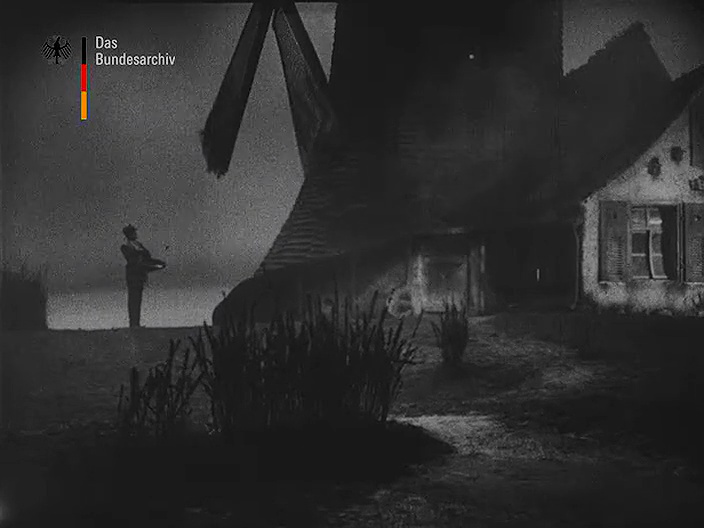
Act 1. From the mists of space, a spinning globe bowls forward. Jazz bands, dancers, superimposed—naked bodies writhing, parting. Fireworks, grotesque dancers. A Catherine wheel spins, overhead visions of dancers, dissolves away over the image of a spinning windmill. The camera tracks back, and back. Surely we at the edge of the world. A title, a motto etched on the wood. The mill is ancient, and it’s as though we’ve travelled back in time since the opening montage. What century are we in now? The only technology here is pre-modern. Labour is manual, the only mechanism the ancient technology of the sail and grindstone. The mill stands at the edge of the world: a studio painted horizon marks the limits of reality as the film knows it.


The old miller (Albert Steinrück) is sieving flour, his oldest son Johannes (Wilhelm Dieterle) emptying a bag, his youngest son Michael (Imre Ráday) cleaning the giant stone grinding wheel. This huge space is the interior of the mill, and it feels cavernous: the exterior is a model, yet the interior is an expansive reality. And here’s Magda (Brigitte Helm), feeding chickens, her hair blowing in the wind.


But already an outsider (Erwin Faber), silhouetted against the pond in the foreground, the mill turning behind him. His letter brings him to work at the mill, but it also promises further “instructions”. He reads the letter one last time, then burns it. Something sinister is afoot. A real sky glowers gloomily above the model and studio set. Just as the man meets Brigitte, the wind picks up; he is heralded by a great gust of dust. Portentous signs…


Inside, the millers gather round the dining table. The newcomer is all helpfulness and smiles, helping pick up the fragments of a dropped plate (but is he the cause of this first mishap?). “I come from the other side of the border”, he explains. The miller (Albert Steinrück) doesn’t mind, just so long as he works well. He is given a room somewhere in the mill, a gloomy cell.


Outside another figure stands before the mill. As the newcomer unpacks, the other man stalks the corridor outside. His knock portends doom. The camera pans rapidly to the door, then shakily follows the man to the door.


It’s Max Schreck, tall, sinister, a devil’s pointed beard and hat. “Are you afraid?” he asks. He’s a pedlar of sorts, but surely far more portentous. But to Brigitte he’s more flirtatious, more camp. He applies lipstick, powder to his own face to tempt her, but she laughs him off. The pedlar leaves, his appearance leaving some strange atmosphere behind him.


Another gloomy interior, the end of the working day. “Next week we’ll celebrate”, the mill will be three hundred years old. An assistant miller plays the accordion, the millers comically cavort. The miller’s son, Johannes (Wilhelm Dieterle), runs after his wife (Camilla von Hollay), who leads him outside, only to show him a baby’s clothes, newly made.


Outside, the pedlar observes the newcomer flirting with Brigitte. Scared by him, they run inside and dance… only to find his eye at a keyhole—the camera tracks rapidly into its sinister ken.

But the baby clothes attract the millers, while the newcomer seeks the owner of the eye at the whole—of course it is the pedlar. “I’ve been overserving you these last days. No love affairs”, he warns. Who is this man, and what is his power? Another shadow falls across the ground. But the truth begins to emerge: the pedlar instructs the newcomer, and threatens him destruction if he betrays his mission. He is a spy!


The old miller reads the paper, which denies the threat of war. That night, a silhouetted figure wanders the plains outside the mill. Vertical wipe-dissolves take us from room to room, then a horizontal wipe from Brigitte’s bed to the newcomer, his shadow moving over the walls, spade in hand. Now he is a prick of light in the dark, inching forward. He digs. But the miller wakens, lights a candle, creeps to the window. The newcomer dashes madly back to bed to avoid detection. (His bed is a sinister war chest, bulging with giant protruding nail heads.) The pedlar stalks the land. End of act 1.


Act 2. The mill’s anniversary. Food and drink are being prepared. A montage of delicious produce, and the labour taken to prepare it: hands stirring, washing, striking, mashing, straining, plucking. Outside, a band of musicians, villagers in their Sunday best, marching to the mill.


Brigitte is making herself look pretty (in the homeliest way—a far cry from her later films). The old miller wears his best suit, his top hat, which he raises to the millers and to the outside world. Johannes is busy building a crib for his future child. After showing off his construction, he rushes into his festive clothes and joins the others. He and his wife march proudly with the rest out to greet the crowd. They parade with the band to the green, where the whole village has become a funfair.


Circus folk—midgets and the “woman without a head”, strapped into a chair. (It’s a grotesque image; the people laugh, but it portends something untoward.) The camera tracks overhead, looking down at the happy dancers, the clowns, the merry-go-rounds—but the camera dissolves into another tracking shot, falling back before a squadron of riders in black masks and hoods. Disaster is surely coming.


The newcomer and Brigitte are flirting. He gives her a love token. She refuses it and runs away, all fidgety nerves, all innocence and fear. She rejoins her family, as does the newcomer—disappointed but tagging along.

The pedlar meets the riders. Spies! “Order to alarm the border villages”.

The dance continues, swirling around the millers. The dance is intercut with the riders. The wind picks up. A rider appears with the news: war has been declared. The dancers are become statues, heads bowed. “Long live the fatherland!” someone cries, and the band strikes up an anthem. (But what anthem to they sing for this prolonged shot of communal musicmaking?) Close-ups of the crowd, of medals on a man’s chest, and the artificial leg he bears. Old heads shake, young faces beam.


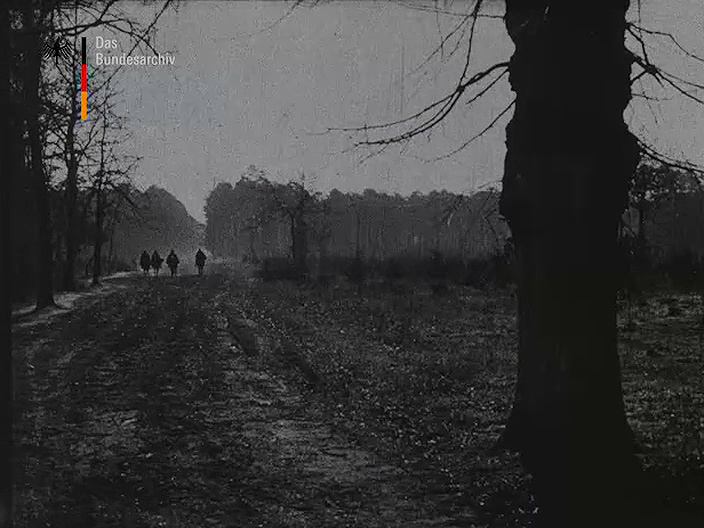
The abandoned fete. The camera rises. There is only the sense of the wind travelling through the empty stands, billowing the streamers. But here is death, astride the horizon, ushering animated lines of bayonets through the horizon. The leaming weaponry becomes a real phalanx of infantry, rising over the folds of the landscape toward the camera.


Act 3. Suddenly it is winter, there are gas-masked troops, warning of attacks, flooded positions. The Great War is upon us, without being heralded by its name.


The pedlar is instructing the newcomer about the arrival of their troops. The latter wants nothing to do with the pedlar, but the pedlar says “there is no way back for you”—he is being watched. The troops wearily arrive at the mill, thronging about its flanks. The millers give them water. Clouds gather on the horizon: horsemen appear. It’s a fabulously sinister image, these real clouds glowering over the studio landscape and stilted trees. Five eyes watch the mill from five angles gathered in a single shot.


The millers wait nervously inside. “The world will perish in poison and gas!” says Johannes, as the newcomer tries to talk to Brigitte. Infantry roll over the folds in the land. It’s another brilliant shot, sinister, rapid. The cutting grows quicker: the single shot becomes a half dozen of the raiding tide, sweeping towards the mill.


“The enemy!” cries Michael. The newcomer looks guilty, scared. He wanders off as the knocking grows more aggressive, as the door is forced open. The enemy burst in, their faces hidden—they are just a flood of silhouettes, backs to the camera.


“Stand up!” the officer (Victor Janson) roars. It’s all stillness now. We can take in the strangeness of the infantry: their metallic helmets (half jäger’s shako, half “coal scuttle” Stahlhelm), the odd cages around their rifles that makes them half resemble automatic weapons. The officer has his rank on his chest, an oversized treble chevron. Touches of expressionism that creep into this half-real world. The mill is commandeered for supplies. The younger men react violently. Brigitte is restrained. Her young brother is taken outside. Brigitte’s glowing face makes the officer halt is roughness a moment. The man is clearly smitten. (It’s like the moment when the villain in Die Liebe der Jeanne Ney is overcome by the extreme close-up of Brigitte’s face.)


Another face at a loophole window: this time it is Brigitte’s anxiously looking out as her brother is led away. “Why so sad miss?” the captain asks, and Brigitte’s huge eyes almost make contact with the camera as she turns to the man. Her brother will be court martialled, says the officer, his hands seeking hers. Grune cuts away to the old mother in a chair, sneezing. (The camera whips round handheld, as it often does—destabilizing the world, here for comic rather than dramatic effect.)

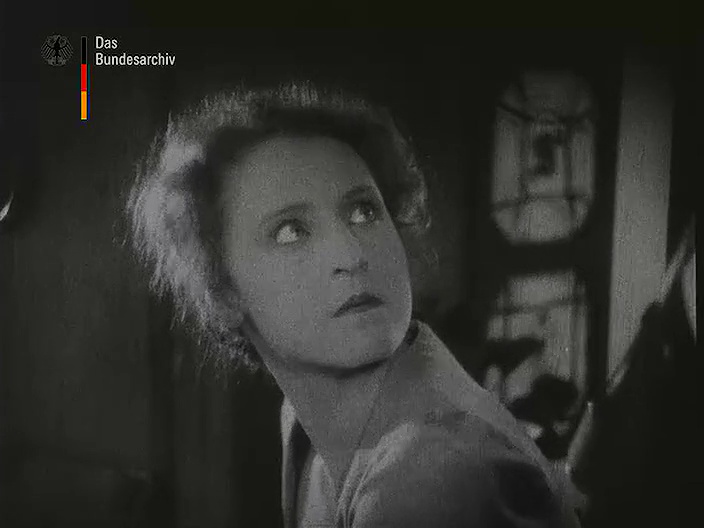


The newcomer sets the wheels of the mill going, then arrests their motion. It’s a signal. The pedlar, now revealed in his officer’s uniform, issues instruction. Great guns open fire, huge plumes of black smoke and debris slow-motion their way into the sky.


Act 4. The young son paces his cell. The father visits. “They don’t understand out language”, he cries to his son. But the brute sign language of the solders is made to feel: he is ushered away. Artillery fire draws closer to the mill. The hillsides are torn up, buried under smoking clods of earth. Brigitte is cowering in feat somewhere inside. The father’s face is etched deep with age and angst. Michael is to be judged today. Brigitte leaves, determined to act.


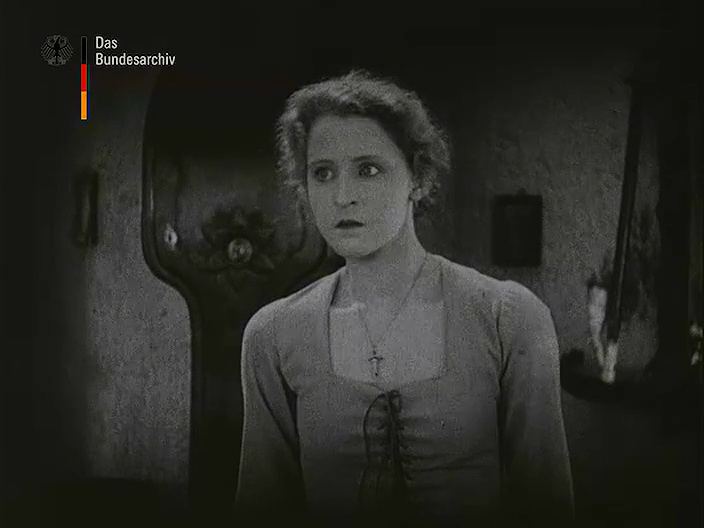
In the cell, the captain orders that Michael be shot. Brigitte flirts her way inside, but is separated from her brother’s embrace. Her drooping head, in profile—a glorious glimpses of her poise, her grace as a performer, amid this rather ordinary scene. The captain says she can save her brother the solution of which is implied simply by his smirk, his leather-gloved hand over her neck, down towards her chest. She has 24 hours to decide. The officer who first raided the mill asks if he can help her. But “war turns people into wild beasts”, she says, and flees inside.
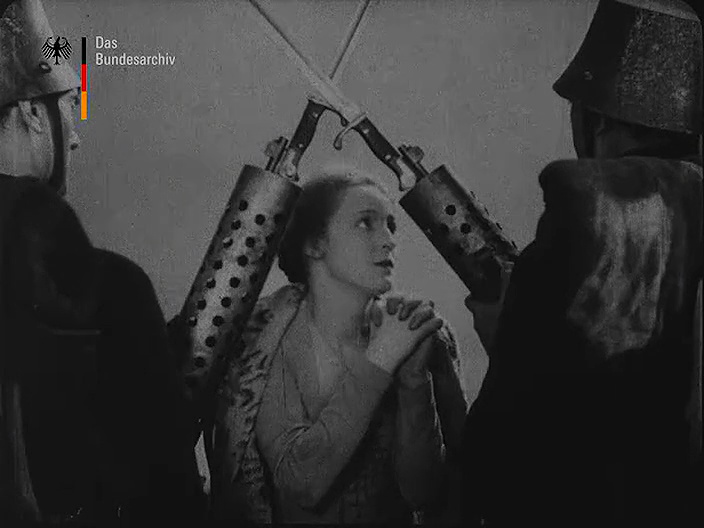


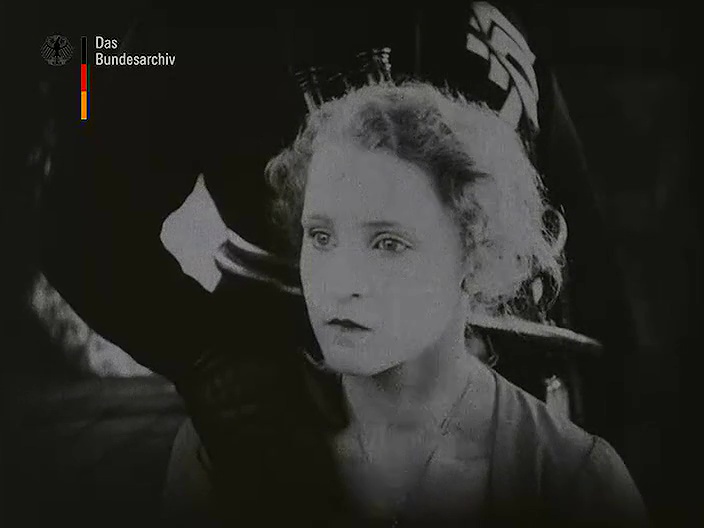


The corridor of the mill’s interior looks narrower, more confining. Here is the newcomer. He says: “Magda, I love you”, but almost in the same breath he confesses he guilt as an agent. Magda—her face in the first big closeups of the film, and they’re beautiful. He says he will turn against his kin to save her brother.


The junior officer tells the senior that he thinks they treated the boy to harsh, but the elder says they need to be strict—to show the locals they mean business. The junior officer finds Magda at home. Her bed is a picture book wooden frame, picture book carvings at its foot. The officer says he will save her brother, but he is seen by her father stroking her hair. So he lumbers in, lumbers between them. She cosies up to him, but he shrugs her off—the only man to resists her great big eyes in the film. Snow is falling. It coats the artificial plains before the mill.


Akt 5. The boy is to be shot. The captain looks at the hour, pours himself a drink, is served his meal, hacks at a great chunk of meat. (His black shirt, his white marks of rank make him look like a fascist: so too his slicked-back hair, cut short.) The lieutenant has aided the escape of Michael. The captain knows it.
The newcomer stops the mill again. The enemy gunners call the captain. The mill must come down, as it is being used as a point of observation by their enemy. (The newcomer is in communication with the pedlar’s men, directing fire.)


Michael returns to his father, in disguise—he wears the uniform given him by the lieutenant, who now arrives—and says they must hide the bother’s clothes or they will be lost. so they go into the basement, where the newcomer is going about his secret task. The lieutenant and Magda flirt, end up in each other’s arms, kiss. She does not quite flee him, succumbs willingly enough to his kiss.


Michael aims to flee in his disguise to their own troops. Johannes’s wife is in bed, presumably nearing the birth. Michael crosses no man’s land, handing a document to an enemy guard. A delightful scene: Magda uses flower to transform the man’s chevron into a stick figure, the head a heart. But the guns are firing outside. “Why are you our enemy?” asks the man, bewildered. “When the war is over, I won’t be an enemy anymore”. He imagines the future…


Akt 6. Soldiers enter the mill. The captain announces the building will be burnt down. A close-up of the father’s face, creased with repressed emotion. But first the captain wants the mill searched for Michael—only to find his lieutenant lurking in the basement. The telephone line has been found. It is cut, but the lieutenant is interpreted as the spy. He ranks is removed and the officer demands the man shoot himself. Magda and her father and Johannes battle the soldiers, who are about to burn the mill. Even the old mother throws water in the face of the guard by Johannes’s wife’s bed. Johannes himself calls the soldiers beasts, says that people need the bread they make. But in come the torches, the flames rise, the smoke thickens. The lieutenant questions Magda about the telephone and she points him to the newcomer. But they, and the family upstairs, are trapped in the burning building. Suddenly the newcomer emerges from his hiding place underground. “It is all my fault!” The lieutenant fights him before Magda, as the building starts to fall around them. It is prolonged, brutal, captured in a long handheld takes—the solider all in black, the assistant in his white shirt. Soon they are bleeding, half naked, sweating. The newcomer says he will die with Magda, but soldiers are breaking through the window to help her out. The assistant says he has betrayed his own fatherland and demands the soldiers shoot him. They oblige, and Magda is set free.


The mill burns, its wings spinning madly, then slowing… as Johannes, his wife, and the father struggle to a nearby farm building and fashion the wife a bed from hay. On the horizon, Magda and the lieutenant embrace. Magda is a silhouette on the horizon.


The baby is born. “He too will go to war—he too will kill people”, the mother mourns. “No, he will build new mills”, says the father, as superimposed artillery fire dissolves over the image of the family in the farm—like a Biblical scene—and the world is a vision of nighttime split open with fire. “Lord forgive them, for they know not what they do”, says the father, as the ghostly mill becomes a cross looming over the smoking battlefield. Ende.


I enjoyed this film a lot. The limited setting and studio aesthetic convey a peculiar atmosphere that is both sinister and otherworldly. It helps make the familiar seem unfamiliar: it’s like a slightly distorted dream of 1914. The uniforms are almost familiar, the setting almost realistic. Everything is subtly exaggerated, subtly off-kilter. Sets, costumes, performances—all are heightened, but only to better convey the atmosphere of the setting and story.
As for the film’s political message, the version that survives still carries a strong pacifist note. There is nothing remotely glamorous about the war or its protagonists. The soldiers are genuinely frightening. Their combination of archaic helmets and modern gasmasks and guns makes them even more sinister, just as their black uniforms give them a distinct flavour of fascism. The religious tone of the final scenes (supposedly highly censored by Ufa’s recutting) still comes across, and I wonder how much more obvious Grune had wanted to make the “message” at the end. As the film stands, the religious imagery creeps up on the viewer rather unexpectedly—and quite effectively. The transformation of the windmill into a cross needs no further visualization than as given in the film. The expressivity of “mute” objects is powerful enough. That said, I do love the fully-realized vision of Death when war is declared. There is something very pleasing about seeing an early twentieth-century version of medieval iconography. (Just as I love these elements in Murnau’s Faust (1926).) Perhaps there was more of this material in Grune’s original cut?
In one aspect, I was a little disappointed by Am Rande der Welt. I confess I wanted to watch the film primarily to see Brigitte’s Helm’s second cinematic appearance, but she’s very much limited by her character here. Her screen persona is very much along the lines of the “good” Maria in Metropolis, but without the exuberance offered to her by her other performance as the robot Maria. In Rande der Welt, she is wholly good and admirable—her character has little in the way of depth or complexity. One might say that about all the figures in the film. Since Grune sets out to make them emblematic of an older, less modern way of life they are all limited in their psychological depth.
My only other reservations about Am Rande der Welt are due to my own moderate confusion when watching the film. I was a little unclear of the nature of the spying, and where/how the artillery was using the newcomer’s telephone to direct fire. There is a lot of cutting to spaces beyond the mill, but we never see the context of these spaces. Thus, where Max Schreck has his observation post is a mystery—as is where any of the other sites of guns, trenches etc.
But the question of how we read the film’s continuity, or its politics, also depends on what version we’re watching. Here, the information is unclear. Having been digitized from a Bundesarchiv print by the Friedrich-Wilhelm-Muranu-Stiftung, the film is freely available online via filmportal.de. But there is no clarification on the physical length of the print used, or whether the intertitles are recreated—and from what sources. The digital version is a few seconds shy of 104 minutes. The database gives the framerate of other archival copies as 22fps, but the Bundesarchiv copy appears to run at 20fps. (Though the video itself translates the original frames into 23.97fps for digital playback, which makes identifying and counting the original celluloid frames difficult.) This would equate to approximately 2400m, so presumably accords with Ufa’s cut of August 1927. (If I’m wrong and it is at 22fps, 104 minutes would equate to Grune’s original version of April 1927. See why it’s important to provide this kind of information with a digital release?)
But regardless of how closely it resembles Grune’s original vision, it’s still a fascinating film. I’m very grateful the film is freely available, but I’d love to see it in better quality. Who knows what a proper restoration and a good score might not do for it.
Paul Cuff

 The Realm of Silence
One thought on “Am Rande der Welt (1927; Ger.; Karl Grune)”