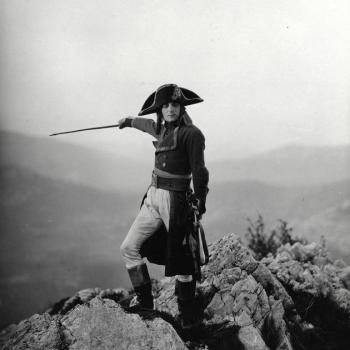
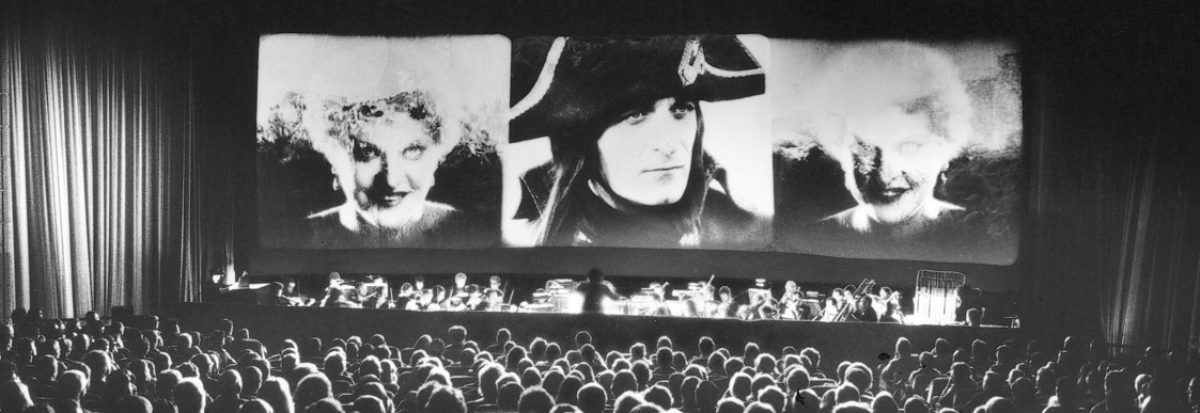
This final post on the Gance retrospective reflects on my experiences at the Cinémathèque. It’s rare that I find myself at such a concentrated cultural feast. Anyone who has read my posts on Pordenone or Bonn will know that festivals are things of great fascination to me, and perennially out of reach. This post is therefore a way of considering everything that an in-person event (what a ghastly phrase) offers and means, and of acknowledging what is missing from my usual film-viewing experience. Writing is also a way of remembering and recording what were for me days of great pleasure.
I should begin by saying that Les Gaz mortels was not the first aesthetic experience of my trip. Friday 13th proved to be an auspicious day. En route to the Cinémathèque, the friend with whom I was staying took me to the Jardin des Tuileries to see the Musée de l’Orangerie. Here are displayed eight giant panoramas of Claude Monet’s Les Nymphéas (1914-26), spread across two rooms. There was something appropriate in seeing art created during the same years of Gance’s emergence as a filmmaker. (Both artists have been associated with the label “impressionism”, but the appropriateness of this -ism is too complex to consider here.) However, what I took away from the Orangerie was an extraordinary sense of the way time shapes these works and affects how we receive them.
In the 1890s, Monet wrote to a friend that he was trying to capture in his series paintings “ce que j’éprouve”. The verb “éprouver” denotes more than a process of seeing: it is a process of feeling, of experiencing. It implies a kind of temporal duration that the verb “voir” does not. To experience, or to feel, a scene is not merely to see but to contemplate; it is also to let the world sink into oneself, or to sink a little into the world. In his series paintings, Monet moved from canvas to canvas, adding successive layers of colour and texture as the hours passed – returning again and again, day after day, season after season, to build up his images. Les Nymphéas use this principle on an even larger scale, and Monet took twelve years to fill canvases that are two metres high and up to seventeen metres long.
The result is an amazing expanse and depth of paint, a veritable layering of time. Staring at the surface of these vast canvases, you realize that the very word “surface” is misleading. Every inch is built of innumerable strokes, of innumerable moments of reflection, consideration, and reaction – of feeling and intelligence. The paintings are not simply an effort at capturing a single moment, a single time of day, but a record of the process of feeling, of experiencing, that time. They are both a document of time passing before the painter and of the time spent by the painter in the act of painting. Standing before the completed canvases, as Monet must have done for countless hours – days – weeks – months – years, I was deeply moved by the sheer laboriousness of the process of painting. Having once been an amateur painter myself, I knew – I could feel, even – the physical history of this act of mark making. The time of painting was as tangible as the painting of time.
But the scale of these images creates time-systems within their borders. Traversing from left to right the thirteen metres of Nymphéas, les nuages, I had the peculiar sensation that I was moving through a kind of narrative. On the left, the reflected trees seem only a little darker than a morning haze (blues mingle with mauves, greens mingle with touches of yellow and turquoise); then the sky appears, brightens, and clouds bloom; but in the last metres the sky’s hue deepens, darkens; and suddenly a great bank of darkness fills the frame from top to bottom – it as if night, or autumn, blots out the memory of a warm afternoon. In those last two metres, the darkness is of a deep, muddy green – as though the autumn mulch were already underfoot. The lilies were dashes of blue and yellow on the left of the canvas, but here on the right they are streaks of crimson and blotches of rust. I stopped and stared at this weird, unsettling depth of gloom, trying – and quite failing – to fathom how it was formed.

From this sense of time creeping over canvas and viewer, it is a relief to find elsewhere a sense of immediacy in the business of brushstrokes. In the second salle, the surface of the pond in Nymphéas, le matin clair aux saules is alive with curling dashes of blue. This is not a great gust of wind, for the downward strokes of the willow leaves hardly stir. It is just a draft, the beginning of a breeze, that catches the water. The clarity of the sky is lost in this murmur of paint. From the mix of azure and clouds that flash amid the ripples, you can see that the weather is changeable. How extraordinary that such infinite pains were taken to capture the ephemeral moment when the wind rose on a bright day, a century ago. In this painting, the depth of time that Monet stood before his canvas crystalizes into an amazing sense of immediacy. The contrast between the process of creation and the actualization of its goal is remarkable. How many hours, over how many years, to build up this sense of subtle movement across the water?

There is personal time, too. I found myself moved not only by the richness of the colours in Nymphéas, reflets verts, but by the fact that its palette is exactly that of my grandmother’s front room – a room that has not existed for twenty years. She, too, was a painter, and adored Monet. She kept an exquisitely rich little garden whose colours spilled into the house. (She never closed the curtains, so as to always be able to see it.) There are greens of astonishing depth in Nymphéas, reflets verts, and blues from late summer skies. The light is fading, but the surface of the pond has a supernal warmth – a kind of aura of the day that is passing, that has long ago passed. (But what day is this on the canvas, if not a kind of distillation of multiple days? Somehow, time here is suspended, hovering outside history.) I stopped and stared at the deepest patches of a reflected sky that is somewhere beyond the frame, somewhere beyond time.

By this point, I became aware that my hour within the Orangerie was itself slipping away. I was struck by the strangeness of this aesthetic experience, by how something so fleeting could plumb such depths of feeling and pastness. This was an encounter of something static by something in motion. The paintings were staying, and lasting; I was moving on, undergoing a different kind of time. I recalled the scene in Le Côté de Guermantes when the duke shows M. the paintings by Elstir, which the narrator compares to the images of a magic lantern – a kind of hallucinated landscape projected by the mind of the artist. Oddly enough, I had been talking about Proust with my friend as we walked through the gardens en route to the Orangerie. As we were leaving, I tried to tell her about the passage in the novel – which M. experiences as an oasis of contemplation amid the bustle of a social event – but speaking was too much. It was the paintings themselves, and the sadness of leaving them; it was the odd proximity I found between my own body and that of the painter, long gone, standing before the canvas – allied with the fact that I could imagine so clearly the process of painting, but I no longer paint; it was the colours of a room that I knew and loved that had been restored to me for an instant; it was the memory of my favourite book, and the memory of the first time I read it: I finished the final pages of Le Temps retrouvé at my grandmother’s house, overlooking her garden. My Englishness obliged me to avoid making some kind of scene, so I gulped back my tears and tottered towards the exit. It is surely apparent by now that I was totally overwhelmed by these two rooms in the Orangerie. (All this will return us, eventually, to Gance – I promise!)
Emotionally primed, and thinking of the passing and the recapturing of lost time, we finally entered the Cinémathèque. Here we had time to visit the “Musée Méliès: La Magie du cinéma” exhibition, which was very charming. Lots of proto-cinematic optical devices, of hands-on machinery, and of designs, costumes, and models from Méliès’ films. Here, quite literally, I saw Proust’s magic lanterns. (There was also a prominent place given to Martin Scorsese’s Hugo (2011), a film I cannot stand, but we can gloss over that.)

The pleasures of the Méliès exhibition were a rewarding parallel to the Monet paintings. Here were the material means of producing immaterial visions. I love the elaborateness of pre-cinematic optical devices, the tangible sense of clunky mechanics that strive to produce fleeting moments of vision. (One of the most amazing assemblages of such material I’ve ever seen was at the “Photography: A Victorian Sensation” exhibition at the National Museum of Scotland in 2015. I’m lucky to live near to the Bill Douglas Cinema Museum, so can brush past a permanent collection of such things almost as often as I wish.) The physicality of a large magic lantern – its polished wooden shell, its gleaming brass fittings, its fragile glass and flammable lamp – is something to behold. Thanks to the Cinémathèque exhibit, it is also something one can actually hold. The labour of projection, the way the great slides must be moved and changed, is a powerful reminder of the way cinema history (and pre-history) is peopled by countless known and unknown figures. Real people are required to operate this material media. And here are the unknown figures of the past, the models for Muybridge’s Zoopraxiscope and Marey’s chronophotographic studies, backlit in their little strips of celluloid – glowing on the wall of the museum. (What happened to that man? What became of that cat?)


By the time the exhibit reaches its final stages, where the legacy of Méliès is explored in modern cinema, it was time to join the queue for the first Gance film. Queuing soon became both a major occupation and a curious pleasure at the Cinémathèque. I observed and sometimes participated in these social events, where the regulars of the establishment chat amongst themselves, where little old ladies cut calmly in front of you to talk to someone they know, and where any sense of order vanishes in the accumulation of people behind the little barrier. (“Ceci n’est pas une queue,” I told someone, “c’est une salade!”) I enjoyed seeing the same faces every single day, and watching the same latecomers scuttle to the ticket office next to the queue. The second afternoon, I was eating an apple in the queue when an old man – a habitué of the place, I’m told – came to tell me that I resembled Snow White. (After a few moments of confused conversation, I came to understand that the film was one of his earliest cinematic memories, and its images are always returning to him.) By Sunday afternoon, I had become well known enough in the queues for strangers to address me in English. Perhaps this was a failure to be adequately Parisian, a condemnation of my stumbling French. (Every time I go to Paris, I have the sense of retaking an exam that I will never pass.)
I did not get to see a film in the Salle Henri Langlois which, as its prominent name implies, is the largest screening room at the Cinémathèque. I believe that Napoléon was shown there, to take advantage of the screen size, and I was glad to hear from others that the triptych was well projected both there and at the Max Linder cinema elsewhere in Paris. (I envied them this experience, having been so disappointed by the botched finale at La Seine Musicale concert in July.) Most of the screenings I attended at the retrospective took place in the Salle Georges Franju, which was an excellent size and allowed enough space for the musicians to comfortably fit on the stage before the screen.
The last two screenings, however, were in the Salle Lotte Eisner, which was upstairs. The door to the room was tucked next to the bookshop. (I pause to acknowledge that this shop is the most concentrated example of highbrow film culture – books and DVDs/Blu-rays – one could imagine.) In fact, the door to the Salle Eisner looks like a fire escape. When I got there, a man was already leaning proprietorially against it, preventing anyone from going upstairs. He wasn’t an employee of the Cinémathèque, simply a regular who knew that there was no room to queue inside the door. When an attendant finally arrived, she observed: “Alors, vous êtes policier?” and duly thanked him. The way beyond the door was, initially, entirely unlit and we stumbled along the narrow enclosure of the staircase with some trepidation. (The average age of the regulars seemed to me to be somewhere north of seventy-five.) The room itself was smaller than Franju, but I quite enjoyed the sense of camaraderie created by everyone having to clamber over each other to get in. That said, the screen in the Salle Lotte Eisner was notably poorer. I could see the screen beneath the image, its network of conjoined dots proving a stubborn texture that interfered with the projected film. Following the end of the 7.00pm screening, getting out of the room was as tricky as getting in. Given that the queue for the 8.30pm projection began immediately, I decided to do as others did: after stumbling down the dark steps, I executed a sharp volte face and stood outside the door once more. Hell, it was my last screening, and I wanted a good seat. Fuck the queue.


If I was all too keen to get the best seat, it was because seeing these early films is so rare. I had never encountered them on the big screen, with live music in packed cinemas, and this might be my only chance. A friend told me that the Cinémathèque française used to programme multiple screenings for each film in a retrospective, but no longer does so. There was only one chance to see the films shown in the Gance retrospective, so even people who lived in Paris might easily have missed their opportunity. (How much I would like to have seen Gance’s Polyvision films of the 1950s, for example, on the big screen.) Of course, Napoléon has been shown in cinemas across France, and will soon be broadcast on French television (though I believe the date has been delayed, for unspecified reasons). But the other films are far less known, and far less available in any format. They, too, deserve their chance to be seen, not least because there is so little information about them in the public realm. Even in published filmographies of Gance’s work there are inaccurate details about some of the cast and crew (e.g. Bareberousse and Ecce Homo) and often no information on the completeness – or even survival – of his early films.
On this note, I heard it mentioned in the introductions to more than one screening that the Cinémathèque française retrospective contained all Gance’s surviving films. I don’t believe this is quite true, though it certainly represents all those available in restored or complete copies. Missing from the 2024 roster is Le Nègre blanc (1912), which is listed in the collection of a German archive. I have not had the opportunity to investigate this print, but if it is accurate, it would represent the earliest Gance film to survive – and the only instance of the screen career of Mathilde Thizeau, Gance’s first wife. (I don’t think I have ever even seen a photo of her.) There is also an important fragment of Das Ende der Welt (1931) in the collection of the Eye Filmmuseum, which I discussed here. (I am currently investigating the survival of another archival print of this film.) I hope that all the new restorations are released on home media, along with anything and everything else Gance produced. As I wrote in my earlier posts, at the end of every screening in the retrospective I wanted to go back into the cinema and see the films again. But just when will I next see them on a big screen? When, indeed, will I see them again on any screen? As much as I believe that these films – all films, even – should be seen on big screens, even basic access to lower-quality versions for home viewing is essential to their broader cultural life. What cannot be seen cannot be studied, cannot be discussed, cannot be valued.
There is a caveat to all this. At the Aéroport Charles de Gaulle, a sign in departures promises: “Paris ne vous oubliera pas”. To heighten this sense of leave-taking, the duty-free sections cram as much Frenchness as is possible into the confines of a busy thoroughfare. With some vague hope of taking home more than just memories of Paris, I bought some wine; and when I got home, I bought some bread and cheese. But it’s futile to try and recreate the flavours of France at home. Even if the ingredients are the same, how can you recreate the sense of being in a particular place and a particular time? No, no, it’s impossible. At the Cinémathèque, I’d met friends, old and new, and I’d seen films, known and unknown. The pleasure of the occasion became part of the pleasure of the art. As much as I want a set of DVDs or Blu-rays, I know they cannot truly realize – actualize – the films. I know, too, that I can look at digital scans of Monet’s paintings, but doing so loses something essential to their being in space, their being in time – and I with them.

In 1936, Walter Benjamin famously claimed that all reproductions of art lack their original’s “presence in time and space, its unique existence at the place where it happens to be”, and thus also lack the “aura” of creative authenticity. Using the idea of the “aura” of artefacts, Benjamin posited that cinema possessed no tangible presence; this form of art was an endlessly reproducible product without an original. Whatever the applicability of this argument to later forms of cinema, it surely fails to take account of the performative element of silent film exhibition. If a projected image is less graspable than a canvas, the system of its presentation – the theatre, the projector, the screen, the stage, the musicians, the audiences, the projectionists – are all part of cinema’s aura. (I would argue, too, that celluloid prints are themselves artefacts of immense value – and that their projection is their aura.)
In my reviews of the screenings, I keep referring to the sense of presence Gance’s images had in the cinema. The live performance of music – separated from, yet allied with, the films – enhanced the suprasensory effect of these silent worlds. The landscapes, alive with sun and the movement of the wind – long passed yet arrested here in astonishing detail; the interior spaces, with their velvety shadows and pools of light, and the objects that carry the symbolic weight of drama, standing alongside the human protagonists in mutual silence; and the close-ups of performers, the way these faces carry the life of the past with them into the present. How can I not be moved by the play of light on Emmy Lynn’s face and hair, by the sudden changes of colour that cling to her image, by the dreamlike and overwhelmingly tangible reality of her life – past and present – on screen? There is also a sense that the silence of these images has its own significance, its own presence. The past on screen is as silent as Monet’s painted scene, and no less potent. These films are evocations from an ever-receding history that maintain their power in the present. There is the same sense of these images, these worlds, having traversed a great distance to meet me, here and now. Perhaps it is this sense of reciprocity that is most important, most moving, in the aesthetic experience: art makes sense only in this meeting of minds across time.
Gance, too, knew and conceived of cinema exclusively as a communal experience, just as he saw it as a way of reconciling past and present, the living and the dead. Coming into a theatre from the streets, the film experience had the potential to be magical, transformative, ecstatic. In a letter of October 1923, Jean Epstein told Gance that if happiness could not be found in the real world it could be sought in their art: “À la bonne heure. Ça, c’est du cinéma!” In a similar vein, I hope to re-encounter these hours of happiness in a setting that does justice to the films. This post has emphasized the context (rather than the content) of images to highlight how differently they are experienced chez moi. Home entertainment is not cinema. (It is film-staying, not filmgoing.) So I’m happy to recall the queues, the old guard of the Cinémathèque, the wizened figures who cut me up, the strange comments, the fight for seats, even the odd smells that wafted from certain sections of the crowd. All this, together with the thrill of the films, is the cinema. I can’t wait to go back. À la prochaine.

Paul Cuff

 The Realm of Silence