Being hosted by an Italian festival, it makes sense for us to visit Italy’s cinematic past. Day 4 takes us to the early days of Italian feature films, and therein to the distant Italian past…

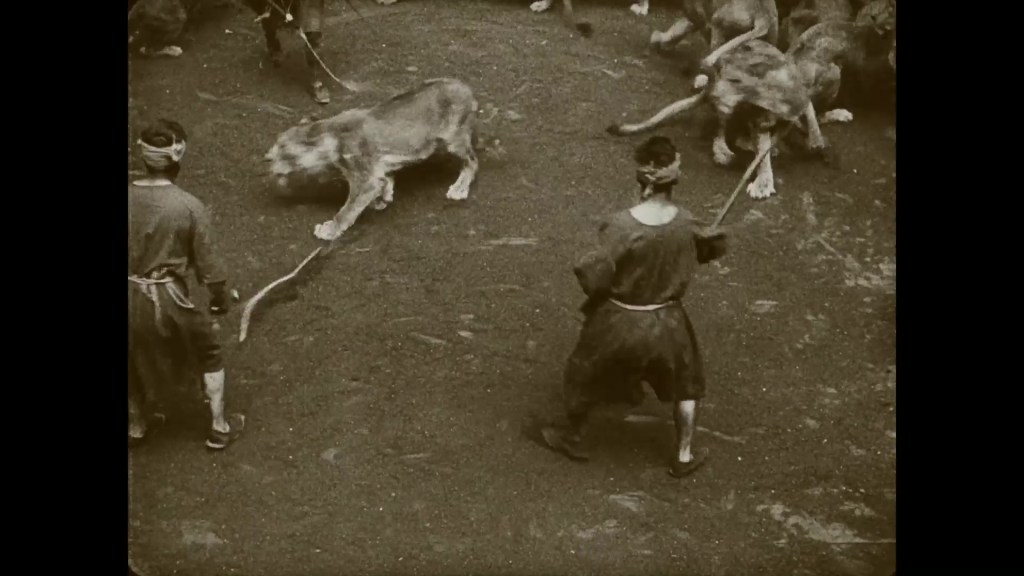
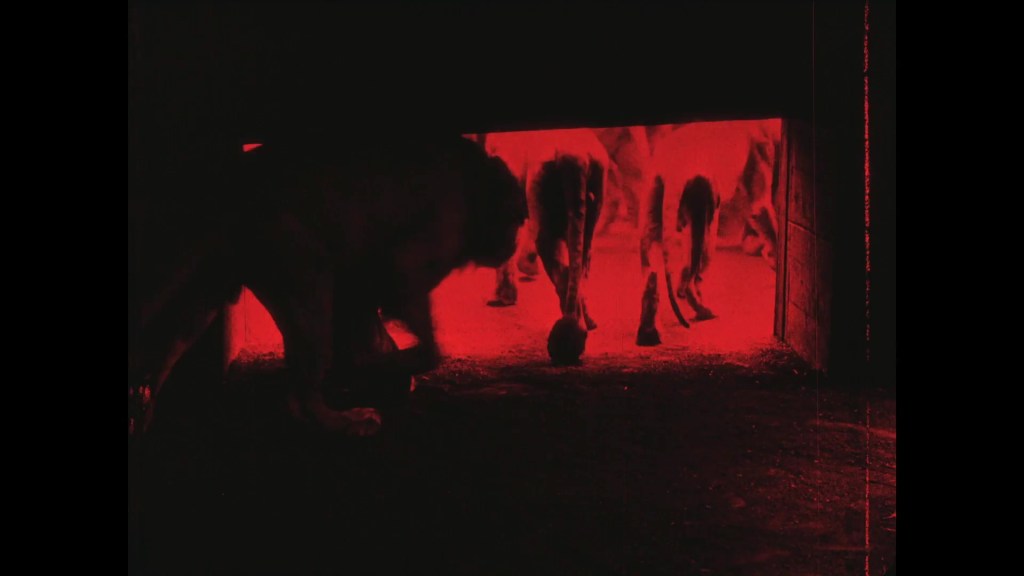
Gli Ultimi giorni di Pompei (1913; It.; Eleuterio Rodolfi). AD79, Pompei. Nidia, the blind flower seller, attracts the attentions of Claudio and Glauco. Seeing Nidia is a slave being cruelly treated by her owners, Glauco buys her – and the girl falls for her new master. But he is in love with Jone, who is also desired by the powerful Arbace, who is enmeshed in corruption with the High Priest of Pompei. Arbace tries to seduce Jone but is prevented by his political rival Apoecide. Jone seeks sanctuary with Glauco, but this drives Nidia to despair with jealousy. She goes to the temple of Isis to pray, where she encounters Arbace and reveals her secret. He promises to give her a love potion, and goes to the sorceress on the slopes of Vesuvius. The sorceress, whom Glauco has previously angered, gives him a potion that will unhinge Glauco’s mind. Arbace gives this to Glauco, believing it is a love potion. Meanwhile, Arbace argues with Apoecide, who threatens to expose Arbace’s corruption with the High Priest. Arbace kills him and blames Glauco, who is suffering the effects of the potion. Nidia wants to expose the High Priest, so Arbace kidnaps her. Glauco is condemned to be thrown to the lions, but Nidia escapes and tells Claudio the truth of Arbace’s crimes. Claudio rushes to the arena, where he publicly confronts Arbace. Just as the crowd turns on Arbace, Vesuvius erupts – and Arbace escapes. Nidia and Glauco rush to Jone’s villa, then rush to the sea. Jone and Glauco escape, but Nidia is left on the shore. In despair, she drowns herself. FINE.


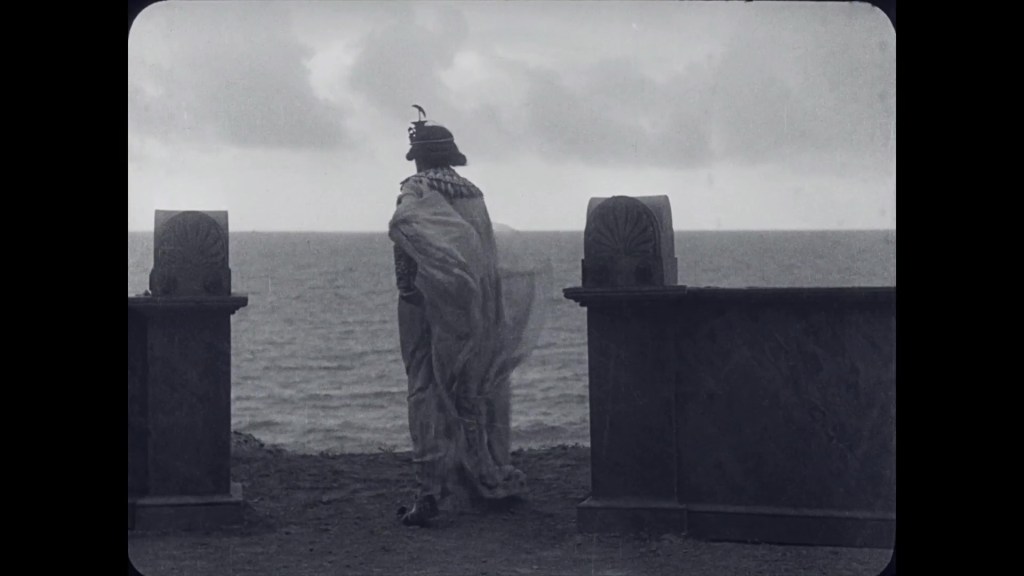


Gli Ultimi giorni di Pompei is a familiar beast. A classic example of the early feature film in Europe, a classic example of the ancient epic, a classic example of Italian cinema of the 1910s. In sum, its form and content are staples of books on film history, film style, and national cinema. But such scholarly familiarity can often do a disservice to the qualities of films as objects of pleasure. Gli Ultimi giorni di Pompei remains an engaging watch, and seen in such a lovely restoration (from 2006) really shows off why it deserves to be remembered.


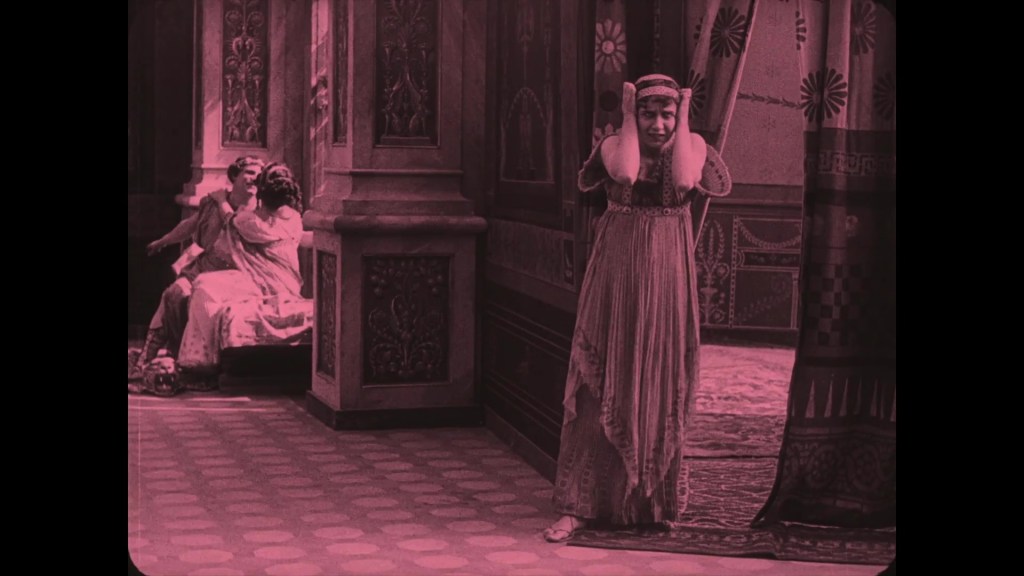
Rodolfi’s camera is always static, but it observes in a way that draws in the eye. The combination of long takes, compositions in depth, and careful choreography of the cast makes every step of the drama clear and engaging. I was talking about Feuillade’s skill with this on Day 2, and here again is proof how much you can do with economic means. Rodolfi has grander perspectives, made grander still by the use of painted backdrops at the rear of his sets: the perspectives created within the fore- and mid-ground keep going! Whole scenes unfold with careful movement from the rear to the fore, from the sides – with additional spaces sometimes even masked and unmasked and masked again by curtains or drapes. The past here is solid and expansive. The impeccable sets and their lovely details (the leopard skin rug, the wall carvings, the ornaments, the statues) make this seem like a huge space that has been and continues to be inhabited.


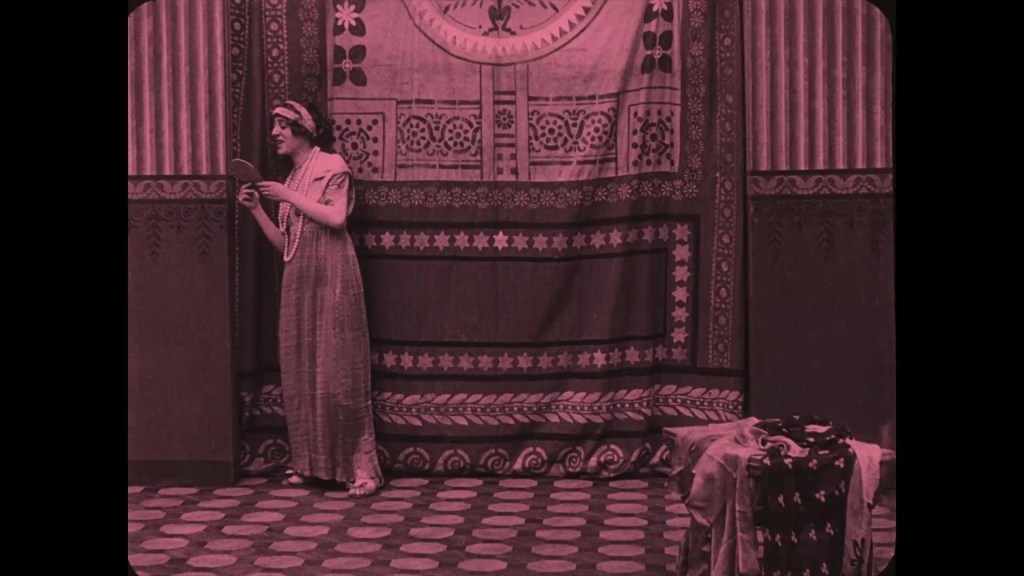

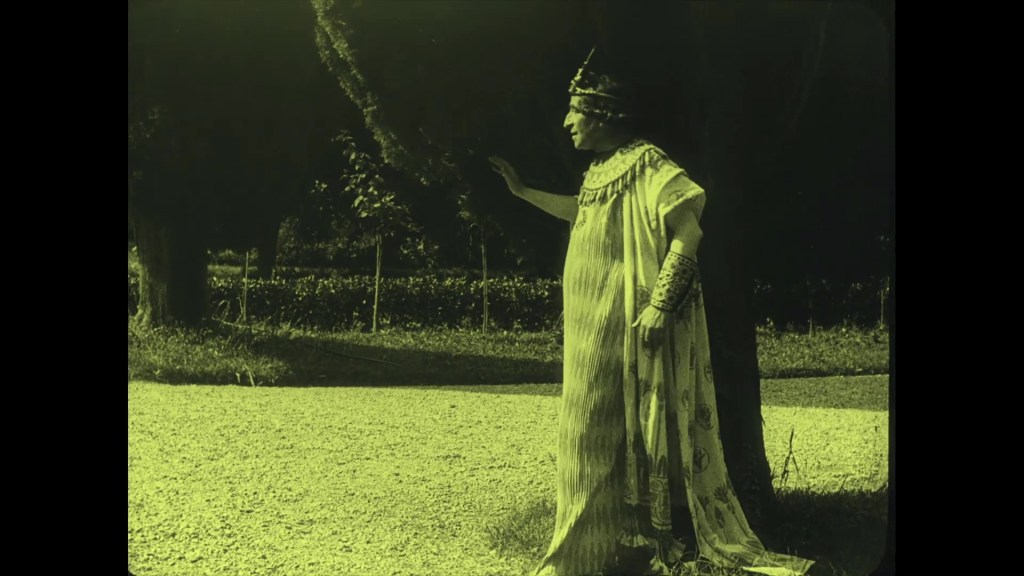


Though there are no close-ups of the humans in this space, we do get some striking cut-aways to cooing doves (symbol of the lovers) and then to a savage looking owl (symbol of Arbace). The unique example of such close shots in the film, they have all the more impact: they are strange, striking images. They suggest something more than just the human drama we are watching. They feel properly odd and archaic, like a classical textual reference come to life.


The performances do not make the lack of close-ups feel important. One can read their gestures and facial expressions clearly enough. There is little nuance of feeling, but feeling is enough. (Take note, Maurice Tourneur; see my last post.) These may be melodramatic figures, waving their arms or bulging their eyes, but they live their parts: the emotions are direct enough to be convincing.

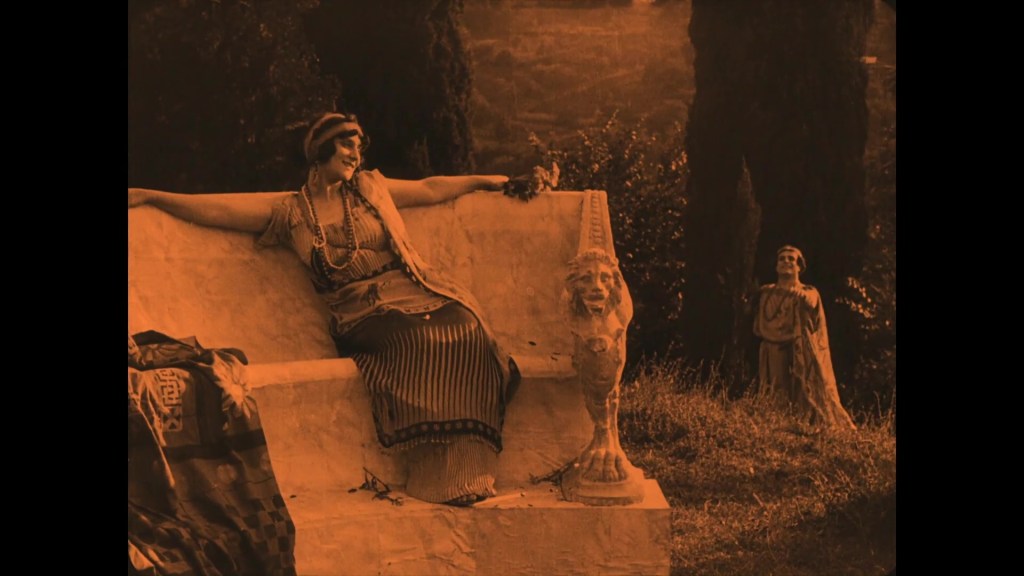


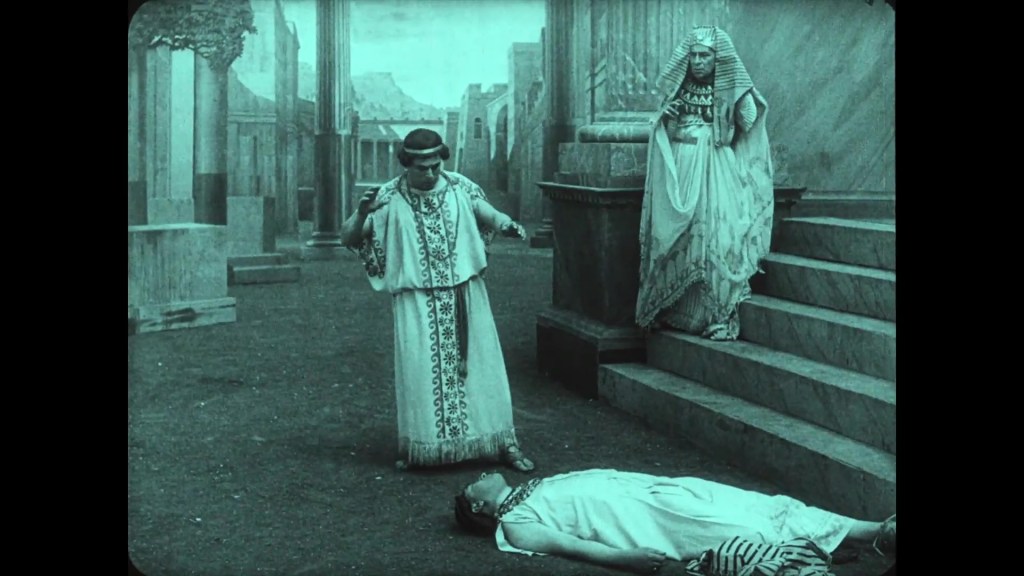


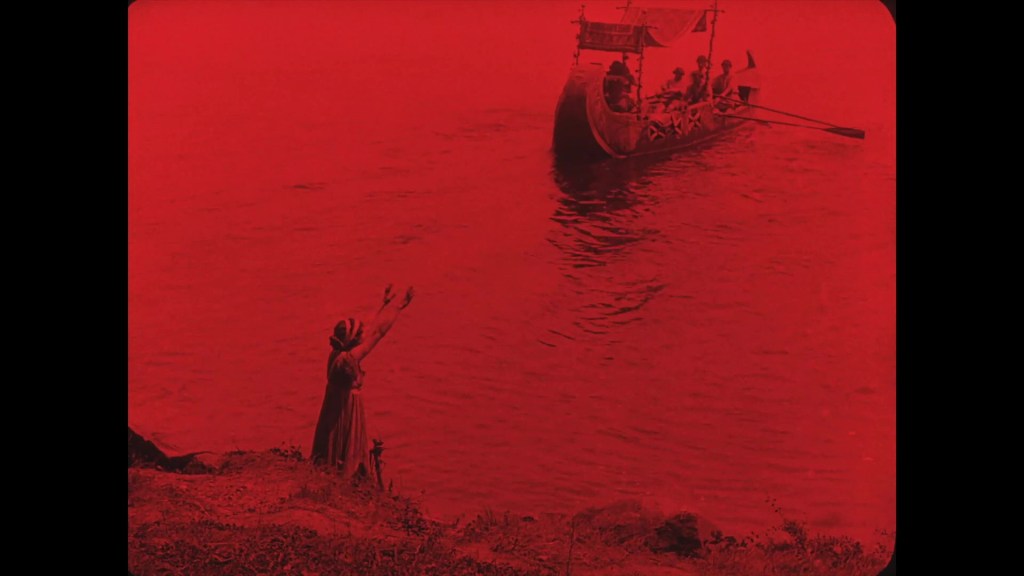
The cast of characters may be pretty simple, but at the centre of the film is Nidia, who makes a compelling figure on screen. If Fernanda Negri Pouget’s performance borders on the grotesque, this makes it all the more interesting that we feel such sympathy for her by the end of the film. She is the only character with a complex range of emotions to portray. The others are fairly straightforward heroes or villains, but Nidia is more complex. Treated cruelly, then rescued, then heartbroken, then furious, then guilty, then desperate, then self-sacrificing, her character carries more than any other. In a nice echo of Feuillade’s Le Cœur et l’argent (1912), seen on Day 2, our Italian heroine here ends up floating in the water like Ophelia. But I don’t think Rodolfi’s staging is as careful or detailed as Feuillade’s, nor is it dramatically as well constructed. As I wrote the other day, Feuillade’s drama carefully foreshadows the fate of its heroine and ends with some very beautiful images of her body in the river. In Gli Ultimi giorni di Pompei, I’ve never been quite sure – dramatically – why Nidia is not carried into the boat at all, other than for the convenience of having her being a tragic figure. The film never invites us to ask about her reasoning, nor the reasoning of those on the boat. (There are no closer views of the group boarding the boat, no closer shot of Nidia to share her emotions. We simply do not know why she stays behind.) And the image of Nidia in the water is, well, not exactly perfunctory, but certainly not elaborate either. I suppose it’s brutal and abrupt, and that’s a punchy way to end the film. But still, I feel Nidia might have been treated a little better: if not allowed to live, at least allowed to die with more fuss.


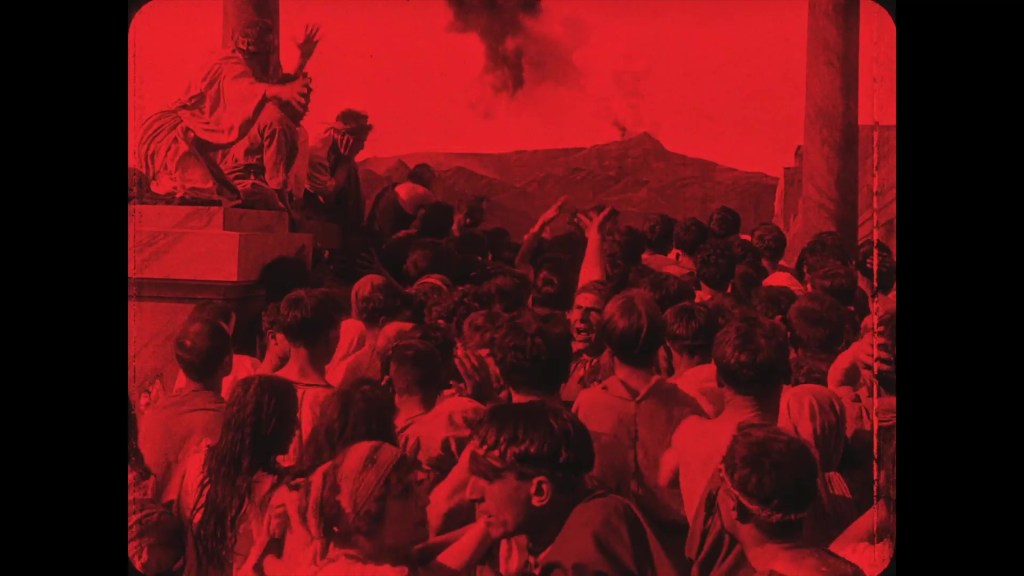
Gli Ultimi giorni di Pompei is one of several treatments of Pompei in silent cinema, and in one aspect at least it I have always felt is falls slightly short: the eruption of Vesuvius. I remembered being disappointed by the documentary footage of molten rock used in the climactic sequence of this film, and I wasn’t disappointed in being disappointed again when seeing it today. The shots are fairly undramatic, containing little more than smoking mud, and are much less impressive than even the most distant long shots of the artificial volcano. (These are created with painted backdrops and superimposed smoke clouds etc.) However, the vivid red tinting and the general movement of the panicking crowd make the sequence effective. I couldn’t help but imagine what an orchestral score would do for this film, and these scenes in particular. I have written elsewhere of the physical impact of large-scale scores making the sheer weight of what’s happening on the silent screen tangible. Music makes present both the emotional and physical aspects of what we see. In Gli Ultimi giorni di Pompei, the exploding volcano, triggering the switch to a red tint, and the resultant collapse of buildings and surge of crowds, would be much more effective in the theatre if given the sonic bulk of orchestral volume.



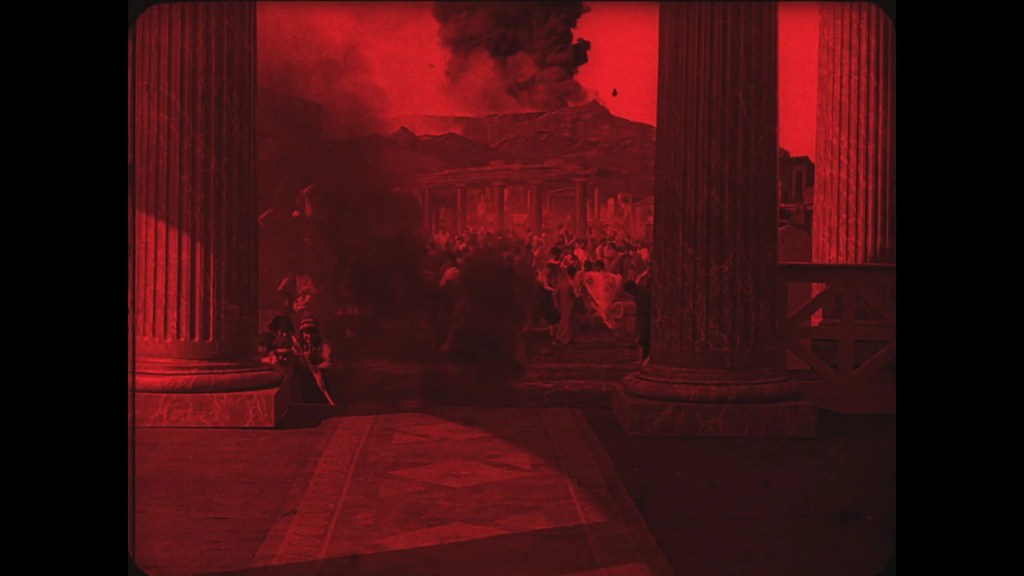


This is not to do down the piano music provided for this presentation by Gabriel Thibaudeau. His music is excellent, capturing the mood and slowly unfolding drama perfectly. But it isn’t on a scale matching that of the film. The screen teems with detail and with people, with huge expanses of land and sea, and (ultimately) with vast natural catastrophe. Sometimes, a piano doesn’t feel enough. Of course, I am not watching this film on a large screen, nor am I watching it with a crowd, nor am I experiencing the music performed live. In these circumstances, I imagine even the forces used on this presentation would have more impact. But I cannot but dream of a grander musical dimension. (One of my most longed-for hopes is that the 2006 restoration of Cabiria (1914), complete with its original orchestral score by Ildebrando Pizzetti, will finally get released – it has been shown live but never issued on home media. Why on earth it has lain in limbo for so long remains a mystery. That combination of music and image will surely demonstrate the power of a properly restored image and score together for exactly this kind of early feature.)
Anyway, I must conclude by saying how much I enjoyed revisiting this film. The image quality was superb, and I noticed so much more than when I first saw it. It’s always good to reacquaint oneself with canonical films, as they can often be taken for granted – or released on so many duff DVD editions that you lose track of how good they should look. And Gli Ultimi giorni di Pompei looks very good indeed.
Paul Cuff

 The Realm of Silence