Some years ago, in my teaching days, I grew conscious that screening material in the classroom was exclusively digital. We watched DVDs, Blu-rays, or even bits and bobs via youtube. I wondered if any of my student had experienced – or would ever in their lives experience – film on film. At that time (10+ years ago), a few prints from the BFI still circulated in the classroom, some of them the very same prints I had seen when I was a student several years before this. But the days of 16mm or 35mm were numbered, and these formats had never been (in my adult life) a feature of studying silent cinema in the classroom. Though I might incorporate discussion of the physical history of film in the module, I wanted students to sense something of the material itself. So I headed to eBay.
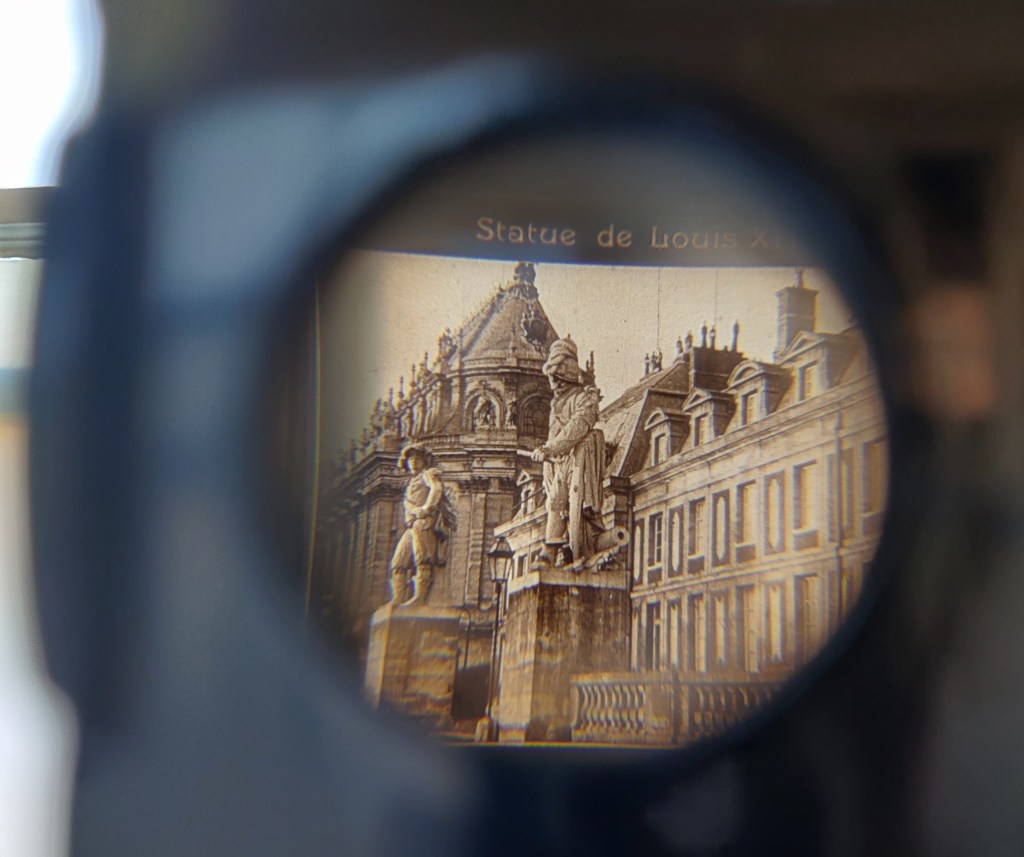
Here, I bought a chunk of inexpensive filmic and proto-filmic paraphernalia from the late nineteenth and early twentieth centuries. Sets of stereoscopic cards and matching “viewer” from the 1880s; a weird, cardboard-mounted strip of tinted frames from an unknown German film of the 1910s; and several boxes of Pathéorama films. Before purchasing the latter, I don’t think I had ever heard about this format. It was launched by Pathé in 1922 as another way of extending its market into home viewing. Cheaper and less cumbersome than narrow-gauge celluloid designed for home projection (17.5mm, 9.5mm etc.), the Pathéorama format is simple and easy to handle. Put simply, it consists of a small reel of 35mm containing single-frame “scenes” that are interspersed with intertitles. This strip of film is loaded into a Pathéorama viewer, a small handheld box which you hold up to the light: you then wind the film past the little peephole window and see the images. (I have included some photos of this process below.)
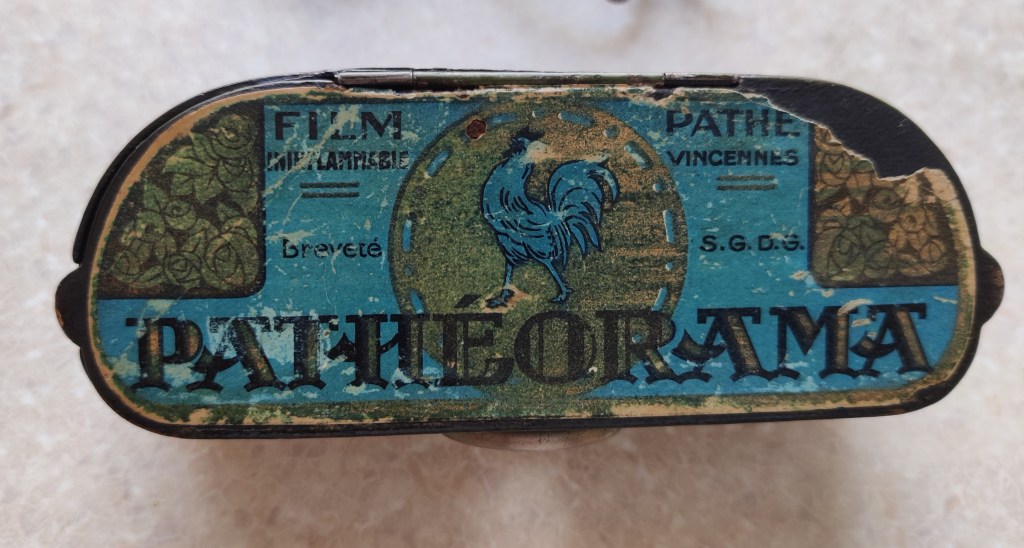
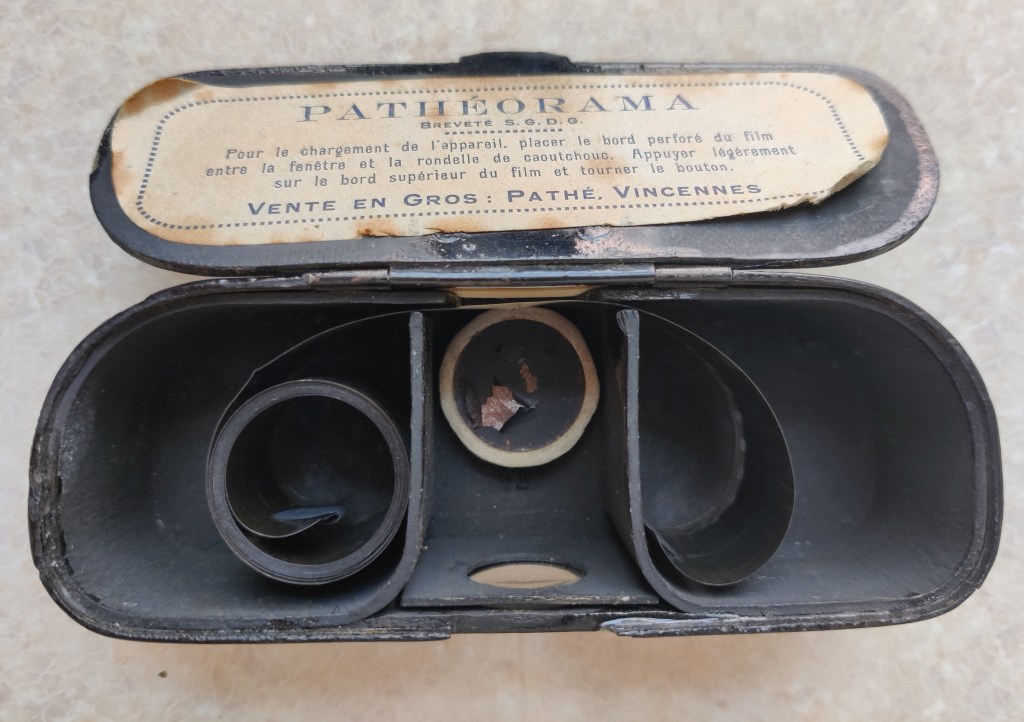
Thanks to a Pathéorama catalogue that came with the set I bought, I could browse the various categories of film the format offered. I say “categories”, but “genre” might be more applicable. Most of these genres are travel-oriented, providing touristic sequences of various kinds of location. Like the cinematic genre of the travel film, the Pathéorama format allowed the viewer to glimpse the wider world. Thus we can see the numerous catalogue entries (and the item codes for convenient ordering): “Paris et ses environs”, “Les beaux paysages”, “Les grandes villes”, “Les montagnes”, “Les plages et les ports”, “Colonies françaises”. Others were more focused on the art culture in these various locations, such as “Les series artistiques” (visits to museums, galleries, historical ruins like Pompeii), or specifically on sites of spiritual significance (“Les films religieux”). Many of these various genres of travel film were also tinted, allowing their little worlds to glow with colour.
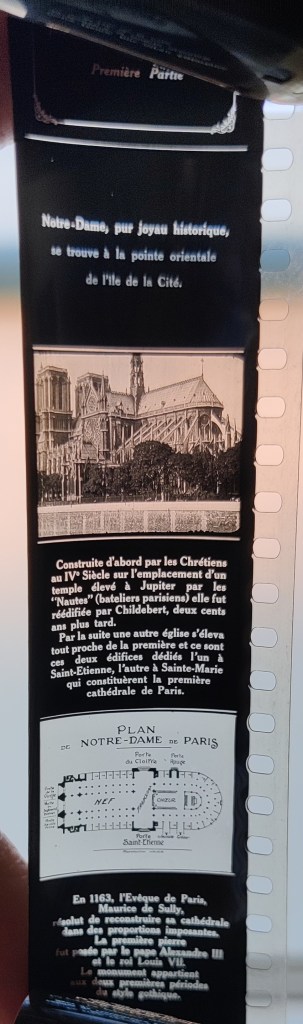
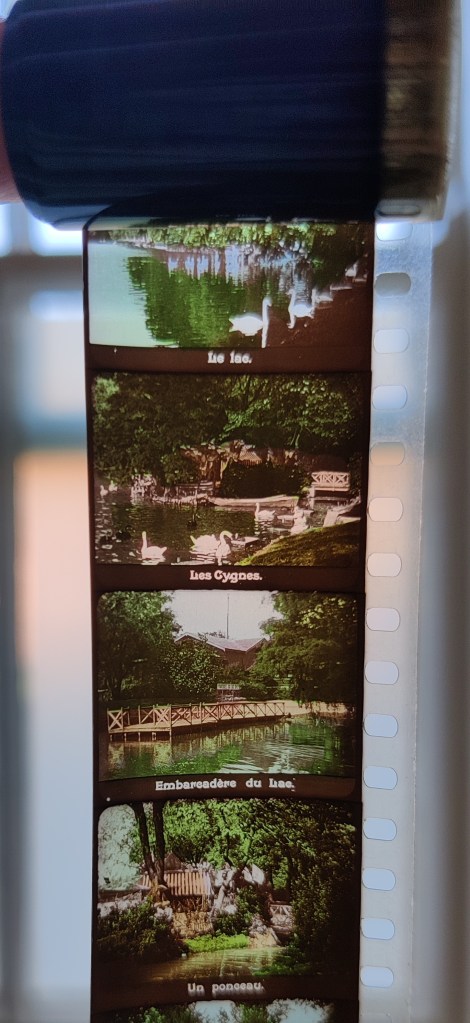
If these genres were implicitly narrative, others were explicitly so. For example, Pathéorama offered “Documentaires” (exhibition walk-throughs; guides to manufacturing, industry, and sport) and “Les Voyages” (guides around regions or nations). But it also made series devoted to children’s stories: “Les contes de Perrault”, “Imageries enfantines”. A genre that combined both touristic travel and child-centred narrative was “Les film d’aventures”. Here, “Le Tour du monde d’un gamin de Paris” was a multi-reel series in which the Pathéorama viewer followed a waif through the streets of Paris – and beyond. (The follow-up series was called “Les Bandits de la Mer (Suite du Tour du monde d’un gamin de Paris).”)
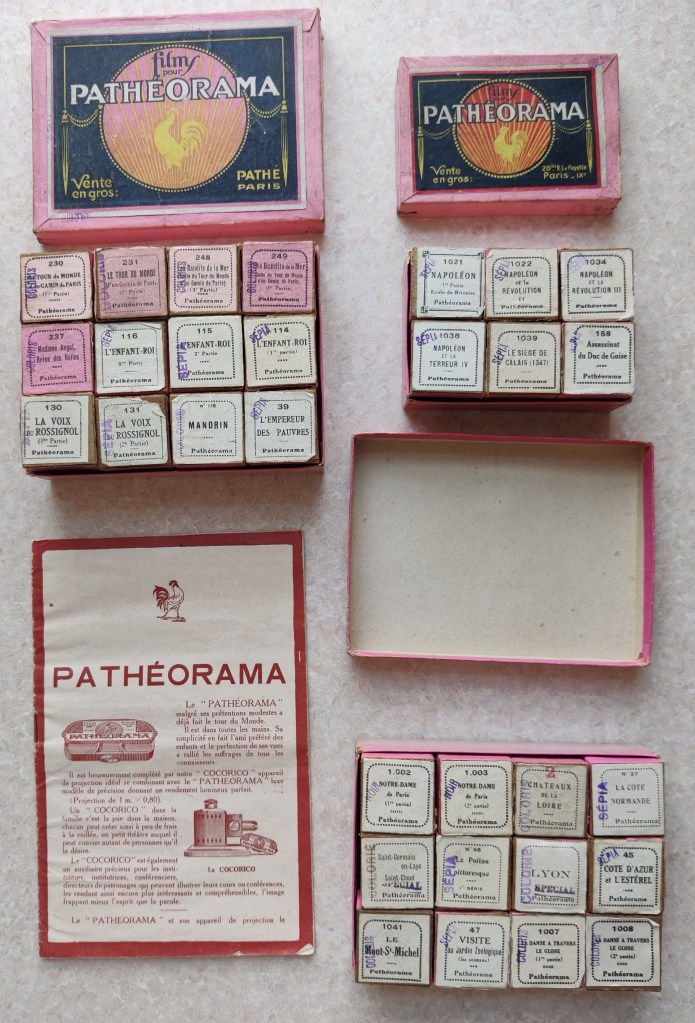
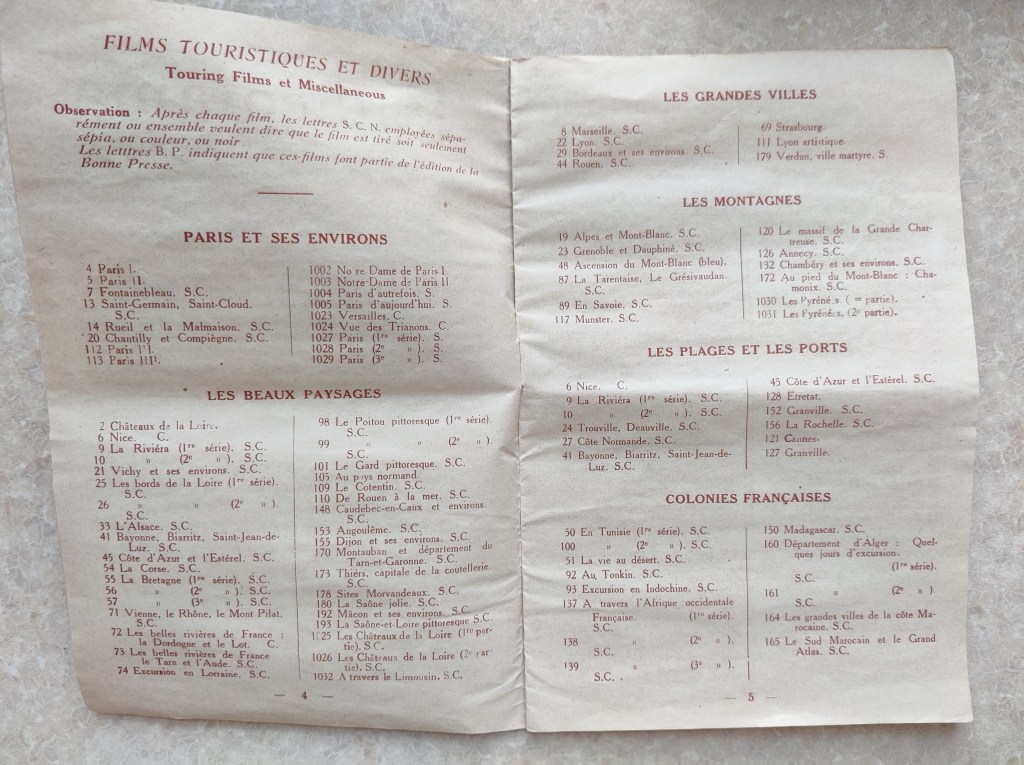
But what really caught my eye among the Pathéorama catalogue were the titles classed under “Les grands succès de l’écran”. This has its own sub-genres: “Ciné-Romans Historiques”, “Ciné-Romans”, and “Ciné-Romans pour la Jeunesse”. All the titles in these various categories were derived from films released in the cinema. It is striking that Pathé deemed the films in the Pathéorama format “ciné-romans”, i.e. film-novels. The film novel was its own literary genre, one which I’ve written about here before. Tying the Pathéorama films to this genre denotes a kinship of form. Whereas a ciné-roman might be a well-illustrated book, a Pathéorama ciné-roman was a heavily-titled film.
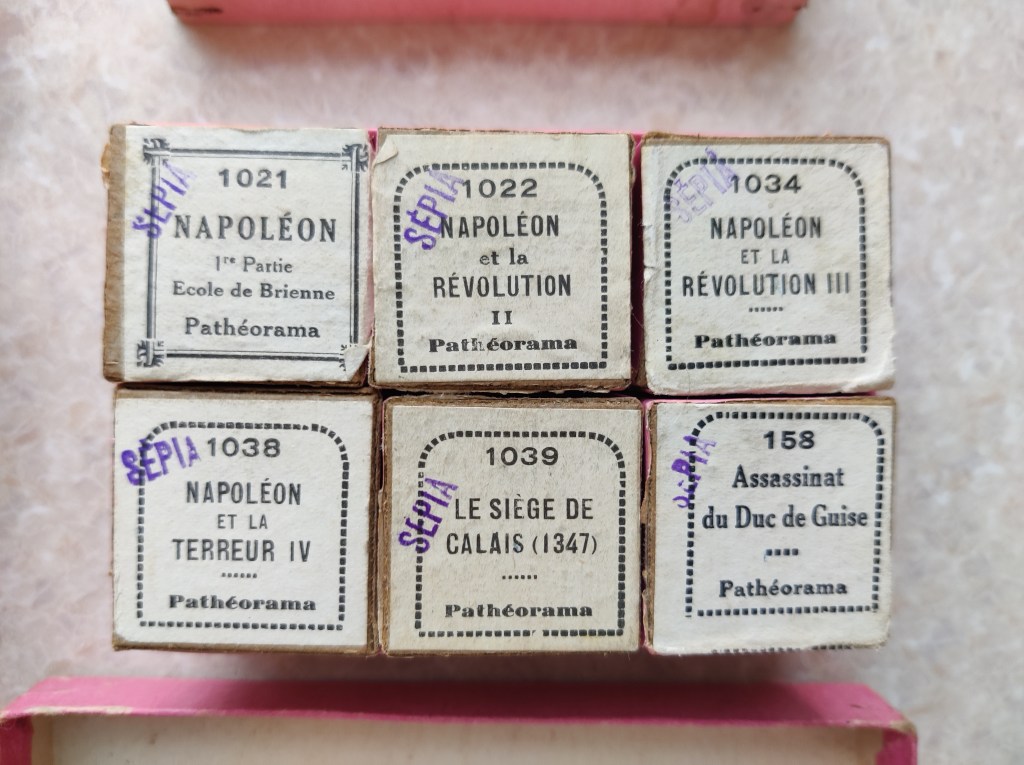
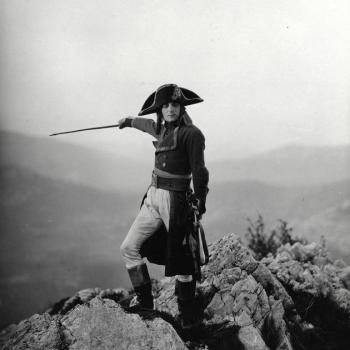
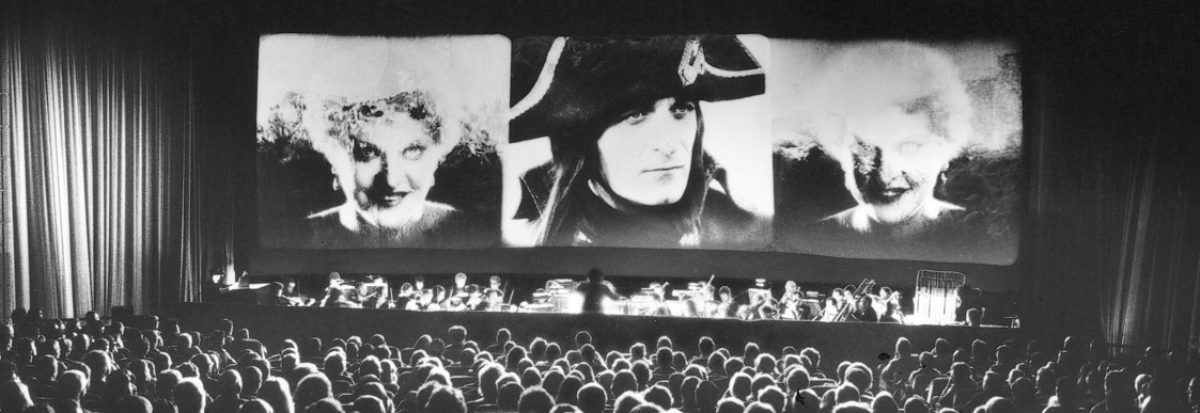
Among the many titles in this genre, my interest was immediately roused by the reels labelled “Napoléon”. Yes, indeed, Pathéorama released Abel Gance’s vast, multi-hour drama as a “ciné-roman” slideshow in several tiny reels. As you will see below, the 35mm frames used by Pathéorama are extracted from rather worn-looking prints from Gance’s film. There are scratches and dirt, as though these were copied from off-cuts – or simply printed with very economic means. Still, they are 35mm frames from Napoléon, and I rejoiced in my miniaturized exploration of yet another version of this endlessly morphing text. I was also especially intrigued by at least one frame from a scene (or at least a single shot) that was not in the cinematic film itself – or at least not in any version that I knew. Here, some cadets and priests stand before a gate behind which mingle a group of adults. Who are these people, and where in Brienne college are they gathered?
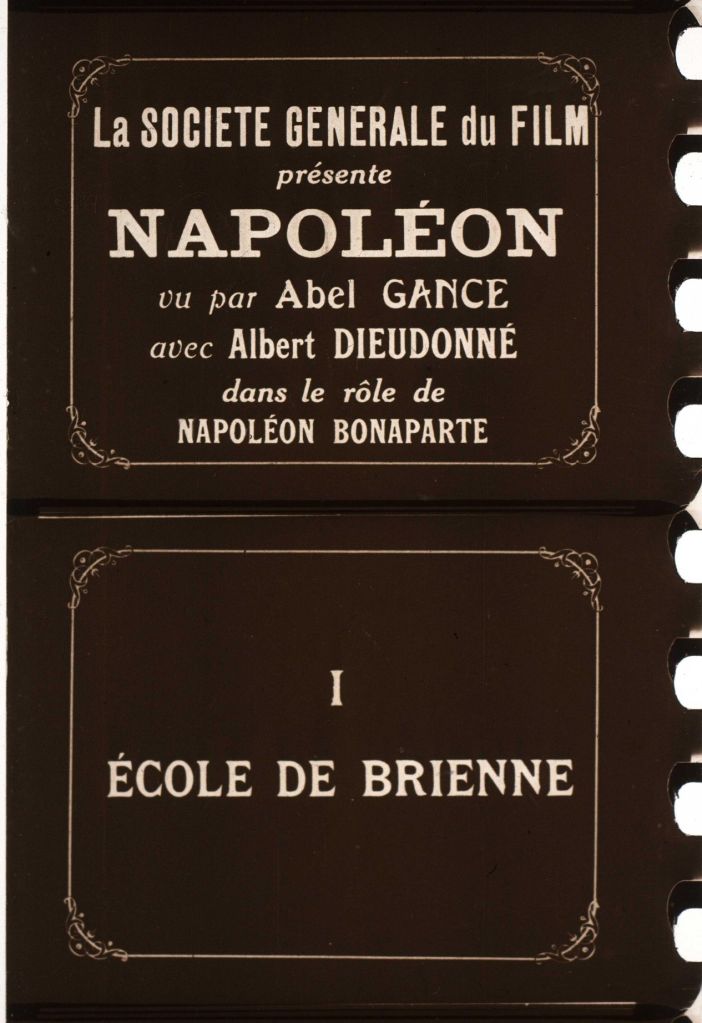
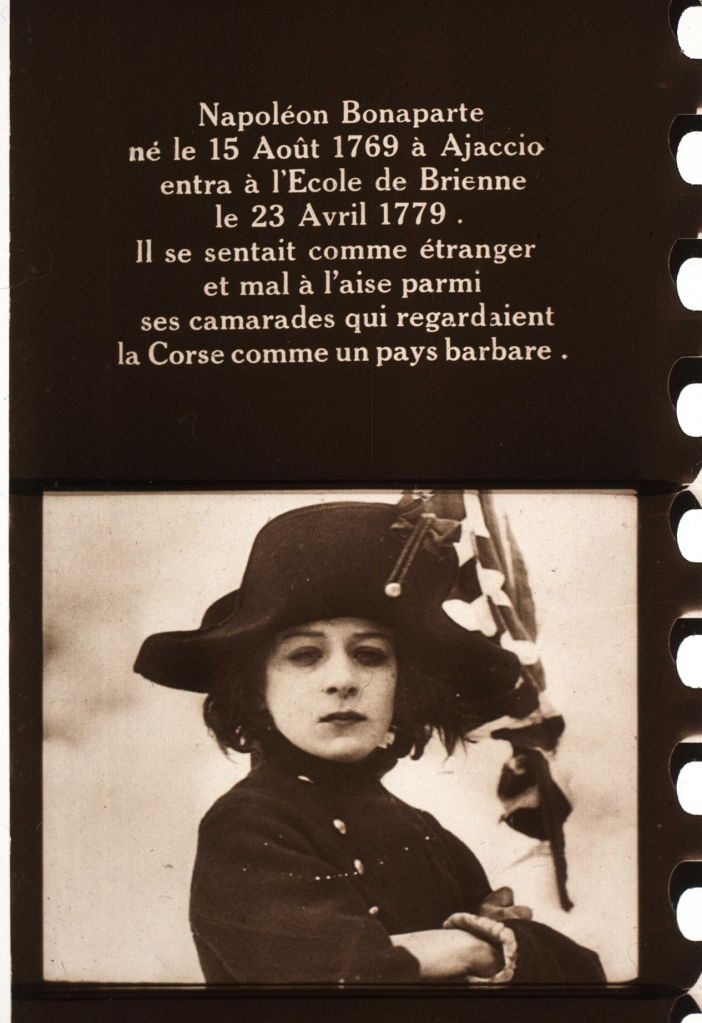
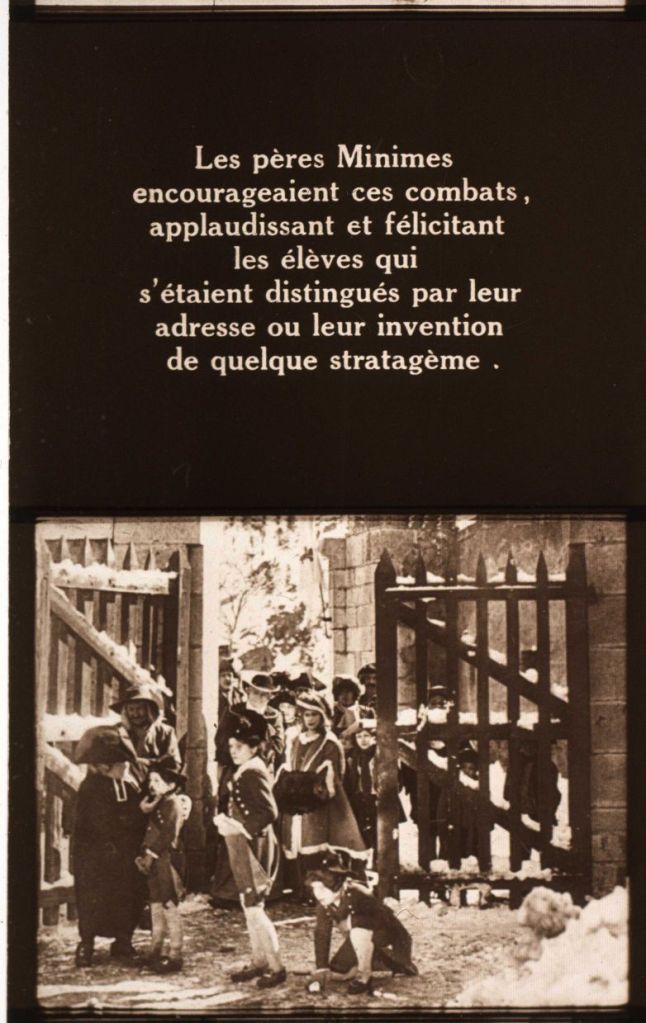
These are not the only questions this Pathéorama version raises. What kind of licensing deal did Pathé have in producing Napoléon in this format? Who decided to include Gance’s film in this series? Who decided on its contents, and how were the images harvested from the original film? Who edited the text of the titles? And how many copies were made of this little Napoleonic series? How many of them were sold? Who bought them, and what experience – if any – had they had of this film in the cinema? If nothing else, these reels demonstrate that Pathé did have commercial hopes and ambitions for Gance’s troublesome film. Pathé also released Napoléon on 9.5mm, another format for home cinematic viewing – though more closely related to the public exhibition format.
If viewing Napoléon on a tiny screen, squinting into the light, might seem a strange, even detrimental way of watching this film, fear not – Pathéorama reels could be projected! Thanks to the “Cocorico” lantern produced specifically for this format, viewers could project their Pathéorama films at home. A successor to the much older magic lantern format, the Cocorico offered the user a proto-cinematic experience – or perhaps a way of reliving a memory of a film experienced in the cinema. Given the difficulty of seeing Napoléon adequately even in 1927, it’s rather touching that Gance’s film had this kind of domestic afterlife. Indeed, the appeal of this format was still relevant in my own life, nearly a century later. When I bought my little Pathéorama reels, Napoléon was not available on home media. If I wanted to see any version of this film, I had to go to an archive – or wait for one of the infrequent public screenings with orchestra. (In my adulthood, the latter was not exactly a regular possibility.) So I was delighted by these reels, which allowed me a kind of vicarious ownership of a print – actual 35mm film, no less – of Napoléon. Though I could never get my Cocorico projector to function, I took pleasure in winding the reels through my “viewer”. And I could share this pleasure with my students at university, allowing them to glimpse the only fragments of Napoléon available in the classroom.
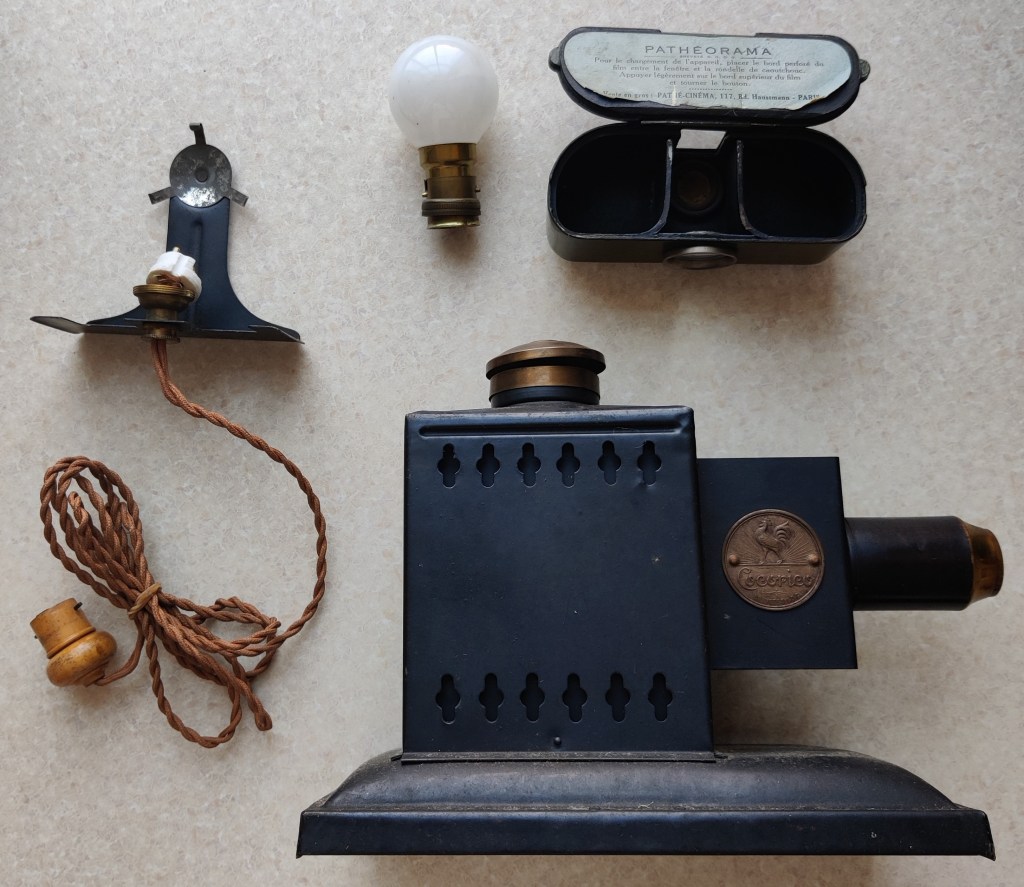
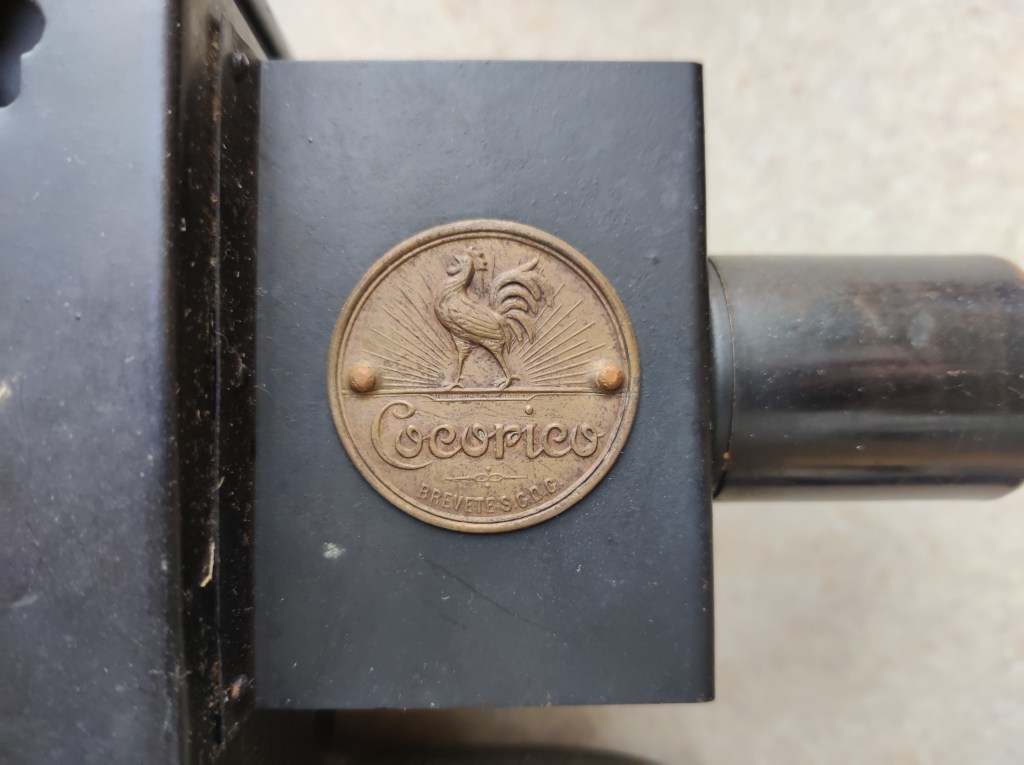
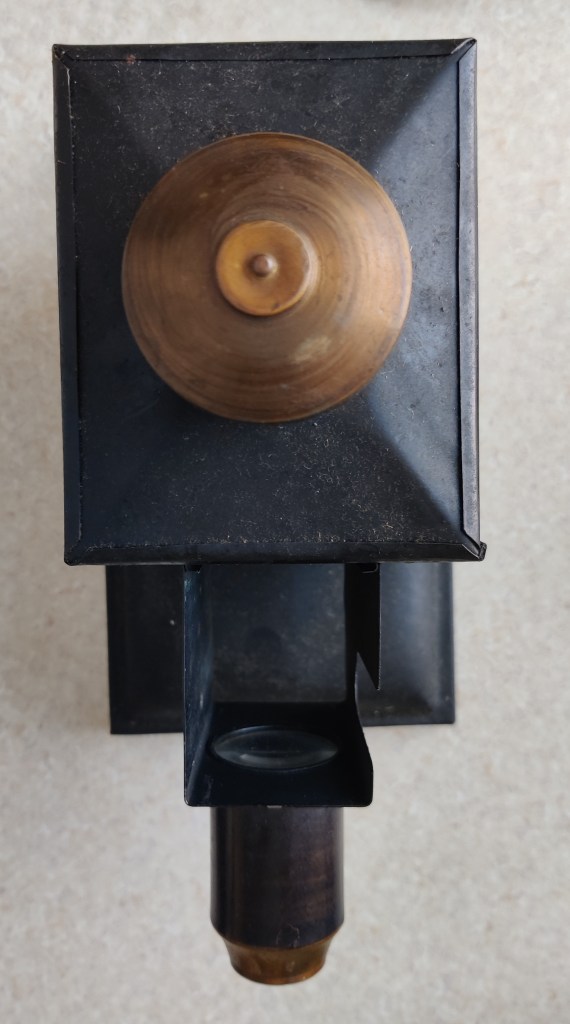
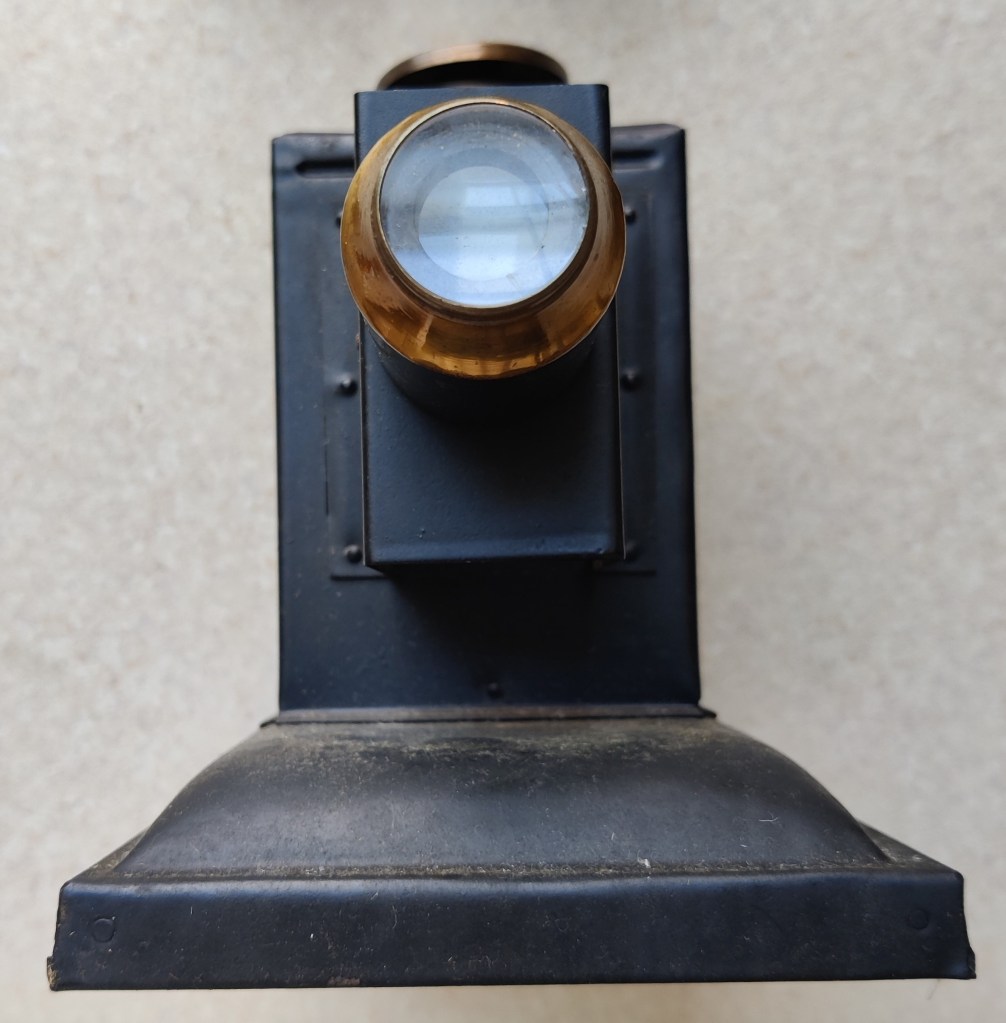
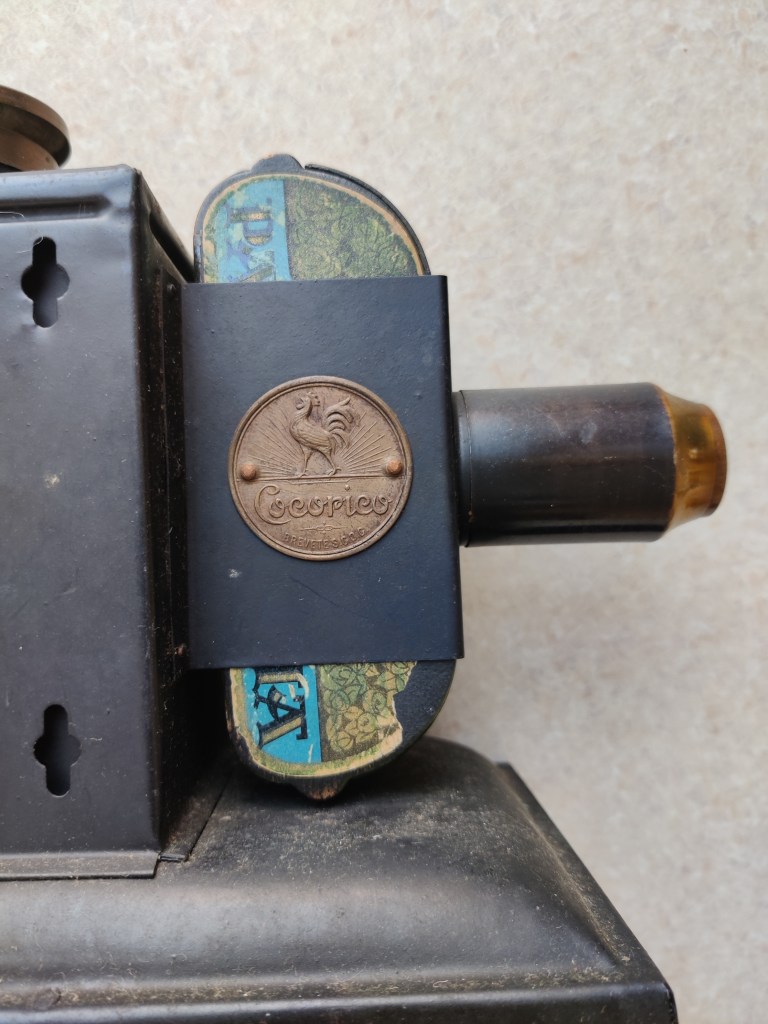
There is a tragi-comic coda to this little history. As I said at the outset, much of my collection had been bought for the sake of the classroom, where I let students have a play with the materials of film history that my otherwise entirely digital course lacked. Outside this context, I rarely used my collection at home. Time passed, and I eventually drifted away from academia (or vice versa). So I packed away my film history ephemera in a box and slid it under the bed. One night I knocked over my glass of water and this box was spattered. In what remained of the night, I went without sleep fretting over the fate of my collection – and wondering what the point of keeping it was without anyone who might share it or have an educational play with it. The idea snowballed until I considered getting rid of just about everything that I had accumulated for a now defunct career: not just the Pathéorama and other curiosities, but all my Gance collection, all my cinematic paraphernalia, all my DVDs, all my everything. In the end, the sheer volume of this material put me off selling it. But I sold a huge chunk of my DVD library, and I sold all the material I used for my teaching: the Pathéorama material, the stereoscope material, and sundry other bits and bobs. The Cocorico projector went to the United States, while the films went to Italy. The projector at least made it to its destination, whereas the films got stuck in customs. As far as I know, five years later, they’re still there.
I suppose this is what happens to the material media of film history. Someone builds a collection, grows weary, grows old, disappears, and the collection is sold piecemeal; some of the material becomes the basis of other collections, while other material gets lost, mislaid, destroyed. How many collections have been dispersed for reasons as trivial as the spilling of a glass of water? And how much of film history sits in customs warehouses, basement boxes, storage facilities, bank vaults, awaiting due process – or simply the end of the world?
Paul Cuff

 The Realm of Silence