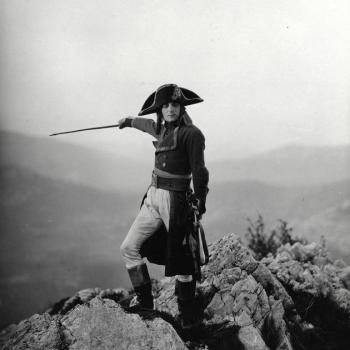
“Please be careful of noise in the room”: Recording Carl Davis’s score for Napoléon (1927)

This week’s piece is in tribute to the composer and conductor Carl Davis (1936-2023), who passed away last week at the age of eighty-six. Like so many, it was through Davis’s music that I fell in love with silent cinema. I first saw Napoléon (1927) in a live performance with his score in December 2004. It was an experience that changed the course of my life. Seeking out other silent films meant encountering more of his music, especially the Thames Silents series, for which he composed many extraordinary orchestral scores. In all, he wrote music for nearly sixty silent films—from the shorts of Chaplin and Keaton to the epic features of D.W. Griffith and Abel Gance. This body of work is of inestimable importance in the revival of silent film and live cinema.

These last few days, I have been wondering how best to pay tribute to Davis and his music. But where do I even begin? Faced with such a challenge, my solution is to focus on one experience of one work. Thanks to Carl and his daughter Jessie, I was able to attend some of the recording sessions for Napoléon in September-October 2015 at Angel Studios, London. What follows is a transcription of notes I took during these sessions. Some of these notes informed an article I wrote on the relationship between live performance and recorded soundtracks. But anyone who has written a piece for academic (indeed, any kind of) publication knows that translating an aesthetic experience into prose inevitably sacrifices much of what was essential to that experience. Just as I have never—despite trying on innumerable occasions, out loud and in print—adequately described the impact of seeing Napoléon, so I feel I have never done justice to how thrilling and moving is Davis’s score for the film. His music understands Gance’s film, grasps and articulates the essence of it, in a way that no other has ever done. It follows that the vast majority of what I wrote during the recording sessions in 2015 has never found the chance to be “translated” for publication. I reproduce them here in their original form because I cannot conceive of where else they might find a reader other than myself. If nothing else, they summon the spirit of the recording sessions.

You will see that I have not tried to attach names to all the snippets of conversations and instructions going on in the booth. This is partly because I couldn’t always identify where the words came from, partly because I didn’t know the names of everyone in the studio, and partly because I like to keep fidelity to my original style. Thus, you will see that I keep referring to the recording producer as “the captain”, since the booth looked like the helm of a ship. (In fact, his name is Chris Egan.) In terms of form, my original transcription kept the line breaks of the manuscript, but for the sake of space here I have indicated line breaks with “/”. I regret this a little, as the line breaks at least gave an impression of the continual shift of sounds and images that I was trying to capture on the fly. Limitations of form aside, I hope this piece gives you a sense of the recording sessions—of the communal effort, the humour and generosity of Davis and the Philharmonia musicians, the skill and perfectionism of Chris Egan and his production team.  It was a tremendous privilege to sit, watch, and listen to this wonderful group of people make music. Reading my notes again after several years, I am reminded of all the hours I have spent under the spell of Davis’s scores—and that these hours have been some of the happiest of my life.

Friday, 25 September 2015

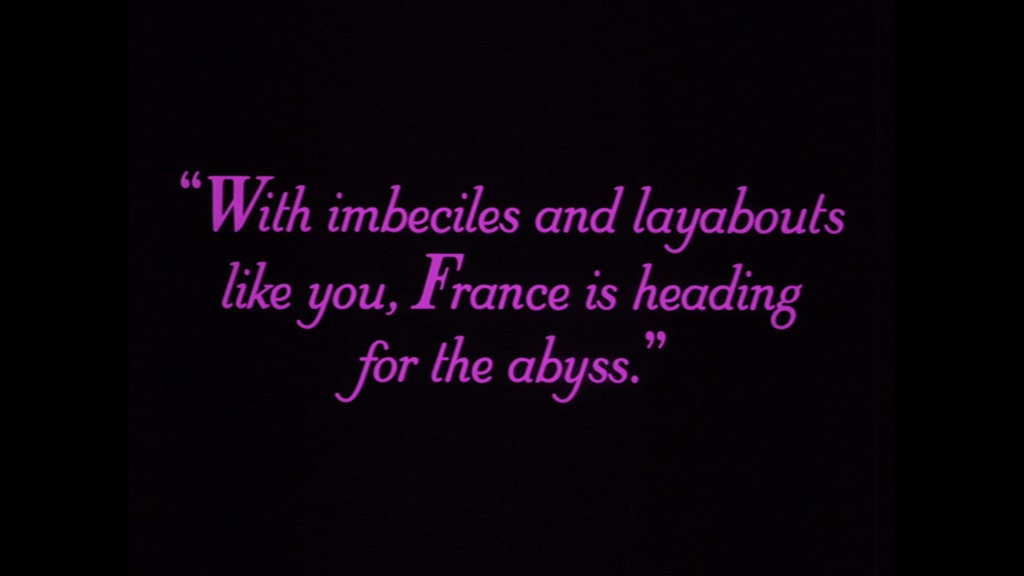
A small, narrow passage; below, a pit that has been extracted from somewhere familiar. / A forest of leafless music stands, petrified. / A flautist is playing “Ça ira”—badly (I’m sure they will improve). / Double-bass sarcophagi, garish and plastered with the remnants of official approval. / The control room has a triptych of glass: Polyvision for the captain at this land-bound helm. / The way out (for relief of at least three kinds) is through a warren of panelled attic doors, over duct-taped zigzags like sloughed snakeskin… We go up, along, left, up, left, down, around, through, up, along, and across (we come back a different way). / An intertitle awaits us in the booth: “In this feverish reaction of life against death, a thirst for joy had seized the whole of France. In the space of a few days, 644 balls took place over the tombs of the victims of the Terror. (Hist.)”

The forest is drawing a population, perhaps curious by this new landmass lifted from an extinct theatre. Warblings, farpings, shrill snatches of melody—broken, repetitive, working towards fluency. The musicians settle. / A titled mirror on the far right; behind, two fragments of wall and window snapped from the upper deck of this ship. / The title is replaced by a murky image, a square of potential floating within the dark grey frame of the monitor. (A gown is waiting to flutter, flickering faintly with the quiver of an electric pulse.) / The clamour of sound grows. / Latecomers, carrying instrumental coffins. (The inhabitants are beautifully preserved.) / The atonal buzz aids my prose—this is an attempt to reacquaint myself with pen and paper.

The players cannot see the film; only the captain and the conductor. / Davis is at the mirrored helm opposite our enclosed triptych cabin. / The forest is filled with music—overlaid, overlaid, overlaid, overlaid. / Superimposition of sound is joined by strange, deep exhalations, breaths short and rasping, the scatter of conversation.

The timbre of Davis’s voice cuts through a multiplicity of clarinets: “This is a transcription of a Beethoven piano sonata, hence all the fiddly bits.” / The sonata is now sonorous. / The captain wanders the helm. / Sound explodes against the triptych glass and breaks into the booth through multiple speakers, bouncing around—wind hitting receptive sails. / A conversation between helm and pit. / Strings only: the balance shifts, hisses, stops. / The speakers on the left and right are shrouded in a black veil, as if in mourning. / In the helm, the music has passed into sound—made indirect. / The woodwind are in the central window of the triptych through which I gaze, yet their music emerges from a speaker on my left. / The timpanist is lost in the funeral roll and misses the calls to stop. He looks over his shoulder at us, nervously.

Though the man stands straight before me, Davis’s voice comes from my left and hovers above a hum of voices behind the black shroud. / Davis’s arms are the only mobile branches.

“Short! Short! Apart from that last note…” / The woodwind give the strings an appreciative noise after their run-through. / Davis amends the balance between bassoons, clarinets, and oboes.

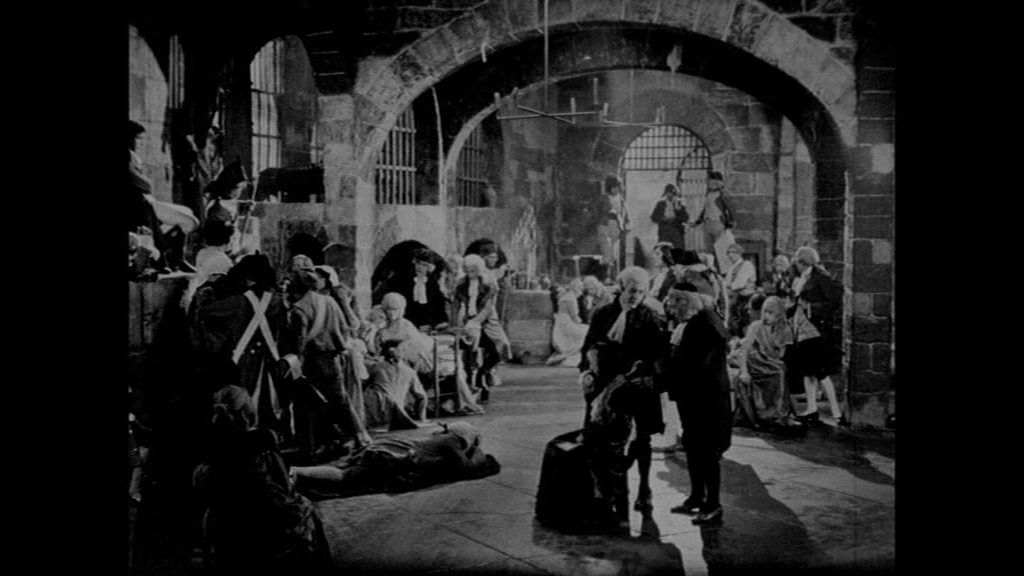
Describing the prison scene the players cannot see, Davis explains: “This is all tragedy and despair and fainting and… so on! It’s meant to be heartrending!” He laughs. / The helm sends instructions: “Six quaver clicks to bar one…” and Josephine enters her cell. / A vertical blue stripe gleaming like cobalt glides across an intertitle and a large white circle leaps into the centre of the frame. Napoléon has been bombed by Ballet Mécanique.

Salicetti enters the room, but the music stops—he carries on into Bonaparte’s cell in awkward silence before someone orders him to freeze; he stays wrapped in his cloak, glaring at the man he has yet to reach.

Clarinet One speaks: “I need some more click.” / A voice from behind me in the booth: “In other words, what you’re saying is ‘Carl, conduct in time’!” / “Yeah, something like that.” / Before each take the musicians put on headphones in ritualistic accord. / Josephine looks out of her cell window outside; Davis wipes away an invisible shot; Gance cuts to the exterior; Davis wipes away another image; Gance cuts back to Josephine.

Salicetti steps into the room once more; he makes it two steps further before being ordered to freeze; he looks even crosser, hands on hips, his glare wider under the foaming plumage of his hat. / “Sorry to stop you. The room was a little bit noisy. Please be careful of noise in the room”, the captain stresses with polite firmness. / “The trombones are moving…” The culprits of the noise? Eyes peer suspiciously round the corner. / Two monitors (one above, centre; one below, right) display the interrupted scene. We are waiting in 2015 and they are waiting in 1927.

The orchestra has lost its click track. / “You may have lost the clicks, but we’ve still got them.” / “I doubt it, on the basis that our computer froze entirely.” / “OK. It’s just my delusional state.”

[Later]

“Folks, just to let you know that I need you to be careful of noise in the quiet moments in this passage, particularly bars 8-11 and 17-20. I’m getting a lot of noise in the room.” / Another take. / “I’m going to need you to go again with that section straight away.” / “9 and 10 are still vulnerable. Strings, if I could suggest that you keep your instruments up when you’re not playing—that would really help us.” / “6 clicks into bar 51…” / Salicetti tries again—and fails.

“Have I got a wipe at this point?” / “Yeah, and I’ll give you a streaker.” / Davis: “OK, this should be ferocious.” / Salicetti enters the room: the orchestra roars in unison before giving Salicetti’s steps the fierce momentum of his mood. / Salicetti enters again, even more ferocious (he’s been frustrated before). / Captain: “Coming from where we’ve been, we really need to make a statement of intent. If we can have a strong accent on that first note, that would help us out of the last cue.” / “Yup”, agrees Davis, “Drama.” / The orchestra hits the silence with even greater force.

Davis: “It’s very serious, I’d say. Dark. A very sonorous sound. And the trudge, trudge, trudge of the bassoons.” / Salicetti confronts Bonaparte. After all this time (so many times, in fact), Bonaparte ignores him—“I’m working out a route to the east, by way of a canal at Suez”—and Salicetti slopes out.

The players are requested to check their mobile phones. There is a rustle of amused outrage. Davis extracts his phone. It was the maestro! / Captain: “OK, I’ll gloss over that.” / Davis: “Napoleon was very modern!”

Basses and cellos are intense, wringing darks strains of melody—opposite, a first violin. / “Some people are landing late on 45. One more time please folks, and please be careful of noise.” / Another take. / “Fabulous. Just a small repair. I’ll give you 4 clicks on 45. Just a little intonation thing, I’m sure we can fix it.” / The third monitor (above, right) mutely tracks the number of takes, moving from “Next” (green) to “Current” (red).

Absolute silence: the helm has muted the orchestra, even their conversation. / “OK, I’ll have the room back on please.” / “We’ll give you a red streamer at the cut-off.” / A whole scene is played through. Davis’s gestures strike the invisible cuts that have changes in emphasis. / Afterwards, the captain double-checks the list of errors with his assistant. A series of repairs are needed, named as timecodes and bars. / “I’m just not covered with a few little noise things for 16-17.” / A series of instructions are relayed from helm to pit, channelled into every player’s ears. Bar-by-bar orders. / “Still think we can do 33-36 better.” / “Anything else, Chris?” / “Yeah, just 57 to the end—general untidiness.” / They go again. / “A little more from the bass drum, please. Carl, if you could pre-empt the streamer.” / It goes wrong. / “Actually, if we could do from 55 through to the end, that would make our join much easier.” / The strings leave.

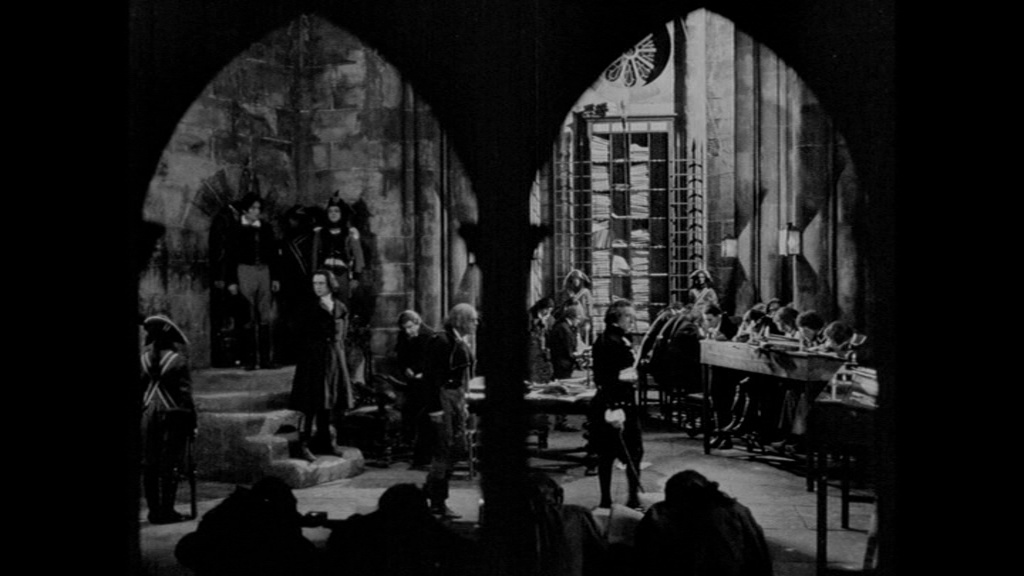
Bach’s Passacaglia in C minor. / Davis tells the woodwinds to be sinister. / Abel Gance enters the room. He is oblivious to the dots and streamers that flick and slide across the digital image. He observes the form of the guillotine in the paperwork. The contrabassoon is guttural. A look of lugubrious pleasure glows in Saint-Just’s expression. The winds growl, the double-bass is scraping the pit of a cavern, and the gothic arch above Saint-Just vibrates with shadow.

“The ending was fabulous.” / “The end was fabulous? Uh-oh!” / “No, no! I just meant the last phrase was perfect.” / They begin. They stop. / “Sorry folks. A little noise in the room.” / Davis: “Yeah, a little distracted. OK, now a minute-and-a-half of glory.” / The bridge of the double-basses resembles the gothic arch of the scene. / Time for coffee.

[Later]

A new session, post caffeine. / The audience awaits—on the screen, and the second screen—a thousand faces face the camera. / Minor wrath at those in the orchestra who have not yet put on their headphones. / Minor panic that a flautist is sitting in the cor anglais’ seat.

Four minutes through which Bach is unwound and ravelled anew—a fearsome logic works itself into a crescendo of volume. The floor trembles, the seats tremble. I feel the music crawling through my flesh, sounding out my bones, testing my tendons.

It is evident that someone has ignored instructions. The booth comments: “That’s how we know who was wearing headphones.” / “Do you want us to land more heavily on that second note?” / “Yup. It’s like—urgh!” (Davis mimes being strangled to clarify his answer for the player.) “OK, so this is nasty, I would say. This pizzicato…” He describes his intentions to the strings, then turns to the whole ensemble. “OK everybody: implacable. We are implacable.” / Amused accusations and counter-accusations when orders for a silent downbeat are missed by one player. / “One of the horns?” Davis inquires. Laughter. “What do I know! I’ve got headphones on.”

Again. / “Can we stop there please, Carl. Sorry folks. It took a few bars to settle. I think we can do it better than that.” / Again. / Deep breaths. / “Bravo, brass.” / Bar-by-bar analysis from the helm. / “Good. Well… not good!” / “No, but will be.” / “It will be!” / Davis delights over some phrases: “The arrangers have drawn out this lovely detail—I think we can really make something of it.” / “One more time folks, thank you. I’m not fully covered yet. It’s sounding fabulous—but we need to make sure it’s absolutely right.” / A repeat. A break.

“Carl?” A voice from the orchestra. Davis looks around. “Over here—the horns, Carl.” / The horns want to have another go. / The captain enters the conversation, addressing horn player Nigel by name. / Another run. Saint-Just despises his body once more, his final speech is about to go again. / “I almost have it. I think we just need to really attack it, picture-wise. If we really attack it hard, we can do it just once.” / Again the floor shakes, the wall shakes. / It works. / “What now?” / “I’d say a 30-second break.”

“I’m thinking something strenuous.” / “Exactly. We’ll have a look and see.” / Discussion. “It’s the Coriolan Overture. The real fun with this is that I had to remove the big major chords in here. It’s a clumsy cut, but necessary: the good news hasn’t come yet! You’ll see when they come.” / A pause. We go back in time before Saint-Just begins his speech. / “The Philharmonia playing Coriolan. How marvellous”, Davis enthuses. He marshals the players.

Robespierre now takes the stand. He is drowned out in the orchestra of voices on screen and by the voices of the orchestra in the pit. / A complete run-through. / Davis discusses the accent of the two-note phrase with the lead violin. / More stitches, revisions. / More, more, more.

A break for several sections. They gratefully remove their headphones and scratch their heads. / Cellos, double-basses, and bass-drum execute a run of tuttis in pizzicato. Their notes walk across the room in single-file, surrounded by stillness and silence.

[Later]

The afternoon session. / Violin is being prepped for recording. Her scenes are timecoded, broken down, divided-up. The beats will fall in the right places—and the orchestra will fall into step. / Davis explains his choice of quotation. As the orchestra can’t see the film, he also describes the action.

The beat precedes the players. They land in its midst and fall into step. / Run-through whole cue. / Changing trills from A-flat to A. “It’s nastier”, Davis concludes. / Another take. / Discussion of dynamics for strings. The helm believes all “to go up one… Everything needs to be a bit healthier.” / Davis compliments his players: “I love the crescendo-diminuendo. It was a real treat.”

Click track adjustment. / Timecodes changed to give an extra second before a key change. / Complex instrument-swapping. / The tambour militaire is changed.

“Follow the click.” / One of the woodwinds went too early and points it out: “I came too early.” / “Yes, you did. I was a bit bewildered”, responds Davis. “I thought, ‘Did I write that?’” Laughter. / More discussion. / “Beethoven’s a terrific film composer”, comments Davis.

There are more small screens in the pit: mobile phones with metronome apps, ticking in silence but synchronizing with the headphone click-track. / Noise of instruments being picked up. / Many takes of Bonaparte entering the Convention: the horns must redo one section; the strings are getting tired; the fifth retake produces laughter… / “Don’t worry”, the helm tells the players, “Whatever we do next will be easier. We’ll find something. There must be something easy in the remaining four-and-a-half hours of music.”

In the hiatus, the woodwind break into a rendition of “Ça ira”, as if threatening revolt against the helm. / Davis responds to the woodwind: “Play it as if it’s familiar to you.” The “Ça ira” becomes more fluent with repetition, as does the other traditional French song, the “Chant du départ”. “Play it knowing that everyone in France knows it”, Davis adds.

It’s the Bal des Victimes. / “Shall we follow you at the click?” / The click sustains the score when soloists are absent. Josephine plays the piano without a pianist. The rest of the orchestra plays around her in silence. / Solos. / “Carl, just don’t turn the page. There’s nothing more I can offer you to help.”

[Later]

The hurdy-gurdy player is alone with Davis in an empty pit. / Davis mimics Robespierre’s hand gestures on screen. / Many takes. Nervous atmosphere.

Monday, 29 September 2015

I have waited in the street outside. I walked past the studio boss on the way, grateful for my sunglasses. / The side road was populated by isolated groups of musicians, smoking or eating. / I am almost recognized. / I want a giant badge that says I belong here. The one face that I wear by default announces only uncertain hesitation. / There are new faces in the orchestra. Old comrades greet each other. The clarinettist from Friday is gone. The grumpy viola returns (only just in time). / The speakers in the helm isolate individual microphones. We hear the sound of drums, horns, strings, woodwind. Each springs into the aural spotlight, its comrades falling into artificial distance.

The Victims’ Ball again. First run-through (without click).

The film frame has slipped—it always will at this timecode. Its perfection is not needed here, not yet. / The snare drum needs a higher pitch. (“We’re being dragged down.”) / Davis instructs individual players on the purpose of phrases: “This is Napoleon spoiling the fun, the old party-pooper.” / The timing is perfect.

The film frame has slipped—it always will at this timecode. / The revellers enjoy another take, and spring once more into joyful dance. / Whilst the dancers step and swing in immaculate gaiety, the orchestra is still settling into cohesion.

The film frame has slipped – it always will at this timecode. / Snare or tambour militaire? “Let’s have both”, Davis says. “It is for Napoleon, after all.” / Rhythm is adjusted from 89 to 95. Figures are tapped into machines, electric notation reconfigures itself.

The film frame has slipped—it always will at this timecode. / Fourth take. An oboist makes a last joke with his colleague. She laughs quietly with only a click to go. The clarinettist scratches his ear as the other sections replay their parts.

New cue. / “It’s supposed to be light and frothy!” Davis explains. He breaks into giggles just as he counts the players in. / The clarinet fluffs his solo. General bemused consternation. / “That was frothy alright! It took us all by surprise. It was fun while it lasted.” / A long pause and discussion. Another take. The drummer is reading a novel. / “Strings, that last phrase…” Davis considers for a moment. “I know I said it should be like a recitative in a Mozart opera, but I don’t think there’s space. So ignore me! Follow the click.”

A new cue is announced: “111.” The drummer puts down his book and flips through the score, then puts on his headphones. / A long confusion with stops/opens for the horns. / “OK, there’s some romance in the air”, Davis announces. / A good take. / “Mm”, says the maestro, “Yummy.” / Discussion of dynamics. / “We’re making a narrative point”, Davis interjects. “An eyebrow is being raised. Ha!” / Long interruption as Davis rummages for his phone. / “He’s hopeless!” calls a voice from next to me in the booth. It’s his wife.

The drummer is free again and busy drumming his leg, just above the knee. / “113.” / The timpanist hesitantly picks up his sticks and headphones, all the while inspecting the score. He sees he isn’t needed and replaces them, refolding his arms. / A great take! Violine is poisoned by her own hand!

The lead violin asks if a stronger phrasing will help. / Davis swoons with pleasure at the result: “Oh yes! Argh! Stabbed!” / The drummer is back into the depths of his book. / The bass-clarinettist stops the next take: “I’m sorry, there was an accident.” / “What happened?” Davis asks, concerned. / “I played the wrong note.” / “Oh, that’s all. I thought it was something serious and dental.”

Violine empties her vial once more. / “Perfect. Great.” / Violine is carried inside. Davis explains the strings are panting, and he himself performs a series of strange gasping noises. There is a touch of embarrassment among the members of his family in the booth.

Davis takes the first run-through too fast. / “I’m sorry”, he says. “I need to calm myself.” / There is a coffee break.

[Later]

Napoleon’s exclamation: “At last!” The orchestra produces a great smack of sound. / A tempo change is needed for the sake of an added shot of Napoleon’s hat at the end of the scene. / “I just need to learn the tempo of this”, Davis mutters. “I don’t want to do any more composing. I’m not writing an anthem for a hat.”

“At last!” Mobile phone interference. Once more… / “At last!” That was great. Once more for safety. / “At last!” I preferred the last one.

The scene complete, the orchestra returns to a much earlier scene. They will now accompany the hurdy-gurdy, recorded last week. / “Good moment for Trombone Three to be sinister”, Davis says encouragingly. / Davis explains that the accent for the title announcing “The Terror” is “a guillotine chop”. The players change the notation to read ff in their scores. “That first note needs to be startling.” Negotiations with strings. The suggestion they alter to mezzo forte is received with audible relief.

Robespierre and Saint-Just stand by while Danton is executed. / The drums are political, not military, Davis adds. / The high strings have trouble. / “Yeah, this is piano music” explains the captain. / Davis gets cellos and violas to give more extreme accelerando/diminuendo—they do so, mimicking the oceanic sway of the Double Tempest.

The orchestra is about to be introduced to the hurdy-gurdy. They must now play around the instrument, the sound of which will reach them through their headphones from last Friday. / The booth flicks a switch and the wheezing whine of the ancient instrument comes through. There are expressions of wonderment, giggles, and orchestral surprise. One violinist nods his head in appreciative rhythm. The bass-clarinettist looks at his colleagues and mimics the hand-cranking gesture of the absent hurdy-gurdy player. / Davis instructs the high strings: “This should be cold—icy—implacably cold.” He is describing Saint-Just.

The next cue: “France, in agony, was starving…” / “The music should be an atmosphere that’s specific to the film”, Davis demands. He alters the dynamics for “the sake of recording. Live, it’s another matter.” / The Captain speaks of 12th Vendémiaire: “I’d just like it in one performance without my having to cut it together later”.

Next scene. Brass and woodwind growl. “Wow!” exclaims Davis. “Wotan’s come in!” / Another scene. Violine’s “marriage” to the shadow of Napoleon. Gorgeous oboe and viola solos. / All tempo changes are removed. /   “That’s slower than I ever intended.” / “This way it hits every cut.” / “If it hits every cut, I’ll buy it.”

Another cue. / “Woah!” Davis cries. “Eroica again. We’ll need a cup of coffee for this one.” / “We’ve got two big ones to do”, warns the helm. / “Two big ones?” / “Yup, and only one cup of coffee.”

[Later]

Afternoon session. / There is a debate over temperature. The helm wants the orchestra to be a degree colder to prevent tiredness: “I’d rather they whinge. Whingeing will keep ’em awake.”

The opening of the Victims’ Ball. / The first take sounds Viennese. / “No slows, please”, Davis instructs. The lead demonstrates the ideal phrasing and accents. / Second take. More French. “But what century?” Davis wonders. / Josephine’s fan. / Josephine is seductive, but the helm thinks the orchestra could be more “playful”.

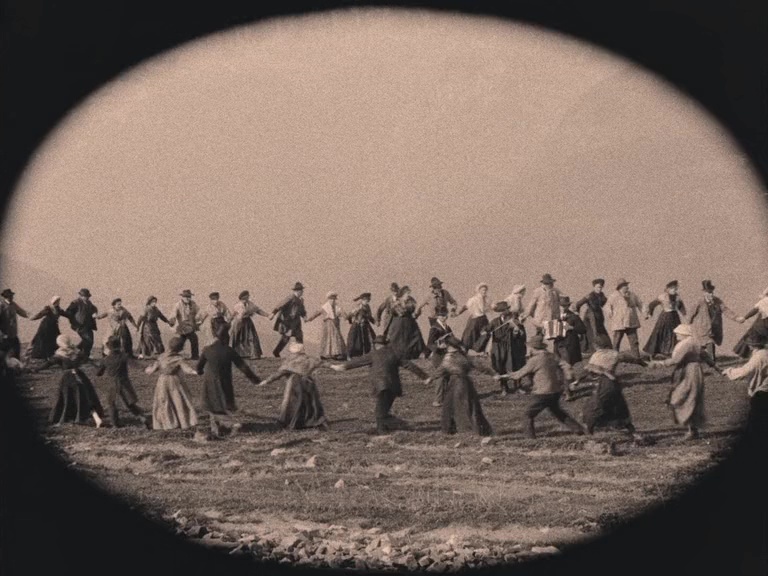
Cue 96. This has been saved for the new guests to the booth. They whisper in respect whilst the guests on the screen let loose. / Beethoven’s Seventh. Whooping horns, racing strings, an orchestra champing at the bit. / “OK, now you’re doomed”, Davis says. “’Bones, you’re the doom!” / “It was here that I was summoned to the guillotine”, Josephine explains. / “It’s meant to be spooky and strange”, Davis interprets. “Apart from a lovely viola solo!” he adds, looking at the viola. / A great take. The orchestra applaud the viola. / Muted trombones. The ghosts of the Terror are moving in their graves, underfoot, in quicklime not yet set.

[Later]

Evening. The orchestra has gone down to a quintet. / Hypnotic chamber sonorities. A silent room. Uneasy quiet. Sinister work. / Saint-Just enters and the quintet falls into uncertain silence. They don’t know how to break it off. / Davis: “Here’s where the most awful man in the world comes in. It’s like Stalin walking in.”

There is an intimacy in the studio, the players gathered around the podium. / The lead violin asks us to make a note that one section of the last take was the best. The captain says we loved the whole take, but thanks him anyway and makes the note. / An error in the printed copy is spotted. / Each player takes great pride in this section. Each one asks to go further than the required repairs, hoping to better their execution.

The quintet becomes a quartet for a new scene. / The players can take the dynamics up a level for the sake of the recording—sound can “get the most out of the instrument”. / Davis’s page-turning of the paper score is amplified into a marvellously sensual solo sound in the helm. He stands a few metres away, but his handiwork flutters like a flock of birds’ wings in our ears. / Davis is enjoying the sound of the quartet so much he has rescored other scenes with Josephine for this small ensemble.

Josephine’s affair with Barras is ending. Davis tells the group: “It’s a romantic scene. They’re both adults. It’s coming to an end. People move on. It’s just one of those things.” / “Is it, Carl?”, chuckles his wife—unheard—in the booth.

The bass player is brought back (the violinist sprints out to open the doors) and we are a quintet again. / “Now this is very slow, and slightly boring”, the composer explains, “but that’s the point. Everyone is waiting—snoring.” / Josephine is waiting for her fiancé to turn up to their wedding. / Take one. / The captain encourages the players: “Just believe in the boredom, believe in the mundane, the banality.”

Now we are down to a single player: the solo viola. / A dialogue in an empty room. Violine’s marriage to the shadow of her absent beloved. / She is on her own. / Davis does not conduct her, but sits in silent contentment. / “It’s gorgeous. Really. And getting lovelier and lovelier.” / The pair discusses a couple of the awkward moments in the score, and they work out between them what is preferable. / Double-stops are dropped in. / Another take, now without click—the viola’s voice superbly alone, a true performance, free to float and find its own rhythm. / “This is so much nicer without the click”—the verdict of us all.

Friday, 2 October 2015

Davis’s voice wanders through a sea of noise. Fragments of his score peel away in disorder from individual players. There is a background hubbub of conversation, a landscape beneath a landscape. / Gossip stands next to a microphone, then passes—“Wine… crazy…” / A violinist squeezes along the rear of the studio wall, climbing up over the podium as she does so. She pauses whilst others make room on the other side. The conductor’s mic has the chance to eavesdrop on someone else. A brief snippet of conversation—the only words caught in the mic from her last phrase: “I’d better get down from the podium or I’ll start shaking.” (She is used to being at the back, on the extremity of the strings.)

The studio falls silent. / “Too still, too still!” Davis cries. “Move around—make some noise!” / The orchestra responds and flutters its woodwind, preens its brass, strokes its strings. / A technician wends his way through the forest to straighten the microphones for the woodwind.

Tuning. Click. / “No click for the violas”, Davis relays to the booth. / “No click for anyone!” someone adds. / Matt, one of the technicians, speaks to all: “I only have one job.” Laughter. / “The person responsible has now been fired”, the captain says in deadpan tones. The clarinets turn around in their seats to look into the booth.

We start with the release from prison, a dance to Beethoven. The dance lasts a fraction of a second too long. Frames are recalculated. / Another take. / Strings only, for balance. A half-empty cue springs from mic to mic, speaker to speaker. / Trumpets only. They play six notes, then stop. Bemused, they break off. The orchestra laughs, shout “Bravo!”—the two trumpeters stand and bow. / More takes. The horns are too raucous.

Haydn. Bonaparte refuses his command. / A new violinist stands to ask Davis a question. Consternation in the helm: “Who’s that? He’s gone up to the podium. The violins are revolting!” / Meanwhile, one of the clarinets is showing the other videos on his phone. / Davis spots an error in second oboe: “In bar 88, you should have an E natural.” / “I thought there was something strange there.” / “It’s a mistake that’s lasted 35 years.” / Captain: “Better late than never, Carl.” / More errors in the oboe part.

“OK, Josephine”, Davis speaks to the figure on-screen that the orchestra cannot see. / After the start of a cue, Davis stops the players to comment: “Late-morning droop. Cellos, it’s A-flat—it’s gotta spell love, it’s an exotic key. It’s Josephine—she’s coming, you can smell her perfume.” / Davis goes through with the strings. He can tell that not all give a pure A natural at a crucial moment. / Overlap is arranged to avoid the noise of a page turn. / Noise is checked on the playback, bar-by-bar, combing through the balance, mic by mic, to isolate the sound of page turns, to hunt down anomalies.

The “Three Graces” at the Ball. / The double-basses ask if they should double the cellos for the last bars. / “A low G? There’s a wonderful name for that on your instrument, isn’t there?” Davis asks. / There is: “The fire escape.”

The orchestra polish themselves to match the soft-focus. Strings are made to soften their steps. / “It’s moving but it’s smooth”, Davis summarizes. / Josephine smiles in recognition but catches her expression in her fan and gathers to herself the secret of her pleasure. / Coffee break.

Cello solo during the game of “Blind Man’s Bluff”. The run-through earns applause. / “I can’t give you that much legato, for time”, comments Davis. “Live, I could, but not for the recording.” / The second flautist has a magazine on her stand, hidden (from Davis’s point of view) behind the score.

A big march for Vendémiaire. / The timpanist is having fun. The music thrashes behind the glass of its cage. Napoleon strides in moody concentration. / In all the commotion, an oboist turns his page and a gust of air blows into the microphone. / Davis comments: “18 minutes ’til lunch.” / The voice of the helm, to everyone: “20 minutes by our watch.” / General laughter.

The game of chess. / The lead asks about phrasing. Davis wants staccato—“a little flirting”.

[Later]

Afternoon session. / The start of the Victims’ Ball. No violas. Darkness is banished. The viola player plays Sudoku; bassoons sit idle: the older of the two reads a magazine, the younger—perhaps more earnest—follows proceedings holding his instrument by his side. / Nigel’s horn solo as Napoleon refuses his command. The helm agrees: “So much better without the click.”

Davis explains the next cue, that of Josephine’s approach to Napoleon: “Very solemn, but very giggly at the same time.” / A 30 second break. In the quiet, the microphone relays Davis’s under-the-breath humming of the forthcoming cue. / The film demands a re-interpretation of the music.

The trumpets leave. Every time they have done so, someone has to get up and shut the door after them. “They never shut that fucking door properly”, a voice comments from the helm. So many times has he been asked to do it that the lead double-bass now goes without instruction to shut the door—getting up before the trumpets are even out of the room.

Violine is at her altar to Napoleon. / Solo violin, oboes, and flutes sound gorgeous. / The solo violin is now allowed to leave the click—but pizzicato strings must “stick with click”. “Live, I would give you some room”, Davis reassures them. / Another take, as Josephine tries on a series of hats. / “Stunning”, Davis adds at the end. “Carry on like this and we’ll definitely be going home early”. The orchestra applauds.

The orchestra now sits in silence whilst their sound reverberates in our booth. Davis takes off his headphones. We hear the mechanical heartbeat of his click through his microphone. / “Does he always have it that loud?” the captain asks. / “He seems alright”, someone responds, a smile evident in their voice. /   “Blood’s trickling from his eyes, but apart from that…” / The booth dissolves into giggles.

[Later]

After a break, Napoleon is eager to rush through the marriage ceremony. “Skip all that!” he cries. / The registrar fumbles ahead in the sheets of official procedure; Davis increases the tempo. / A quick break. / A string player manages to segue from Beethoven’s Creatures of Prometheus to a sea shanty.

The end of the day. The orchestra has left. A series of short, stocky men clear the floor and the piano is manoeuvred into the centre of the space. The shortest of the group sets about tuning the strings. Notes, then chords, emerge from the piano. Everyone looks on at the laborious work and checks their watches.

Davis is now at the piano, grinning. “This is the Hitchcock moment!” He is about to appear in his own score. / The first take. / He practices the cue while we listen to the last take being played back in the booth. Davis is unwittingly performing a duet with himself.

Paul Cuff

The films of Abel Gance in the Netherlands, 1915-1937

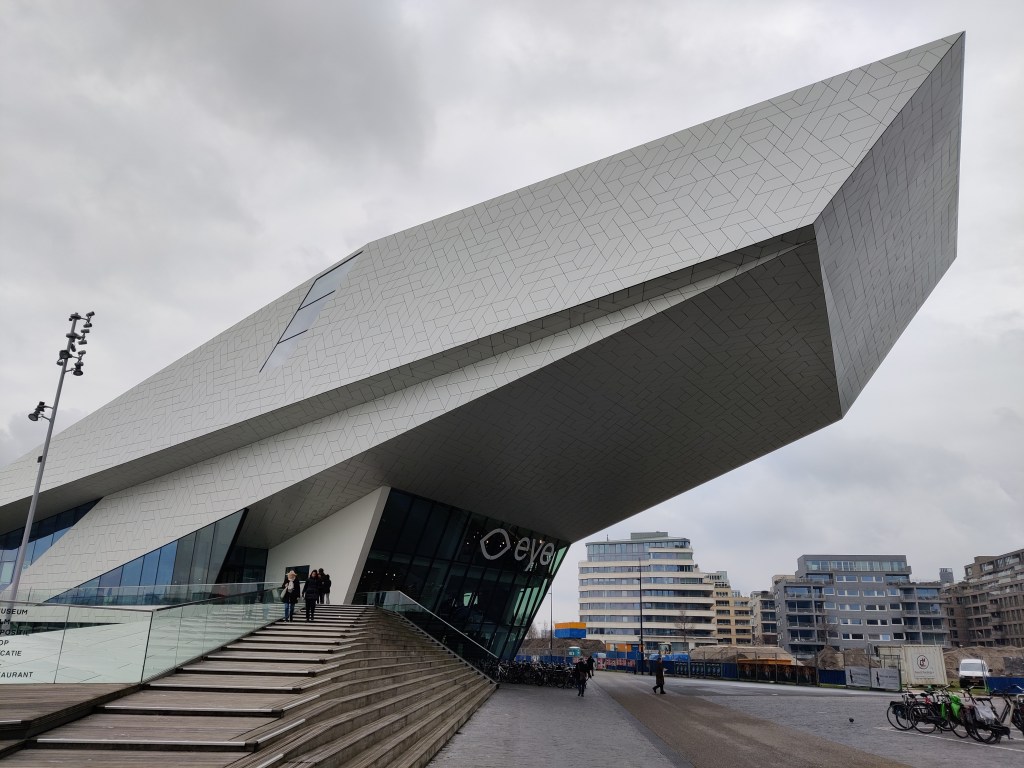
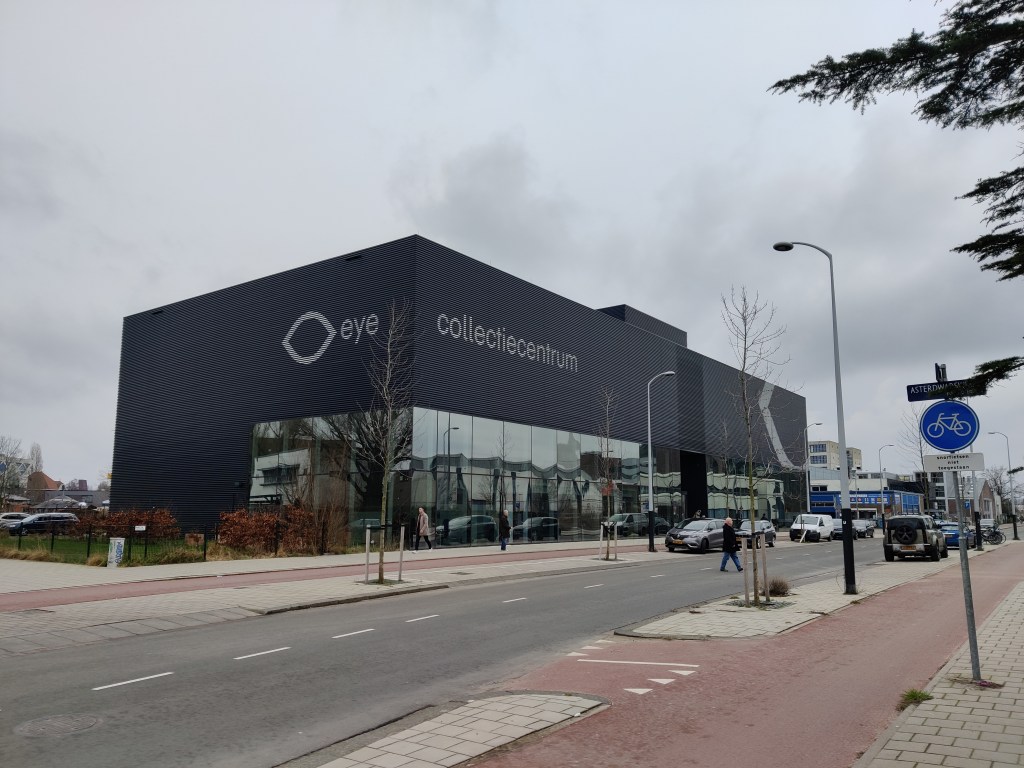
This piece is inspired by a recent trip to Amsterdam to visit the archive of the Eye Filmmuseum. Here, their collection specialist Leenke Ripmeester was an exceedingly helpful host. She not only showed me a unique print of Gance’s first sound film but also introduced me to some fantastic online resources where I could research historical film distribution in the Netherlands. The most remarkable for me was “Cinema Context”, an amazing database containing information from the Dutch film censors and contemporary press reports. (Leenke told me that she herself, in her student days, was part of the team who collated the data from contemporary documents.) It strikes me as a fabulous project, one that I wish every country would pursue. This, together with the newspaper archive, proved tremendously useful in revealing how, when, and in what form Gance’s films were shown in the Netherlands during the 1920s-30s. What follows is a brief account of my visit to the archive that afternoon, and what I have discovered about Gance’s silent and early sound films in the meantime…

Films produced by Le Film d’art (1915-1917)

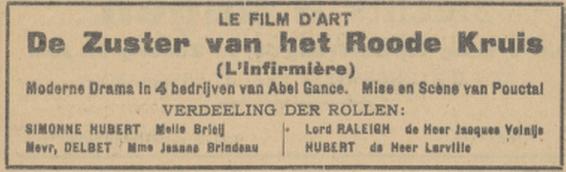
The earliest reference to Gance’s name in the Netherlands press is in 1915, when he had started working for Louis Nalpas’ production company Le Film d’art. His first assignment—as scenarist—was Henri Pouctal’s L’infirmière (1915). The film was released in the Netherlands and the adverts even featured Gance’s name alongside that of Pouctal (see below, from the Arnhemsche courant (17 June 1915)). Thereafter, Gance assumed the direction of his own scripts, and Le Film d’art productions seem to have been distributed in the Netherlands throughout the war years.

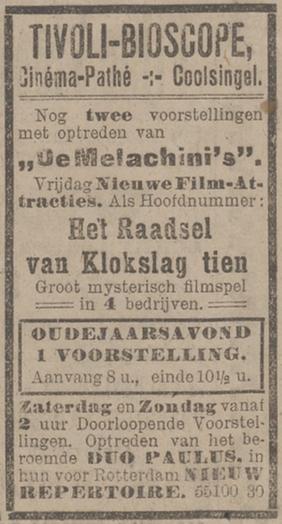
L’Énigme de dix heures (1915). First released in France in August 1915 in a version of 1200m. First shown in the Netherlands in December 1915 under the title “Het Raadsel van klokslag tien”.

La Fleur des ruines (1915). First released in France in late 1915 in a version of three parts (sometimes listed as four parts). First shown in the Netherlands in November 1915 under the title “De Lelie der puinen” or “Een lelie tusschen de puinhoopen”. There is no known length listed for the French version, but the Dutch censors record the length as 900m. (This is the first time Gance is mentioned by name in the reports.)

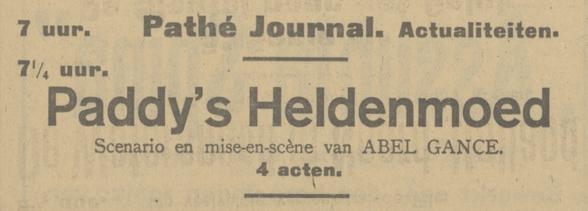
L’Héroïsme de Paddy (1915). First released in France in October 1915 in a version of three parts. First shown in the Netherlands in January 1916 under the title “Paddy’s heldenmoed”. There is no known length listed for the French version, but the Dutch censors record the length as 1200m. An advert in the Arnhemsche courant (26 January 1916) describes the film as being in “four acts”.

Le Fou de la Falaise (1916). First released in France in January 1916 in a version of 1180m in three parts. First shown in the Netherlands in May 1916 under the title “De Gek van de klippen” or “De Dwaas van de rotsen”. Dutch censor also gives length as 1180m.

La Droit à la vie (1917). First released in France in January 1917 in a version of 1355m (some filmographies say 1600m). First shown in the Netherlands in March 1917 under the title “Een Kind uit het volk” or “Het Recht om te leven”. Described by the censor as a “social drama in four acts” with the original act titles: “1. De brand, 2. Oproer, 3. Haar offer, 4. Uitgestoten”.

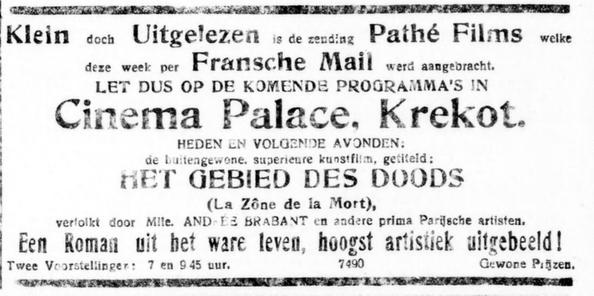
La Zone de la mort (1917). First released in France in October 1917 in a version of 1535m. First shown in the Netherlands in July-August 1918 under the title “Het Vuur” or “Het Gebied des doods”.

Barberousse (1917). First released in France in April 1917 in a version of 1600m. First shown in the Netherlands in December 1921 under the title “De Bende van Barbarossa”. Dutch censor gives length as 1700m (100m longer than Gance filmographies state). After a much-delayed release in Leiden in December 1921, the film was then rereleased in Rotterdam in April-May 1922.

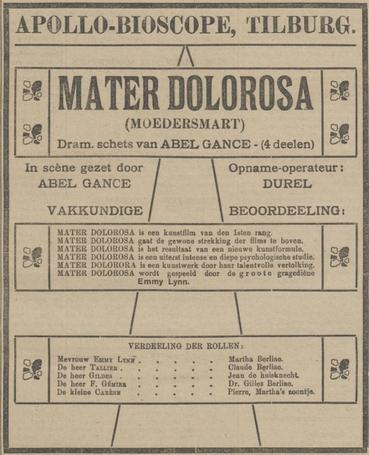
Mater Dolorosa (1917). First released in France in March 1917 in a version of 1510m. First shown in the Netherlands in April 1917 under the titles “Vrouwennoodlot”, “Een Moederhart verloochent zich niet”, or “Moedersmart”. Dutch censor gives length of 1344m and an age certificate of 18+. (This is the first Gance film I have found in the Dutch records to be given an age rating.) The film was rereleased in the Netherlands in June 1920 and again in February 1924.

La Dixième symphonie (1918). First released in France in November 1918 in a version of 1510m. First shown in the Netherlands in October 1919 under the title “De Tiende symphonie”. The release date suggests the film was shown in the wake of J’accuse, presumably to capitalize on the latter’s commercial success (see below).

Films produced by Pathé (1919-23)

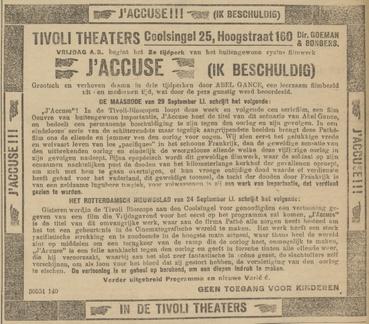
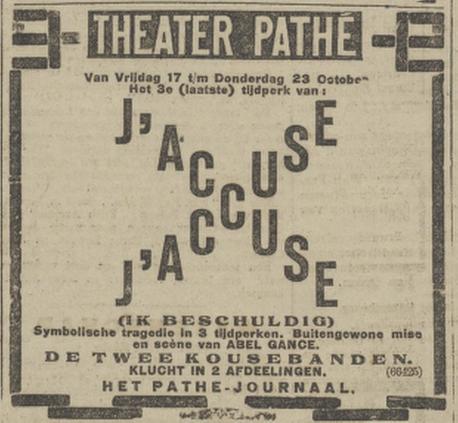
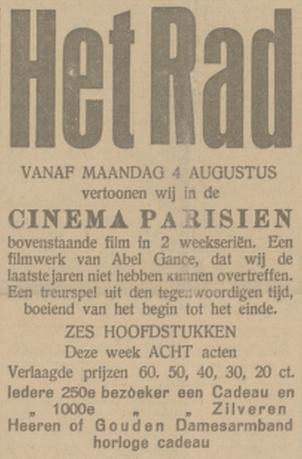
J’accuse! (1919). First shown in France in March-April 1919 in a four-part version of 5250m, released generally in a three-part version of 4350m, rereleased in a version of 3200m in 1922. First shown in the Netherlands in September 1919 under the title “Ik beschuldig”. Censorship records record the length as 4500m (150m longer than Gance filmographies state), divided into three parts. The film evidently had a wide release across the Netherlands, as there are records of screenings in various locations from late 1919 through to September 1920.

La Roue (1922). First shown in France in December 1922 in a six-part version of 11,000m, released generally in a four-part version of 10,495m, then rereleased in 1924 in a two-part version of 4500m. First shown in the Netherlands in a two-part version of 4632m in March 1924 (The Hague). Gance filmographies state the length of the two-part version (which Pathé intended to be the standard export version of La Roue) as 4200m or 4500m, but the Dutch records give a precise length. The records note the title of part two as “De Witte symphonie”, which matches the evidence that the 1924 version was divided into “La Symphonie noire” (part one) and “La Symphonie blanche” (part two). The Dutch censor gives an age certificate of 18+ for La Roue for “ongezonde, krankzinnige vertoning” (i.e. “unhealthy” displays of “mad” behaviour). The film was successful enough to be rereleased in the Netherlands in March 1925 (Amsterdam and Rotterdam) and again in February 1927 (Leiden).

Au secours! (1924). First released in France in October 1924 in a version of 900m. A 752m version of the film was passed for censorship in the Netherlands in October 1928 under the title “Max Linder en het spookslot” but there is no indication that the film was exhibited. The Dutch censor gives this film an age certificate of 18+ for “griezeligheden” (“creepiness”!).

Napoléon, vu par Abel Gance (1927)

Well, such are the complexities of this film that it needs its own section. Napoléon was first shown in France in April 1927 in a version of 5200m with triptych sequences (the “Opéra” version), then released in May 1927 in a version of 12,961m without triptychs (the “Apollo” version); subsequently prepared for international distribution in a version of 9600m with triptychs (the “definitive” version). First shown in the Netherlands in August 1927, then rereleased in March 1929 and September 1931.

Given the innumerable different versions of the film released in 1927-28, many without supervision by Gance, it is difficult to tell in what form Napoléon was exhibited in the Netherlands. It is possible that the version shown in August 1927 was the same version seen in Berlin in October 1927 and subsequently released in central Europe through UFA. This version was around three hours, which would accord with the Dutch records providing a length of 3946m (170 minutes at 20fps) for Napoléon. However, the film’s Dutch premiere in The Hague predates the first censorship records from March 1929. Though the length of the film is given as 3946m, there are also separate records for two “episodes” of this version: part one is 973m, part two is 1033m (i.e. a total length of only 2006m). The censor records six cuts were made to the version shown in 1929, due to “schijn van ongeklede dames” (i.e. scantily-clad women). The 1931 file states the film has two “episodes” that pass without cuts. For its screenings in 1929, the exhibition records reveal that Napoléon was shown in a programme that also included several films by Walter Ruttmann: the avant-garde shorts Opus II (1922), Opus III (1924), and Opus IV (1925), together with his feature documentary Berlin: die Sinfonie der Grossstadt (1927). Given the potential length of this programme, it would indicate that only a severely reduced version of Napoléon was shown in 1929—perhaps even a version amounting to extracts of the major sequences.

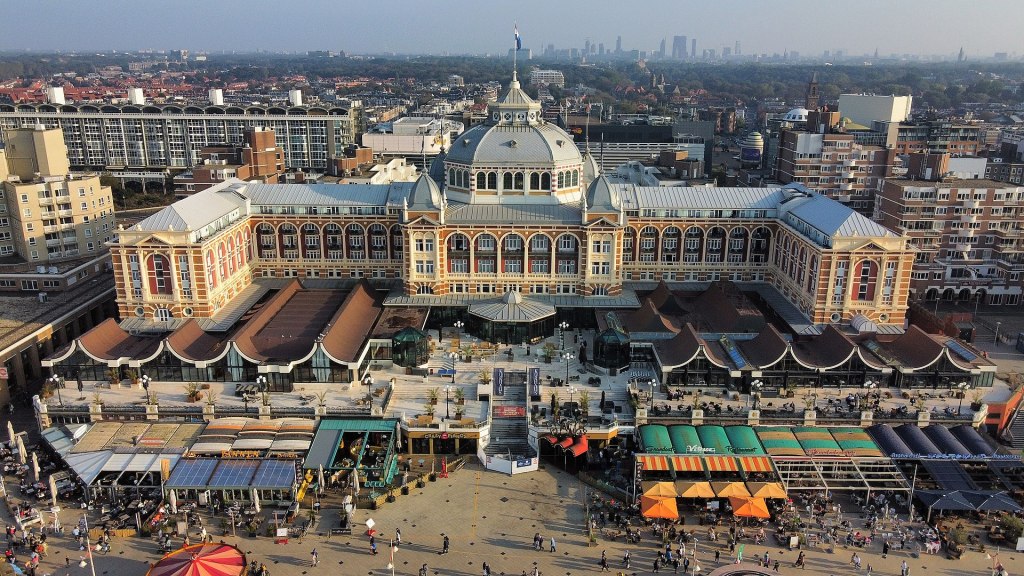
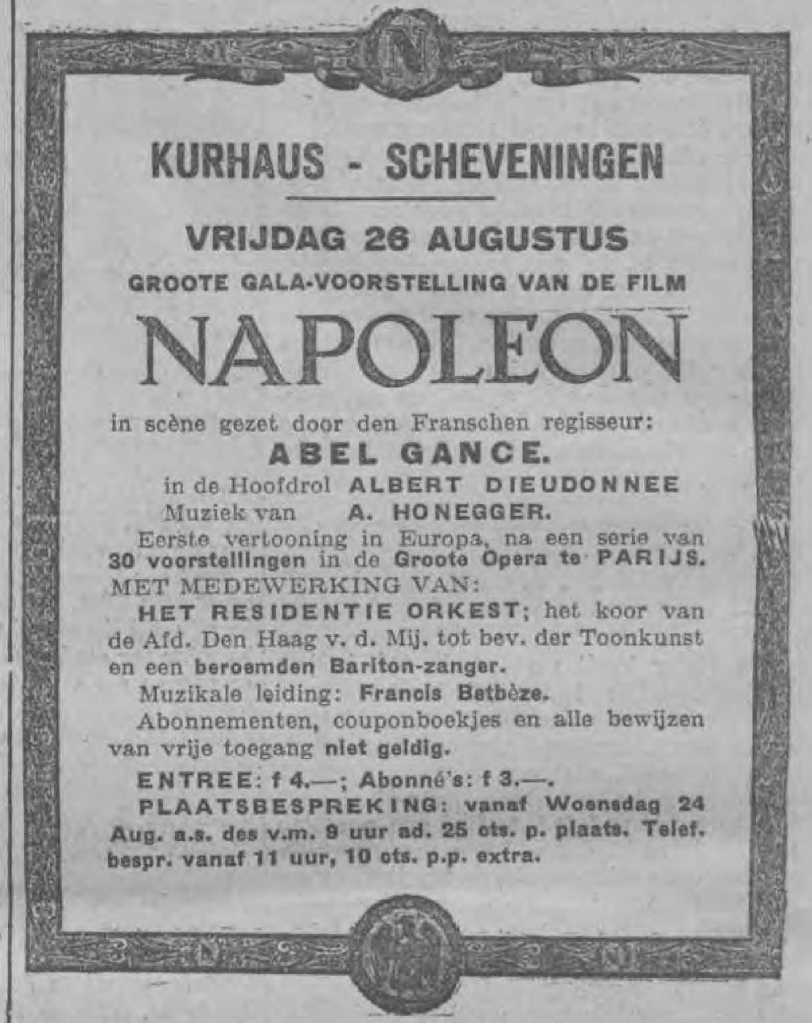
But it is the film’s first exhibition in the Netherlands that intrigues me most. Contemporary reviews indicate that the version of Napoléon shown there in 1927 measured 4000m (De locomotief, 1 October 1927; De Telegraf, 27 August 1927), which accords with the 3946m length given in the censorship records. This version had its gala premiere in the Kurhaus, The Hague, on 26 August 1927. It was clearly a major screening in a grand location (see an image of the venue below).

Musical accompaniment was provided by the 82-man resident orchestra and the 40-strong chorus of the Haagsche Toonkunst, together with the baritone Tilkin Servaes (Het Vaderkabd, 13 August 1927). The conductor was due to be Francis Betbèze, but he was ill the day of the premiere so was replaced by a Mr. Schuyer. The score itself was that written and arranged by Arthur Honegger for the film’s premiere at the Paris Opéra in April 1927. Before reading the Dutch press reports, I had no idea that Honegger’s score was ever performed outside of France in 1927. It must have been specially arranged by Betbèze or Schuyer, because Honegger’s score was designed to accompany a longer version of the film (the Opéra print ran to 5200m, 1200m longer than the Netherlands version). There was also the inherent issue of the score being a rushed and unsatisfactory project. Reviews of the premiere performance in Paris describe Honegger’s music as being badly performed (as well as poorly arranged) and often clashing with the film. This isn’t surprising, given that Honegger walked out on Gance before he had finished work on the score—there were doubtless last-minute changes in editing that meant the music had little chance of synchronizing throughout. So how did the music fare in The Hague performance?

The review of the premiere in De Telegraf (27 August 1927) indicates that the music was as much a failure here as it had been in Paris. Due to bad timing (whether due to projection speed or musical error), the solo baritone had to sing the Marseillaise “at a gallop”. The choir was likewise “forced to sing at a tempo apparently much faster than it had rehearsed”. But this was only one instance of a general problem:

Honegger’s accompanying music has not taken any further steps in solving the problem of film music. One does not get the impression that this music was composed especially for the film. On the contrary. Scenes in which the obsessive violence of revolution can be seen on screen are sometimes accompanied by an idyllic duet of two flutes. Modern and modernist sounds are unleashed on the film when a piano is seen on screen: the piano is represented by a celesta while the orchestra plays Mozart’s B-flat aria from The Marriage of Figaro. No trace of style. Indeed, in many places the music destroyed the mood evoked by the film images. The last act of the film is apparently not accompanied by Honegger’s arrangement. The potpourri then performed has a cheap allure. Thus, the performance ended in a vocal and instrumental debacle. Music synchronized with images: this ideal was a long way off from the premiere of Napoleon!

These are much the same issue cited in the performance of Honegger’s music in Paris. Doubtless, the textual changes to the 4000m version shown in The Hague exacerbated the existing issues with synchronization in the score. But the mere fact that Honegger’s original score accompanied the film is itself an indicator of the effort put into the exhibition of Napoléon in the Netherlands. The press reports feature photos of Gance, and the reviews repeatedly use the word “masterpiece” in their advertisements. However flawed its musical presentation, the film itself made a critical impact.

One last note to add to this section is the fact that Jean Arroy’s documentary Autour de Napoléon (1928) was also shown in the Netherlands. It was first released in France in February 1928 in a version of 1200m. It was released in the Netherlands in May 1928 (at the Centraal Theater, Amsterdam and the Corso cinema, Rotterdam). That it was exhibited at all in the Netherlands indicates that Napoléon generated public interest. After all, various versions of Napoléon continued to circulate there throughout 1927-31.

La Fin du Monde / Das Ende der Welt (1931)

The history of La Fin du monde is exceedingly complex. (For a full account of the production and its context, I refer readers to my book on the subject.) In brief, before surrendering control of the editing to his producer, Gance assembled a version of 5250m (over three hours). The version that was ultimately released was only 2800m (c.100 minutes). It was first shown in Brussels in December 1930, then began its general release in France in January 1931. The German-language version, Das Ende der Welt, was first shown in Zurich in January 1931, then began its general release in Germany in April.

When La Fin du monde is first discussed in the Dutch press, it is under the title “Het Einde der wereld”, the literal Dutch translation of “La Fin du monde”. The Paris correspondents of various Dutch newspapers reported on La Fin du monde and highlighted all the faults that other critics noted (exaggerated performances, poor sound, inept editing). Given that both the film’s production company (L’Écran d’art) and its main distributor (Les Établissements Jacques Haïk) went bankrupt by the end of 1931, it’s not surprising that La Fin du monde was not taken up by distributors in the Netherlands at this stage. A comment in Het Vaderland at the end of the year summed it up well: La Fin du monde “has not yet been shown in our country, but in Berlin it has already sunk like a brick” (19 September 1931).

Although the film was not yet released in the Netherlands, the French-language version had been submitted to the censor in March 1931. I was very intrigued to discover that these records give a precise length for La Fin du monde of 2906m, longer than the 2800m usually cited in filmographies. The files show that the film was given an 18+ rating, describing the film as “sensational, exciting, confused” and included a “banal image of suffering Christ”. Six cuts were made, all of them to the “orgy” sequence near the climax of the film. (One gets the impression of a protestant sensibility in the Dutch censors’ office.) But despite being passed for release, La Fin du monde was not shown in the Netherlands in 1931.

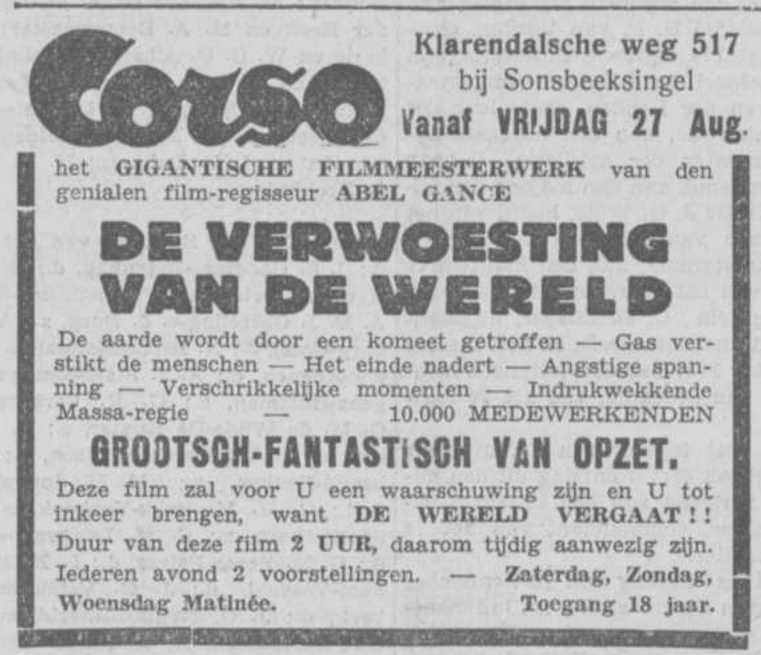
There is a second file from May 1935. The film is now referred to as “Het einde der wereld”, the literal Dutch translation of the French original. But the film is still not released. In December 1935, the film once again comes before the censor—this time under the new title “De Verwoesting van de wereld”, i.e. “The Destruction of the World”. However, the print being submitted is not the French-language version of the film, but the German-language version: Das Ende der Welt. The censor again gives the film an 18+ rating for the film’s “sensational tenor and frivolity”. Two cuts are recorded, totalling 76m of footage. (No content description is given, but one presumes it was the same orgy sequence that again brought out the scissors.)

In June 1936, over five years since it was first shown in Switzerland and Germany, Das Ende der Welt was finally released in the Netherlands under the title “De Verwoesting van de wereld”. It was shown at the Roxy cinema in Leiden, then in various other cities across 1936-37. Why did it take so long for the film to reach the Netherlands? One reason is that the film was such a flop in 1931 that it was perhaps wise to wait until the memory of its failure had faded. For by 1936-37, newspapers were announcing “De Verwoesting van de wereld” as if it were a new production. (Perhaps the title was changed precisely to dissociate the film with its original release.)

The Arnhemsche courant, for example, carried a hyperbolic advert announcing the “gigantic film masterpiece by the genius director Abel Gance” (26 August 1937). The tone of the Dutch press pieces strongly echoes the advertisements in the German press in 1930-31, which also emphasized the scale of the spectacle and the numbers of extras. It is worth noting that it was Viatcheslav Tourjansky who had supervised the editing of the German-language version of Gance’s film. Very little is known about how either the French or German prints were assembled for their release, so the existence of “De Verwoesting van de wereld” is a significant piece of evidence. The adverts for its release in 1936 say the film lasts two hours, though the censor record of 2906m suggests an actual time of 105 minutes. However, with a fifteen-minute interval, you can easily imagine the film becoming a two-hour showing.

There are surprisingly few reviews that I can find from 1936-37, and none of anything like the length of the reviews sent from Paris correspondents to the Dutch press in 1931. The Nieuw weekblad voor de cinematografie calls it an “exciting film” and reassures its readers that the epic story is in the “safe hands” of Abel Gance (17 April 1936). (I think this is the only time I’ve ever seen Gance referred to as a pair of safe hands!) The Dagblad van Noord-Brabant mentions the film’s scale and number of extras but offers scant comment on its quality (20 February 1937).

But thanks to the Eye Filmmuseum, I can at least offer some comment on “De Verwoesting van de wereld”: for a print of 830m (thirty minutes) is preserved in their collection in Amsterdam. I had long thought that no copy of the German version of Gance’s film survived. (I had even said so in print!) So I was incredibly excited to see even this fragment of Das Ende der Welt. The print had Dutch introductory credits and Dutch subtitles, but the soundtrack was most definitely in German. For this, I knew from my earlier research that the main performers (Abel Gance, Victor Francen, Samson Fainsilber etc) had been dubbed by German actors. Only one actor was recast for the German version: Wanda Gréville (credited as Vanda Vengen) replaced Colette Darfeuil from the French version. (Gréville was English but spoke German fluently. She was also intended to shoot scenes for an English-language version of the film, but this version was never assembled in 1931. The version of the film released in the US in 1934 was the French version with English title cards and subtitles.)

Sadly, the first third of the film is entirely missing from the Dutch copy, so there is no sight of Gance as Jean Novalic at all—I had so hoped to hear what he sounded like in the German dub. But Victor Francen as Martial Novalic is there, dubbed in authoritative German. I also spotted at least two scenes featuring German dialogue recorded live on set (i.e. not dubbed), but only with minor characters. Most of the Dutch print consists of the climactic scenes of the comet approaching: we see crowds fleeing in panic, nature running amok, extreme weather etc. Amongst this material are several shots that do not survive in the French version, but nothing significant. Sadly, there is no sign of Wanda Gréville. I had also wondered if there were any extra scenes missing from the surviving French-language copies of the film. The recent Gaumont restoration of La Fin du monde runs to 94 minutes, several minutes short of the prints shown in 1931. But aside from a few very brief shots, there are no major discoveries in the Dutch print. (The only shot that was suggestive of a missing sequence was one shot of Martial Novalic behind-the-scenes at the “Universal Convention” in the last minutes. Assuming this is him after he makes his grand speech, it would belong to the scenes in which he is—according to the script—finally reunited with Geneviève.)

Though it is only a fragment of “De Verwoesting van de wereld” as it was shown in 1936-37, the surviving Dutch print survives in very good visual quality. The viewing copy I saw was an acetate dupe of the 35mm nitrate print held in the archive, so the original should look even better. The 35mm print was part of a private collection of reels purchased by the Eye Filmmuseum in the 1960s. No further information is known about the history of this particular print, or how it ended up being reduced from c.105 minutes to just thirty.

Summary

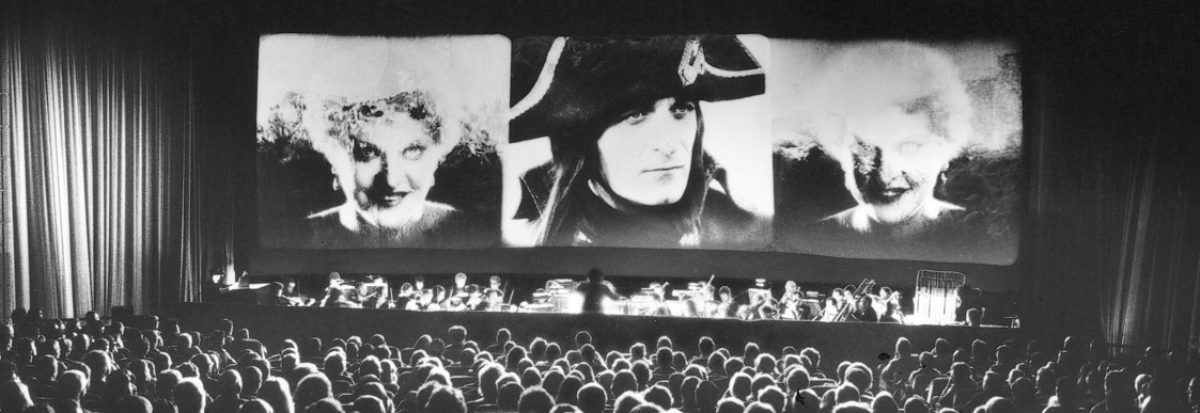
This was only my second trip to Amsterdam. The first was in 2014 for a screening of Napoléon at the Ziggodome. Here, the film was projected on 35mm and accompanied by Carl Davis conducting the Het Gelders Orkest. This was the most extraordinary performance of the film I have ever seen. For the final triptych, the three screens measured a total of forty metres wide and ten metres tall.

My trip to the Eye Filmmuseum to see the fragment of Das Ende der Welt on a small screen was less spectacular, but nevertheless rewarding. I knew nothing about the print until revisiting the FIAF database in 2021. The mere existence of the print is a miracle, especially as it led me to explore the wonderful Dutch archive sites and discover all kinds of new information on the distribution of Gance’s films. It just proves to show how much more can be gleaned if only you know where to look. And I do hope more of any version of La Fin du monde turns up. (Of course, the mythical three hour cut that Gance assembled would be a dream, but the chances of it existing at all are infinitesimally small.) I have just seen that Kino is to release the recent Gaumont restoration of La Fin du Monde on Blu-ray in North America. Sadly, there are no new extras. Will someone be keen enough to offer a UK release? If so, I can certainly recommend at least one extra: the Dutch print of Das Ende der Welt. (And I know at least one person who’d be keen to do another commentary track. Ahem…)

My thanks once again to Leenke Ripmeester for her time and help within and beyond the archive.

Paul Cuff

Abel Gance and Charles Pathé: Correspondence, 1918-1955

Hello again, and welcome to life after Pordenone. After the hectic schedule, it has taken me a while to find my blogging feet once more. (Additional context: we are also redoing the kitchen.) As today is Abel Gance’s 133rd birthday, it seems fitting to post something on a Gancian theme. What follows is a kind of review of a recent(-ish) book. I had intended to submit a proper review of it to an academic journal last year, but for various reasons this never happened. I use the opportunity of this anniversary, and of this blog’s more informal setting, to resurrect it for your reading pleasure.

Abel Gance-Charles Pathé: Correspondance, 1918-1955, ed. Elodie Tamayo (Paris: Gallimard, 2021)

In 1918, Abel Gance was flush with the commercial success of a series of short, commercial feature films made for the Film d’Art company under the aegis of Louis Nalpas. But the war was in its fourth year, and Gance was dreaming of bigger projects. Enter the largest name in the French film industry: Charles Pathé. Pathé’s name was the leading brand of French film. By 1918, he employed thousands of staff and had offices across the world—not to mention laboratories, studios, theatres…

“On January 21 in Nice, I see Charles Pathé”, writes Gance in his journal. “Conversation of an hour and a half. Great affability. Main points: certainty of my cinematographic future. I am at the top of the list of European directors.” Pathé tells him: “My house is always open to your talent” (qtd in Ede 2020, 9-10). What follows is the correspondence detailed in Tamayo’s edited volume.

Of the 210 letters contained in the book, 132 of them are written by Gance. His letters are generally longer—sometimes hugely so—than those from Pathé. As François Ede observes, Pathé’s letters to Gance bear “the mark of paternal affection with which he surrounds his protégé” (2020, 19). Gance always signs off with the phrase “all my devotion” or “my unfailing and profound devotion”. The words are those of disciple, or earnest child; they are also trying to make a bargain, to invoke pity or aid. Tamayo breaks down the correspondence into three broad sections, and to make things simple I will follow suit:

(Dés)espoirs de la fin de guerre: 1918-1919

As Tamayo explains in her introduction, in March 1918 Gance founded Films Abel Gance, and Pathé gave him carte blanche to pursue his projects (19). That month, Gance writes that his conversations with Pathé are “for me an unheard-of attraction not of utopian dreams, but of solid anticipations. They are for me, and I insist, decisive moments where the social future of the cinema has played its first card. […] My will reaches out towards a gigantic goal” (37). It’s the kind of thing one would write in a private diary, but Gance shares it with Pathé. As he would do throughout his life and work, Gance peppers his early letters with literary and philosophic quotations as a means of sharing, imploring, showing-off. In letters to Pathé, we encounter lines from François de Malherbe and William of Orange, just as Gance would later quote Schuré and Nietzsche in the hope of persuading other financiers to give him money. But Gance doesn’t hide behind his quotations; they are an invitation to see into his inner life, to link a singular goal to wider cultural ones. Pathé is attracted by Gance’s ambition, but ever practical. Their letters proceed to discuss the nature of nitrate, the possibilities of colorization, of tinting methods, of camera speed and lighting (39-41).

March 1918. Films Abel Gance embarks on its first project: Soleil Noir, subsequently renamed Ecce Homo. Gance sends the familiar reassuring boasts to Pathé: “We will obtain immeasurable results with Soleil Noir. The era of cinema will begin” (43). Everything he says, he means in earnest; he underlines his assertions, quite literally on the page, with key phrases emphasized for Pathé. Even when the production of Ecce Homo breaks down later in the spring of 1918, he pursues the next (La Fin du Monde) with equal conviction: assuring Pathé that when he speaks of another unparalleled success, he says so “with absolute certainty” (44-45). La Fin du Monde will be in ten episodes of 1200m (a total of ten hours on screen), the first overestimation of a project that will take another dozen years to realize and that will ultimately destroy his career in 1930-31.

May 1918. Here is Gance writing to Pathé to argue for the absolute control of his film La Dixième symphonie in exhibition. It has had a special score written to accompany it, and Gance insists the film “must be seen and heard in its entirety with music of Maurice-Lévy” (46). (The score has never been performed since, though a few seconds of a piano part were played on French radio in 1955, while Gance and Maurice-Lévy reminisced about their collaboration.) Gance writes the way a youth writes to impress his peers, his teachers. He boasts that he has “something of Nietzsche’s will in my veins” (47), but he abandons Ecce Homo. Three hours of rushes survive. The pictorial quality is astonishing, printed from the original camera negative. But it’s left behind, together with a debt of 50,000F; Pathé pays it off and gives Gance the green light for yet another wild scheme: a triptych of films on the war (50n).

June 1918. Gance is shooting near Nice, near Marseille (59). He is filled with inner belief. He tells Pathé that in him “I have found the most formidable force capable of disseminating my thoughts throughout the world, [and that] you believe you have found in me a writer for the eyes” (64-65). But Gance has an eye on the practical as well as the philosophical. He sends Pathé a letter the size of a manual on technical specs that he wants from studios, from technicians; he specifies the space he needs, even the voltage of electronic circuits he wants (67-72). Mid-production on J’accuse, Gance is still monitoring the exhibition of La Dixième symphonie, once more begging that the original score be shown during screenings: the film was conceived “as a particular attempt to ally music with the screen” (70); Pathé obliges (74).

August 1918. Gance is besotted with the cinema. From the sun-soaked landscapes around Marseille, he sends Pathé his vision:

The cinema is a miraculous beacon, more powerful than the other arts that are nearing the end of their lives by extenuation. I am inexpressibly moved to think that one day I will be able to speak the same language at the same time to all my friends across the universe. […] To you I will owe this wonderful diffusion. I hope to thank you for bringing back to cinema a spiritual prestige that it still lacks and that will make it the most prodigious instrument of internationalization in the future. (71)

Pathé is pulling strings, mobilizing his contacts. He enables Gance to inspect and use footage from the Army Cinematographic Corps (75-77). By October 1918, Gance finishes the exteriors for J’accuse on the Côte d’Azur (82).

November 1918. Gance puts words into Pathé’s mouth: “You sense that I have a clear vision of the future of cinematography and the result of our collaboration can only result in excellent things for our nascent Art” (84). He spells out the need to realign the way artists and industrialists work together: “There are effectively not enough links between directors and producers in France. Often one speaks commercially, industrially, and technically—but almost never spiritually. This, I repeat, is the foundational sin in France” (84). The war ends. In December, Gance finishes shooting J’accuse (87). But the notion of the “foundational sin” of cinema’s mercantilism nags at Gance, and in later years the sense of betrayal will dominate his mindset.

When J’accuse! is released in the spring of 1919, Gance sends Pathé a long letter discussing—and complaining, and demanding—conditions for its success, for the success of European cinema in the market dominated by America (97-102). But his concerns are also turned upon France itself. In May 1919, Gance despairs how D.W. Griffith’s Intolerance (1916) is being received in France: “Intolerance has absolutely no success here. The film provokes a scandal; we laugh and whistle. Decidedly, the French do not yet understand the best cinema.” (112) This, too, is the seed of a despondency that will grip Gance by the end of the 1920s: that even the public might turn upon its cultural benefactors. What’s more, Pathé writes and explains how difficult it is to get J’accuse picked up by distributors in the USA: he predicts a long delay before the film is released there (113-18). (Later, he reports that the reaction of the board of Pathé Exchange to a preview screening of J’accuse was negative (158).) Gance wanted his film shown abroad, but worried over how J’accuse was being exhibited. In 1920, he complains about the English translator of intertitles for J’accuse, Sir Max Pemberton. “No-one must touch J’accuse except me” Gance demands (188-89). (A few of Pemberton’s lines survive in contemporary trade adverts for the UK release of J’accuse. When TCM broadcast the film in a new restoration in 2007, new English-language titles were made for the American television version. I suggested that, since the original French titles were not being used for the broadcast, they use the surviving UK titles from 1920. This was fine for the broadcast, but much to my regret, Pemberton’s purple prose still inhabits the final few minutes of the DVD subtitles under the superior French originals: Diaz’s tirade against the sun remains as distorted in English as it was in 1920.)

August 1919. Gance is convalescing in the Alps. In the winter of 1918-19, both he and his fiancée, Ida Danis, have caught bronchial illnesses, possibly tuberculosis—possibly from their time shooting J’accuse among the frontline troops. He is planning a film calling “Le Rail”, with which “we will reveal the new formula of cinematic art of which this [film] will be the starting point” (119). His thoughts turn to Griffith. He reflects on the trade strategy for the release of Broken Blossoms (1919), the first production marketed as a “super film” with a slow roll-out across the USA and beyond into Europe (120-21). Gance is concerned to protect his work from interference, from commercialism. He guides his films through production and beyond: “I always insist like a father who knows what’s best for his child” (126). How to protect the art of cinema? Gance wants to build a new cinema theatre for showing his own choice of films: opera films, avant-garde shorts, documentaries, scientific films (130-33). In September, he writes to Pathé about how cinema should advance itself. There should be programmes “to enhance and affirm the prestige of Film as an international language and instrument of scientific and social propaganda” (131). Gance is planning a version of Don Quixote with Frank Keenan in the lead; or else a project called Entre l’est et l’ouest, a film about reconciling the New World with the Old; or else a book of film theory, to be called Les Antennes de l’art muet; or else a meeting with President Wilson, to advance cinema in tandem with the League of Nations (136-39). Can Pathé oblige? Gance makes plans regardless. His projected “Grande Salle de l’Art Cinématographique” is envisioned in tremendous detail: he details the kind of frontage space he wants, mentions possible architectural candidates. Inside, he wants to create “luminous symphonies”: great, shifting kaleidoscopes of colour upon the screen, produced by a kind of light-producing keyboard, like an organ (145-52).

Pathé listens. He is a patient man, thus far. It is he who advises Gance to cast an English actor to ensure the commercial success of La Roue, as “Le Rail” is now called (142). He also arranges for Frank Keenan to agree to a gap in his working schedule to go to France and work with Gance on Don Quixote (162). But in response to the Grande Salle project, Pathé simply pleads exhaustion: his doctor has ordered him a total rest for one month. The Grande Salle idea is too ambitious, too enormous to contemplate. Pathé urges Gance to accept the new world market dominated by the USA (163-65). Writing from across the Atlantic in November 1919, he tells Gance: “To be seen with any clarity, the question of cinema must be seen from New York […] France, believe me, counts and will count for very little in the national film industry. […] The world market is here [in America] and can never be anywhere else” (164-65). Gance replied, saying he too senses the shift in the commercial landscape (166). But would he admit the consequences?

Puissances des années 1920: 1920-1926

As Tamayo highlights, the second part of the Gance-Pathé correspondence begins at a crucial historical juncture in the film industry in France. By 1918, Pathé was already aware that the Great War had fundamentally changed the film industry. In the years before the war, the French industry calculated that 90% of all films being shown in the world were French. Within a year of the outbreak of war, this figure had dropped to between 30% and 35%. By 1917, over 50% of films shown in Paris were American and by 1919 only 10-15% of films being shown in Paris were French. One study calculated that for every 5000 metres of French films being presented weekly in France, there were 25,000m of imported films, mostly American. The response of many industry moguls in France was to devour what was left of their own industry for short-term gains: buying cheap American imports in the hope of achieving profit. It cost between 0.18 to 0.35 centimes to export each metre of film to the US or the UK, whereas it cost only 0.02c to import one metre of film from America (Abel 1984: 10-13). This is the context in which Gance and Pathé begin to correspond.

When Gance embarked upon La Roue in 1919-20, Pathé had made the decision to cease producing films. In the space of a few months, Pathé’s company shifted identity: in September 1920, “Pathé” became Pathé-Cinéma, then in February 1921 Pathé-Cinéma became Pathé-Consortium-Cinéma (224n; see also Ede 2020, 21). Pathé would make profit on films being produced under his brand, but all productions would be handled by associated producers and subsidiary companies.

February 1920. Pathé meets Gance on location during the shooting of La Roue (169). Their encounter is caught on film by Blaise Cendrars (in Autour de la Roue, 1923). The footage shows Pathé at close quarters with Gance, gesturing and looking concerned. What’s being discussed? Is Pathé anxious? As François Ede, the restorer of La Roue, points out, Gance was hiding the extent to which La Roue had outgrown its contracted form: a film intended to be 1500m was to end up 10,000m long (2020, 35). For Pathé, this would be a watershed moment. Gance was the man he had supported and whose projects he had backed despite numerous delays and industrial pressures. After La Roue, things would be different: “The trust he had shown in him until then is shaken and he is tired of the filmmaker’s unpredictability” (Ede 2020, 41).

April 1920. While the film grows in length, Ida Danis is undergoing an operation on her lungs. Gance’s subsequent dedication to her in the opening credits of La Roue calls her “ma femme”, implying “wife”, but they never married. Perhaps Pathé was unaware, for he refers to Danis as “Madame Gance” in the letters of this time. Gance lists excuses for the delay in finishing La Roue: “Mme Gance’s” illness, the currency exchange paying Ivy Close (she earns £150/week), Séverin-Mars leaving to shoot L’Agonie des aigles (Dominique Bernard-Deschamp & Julien Duvivier, 1922) (196-97).

As Tamayo’s notes make clear, the production was also moving geographically. Abandoning the railyards around Nice and Marseille, they went to the slopes around Mont-Blanc, then to Cambo-des-Bains, and finally to Arcachon on the Atlantic coast, where a local casino was turned into an impromptu studio to finish filming (209n, 211n). Gance set up home in the Villa “La Bruyère” in Arcachon. Here he contemplated the meaning of his film and his art: “The action of the image is not solely upon the eyes; there is a profound reflex on the heart and soul of the crowd. It is to provoke this reflex that directors must apply themselves” (221).  Meanwhile, Pathé’s company was undergoing the changes detailed earlier. No longer could Gance assume that Pathé would grant his wishes: he now had the directors of Pathé-Consortium-Cinéma to appease, and there were the first of many tussles over his contract.

July 1922. Gance is being pressed about the delay finishing La Roue; he writes to Pathé to complain (225-27). But what can Pathé do? The film is released in a version of over eight hours. Its photography, editing, and emotive power are praised and criticized in equal measure. But it is a success. Gance boasts to Pathé that he has received over 500 letters of admiration from fans (237). (In the archives, some of these survive, including poems sent to him about the film.) Is this a relayed kind of thanks, or a gesture of defiance? The film succeeded because of Pathé’s initial backing, but despite the difficulties created by his company’s reformation.

October 1923. Gance writes a letter to Pathé that he never sends:

I want to act here for posterity. This letter will be made public in five years; posterity will give light to your name only because you added lustre to mine. […] If La Roue should die, you will take responsibility for this catastrophe, because you didn’t want to see, you didn’t want to understand, you didn’t want to feel. […] You hid behind the stupid sensibilities of a mediocre bourgeois, refusing to listen to the thunder of the waves. (245-46)

Beyond the specific troubles producing and releasing La Roue, Gance’s anger seems directed at the broader challenges of cinema in the 1920s. Pathé’s decision to cease active production was seen as a kind of betrayal by some in the industry, but it was an inevitability. In his memoirs, written in 1940, Pathé revealed the logic behind this decision:

From now on, it was painfully clear that America, with its infinite resources, had conquered the global market—probably forever. The war had simply brought forward the date of this inevitable supremacy. […] I know only too well that many of us always nourished the hope that our films would get substantial receipts abroad—above all in the huge American market. But this was an illusion. (2006: 204–5)

Léon Gaumont followed suit and ceased active production in 1924. Making a deal with Metro-Goldwyn-Mayer (MGM), Gaumont’s French company became a subsidiary called Gaumont-Metro-Goldwyn (GMG). This was the company with which Gance would negotiate during the fraught release of Napoléon, an experience that altered the course of his career. Even in 1923, Gance no longer had faith in Pathé as the guiding light of cinema. Perhaps Pathé had also run out of patience with Gance.

December 1923. Pathé’s wife dies. Gance is preparing for the future. First, another series of films called Les Grands initiés, designed to be “the definitive event of the new silent language between peoples” (248). But in the meantime, Napoléon. Will Gance succeed in this vast project? “Know only that the radioactivity grows within me: the rest is nothing”, he tells Pathé in January 1924 (249).

November 1924. The film is written, the script the length of a novel—and it is only the first of six projected films. Justifying his aims, Gance quotes the philosophers. Pathé responds with an old adage: “Grasp it all, lose it all”. “In my opinion”, he warns Gance prophetically, “Napoleon is a hero enough to occupy an entire lifetime” (252-53). Gance responds with a vast letter. He claims enthusiasm will overcome all obstacles, that he can make all six films in a single year (253-58). “This work can only succeed by being a violent thunderclap precipitated by the rapid work and combined energies of all its participants” (255). More than this, Gance wants to reshape European cinema: “The future of cinema must be put back entirely into the sacred hands of Art […] What is necessary is an autocratic artistic power—active and uncompromising—in every state” (284).

Gaps begin to appear in the chronology. Months pass without word. Then the crisis. Gance’s production company, Westi, collapses. In August 1925, he sends an urgent plea to Pathé to ensure his film survives: “Defend Napoléon to the last—I beg you—victory is in sight” (301). But is it? Months pass and the film keeps filming.

May 1926. Gance writes of perpetual exhaustion: “this perpetual struggle that I must undergo in order not to be devoured by the incomprehension, the greed, the puerility, the malice, and especially the idiocy, of those who circle around me, who prepare for posterity a pitiful martyrology of all true European cinematic artists” (317). It is the mindset of a man besieged. The effort of getting Napoléon made feels superhuman, almost incomprehensible. The letters give us glimpses, flashes of chaos and triumph. Then in November 1926, the correspondence breaks off. Gance begins the editing of Napoléon. He doesn’t write to Pathé for two-and-a-half years.

Écriture mélancholique et rétrospection (1929-55)

What happened? Was something said? Was something not said? There survives a sporadically-written production diary from 1924-27, but this history of Napoléon is desperately sparse. In his notes from 1924-25, Gance mentions Pathé as an ally, and Pathé evidently helped when the film’s original production company, Westi, collapsed in 1925. When the new production company, Société Générale des Films (SGF), was founded, Pathé was a board member (alongside Léon Gaumont, the Comte de Breteuil, and the Comte de Béarn). But what was his role? What kind of opinion did he have on Gance’s methods and aims? Did he see the mammoth ten-hour preview version of the film? Or any version? The letters do not tell us. SGF certainly rescued Napoléon after the collapse of Westi, but Gance always credited Jacques Grinieff (the founder of SGF) as the film’s saviour. Gance ceased to write the production diary in 1927, so there is no more information about Pathé’s role during the decisive months when the film was previewed and exhibited—and then butchered.

April 1929. After a gap of two years, Gance writes an astonishing letter to Pathé:

Do not be surprised when you receive this letter. First, it has no ulterior motive. I wanted to write to you only when my new project was settled; now that this is accomplished, I have no fear that that you might attribute to opportunism what is dictated only by my feelings.

And now that we are a little further from the events that separated us, it should be permitted for me, not to justify myself—since I have long understood that on earth “greatness is more than just speaking from on high”, and that fundamental truth and devotion to its cause were interpreted as flaws in a mad, hypocritical society—but to tell you that your behaviour has been one of the greatest disappointments of my life. You have always, like me, been poorly supported, poorly served, misinterpreted, misguided. Venom has wound itself around you like a frontier, and I would love to know if you truly saw a friend anywhere in film, except me.

I counted on you: you the man and you the financier. That the latter abandoned me for more or less judicious reasons, I would have understood; but that the man deliberately ignored the gigantic effort I made to try to preserve a French cinema awash with idiocy and blandness, that he listened to the chorus of imbeciles and liars, that he did not sense what incredible battles I had to fight on every front at every moment, battles which I believe no one in France could sustain: this I simply cannot conceive.

I have a very clear conscience and that is why I am speaking to you so frankly. In Napoléon, I have made the best European film of the last ten years; just ask M. Byre, Director of the Metro, if my film in 3 parts has not broken all the rental records of all existing films to date, Ben-Hur [1925] excepted. I receive enthusiastic letters from theatre directors, from Brezillon down to the most obscure provinces, expressing their satisfaction and that of the public. This for me is my revenge; a little late, but profound. There is no great French historian who hasn’t written to me enthusiastically, there is no schoolboy who doesn’t retain my film better than any history lesson. What else can be said? Only words of hatred, stupidity, or envy.

I have put aside a whole file for you, which will surprise you when you see how right I was. But for a short-sighted administration, but for interference in my work, but for foreign pressure that exceeded my expectations; I was not in control, I had no autonomy.

I tell you all this, I repeat, not to exonerate myself, since I do not feel guilty of any fault—but to know if the friend I had in you has died permanently. Modern business is dangerous because it paralyzes feelings, and I promised myself that I would never again undertake any business with friends. Life is too short and too full of pain to add such disillusionment.

This one word, dear M. Pathé, that you might believe my silence is only a deeply offended dignity, and that a word from you will soften the pain I have felt.

Believe in my constant and melancholy affection.

Pathé is moved to reply, briefly, but the correspondence swiftly breaks off as Gance begins the disastrous production of La Fin du Monde and doesn’t write again for another two years. Thereafter, Gance’s dreams of cinematic glory are sporadic, unachieved. Gance could create only what he deemed “dead letters” or “paper films” (335n). His correspondence with Pathé continued only in fits and starts during the Second World War, and a renewed exchanged in the late 1940s when Gance was again dreaming of mammoth films.

Gance was now in his 50s, Pathé in his 80s. Gance remained the dreamer, recruiting followers and financiers to his cause. Pathé was no longer able to help materially but offered moral encouragement. “You are still young”, writes Pathé to the 57-year-old Gance in 1947 (337). A year later, Gance was still chasing the same illusive project. Pathé writes to assure Gance that “You are probably the only person alive in the world able to master the huge scenarios that you describe to me” (345). How touching that it’s Pathé who now underlines his text. Gance replies:

The work you did in our profession was that of a giant architect. You created the film industry from scratch at a time when those who now make a living from cinema laughed and threw stones at us. In the ocean of affairs, our name will still stand as the first lighthouse that marked for modern humanity the unimagined coast of the most magical of kingdoms. (338)

Pathé was now 83 and hardly able to hold a pen. Nevertheless, Pathé replies to Gance: “I wish you the success you deserve, and I am convinced that future histories of Cinema will designate you as one of the principal directors to whom we owe the greatest triumphs of the screen since its foundation.” (346).

Summary

I can’t adequately stress what a superb piece of primary documentation this book represents, not to mention it being an exemplary work of archival research and scholarship. The original documents—a mix of manuscript and typescript letters, notes, drafts, and telegrams—are scattered across multiple collections in multiple locations across France. This is the kind of paper trail that drives researchers mad, as well as complicating travel itineraries and stretching budgets. To have the letters in one volume, at a sensible price, is a godsend. The book is an incredibly informing, revealing, moving read. (Of course, I have a vested interest, but I stand by my point.) It also looks nice and has a selection of lovely colour photographs to give a sense of the people and films being discussed. Elodie Tamayo’s introduction is incredibly useful, as are her annotations throughout. A tremendous publication, and a credit to all those involved in producing it.

Paul Cuff

References

Richard Abel, French Cinema: The First Wave, 1915-1929 (Princeton: Princeton University Press, 1984).

François Ede, “La Roue, Cahiers d’une restauration.” Booklet notes for La Roue, DVD/Blu-ray. Paris: Pathé, 2020.

Charles Pathé, Écrits autobiographiques, ed. Pierre Lherminier (Paris: L’Harmattan, 2006).

Elodie Tamayo (ed.), Abel Gance-Charles Pathé: Correspondance, 1918-1955 (Paris: Gallimard, 2021).