Gance’s La Roue is a film that has obsessed for me for nearly twenty years. The seeds were sown in December 2004, when I first saw Napoléon. On the return train from London, I began reading Kevin Brownlow’s history of the film. It was the first book I ever read about Gance, and I immediately wanted to know more about the epic production that had preceded Napoléon—and pioneered many of the techniques that Gance perfected in his masterpiece of 1927. Back then, La Roue was a very very difficult film to see—as was virtually all of Gance’s silent work. (Much of it still is.) I tracked down various copies—from a three-hour version released on laserdisc in Japan, to a five-hour restoration assembled by Marie Epstein—before a DVD was released by Flicker Alley in 2008. This version was both wonderful and disappointing. Despite the inevitable claims of this being “the longest version of the film shown since 1923”, it wasn’t: it was shorter than Marie Epstein’s 1980 restoration. But it did have material that the latter lacked. By now irredeemably obsessed, I collated the two copies together with the laserdisc version. Using various synopses and the novelization written by Ricciotto Canudo in 1923, I assembled a homemade version of 6h15m and compiled a score for my own viewing pleasure.


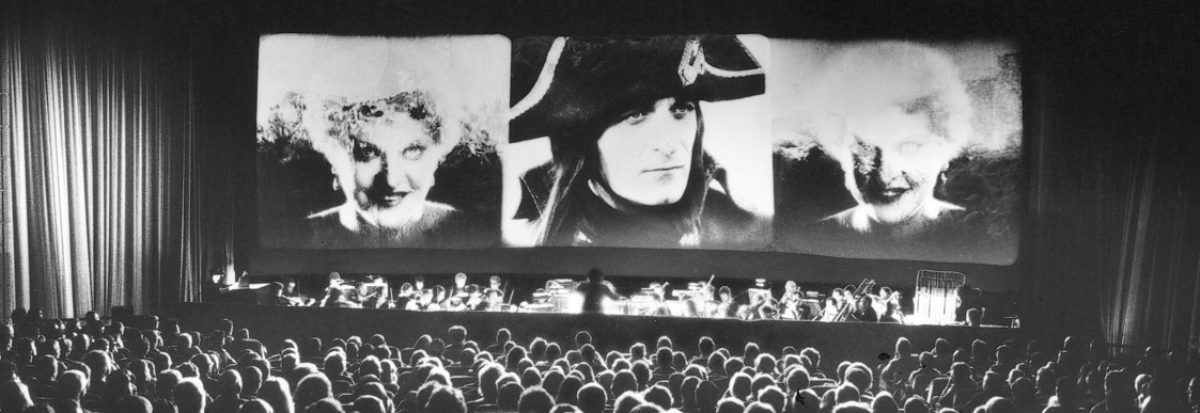
Thankfully, a professional restoration was in the offing. In the 2010s, a huge project led by François Ede and the Cinémathèque française was busy restoring the film to a version of 7 hours. Ede’s work is simply extraordinary, and his essay in the booklet that accompanies the 2019 Blu-ray edition of the film is the finest set of liner notes I have ever encountered. Anyone interested in the film’s making, unmaking, and restoration should read it to find out this unbelievably complex story. What was particularly exciting was the fact that this new version was accompanied by Bernd Thewes’s reconstruction of the musical score compiled in 1922-23 by Paul Fosse and Arthur Honegger. I was lucky enough to attend the world premiere of this restoration at the Konzerthaus Berlin in September 2019. There, I experienced La Roue on a huge screen with Frank Strobel conducting the Rundfunk-Sinfonieorchester Berlin in live concert. It was one of the great cinematic experiences of my life. In this piece, I offer some reflections on the reconstructed score and its relation to the film. Though what follows is based on numerous relistenings to the score via the soundtrack of the Blu-ray, I will always refer back to my initial experience of the film the context of its live presentation in 2019. This circumstance was the way Gance wanted the film shown, and my understanding of the effectiveness of the music on that day was at once aural, physical, and emotional…
The score: Music history, film history
La Roue was premiered across three weekly screenings in December 1922 at the Gaumont-Palace, Paris. The Gaumont-Palace was a grand, prestigious venue and had its own orchestra, directed by Paul Fosse. Between 1911 and 1928, Fosse arranged music for over 1500 silent films shown at the Gaumont-Palace. Two huge volumes of handwritten cue sheets survive, each one detailing which pieces of music were used. Though the details are not always precise, these documents offer an extraordinary picture of the music used for accompaniment at the Gaumont-Palace. Among the cue lists can be found those for La Roue. After the premiere in December 1922, the film was slightly reduced in length (from 10,730m to 10,495m) and restructured from six “chapters” into four “episodes” for its general release in February 1923. Fosse’s cue sheet accords with this four-part version, and his notations were an invaluable guide for the team reconstructing the film. Since all the music used for this version of the film was listed, it also allowed the opportunity to reconstruct the score as presented in 1923.


For La Roue, Fosse collaborated with his friend Arthur Honegger to compile and arrange what originally amounted to over eight hours of music. They presumably also consulted Gance, but one of the great missing links in this history is the exact nature of the decision-making process that led to the score’s assembly. While many film histories assume that the score for La Roue was wall-to-wall Honegger, Fosse’s cue sheets reveal that Honegger is one of 56 composers whose music is used. Honegger wrote the film’s overture and five pieces for specific sequences: six cues among a total of 117, i.e. just 5% of the score. Even with the five pieces used in the film, two are simply repetitions of music from the overture. And though this overture survives, all three of Honegger’s pieces of “special” music—“musique accident”, “disques”, “catastrophe”—are lost and had to be recreated on the basis of his other work.


The musical adaptation and arrangement for the 2019 restoration was by composer Bernd Thewes. Though Thewes had worked on other silent film scores (some of which I have discussed in earlier posts), La Roue was to be a challenge of very different proportions. As well as the detective work in finding the sheet music for numerous (often very obscure) cues, Thewes had to orchestrate and arrange the entire score into a coherent whole. Some of the music proved untraceable, just as there were missing parts of the film to negotiate. Even regardless of these obstacles, I think his work is masterful. The reconstructed music for La Roue is one of the great achievements in the history of film restoration.
The score: Music and montage
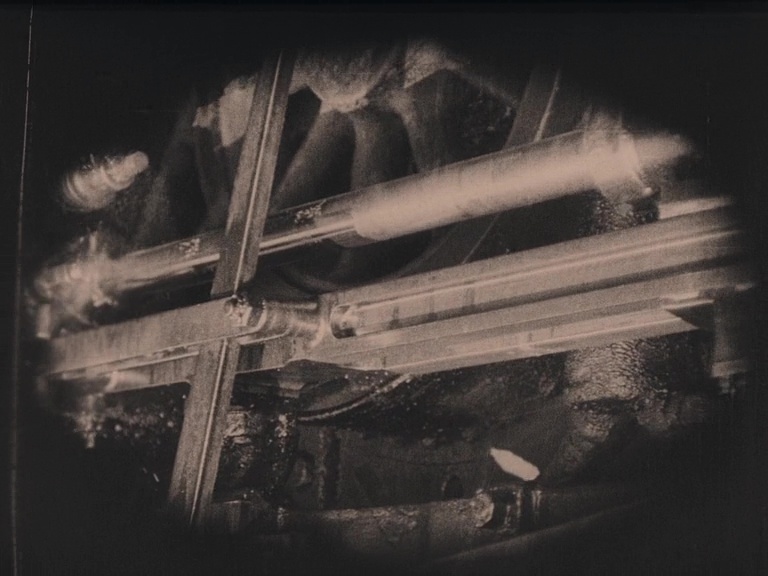
Right from the start, the score provides a complex, often intimate, accompaniment to the images. Having listened many times to Honegger’s “overture” from La Roue (the only piece from the 1923 score to have been previously recorded), I was astonished to see how well each section and theme fitted the opening credits and build-up of images before the first main sequence. Its mix of soft and abrasive tones, its juddering rhythms and calm interludes, its patches of light and dark—all of it made perfect sense with the restored montage. The music added depth to the images, just as the images made the structure of the “overture” make sense: indeed, the credits are themselves a visual overture that introduce not just the characters/performers of the film but also the visual motifs (rails, wheels, signals) of the drama.


Then, for the train crash itself, the orchestra thunders into music from Jean Roger-Ducasse’s Orphée (1913). At the Konzerthaus in 2019, I sat sweating in my seat at the sheer sonic weight of Roger-Ducasse’s pounding rhythms. On screen, a third train threatens to plough into the wreckage of the two derailed trains: Gance cuts between the crash site, the oncoming train, the signalmen, and Sisif. As the montage quickens, the music builds into an immense crescendo. In the 2019 screening, I could hear people around me quite literally gasping with tension as the sequence tightened; and, when it ended in the avoidance of further disaster, a woman behind me let out a great breath in relief. The visual montage is already a remarkable instance of quick cutting between multiple spaces, but the addition of the music multiplied its effectiveness. In the theatre, you could feel the tension: Gance’s silent world was given weight and pressure through music, through the sound of the orchestra in the air, the sensation of music vibrating through the floor and seats. Truly, there is nothing like seeing a silent film with a live orchestra.


Part of what was striking about the musical-visual whole was the aesthetic complexity of the experience. Just as Roger-Ducasse’s music utilizes the full range of orchestral timbre—from deep brass to glistening percussion,—so Gance’s utilizes a wide range of colour elements across his montage. The effectiveness of this was enhanced by the restoration. Ede’s team decided to reproduce the visual quality of what the “monochrome” black-and-white sections of the film would have had on screen in 1923: i.e. not pure black-and-white but subtly warm monochrome (like a very faint wash of ochre). This choice allowed the range of other colours a warmer base level with which to interact: it made the complex stencil-colouring (for individual areas of the frame) less garish, while not lessening their presence. Seen across the opening crash sequence, the impact of these various forms of colour is amazing: there are vibrant reds, subtler reds, yellows, ambers, washes of ochre, sudden splashes of stencilled red and yellow and green. The image changes its tone just as the music changes its texture.


The Fosse/Honegger score also does well to provide both consistency and variety in its musical accompaniment. It’s noteworthy, for example, that Honegger’s music doesn’t dominate all the sequences of rapid montage. I’ve already mentioned Roger-Ducasse’s music over the opening train crash, but the later scenes of impending disaster and fury feature music by Ferruccio Volpatti, Alfred Bruneau, and Gabriel Dupont. Among these, I particularly enjoyed the use of Volpatti’s Vers la gloire [n.d.]. Bernd Thewes’s orchestration of this (utterly obscure) piece is superb: listen to that pulsing, mechanical rhythm, the punching brass beats, the hyperventilating woodwind, the rising strings. It sounds like the orchestra has been put on some dangerous autopilot setting—or else possessed by a machine: it’s all rhythm, a mechanism racing at full-pelt, held in perfect synchronism while hurtling toward to dissolution. Again, in the theatre, this was a simply thrilling sequence to watch.
While many scholarly accounts of La Roue have (understandably) emphasized its sequences of rapid montage, the film is also concerned with duration in all its senses (one might say, at all tempi). The film was, after all, originally over eight hours long—effectively the length of several substantial feature films. This is a very protracted drama, not some kind of ceaseless collage. What makes the rapid sequences so effective is the fact that they occur within the context of a much longer, slower narrative. Great stretches of brooding melodrama suddenly condense and erupt in violent passages of lightning-quick editing. The music reflects these contrasts in tempo.
Like most scores from the silent era, the Fosse/Honegger score for La Roue often floats over the images—occupying space and time without directly mimicking the images. For the most part, this is an inevitability because 111 of the 117 musical cues were not written for the film but selected from music in the repertory (and, specifically, Fosse’s in-house music library at the Gaumont-Palace). Thus, part of the pleasure is just in watching in a kind of trance as the rich strains of late romantic music, some familiar pieces but most unfamiliar, move like weather systems over the imagery. L.-H. Burel’s cinematography is as rich, textured, and evocative as any you’ll ever see; seeing it while listening to Massenet or Sibelius, Schmitt or Debussy only enhances the aesthetic pleasure. The music invites an emotional engagement with even the simplest or most abstract views: organized sound makes (I think) the spectator more receptive to the drama, more ready to be moved, more ready to feel what’s happening. Part of the nature of late romantic symphonic music is the fact that it often takes is sweet time to develop, to explore an idea, to unravel a theme. The same can be said of the film: it moves across time in great sweeps, long paragraphs; it reflects back on itself, summons memories of earlier episodes, shifts tempo, broods, slows, comes to a halt, only to move on again…
The score: Matches and misalliances
On a purely musical level, Thewes’s reconstruction of the Fosse/Honegger score is an unmitigated pleasure for me. As I have written before, I have been a lifelong sucker for late romantic music—especially obscurities that offer the additional pleasure of my having to scour the earth for recordings. The Fosse/Honegger compilation is a treasure-trove of music that was known and played in the 1920s but has now fallen entirely from the repertoire. There is simply nowhere else that I can go to hear the orchestral works of Georges Hüe, Félix Fourdrain, or Georges Sporck. Indeed, even more major figures like Vincent d’Indy or Gustave Charpentier are rarities in concert halls today—especially outside France. I first saw the Fosse/Honegger cue sheet several years before the 2019 restoration was completed, and my own exploration of the music that I could find available was already a revelation. It was through La Roue that I came to love the work of d’Indy and Charpentier, as well as the more obscure (but no less interesting) work of composers like Guy Ropartz, Benjamin Godard, Roger-Ducasse, and Alfred Bruneau. Straddling two centuries, their music represents the overlapping worlds of late romanticism and experimental modernism in sound. In the wake of seeing the restoration in 2019, the score has become a further springboard to hear more. (Happily, the music of Gabriel Dupont, for example, has now been recorded together with Dupont’s other symphonic works and released on CD (Outhere/Fuga Libera, 2019). So too has the work of Fernand de La Tombelle (Outhere/Bru Zane, 2019).)
Obscure or not, the music takes on a wonderfully definite role when used in the film. Take, for example, the lengthy sequence of Sisif’s confession to Hersan at the end of Part 1. It begins with Saint-Saëns’s prelude to Le Déluge (1875)—a familiar piece whose frequent use in silent films scores I even discussed in an earlier piece on The Three Musketeers (1921). In La Roue, Saint-Saëns’s uneasy opening section for strings alone introduces Sisif’s angsty exchange with Norma and then Hersan (the close-up of Sisif turning toward the camera times perfectly with the measure for lowest strings); the passage with solo violin over pizzicato strings then coincides with Elie’s playing of the violin as Norma watches from the window. I’ve heard this piece used so many times, but never has the solo violin section been so well used for events on screen: Elie’s playing picks up the sounds coming from the orchestra. But it’s the next piece of music, the first movement from Philipp Scharwenka’s Fantaisie dramatique (1900), that really make the sequence. The angry brass chords with which it opens announces the darkness of Sisif’s confession. The tempo is slow to start, but this musical pace actually heightens the intensity of the first flashback sequence (related via a rapid montage of the film’s opening scenes): the minor-key intensity of the piece is the perfect mood music, creating an emotional through-line that traverses the screen’s sudden plunging through time. The subtle shifts to lighter passages accompany other, happier, memories of Norma and her life with Sisif at home—followed by more brassy interjections that swing the music back into growling depths of anger and desire. And it’s also the skill of Thewes as an orchestrator that allows the next piece—a “lied” by Gaston Schindler (originally for piano and violin)—to segue so convincingly from Scharwenka’s piece and into Ropartz’s Les Landes, the piece that concludes Part 1. Diverse pieces, from the well-known to the obscure, are made to work with and enhance the images.


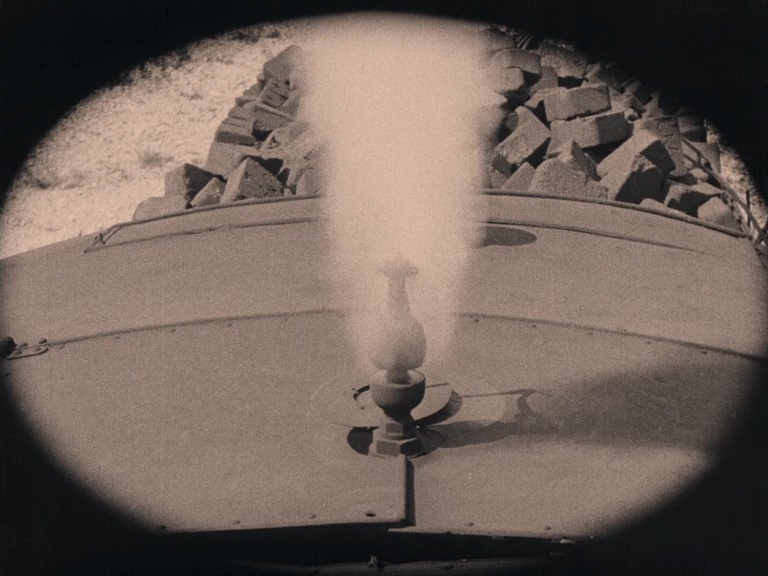
So what doesn’t work? Well, there are some notable scenes where the music weirdly detaches itself from the drama in a way that feels oddly ineffective. One of these is the scene in Part 2 in which Sisif is partially blinded by an accident while repairing a steam valve on his train. The music is “L’Epreuve”, by Charles Pons (1870-1957), and it is a mildly dreamy, slow piece—a charming, if not very memorable work of late romantic loveliness. So why is it being used in a scene of drama and tragedy? It could of course be a question of historical taste, but there is one other possibility. At the premiere of La Roue in December 1922, the orchestral score was augmented by numerous sound effects produced via mechanical means. The critic Emile Vuillermoz reported that the audience heard “real jets of steam” synchronized with at least one scene in the film (Comœdia, 31 December 1922). Was the audible drama for Sisif’s blinding originally provided by this use of sound? If so, it would make sense that the music played by the orchestra would be quiet: this way, the sound effect could be heard more effectively. Sadly, the reports from 1922-23 do not make this issue any clearer, and I can find no record of what sound effects were used in what sequences (or in which subsequent screenings). This issue is also apparent in the moment (in Part 1) when Elie and Norma are interrupted from their mutual daydreaming by the sound of a train’s steam-powered whistle. The musical cue ends precisely before the film cuts to the source of the aural interruption (and then rapidly cuts to an even closer shot of the shrilling steam). This is a sound effect rendered entirely visual: the music does not resume until the film cuts back to the interior scene of Elie and Norma. The effect is very odd, since it is silence that does the interrupting rather than sound. I presume that, at least at the 1922 premiere, this moment was accompanied by a sound effect that reproduced the visual cue. While the silent interruption is weirdly effective, we should bear in mind that this may not have been the original way the moment worked.




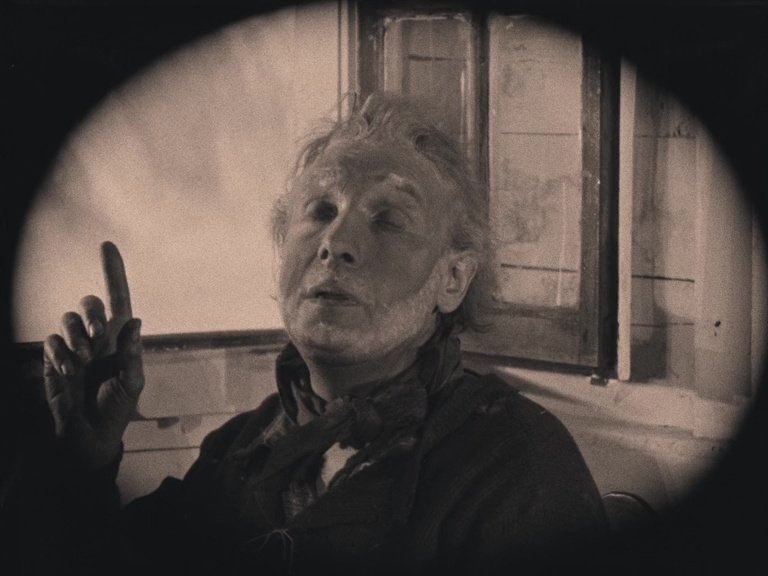
Talking of silence, there is another moment in the film that struck me as not working as originally intended. At the end of Part 3, Elie is hanging by his fingertips to the side of a cliff. Norma and Sisif (and Tobie, Sisif’s dog) are racing to the rescue. But, just as Norma arrives, Elie’s grip loosens. There is an astonishing sequence of rapid montage, which accelerates to the rate of one frame per shot—the filmstrip’s maximum unitary velocity—as Elie’s memories of Norma flash across the screen. This was the first time in film history that such a technique had been used like this, and it remains dazzling. Gance’s film invites us to share the subjective vision of his character, his last moments of consciousness, before he plunges into the abyss. But somehow, the awful suddenness of the fall isn’t as awful or as sudden in the restored score. Fosse’s original cue sheet states that there should be “a silence for the fall”. But the reconstructed score does not give us a silence here; instead, the music overlaps the climactic burst of rapid montage and the sight of Elie plummeting into the ravine. Though it is timed reasonably well with a small crescendo in the music, there is no equivalent burst of speed, fury, or anger in this section of Dupont’s Le Chant de la destinée. Wouldn’t it have been more effective to simply cut the music short—even mid-bar—for this moment? I can imagine it could more potently create the sense of a life being cut short, of our expectations of Elie’s rescue being so swiftly ended. (From memory, I think I was more disappointed by this moment in the live 2019 performance than when reviewing the scene on Blu-ray at home. Perhaps that’s because the tension generated in a live, continuous experience was all the greater when I felt the tension dissipate.) It’s not that the sequence doesn’t work (it does), but that it could have worked better.




The score: Missing music
There are sections of the Fosse/Honegger compilation that could not be reconstructed with historical precision because the music has proved untraceable. I have already mentioned Honegger’s missing “special” pieces (“musique accident”, “disques”, “catastrophe”) that had to be recreated from surviving music. Additionally, a piece called “Cher passé” by a composer cited only as “Abriès” was impossible to identify or find. While Abriès’s music was only used in one scene, a more substantial loss was Pons’s Symphonie humaine. Sections of this music were used in two sequences: firstly, in a scene in Part 1 prior to Sisif’s confession; secondly in the scene in Part 3 where Elie witnesses Hersan’s rape of Norma. (Thewes replaces these with portions of another work used elsewhere in the score: Scharwenka’s Fantaisie dramatique.) I was curious about the fate of Pons’s piece, so I did some digging. It turns out to have quite a revealing history: revealing not just about how music can disappear, but the way in which it could be recycled during the lifetime of its composer.
Intriguingly, Pons’s “symphony” appears to have started life as the score for another film! In November 1916, the Gaumont-Palace presented Henri Pouctal’s La Flambée, which was based on a play by Henry Kistemaeckers. Among the music used, the contemporary reviews mention Godard’s Scènes poétiques, d’Indy’s prelude to L’Etranger, Paul Dukas’ overture to Polyeucte, and Pons’ Symphonie humaine. All four of these pieces were subsequently used in the Fosse/Honegger score for La Roue. But Pons’ Symphonie humaine is cited as being a piece specially composed for Pouctal’s La Flambée in 1916. The music “underlines by its harmonic intensity the scene of the spy’s death and the tragic scene of reconciliation between Colonel de Felt and his wife” (Le Film, 18 November 1916). Other reviews also mention the superb way that Pons had captured the emotional rhythm and tone of the sequences in the film (L’Œuvre, 10 November 1916; La Liberté, 11 November 1916). The press reports also reveal that Pons himself came to compose for the cinema via his work at the Opéra Comique and his incidental music for Georges Clemenceau’s drama Voile du Bonheur (1901). Clearly, there was good employment to be had for a young composer writing new orchestral music for various forms of live accompaniment in Paris.
This is all rather interesting: in 1922-23, Fosse reused the entirety of the music assembled for Pouctal’s La Flambée at the Gaumont-Palace in 1916. But the reuse of Pons’ symphony was not limited to cinematic presentations. After the end of the silent era, this work later appeared on concert and radio programmes. In February 1936, for example, Radio-Paris broadcast a programme that included Pons’ Symphonie humaine, which is described as a “musical commentary in three episodes” from Kistemaeckers’s drama (Le Peuple, 20 February 1936). The same station broadcast another performance of the symphony in April that year (Le Matin, 29 April 1936), and in 1937 Grenoble radio broadcast a concert with several works by Pons, including the Symphonie humaine (L’Intransigeant, 9 June 1937).
Conclusion: Miracles musical and visual
Part 4 is my favourite portion of La Roue, and in the 2019 restoration I think it’s a perfect miracle of musical and visual collaboration. (I have just rewatched the last half hour of the film and find myself in floods of tears.) This part is called “La symphonie blanche” (“Symphony in white”) and the whole last movement is a kind of late romantic tone poem of darkness giving way to light, of death and transfiguration.
I’ve written about this part of La Roue in detail elsewhere, but I did so before I had seen the film with its reconstructed score. By the time of the live performance in 2019, I’d seen many different versions of La Roue in many different circumstances, on every format from VHS to 35mm, on tiny screens and cinema screens. None of that prepared me for the effect that the film had on me in the cinema with live orchestra. There are many miraculous moments in “La symphonie blanche”, all of which are made more miraculous by the music.
This final part of the film is its strangest. Dramatically, it contains the least potential of any episode of La Roue. Hersan has died, Elie has died. Minor characters have been left behind. Only two of the film’s four main characters are still alive, and the sole source of tension is whether Sisif will welcome Norma back into his life. Despite these potential limitations, Gance proceeds to draw out his increasingly strange resolution for nearly two hours—and the music finds ways of articulating the strange emotional journey of the film’s protagonists.


Only in the second half of Part 4 do Sisif and Norma even encounter one another directly. After Sisif has planted the cross at the site of Elie’s death, Norma silently follows him back to his cabin and, at night, appears trembling in the doorway in a swirl of ice and snow. She enters and finds herself alone by the unlit hearth. The music here is from Albert Roussel’s first symphony, known as “Poème de la forêt”. The movement here has the perfect thematic link to the wintry scene: the “Fôret d’hiver”, which magically sparkles and warms as Norma lights the fire—the tinting shifting from blue to orange as the fire is lit. The next cue—Camille Chevillard’s Ballade symphonique (1889)—likewise gradually seems to warm to life: there is a lovely, winding theme for the strings that feeds through Norma’s first scenes in daylight in the cabin. But it also shifts into an angry climax (accompanying Sisif’s fury on discovering that he has an intruder), before calming for Sisif’s slow acceptance. (Here the score switches to the calm mood of “Dans les bois” from Godard’s Scènes poétiques (1878).)


There follows one of my favourite scenes in the film, when Sisif gently strokes Norma’s hair as she sleeps (the first time he has touched her in years). The scene is given an absolutely beautiful accompaniment: Henri Duparc’s Aux étoiles (1874). Just as Norma wakes to her father’s touch, a solo violin line rises out of the gentle glow of the orchestral adagio… it’s an exquisite moment, surely one of the most tender in Gance’s entire filmography. The next cue—the “Carillon” from Fernand de La Tombelle’s Impressions matinales (1892)—accompanies the “transformation” of Sisif’s interior space with increasingly bright orchestral textures, as well as a lovely bell-like pealing in the brass.


But just as we think that the score is beginning to lift some of the narrative weight that has preceded it, the lightened atmosphere is broken by the next piece if music, taken from Honegger’s overture to La Roue. The visual cue is a cutaway to the ascent of the funicular railway and the music returns us to the opening montage of wheels in motion. It is a sinister, mechanical march—pulsing, threatening. Sisif and Norma have not yet spoken to each other, not yet openly acknowledged their mutual presence; the score’s sudden shift to this troubled musical world of the Prologue indicates that all is not well—that there are issues yet to be resolved in the drama. The transition is made more effective by being followed by a passage from Roger-Ducasse’s Orphée—the same eerie soundworldthat accompanied the nighttime part of the crash sequence (when Sisif first found Norma). This is used for their “first words” to each other. The music becomes lighter, just as the snow outside and the newly-painted white interior of the cabin are bright spaces. This is suddenly interrupted by another musical reminiscence: to more music from Roger-Ducasse, repeated from the end of the Prologue, as Sisif ruminates on the past. (The original piece of Honegger here is lost; Thewes chose the Roger-Ducasse piece as a strong substitute that also recalled the earlier scenes of the accident and the children’s game that recreated the crash with toy trains. It works brilliantly, again disrupting the optimistic atmosphere of the previous cue.) The brutal blast of brassy, percussive sound that disrupts the gentle texture of the scene dissolves back to lightness in the strings.




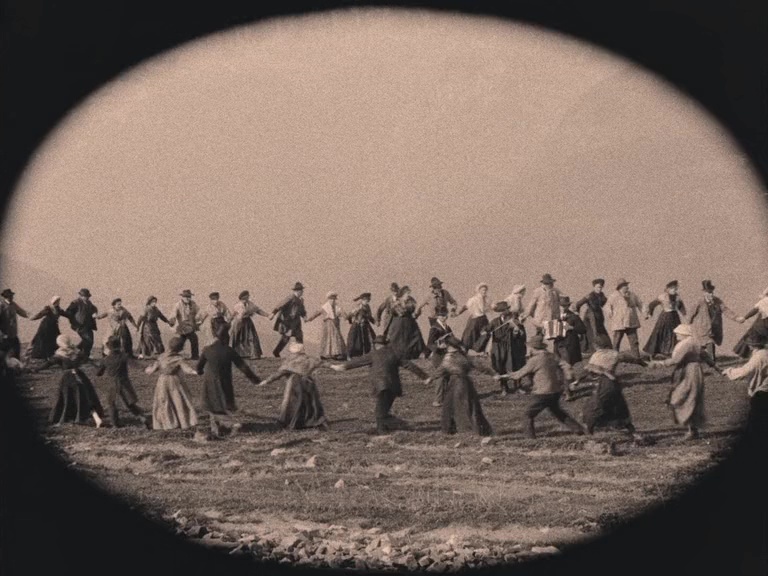
The score next uses Debussy’s “La fille aux cheveux de lins” (from his piano preludes of 1909-13), a deliciously light, ungraspable texture. (Just see how it seems to rhyme with the soft fronds of the pampas grass that Sisif gathers in his arms to decorate the cabin.) From this point, Gance allows his characters time to experience something close to contentment with one another, just as he offers the film’s audience time to fall in synch with the quiet tempo of dramatic domesticity. We see the arrival of the guides, who as part of their seasonal fete begin a dance up to the highest meadow on the mountainside, overlooked by Sisif’s cabin. Here, the score switches to a popular mode: a folk-like dance from Marcel Samuel’s-Rousseau’s Noël Bénichon (1908). The use of this, and a later cue on a similar theme, is perhaps the score’s most joyful, happy cue. After so many hours of tension and anger and fear, finally the mood is one of release. Pent-up angst has become a kind of dance. (And another form of the wheel, as the dancers outside circle round a tree.)




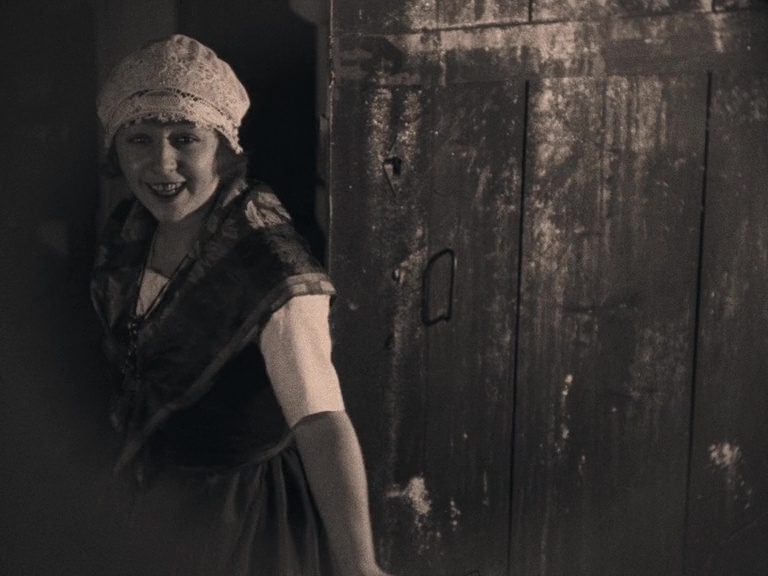
There is a far subtler, more lyrical lilt to the next music cue: from the ballet music of Georges Hüe’s opera Le Miracle (1910). This is the only music by Hüe that I’ve ever heard, and it’s absolutely gorgeous. Listen to the way the simple, yearning melody becomes stranger and more captivating as it’s passed between high strings, woodwind/harp, then back to the lower strings. The scene it accompanies is one of my favourites in the film. When a local girl asks Norma to join the dance of the guides, Norma reacts with girlish glee. She tells Sisif, asking if it’s alright to leave him for a while, then rushes over to the girl with her answer. After a slight pause, as if not sure how to show or offer her affection, Norma kisses the girl—then returns to apply “a touch of powder”.


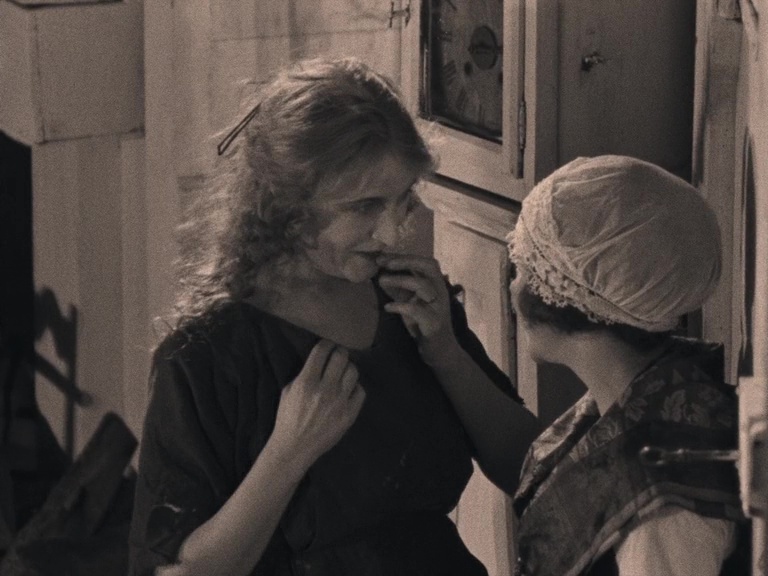


(A passing note: one of the inspirations for Gance’s theme of unrequited love was Kipling’s novel The Light that Failed (1891). The novel centres on Dick, a youth who falls for Maisie, a fellow orphan; after a successful career as a war artist, Dick reencounters Maisie in later life—who still rejects his love; Dick then descends into bitterness, blindness, and eventual death on a remote battlefield. Discussing The Light that Failed with Kipling when Gance visited the author in 1919 (just before beginning work on La Roue), the filmmaker startled Kipling by telling him that Maisie was a lesbian—identifying the truth about Flo Garrard, the real-life inspiration for Kipling’s character, long before modern biographers confirmed her sexuality. Is Norma’s kiss in this scene in La Roue—the only kiss that she willingly gives to someone outside her family in the entire film—an echo of this theme? The film offers us few clear indications of Norma’s romantic desires. She might willingly fall into the incestuous fantasy of Elie’s imagination, but it is his fantasy, not hers. What are her real wants and needs? In this context, you can see how her one kiss with another woman carries great significance.)
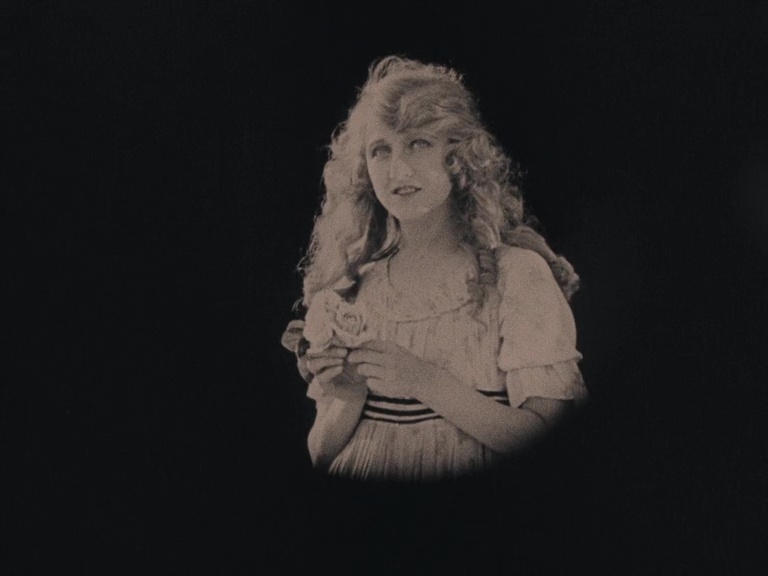
Now, as well as powdering her face, Norma childishly ties a huge bow in her hair. (It recalls the bow in her hair for the very first time we see her in the film, as a child.) In the mirror she sees a wrinkle and finds a grey hair. Her whole body droops in visceral recognition that she is no longer a girl. She slowly pulls the ribbon from her hair then (in a miraculous moment of performance) shivers herself back to life—shaking the doubt from her body and smiling once more. This half-second of time is tremendously moving precisely because it takes place within the context of such a long narrative—and reminds us that Norma has a life that will extend beyond the film’s timeframe.


She goes over to Sisif to say goodbye. He senses in her the nervous tremor that has inhabited her since Elie’s death. “Tu n’es donc pas gaie aujourd’hui?” he asks. She replies: “Je ne suis pas gaie papa… je suis heureuse! Ce n’est pas la même chose… C’est plus doux et plus triste!” The distinction between “gaie” and “heureuse” is difficult to render in English, but the “sweeter and sadder” qualities of happiness are made evident in the tone of Gance’s ultimate scenes—and in the exquisite music here by Hüe.


Just as Norma shook off her melancholy, so now the film seems to shake of its melancholy. For here it shows us the dance of the guides, which ascends higher and higher up the mountain until it reaches the plateau below the summit of Mont Blanc. Gance shot all these exteriors on location, and they are truly extraordinary scenes.


The music that accompanies this sequence is a selection of folk dances, arranged and orchestrated by Julien Tiersot in his Danses populaires françaises (c.1903). First, a jaunty “Branle de Savoie” and “farandole” (as Sisif waves goodbye to Norma from the window; he has hardly smiled in the whole film, but now grins with almost childish innocence), then two “danses provençales”. The last of these is a quite gloriously catchy melody, perhaps the most memorable of the film. The first time I heard it (live in 2019), I had the uncanny feeling that I had encountered it before. I don’t think I can have done, since this particular set of dances by Tiersot has never (to my knowledge) been recorded. But the piece is a folk tune; whether or not it has been used in some piece I have heard before, the melody is so instantly memorable that it sounds familiar. During the recording sessions in September 2019, there was some discussion among the musicians about this piece. The conductor Frank Strobel felt that going from this piece (the folksiest melody in the entire score) to the next (the ethereally sublime final scene from Debussy’s Le Martyre de Saint Sébastien (1912)) was too abrupt and startling a transition. But it absolutely works with the film. The “danse Provençale” is purposefully simple and joyful—it’s a release of tension, and a way for Norma to find her way back into the rhythm of everyday life (which she has been denied for so long in the narrative). And the pace of the music and dancers is also deliberately at odds with Sisif’s own ailing body. He listens to the distant sounds of the dance, but his body falls out of rhythm with its meter. Put next to the image of Sisif’s vitality visibly fading, the suddenness of the music’s end—a kind of boisterous full stop—is a shock.

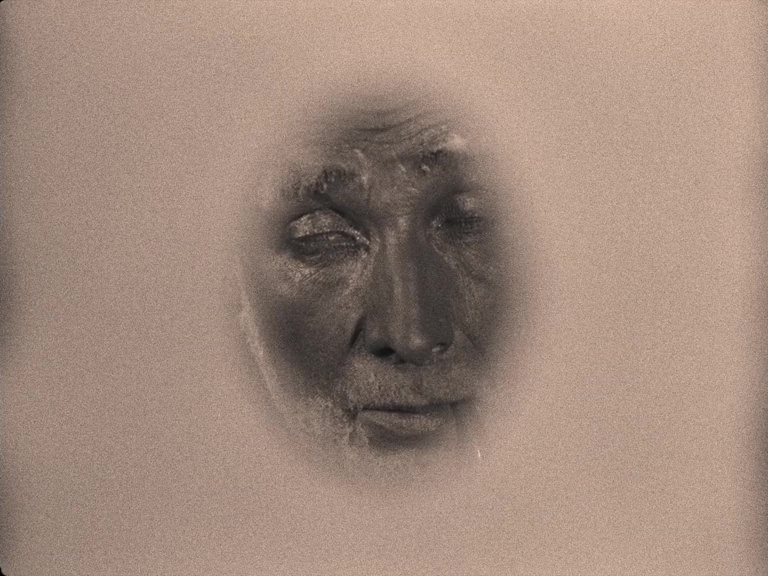

Then comes the piece by Debussy, which begins with some of the strangest and most eerie orchestral music he ever wrote. Unearthly strings, unsettled harmonies, chromatic shifting. Is it formlessness seeking form, or form seeking formlessness? On screen, Sisif’s body untenses and he wearily lowers the pipe from his mouth—tracing, as he does so, the smallest circles with its stem. Finally, he slumps in his chair, but does not fall. We see smoke rings from Sisif’s pipe dissolve in the air; outside, clouds encircle the peaks and Norma dances in a giant ronde on the snow-covered plateau beneath Mont Blanc.


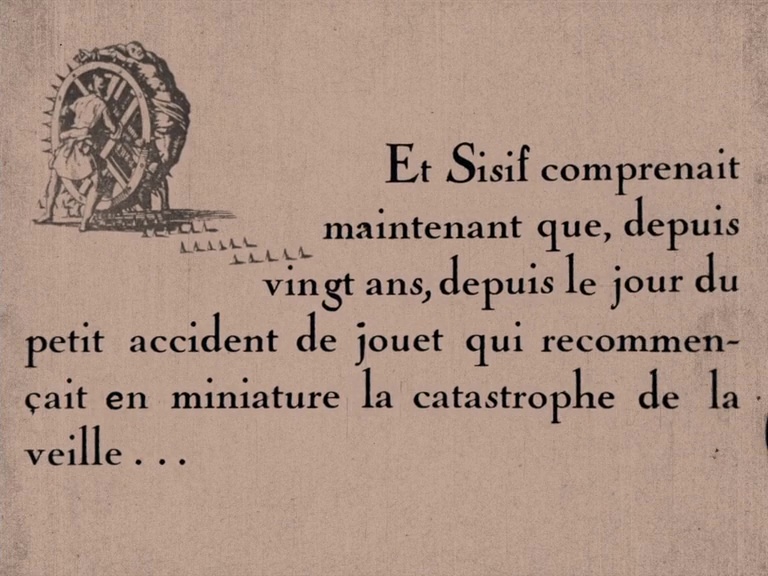
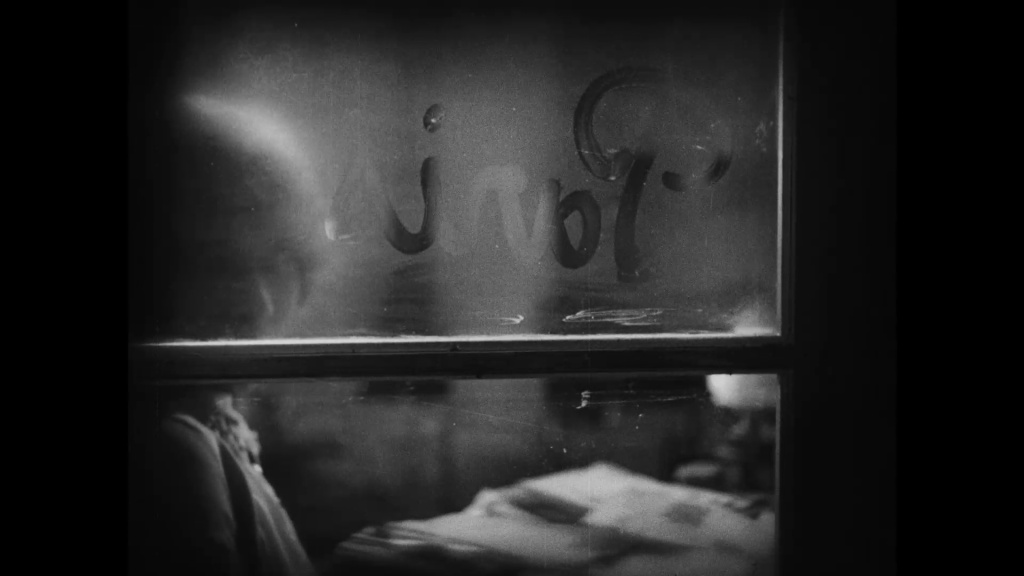
Debussy’s music here originally served as incidental accompaniment to Gabriele D’Annunzio’s Le Martyre de Saint Sébastien. The music that conveys Sisif into the snowy blankness of eternity was that which (in the play’s final scene) lifted Sébastien into the heavens. The martyr’s liberated spirit cries out: “I come, I rise up. I have wings. / All is white.” In Gance’s film, intertitles tell us that Sisif’s soul possesses “adumbral wings” that caress Norma as they ascend. The image is visualized as the shadow of clouds passing over the dancers circling in the snow. It is an uncannily beautiful scene, accompanied by uncannily beautiful music. The final close-up of Sisif is a freeze-frame, his face arrested at the moment of death; in repeating and extending this static image uncannily forward through time, Gance makes manifest the cinematic afterlife of Séverin-Mars, who died before the film premiered. The last movement within La Roue is Tobie, who sits up and barks into the silence; Sisif’s inert form continues to face the snowy nothingness through the window frame—then, likewise, the cinematic frame through which we view him dissolves onto the blank image of a pale curtain. The music reaches its climax, the final chord booming out over the last title: FIN.


These last scenes of La Roue are as moving as anything Gance realized, and possess a kind of ecstatic calm found nowhere else in his films. The music is as sad, serene, and piercingly beautiful as the images on screen. If you haven’t already, please go and find a way to watch the restoration. (The Blu-ray may be very difficult to obtain, but you can always try watching it on the Criterion Collection channel.) It’s a truly miraculous film.
Paul Cuff
Further reading
Paul Cuff, “Interpretation and restoration: Abel Gance’s La Roue (1922)”, Film History 23.2 (2011): 223-41.
Paul Cuff, “The Cinema as Time Machine: Temporality and Duration in the Films of Abel Gance”, Aniki 4.2 (2017): 353-74. [Available online.]
Paul Cuff, “Words Radiating Images: Visualizing Text in Abel Gance’s La Roue”, Literature/Film Quarterly 46.3 (2018) [online].
François Ede, “La Roue, Cahiers d’une restauration.” Booklet notes for La Roue, DVD/Blu-ray. Paris: Pathé, 2020.
Jürg Stenzl, Musik für über 1500 Stummfilme/Music for more than 1500 silent films. Das Inventar der Filmmusik im Pariser Gaumont-Palace (1911-1928) von Paul Fosse (Münster: Lit-Verlag, 2017).

















































 The Realm of Silence