Some time ago, I wrote about the music that accompanies different releases of Douglas Fairbanks’s The Three Musketeers (1921). I have long been meaning to do something similar for The Thief of Bagdad (1924). In the aftermath of the festival at (or via) Bonn, I felt like a return to Hollywood, so seize the chance now to turn my eyes – and especially my ears – towards Fairbanks…
First, some context. The original music for The Thief of Bagdad was written by American composer Mortimer Wilson and was commissioned by Fairbanks himself. “Make your score as artistic as you can and don’t feel that you have to jump like a bander-log from one mood to another at the expense of the development of your musical ideas”, he told Wilson (qtd in Vance 2008, 175). The result was a fully original orchestral score, which was performed at the film’s premiere on 18 March 1924 at the Liberty Theatre in New York. Wilson’s music received very good reviews from the critics, but its qualities were not appreciated by Morris Gest. Gest had already planned, in conjunction with Fairbanks, an exceedingly elaborate road show presentation for the film’s initial release. No expense was spared on ballyhoo: a veritable circus of road show variety – stage performers, an “Arabian” band, fancy-dress ushers, decorative incense, magic carpets etc – was duly assembled to exotify each venue booked for the roadshow. To support this cavalcade of orientalist claptrap, Gest wanted a score from a composer with a “big name”. For him, Wilson was not well-known enough as a composer to encourage public interest in the roadshow. Gest therefore employed James C. Bradford to compile a score from existing music – tunes more well-known than those of Wilson, and thus (Gest reasoned) more appealing to audiences. The result was not a success and quickly dropped. It was Wilson’s score that accompanied the film during its roadshow presentation at various major US cities.
However, while The Thief of Bagdad certainly made a big splash with critics, it was not the commercial success Fairbanks (and Gest) hoped. Despite being hailed as a landmark production, it proved less popular with Fairbanks’s own fans. The film was seemingly too ambitious (too long, too fanciful, too everything) for audiences in the US. But it had made its mark on history, and the film survived in enough high-quality 35mm prints to be restored in later decades, and returned to its rightful place in the canon of silent cinema.
But what of Wilson’s score? Despite Gest’s efforts to sideline it in 1924, the music has maintained a notable presence in histories of film music – and has been championed by many writers and practitioners. Composer and conductor Gillian B. Anderson, for example, has called it “one of the best film scores ever written”. Though Anderson also details its merits in more detail in her Music for Silent Films, 1894-1929: A Guide (xxxix-xlii), and the film appears on her website’s directory of original scores, I am unsure if/when she has performed it with orchestra. (Unlike many other scores on her website, it does not include performance details or guidelines for musicians.) Indeed, it is a curious fact that, despite the amount of information on the music and the survival of the music itself, Wilson’s work has remained what you might call a “paper score”.
This music certainly didn’t feature on any of the first home media releases of The Thief of Bagdad. The first DVD of the film was the 1998 edition by Film Preservation Associates. This featured the music cues assembled by Bradford in 1924, performed by Gaylord Carter on the theatre organ. (The recording itself dates from the 1970s, when presumably it accompanied a theatrical re-release of the film on 16mm/35mm. In 1978, Carter also released an extract from this score on an LP of music from silent films. Together with The Thief of Bagdad were extracts from the David Mondoza/William Axt score for Ben-Hur (1925) and the Ernst Luz score for The Temptress (1928). Rarities in themselves!) For all Carter’s personal links to the era, together with his admirable resurrection of historical scores, I often struggle with organ scores – especially for a film this long. And in any case, it’s a theatre organ not an orchestra. That it was recorded over other options evidences the relative ease of accessing and recording a theatre organ, and the preference for Bradford’s readily adaptable cue sheets rather than Wilson’s more complex orchestral score.
The first edition of The Thief of Bagdad that I owned was the 2004 release by Kino. This “deluxe edition” features an “orchestra soundtrack performed by the Mont Alto Orchestra”. The DVD credits further describe this as a score “compiled by Rodney Sauer and Susan Hall, adapted from the original 1924 cue sheet”. As I observed in my piece on The Three Musketeers, Kino’s marketing inevitably disappoints anyone expecting an “orchestra”: the credit sequence at the end of the DVD reveals that this consists of just five musicians. Kino’s use of the phrase “the original 1924 cue sheet” is also somewhat contentious. The first cue sheet used to accompany the film was the one that (briefly) replaced Wilson’s score after the first performances in 1924. Is the Sauer/Hall score based on this selection (i.e. the one by Bradford)? Even Kino’s “deluxe” edition does not provide any information on this issue. Even if it were Bradford’s selection from 1924, the word “original” seems a little misleading. After all, Bradford’s compilation of library music was a replacement for a truly original score by Wilson – the score that Fairbanks himself had commissioned. All this said, the Sauer/Hall score is perfectly fine. It is well performed and suits the film. But it feels out of scale with the images. As with the Mont Alto Orchestra’s music for The Three Musketeers, it sounds rather meagre next to the huge production values of The Thief of Bagdad. This film needs an orchestra, not an “orchestra”.
My disappointment with the Kino DVD was exacerbated by the fact that I knew that a Carl Davis score existed for this film. First performed in 1984 as part of the Kevin Brownlow/David Gill series of “Thames Silents” restorations, it was recorded for television broadcast and for home media. There was a laserdisc of the Thames Silents edition in 1989, and a VHS in 1991. Given the superior sound quality of laserdiscs, I chased down the laserdisc edition and giddily transferred it to DVD for my personal enjoyment. Davis’s score is compiled from the music of Nikolai Rimsky-Korsakov, especially from his famous orchestral suite Scheherazade (1888). The music is a perfect choice. After all, the sets, costumes, and overall conception of The Thief of Bagdad owes much to the influence of Sergei Diaghilev’s Ballets Russes, and especially to their Scheherazade, which repurposed Rimsky-Korsakov’s music. As ever, Davis rearranges the historical music with extraordinary deftness. While the music maintains its original identity, it also serves the film’s rhythm and mood. As it happens, I love Rimsky-Korsakov’s music anyway, so my first encounter with the Davis score (sat in a tiny booth, squinting at the small television screen as my laserdisc whirred away on the side) was an absolute delight. It’s a glorious compilation, perfectly suiting the dreamy, exotic, fantastic, and balletic qualities of the film. So enamoured of the music was I that I laboriously transferred the soundtrack of my laserdisc to DVD-R, then from DVD-R to my PC, then used editing software on my PC to affix the laserdisc soundtrack to the superior video image from the Kino DVD, just for my own viewing pleasure. This little experiment was the best version of The Thief of Bagdad I had until the DVD/Blu-ray release of the film, issued in the US by Cohen Media (in 2013) and in the UK by Eureka/Masters of Cinema (in 2014). This edition finally reunited the Davis score with an excellent transfer of the film.
But soon after this edition was released, it became apparent that a new restoration was in the works – one that was to revive Mortimer’s score from 1924. For this, an entirely new performing edition of the score was prepared in 2015 by Mark Fitz-Gerald. As Fitz-Gerald records in his excellent liner notes for the CD release (discussed below), the surviving music required a good deal of editing and preparation to ensure it matched the restoration of the film. Since Wilson composed the music during the production and allowed room for adjusting the length/order of scenes after the film’s premiere, there was a degree of inconsistency between surviving music and montage. Fitz-Gerald found that there was too much music for some scenes and not enough for others – as well as plenty of notational errors in various instrumental parts. These are common issues to the reconstruction of silent film scores, and there are many examples which necessitate very elaborate editing or additional composition. Nevertheless, Wilson left enough clues (and more than enough cues) for his score to be readily edited into its current working form. Fitz-Gerald’s edition of the score premiered with the film at the Pordenone festival in October 2016. Subsequently, the score was recorded in Frankfurt in April 2019 and then broadcast on ARTE later that year, with Fitz-Gerald conducting the Frankfurt Radio Symphony. Highlights from this recording were released on CD in 2022. This CD contains 75 minutes of music, which the liner notes inform us represents the “complete” score, minus the repeats of cues that make up the remaining 75 minutes of the film’s timespan.
I had to listen to Wilson’s score a couple of times before it properly sank in. I suspect this was because I was very used to Davis’s music. Though both are full, symphonic soundworlds, rich without being dense, there is a definite difference in tone. Wilson is less rapt, less intense, less filled with grand, sweeping gestures. One might say that Wilson is less inclined to being showy or flash, which Rimsky-Korsakov’s detractors would certainly argue is the case with some of his music. (Though few would argue that he isn’t one of the greatest of all orchestrators.) Davis is also working with music that is already well-known, saturated with memorable melodies – melodies that I knew incredibly well even before hearing his score for The Thief of Bagdad. Wilson’s melodies have gone virtually unheard in a century, and they are decidedly less emphatic than Rimsky-Korsakov’s – but no less worthy of being seen alongside this film. And Fitz-Gerald notes the echoes of other composers like Puccini, Reger, Tchaikovsky, and Wagner in Wilson’s score. (He even compares parts of the soundworld to that of Alban Berg, which is perhaps over-selling it. A score doesn’t need to be, or to sound, “modernist” in order to be relevant or interesting.) But there is never direct quotation, just these echoes – in the shape of melodies, or the texture of sounds.
As well as the difference in musical/historical contexts for these scores, Wilson’s original music is surely conceived with a different objective in mind. In Scheherazade Rimsky-Korsakov is conjuring an entire picture from scratch, using the orchestra to form an impression in the listener’s imagination; whereas Wilson is accompanying an already-imagined world. If Wilson is less intense, perhaps this is because he isn’t striving to do everything: half the drama is already there on screen, so he is happy to be less emphatic. Just as the city walls seem to hover over those polished black floors, or the minarets hang before those dreamy picture-book skies, so Wilson’s music floats over the images. Everything works in tandem with the action, but the music has its own tempo, its own sense of mood. While there are plenty of examples of percussive effects for particular moments (gongs, weapons, jewels, clapping hands, magical apparitions etc.), the score itself is never in a rush to match every movement on screen. Wilson maintains a very pleasing balance between fidelity and independence. His music seems to have just the right tempo, both for individual scenes and for the film as a whole. It flows with the drama, seamlessly negotiating each sequence – picking out individual moments to highlight, but always with a wider sense of forward momentum. It certainly exudes the same warmth, geniality, and feeling as the drama.
Such qualities are immediately clear in Wilson’s opening theme, spelt out over the opening title. This theme is a slow, singing melody: wistful, yearning, gentle. If it lacks the absolute immediacy of Rimsky-Korsakov’s opening theme on the solo violin, used by Davis for the film’s prologue, it possesses a kind of calm that really works. This is music that’s never in a rush to impress. Like the film, it takes its time to unfold. Wilson’s main theme is heard for the first time within the drama when Ahmed enters the mosque and we see the Holy Man speak. The immediate sense of peace that Wilson conjures, a kind of sonic balm, is perfect. From the bustle of the streets, we enter a different kind of space – physical and emotional.
Later, when Ahmed first sees the Princess, the music grows into a slow, dreamy ecstasy. Like the opening theme, subsequently associated with the Holy Man, Wilson produces a drawn-out, singing melody – this time brought out in the low strings. It’s like a romantic version of the spiritual theme. In Davis’s score, the scene is more musically ambiguous. The theme that we will hear fully developed, expanded in orchestration and in volume at the end of the film’s first part, when Ahmed sets out on his quest, is here heard for the first time in tentative form. Over quiet, tremolo strings, solo oboe and then clarinet start to spell out the theme – but are soon interrupted in the scene when the Princess’s guards return. Davis’s score recognizes (in its orchestration) the intimacy of the scene, but (in its melody) hints at the dramatic consequences of this first contact between Ahmed and the Princess.
I have spent the best part of three mornings listening to the Davis and Wilson scores side-by-side, and I love them both. For sheer richness, variety, and moments of piercing intensity, Davis’s is hard to beat. (How I wish I had heard this score performed live!) But Wilson’s score has a tremendous cumulative impact: everything about it simply works. It’s beautifully organized, orchestrated, and fits the film like a glove. The restoration of Wilson’s score is reason to celebrate.
Added to this are the qualities of the Photoplay Productions restoration of The Thief of Bagdad. While the off-air copy from ARTE that I have watched does not do the astonishing imagery justice, it immediately signals its difference from earlier transfers of the film. Firstly, it contains the original credit sequence. The version presented both on the Kino DVD and the Cohen/MoC Blu-ray has a different (less elaborate) font for the main title, then dissolves straight to the image of the Holy Man and child in the desert:
In the Photoplay version, the more elaborate title is followed by full credits of cast and crew, then the desert prologue scene:
But the major difference is that the image in the Photoplay restoration is darker, the colours more saturated; it is as though the whole film has had a bath in some enriching elixir. I suspect that many viewers might worry the shadows are too dark. Having never seen an original tinted print from 1924, I cannot say how it compares with a contemporary copy – nor can I say how it compares to a contemporary projection of the film. What I can say is that it makes the previous transfers look anaemic, as though they have been over-cleaned. This is especially obvious in the beautiful transition from day to night via a dissolve. In the Cohen version, the tinting dissolves almost to monochrome for night:
In the Photoplay version, the tinting dissolves to deep blue:
As you can see from the following captures, the overall difference in colour and contrast makes a big difference. In the images below, stills from the Cohen Blu-ray are on the left, images from the ARTE broadcast of the Photoplay version on the right:
I simply don’t know which is more “authentic”, but I must say I’m a sucker for the shadowy saturation of the Photoplay version. I also note that many compositions in the Photoplay restoration are less cropped at the top, left, and bottom of the frame. (The takes and editing appear to be exactly the same in Cohen/Photoplay versions, so I don’t think this is an instance of each copy deriving from a different negative.) This, combined with the title font and longer credit sequence, suggests a different, and dare I say superior, generation print being used by Photoplay. It really does look gorgeous.
But will we ever see it on home media? And will Wilson’s score ever get a chance to accompany it? There is certainly reason enough culturally, and surely room enough commercially, for both the Davis/Cohen release and the Wilson/Photoplay restoration to co-exist. Please, someone make it so!
Paul Cuff
References
Gillian B. Anderson, Music for Silent Films, 1894-1929: A Guide (Washington, DC: Library of Congress, 1988).
Mark Fitz-Gerald, liner notes for Mortimer Wilson: The Thief of Bagdad, First Hand Records FHR126, 2022, compact disc.
Jeffrey Vance, Douglas Fairbanks (Berkeley, CA: University of California Press, 2008).
This week’s post has been written by Devan Scott, host of the superb “How Would Lubitsch Do it?” podcast. As anyone familiar with this series will know, Devan is not only an exceedingly knowledgeable devotee of Lubitsch but an active participant in researching and promoting the director’s work. Here, he writes about the discovery of an alternate version of The Student Prince in Old Heidelberg and the light this copy sheds on the film’s production and exhibition across 1927-28. So, without further ado, I now hand over the reins to Devan…
The Student Prince in Old Heidelberg – also known under the title Old Heidelberg – has been an obsession of mine ever since I first watched it a half-decade ago, and I attribute this to the fact that it exists at a unique intersection between three interests of mine.
First: it is not only a film by Ernst Lubitsch, greatest of all directors of romantic comedies, but a great film. It is, as far as his American canon is concerned, an unusually simplistic bit of melodrama: a young, cloistered prince experiences the world for the first time and winds up in a doomed romance with someone below his station. There’s very little of Lubitsch’s trademark high-society gamesmanship, but it’s brilliant anyways because of his singular ability to shade every single gesture with the lightest of brushstrokes. It’s a swooning film of large gestures, but it’s never only that.
Second: the version of the film I first encountered features an orchestral score composed by Carl Davis, greatest of all retrospective silent film composers. In typical Davis fashion, it is a brash, boisterous marvel of a thing, with an uncommon sensitivity towards the film for which it has been composed. It interfaces with the film as readily as any of Lubitsch’s own gestures, and this collaboration across time has resulted in a masterpiece.
Third, and the focus of this blog piece: outside of the odd 35mm screening here or there, the film has solely been available in the form of a telecine of the 1984 restoration by Kevin Brownlow and David Gill, for which Davis wrote his score. Released on laserdisc by MGM/UA Home Video in 1993, and occasionally broadcast since then, this telecine is a wholly inadequate representation of a work of such magnitude. (Retroformat recently posted a different version of Old Heidelberg. Though this version matches the cut restored by Brownlow/Gill, it derives from a heavily cropped 16mm print that is unfortunately inferior to the laserdisc.)
And so it came as a pleasant surprise that one day, out of the blue, a high-definition version of the film suddenly appeared on the Bundesarchiv’s digital platform. (Credit to Anthony on my Discord server for spotting this.) Per the opening title card, this version derives from the archives of the Museum of Modern Art (MoMA) – and features a distinct title. Whereas the widely circulating Brownlow/Gill version credited itself simply “Old Heidelberg”, this version was titled “The Student Prince in Old Heidelberg.” Though a problematic transfer of an unrestored print, the improvement it offers on the laserdisc is obvious:
Clearly, the logical next step for me was to line it up with the laserdisc version so as to create an ideal hybrid video synchronized to the Carl Davis soundtrack. This is the point at which certain kinks made themselves known: it quickly became apparent that these two versions of the film featured often wildly divergent shot lengths and, in the case of the MoMA version, greatly extended sequences with distinct footage.
My initial suspicion was that this was an alternative negative, possibly struck for overseas territories; this suspicion was echoed by the many extremely helpful folks who generously responded to my various self-indulgent emails on the subject. (In addition to this blog’s proprietor, Dave Kehr, Peter Williamson, Scott Eyman, David Neary, Stefan Drossler, Jose Arroyo, and Matt Severson all contributed information and guidance to this piece.)
Further analysis of the film made it clear that – with a few exceptions involving alternate takes and a few extended or truncated scenes – the bulk of the changes were related to two elements:
New location footage of the real Heidelberg, Germany, totally absent from the earlier version which featured footage exclusively shot in the Los Angeles County area.
Norma Shearer’s performance, which has (compromised logistics of quick-and-dirty reshoots permitting) been largely reshot to the tune of at least fifty new distinct replacement shots. Only a few of these feature any other performers: the vast majority feature her and only her. (Note the production design inconsistencies in the example below (see images), which indicate pick-up photography done after principal had wrapped.)
The aesthetic implications of the first additions are limited: there’s a greater sense of verisimilitude around Heidelberg, the entrance to which is rendered with significantly more grandeur. A fine set of additions, but the fabric of the film is not fundamentally altered.
Shearer’s reshoots, on the other hand, have fascinating knock-on effects on the film’s form. She hits her emotional beats with far more emphasis in the new footage, and the rhythms of the performative edits are far more generous – geared to give her time in which to land those beats. The results are a mixed bag: certain beats cut through with more clarity, but (though this could be my own familiarity bias towards Old Heidelberg) at other points Shearer risks embodying Rawitch a little too closely.
The most interesting by-product of this new coverage is the way that scenes otherwise covered in long master shots have been broken up with somewhat more conventional coverage in the form of close-ups. Whether the motivation for doing so was to better highlight Shearer’s performance or to better suit the limited nature of pick-ups (it’s easier to recreate a set if the background is cropped and out-of-focus), the impact in the newer version is that the camera direction subtly changes whenever Shearer is on screen. There’s a slightly out-of-character (for Lubitsch) cuttiness, and Lubitsch was rarely one to lean on close-ups to make subtle emotional beats emphatic anyways. For example, in the below scene (see images) there is a common occurrence: a cut breaks up the final wide shot with a close-up, extending the scene and more forcefully punctuating the emotional beat.
As is probably clear at this point, this is no A-negative/B-negative situation but an updated version of the film assembled at a later date. What we know about the circumstances of the film’s development, production, and post-production cycle is in some ways illuminating and in others a contradictory fog-of-war situation…
The film’s origin lies with MGM’s purchase of the rights to the operetta The Student Prince (1924), itself based on Wilhelm Meyer-Förster’s play In Old Heidelberg (1901), itself adapted from his novel Karl Heinrich (1898). William Wellman and Erich von Stroheim were at various points either attached or courted before Lubitsch – on loan in the midst of his move from Warner Brothers to Paramount – landed the project. Both Shearer and Navarro were reportedly insisted upon by the studio.
Principal photography wrapped up by early May 1927. Lubitsch’s desire to include footage of the real Heidelberg led him to decamp to Germany to record b-roll material there in mid-May. This is where things become hopelessly convoluted. Various sources, including The Exhibitor’s Herald and Picture Play, all seem to agree that John Stahl undertook reshoots in Lubitsch’s absence, but the details of these reshoots are contested: the Herald (August 1927) claims that these involved retakes of Shearer, and that additionally Paul Bern and Fred Niblo also took turns at the helm before Lubitsch resumed control when he returned from Germany. Picture Play (October & November 1927) claims that certain “love episodes” were “tempered”.
A frequently-made claim involves Stahl reshooting the film’s major “love scene” in particular. An odd claim, considering that this scene – the one in the moonlit field – is one of the few featuring Shearer that is virtually identical between the two cuts. Could this claim be referring to a later, far more subdued (and heavily reshot) scene in which Karl and Kathi kiss on a sofa before a fade-out (the sole time in the film that we’re invited to infer that the two have consummated their romance)?
Confusing matters further, Meyer-Förster and MGM were embroiled in various legal battles throughout 1927 over naming rights: various trade publications refer to the film in early 1927 as “Old Heidelberg” before transitioning to “The Student Prince” thereafter. Meyer-Förster’s lawsuit and appeal – though both rejected – would seem to have something to do with this name change, as reported in Picture Play:
[T]he author of “Old Heidelberg” took occasion to make some unpleasant remarks about the filming of his play. His contention was that the picture had been made without his permission. It seems that this had necessitated a change in title, and so “Old Heidelberg” will come to the screen as “The Student Prince”, thus linking it up with the recent musical version of the famous German play.
Whatever the provenance of the various shoots, the film premiered in September 1927 in New York and entered general release in January 1928. MGM’s continuity cutting report, filed in June 1928, would appear to indicate that the later “The Student Prince in Old Heidelberg” cut – complete with reshoots – was what entered general release that year. By 1936, MoMA had acquired the nitrate print of “The Student Prince in Old Heidelberg”, with a copy landing at the Bundesarchiv in 1970.
This version, however, seems to have been lost to film history at some point between MoMA’s acquisition and its resurfacing this year. Virtually everything written about the film – at least, what’s publicly available – is based on the “Old Heidelberg” version. To take one example, in a text from 2017 that continues to accompany screenings, Kevin Brownlow states that Lubitsch’s on-location footage taken in Heidelberg never made it into the final cut of the film. (This text has been reprinted at recent screenings of the film.) Yet the existence of “The Student Prince in Old Heidelberg” cut – and its apparent status as the definitive released version – clearly indicates that this is not the case. Additionally, prior to my inquiries it seems that neither the Bundesarchiv nor MoMA had any information regarding this version and its distinctiveness: it appears to have fallen through the historical cracks until now. I look forward to a more detailed account of the two versions and their provenance, once more investigation has taken place.
Just as interesting are the numerous unanswered questions: did the Old Heidelberg cut ever see significant screenings in 1927? Perhaps this was what premiered in New York in 1927, or maybe it was relegated to overseas showings? Why did this version, almost certainly lesser-seen, eventually become the only widely-available one? Who or what instigated the Shearer-centric reshoots? It’s tantalizing to imagine that they were an Irving Thalberg initiative, given his relationship with Shearer. How much of the new footage was directed by Lubitsch? These questions vary in terms of knowability, but they’re fascinating to contemplate.
Happily, the resurfacing of “The Student Prince in Old Heidelberg” cut has set gears in motion that might lead to a full restoration (and release) of the film. This should include the tinting scheme detailed by MGM’s continuity report of 1928. While most of the film remains monochrome, blue is indicated for nighttime scenes and lavender for the death of the king and its aftermath.
There remains the question of whether Carl Davis’s score can be made to synchronize with a different cut of the film. My own (amateur) synchronizing of the two versions indicates that Davis’s work could be adapted for the new cut without many compromises. (Some looping and grafting fixed most of the holes, but the different pacing of various scenes meant an increase of speed by as much as 10%.) I can only hope that such minor changes to the score/recording might be possible for any future (official) restoration.
Whatever happens, this is an exciting time to be one of this film’s fans. When unencumbered by the ravages of a decades-old laserdisc transfer, The Student Prince in Old Heidelberg is a film of immense emotional power, and one of Lubitsch’s great silent works.
La Seine Musicale stands on the Île Seguin, some few minutes’ walk from the last stop on line 14 of the Paris metro. On a warm Thursday afternoon, I find myself among a band of spectators trooping across the bridge towards the concert hall. The hot sun makes us sweat convincingly for the first security check. Tickets scanned, we file through. It is half past five. Several lines lead towards covered checkpoints. Bags are inspected, bodies are searched. We proceed to the doors, where our tickets are scanned once more. Inside, there is a buzz of expectation. I overhear conversations in French, English, German. Further down the lobby, I see a giant projection of the trailer for tonight’s premiere. I catch the words “definitive”, “monumental”, “historic”, “complete”. Above the doors to the auditorium, the same video loops on LCD screens.
The screening is supposed to start at six o’clock, but five minutes beforehand queues still struggle through the three tiers of security outside. Inside, I take a programme booklet and search for my seat. Buying tickets online was not easy. The seating plan was like a nightmarish game of Tetris. With no sense of where each block lay in relation to the screen, in desperation I opted for “gold” tickets. Inside the concert hall, I find with immense relief that my view is superb. Dead centre, two ranks below the projection booth, three ranks above the sound mixing station. (Seemingly, the orchestra is being augmented through speakers to ensure level volume throughout the auditorium.)
I sit and read the programme. It promises me a kind of accumulative bliss. Sixteen years of work. 1000 boxes of material examined. 300 kilometres of celluloid sorted. A score of 148 cues from 104 works by 48 composers, spanning 200 years of music. (It is as if the sheer number of pieces cited, and the breadth of periods plundered, were proof of artistic worth.) Even the performance space is advertised in terms of gigantism. This is to be a ciné-concert “on a giant screen”. Giant? I look up. The screen is big, but it’s the wrong format. It is 16:9, like a giant television. The sides are not curtained or masked. How will they produce the triptych? The hall fills up. Last-minute arrivals scurry in. I catch a glimpse of Georges Mourier. He has chosen to sit very close to the screen. (Does he know something?) I switch my phone to flight mode and put it away. By the time the lights go down, it must be at least a quarter past six. But what matter a few minutes’ delay compared to sixteen years of preparation? This is Napoléon.
I have indulged in the above preamble because I had been anticipating this premiere for several years. With its much-delayed completion date, the Cinémathèque française restoration of Napoléon seemed always to be on the horizon. Now that it has at last arrived, the marketing generated by its release has swamped the film in superlatives. I have seen Napoléon projected with live orchestra four times before, in London (2004, 2013, 2016) and in Amsterdam (2014), but this Paris premiere outstripped them all in terms of sheer ballyhoo.
So, what does the new restoration offer? For a start, it looks stunning. The “giant screen” promised me did indeed present the single-screen material in superb quality. Though there was far too much light spill from the orchestra on stage, and no mask/curtains to define the edges of the frame, the image still revealed great depth and detail. Throughout, the photography is captivatingly beautiful. I was struck anew by the sharpness of Gance’s compositions in depth, by the landscapes across winter, spring, and summer, by the brilliance of the close-ups. I fell in love all over again with those numerous shots in which characters stare directly into the camera, making eye contact with us nearly a century later. The young Napoleon’s tears; the smallpox scars on Robespierre’s face; the adult Napoleon’s flashing eyes amid the gleaming slashes of rain in Toulon; the sultry soft-focus of Josephine at the Victims’ Ball. The tinting looked quite strong, but the visual quality was such that – for the most part – the images could take it. (I reserve judgement until I’ve seen the film without such persistent light spill on the screen.) In terms of speed, I was rarely disturbed by the framerate of 18fps throughout the entire film. (As I noted in my earlier post, the 2016 edition released by the BFI uses 18fps for the prologue but 20fps for the rest of the film.) Aside from a few shots that looked palpably too slow (for example, Salicetti and Pozzo di Borgo in their Paris garret), the film looked very fluid and natural in motion. Though some sequences did seem to drag a little for me, this was entirely due to the choice of music (more on this later).
The Cinémathèque française restoration is notable for containing about an hour of material not found in the BFI edition. The longest single section of new material comes at the start of the Toulon sequence, with Violine and Tristan witnessing civil unrest. It provides a welcome fleshing-out of their characters, which were much more present in the longer versions of the film in 1927. (Indeed, in the 1923 scenario that covered all six of Gance’s planned cycle, they were the main characters alongside Napoleon.) Not only are the scenes important for the sake of character, but they also have some superb camerawork: multiple superimpositions of Violine observing the horror, plus handheld (i.e. cuirass-mounted) shots of the scenes in the streets. Elsewhere, there were many new scenes of brief duration – together with numerous small changes across the entire film: new shots, different shots, titles in different places, new titles, cut titles. I welcome it all and greedily ate up every addition. Though most of the contents of this new restoration will be familiar to anyone who has seen the BFI edition, I was continually struck by the fluidity of the montage.
Do these changes fundamentally change or transform our understanding of Napoléon? Not as such. The alterations tend to reinforce, rather than reorient, the material evident in previous restorations. And if the montage is clarified or intensified in many places, there are others when it still feels oddly incomplete. When Napoleon sees Josephine at the Victims’ Ball, for example, the rapid montage of his previous encounters with her includes shots from several scenes that are no longer in the film. Is this a case of Gance not wishing to lose the cadence of his montage, or are there still missing scenes from the new restoration? (There is a similar instance in La Roue, when Sisif’s confession begins with a rapid montage that includes snippets of scenes cut from the 1923 version of the film.)
In another instance, I remain unsure if the additional material in the new restoration helps or hinders the sequence in question. I’m thinking of the end of the Double Tempest, where a new section – almost a kind of epilogue – appears after the concluding titles about Napoleon being “carried to the heights of history”. The additional shots are dominated by Napoleon in close-up, looking around him, a shot that Mourier himself explained (in a 2012 article) originally belonged in the central screen of the triptych version of the sequence. In that version, Gance’s triptych montage used the close-up of Napoleon looking around him to make it seem like he was observing the action on the two side screens. In that context, it made perfect sense. But now, in the latest restoration (which, for unstated reasons, did not attempt to reconstruct the Double Tempest triptych), the shot appears in isolation and looks a little odd. It’s still a compelling image, but it has nothing to interact with on either side, as originally intended. What exacerbates this disconnection between the old and new material is the music that accompanies it. The sequence reaches its climax – in terms of sheer volume, if nothing else – with the slow, loud, dense, chromatic roar of music from Sibelius’s Stormen (1926). (From my seat, I could see the decibel counter reach 89db, the loudest passage of the score thus far.) This cue – an almost unvarying succession of waves and troughs – ends at the point the sequence stops in previous restorations. This is then followed by Mozart’s Maurerische Trauermusik (1785): swift, lucid, succinct, melodic. There was no obvious link between the two musical pieces, which made the new material seem divorced from the rest of the sequence. Even if the film knew what it was doing (and I can find no information to say if this sequence is truly “complete”), the score didn’t.
The music. The role of Simon Cloquet-Lafollye’s score is central to this issue of aesthetic coherence. His musical adaptation is the major difference between the new restoration and previous ones, which featured scores by Carl Davis (1980/2016), Carmine Coppola (1981), and Marius Constant (1992). I will doubtless find myself writing more about this in the future, when I’ve been able to view the new version on DVD/Blu-ray. But based on the live screening, several features strike me as significant.
As (re)stated in the concert programme, Cloquet-Lafollye’s aim was to produce “a homogenous, coherent piece, in perfect harmonic synchronization with the rhythm imposed by the images”, a “score totally new and hitherto unheard that takes its meaning solely from the integrity of the images” (28-29). But these ambitions were only intermittently realized, and sometimes entirely abandoned. Rhythmically, aesthetically, and even culturally, the music was frequently divorced from what was happening on screen. My impression was of blocks of sound floating over the images, occasionally synchronizing, then drifting away – like weather systems interacting with the world beneath it. To me, this seemed symptomatic of the way Cloquet-Lafollye tended to use whole movements of repertory works rather than a more elaborate montage of shorter segments. Using blocks of music in this way also made the transition from one work to the other more obvious, and sometimes clunky. This is most obvious when, for the same sequence, Cloquet-Lafollye follows a piece from the late nineteenth/early twentieth century with something from the late eighteenth/early nineteenth century. It’s not just a question of shifting from more adventurous (even dissonant) tonality to classical textures, but often a difference in density and volume. In part one, Gaubert (the “Vif et léger” from his Concert en fa majeur, 1934) is followed by Mendelssohn (Symphony No. 3, 1842), Sibelius is followed by Mozart (per above); in part two, Mahler (Symphony No. 6, 1906) is followed by Mozart (Ave Verum Corpus, 1791). The music itself was all good, sometimes even great, but in many sections sound and image remained only passingly acquainted. (This is sometimes heightened by the fact that, by my count, thirteen of the 104 works used in Cloquet-Lafollye’s compilation postdate 1927.)
In the film’s prologue, for example, the snowball fight was often well synchronized – though its climax was mistimed (at least in the live performance). But the geography lesson, the scene with the eagle, the start of the pillow fight, and the return of the eagle in the final scene, all failed to find a match in the music. The score reflected neither the precise rhythm of scenes, nor the broader dramatic shape of the prologue. Cloquet-Lafollye ends the prologue with music from Benjamin Godard’s Symphonie gothique (1874). This slow, resigned piece of music accompanies one of the great emotional highpoints of the film: the return of Napoleon’s eagle. In the concert hall, I was astonished that this glorious moment was not treated with any special attention by the score. Why this piece for that scene? Of course, these reservations are no doubt informed by personal taste – and my familiarity with Davis’s score for Napoléon. But there are many examples of significant dramatic moments on screen that cry out for musical acknowledgement, and which Cloquet-Lafollye’s choices ignore. Too often, the score is working in a different register and/or at a different tempo to the film.
All this said, there were sequences where the choices did, ultimately, gel with the image. In the final section of part one, the Battle of Toulon can sometimes drag – and I was wondering if the slower framerate (and extra footage) of the new restoration would exacerbate this. (Certainly, some friends at the screening thought it did.) But here, Cloquet-Lafollye’s movement-based structure did, for me, help structure the often-confusing events of this long section into an effective whole.
In particular, one passage worked both theatrically and cinematically. As the storm and battle reaches a climax on screen, on stage extra brass players began trooping from the wings to join the orchestra. It was a premonition of musical might, realized a few moments later in the form of “Siegfrieds Trauermusik” from Wagner’s Götterdämmerung (1874). I confess I was initially deeply unsure of this choice. (It is, after all, very famous and has its own specific operatic/dramatic context.) As often with Cloquet-Lafollye’s selections, this piece was initially too slow for the images on screen and the vision of hailstones on drums (a clear invitation for a musical response) went without musical comment. Only gradually did the music coalesce with images: the immense crescendo, the switch from minor to major key, and climactic thundering of orchestral timbre, snare drums included, was irresistible. I’d never heard this piece performed live, and it was simply thrilling. (On the decibel reader, Wagner hit 91db – the loudest piece in the entire score. Perhaps the programme notes could have included this in its list of numerical achievements? “More decibels than any previous restoration!”)
But, as elsewhere, Cloquet-Lafollye followed this immensely dense, loud, surging late romantic music with a piece from an earlier era: the “Marcia funebre” from Beethoven’s Symphony No. 3 (1804). As well as not fitting the rhythm of the scenes, this music undercut the gradual shift from mourning to the vision of Napoleon asleep but triumphant. In these final shots, Gance mobilizes several recurrent visual leitmotifs to reaffirm the place of Toulon in the course of Bonaparte’s destiny: the eagle lands on a tree branch nearby, echoing its earlier appearance on the mast of the ship that rescues Bonaparte after the Double Tempest; the morning sun rises above the sleeping general, blazing ever brighter at the top of the frame’s circular masking; the gathered flags are caught in a sudden gust of wind and flutter as brilliantly as Liberty’s superimposed pennants in the Cordeliers sequence or the wind-lashed waves of the Double Tempest; and, in the lower left of the frame, a gun-carriage wheel replicates the last image of the young Bonaparte at Brienne. These images cry out for a musical statement to acknowledge Napoleon’s destiny, but Cloquet-Lafollye just lets the funeral march play out in full – a slow, quiet, trudge to mark the end of the film’s first part. As much as I enjoyed the movement-based structure of the score for Toulon, this didn’t feel the right finale.
These issues of tone and tempo effect comedic scenes as well as dramatic ones. In part two, the Victims’ Ball begins with a title announcing: “The Reaction”. The opening shots – gruff guards, prison bars, bloody handprints – are designed to echo the earlier scenes in the Terror. Convinced of the gravitas of the scene, the audience is unprepared for what happens next: after returning to the establishing shot, the camera slowly pulls backwards to reveal that the “victims” in the foreground are in fact dancing. This carefully prepared joke is lost in Cloquet-Lafollye’s score, which begins the sequence with light, graceful dance music (from the ballet of Mozart’s Idomeneo (1780)). The music gives away the punchline while the film is still establishing the set-up.
Part of me wondered if these elements of disconnection stem from Cloquet-Lafollye’s working method. Per their programme notes, Frédéric Bonnaud and Michel Orier confirm that the score was constructed from tracks taken from existing recordings. Cloquet-Lafollye initially submitted “a montage of recorded music” (17) to the musical team, which suggests he did not begin his work from paper scores or working through passages on the piano. Might this process discourage a more hands-on, score-based construction?
One other point about the score is the inclusion of a single piece from Arthur Honegger’s original music for the film, created for Paris Opéra premiere in April 1927. His name was absent from the musical table of contents issued in the recent Table Ronde publication on Napoléon, so it was a pleasant surprise to see his name in the concert programme. This sole piece, “Les Ombres” for the ghosts of the Convention sequence in part two, was eerie and effective – and distinctive. It is a nice, if brief, acknowledgement of Honegger’s work – though I am puzzled as to why its inclusion was not mentioned until the programmes were issued on the day of the concert. (Cloquet-Lafollye’s essay mentions Honegger only to reiterate that both he and Gance were dissatisfied with the music at the premiere.)
On a similar note, I wonder if Cloquet-Lafollye was familiar with Carl Davis’s score. There are two scenes where the former seems to echo the latter. The first is in Toulon, where Cloquet-Lafollye uses the same traditional melody – “The British Grenadiers” – to contrast with “Malbrough s’en va-t-en guerre” during the build-up to the battle. (In the programme notes, “Malbrough s’en va-t-en guerre” is not credited as “traditional”, but to Beethoven’s Wellingtons Sieg (1813) – though I would need to relisten to the score to discern how closely it follows Beethoven’s version.) The second similarity occurs in one of the few scenes credited as an original piece by Cloquet-Lafollye: “Bureau de Robespierre”. Here, he cites the same popular melodies for the hurdy-gurdy as Davis, and even orchestrates the scene where Robespierre signs death warrants the same way as his predecessor: the hurdy-gurdy accompanied by a low drone-like chord in the orchestra, with strokes of the bell as each warrant is signed. A curious coincidence. (I look forward to being able to listen to these scenes again to compare the scores.)
By far the best section of the music (and the film performance as a whole) was the performance of “La Marseillaise” in part one. I think this was precisely because the sequence forced Cloquet-Lafollye to stick to the rhythm of events on screen, moment by moment, beat by beat. There was also the tremendous theatricality of seeing the choir silently troop onto stage in the concert hall, switch on small lamps above their sheet music, and wait for their cue. The tenor Julien Dran launched into the opening lines, synchronizing his performance with that of Roget de Lisle (Harry Krimer) on screen. When the choir joins in, their first attempt is delightfully disjointed and out of tune. This makes their final, united rendition all the more satisfying and moving. Here, too, the montage of the new restoration evidences the stunning precision with which Gance visualizes “La Marseillaise” on screen: each line and word of the anthem is carried across multiple close-ups of different faces in a tour-de-force of rapid editing. The long-dead faces on screen were suddenly alive – the emotion on their faces and the song on their lips revivified in the theatre. I had never heard “La Marseillaise” performed live, and in the concert hall I wept throughout this rendition. (Even recalling it – writing about it – is oddly powerful.) It was one of the most moving experiences I have had in the cinema. But seeing how well this sequence worked – images and music in perfect harmony – makes me regret even more the way other sections were managed. Considering that Cloquet-Lafollye’s score draws on 200 years of western classical music for its material, and that it has had several years to be assembled, I was disheartened to find so many scenes which lacked a sustained rhythmic, tonal, and cultural synchronicity with the film.
Polyvision. All of which brings me to the film’s finale. I wrote earlier that the screen size (and lack of masking) made me wonder how the triptych would be handled in the Paris concert hall. Since there was no rearrangement of the screen or space for the second evening’s projection, I was even more puzzled. How would they fit the three images on screen?
Eventually, I got my answer. When Napoleon reaches the Army of Italy and confronts his generals, something peculiar started happening to the image: it started shrinking. This was not a sudden change of size. Rather, like a form of water torture, the image slowly, slowly, got smaller and smaller on the screen. To those who had never seen Napoléon before, I cannot image what they thought was happening; did they belief that this gradual diminishment was Gance’s intention? As the image continued to shrink, someone in the audience started shouting. I couldn’t make out what he said, but something along the lines of “Projectionist!” Was he shouting because he didn’t know what was happening, or because he knew what should be happening? I would have started shouting myself, but I was struck dumb with disappointment. More than anything, it was the agonizing slowness of the image wasting away that made me want to sink into the ground rather than face what I realized was coming.
When the image had shrunk enough (making me feel like I was fifty rows further back in the auditorium), the two additional images of Gance’s triptych joined the first. This was the first time I’ve seen Napoléon projected live when the audience didn’t spontaneously applaud this moment. Why would they applaud here, when the revelation was rendered so anticlimactic? Those who hadn’t seen the film before must have been baffled; those who had seen the film before were seething. If the organizers had announced in advance that this was going to happen, it would still have been bad but at least those who had never seen the film would know it wasn’t the way Gance wanted it to be seen. As it was, nothing was said – and the consequences of this decision unfolded like a slow-motion disaster. I’m not sure I’ve ever been so disappointed in my life. Every time I’ve seen the triptych projected as intended, I’ve been almost physically overwhelmed by the power of it. (In Amsterdam in 2014, before a triptych forty metres wide and ten metres high, I thought my heart was about to burst, so violently was it beating.) This time, I was taken utterly out of the film. I could hardly bear being in the concert hall.
All this was exacerbated by the choice of music. Gance’s vision of the assembly of Napoleon’s army, the beating of drums, the shouts of command, the immense gathering of military and moral force, and the revelation of the triptych, is one of the great crescendos in cinema – and the transition from single to triple screen is a sudden and sensational revelation. But Cloquet-Lafollye accompanies these scenes with “Nimrod” from Elgar’s Enigma Variations (1899): slow, restrained, stately music that takes several minutes to swell to its climax. Rhythmically, it is virtually the antithesis of the action on screen. Culturally, too, I thought it was utterly absurd to see Napoleon reviewing the French army to the music of his enemies – the very enemies we saw him fighting in part one. Furthermore, “Nimrod” isn’t just any piece of British orchestral music, but almost a cliché of Englishness – and of a certain period of Englishness, a century away from the scenes on screen. This was followed by the opening of Mahler’s Symphony No. 6, which was at least swifter – but only rarely synchronized in any meaningful or effective way with the images of Napoleon’s invasion of Italy. (Chorus and hurdy-gurdy aside, Cloquet-Lafollye’s score does not respond to musicmaking – bells, drums, bugles – within the film; in the finale, the drumroll of the morning reveille on screen goes unechoed in his orchestra on stage.)
In the final few minutes, Napoleon’s “destruction and creation of worlds” bursts across three simultaneous screens: lateral and consecutive montage combine; shot scales collide; spatial and temporal context are intermingled. Finally, the screens are tinted blue, white, and red – just as Gance simultaneously rewinds, fast-forwards, and suspends time. After this incalculable horde of images flies across their breadth, each of the three screens bears an identical close-up of rushing water. This is an image we first saw during the Double Tempest when Bonaparte sets out to confront his destiny – there, the water churns in the path of his vessel, borne by a sail fashioned from a huge tricolour; now, the screen itself has become a flag: the fluttering surge of the ocean is the spirit of the Revolution and of the cinema. The triptych holds this form just long enough for the spectator to lose any sense of the world beyond it, then vanishes with heart-wrenching suddenness. The elation of flight is followed by the sensation of falling to earth.
But what music does Cloquet-Lafollye chose for this visual apocalypse, this lightning-fast surge of images? During the last passage of the Mahler, I saw the choir troop back onto the stage to join the orchestra. Was this to be another performance of “La Marseillaise”? No. As the Army of Italy marches into history, the choir and orchestra on stage began their rendition of Mozart’s Ave Verum Corpus – music of the utmost slowness and serenity, of absolute calm and peace. It is perhaps the most ill-conceived choice of music I have ever seen in a silent film score. I’ve sat through far, far worse scores, but none has ever disappointed me as much as this single choice of music. When the choir started singing, I honestly thought it must be a mistake, a joke – even that I was dreaming, the kind of absurd anxiety dream where something impossibly awful is happening and there is nothing you can do to stop it. While Gance was busy reinventing time and space, hurling cinema into the future, my ears were being bathed in shapeless placidity. Instead of being bound up in the rush of images, I was sat in my seat as my heart sank through the floor.
How was I meant to feel? What intention lay behind this choice of music? Why this sea of calm tranquillity, this gentle hymn to God, this sense of exquisite grace and harmony? On screen, Gance explicitly compares Napoleon to Satan in the film’s final minutes – the “tempter” who offers the “promised land” to his followers; and our knowledge that this hero is already doomed to corruption and to failure is suspended in the rush of promise that history might, could, should have been different, that the fire of the Revolution might yet inspire other, better goals. Yet from the Paris stage on Friday night, Mozart’s hymn to God carried serenely, blissfully, indifferently over the fissuring, rupturing, exploding imagery on screen – beyond the last plunge into darkness, beyond Gance’s signature on screen, until – having reached the end of its own, utterly independent itinerary – it faded gently into silence. I did not understand. I still do not understand. I sat in bewilderment then as I write in bewilderment now. In combination with the shrunken triptych, this musical finale seemed like the ineptest imaginable rendering of Gance’s aesthetic intentions. (In the lobby afterwards, an acquaintance who was very familiar with the film put it more bluntly: “What a fucking disgrace.”) Roll credits.
Summary. But how to summarize this Parisian ciné-concert of Napoléon? I am still digesting the experience. I wouldn’t have missed this premiere for the world, but aspects of the presentation deeply upset me. Part of my disappointment is doubtless due to the intensity of the marketing around the release of the Cinémathèque française restoration. In my review of the Table Ronde publication that coincides with this release, I expressed reservations about the language with which the restoration has been described, as well as the misleading equivalencies made with previous versions of the film. The same aspects are repeated in the programme notes for the screening, which reproduces the essays by Costa Gavras, Georges Mourier, and Simon Cloquet-Lafollye. The new pieces by Frédéric Bonnaud and Michel Orier (“Comme une symphonie de lumières”) and Thierry Jousse (“Abel Gance et la musique”) are in much the same vein.
In the programme, only the last line of credits cites a precise length for the version we are supposedly watching: “Grande Version (négatif Apollo) / 11,582m”. This length is a metric equivalent of the 38,000ft positive print that Kevin Brownlow (in 1983) records Gance sent to MGM in late 1927. (As opposed to the 9600m negative print that Mourier, in 2012, cites as being assembled for international export at the same time in 1927.) The total amount of footage in the MGM positive included the material used for all three screens of both the Double Tempest and Entry into Italy triptychs, plus (Brownlow assumes) alterative single screen material for these same sequences. The total projected length of the print is given as 29,000ft (a length of such neatness that it suggests approximation). At 18fps, this 29,000ft (8839m) would indeed equate to the 425 minutes of the Cinémathèque française restoration. But are its contents (or two-part structure) the same? There is still no information on how Mourier et al. distinguished the contents of the “Grande Version” from that of the (longer) Apollo version. (Or, indeed, how to distinguish the contents of the “Grande Version” from the contemporaneous 9600m version.) Without more clarification, I’m unsure if the figure of 11,582m in the programme notes truly represents what we are watching. Any differences between the 1927 and 2024 iterations of the “Grande Version” would not matter were it not for the fact that every single press piece and publication relating to the film insists that the two are one and the same thing. Finding even the most basic information about runtimes and framerates is hard enough amid the perorations of marketing.
None of this should obscure the fact that this restoration really does look very good indeed – absolutely beautiful, in fact. And I must reaffirm that Cloquet-Lafollye’s score is not all bad, and sometimes effective – but I simply cannot understand the finale. Even if the image hadn’t shrunk in size in the concert hall, the music would have baffled me. In combination with the botched triptych, it was simply crushing. I still struggle to comprehend how it can have been allowed to take place at the premiere of such a major (not to mention expensive) restoration. Some of the friends with me in Paris had at least seen Napoléon in London or Amsterdam, so knew what it should look (and, ideally, sound) like. But I felt devastated for those experiencing the film for the first time. Only a proper projection of the triptych, as Gance intended, on three screens, will do. I can scarcely believe that the organizers booked a venue in which the outstanding feature of their new restoration could not be adequately presented. I am sure that arranging the forces involved in this concert was both hideously expensive and exhaustingly complex. But why would you go to all that trouble when the film can’t be shown properly? I remain dumbfounded.
One aspect of the Paris concert that I cannot criticize is the musical performance. Throughout both nights, the musicians on stage provided a remarkably sustained, even heroic accompaniment. Frank Strobel conducted the Orchestre Philharmonique de Radio France for part one (Thursday) and the Orchestre National de France for part two (Friday), together with the Chœur de Radio France (both nights), with immense skill. I have admired his work for silent films over many years, including the premiere of La Roue in Berlin in 2019, and I can hardly imagine a better live performance being given of this score. The audience offered regular applause throughout the film, which was richly deserved. Indeed, there was a great deal of communal enjoyment throughout the concert that I found infectious. (This was evident even beyond the musical performance. There is no music during any of the opening credits, so the Paris audience amused itself by applauding each successive screen of text. This got increasingly ironic, and there were even some laughs when the “special thanks to Netflix” credit appeared.)
If I left the concert hall on Friday night with a heavy heart, it was because of an overwhelming sense of a missed opportunity. This was a long-awaited and much-heralded premiere, and I had so wanted it to be perfect. The restoration is a ravishing visual achievement, offering (thus far) the most convincing montage of this monstrously complex film. But I remain unconvinced by the new score. Given its stated remit of precise synchronization, too much of it washes over the images – and sometimes directly contradicts the film’s tone and tempo. Its soundworld is neither that of the film’s period setting, nor that of the film’s production. In either direction, something more appropriate could surely have been achieved. Bernd Thewes’s rendition of the Paul Fosse/Arthur Honegger score for La Roueis a wonderful model of musical reconstruction, offering a soundworld that is both historically informed, aesthetically coherent, and emotionally engaging. Alternatively, Carl Davis’s score for Napoléon is a model of musical imagination: respecting both historical and cinematic dimensions, it is sensitive, intelligent, witty, and in perfect synch with the film’s every mood and move. I cannot say the same of Cloquet-Lafollye’s work. So while I offer my utmost and enthusiastic praise for the work that went into the Cinémathèque française restoration, I resist the idea that this presentation of Napoléon is “definitive”.
Last year I wrote about the Film Preservation Society’s Blu-ray of The Three Musketeers, released for the hundredth anniversary of the film in 2021. Since then, Cohen Media released another version of the film in a Blu-ray package which also includes The Iron Mask (1929; US; Allan Dwan). The Cohen Media release is an entirely separate restoration to that of the Film Preservation Society. Scanned in 4K and transferred at 21fps, the Cohen release looks excellent – but it is presented entirely in monochrome. As I wrote in my previous post on thefilm, The Three Musketeers was designed to be shown with extensive tinting – including use of the Handschiegl colour process to render D’Artagnan’s “buttercup yellow” horse. In recreating these colour elements, the Film Preservation Soceity’s restoration is visually superior. But where the new release is decidedly stronger is in its musical accompaniment, and it is this soundtrack that I want to write about here.
In 1921, Louis F. Gottschalk assembled a score for The Three Musketeers that was performed by an orchestra for the film’s first run. The music survives, but it has not been well treated in its modern realizations. The soundtrack for Kino’s old DVD edition of the film featured the Gottschalk score “performed by Brian Benison and the ‘Elton Thomas Salon Orchestra’”. Sadly, this “orchestra” wasn’t an orchestra at all, but a collection of synthesized MIDI files. Though I have listened to this rendition of Gottschalk’s music, I still wouldn’t claim I’ve heard the real thing. Budget-saving soundtracks will be familiar to anyone who has collected enough home media release of silent cinema over the years. It’s a familiar history of “orchestral scores” not performed by orchestras, of original music being rendered null by synthetic sound or else replaced entirely. I remember struggling to enjoy much about The Three Musketeers when watching the Kino release. The aesthetic effect of this synthetic soundscape is the homogenization of musical rhythm and timbre, and its computerized tones ensure that the acoustics are divorced from human performance. Put bluntly, the assemble of MIDI files is a bland, insipid procession of synthetic sounds that makes me squirm in my seat. Even if Gottschalk’s music were more varied or exciting (and it isn’t really either of these things), this realization renders it null and void on the soundtrack.
The Film Preservation Society’s Blu-ray release of The Three Musketeers in 2021 featured a score arranged by Rodney Sauder and performed by the Mont Alto Orchestra (a six-piece ensemble). But even if it consists of real musicians playing real music, this “orchestra” cannot produce an orchestral soundscape. My earlier piece discussed how the score frequently lags behind the film’s action, and (above any other factor) struggles to match the scale or richness of the world presented on screen. By contrast, the Cohen Blu-ray features a new orchestral score arranged by Robert Israel and performed by the Moravian Philharmonic Orchestra. And yes, the Moravian Philharmonic Orchestra is an actual orchestra. Despite the claims of the last two home media editions, Israel’s score is the first truly orchestral score this film has received.
Right from the off, the difference is apparent. When the film’s opening titles appear, we get a brassy, boisterous theme—the whole orchestra is up and running. It sets the tone of the film perfectly. It sounds like a period score (i.e. one from the 1920s) while also evoking the kind of music more familiar from this genre in later decades. (One can imagine Errol Flynn arriving on screen just as much as Fairbanks.) The music also captures the tone of Fairbanks’s adventure: excitement, drama, and (above anything else) fun. The period of the film’s setting is soon evoked through baroque turns of phrase and instrumentation. For the domestic scenes with Queen Anne and her staff, a harpsichord forms part of the orchestral texture; then, organ and bell appear for the introduction of Father Joseph. Period, character, and tone are all created and developed with the choice of melody and orchestration.
Israel’s orchestration also makes room for smaller combinations of instruments and soloists. It can alternate between the chamberlike scale that introduces D’Artagnan’s home and father with the brassy fanfare for D’Artagnan himself. There also little gags made musical by Israel’s instrumentation. The little bassoon solo that accompanies the comic figure trying to escape D’Artagnan’s first fight with Rochefort at the inn. Or, when D’Artagnan has just bought his new hat in Paris, the descending glockenspiel scale that signals someone chucking out a bucket of water into the street. The same little gesture occurs again when D’Artagnan trips up on the steps of Bonacieux’s shop. The glockenspiel motif thus becomes one not just of a sight gag, but of D’Artagnan’s social embarrassment.
The greater variety provided by Israel’s orchestral forces means that, even when very familiar pieces are used, you do not get the impression of direct copy-and-paste musical assembly that you sometimes do with smaller ensembles. The melody that accompanies a scene between Queen Anne and King Louis (from Saint-Saëns’s prelude to Le Déluge (1875)) is one that I’ve heard used many times over in silent film scores. (Indeed, I’m sure I’ve heard Israel use it before in his other work.) I’ve heard it reduced for a small ensemble, for a duo with piano, for… well, god knows what else; I’ve heard it well played, poorly played, indifferently recorded, badly recorded. It gets used a lot. What makes it work in Israel’s score for The Three Musketeers is hearing its proper treatment: the violin taking the melody, with strings providing an underlying rhythm, by turns consoling and agitated. The tempo modulates across the scene, quickening as the King interrogates the Queen. The strings sometimes divide into multiple parts, then settle back into their united rhythm. Brass occasionally supports the strings, either to emphasize the return of the main melody, or else to add weight to a particular beat on screen. Even in repeating the same melody, the orchestral timbre provides a shifting soundscape across the scene. What can sound thin and trite when performed by a tiny ensemble has greater depth and gravitas when rendered (as Saint-Saëns originally intended) for orchestra. Give a well-worn theme musical body, greater acoustical depth, and it assumes a kind of grandeur. Put simply, it’s nice to hear a melody written for orchestra actually played by an orchestra.
A real orchestra also makes such a difference to the sense of the film’s scale. Early in the film, D’Artagnan approaches the city that is his destination, and his destiny. There is a title card announcing, simply: “Paris—”. The extended hyphen, which I always like to see, gives us a sense of expectation. It’s as if no more need be said, for Paris is, well… Paris—! This is D’Artagnan’s first experience of Paris, and it’s our first sight of the film’s Paris sets too. It’s a moment and it demands a response from the music. Israel gives us that response. After a few bars of silence that accompanied the previous title and transition, the full orchestra enters at a rapid tempo, responding to the excitement of seeing the city’s grand gates, its tall façade of houses, its bustling streets. This is a proper sense of musical boisterousness for a scene of visual boisterousness. (Compare this with the MIDI score on the old Kino DVD, or the music offered by the Monte Alto Orchestra. Even if the choices of music had been grander, the difference in sonic scale is tremendous. Israel evokes the bustling streets of Paris, the other scores only summon small provincial marketplaces.) Israel’s orchestral forces also have a greater ability to directly reflect sound being produced on screen. Fanfares on screen are accompanied by fanfares in the orchestra. A tambourine struck on screen becomes a tambourine struck in the orchestra. It makes the world on screen more tangible, more directly translated into the sound that occupies the acoustic space of the viewer.
Part of what impressed me was also the subtler shifts of motif within individual sequences. This is music that can shift gear quickly and effectively. Sometimes, only a few bars of a piece are used before segueing to the next. For example, Comte de Rochefort is introduced with a motif from the sinfonia of Verdi’s Luisa Miller (1849). When we first see this character at the inn of Meung, we just have time to register the melody before D’Artagnan enters the scene and the music shifts. Yet the melody recurs later in the film to remind us of this moment: when D’Artagnan sees Rochefort from a window in Paris, there is the theme again—more pronounced, carrying greater orchestral (and narrative) weight. Again, the music shifts gear and moves along… Near the end of the film, for D’Artagnan’s fight with Rochefort and his men, followed by the rooftop escape with Constance, Israel again uses the motif from Luisa Miller, but segues rapidly into Berlioz’s frenetic overture Les Francs-juges (1828). The switching from motif to motif is marvellously assured and effective. It gives the impression of a continuous musical intelligence, even though it is made up of music taken from many different sources and periods.
Many times, I was struck by how Israel’s choices make the drama more… well, dramatic. Take the scene in which Richelieu tries to keep D’Artagnan talking long enough for an assassin to kill him. Richelieu’s line, “If you were about to die, what would you do?”, is invested with real weight by beat of the timpani that underscores the moment. Then the switch to a march motif, complete with snare drum and little flourishes in the brass, makes D’Artagnan’s reply as bold and brassy as it is. The climax, when D’Artagnan makes his daring escape past the Cardinal’s guards, suddenly brings in the whole orchestra swelling into D’Artagnan’s own musical theme. The music makes the moment as thrilling, charming, and satisfying as it ought to be. Switching from motif to motif, this whole sequence worked for me in a way that it never quite did with previous scores.
There is also the pleasure of recognizing pieces of music that arrive out of the blue. For example, in the final court ball sequence, we see live music and dances being played on screen. Israel’s score accompanies the scene with a delightful orchestration of a seventeenth-century melody I recognized as one of Michael Praetorius’s terpsichorean dances (c.1612). (Rechecking my CD liner notes, I find that the melody—a bourrée—originates with Adrianus Valerius (c.1575-1625). Praetorius collected it as part of his series of 300 dances based on popular contemporary melodies from across Europe, especially France.) There was delight in recognizing the music (a quite fabulously catchy little melody) but delight too in the way Israel’s treats it. His score offers a small-scale, period arrangement of the music, then suddenly alters to bring in brass and strings whenever the scene cuts away to exterior scenes of intrigue.
So, in summary, this is a really excellent score. More than just well selected (i.e. appropriate for what’s happening on screen), Israel’s music is warm, charming, and immediately accessible. It is intelligent and emotive, subtle when it needs to be and obvious when required. Though it matches the action through tempo and instrumentation, there are also some very pleasing moments of synchronization. (I’ve already mentioned some comic touches with the glockenspiel, but a scene that brought particular satisfaction was Rochefort’s final clash with D’Artagnan. This sees a more extensive use of Luisa Millar motif, Rochefort’s theme, and Israel times the brass perfectly with several thrusts of his sword in this last scene. It’s a really lovely touch.) Israel’s score for The Three Musketeers in fact pairs very nicely with the wonderful Carl Davis score for The Iron Mask, which is also on the Blu-ray. The latter was recorded by the City of Prague Philharmonic and featured on the 1999 DVD release of the film. It’s curious that the films each have music performed by Czech orchestras (dare I say that rates are cheaper there than in the US?). Occasionally, Israel’s orchestra sounds as though it needed a couple more run-throughs to really gel. (By comparison, the Davis recording—made some quarter-century earlier—sounds not merely professional but polished.) But this is a very minor reservation indeed. Israel’s score sounds much better than many silent soundtracks, and I rejoice at being able to hear it. If only it accompanied the Film Preservation Society’s restoration of the film!
This week, I’m returning to my notes for another piece on the music of the late Carl Davis. In August, I wrote about the recording sessions for Napoléon. Today, I turn my attention to Ben-Hur: A Tale of the Christ (1925) and the orchestral score written for it by Davis in 1987. In May 2016, I experienced four successive performances of this music with Davis conducting the City of Birmingham Symphony Orchestra: two run-throughs at the CBSO Centre, followed by a dress rehearsal and public screening at the Birmingham Town & Symphony Hall.
Returning to the notes I made at the time, I’m struck by how little I wrote compared to the recording sessions of Napoléon. This is more to do with the different pace and atmosphere of the two environments than my own levels of interest. (Watching orchestras rehearse and perform has been one of the greatest joys of my life.) The soundtrack of Napoléon was a thousand-and-one piece jigsaw, its recording continuity entirely separate from the continuity of the film. Cues were recorded in a way that suited the schedule and personnel. At the Angel Studios sessions in 2015, the music was being prepared for a soundtrack. In Birmingham in 2016, music was being prepared for a live performance. Instead of a jumbled jigsaw, the score was to be a continuous stretch of music: two hours and twenty minutes’ worth of sound. There were no click tracks, no visual markings. The orchestra sight read from sheet music, followed Davis’s directions, and marked changes or comments with pencil on their copies. It follows that the rehearsals were arranged around several long, near-continuous read-throughs. There was no technology, no instant feedback, no continuous repetition—none of the endless back-and-forth, chop-and-change rhythm of the recording sessions. It all felt curiously relaxed, far less pressured than the studio environment. Conversation often took place as the orchestra played: musicians might exchange whispered comments or smiles of encouragement, and were free to applaud good work. Davis, too, was free to use his voice as well as gestures to communicate during rehearsals. Yet all this was preparation for the intense collective concentration of the concert itself, a unique endeavour within an exacting timeframe—where no error could be corrected.
All of which is to explain why what follows feels brief compared to the Napoléon sessions I wrote about last month. Put simply, the continuity of the rehearsal and concert presented far less opportunity for notetaking. To make this piece more “complete”, I have used a subsequent publication and some additional memories to supplement the final sections on the dress rehearsal and actual concert performance. As before, I gather this material here for lack of any other viable place to share them.
Thursday, 12 May 2016: CBSO Centre, Birmingham
The CBSO Centre feels like a sports hall. Outside, chairs and sofa before the reception. Inside, it’s a great, empty box. High, bare walls. Wooden floor. Narrow galleries far above. Chairs stacked at the back. / I am used to the studio booth. The orchestra could ignore me there. Here, there is no glass and steel to sit behind. I sit conspicuously in my chair in front of the gathered instrument cases, facing the orchestra. I am the entire audience.
The rehearsal begins by lowering the curtains. The sound must be contained, but gently. Half the walls are slowly shrouded by synchronous ochre blinds that unfurl from the rafters. / Ben-Hur is placed on a makeshift plinth: a mobile crate wheeled before the podium is the base for a monitor. Back and to the right of the podium is a small table on which a laptop displays a timecoded copy of the film. In control of this, Davis’s assistant sits quietly waiting for instruction. / At the back of the room, the percussion section sends eyebrows into the air with a low blast of sound that shakes the wooden floor. / Rhythms break out in ignorance of one another. Melodies test their legs, as do technicians—on patrol with wires and portable kit. / (I can hear an organ, and I can see an organist at his keyboard—but where is the organ?)
An announcement for the players (there is an outside world). Other concerts, other dates, other commitments. / Davis is introduced. / Many of the orchestra have played for him before. But Davis manages an instant rapport with them all. He is already beaming, smiling, joking. / Davis calls Ben-Hur “a really grand film. We’re talking Wagner, Bruckner, Strauss—that kind of level. But there are laughs!”
Monitors are checked, scores flutter on stands. The bustle of settling down. / The orchestra attends. / “So…”, says Davis at last, “roll film.”
The “Dreden Amen” sounds in the brass. Thus does Parsifal draw nigh to the gates of MGM. / The percussion is on high, perched around the rear rank of players, but the sound seems to rumble under my feet—to trip me up from below whilst hitting me on the head. / Camel bells make me look up—just in time to see the animal negotiate a timecode and lumber across the crowded screen. / Romans and horns must coincide. Work to be done.
Davis encourages the violin leader’s solo to be less pretty—the character on screen is “pretty rough”. / The “Dresden Amen”. An immensely moving sonic apparition. My eyes seek the monitor. It’s the Mother of God! / There is no room in the inn. / Scenes from an illustrated bible. Timecodes are exacting in this world of legend. / Three kings are crossing the desert. (If they are not on time, the orchestra must be.) / There are whispers among the double-basses but they must concentrate on pizzicato.
The star falls from heaven and comes to rest over a tiny stable. / We run through the birth of Christ. A glimpse of two-strip Technicolor. The music here is all, the images must wait to be unboxed. / The orchestra unfolds an immense crescendo. / Davis adjusts the balance of sound.
Later in time, Romans are marching. / Double-basses begin the march col legno, as if equipment were rattling on their shoulders. / Such is the fun they have, the players begin to laugh. / The cue is replayed. The double-basses go again. They are soon joined by cellos. Footsteps made into music. / (There is noise in the room. Coughs, whispers, a rustle of paper.)
Ben-Hur is introduced with his motif. I have not heard it for five years, and its sudden appearance moves me unaccountably. It’s like meeting an old friend. I gulp back a sob. (Would it be a social gaff to cry at a rehearsal? I feel more conspicuous than ever, the observer being observed.)
“Can we start at bar 30?” the assistant asks, so Davis translates into a timecode: “20:16 please”. / A run-through. / The curtains on the left of the room rise, to general bemusement.
“Now ’bones, you’ve got the full Roman ‘Bah-bam!!’ OK?” / Ben-Hur’s motif speaks for him. / Davis says, “Sorry, it’s my problem—I need to go a little faster.” / A man carefully holding a cup of coffee walks slowly on the uppermost balcony, pausing to look down at us.
The fanfares are out of synch—but my eyes are on the live players. More trumpets appear on screen—and nothing happens! The assistant pauses—plays—pauses, in confused expectation of a problem. / We start with the absent fanfare.
Romans march. Trombones have fun. The martial rhythm slowly spreads through the orchestra. Musicians—playing through the score for the first time—begin bobbing and nodding appreciatively. By the climax of the cue, some are swaying in their chairs. / (But this is kinetic learning. Musical preparation is also physical preparation. The concert tomorrow will be an immense exertion, a form of athleticism.) / The march builds up a head of steam, stretches its legs and chest to the full—“Then”—a tile falls from the roof and the orchestra scrambles into angry reaction. / Ben-Hur is arrested. A percussionist leaps from one instrument across to another. / I finally spot the organist, on the left. (No wonder I was confused. The pipes are somewhere else.)
The desert. Slaves and their brutal overlords. / Davis explains some of the effects. / “Now I’ve had to give up the whipping here.” / A massive groan of disappointment from all players. / No visuals—“But let’s see if I can do it by directing.” / Grins of delight at the strange sounds. (The desert chain gang, “The Way of Death”. Two lines of mounted guards, a single line of desperate prisoners. An expanse of sand and hills.) / Strange tones of organ. It is a glimpse of Christ amid the horror. / Ben-Hur lurches for water, but the guard pours it on the ground and swipes away the wet dirt. / More sound-effects in the score are abandoned for the sake of the live performance. / “No rattle at the back!” instructs Davis. / Groans from the eager percussionists. / Before we are sent to the galley, we get a coffee break.
[Later]
“Now who’s my galley driver?” Davis asks. / A man with what appears to be a large club waves it in the air. / All pencil marks are to be ignored. Back to the original. / The galley driver starts off with pencilled markings and sets off at a lumbering run. / “Stop! We’re not doing it that way!”
Pirates. The galley rhythm needs to be sharper, reaction more coherent. / “Now, snakes…” The lead violin demonstrates a variety of ways of playing. Which is the right sound? / “Should they be angry snakes?” she asks. / “Yes, angry snakes”, Davis replies. […] “There are more snakes up ahead, but you know what you’re doing now—it’s authoritative!”
The attack. A run-through. / Davis must drive the galley driver faster—everyone is falling behind. / Another run-through. We get further—the camera oscillates on impact; the orchestra enjoys doing violence. / “OK, the snakes have moved over to woodwind now.”
[Later]
Each time there is a break in rehearsal, the sound of a harpist practising their cue cuts through the gentle hum. It’s the promise of melodic delight somewhere later in the score.
Act 2. / Davis sets the scene: “Now, we’re in the world of Egyptian spice, courtesans, exoticism—Salome.” He turns to the first violins: “…and you, you’re…” (To demonstrate glamour, he hugs himself, hugs his own gesture.) / The orchestra proceeds into the lush soundscape. / The Egyptian princess Iras. / “And… change!” Davis cries out, as the strings move to shimmer and seduce.
Since the orchestra cannot see any screen, the film they are illustrating remains a mystery. / Davis guides his players: “Percussion, you need to come out a bit here—we’re talking money… Clarinets, you should be a bit looser. We’re in a bazaar. You sound too good!… Yes, cello, it’s like a drug.” / We break for lunch.
[Later]
The orchestra retunes for the chariot race. The talk at lunch was of the energy needed for the next ten minutes of the score. / The entry into the Circus of Antioch. The volume of sound conjured is huge. / The organ enters—and immediately Davis stops. / “Sorry. Organ: we’re starting at bar 43.” / “Oh, I’m sorry.” / General, good-natured laughter. / The chariots make ready. The players brim with excitement.
A whole run-through of the race. Musically, it is magnificent. / But too slow! On the monitor, the chariots have been and gone. The next scene waits impatiently. / Groans as Davis announces: “Rather than do bits and pieces, I suggest we do another run through at the tempo I need.” / Second run-through. The orchestra ties the race with the image. The perfect result. / Ben-Hur’s winnings make his motif do an almost grotesque gig.
The film plays through. In step, the orchestra learn their paces. / Esther wins Ben-Hur’s heart. Stones are cast. Legions are raised and march. / An encounter with Christ transforms Ben-Hur’s motif into the lightest of violin solos. / It is hard work, and the musicians are conscious that they are rehearsing for a continuous performance. Stamina, exertion, and timing. Is there room for manoeuvre? / In one scene, Davis highlights that there may be more or less of a gap “on the night”: “It depends how I’m doing.” / In another, he tells a player: “Bass clarinet, at bar 52-53 there can be a bit of a hiatus. If it gets too long and it becomes difficult to sustain, just stop. Especially if you run out of breath. Maybe you will, maybe you won’t. It’s different for every show.”
Ben-Hur wishes to lead a revolution. His theme is garbed in unwholesome aggression. Trombones spell it out, and his name is growled into the floorboards. / The death of Christ. The walls of Jerusalem fall. The room trembles, and on the tiny screen the superimposed masonry flickers and crumbles to shadow. / Ben-Hur’s final address. A soft haze of Technicolor flesh. The strings are divided: a cello descends slowly into the depths, while the violins climb higher. The musical line is split in two, yet this falling away and this rising up are part of the same journey. The cello’s line is met by a percussive finality, and the high strings form the last iteration of the “Dresden Amen” at end of the film.
Friday, 13 May 2016: Birmingham Town & Symphony Hall
I meet Davis early to help him carry his bags across to the Symphony Hall. We have time for some refreshment. He orders tea and scones, the consumption of which he soon delegates to me. It’s been many years since I ate a scone. I fumble with the spreading of cream and jam. My scone breaks apart as I grapple it. Davis watches, bemused. “Wow, you’ve really fucked that up”, he says.
The time has come. We cross to the Hall, via a combination of stairs, lift, and suspended corridor. Within, there are keycards and doorways and narrower passages. A small room, a dressing room for later. And for now, a drop-off point for bags. Messages descend and ascend.
Then we descend, further down, via a route I could never retrace. Eventually we emerge at the side of the stage. The screen is immense. A great white wing hovering overhead. The orchestra’s seats are laid out in front, their backs to the empty screen. The maestro moves across to the podium. Greetings, questions, a gentle hubbub. (Importantly, we are told where the bathroom is backstage.)
I have never seen this space from the stage. (I’ve never even been on a stage this large.) It’s strange and wonderful to stand here. Thousands of vacant seats, vacant galleries. Somewhere at the very back of the space, a dim booth, a gleam of light. Therein, the projector and its team. I find a seat in the centre, close enough to keep an ear on what’s being said by the musicians.
It is 2pm. The orchestra has gathered. In the empty hall, the organ tests its lungs. Snare drums snap out a summoning beat across so many unpeopled rows. / The harpist practices a delicate refrain, the organist the appearance of Christ, the drummer a Roman march. / Now added: a trombone’s lugubrious step-downs, the padded footsteps of a drummer’s distant roll—thunder taking its time; the mellow scales of woodwind glimmer behind the podium; a gong sounds from the back; strings adjust their heights. / Lights from above dim then reassert themselves.
The great pale wing of the screen barely wavers. / The lights fade. / The screen comes alive. And I want to hug myself for my luck to sit before an orchestra in this empty hall.
The stars. / The Star resonates with light, the orchestra rings with sound. / Music fills the air. Some distant memory of watching the film on DVD. I showed it to my students a few years previously. I wish they were all here, to see and hear and feel how this film should be shown and experienced. / Don’t trust Massala—the orchestra growls under his tread. / Jesus defies the laws of continuity. / Aboard the galley, Ben-Hur impresses Quintus Arrius. When his ankle is unchained, Ben-Hur’s motif floats up in a solo violin. / The fleets crash together. Extras tumble. (There were dark rumours of real deaths.) Percussionists thunder out the clash of arms, the sliver of snakes. / I spot one of the double-basses cast a furtive look up at the screen to see what’s going on. Is this the first glimpse he’s had of the film? Interval.
[Later]
After a break, the orchestra are on stage. / There is a long delay. Footsteps in the hall. A woman with a torch comes to the front. A messenger. / Somewhere far behind us, in the projection booth, comments are being relayed forward. / There is too much light spill from the stage: the image up on screen is being lost. / Can the orchestra put blue filters on their lamps? / The filters are fitted. There is a flurry of comments. Discussion with Davis. / The verdict: the players cannot adequately see their paper scores. / From the projection booth, a message of disappointment. More discussion. (Last year, Davis told that me this happens at every performance.) / Compromise is reached. The filters will be half placed over the lamps: a little more clarity for the players, a little more clarity for the screen.
The chariot race. / In the CBSO centre, the orchestra competed against two tiny monitors; here in the Symphony Hall, a screen several metres wide still quakes at the music’s power to spill across time. / I am one among barely half a dozen people scattered around the empty hall. The number of extras on screen, cheering on the racers, makes the empty hall feel all the stranger. / Ben-Hur is tied for first with the musicians, but the winner finishes celebrating before the orchestra: Ben-Hur’s mother and sister (in the next scene) seem to cower in fear at the immense volume of celebration still booming from the stage. / To me, even this minor error seems a tremendous achievement.
[Later]
7.30pm. From six scattered spectators this afternoon to an audience of 2,000 this evening. The pleasure of experiencing the rehearsals seeps into the pleasure of seeing the final concert. I’m curious—nervous, in fact—to see how the performance matches the run-throughs. Will the timing be the same? Will the performance feel different?
Here are the opening scenes once more. I’m struck by how Davis’s score not only matches the physical exertions on screen during the chariot race, but also gives weight to these earlier scenes which rely on artificial visual effects. The star appears over Bethlehem in a shower of meteors. This glittering curtain falls and fades, leaving a single star that dominates the sky—its gleams condensing into the sign of a cross. As the Wise Men and Shepherds see this apparition, the star radiates ever brighter—sending ripples of light out through the sky. While these images can seem synthetic on a television monitor, they have tremendous impact when revitalized during live performance—especially projected on 35 mm. On such a scale, and accompanied by an orchestra, spectators are invited to appreciate the human touch that created the scene’s effects: hand-operated cameras, hand-painted glass mattes, celluloid manhandled into chemical baths to tint its silver with colour.
Davis’s score for this scene is orchestrated to provide a wealth of sonic sensations: from the aural coruscation of falling meteors (glissandi bell tree, high strings/woodwind, rolling cymbals/tam-tam) to the floor-shuddering bass of the star itself (all the above plus fortississimo timpani, horns, trumpets, trombones, tuba, organ). This music evokes extreme depths and extreme heights: acoustic space expands the dimensions of the image, making its impact near supernatural.
Davis introduced the “Dresden Amen” theme during the opening credits but withholds its full iteration until this moment at Bethlehem. As the star grows into a luminous cross, the “Dresden Amen” is projected with immense clarity by the brass—a blast of sound that organizes the layers of orchestral timbre into meaning, reconnecting this scene with the film’s religious narrative. This is at once a moment of intellectual comprehension and of emotional revelation: the visual shockwaves from the star are transformed into music that reverberates through the concert hall. Silent images thus have physiological impact on spectators in the venue; the star’s ringing clamour is followed by the tangible dissipation of its sound.
Experienced in the concert hall, I was especially struck by these spatial dimensions of Davis’s score. I don’t just mean the thrilling loudness of music in the climactic scenes. Quietness, I think, is just as affecting when freed from the confines of a soundtrack. In a later scene, Ben-Hur returns to his former home and, exhausted, falls asleep on the stone steps at the base of the wall outside. His mother, Miriam, and sister, Tirzah—both afflicted with leprosy—arrive, dragging with them (through the orchestra) the Hur family motif, disfigured by the scraping strings that have throughout signified their illness. In his sleep, he mutters “Mother”; a solo violin raises Ben-Hur’s motif, which his mother seems to hear. The two women approach, but Miriam holds Tirzah back: “Not a sound! He belongs to the living—and we to the dead.” The Hur theme climbs to a higher register, as if lifting itself away from the sleeping figure. The low sonorities of a solo cello accompany Miriam as she crawls up to her son, while Tirzah kisses the sole of his boot. As Miriam caresses the stone beneath Ben-Hur’s head, harps accompany the cello’s refrain—low and high pitch seem equally to avoid making too loud a sound. The mother places her head in a position parallel to her son, stretching out one step below him. After kissing the step, she withdraws—but we see that she has left a tear on the stone. The two women retire, the orchestra’s strings scuffing in deep tremolo—the musical texture of their leprosy.
Ben-Hur awakes. He places his foot down onto the lower step, not realizing he has almost stepped on his mother’s tear; the plucked note of a harp suggests the fallen drop and—as did his mother before him—Ben-Hur seems to hear the motif in the orchestra, but remains unaware of his family hiding nearby. This scene is the film’s most moving, and its dramatic irony is worked into the music through the motifs that trigger mutual reminiscence among characters and spectators. Davis’s score plays upon the idea of presence and presentiment—on screen and in the auditorium. The effect is made stronger by the fact of the music’s generation by live musicians. While this sequence seemed powerfully intimate for those in the near-empty hall at rehearsal in 2016, the filled concert space later magnified the moment’s empathy.
While a DVD presentation might trigger these connective experiences, the sense of dramatic continuity in a live concert is unrepeatable. The 2016 performance was nothing short of miraculous: the chariot race was delivered with an ideal blend of panache and precision. This was a collective feat no less impressive than the race itself. The timing was perfect, the effect thrilling beyond words.
Yet there was another, stranger sensation produced in 2016 through accident. Near the end of the film, Christ’s crucifixion is followed by earthquakes that wrack Jerusalem, climaxing in the collapse of the huge Senate building. This remarkable screen effect is achieved through the combination of matte painting, models, and superimposition. Davis’s score grants the catastrophe an immense sonic impact: the weightless fiction of silent images attains preternatural mass in performance, where the venue’s interior trembles in response to a full orchestral fortississimo. In the 2016 concert, this musical climax was mistimed: the sound of Jerusalem’s masonry hitting the ground preceded its image by around five seconds. Yet even here, the silence of the building’s slow-motion disintegration possessed an uncanny gravitas. In the presence of an orchestra, silence itself acquires heightened impact. For these few moments, conductor, players, and audience were united in rapt attention to the film’s solo performance.
Afterword
After the concert, I went back to listen to highlights from the score on CD. The performance recorded in 1989 features Davis conducting the Royal Liverpool Orchestra. I was struck by how different the music sounded. The 1989 performance was tremendous, and the recording creates a great sense of space and depth to the music. But it didn’t sound the same as the CBSO performances I had just experienced. Over the course of the rehearsals, I had got used to the music per the 2016 performances. Subtle differences in phrasing, in emphasis, in balance made the music sound very different in the 1989 recording. What was the music losing? What was the music gaining?
Of course, after multiple relistenings to the 1989 recording, the CD version has become my dominant impression of the score. Now I cannot say for certain how the performances differed. I certainly feel the CD is a better-sounding document of the music than the recording featured on home media editions of Ben-Hur. For the laserdisc release (subsequently issued on DVD), Davis conducted the London Philharmonic Orchestra. (There is no date for the recording, but the laserdisc was released in 1989, so I presume the recording dates from sometime between 1987, the year Davis’s score premiered in London, and 1989.) This is the version through which I first encountered both film and score. It is the version I watched while taking a course at university and which I, in turn, later showed my students on a course that I taught. The film always impressed, just as the score always impressed. But it’s an entirely different experience to a live projection with orchestra.
Years later, I rewatched sections of the film on DVD for the sake of writing this piece. At this distance, it seems all the more difficult to connect my experience of the film at home with the memory of the concert in 2016. I so desperately want to go back and hear those CBSO performances again, to discover the differences between them and the older recordings. Weren’t the arpeggios in the strings for the “Star of Bethlehem” brought out more in 2016? Didn’t the attack of the pirates have an angrier twist to the rhythm? And how can any recording recapture the sensation of sound travelling through the air, reverberating through the floor? Or of the sensation of being in the midst of hundreds or thousands of spectators, in thrall to film and music?
Even if the precise memories of those days in May 2016 have faded, the impression made by Ben-Hur in concert grows in stature—especially now, after the death of Davis. Though his recorded legacy is strong, I hope his music will persevere in live screenings. It is here, in the ritual strangeness of a single, continuous performance of music before an audience, that the power of silent cinema is most fully revealed.
This week’s piece is in tribute to the composer and conductor Carl Davis (1936-2023), who passed away last week at the age of eighty-six. Like so many, it was through Davis’s music that I fell in love with silent cinema. I first saw Napoléon (1927) in a live performance with his score in December 2004. It was an experience that changed the course of my life. Seeking out other silent films meant encountering more of his music, especially the Thames Silents series, for which he composed many extraordinary orchestral scores. In all, he wrote music for nearly sixty silent films—from the shorts of Chaplin and Keaton to the epic features of D.W. Griffith and Abel Gance. This body of work is of inestimable importance in the revival of silent film and live cinema.
These last few days, I have been wondering how best to pay tribute to Davis and his music. But where do I even begin? Faced with such a challenge, my solution is to focus on one experience of one work. Thanks to Carl and his daughter Jessie, I was able to attend some of the recording sessions for Napoléon in September-October 2015 at Angel Studios, London. What follows is a transcription of notes I took during these sessions. Some of these notes informed an article I wrote on the relationship between live performance and recorded soundtracks. But anyone who has written a piece for academic (indeed, any kind of) publication knows that translating an aesthetic experience into prose inevitably sacrifices much of what was essential to that experience. Just as I have never—despite trying on innumerable occasions, out loud and in print—adequately described the impact of seeing Napoléon, so I feel I have never done justice to how thrilling and moving is Davis’s score for the film. His music understands Gance’s film, grasps and articulates the essence of it, in a way that no other has ever done. It follows that the vast majority of what I wrote during the recording sessions in 2015 has never found the chance to be “translated” for publication. I reproduce them here in their original form because I cannot conceive of where else they might find a reader other than myself. If nothing else, they summon the spirit of the recording sessions.
You will see that I have not tried to attach names to all the snippets of conversations and instructions going on in the booth. This is partly because I couldn’t always identify where the words came from, partly because I didn’t know the names of everyone in the studio, and partly because I like to keep fidelity to my original style. Thus, you will see that I keep referring to the recording producer as “the captain”, since the booth looked like the helm of a ship. (In fact, his name is Chris Egan.) In terms of form, my original transcription kept the line breaks of the manuscript, but for the sake of space here I have indicated line breaks with “/”. I regret this a little, as the line breaks at least gave an impression of the continual shift of sounds and images that I was trying to capture on the fly. Limitations of form aside, I hope this piece gives you a sense of the recording sessions—of the communal effort, the humour and generosity of Davis and the Philharmonia musicians, the skill and perfectionism of Chris Egan and his production team. It was a tremendous privilege to sit, watch, and listen to this wonderful group of people make music. Reading my notes again after several years, I am reminded of all the hours I have spent under the spell of Davis’s scores—and that these hours have been some of the happiest of my life.
Friday, 25 September 2015
A small, narrow passage; below, a pit that has been extracted from somewhere familiar. / A forest of leafless music stands, petrified. / A flautist is playing “Ça ira”—badly (I’m sure they will improve). / Double-bass sarcophagi, garish and plastered with the remnants of official approval. / The control room has a triptych of glass: Polyvision for the captain at this land-bound helm. / The way out (for relief of at least three kinds) is through a warren of panelled attic doors, over duct-taped zigzags like sloughed snakeskin… We go up, along, left, up, left, down, around, through, up, along, and across (we come back a different way). / An intertitle awaits us in the booth: “In this feverish reaction of life against death, a thirst for joy had seized the whole of France. In the space of a few days, 644 balls took place over the tombs of the victims of the Terror. (Hist.)”
The forest is drawing a population, perhaps curious by this new landmass lifted from an extinct theatre. Warblings, farpings, shrill snatches of melody—broken, repetitive, working towards fluency. The musicians settle. / A titled mirror on the far right; behind, two fragments of wall and window snapped from the upper deck of this ship. / The title is replaced by a murky image, a square of potential floating within the dark grey frame of the monitor. (A gown is waiting to flutter, flickering faintly with the quiver of an electric pulse.) / The clamour of sound grows. / Latecomers, carrying instrumental coffins. (The inhabitants are beautifully preserved.) / The atonal buzz aids my prose—this is an attempt to reacquaint myself with pen and paper.
The players cannot see the film; only the captain and the conductor. / Davis is at the mirrored helm opposite our enclosed triptych cabin. / The forest is filled with music—overlaid, overlaid, overlaid, overlaid. / Superimposition of sound is joined by strange, deep exhalations, breaths short and rasping, the scatter of conversation.
The timbre of Davis’s voice cuts through a multiplicity of clarinets: “This is a transcription of a Beethoven piano sonata, hence all the fiddly bits.” / The sonata is now sonorous. / The captain wanders the helm. / Sound explodes against the triptych glass and breaks into the booth through multiple speakers, bouncing around—wind hitting receptive sails. / A conversation between helm and pit. / Strings only: the balance shifts, hisses, stops. / The speakers on the left and right are shrouded in a black veil, as if in mourning. / In the helm, the music has passed into sound—made indirect. / The woodwind are in the central window of the triptych through which I gaze, yet their music emerges from a speaker on my left. / The timpanist is lost in the funeral roll and misses the calls to stop. He looks over his shoulder at us, nervously.
Though the man stands straight before me, Davis’s voice comes from my left and hovers above a hum of voices behind the black shroud. / Davis’s arms are the only mobile branches.
“Short! Short! Apart from that last note…” / The woodwind give the strings an appreciative noise after their run-through. / Davis amends the balance between bassoons, clarinets, and oboes.
Describing the prison scene the players cannot see, Davis explains: “This is all tragedy and despair and fainting and… so on! It’s meant to be heartrending!” He laughs. / The helm sends instructions: “Six quaver clicks to bar one…” and Josephine enters her cell. / A vertical blue stripe gleaming like cobalt glides across an intertitle and a large white circle leaps into the centre of the frame. Napoléon has been bombed by Ballet Mécanique.
Salicetti enters the room, but the music stops—he carries on into Bonaparte’s cell in awkward silence before someone orders him to freeze; he stays wrapped in his cloak, glaring at the man he has yet to reach.
Clarinet One speaks: “I need some more click.” / A voice from behind me in the booth: “In other words, what you’re saying is ‘Carl, conduct in time’!” / “Yeah, something like that.” / Before each take the musicians put on headphones in ritualistic accord. / Josephine looks out of her cell window outside; Davis wipes away an invisible shot; Gance cuts to the exterior; Davis wipes away another image; Gance cuts back to Josephine.
Salicetti steps into the room once more; he makes it two steps further before being ordered to freeze; he looks even crosser, hands on hips, his glare wider under the foaming plumage of his hat. / “Sorry to stop you. The room was a little bit noisy. Please be careful of noise in the room”, the captain stresses with polite firmness. / “The trombones are moving…” The culprits of the noise? Eyes peer suspiciously round the corner. / Two monitors (one above, centre; one below, right) display the interrupted scene. We are waiting in 2015 and they are waiting in 1927.
The orchestra has lost its click track. / “You may have lost the clicks, but we’ve still got them.” / “I doubt it, on the basis that our computer froze entirely.” / “OK. It’s just my delusional state.”
[Later]
“Folks, just to let you know that I need you to be careful of noise in the quiet moments in this passage, particularly bars 8-11 and 17-20. I’m getting a lot of noise in the room.” / Another take. / “I’m going to need you to go again with that section straight away.” / “9 and 10 are still vulnerable. Strings, if I could suggest that you keep your instruments up when you’re not playing—that would really help us.” / “6 clicks into bar 51…” / Salicetti tries again—and fails.
“Have I got a wipe at this point?” / “Yeah, and I’ll give you a streaker.” / Davis: “OK, this should be ferocious.” / Salicetti enters the room: the orchestra roars in unison before giving Salicetti’s steps the fierce momentum of his mood. / Salicetti enters again, even more ferocious (he’s been frustrated before). / Captain: “Coming from where we’ve been, we really need to make a statement of intent. If we can have a strong accent on that first note, that would help us out of the last cue.” / “Yup”, agrees Davis, “Drama.” / The orchestra hits the silence with even greater force.
Davis: “It’s very serious, I’d say. Dark. A very sonorous sound. And the trudge, trudge, trudge of the bassoons.” / Salicetti confronts Bonaparte. After all this time (so many times, in fact), Bonaparte ignores him—“I’m working out a route to the east, by way of a canal at Suez”—and Salicetti slopes out.
The players are requested to check their mobile phones. There is a rustle of amused outrage. Davis extracts his phone. It was the maestro! / Captain: “OK, I’ll gloss over that.” / Davis: “Napoleon was very modern!”
Basses and cellos are intense, wringing darks strains of melody—opposite, a first violin. / “Some people are landing late on 45. One more time please folks, and please be careful of noise.” / Another take. / “Fabulous. Just a small repair. I’ll give you 4 clicks on 45. Just a little intonation thing, I’m sure we can fix it.” / The third monitor (above, right) mutely tracks the number of takes, moving from “Next” (green) to “Current” (red).
Absolute silence: the helm has muted the orchestra, even their conversation. / “OK, I’ll have the room back on please.” / “We’ll give you a red streamer at the cut-off.” / A whole scene is played through. Davis’s gestures strike the invisible cuts that have changes in emphasis. / Afterwards, the captain double-checks the list of errors with his assistant. A series of repairs are needed, named as timecodes and bars. / “I’m just not covered with a few little noise things for 16-17.” / A series of instructions are relayed from helm to pit, channelled into every player’s ears. Bar-by-bar orders. / “Still think we can do 33-36 better.” / “Anything else, Chris?” / “Yeah, just 57 to the end—general untidiness.” / They go again. / “A little more from the bass drum, please. Carl, if you could pre-empt the streamer.” / It goes wrong. / “Actually, if we could do from 55 through to the end, that would make our join much easier.” / The strings leave.
Bach’s Passacaglia in C minor. / Davis tells the woodwinds to be sinister. / Abel Gance enters the room. He is oblivious to the dots and streamers that flick and slide across the digital image. He observes the form of the guillotine in the paperwork. The contrabassoon is guttural. A look of lugubrious pleasure glows in Saint-Just’s expression. The winds growl, the double-bass is scraping the pit of a cavern, and the gothic arch above Saint-Just vibrates with shadow.
“The ending was fabulous.” / “The end was fabulous? Uh-oh!” / “No, no! I just meant the last phrase was perfect.” / They begin. They stop. / “Sorry folks. A little noise in the room.” / Davis: “Yeah, a little distracted. OK, now a minute-and-a-half of glory.” / The bridge of the double-basses resembles the gothic arch of the scene. / Time for coffee.
[Later]
A new session, post caffeine. / The audience awaits—on the screen, and the second screen—a thousand faces face the camera. / Minor wrath at those in the orchestra who have not yet put on their headphones. / Minor panic that a flautist is sitting in the cor anglais’ seat.
Four minutes through which Bach is unwound and ravelled anew—a fearsome logic works itself into a crescendo of volume. The floor trembles, the seats tremble. I feel the music crawling through my flesh, sounding out my bones, testing my tendons.
It is evident that someone has ignored instructions. The booth comments: “That’s how we know who was wearing headphones.” / “Do you want us to land more heavily on that second note?” / “Yup. It’s like—urgh!” (Davis mimes being strangled to clarify his answer for the player.) “OK, so this is nasty, I would say. This pizzicato…” He describes his intentions to the strings, then turns to the whole ensemble. “OK everybody: implacable. We are implacable.” / Amused accusations and counter-accusations when orders for a silent downbeat are missed by one player. / “One of the horns?” Davis inquires. Laughter. “What do I know! I’ve got headphones on.”
Again. / “Can we stop there please, Carl. Sorry folks. It took a few bars to settle. I think we can do it better than that.” / Again. / Deep breaths. / “Bravo, brass.” / Bar-by-bar analysis from the helm. / “Good. Well… not good!” / “No, but will be.” / “It will be!” / Davis delights over some phrases: “The arrangers have drawn out this lovely detail—I think we can really make something of it.” / “One more time folks, thank you. I’m not fully covered yet. It’s sounding fabulous—but we need to make sure it’s absolutely right.” / A repeat. A break.
“Carl?” A voice from the orchestra. Davis looks around. “Over here—the horns, Carl.” / The horns want to have another go. / The captain enters the conversation, addressing horn player Nigel by name. / Another run. Saint-Just despises his body once more, his final speech is about to go again. / “I almost have it. I think we just need to really attack it, picture-wise. If we really attack it hard, we can do it just once.” / Again the floor shakes, the wall shakes. / It works. / “What now?” / “I’d say a 30-second break.”
“I’m thinking something strenuous.” / “Exactly. We’ll have a look and see.” / Discussion. “It’s the Coriolan Overture. The real fun with this is that I had to remove the big major chords in here. It’s a clumsy cut, but necessary: the good news hasn’t come yet! You’ll see when they come.” / A pause. We go back in time before Saint-Just begins his speech. / “The Philharmonia playing Coriolan. How marvellous”, Davis enthuses. He marshals the players.
Robespierre now takes the stand. He is drowned out in the orchestra of voices on screen and by the voices of the orchestra in the pit. / A complete run-through. / Davis discusses the accent of the two-note phrase with the lead violin. / More stitches, revisions. / More, more, more.
A break for several sections. They gratefully remove their headphones and scratch their heads. / Cellos, double-basses, and bass-drum execute a run of tuttis in pizzicato. Their notes walk across the room in single-file, surrounded by stillness and silence.
[Later]
The afternoon session. / Violin is being prepped for recording. Her scenes are timecoded, broken down, divided-up. The beats will fall in the right places—and the orchestra will fall into step. / Davis explains his choice of quotation. As the orchestra can’t see the film, he also describes the action.
The beat precedes the players. They land in its midst and fall into step. / Run-through whole cue. / Changing trills from A-flat to A. “It’s nastier”, Davis concludes. / Another take. / Discussion of dynamics for strings. The helm believes all “to go up one… Everything needs to be a bit healthier.” / Davis compliments his players: “I love the crescendo-diminuendo. It was a real treat.”
Click track adjustment. / Timecodes changed to give an extra second before a key change. / Complex instrument-swapping. / The tambour militaire is changed.
“Follow the click.” / One of the woodwinds went too early and points it out: “I came too early.” / “Yes, you did. I was a bit bewildered”, responds Davis. “I thought, ‘Did I write that?’” Laughter. / More discussion. / “Beethoven’s a terrific film composer”, comments Davis.
There are more small screens in the pit: mobile phones with metronome apps, ticking in silence but synchronizing with the headphone click-track. / Noise of instruments being picked up. / Many takes of Bonaparte entering the Convention: the horns must redo one section; the strings are getting tired; the fifth retake produces laughter… / “Don’t worry”, the helm tells the players, “Whatever we do next will be easier. We’ll find something. There must be something easy in the remaining four-and-a-half hours of music.”
In the hiatus, the woodwind break into a rendition of “Ça ira”, as if threatening revolt against the helm. / Davis responds to the woodwind: “Play it as if it’s familiar to you.” The “Ça ira” becomes more fluent with repetition, as does the other traditional French song, the “Chant du départ”. “Play it knowing that everyone in France knows it”, Davis adds.
It’s the Bal des Victimes. / “Shall we follow you at the click?” / The click sustains the score when soloists are absent. Josephine plays the piano without a pianist. The rest of the orchestra plays around her in silence. / Solos. / “Carl, just don’t turn the page. There’s nothing more I can offer you to help.”
[Later]
The hurdy-gurdy player is alone with Davis in an empty pit. / Davis mimics Robespierre’s hand gestures on screen. / Many takes. Nervous atmosphere.
Monday, 29 September 2015
I have waited in the street outside. I walked past the studio boss on the way, grateful for my sunglasses. / The side road was populated by isolated groups of musicians, smoking or eating. / I am almost recognized. / I want a giant badge that says I belong here. The one face that I wear by default announces only uncertain hesitation. / There are new faces in the orchestra. Old comrades greet each other. The clarinettist from Friday is gone. The grumpy viola returns (only just in time). / The speakers in the helm isolate individual microphones. We hear the sound of drums, horns, strings, woodwind. Each springs into the aural spotlight, its comrades falling into artificial distance.
The Victims’ Ball again. First run-through (without click).
The film frame has slipped—it always will at this timecode. Its perfection is not needed here, not yet. / The snare drum needs a higher pitch. (“We’re being dragged down.”) / Davis instructs individual players on the purpose of phrases: “This is Napoleon spoiling the fun, the old party-pooper.” / The timing is perfect.
The film frame has slipped—it always will at this timecode. / The revellers enjoy another take, and spring once more into joyful dance. / Whilst the dancers step and swing in immaculate gaiety, the orchestra is still settling into cohesion.
The film frame has slipped – it always will at this timecode. / Snare or tambour militaire? “Let’s have both”, Davis says. “It is for Napoleon, after all.” / Rhythm is adjusted from 89 to 95. Figures are tapped into machines, electric notation reconfigures itself.
The film frame has slipped—it always will at this timecode. / Fourth take. An oboist makes a last joke with his colleague. She laughs quietly with only a click to go. The clarinettist scratches his ear as the other sections replay their parts.
New cue. / “It’s supposed to be light and frothy!” Davis explains. He breaks into giggles just as he counts the players in. / The clarinet fluffs his solo. General bemused consternation. / “That was frothy alright! It took us all by surprise. It was fun while it lasted.” / A long pause and discussion. Another take. The drummer is reading a novel. / “Strings, that last phrase…” Davis considers for a moment. “I know I said it should be like a recitative in a Mozart opera, but I don’t think there’s space. So ignore me! Follow the click.”
A new cue is announced: “111.” The drummer puts down his book and flips through the score, then puts on his headphones. / A long confusion with stops/opens for the horns. / “OK, there’s some romance in the air”, Davis announces. / A good take. / “Mm”, says the maestro, “Yummy.” / Discussion of dynamics. / “We’re making a narrative point”, Davis interjects. “An eyebrow is being raised. Ha!” / Long interruption as Davis rummages for his phone. / “He’s hopeless!” calls a voice from next to me in the booth. It’s his wife.
The drummer is free again and busy drumming his leg, just above the knee. / “113.” / The timpanist hesitantly picks up his sticks and headphones, all the while inspecting the score. He sees he isn’t needed and replaces them, refolding his arms. / A great take! Violine is poisoned by her own hand!
The lead violin asks if a stronger phrasing will help. / Davis swoons with pleasure at the result: “Oh yes! Argh! Stabbed!” / The drummer is back into the depths of his book. / The bass-clarinettist stops the next take: “I’m sorry, there was an accident.” / “What happened?” Davis asks, concerned. / “I played the wrong note.” / “Oh, that’s all. I thought it was something serious and dental.”
Violine empties her vial once more. / “Perfect. Great.” / Violine is carried inside. Davis explains the strings are panting, and he himself performs a series of strange gasping noises. There is a touch of embarrassment among the members of his family in the booth.
Davis takes the first run-through too fast. / “I’m sorry”, he says. “I need to calm myself.” / There is a coffee break.
[Later]
Napoleon’s exclamation: “At last!” The orchestra produces a great smack of sound. / A tempo change is needed for the sake of an added shot of Napoleon’s hat at the end of the scene. / “I just need to learn the tempo of this”, Davis mutters. “I don’t want to do any more composing. I’m not writing an anthem for a hat.”
“At last!” Mobile phone interference. Once more… / “At last!” That was great. Once more for safety. / “At last!” I preferred the last one.
The scene complete, the orchestra returns to a much earlier scene. They will now accompany the hurdy-gurdy, recorded last week. / “Good moment for Trombone Three to be sinister”, Davis says encouragingly. / Davis explains that the accent for the title announcing “The Terror” is “a guillotine chop”. The players change the notation to read ff in their scores. “That first note needs to be startling.” Negotiations with strings. The suggestion they alter to mezzo forte is received with audible relief.
Robespierre and Saint-Just stand by while Danton is executed. / The drums are political, not military, Davis adds. / The high strings have trouble. / “Yeah, this is piano music” explains the captain. / Davis gets cellos and violas to give more extreme accelerando/diminuendo—they do so, mimicking the oceanic sway of the Double Tempest.
The orchestra is about to be introduced to the hurdy-gurdy. They must now play around the instrument, the sound of which will reach them through their headphones from last Friday. / The booth flicks a switch and the wheezing whine of the ancient instrument comes through. There are expressions of wonderment, giggles, and orchestral surprise. One violinist nods his head in appreciative rhythm. The bass-clarinettist looks at his colleagues and mimics the hand-cranking gesture of the absent hurdy-gurdy player. / Davis instructs the high strings: “This should be cold—icy—implacably cold.” He is describing Saint-Just.
The next cue: “France, in agony, was starving…” / “The music should be an atmosphere that’s specific to the film”, Davis demands. He alters the dynamics for “the sake of recording. Live, it’s another matter.” / The Captain speaks of 12th Vendémiaire: “I’d just like it in one performance without my having to cut it together later”.
Next scene. Brass and woodwind growl. “Wow!” exclaims Davis. “Wotan’s come in!” / Another scene. Violine’s “marriage” to the shadow of Napoleon. Gorgeous oboe and viola solos. / All tempo changes are removed. / “That’s slower than I ever intended.” / “This way it hits every cut.” / “If it hits every cut, I’ll buy it.”
Another cue. / “Woah!” Davis cries. “Eroica again. We’ll need a cup of coffee for this one.” / “We’ve got two big ones to do”, warns the helm. / “Two big ones?” / “Yup, and only one cup of coffee.”
[Later]
Afternoon session. / There is a debate over temperature. The helm wants the orchestra to be a degree colder to prevent tiredness: “I’d rather they whinge. Whingeing will keep ’em awake.”
The opening of the Victims’ Ball. / The first take sounds Viennese. / “No slows, please”, Davis instructs. The lead demonstrates the ideal phrasing and accents. / Second take. More French. “But what century?” Davis wonders. / Josephine’s fan. / Josephine is seductive, but the helm thinks the orchestra could be more “playful”.
Cue 96. This has been saved for the new guests to the booth. They whisper in respect whilst the guests on the screen let loose. / Beethoven’s Seventh. Whooping horns, racing strings, an orchestra champing at the bit. / “OK, now you’re doomed”, Davis says. “’Bones, you’re the doom!” / “It was here that I was summoned to the guillotine”, Josephine explains. / “It’s meant to be spooky and strange”, Davis interprets. “Apart from a lovely viola solo!” he adds, looking at the viola. / A great take. The orchestra applaud the viola. / Muted trombones. The ghosts of the Terror are moving in their graves, underfoot, in quicklime not yet set.
[Later]
Evening. The orchestra has gone down to a quintet. / Hypnotic chamber sonorities. A silent room. Uneasy quiet. Sinister work. / Saint-Just enters and the quintet falls into uncertain silence. They don’t know how to break it off. / Davis: “Here’s where the most awful man in the world comes in. It’s like Stalin walking in.”
There is an intimacy in the studio, the players gathered around the podium. / The lead violin asks us to make a note that one section of the last take was the best. The captain says we loved the whole take, but thanks him anyway and makes the note. / An error in the printed copy is spotted. / Each player takes great pride in this section. Each one asks to go further than the required repairs, hoping to better their execution.
The quintet becomes a quartet for a new scene. / The players can take the dynamics up a level for the sake of the recording—sound can “get the most out of the instrument”. / Davis’s page-turning of the paper score is amplified into a marvellously sensual solo sound in the helm. He stands a few metres away, but his handiwork flutters like a flock of birds’ wings in our ears. / Davis is enjoying the sound of the quartet so much he has rescored other scenes with Josephine for this small ensemble.
Josephine’s affair with Barras is ending. Davis tells the group: “It’s a romantic scene. They’re both adults. It’s coming to an end. People move on. It’s just one of those things.” / “Is it, Carl?”, chuckles his wife—unheard—in the booth.
The bass player is brought back (the violinist sprints out to open the doors) and we are a quintet again. / “Now this is very slow, and slightly boring”, the composer explains, “but that’s the point. Everyone is waiting—snoring.” / Josephine is waiting for her fiancé to turn up to their wedding. / Take one. / The captain encourages the players: “Just believe in the boredom, believe in the mundane, the banality.”
Now we are down to a single player: the solo viola. / A dialogue in an empty room. Violine’s marriage to the shadow of her absent beloved. / She is on her own. / Davis does not conduct her, but sits in silent contentment. / “It’s gorgeous. Really. And getting lovelier and lovelier.” / The pair discusses a couple of the awkward moments in the score, and they work out between them what is preferable. / Double-stops are dropped in. / Another take, now without click—the viola’s voice superbly alone, a true performance, free to float and find its own rhythm. / “This is so much nicer without the click”—the verdict of us all.
Friday, 2 October 2015
Davis’s voice wanders through a sea of noise. Fragments of his score peel away in disorder from individual players. There is a background hubbub of conversation, a landscape beneath a landscape. / Gossip stands next to a microphone, then passes—“Wine… crazy…” / A violinist squeezes along the rear of the studio wall, climbing up over the podium as she does so. She pauses whilst others make room on the other side. The conductor’s mic has the chance to eavesdrop on someone else. A brief snippet of conversation—the only words caught in the mic from her last phrase: “I’d better get down from the podium or I’ll start shaking.” (She is used to being at the back, on the extremity of the strings.)
The studio falls silent. / “Too still, too still!” Davis cries. “Move around—make some noise!” / The orchestra responds and flutters its woodwind, preens its brass, strokes its strings. / A technician wends his way through the forest to straighten the microphones for the woodwind.
Tuning. Click. / “No click for the violas”, Davis relays to the booth. / “No click for anyone!” someone adds. / Matt, one of the technicians, speaks to all: “I only have one job.” Laughter. / “The person responsible has now been fired”, the captain says in deadpan tones. The clarinets turn around in their seats to look into the booth.
We start with the release from prison, a dance to Beethoven. The dance lasts a fraction of a second too long. Frames are recalculated. / Another take. / Strings only, for balance. A half-empty cue springs from mic to mic, speaker to speaker. / Trumpets only. They play six notes, then stop. Bemused, they break off. The orchestra laughs, shout “Bravo!”—the two trumpeters stand and bow. / More takes. The horns are too raucous.
Haydn. Bonaparte refuses his command. / A new violinist stands to ask Davis a question. Consternation in the helm: “Who’s that? He’s gone up to the podium. The violins are revolting!” / Meanwhile, one of the clarinets is showing the other videos on his phone. / Davis spots an error in second oboe: “In bar 88, you should have an E natural.” / “I thought there was something strange there.” / “It’s a mistake that’s lasted 35 years.” / Captain: “Better late than never, Carl.” / More errors in the oboe part.
“OK, Josephine”, Davis speaks to the figure on-screen that the orchestra cannot see. / After the start of a cue, Davis stops the players to comment: “Late-morning droop. Cellos, it’s A-flat—it’s gotta spell love, it’s an exotic key. It’s Josephine—she’s coming, you can smell her perfume.” / Davis goes through with the strings. He can tell that not all give a pure A natural at a crucial moment. / Overlap is arranged to avoid the noise of a page turn. / Noise is checked on the playback, bar-by-bar, combing through the balance, mic by mic, to isolate the sound of page turns, to hunt down anomalies.
The “Three Graces” at the Ball. / The double-basses ask if they should double the cellos for the last bars. / “A low G? There’s a wonderful name for that on your instrument, isn’t there?” Davis asks. / There is: “The fire escape.”
The orchestra polish themselves to match the soft-focus. Strings are made to soften their steps. / “It’s moving but it’s smooth”, Davis summarizes. / Josephine smiles in recognition but catches her expression in her fan and gathers to herself the secret of her pleasure. / Coffee break.
Cello solo during the game of “Blind Man’s Bluff”. The run-through earns applause. / “I can’t give you that much legato, for time”, comments Davis. “Live, I could, but not for the recording.” / The second flautist has a magazine on her stand, hidden (from Davis’s point of view) behind the score.
A big march for Vendémiaire. / The timpanist is having fun. The music thrashes behind the glass of its cage. Napoleon strides in moody concentration. / In all the commotion, an oboist turns his page and a gust of air blows into the microphone. / Davis comments: “18 minutes ’til lunch.” / The voice of the helm, to everyone: “20 minutes by our watch.” / General laughter.
The game of chess. / The lead asks about phrasing. Davis wants staccato—“a little flirting”.
[Later]
Afternoon session. / The start of the Victims’ Ball. No violas. Darkness is banished. The viola player plays Sudoku; bassoons sit idle: the older of the two reads a magazine, the younger—perhaps more earnest—follows proceedings holding his instrument by his side. / Nigel’s horn solo as Napoleon refuses his command. The helm agrees: “So much better without the click.”
Davis explains the next cue, that of Josephine’s approach to Napoleon: “Very solemn, but very giggly at the same time.” / A 30 second break. In the quiet, the microphone relays Davis’s under-the-breath humming of the forthcoming cue. / The film demands a re-interpretation of the music.
The trumpets leave. Every time they have done so, someone has to get up and shut the door after them. “They never shut that fucking door properly”, a voice comments from the helm. So many times has he been asked to do it that the lead double-bass now goes without instruction to shut the door—getting up before the trumpets are even out of the room.
Violine is at her altar to Napoleon. / Solo violin, oboes, and flutes sound gorgeous. / The solo violin is now allowed to leave the click—but pizzicato strings must “stick with click”. “Live, I would give you some room”, Davis reassures them. / Another take, as Josephine tries on a series of hats. / “Stunning”, Davis adds at the end. “Carry on like this and we’ll definitely be going home early”. The orchestra applauds.
The orchestra now sits in silence whilst their sound reverberates in our booth. Davis takes off his headphones. We hear the mechanical heartbeat of his click through his microphone. / “Does he always have it that loud?” the captain asks. / “He seems alright”, someone responds, a smile evident in their voice. / “Blood’s trickling from his eyes, but apart from that…” / The booth dissolves into giggles.
[Later]
After a break, Napoleon is eager to rush through the marriage ceremony. “Skip all that!” he cries. / The registrar fumbles ahead in the sheets of official procedure; Davis increases the tempo. / A quick break. / A string player manages to segue from Beethoven’s Creatures of Prometheus to a sea shanty.
The end of the day. The orchestra has left. A series of short, stocky men clear the floor and the piano is manoeuvred into the centre of the space. The shortest of the group sets about tuning the strings. Notes, then chords, emerge from the piano. Everyone looks on at the laborious work and checks their watches.
Davis is now at the piano, grinning. “This is the Hitchcock moment!” He is about to appear in his own score. / The first take. / He practices the cue while we listen to the last take being played back in the booth. Davis is unwittingly performing a duet with himself.
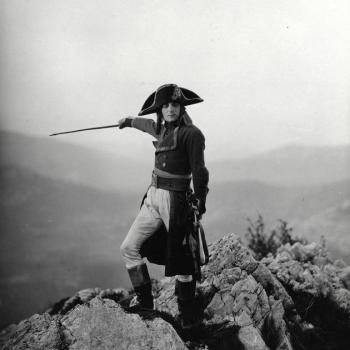
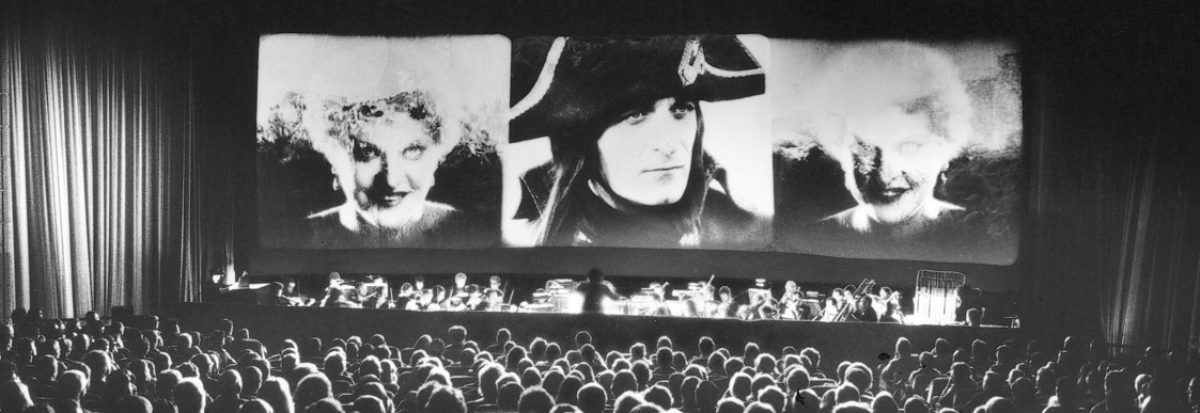


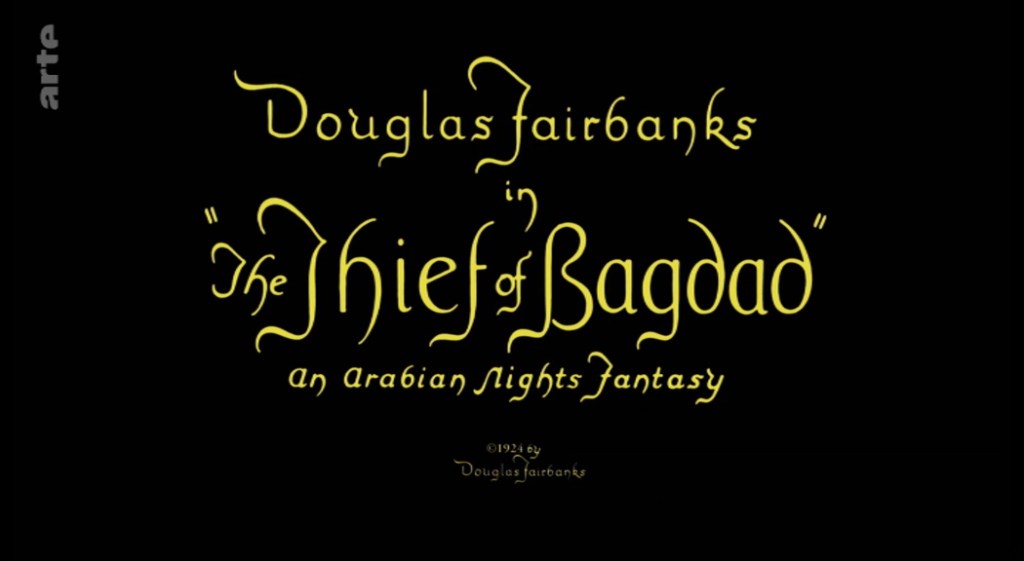


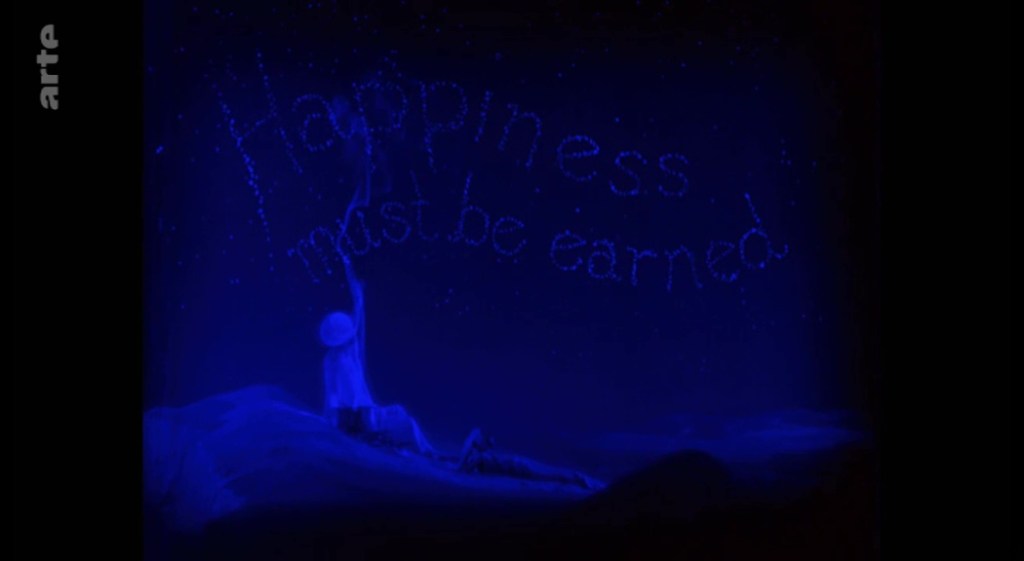


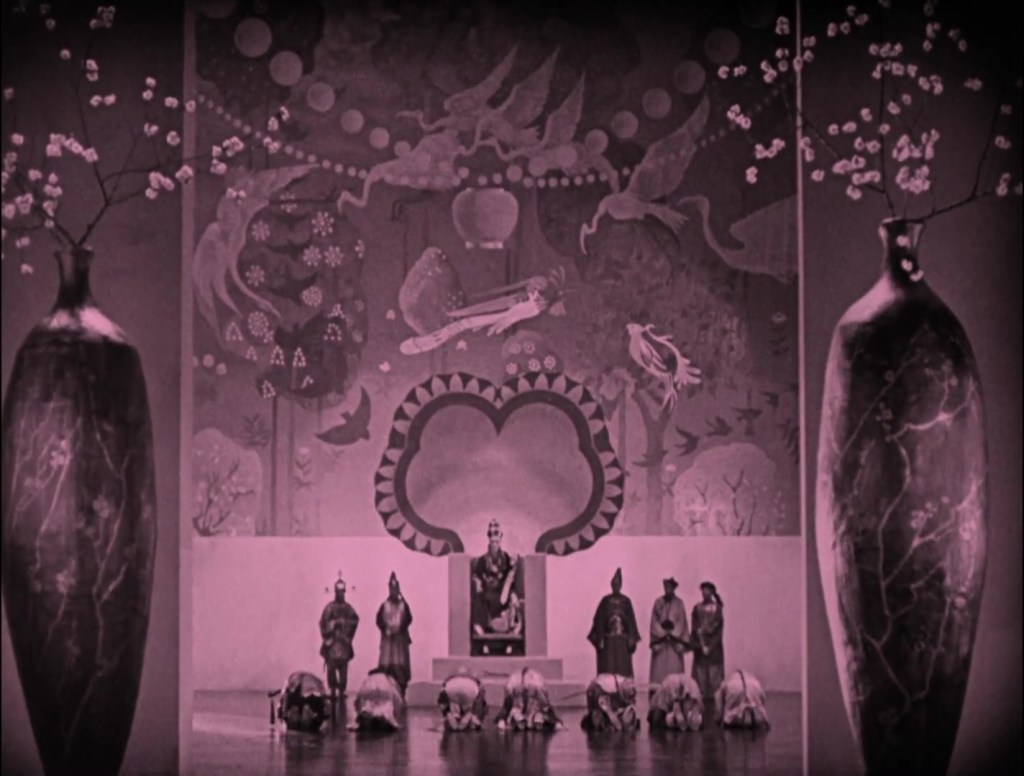


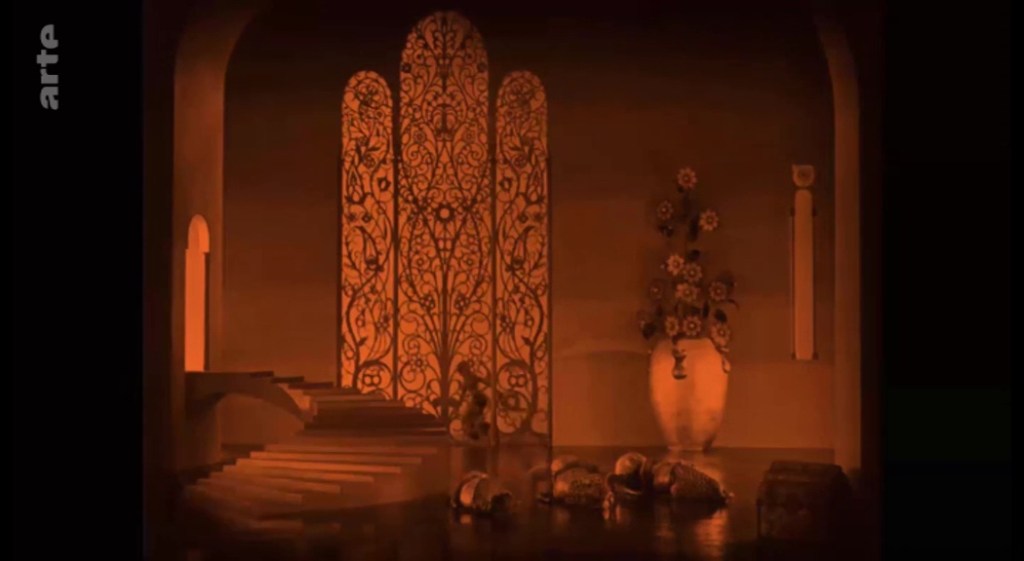

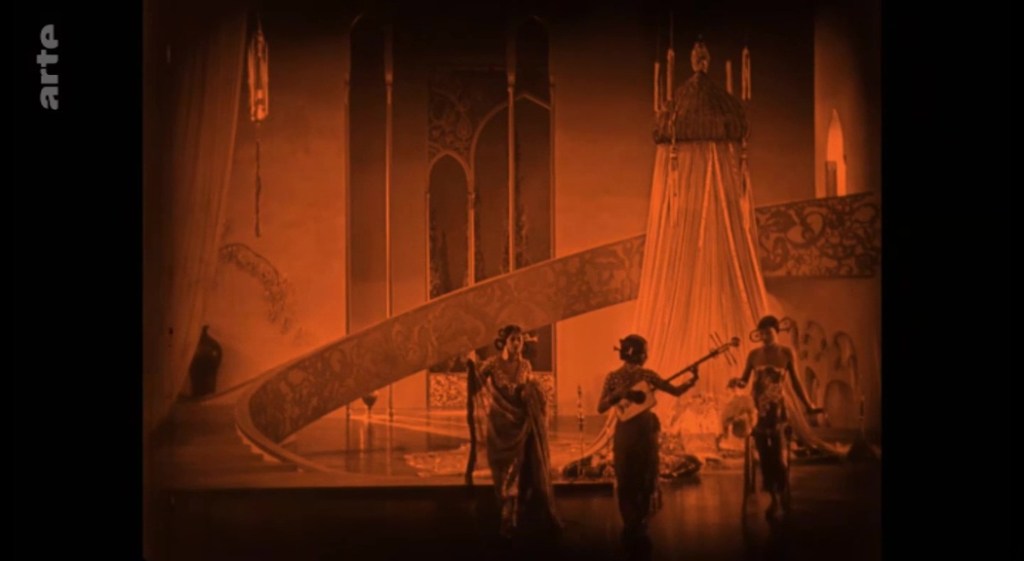
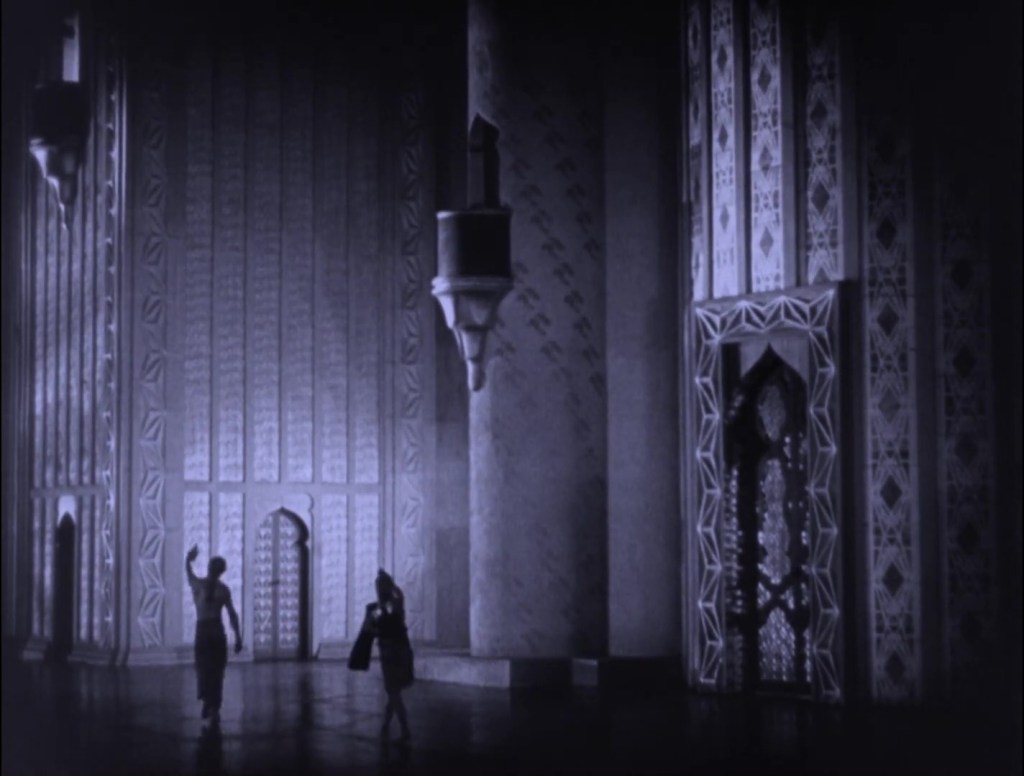


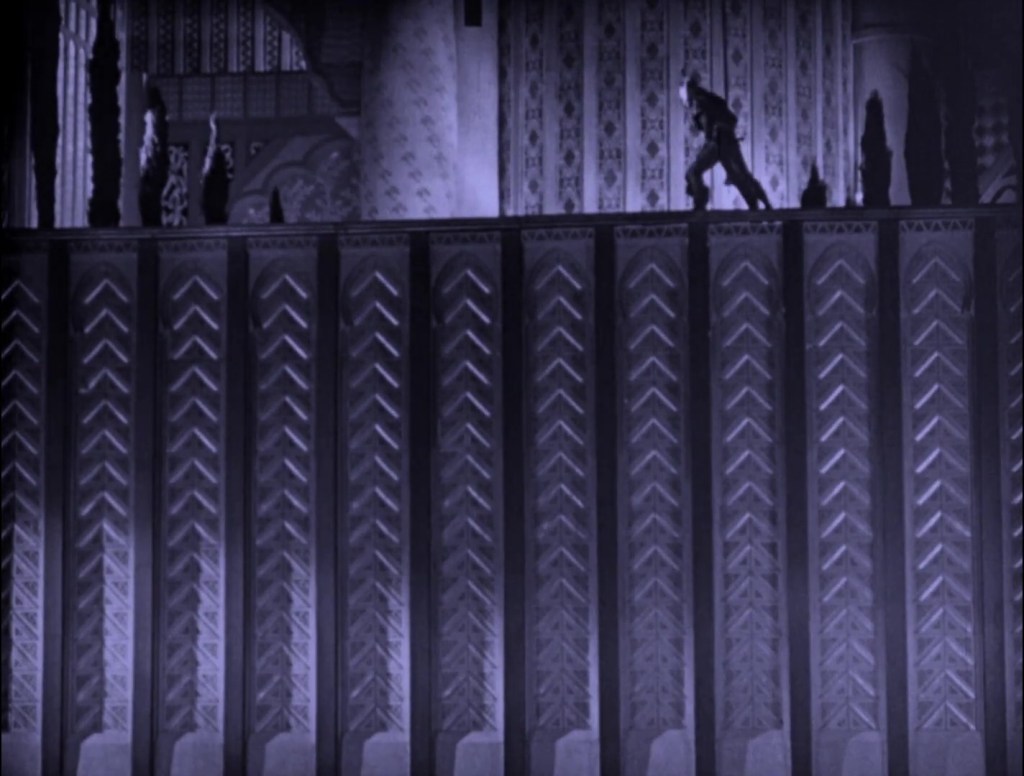


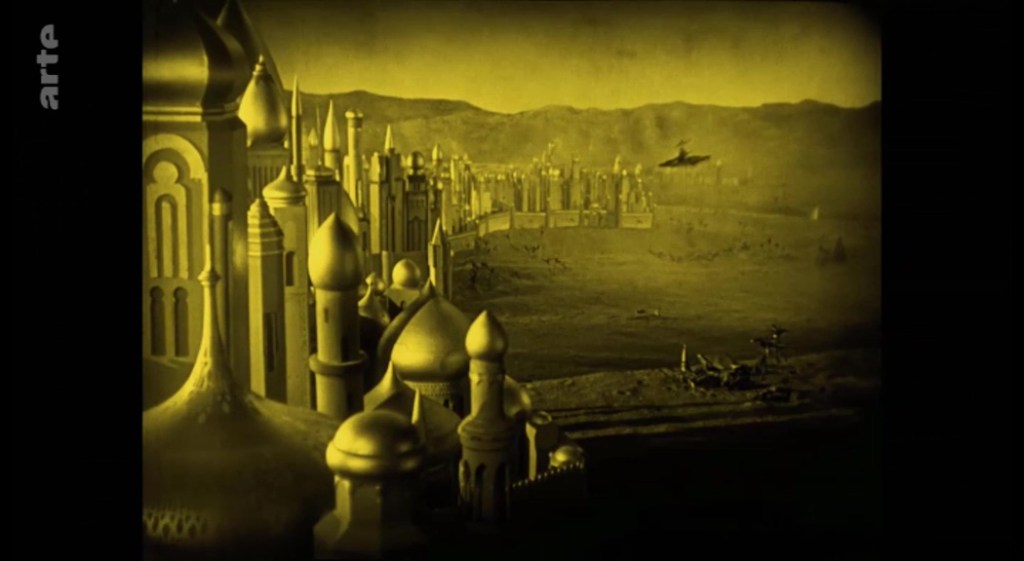



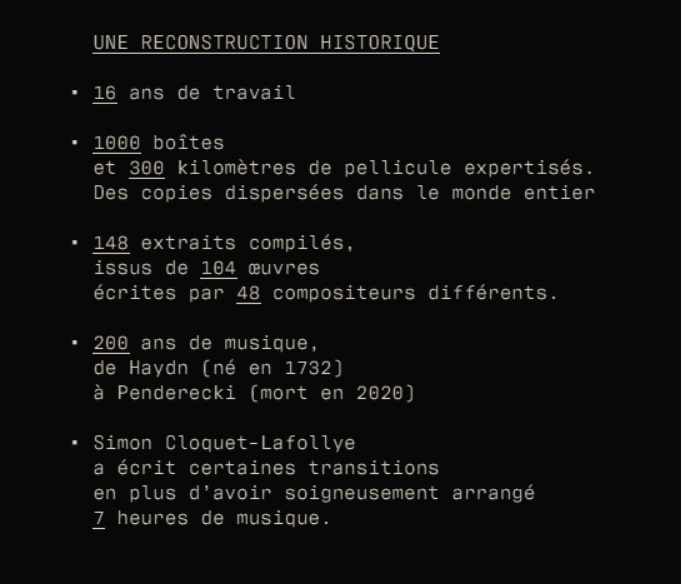




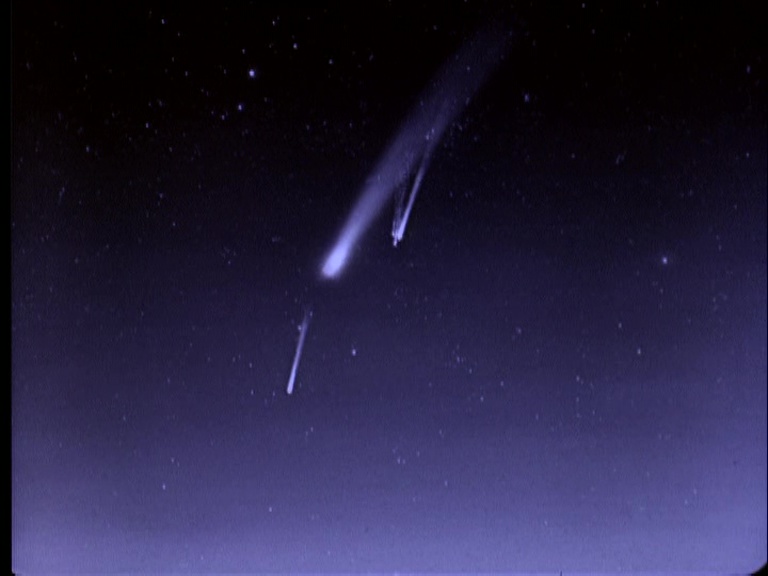


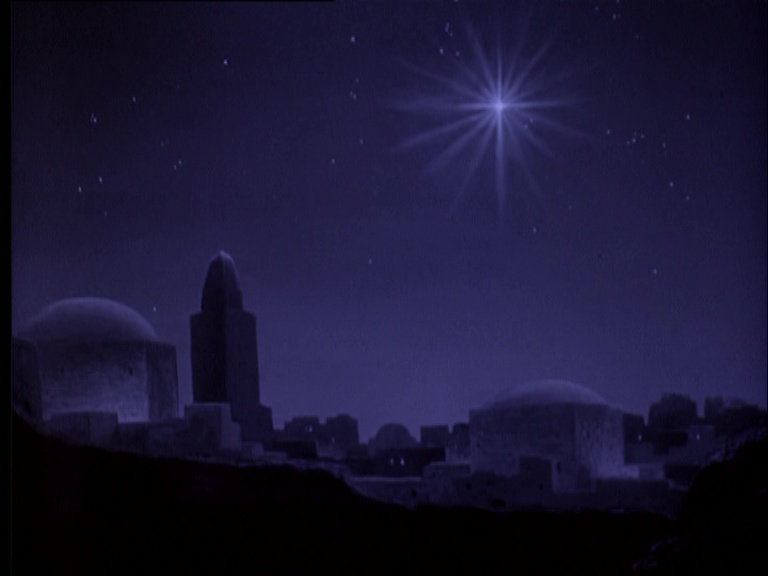


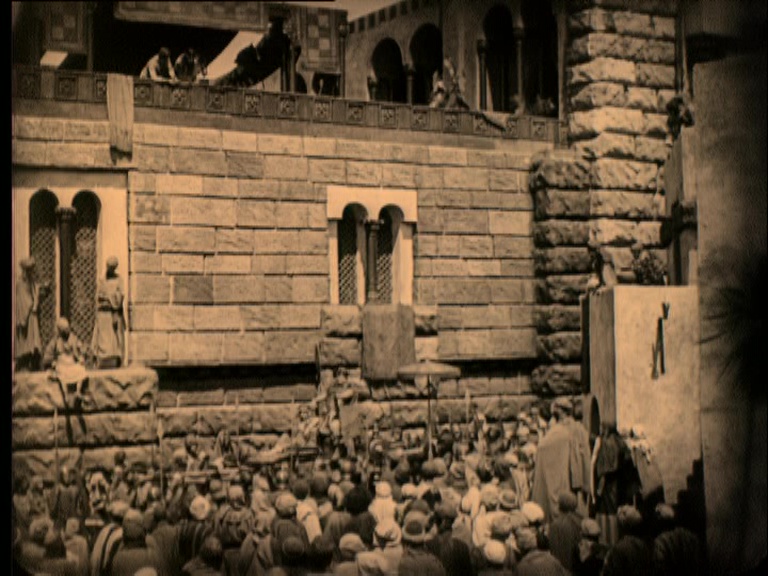


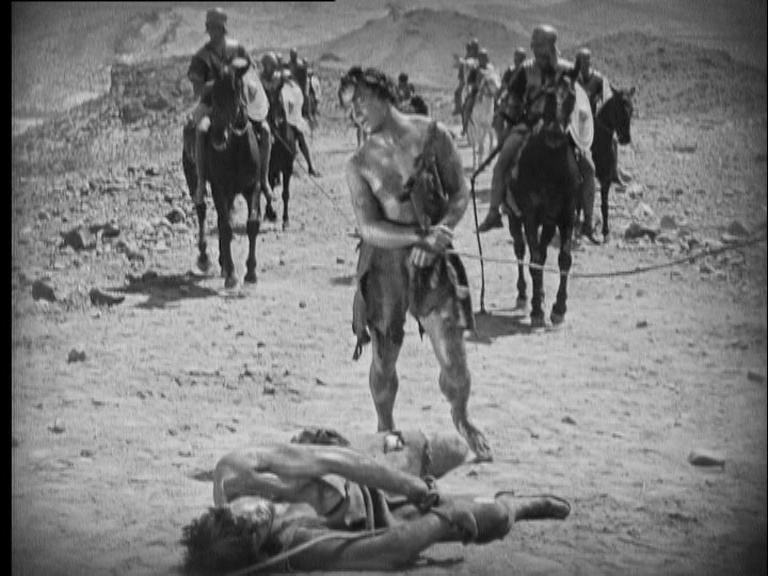




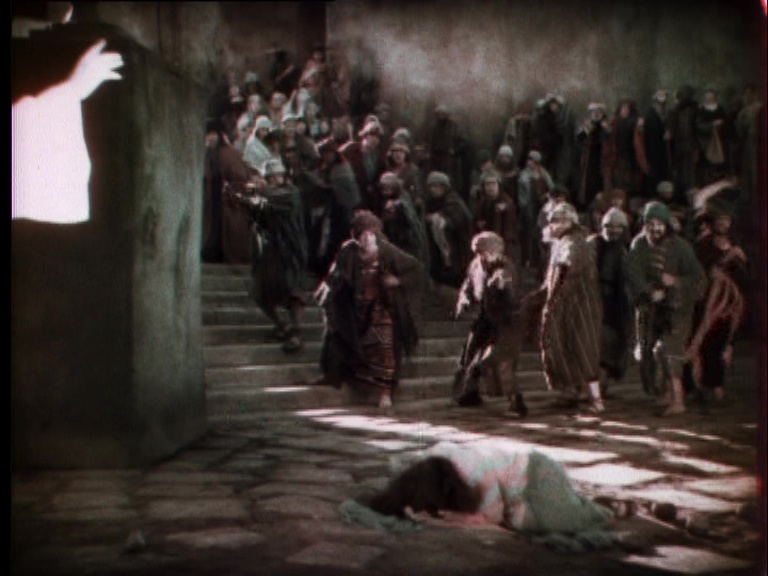


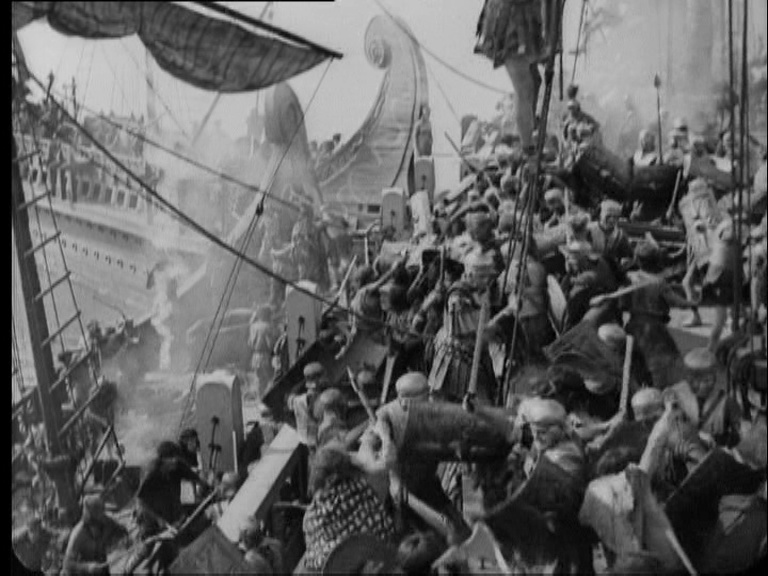


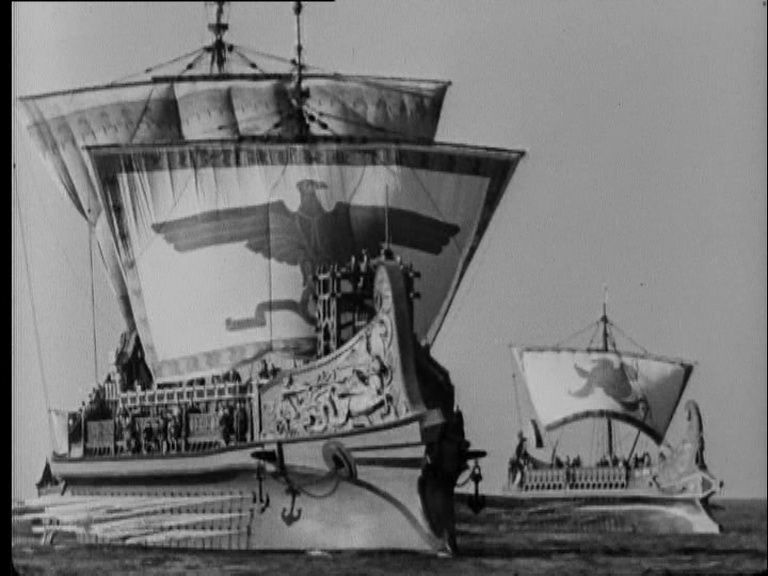


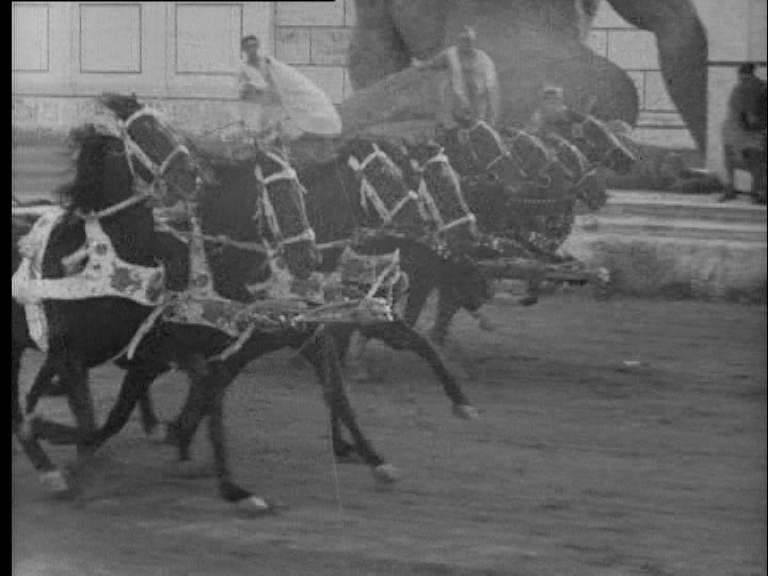
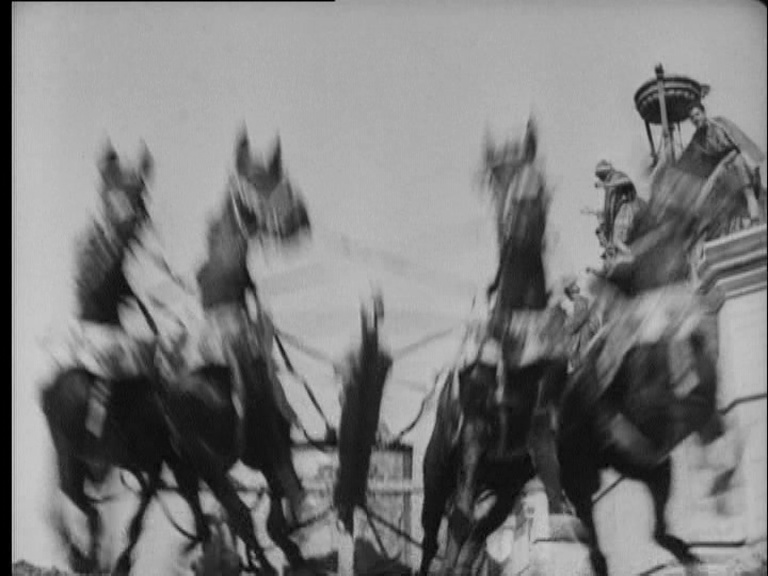





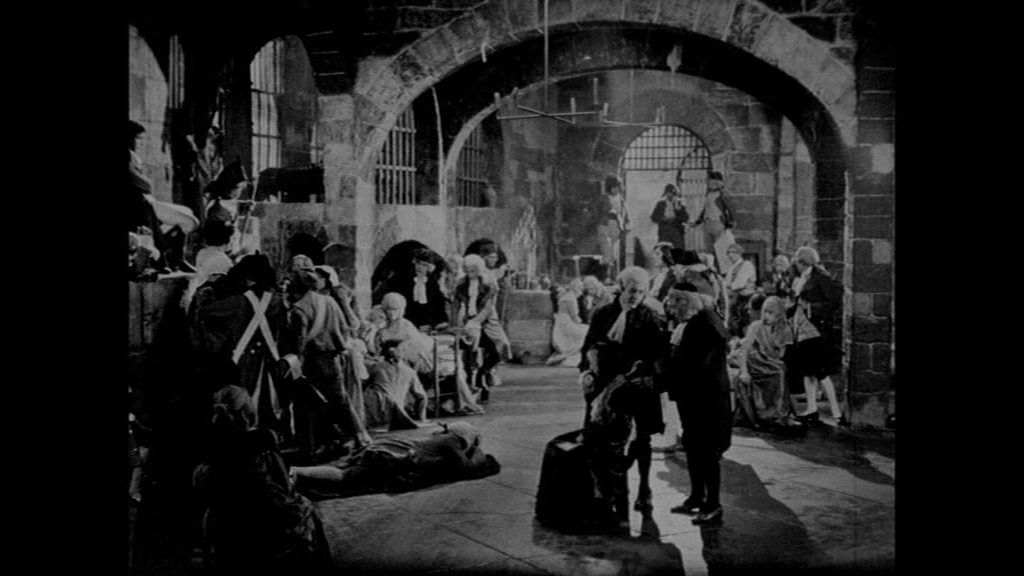


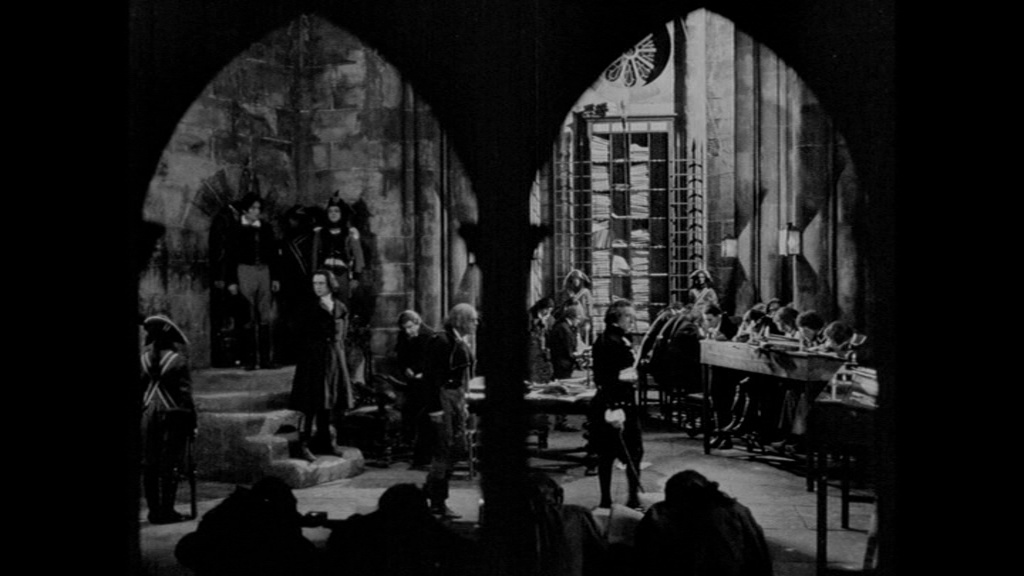




 The Realm of Silence