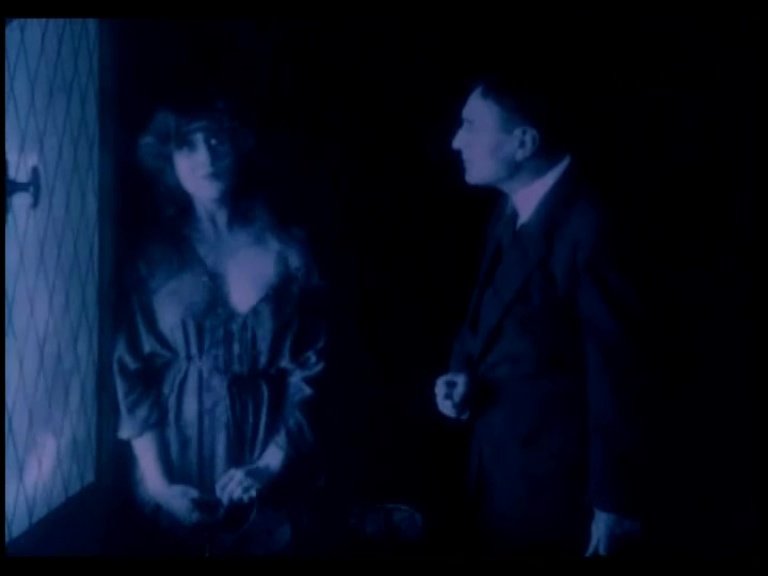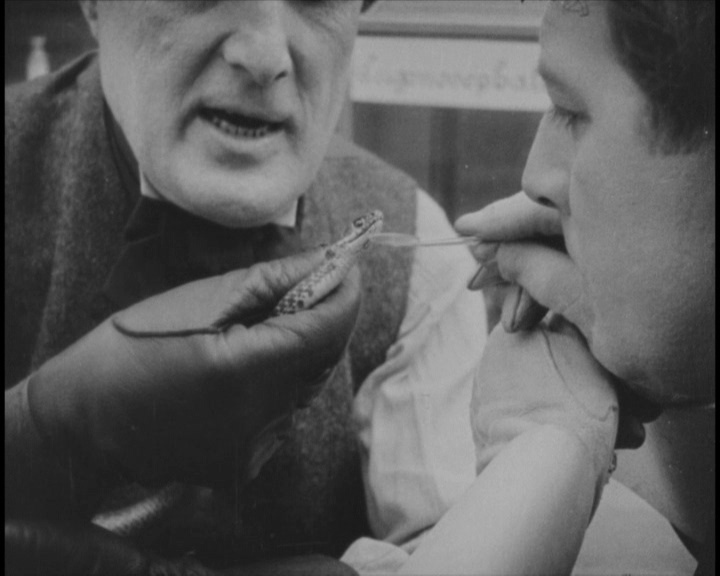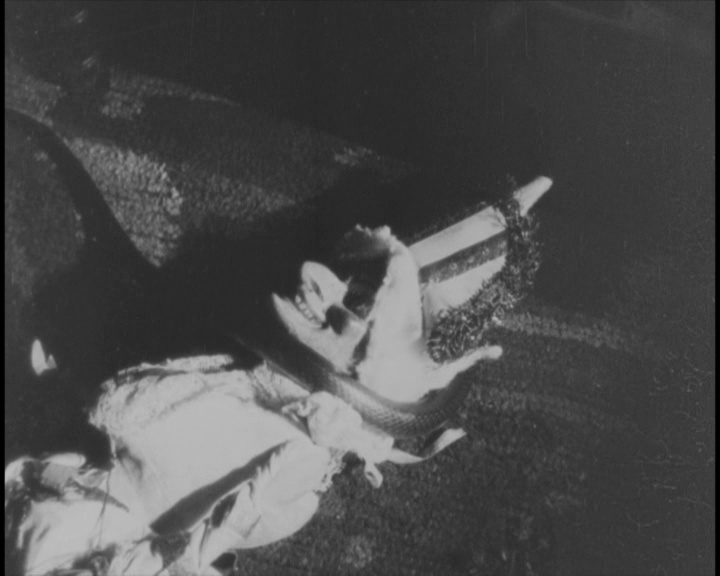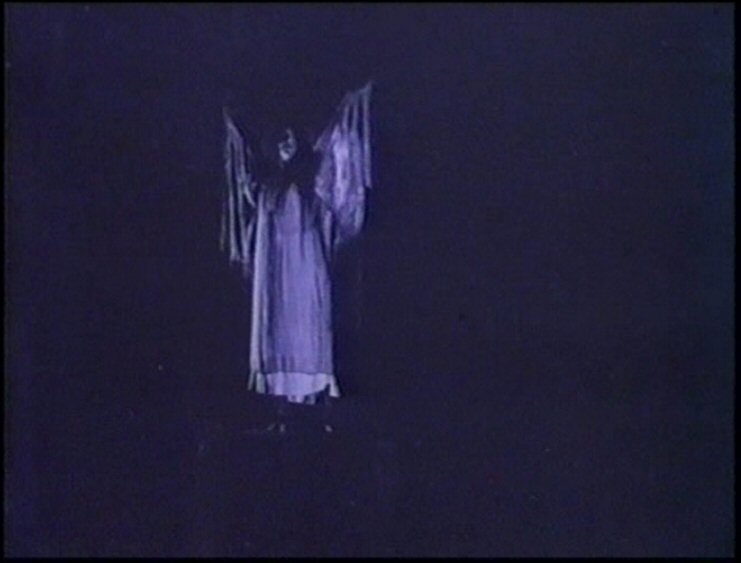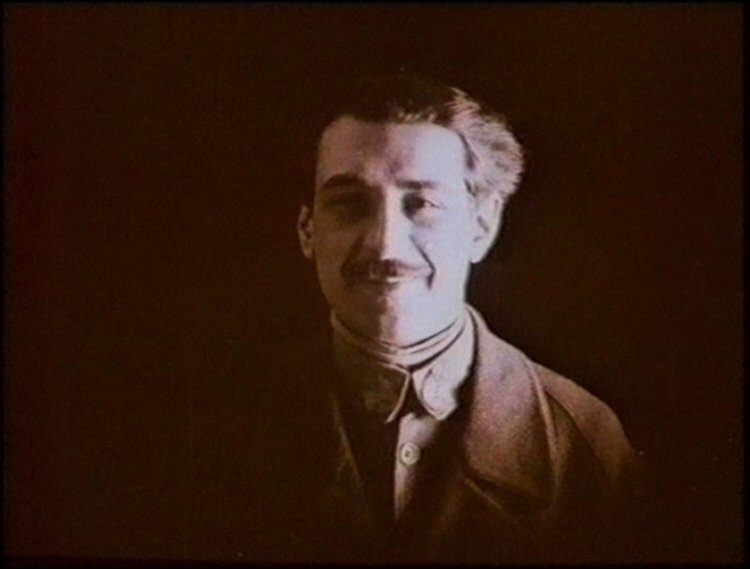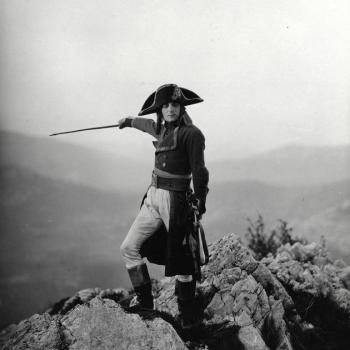
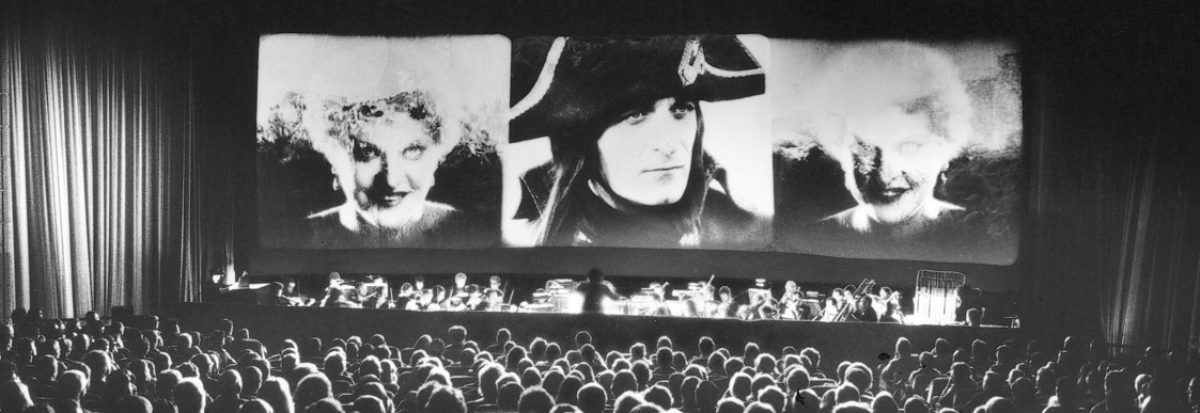
DVD/Blu-ray review: Napoléon, vu par Abel Gance (Potemkine, 2025)

This week, I return to the new restoration of Abel Gance’s Napoléon (1927) by the Cinémathèque française. I saw the premiere of this version with live orchestra in Paris in July 2024, but now I have the opportunity to pour over it on the small screen. Yes, the restoration has finally been released on UHD, Blu-ray, and DVD formats in France by Potemkine. What follows is not so much a technical review, especially since I do not have the wherewithal to play – let alone analyse – the UHD discs of this edition. Instead, I want to comment on how the Blu-rays reveal some of the choices made during the restoration process. Though it was broadcast on French television in November last year, this is the first time I have been able to see it in detail. At home, I can pause, replay, and capture. While the sense of live drama so palpable in the Paris concert cannot be replicated at home, other aspects are perhaps more evident through analysis on the small screen…

Presentation. As befits the ballyhoo around this restoration, the box is pleasingly hefty. Indeed, it rather resembles a Kubrickian obelisk. And, like our prehistoric ancestors, it took me several minutes of examination and careful fondling to work out how to open the damn thing. But I can’t deny that it’s a lovely object to observe and to handle. Inside are 1) a fold-out box of the UHD and Blu-ray versions of the film, 2) a small booklet discussing the music and listing Gance’s cast/crew, and 3) the Table Ronde book from 2024 that contains a series of essays by various people involved in the restoration, as well as historians analysing the film. The booklet contains very little material that hasn’t been included elsewhere before, and the Table Ronde book was released in exactly the same format as a separate publication last year. (On this, see my earlier review.)

On the discs themselves, I immediately flag an issue that may concern non-French speaking readers of this blog. The Potemkine edition has no subtitles of any kind on any of its presentations. This is despite press releases promising (at the very least) English options for any/all formats of this edition (DVD, Blu-ray, UHD). Furthermore, the restoration end credits include a list of translators for six foreign subtitle tracks. None of these are listed on the packaging, and I checked on the Potemkine website and various other retail outlets in France to confirm: there is no mention of subtitles. I can only assume that this was due to copyright reasons, as it is commercial folly to reduce your potential foreign sales by not offering more language options. I’ve not yet heard about any plans for the film’s international release, either via Netflix or any other means. I can only imagine that one or more interested parties don’t like the idea of an English-language home media edition of this film preceding a future release. Though the Table Ronde publication makes the claim for the Cinémathèque française possessing worldwide copyright for Napoléon, there are clearly limits as to how and when it is being sold to international territories. Since I began writing this review, news has emerged that Potemkine (and other retailers) have begun cancelling orders to anyone outside France. Merry Christmas, everyone!

Image. Something I had not properly appreciated at the film concert in Paris was the was the Cinémathèque française sought to digitally simulate the look of Napoléon as it might have been projected on screen in 1927. This involves simulating the relative brightness of the projection lamp, as well as the framing of the image as projected on the screen itself. Watching the Blu-ray, these choices are much more striking.

In terms of the relative brightness, projector lamps of 1927 were not only powered by different means but ultimately less luminous than a modern equivalent. A simulation of this difference involves filtering the restored video to make it look warmer than it would otherwise appear. Restorers are always conscious about digitally recreating the “look” of a silent film that was shot on celluloid, but the issue of projected brightness is less discussed. However, the effort to adjust the look of Napoléon this way has at least one recent precedent. The 2019 restoration of Gance’s La Roue (1923) by François Ede and the Cinémathèque française made a conscious effort to reproduce the look of the film as projected in 1923. (You can see images from this restoration on my post from last year.) Apparent to anyone who saw previous editions of La Roue, either projected on 35mm (on modern projectors!) or digitally reproduced on DVD, Ede’s choice gave the extensive black-and-white photography of this film a much warmer look than before. This results in black-and-white no longer being… well, black-and-white. For monochrome scenes (the majority of the film), it’s like an ochre wash has permeated the frame. It will also influence tinted/toned sequences, though the interaction of this filtered brightness with colour elements is more difficult to unpick.

All of which is to say that the black-and-white sequences of Napoléon also look less black-and-white than in previous editions. This is most obvious (and, to my eyes, most aesthetically counter-intuitive) in the prologue, where the snow in the snow-covered landscape now looks decidedly less clean. On the big screen in 2024, I think my eyes adjusted to this – though there was so much light spill from the orchestra that the contrast was hardly the best anyway. On the small screen, I notice the aesthetics of this simulated warmth (I can’t quite call it “dimness”, but that it surely part of it) on the Blu-ray much more. Ede explained his reasoning for this choice about brightness in the liner notes for the Blu-ray of La Roue in 2019, by far the best and most transparent set of notes for a restoration I have ever read in this format. There are no such explanatory notes on the Cinémathèque française release of Napoléon, so it’s worth saying again: these scenes are not tinted or toned; they are monochrome black-and-white, purposefully rendered less so.

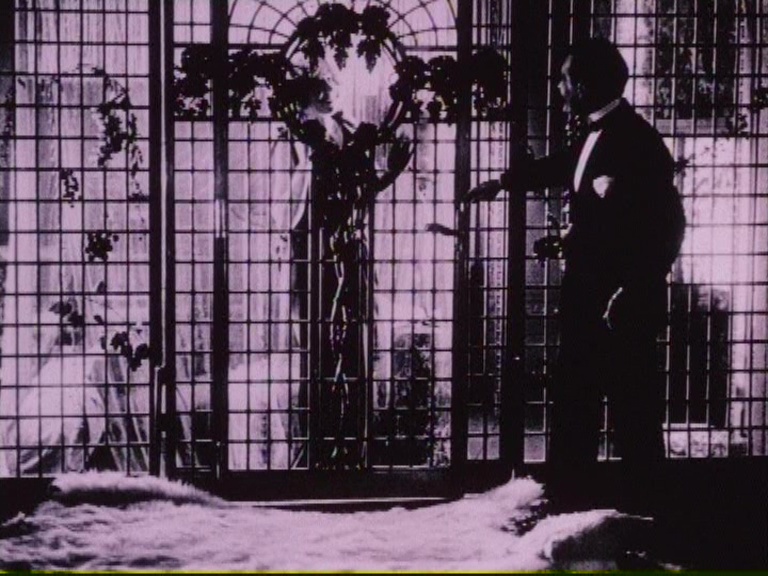
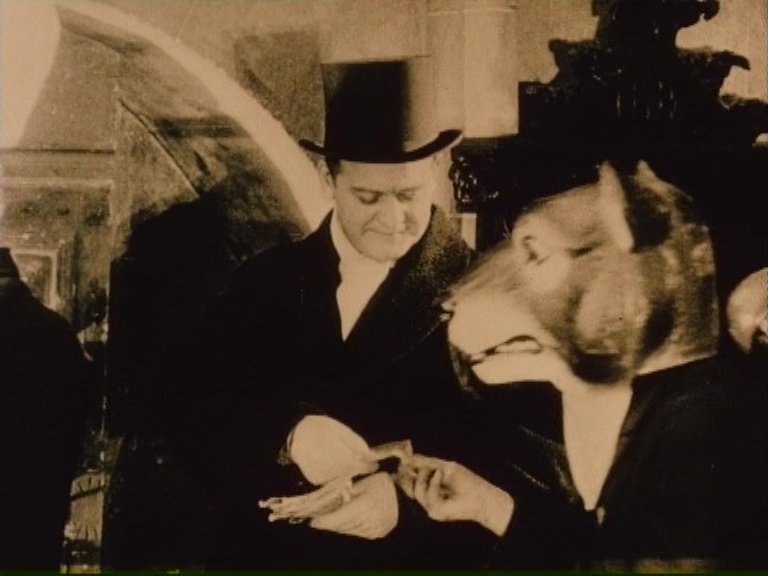
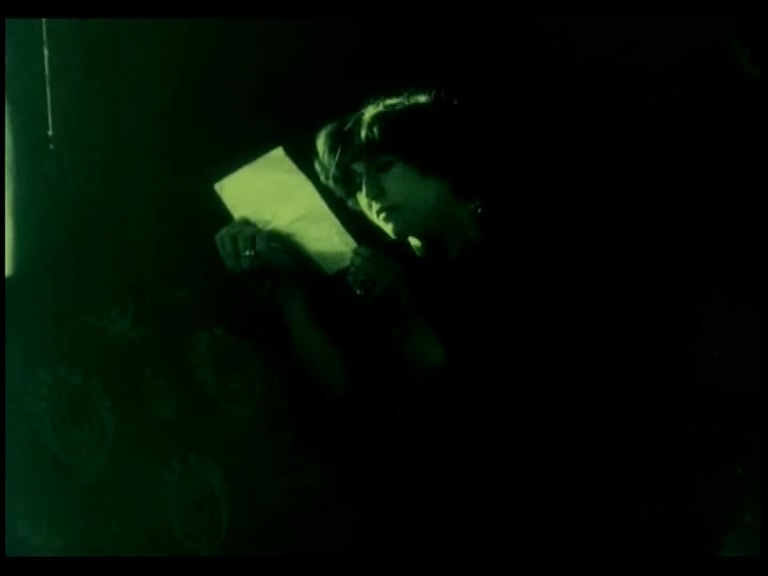
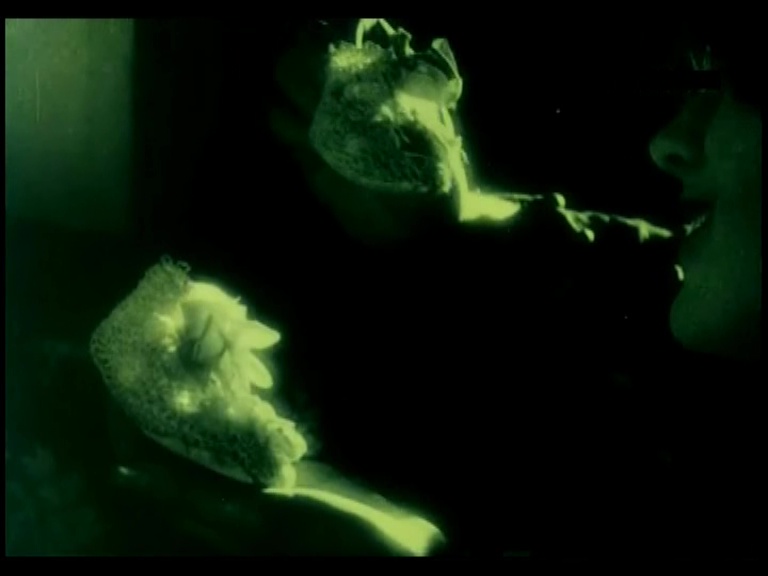
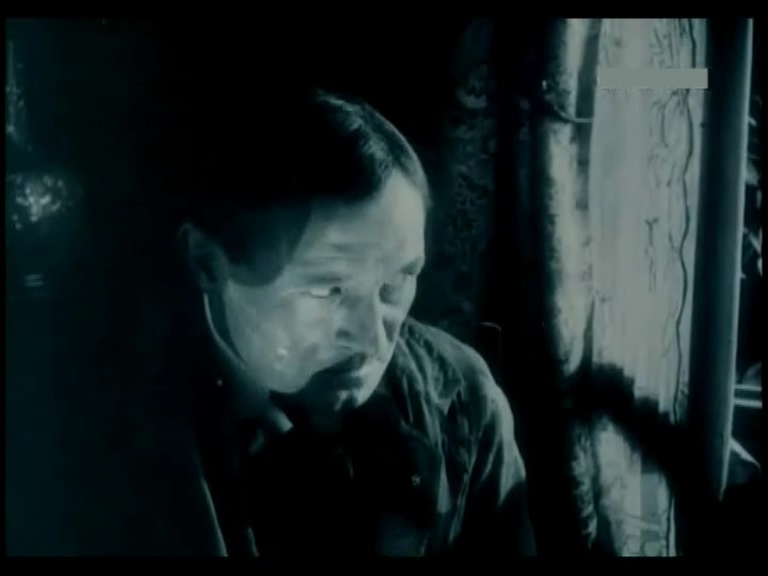
In terms of framing, the Cinémathèque française went one step further with Napoléon than with La Roue. According to their analysis, the aperture of contemporary projectors would slightly crop the film image on all four sides of the frame. As the below captures illustrate, there is less information within the frame in the 2024 restoration than in the BFI’s 2016 restoration. This is very noticeable as soon as you compare identical frames from identical shots between versions. I don’t have the time or energy to offer dozens of examples. (It is complicated by the fact that different restorations have utilized material from different versions of the film, so finding identical shots is rather time consuming!) But the final triptych is a clear example of how images deriving from the same negative (originally included in the Opéra version and subsequently added to some presentations of the (shortened) Apollo version) look different due to choices of the restorers. First is an image from the BFI’s 2016 restoration, second one from the new Cinémathèque française restoration:

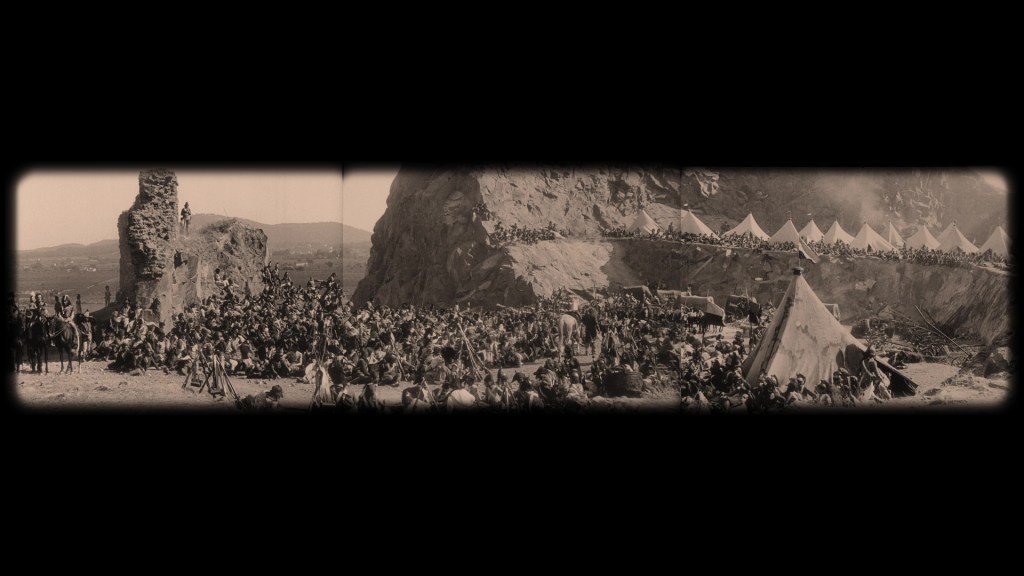
I simply don’t know what to think about either of these choices. I understand and respect absolutely the desire to be historically informed, though it is ultimately impossible to ensure absolute fidelity to lost practices. Accuracy is also difficult to guarantee in a realm where there was enormous diversity across cinemas and equipment. Even this “fixed” digital image will look different on every screen that it is seen – projected or otherwise – in 2025. This is not to say that any desire to emulate the aesthetic of projection in 1927 is wrongheaded; it isn’t. But it is an irony that this restoration, which seeks to reveal Gance’s masterpiece in its ideal form, also takes steps to restrict the boundaries of its images.

It is also curious that Napoléon has been chosen to be presented in this way, but not other contemporary films produced by the same company, the Société Générale de Films (SGF). Gaumont’s recent restorations of La Passion de Jeanne d’Arc (1928) and Finis terrae (1929) do not feature the cropping or dimming undertaken on Napoléon. You can see the edges of the frames in these other films, and the black-and-white is… well, black-and-white. Does Napoléon particularly benefit from extra treatment? If so, why? Or are we to take it that Gaumont’s restorations are somehow inaccurate, or at least ahistoric? I would perhaps have fewer qualms if the choices made during this restoration of Napoléon were in any way detailed, clarified, or explained in the accompanying booklet. But they are not.

The extras. To better illustrate the above issues, I can do no better than turn to one of the extras on the Blu-ray edition. Autour de Napoléon (1928) is a documentary made by Jean Arroy during the filming of Napoléon in 1925-26. It boasts some extraordinary behind-the-scenes footage of the production, both during and in-between shooting, as well as extracts of Napoléon itself. Extracts from Arroy’s remarkable film have previously featured in various modern documentaries on Gance and/or Napoléon, but this is the first time the surviving material has been assembled into a coherent whole. Alas, this restoration of Autour de Napoléon does not state how long it is, nor how this compares to the film’s original length in 1928. (Nor does it state what framerate(s) it uses.) However, information from 1928 does survive in the archives, so I can report that the film was originally shown in a version of 1605m, which would be approximately 70 minutes at 20fps (or 78 minutes at 18fps). At just less than one hour, this 2025 reconstruction at least presents most of the film. And, unlike the opening credits of Napoléon, it admits that the original montage is lost and cannot be definitively recreated with existing material.

Autour de Napoléon was restored by Eric Lange, with the assistance of Joël Daire, Serge Bromberg, and Kevin Brownlow. The restoration was produced by FPA France (the successor company to Lobster), though in association with the Cinémathèque française. What is immediately striking about this presentation of Autour de Napoléon is that it does not feature either the re-adjusted monochrome or frame cropping of Napoléon. This is most obvious when Autour de Napoléon includes extracts from Gance’s film. Though the footage used by Arroy seemingly derives from both the Opéra and Apollo versions of the film, certain shots are identical to those found in the Cinémathèque française restoration of Napoléon. In these examples, the full frame is visible, and the monochrome is more obviously black-and-white. (The tinted scenes are also far less saturated.) Though the original material (derived from several sources) for Autour de Napoléon is clearly less well preserved than for Napoléon, the difference in what is seen on screen is significant. In the below image captures, those from (the FPA France) Autour de Napoléon are on the left and those from (the Cinémathèque française) Napoléon on the right:
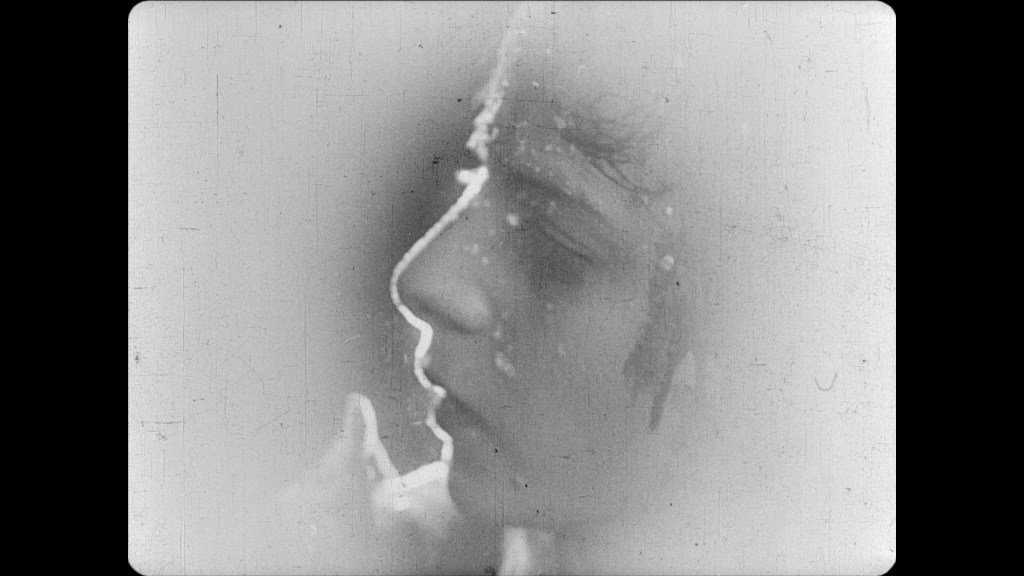
But these aesthetic issues are secondary to the sheer joy of watching Autour de Napoléon. The footage of Gance and his crew filming Napoléon is astonishing. You can see the unbelievable lengths they went to in order to achieve visual mobility: we see the camera mounted on a sledge-propelled guillotine, strapped to an operator’s chest, run on cables from the ceiling, mounted on the back of trucks and of horses. What’s more, the camera so often had to be specially mechanized to turn without being cranked by hand. Witness the amazing sight of Gance and his crew standing to admire the camera turning 360 degrees on its tripod, as if it were a living thing.

None of this would be so impressive if it weren’t for the evident energy of the entire cast and crew at work. Quite simply, Autour de Napoléon is one of the most joyful records of filmmaking you’ll ever see. Immediately striking is the sheer fun these people are having making this film. Gance – as Bonaparte is described in the prologue of Napoléon – is everywhere. Here he is in the snow, urging on the children in their snowball fight, and urging on his cameraman Jules Kruger to capture the action. Here he is demonstrating a gesture to his young Bonaparte, a gesture we will see exactly reproduced by the actor in the film itself. Here he is with an enormous megaphone, poised to direct the huge crowd that fills the set of the Convention. Here he is with a revolver, firing in the air to create the shock and fear he wants from his performers…

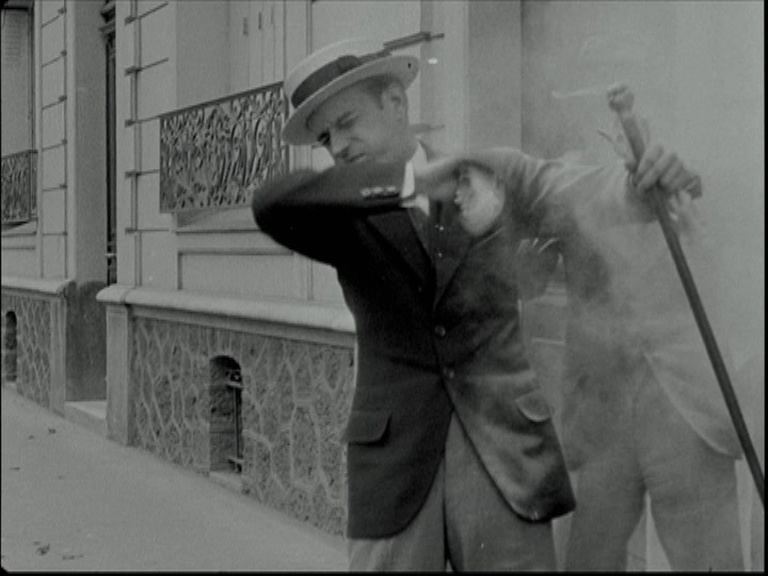
What’s so striking is how playful Gance is on camera. At a distance, we see him intensely concentrating on the activity on set. But when he’s close by, he’s always got an eye for the camera – for us – and he plays up to it wonderfully. Here he is in a huddle with Annabella and Gina Manès, playing with Josephine’s dog, making everyone laugh. I love these in-between moments of silliness. You get such a sense of the mood on set, such wonderful glimpses of these long-dead artists caught in the midst of life. By contrast, I think of the forbidding Marcel L’Herbier on set in Jean Dréville’s later making-of documentary Autour de l’Argent (1929). Here, L’Herbier never takes off his impenetrable sunglasses that shield him from the studio lights – and from our gaze. He’s a faintly sinister presence, always at work and never at play. (Kevin Brownlow once told me that meeting L’Herbier was like encountering an aristocrat from before the Revolution.) Dréville’s film is far more polished than Arroy’s, but it entirely lacks the fascinating odds and ends of Autour de Napoléon. See how much in-between time there is on screen. We see cast and crew relaxing on Corsica, meeting the locals; we see them waiting for the action to resume, or killing time when things ground to a halt. Arroy has an eye for the comic and incongruous. Here is a troupe of cavalry led by Bonaparte, who happens to be driving a car down the street. Here is Bonaparte, pistol in hand, sat on the back of another car. Simon Feldman, Gance’s Russian technical director, leans over the side, smoking a small cigar. They are waiting for a train to pass before they can resume filming. In the background stands a group of Pozzo’s frustrated cavalry. Gance is there too with Jules Kruger, who holds his huge handheld camera on his shoulder. The train slowly trundles past. As it does so, Gance sees that Arroy is filming and stalks towards the camera. He comes up to the back of the car and goes “Boo!”, throwing forward his arm. Arroy cuts to the next scene. It’s such a lovely moment, one of many rendered incredibly human by their incidental nature. That this film exists is miraculous, and I’m incredibly pleased and moved to finally be able to see so much of it. On this edition, Neil Brand provides a lively and fitting accompaniment on the piano. A superb extra.

Next up is Abel Gance et son Napoléon (1984), an hour-long documentary by Nelly Kaplan. This includes fragments of Autour de Napoléon, together with narration by Michel Drucker, who also appears at intervals in the former Billancourt studios where Gance filmed in 1925-26. Kaplan was Gance’s artistic (and personal) collaborator in the 1950s and early 1960s, as well as a much respected filmmaker in her own right in later years. It’s a shame, therefore, that she herself does not feature as a subject in this film. I recall seeing Kaplan for the last time in 2015, when she made an appearance at the Cinémathèque française during a presentation by Mourier about Napoléon. This included an extract from Abel Gance et son Napoléon, and when Michel Drucker appeared on screen much of the auditorium started laughing. Such is Drucker’s reputation as a cheesy host from French television in the 1980s. I felt very sorry for Kaplan, who was otherwise largely ignored at this event. One suspects that the inclusion of her Abel Gance et son Napoléon on this new Blu-ray is a mark of respect more than a measure of the documentary’s importance. Next to Autour de Napoléon, it is unfortunately rather thin.

Elsewhere, we get La Saga du Napoléon d’Abel Gance (2025) an hour-long documentary by Georges Mourier. It covers the story of the restoration, as well as the memories of some of Gance’s surviving friends and relatives. It’s lovely how Mourier plays with the age of his interviewees, showing them juxtaposed, young and old in a variety of archive (and new) footage – demonstrating the years that have passed, the time taken for this project to be envisioned and realized. I also found it very endearing to see Mourier and his colleague Laure Marchaut at work, and to see them age across the film. It’s a testament to their decades-long devotion that this documentary captures the effects of time on its human subjects as well as the film itself.

Of course, I was also longing to hear more information on the choices of the restoration, but that is not provided here. It’s very much geared to the story of the search across the globe for every last copy of Napoléon, and of the discovery of the “Rosetta Stone” in the archives: the document that details the scene-by-scene breakdown of the original Apollo version of 12,961m. But the history of how and when the Cinémathèque française decided to reconstruct the later, shorter edition of the Apollo version – “la Grande Version” – is not discussed. Nor is when and why this version was deemed “la Grande Version”, nor how its contents were determined, nor if other material survives that was excluded from the restoration, nor how closely the restoration resembles the original “Grande Version” in length or structure. As I outlined in detail in my previous posts on the new restoration, these questions remain unanswered. And since neither the credits, book, nor indeed any source mentions it, I did a quick time check. Excluding the lengthy restoration credits, this version of Napoléon runs to 6hrs, 59min, 37sec. At 18fps, this indicates a projected length of approx. 8633m – another figure not mentioned anywhere in the literature.

(I must also record my amusement at some of Mourier’s musical choices on the soundtrack of his documentary. He uses Beethoven’s Symphony No. 6 to accompany a clip of the “Double Tempest”, just as he uses sections of the same composer’s Symphony No. 7 and Coriolan Overture to show other scenes of the Revolution being reassembled. These are the exact pieces used by Carl Davis in his score for the film, per the BFI edition. It’s interesting that Mourier seems to prefer Davis’s choices than Cloquet-Lafollye’s choices, which form the soundtrack of the Cinémathèque française restoration but do not feature in this documentary. Hmm.)

There are also three videos from film historians. In “Napoléon au cinema”, David Chanteranne talks about Gance’s film in relation to other cinematic Bonapartes, and to Napoleonic iconography more generally. The other two videos are by Elodie Tamayo. I have sung her praises in earlier posts, as her work editing Gance’s correspondence and resurrecting the fragments of his Ecce Homo (1918) is of enormous value. For this release of Napoléon, there is an interview with her and a video essay featuring clips from Gance’s film itself. Both are extremely engaging, interesting, and – especially the video essay (“Napoléon à contre-jour”)  – beautifully thought-through presentations. She discusses the film’s relationship with history, with Gance’s ideology, and with the medium of cinema itself. Her analysis manages to get to the heart of this enormously long film in an impressively brief space of time. (And I speak as someone who spent 332 minutes commentating on the BFI Blu-ray and still worries I didn’t do enough!) I earnestly hope that we hear more from Tamayo on Gance in the future…

Those are the sum of the extras, but I can’t help feeling that there are many more than might have been included. Most obviously, the Opéra version of Napoléon would have made a fascinating comparison piece. For all Mourier has emphasized that this was inferior to the Apollo version, it would be nice to see the difference for ourselves. If nothing else, it is of tremendous historical significance as the first version of the film shown in public. But I can also understand why this version might not have been included, aside from its four-hour length – and the expense of producing it. Its inclusion would inevitably signal that other versions of Napoléon might be interesting, valid, and valuable iterations of Gance’s project. This would rather jar against the label “definitive” that has been appended to the marketing for the restoration. Releasing the Opéra version would also demonstrate the fact that the triptych version of the “Double Tempest” it once boasted remains missing, and this fact might also raise awkward questions about the restoration process, its decisions, motives, and outcomes.

Another absence is the single-screen ending of Napoléon, as included in the original Apollo version – and in subsequent screenings at cinemas that lacked the capacity to project the triptychs (i.e. most cinemas). (Thankfully, this alternate ending is included on the BFI release as an extra.) Also absent are the triptych “studies” that Gance produced in 1927 using footage from Napoléon, short films which were subsequently projected at Studio 28. Two of these, Danses and Galops, have been restored and were shown at the Gance retrospective at the Cinémathèque française last year. (Sadly, this was a screening I couldn’t attend.) The third of Gance’s studies, Marine, is seemingly lost – a great shame, as it was purportedly the most visually beautiful of the three. Any material from or relating to these short films would have been a great bonus. Will they ever get a home media release?

Finally, I must admit my chagrin at the only book included in this set being the Table Ronde publication. I had thought that Mourier might have contributed a more substantial written account of the restoration. He announced some time ago that he would be publishing a book on his work on Napoléon, and I hoped that it would be included with the Blu-ray edition. Sadly, I must wait to give the Cinémathèque française yet more of my money. I do hope the book includes more evidence of the choices made during the restoration. (Rest assured, if/when it’s published, I will write a review.)

Conclusion. Nothing I’ve said should prevent you from buying the new edition of Napoléon. Indeed, purely on the basis of supporting this film, its makers, its legacy, its restoration, and its overall cultural importance, I strongly urge you to buy it. Several years overdue, and goodness known how much overbudget, this is the longest version of the film we’re likely to see. The Cinémathèque française is not going to be funding any further work on Napoléon. Aside from anything else, the word “definitive” in all their marketing signals that they’re done with this film. The only question is whether you will be able to buy the Potemkine edition, and whether any alternate edition will be released on Blu-ray outside France. It would be a sad fate for this most cinematic of films to be limited to streaming via Netflix.

Paul Cuff

Abel Gance at the Cinémathèque française (4)

This final post on the Gance retrospective reflects on my experiences at the Cinémathèque. It’s rare that I find myself at such a concentrated cultural feast. Anyone who has read my posts on Pordenone or Bonn will know that festivals are things of great fascination to me, and perennially out of reach. This post is therefore a way of considering everything that an in-person event (what a ghastly phrase) offers and means, and of acknowledging what is missing from my usual film-viewing experience. Writing is also a way of remembering and recording what were for me days of great pleasure.

I should begin by saying that Les Gaz mortels was not the first aesthetic experience of my trip. Friday 13th proved to be an auspicious day. En route to the Cinémathèque, the friend with whom I was staying took me to the Jardin des Tuileries to see the Musée de l’Orangerie. Here are displayed eight giant panoramas of Claude Monet’s Les Nymphéas (1914-26), spread across two rooms. There was something appropriate in seeing art created during the same years of Gance’s emergence as a filmmaker. (Both artists have been associated with the label “impressionism”, but the appropriateness of this -ism is too complex to consider here.) However, what I took away from the Orangerie was an extraordinary sense of the way time shapes these works and affects how we receive them.

In the 1890s, Monet wrote to a friend that he was trying to capture in his series paintings “ce que j’éprouve”. The verb “éprouver” denotes more than a process of seeing: it is a process of feeling, of experiencing. It implies a kind of temporal duration that the verb “voir” does not. To experience, or to feel, a scene is not merely to see but to contemplate; it is also to let the world sink into oneself, or to sink a little into the world. In his series paintings, Monet moved from canvas to canvas, adding successive layers of colour and texture as the hours passed – returning again and again, day after day, season after season, to build up his images. Les Nymphéas use this principle on an even larger scale, and Monet took twelve years to fill canvases that are two metres high and up to seventeen metres long.

The result is an amazing expanse and depth of paint, a veritable layering of time. Staring at the surface of these vast canvases, you realize that the very word “surface” is misleading. Every inch is built of innumerable strokes, of innumerable moments of reflection, consideration, and reaction – of feeling and intelligence. The paintings are not simply an effort at capturing a single moment, a single time of day, but a record of the process of feeling, of experiencing, that time. They are both a document of time passing before the painter and of the time spent by the painter in the act of painting. Standing before the completed canvases, as Monet must have done for countless hours – days – weeks – months – years, I was deeply moved by the sheer laboriousness of the process of painting. Having once been an amateur painter myself, I knew – I could feel, even – the physical history of this act of mark making. The time of painting was as tangible as the painting of time.

But the scale of these images creates time-systems within their borders. Traversing from left to right the thirteen metres of Nymphéas, les nuages, I had the peculiar sensation that I was moving through a kind of narrative. On the left, the reflected trees seem only a little darker than a morning haze (blues mingle with mauves, greens mingle with touches of yellow and turquoise); then the sky appears, brightens, and clouds bloom; but in the last metres the sky’s hue deepens, darkens; and suddenly a great bank of darkness fills the frame from top to bottom – it as if night, or autumn, blots out the memory of a warm afternoon. In those last two metres, the darkness is of a deep, muddy green – as though the autumn mulch were already underfoot. The lilies were dashes of blue and yellow on the left of the canvas, but here on the right they are streaks of crimson and blotches of rust. I stopped and stared at this weird, unsettling depth of gloom, trying – and quite failing – to fathom how it was formed.

From this sense of time creeping over canvas and viewer, it is a relief to find elsewhere a sense of immediacy in the business of brushstrokes. In the second salle, the surface of the pond in Nymphéas, le matin clair aux saules is alive with curling dashes of blue. This is not a great gust of wind, for the downward strokes of the willow leaves hardly stir. It is just a draft, the beginning of a breeze, that catches the water. The clarity of the sky is lost in this murmur of paint. From the mix of azure and clouds that flash amid the ripples, you can see that the weather is changeable. How extraordinary that such infinite pains were taken to capture the ephemeral moment when the wind rose on a bright day, a century ago. In this painting, the depth of time that Monet stood before his canvas crystalizes into an amazing sense of immediacy. The contrast between the process of creation and the actualization of its goal is remarkable. How many hours, over how many years, to build up this sense of subtle movement across the water?

There is personal time, too. I found myself moved not only by the richness of the colours in Nymphéas, reflets verts, but by the fact that its palette is exactly that of my grandmother’s front room – a room that has not existed for twenty years. She, too, was a painter, and adored Monet. She kept an exquisitely rich little garden whose colours spilled into the house. (She never closed the curtains, so as to always be able to see it.) There are greens of astonishing depth in Nymphéas, reflets verts, and blues from late summer skies. The light is fading, but the surface of the pond has a supernal warmth – a kind of aura of the day that is passing, that has long ago passed. (But what day is this on the canvas, if not a kind of distillation of multiple days? Somehow, time here is suspended, hovering outside history.) I stopped and stared at the deepest patches of a reflected sky that is somewhere beyond the frame, somewhere beyond time.

By this point, I became aware that my hour within the Orangerie was itself slipping away. I was struck by the strangeness of this aesthetic experience, by how something so fleeting could plumb such depths of feeling and pastness. This was an encounter of something static by something in motion. The paintings were staying, and lasting; I was moving on, undergoing a different kind of time. I recalled the scene in Le Côté de Guermantes when the duke shows M. the paintings by Elstir, which the narrator compares to the images of a magic lantern – a kind of hallucinated landscape projected by the mind of the artist. Oddly enough, I had been talking about Proust with my friend as we walked through the gardens en route to the Orangerie. As we were leaving, I tried to tell her about the passage in the novel – which M. experiences as an oasis of contemplation amid the bustle of a social event – but speaking was too much. It was the paintings themselves, and the sadness of leaving them; it was the odd proximity I found between my own body and that of the painter, long gone, standing before the canvas – allied with the fact that I could imagine so clearly the process of painting, but I no longer paint; it was the colours of a room that I knew and loved that had been restored to me for an instant; it was the memory of my favourite book, and the memory of the first time I read it: I finished the final pages of Le Temps retrouvé at my grandmother’s house, overlooking her garden. My Englishness obliged me to avoid making some kind of scene, so I gulped back my tears and tottered towards the exit. It is surely apparent by now that I was totally overwhelmed by these two rooms in the Orangerie. (All this will return us, eventually, to Gance – I promise!)

Emotionally primed, and thinking of the passing and the recapturing of lost time, we finally entered the Cinémathèque. Here we had time to visit the “Musée Méliès: La Magie du cinéma” exhibition, which was very charming. Lots of proto-cinematic optical devices, of hands-on machinery, and of designs, costumes, and models from Méliès’ films. Here, quite literally, I saw Proust’s magic lanterns. (There was also a prominent place given to Martin Scorsese’s Hugo (2011), a film I cannot stand, but we can gloss over that.)

The pleasures of the Méliès exhibition were a rewarding parallel to the Monet paintings. Here were the material means of producing immaterial visions. I love the elaborateness of pre-cinematic optical devices, the tangible sense of clunky mechanics that strive to produce fleeting moments of vision. (One of the most amazing assemblages of such material I’ve ever seen was at the “Photography: A Victorian Sensation” exhibition at the National Museum of Scotland in 2015. I’m lucky to live near to the Bill Douglas Cinema Museum, so can brush past a permanent collection of such things almost as often as I wish.) The physicality of a large magic lantern – its polished wooden shell, its gleaming brass fittings, its fragile glass and flammable lamp – is something to behold. Thanks to the Cinémathèque exhibit, it is also something one can actually hold. The labour of projection, the way the great slides must be moved and changed, is a powerful reminder of the way cinema history (and pre-history) is peopled by countless known and unknown figures. Real people are required to operate this material media. And here are the unknown figures of the past, the models for Muybridge’s Zoopraxiscope and Marey’s chronophotographic studies, backlit in their little strips of celluloid – glowing on the wall of the museum. (What happened to that man? What became of that cat?)

By the time the exhibit reaches its final stages, where the legacy of Méliès is explored in modern cinema, it was time to join the queue for the first Gance film. Queuing soon became both a major occupation and a curious pleasure at the Cinémathèque. I observed and sometimes participated in these social events, where the regulars of the establishment chat amongst themselves, where little old ladies cut calmly in front of you to talk to someone they know, and where any sense of order vanishes in the accumulation of people behind the little barrier. (“Ceci n’est pas une queue,” I told someone, “c’est une salade!”) I enjoyed seeing the same faces every single day, and watching the same latecomers scuttle to the ticket office next to the queue. The second afternoon, I was eating an apple in the queue when an old man – a habitué of the place, I’m told – came to tell me that I resembled Snow White. (After a few moments of confused conversation, I came to understand that the film was one of his earliest cinematic memories, and its images are always returning to him.) By Sunday afternoon, I had become well known enough in the queues for strangers to address me in English. Perhaps this was a failure to be adequately Parisian, a condemnation of my stumbling French. (Every time I go to Paris, I have the sense of retaking an exam that I will never pass.)

I did not get to see a film in the Salle Henri Langlois which, as its prominent name implies, is the largest screening room at the Cinémathèque. I believe that Napoléon was shown there, to take advantage of the screen size, and I was glad to hear from others that the triptych was well projected both there and at the Max Linder cinema elsewhere in Paris. (I envied them this experience, having been so disappointed by the botched finale at La Seine Musicale concert in July.) Most of the screenings I attended at the retrospective took place in the Salle Georges Franju, which was an excellent size and allowed enough space for the musicians to comfortably fit on the stage before the screen.

The last two screenings, however, were in the Salle Lotte Eisner, which was upstairs. The door to the room was tucked next to the bookshop. (I pause to acknowledge that this shop is the most concentrated example of highbrow film culture – books and DVDs/Blu-rays – one could imagine.) In fact, the door to the Salle Eisner looks like a fire escape. When I got there, a man was already leaning proprietorially against it, preventing anyone from going upstairs. He wasn’t an employee of the Cinémathèque, simply a regular who knew that there was no room to queue inside the door. When an attendant finally arrived, she observed: “Alors, vous êtes policier?” and duly thanked him. The way beyond the door was, initially, entirely unlit and we stumbled along the narrow enclosure of the staircase with some trepidation. (The average age of the regulars seemed to me to be somewhere north of seventy-five.) The room itself was smaller than Franju, but I quite enjoyed the sense of camaraderie created by everyone having to clamber over each other to get in. That said, the screen in the Salle Lotte Eisner was notably poorer. I could see the screen beneath the image, its network of conjoined dots proving a stubborn texture that interfered with the projected film. Following the end of the 7.00pm screening, getting out of the room was as tricky as getting in. Given that the queue for the 8.30pm projection began immediately, I decided to do as others did: after stumbling down the dark steps, I executed a sharp volte face and stood outside the door once more. Hell, it was my last screening, and I wanted a good seat. Fuck the queue.

If I was all too keen to get the best seat, it was because seeing these early films is so rare. I had never encountered them on the big screen, with live music in packed cinemas, and this might be my only chance. A friend told me that the Cinémathèque française used to programme multiple screenings for each film in a retrospective, but no longer does so. There was only one chance to see the films shown in the Gance retrospective, so even people who lived in Paris might easily have missed their opportunity. (How much I would like to have seen Gance’s Polyvision films of the 1950s, for example, on the big screen.) Of course, Napoléon has been shown in cinemas across France, and will soon be broadcast on French television (though I believe the date has been delayed, for unspecified reasons). But the other films are far less known, and far less available in any format. They, too, deserve their chance to be seen, not least because there is so little information about them in the public realm. Even in published filmographies of Gance’s work there are inaccurate details about some of the cast and crew (e.g. Bareberousse and Ecce Homo) and often no information on the completeness – or even survival – of his early films.

On this note, I heard it mentioned in the introductions to more than one screening that the Cinémathèque française retrospective contained all Gance’s surviving films. I don’t believe this is quite true, though it certainly represents all those available in restored or complete copies. Missing from the 2024 roster is Le Nègre blanc (1912), which is listed in the collection of a German archive. I have not had the opportunity to investigate this print, but if it is accurate, it would represent the earliest Gance film to survive – and the only instance of the screen career of Mathilde Thizeau, Gance’s first wife. (I don’t think I have ever even seen a photo of her.) There is also an important fragment of Das Ende der Welt (1931) in the collection of the Eye Filmmuseum, which I discussed here. (I am currently investigating the survival of another archival print of this film.) I hope that all the new restorations are released on home media, along with anything and everything else Gance produced. As I wrote in my earlier posts, at the end of every screening in the retrospective I wanted to go back into the cinema and see the films again. But just when will I next see them on a big screen? When, indeed, will I see them again on any screen? As much as I believe that these films – all films, even – should be seen on big screens, even basic access to lower-quality versions for home viewing is essential to their broader cultural life. What cannot be seen cannot be studied, cannot be discussed, cannot be valued.

There is a caveat to all this. At the Aéroport Charles de Gaulle, a sign in departures promises: “Paris ne vous oubliera pas”. To heighten this sense of leave-taking, the duty-free sections cram as much Frenchness as is possible into the confines of a busy thoroughfare. With some vague hope of taking home more than just memories of Paris, I bought some wine; and when I got home, I bought some bread and cheese. But it’s futile to try and recreate the flavours of France at home. Even if the ingredients are the same, how can you recreate the sense of being in a particular place and a particular time? No, no, it’s impossible. At the Cinémathèque, I’d met friends, old and new, and I’d seen films, known and unknown. The pleasure of the occasion became part of the pleasure of the art. As much as I want a set of DVDs or Blu-rays, I know they cannot truly realize – actualize – the films. I know, too, that I can look at digital scans of Monet’s paintings, but doing so loses something essential to their being in space, their being in time – and I with them.

In 1936, Walter Benjamin famously claimed that all reproductions of art lack their original’s “presence in time and space, its unique existence at the place where it happens to be”, and thus also lack the “aura” of creative authenticity. Using the idea of the “aura” of artefacts, Benjamin posited that cinema possessed no tangible presence; this form of art was an endlessly reproducible product without an original. Whatever the applicability of this argument to later forms of cinema, it surely fails to take account of the performative element of silent film exhibition. If a projected image is less graspable than a canvas, the system of its presentation – the theatre, the projector, the screen, the stage, the musicians, the audiences, the projectionists – are all part of cinema’s aura. (I would argue, too, that celluloid prints are themselves artefacts of immense value – and that their projection is their aura.)

In my reviews of the screenings, I keep referring to the sense of presence Gance’s images had in the cinema. The live performance of music – separated from, yet allied with, the films – enhanced the suprasensory effect of these silent worlds. The landscapes, alive with sun and the movement of the wind – long passed yet arrested here in astonishing detail; the interior spaces, with their velvety shadows and pools of light, and the objects that carry the symbolic weight of drama, standing alongside the human protagonists in mutual silence; and the close-ups of performers, the way these faces carry the life of the past with them into the present. How can I not be moved by the play of light on Emmy Lynn’s face and hair, by the sudden changes of colour that cling to her image, by the dreamlike and overwhelmingly tangible reality of her life – past and present – on screen? There is also a sense that the silence of these images has its own significance, its own presence. The past on screen is as silent as Monet’s painted scene, and no less potent. These films are evocations from an ever-receding history that maintain their power in the present. There is the same sense of these images, these worlds, having traversed a great distance to meet me, here and now. Perhaps it is this sense of reciprocity that is most important, most moving, in the aesthetic experience: art makes sense only in this meeting of minds across time.

Gance, too, knew and conceived of cinema exclusively as a communal experience, just as he saw it as a way of reconciling past and present, the living and the dead. Coming into a theatre from the streets, the film experience had the potential to be magical, transformative, ecstatic. In a letter of October 1923, Jean Epstein told Gance that if happiness could not be found in the real world it could be sought in their art: “À la bonne heure. Ça, c’est du cinéma!” In a similar vein, I hope to re-encounter these hours of happiness in a setting that does justice to the films. This post has emphasized the context (rather than the content) of images to highlight how differently they are experienced chez moi. Home entertainment is not cinema. (It is film-staying, not filmgoing.) So I’m happy to recall the queues, the old guard of the Cinémathèque, the wizened figures who cut me up, the strange comments, the fight for seats, even the odd smells that wafted from certain sections of the crowd. All this, together with the thrill of the films, is the cinema. I can’t wait to go back. À la prochaine.

Paul Cuff
Abel Gance at the Cinémathèque française (3)

The third day of my cultural smash-and-grab was the busiest. Three screenings: one illustrated talk, two shorts, and one feature…

Sunday 15 September 2024: Salle Georges Franju, 2.30pm

The first event of the day was a “Ciné-conférence” by Elodie Tamayo, devoted to Gance’s unfinished project Ecce Homo (1918). Gance wrote this screenplay in March-April 1918 and began shooting that same month around Nice. His cast included Albert t’Serstevens as Novalic, a prophet who is ridiculed by society and committed to a mental asylum. His one true disciple, Geneviève d’Arc (Maryse Dauvray) reads his testament, “Le Royaume de la Terre”, and traces Novalic to his asylum where she hopes to help him recover his sanity. Parallel to this social/religious story is the melodrama of Geneviève’s infatuation for Rumph (Sylvio De Pedrelli), Novalic’s son from a liaison with an Indian woman, together with Rumph’s romance with Oréor (Dourga), an orphaned girl from the east. Though Novalic’s written testament is falsified and ultimately destroyed as a result of the conflict between Geneviève and Rumph, at the end of the film the prophet returns to his senses and plans to use cinema to make his message more readily understood. Ecce Homo was to end with the writing not of a book, but of a screenplay: the blueprint, one might imagine, for the very film we have just watched. Novalic declares to his contemporaries:

You haven’t understood my deeds, you haven’t read my books, you haven’t listened to my words; I am going to try another way. I will use neither the written word nor the spoken word to reach you. I will employ a new language of the eyes, which, unlike other forms of communication, knows no boundaries. Like children, I will show you oversized infants Moving Pictures, and my great secret will be to say simultaneously, and across the whole world, the most profound ideas with the simplest of images. Soon I will etch my dreams across your pupils, like an engraver might animate his work. And I think that this time you will understand me!

Gance abandoned Ecce Homo in May 1918, only a few weeks into its production. He wrote in his notebooks: “I quickly perceive that my subject is too elevated for everything around me, even for my actors, who don’t exude sufficient radioactivity. I’ll kill myself in no time at all if I continue to give this voltage for no purpose.” Miraculously, three hours of 35mm rushes survive from the material shot in April-May 1918. I first saw this material in 2010 and found it utterly fascinating. It was so moving to view not only the evidence of the filmed scenes, but the glimpses of Gance and his crew in-between takes: the director appearing, glancing at the camera, disappearing; the notes about each take – “Good”, “V. good” – chalked on boards at the end of the scene. Seeing this material on the small screen in the archive, I longed to see it projected…

All of which brings us back to the Salles Georges Franju last Sunday. Tamayo’s presentation offers not just extracts from the rushes (digitized in excellent quality), but a rich context in which to understand their significance. Texts by Gance and others were read by Virginie di Ricci, while electronic music was provided by Othman Louati. Tamayo herself presented information on the film’s context, production, and surviving content. I will say more on this shortly, but first and foremost I want to give a flavour of the surviving material.

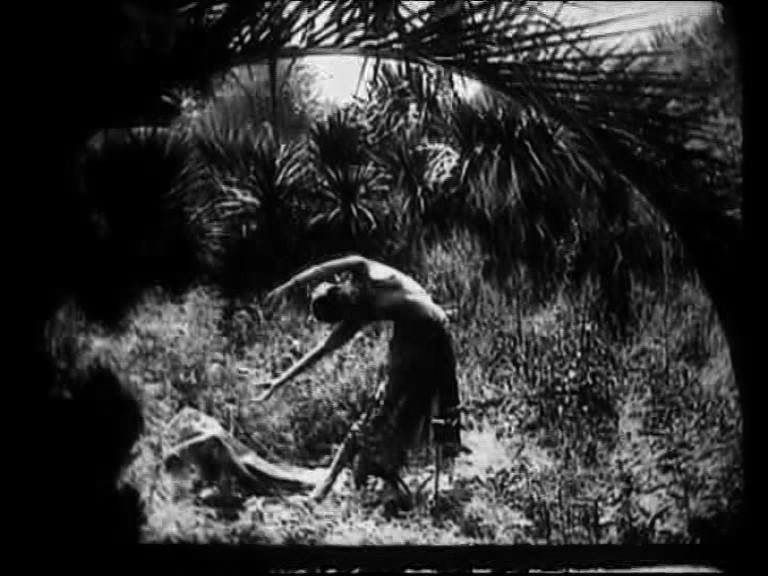
Shot by Léonce-Henri Burel, the surviving footage once more uses the coastal landscapes of the south of France as a luminous stage for the drama. The location doubles, most notably, for the Indian jungle in which we see Oréor’s seductive dance for Rumph. It looks stunning, and seeing this on the big screen was an absolute thrill. I remembered the rough outline of the images, but I was struck anew by their visual quality. There is one faultless superimposed dissolve, for example, which transforms Oréor into a semi-transparent apparition as she begins her dance. Then there is a stunning view of a moonlit clearing in which the half-naked character poses with her veil. Burel’s control of low-key lighting, and Dourga’s extraordinary physicality, are a fabulous combination. Oréor’s dance demonstrates a clear transition from the diaphanous, hand-tinted dance sequence in La Dixième symphonie to Diaz’s subjective visions of Edith in J’accuse. But I think Dourga’s scenes in Ecce Homo are more interesting than either of these sequences: more evocative for the eye, more erotic for the senses.

Talking of J’accuse, I found it wonderful to see Maryse Dauvray on the big screen. (When I first saw the rushes of Ecce Homo, I realized that every filmography I had read misattributed her role to another actress!) Gance gives her some beautiful close-ups, and the sight of her reading from Novalic’s testament was so extraordinarily vivid that I found myself crying. My god, the quality of the footage is superb. Yet again, the sheer presence of these images is something miraculous. I wept too at her scenes with Rumph, when she watches him burning copies of “Le Royaume de la Terre”. The sight of the pages billowing like fallen leaves across the ground becomes a moving metaphor for the fate of Gance’s own film.

The scenes of t’Serstevens as Novalic are equally striking. He is delightfully corporeal, earthy: we see him shabby and unshaven; he roars with laughter at his own words; he walks backwards, perseveringly circling a tree to bless the insane. There is something touchingly natural and believable about him as a madman. (Something not the case with Gance’s own performance as Novalic in La Fin du Monde, a decade later.) And, as Tamayo pointed out in her talk, Novalic’s fellow inmates on screen are played by the real population of a mental asylum. As well as shots of their collective respect for (and defence of) Novalic, there is a heartbreaking sequence of close-ups of their faces, dissolving from one to another, that is simply extraordinary. Gance had a knack for finding the right faces, and here are dozens of real people, their pasts and their struggles written on the lines of their faces. This is not manipulation but revelation.

On the relation of Novalic to his time, Gance begins his scenario with a quotation from Ernest Renan: “If the Ideal incarnate returned to Earth tomorrow and offered to lead mankind, he would find himself facing foolishness that must be tamed and malice that must be scoffed at.” Just as we see remarkable images of the Christ-like Novalic behind bars, so the rushes contain lots of footage of the malicious populace – from policemen and soldiers down to bourgeois women and children. Like the vindictive mob that bullies and beats the half-German child in J’accuse, the crowds of Ecce Homo are gleefully nasty: laughing cruelly, pointing at the mad, hurling stones, a swirling mass of malicious derision. Some of the most remarkable scenes to survive include shots of this seething crowd cowering before a cross that rises mysterious up into the camera lens. The doubters are quite literally brought to their knees before the camera. (Seeing these shots again, I also thought that the crucifix resembles the crosshairs of a gun: the camera as weapon!)

Central to the success of Tamayo’s ciné-conférence is her careful shaping and framing of this original footage. The event began with the entire auditorium being cast into darkness (the Salle Franju screen disappearing in a swirl of mobile walls), after which we hear the opening words of Gance’s scenario:

At that time, men were so tired that they could not raise their eyes higher than the roofs of banks or the chimneys of factories. The war had just crushed the most beautiful energies, and the last beliefs in a just God had been swept away in a tempest of hatred. The heart of the world was annihilated by pain, by tears, and by blood that had been shed in vain.

After this prologue in darkness, there is a wonderful coup de théâtre as the screen reappears to offer us the first image: Albert t’Serstevens as Novalic. Presented as the introduction to the ciné-conférence, Gance’s text acts as a frame not only for the plot of Ecce Homo but also for the production itself. “At that time” refers to 1918, which Gance’s fiction imagines as the past – and which is now, a century later, truly the distant past. Reading the scenario, one becomes aware that the “I” of the text is not Gance but an imagined future narrator. Ecce Homo was thus imagined as a kind of extended flashback, a parable from the world to come. The scenario’s narrator reveals that he witnessed the whole story one evening in the “moving stained-glass windows” of a future cathedral. The idea of “moving stained-glass” evokes the kind of visionary projects that continually animated Gance’s artistic imagination. Around 1913, he envisioned “orgues lumineuses”, synaesthetic instruments which could produce turn sound into image, music into light, on giant screens. In 1918, Ecce Homo imagines a future technology – a future culture – that offers “moving stained-glass windows”: a kind of hallucinatory architecture, an immersive visuality, kaleidoscopic and coloured, that shapes and reshapes itself for the beholder, spelling out the visual narrative of Novalic’s life and message.

In his notes for Ecce Homo, Gance quotes from Oscar Wilde’s De Profondis: “Every single work of art is the fulfilment of a prophecy; for every work of art is the conversion of an idea into an image.” It is this process that Gance tried to realize in his film (in all his films, one might say). It is also an idea taken up in Tamayo’s ciné-conférence. Her finale uses AI images (created by Érik Bullot and David Legrand), together with ink drawings (by Jean-Marc Musial) to evoke the futuristic framing of Ecce Homo. In this sequence, images from the past are transformed via the AI imagination: here is a luminous cathedral, glass glowing, melting, crystalizing; here are spectators, cameramen, vehicles, crowds coming and going; here are monochrome landscapes dissolving and coagulating; and here is Novalic, carrying his image of 1918 like a window around his shoulders, striding toward us. Tamayo also uses some of the imagery Gance sketched for his later project, La Divine tragédie (1947-52), in which a Turin Shroud-like screen, carried upon a cross – floating like a sail or a wing – bears the projection of the Passion. All these images – recycled, blended, reconfigured through AI – invite us to contemplate the process of visual memory, of visual image-making. They remind us that to recollect is also to recreate, and that our relationship with “lost” films can be a generative process. The power of ruins lies in their appeal to our imagination, to invoke the spectator’s response.

This whole finale is a wonderful conceit, though I was so moved by the images of 1918 – their sharpness, their clarity, their depth – that nothing the “mind” of artificial intelligence could produce could match them. In this visual archaeology, the ruins of 1918 stand as startling outposts of a lost past – and a lost future. But how wonderful to have Gance’s project so engagingly, and so imaginatively, presented. Bravo!

Sunday 15 September 2024: Salle Lotte Eisner, 7.00pm

After a couple of hours trying to find a quiet spot to eat some bread along the Seine, I returned to the next screening – and a new venue for me: the Salle Lotte Eisner. (I will say more about the different rooms in my final post in this series.) Here I settled down to La Folie de Docteur Tube (1915) and Au secours! (1924). Two films that I had seen before but never on a big screen, and never with other people…

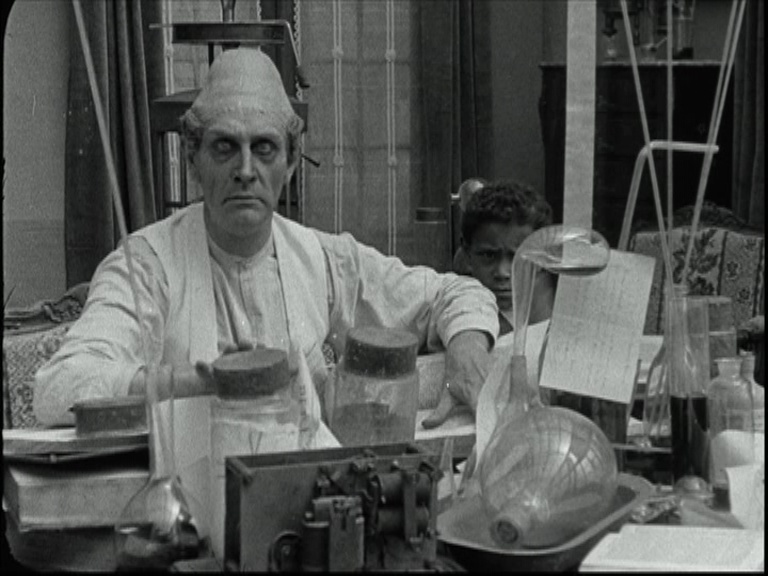
La Folie de Docteur Tube is usually cited as Gance’s earliest surviving film and, ironically, it was deemed too peculiar for distribution in 1915. However, it eventually accrued a reputation by its circulation on the ciné-club circuit. (Long available in various formats, the 2011 restoration by the Cinémathèque française is now available via HENRI here.) Henri Langlois famously called La Folie de Docteur Tube “the first film of the avant-garde”. The plot of this one-reel curiosity is simple: Docteur Tube (the clown Di-Go-No) discovers a magic powder that transforms himself and the world around him. He dowses his nieces (unknown; unknown) and then their suitors (unknown; Albert Dieudonné), before the group find a way to reverse the transformation.

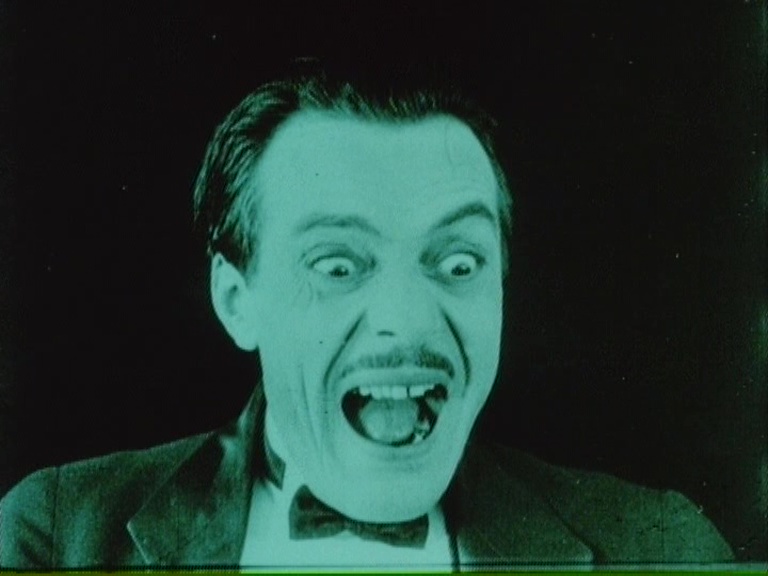
I confess that I have quite a low tolerance for this kind of film. (I find anything that might be considered “psychedelic” pretty tedious.) Even at barely fifteen minutes, La Folie de Docteur Tube often outstays its welcome. But I’m very glad to have seen it on a big screen, since the power of its imagery relies on scale. Gance achieved the transformation effect by filming scenes via a variety of distortive mirrors. Cutting from different views, seemingly from different realities, is still startling. It’s difficult to decipher these images on a small screen, and the effect is more obfuscating than revelatory. I won’t describe seeing it in the Salle Eisner as a “revelation”, but it certainly brought home the interest in Gance’s first (surviving) effort at producing truly transformative imagery. The peculiarity of the stretched, warped, distended bodies on screen force the viewer to look at the world differently. What starts off as a joke becomes an exercise in sustained visual interpretation: just what is happening on screen? There is time enough also to marvel at the effects of the monochrome smears, the blobs of black and white, the condensed creases of texture, and the sudden expansion and contraction of shapes. (I was also struck by how reminiscent these images are to the AI imagery produced in Tamayo’s Ecce Homo presentation.) I was surprised (and relieved) to find La Folie de Docteur Tube even got a few laughs, albeit slight ones. Most of these were generated by the antics of Tube’s young black servant, who mimics the doctor’s actions and delights in drinking wine from the bottle when he’s able. I find Tube’s weird grins and changes of mood quite terrifying, but his weird capering also raised a titter or two.

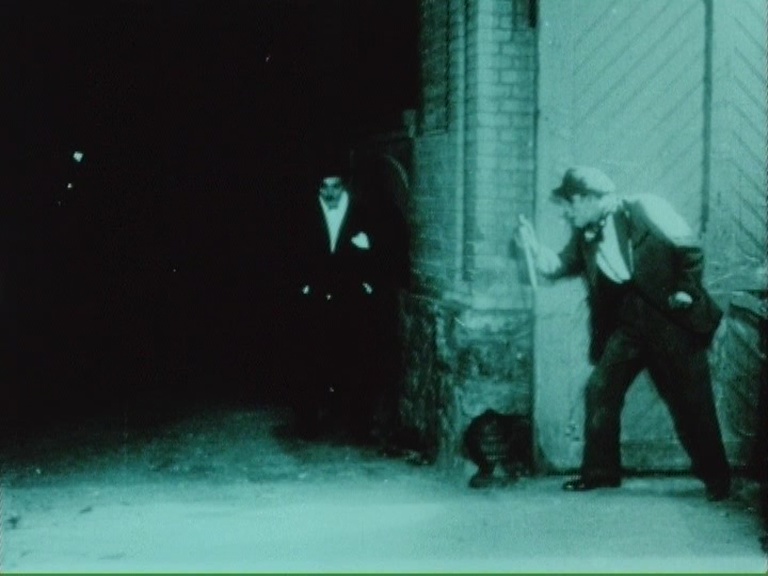
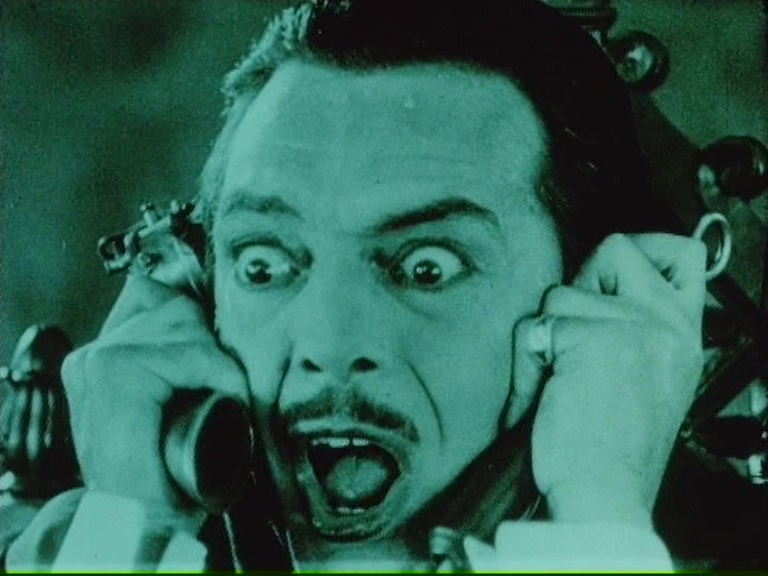
Au secours! is another film which is both very slight and incredibly elaborate. The plot involves a bet placed by the Comte de Mauléon (Jean Toulout) that Max (Max Linder) cannot stay until midnight in a haunted mansion without calling for help. Max duly arrives and is confronted by a bizarre array of walking wax statues, grizzly monsters, and hallucinatory tricks. He survives them all, but when his wife Suzanne (Gina Palerme) telephones to say that she is being attacked by a monster, Max calls for help. It transpires that it is all an elaborate hoax, on both Max and Suzanne, arranged by Mauléon.

As Elodie Tamayo pointed out in her introduction to these two films, Au secours! is a peculiarity in Gance’s filmography. Sandwiched in-between the epic dramas La Roue and Napoléon, Au secours! is a disconcertingly light film that also embodies some of Gance’s most extreme forms of visual manipulation. At various points, the screen warps – squishing and stretching Max as he swings from a chandelier – or else flickers – as a barrage of rapid montage hurls dozens of monsters at Max in the space of a few seconds. Yet these moments are soon laughed off by Max, just as the pianist (whose name I cannot find in any source: she was Korean and very good!) chose to let the flashes of montage pass in silence. Indeed, the sheer vehemence of these outbursts of avant-gardism become part of the joke. Max, the comedian, effectively laughs at the tricks of Gance, the dramatist.

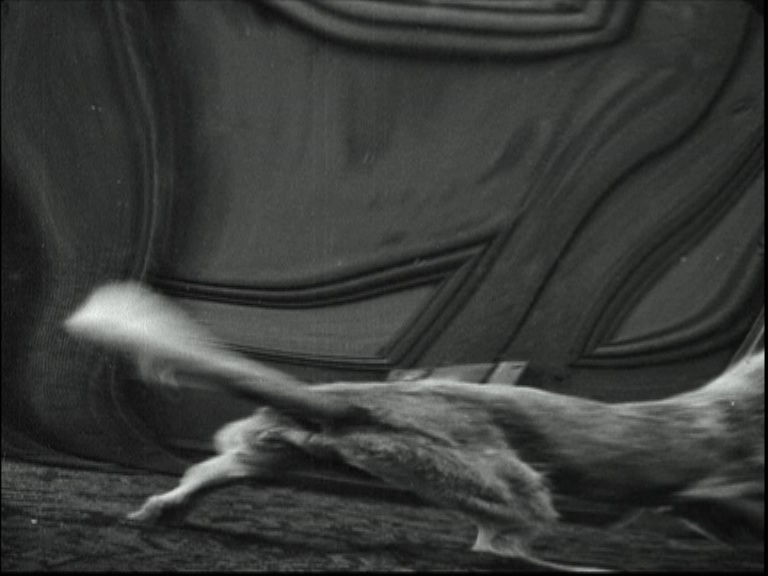
Yet there is also something profoundly disturbing about this film. Firstly, the montage is very rough. Very few successive shots quite fit together, and Gance further destabilizes his film by the use of stock footage (from zoos), bizarre close-ups of stuffed animals, ludicrous apparitions, and preposterous grand-guignol. The film starts to exhibit the kind of unhinged hysteria to which its central protagonist soon succumbs. Furthermore, Max Linder’s performance may begin as charming and lightweight as any of his work of the 1910s, but ends with him in floods of tears, screaming madly down the telephone. It’s a terrifyingly convincing portrayal of emotional extremes, of a kind of madness. All these disturbing qualities are exacerbated, in hindsight, by the knowledge that Linder would convince his very young wife to commit suicide with him less than a year after the release of Au secours! (Suzanne, in the film, is also explicitly described as his new bride.) The combination of intensity, hilarity, and violence is truly unsettling. Even when the “trick” is revealed, and the count uses his winnings to pay his army of extras, our experience of the film – and of Max’s experience of events – is woefully unresolved. If it was all just theatre and props, how did the mansion warp and buckle? – from whence sprung the barrage of rapid cutting? – how can we understand the cutaways to real animals? The film only makes sense, in retrospect, if we accept that Max was subject to a sustained mental breakdown. This throwaway little film is as ultimately as disturbing as anything Gance ever made. The combination of low budget with maximal style produces (for me, at least) the same kind of skin-crawling sensation as low-budget B-movies of a later generation. The sheer awkwardness of its mise-en-scène and montage allows a kind of madness, of horror, into the fabric of the film. As much as I enjoyed seeing it on a big screen, it was also quite a relief when it was over.

Au secours! was restored in 2000 in a version that is nicely tinted throughout, and looks as good as this oddity can be expected to look. The audience in the Salle Lotte Eisner laughed along with its antics, as did I – though I can never shake off the sense of something disturbing and tragic pulling at its seams.

Sunday 15 September 2024: Salle Lotte Eisner, 8.30pm

Next up was Barberousse (1917), a film I have wanted to see for years. Barberousse was first shown as an “exclusive event” with a large orchestra at the Cinéma des Nouveautés Aubert-Palace in the summer of 1916, when it was advertised as a “remarkable [film with] first-rate acting and direction” (L’Intransigeant, 11 August 1916). Yet this production was not released generally until the following spring, whereupon it became “a great adventure-drama in four parts” (Le Film, 26 March 1917) to be screened in episodes alongside Louis Feuillade’s serial Les Vampires (1915-16) (La Presse, 22 June 1917). This programming is emblematic of the market in which Gance’s film was designed to fit. The plot of Barberousse seeks both to replicate and to satirize the kind of crime serials mastered by Feuillade…

We begin with our first view of the titular figure of Barberousse (credited as being played by “?”), who wishes to become one of the world’s most revered criminals. The film then recounts his infamous murder of investigative journalists and detectives who try to discover his identity or whereabouts. Gesmus (Émile Keppens), the editor of La Grande Gazette, has made a small fortune in printing stories about this infamous bandit. Yet he can find no new reporter to follow-up these stories, since everyone is terrified of being the next victim. However, after the murder of another famous journalist (Paul Vermoyal), the writer Trively (Léon Mathot) is determined to unmask Barberousse. He allies himself with another newspaper commissioner (Henri Maillard) and tracks down Barberousse and his assistant Topney (Doriami) near their hideout on the “black pond”. But Barberousse’s gang captures Trively’s wife Odette (Germaine Pelisse), triggering a crisis of conscience for the chief bandit. Odette is allowed free, and helps her husband and the police to find Barberousse’s lair. After a gunfight and huge fire around the wood and marsh where the bandits roam, Barberousse escapes. By now, Trively is convinced that Gesmus is Barberousse. He tricks the bandit into revealing himself and Gesmus/Barberousse is arrested along with his daughter Pauline (Maud Richard). The coda to the film is another scene by the fireside of “Barberousse”, who is revealed to be a peasant who has dreamed the whole film. His family – the played by the same actors we have just seen – arrive and he sets about recounting his dream…

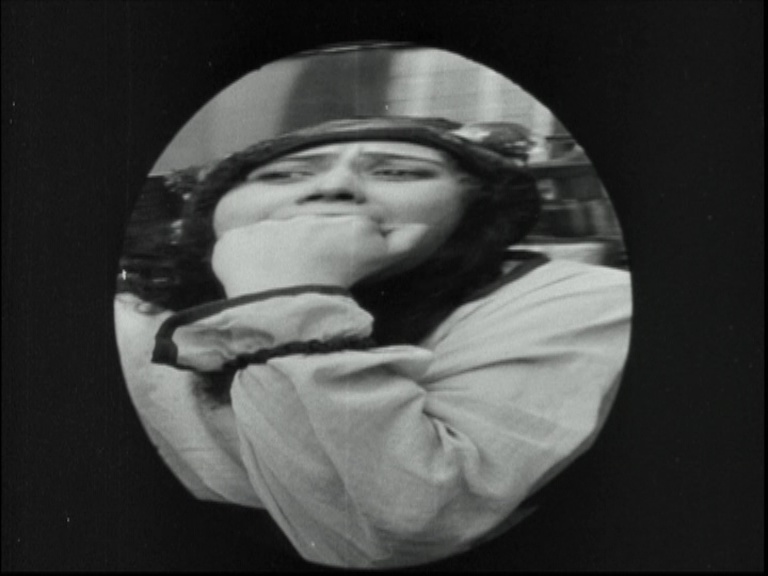
Barberousse is a delightful film: charming, amusing, and dramatic in equal measure. It is beautifully shot with some superb exterior scenes around the scrubland and coast of the south of France. Gance filmed Barberousse near Sausset-les-Pins, where he was captivated by the woodland that was blasted by the coastal winds. On screen, these woods become a mysterious lair for the bandits. The sequence in which Odette is captured by what appear to be a moving set of bushes is marvellously silly. But is also uses the wind-whipped trees of this strange landscape to produce some eerie effects. As with the other films I have rhapsodized in previous posts, I can only repeat that Burel was a genius in his own right. The lighting of both these exteriors, and many of the low-key lit interiors, is simply marvellous. The camera is more mobile than in Les Gaz mortels, and we get some striking tracking shots in cars and on boats. There is also a superb extreme close-up of Odette as she is about to drink a poisoned cup of tea: a delightful dramatic detail that, as with many others in this film, makes the contrivances of the plot come to life.

The cast is the same that appears in Les Gaz mortels, with others (like Vermoyal) from Gance’s other films made in 1916-17. Barberousse shows them all to better advantage. I much preferred Henri Maillard in this film. In Les Gaz mortels, I found him stiff and awkward. In Barberousse, he’s more assured, aided by a beard and less dramatic weight to bear. His death is delightfully silly: he’s killed by a poisoned cigar. (“Have you noticed that the smoke from your cigar has a greenish hue?” Trively asks, only to realize that the old man is dead.) Germaine Pelisse has more of a starring role in this film and manages to be convincing even when she’s being pursued by walking bushes. Émile Keppens and Léon Mathot both manage to have the right air of respective villainy and determination. Keppens, in particular, makes a splendid editor-cum-bandit-cum-dreaming peasant. Even Doriani and Vermoyal are less hammy in Barberousse than in their other Gance appearances.

This new restoration offers a rewarding and entertaining viewing experience, though there is surely some missing material. (We see only the aftermath of Trively’s first fight with Barberousse and Topney, not the fight itself. There is no explanatory text to help cover this ellipsis.) I also felt that there were some odd repetitions of frames in a few places, perhaps where intertitles were once positioned. Then again, this may simply be an accurate reproduction of errors present in the original prints. My only real reservation is the lack of tinting, which robs some scenes of their sense of temporal setting. When Topney is tapping a telephone wire, for example, he consults his notes by lighting a candle – a detail which makes no sense when the day-for-night filming offers no hint of it being dark. Blue tinting would also make the walking bushes sequences more believable, since it too is meant to take place at night. And the climactic woodland fire in the big shootout sequence would also gain much from some appropriate red or orange tinting. The oddity about this restoration is that it offers all the intertitles in blue tints – it’s just the film itself that remains in monochrome. I appreciate that without evidence it’s very difficult to try and be “creative” – but leaving the film in monochrome is itself a significant creative choice. (Having just consulted the filmography in a scholarly sourcebook on Gance, I see that Le Droit à la vie is listed as being “colorized”, i.e. tinted, something that the 2024 restoration of that film also lacks.)

I must also mention that the music for the screening of Barberousse was provided by Kellian Camus, another young talent from the piano improvisation class of Jean-François Zygel. There were some pleasing jazzy touches to his approach, and his performance matched the half-serious, half-comic tone of the film perfectly.

Though Barberousse was the last screening of my time in Paris, but I will write one further post on my experience of the retrospective and the live performances at the Cinémathèque…

Paul Cuff

Abel Gance at the Cinémathèque française (2)

Day two of my retrospective binge, and we continue our exploration of Gance’s melodramas from the 1910s. Both films were familiar to me, but not in the form they were presented at the Cinémathèque…

Saturday 14 September 2024: Salle Georges Franju, 6.30pm

First up was Le Droit à la vie (1917). I had seen this film in the archives of the Cinémathèque française in 2010, in the company of Kevin Brownlow, and was very impressed by it. However, the copy that we saw had no intertitles at all, so we had only the synopsis to go on. (Some weeks later, Brownlow sent me a list of titles from his Pathé-Baby 9.5mm print, so having seen the film I could then read it!) Thankfully, the film has since been beautifully restored by the Cinémathèque française alongside (as the retrospective notes are keen to acknowledge) TransPerfect Media. The screening last week was, I believe, the premiere of this restoration – so it was a real treat to see it. This was a 4K restoration, based on the surviving 35mm negative. This original element had begun to decompose, so it was supplemented by the safeguard copy made of the negative in 1965. The missing titles were recreated on the basis of those in the 9.5mm version and Gance’s manuscript scenario, both preserved in the collection of the CNC/Cinémathèque française. The font for the titles was recreated after the typography of La Dixième Symphonie. I report this latter information with some pleasure, since one thing that can spoil even the best restoration is a modern font. (I think especially of many North American DVDs that not only translate but transliterate the foreign titles, turning them into the ugliest imaginable insertions into original prints. Urgh! I’ve written about this in an issue of Screen, should anyone be interested in more detailed pedantry.)

The plot of Le Droit à la vie is a pleasingly gripping drama (and yes, spoilers ahead). Pierre Veryal (Pierre Vermoyal) is a prodigiously talented young financier, aided by his two ambitious secretaries, Jacques Althéry (Léon Mathot) and Marc Toln (Georges Paulais). However, Veryal’s absolute – and amoral – devotion to his work is undermining his health, and he ignores his doctor’s recommendation for absolute rest. Veryal’s only real feelings are for his pupil Andrée Maël (Andrée Brabant), an orphan being looked after by her grandmother (Eugénie Bade). But Andrée loves Jacques, who returns her feelings while being financially unable to support a wife. He is about to ask Andrée’s grandmother for permission to marry, but the old woman dies – and Jacques must leave for America to manage Veryal’s affairs, and to win his own fortune. The grandmother has willed that Andrée is entrusted to the care of Veryal, who exploits this to marry Andrée. Many months later, Jacques returns from America a rich man. He not only finds that Andrée is married, but that Veryal has an infectious illness that will condemn Andrée if there is significant “contact”. Despite Jacques’s entreaties, Veryal insists on enjoying his last months of life. He sells all his assets to fund lavish parties. Meanwhile, Marc Toln exploits Veryal’s distraction to embezzle large sums from his accounts. When this is discovered by Veryal during a masked ball, Toln tries to kill his employer – but only succeeds in wounding him, an act witnessed by Jacques. Knowing Jacques is a rival for Andrée’s affections, Veryal falsely supports Toln’s claim that it was Jacques who fired the shot. But at the trial, Jacques is vindicated by Veryal, who dies after having accepted that Andrée will marry Jacques.

Le Droit à la vie is a cracking film. It’s beautifully staged, beautifully lit, and the drama has real heft. The central love triangle – between a corrupt (usually capitalist, usually older) man, a younger woman, and her young lover – is one that recurs in multiple variations across Gance’s work. In Le Droit à la vie it is given its most vivid realization thus far in his filmography. The bite to Veryal’s predatory sexuality comes in the form of his illness, which initially seems to be merely fatigue – but is soon implied to be something more sinister. His increasingly erratic and violent behaviour, coupled with his rapid mental deterioration (even before being shot!), suggests syphilis – a diagnosis surely confirmed by the doctor’s insistence that he must avoid “contact” with his wife. No other kind of “contact” is envisaged as being dangerous, and the horror of Veryal’s “right” to Andrée’s body is as explicit as can be imagined.

Le Droit à la vie finds marvellous imagery with which to make this situation sinister. In particular, there is one remarkable staging of a scene that Gance replicates (closely) in J’accuse and (virtually identically) in La Roue. This is when Jacques witnesses Veryal forcing Andrée into his arms. The brutish embrace is framed within a window and partially-concealed by lace curtains. The equivalent scene in J’accuse is when Jean Diaz sees Edith being assaulted by her brutish husband François at the window – a moment made all the more shocking by the symbolic breaking of the glass and bleeding hand. And in La Roue, when Elie witnesses Norma being assaulted by Hersan, Gance goes further – making the rape of Norma as explicit as could be expected within the laws of censorship. (This scene was so often cut from the film that it was lost from all surviving prints, so the 2019 restoration had to reconstruct it from the 35mm rushes discovered in the archives.) Its iteration in Le Droit à la vie is still very powerful, one of many scenes when the combination of framing, editing, and lighting are united into a perfect mise-en-abïme of the drama.

It is with great sadness that I cannot share any image captures from this film, since it has never been released on any format since the advent of 9.5mm! I really, really hope that it is released on home media because it looks stunning. Burel’s photography is sumptuous, from the dark, complex interior spaces of Veryal’s rooms to the exquisite sun-dappled exteriors where the forbidden lovers meet. During the latter, there is one stunning shot of Jacques and Andrée: he half-concealed behind a tree, his profile outlined in sunlight; she, half-revealed in the clearing beyond, her face and hair haloed with natural back-lighting. My god, my god, my god this is a good-looking film. I cannot praise the visual qualities of the restoration highly enough. The 4K scan does real justice to the film, and seeing it on the big screen in the Salle Franju was incredibly moving. Some of the close-ups of Andrée were ludicrously detailed, simply glowing with life. Such was the sheer presence of this film, I cried just to look at it.

The performances in Le Droit à la vie are very good. Andrée Brabant is a proto-Ivy Close in La Roue, and both women have the long, curly blonde hair of a Mary Pickford – and are as exquisitely lit as she or (very much Gance’s role-model) Lillian Gish. Brabant herself is an engaging presence, able to communicate with her eyes – sometimes directly into the camera – the emotions of her character. Not to repeat myself from my last post, but Léon Mathot is once again both a sensitive and dramatic performer. However, I find him more engaging and affecting in Le Droit à la vie than in Les Gaz mortels. I think this is entirely to do with the respective quality of the films. Le Droit à la vie is a pleasingly dark drama, and the performers have something to work with – Mathot included. Vermoyal is creepy as Veryal, but has a tendency to eye-rolling exaggeration and occasional histrionics (especially when suffering from his bullet wound). I’ve only seen him in Gance’s early films and believe he was an actor from the Grand-Guignol theatre, which might explain his playing-to-the-gallery mode of performance. His was the only performance that stood out for its moments of crudity – but I suppose that conveying the signs of tertiary syphilis gives license to a bit of excess. Actually, I thought one of the most engaging performances in Le Droit à la vie is by Georges Paulais. His role is relatively minor, but there is a great clarity and presence in all of his gestures, all of his glances.

My final word on the film must go the music for this screening by Nicolas Giraud and Fixi. I confess that when I saw the name “Fixi” I was faintly worried about being given something peculiar (a fear not exactly allayed by the sight of his garish shirt as he stood to acknowledge our applause welcoming him to the stage). Fixi was at the piano, but he sometimes swapped the keyboard for his accordion. Giraud played a variety of instruments, from guitar to percussion and acoustic loops. If all this sounds like an odd mix, the result was superb: rhythmically and tonally in tune to the action, and independently musically satisfying. There were some very pleasing combinations of sounds, and such was the variety of combinations that it often felt like the musicians were jamming with the film – but jamming in the best possible sense, of playing off the changes in tempo and dramatic context. The score was well-conceived and well-executed. A pleasure to hear, and an enhanced pleasure to watch. Bravo!

Saturday 14 September 2024: Salle Georges Franju, 8.15pm

Hot on the heels of Le Droit à la vie, released in January 1917, Gance’s Mater Dolorosa (1917) was released in March 1917. Another concentrated melodrama, Mater Dolorosa focuses on Marthe Berliac (Emmy Lynn), who is having an affair with her brother-in-law, the writer Claude Berliac (Armand Tallier). In an attempted suicide, Marthe accidentally shoots her lover. Though she promises the dying Claude never to reveal the truth, Marthe’s secret attracts the interest of hunchbacked blackmailer Jean Dormis (Pierre Vermoyal) and his henchman (Gaston Modot). In attempting to pay off these men, Marthe’s husband Gilles Berliac (Firmin Gémier), a successful doctor, discovers the affair and disowns both Marthe and their son Pierre (Carène). Pierre is sent away to the suburbs of Paris, where he falls dangerously ill. Marital and paternal crises are eventually resolved when the husband sees the sincerity of his wife’s anguish, and is provided with new evidence by loyal servant Ferval (Anthony Gildès). Gilles finally reunites Marthe with Pierre and welcomes both back into his life.

Mater Dolorosa has a complex history during the silent era, and was also remade by Gance as a sound film with the same title in 1932. After being premiered in 1917, the silent version was re-edited and rereleased several times between 1918 and 1926. In 1993, the Cinémathèque Royale Belge undertook two restorations: the first reconstructed the original version of 1917, the second reconstructed the final rerelease version of 1926. The differences between the two include character names, character identities, and intertitles. The restoration of the 1917 version is (for me) by far the most satisfying, and the one I am used to seeing. Tinted and toned, it looks utterly gorgeous – while also being less verbose and more concentrated as a text. (The image captures included in this post are all from a copy of that version.) The 1926 rerelease version of Mater Dolorosa has more (to me, unnecessary and distracting) titles, as well as watering-down the love triangle by demoting the dead lover to a mere friend of Gilles Berliac rather than his brother. It also survives in monochrome only, which denies the film something of its visual richness.

The Cinémathèque française retrospective showed only the 1926 version. I confess that I was disappointed by the quality of the print, which was by far the poorest of any film I saw. It looked as though it had been assembled from copies of copies of copies, as well as being quite badly scratched. The restoration of the 1917 version is in much better shape, as well as offering the original tinting/toning that the 1926 print lacked. The 1993 restoration was shown on 35mm, but it lacked any restoration credits to explain its complex history. (For anyone seeing a copy of the 1917 Mater Dolorosa for the first time, it must have been confusing to see all the letters in the film dated March 1920!) All that said, I still enjoyed seeing the film projected, and with a good accompaniment on piano by Kolia Chabanier, another student from Jean-François Zygel’s school of improvisation.

This was Gance’s first collaboration with Emmy Lynn, and her performance is terrific – it’s her film, from beginning to end, and she carries the drama. With a fabulous wardrobe of dark, velvety dresses, of fur-lined coats, of hats and veils, she is a passionate, sombre diva – retreating into shadows, falling to her knees, her hair haloed against fire, against wintry windows. The intensity of emotion, and her rendering of anguish, is also inseparable from the way Gance visualizes the dramatic tone. I have previously described Gance’s love of sun-soaked southern landscapes. Mater Dolorosa is the antithesis of the outdoorsy brightness evident in the opening scenes of Les Gaz mortels. Mater Dolrosa was shot in and around Paris in the winter of 1916-17. Bleak northern light, forever dimmed by clouds, defines the exterior spaces. The house to which Pierre is exiled is grim in and of itself, but the bare trees and cold glinting pond outside make it doubly so. The climactic sequence, in which Gilles drives his wife through a rundown suburban landscape of dark woods and walled cemetery, is chilling in every sense. This is a cold world, in which passions smoulder in the shadowy interiors of domestic space.

Chiaroscuro lighting defines all the scenes of emotional intensity, from the rich – and faintly sinister – apartment of Claude Berliac to the curtained spaces of Gilles and Marthe. Gance’s compositions delight in great swathes of black, from dramatic drapes to silhouetted figures. Light floods across floors, illuminating patches of action or highlighting pale faces. It’s exquisite to look it, an aesthetic that wraps you up in its atmosphere.

It helps that Gance fills his drama with strange touches and rich images. Take the way that the romping Pierre, playing naked in a fish tank, comes to the window to see his parents. It’s another scene framed by a window, Marthe and Gilles half masked by the lace curtains. The child puts its hands up towards his parents, but can only paw at the lace and glass. It’s such a beautiful moment, and one that sems to carry some extra weight of meaning. It is as though Pierre’s parents don’t really exist: they are as unreachable as a projection, a painting framed by the window. (It’s almost an image from an Ingmar Bergman film.) The compelling oddness of the image unsettles the cosiness of the family so effectively, so completely, that you can totally understand the way Gilles willingly tries to destroy their relationship.

So too with the scene when Gilles deposits Pierre into the care of a nurse in a distant house. Convinced he is not the father of the child, he reaches for a mirror and stares at his image. We see the light gleaming on his face (yet again framed against a window), the cruelty in his eyes. When he reaches for his child, his hands clasp around Pierre’s throat. It’s an embrace and a threat. The same gesture recurs in Gance’s films, each time becoming more complex, more troubling. It’s there in Le Droit à la vie, in Veryal’s sinister embrace of the reluctant Andrée – a gesture of enforced attachment, of physical ownership and restraint. In J’accuse, Edith is raped by German soldiers and gives birth to Angèle, who is adopted by her lover Jean Diaz. This adoption of the half-German Angèle is absorbed into (and complicated by) the film’s narrative concern with revenge and forgiveness. After Édith shows Jean her child for the first time, there is an extraordinary moment when Jean half-protectively, half-threateningly holds Angèle’s throat. Looking into her eyes, he tells her: “I’ll teach you how to become French. Then you can find your own way to punish your father as he deserves.” In La Roue, Sisif clasps his son Elie – who is also his rival in love for Sisif’s adopted daughter Norma – around the neck with the same gesture, realizing that Norma has returned into their life. And in Napoléon, Bonaparte enacts this gesture in the scene with his adopted daughter Hortense, forcing her into a reluctant kiss. (Sadly, I could not make the screening of the 1932 Mater Dolorosa in the retrospective, but the same gesture is evidently in that film: one of its posters uses this subject.)

But to return to the silent Mater Dolorosa, I long to see the 1917 version on a big screen with live music. I love its imagery, its atmosphere, its wintriness, its strangeness. Perhaps the last word on Gance’s film should go to Colette. “Let us praise Mater Dolorosa”, she wrote in June 1917:

Let us praise Emmy Lynn, exhausted young mother, who surpasses everything she promised us in the theatre. Agree with me, since I take so much pleasure in it, that the action progresses in scenes lit with a rare richness – gilded whites, sooty and profound blacks. And my memory also retains certain sombre close ups in which the speaking, suppliant head of Emmy Lynn floats like a decapitated flower.

Paul Cuff
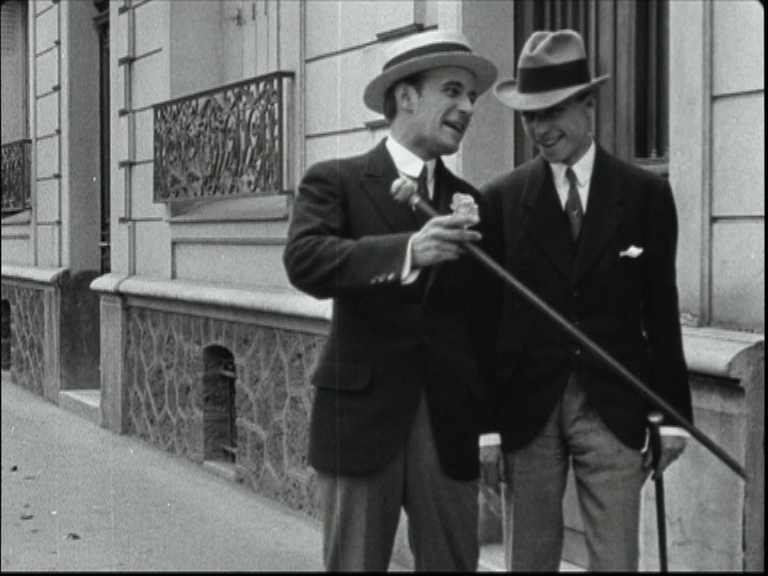
Abel Gance at the Cinémathèque française (1)

Between 29 August and 25 September 2024, the Cinémathèque française is hosting a retrospective of the works of Abel Gance. This programme presents (almost) all the surviving films and television work Gance made across his lengthy career. The retrospective features new restorations, as well as presentations by restorers and scholars. Time and geography permitting, I would have attended every screening. (This is not the first time in my life that I have longed to be Parisian.) However, across the weekend of 13-15 September I was able to make a targeted smash-and-grab raid on Gance’s early silent filmography. Across three days, I attended seven screenings and saw five feature films, two shorts, and a curated presentation of fragments. I will devote a post to each day of cinemagoing that I attended in the retrospective, and another to offer some concluding thoughts on the experience as a whole. (There might even be an anecdote or two.) So, without further delay, day one of my trip…

Friday 13 September 2024: Salle Georges Franju, 6.30pm

The first film I saw was Les Gaz mortels (1916), the earliest surviving multi-reel production in Gance’s filmography. In the spring of 1916, producer Louis Nalpas ordered Gance to head south with a small cast and crew and return to Paris a.s.a.p. with two films. According to Gance, he wrote the scripts on the train to Cassis and shot Les Gaz mortels and Barberousse simultaneously. (“Quite a business!” Gance recalled to Kevin Brownlow. “But it gave me a great facility. I really had to exert myself – it was like doing one’s Latin and Greek at the same time.”) The first film to be edited was Les Gaz mortels, released in Paris cinemas in September 1916. The name of Gance’s employers, Le Film d’Art, is a little misleading: much of the company’s output at this time was made for a commercial market. In wartime France, escapism jostled strangely alongside grim realities. For its initial release at the Pathé-Palace, Les Gaz mortels took its place in a programme that included episodes from the Pearl White serial The Exploits of Elaine (1914), the latest Rigadin comedy starring Charles Prince, and newsreels fresh from the frontline (La Presse, 1 September 1916). Given this context, the plot that Gance concocted for Les Gaz mortels while his train rattled the length of France is a pleasing mix of popular genres: it is at once a Western, war drama, suspense drama, melodrama, and race-to-the-rescue film…

The renowned French scientist Hopson (Henri Maillard) and his American assistant Mathus (Léon Mathot) work in Texas, where they are called to help Maud (Maud Richard) escape the clutches of Ted (Doriani), a drunkard who supplies the two researchers with snakes from Mexico. Maud is rescued and returns with the scientists to France, where a romance develops between her and Mathus. But war is declared, and Hopson’s son is killed by poison gas on the frontline, leaving Hopson’s grandson André (Jean Fleury) in the care of Edgar Ravely (Émile Keppens) and his wife Olga (Germaine Pelisse) – who hope to profit from their role. But Hopson takes André from his carers, who then join forces with Ted to seek revenge. Edgar and Ted sabotage the poison gas factory run by Hopson and Mathus, while Olga unleashes a poisonous snake into André’s bedroom…

Les Gaz mortels is familiar to me, as I have watched the DVD several times. (The film is also currently available via HENRI, the free online film selection from the Cinémathèque française.) However, it was an entirely unfamiliar experience on the big screen – and projected on 35mm. Unlike the entirely silent DVD issued by Gaumont, this Cinémathèque screening was accompanied by a pianist from the improvisation class of Jean-François Zygel. (One minor bugbear with the retrospective is that not all the performers are credited in the programme or online. I have tried to find the names of all the musicians but lack details for two of them – the first being the fellow who accompanied Les Gaz mortels.)

Les Gaz mortels is a compact, well-made, and rather fun drama. At just over an hour, it was Gance’s longest film to date, and it races along to a satisfying conclusion. It is also beautifully shot by Léonce-Henri Burel. I adore the opening scenes set around the Mexican-Texan border but filmed on the south coast of France around Cassis. It was clearly a location Gance loved. Many of his early films were shot amid these sun-soaked landscapes, and Burel’s photography makes the most of the landscapes, the seascapes, the gorgeous southern light.

Seeing the film projected on the big screen of the Salle Georges Franju was a particular pleasure. I spotted details I’d never noticed before, like the initials carved onto the branch of a tree overlooking the sea, where Maud pauses for a moment on her search for vipers. Indeed, Maud’s snake-hunt features some of the most beautiful, naturally back-lit scenes of the film. Her hair is transformed into a chaotic halo, like a white flame flurrying worriedly about her head as she runs in terror from the snake-infested scrubland. Then there is the scene of her wakeful night, spent longing for release from capture. The lighting is simply exquisite, giving this entirely incidental scene a curious poignancy. The character is contemplating her imagined future, and we contemplate the image of her at the open window – seduced for a few seconds by the same evening light, the same moment of calm.

But such moments of “calm” are rare in a film that deals primarily in seething skullduggery and dramatic spectacle. The film climaxes with complex intercutting between various spaces. The parallel race-to-the-rescue scenes cut not just between two different locations, but between multiple spaces within each location. The interiors where the snake is let loose boast some very striking close-ups (the snake sliding over the neck of a doll) and effective low-key lightning (Olga peering into the snake tank), just as the exteriors offer some travelling shots and intriguing views of the (unnamed) town and landscape being swathed in swirling banks of gas.

The performances are rather mixed in style. As the drunkard Ted, Doriani is as crudely villainous as anything from a serial quickie. The two bourgeois baddies, Émile Keppens and Germaine Pelisse, are more convincing (if two-dimensional). Maud Richard is charming enough, but her toothy grinning can be slightly gawkish. Henri Maillard is a little stiff as Hopson, while Léon Mathot is alternately winsome and bathetic as Mathus. Of course, Les Gaz mortels offers scant dramatic depth for the performers to plumb, but even so… I have mixed feelings about Mathot as an actor. He is a reliable, sometimes strong presence on screen, but when tasked with expressing sadness he has a certain default expression that strikes me as mawkish. It’s interesting that such an important early male star should be so vulnerable, so evidently sensitive, on screen, but I am not affected – not moved – by his performances. He signals sentiment while (for me) never quite giving the illusion of real depth. (Several years after his collaborations with Gance, Mathot is still the same mawkish presence in Jean Epstein’s L’Auberge rouge (1923) and Cœur fidèle (1923), films that are beautiful to look at and, alas, highly soporific.)

The 2006 restoration of Les Gaz mortels is based on a (jumbled) negative print that survived without titles. Thankfully, it was possible to reconstruct the film’s titles and original montage – though the print remains untinted, which may not be how audiences saw it in 1916. As a study by Aurore Lüscher explores, Gance (in his notebooks from 1916) refers to the film variously as “Le Brouillard Rouge”, “Le Brouillard de Mort”, and “Le Brouillard sur la ville”. The title “Red Fog” makes me wonder if Gance had a colour-scheme in mind to heighten the climactic images of fire and gas stand out visually. (There are also nighttime scenes that could be clarified by some blue.) This reservation aside, the film looks as good as it can, and it was a great pleasure to see projected.

Friday 13 September 2024: Salle Georges Franju, 8.15pm

As soon as the first screening ended, so the queue began for the next. After a few minutes’ respite to chew some bread and gulp down water, we were let back into the Salle Georges Franju for La Dixième symphonie (1918). I have seen this film several times before, but the new restoration shown at the retrospective was nothing short of a revelation. The print that served as the basis of the restoration was exquisitely tinted and toned, a beautiful example of how elaborate and enriching contemporary prints could (and can) look. In his introduction to the film, Hervé Pichard explained that the restoration retained the original title cards between “parts” giving notice to spectators of a short break while the reels were changed. As Pichard put it, retaining these titles were a mark of respect for the original celluloid (and its exhibition context). A nice touch, given that we were watching the film via a DCP.

La Dixième symphonie is both a vivid melodrama and an ambitious foray into new expressive possibilities. Eve Dinant (Emmy Lynn) marries the widowed composer Enric Damor (Séverin-Mars) and adopts his daughter, Claire (Elizabeth Nizan). The latter is pursued by the exploitative Fred Ryce (Jean Toulout), who is also blackmailing Eve over her involvement with the death of his sister. Eve’s attempts to prevent Claire’s marriage are misinterpreted by Enric, who thinks she is having an affair. He finds solace in music, composing a symphony that expresses his sorrow and its transformation. The drama is resolved when the apparent rivals in love, Eve and Claire, confront Ryce and reveal the truth to Enric.

If this plot is like something out of D’Annunzio (whom Gance had met and admired), then the décor is as lush as the Italian’s prose. It looks utterly sumptuous. Emmy Lynn’s costumes are gorgeous, and everything on screen has such depth and detail that you felt as though you could reach out and feel the fabrics, the furs, the furniture, the sculpture. Fred’s lair is decked in decadent clutter: animal skins strewn over steps, throws and rugs galore, glass screens, weird ferns, cabinets with secret compartments, and “the god with golden eyes” – an oriental statue – that overlooks the ensemble. There are shadowy recesses, curtained partitions, screened-off niches – and all treated with exquisite chiaroscuro lighting and rich tinting and toning. Outside, the exteriors are just as gorgeous. My god Burel was a great cameraman! Every leaf, every blade of grass is practically three-dimensional. This is a truly stunning-looking film.

But it’s not just how good it all looks. The drama is marvellous. I love how it opens in medias res with a body on the steps, with the dog trampling across the room in panic, with the flustered Eve immediately falling into Fred’s sinister influence. And I love that the comedic character – the Marquis Groix Saint-Blaise (André Lefaur), Claire’s absurd older suitor – got real laughs in the cinema, and functioned both to puncture the air of preciousness the film might otherwise exude and to heighten the drama of the romantic entanglements. Most of all, I loved how much bite there is in every twist and turn of the narrative. Gance finds ways of making us gasp or chuckle, of drawing attention to telling details, of making these characters more than just stock villains, victims, types. I’d forgotten how fabulously slimy and sinister Jean Toulout’s character is, with his creepy haircut and louche tastes. I’d forgotten, in particular, how he looks right into the camera for a moment before shooting himself at the end of the film: with an almost triumphant smile, he defies us not to be surprised, even impressed, by his final act of will.

There are some superb close-ups, and having only experienced the film via small-screens I was unprepared for how emotionally effective these were. I had never properly seen the tears on Damor’s face; seeing them was a kind of revelation, as though the film was finally able to show me the depth of its feeling. I finally believed in Damor as a man as well as an artist, and the whole drama just clicked into place. From the outset, the sheer visual quality of the film revealed such great depth of detail to the faces that I was moved as never before. I’d always loved Emmy Lynn in this film, but it was Séverin-Mars’s performance that really struck me. He always has such intensity on screen, but he can sometimes seem to give a little too much. But in La Dixième symphonie he gets it just right: there is the right balance of emotional give-and-take, of guarding and revealing feeling. After ninety minutes of the drama, I found Damor’s final words to his wife – “Eve, I love you infinitely” – extraordinarily moving. It was not the only scene in which I found myself crying.

I must also credit much of the success of this screening to the music written by Benjamin Moussay and performed on piano (Moussay), violin (Frédéric Norel), and trumpet (Csaba Palotaï). The original score to La Dixième symphonie, cited in the opening credit sequence, was written by Michel-Maurice Lévy. So far as is known, this is lost. However, the very opening image of the film is the full-page score of the titular “Tenth Symphony”, so some of the most important music cue survives thanks to the celluloid itself. For its release on VHS, the 1986 restoration by Bambi Ballard was accompanied by an orchestral score by Amaury du Closel. The music is very nice, but I never felt it really matched the film scene by scene. It was too distant from the images, and thus never really got to grips with the emotional drama. By contrast, Moussay’s score for the 2024 screening was superbly judged. It supports the film at every stage, providing a constant melodic counterpoint to the images on screen. The narrative has a constant sense of impetus and development, of emotional depth and dramatic clarity. The arrangement for trio is beautifully balanced. The use of the trumpet provides extra sonic depth to the musical texture but is used both sparingly and sensitively.

For the central performance of Damor’s symphony on screen, Moussay matches the film’s own visual instrumentation: piano and violin. Together, they offered a “symphony” that was both harmonically in touch with Beethoven while also being distinct enough to seem new: the ideal combination for this sequence. The sequence itself, in which the music is rendered visual through visions of superimposed dances (by Ariane Hugon), complete with masking and hand-coloured details, is the most well-known of the film. It’s certainly avant-garde as a cinematic conceit, though I’ve always felt that it’s couched in conventional imagery. But Gance recognizes that something needs to happen here for the point and import of Damor’s symphony to have significance. This visual music breaks out of the film, and the way Gance intercuts these visions with the enraptured expressions of the spectators creates the impression of a collective hallucination. (Much as the return of the dead at the end of J’accuse is a kind of collective hallucination.) It is this dramatic handling of the vision, more than the aesthetics of the vision itself, that is really interesting – and effective.

Though this symphony worked superbly, the scene that moved me most was earlier. When Damor discovers Eve’s supposed affair, he sits (almost falls) at the piano and his fist strikes the keyboard. In the Salle Franju screening, Moussay’s own hand struck the keyboard at precisely this moment. All the instruments had ceased playing a few moments earlier, so the piano’s single, despairing chord resonated in the total silence of the cinema. The chord died away until Damor, on screen, began feeling out a melody. Moussay, in the cinema, felt out this same melody, matching his own strokes of the keyboard to the figure on screen. It was a perfect moment. Two hands striking the same chord, a hundred years apart; two musicians, a hundred years apart, feeling out the same melody. The sense of synchronicity was both uncannily powerful and deeply moving. Live music became an act of communication, a literal reaching out of the hands to touch and revive the past. But it was also touching because of the context of the drama, for in this scene Damor feels entirely alone – deprived of the woman he loves – until he sits at the piano. Music is his solace, and he finds it not merely on screen but in the act of a live musician revivifying his creation. It’s an instance of connection, of time transcended, that only live silent cinema can provide. A truly beautiful moment.

Almost as touching was the last shot of the film. After the image of Enric and Eve has faded to black, Gance himself appears under his name. This visual credit has always delighted me, but I’ve never experienced it in the cinema before. On Friday, I watched Gance turn to face the camera and smile. The audience broke into a great wave of applause just as Gance mouthed his thanks to us and smiled again. I can’t tell you how pleasing and moving this moment was: it was another instance of communication across a century of time. After seeing the creation of Damor’s symphony, we applaud the creator of La Dixième symphonie. A perfect end to a perfect screening. Bravo!

Paul Cuff