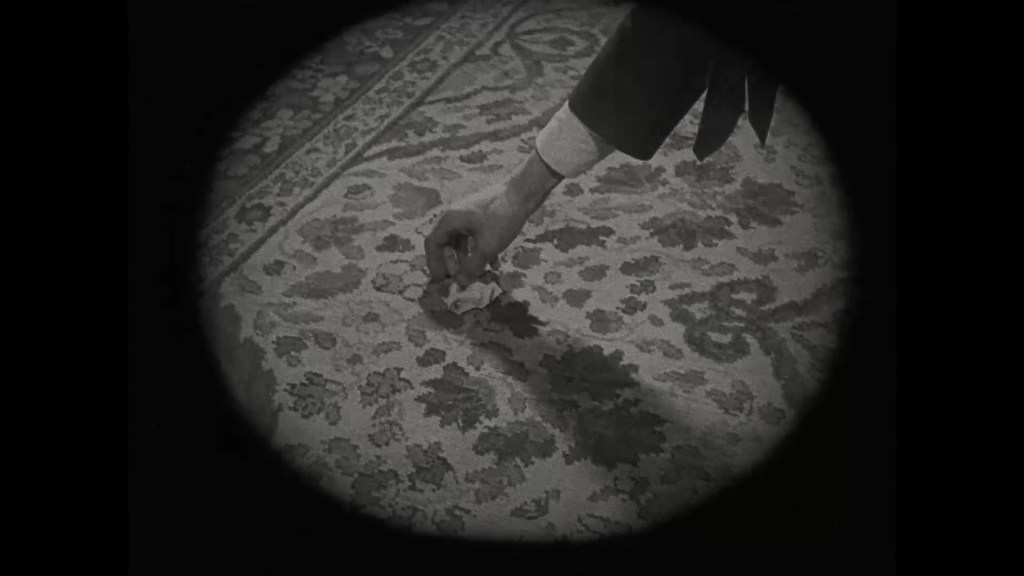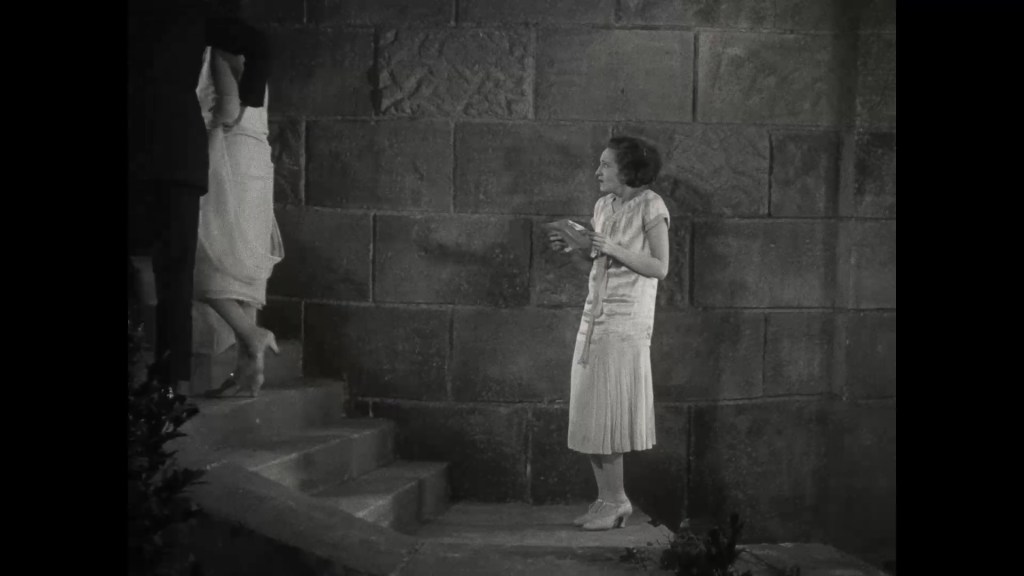
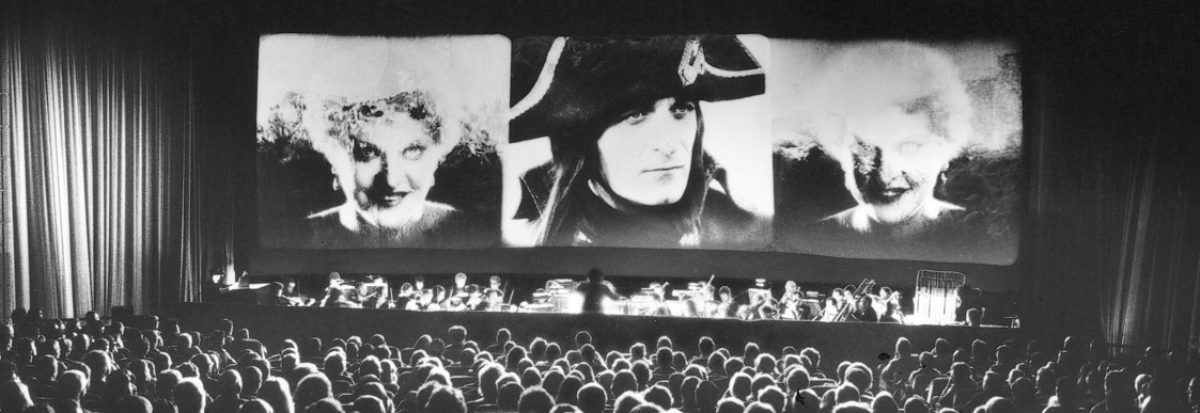
Searching for Der Evangelimann (1923; Ger.; Holger-Madsen)

This week, I’m writing about not being able to write. I’d love to be telling you all about the beauties of Holger-Madsen’s film Der Evangelimann (1923), but all I can do is write about my entirely unsuccessful efforts to find a copy. While I am therefore unable to offer much insight into the film itself, I hope to offer some reflection on the intractable difficulties of writing about film history – and finding it.

Why am I interested in Der Evangelimann? Well, as previous posts indicated, I have a growing curiosity about the work of Paul Czinner and Elisabeth Bergner. I have a longstanding project on their Weimar films, but I am also interested in their work before their first collaboration in 1924. Der Evangelimann was Bergner’s first film role, and her only pre-Czinner work for the cinema. This Ufa production was made in Germany but was directed by the Danish filmmaker Holger-Madsen and premiered in Austria in December 1923. Contemporary reviews were mostly favourable, but since its general release in 1924 it has virtually disappeared from the record.

I am also interested in the cultural background to Der Evangelimann. The film was based on an opera of the same name, composed by Wilhelm Kienzl (1857-1941). As even semi-regular readers of this blog may be aware, I am a devotee of late romantic music – and obscure operas by lesser-known composers have their own attraction for me. Since it swiftly became apparent to me that Der Evangelimann was going to be a difficult film to see, I turned my attention to finding a recording of the opera. As it turned out, Kienzl’s music was an absolute delight. A pupil of Liszt and a devotee of Wagner, by the 1890s Kienzl had become a successful composer and music director in various central European cities. Der Evangelimann (1895) was his greatest hit and became a regular production for opera houses into the first decades of the twentieth century. However, Kienzl never produced another opera that established itself in the repertoire to this extent, nor did he write much in the way of substantial music in other genres. By the 1930s, he had withdrawn from active work and by the time Europe emerged from the Second World War he was dead, and his work largely neglected. (His support for the Nazi takeover of Austria in 1938 cannot have helped his posthumous reputation.)

The opera Der Evangelimann is a pleasing blend of late romanticism with a touch of verismo (i.e. something rather more realistic than romantic drama). The libretto, adapted by Kienzl from a play by L.F. Meissner, is also a kind of ethical drama. Act 1 is set in 1820 around the Benedictine monastery of St Othmar in Lower Austria. The monastery’s clerk Matthias is in love with Martha, the niece of the local magistrate Friedrich Engel. Matthias’s brother Johannes is jealous of this romance, since he covets Martha for himself. Johannes betrays the lovers’ secret relationship to Friedrich, who furiously dismisses Matthias from his job. Seizing his chance, Johannes proposes to Martha, but he is angrily rejected. Matthias arranges with Martha’s friend Magdalena that he will meet his beloved late one evening, before he leaves town to seek work elsewhere. Their nocturnal meeting is witnessed by Johannes, who storms away in a fury of jealousy. As the lovers say a sad farewell, a fire starts in the monastery. Matthias tries to help but is swiftly blamed and arrested for the crime. Act 2 is set thirty years later, when Matthias returns to St. Othmar. He has spent twenty-five years in prison, after which he became a travelling evangelist, preaching righteousness and justice. He encounters Martha’s old friend Magdalena, who now looks after the ailing Johannes. We learn that Martha drowned herself rather than submit to Johannes’s proposal, and that Johannes has since attained great wealth but is haunted by enormous guilt. Magdalena ushers Matthias to see Johannes, who receives Johannes’s dying confession of guilt for the fire. Matthias forgives his brother, who dies in peace.

Kienzl’s opera is gorgeously orchestrated and contains at least two rather wonderful melodies. The most famous, “Selig sind, die Verfolgung leiden um der Gerechtigkeit willen”, is Matthias’s evangelist hymn. Kienzl, knowing he had written a good tune, cunningly makes Matthias teach a troupe of children this melody on stage. We thus get to hear the melody several times in a row, and it becomes the leitmotiv of reconciliation and forgiveness between the brothers. But my favourite scene of the opera is in Act 1. Rather than a set-piece number, it is a scene of anxious, hushed dialogue between Mathias and Magdalena. They are arranging Matthias’s final meeting with Martha before he leaves, and as they talk the bells are ringing across town for vespers. Kienzl creates a spine-tingling atmosphere that has remarkable depth of sound: from the slow, deep ringing of the cathedral bell to the warm halo of strings, then to the bright chiming of a triangle. A simple downward motif is thus given greater emotional resonance: you can sense the space and warmth of the evening, but also the sadness of departure, the steady pressing of time upon Matthias. In Act 2, when Matthias meets Magdelena again, the midday bells sound: suddenly, the scene evokes the past through an echo of its warm, chiming orchestration. It’s a beautiful scene, perfectly realized. (At this point, I pause to recommend the 1980 recording of Der Evangelimann conducted by Lothar Zagrosek. It has a great cast, too: Kurt Moll, Helen Donath, Siegfried Jerusalem. Though the EMI set is out of print, it is readily available second-hand. A must for anyone interested in out-of-the-way late romantic opera.)

The 1924 film maintains the same basic plot and setting as the opera, though it has one or two curious departures. Per the opera, the first part of the film replicates Mathias (Paul Hartmann) and Martha (Hanni Weisse) being betrayed by Johannes (Jakob Feldhammer) to Friedrich Engel (Heinrich Peer), followed by the fire in the monastery and Mathias’s arrest. Years pass, Martha has married Johannes and together they have a young daughter, Florida. Martha then discovers that Johannes was the real arsonist (when he talks in his sleep) and ends her life rather than continue in their doomed marriage. After her death, Johannes moves to America – leaving Florida in the care of Magdalena (Elisabeth Bergner). Twenty years after the fire, the dying Johannes returns to St Othmar – as does the newly-released Mathias, now known as “the Evangelist” due to his preaching of holy justice. After Magdalena and the teenage Florida (now played by Hanni Weisse) go in search of him, Mathias eventually meets the dying Johannes – who then confesses to his brother and receives forgiveness.

I initially pieced together a synopsis from those available via various online sources, plus evidence from contemporary reviews. However, online sources do not provide the sources of their information, and I was left uncertain of numerous details. After a more thorough searching of the documentation catalogue of the Bundesarchiv (Germany’s state archive), I located the German censorship report of July 1923. Thankfully, this had been digitized and made available for public access. (As have many such censorship documents from the period.) The censorship report includes a complete list of all the original intertitles for the film, together with an exact length (in metres) for each of the six “acts” (“act” usually being a synonym for reel). Though there is no accompanying description of the action (i.e. what’s happening on screen), the titles provide a much clearer picture of the film’s structure and action. The document demonstrates how significantly Holger-Madsen expanded the ellipsis between the opera’s original two acts. The film’s second and third acts are set after the trial and the first years of Mathias’s imprisonment, allowing a glimpse into the minds of both brothers and of Martha – and showing us Martha’s discovery of Johannes’s guilt, and then her suicide.

Yet even the list of titles leaves some aspects of the narrative unclear. The film’s invention of a daughter for Martha/Johannes allows Hanni Weisse a double role as both mother and daughter. But I am unclear as to what (if any) dramatic function Florida has to the plot (she is evidently not a suicide deterrent!), or how exactly Mathias’s return is handled. Does Magdalena have a crucial role in this, or does he find his way back by chance – or by his own volition? Does Mathias encounter Florida, and what is his reaction to seeing the spitting image of his lost love? The titles do not make this clear.

Would other documents help? I know that if I visit the Bundesarchiv collection in person, I can inspect a copy of the programme for Der Evangelimann which may (or may not) clarify the issue. But where else to turn? I cannot find evidence of the film being released in France, in the US, or in the UK, and thus cannot find any other easy source of a more elaborate synopsis or of additional still photographs.

What of sources on Bergner? In Germany, there are many books devoted to her life and career on stage and screen – as well as her own memoirs. Ten years after the film was released, Bergner recalled being so disappointed with her experience on Der Evangelimann that it inspired her “contempt” for the entire medium of cinema (Picturegoer, 18 August 1934). In her later memoirs, Bergner claims that Nju (1924) was “my first film” (69) – erasing altogether the memory of Der Evangelimann. Those subsequent biographers or scholars to mention the film do so only in passing, but most accounts simply ignore its existence. The only account that even suggests familiarity with the film is that of Klaus Völker, which provides a meagre synopsis in its filmography and describes Bergner’s “slightly hunchbacked” appearance (398). Had Völker seen Der Evangelimann, or was this description based purely on publicity photos of the production? (The book contains only one other reference to the film, which repeats Bergner’s own grave disappointment in the role and the medium as a whole.)

Elsewhere, Kerry Wallach’s very interesting discussion of suicide in Bergner’s films (and contemporary Weimar/Jewish culture) makes passing reference to Der Evangelimann (19), but nothing that suggests familiarity with its content. Given Wallach’s interest in suicide and love triangles across Bergner’s films, it is odd that nothing is made of this first screen role being in a film that has both. I am curious, too, that Holger-Madsen chose to cast Bergner in the secondary role of Magdalena, since Martha is a much more interesting character – and her off-screen suicide (“in the waters of the Danube”, according to Matthias in the opera) would have directly foreshadowed the deaths of Bergner’s later characters.

All of which brings me to the nub of the issue: does any copy of Der Evangelimann survive? Has anyone seen it? Of course, the first source interested parties are usually advised to consult is the Fédération internationale des archives du film (FIAF) database. This is designed to be a collaborative database for information on archival holdings from across the world. Search here, and you can find the details of a film and a list of archives that hold material relating to it. That, at least, is the theory. In practice, it relies on data from its member archives that is not always available, complete, accurate, up-to-date, or forthcoming. I have long since accepted that the absence of a film on the FIAF database does not mean it is absent from the archives. This acceptance brings hope but creates other problems.

The next step, at least for a German production, is the usually (but not always) reliable filmportal.de. It is usually a decent indicator of the film’s survival in German archives and will also list the rights holders to the film and/or any restored copies. In the case of their page on Der Evangelimann, it lists the rights holders as the Friedrich-Wilhelm-Murnau-Stiftung – the inheritors of much German cinema of the pre-1945 era. The FWMS lists details of the film on their website but (having asked them) they do not themselves possess any copy. Such is often the case, where the legal possession of a film does not coincide with the physical possession of a copy – or even the guarantee that a copy exists.

Where next? Well, the Bundesarchiv helpfully provides an accurate database of its film holdings – but this too yields no copy of Der Evangelimann. Various catalogue searches and archival contacts in Germany, Austria, the UK, and Russia have likewise yielded no result. Given that Holger-Madsen was Danish, I did also consult the Danish Film Institute about the film – but Der Evangelimann is not even listed on the DFI filmography of Holger-Madsen’s work, and they profess to have no copy. (Or at least, did not profess so to me.)

If Der Evangelimann had been restored, it would likely appear on more archival or institutional catalogues available online. But it seems scarcely to have made any mark on film history before proceeding swiftly to oblivion. Indeed, the only record I can find of any screening since 1924 was at the Internationales Filmfestival Mannheim-Heidelberg in 1963, where Der Evangelimann was part of a retrospective of Bergner’s work. Was this a complete print? Was it even shown, or just listed as part of the line-up? (Needless to say, I have contacted the IFFMH to see if they have any record of which archive loaned them the print, but I have not yet heard back.)

My only remaining option is to contact every film archive in the world, but there is no guarantee (as I have already discovered) that any of them will reply to a private researcher undertaking a wild goose chase. If an institution, restoration team, or legal rights holder were to make this inquiry, I imagine the process would be much more likely to yield results. As an individual, I have only a handful of contacts in the archival world, and limited resources of time, money, and patience to feed into this search. I cannot issue a convenient “call for help” that summons responses from across the world.

All of which makes an illustrative example of the problems of film history. What I have experienced scouring public resources for traces of Der Evangelimann is a frequent and frustrating instance of a common issue. The film may well exist in an archive, but without any publicly available acknowledgement of its status it might as well (for the purposes of film history and film historians) not exist. That which cannot be seen cannot be studied. It is also frustrating that no scholar on Bergner has ever taken care to admit either that they have not seen the film, or that the film does not exist – and that therefore future scholars should not waste time trying to locate it. Filmographies are infinitely more useful if they include information on a film’s original length (in metres, not duration), together with its current restorative status in relation to its original form of exhibition. These are quite basic facets of film history, but it is amazing how rarely scholars ever cite them – or are required to do so. (I am myself guilty of this.) As regular readers will know, it is a bugbear of mine that many restorations and home media editions likewise provide viewers with so little information on the history of what we are actually watching. It perpetuates a cycle of missing information: the material history of a silent film – the most literal evidence of the medium itself – is too often taken for granted and simply left out of its presentation, either on video or in written texts.

In the case of Der Evangelimann, a century of critical and cultural disinterest has left me with very little evidence to go on. Does the film survive? I do hope so. Even if it is a failure, and even if Bergner’s performance awful, I just want to see it and find out. A film doesn’t have to be a masterpiece to deserve recognition and restoration. I just want to see it! I will continue to pester archives, but in the meantime I suppose I can also pester you, dear reader. Do you know anything about where a copy of Der Evangelimann might be held? Any information would be most gratefully received.

Paul Cuff

References

Elisabeth Bergner, Bewundert viel und viel gescholten: Elisabeth Bergners unordentliche Erinnerungen (Munich: Bertelsmann, 1978).

Klaus Völker (ed.), Elisabeth Bergner: das Leben einer Schauspielerin (Berlin: Hentrich, 1990).

Kerry Wallach, ‘Escape Artistry: Elisabeth Bergner and Jewish Disappearance in Der träumende Mund (Czinner, 1932)’, German Studies Review 38/1 (2015), 17-34.

Der Geiger von Florenz (1926; Ger.; Paul Czinner)

Der Geiger von Florenz was the sixth film directed by Paul Czinner and the third to star Elisabeth Bergner, whom he later married. It’s also the first of Czinner’s silent films to be released on Blu-ray. Given that my last experience of Czinner’s silent work was the shoddy copy of The Woman He Scorned (1929), I was keen to see his work in high definition. I was also intrigued to see Elisabeth Bergner as the lead, a very different star to Pola Negri.

First, the plot—and yes, as ever, I spoil everything. The young Renée (Elisabeth Bergner) is deeply attached to her father (Conrad Veidt) and deeply jealous of her stepmother (Nora Gregor). After numerous petty squabbles, Renée is sent away to a ladies’ finishing school in Switzerland. There, she rebels against her teachers and runs away, disguising herself as a boy in order to cross the border into Italy. While roaming the streets, she encounters an old violinist and asks to play his violin. As she does so, a car pulls up and the artist (Walter Rilla) and his sister (Grete Mosheim) are entranced by the image of this beautiful young player. Renée goes with the siblings to Florence, where she becomes the subject of the artist’s paintings. The painting of the anonymous “Fiddler of Florence” is published and seen in a newspaper by Renée’s father, who seeks out his missing daughter. Renée’s identity as a woman is revealed, as is the mutual attraction between her and the artist. Renée’s father arrives in time to bless the couple.

At a little over eighty minutes, the film is a seemingly simple drama: light, charming, faintly silly. But it has plenty of telling details that cumulatively make for a surprisingly complex engagement with the complexities of desire and gender.

The daughter/stepmother jealousy plays out in the very first scene: at her father’s desk, Renée substitutes a photo of her stepmother for her own—and destroys the image of her rival. At the dinner table, she replaces her stepmother’s choice of flowers with her own enormous bouquet, which she then moves to try and block the conversation between father and stepmother. The rivalry is then played out through two rival dogs: Renée feeding her own dog, which then ends up attacking the stepmother’s dog under the table. The whole trio tries to placate the dogs, one of which bites Renée’s father—the two women gather round with medical boxes, bandages etc. It’s a comic sequence, a snowballing farce than ends up with everyone chasing around the house.

All this is told through images. But when Renée sees her father alone outside, clearly depressed, she commits her thoughts to her notebook. The film then offers us a lot of contextual information through this written text, then through two flashbacks. We see Renée on holiday with her father in Italy, where she embraces him and says that “If you weren’t my father, I’d marry you”. Then, when her father spots the woman who will become his second wife at the next table, Renée keeps moving her parasol to block their eye contact. It’s the same trick she pulled with the flowers earlier in the film, and the history of their fraught daughter-father-stepmother relationship confirms the impression that it’s effectively a love triangle. Outside, the stepmother joins the father. She issues him an ultimatum: either Renée goes, or she does.

Renée’s desire for her father is epitomized in the next scene, when her father comes to say goodnight. Renée eagerly pats the bed, but her father pulls up a chair. Renée is visibly crestfallen, and the sustained close-ups of her face in the ensuing conversation show the waves of emotion passing over her. Bergner’s face is wonderfully expressive, her eyes beautifully lit: they seem huge, and you seem to fall into them in these close-ups. Indeed, much of the film is spent watching Bergner’s expressivity. Her performance is incredibly animated. She’s scheming, or emoting, or running away, or hurling herself away in shock or fear or despair or delight. The framerate of the film is faster-than-life throughout, apart from one section of slow-motion. Thus, Bergner’s movements are all exaggerated. It’s as though the film itself shares the energy and ferocity of her teenage emotional life. Even in these close-ups in her bedroom, her face becomes the sight of tremendous emotional activity—condensed in her luminous eyes.

Promised another Italian holiday if she behaves, Renée tries to make things up with her stepmother. We see her in the next scene approaching her rival as if attempting to seduce her: she creeps along the wall, nervously—or is it flirtatiously? Then she helps make a punch, urging her stepmother to make it stronger and stronger. So they get very rapidly tipsy and start to dance with each other. Enter Renée’s father, who is offered cups of punch by both women. He pushes away Renée’s hand and drinks from his wife’s cup. Renée hurls her glass of punch at her stepmother. There’s a kind of savagery in this action: the violence of the gesture contrasting with the primness of the weapon.

So Renée is sent to Switzerland, where we see her writing of her sadness at her confinement. The film has skipped forward here, for Renée has already made an enemy of her tutor. We see her wipe away a chalkboard announcement of her punishment and draw instead a caricature of the tutor. In another riff on the dog theme seen in the opening scenes, Renée has better command over the tutor’s dog (called Fellow) than the tutor herself. Renée waits for a letter from her father to rescue her, but instead a letter arrives that says she must stay put. Perhaps Czinner was conscious of how much letter-writing (and thus letter-reading) there has been in the film in this section, for he provides a gorgeous visualization of Renée’s emotions as she reads here. She is on a bench in parkland and the wind whips the trees all around her as she wanders forlornly back and forth across the grass. It’s a lovely scene, and a relief that Czinner finds a way of visualizing feeling again, not having to rely on more text.

At night, Renée escapes—wearing an extraordinarily eye-catching plaid outfit and hat. Thankfully, after failed attempts to cross the border to Italy via train and road, she is able to swap clothes with a young peasant. In male clothing, she crosses into Italy and roams freely along the beautiful mountainside roads. For such a short film, Czinner gives plenty of time to Renée’s wandering here: we see the landscapes around lake Lugano in dazzling sunlight. The haze of the vistas interacts beautifully with the grain of the filmstock. You can understand why Czinner lets the film’s plot meander here, it’s lovely to look at—with Bergner’s tiny figure, dressed almost as if from a previous century, providing scale and narrative punctuation to the landscapes.

She eventually encounters a beggar playing a violin by the roadside. Convincing him to lend her his instrument, she begins to play—just as a motorcar draws up alongside. The driver and his companion seem to take a fancy to this strange figure, dressed in peasant clothes, striking a pose from another age. The man is an artist and wishes to paint the “boy” violinist. Renée readily agrees. There follows a lovely (and again, surprisingly lengthy, given the film’s short length) segment where the camera sits behind Renée and follows her journey to Florence. It becomes a travelogue documentary, the film simply cutting as it wishes to segue from one view to the next. It’s always fascinating to glimpse the real streets of the 1920s, with ordinary people moving aside for the car and glancing at the camera as it passes.

But the levels of artifice are foregrounded in what follows. At his glamorous estate in Florence, the artist is transformed from an apparently old, grey-haired man into a youth. For the grey of his hair, and that of his female companion, is merely the dust of the roads. Renée is startled by their transformation, just as she is frightened when the artist demands that “he” too must be scrubbed clean. Renée’s own transformation into the suited “boy” is greeted with curiosity by both her hosts. She is an object of fascination and flirtation by both the man and woman. They are siblings, but Renée doesn’t discover this until she has already fallen for him. She poses as the “fiddler”, and Czinner turns the posing into a lengthy sequence for Bergner to express her fidgety, restless character. She cannot stand still, and the artist grows irritated. So Czinner makes this frustration into a little marvel of cinematic magic: the camera is over-cranked, thus slowing the film for us in projection. Renée’s restless movements become a strange dance, the film finally finding a way of slowing her down, of capturing her for our gaze.

The peculiarities pile on, however, as the artist’s sister grows jealous of his new muse. It’s the artist’s turn to be offered two cups of punch, and when he chooses Renée’s, his sister throws her drink at Renée. This reverse of the scene with Renée and her stepmother reminds us of the weirdness of the film’s emotional path. Renée seems keen to be adopted by what she takes as an older man, only to find him a young man. The artist thus attracts her as an image of her father, then wins her over as a different kind of male figure: Renée transfers (at least some of) her affections from a familial to a romantic object.

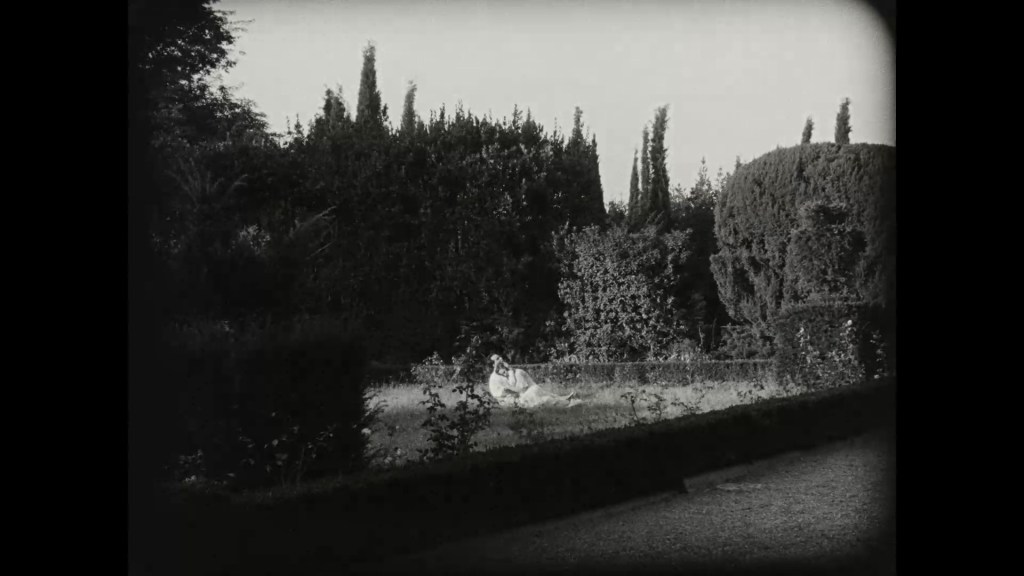
But the film isn’t as neat as that sounds. For the brother-sister relationship of the artist and his sister is also weirdly intense. Renée sees them embracing in the garden and it’s not just her who wonders just how close this couple might be. And the sister not only flirts with Renée when she is disguised as a young man, but also reveals Renée’s femininity by placing her hand on Renée’s breast and embracing her. Thus, wherever you look, the film offers unusual and interesting couplings, or the potential of unusual and interesting couplings. Besides, what kind of disguise is Renée’s outfit? And for what do we or the characters take her? She is androgynous by virtue of her clothing but also by her age: she is not quite a woman, not quite a man, not quite a girl, not quite a boy.

The word to describe all this is doubtless “queer”. It’s a queer film whose brevity and lightness allows it to get away with a complex play on the ambiguities of gender and familial/romantic feeling. A contemporary reviewer in the UK said that Der Geiger von Florenz possessed a “somewhat unusual theme” (Kinematograph Weekly, 7 October 1926), which is a very British way of saying “queer”.

The impression of queerness, however lightly worn or exercised, made me curious about both its director and star. The English-language Wikipedia page suggests that Czinner was gay, but that “despite” this factor his marriage “proved a happy and personally and professionally enriching one for both partners.” Well, that’s very interesting—although the “citation needed” at the end of the paragraph casts its contents into uncertainty. (His sexuality is not mentioned in other available sources.)

So, is there anything autobiographical hidden in Der Geiger von Florenz? It’s worth observing that Czinner himself was a child prodigy on the violin. Can we read the “boy” Renée, attracting the attention of an elder male lover, as a version of Czinner’s early life? One can only conjecture. What is curious is that the film itself offers no more convincing context to Renée’s musical talents and thus narrative journey. At no point in Der Geiger von Florenz are we told that Renée is musical or can even play an instrument. Her ability to play is a seemingly spur-of-the-moment decision, one which immediately propels the plot into a new direction.

Looking for some kind of context for Der Geiger von Florenz, we might turn to Czinner’s other silent work with Bergner. As in Der Geiger von Florenz, the Bergner characters in Nju (1924), Doña Juana (1927), and Fräulein Else (1929) are all dominated by complex relationships with older men—husbands, fathers, or lovers.

Of particular note is Doña Juana, a film which I’m now dying to see. The latter also stars the legendary Max Schreck as Bergner’s father, who sends her out into the world dressed as a boy. From what I can tell, the film reworks many of the themes of Der Geiger von Florenz, providing a happy ending—unlike the suicides that the Bergner character commits at the end of Nju, Liebe (1926), and Fräulein Else. These stills from the German magazine UHU (December 1927) certainly whet the appetite for Der Geiger von Florenz—not just for Bergner in the role, but for more location shooting, this time in Spain: 

All of which brings us to Elisabeth Bergner. A lot has been written about her in German and almost nothing about her in English. This is surprising, given her career path: from acclaim as a young stage star in Germany, a flourishing film career followed by exile to the UK, a move to the US in WWII, then a return to various projects on stage and screen across the world until her death in 1986. She led a fascinating life about which I want to know more. (And, to be honest, in the time it has taken me to finish this piece I’ve embarked on a project about Bergner so have developed a little obsession. This will be the subject of another piece, another time…) She was certainly bisexual, perhaps more interested in women in men, and one cannot help but wonder how her marriage with Czinner worked. They were both Jewish and fled from mainland Europe, marrying to cement their relationship—and presumably their careers. But as to one might call the practicalities of their marriage, much remains unknown. In many studies on Czinner-Bergner, we’re in a world of unspoken truths, of sly hints, of euphemisms and ambiguities. It’s a world of mysterious “travelling companions” and of “intimate friendships”. It makes everything tantalizing and nothing certain. But it should certainly inform our viewing of their films, and Der Geiger von Florenz in particular.

I should also make clear that the Blu-ray of this film was released in Germany in 2019, without English subtitles. As explained in the opening credits, the original negative for Der Geiger von Florenz no longer exists. The 2018 restoration used a (shorter) negative of the film, which had been prepared for the film’s export to the UK, supplemented by extracts from exports prints from Russia and the US. Thanks to a little more digging on the ever-useful filmportal.de database, I learned that Der Geiger von Florenz was originally 2260m, divided into “Five Acts”. The 2018 restoration runs to 81 minutes at 24fps, giving it an approximate length of 2243m, so very close to the original length. This slightly surprised me, as the film seemed to have some very sudden transitions between scenes, as well as some odd glitches in continuity. (The reviewer of the Kinematograph Weekly noted this when the film was released in the UK: “Continuity is jerky, probably due to cutting” (7 October 1926).) I’m thinking especially of the scene when Renée decides to run away from her school in Switzerland: the dog flashes past in one shot but doesn’t reappear until later in the scene. Perhaps the restoration was forced to cut between two different continuities across prints; or perhaps the error was always in the film. Ditto my sense of the sudden transition between scenes, especially in the first part of the film. At the end of one scene, Renée is in bed, then she is suddenly outside sipping punch with her stepmother. Is this the same night, or the next? Soon after, when she is given the letter notifying her of her forced emplacement in Switzerland, we cut straight from her holding the letter to her in Switzerland, weeks later, writing in her notebook in a field. At the very least, I would expect a title to prepare us for this transition. The film was originally in five “acts”, so surely this transition would have had a new “act” title card here? As it stands, the continuity is so swift it’s startling. The 2018 restoration has recreated all the original intertitles in the original font—but it has no division into “acts”. I’m guessing the lack of domestic print material leaves no indication of where the acts may have started/ended, so they have not tried to recreate this element. It’s not a substantial loss, I suppose, but it does make a difference to the rhythm of the film.

I wonder also if having a clearer structure might have encouraged the score to behave differently, to shape its overall structure a little more clearly. For this 2018 restoration, a new score for quartet (violin/mandolin, cello, piano/organ, trombone) was written by Uwe Dierksen. It’s perfectly fine, but far too busy for most of the film. It is chromatically restless, occasionally spiky, sometimes outright sinister—not exactly descriptors of the film itself. More surprisingly, the score makes no effort to match the music being performed on screen. Neither the scene where Renée plays her violin, nor the scene when her stepmother plays the piano, is matched in the new score. Would it really be too much to ask that a film called “The Fiddler of Florence” should feature the odd section for solo violin? The original music for Der Geiger von Florenz was by Giuseppe Becce, one of the most prominent film composers working in Germany in the silent era. Alas, this score is one of many that do not appear to have been preserved or survive. A shame, as I would love to see the film with a more sympathetic, a more charming and romantic, score.

Paul Cuff