Bonn from afar (2025, day 3)

After a day of urbane, light-hearted musical comedy, Day 3 of Bonn takes us to the streets for poverty and vagabondage…

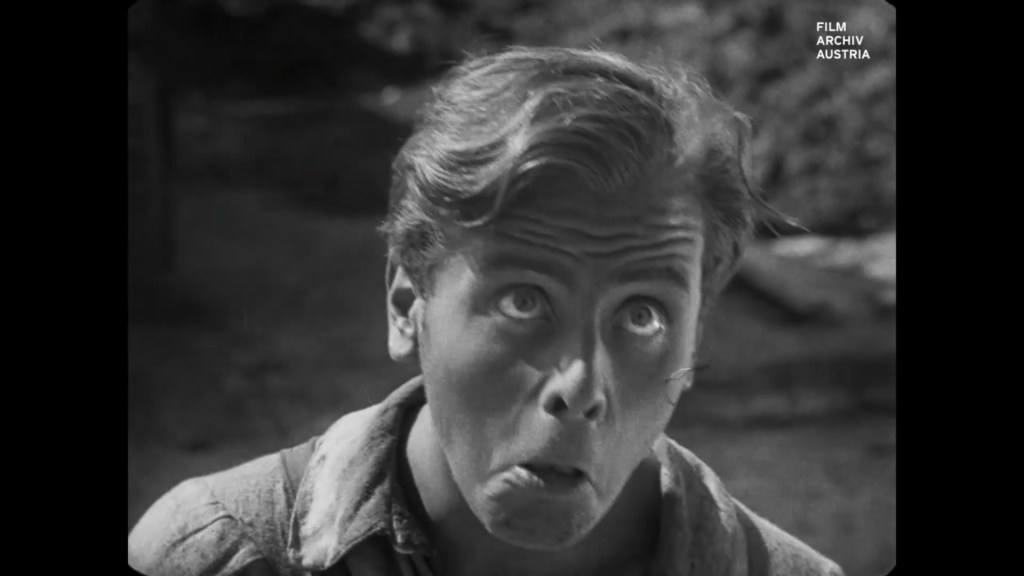
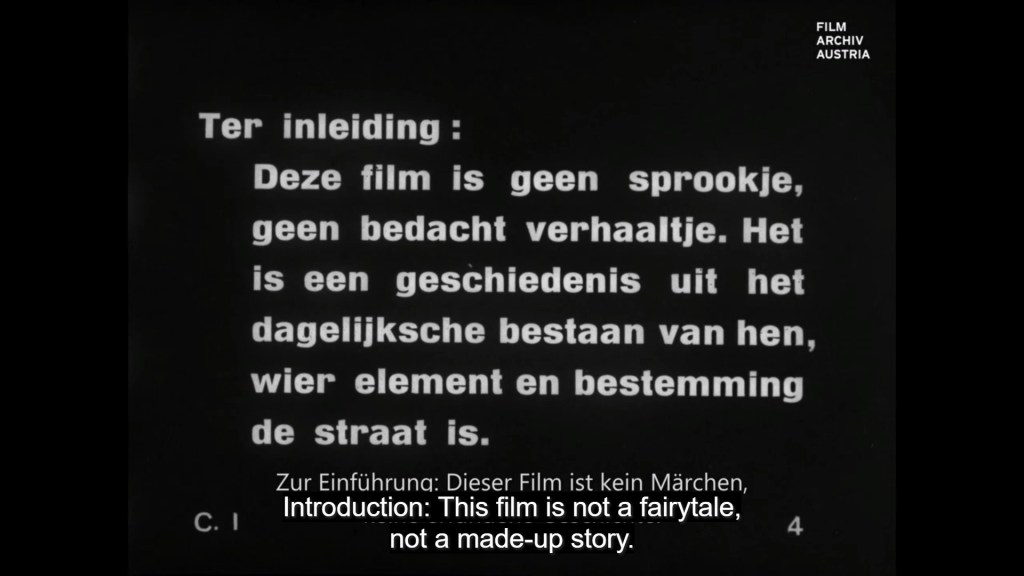
Der Vagabund (1930; Aut.; Fritz Weiß). The opening titles tell us that this is a story “taken from everyday lives”, as recounted to a journalist. The prologue begins with the sight of a vagrant’s body being found in a country ditch between Werder and Potsdam. All that’s found with him is a self-penned poem, an enigma that sets the journalist on a journey to the homeless shelter and the underworld of the unemployed and destitute. What follows is both an account of the journalist’s investigation and the stories he hears from the “vagabonds” themselves. What account of the “plot” I can give is necessarily brief: the film frames its narrative with the journalist visiting shelters and listening to personal accounts of vagrancy and homelessness. The main story becomes that of a man’s journey through Austria, where he encounters the uncaring attitude of many in society. Put like this, Der Vagabund sounds prosaic. But the structure and its cinematic realization are very striking, and the film is filled with amazing images of people and places.
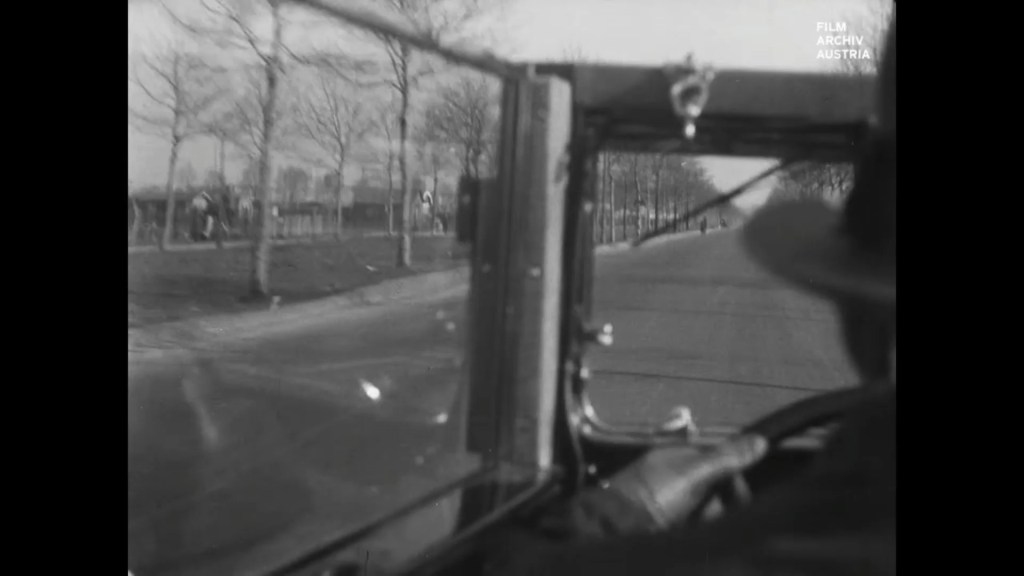
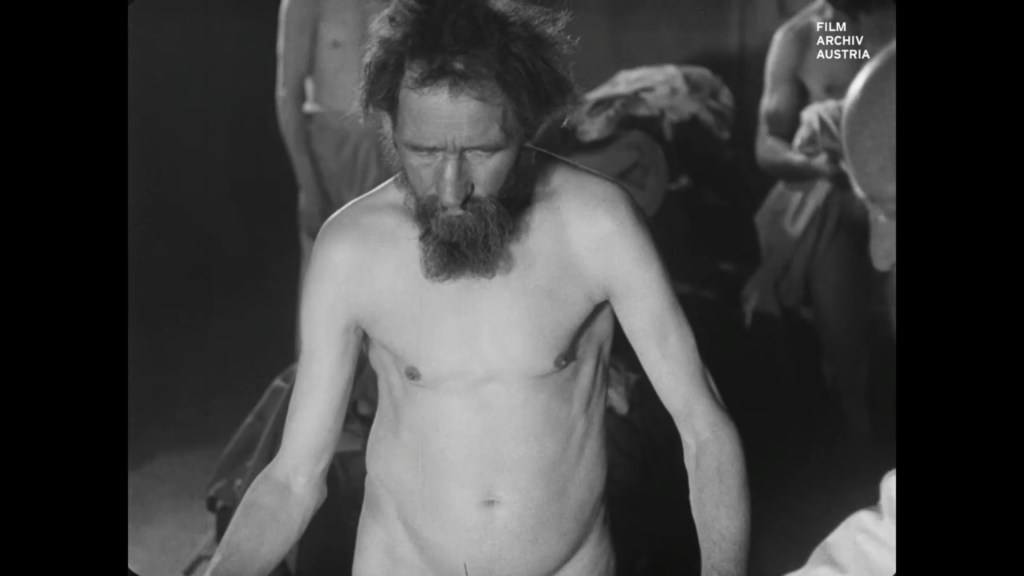
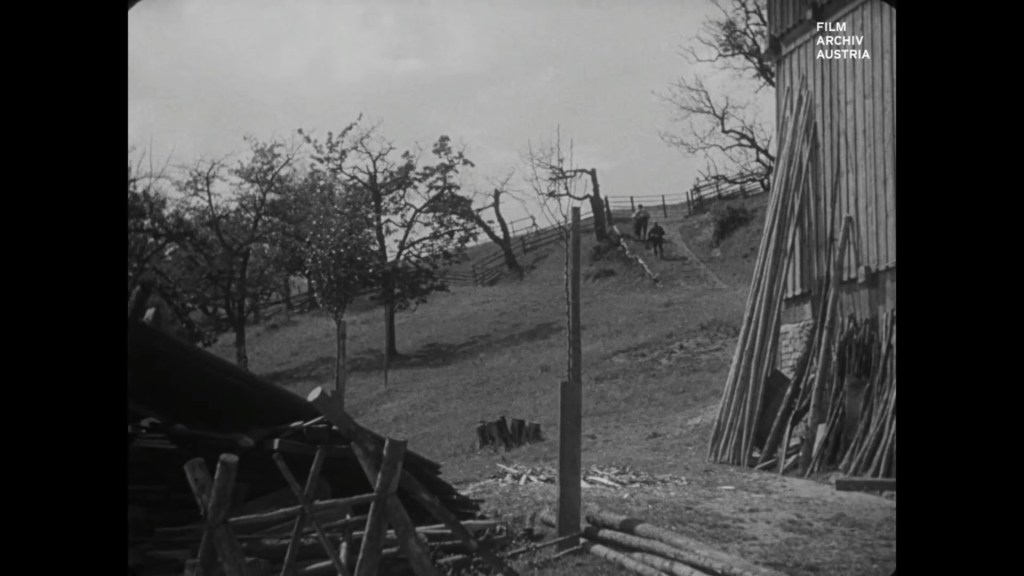
From the outset, director Fritz Weiß provides some beautifully composed images of the landscape, the stillness of which is then offset by the handheld camerawork that brings us up-close to look at lived reality. Soon the camera is perched behind the journalist as he speeds into the city, where there are some amazing shots of the bustling streets that whiz past the car. Alongside the journalist, we visit the shelters and inspect the occupants. We see the vagrants strip and get inspected for lice, then shower. The faces and bodies are palpably real. (When the camera tracks past the vagrants as they eat, one of them shelters his face from the camera, as if ashamed or fearful of being seen.) There are powerful, often quick montages of details: the faces, the bodies, the clothes of the vagrants; or the watches, the coats, the hats left hanging in the shelter.  

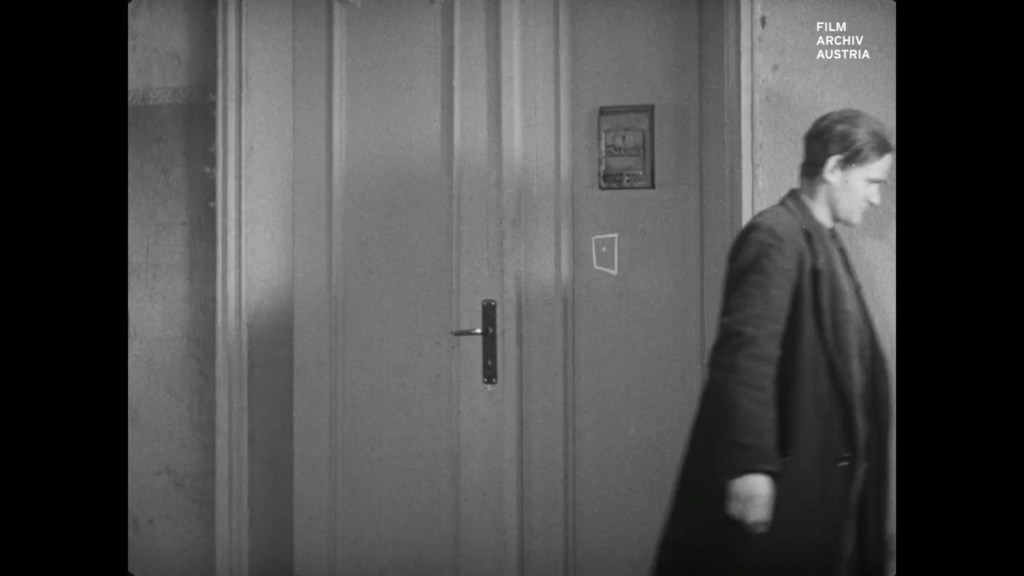
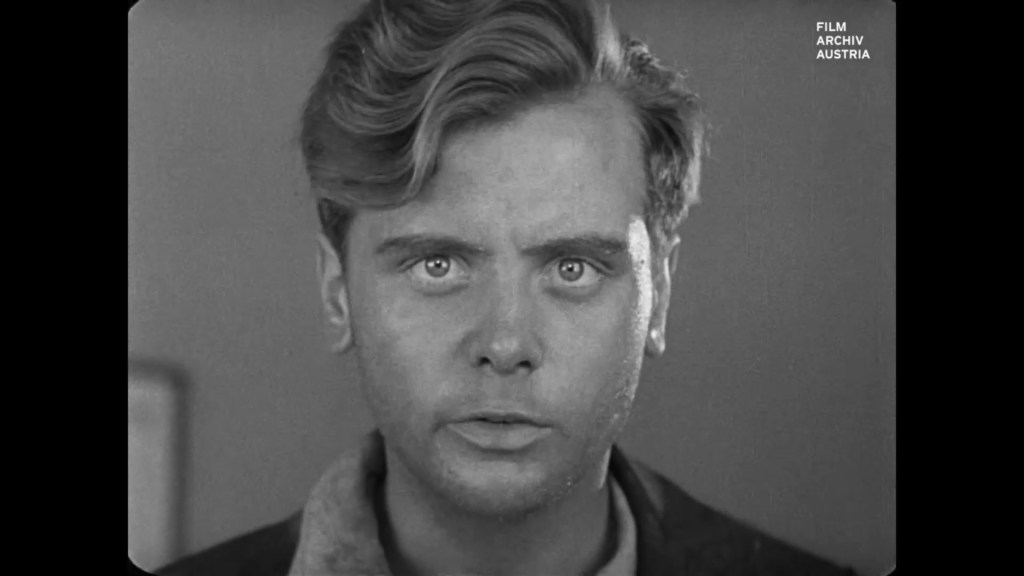
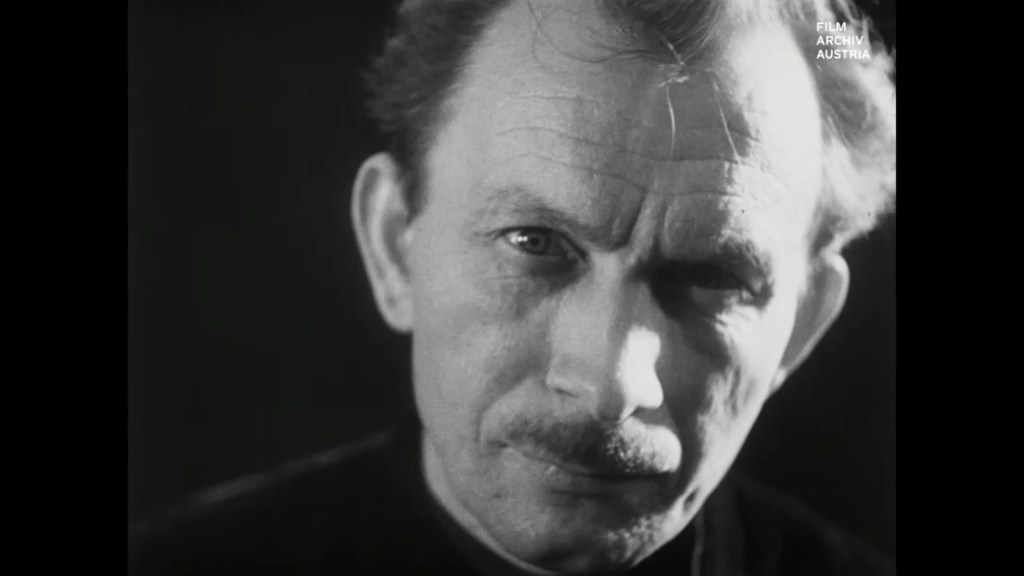
The film begins to give us some context for these people. We meet Gregor Gog, “the vagrants’ leader”, who gets an amazing introductory close-up in which he stares at – almost through – the camera. It’s a challenging look, one that demands we pay attention; it’s also a kind of question: what are we thinking when we see the vagrants on screen? There is a series of cutaways to the unemployed, drunks, petty thieves. We see their faces, are given little vignettes of their actions and habits. There are scenes in which we see the sign language by which their “brotherhood” communicates – chalked symbols on the walls if houses where they have found, or not found, help or food. The film thus gives us a sense of community, of commonality, between these otherwise isolated, down-and-out individuals.

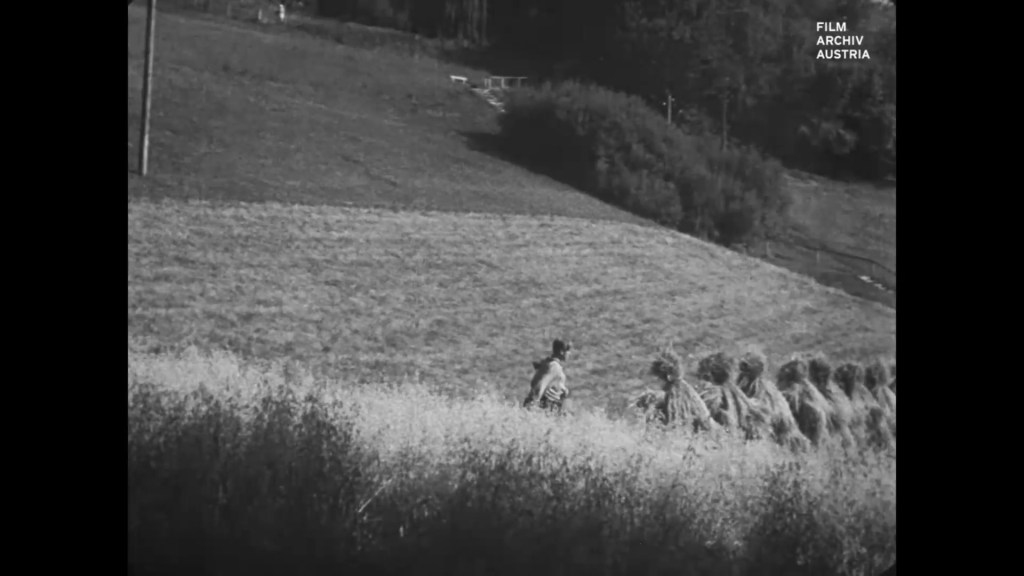
This leads me to think about the film’s structure, which I found very curious. The first section of Der Vagabund, discussed in my previous paragraphs, is based on articles which (within the film) is deemed “too theoretical” by the newspaper editor. Is this a kind of judgement on the style of the film we have just seen? As if in reaction, the film shifts register. The editor wants “life stories”, and that then is what we are given by the film. Though it is carefully framed via the journalist’s interview, what follows is the story of one man who wandered through Austria. We see his temporary work, his moving from place to place, his interactions with locals in a smith, a farm, and on the road. We also see a glimpse of his time with a woman, of a shelter in Austria for other vagrants. Throughout, the film intercuts between this inner narrative and the framing narrative of the journalist interviewing the vagrants. There is a pleasing tension between the real and the fictional, especially given how real even the fictionalized sequences look. This is also felt in the rhythm of the editing. While earlier sequences have some swift montage of faces and illustrative scenes, when we are on the road with the vagrant in Austria there are more long shots/takes of his travels. It’s always a pleasure to roam about in the past like this, and this film’s rambling itinerary is the perfect way to see little pockets of history that you would other never see. There are beautifully composed images that show us the sweep of mountains and valleys. Though the film always gives us a contrast between the richness of the summer meadows and the rags and dirt of the traveller.

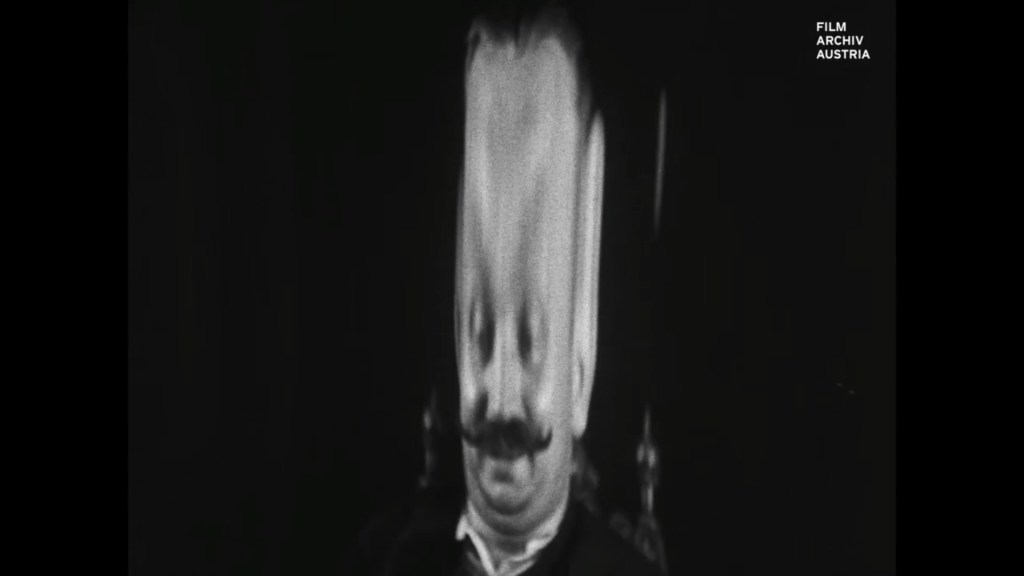
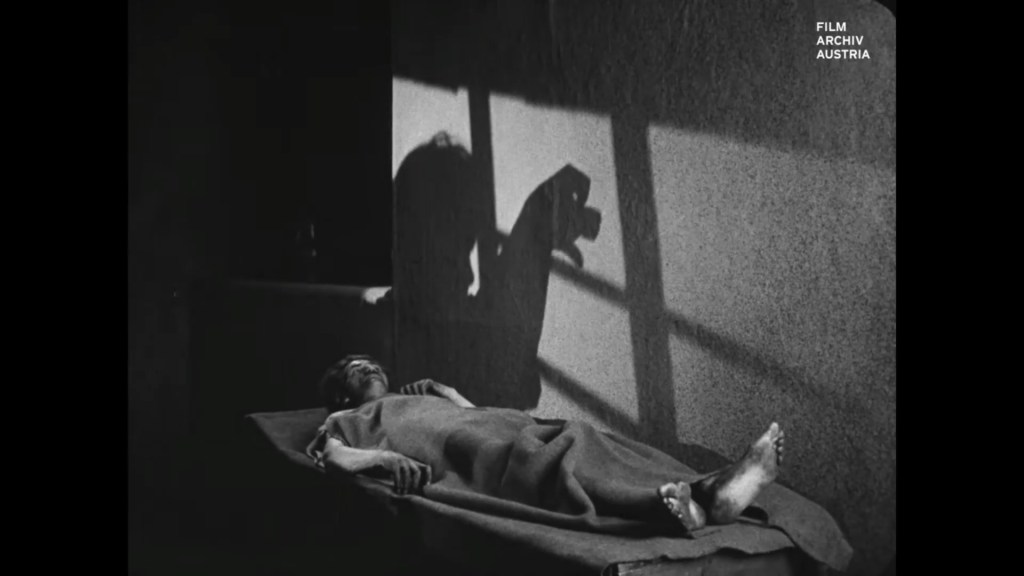
The film’s mode is not solely naturalistic, as there is a trippy dream sequence in which the vagrant character imagines himself tried and executed by the bourgeois bullies he has encountered on the road in Austria. It’s a wonderfully strange interlude, with a bleak edge: he imagines himself being hanged in a kind of forbidding, expressionist landscape. And “naturalist” doesn’t mean this film is so austere that it lacks lyricism or poetry. As I’ve said, there are some beautiful shots – beautifully composed and photographed – throughout the film, especially in the Austrian countryside. There is also a delightful sequence of shadow puppetry, improvised by the main character on the wall of the prison cell he shares with another vagrant, who is ill and lying in bed. The setting is realistic, but it finds a way of expressing something more personal than the set-up might suggest. The scene is silly and sad and touching all at once.

Der Vagabund ends with a montage of people from all classes pouring over the journalist’s articles in the newspaper Tempo. The motage then begins to intercut these scenes of reading with the “march” of the vagrants. To these shots are superimposed a vision of Gregor Gog giving a passionate speech. It was curious to see Gog emerge as a kind of heroic leader in this final montage. Though he is a real figure, playing himself on screen, his appearance at the end of the film is much more like that of a work of Soviet propaganda. Are we to read this as a promise of reform? A threat of revenge? A call to arms? It might be all three, and it is a surprisingly punchy end to Der Vagabund. Like the bourgeois readers of Tempo on screen, the media we consume is coming to life and confronting us with reality – demanding we think, reflect, react. Though the images stand comparison with numerous scenes in Soviet fiction films of this period, it also reminded me – with its confrontational crowd marching towards the camera – of Abel Gance’s J’accuse! (1919). The realization of the imagery is not as developed and sustained in Der Vagabund as in either these French or Soviet counterparts, but perhaps that is to its advantage. In such a film, I’d rather be won over by naturalism or lyricism than lectured or beaten over the head with crude slogans or overly tooled editing.

I should add that since watching the film I looked up Gregor Gog (what a name!), and I see that he led quite the life. From a working-class background, he ended up being drafted into the German army, where he was court-martialled during the Great War for his political activities. Mixing in an anarchist-communist milieu in the 1920s, he came to lead the “Vagabond Movement” (Vagabundenbewegung) and edit their mouthpiece publication, Der Kunde, which we see in the film. After 1933, he was arrested by the Nazis, escaped, fled to Switzerland, was expelled to Russia, spent time there in a labour camp, tried to become a novelist, and ended up dying in a sanatorium in Uzbekistan. Der Vagabund thus gives us a vivid glimpse into this corner of interwar Europe and its political movements. That said, Der Vagabund is not a work of crude propaganda. It certainly has an anti-bourgeois attitude (per the film’s many negative portrayals of monocled officials, hypocritical housewives, and brutish burghers). But it is also poetic and rambling. Its very structure of a narrative within a narrative lends it a picaresque quality, a slightly ramshackle form that loosens any sense of the viewer being lectured. A couple of years ago, I watched another low-budget socialist film, Brüder (1929), which was far cruder in its messaging – and (despite much beautiful location photography) less skilled in mobilizing either its lyrical, naturalist elements or its fictional, narrative elements. Der Vagabund is altogether a more interesting and more successful film.

The music for this presentation was by Filmsirup (Matthias André and Michi Hendricks) on piano and electric guitar. I found this extremely sensitive and sympathetic to the film. The rhythm was perfectly in match with the action, though “action” is often not the right word. Much of the time, the film follows characters who are killing time, mooching or loitering with or without intent. The music finds way of matching these sections very well. The dotted rhythms follow the vagrants as they walk along, slow down, dawdle, come to a halt, and resume again. The plash of water in the shower and the shattering of glass get their own moments in the music, just as the flashes of anger or dips into resignation of the characters are felt. I imagine this might be a difficult film to accompany, but Filmsirup do a very admirable job.

In sum, I found Der Vagabund an extremely interesting and engaging experience. Realistic and poetic, inventive and provocative, it’s a fascinating film. The restoration by Film Archiv Austria, based on a Dutch copy of the film, is beautiful to look at. A rich a rewarding film, with a pleasing musical accompaniment. A rich and rewarding film, with a pleasing musical accompaniment. Just the kind of thing you hope to discover at a festival. Bravo.

Paul Cuff

Kaiser im Kino: Franz Joseph I. in historic film documents (1903-16)

It’s been a few weeks since my last post, for which I apologize. I have been busy writing, but for a book project that is wresting control of my schedule. Having just finished a chunky chapter, I take a thematic break by revisiting a DVD released by Film Archiv Austria in 2016 to coincide with the centenary of the death of Emperor Franz Joseph I. This edition, called Kaiser im Kino: Franz Joseph I. in Historischen Filmdokumenten, is a nicely produced DVD with English subtitles and plenty of details about the sources for its selection of films. (There is also a musical soundtrack, of which more later.) There are twenty-four films, mostly produced during the Emperor’s lifetime, together with some that postdate his death. The programme is 75 minutes long, enough time to glimpse a vanished world…

The first film in this collection does not feature the Emperor. Entrée du cinématographe (1896) is a Lumière film shot to advertise the presence of their films in Vienna. It was at the cinema on Krugerstrasse on 18 April 1896 that the Emperor first encountered moving images. “Ah, c’est magnifique!” he marvelled. He was already advanced in years. Born in August 1830, he ascended to the throne in the tumultuous year of 1848. He was thus nearly 66 when he saw his first film. As an icon of the old world, and heir to the Habsburg monarchy that dated to the thirteenth century, there is something poignant about this encounter. What films did he see that day? How did eyes that had seen most of the nineteenth century react to the medium that would define the twentieth? The month Franz Joseph was born, the last Bourbon monarch of France was entering exile; when he died in November 1916, Russia was on the brink of revolution.

But here he is in 1903, a flickering patch of white, beyond ranks of dignitaries. Head down, he is annunciating a speech. In silence we watch. But the film skips this speech, untranslatable, in favour of the reaction. Umbrellas are thrust into the air. Top hats are hoisted in salute. Children curtsy. The old world goes about its awkward choreography. The Emperor shuffles off. Though he had been filmed first in 1899, Der Besuch Kaiser Franz Josephs in Braunau am Inn (1903) is the earliest surviving footage of him. As the short essay in the DVD’s liner notes highlights, the Emperor rarely gets close to the camera. For the most part, he is seen from afar. Per the liner essay, is this is a “respectful distance maintained between rulers and the ruled” – even a “quasi-religious distance”? Perhaps, yes. It is also the awkwardness of early technology, the awkwardness of etiquette. How close could a camera operator – often a foreign employee of the Lumières or Gaumont – hope to stand in public events? There are no other photographers on screen, no suggestion in these few metres of gathered reporters. Just the crowds, the dignitaries, the dusty past. We are awkward eavesdroppers, stood on tiptoe, craning to catch a glimpse. For all the talk of “quasi-religious distance”, the camera setups often speak of an ordinariness that is quite charming. These events are partially staged, but not rigorously so – not quite, it seems, for the camera. Too often we are jostled or struggle to keep the Emperor in view. He’s not a god, just an old man liable to get swallowed by the crowd. At the end of Der Besuch Kaiser Franz Josephs in Braunau am Inn, the Emperor and his little retinue come closer to the camera. It seems for a moment that he might confront the lens directly, but this impression is swiftly quashed. Instead, he ignores us entirely and marches off to our right. Saluting arms get in the way of the frame and the camera hastily pans to the right to try and keep the Emperor in view. But the old man is too fast: he disappears entirely, leaving the camera with a view blocked by the leaves of a small tree. A final shot pans around the faces of the crowd and the uniformed police presence. A man strokes his beard. Dignitaries clutch limp speeches. People mill around. The film ends.

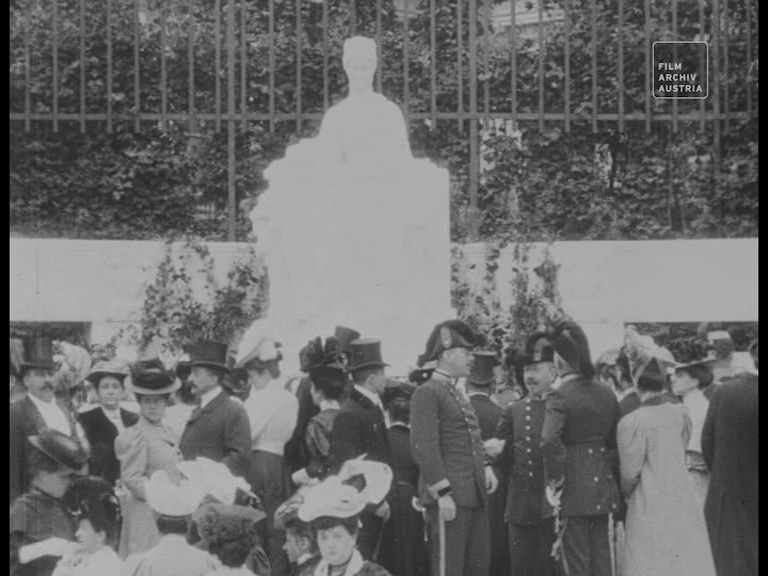
Years pass. Enthüllungsfeierlichkeiten des Kaiserin Elisabeth Denkmals (1907) – the “unveiling of the Empress Elisabeth monument” – alerts us to the recent past. In 1898, Franz Joseph’s wife Elisabeth was assassinated in Geneva by an Italian anarchist. Informed of her death, he initially assumed it was suicide, since Elisabeth (“Sisi”) had long since been mentally and physically unwell. She herself had never recovered from the death of their only son, Rudolf, who perished in a murder-suicide pact with his mistress in 1889. (In the space of ten years, she had lost both parents, two sisters, and her son.) So Franz Joseph and Elisabeth were never to appear on film together, just the image of her as the statue in the Vienna Volksgarten. In Enthüllungsfeierlichkeiten des Kaiserin, the trees flutter in the breeze. The Emperor does his rounds, saluting almost constantly. Dozens of uniformed men and hatted women follow in his trail. The statue of Elisabeth is too pale for the celluloid. Over-exposed, she is doubly absent in this film. In the sunlight of a previous century, she is rendered almost blank.

In Unser Kaiser eröffnet das neue Kinderheim in Gersthof (1910), the weather has turned. Umbrellas gleam with ancient rain. The greatcoated Emperor walks unperturbed as dignitaries with sodden shoulders introduced him to a series of tailcoated officials. Gowned priests bob around in the background. A throng stands and waits in the storm.

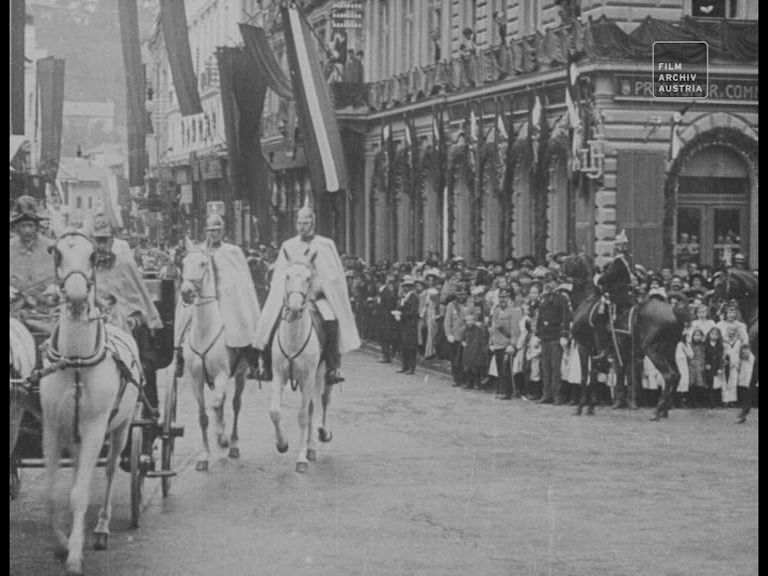
Here is Kaiser Franz Joseph in Sarajevo (1910), and the Emperor walks the streets where four years later his nephew Franz Ferdinand would be assassinated, triggering the Great War. Carriages pass. The Emperor walks up some steps. The camera is not privy to the interior, nor the passage of time therein. Immediately, therefore, the Emperor is outside. The carriage return. He mounts. A man walks in front of the camera and is ushered out the way. Parades of children in fezzes. The Emperor stands. The film skips past another speech, then realizes there is no more to be seen, so stops.

In Der Kaisertag in St. Pölten am 21.6.1910 (1910), the Emperor receives raised hats and salutes. Plumed gentlemen bob around him. The camera struggles to focus on its moving target. A woman anxiously looks over her shoulder, waiting for her cue to curtsy. Crowds of young girls wave their arms under instruction from their guardian. Older girls perform a floral dance. The camera glimpses faces, backs, gestures, odd looks. The operator stops turning now and then, anxious not to waste celluloid. The past skips along, slips away between frames.

The Emperor is absent from Kundgebung für den kaiser vor dem Brigittenauer-Kino (c.1910), but we see a poster bearing his image on the cinema wall. Two children in the corner of the frame, keenly peering towards us. Someone has issued instructions, for now a crowd of children cheers the image of the Emperor. But they would clearly rather look at the camera. Facing the wall, they demonstrate their fealty. Turning sneakily to us, they grin more gleefully. And how do we feel when we see these smiles of long-dead children?

Enthüllung des Denkmals “Franz Joseph als Weidmann” am Laufener Wald bei Ischl am 24 August 1910 (1910) is the first of two films recording the Emperor as huntsman. This film shows him milling as part of a crowd before his own image. He is only slightly more animated than his metalled self. In the background, a train passes – and I wonder about the travellers, and their view of us through the frames of their windows. Se. Majestät Kaiser Josef I. auf der Gemsjagd bei Ischl (1910) is the main event, though, and among the most substantial of the shorter films. The imperial villa at Bad Ischl. The Emperor emerges, smoking a cigarette. He takes a last puff, flicks the butt onto the driveway. He turns, sees the camera, pauses for a moment, then turns away. Is this the first time he has looked directly at us? It is from a distance. The connection is fleeting, for the carriages arrive. The Emperor is off into the hills, the woods. We see him striding slowly through the trees. There is something touching about his ensemble: pale knees showing between lederhosen and thick woollen socks. The Alpine hat and plume, the grand white whiskers. A horse’s tail, in perfect focus, flicks behind the blurred image of the Emperor gesturing to an assistant. Now they are higher up. A beautiful image of the throng of hunters at the bases of a slope. Sunlight streaks through the pines, highlights the white rocks. It’s a superbly composed image, perhaps the first moment of something with real vision in these films. The Emperor hunts, shoots. Dark chamois hurtle across the pale scree. Bodies are lugged uphill.

The sight of death prepares us for Unser Kaiser am Flugfelde in Wr. Neustadt (1910). Spectacularly elaborate and flimsy-looking planes await the Emperor’s inspection. Even the roller-coaster ride shown in Kaiserhuldigung im Wiener k.k. Prater (1911) feels more secure than the sight of those planes.

Vermählung des künftigen Thronfolgers (1911) shows the celebration of the marriage of the Emperor’s heir apparent Archduke Charles Franz Joseph and Princess Zita of Parma at Schwarzau castle. And of all the films in this collection, this is the most intimate. We see the various titled guests arrive, and I find it enormously endearing to see men decked out in extraordinarily elaborate military costumes puffing away at cigarettes and chuckling at private jokes. When the guests gather on the terrace, there is an amazing jostling of nobles. There is the groom, grinning and flashing a glance at the camera. There is Franz Ferdinand, lurking behind the Emperor, pulling at his collar. Children peep from behind adults, old women drift curiously past the lens. Is that the Emperor smiling?

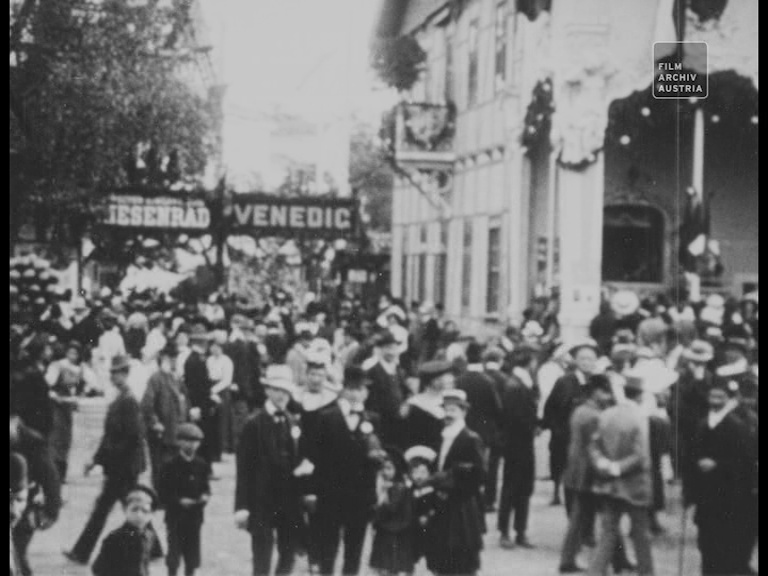
Vue de Vienne et ces principaux monuments (1912) and Bilder aus Bad Ischl (1913) are interludes of postcard views of pre-war Vienna and Bad Ischl, and there is something touching (as always) about the past going about its business, the everyday fabric of life. And the eerie sense of emptiness in the shots of parks, the views of landscapes, the slow turn of the camera’s head to take in a present that is now long gone.

Then there is the public life of the Emperor on the brink of war. A slow parade of waiting: waiting for carriages, waiting for footmen, waiting for doors, waiting, waiting, waiting. Films like Kaiser Franz Joseph I. eröffnet die Adria-Ausstellung in Wien (1913), Geburtstagsfeierlichkeiten S.M. Kaiser Franz-Josef I. (1913), Kaiser Franz Fosef I. kehrte aus Bad Ischl zurück (1913), Kaiser Franz Joseph Denkmal-enthüllung in Mürzzuschlag (1913), and Einweihung der neuen Kaiser Franz Josef-Gedächtniskirche (1913) bear titles that take as long to pronounce are they do to watch. The Emperor is glimpsed for real and in bust form, taking salutes, stepping into or off of various forms of transport. In Wien. Platzweihe der Eucharistischen Gedächtniskirche (1913) he mounts a carriage and is handed a greatcoat to place over his legs. A reminder of the cold that we cannot feel, and of the age of his bones. In Jahrhundertfeier am Schwarzenbergplatz in Wien (1913) a crowd in greatcoats occupies a square. The wintry gloom, the cobbled streets, the silent façade of the buildings all carry an aura of premonition. How many such cities of the early twentieth-century will we see crowded, for good and ill? The Emperor walks slowly. He is old. He takes a salute. Horseshit peppers the cobbles.

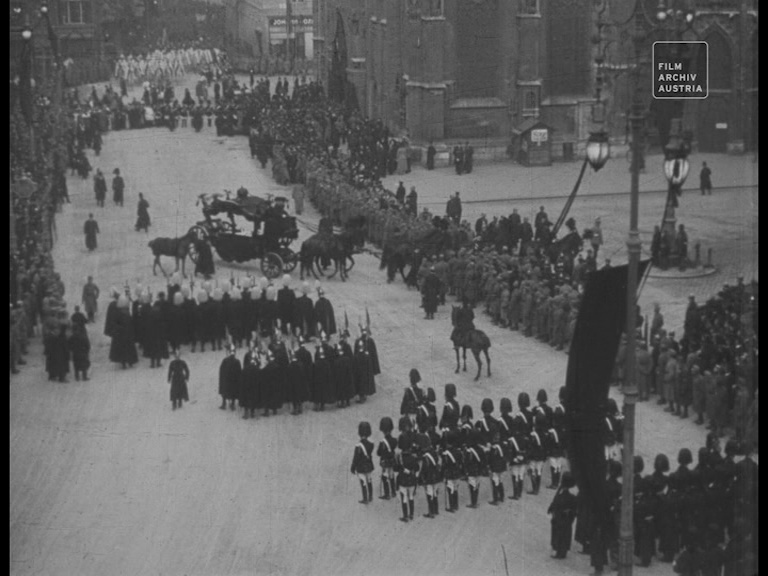
Already history has caught up with him. The very title of Aus den letzten Lebensjahren wieland Sr. Majestät (1916) evokes the inevitability of Franz Joseph’s death. By far the most evocative glimpse of the past in this film is the procession of Corpus Christi. The image, the uniforms, the ranked crowds – it is the very sight that Erich von Stroheim recreates in the centrepiece sequence of The Wedding March (1928). The film of 1916 is already looking back to the past, just as Stroheim did in 1928, and we do now in 2024. The slow march of the past. Die Trauerfeierlichkeiten für Kaiser Franz Josef I. (1916) shows us the Emperor’s funeral. Photographers await the pall. Children carrying immense candles. A world dressed in black, the dim winter light, the grey streets. Already Austro-Hungarian forces had lost two million men in the fighting.

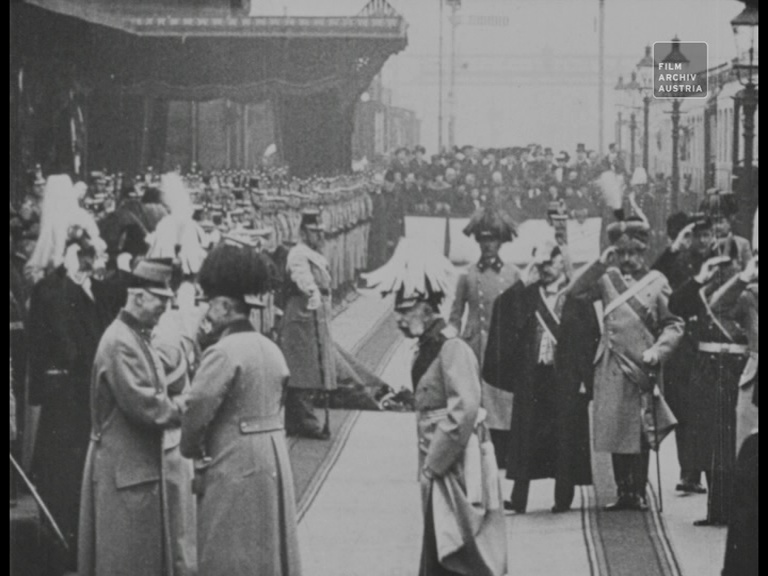
In Kaiser Franz Joseph I. als Regent und als Mensch (1930), the empire – the very idea of Austria-Hungary – is already a distant memory. A grandfather tells his two grandsons about the Emperor. Here is his image again, this time as a small figurine. Flashbacks take the form of newsreels, newsreels that are not included in the preceding selection on this DVD. So we see more parades – soldiers and civilians wearing the uniforms of past centuries – and more formal greetings at railway stations. And army manoeuvres, wherein the soldiers that would be so appallingly led during the war are seen – still alive – forming up in line, advancing, reconnoitring, charging on horseback. It’s a messy, incoherent picture of the past. The poor quality of the newsreel, as preserved for its inclusion in the 1930 assembly, makes it all the more dim and distant. A final image of the Emperor, once more cheered by a crowd. His carriages moves off, into the past. The Emperor, the people, the world around them. All gone, all gone, all gone.

This DVD has more than general interest for me. Late-nineteenth and early twentieth-century Austria-Hungary is a subject of deep fascination. So many of my favourite writers, artists, and composers occupy the culture of this period. Even the disasters that befell the empire and its eastern neighbours after 1914 are compellingly interesting. And the later worlds of Stroheim and Lubitsch owe much to the very idea of the shambolic, charming, precarious state of middle-European history.

One of my most cherished writers is Joseph Roth (1894-1939), whose fiction obsessively revisits the end of the Austro-Hungarian empire. Sensing, then experiencing firsthand, the horrific modes of nationalism that erupted after the Great War, Roth looked back on the pre-war world with a sense of deep regret and longing. While Roth’s prose is as evocative as any of the twentieth century, I was intrigued by the idea of watching images from the era of Franz Joseph. There is something silly and sad and mournful about the entire collection of films on this DVD. (I pause to note that the soundtrack for the disc is a rather weird mishmash of electronic sounds and snatches of Schubert and Beethoven, played too fast. At the moment we see the bride and groom on the terrace at Schwarzau, the soundtrack delivers an amazingly rapid blast of synthesized fanfare that was so surreal that I burst out laughing.)

If looking back at these films in 2024 is strange, a century ago it was stranger still. In late 1925, Roth went to the cinema and saw a short film juxtaposing an old newsreel of Tsar Nicholas II with the new Bolshevik leaders. Watching the Tsar, murdered seven years earlier, was an uncanny experience for Roth. He wrote a piece called “The Opened Tomb”, where he reflects on a past that is both incredibly recent and indelibly lost. The fashions are gone, the people are gone, the world is gone. There is something in the quality of the newsreel, even its brevity, that makes it so potent for him. I cannot possibly match Roth’s prose, so I end this piece with his final paragraph, written almost exactly 99 years ago:

It’s all over in three minutes. It’s no more than one of the numerous terrible moments of world history that show crowned heads at play. This one happened to have been caught by a camera and handed down to posterity. The film is a little worn, the pictures flicker, but one can’t say whether it is punctures made in it by the tooth of time, or molecules of natural dust that have shrouded these seemingly living subjects. It is the most terrible irreality that film has ever shown; a historical dance of death, an opened tomb that once looked like a throne…

Paul Cuff