I couldn’t summon the will to write about something “seasonal” (i.e. Christmassy) this week, so I went back to revisit something I saw earlier this year. (Although I suppose, as the central section of the film is a party scene, it might have some vague seasonal rhyme with New Year.) We’re in Germany in the late 1920s, so it’s odds on that whatever we see will be a quality production. We’re in the hands of G.W. Pabst, which suggests directorial excellence, and we’re in the company of Brigitte Helm, which promises…. well, ahem, good things.
Abwege (1928; Ger.; G.W. Pabst)
The opening title makes it clear whose picture this is: “Brigitte Helm in Abwege”. It’s a matter-of-fact style font, spelled out in a cool blue. I’m used to a certain kind of green for German intertitles of an earlier period (1910s-early 20s), but I like this blue.
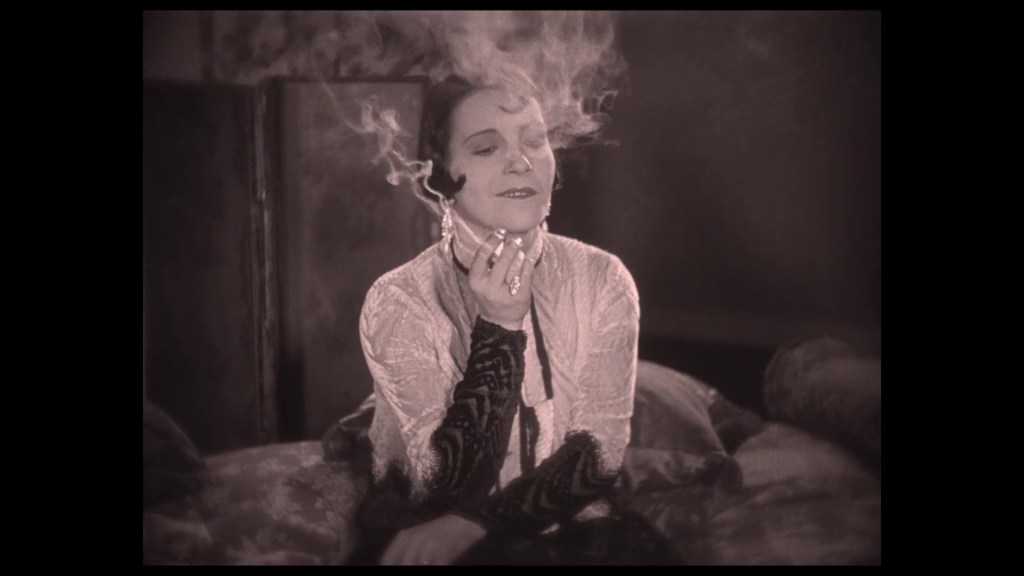
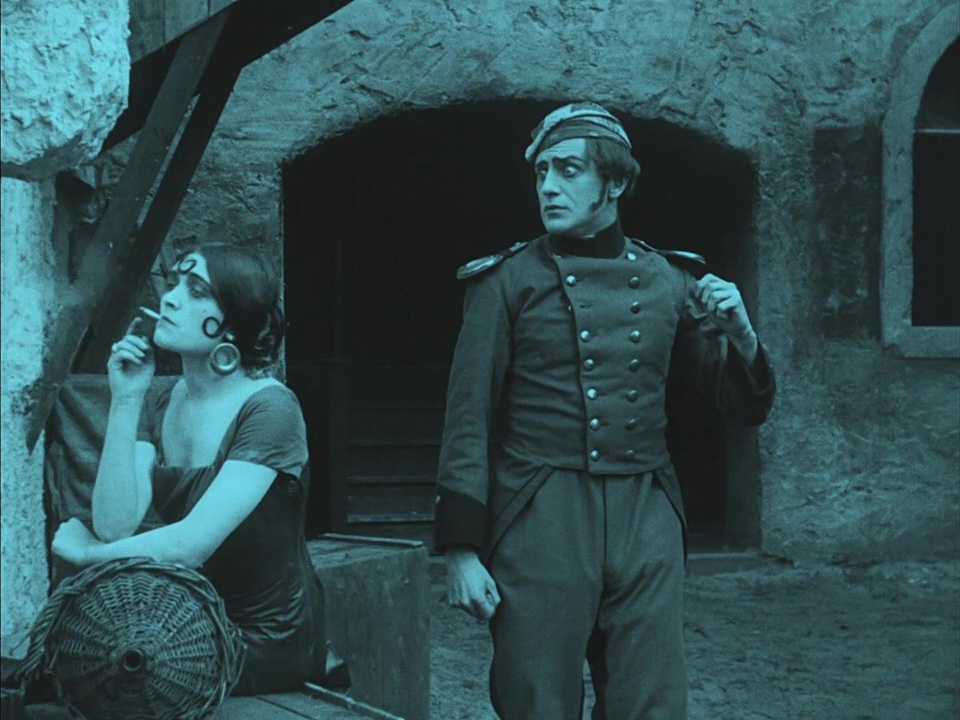
The first shot shows us Brigitte Helm, or rather, her image. The artist Walter is drawing Irene (Helm) in profile: she’s the star, the central concern, and here she is. Walter is fond of Irene and doesn’t hide it. Irene knows it and demurs, just a little; but Liane, her friend, enjoys sitting in on their unspoken flirtation. Walter invites her to his studio. Liane seems keen for Irene to accept. There’s something curious about Liane (Herta von Walther). Her short, black hair, her dark, eyes, always narrowed in—how to put it?—receptivity. It’s not as though she’s sinister; but there’s something about her that makes her look as though she has a scheme on the go. With the cigarettes, short hair, and chic dark look there’s also a touch of the “intimate female companion” visible in other characters from films of this period (think Augusta in Pabst’s Die Büchse der Pandora, 1929). It’s like she’s seducing Irene through Walter.


There is a close-up of Irene, mulling over the idea of seeing Walter—imagining it, and perhaps its possibilities; but her face suddenly changes, her eyes widen with delight, and we realize she’s seen something at the other end of the room. Yes, indeed: her husband arrives home, and for the first time the camera gives us an establishing shot of the whole interior space. Up till now, it seemed as though we were in a sitting room. But the long shots reveal its context. First, we see the huge space extending to the glass doors that mark the entrance. Second, the camera looks back at the reception area where Irene and friends are sat. It’s dwarfed by the space around it, by the grand staircase extending over it. The furniture is huddled into this far corner; the rest of the space is empty. Apart from the curtains in the snug corner, the walls are bare, the space free of “soft” furnishing. Floor and walls are tiled. It looks like a medical facility.


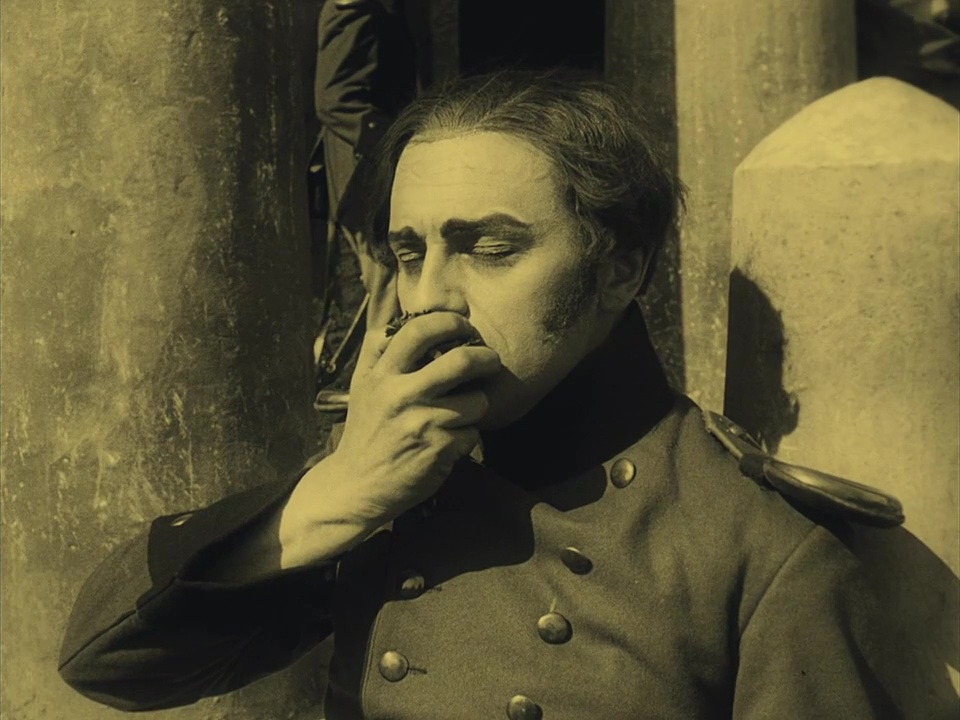
Irene’s husband arrives. He kisses her, but when their lips meet Pabst cuts back to Liane lighting a cigarette. It’s a rhyme on their rival lips, a play of rival habits. The film has offered us no introductory titles to anyone so far. The only list we’ve seen is the opening credits. So although we’ve read there that Irene’s husband is “Dr Thomas Beck”, and presumably therefore a professional doctor or academic, the film makes us work out—visually, silently—what this means in terms of the relations on screen. So here is Liane, offering a cigarette to the doctor; he refuses, but a look from his wife (of hurt, disappointment, embarrassment) makes him take one out of politeness. The history of this group, the internal tensions, is all here for us to see in a few well-chosen, economic gestures of set design, performance, and editing. Even the doctor’s sense of detachment, or superiority, is here: for Pabst frames the doctor taking the cigarette from a slightly low angle, almost akin to Liane’s point of view. He’s all profile, and behind him is the well-machined, well-designed staircase, angling away to the top of the frame. It’s all very cool, reserved. Smoke drifts from the bottom of the frame. He looks away from its source, from Liane. When finally he takes a cigarette and smokes, he is still looking away from Liane. But Pabst doesn’t look away: he cuts back to Liane, amid the cushions and comfort of the only soft-furnished corner of the room, grinning in her small, but significant, moment of triumph. (My word, this film really is well directed.)


Liane has invited them to a part at the Eldorado, but the doctor has asked Irene “a hundred times” not to “associate with that woman”—and does so again now. Irene goes to say goodbye, sadly, to her friends. At the door, she shakes her head: she can’t come out tonight. Walter kisses Irene’s hand, a little too long. Liane asks Irene “why do you allow yourself to be locked away like this?”, and the words are made all the stronger for taking place at the glass doors of the entrance. Earlier, I said the interior looked like a medical facility, and now my impression is reaffirmed: the glass doors mean that Irene, inside, can be observed from outside. A space that offers scant comfort (in terms of furniture, homeliness, the bustle of everyday life) also offers scant privacy. Irene withdraws. She stands at the glass doors and it’s as if she is under observation in a facility.

But Pabst again does something interesting. As Irene stands at the doors, the film cuts back to her husband finding Walter’s drawing of Irene. He looks at her profile, and the viewer (if not the husband) realizes that Irene is caught between the roles given to her by two men. From the square sheet of paper on which Irene’s face is framed, Pabst cuts back to the square frame of the glass door behind which Irene stands. Both are frames through which Irene is observed (and, of course, we too observe her through the frame of the cinema screen). If she is trapped at home by her husband, the alternative is to be trapped in her admirer’s designs.


Irene herself picks up this theme in the next scene, accusing her husband of “locking me away”. The phone rings, and it’s more work for the doctor. He talks and examines his files, while Irene sits on his desk and glares at him. The camera cuts between close-ups of the files, the husband, and Irene. You might call the cutting here a kind of “free indirect” style, whereby the film shows us the character’s thoughts and feelings without ever quite being subjective. “This is where our marriage is!” Irene roars at the end of this little montage: has the editing prompted her cry, or were was the editing prompted by her feelings? Still he ignores her, so off she runs.
In Walter’s studio, we see more images of Irene: her face is being crafted, improved, ready to be fed into the rack of the printing press. It’s a faintly threatening image: that it precedes Irene’s arrival suggests she doesn’t quite know what’s coming. Nor does she know what’s following her: a cab with her husband. He is in his own frame now, the jealous husband, behind the glass cab window. His fur-collared coat is dark, brooding. It’s the only thing “soft” about him, even his house. It might be a sign of tenderness, of a desire for something soft and yielding, but the coat makes him look threatening: his clean-cut profile and slicked-back hair brooding over his tall, black form. He’s in marked contrast to Walter, the artist, who has donned his white studio coat. In his room, the large canvas and papers are matched by the pale sheets over the large skylight. His whole room is dominated by his craft. Irene’s face is being pressed onto a sheet. Now Irene enters. She sees her image strewn about the room. She is flattered, pleased; she demurely hides her emotion from Walter in the background, but Pabst captures the look in the foreground. When Irene sits beside Walter, she gives vent to her anger—but Pabst offers no title to translate her emotion; Helm can say it all with her performance, her face, her hands, her shoulders tensing and untensing, her body writhing even while sitting. Walter seizes his chance, and suggests they escape together to Vienna. Irene writhes into—and then out of—Walter’s embrace. (Truly, no-one writhes like Brigitte Helm.) For the first time, she’s showing off the clingy sheen of her dress—and the fact that she has the sensuality to wear it like it’s meant to be worn.


But the doctor watches still. And now he’s up in Walter’s studio, and hears him ordering the train tickets (the “sleeper” service is as suggestive a kind of ticket as any scriptwriter might cite). His entrance sends papers blowing across the room. It’s the first time the doctor seems more than merely morally assertive: here we realize he’s physically powerful, and the artist Walter looks weedy when he stands to confront him. The doctor walks stiffly, upright. He takes off his hat. Will he punch him? Pabst fades to black. (The film cannot yet show us the doctor doing something physically assertive. Throughout the film, it’s as if we’re supposed to take him as a virgin, as someone never quite capable of a physical act of intimacy with his wife. Is that it? Does she just want him to desire her physically?)


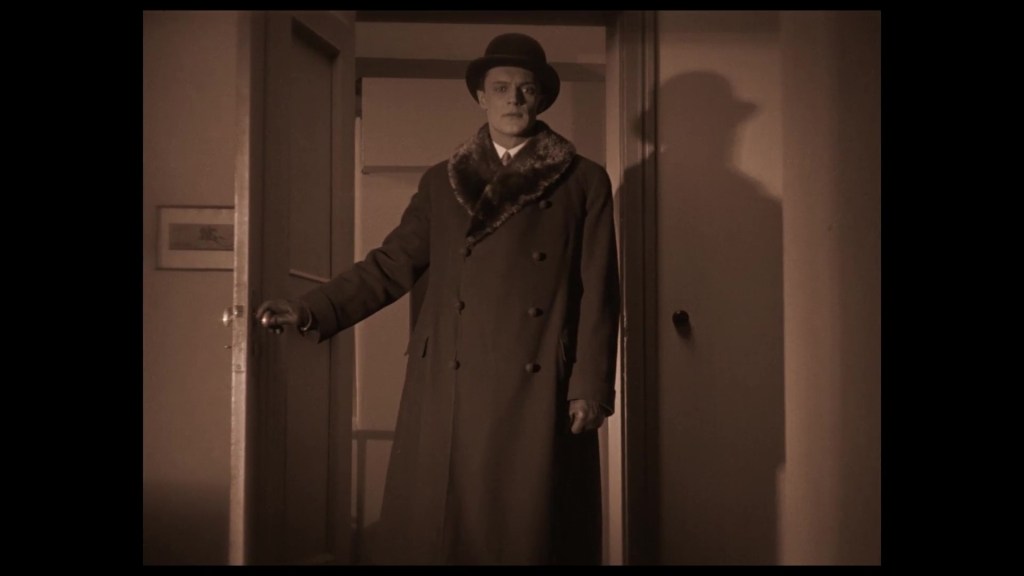
Irene is alone at the station; but not quite alone. Her husband arrives. It’s cold. It’s cold not merely because it’s evidently winter (the light, the trees, the clothes); it’s cold because suddenly the tinting has gone. This is the great advantage of tinting—and here it’s a subtle range of colours (sepia, yellow, pink, turquoise), almost like inky washes over the image: warmth and cold can be added to the tonal range, or created by transitioning from colour to monochrome.

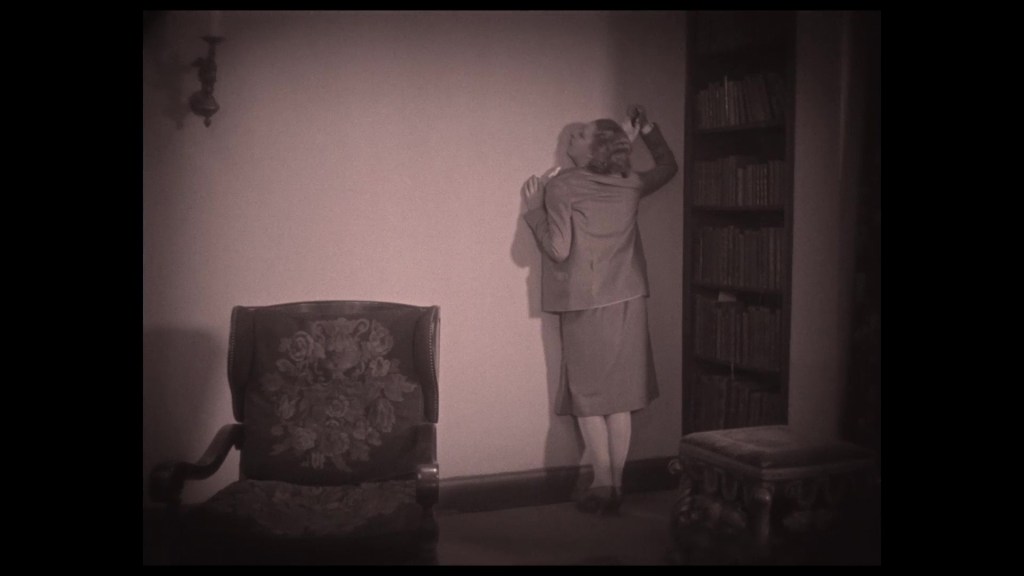
The interior confrontation scene is introduced via the glass doors: first, Thomas steps through them to deliver Walter’s letter to Irene (the letter is a meek apology, presumably dictated to him by the husband); then, Irene goes through another set of sliding glass doors to read it, and presses her body against the wall, fists raised in anger. The husband looks guilty. But what will he do? She—well, we—are crying out for him to be human, warm. Go and kiss her, man! Show her you love her! Come on! He comes to the sliding doors. She runs to them. An embrace? No! He’s got his massive coat on again. “You’re going out now?” Irene asks, as incredulous as we are. A chance for tenderness is gone. Both regret it. The husband doesn’t go to his club, but slinks upstairs. As with the moment Irene reads the letter and presses herself against the wall, Pabst here uses a handheld camera to show the husband going upstairs. In both cases, it’s just for a moment: the camera pans, but clearly trembles a little as it does so. It’s a moment—two moments, in a visual rhyme—that introduces uncertainty, disequilibrium. Both characters are about to go off the rails.
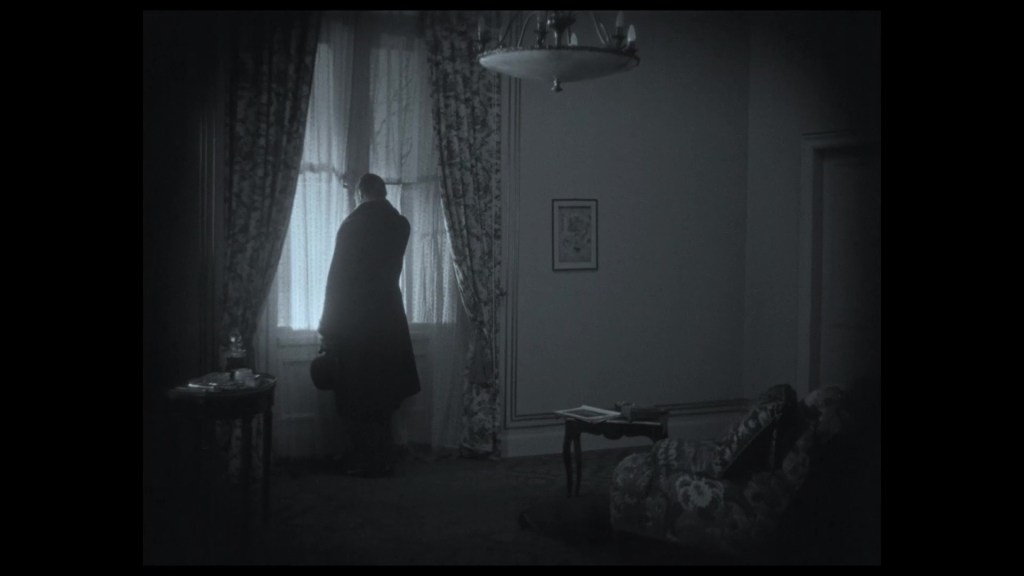
Upstairs, the husband is alone with his shadow in the bedroom: the tinting is gone again, it looks extra bleak and cold. Downstairs, Irene descends in an astonishing dress (more on this in a moment), only to find a friend of her husband (councillor Möller) at the door. So surprised is he by her appearance and dress (and the doorman has already convinced him that Dr Beck has already left), that he allows her to invite him along to a nightclub. The doctor observes from the upstairs window, leaving it open as he slumps back onto a comfy seat.
The Eldorado is in full swing. It’s tinted a gentle pink, suggestive of warmth, and this is the first time we’ve seen crowd of people, the sense of this being a city, and the specific city of Berlin in the late 1920s. It would be a delight if it weren’t for the two sad figures on the side-lines: Walter, already drunk, and an anonymous woman (later identified as Anita), who looks not only intoxicated but world-weary to the point of moral collapse. We also glimpse two well-dressed, slightly effete, men smoking and drinking together; I say “men”, but one looks to be in his mid-teens; are they a couple? This nightclub is an ambiguous space. It’s joyful but sad, it’s a place where men and women meet, but also a place where other couplings are possible.


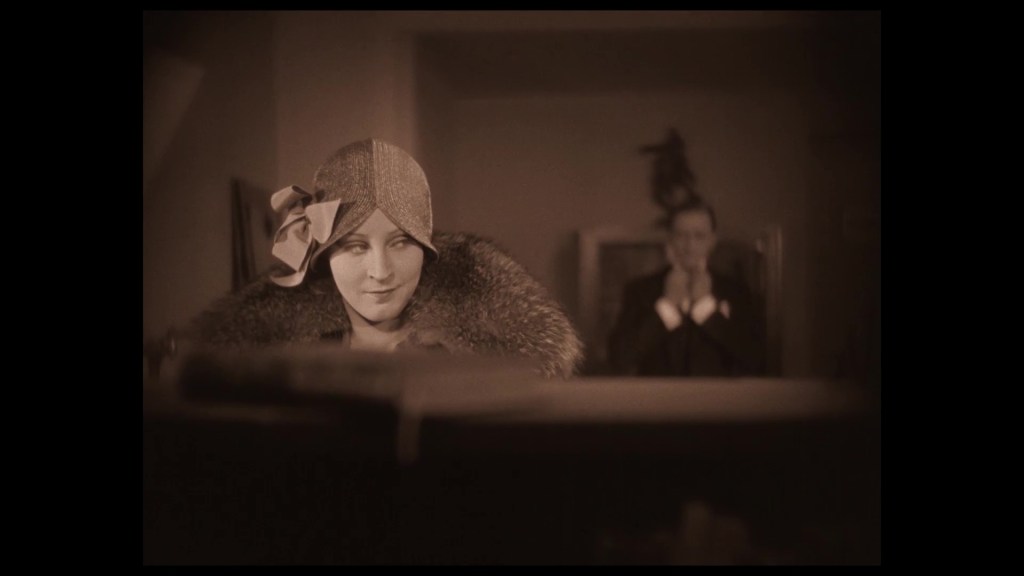
Enter Irene. Now let’s talk about what she’s wearing. You can glimpse the pale, silky something beneath her equally silky, fur-lined jacket, itself a kind of show-offy cut. She looks like a kind of dark-furred powder puff. And look at her hat! It’s a kind of glittering skull-cap, with two large fluffy tassels dropping like dogears on either side. It’s a mad ensemble, and Irene looks faintly frightened to wear it all as she crosses the dance floor.
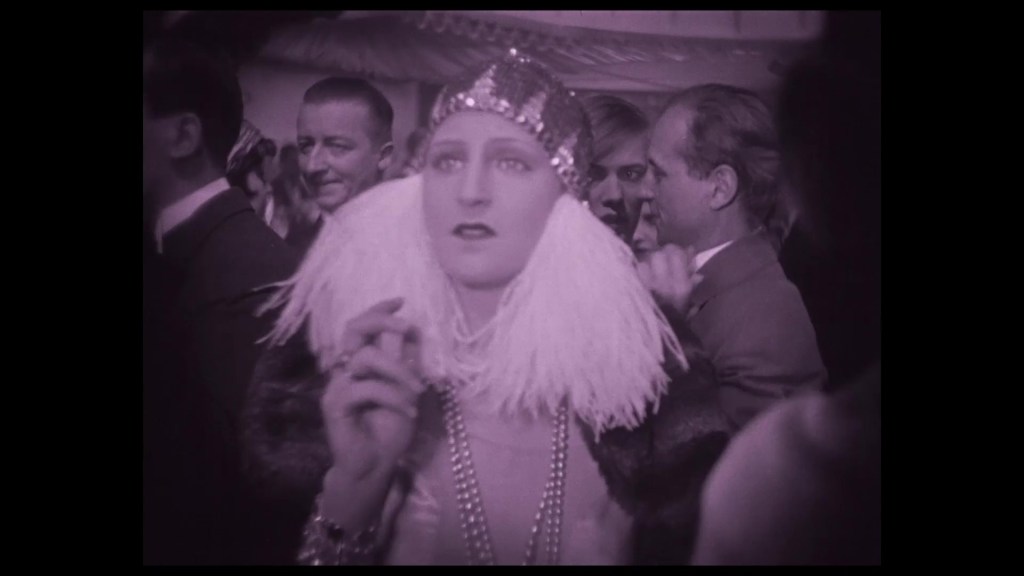
It’s an amazing sequence, for Pabst now fully utilizes the handheld camera. (I say “handheld”, but it’s more likely to have been a chest-mounted camera, such was the weight of the apparatus and the difficulty of having to hand-crank it.) As Irene pushes her way through the throng, the camera struggles to keep her in focus; it’s buffeted by the crowd, it tries to keep steady while showing us the effort needed to do so. Irene is trying to reach Liane, who is dancing in the heart of the crowd. When they go and sit at a table, Irene looks calmer. Her coat is removed, and she brushes back her hair: behold, Brigitte Helm. The silky something is now seen: a sleeveless dress, with a triple-wound pearl neckless and substantial, bejewelled wristlet to compliment it.

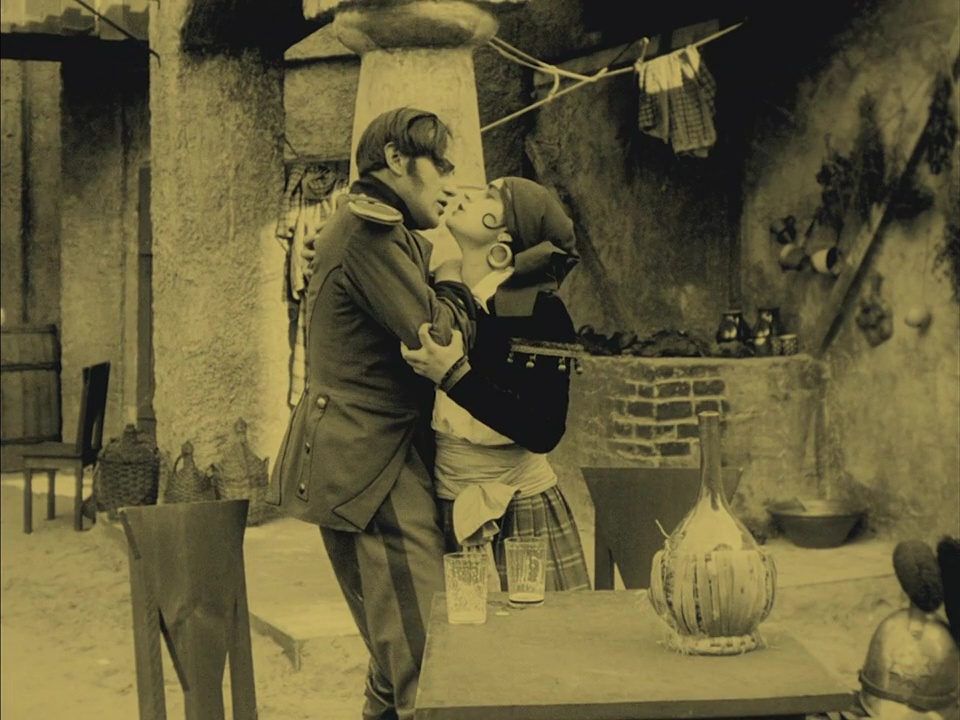
The nightclub sequence that follows is remarkable for intercutting lots of complex little subplots and characters. We see councillor Möller, for example, assailed by bob-cut flappers and embarrassed to be recognized elsewhere by someone he knows. Drink steadies his nerves, but also introduces him to other forms of temptation. When he joins Irene and co., he sees something fall down the back of Liane’s low-cut black dress and fears to go to the rescue—before letting something else drop there so he can have a rummage (much to Liane’s amusement). Meanwhile, at a neighbouring table, the boxer Sam Taylor observes the cool profile of Irene and begins throwing streamers over her. And on the fringes, Anita tries to score a hit (or hit it off—for money?) with various shady characters moving between various groups of people.


While all these little dramas play out, Pabst resumes the main drama of the night: Irene’s flirtation with Walter. When she first sees him, it’s as if Irene remembers that she’s Brigitte Helm. From across the room, she goes what you might call full-Helm: the slightly squinting eyes, the arched eyebrow, the power-pout, the arched back. It’s a glorious moment. To cap it off, she drains her glass—and then grabs Liane’s friend to dance and make Walter jealous.

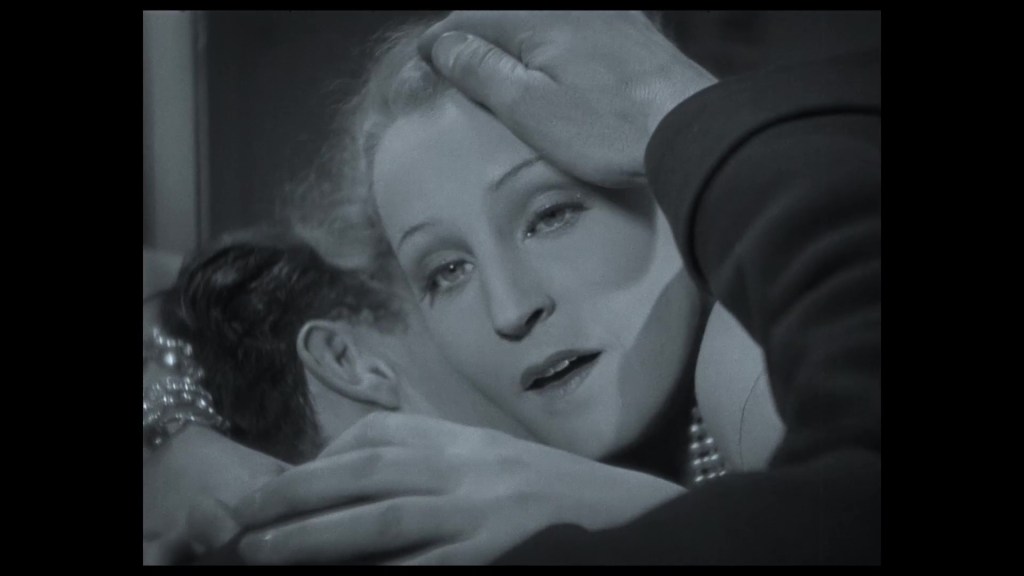
Things start to get strange. Vendors are selling sinister child-size puppets at the tables. (We see Sam Taylor playfight with a half-naked, hairy-chested puppet version of himself.) Anita crosses Irene’s path and Liane explains that she’s after “a magic potion that carries souls up to heaven”. As Liane’s friend kisses her arm, Pabst cuts back to the doctor at home, shivering in the blowy room. At the party, Anita slips a note to gain some of her potion. Irene wanders off to sample the “potion” that Anita offers. They disappear into a curtained chamber. We see Möller, happily but unstably drunk; he’s there to make us a smile a little, and to contrast with the more serious events unfolding around him. For here is Irene, emerging through the curtains, her head slumped onto her chest. It’s like the familiar Helm writhe has been arrested halfway through and her body is stuck in a twisted shape. Her head lolls, but she tries to dance again—until she passes Walter. The two, now equally addled, stare at each other for a moment before Irene grabs another man (a stunted, almost expressionless old man with a Prussian moustache) and launches into a wild, twirling dance. When she swirls into her seat again, her mannerisms are the familiar Helm-isms, rendered even more mannered. A moment of sobriety comes as Anita passes in the arms of a dancer. It’s as if we see Irene in the future. To underscore the notion of this possibility, Irene finally asks Liane who is this woman. Only now, many scenes into the sequence, are we told: “She was the wife of the banker Haldern… who shot himself when she left him”. Irene runs out, horrified.


At home, she finds her husband immobile in the freezing room. She fears he’s dead, so is hugely relieved when he opens his eyes. She closes the window, warms his hands, takes off his coat. The film might end here, surely—if only he’d take her in his arms. But when they prepare for bed, and Irene slips invitingly between the sheets, the doctor finds the weird doll of the boxer and storms out angrily.
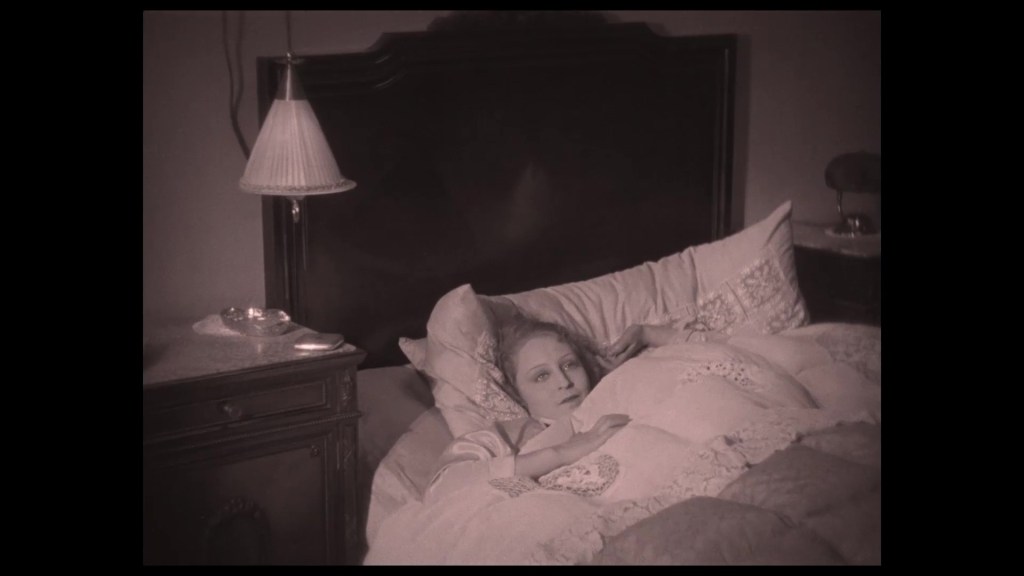

Irene collapses in a torpor, then wakes the next morning to find the gang from the club serenading her bedside. The room fills with liqueur and cigarette smoke, and the sight of Möller in Liane’s arms. Irene looks upset, more so when her husband walks in. The doctor tells them (sarcastically) to act as if they were in their own home. Irene stands and yells at him: “You’re no man!” (Still he refuses to assert himself physically, and the sexual connotations of these moments of refusal/reticence speak volumes about the marriage.) “You’re sick, my girl”, the doctor explains, to Irene’s fury. Sick? She’ll show him “sick”…


Pabst cuts from the limp boxer-doll on the floor to the real boxing ring. (More handheld camerawork here as Sam fights a black boxer. It’s as if the dance floor and boxing ring are equally spaces of dangerous thrills.) Irene is there with Liane, looking on. Irene’s dress is now a silky black cape, her headpiece a kind of false black bob, with glittery brow. (She’s turning the Helm-dial up to about 8 at this point.)

Irene takes Sam up to Walter’s studio: ostensibly for a portrait, but really to engage in complex flirtation and jealousy. (Meanwhile, Liane warns the doctor that his wife may be about to do “something silly”.) In the empty studio, it is Sam who is the cause of danger: he carries Irene to a bed and looms menacingly over her. Irene ceases her performative flirtation and becomes genuinely frightened. Pabst again uses the handheld camera to make the threat real, a kind of extension of the danger of the dancefloor or boxing ring. (And the unsteadiness of the frame reminds the viewer of those first scenes that set the plot in motion: the reading of the letter, the retreat of the husband to the room.) Walter arrives just in time. Irene is dishevelled, in tears. But Walter is too petty to go and comfort her. He petulantly throws his portraits of her on the floor. Irene blames him for what’s happened, only for him, in self-pity, to explain that he can’t offer her the lifestyle of her rich husband. Irene forces herself into his arms and—for the first time in the film—presses a kiss on him. But just as Pabst interrupted Irene’s marital kiss in the film’s first scene, so now the extramarital kiss is interrupted by the husband at the door. Walter is afraid, but Irene can’t suppress a smile. She quickly strips down to her chemise and makes Walter open the door. It’s a striking, candid moment of her longing for him: her eyes say it all, as she stares intently at him. As I said before, it’s as if her marriage is yet unconsummated; she’s stood there waiting for Thomas to… well, do something. But again he refuses, walking out of the scene.


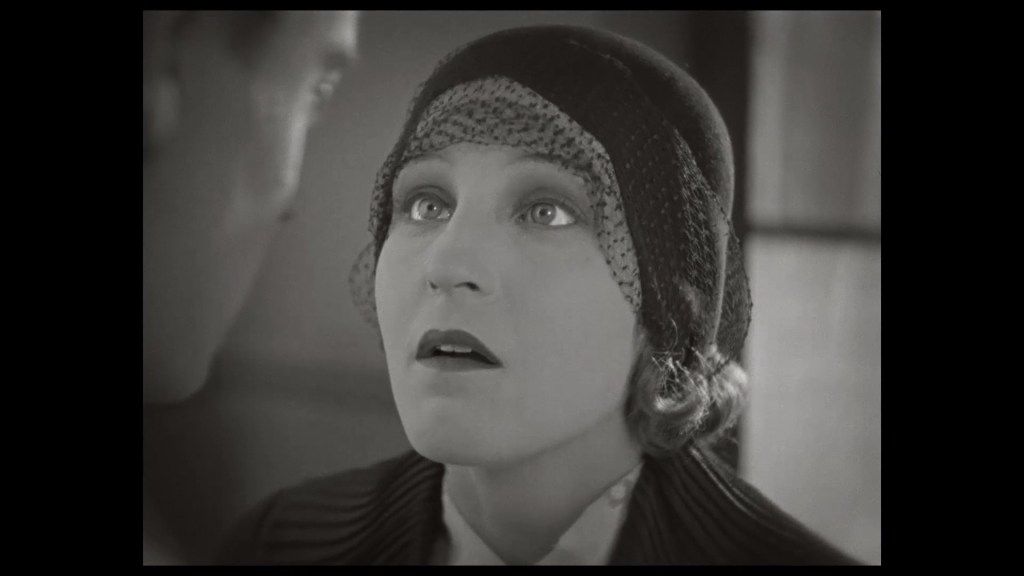
Time passes between scenes. Walter has been asked to appear as a witness in the Becks’ divorce hearing. Irene wears a black veil, as though in mourning. Her eyes are sad, sincere, even if she can’t speak. Finally, outside, in the corridor, the couple approach each other. She swears she was not unfaithful, but the court has already ruled: they are divorced. But the pair are happy. Alone together in the hall, they sit on a bench. She rests her head on his shoulder. He tells her he loves her. When they kiss now, it has passion in it. It’s a kind of first kiss. When will they get married? “As soon as possible!” Irene exclaims. ENDE.


A very, very good film. Helm embodies her character’s emotions: she’s caught between wanting to express her sexuality (the desire for sex itself) and the fear of losing a marriage that might yet be saved; she’s alluring and unsatisfied, daring and timid; she wears astonishing clothes, but only intermittently knows how to mobilize their effect. As her husband, Gustav Diessl likewise manages to be both physically imposing and emotionally reticent: we spend the film waiting for him to align both body and brain with his wife. And though the narrative might seem conservative—the (un)married couple (re)united at the end, the idea of marriage itself reaffirmed—there are so many interesting, unsettling things bubbling away through the film. Even if it reassures us that husband and wife should stick together, the film is also quite clear about the need for appetites to be tested and satisfied.
The title itself—“Abwege”—might translate literally as “Mistakes” or “Wrong Ways”; when released in Anglophone markets, it was retitled “Crisis” or “The Devious Path”. Yet the word “Abwege” is one of those suggestive, faintly enigmatic German compound words. “Ab” is a preposition, a kind of directional prefix (“from” or “off”), and “Wege” the plural of “Weg”, i.e. “path/track” (hence the English word “way”). The illustrative phrase you find in dictionaries is “auf Abwege geraten”, to “go astray”. Both the official English titles for the film fumble with the subtle sense of movement, of deviation, implied in the German original. I’ll bet whoever came up with “The Devious Path” was quite pleased with themselves; but it sounds too much like the title of some government-sponsored anti-drugs film. Abwege is not a salacious or moralistic film in that way; this is Pabst, after all, not DeMille. The film’s first intertitle, “Brigitte Helm in Abwege”, is almost an extension of the film’s name: something akin to “Brigitte Helm is going astray”. Again, it’s an instance where reading a subtitle doesn’t evoke the same sense as the original title.
But my word, the film looks fabulous. It’s not a huge studio spectacular, but the sets are superbly designed and always expressive. The Beck household is big and cold; the nightclub set a swirling nest of bustle. Pabst lets performers, sets, and editing tell the story: there are remarkably few intertitles. After the opening credits, all the relationships between the characters are told entirely visually—Pabst sees no need to reintroduce anyone with a title. He trusts us to be intelligent, to see—and interpret—what’s being shown.
The restoration notes also mention that the film was tinted when first released in 1928, so the restorers have added tints in line with “the conventions of that time”. How many films of the period are still shown in monochrome prints when they were intended to be tinted? It’s a frustration that even new releases on home media (I’m thinking especially of the Feuillade serials from the 1910s) forego tinting altogether. In the case of the Feuillade serials, the restorers not only have plentiful evidence of the “conventions of that time”, but even incomplete tinted copies of the serials at their disposal—yet still they choose to release a monochrome restoration. (If you’re not going to tint your restored version, at least show us an extract of the tinted copy/copies as part of your extras—don’t hide the evidence!) So it was nice to see a restoration where a little conjecture is used to enhance the image as it would have been enhanced in the period it was made and released.
Finally, the music. I watched this film via the restoration shown (and streamed) at Pordenone in 2020. This had music for piano by (I believe) Mauro Colombis. Which was fine. Like most semi-improvised piano scores, it was perfectly acceptable. It was… just… well… fine. But I longed for an orchestra, for something as rich as the photography, as supple as the performances, as enticing as the characters. Unless it’s a through-composed score with striking melodies or invention, you’re never going to remember a piano score. You might remember it being good, it suiting the film, but in all my years of watching silent films I can only remember one piano score— Neal Kurz’s for the English-language restoration of Dreyer’s Michael (1924)—and that was because it was through-composed, and cited numerous classical works with which I was already familiar (Schubert, Tchaikovsky etc), pieces which were already great before appearing in the film. It’s always the case when I watch a great film, I want a great score to go with it and do it justice. Imagine my delight when I found that there was an excellent, a really excellent, chamber orchestra score for Abwege written by Elena Kats-Chemin—and that it was on YouTube for me to see and hear. (Notably, it was written in 1999 for a broadcast of the film on ARTE, a version that uses different titles than the newer restoration.) The music is everything it should be: it follows the film, but not so closely that it feels cloying—it floats carefully above the images. It’s restless, rhythmic, but still melodic; with its lilt and dance-inflected feel, it fits the setting and the period. It’s also emotionally intelligent; it moves you when it need to. I love the cool, reverberating sheen of the glockenspiel—most especially when Irene emerges from the curtained room, filled with chemical heaven. (The ARTE soundtrack must have been recorded live, for there are plenty of coughs and acoustic shifting and shuffling that a proper studio recording would have avoided. But there is good atmosphere, and perhaps the performance benefits from being live and engaging with its audience.) If the film gets a proper release on Blu-ray, I do hope the best score is reunited with the best image. Without an official release on home media, there’s only so much patience I can muster to resynch the video of one rip with the audio of another…
What else to say about Abwege? Pabst’s great, Helm’s great. It’s a really, really good film.
Paul Cuff























 The Realm of Silence