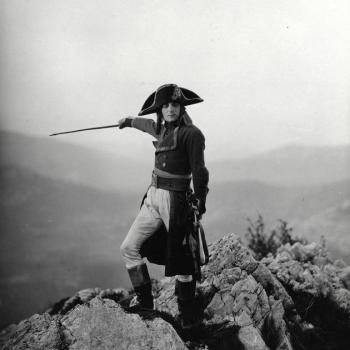
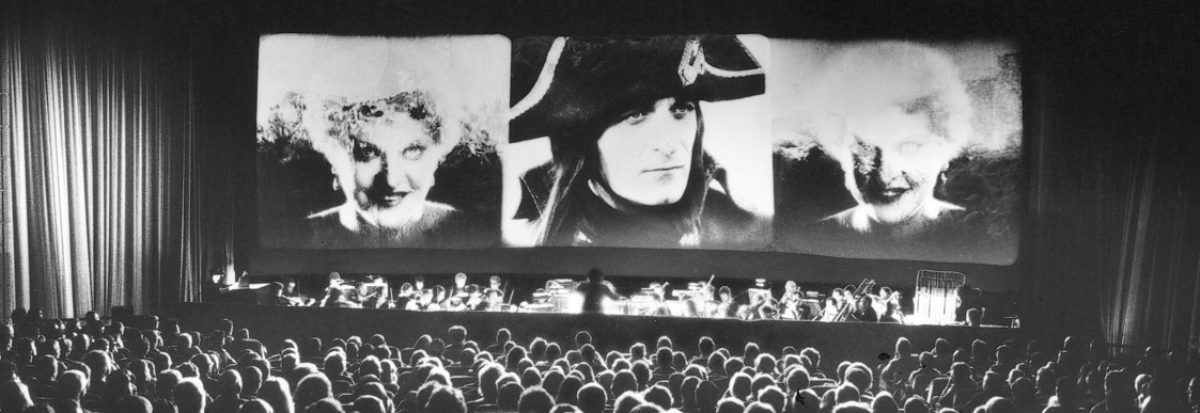
Ilya Ehrenburg: history, memory, cinema (1/2)

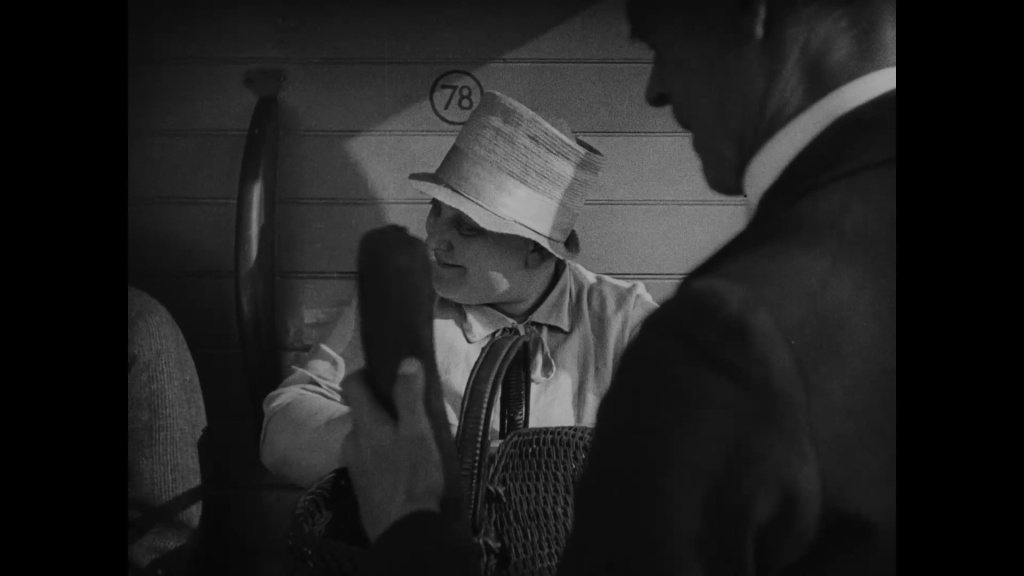
This week, I talk about Ilya Ehrenburg (1891-1967), a writer whose work I discovered through silent cinema. I’m a huge fan of G.W. Pabst’s Die Liebe der Jeanne Ney (1927) and was curious to read the novel on which it was based. After a long search, I tracked down an English edition of The Love of Jeanne Ney from 1929. Given the price tag of my copy, I was worried I would regret my purchase of this utterly obscure novel. But within a few pages, I was totally won over by the style and tone of the author. By turns humorous and brutal, charming and satirical, cruel and romantic, the novel is a superb read. Ehrenburg’s voice so appealed to me that I looked up what else he had written. It became apparent that the man was prolific, publishing numerous novels, reams of poetry, volumes of travel journalism, war reports, speeches, reviews – all in different languages: Russian, French, German, Yiddish… Of this ungraspably extensive bibliography, I found that none of his non-journalistic work was in print in English. Some of his wartime work remains available, in particular his report on the Holocaust in eastern Europe: The Complete Black Book of Russian Jewry, a collection of eyewitness accounts compiled with Vassily Grossman.

This situation was very different in the 1960s, in the post-Stalin cultural “thaw” (a term Ehrenburg popularized), when the author’s work was widely discussed in the anglophone world. It was in this period that he wrote his memoirs. Finding decent copies of all six volumes of this work was difficult, but I love a challenge. From bookshops across the globe, I amassed them all and read them across the course of last summer. Quite simply, Men, Years – Life (1961-66) is one of the most extraordinary memoirs I’ve ever read. It is almost unbelievable what this man experienced: from imperial to post-Stalinist Russia, from trenches in Spain to the skyscrapers of New York, from the cafes of Paris to the battlefields of the east, from writing poetry in garrets to making speeches at peace rallies, Ehrenburg experienced almost every conceivable facet of the early twentieth century. That he did not perish in the revolutions, civil wars, world wars, genocides, and multiple purges that he experienced is miraculous. “I have survived”, he writes in his opening pages, “not because I was stronger or more far-seeing but because there are times when the fate of a man is not like a game of chess played according to rule but like a lottery” (I, 7). As the title of his memoirs indicates, Men, Years – Life is a personal record of his era through the people he encountered. Amid his generosity to innumerable writers, artists, and fighters he met, the major events of Ehrenburg’s personal life sometimes slip in through devastatingly brief asides. (Thus, in passing, do we learn that his first wife leaves him for another man, with whom she raises their daughter Irma (I, 186).) If nothing else, it is an amazing record of the first half of the twentieth century, a time when “history unceremoniously broke into our lives by day and by night” (III, 89).

This week’s post, and my subsequent post, is a selected tour through some of Ehrenburg’s life and his relationship with cinema: cinema as culture, cinema as literary adaptation, cinema as a way of seeing the world.

Part 1: Early years

Ehrenburg was born in Kiev, a subject of the Russian Empire, to a Lithuanian-Jewish family. His first memories are of an era that would bring an unceasing flood of cultural shocks and revelations. “The twentieth century was under way”, he writes: “I remember one of our visitors telling us that soon a ‘bioscope’ would be opened and that they would show living photographs” (I, 30). For the adolescent Ehrenburg, the new century means other forms of revolution, too. He becomes involved in political activity associated with Bolshevism. Aged seventeen, he is arrested and exiled.

He arrives in Paris in December 1908, knowing barely any French – just an outré vocabulary drawn from the plays of Racine. With his unerring knack of finding extraordinary people wherever he went, he soon meets a raft of other local or exiled figures – from Lenin (“his head made me think not of anatomy but of architecture” (I, 69)) to Blaise Cendrars (“he was the yeast of his generation” (I, 170)), not to mention fellow avant-gardists Picasso, Modigliani, Rivera, and others. The writers and artists among them would meet at the Café de la Rotonde, a restaurant in Montparnasse where “we would gather […] in the evenings to drink, read poetry, make prophecies or simply to shout” (I, 171). Living in what amounted to almost debilitating poverty, Ehrenburg became a poet “because I had to” and a journalist “because I lost my temper” (I, 178). When he could afford it, he went out. In 1911 he attended the (in)famous premiere of Le Martyre de saint Sébastien, D’Annunzio’s stage collaboration with Debussy. He records being “infuriated by its mixture of decadent aestheticism and a kind of scent shop voluptuousness” (II, 128). (He didn’t realize it, but Abel Gance was there on stage, playing one of the extras.) Later, in the company of the painter Diego Rivera, Ehrenburg encountered a new kind of artist for the age:

Once at a small cinema Rivera and I saw a film actor I had never seen before. He smashed crockery and daubed elegant ladies with paint. We guffawed like everyone else, but when we had left the cinema I said to Diego that I felt afraid: the funny little man in the bowler hat exposed the whole absurdity of life. Diego replied: “Yes, he’s a tragedian.” We told Picasso to be sure to see the film with Chariot: that was the name the French gave Charlie Chaplin, as yet entirely unknown. (I, 199)

Then came the Great War, “a grandiose machine for the planned extermination of human beings” (I, 184). Ehrenburg volunteers to fight Germany but is rejected by the army doctor as unfit (“One cannot with impunity prefer poetry to beef for a period of three or four years” (I, 161)). So he becomes a witness, watching the old order disintegrate – and the violent forces this process unleashes. Europe’s civilization is merely a set of clothing now shed, its philosophy abandoned for bloodlust. For Ehrenburg, it is a swift and uncomfortable revelation. “I realised that I had not only been born in the nineteenth century: in 1916 I lived, thought and felt like a man from the distant past. I also realized that a new century was on its way and that it meant business” (I, 185). Europe was stepping “into the dark ante-room of a new age” (II, 101). And from the west, American culture floods in. When the US enters the war in 1917, the newspapers gush over the prospect not merely of American soldiers but American culture: “They extolled everything – President Wilson and Lilian Gish, American tinned food and the dollar” (I, 219).

After the war, Ehrenburg returns to the east. This part of his memoirs is among the most personal, since there was not enough political or cultural stability to sustain his creative life. Having always considered Kiev as his “home town”, in 1919-20 Ehrenburg realized how contingent the idea of “home” might be. “[The] Romans […] used to say Ubi bene, ibi patria: where it is good, there is your motherland. In reality, your motherland is even where it is very, very bad” (II, 75). Russia and much of eastern Europe was in turmoil. Kiev was at the centre of a civil war and changed hands several times. “Sometimes I felt as if I were watching a film and could not understand who was chasing whom”, Ehrenburg writes: “the pictures flashed by so quickly that it was impossible to see them properly, let alone think about them” (II, 80). Cinema here becomes a metaphor both for vision and for bewilderment – a kind of impediment to vision. Like silent films that were projected at faster-than-life velocities, lived history did not behave according to clock time.

The chapters that follow read like the flickering images Ehrenburg describes, passages of events so bewildering and terrifying that it is staggering that the narrator survived to narrate. Only when, for six months, the Red Army occupies Kiev is there a window of stability – at least for Ehrenburg. But even this interval is surreal, since he is charged with supervising “mofective children” (i.e. “morally defective” children). It was a form of re-education for the socialist utopia that beckoned. “The discrepancy between our discussions and reality was staggering”, Ehrenburg observes (II, 83-90). Utopia is postponed. The Reds are swept away. The Cossacks arrive. There is a pogrom. A disorganized medley of murder, mutilation, rape. As a Jew, Ehrenburg moves from hiding place to hiding place. Captured, he narrowly avoids being “baptized” (i.e. thrown into the ice-covered sea of Azov) (II, 95). He is among a flood of refugee in the Crimea, where he is starved and abused for being both a Jew and a Red. Then typhus strikes. His wife is a victim. She survives, but in what state?

After Lyuba’s temperature had gone down, a complication arose: she was convinced that she had died and that we were for some reason forcing a life after death upon her. With the greatest difficulty I got food for her and cooked it, my mouth watering, while she repeated: “Why should I eat? I’m dead, aren’t I?” One can easily imagine the effect this had on me; yet I had to go to the playground and play ring-a-ring-o’-roses with the children. (II, 101)

There follows a series of interventions random, comic, and horrifying. Ehrenburg escapes from the Crimea on a salt barge that he realizes is slowly sinking. He finds refuge in Georgia, then goes to Moscow. Having been nearly murdered by the Whites (for being a Red), Ehrenburg is now arrested by the Reds (for being a White). He is imprisoned, than released. Vsevolod Meyerhold invites him to head the organization of children’s theatre in Russia. But in 1921 Ehrenburg leaves Russia. He goes via Riga, Danzig, Copenhagen, and London to Paris – only for the French authorities to expel him to Brussels for being a suspected Bolshevik agent (II, 186-8). He travels to Berlin and witnesses the febrile uncertainty of the Weimar Republic: “The Germans were living as though they were at a railway station, no one knowing what would happen the next day. […] Everything was colossal: prices, abuse, despair” (III, 14). In a beerhall in Alexanderplatz, Ehrenburg hears the name of Adolf Hitler for the first time. Visiting Italy soon afterwards, he sees uniformed fascists.

These surreal shifts of fortune make even the most bizarre filmic narrative of the 1920s seem realistic. Ehrenburg records that the White general who instigated the pogrom in Kiev later became a circus performer, in which role he encountered him in Paris in 1925 (II, 92-3). This reads like a detail from a film by Stroheim or Sternberg, or a scene from a Joseph Roth novel. The people and events that swirl around Ehrenburg here are those whose shadows are caught in the films of the period. I’m thinking of the newsreels, those glimpses of real people and places, but also of the fictions whose strangeness is hardly less compelling. One is tempted to describe this section of the memoirs as a record of modernity at its most frenzied and fragmented, but Ehrenburg defies such labels – either as a (contemporary) protagonist or as a (retrospective) narrator. He describes himself as a “rank-and-file representative of pre-Revolutionary Russian intelligentsia” (II, 150) who understood the turmoil of 1920-21 in apparently old-fashioned terms:

We ridiculed romanticism but in reality we were romantics. We complained that events were developing too swiftly, that we could not meditate, concentrate, realize what was going on; but no sooner had history put on the brakes than we fell into despondency – we could not adapt ourselves to the new rhythm. I wrote satirical novels, had the reputation of being a pessimist, but privately nursed the hope that, before ten years had passed, the whole face of Europe would have changed. In my thoughts I had already buried the old world, yet suddenly it had sprung to life again, had even put on weight and was grinning. (III, 58)

This conflict between imagined and lived worlds, between ideals and realities, defines much of Ehrenburg’s experience of the post-1918 years. He finds himself in a world of film, radio, automation, mechanization: “I felt that the rhythm of life and its pitch were changing” (III, 93). In Paris, the artists of the 1920s “wanted to turn the world upside down, but the world stood firmly on its feet as ever” (III, 91). He meets a new generation of filmmakers: René Clair, Abel Gance, Jean Renoir, Jacques Feyder, Jean Epstein. In the cinema, he sees The Pilgrim (1923) and The Gold Rush (1925) (III, 92-3). Cultures mix and mingle. In a Paris bar, Ehrenburg overhears someone asking their friend: “Is it true that Potemkin is a better actor than Mosjoukhine?” It turns out that the man “had heard something or other about the success of Eisenstein’s film and thought Potemkin was the name of an actor” (III, 96). Similarly, finding himself in a disreputable beerhouse in Moscow in the summer of 1926, Ehrenburg overhears an argument. It ends with a girl shouting to another youth (who is covered in blood): “You needn’t try so hard. Harry Piel – he’s the one I like!” (III, 108). Later, in the UK at a PEN Club meeting, Ehrenburg is mistakenly introduced to his audience as Pabst, “the outstanding Austrian film director who had made that excellent film, The Love of Jeanne Ney” (I, 117).

These eclectic encounters should remind us that film was very different before it became “film history”. Ehrenburg meets it out of context, in translation, in argument, in slang, in misattribution, and in simple error. The modern reader may feel out of kilter, recognizing names, dates, and titles only with difficulty. But it is also curious (and curiously touching) evidence of how cinema muddled along within popular culture. The neatness of filmographies or encyclopaedias of this period do not do justice to the pell-mell realities of lived history. For the inhabitants of the past, silent cinema was a moving feast – part of a complex, multicultural diet.

Ehrenburg also does more than witness cinema. In 1927, he revisits Penmarch (in Brittany) with the artist László Moholy-Nagy to make film about Breton fishermen – but the project remains unrealized (III, 122). The always on-the-move Ehrenburg is also a go-between for other filmmakers. In 1926 (the same summer, presumably, that he overhears the drunken argument about Harry Piel) he is asked to export extracts from French films “given to me by Abel Gance, René Clair, Feyder, Epstein, Renoir, Kirsanoff.” He shows them in Moscow, where many Soviet filmmakers see the experiments of the French avant-garde for the first time. So “enthusiastic about the cinema” is he that Ehrenburg writes a pamphlet: Realization of the Fantastic. But he also states that “in point of fact, I did not like German films of the Caligari type and the people I really admired were Chaplin, Griffith, Eisenstein, René Clair” (III, 124). Ehrenburg befriends Eisenstein and later hears him speak on film and art at the Sorbonne in Paris (III, 136). But it is Clair’s Paris qui dort (1925) that he says characterizes his experience of Paris in the 1920s (III, 131).

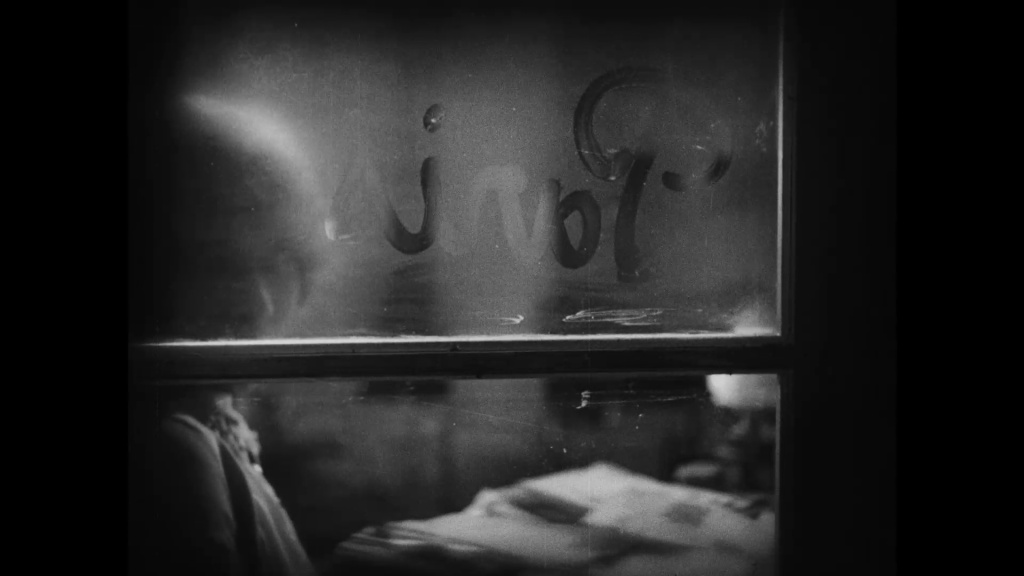
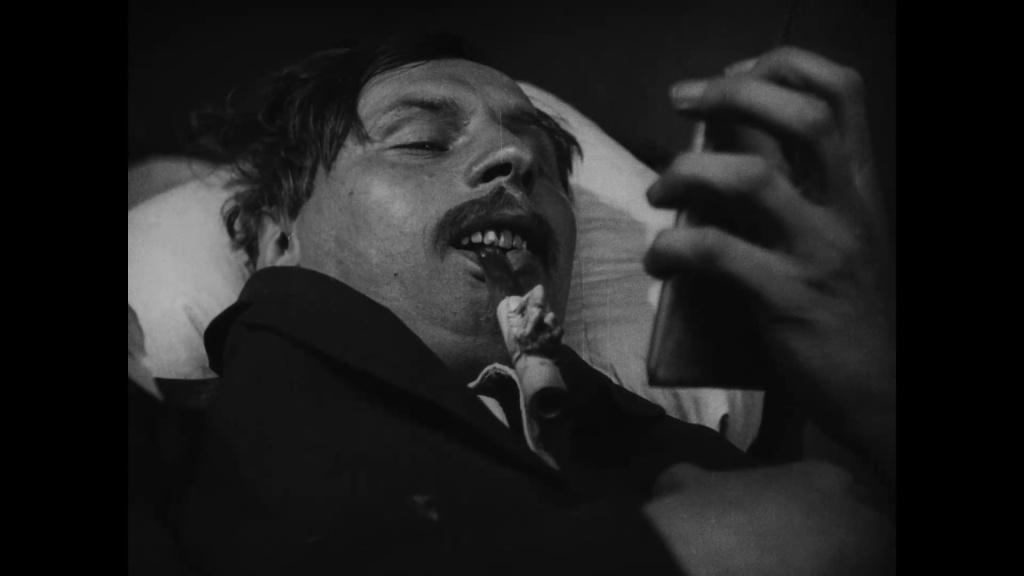
I close this week’s piece with the work that inspired it: Die Liebe der Jeanne Ney, based on Ehrenburg’s eponymous novel of 1924. One can sense in its pages the wild emotional extremes of the post-war years, as well as the streak of romanticism that the author admitted filled his mindset. He calls it “my sentimental novel”: “a tribute to the romanticism of the revolutionary years, to Dickens, to enthusiasm for the plots of novels, and to my (this time non-literary) desire to write not only about a Trust concerned with the destruction of Europe, but also about love” (III, 57). Ehrenburg’s brush with a suspicious, reactionary French bureaucracy in 1921 surely colours his novel. The authorities in Paris (and just about every authority figure in the novel) are depicted as cruel, rapacious, sadistic. These characteristics might seem exaggerated, but given what Ehrenburg had gone through they are hardly surprising – or (one feels) inaccurate. The novel is startingly brutal but also incredibly tender. It is a story where love can (and must) survive violation and death.

The German film adaptation of 1927 retains the essentials but makes notable changes. The ending is markedly different. In the novel, Jeanne is repeatedly raped by Chalybjew – a sacrifice that does not save Andrej from being executed. In the film, Jeanne fends off Chalybjew, who is captured – thus allowing the release of Andrej from prison. The novel ends with Jeanne carrying on Andrej’s revolutionary activities, her memory of their love sustaining her life and work. The film ends with Jeanne imagining Andrej’s release (and, presumably, their future together).

Pabst’s production could never depict, let alone imply, some of the events in the novel – but its changes to the story became the subject of controversy about the conservative/nationalist politics at Ufa. Indeed, the film’s greatest political attack came from Ehrenburg himself in 1927. Through the German communist Wieland Herzfelde, he had been brought into contact with Pabst and invited to watch the filming. He accompanied the production to Berlin and Paris, where he encountered exiled White Russian soldiers among the extras, observed Pabst bullying tears from the star Édith Jéhanne, and marvelled at the crew’s futile efforts to film bedbugs in close-up. When shown the finished film, Ehrenburg couldn’t contain his mirth: “it all looked different, in details and in essentials”; “one moment I laughed angrily, at another abused everybody” (III, 128). He wrote a newspaper article claiming that his novel had been butchered. When Ufa failed to respond, Ehrenburg’s comments were expanded into a seven-page pamphlet that attacked the company for being reactionary and the film for being a betrayal of real life.

In retrospect, Ehrenburg writes with much more tolerance of Pabst’s film. Indeed, in his memoirs he spends more time talking about the in-between moments of the production than the film itself. On set, his favourite actor was Fritz Rasp, who plays the villain Chalybjew:

Rain set in, the shooting was constantly put off, and Rasp strolled with me about Paris, whirled in roundabouts at fairs, danced himself to a standstill with gay shop-girls, daydreamed on the quays of the Seine. We quickly became friends. He played villains but his heart was tender, even sentimental; I called him “Jeanne”.

We met again in later years, in Berlin, in Paris. When Hitler came to power in Germany things grew difficult for Rasp. He told me that during the war years he had lived in an eastern suburb of Berlin. SS men had entrenched themselves there and were shooting at Soviet soldiers from the windows. I have already said that Rasp looked like a classical murderer. What saved him was my books with inscriptions and photographs where we figured together. The Soviet major shook him by the hand and brought sweets for his children. (III, 127)

I love Rasp on screen, and I love this anecdote. It’s rare to hear any details about such relatively minor figures of the silent era – character actors who never play the lead, but whose faces one always encounters and delights in recognizing. Here, then, is Fritz Rasp, cavorting about Paris in 1927 with a Bolshevik, being sentimental and silly. Ehrenburg’s account of Rasp in 1945 also makes a nice counterpoint to the famous story (also set in 1945) about Emil Jannings waving his Oscar at American soldiers to convince them he was on their side.

But already the spectre of the 1930s is upon us! This means the coming of sound, and it means upheavals of a more urgent nature. Though this blog is (after all) devoted to the era of silent cinema, Ehrenburg’s life and memoirs are too fascinating to leave off at this point. And his engagement with art and artists, including film and filmmakers, continued sporadically through the rest of his life. I am interested not only in the events of the interwar years, but also how these events were seen in retrospect. This will be the subject of my next post.

Paul Cuff

References

Ilya Ehrenburg, The Love of Jeanne Ney, trans. Helen Chrouschoff Matheson (London: Peter Davies, 1929).

Ilya Ehrenburg, Men, Years – Life, trans. Tatania Shebunina and Yvonne Kapp, 6 vols (London: MacGibbon & Kee, 1961-66).

Music for Die Liebe der Jeanne Ney (1927; Ger.; G.W. Pabst)

This piece is devoted to the score arranged and orchestrated by Bernd Thewes for the 2016 restoration of Pabst’s Die Liebe der Jeanne Ney (1927). I confess at the outset that I love this score unreservedly. I have relistened to it all the way through a dozen times, and to certain sections of it many times more. No review that I’ve read has gone into much detail about the music, which seems to me a great oversight. This piece tries to make amends for that.

The model for Thewes’s 2016 orchestral score is a piano score from the music collection of the Museum of Modern Art in New York. This anonymous work is not an original composition, but a compilation of existing music. It was likely made in the 1930s when Iris Barry (MoMA’s curator) acquired a copy of Die Liebe der Jeanne Ney from the Reichsfilmarchiv in Berlin. We don’t know the identity of the musician who assembled this piano score, nor does the score identify the pieces of music used within it. While there is recognizable material from familiar composers (Tchaikovsky, Rachmaninov, Verdi), much of the music remains obscure—at least to me.

What’s so pleasing about Thewes’s arrangement is that it treats the identifiable and unidentifiable pieces with equal originality. Thewes began work by dubbing the piano music to match the video of the restored film, then orchestrated the score from scratch to produce a coherent sound world that fitted the images. There is a tremendous sense of freedom in this method: the familiar and the unfamiliar are made to sound equally new. Thewes’s choice of instrumentation is key to this sense of playful recreation. To the forces of a symphony orchestra (including piano) are added electric bass, saxophone, Hammond organ, and drum set. Much like the contents of the original piano score, these forces are a blend of the classical and the popular.

One of the pleasures of listening to scores based on musical compilations is recognizing familiar pieces, and hearing how they are (re)arranged to suit the film. Two of the main themes in the film are well-known pieces by well-known composers. The piece associated with the romance between Jeanne (Édith Jéhanne) and Andreas (Uno Henning) is “June”, from Tchaikovsky’s piano suite The Seasons (op. 37a, 1875-76). In Thewes’s score, this piece—a barcarolle—becomes a warm, mellow, melancholy theme taken up by the strings and supported by the Hammond organ. The organ might suggest a matrimonial—if not religious—tone to such a piece; no doubt it does in this score, but I think the distinctive timbre of the Hammond also offers something else. Its use in prog rock and pop music brings in a very different context than a pipe organ would from the context of theatre or church. (When, in later scenes, it is used in combination with an electric base, the Hammond also brings in the context of horror films.) One might say the Hammond organ is a secular counterpart to traditional pipe organs. Its use in the orchestration of Tchaikovsky’s “June” might hint at religious matrimony but it does so only within the context of secular music: a classical melody rendered on a popular instrument. Its timbre also (to my ears) heightens the sense of melancholy. We first hear the piece when Jeanne is staring into the dark, remembering time spent with the absent Andreas; this music is not just an expression of love, but of love lost or love yet to be fulfilled.

Another recurring theme is the music used for the villain of the film, Khalibiev (played by the deliciously repellent Fritz Rasp). For this, the score uses Rachmaninov’s Prelude no. 5 in G minor (from the op. 23 preludes, 1901-03). The orchestration emphasizes the sinister, irregular gait of the music: with the equivalent of the lowest (lefthand) notes from the piano taken by the bassoon and soon strengthened with brass. Later, Thewes allows the piano to join the orchestra, turning the prelude into a kind of concerto. If the “June” motif is an unpretentious, accessible theme for the lovers, the more flamboyant (more overtly “classical”) Rachmaninov prelude reflects the sinister pretensions of Khalibiev, who poses as a kind of exiled Russian aristocrat.
Other familiar pieces in the score are more radically reworked. “The Internationale” anthem (music composed in 1888) is cited several times. This well-worn tune takes on a new dimension thanks to the way Thewes uses Hammond organ, drums, and brass in his score: there’s suddenly a narrative drive to the music, one that makes it more than a recitation of the anthem’s own themes. The melody becomes threatening (for the battle scenes), boisterous (for the Bolshevik courtroom), and celebratory (for the flashback to Jeanne’s first sight of Andreas). The variations in tempo and orchestration transform what can be a slow, turgid piece (designed for the accompaniment of text, after all, not images) into exciting, thrilling music that sounds fresh and alive.

More subtly, in the scene where Andreas is in a bar, plotting with his comrades, the score uses Tchaikovsky’s “Danse russe”, from 12 Morceaux for piano (op. 40, 1878). But the way the tempo is altered (shifting in line with the ebb and flow of conversation and movement on screen) makes the music entirely serve the film. Likewise, immediately after the above scene, excerpts from Tchaikovsky’s Marche slave (op. 31, 1876) are rearranged to fit the rhythm and content of the images. Its first appearance (for the first shot of the Bolshevik forces gathering for the assault) is only a few bars from the sinister opening of the piece, but Thewes adds cymbals to subtly mimic the splash of horses galloping through the water on screen—and the added rhythm quickens the propulsion of the “march”. A few scenes later, the Marche slave’s next appearance is much in line with the original orchestration (from its finale), but after a couple of bars the organ enters to take up the rhythm: with a few deft touches, a very familiar (and much used) piece of music becomes part of the specific sound world of this score. 

Later in the film comes a piece of music whose transformation particularly struck me when first I heard it. When the newspapers announce the murder of Raymond Ney, the score uses the main theme from Verdi’s overture to La forza del destino (1862/69). It’s a very well-known piece, but in Thewes’s arrangement it took me totally by surprise. For the theme is first spelled out by the organ, supported by drums and brass before the strings enter. After this first iteration (and a fabulous diminuendo that ends in the lowest growlings of the brass), the theme is given over entirely to the organ. It’s the perfect example of making the familiar sound new. There’s more than a hint of prog about this melding of classical repertory with modern instruments (the drum kit and Hammond organ are exemplary of a prog soundscape). It makes the piece doubly new: recontextualizing it to the images of 1927 and to the worlds of both classical and popular music. And, quite simply, it’s fun.

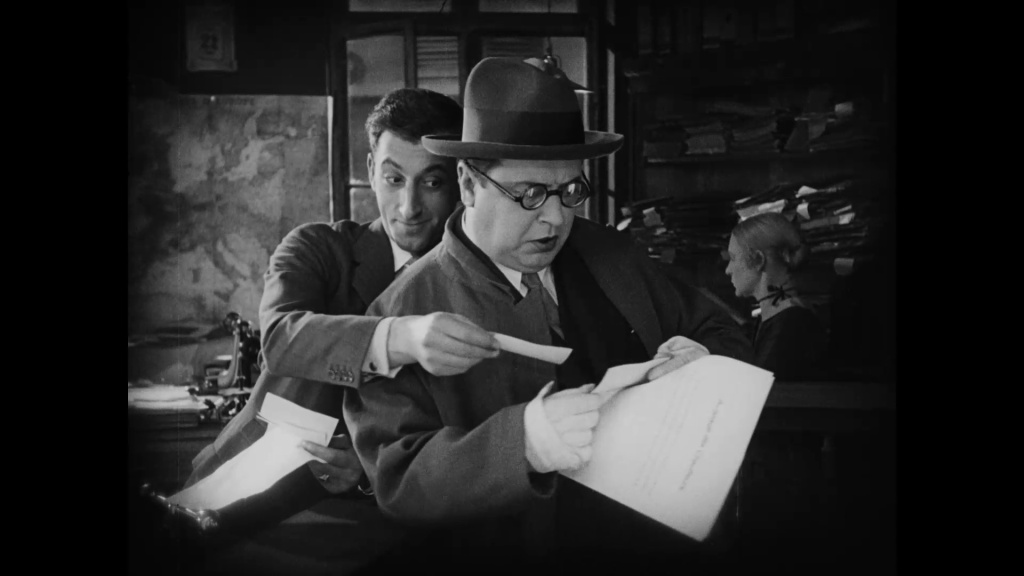
Indeed, I should keep saying just how fun Thewes’s orchestration is throughout. To pick another moment, listen to how we are introduced to the detective agency of Raymond Ney (Adolf E. Licho) in Paris. The score uses Armas Järnefelt’s Præludium (1899-1900), a piece not now familiar for most. (After a lot of digging around trying to identify this piece, I realized that not only had I heard it before but that I actually owned it on CD. I suspect I am among a very small number of people who own a collection of Järnefelt’s work on CD, and an even smaller subset who own more than just the recent release of his music for Stiller’s Sången om den eldröda blomman (1919).) Bearing in mind that Thewes orchestrated this piece from its piano reduction, it’s remarkable how this 2016 arrangement is both similar to and distinct from the original. Thewes’s orchestration makes this charming fanfare sound more baroque than the original (with more emphasis on the bright, shiny timbre of brass). But with the addition of the saxophone, it also melds its tone into the sound world of the rest of the film. Listening to them side-by-side, I find I prefer Thewes’s orchestration to Järnefelt’s own arrangement. (Thewes removes the unnecessary pomp of Järnefelt’s cymbals and glockenspiel for the forte passages.) And the timing of the piece for the action on screen—the growling brass for Gaston’s demand for “Geld! Geld!” , the solo violin for the client’s tearful farewell to both his adulterous wife and his money—is marvellous.

But there is one section of the film that I have listened to even more times, which is when Andreas first arrives in Paris and reunites with Jeanne. This run of scenes—less than ten minutes of screen time—uses pieces of music that I have been unable to identify. Part of their charm for me is exactly this sense of the unknown, and the revelation of how beautifully arranged and orchestrated they are for the film.

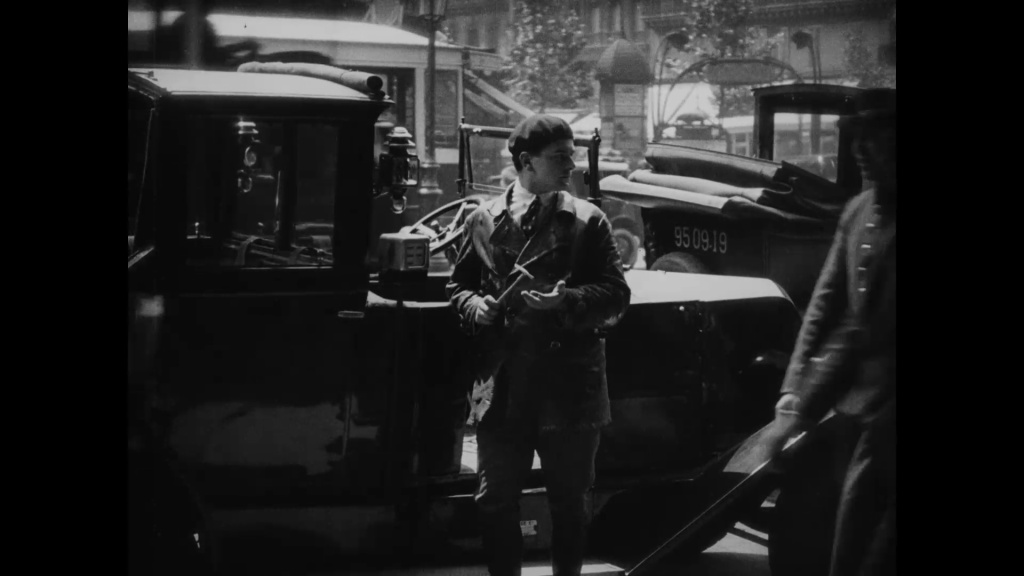
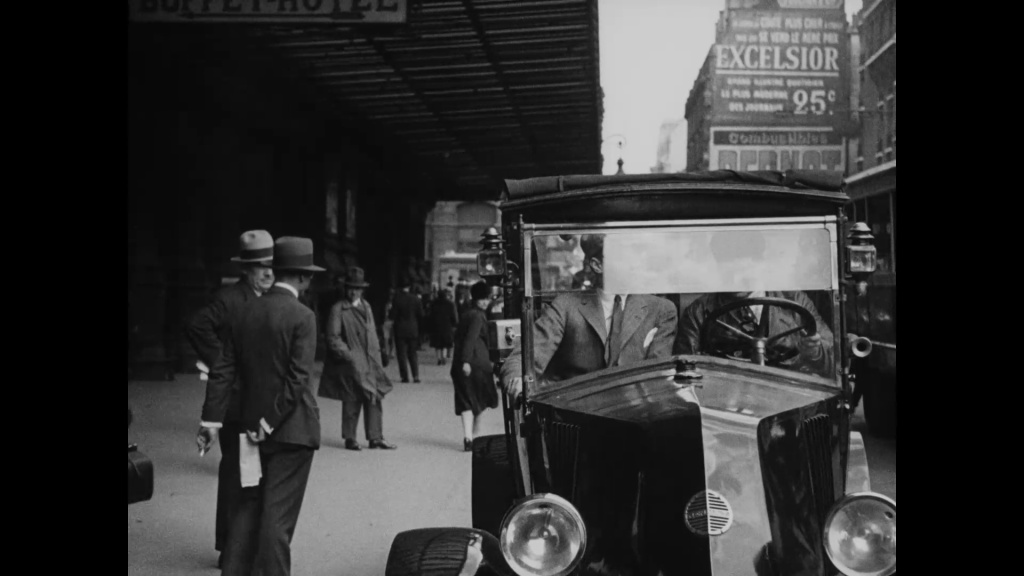
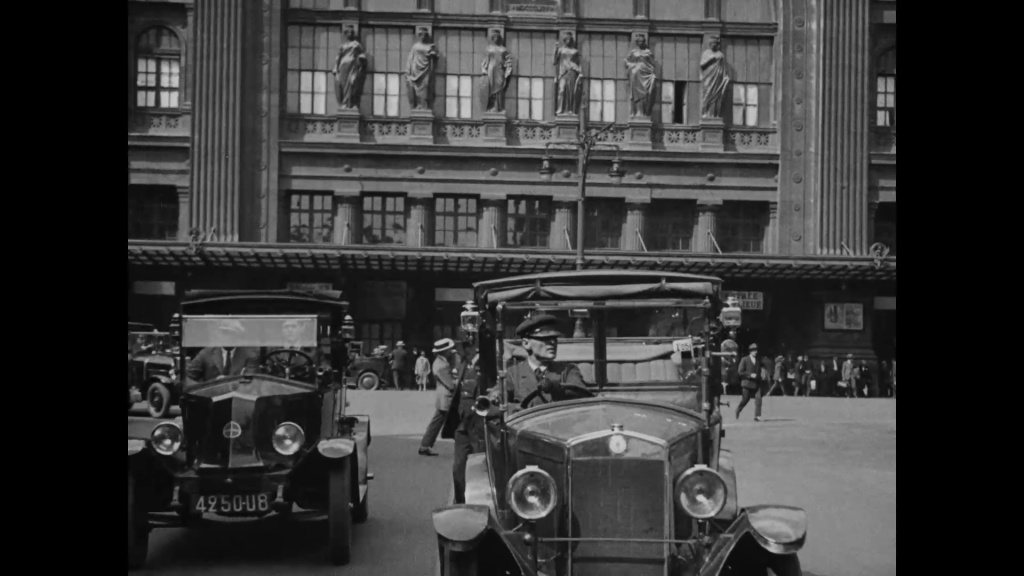
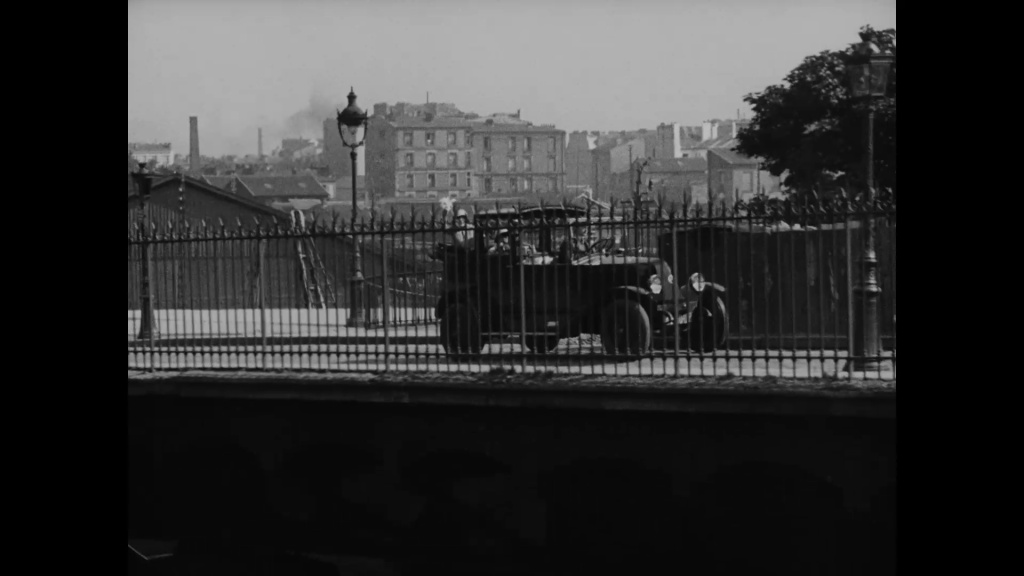
The first scene in this section is of Poitra (Hans Jaray) waiting for Andreas outside the train station. The strings spell out the main melody: a simple, sweet, slow sigh. The two men great each other and, as soon as Andreas steps into the taxi, the organ takes up the main theme from the strings. When the car drives away from the station, the drums mark out the underlying beat—as though catching on to the tempo of the traffic. The camera tracks back before the car, and slowly the sense of location becomes the subject of the sequence. For here is the Gare du Nord, filling the width and height of the screen, and traffic filling the foreground. People crisscross the street. The taxi must switch lanes, weave back into view. I find it hard to say what it is about this scene that I find so moving, but I know that the music brings something out of it that is both touching and melancholy. The slow, sweet, sad melody is light music as its most winsomely romantic. I have no idea what piece it is, or who wrote it: but it bears the hallmarks of a popular tune, since it is instantly graspable, hummable, whistleable. It’s a curiously moving experience, too, to find this anonymous melody popping back into one’s head many weeks later (as it did and does into mine), and to be able to rediscover its melodic contours so easily.

The way Thewes’s arrangement handles the tune is also key to its effectiveness. I’m not normally a fan of organ scores for silent films, but I love the use of any keyboard instruments as part of an orchestral texture. For this scene, the texture of the melody is carried by the Hammond organ and—just for the last repetition of the tune—supported by a sweep of undivided strings. Its simplicity as a tune is made doubly effective by the simplicity of its rendering here: all the instruments unite for the final bars, producing a splendid sheen of sound. The presence of the Hammond organ in the midst of this piece gives the music (to my ears) a pleasingly vintage aura, summoning up a past with its warm tones. When I was a child, our neighbour (born, I think, around 1918) had a small Hammond organ at the entrance to his living room. On this, he would accompany himself singing sentimental songs from his youth of the 1930s and 40s. The Hammond organ in Thewes’ score for the melody in this Gare du Nord scene sets me in mind of this kind of popular mode: it is easy on the ear, memorable, sweet, warm. The organ was a widespread instrument in cinemas of the 1920s, and continued to be one of the few surviving aspects of live music in theatres after the arrival of sound. The instrument is thus associated with several generations of cinema sound, and its use here for this piece of (once) popular music is perfectly judged. It’s sentimental in the right way, and makes the texture of the melody more interesting than if scored simply for the sweeping strings. Purely and simply, it’s lovely. And it functions also to underline one of the pleasures of the film: seeing Paris. The sense of nostalgia in the melody also works in relation to the streets we see on screen: we are driving slowly through the past, observing the motions of the people on the street, the slow passage of the cars and trucks. The melody moves as slowly as the taxis, as the camera itself, as it tracks back through the street. It’s perfect.

For the brief scene of Jeanne at her typewriter, dreamily typing Andreas’s name before XXXX-ing it out, we hear a repeat of the melody used earlier in the film that accompanied the lovers’ last embrace in Russia. It’s like the melody is her counterpart to the dreaminess of the tune that greets Andreas at the station. And, like the previous melody, Thewes orchestrates this piece so that it’s a delightfully simplified sweep of sound—the organ this time rounding out the last iteration of the theme (as if repaying the compliment from the previous scene, where the orchestra took over from it at the end).

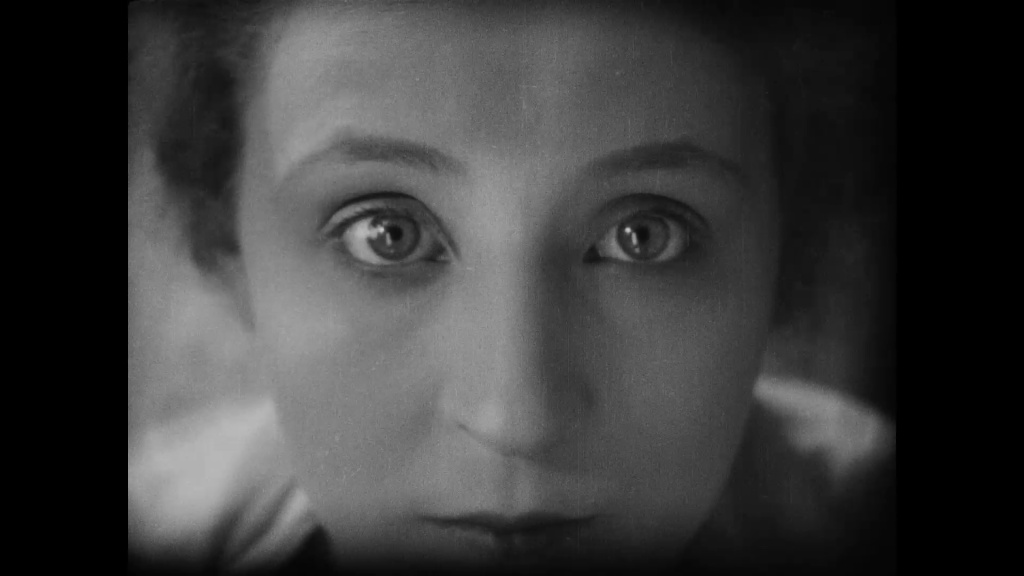
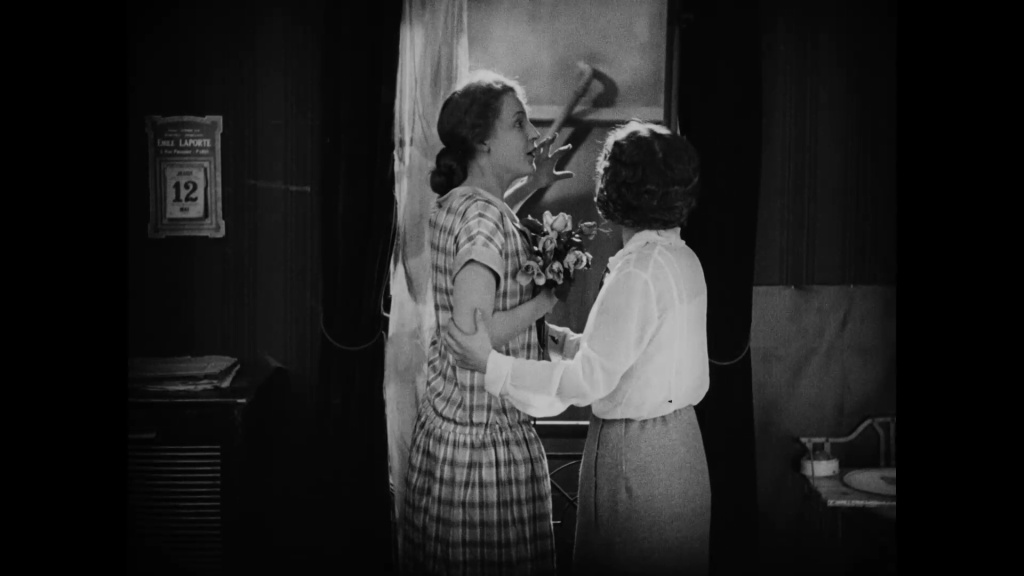
Next, we cut to Khalibiev and Raymond Ney. Khalibiev is holding a bouquet of flowers, and now Gabrielle (Brigitte Helm) appears. In the score, a delicious combination of piano, harp, and strings sound out a skipping, nervous, innocent melody as she approaches. It’s perfect for Gabrielle, whose naïve trustfulness of Khalibiev almost unnerves the latter. Pabst provides us with an amazing close-up of Gabrielle, staring wide-eyed into the camera. We share Khalibiev’s perspective, gazing at this beautiful face with its gleaming eyes. (Hear how the strings end their phrase with a lovely diminuendo, climbing higher before fading away.) “I’m so happy!” says Gabrielle to Jeanne, and the music has been telling us this already. But beware Khalibiev! The presence of the piano in the orchestration here reminds us of Khalibiev’s own theme, and the way this instrument tends to rumble out from the brass and take it over. And Jeanne’s worried glance at Khalibiev coincides with another melting-away of the main theme in the strings: even when the melodic line is cheerful, the placement of each phrase can carry such subtle shifts in emphasis.

Outside, Poitra is waiting with the car. (Observe here how a cat walks into frame and sits, with perfect timing and placement in the corner of the frame, just before the handheld camera pans left to see the two women emerge from Ney’s building. It’s one of those lovely unplanned moments that comes from filming on location.) The main theme—a four note phrase, with an emphasis, like an excited skip, on the second note—is taken up by the strings. Pabst cuts to a long shot of the whole street. You can see the long flight of steps behind the alley, and the sun throws swathes of light and dark between the buildings. It’s a lovely image, with depth of focus and composition: here again Paris becomes the subject of the scene.

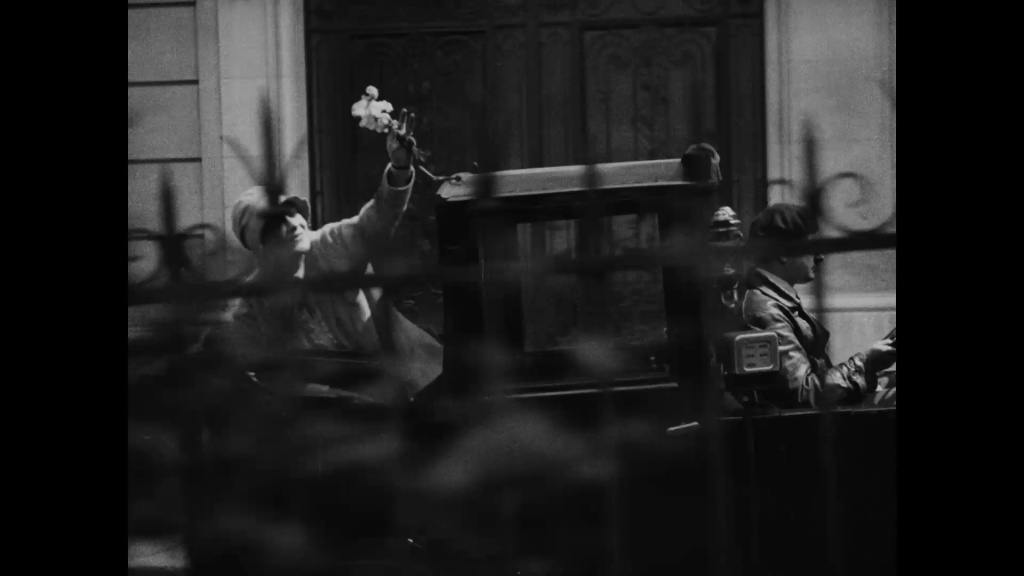
The women get into the back of the cab, which has its roof down to let in the sun. Poitra has with him a little posy of flowers, which he looks at, then throws over his shoulder to Jeanne in the back. The music is so perfectly timed here, swelling in volume in time with Poitra’s gesture. (Again, the melodic content is a simple repetition of material, but the tempo allows the beginning and ending of phrases to make an impact.) The cab sets off and the saxophone takes up the main melody. To me, the saxophone feels delightfully in keeping with both the easy melody and the sense of time and place on screen (and, thus, the emotions of the characters who inhabit it). Pabst’s camera sits facing the two women, each holding their flowers, Gabrielle clutching at Jeanne with her free hand. In the background, the shaded walls and sunlit road flash by. “Are we flying?” asks the enraptured Gabrielle. “Yes, we’re flying—into bliss!”

Listen to the joyful way the music transitions here: brass and drums take over the impetus of the melody, then beat out a faster rhythm. It’s as if the orchestra has warmed up, has broken into a run or a dance. For a few seconds, it’s just the brass and drums, rumbling around in a repeated refrain. It’s like the bumpy road that shakes them around in the cab. It’s the quickened heartbeat of the separated lovers. It’s the excitement of an anticipated meeting. And it’s the premonition of the bustle of the underground club that now appears on screen: for we see Khalibiev descend into the bar where he meets Margot (Hertha von Walther).

Pabst creates a marvellous sense of space here: behind the bar is a huge mirror, reflecting the spiral staircase from above, down which Khalibiev speeds. The orchestra switches to a swinging, brassy, almost tipsy melody. It’s the change in tempo and rhythm, as much as the textural one, that makes the contrast between this scene and that last so effective. The transition between one “cue” and the next itself becomes a chance to switch the orchestration, to emphasize a different texture and mood. Without the score in front of me (and not recognizing the music being used), it’s difficult to know precisely how the original score changes here. Listening to it multiple times, I almost feel that the music for Khalibiev is a kind of parodic distortion of the melody used for Jeanne in the cab. Certainly, it feels as though the first melody—sweet and sentimental—slowly morphs into its boisterous, unbuttoned sequel. The way Thewes orchestrates this shift makes it a perfect match for the images.

In the bar (to a foursquare, oom-pah-oom-pah, beat in the brass), Khalibiev flirts with Margot, orders two liqueurs, and downs his in one. Khalibiev stares at Margot. Pabst gives us a huge close-up of her face, her dark brows and eyes a kind of counterpart to the pale, luminous face and eyes of Gabrielle in the earlier scene. Having been bewildered by Gabrielle, able only to ghost a kiss on her forehead, Khalibiev now grabs Margot and plants a kiss on her brow—then marches back up the stairs, just as the rumbunctious brass rounds off its melody with a flourish.

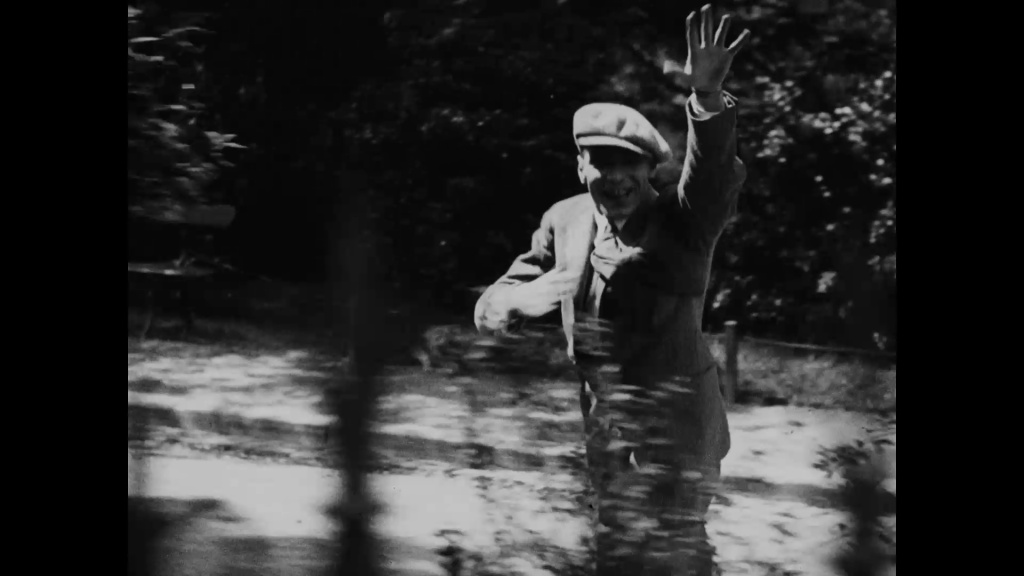
Andreas is waiting on a bridge by an entrance to the park. (The place we see them visit is the Parc des Buttes-Chaumont.) He turns round, waiting anxiously for Jeanne. The organ, too, sounds out an anxious, excited tremolo. (It’s a kind of acoustic equivalent of an impatient tapping of the foot.) As Pabst cuts to a long shot of the road curving round towards Andreas’ position, the organ begins the melody that defines this next sequence: a quick, delightful, tripping tune that expresses the excitement of the lovers’ reunion. It is swiftly joined by the drums (at first very softly, then with a rattling of a tambourine), these added textures bringing out the sense of giddy fun in the music. For Andreas is leaping at the sight of Jeanne’s car, waving his arms and running towards her—and Pabst begins cutting between parallel tracking shots that follow the lovers. The strings join in, filling in the harmony, strengthening the melody. The organ skips along with the rhythm, while the drums spell out an excited beat underneath—brass occasionally rounding-out the theme. I love, simply love, the mix of texture of timbre that this combination produces: the fizz of the drum set, the deep warble and light chirping of the organ, the sweet richness of the strings. It’s almost silly it’s so delightful. And the scene itself is likewise sillily winsome as the characters rush madly toward one another.

But for their actual meeting, everything slows down, stops. The melody of their courtship—Tchaikovsky’s “June”—floats in on woodwind, supported by wistful strings. And despite their energy, the lovers don’t end their respective journeys with a climactic embrace. Instead, Andreas doffs his cap, and they walk side by side, slowly, into the gardens. It’s strangely innocent, as though neither is quite ready to express their desires. The music waylays our expectations, reminds us of the lovers’ troubled past and uncertain future.

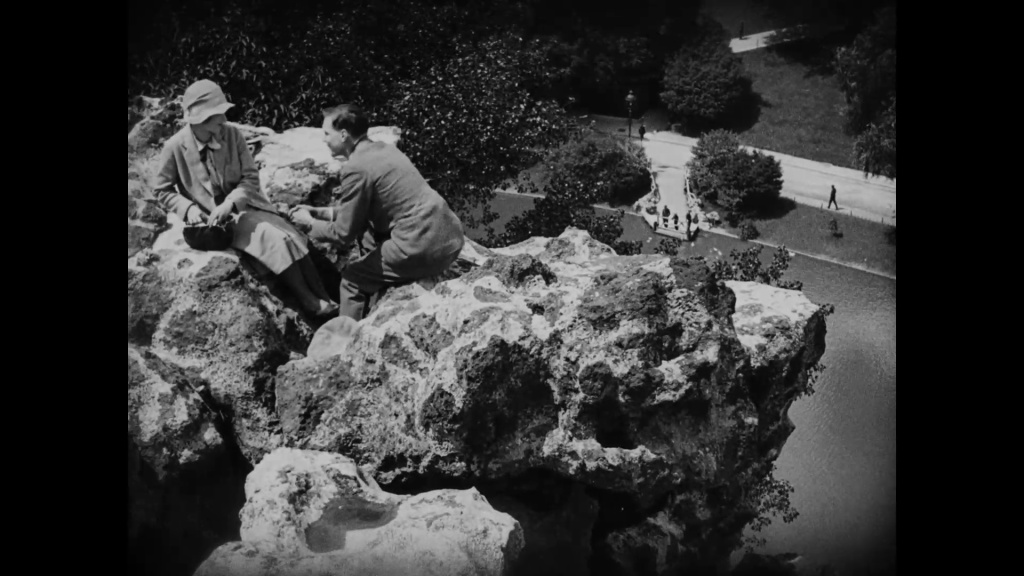
After cutting back to the car, to glimpse Poitra alone with Gabrielle, Pabst’s camera finds the lovers atop an artificial grotto in the park. It’s glorious to see across the rooftops of Paris: you can even match the same image to that of today’s skyline (which, thanks to the city’s ban on tall buildings in its centre, remains much the same as it was in 1927). The image of Jeanne and Andreas makes literal the sense of their elated state in each other’s company. They are (quite literally) on high. But it also carries an implied danger of their fall, of their togetherness being precarious. The music here repeats the same material heard in earlier scenes with the lovers (their last embrace in Russia; Jeanne’s daydream at her typewriter). Again, it is dominated by the tone of the saxophone, which floats over the strings. The orchestration is easy on the ear, but the use of the saxophone gives it a feeling not just of light music but of period light music. It’s a nod to the film’s setting and belonging to the 1920s.

Finally, I must finish with a comment on the last scenes in the film, set on a train as Jeanne wrests the incriminating evidence from Khalibiev. By way of prelude, I should note that the eponymous novel (by Ilya Ehrenburg) on which the film is based has the characters zipping about all over Europe on trains. Even if the film eliminates some of this journeying back and forth, there is more than one scene on a train and Thewes’s orchestration contains distinctive elements for these scenes. He includes percussive instruments, but ones that evoke something more than the simple sounds of coaches rumbling over tracks. Before Andreas is arrested, he is alone in a train carriage. He has just spent the night and morning with Jeanne and their new life beckons. In eighteen seconds of screen time, the score makes us sense everything around and within him. The melody is bright and peppy (it’s another piece I don’t recognize), made brighter and peppier by the addition of drums, bell, and triangle to the orchestra. The quick rhythm of the drums and triangle suggests not just the motion of the train but a kind of inner rhythm of the character: you can sense his joy as he sits, almost fidgety with energy, on the seat and smiles. And the fact that the view through the train window is of dappled trees, the light spilling across Andreas’s beaming face, likewise gives a visual sense of brightness and joy; the same sense of brightness and joy given to the music by the rhythm of drums and the sparks of the triangle.

The regular sounding of the bell harks back to the lovers’ morning, spent walking through Paris and at one point entering a church where they—all too briefly—link hands before the altar. It’s not a wedding, but the promise of a union together. Thewes included the bell in the musical climax for this earlier scene, and now it appears in this scene on the train as a reminder: it’s as if Andreas is summoning the sound of bells in his head, and we can hear it.

All this feeds into the final scene of Jeanne and Khalibiev on the train. Just as Jeanne tries to convince Khalibiev to help her, the two locals in their compartment proffer them sausages and bread. It’s a delightfully farcical way to increase the tension. And the score enters into the farcical spirit. The melody used at this point is a chirrupy, almost childish little theme. Thewes lets the woodwind carry this theme, with the rhythm backed up by the drums. The addition of the bell as a regular chime in this scene, as well as making the simple melody more musically interesting, has an ironic function in that it reminds us of the bell’s presence in earlier scenes: the wedding-like vision in the Paris church, Andreas’s private joy in the train carriage. There’s also a sense of a chiming clock, as if to remind us (musically) of impending deadlines: Jeanne must get the information from Khalibiev before it’s too late. Thus, this amusingly rustic tune functions to underline both the comedy of the scene and the dramatic tension underlying it. Like the scene itself, the music is a kind of elaboration of a simple theme, its function to produce tension by slowing things down at the moment when we want things to hurry up. It’s like the two locals come are humming their own tune, heedless of the drama they suspend by their presence.

After the climax, in which Jeanne wrestles with Khalibiev and finds the missing jewel, there is an extended hiatus before we reach the “end”. The film fades to black, but the black screen continues for another forty seconds until the title “ENDE” appears. Why? (This is not, as far as I am aware, a restorative choice, but the original ending as chosen in 1927.) It’s as if the blank space here—temporal, aesthetic—is a kind of inner space for Jeanne to savour her joy. So we sit in the dark, her blissful smile the last image in our mind’s eye, and the orchestra keeps playing; that it does so shows respect, sympathy even, for the black screen. This hiatus is also a chance for the music to wind down, to relax after the tension of the last scene. The music here derives from the same piece used for the earlier scene at the church, so it’s as if the score is reliving the past—and envisioning the future of the lovers. It makes the ending more complex, somehow, more resonant. And, from my point of view, it nicely refocuses our attention back on the score itself. It deserves to have the last say.

Die Liebe der Jeanne Ney is a film I had seen many years ago but never appreciated. Perhaps one reason is the quality of its earlier incarnation on DVD. That version, released in 2001 by Kino, featured a score by Timothy Brock. Revisiting this now, I am reminded how oddly subdued it feels compared to the film—and most especially to the 2016 score. It’s not just the tone of the music but the quality of the performance and recording. Produced for an earlier release (presumably VHS or even laserdisc) in 1992, the Brock score is performed by the Olympia Chamber Orchestra. This group also recorded other Brock scores for Murnau’s Faust (1926) and Sunrise (1927) in the early 1990s. I love Brock’s score for Faust, but the recording for the soundtrack doesn’t do it justice. The Olympia Chamber Orchestra is an irregular ensemble rather than a professional orchestra. Their performance is perfectly adequate, but I can imagine a far sharper, more convincing rendering. (Frankly, the playing—especially the strings—is sometimes a bit ragged. Too often the ensemble sounds out of sync, if not actually out of tune, and the dull recording hardly helps.)

The production values for the new restoration of Die Liebe der Jeanne Ney belong to a different league altogether. Recorded in February 2017 at the Westdeutscher Rundfunk, with Frank Strobel conducting the WDR Funkhausorchester Köln, the soundtrack for the Blu-ray is superb. Both the orchestral performance and the sound recording are exemplary. (I should namecheck the sound engineers listed in the credits: Rolf Lingenberg and Walter Platte.) This is the kind of result you can get when proper resources are fed into a film restoration.

My deepest thanks go to Bernd Thewes for answering my questions on his work on this score. This piece can only be a small expression of how much joy his music has brought me.

Paul Cuff

Abwege (1928; Ger.; G.W. Pabst)

I couldn’t summon the will to write about something “seasonal” (i.e. Christmassy) this week, so I went back to revisit something I saw earlier this year. (Although I suppose, as the central section of the film is a party scene, it might have some vague seasonal rhyme with New Year.) We’re in Germany in the late 1920s, so it’s odds on that whatever we see will be a quality production. We’re in the hands of G.W. Pabst, which suggests directorial excellence, and we’re in the company of Brigitte Helm, which promises…. well, ahem, good things.

Abwege (1928; Ger.; G.W. Pabst)

The opening title makes it clear whose picture this is: “Brigitte Helm in Abwege”. It’s a matter-of-fact style font, spelled out in a cool blue. I’m used to a certain kind of green for German intertitles of an earlier period (1910s-early 20s), but I like this blue.

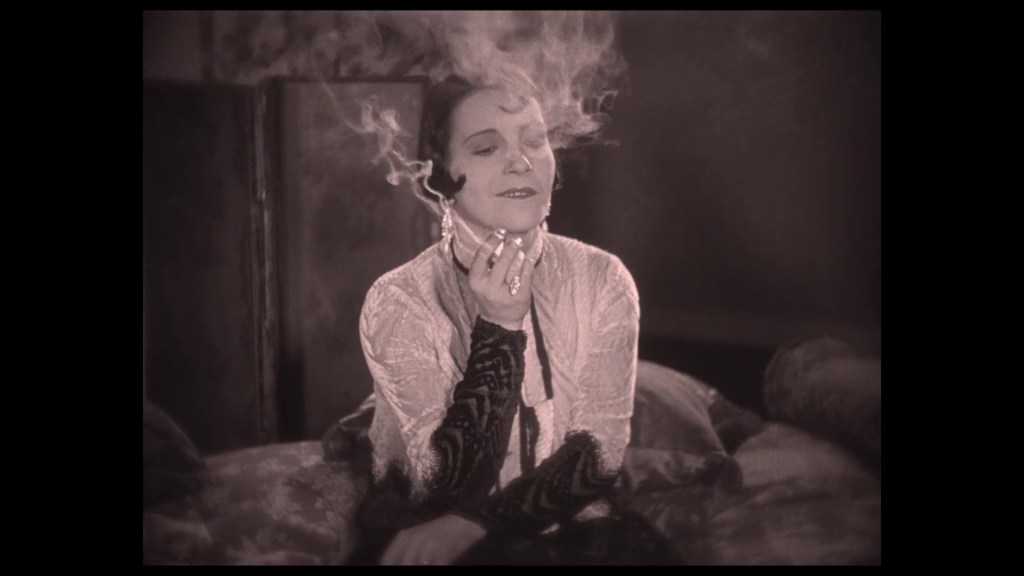
The first shot shows us Brigitte Helm, or rather, her image. The artist Walter is drawing Irene (Helm) in profile: she’s the star, the central concern, and here she is. Walter is fond of Irene and doesn’t hide it. Irene knows it and demurs, just a little; but Liane, her friend, enjoys sitting in on their unspoken flirtation. Walter invites her to his studio. Liane seems keen for Irene to accept. There’s something curious about Liane (Herta von Walther). Her short, black hair, her dark, eyes, always narrowed in—how to put it?—receptivity. It’s not as though she’s sinister; but there’s something about her that makes her look as though she has a scheme on the go. With the cigarettes, short hair, and chic dark look there’s also a touch of the “intimate female companion” visible in other characters from films of this period (think Augusta in Pabst’s Die Büchse der Pandora, 1929). It’s like she’s seducing Irene through Walter.

There is a close-up of Irene, mulling over the idea of seeing Walter—imagining it, and perhaps its possibilities; but her face suddenly changes, her eyes widen with delight, and we realize she’s seen something at the other end of the room. Yes, indeed: her husband arrives home, and for the first time the camera gives us an establishing shot of the whole interior space. Up till now, it seemed as though we were in a sitting room. But the long shots reveal its context. First, we see the huge space extending to the glass doors that mark the entrance. Second, the camera looks back at the reception area where Irene and friends are sat. It’s dwarfed by the space around it, by the grand staircase extending over it. The furniture is huddled into this far corner; the rest of the space is empty. Apart from the curtains in the snug corner, the walls are bare, the space free of “soft” furnishing. Floor and walls are tiled. It looks like a medical facility.

Irene’s husband arrives. He kisses her, but when their lips meet Pabst cuts back to Liane lighting a cigarette. It’s a rhyme on their rival lips, a play of rival habits. The film has offered us no introductory titles to anyone so far. The only list we’ve seen is the opening credits. So although we’ve read there that Irene’s husband is “Dr Thomas Beck”, and presumably therefore a professional doctor or academic, the film makes us work out—visually, silently—what this means in terms of the relations on screen. So here is Liane, offering a cigarette to the doctor; he refuses, but a look from his wife (of hurt, disappointment, embarrassment) makes him take one out of politeness. The history of this group, the internal tensions, is all here for us to see in a few well-chosen, economic gestures of set design, performance, and editing. Even the doctor’s sense of detachment, or superiority, is here: for Pabst frames the doctor taking the cigarette from a slightly low angle, almost akin to Liane’s point of view. He’s all profile, and behind him is the well-machined, well-designed staircase, angling away to the top of the frame. It’s all very cool, reserved. Smoke drifts from the bottom of the frame. He looks away from its source, from Liane. When finally he takes a cigarette and smokes, he is still looking away from Liane. But Pabst doesn’t look away: he cuts back to Liane, amid the cushions and comfort of the only soft-furnished corner of the room, grinning in her small, but significant, moment of triumph. (My word, this film really is well directed.)

Liane has invited them to a part at the Eldorado, but the doctor has asked Irene “a hundred times” not to “associate with that woman”—and does so again now. Irene goes to say goodbye, sadly, to her friends. At the door, she shakes her head: she can’t come out tonight. Walter kisses Irene’s hand, a little too long. Liane asks Irene “why do you allow yourself to be locked away like this?”, and the words are made all the stronger for taking place at the glass doors of the entrance. Earlier, I said the interior looked like a medical facility, and now my impression is reaffirmed: the glass doors mean that Irene, inside, can be observed from outside. A space that offers scant comfort (in terms of furniture, homeliness, the bustle of everyday life) also offers scant privacy. Irene withdraws. She stands at the glass doors and it’s as if she is under observation in a facility.

But Pabst again does something interesting. As Irene stands at the doors, the film cuts back to her husband finding Walter’s drawing of Irene. He looks at her profile, and the viewer (if not the husband) realizes that Irene is caught between the roles given to her by two men. From the square sheet of paper on which Irene’s face is framed, Pabst cuts back to the square frame of the glass door behind which Irene stands. Both are frames through which Irene is observed (and, of course, we too observe her through the frame of the cinema screen). If she is trapped at home by her husband, the alternative is to be trapped in her admirer’s designs.

Irene herself picks up this theme in the next scene, accusing her husband of “locking me away”. The phone rings, and it’s more work for the doctor. He talks and examines his files, while Irene sits on his desk and glares at him. The camera cuts between close-ups of the files, the husband, and Irene. You might call the cutting here a kind of “free indirect” style, whereby the film shows us the character’s thoughts and feelings without ever quite being subjective. “This is where our marriage is!” Irene roars at the end of this little montage: has the editing prompted her cry, or were was the editing prompted by her feelings? Still he ignores her, so off she runs.

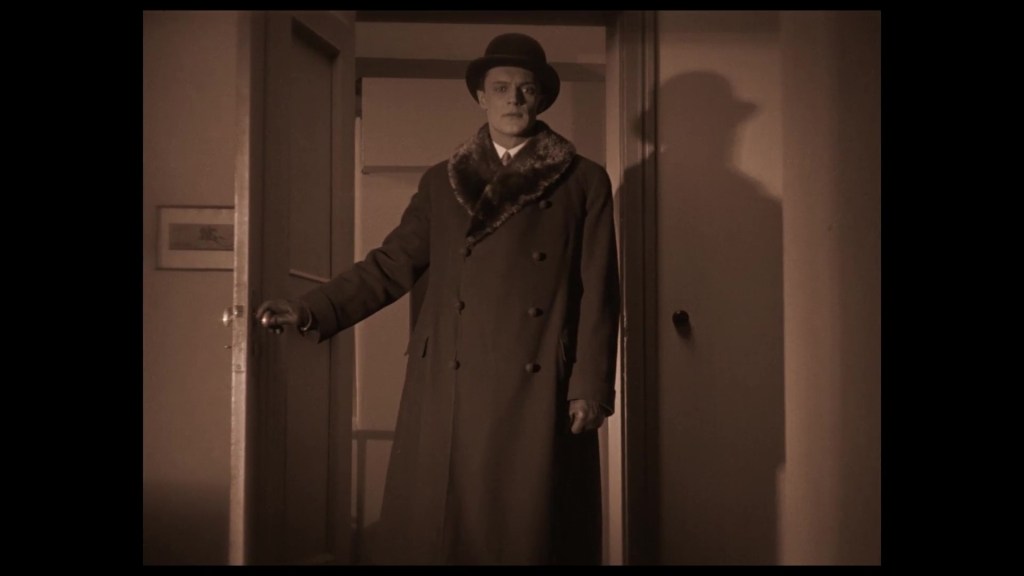
In Walter’s studio, we see more images of Irene: her face is being crafted, improved, ready to be fed into the rack of the printing press. It’s a faintly threatening image: that it precedes Irene’s arrival suggests she doesn’t quite know what’s coming. Nor does she know what’s following her: a cab with her husband. He is in his own frame now, the jealous husband, behind the glass cab window. His fur-collared coat is dark, brooding. It’s the only thing “soft” about him, even his house. It might be a sign of tenderness, of a desire for something soft and yielding, but the coat makes him look threatening: his clean-cut profile and slicked-back hair brooding over his tall, black form. He’s in marked contrast to Walter, the artist, who has donned his white studio coat. In his room, the large canvas and papers are matched by the pale sheets over the large skylight. His whole room is dominated by his craft. Irene’s face is being pressed onto a sheet. Now Irene enters. She sees her image strewn about the room. She is flattered, pleased; she demurely hides her emotion from Walter in the background, but Pabst captures the look in the foreground. When Irene sits beside Walter, she gives vent to her anger—but Pabst offers no title to translate her emotion; Helm can say it all with her performance, her face, her hands, her shoulders tensing and untensing, her body writhing even while sitting. Walter seizes his chance, and suggests they escape together to Vienna. Irene writhes into—and then out of—Walter’s embrace. (Truly, no-one writhes like Brigitte Helm.) For the first time, she’s showing off the clingy sheen of her dress—and the fact that she has the sensuality to wear it like it’s meant to be worn.

But the doctor watches still. And now he’s up in Walter’s studio, and hears him ordering the train tickets (the “sleeper” service is as suggestive a kind of ticket as any scriptwriter might cite). His entrance sends papers blowing across the room. It’s the first time the doctor seems more than merely morally assertive: here we realize he’s physically powerful, and the artist Walter looks weedy when he stands to confront him. The doctor walks stiffly, upright. He takes off his hat. Will he punch him? Pabst fades to black. (The film cannot yet show us the doctor doing something physically assertive. Throughout the film, it’s as if we’re supposed to take him as a virgin, as someone never quite capable of a physical act of intimacy with his wife. Is that it? Does she just want him to desire her physically?)

Irene is alone at the station; but not quite alone. Her husband arrives. It’s cold. It’s cold not merely because it’s evidently winter (the light, the trees, the clothes); it’s cold because suddenly the tinting has gone. This is the great advantage of tinting—and here it’s a subtle range of colours (sepia, yellow, pink, turquoise), almost like inky washes over the image: warmth and cold can be added to the tonal range, or created by transitioning from colour to monochrome.

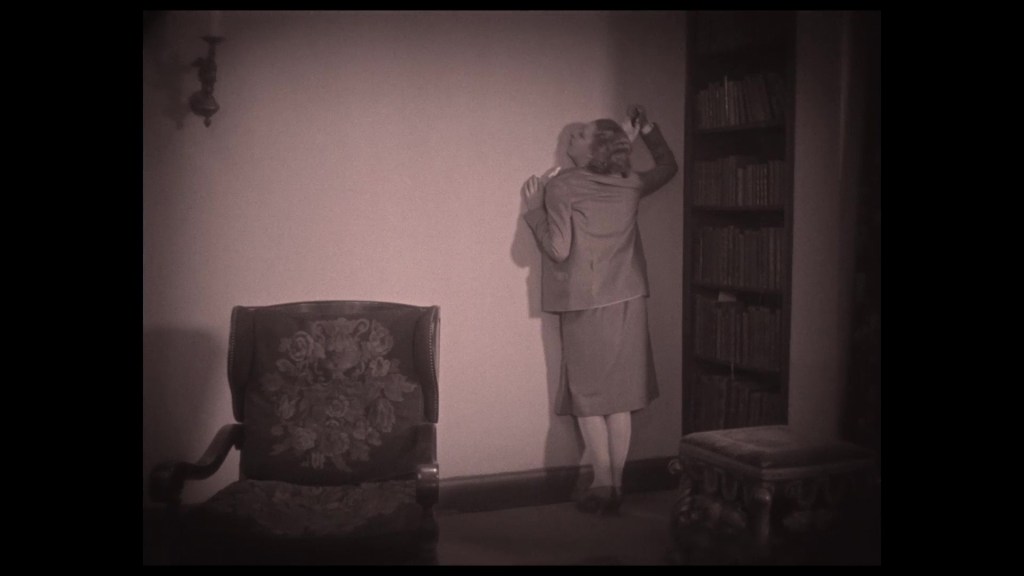
The interior confrontation scene is introduced via the glass doors: first, Thomas steps through them to deliver Walter’s letter to Irene (the letter is a meek apology, presumably dictated to him by the husband); then, Irene goes through another set of sliding glass doors to read it, and presses her body against the wall, fists raised in anger. The husband looks guilty. But what will he do? She—well, we—are crying out for him to be human, warm. Go and kiss her, man! Show her you love her! Come on! He comes to the sliding doors. She runs to them. An embrace? No! He’s got his massive coat on again. “You’re going out now?” Irene asks, as incredulous as we are. A chance for tenderness is gone. Both regret it. The husband doesn’t go to his club, but slinks upstairs. As with the moment Irene reads the letter and presses herself against the wall, Pabst here uses a handheld camera to show the husband going upstairs. In both cases, it’s just for a moment: the camera pans, but clearly trembles a little as it does so. It’s a moment—two moments, in a visual rhyme—that introduces uncertainty, disequilibrium. Both characters are about to go off the rails.

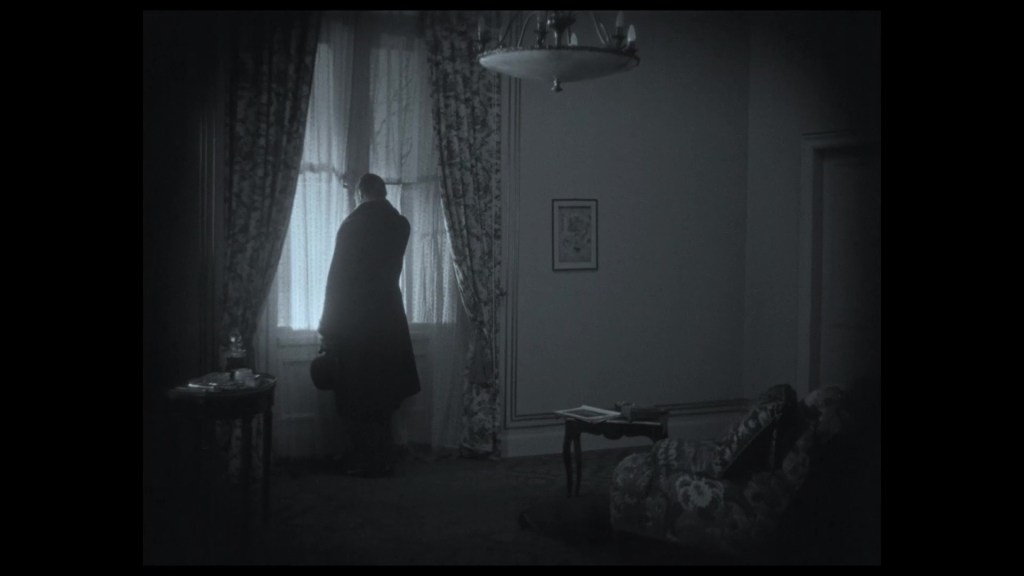
Upstairs, the husband is alone with his shadow in the bedroom: the tinting is gone again, it looks extra bleak and cold. Downstairs, Irene descends in an astonishing dress (more on this in a moment), only to find a friend of her husband (councillor Möller) at the door. So surprised is he by her appearance and dress (and the doorman has already convinced him that Dr Beck has already left), that he allows her to invite him along to a nightclub. The doctor observes from the upstairs window, leaving it open as he slumps back onto a comfy seat.

The Eldorado is in full swing. It’s tinted a gentle pink, suggestive of warmth, and this is the first time we’ve seen crowd of people, the sense of this being a city, and the specific city of Berlin in the late 1920s. It would be a delight if it weren’t for the two sad figures on the side-lines: Walter, already drunk, and an anonymous woman (later identified as Anita), who looks not only intoxicated but world-weary to the point of moral collapse. We also glimpse two well-dressed, slightly effete, men smoking and drinking together; I say “men”, but one looks to be in his mid-teens; are they a couple? This nightclub is an ambiguous space. It’s joyful but sad, it’s a place where men and women meet, but also a place where other couplings are possible.

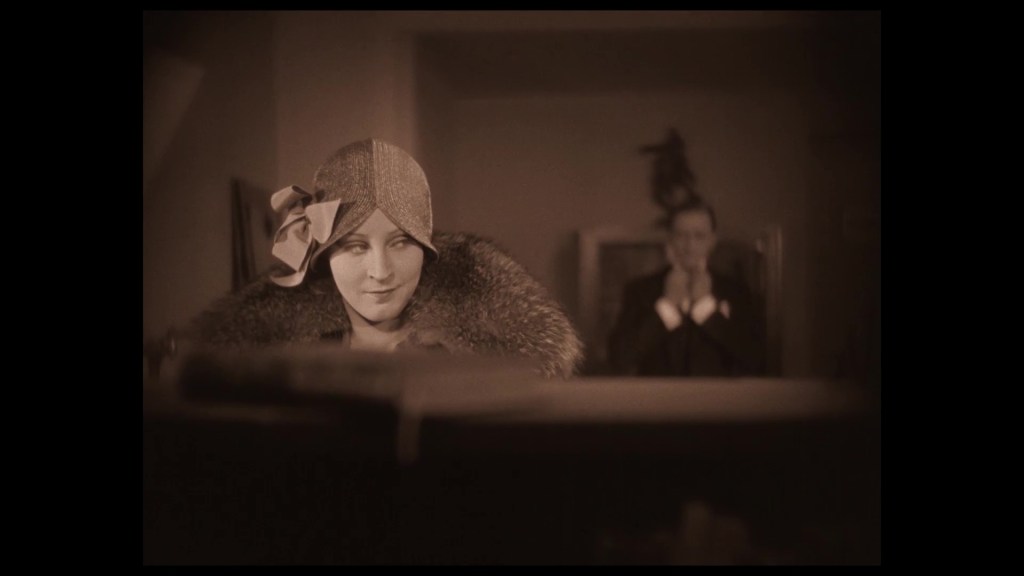
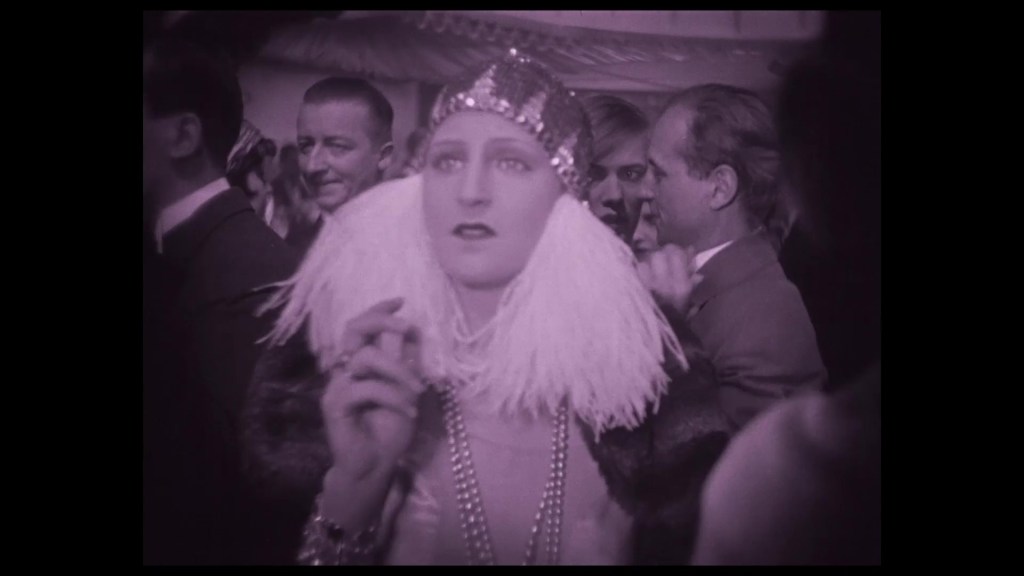
Enter Irene. Now let’s talk about what she’s wearing. You can glimpse the pale, silky something beneath her equally silky, fur-lined jacket, itself a kind of show-offy cut. She looks like a kind of dark-furred powder puff. And look at her hat! It’s a kind of glittering skull-cap, with two large fluffy tassels dropping like dogears on either side. It’s a mad ensemble, and Irene looks faintly frightened to wear it all as she crosses the dance floor.

It’s an amazing sequence, for Pabst now fully utilizes the handheld camera. (I say “handheld”, but it’s more likely to have been a chest-mounted camera, such was the weight of the apparatus and the difficulty of having to hand-crank it.)  As Irene pushes her way through the throng, the camera struggles to keep her in focus; it’s buffeted by the crowd, it tries to keep steady while showing us the effort needed to do so. Irene is trying to reach Liane, who is dancing in the heart of the crowd. When they go and sit at a table, Irene looks calmer. Her coat is removed, and she brushes back her hair: behold, Brigitte Helm. The silky something is now seen: a sleeveless dress, with a triple-wound pearl neckless and substantial, bejewelled wristlet to compliment it.

The nightclub sequence that follows is remarkable for intercutting lots of complex little subplots and characters. We see councillor Möller, for example, assailed by bob-cut flappers and embarrassed to be recognized elsewhere by someone he knows. Drink steadies his nerves, but also introduces him to other forms of temptation. When he joins Irene and co., he sees something fall down the back of Liane’s low-cut black dress and fears to go to the rescue—before letting something else drop there so he can have a rummage (much to Liane’s amusement). Meanwhile, at a neighbouring table, the boxer Sam Taylor observes the cool profile of Irene and begins throwing streamers over her. And on the fringes, Anita tries to score a hit (or hit it off—for money?) with various shady characters moving between various groups of people.

While all these little dramas play out, Pabst resumes the main drama of the night: Irene’s flirtation with Walter. When she first sees him, it’s as if Irene remembers that she’s Brigitte Helm. From across the room, she goes what you might call full-Helm: the slightly squinting eyes, the arched eyebrow, the power-pout, the arched back. It’s a glorious moment. To cap it off, she drains her glass—and then grabs Liane’s friend to dance and make Walter jealous.

Things start to get strange. Vendors are selling sinister child-size puppets at the tables. (We see Sam Taylor playfight with a half-naked, hairy-chested puppet version of himself.) Anita crosses Irene’s path and Liane explains that she’s after “a magic potion that carries souls up to heaven”. As Liane’s friend kisses her arm, Pabst cuts back to the doctor at home, shivering in the blowy room. At the party, Anita slips a note to gain some of her potion. Irene wanders off to sample the “potion” that Anita offers. They disappear into a curtained chamber. We see Möller, happily but unstably drunk; he’s there to make us a smile a little, and to contrast with the more serious events unfolding around him. For here is Irene, emerging through the curtains, her head slumped onto her chest. It’s like the familiar Helm writhe has been arrested halfway through and her body is stuck in a twisted shape. Her head lolls, but she tries to dance again—until she passes Walter. The two, now equally addled, stare at each other for a moment before Irene grabs another man (a stunted, almost expressionless old man with a Prussian moustache) and launches into a wild, twirling dance. When she swirls into her seat again, her mannerisms are the familiar Helm-isms, rendered even more mannered. A moment of sobriety comes as Anita passes in the arms of a dancer. It’s as if we see Irene in the future. To underscore the notion of this possibility, Irene finally asks Liane who is this woman. Only now, many scenes into the sequence, are we told: “She was the wife of the banker Haldern… who shot himself when she left him”. Irene runs out, horrified.

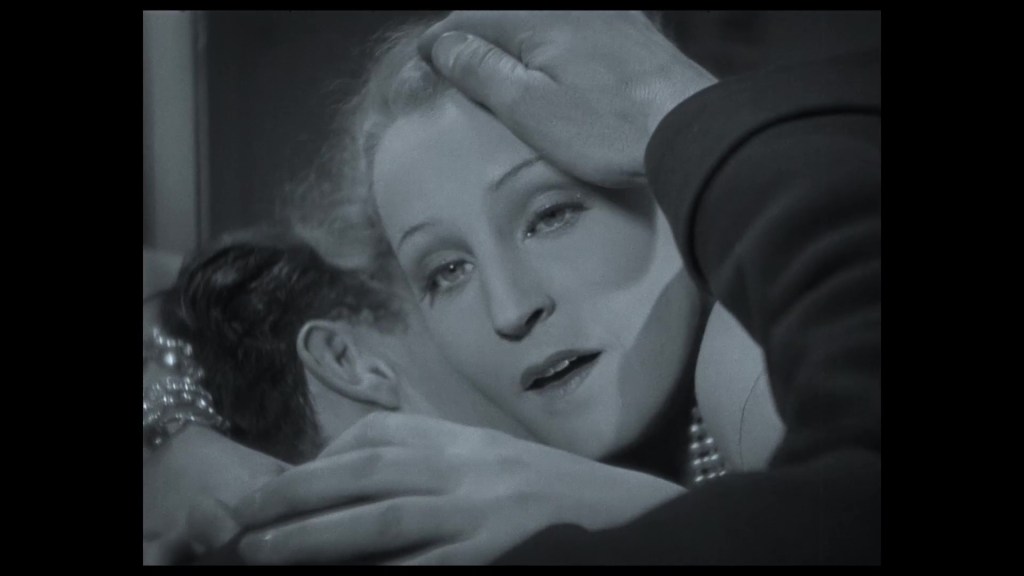
At home, she finds her husband immobile in the freezing room. She fears he’s dead, so is hugely relieved when he opens his eyes. She closes the window, warms his hands, takes off his coat. The film might end here, surely—if only he’d take her in his arms. But when they prepare for bed, and Irene slips invitingly between the sheets, the doctor finds the weird doll of the boxer and storms out angrily.

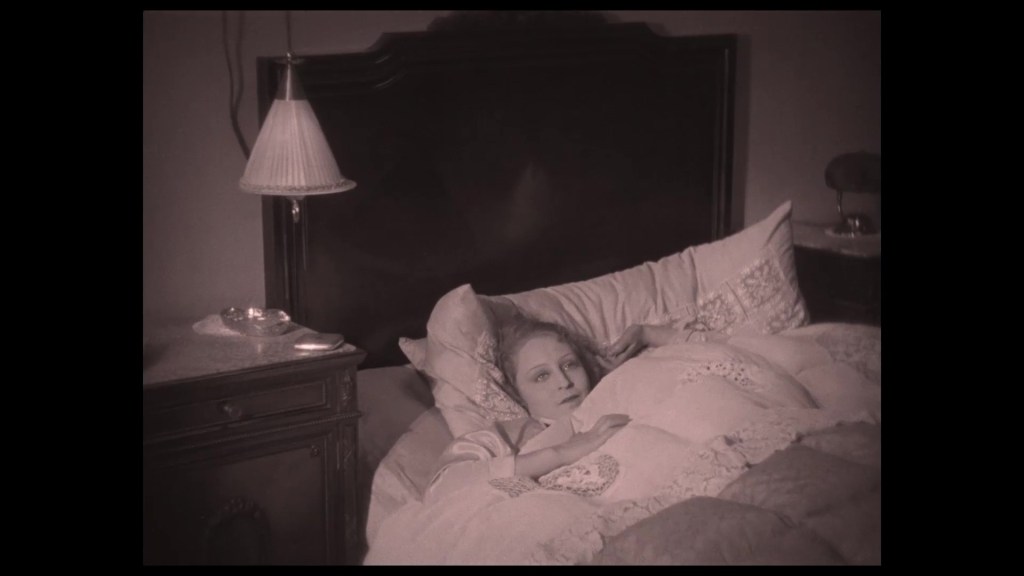
Irene collapses in a torpor, then wakes the next morning to find the gang from the club serenading her bedside. The room fills with liqueur and cigarette smoke, and the sight of Möller in Liane’s arms. Irene looks upset, more so when her husband walks in. The doctor tells them (sarcastically) to act as if they were in their own home. Irene stands and yells at him: “You’re no man!” (Still he refuses to assert himself physically, and the sexual connotations of these moments of refusal/reticence speak volumes about the marriage.) “You’re sick, my girl”, the doctor explains, to Irene’s fury. Sick? She’ll show him “sick”…

Pabst cuts from the limp boxer-doll on the floor to the real boxing ring. (More handheld camerawork here as Sam fights a black boxer. It’s as if the dance floor and boxing ring are equally spaces of dangerous thrills.) Irene is there with Liane, looking on. Irene’s dress is now a silky black cape, her headpiece a kind of false black bob, with glittery brow. (She’s turning the Helm-dial up to about 8 at this point.)

Irene takes Sam up to Walter’s studio: ostensibly for a portrait, but really to engage in complex flirtation and jealousy. (Meanwhile, Liane warns the doctor that his wife may be about to do “something silly”.) In the empty studio, it is Sam who is the cause of danger: he carries Irene to a bed and looms menacingly over her. Irene ceases her performative flirtation and becomes genuinely frightened. Pabst again uses the handheld camera to make the threat real, a kind of extension of the danger of the dancefloor or boxing ring. (And the unsteadiness of the frame reminds the viewer of those first scenes that set the plot in motion: the reading of the letter, the retreat of the husband to the room.) Walter arrives just in time. Irene is dishevelled, in tears. But Walter is too petty to go and comfort her. He petulantly throws his portraits of her on the floor. Irene blames him for what’s happened, only for him, in self-pity, to explain that he can’t offer her the lifestyle of her rich husband. Irene forces herself into his arms and—for the first time in the film—presses a kiss on him. But just as Pabst interrupted Irene’s marital kiss in the film’s first scene, so now the extramarital kiss is interrupted by the husband at the door. Walter is afraid, but Irene can’t suppress a smile. She quickly strips down to her chemise and makes Walter open the door. It’s a striking, candid moment of her longing for him: her eyes say it all, as she stares intently at him. As I said before, it’s as if her marriage is yet unconsummated; she’s stood there waiting for Thomas to… well, do something. But again he refuses, walking out of the scene.

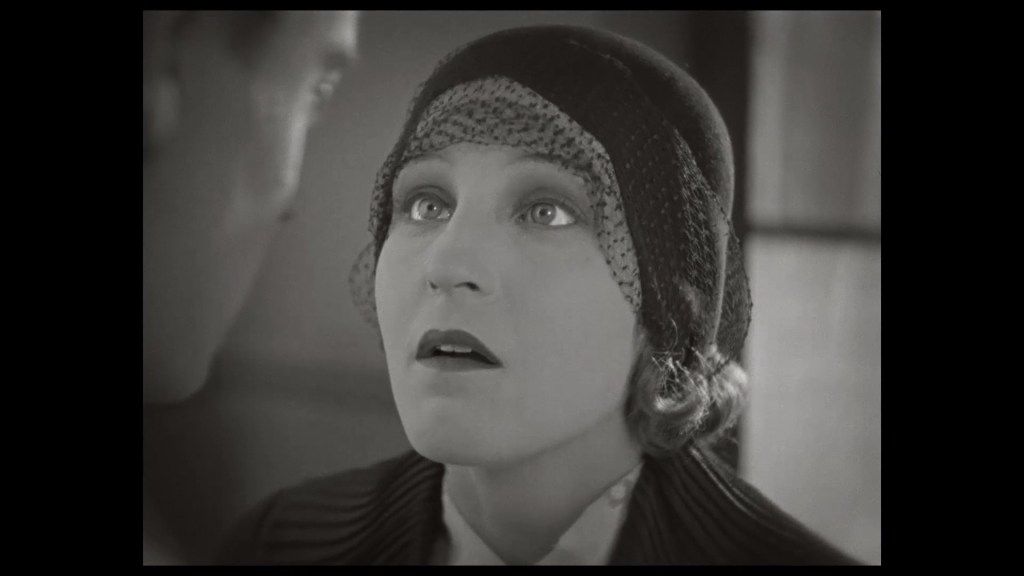
Time passes between scenes. Walter has been asked to appear as a witness in the Becks’ divorce hearing. Irene wears a black veil, as though in mourning. Her eyes are sad, sincere, even if she can’t speak. Finally, outside, in the corridor, the couple approach each other. She swears she was not unfaithful, but the court has already ruled: they are divorced. But the pair are happy. Alone together in the hall, they sit on a bench. She rests her head on his shoulder. He tells her he loves her. When they kiss now, it has passion in it. It’s a kind of first kiss. When will they get married? “As soon as possible!” Irene exclaims. ENDE.

A very, very good film. Helm embodies her character’s emotions: she’s caught between wanting to express her sexuality (the desire for sex itself) and the fear of losing a marriage that might yet be saved; she’s alluring and unsatisfied, daring and timid; she wears astonishing clothes, but only intermittently knows how to mobilize their effect. As her husband, Gustav Diessl likewise manages to be both physically imposing and emotionally reticent: we spend the film waiting for him to align both body and brain with his wife. And though the narrative might seem conservative—the (un)married couple (re)united at the end, the idea of marriage itself reaffirmed—there are so many interesting, unsettling things bubbling away through the film. Even if it reassures us that husband and wife should stick together, the film is also quite clear about the need for appetites to be tested and satisfied.

The title itself—“Abwege”—might translate literally as “Mistakes” or “Wrong Ways”; when released in Anglophone markets, it was retitled “Crisis” or “The Devious Path”. Yet the word “Abwege” is one of those suggestive, faintly enigmatic German compound words. “Ab” is a preposition, a kind of directional prefix (“from” or “off”), and “Wege” the plural of “Weg”, i.e. “path/track” (hence the English word “way”). The illustrative phrase you find in dictionaries is “auf Abwege geraten”, to “go astray”. Both the official English titles for the film fumble with the subtle sense of movement, of deviation, implied in the German original. I’ll bet whoever came up with “The Devious Path” was quite pleased with themselves; but it sounds too much like the title of some government-sponsored anti-drugs film. Abwege is not a salacious or moralistic film in that way; this is Pabst, after all, not DeMille. The film’s first intertitle, “Brigitte Helm in Abwege”, is almost an extension of the film’s name: something akin to “Brigitte Helm is going astray”. Again, it’s an instance where reading a subtitle doesn’t evoke the same sense as the original title.

But my word, the film looks fabulous. It’s not a huge studio spectacular, but the sets are superbly designed and always expressive. The Beck household is big and cold; the nightclub set a swirling nest of bustle. Pabst lets performers, sets, and editing tell the story: there are remarkably few intertitles. After the opening credits, all the relationships between the characters are told entirely visually—Pabst sees no need to reintroduce anyone with a title. He trusts us to be intelligent, to see—and interpret—what’s being shown.

The restoration notes also mention that the film was tinted when first released in 1928, so the restorers have added tints in line with “the conventions of that time”. How many films of the period are still shown in monochrome prints when they were intended to be tinted? It’s a frustration that even new releases on home media (I’m thinking especially of the Feuillade serials from the 1910s) forego tinting altogether. In the case of the Feuillade serials, the restorers not only have plentiful evidence of the “conventions of that time”, but even incomplete tinted copies of the serials at their disposal—yet still they choose to release a monochrome restoration. (If you’re not going to tint your restored version, at least show us an extract of the tinted copy/copies as part of your extras—don’t hide the evidence!) So it was nice to see a restoration where a little conjecture is used to enhance the image as it would have been enhanced in the period it was made and released.

Finally, the music. I watched this film via the restoration shown (and streamed) at Pordenone in 2020. This had music for piano by (I believe) Mauro Colombis. Which was fine. Like most semi-improvised piano scores, it was perfectly acceptable. It was… just… well… fine. But I longed for an orchestra, for something as rich as the photography, as supple as the performances, as enticing as the characters. Unless it’s a through-composed score with striking melodies or invention, you’re never going to remember a piano score. You might remember it being good, it suiting the film, but in all my years of watching silent films I can only remember one piano score— Neal Kurz’s for the English-language restoration of Dreyer’s Michael (1924)—and that was because it was through-composed, and cited numerous classical works with which I was already familiar (Schubert, Tchaikovsky etc), pieces which were already great before appearing in the film. It’s always the case when I watch a great film, I want a great score to go with it and do it justice. Imagine my delight when I found that there was an excellent, a really excellent, chamber orchestra score for Abwege written by Elena Kats-Chemin—and that it was on YouTube for me to see and hear. (Notably, it was written in 1999 for a broadcast of the film on ARTE, a version that uses different titles than the newer restoration.)  The music is everything it should be: it follows the film, but not so closely that it feels cloying—it floats carefully above the images. It’s restless, rhythmic, but still melodic; with its lilt and dance-inflected feel, it fits the setting and the period. It’s also emotionally intelligent; it moves you when it need to. I love the cool, reverberating sheen of the glockenspiel—most especially when Irene emerges from the curtained room, filled with chemical heaven. (The ARTE soundtrack must have been recorded live, for there are plenty of coughs and acoustic shifting and shuffling that a proper studio recording would have avoided. But there is good atmosphere, and perhaps the performance benefits from being live and engaging with its audience.) If the film gets a proper release on Blu-ray, I do hope the best score is reunited with the best image. Without an official release on home media, there’s only so much patience I can muster to resynch the video of one rip with the audio of another…

What else to say about Abwege? Pabst’s great, Helm’s great. It’s a really, really good film.

Paul Cuff