Bonn from afar (2025, day 7)

On Day 7 of Bonn, we are once more treated to a full feature film presentation. For today, we are off to Denmark with that nation’s most popular comic duo of the silent era…

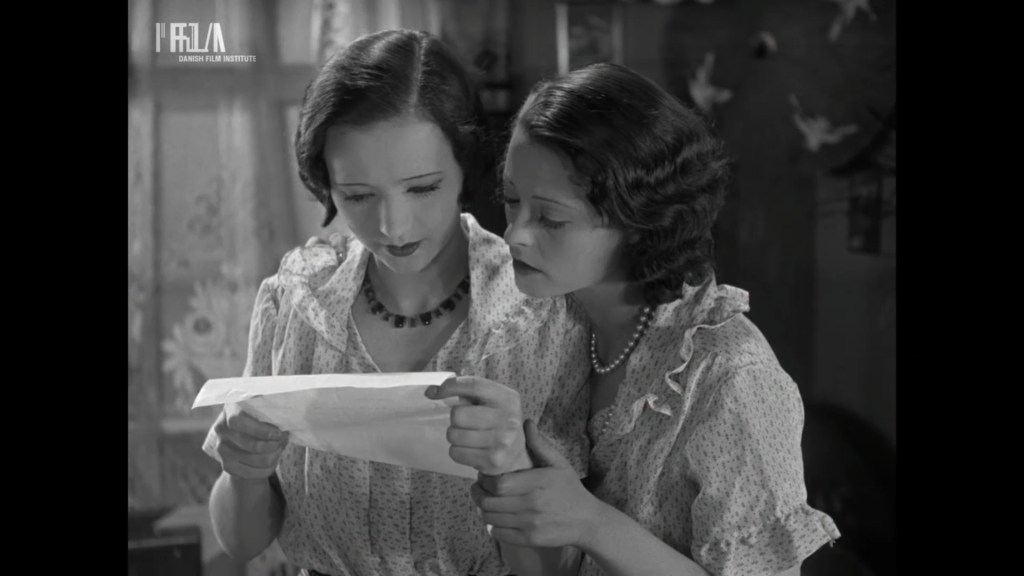
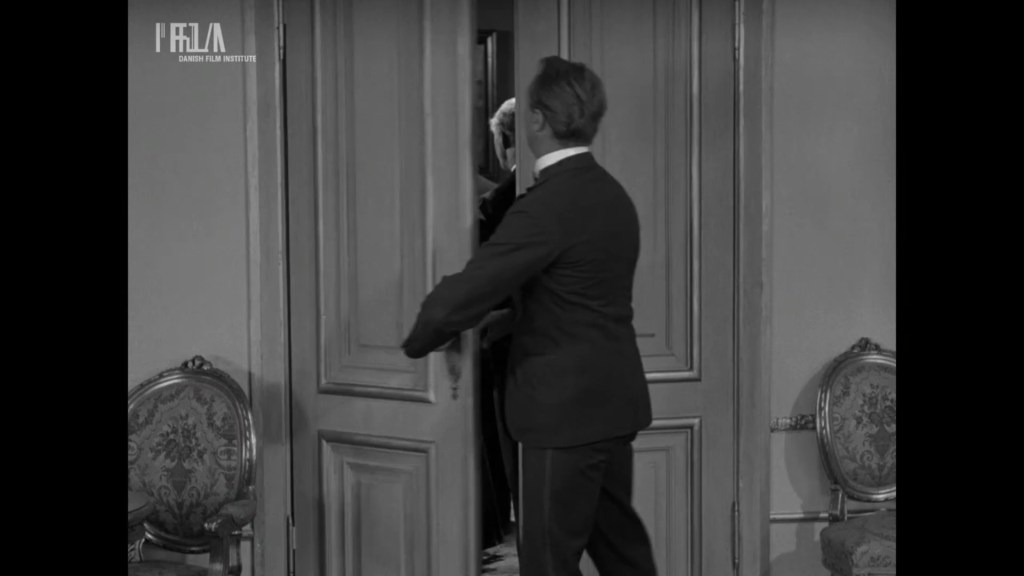
Krudt med Knald (1931; Den.; Lau Lauritzen Sr). Long and Short (Carl Schenstrøm and Harald Madsen) live in a boarding house, flirting with their young neighbours – a nimble duo of roller-skating dancers (Marguerite Viby, Nina Kalckar) – and making friends with their older neighbour, the Inventor (Jørgen Lund). The latter has invented a proto-televisual system, which is highly prized by a sinister trio of men representing “United Electric”. The trio move into the pension, aiming to steal the Inventor’s drawings and also the girls upstairs. After inadvertently foiling one attempt to steal the drawings, Long and Short are hired as drivers by the trio. Thinking this will get them out the way, the trio take the girls for a drive – but are once more stopped in their plans of seduction by Long and Short. Meanwhile, the Inventor signs a deal to gain half the profits from his invention from United Electric. But the trio from the company want to steal them from their boss to gain all the profits themselves. The trio enlist Long and Short to help them break into the office and the safe where the plans are, and arrange that the duo get arrested in their place. But the duo escape and save the day, catching the trio and saving the Inventor. ENDE

I’ll be honest: I feared that I wouldn’t get on with this film. I have been aware of the Danish comic duo Fyrtårnet and Bivognen for some years. Many of their films, including today’s, have been long available for free via the DFI silent film portal. But without subtitles or music, this little thread of silent film history has never enticed me to battle through. (On this same theme, I have had a deluxe Film Archiv Austria DVD edition of the films of early Austrian slapstick duo Cocl and Seff on my shelf for years. Somehow, I’ve never quite been in the mood to unwrap and investigate.) Yet this is precisely the kind of hesitancy I should overcome. After all, Danish silent cinema is a much more complex and multifaceted body of work than as represented by the canonical films of Benjamin Christiansen and Carl-Th. Dreyer, or the stardom of Asta Nielsen and Valdemar Psilander. The comic duo Fyrtårnet (Carl Schenstrøm) and Bivognen (Harald Madsen) were wildly popular in the 1920s and 1930s, and not just in Denmark. As the DFI page dedicated to their work reveals, under the names “Pat and Patachon” they were also big stars in Germany. Indeed, even the English version of the DFI pages on the duo stick with the Germanified “Pat and Patachon” as their non-Danish character names. “Long and Short” seem to be the English equivalent, and I only know this thanks to the English subtitles available on this presentation from Bonn.

All of which is to say that I was utterly unprepared for how much I enjoyed Krudt med Knald. I was also unprepared for the rhythm of the film, and how this heightened the pleasure of watching it. Though Long and Short (to reinstate their English aliases) are slapstick performers, the timing and execution of their gags do not attempt the speed or sheer breathtaking cleverness of Keaton, Lloyd, or Chaplin. They are a shambling, mostly slow-moving pair. One can follow their thought patterns more readily, watch their logic slowly unfold with everyday velocity. The opening scene is about neither character wanting to get up before the other: the Keaton-esque pulley system to tip one another out of bed is not especially sophisticated. (As compared to Keaton’s house in The Scarecrow (1920), for example.) But it’s character that seems to drive the gags, not the gags that define the character. It’s the mutual stubbornness, and the ultimately comradely and good-natured conclusion of the scene, that comes across – and brings the laughs.

The world they inhabit is also exceedingly well observed. The lengthy meal scene at their boarding house, overseen by the large landlady, is filled with brilliant touches. While the gags about increasingly large/tall/long-limbed neighbours at the table is good, if not necessarily sophisticated, the real laughs come from the manners and mores of the setting. The film cuts from the duo’s resigned efforts to make the most of their miserly portions to wall-mounted slogans about the health benefits of privation: “Keep sound: Don’t eat too much.” “To eat one’s fill is to eat too much.” “The less you eat, the better you feel.” The efforts of Long and Short to fit in (literally and metaphorically) to the pretensions of their petit-bourgeois hostess is marvellous.

Later, there is another rather shambling sequence involving a sleepwalking Short, who walks along the rooftop of the boarding house and frightens the inhabitants. A rooftop sleepwalking sequence is hardly novel (especially for 1931), and it doesn’t pretend to offer the suspense or drama of the stunt work of a Keaton or Lloyd. But what it does instead is take the opportunity to poke fun at the landlady and her friends, who are busy having a séance. When the landlady sees the silhouette of Short, wrapped in his bedsheet, she screams: “It was Napoleon!” It’s a brilliant gag, in which the landlady’s fear also boasts of her pretension at having summoned a mighty name of history to her boarding house séance. The payoff, too, is surprising. For Short’s friends all rally round him and they form a little community, gathered round the Inventor in mutual support.

Time and again, I was surprised by how plot lines or details of character developed in unexpected directions. For example, the Inventor is portrayed initially as a comic figure, inspired by drink. “At the bottom: that’s where the good ideas are!”, the Inventor explains to Long and Short, motioning to his bottle of liqueur. “I’ve never found anything up there”, he adds, pointing to the top of the bottle. It’s a marvellous line. (And the kind of joke about drink and human foibles that still inflects Danish cinema today.) But it also marks the old man as vulnerable and human, facets which foster his friendship with Long and Short, and with the two performing girls.

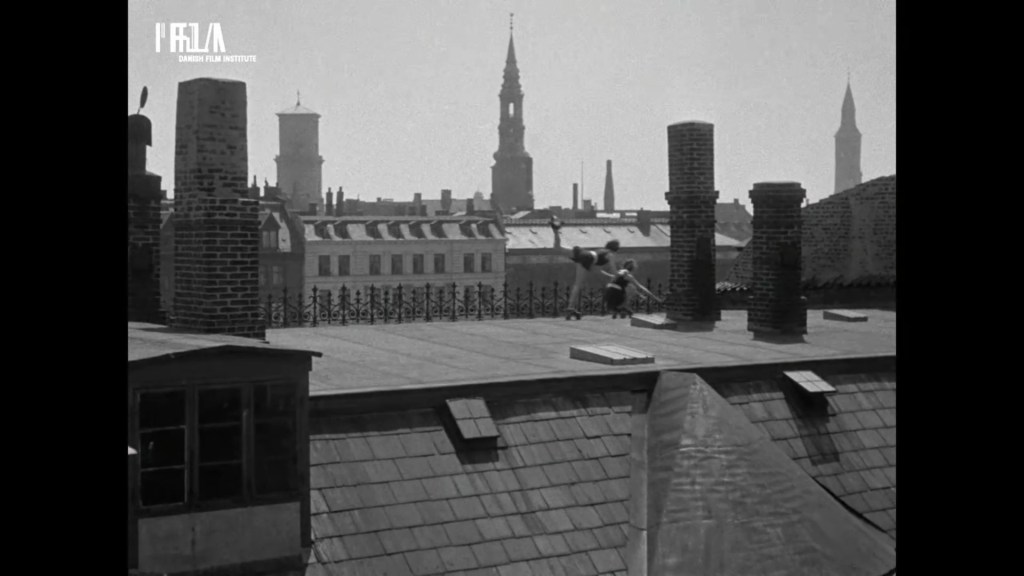
Regarding the latter, I was also very touched at how Long and Short treat them with almost chaste respect. There is no romance as such, just a kind of comradely innocence and mutual respect. The pleasure of their relationship is not so much the prospect of romantic love as of protective friendship. We first meet the girls on the rooftop of the boarding house, where they are trying out their new “number” on roller-skates. It’s an entirely unnecessary sequence, as far as narrative is concerned, but it’s utterly, utterly delightful. Filmed on an actual rooftop overlooking the city (Copenhagen, one assumes – but I’ll gladly be corrected), there is a real sense of freedom and space – but a freedom and space that are also limited. It’s a moment of joy, demarcated in this small, somewhat precarious space, but set against the bright, open sky and the huge sweep of the cityscape. It’s more than charming or silly, it’s really rather beautiful.

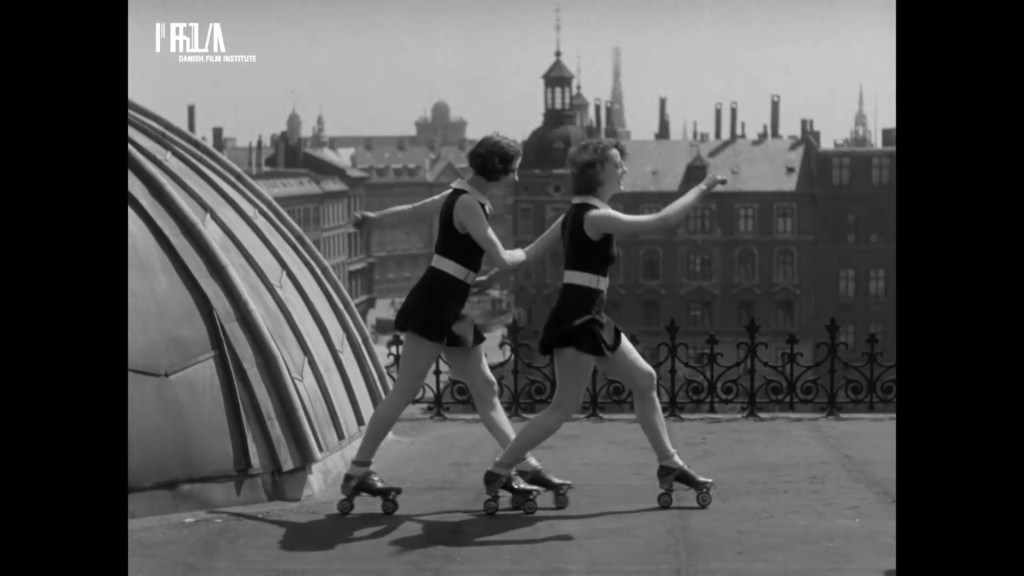
Indeed, there are many moments like this, when the use of location is more than merely incidental but striking and beautiful. The yard where Long and Short are employed to move barrels has some amazing piles of materiel, used to striking effect in some compositions (as when the dup appear right on top of a mountain of barrels) – and for an extended and wonderful sequence involving hiding from the police among the barrels. Here again, it’s not so much the speed of the chase as the sheer extension of the gag: Long and Short popping up and down at random places amid the barrels, while an ever-increasing number of policemen crawl into the maze.

Later, there are also some gorgeous glimpses of the summer landscape. There is a shot of the duo driving through a wheat field in which we see only their heads and shoulders moving through the crop. The sky is bright, the wheat is swaying in the breeze. It’s a surreal sight, wonderfully shot and composed. But there is also great beauty in the way the scene shows us the sweep of countryside. The scene lingers just long enough for the sway of the crop and the treetops to become a subject of contemplation. Even in the middle of a chase sequence, the film is paced and short such as to have an interest that is more than merely narrative.

Krudt med Knald is also weirdly moving. I’ve tried to explain above how the rhythm of the film allows for an accrued sense of emotional engagement – at least with this viewer. So when we see the Inventor, the duo, and the girls join forces and make friends in the boarding house – not just sticking together but living together in one toom – I was genuinely glad that these people – poor, struggling, disappointed, but hopeful – came together. Whenever there is misfortune to any of them, they come together to commiserate or reassure. When Long and Short finally earn some money, the first thing they do is buy food and drink to share with their friends.

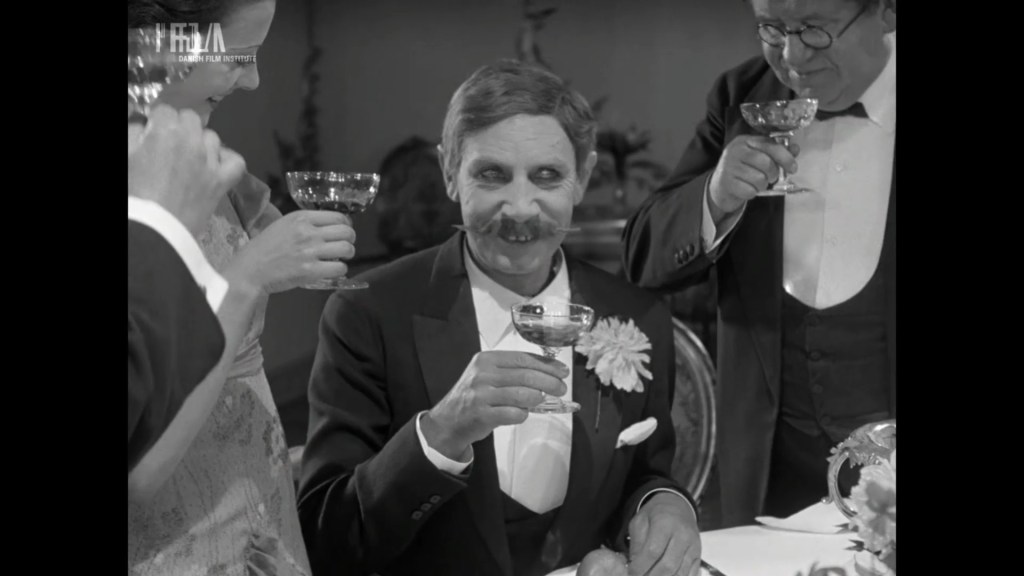
That the film successfully mobilizes a sense of emotional connection is really felt near the end. When, near the end, Long and Short have been supposedly caught in the act of stealing the Inventor’s plans to give to the criminal trio, all their friends are present to witness their arrest by the police. The moment when the girls and the Inventor believe that the duo have betrayed them packs far more emotional punch than I expected. It’s not the outrage at false accusation that stings so much as the hurt of betrayal by those they believed were their friends. It’s very subtly played. (One can imagine a Hollywood production laying it on more thickly.) And it’s the subtleness that gives it an emotional reality, an emotional edge. So it’s all the more effective when we see the group all together in the final scene, where a dinner has been arranged to celebrate the Inventor’s success with United Electric. “This is one of the happiest days of my life!”, the Inventor says. “And I am fill of the deepest gratitude… especially towards my two friends…” – and here his hand falls for a moment on Long’s shoulder. His words, and the performances here, make this moment surprisingly touching. Isn’t it nice to feel happy for such characters? It isn’t the neatness of the narrative resolution, it’s the cumulative sense of comradery build up between character, and between them and us, that makes the end effective.

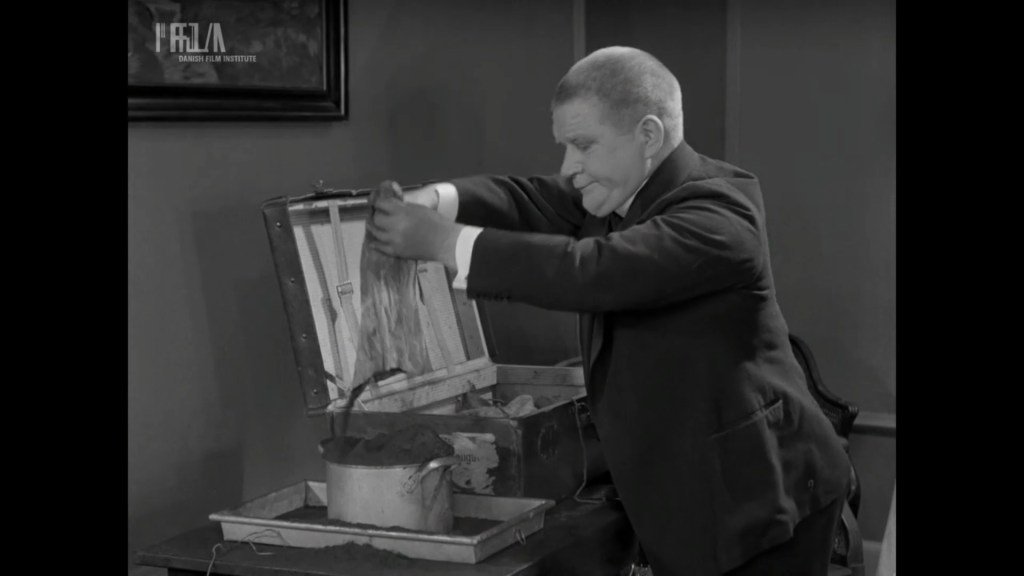
I should also mention that the film’s title Krudt med Knald seems literally to translate as “Gunpowder with a bang”, but is translated in this presentation as “Long and Short invent Gunpowder”. Original and given titles are both somewhat misleading, but this seems to me rather typical of the film’s approach. One subplot is indeed about Short trying to concoct his own brand of gunpowder. He is inspired by the Inventor’s reliance on alcohol to fuel his inventiveness, so starts guzzling bottles to receive inspiration. It’s a silly plotline, one that interacts only tangentially with the main storyline of the Inventor and his drawings. But it is the source of some good gags, especially the postscript to the final dinner scene. Here, Short is ready to show off his own invention to the assembled cast. As he prepares his experiment, the film cuts back and forth from Short’s preparations (the danger of which looks increasingly alarming) to the guests leaving, one-by-one. The time this gag takes to unfold is typical of the film’s rhythm: it’s quite slow, but the sheer elaboration of the single gag attains its own humour. The pay-off is exactly as one would expect: there is a huge explosion, with Long and Short emerging, smoke-blackened and in tatters, from the wreckage of the room. But the pleasure is not in being surprised, so much as in seeing the inevitable conclusion of this plotline, so long prepared and so inevitable that the sheer pointlessness of it – and its stubborn and unnecessary pursuit – is itself the source of humour. By this point, I had already been totally won over by the film. The cumulative silliness had me chuckling throughout Short’s demonstration. And the final shot, of both characters looking directly at the camera, is both funny and touching. Their look is not one of pleading or bafflement or attention-seeking, but a pleasing moment of engagement from character to spectator. And the way Long strokes away the ash from Short’s head – an act of cleanliness, yes, but more a gesture of care and affection – sums up the curious emotional tenor of the film. It’s deadline and funny and moving all at once. A lovely way to end.

The presentation of Krudt med Knald via the DFI portal is with replacement (i.e. modern, digital) intertitles in Danish. There is neither music for subtitle options, so while looking great the video is useful only to the more devotedly interested. As presented here at Bonn, the film has new digital German titles (a sensible option, given that no original aesthetic is being lost) and optional English subtitles. There is also a pleasing musical accompaniment for electric guitar and piano by Tobias Stutz and Felix Ohlert. Like the film, the music has an amiable, rambling quality that suits what I might call the gentleness of the film. While I am curious about the kind of musical accompaniment available in 1931, it was nice to see the film with music that didn’t overstate itself. It’s a curiously subtle film, one that might easily be overpowered by too strident a score.

So, overall, a very pleasant experience. I’m so glad that I’ve finally seen something with Fyrtårnet and Bivognen, as they have been on my horizon for years. While their films have been available via the DFI, this is the first time I’ve had the chance to see one presented in such a way that I gladly seized the chance to sit down and watch it. (As a foot note to the pertinence of programming this film, it was a pleasure to see the Danish director Holger-Madsen playing the small role of the detective. Given that we saw one of his films on Day 4 of Bonn this year, and that I have recently been trying to track down a copy of one of his German films of late, it was rather nice to see the man himself, alive and well and very much not lost from history.)

In sum, Krudt med Knald was a delightful surprise. But that’s rather what I’ve come to expect from the programme at Bonn.

Paul Cuff

Bonn from afar (2025, day 4)

After yesterday’s exploration of vagrancy and destitution, today we return to the world of the bourgeoisie and to the genre of light comedy. This film was just as much an unknown to me as yesterday’s, and just as welcome a treat…

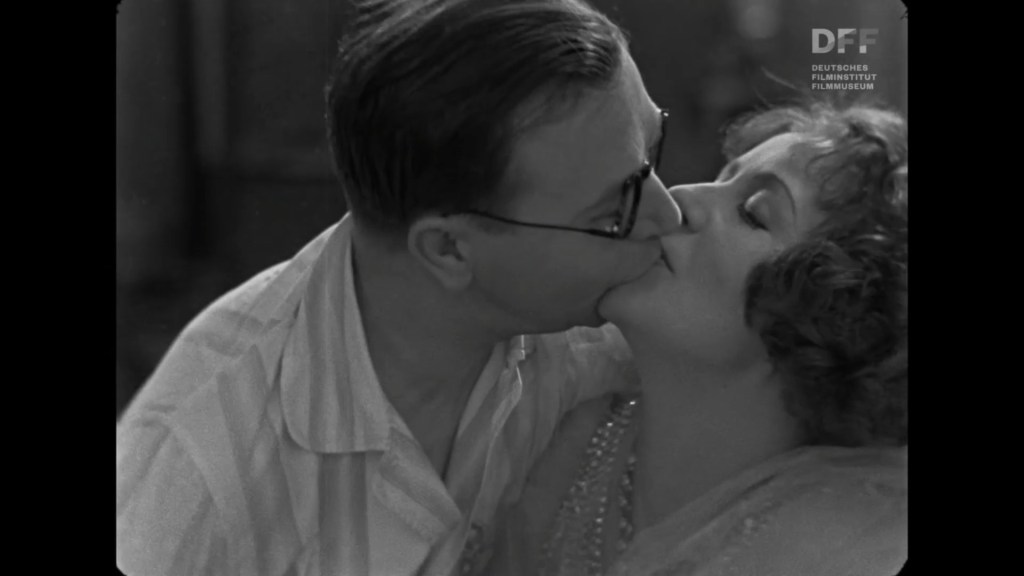
Was ist los mit Nanette? (1929; Ger.; Holger-Madsen). Otti (Ruth Weyher) is married to the night editor of a newspaper, Richard Curtius (Georg Alexander). Unbeknownst to Richard, Otti has saved him from bankruptcy by living a double life. By day she is a dutiful housewife, but at night she works as “Nanette”, a successful vaudeville dancer. Richard still believes the money came from the will of Otti’s late aunt Finchen, from Batavia. However, things get complex when Aunt Finchen (Margarete Kupfer) turns up on their doorstep. Otti pretends Richard is deeply unwell, so hides her aunt in the attic, along with her pet monkey and a huge amount of luggage. Richard’s rich friend Toto (Harri Hardt), who has a crush on “Nanette”, also comes to stay. Inevitably, events soon spiral out of control. After various farcical chases and confusions, Richard realizes that his wife has been lying to him. Accusing Otti of disloyalty, he decides to pursue other women. First among them is “Nanette”, whom he invites to a night out at the Trocadero club. There, the truth emerges. Richard learns of Otti’s double life and her sacrifice for the sake of their marriage. After recognizing that they still love each other, the couple reconcile. ENDE.

This was the only film produced by Ruth Weyher-Film, the company founded by the star. (She would quit acting at the start of the sound era.) I have seen and liked Weyher in a few productions from earlier in her career, but she is more striking here in this lead role, which drives the whole film. It is very interesting to think of Was ist los mit Nanette? as the work of a female producer and star, since its central concern is with a woman’s agency in the face of male expectations. Otti is introduced very deliberately as “Frau Dr. Curtius”, which is formally correct, but markedly eliminates her given name altogether. By contrast, her friend is introduced as “Anita Morell” (Maria Mindszenty), a woman “widowed young” and “halfway to being remarried”. It is as if the shedding of the dead husband has already given her back her name, and the possibility of agency. We might wonder if being “halfway” to marriage is rather more satisfying than being married. Weyher herself gives a delightful performance. Yes, it’s a chance for her to show off before the camera. She gets to dance on stage, run around, and don disguise. But she always bristles with intelligence and wit, her eyes flashing with playful cunning. The film also gives her plenty of close-ups in which something deeper is revealed, glimpses of emotion (doubt, frustration, longing) that lie beneath the play.

As her husband Richard, Georg Alexander is perfect. I think I’ve seen him in more sound films of the 1930s, so I am rather familiar with his distinctive voice, but here on the silent screen he makes the perfect foil for Otti. Everything about him is fussy, particular – a little vulnerable, a little defensive, a little rigid. His married life quickly unravels, and we realize how limited is his conception of a romantic union. From being a loving husband, he reveals the smallness of his mindset. He soon draws on cliched images of a “painted and deceitful” woman to describe Otti. “They used to burn people like you!” he cries at one point. Otti replies that she won’t forget that insult, and neither will we. It’s an absurd thing to say, but it is said in earnest and in spite. But since this film is, ultimately, a comedy, Richard gets his chance to learn. When he hears Otti’s true history of sacrifice – and a sacrifice for love of him – we see him realize his mistake. Alexander’s performance has enough reality to it (enough seriousness) that we might just have hope for his future with Otti.

Around these two leads are a number of interesting supporting performance. The most significant is Margarete Kupfer as Aunt Finchen. I thought this was a marvellous creation. Her hypochondria makes for some delightful use of costumes and props. Obsessed with her own glands, she travels with a monkey and an enormous spray-pump to ward off germs. The latter she uses as a splendidly phallic weapon to chase Richard around his own home. The former animal is the source of slapstick, but also of some great lines of dialogue. (“My glandular baboon! Preserver of my youth!” Finchen blubs at one point.) But this comedy also enables something more interesting. It is noteworthy how much of the physical slapstick in the film is driven by the women (the wife, the best friend, the aunt, the maid), who give out as much as they take. Echoing Otti’s use of disguise, the aunt also finds the liberation of being in costume. With the aid of Otti’s theatrical manager, Finchen undergoes a beauty treatment, emerging from her frumpy outfit and curled hair into glamorous eveningwear and tastefully modern bob cut. We have come to think of her as a purely comedic, almost buffoonish, character – but in the last act she reveals her worldly wisdom. It is she who advises Richard to feign illness, take to his bed, and earn Otti’s sympathy. He duly does, and the trick reunites husband and wife. Not so daft and dowdy, after all, these aunts.

I have so far talked about the film’s performers and themes, but more broadly I must praise how nice Was ist los mit Nanette? looks, and how well the action is directed. The sets – the house, the office, the theatre, the nightclub – are great, richly detailed and beautifully dressed. Amid all this, Holger-Madsen provides lots of nice touches, such as the striking high-angle shot of the characters looking up through the ceiling light when they hear the noise from upstairs. The shot emphasizes the shock, momentarily turning this into a moment of suspense. The characters are taken by surprise with a sound, and the film transforms this into a moment of surprise for us through visual means. More imaginative camerawork is involved in a rather brilliant dream sequence in which the drunk and depressed Otti dreams of being judged and condemned by Richard in a court of law. Superimposed over Otti writhing in her sleep, this courtroom scene is a little comic gem of editing and choreography. (Compared to yesterday’s dream sequence in Der Vagabund, also involving a character dreaming of being tried and condemned, the equivalent in Was ist los mit Nanette? is much more technically sophisticated and rhythmically polished.) It also links nicely to the opening scene of Richard waking up, when he drowsily reaches for the alarm clock and we see it spinning in a kaleidoscopic multiplication of itself. Both scenes are about the vulnerability of the two characters, each experienced in scenes by themselves. It’s one of many fine touches in Was ist los mit Nanette?, which is filled with pleasing details to reveal character and emotion. The whole film is well staged, well photographed, and well edited. Though one reel of the film suffers from some bad decomposition, it is a great example of how good a film of this era can look.

Music for this presentation from Bonn was by Maud Nelissen and Mykyta Sierov. Their combination of piano and oboe is playful, sympathetic, rhythmic, and melodic – a great accompaniment to the film. Though the live presentation of the film in Bonn (so the online notes tell me) was prefaced by an introduction and rare footage from the Weyher estate, which I would have loved to have seen, Was ist los mit Nanette? by itself is a great feature with an enjoyable score.

I said at the outset that Was ist los mit Nanette? is a very different world to yesterday’s film, Der Vagabund. But Weyher’s comedy also has an edge and offers, in its own way, a subtle critique of the bourgeois world in which it is set. Socialist drama it ain’t, but it also finds a sophisticated way for us to think about what we’ve seen, and question the assumptions we might have: about gender roles, about performance and disguise, and about our expectations and assumptions of what an equal relationship might be. I very much enjoyed this film, which was a total unknown to me. A delightful surprise, beautifully presented.

Paul Cuff

Searching for Der Evangelimann (1923; Ger.; Holger-Madsen)

This week, I’m writing about not being able to write. I’d love to be telling you all about the beauties of Holger-Madsen’s film Der Evangelimann (1923), but all I can do is write about my entirely unsuccessful efforts to find a copy. While I am therefore unable to offer much insight into the film itself, I hope to offer some reflection on the intractable difficulties of writing about film history – and finding it.

Why am I interested in Der Evangelimann? Well, as previous posts indicated, I have a growing curiosity about the work of Paul Czinner and Elisabeth Bergner. I have a longstanding project on their Weimar films, but I am also interested in their work before their first collaboration in 1924. Der Evangelimann was Bergner’s first film role, and her only pre-Czinner work for the cinema. This Ufa production was made in Germany but was directed by the Danish filmmaker Holger-Madsen and premiered in Austria in December 1923. Contemporary reviews were mostly favourable, but since its general release in 1924 it has virtually disappeared from the record.

I am also interested in the cultural background to Der Evangelimann. The film was based on an opera of the same name, composed by Wilhelm Kienzl (1857-1941). As even semi-regular readers of this blog may be aware, I am a devotee of late romantic music – and obscure operas by lesser-known composers have their own attraction for me. Since it swiftly became apparent to me that Der Evangelimann was going to be a difficult film to see, I turned my attention to finding a recording of the opera. As it turned out, Kienzl’s music was an absolute delight. A pupil of Liszt and a devotee of Wagner, by the 1890s Kienzl had become a successful composer and music director in various central European cities. Der Evangelimann (1895) was his greatest hit and became a regular production for opera houses into the first decades of the twentieth century. However, Kienzl never produced another opera that established itself in the repertoire to this extent, nor did he write much in the way of substantial music in other genres. By the 1930s, he had withdrawn from active work and by the time Europe emerged from the Second World War he was dead, and his work largely neglected. (His support for the Nazi takeover of Austria in 1938 cannot have helped his posthumous reputation.)

The opera Der Evangelimann is a pleasing blend of late romanticism with a touch of verismo (i.e. something rather more realistic than romantic drama). The libretto, adapted by Kienzl from a play by L.F. Meissner, is also a kind of ethical drama. Act 1 is set in 1820 around the Benedictine monastery of St Othmar in Lower Austria. The monastery’s clerk Matthias is in love with Martha, the niece of the local magistrate Friedrich Engel. Matthias’s brother Johannes is jealous of this romance, since he covets Martha for himself. Johannes betrays the lovers’ secret relationship to Friedrich, who furiously dismisses Matthias from his job. Seizing his chance, Johannes proposes to Martha, but he is angrily rejected. Matthias arranges with Martha’s friend Magdalena that he will meet his beloved late one evening, before he leaves town to seek work elsewhere. Their nocturnal meeting is witnessed by Johannes, who storms away in a fury of jealousy. As the lovers say a sad farewell, a fire starts in the monastery. Matthias tries to help but is swiftly blamed and arrested for the crime. Act 2 is set thirty years later, when Matthias returns to St. Othmar. He has spent twenty-five years in prison, after which he became a travelling evangelist, preaching righteousness and justice. He encounters Martha’s old friend Magdalena, who now looks after the ailing Johannes. We learn that Martha drowned herself rather than submit to Johannes’s proposal, and that Johannes has since attained great wealth but is haunted by enormous guilt. Magdalena ushers Matthias to see Johannes, who receives Johannes’s dying confession of guilt for the fire. Matthias forgives his brother, who dies in peace.

Kienzl’s opera is gorgeously orchestrated and contains at least two rather wonderful melodies. The most famous, “Selig sind, die Verfolgung leiden um der Gerechtigkeit willen”, is Matthias’s evangelist hymn. Kienzl, knowing he had written a good tune, cunningly makes Matthias teach a troupe of children this melody on stage. We thus get to hear the melody several times in a row, and it becomes the leitmotiv of reconciliation and forgiveness between the brothers. But my favourite scene of the opera is in Act 1. Rather than a set-piece number, it is a scene of anxious, hushed dialogue between Mathias and Magdalena. They are arranging Matthias’s final meeting with Martha before he leaves, and as they talk the bells are ringing across town for vespers. Kienzl creates a spine-tingling atmosphere that has remarkable depth of sound: from the slow, deep ringing of the cathedral bell to the warm halo of strings, then to the bright chiming of a triangle. A simple downward motif is thus given greater emotional resonance: you can sense the space and warmth of the evening, but also the sadness of departure, the steady pressing of time upon Matthias. In Act 2, when Matthias meets Magdelena again, the midday bells sound: suddenly, the scene evokes the past through an echo of its warm, chiming orchestration. It’s a beautiful scene, perfectly realized. (At this point, I pause to recommend the 1980 recording of Der Evangelimann conducted by Lothar Zagrosek. It has a great cast, too: Kurt Moll, Helen Donath, Siegfried Jerusalem. Though the EMI set is out of print, it is readily available second-hand. A must for anyone interested in out-of-the-way late romantic opera.)

The 1924 film maintains the same basic plot and setting as the opera, though it has one or two curious departures. Per the opera, the first part of the film replicates Mathias (Paul Hartmann) and Martha (Hanni Weisse) being betrayed by Johannes (Jakob Feldhammer) to Friedrich Engel (Heinrich Peer), followed by the fire in the monastery and Mathias’s arrest. Years pass, Martha has married Johannes and together they have a young daughter, Florida. Martha then discovers that Johannes was the real arsonist (when he talks in his sleep) and ends her life rather than continue in their doomed marriage. After her death, Johannes moves to America – leaving Florida in the care of Magdalena (Elisabeth Bergner). Twenty years after the fire, the dying Johannes returns to St Othmar – as does the newly-released Mathias, now known as “the Evangelist” due to his preaching of holy justice. After Magdalena and the teenage Florida (now played by Hanni Weisse) go in search of him, Mathias eventually meets the dying Johannes – who then confesses to his brother and receives forgiveness.

I initially pieced together a synopsis from those available via various online sources, plus evidence from contemporary reviews. However, online sources do not provide the sources of their information, and I was left uncertain of numerous details. After a more thorough searching of the documentation catalogue of the Bundesarchiv (Germany’s state archive), I located the German censorship report of July 1923. Thankfully, this had been digitized and made available for public access. (As have many such censorship documents from the period.) The censorship report includes a complete list of all the original intertitles for the film, together with an exact length (in metres) for each of the six “acts” (“act” usually being a synonym for reel). Though there is no accompanying description of the action (i.e. what’s happening on screen), the titles provide a much clearer picture of the film’s structure and action. The document demonstrates how significantly Holger-Madsen expanded the ellipsis between the opera’s original two acts. The film’s second and third acts are set after the trial and the first years of Mathias’s imprisonment, allowing a glimpse into the minds of both brothers and of Martha – and showing us Martha’s discovery of Johannes’s guilt, and then her suicide.

Yet even the list of titles leaves some aspects of the narrative unclear. The film’s invention of a daughter for Martha/Johannes allows Hanni Weisse a double role as both mother and daughter. But I am unclear as to what (if any) dramatic function Florida has to the plot (she is evidently not a suicide deterrent!), or how exactly Mathias’s return is handled. Does Magdalena have a crucial role in this, or does he find his way back by chance – or by his own volition? Does Mathias encounter Florida, and what is his reaction to seeing the spitting image of his lost love? The titles do not make this clear.

Would other documents help? I know that if I visit the Bundesarchiv collection in person, I can inspect a copy of the programme for Der Evangelimann which may (or may not) clarify the issue. But where else to turn? I cannot find evidence of the film being released in France, in the US, or in the UK, and thus cannot find any other easy source of a more elaborate synopsis or of additional still photographs.

What of sources on Bergner? In Germany, there are many books devoted to her life and career on stage and screen – as well as her own memoirs. Ten years after the film was released, Bergner recalled being so disappointed with her experience on Der Evangelimann that it inspired her “contempt” for the entire medium of cinema (Picturegoer, 18 August 1934). In her later memoirs, Bergner claims that Nju (1924) was “my first film” (69) – erasing altogether the memory of Der Evangelimann. Those subsequent biographers or scholars to mention the film do so only in passing, but most accounts simply ignore its existence. The only account that even suggests familiarity with the film is that of Klaus Völker, which provides a meagre synopsis in its filmography and describes Bergner’s “slightly hunchbacked” appearance (398). Had Völker seen Der Evangelimann, or was this description based purely on publicity photos of the production? (The book contains only one other reference to the film, which repeats Bergner’s own grave disappointment in the role and the medium as a whole.)

Elsewhere, Kerry Wallach’s very interesting discussion of suicide in Bergner’s films (and contemporary Weimar/Jewish culture) makes passing reference to Der Evangelimann (19), but nothing that suggests familiarity with its content. Given Wallach’s interest in suicide and love triangles across Bergner’s films, it is odd that nothing is made of this first screen role being in a film that has both. I am curious, too, that Holger-Madsen chose to cast Bergner in the secondary role of Magdalena, since Martha is a much more interesting character – and her off-screen suicide (“in the waters of the Danube”, according to Matthias in the opera) would have directly foreshadowed the deaths of Bergner’s later characters.

All of which brings me to the nub of the issue: does any copy of Der Evangelimann survive? Has anyone seen it? Of course, the first source interested parties are usually advised to consult is the Fédération internationale des archives du film (FIAF) database. This is designed to be a collaborative database for information on archival holdings from across the world. Search here, and you can find the details of a film and a list of archives that hold material relating to it. That, at least, is the theory. In practice, it relies on data from its member archives that is not always available, complete, accurate, up-to-date, or forthcoming. I have long since accepted that the absence of a film on the FIAF database does not mean it is absent from the archives. This acceptance brings hope but creates other problems.

The next step, at least for a German production, is the usually (but not always) reliable filmportal.de. It is usually a decent indicator of the film’s survival in German archives and will also list the rights holders to the film and/or any restored copies. In the case of their page on Der Evangelimann, it lists the rights holders as the Friedrich-Wilhelm-Murnau-Stiftung – the inheritors of much German cinema of the pre-1945 era. The FWMS lists details of the film on their website but (having asked them) they do not themselves possess any copy. Such is often the case, where the legal possession of a film does not coincide with the physical possession of a copy – or even the guarantee that a copy exists.

Where next? Well, the Bundesarchiv helpfully provides an accurate database of its film holdings – but this too yields no copy of Der Evangelimann. Various catalogue searches and archival contacts in Germany, Austria, the UK, and Russia have likewise yielded no result. Given that Holger-Madsen was Danish, I did also consult the Danish Film Institute about the film – but Der Evangelimann is not even listed on the DFI filmography of Holger-Madsen’s work, and they profess to have no copy. (Or at least, did not profess so to me.)

If Der Evangelimann had been restored, it would likely appear on more archival or institutional catalogues available online. But it seems scarcely to have made any mark on film history before proceeding swiftly to oblivion. Indeed, the only record I can find of any screening since 1924 was at the Internationales Filmfestival Mannheim-Heidelberg in 1963, where Der Evangelimann was part of a retrospective of Bergner’s work. Was this a complete print? Was it even shown, or just listed as part of the line-up? (Needless to say, I have contacted the IFFMH to see if they have any record of which archive loaned them the print, but I have not yet heard back.)

My only remaining option is to contact every film archive in the world, but there is no guarantee (as I have already discovered) that any of them will reply to a private researcher undertaking a wild goose chase. If an institution, restoration team, or legal rights holder were to make this inquiry, I imagine the process would be much more likely to yield results. As an individual, I have only a handful of contacts in the archival world, and limited resources of time, money, and patience to feed into this search. I cannot issue a convenient “call for help” that summons responses from across the world.

All of which makes an illustrative example of the problems of film history. What I have experienced scouring public resources for traces of Der Evangelimann is a frequent and frustrating instance of a common issue. The film may well exist in an archive, but without any publicly available acknowledgement of its status it might as well (for the purposes of film history and film historians) not exist. That which cannot be seen cannot be studied. It is also frustrating that no scholar on Bergner has ever taken care to admit either that they have not seen the film, or that the film does not exist – and that therefore future scholars should not waste time trying to locate it. Filmographies are infinitely more useful if they include information on a film’s original length (in metres, not duration), together with its current restorative status in relation to its original form of exhibition. These are quite basic facets of film history, but it is amazing how rarely scholars ever cite them – or are required to do so. (I am myself guilty of this.) As regular readers will know, it is a bugbear of mine that many restorations and home media editions likewise provide viewers with so little information on the history of what we are actually watching. It perpetuates a cycle of missing information: the material history of a silent film – the most literal evidence of the medium itself – is too often taken for granted and simply left out of its presentation, either on video or in written texts.

In the case of Der Evangelimann, a century of critical and cultural disinterest has left me with very little evidence to go on. Does the film survive? I do hope so. Even if it is a failure, and even if Bergner’s performance awful, I just want to see it and find out. A film doesn’t have to be a masterpiece to deserve recognition and restoration. I just want to see it! I will continue to pester archives, but in the meantime I suppose I can also pester you, dear reader. Do you know anything about where a copy of Der Evangelimann might be held? Any information would be most gratefully received.

Paul Cuff

References

Elisabeth Bergner, Bewundert viel und viel gescholten: Elisabeth Bergners unordentliche Erinnerungen (Munich: Bertelsmann, 1978).

Klaus Völker (ed.), Elisabeth Bergner: das Leben einer Schauspielerin (Berlin: Hentrich, 1990).

Kerry Wallach, ‘Escape Artistry: Elisabeth Bergner and Jewish Disappearance in Der träumende Mund (Czinner, 1932)’, German Studies Review 38/1 (2015), 17-34.