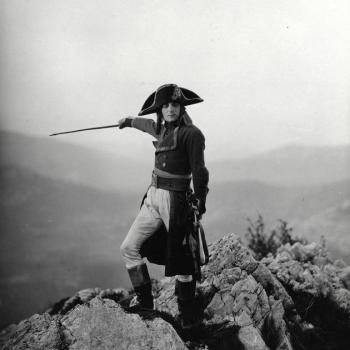
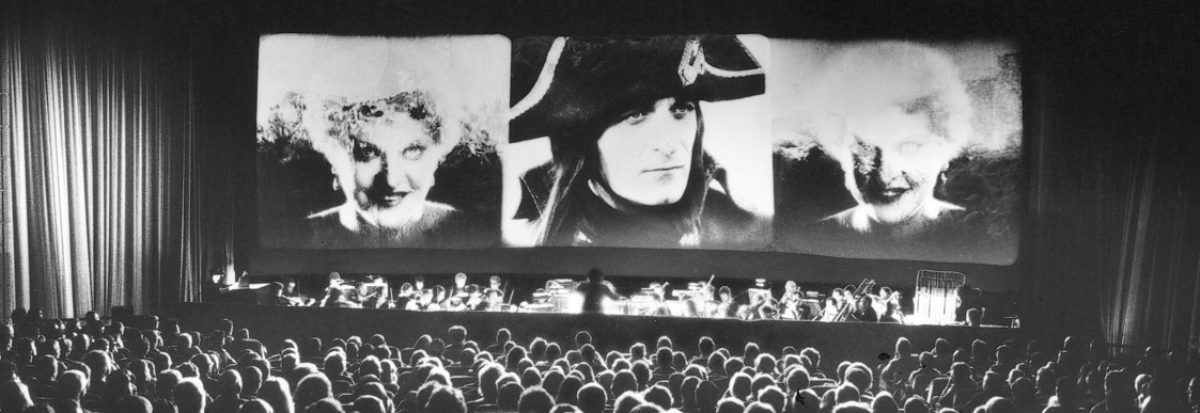
I watched Henri Pouctal’s Alsace because I had about an hour to spare, and the film is about an hour long. This copy, from the EYE Filmmuseum is preserved with English language text, which suggests it was an easy sell to wartime allies across the Channel. Aside from its convenient timespan, it also appealed to me because it stars Albert Dieudonné, an actor with whom I’ve spent an inordinate amount of time by simple virtue of having seen Napoléon so very, very many times. In fact, such was his peculiar CV, it’s a little uncommon to happen upon him outside the confines of a film by Abel Gance. In terms of screen time (Napoléon alone being the length of several normal feature films), Dieudonné spent a high proportion of his life on celluloid within the confines of Gance’s oeuvre. All of which leads us to…
Alsace (1916; Fr.; Henri Pouctal)
In pre-war Alsace, the Orbey family are loyal to France while living under threat of expulsion by the German occupiers. Jacques, the son of militant Francophile Jeanne Orbey, falls for Marguerite, the daughter of a German family. A fight ensues over the identity of Jacques. Whom will he choose: his mother or his wife?—France or Germany?
A vibrant green spells out the film’s title: Alsace. But what is this title introducing? In this print, at least, there are no other titles before the film’s first image: An exterior. Trees tinted green. The Mother: Jeanne Orbey. Dressed in black, she slowly raises a hand to her brow, in grief. The film’s title is her own introduction: she is Alsace.

Jeanne wears traditional Alsatian costume, which for women involves a huge bow-like headpiece. When we see her home, we realize that all the local women wear traditional local costume. It’s like wandering around inside a patriotic postcard produced in the years after Alsace’s annexation by the newly-invented Germany in 1871.
Only it’s not. For the world on screen is incredibly rich. Look at those thick, heavy crinolines, that child’s tunic, the dark-suited elders. The ceiling and walls are dark with age and varnish. The curtains are visibly heavy, patterned, luxurious. Look at the ceiling lamp with its material shade, glowing gold in the tinting. It’s a gorgeously-mounted set. It’s not a rich environment—these people are middle-class, not aristocracy—but the texture of the image makes you sense it’s a lived-in space. I can believe these people have roots here: just look how heavy the furniture is.

“Their German neighbour, Herr Schwartz and his friends junket on sauerkraut and beer.”
When was the last time you saw the word “junket”? It strikes me as the kind of word tabloid headlines reach for when they want to make a perfectly ordinary event seem outrageous. If you didn’t know this film’s stance on the occupation, you know now. For the Germans don’t “eat” their dinner like decent French Alsatian folk, they “junket” on their foreign sausages, despicable German sausages, not like salt-of-the-earth French saucisson. And just look at their ceiling lamp: a monstrous metal contraption that hovers sinisterly over their table. As the local French population dresses in patriotic postcard chic, so the Germans dress to eat like they’re heading for the parade ground. They are epaulette-heavy, cavalry frockcoated, broad-chested, shiny-buttoned. They have no manners. Just look how that pudgy woman gobbles that sausage. “To—Greater Germany!” is their toast. Boo! Germans! Boo! They drink with heavy tankards. Boo! Nasty German tankards! Boo!

It’s a relief to go outside for some air. But no! Even here the pantomime villainy continues. A lovely scene—toned brown, tinted light blue. The trees have the look of winter. It’s fabulous to watch the branches. It makes me think of a Gance film from the same period—Mater Dolorosa (1917)—that features a similar tinting scheme, and revels in the chilly poetry of winter exteriors. (Looking up more info on Alsace, I am very pleased to see that the two films share the same great cinematographer: L.-H. Burel. I clearly have a good eye for wintry French cinematography.) Moustachioed Krauts with swords and big hats barrel around in oafish aggression. They try and feel up the local women wearing (yes, you’ve guessed it) traditional Alsatian dress. “Provoked beyond endurance”, the locals revolt and a punch-up starts.

Jeanne Orbey has gathered loyal Alsatians. They sing the forbidden anthem: “La Marseillaise”. Jeanne is on the right of frame. Her friends are to her left, but she looks to her right: at us. The crowd waves little flags at the top of the frame. In the foreground, they crouch low, they clench their fists. An old man at the fore mouths the words with clarity. Not just Jeanne, but the whole cast seem to be urging us to join in, to clench our fists, to shout, to sing. It’s an amazing scene. But it’s sinister, too. The old men seem to be stalking the camera, ready to launch out at us.

(Compare this mentality to the “Marseillaise” sequence in Napoléon. Though Gance’s film has often been accused of nationalism, the crowd of 1792 sings this anthem in an expression of communal joy. You see faces weeping in real emotion; it’s not angry at all; there is no visible enemy to threaten; it’s a sequence of inclusivity. In Alsace, “La Marseillaise” is a hymn of angry defiance, of exclusive identity. The old men practically wave their fists at the camera as they sing it. They’re terrifying. This is a mob looking for a victim. This is nationalism.)
Outside, a platoon of Germans (boo! look at their pointy hats! boo!) hears the anthem and approaches the house. There is a confrontation. M. Orbey is sentenced to three months’ imprisonment. So, “Recalled by his mother, Jacques Orbey returns home from his college at Nancy.”
Here is Albert Dieudonné. It’s a nice change to see him in a suit, to see him hesitant, weak-looking. He is called for military service by the (German) authorities. He stands. His hand rises slowly to his head. Even his sadness is hesitant, weakly. M. Orbey is expelled from Alsace, so Jeanne goes with him. Jacques stays to prevent the family business “falling into German hands.” A crowd gathers to cheer the departing resisters. Many an Alsatian bow bobs in the crowd.
A year later. A letter from Jacques. He claims he loves France as much as his parents, but he says he enjoys his work and befriends his workers. And in the mill, Jacques is left by his uncle (a veteran of the war of 1870) to deal with Herr Schwartz, whom he cannot stand. But Jacques gets on well with the affable Herr Schwartz.
Family friends observe the two young Schwartz girls. Then the two families encounter one another. “A German Invasion” is how the title describes the scene: it’s another tabloid headline. Jacques is unaware how uncomfortable he makes his uncle by being polite to his German neighbours, by falling for one of the daughters. A lovely tableau: the lovers in the window of the house, kissing; in the foreground, the uncle and aunt, scowling. It would be charming or comic if the film didn’t want us to be outraged at love that crosses national boundaries.

“It’s enough to make your murdered grandfather turn in his grave” shouts the uncle in the next scene, confronting Jacques, who (again) feebly holds his head in his hands. (Will this man really be Bonaparte in ten years’ time?) The uncle writes to Jeanne about Jacques’ engagement to Marguerite. (She is both Marguerite and Gretchen in various titles, depending—I imagine—on whether the characters are meant to be talking in French or German. The same switch happens in French translations of Goethe’s Faust. French operas have their Marguerites, German operas have their Gretchens. Then again, this film’s English titles are inconsistent in spelling the names of all the main protagonists: are they the Schwarz or Schwartz family? Is the cousin Susie or Suzie? Is he Jacques or Jacque?)

But how will Jacques deal with the Schwartz family? They have their own singing scene, celebrating the military promotion of one of their kin. Instead of facing the camera, they face to the right. The comic exaggeration of the performances signal that this anthem is pompous nonsense (not like our anthem!). Poor Jacques looks miserable, stuffed into the corner of the frame. Then he is told that his mother has been given a permit to return. Jacques looks sad, Marguerite concerned. “Your uncle wanted to surprise you”, she says. “He is bringing up reinforcements to defeat the German girl.” It’s meant to be a catty comment (her expression, direct to camera, shows as much) but it’s perfectly true.

Jeanne returns. She makes an entrance. A slow entrance. She walks across the room, decked out in little tricolours and bows. She fondles a cabinet. She strokes a chair. A woman in (all together now…) traditional Alsatian dress is in the background, looking admiringly at Jeanne’s restrained emotion at returning home. She is handed a large bouquet. “Oh, the lovely flowers of Alsace!” (Yes, gathered in the woods by loyalist women.) Jacques havers awkwardly in the background. The women take centre stage, his mother occupying front centre.

Now to the crux of things. Jeanne puts her hand on Jacques’ shoulder. Behind them, the uncle’s family look on: it completes the triangular composition, but it makes it look like an additional weight on Jacques’ shoulder. He is overlooked, burdened. “Tell me it’s not true?” his mother asks of his engagement to a German girl. “Yes, it’s true. I love Marguerite… and why not?… Love knows no frontier.” It’s a good answer, and the first thing Jacques says with real conviction. He stands and shouts and clasps his hands (Bonaparte at last!), but then immediately covers his head with his hands, as though he’s said something appalling. And just look at his mother, who looks at him with contempt (at least she looks at him, the family avert their eyes with horror and shame.) “You dare say that? Think of your banished father and your grandfather whom they murdered!” She demands he promise never to marry her: “don’t let the Germans take you… remain one of us”. She coddles him in her arms. The family flank them. He is imprisoned in Pouctal’s framing of the family.


The Schwartz family arrives with kind gestures and delicious cake. (But Gretchen pleads a headache and stays at home.) “May I congratulate you on your son? He’s a nice boy and a fine soldier.” So says the elder Schwarz; it’s a compliment, but Jeanne’s face scowls like it was an insult.
The neighbours visit Jeanne, all wearing (surprise, surprise) traditional Alsatian dress. It’s propaganda postcard territory again. These aren’t people, they’re symbols trotted in to make a point. And the point is reinforced as everyone gathers around the piano. Jeanne wants to lead them in “La Marseillaise” again. Jacques warns her of the danger. “Who dares say ‘hush’?” she demands, addressing the room as if her son didn’t exist. He runs out.
Jeanne is now a widow. She moves in with her family. We see a night at home: Susie (Jacques’ cousin) boasting that her fiancé is serving in the French army. Jacques is in the background. At Susie’s words, he strikes the cabinet in frustration. I have every sympathy with him. His mother, in the foreground as ever, looks appalled at his behaviour. Jacques puts his head in his hands again. (Poor Bonaparte.)
Jacques is seriously ill, the doctor unable to cure him. “In my opinion, only you can save your son”, he tells Jeanne. Look at Jacques. At last he is in the foreground of the frame, but only by virtue of being bedridden with suicidal depression. It’s a marvel to see him so emasculated. When his mother swoops, her black dress presses down on his pale face and the white sheets. It is Jeanne who dominates the frame when she rises. The camera gives her a moment—more than a moment—to show her emotional struggle. Will she admit Marguerite/Gretchen into the family? She briefly consults her brother, then goes to the Schwarz household.

She turns up in an extraordinarily forbidding costume: something between funerary majesty and celebratory pomp. Marguerite/Gretchen rises, approaches. She submits to Jeanne’s kiss upon her brow. Her family are ecstatic. (And yes, they are always so friendly, so comically expressive. It’s not a victory over France that they celebrate, but the thought of peace and love.)

“Some months later… Jacques and Marguerite are married… but deep-rooted racial differences soon sow discord between them.”
What are these deep-rooted racial differences? All the film can offer us by way of evidence is a scene in which the German girls admire a parade outside. “Our soldiers are splendid”, says their mother, “I have never before seen so many troops in the Vosges.” Jacques reads the paper disconsolately. There is a passing comment about Jacques preferring French cooking to German. Deep-rooted racial differences? Then the family rejoices in one of their own, fresh in his parade ground uniform, showing off his rank. Jacques keeps reading his paper.

News of Russia’s mobilization. “When the ‘Day’ arrives, everyone must know his duty”, says Jeanne. While the French family discuss the news, the Schwarz family argue about Jacques. Marguerite/Gretchen blames Jeanne and says she wants to drive the Germans out of Alsace. The elder man in uniform responds. The text of the title is huge: “They’ll never drive us out of Alsace! Impossible!” (The size of the font seems specifically geared to audiences of 1916 cheering and mocking this statement in the cinema.) Jeanne turns up and starts rabblerousing and insulting. Herr Schwartz arrives and acts with good grace, as ever. An apology is attempted. But Marguerite/Gretchen cannot bear her presence.

Now Suzie’s fiancé returns by stealth, hoping to say farewell before the onset of war. Martial law has been declared, so his presence sparks the police to intervene. The French family helps him escape, while the Schwarz family watches on in worry.
War arrives. The French loyalists must leave. Jacques must say goodbye. Will he join her? Finally he seems decided. “Marguerite! Can’t you understand my own flesh and blood are calling me… my own race… my country.” But once more his Napoleonic outburst ends with him sinking down onto a chair, his head in his hands. Her wife tells him: “you must make up your mind… your mother or me.”

News comes to Jeanne that Jacques is to leave for Stuttgart. He has chosen his wife. So Jeanne goes to confront Marguerite/Gretchen. The latter says, “Jacques belongs to me and me only”, that he has gone to do his duty for “his country”. “His country!” Jeanne shouts: “His country is Alsace. She has bequeathed to all her sons the sacred duty to be French for ever, in peace and in war.”

Outside, Jacques is passing a crowd celebrating the mobilization. He hears a cry of “Death to the French!” and responds with “Vive la France!” It’s his most Napoleonic moment, and immediately he is swamped by the furious German crowd.

He bursts into the room where his mother and Marguerite/Gretchen are arguing. He tells his mother that he was wounded because he defended France. His mother rejoices, his wife despairs. Jeanne now drags her son from the room, shouting triumphantly at Marguerite/Gretchen: “No, he is not yours… he is mine… he is mine now.”


Cut to shot of soldiers running past. The tinting is the colour of fire. Jeanne is at the entrance to a cemetery. She is magnificent in mourning: her huge black Alsatian headpiece, the massive necklace, her rich black dress spreading like the wings of death. She turns and goes inside. She crouches joyfully at her son’s grave. Years have passed. He has been killed in 1915. Now the French army marches past the side of the tombs and Jeanne rises. She shouts over the tomb that Jacques should rejoice. She is ecstatic. She raises her arm in a gesture of triumph. The End.


A strange, uncomfortable, compelling film. Impeccably photographed, coolly directed, yet there is a kind of madness that finally breaks out at the end. It’s as if the careful formal design keeps in check the febrile, fanatic attitudes that lurk beneath. The film is waiting for war to be declared for it to show its true hand. And then it does so: all the pent-up fury and revanchist nationalism bursts out; finally we get real mobs, real blood. That last, elliptical transition from interior to exterior makes it seem as though Jeanne has quite literally dragged her son from the arms of his wife into the tomb. The son is repatriated within the body of France, the soil itself. The last image of Jeanne cooing in triumph over her son’s grave is astonishing, chilling. Does Pouctal play-up the struggle between wife and mother, and Jacques’ weakness, to emphasize the nastiness of nationalism? Certainly, the weirdness of the relationships is made amply apparent in their performances: Gabrielle Réjane as Jeanne is the star (she was a very famous theatre actress), Dieudonné as Jacques a meagre up-and-comer waiting for a proper role. But the film clearly knows its role as blood-and-soil propaganda, mobilizing populist images and populist slogans. I can’t deny it has a certain, grim power—as morbid, elegant, and frightening as Jeanne’s final gesture.
Paul Cuff
 The Realm of Silence