It’s the final film of the (streamed) festival, and also a chance to reflect on the experience of going to Pordenone without going to Pordenone. We end on a silly, giggly, frothy, funny note with what the programme described as “a saucy bedroom farce”…
Up in Mabel’s Room (1926; US; E. Mason Hopper)
The tone is set straight away, with Mabel on a cruise ship with a crowd of five gentleman callers. The wind is blowing on deck and she manages to flash them all before falling headfirst into her room. Yes, she has men at her beck and call, but it’s her ex-husband Garry she wants back. (“You mean to say you’re going to scramble the same egg again?” her maid asks.) Mabel caught Garry in a ladies’ lingerie store buying something he wouldn’t explain. “Sounds like a movie”, quips the maid. Indeed. (Or a P.G. Wodehouse novel, which this film increasingly resembles; or, I suppose, vice versa.) But Mabel reveals that Garry was merely buying her a gift—a black lace negligee with his embroidered dedication to her—and has kept it ever since the divorce. (“And to think he never got to see me wear it”, she sighs sadly.)
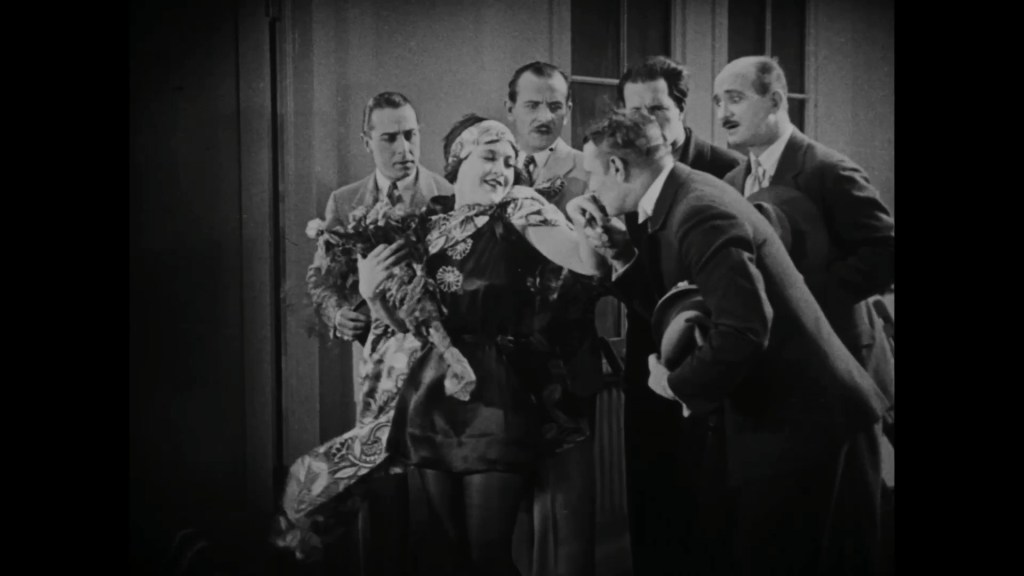
Enter older siblings Leonard and Henrietta. She is the subject of a series of fat jokes about her penchant for chocolate; he is subject to the jealousies of other men for his existing friendship with Mabel. He reveals that Garry is now posing as a bachelor and his “marriage” is a hidden secret. Mabel’s face pouts in thought. Already she sees opportunities to win back Garry.
Cut to land, and to the offices where Garry works as an architect. Next door, his friend Jimmy is overwhelmed by telephone calls; he grabs all the receivers and shouts into them at once. And here are our other set of characters: Alicia, Jimmy’s wife (always suspicious); Phyllis, “unmarried but not unwilling”; Arthur, besotted by Phyllis but too shy to pop the question. Everyone is sleek and neat, the women bedecked in fluffy furs around shoulders and necks. The early scenes also introduce us to the farcical mode of much of the film: office corridors serve as conduits for mistaken identities and quick escapes, for flirtations and flights. Phyllis is all over Garry; Arthur is jealous of Garry. Garry is invited to Jimmie and Alicia’s wedding anniversary (of course, they’ve only been married six months, but their celebration is a “precaution” against divorce, which is as easy to catch as the common cold).
Into this mix comes Mabel. She immediately sets about seducing Garry. She forces herself into his arms, trying to get a kiss—her hands tighten around the back of his neck. “Well if you won’t kiss me, I’ll kiss you!” But Garry resists: “You’re not my wife any more! You’re my widow!” She climbs all over him, steps on his feet and they walk awkwardly a few steps then fall over. In front of his secretary, Mabel stuffs Garry’s face into her bosom and makes him drunk on her perfume. Garry is thought “pure” by his new friends, and he worries Mabel will make everyone think him “a swivel chair sheik”.
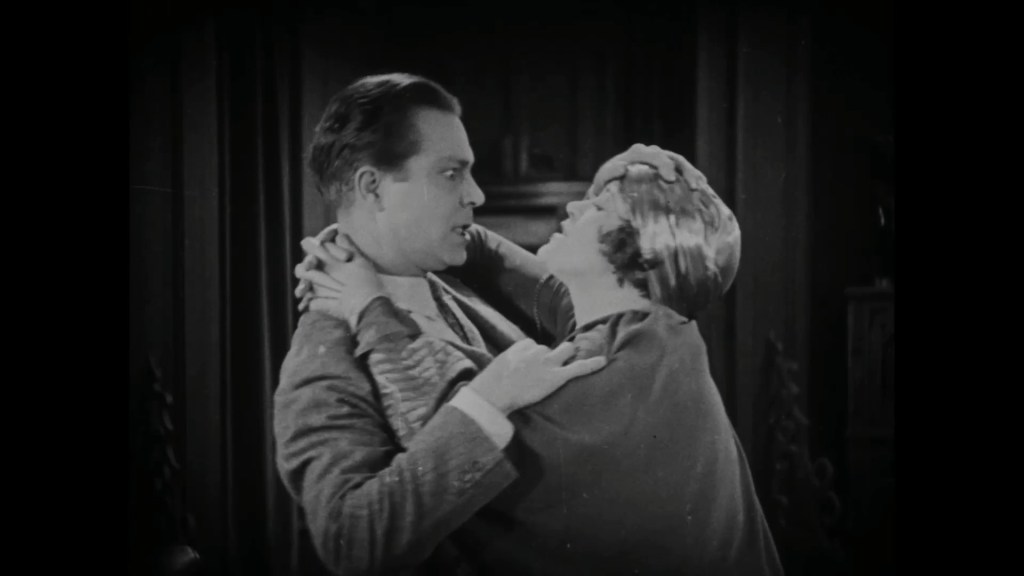

The El Rey Night Club. A party. Scanty chorus of girls. Leonard is Jimmy’s uncle and he tells Garry he’s brought a “snappy number” with him: and, yes, it’s Mabel. She grabs Garry and dances with him. Her embrace is a strangle hold. (“We’re supposed to be dancing… not wrestling”, Garry complains.) The only thing that would stop her marrying him again, she says, is if another girl beat her to it…
Garry can see the plot approaching fast. He also finds out that Leonard thinks Mabel’s ex was a wife-beater and a thief, that he would force the ex to remarry her—unless it turned out he was married to someone else. Phyllis having broken up with Arthur, Garry takes Arthur’s engagement ring and pursues the first woman he sees: this turns out to be Phyllis, who is already keen on Garry. Mabel is surprised but immediately resourceful: she tells Garry she’ll send Phyllis the signed lingerie Garry gave her. She publicly badmouths her ex in front of everyone. Garry fumes. Leonard and Henrietta want to give Garry and Phyllis an engagement party. Close-up of Mabel, pouting and squinting: she has a plan…
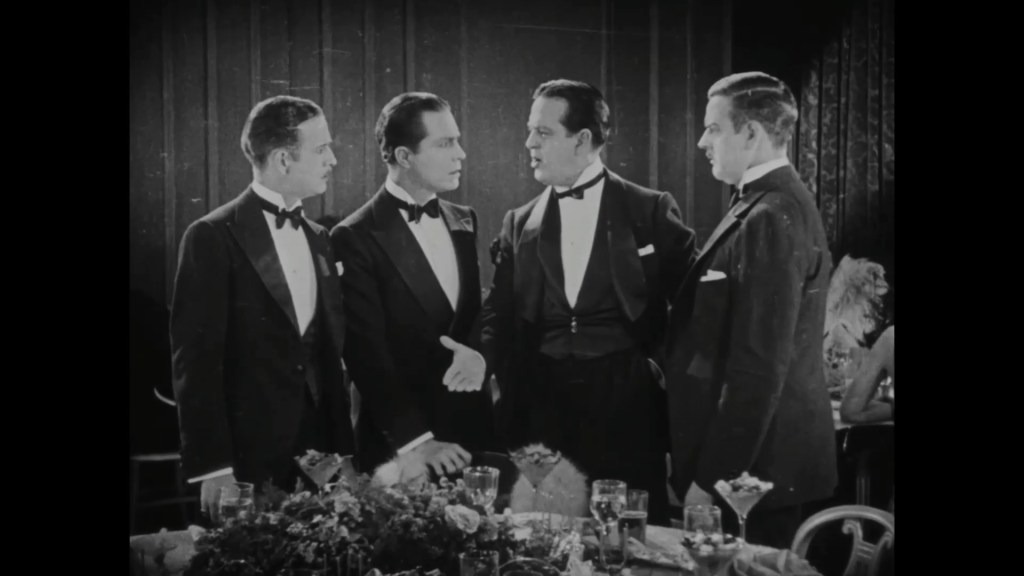
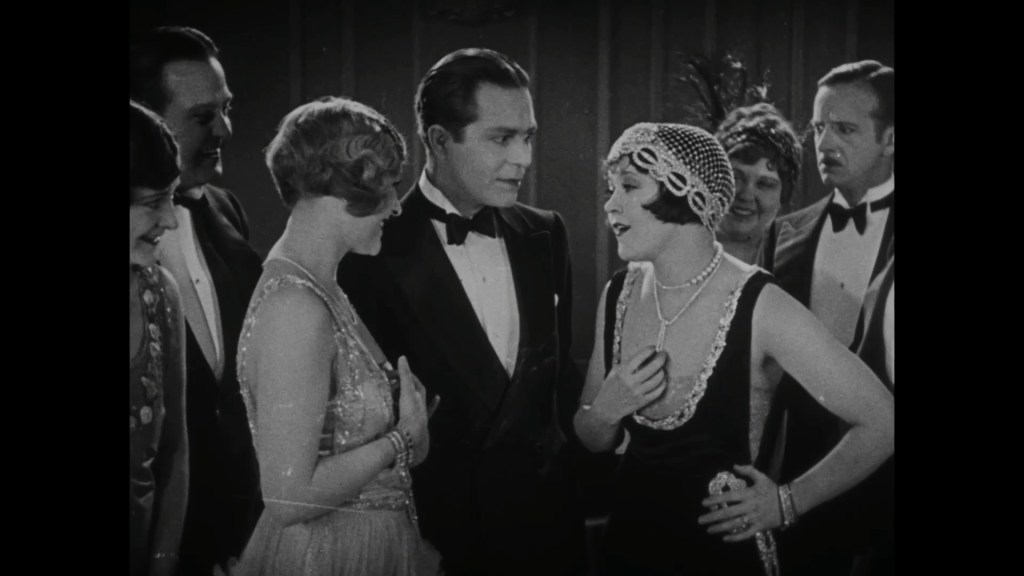
Mabel first visits Garry at his apartment, makes instant friends with Garry’s butler Hawkins, then steps out of her coat into a very revealing little dress and makes herself at home. Phyllis turns up, also in something frilly, fluffy, and revealing; Garry hurls Mabel behind a screen and tries himself to flee upstairs, but Phyllis catches him to say goodnight (“I adore you Garry. You’re so innocent and pure…”). Mabel listens in and starts hurling her clothes over the screen to be discovered by Phyllis. First it’s her coat (Phyllis is concerned); then her shoes appear beside the screen (Garry pretends they’re novelty ashtrays); then more and more clothing appears, down to transparent underlayers. Phyllis storms out, then Mabel calls to Garry. She pretends to appear in all her glory and hurls down the screen—but after reducing him to a pulp of nerves, she reveals she has kept on her top layer and walks triumphantly from the door.

It’s the house party hosted by Leonard and Henriette.
Garry and Hawkins have their plan. There’s a fantastic little scene in which they both try to visually describe the “intimate” garment they must steal. Garry tries first and is immediately caught by Mabel, then by Phyllis—who takes solace back with Arthur.
Mabel now starts flirting with Jimmy to make Garry (and Alicia) jealous.
Hawkins turns up with a stolen garment to give to Garry, but it’s the wrong garment; Garry is now caught by Phyllis, who faints and is taken up to Mabel’s room, where Garry is now hidden under jer bed trying to catch the right piece of clothing.
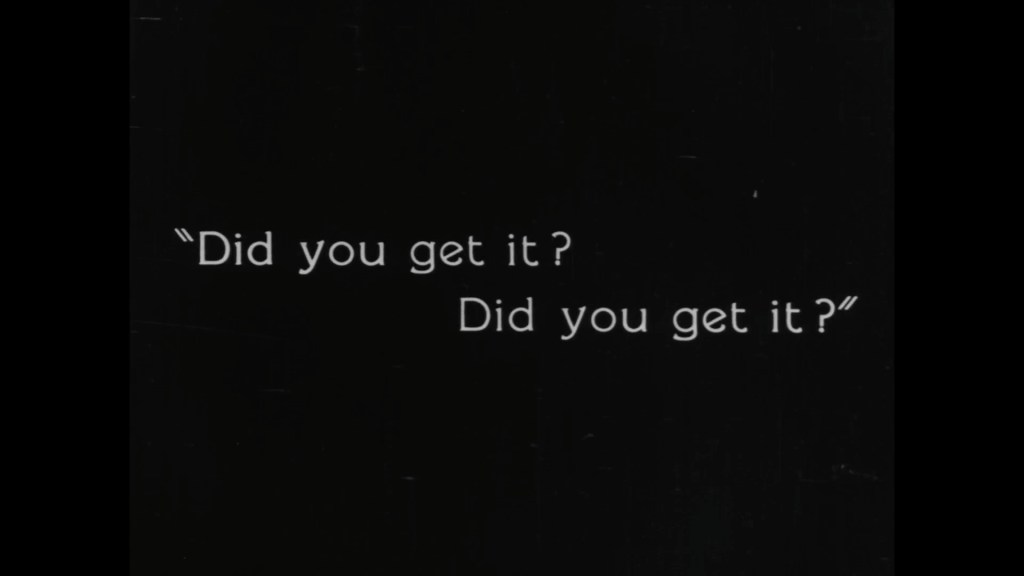
The farce gathers pace: all the men are sequentially caught in possession of the nightie, and the house butler keeps directing jealous woman to their other-halves who are all “up in Mabel’s room”. There, Hawkins and Garry bump into each other from respective hiding places: questioning titles cross the screen to meet each other: “Did you get it?” But the real negligee remains hidden. Trying to escape out of Mabel’s window, they are spotted and the cry goes out that there are burglars. At last the negligee is found but Leonard and Arthur shoot at the supposed burglars, forcing them back into Mabel’s room.
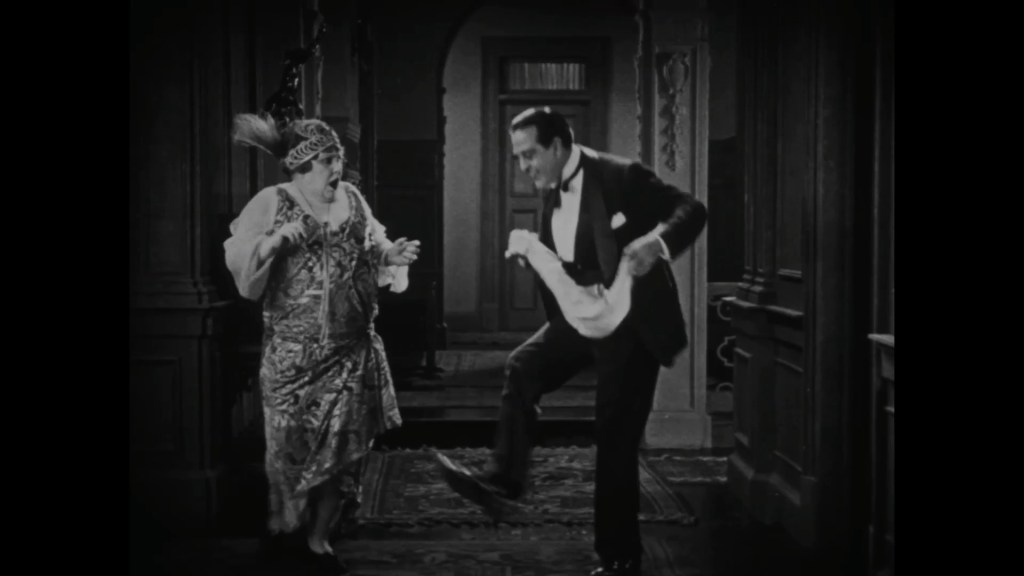
Everyone is now convinced the burglar is in Mabel’s room: Mabel, Phyllis, and Henrietta climb the stairs from inside, while Leonard climbs in from outside—the garment having by now been dropped outside at Arthur’s feet. All three men now hide inside under the bed and the three women sneak in through the door; there’s a great scene as the groups go back and force from hiding place to hiding place. Leonard is caught, but Garry and Hawkins escape through the window to try and recapture the negligee—bumping into a hose on the way down and soaking Garry’s clothes.
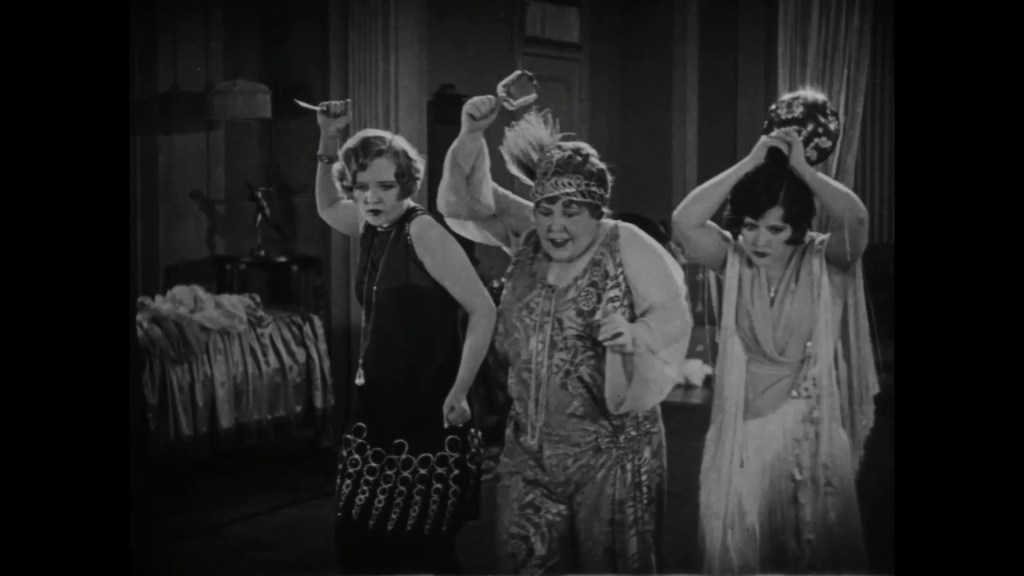
More farce in the other rooms: Jimmy goes into Garry’s room, where he is mistaken for Garry by Mabel who flirts with him; Alicia sees this and storms off. But as Arthur now has the negligee, Mabel has to sneak into his room—and a suspicious Phyllis finds her there under Arthur’s bed. Mabel has captured the negligee and put it on under her dress.
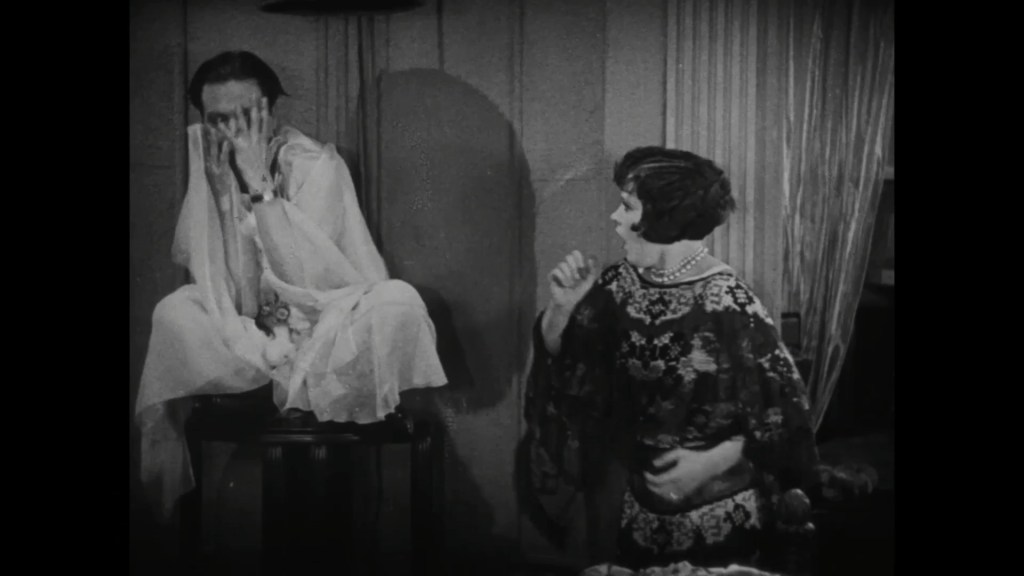

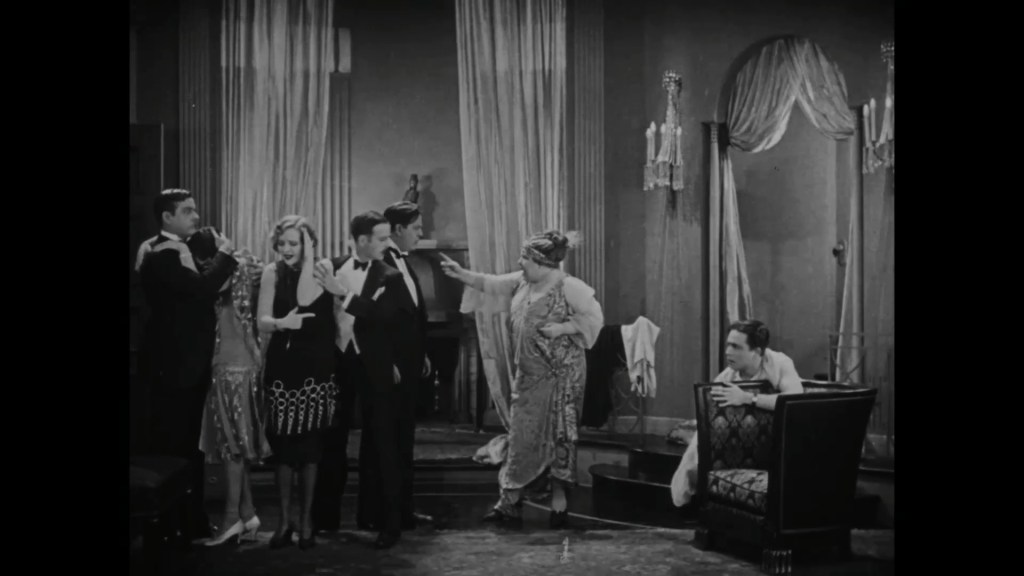
Meanwhile Garry is down to underclothes after his watery escape. To avoid detection, he climbs back up to Mabel’s room to get back to his own; but Mabel catches him in her room wearing her night dress and pretending to be a lamp. Hawkins is then caught going upstairs by the whole household; he says that Garry is yet again “up in Mabel’s room”, where everyone now goes. The butler interrupts the siege: a telegram for Mabel saying that her divorce is void due to a technical reason. Garry and Mabel are still married! Everyone bursts in. Mabel’s negligee and the telegram explain the whole story. The married couple embrace, but a shower of shoes from their well-wishing friends knocks out Garry; he falls into Mabel’s arms; she looks to camera and winks, then is herself struck by a shoe. She kisses the prostrate Garry, and the film fades to black. The End

I was worried after the first half hour of this film that the flippant, knowing tone (and the endless quips of narrational titles) would grate after a while. But when the action and dialogue took over, I shed my reservations and thoroughly enjoyed myself. It’s a Wodehouse novel come alive. And even the titles became more visually inventive. There are small fonts to indicate a whisper, large ones for shouting—and wiggly, trembling text to indicate a scream. Though the camera is static throughout, the editing is snappy and the film mobilizes everything it can to quicken the pace while providing clear continuity across multiple spaces. Marie Prevost steals every scene, every shot she’s in: winking, pouting, flaunting, seething, rolling her eyes. It’s one of the most outrageously enjoyable (and clearly, self-enjoying) performances you can imagine. Up in Mabel’s Room is also the first film streamed to feature an orchestral score. (Though there is a brief appearance of other instruments in the soundtrack for The Lady, they disappear after a single scene: why bother providing them if you’re going to take them away so soon?) Günter A. Buchwald’s jazzy score is excellent. The restless, peppy theme for Mabel breaks out each time she outthinks and outacts her competitors and husband. I imagine it would be great fun to see and hear performed live. Which brings me neatly to…
Pordenone 2022: Online festival round-up
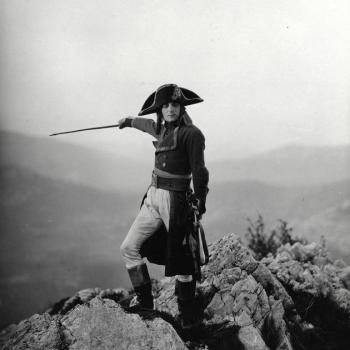
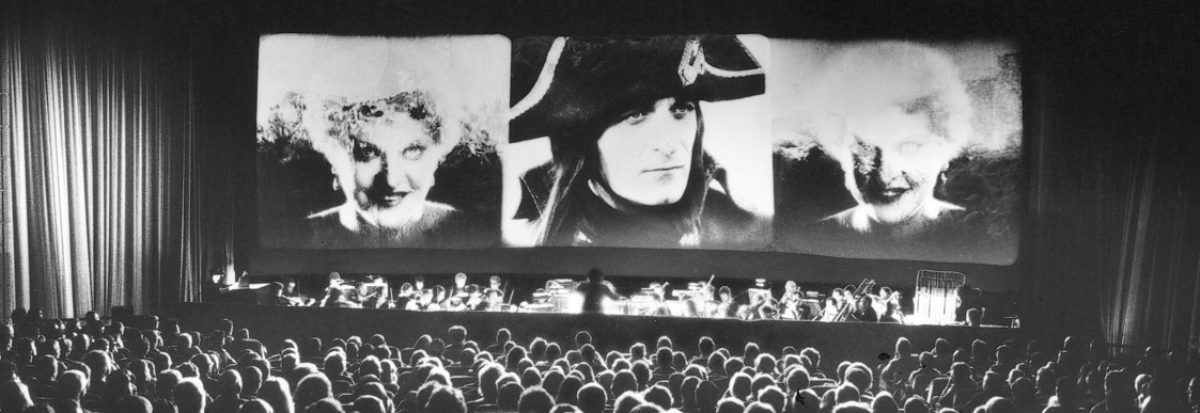
So, what are my impressions of the festival in its streamed format? It’s my first experience of Pordenone and I’m very glad to have participated. For accessibility, it’s a tremendous new feature of the festival (and others like it). Technically, I had no issue with any of the streams. It took a minute to learn how to amend the format of the subtitles to make them unobtrusive (the default mode gives them an opaque background that blots out part of the screen), but apart from that I have no complaints. The 24-hour period to watch the films is much appreciated, as watching them “live” would be virtually impossible for me given that I’m fitting a festival into a normal working week. As it was, even seeing all the films on offer was a hectic fit. I skipped all the filmed introductions to the films, which I regret—but I really couldn’t spare the time. The variety of the films themselves—from 1912 to 1930, from Hollywood to Slovakia—was good, with enough of a sense of the running themes (Ruritania, Norma Talmadge) to get a sense of the festival. The music was very good, though I greatly miss seeing it performed live. I never feel the need to comment much on piano scores: put simply, much less can go wrong with them than with orchestral scores. They are adequate, often more than that. But I do miss seeing and hearing performers and orchestra, and I’m aware the live festival had many more large-scale performances than the streamed selection. I’m also aware of the films I missed. Among the many not streamed was Abel Gance’s La Dixième symphonie (1918). As anyone who glimpses at my publications page will realize, Gance is my specialist subject. I’ve never seen La Dixième symphonie with an audience and I would love to know how the screening went at its live projection.
More generally, I feel that both “experience” and “participate” are odd verbs to use (as I did at the outset) to describe me alone, sat or stood by my monitor, hundreds of miles from the festival. The option to add comments or stars to review or rank the films was there, but I didn’t “participate” in this either. Yet how strangely moving it was to see among these signed reviews the name of a university friend whom I’ve not seen since, and to know that they were somewhere in the world—also, I presume, sat at their monitor in the gloom. How different it is to peer at a monitor and glimpse another’s existence, than to encounter them at a festival and talk. I’ve attended a festival, yet I’ve gone nowhere and seen no-one. Much of my writing in recent years has reflected on the experience of live cinema, and I feel guilty having proselytized on behalf of liveness while never having been to a festival. But it’s a matter of time and—more so now than ever—money.
What does appeal to me is writing, and I don’t suppose I’d be able to (or want to) take notes during a live performance as I have when viewing these films at home. Writing these entries has been time-consuming. But the writing has also given me more of a sense of purpose and meaning in “participating” in a festival. I may not have been to Pordenone, but at least it’s given me the final push to start this blog and write a regular piece on silent cinema. I hope to keep it up, with a fresh film or related subject each week or so.
So, thank you Pordenone. Perhaps one day we’ll meet in person.
Paul Cuff
 The Realm of Silence