Day 2 of Pordenone takes us to Uzbekistan for serial-style adventure, then to Mexico for bursting-at-the-seams melodrama. These films were totally unknown to me, and exactly the type of thing you would hope to encounter at a festival…
So, Ajal Minorasi/Minaret Smerty (1925; USSR/Uzbek SSR; Viacheslav Viskovskii). “The Minaret of Death” is a great title. Based, the credits promise me, on an ancient legend of Bukhara from the sixteenth century. Jemal (Nadia Vendelin) from the Khanate of Khiva and her Arab sister Selekha (Valentina Baranova) are travelling from Bukhara to Khiva, sent by Jemal’s uncle Khalmurad. En route, the caravan is attacked by Kur-Bashi, “Ataman of the thieves” (H. Abduzhalilov). The two women are captured, where they encounter Gyul-Sariq (Olga Spirova), who is herself in love with Kur-Bashi – and jealous of his attempts to woo the women. Gyul-Sariq offers to help the women escape, which they do – swapping their horses for camels to cross the desert. Meanwhile, Kur-Bashi is warned against Gyul-Sariq’s involvement in the escape and orders her death. In the desert, the knight Sadiq (Oleg Frelikh) is watching the road to Khiva, where he encounters the exhausted Jamal and Selekha. In Khiva, Jamal gives Sadiq her necklace as a token of thanks. Months later, the Emir of Bukhara (A. Bogdanovsky) arrives with his son Shahrukh-bek (Iona Talanov) to celebrate a raid against Khiva. Among his captured prisoners are Jamal and Selekha. A contest is held to determine the winner of the prisoners. Sadiq is among the horsemen who compete, and he wins Jamal. But Shahrukh-bek fights Sadiq and recaptures Jamal to be “the queen of my harem”. Selekha manages to get hold of a knife and tries to enlist the help of Sadiq. A Persian love potion is prepared to make Jamal submit, but Selekha goes to the Emir and tells him that Sadiq’s prize woman has been stolen by his son. Shahrukh-bek kills his father and blames Jamal. But the reign of the new emir is unpopular, and Sadiq rallies the local men to rally against Shahrukh-bek. His army attacks Shahrukh-bek’s fort, but it is too strong. Sadiq tries to negotiate, demanding all the prisoners be let free. But Shahrukh-bek sends his enemies to be hurled off a minaret. Happily, the women save the day, rebelling against Shahrukh-bek’s guards – and Sadiq is able to rescue Jamal on the precipice, from which Shahrukh-bek is hurled. END.


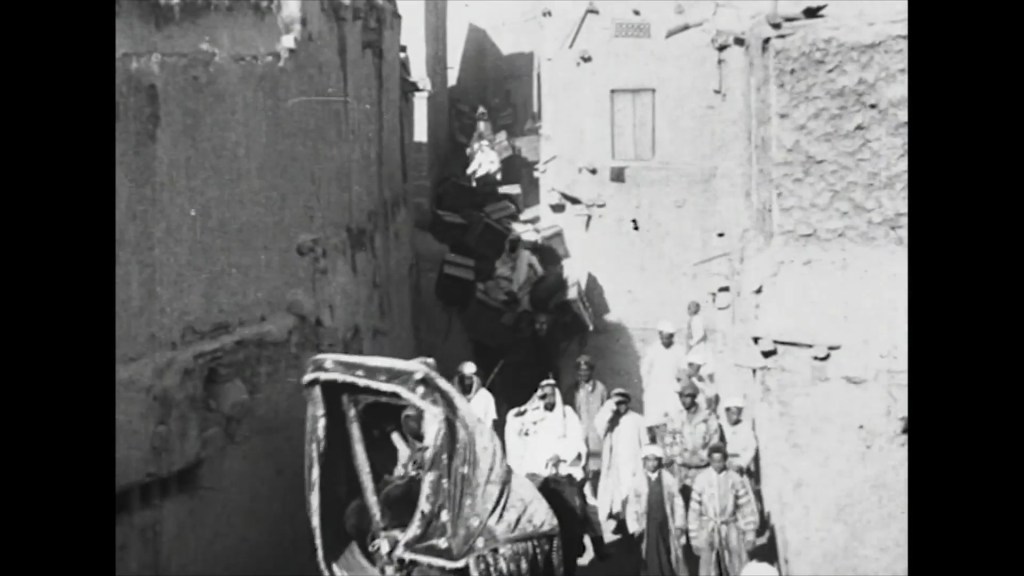


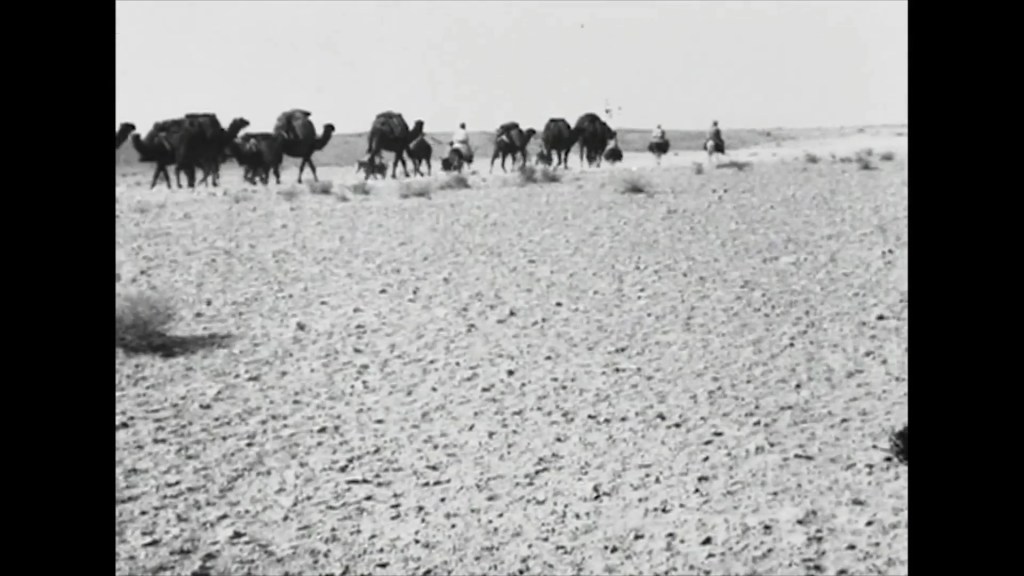


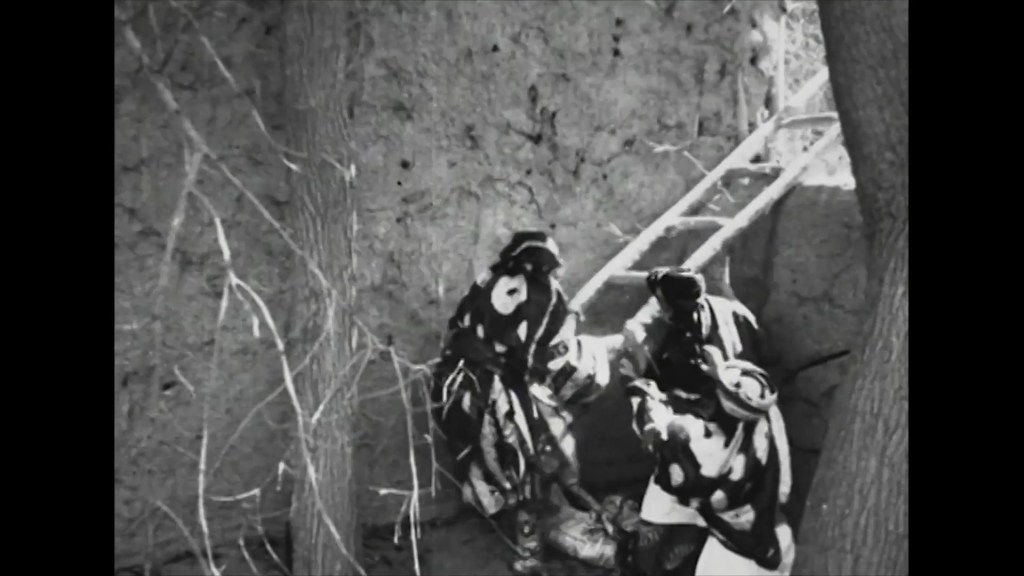


What a delightful oddity this film is. It feels like a multi-hour serial condensed into the space of a single episode. Months suddenly disappear in-between scenes. Characters are kidnapped, rescued, kidnapped, rescued, and imprisoned once more. Emirs come and go, armies assemble then vanish. There are traditional dances, harems, sudden accumulations of crowds, glimpses of deserts giving way to rivers and fields, strange buildings, swords brandished, cavalry charges. In the way of many serials, the whole thing veers from stodgy inertia to breathless action. Schemes are enacted before they’ve been properly elaborated, while deaths and betrayal suddenly switch the narrative to new directions.


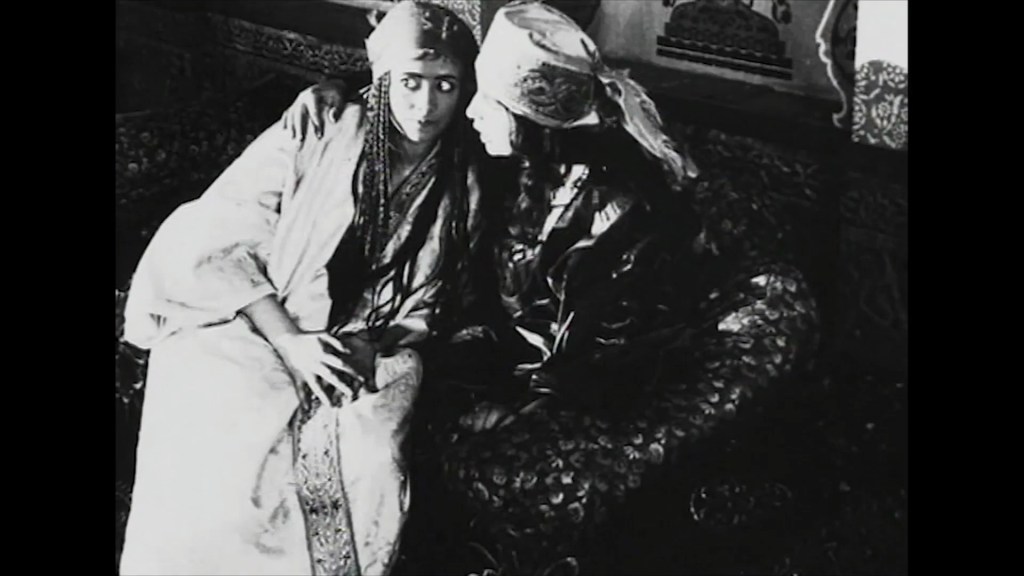


Redolent of numerous (western-produced) serials set in the east, Ajal Minorasi has the great benefit of being shot on location in Uzbekistan. The towns, landscapes, and people look pleasingly unpolished. Everything has a dusty, sun-bleached reality that contrasts with the highly contrived drama playing out on screen. The film has a charming feeling of being scripted on the hoof and shot on the fly. There are marvellous glimpses of real faces and lives amid the hoopla of villainy and heroism, and though none of the lead performers have characters with any depth the two female leads have real presence on screen. The experience of watching this film was at once exciting, confusing, and confounding. I’m not sure when I would want to sit through it again, but I’m glad that I have.
The second part of Day 2’s programme beings with Abismos (1931; Mx.; Salvador Pruneda), one of Mexico’s first films with synchronized soundtrack – but the latter appears not to survive. The fragment presented here has a piano accompaniment by José María Serralde Ruiz. As such, it is a curiosity: a sound film rendered silent by the exigencies of time, transformed into a new viewing experience in a silent festival. A woman approaches a prostrate figure on a bed. We see a bottle in his pocket. He is drunk. She tries to raise him. Another scene, at breakfast. (Already, we take it that the woman is the mother, the inert boy her son, and here at table an older daughter and the father.) A conversation unfolds, in silence, an awkward confrontation with the son. Another scene, an interior confrontation with a lawyer(?), then a cutaway to paperboys on the street. Something has happened, and the police come to confront the drunken youth. Now the son is behind bars. Flashbacks, fire, drink, guilt – and more conversations unheard. It ends.


Next, a fragmentary short: Como por un tubo o el boleto de lotería (1919; Cl.; unknown). A charmingly ramshackle, mischievous title sequence. The stars awkwardly superimposed behind a production logo, and another man – half-buried in straw – holds up a cardboard sign to credit the production company. On the streets, our main character is knocked out by a villain, who steals a baby and substitutes the unconscious man in its place. There are little groups of onlookers: are they extras or just curious bystanders? Glimpses of the sea, of streets, of the past. A series of peculiar incidents: a political speech, delivered for real then mocked by the comic; a brawl, a blackeye, a bit with a dog. The end.


Finally, our last feature of the day: Santa (1918; Mx.; Luis G. Peredo). The opening title announces the “first part of the triptych: PURITY” with “symbolic installations by Norka Rouskaya”. Wow. Symbolic installations? (“Actitudes simbólicas”) Yes please. Hit me! The film begins, seemingly in medias res. Marcelino, a soldier, mounted, on his way to Mexico City. (The screen warps and wanders in the frame. It’s like we’re viewing the film reflected in the depths of a well.) The girl waits, gestures. The men ride past. “Abandoned!” Four months later, “her sin revealed”, the girl – Santa – is ejected from her home. Her mother lectures her at great length (over the course of two titles) about Santa’s wickedness. Her mother says she is “smeared” with her daughter’s foulness.


Part Two of the triptych: Vice. And here are our first symbolic installations. The dancer, writhing with flowers in a park. It’s a very brief installation, for here we are in the metropolis: Mexico City. And here is Chapultepec. (Touristic views of the park, the streets.) Santa heads to Elvira (whole areas of backstory skipped, missing). Santa behind bars, praying for a return to her home and family. Hipólito the blind man (Alfonso Busson). Months pass. Santa gets close to Hipólito, who tells her his life story. (A single shot of an impoverished home.) Santa and “El Jarameño”, the matador, “make their lives exult”. Plenty of bizarre titles about female inconstancy, and Santa betrays El Jarameño while he is busy mauling cattle. He returns, finds Santa together with a lover, but his knife gets stuck and a painting of the Virgin Mary tumbles into view – triggering “his religious fanaticism”. Oh dear, now Santa is back to her “ways of vice”. Hipólito loves her. He pours out his heart in endless intertitles, says he is a monster to look at. Seconds later, Santa has gone through another lover – Rubio – and “under the attack of an insidious evil, [she] has become an alcoholic”. (We see her sipping wine with a reprobate.) Santa is rotted by sin, by crime, by the kitchen sink, and so the third part of the triptych, “Martyrdom”, begins.


Abandoned by all, sick, miserable, “useless”, Santa turns to Hipólito to help recover “the holy deposit”. (I think the film means her soul, but it sounds rather less sanitary.) He takes her to share his simple home (and boy servant). “We are all your slaves!” he says, to do as she wishes. She has an attack of piety, clutches his knees, has a brief repast, glugs back wine. A doctor calls. Santa has an incurable disease that needs an expensive operation. Oh dear, oh dear. Now she’s in bed, writhing, feeling that someone’s removing her bones, wanting to be buried by her mother in her home in Chimalistac. The operation. Lengthy procedural wrappings. Time passes. Hipólito waits. A crisis, just as she’s being stitched up. Bloody bandages. Oh dear, oh dear, she’s dead. Hipólito collapses over her body. She’s buried in her village. Hipólito tends her grave. The sun sets. Hipólito runs his fingers over the inscription on the tombstone and prays for her soul. END.


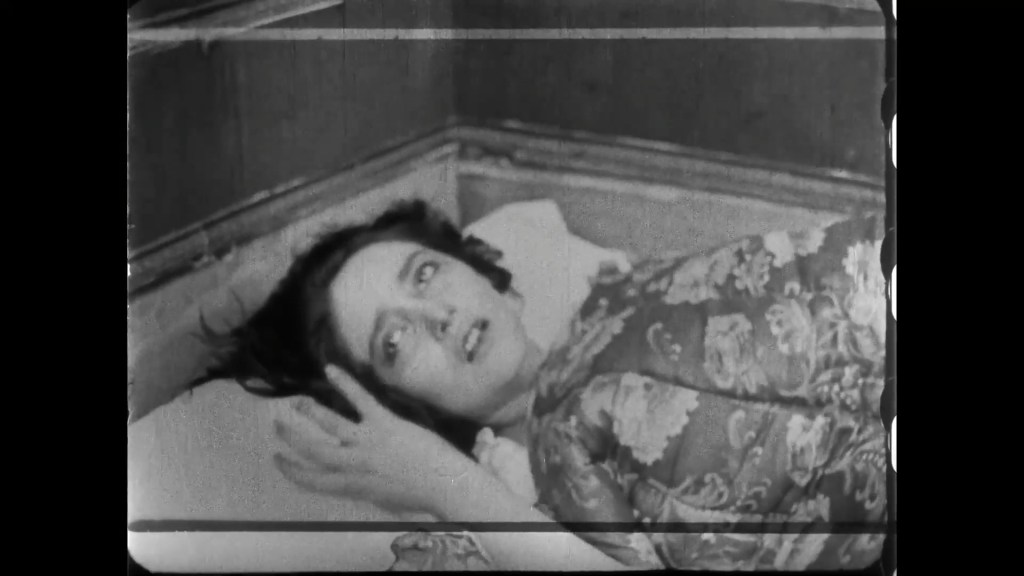


Well, what can I say to all that? The film is so rife with melodrama it appears to be coming apart at the seams. The image itself buckles and warps, the frame shifts awkwardly. The copy is fragmentary and hurtles forward at an even greater rate of dramatic velocity than Ajal Minorasi. The intensity of the drama is exacerbated by the state of the print: it’s like the film is fast-forwarding through Santa’s life, racing towards its inevitable conclusion. In this sense, I found it a far more gripping film than Ajal Minorasi, which seems almost stilted by comparison.
Yet I can’t deny that Santa is in many ways a cruder film. The way it’s staged and edited feels utilitarian, awkward, heavy-handed. There are far too many titles, which (when they are not explaining what we have just seen) are overloaded with information that the surrounding scenes do not – or cannot – register. It’s like paragraphs from a pulpy novel have been pasted onto the screen, regardless of the film’s visual world. The tone of these titles, too, veers madly between stilted exposition, religiose moralism, and pretentious verbiage. The “symbolic installations” (or what survives of them) are weird interruptions, failed attempts to elevate or exteriorize feelings that the film simply cannot express.
Elena Sánchez Valenzuela is a beautiful Santa and has a world of emotion in her eyes – but the film has no way of allowing us access to those depths, to the reality of her experience. Indeed, the film goes out of its way to suppress any alternative interpretation to the narrative other than that expressed by the titles. In this way, the whole film feels like some dreadful piece of Catholic propaganda made flesh. The woman is blamed at every stage of the way, condemned by her unalterable nature, an original sinner who must live out the awful consequences of her actions. Santa has a dreadful life, then dies a dreadful death. The film is based on Federico Gamboa’s eponymous novel of 1903. Gamboa is described as a “naturalist”, but I wonder how the tone of the novel compares with the film. Is it as moralistic? Does it judge and condemn Santa in the same way? Where are its sympathies, and what is its diagnosis?
If Santa is a crude film in all these senses, it is – perhaps because of its crudity – absolutely compelling. I was gripped by the mad pace of it, by the intoxicating brutality of its drama, by the ludicrous exegeses of its titles, by the peculiarity of its “symbolic” pretensions, by the textual (and textural) instability of its images and sudden ellipses of the fragmented print. Part of its success for me was the piano accompaniment by José María Serralde Ruiz: full-hearted, sincere, dramatic. Bravo.
So that was Day 2. A well-travelled day. I’m not sure how many silent films shot on location in Uzbekistan or Chile I have ever seen, and I’m very happy to have glimpsed these worlds on screen. Santa, too, offers some amazing views of Mexico City (even though they are entirely unintegrated into the narrative). In all these films, the sense of time and place vividly creeps over the images. It’s there in the faces, in the texture of the locations, in the light and dust of the streets and fields. Even at their crudest, they were interesting to watch. The only film that I didn’t get much from was Abismos, perhaps because of its peculiar status as a sound film without soundtrack. I can see (or assume) its historical value, but next to even the most fragmented of the other films it was oddly lifeless. But it was only a few minutes long, and it fitted with the rest of the programme, so I mustn’t complain. Day 2 took me to places I’d never been, and I’m grateful for the experience.
Paul Cuff
 The Realm of Silence