Day 5 of the Bonn festival takes us to Germany, and an exploration of jealousy and marital strife. Described by its opening titles as “A tragicomedy between man and woman”, I was expecting – well, I suppose I was expecting something very much akin to what I got…
Eifersucht (1925; Ger.; Karl Grune)
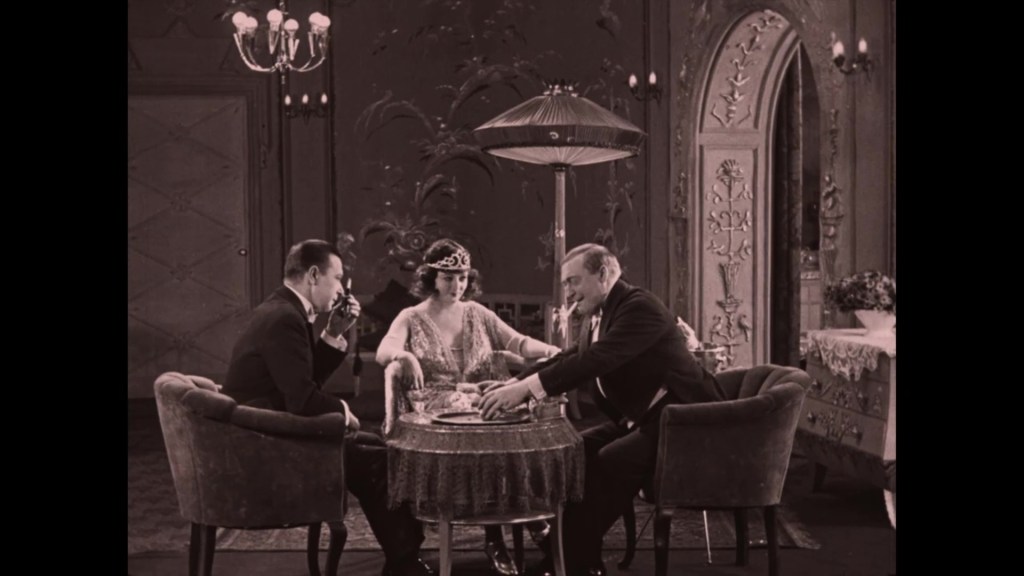
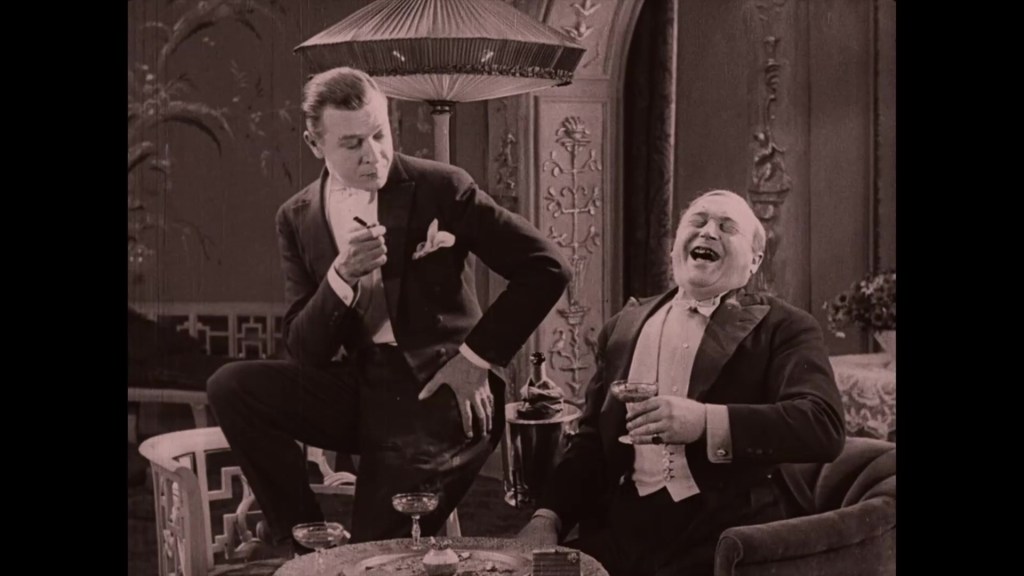
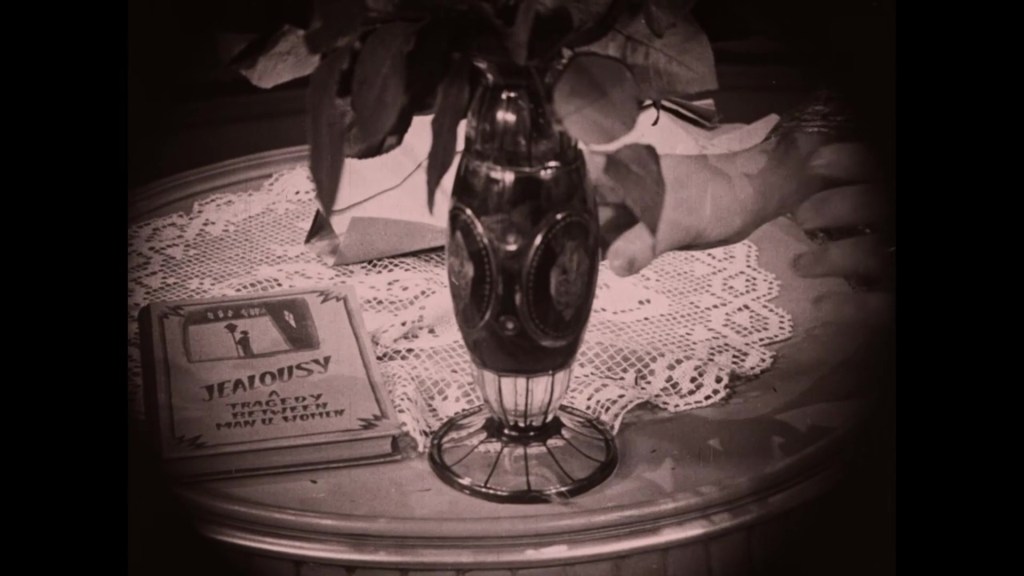
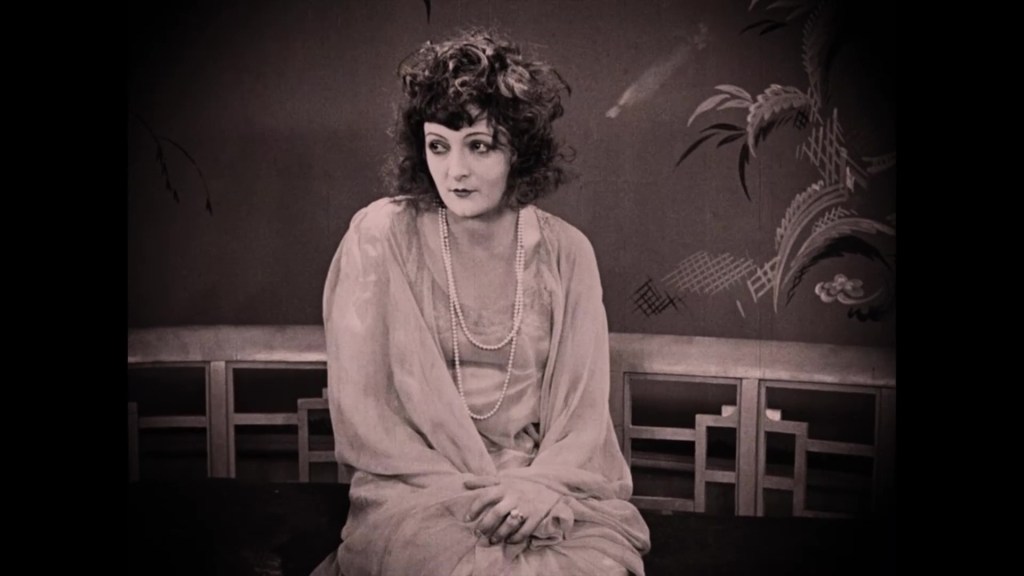
Act 1 establishes what might be called the rules of the game for the remaining film. The opening scene of a husband strangling his wife is revealed to be a stage performance, and the playwright (Georg Alexander) comes on stage to take the applause. He then returns home with his two friends, a husband (Werner Krauss) and wife (Lya De Putti) whose marriage seems to be ideal. But the playwright keeps questioning whether either of the couple feels jealousy, while trying to flirt with the wife. Act 2 sees the first signs of jealousy: the wife receives flowers and refuses to tell her husband the sender; the wife finds a lock of blonde hair in the husband’s pocket watch. The playwright then arrives and flirts with the wife and convinces them to go to the palais de dance. There, the wife makes both men jealous by dancing with a stranger. The husband ends up striking the stranger and the night ends with husband and wife sleeping in separate beds. In Act 3, after a frosty breakfast the wife becomes intrigued by her husband’s correspondence – reading and then stealing his latest letter. She goes to the playwright, then lies that she has been to her friend Lola’s – and is confronted by her husband. In Act 4, the wife gets Lola to lie for her, covering her absence from home both in the past and on future nights. The husband follows her to a giant apartment store, then loses her and blunders about town in search of her. The wife arrives home, still fuming over the husband’s mysterious letter. The husband tells her how much he loves her and begs to know what she has been doing. She asks for his trust, but he insists on knowing the truth. She demands the truth from him and says he would be ashamed to know the truth from her. He raises his hand to strike her but doesn’t land the blow. In Act 5, the husband follows the wife, this time to a strange building on the outskirts of town. He sees his wife kissing a child who address her as “mummy”. Back home, the husband demands (via a note passed via a servant) that the wife leaves the house. Infuriated by her refusal of the truth about the child, he hurls his wife to the floor. The violence is interrupted by the arrival of the playwright, and the truth is eventually discovered. The letter the wife has stolen from the husband refers to his child, whose carer cannot afford it any longer. The husband falls at his wife’s feet and the two are reconciled. ENDE
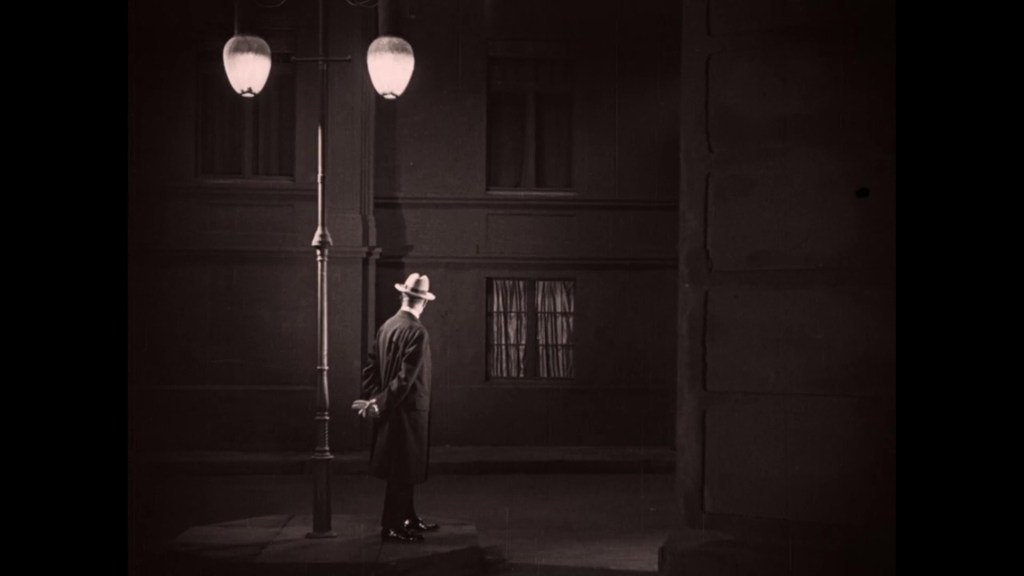
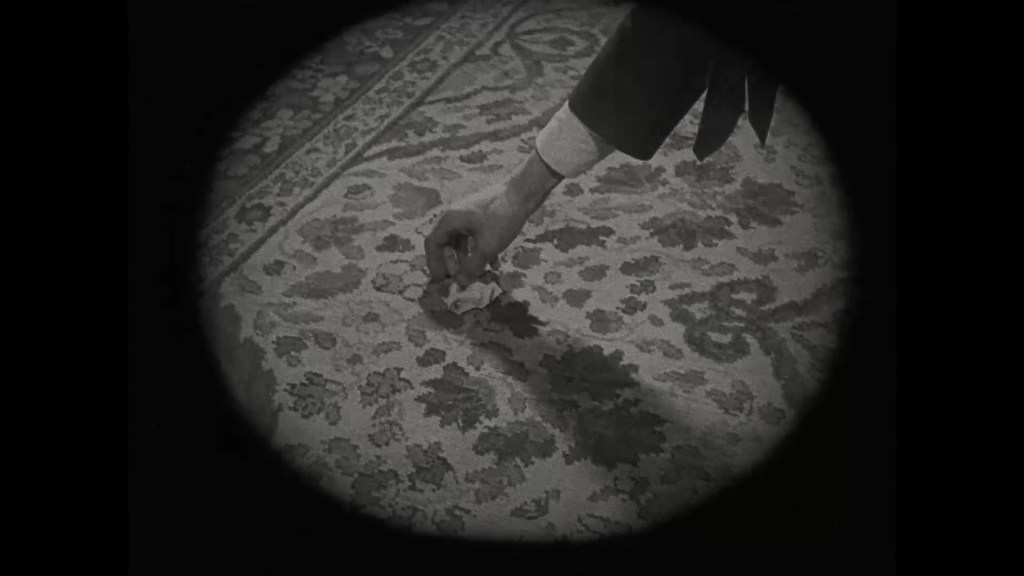
As I said, a plot that doesn’t offer any real surprises. It’s well-written, well-mounted, and well-played. I admired the numerous nice touches that shaped the drama, like the repeated detail of the couple’s shoes: hers next to his at the start, then separate from his during their fallout, then reunited in the final images; or the way their first breakfast scene has them sat side-by-side, but the second has then say on opposite sides of the table. Technically, the film was also well executed. There are also some neat moments of superimposition. Some are simple, like the wife imagining the lock of hair in the watch, or later seeing his imagined lover superimposed over her book. Some are more complex, like the husband seeing his wife dancing with another on the crowded dancefloor – only for the other dancers to fade into ghost-like transparencies, revealing his wife and her partner at the centre (a really lovely effect). Though I liked some deep focus compositions in the apartment, it was the exterior scenes that really stood out. There are several big sets/matte painted night cityscapes, which are reminiscent of Grune’s Die Straße. Particularly effective is the apartment store, with a double paternoster lift and a view across to a multistorey wing illuminated from within. You sense the husband’s fear becoming faintly nightmarish in these surroundings, just as you did with the central character in Die Straße.
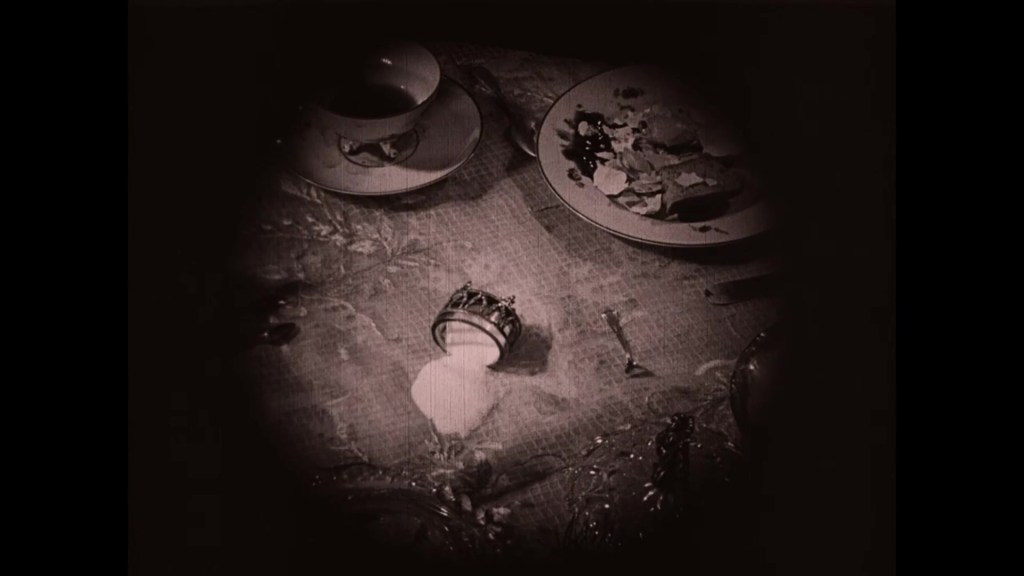
But what interested me particularly with Eifersucht was its script by Paul Czinner. (I have a longstanding project on Czinner that I have kept delaying for various reasons.) I was struck by how many details in Eifersucht match traits from his other films. There is the jealousy over a bunch of flowers (cf. Der Geiger von Florenz (1926)), conflicts spelt out over a breakfast routine (cf. Ariane (1931) and Der träumende Mund (1932)), the woman reflecting on her image in relation to men (Fräulein Else, 1929), the nods to luck and fate (like the spilling of salt) and life’s reflection of art that haunt numerous of Czinner’s other films. Czinner’s authorship is often overshadowed by the two figures with whom he collaborated: his frequent leading actress, Elisabeth Bergner, and his screenplay collaborator, Carl Meyer (often uncredited). In this sense, it was curious to feel how strongly Eifersucht felt like a Czinner film without either of these two influences at play. But also, this made me like Eifersucht less. The marital strife in Grune’s film is more interestingly played, and played out, in Czinner’s Nju (1924), just as the sense of life imitating the tragedy of art is more potent in Czinner’s Der träumende Mund. And Bergner is an infinitely more subtle, complex, and sympathetic performer than De Putti. Werner Krauss’s character, too, is at the very least equalled by Emil Jannings’s character in Nju, for example, and Georg Alexander’s rather underdeveloped character is a pale shadow next to that of Rudolf Forster in Der träumende Mund. (Der träumende Mund, if you’ve not seen it, is a masterpiece.)
More broadly, in fact, my problem with Eifersucht was precisely this sense that what I was watching I had seen done better, and with more dash, elsewhere. Czinner’s films aside, I also thought of E.A. Dupont’s contemporary Varieté (1925), which features De Putti in a much more powerful drama, and one which allows for more complex, stylish cinematic storytelling. (Dupont’s film was also, confusingly, released under the title “Jealousy” in some regions.) Eifersucht’s theatricality is ultimately a kind of limitation. It is, if anything, too neat and tidy, too precisely organized. (Even the dance hall feels oddly well-mannered to sense the wife’s desire for freedom express itself. Think of how many other Weimar films have great party scenes!) Eifersucht feels like an exercise more than a living, evolving drama. Even the interesting outdoor sets and moments of technical skill didn’t lift the film into something more complex or moving. Indeed, I still await being really moved a Karl Grune film: his are films that I admire without truly liking. (See my pieces on Am Rande der Welt(1927) and Die Straße.) The fact that Eifersucht describes itself as a “tragicomedy” rather sums it up: it is neither comic enough nor tragic enough. (All Czinner’s films are much sharper in their comic touches and more tragic in their outcomes.) It is a good film, but not a great one.
The music for this performance was by Richard Siedhoff and Mykyta Sierov. Their combination of piano and oboe worked well, though its emotional register could never make the film more moving than it was. I must also highlight the excellence of the detailed restoration credits at the start of the film: we are given a history of the film’s release, the location and qualities of surviving prints, the ethics behind the restoration choices, and the precise lengths in metres of various copies, as well as the speed used in the transfer. It should be mandatory to have such information at the outset of all films, especially silents. (Yes, the latest restoration Napoléon, I’m thinking of you.)
Der Geiger von Florenz was the sixth film directed by Paul Czinner and the third to star Elisabeth Bergner, whom he later married. It’s also the first of Czinner’s silent films to be released on Blu-ray. Given that my last experience of Czinner’s silent work was the shoddy copy of The Woman He Scorned (1929), I was keen to see his work in high definition. I was also intrigued to see Elisabeth Bergner as the lead, a very different star to Pola Negri.
First, the plot—and yes, as ever, I spoil everything. The young Renée (Elisabeth Bergner) is deeply attached to her father (Conrad Veidt) and deeply jealous of her stepmother (Nora Gregor). After numerous petty squabbles, Renée is sent away to a ladies’ finishing school in Switzerland. There, she rebels against her teachers and runs away, disguising herself as a boy in order to cross the border into Italy. While roaming the streets, she encounters an old violinist and asks to play his violin. As she does so, a car pulls up and the artist (Walter Rilla) and his sister (Grete Mosheim) are entranced by the image of this beautiful young player. Renée goes with the siblings to Florence, where she becomes the subject of the artist’s paintings. The painting of the anonymous “Fiddler of Florence” is published and seen in a newspaper by Renée’s father, who seeks out his missing daughter. Renée’s identity as a woman is revealed, as is the mutual attraction between her and the artist. Renée’s father arrives in time to bless the couple.
At a little over eighty minutes, the film is a seemingly simple drama: light, charming, faintly silly. But it has plenty of telling details that cumulatively make for a surprisingly complex engagement with the complexities of desire and gender.
The daughter/stepmother jealousy plays out in the very first scene: at her father’s desk, Renée substitutes a photo of her stepmother for her own—and destroys the image of her rival. At the dinner table, she replaces her stepmother’s choice of flowers with her own enormous bouquet, which she then moves to try and block the conversation between father and stepmother. The rivalry is then played out through two rival dogs: Renée feeding her own dog, which then ends up attacking the stepmother’s dog under the table. The whole trio tries to placate the dogs, one of which bites Renée’s father—the two women gather round with medical boxes, bandages etc. It’s a comic sequence, a snowballing farce than ends up with everyone chasing around the house.
All this is told through images. But when Renée sees her father alone outside, clearly depressed, she commits her thoughts to her notebook. The film then offers us a lot of contextual information through this written text, then through two flashbacks. We see Renée on holiday with her father in Italy, where she embraces him and says that “If you weren’t my father, I’d marry you”. Then, when her father spots the woman who will become his second wife at the next table, Renée keeps moving her parasol to block their eye contact. It’s the same trick she pulled with the flowers earlier in the film, and the history of their fraught daughter-father-stepmother relationship confirms the impression that it’s effectively a love triangle. Outside, the stepmother joins the father. She issues him an ultimatum: either Renée goes, or she does.
Renée’s desire for her father is epitomized in the next scene, when her father comes to say goodnight. Renée eagerly pats the bed, but her father pulls up a chair. Renée is visibly crestfallen, and the sustained close-ups of her face in the ensuing conversation show the waves of emotion passing over her. Bergner’s face is wonderfully expressive, her eyes beautifully lit: they seem huge, and you seem to fall into them in these close-ups. Indeed, much of the film is spent watching Bergner’s expressivity. Her performance is incredibly animated. She’s scheming, or emoting, or running away, or hurling herself away in shock or fear or despair or delight. The framerate of the film is faster-than-life throughout, apart from one section of slow-motion. Thus, Bergner’s movements are all exaggerated. It’s as though the film itself shares the energy and ferocity of her teenage emotional life. Even in these close-ups in her bedroom, her face becomes the sight of tremendous emotional activity—condensed in her luminous eyes.
Promised another Italian holiday if she behaves, Renée tries to make things up with her stepmother. We see her in the next scene approaching her rival as if attempting to seduce her: she creeps along the wall, nervously—or is it flirtatiously? Then she helps make a punch, urging her stepmother to make it stronger and stronger. So they get very rapidly tipsy and start to dance with each other. Enter Renée’s father, who is offered cups of punch by both women. He pushes away Renée’s hand and drinks from his wife’s cup. Renée hurls her glass of punch at her stepmother. There’s a kind of savagery in this action: the violence of the gesture contrasting with the primness of the weapon.
So Renée is sent to Switzerland, where we see her writing of her sadness at her confinement. The film has skipped forward here, for Renée has already made an enemy of her tutor. We see her wipe away a chalkboard announcement of her punishment and draw instead a caricature of the tutor. In another riff on the dog theme seen in the opening scenes, Renée has better command over the tutor’s dog (called Fellow) than the tutor herself. Renée waits for a letter from her father to rescue her, but instead a letter arrives that says she must stay put. Perhaps Czinner was conscious of how much letter-writing (and thus letter-reading) there has been in the film in this section, for he provides a gorgeous visualization of Renée’s emotions as she reads here. She is on a bench in parkland and the wind whips the trees all around her as she wanders forlornly back and forth across the grass. It’s a lovely scene, and a relief that Czinner finds a way of visualizing feeling again, not having to rely on more text.
At night, Renée escapes—wearing an extraordinarily eye-catching plaid outfit and hat. Thankfully, after failed attempts to cross the border to Italy via train and road, she is able to swap clothes with a young peasant. In male clothing, she crosses into Italy and roams freely along the beautiful mountainside roads. For such a short film, Czinner gives plenty of time to Renée’s wandering here: we see the landscapes around lake Lugano in dazzling sunlight. The haze of the vistas interacts beautifully with the grain of the filmstock. You can understand why Czinner lets the film’s plot meander here, it’s lovely to look at—with Bergner’s tiny figure, dressed almost as if from a previous century, providing scale and narrative punctuation to the landscapes.
She eventually encounters a beggar playing a violin by the roadside. Convincing him to lend her his instrument, she begins to play—just as a motorcar draws up alongside. The driver and his companion seem to take a fancy to this strange figure, dressed in peasant clothes, striking a pose from another age. The man is an artist and wishes to paint the “boy” violinist. Renée readily agrees. There follows a lovely (and again, surprisingly lengthy, given the film’s short length) segment where the camera sits behind Renée and follows her journey to Florence. It becomes a travelogue documentary, the film simply cutting as it wishes to segue from one view to the next. It’s always fascinating to glimpse the real streets of the 1920s, with ordinary people moving aside for the car and glancing at the camera as it passes.
But the levels of artifice are foregrounded in what follows. At his glamorous estate in Florence, the artist is transformed from an apparently old, grey-haired man into a youth. For the grey of his hair, and that of his female companion, is merely the dust of the roads. Renée is startled by their transformation, just as she is frightened when the artist demands that “he” too must be scrubbed clean. Renée’s own transformation into the suited “boy” is greeted with curiosity by both her hosts. She is an object of fascination and flirtation by both the man and woman. They are siblings, but Renée doesn’t discover this until she has already fallen for him. She poses as the “fiddler”, and Czinner turns the posing into a lengthy sequence for Bergner to express her fidgety, restless character. She cannot stand still, and the artist grows irritated. So Czinner makes this frustration into a little marvel of cinematic magic: the camera is over-cranked, thus slowing the film for us in projection. Renée’s restless movements become a strange dance, the film finally finding a way of slowing her down, of capturing her for our gaze.
The peculiarities pile on, however, as the artist’s sister grows jealous of his new muse. It’s the artist’s turn to be offered two cups of punch, and when he chooses Renée’s, his sister throws her drink at Renée. This reverse of the scene with Renée and her stepmother reminds us of the weirdness of the film’s emotional path. Renée seems keen to be adopted by what she takes as an older man, only to find him a young man. The artist thus attracts her as an image of her father, then wins her over as a different kind of male figure: Renée transfers (at least some of) her affections from a familial to a romantic object.
But the film isn’t as neat as that sounds. For the brother-sister relationship of the artist and his sister is also weirdly intense. Renée sees them embracing in the garden and it’s not just her who wonders just how close this couple might be. And the sister not only flirts with Renée when she is disguised as a young man, but also reveals Renée’s femininity by placing her hand on Renée’s breast and embracing her. Thus, wherever you look, the film offers unusual and interesting couplings, or the potential of unusual and interesting couplings. Besides, what kind of disguise is Renée’s outfit? And for what do we or the characters take her? She is androgynous by virtue of her clothing but also by her age: she is not quite a woman, not quite a man, not quite a girl, not quite a boy.
The word to describe all this is doubtless “queer”. It’s a queer film whose brevity and lightness allows it to get away with a complex play on the ambiguities of gender and familial/romantic feeling. A contemporary reviewer in the UK said that Der Geiger von Florenz possessed a “somewhat unusual theme” (Kinematograph Weekly, 7 October 1926), which is a very British way of saying “queer”.
The impression of queerness, however lightly worn or exercised, made me curious about both its director and star. The English-language Wikipedia page suggests that Czinner was gay, but that “despite” this factor his marriage “proved a happy and personally and professionally enriching one for both partners.” Well, that’s very interesting—although the “citation needed” at the end of the paragraph casts its contents into uncertainty. (His sexuality is not mentioned in other available sources.)
So, is there anything autobiographical hidden in Der Geiger von Florenz? It’s worth observing that Czinner himself was a child prodigy on the violin. Can we read the “boy” Renée, attracting the attention of an elder male lover, as a version of Czinner’s early life? One can only conjecture. What is curious is that the film itself offers no more convincing context to Renée’s musical talents and thus narrative journey. At no point in Der Geiger von Florenz are we told that Renée is musical or can even play an instrument. Her ability to play is a seemingly spur-of-the-moment decision, one which immediately propels the plot into a new direction.
Looking for some kind of context for Der Geiger von Florenz, we might turn to Czinner’s other silent work with Bergner. As in Der Geiger von Florenz, the Bergner characters in Nju (1924), Doña Juana (1927), and Fräulein Else (1929) are all dominated by complex relationships with older men—husbands, fathers, or lovers.
Of particular note is Doña Juana, a film which I’m now dying to see. The latter also stars the legendary Max Schreck as Bergner’s father, who sends her out into the world dressed as a boy. From what I can tell, the film reworks many of the themes of Der Geiger von Florenz, providing a happy ending—unlike the suicides that the Bergner character commits at the end of Nju, Liebe (1926), and Fräulein Else. These stills from the German magazine UHU (December 1927) certainly whet the appetite for Der Geiger von Florenz—not just for Bergner in the role, but for more location shooting, this time in Spain:
All of which brings us to Elisabeth Bergner. A lot has been written about her in German and almost nothing about her in English. This is surprising, given her career path: from acclaim as a young stage star in Germany, a flourishing film career followed by exile to the UK, a move to the US in WWII, then a return to various projects on stage and screen across the world until her death in 1986. She led a fascinating life about which I want to know more. (And, to be honest, in the time it has taken me to finish this piece I’ve embarked on a project about Bergner so have developed a little obsession. This will be the subject of another piece, another time…) She was certainly bisexual, perhaps more interested in women in men, and one cannot help but wonder how her marriage with Czinner worked. They were both Jewish and fled from mainland Europe, marrying to cement their relationship—and presumably their careers. But as to one might call the practicalities of their marriage, much remains unknown. In many studies on Czinner-Bergner, we’re in a world of unspoken truths, of sly hints, of euphemisms and ambiguities. It’s a world of mysterious “travelling companions” and of “intimate friendships”. It makes everything tantalizing and nothing certain. But it should certainly inform our viewing of their films, and Der Geiger von Florenz in particular.
I should also make clear that the Blu-ray of this film was released in Germany in 2019, without English subtitles. As explained in the opening credits, the original negative for Der Geiger von Florenz no longer exists. The 2018 restoration used a (shorter) negative of the film, which had been prepared for the film’s export to the UK, supplemented by extracts from exports prints from Russia and the US. Thanks to a little more digging on the ever-useful filmportal.de database, I learned that Der Geiger von Florenz was originally 2260m, divided into “Five Acts”. The 2018 restoration runs to 81 minutes at 24fps, giving it an approximate length of 2243m, so very close to the original length. This slightly surprised me, as the film seemed to have some very sudden transitions between scenes, as well as some odd glitches in continuity. (The reviewer of the Kinematograph Weekly noted this when the film was released in the UK: “Continuity is jerky, probably due to cutting” (7 October 1926).) I’m thinking especially of the scene when Renée decides to run away from her school in Switzerland: the dog flashes past in one shot but doesn’t reappear until later in the scene. Perhaps the restoration was forced to cut between two different continuities across prints; or perhaps the error was always in the film. Ditto my sense of the sudden transition between scenes, especially in the first part of the film. At the end of one scene, Renée is in bed, then she is suddenly outside sipping punch with her stepmother. Is this the same night, or the next? Soon after, when she is given the letter notifying her of her forced emplacement in Switzerland, we cut straight from her holding the letter to her in Switzerland, weeks later, writing in her notebook in a field. At the very least, I would expect a title to prepare us for this transition. The film was originally in five “acts”, so surely this transition would have had a new “act” title card here? As it stands, the continuity is so swift it’s startling. The 2018 restoration has recreated all the original intertitles in the original font—but it has no division into “acts”. I’m guessing the lack of domestic print material leaves no indication of where the acts may have started/ended, so they have not tried to recreate this element. It’s not a substantial loss, I suppose, but it does make a difference to the rhythm of the film.
I wonder also if having a clearer structure might have encouraged the score to behave differently, to shape its overall structure a little more clearly. For this 2018 restoration, a new score for quartet (violin/mandolin, cello, piano/organ, trombone) was written by Uwe Dierksen. It’s perfectly fine, but far too busy for most of the film. It is chromatically restless, occasionally spiky, sometimes outright sinister—not exactly descriptors of the film itself. More surprisingly, the score makes no effort to match the music being performed on screen. Neither the scene where Renée plays her violin, nor the scene when her stepmother plays the piano, is matched in the new score. Would it really be too much to ask that a film called “The Fiddler of Florence” should feature the odd section for solo violin? The original music for Der Geiger von Florenz was by Giuseppe Becce, one of the most prominent film composers working in Germany in the silent era. Alas, this score is one of many that do not appear to have been preserved or survive. A shame, as I would love to see the film with a more sympathetic, a more charming and romantic, score.
I’ve been revisiting lots of early Lubitsch films recently, and it occurred to me that my knowledge of Pola Negri is confined almost exclusively to these German productions of the late 1910s-early 1920s. Negri’s silent filmography features a huge number of missing films, and many of the surviving pictures from her career in the 1920s are available only in copies so grim to watch that I have stayed clear. But one title intrigued me enough to take the plunge. In 1929, Negri was at a strange, transitional stage of her career. Having been in Hollywood since 1922, by the end of the decade Negri had married the Georgian “Prince” Serge Mdivani, broken with Paramount, and retired to France. However, the retirement was short-lived. She suffered a miscarriage, while her husband gambled away his money. So, she returned to work, and made her last silent film in the UK. This would be one of the many British-German co-productions produced in the late 20s. Alongside Negri, it starred the Swiss actor Hans Rehmann and the British Warwick Ward—both of whom appeared in a number of German films of the period. Its director, Paul Czinner, was Austrian—though it’s difficult to know what to call the many artists who were born anywhere across the expanse of the former Austro-Hungarian territories, and who went on to work across Europe. Czinner was born in Budapest, educated in Vienna, spent most of the silent era working in Germany—and (since he was also Jewish) would emigrate to the UK in 1933 to escape the Nazis. His first “British” film was also Negri’s last silent. Much of the production was filmed in Cornwall, on what must have been a very small budget—but it still packs a punch…
The Woman He Scorned (1929; UK; Paul Czinner)
The sea. Waves breaking. In the distance, a lighthouse. Closer and closer, until we’re right up next to the lamp. The younger of the two lighthouse keepers, John (Hans Rehmann), goes to the harbour to get his telescope fixed. Views of the harbour, murky against the bright expanse of sea. The camera pans, and pans again. The filmmaking is economic, the spaces quickly introduced. We are inside the opticians. The keeper tries the lens, approves, steps outside. The focus shifts: we see through the window to the street, where he turns his lens across the town. And now the camera pans per the view of the telescope. Czinner plays with a subjective glance of the town, but soon the camera is panning and cutting quickly. Where are we? There are no explanatory titles, just images. We see café signs in French, but this is the only hint of location. The quick cutting makes this town almost alien. We cannot settle our eyes, take it in. We’re in the midst of the streets, an impressionistic account of space. Czinner shows off the wider seascape with stylish movements, but the mood is bleak: the sky is overcast, the sea churning, the rocks dark, the town overlooked by factory chimneys, the streets full of shadow.
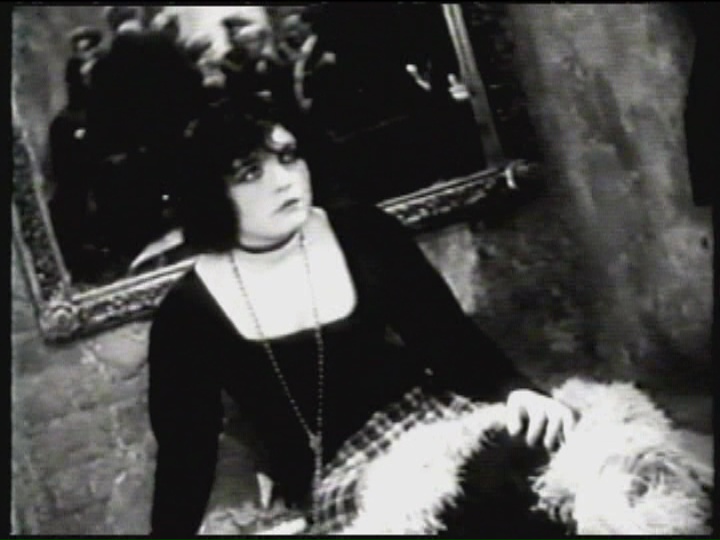
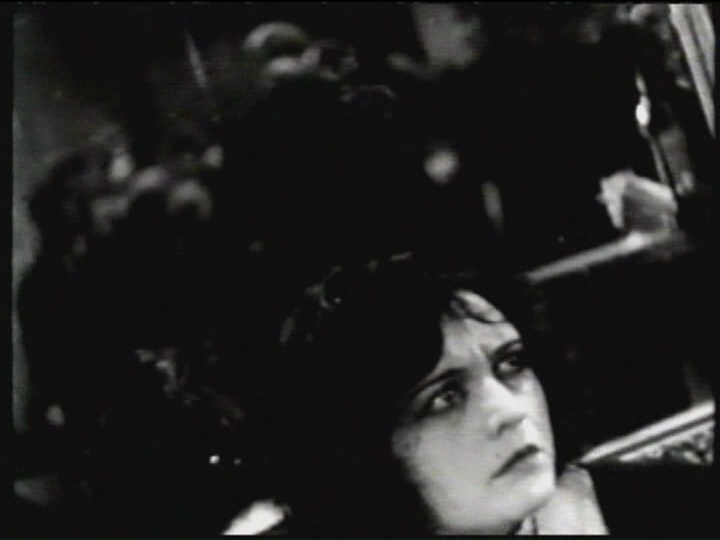
Now we’re with Louise: Pola Negri. She’s pinning pictures up on the wall (a modernist collage above, a classical nude below). She’s smoking. Her dark hair is dishevelled. Her eyes dark. A black neckband highlights how pale and slender her arm and shoulders seem. The camera is tilted. It’s intimate, off-kilter. She winds a gramophone and sits at a mirror. She applies mascara. A man appears in the mirror. The camera flexes, half looks up. It’s Max (Warwick Ward). The dingy bar. Tilted angles. Max with cigarette, with a flash of cash. He looks greasy, hard-up. He drinks, smokes, gambles.
John enters the “Bleue Paradis”. Around him, it’s a den of vice. Female shapes are scrawled on the wall. He sits, drinks. Titled angles, mirrors, smoke. Women approach, kick out their legs. The walls loom down. Enter Louise, the camera slanted as she comes down in feather boa and hat, smoking, drinking. Close-ups of dancers, attitudes. She goes up to the lighthouse keeper. She raises her eyebrow, gives him the eye, turns, turns again, looks at him through his telescope, drinks his drink, shows off her cleavage, waves her boa at him. She sits on his table, forces him to look at her. The camera pans 360 degrees as she does a turn round the room. She’s the life of the place, turning the room into her own parlour. The cutting becomes quicker, the camera moving from faces and gestures around the room. There are no intertitles. We’ve had no intertitles since the first scene of the film. It’s pure visual filmmaking, and it’s superb.
Louise sees John get out a banknote. She snatches it, twirls it round it, makes him grab for it, then pushes it down her cleavage. She puffs out a great bloom of smoke toward his face. She moves closer. So does the camera. The camera is high, now low, now peering over shoulders, now switching focus. Max is half directing her from the next table. He loses patience.
Now Max and Louise are dancing. He is aggressive, she dives away, returns. Their dance shows their power relations: he grabs her, she swirls away, he grabs her again. They fight. He hurls her across the room. John stands, moves to threaten Max. Close-ups of faces, closer and closer, all from tilted angles. Louise looks on, her face drained, surprised—and taken, taken with the stranger. John leaves and Louise follows, a silhouette down the street.
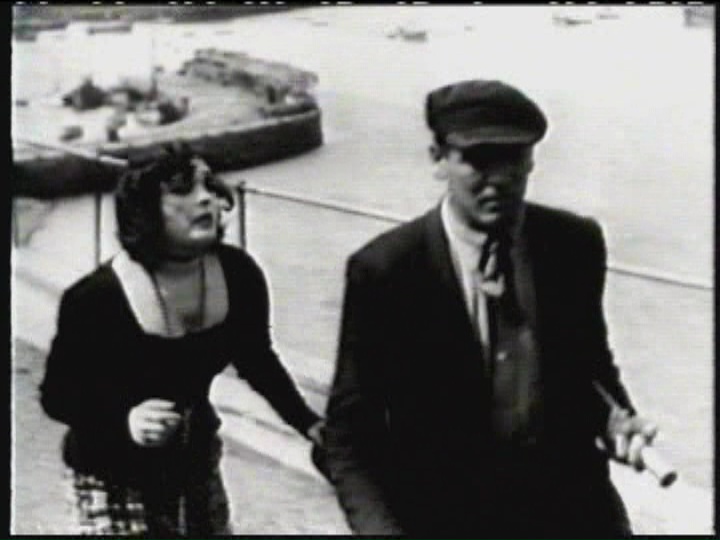
Max is slapped gently awake from his stupor, exits, enters the same street. The pair are ahead of him and hide in the shadows. Louise is following the keeper, desperate. “Take me! Take me!” She’s saved $100 and will give him everything. The camera tracks in front of them, capturing his flight and her determination. She stumbles, falls. She’s pleading. “Max will kill me!” she says, and it’s the first time we’ve seen a character’s name spelled out on screen. The keeper strokes her hair, calms her. Overcome, she sinks back against the steps. He folds her boa into a makeshift pillow, slips some money into her purse, and takes to his boat to leave.
The sea is swooshing past. The wind rises. Birds flock around the mast. The camera bobs, is assaulted by waves. The sea hurls itself against the dock. The camera grows seasick: shots of sea, sky, boat, hands, waves, foam. Rapid cutting. John is overboard. He prays to God: he will save the unfortunate if only his life is spared. The skies calm. Czinner dissolves from the roughing waves to the static image of the married couple—and the two images overlap, the mobile waves and the immobile couple. It’s a moment before you realize it isn’t a photograph but a moving image, so still do John and Louise look. The camera pans to the others at the table, first left, then right, then tracking back: a bizarre, entirely frozen crowd. As the camera tracks back and back, a dark figure crouches in the foreground: it’s a photographer, who snaps his shutter, and suddenly the scene comes alive. It’s an extraordinary little scene, so strange and sinister. What is the future of this frozen marriage?
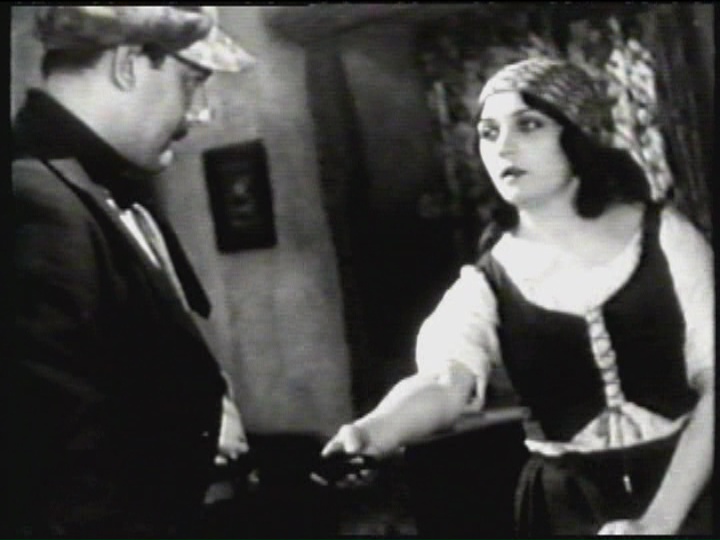
They come home. Louise wanders around, at a loose end. She sits on the bed, huffs and puffs in—what? Boredom? Frustration? The husband walks up and down. Louise wipes her nose on her wedding dress. “Anything to drink?” she asks. She lights a cigarette, as her man paces up and down. He goes to the window, looks out. Louise throws off her veil and gown, shouts at him. John doesn’t hate her, he says, but worries he’ll do her no good. But suddenly she is tender, and he too. She wants him to forget her past.
The waves break upon the shore. The camera pans around the bedroom. Louise is in bed, cosy. She reaches in her half-sleep to the pillow next to her. Where is he? She gets up, sets kettle on stove, lights a fire. The camera pans around the room, watching her busy herself with wifely duties: but she’s in a flap, dropping things, in too much of a hurry. A cat is eating an egg she’s dropped. The fire is too strong. The kettle is too hot. She’s spilled the milk. She’s cut her finger on the breadknife.
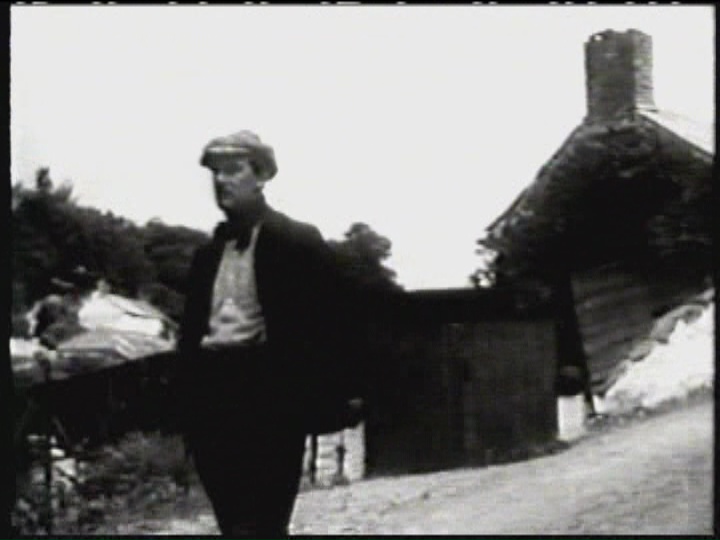
She goes out, to the shore. She wanders over the rocks, out towards the lighthouse. People stare. She makes the same visual and spatial journey as made by the camera in the opening of the film: the same shots, now occupied by her. She shouts up to her man: why didn’t he eat before leaving? His life is tied to “the blue paradise”. (This is the name of her former brothel, and John’s phrase seems to make her look down in fear, or regret, or shame.) But he’s smiling at her care for him, and she busies herself making her man and the older keeper some tea. The older man looks at Louise’s legs—or is it the high heels she’s worn to climb over the rocks to reach them? He’s laughing at this strangely allied couple: the gruff sailor with lipstick on his cheek, and the housewife in heels and makeup who’s climbed out to the lighthouse. John wipes away the trace of the kiss, just as Louise hides her hurt as she turns and puts on her shawl, offering a smile as she leaves. He runs after her, gives her money to buy new shoes and a scarf. She goes away, over the barren rocky landscape inland.
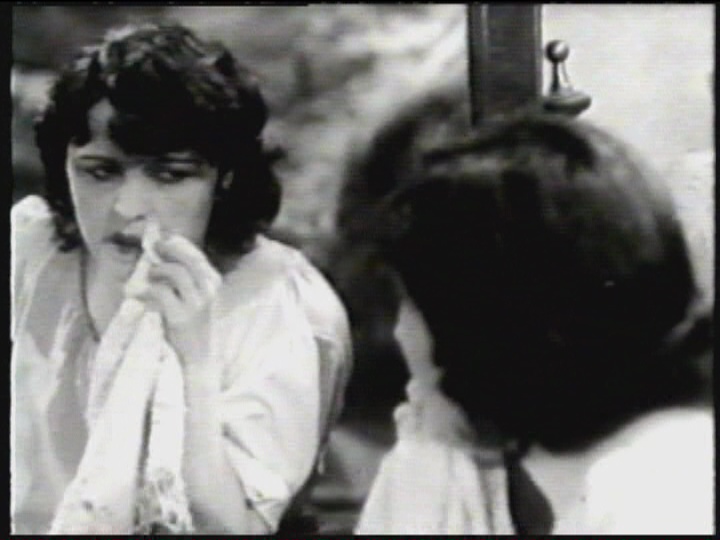
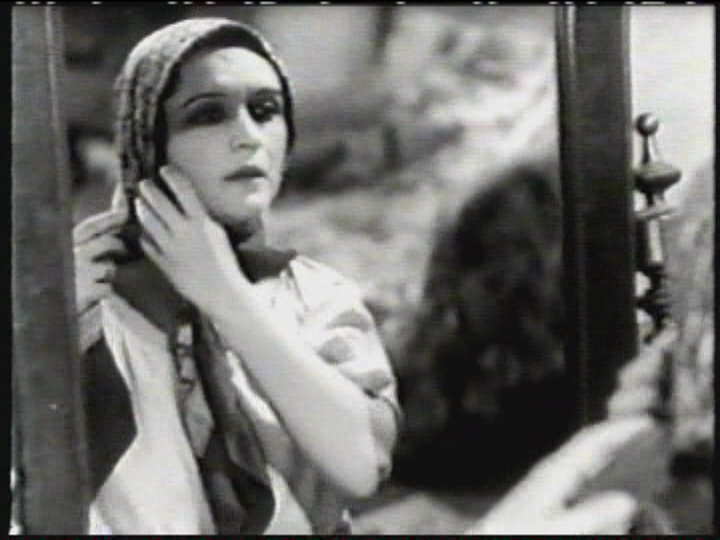
Back home, she sits and takes off her stockings and shoes. In the mirror, she looks at herself. The camera cuts closer, and closer still. She wipes away a beauty spot, her lipstick, a smear of mascara. She ties her head in a scarf, hides her hair away. She is transformed. She smiles at herself, and it’s a warm, surprised, happy smile. It’s a beautiful scene, and touching.
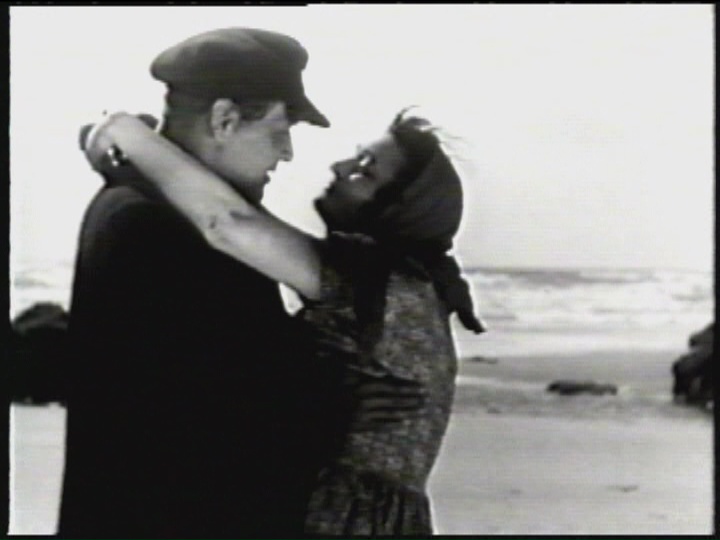
So Louise is at home, with flowers, with kittens. The camera once more pans around to follow her domesticity. It’s better done this time, and her husband arrives to embrace her—and it’s a warm embrace. They’re both smiling for the first time. She cuts his butter, hands him the bread. She’s gazing at him, lovingly. “It’s been three months”, she says, and finally she feels he had confidence in her. They go together through the village, and rather than stare at her the locals smile and doff their hats to the couple. They embrace on the beach, and she nestles her head against his neck.
But who is this following her on her return to the village? It’s Max. He noses around town, sees the photo of the wedding on the noticeboard.
Cue a scene of Louise singing, wordlessly. She’s interrupted by the cat, then by Max. He appears first as a silhouette on the wall. He’s threatening. The camera is tilted again, as it was at the brothel. “What do you want?” “You!” But the neighbour is at the door. Louise ushers her out. Max has hidden on her bed, and makes himself comfortable to sleep. Louise implores him to leave. He gets up, his huge shadow trailing him around the room. The police are after him. Louise is on the floor, the tilted camera looming over her—she’s desperate, oppressed within the frame. She will find John (the first time he’s named) and tell him everything. But Max wants money, time to rest, and doesn’t trust John to be told. He tells her to turn off the light. So the only light in the room is the intermittent flash of the lighthouse: it’s a beautiful moment.
Next morning, the neighbour sees Max leave the couple’s house—and sees the wanted poster of Max, freshly plastered to the wall. The village is in uproar. The policeman comes to Louise to ask about Max. She’s wrapped in her black shawl. She looks so vulnerable, so cold.
Back at the lighthouse, John sees Louise arrive by boat. She breaks down in tears, throws herself into his arms—tells him about Max. It’s all done in a single take, without titles—her face says everything. She lied to the policeman not to save Max “but to save my happiness”. John demands she denounce Max if he turns up again, and she swears—her hand raised in tentative agreement. She’s afraid to go back to the village (and the villagers), so stays with John at the lighthouse.
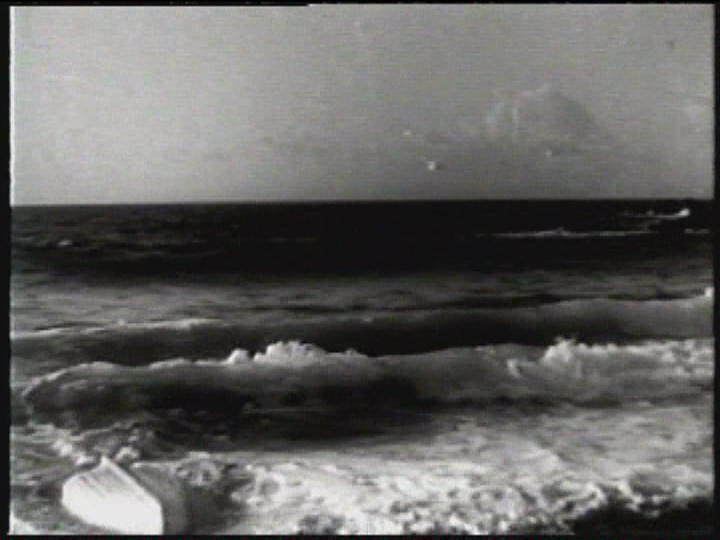
But here’s Max, whistling from the gate of the lighthouse. Louise creeps out, to make Max go away. She gives him money, demands he go away on her boat. As the wind whips her hair, she looks on at the men fight. John tells her to go away forever, calls her a whore—and the word hurts her. She drags herself away, away to the water’s edge. She gets into the boat. The villagers and police arrive, and as Max flees, he falls to his death. And Louise? The waters are raging, a storm building. She rows. The skies darken. She hears his words again. She is alone with the camera, her face in the leigh of the light. She flings aside the oars. She stares at us. What do we think of her? Cut back to land, where John is on the shore, his back to us, staring out to sea. We see an upturned boat on the shore, amid the foaming waves. The sea and sky are dark, but a patch of sunlight catches the white hull of the boat. Waves break over its back. The camera holds upon the image—holds, and holds… FIN.
An excellent film. Czinner makes the most of his small cast, low budget, and coastal locations. The deserted Cornish (or should that be “French”?) streets are turned alternately into idyllic retreats or threatening, noir-ish mazes. The locals are friendly but can turn into a mob. From the dark world centred on the brothel, we go to the windswept expanses of sea and sky around the village and lighthouse. This society may be remote from the lower depths of the brothel, but it can still judge and condemn individuals. Louise is dominated by Max in the brothel, but married life with John carries its own burdens. And the elements are there all around, threatening and buffeting Louise in her new life.
At the heart of the film is Pola Negri, who is always compelling. To see her smoking, dancing, flirting, and fighting in the brothel scenes is a thrill. And to see her find something that might be love, and to make somewhere that might be called home, is moving. Though I can imagine other stars of this period in similar roles, I cannot imagine them doing quite what Negri does here. Gloria Swanson, in her more daring outings, such as Sadie Thompson (1928), might have pulled it off—but her glamour is of a different order to that of Negri. Glamour is a kind of presence, but I don’t know if it’s the word I’d use to describe Negri’s presence. Thinking of slightly later films, you might imagine Marlene Dietrich taking on this role of prostitute-turned-housewife. But Dietrich (at least for Sternberg) likewise has a kind of glamour that doesn’t thrive in the climate of a film like The Woman He Scorned. She’s impeccable, even in poverty, even in exotic locations. I could imagine Dietrich in the brothel of Czinner’s film, but not on the streets even immediately outside it. Perhaps my imagination here is too limited to the impeccably arranged mise-en-scène of Sternberg films, and I do Dietrich a disservice, but somehow I can’t see her being so open to the elements as Negri. And I couldn’t imagine Dietrich convincingly becoming a housewife for a lighthouse keeper, which Negri does—or at least conveys her own belief in being that role. Negri is a messier screen presence, more able both to be convincingly violent and convincingly tender. Dietrich never moves me; impresses, yes, but never moves. (But I suppose, her films with Sternberg are not meant to move you in such a manner. Doubtless Sternberg might scoff at my talking about his films in such a way.) Negri has a bodily presence; she’s more than an image, more than a luxurious piece of the mise-en-scène; she’s able to be raw. Though I love her presence on screen, I can far more easily imagine her walking off screen, off set, and onto the real streets than many of her contemporaries.
Not that The Woman He Scorned is just Negri. The world around her is atmospheric, and the performances around Negri set the limits of her world, the horizons of her expectations. Warwick Ward is pleasingly greasy, selfish, and violent—while still looking like he might, once, have been charming. As John, Hans Rehmann is solid if not remarkable. Frankly, I’d need to see a better-quality print to better follow his facial and bodily performance. For much of the film, he is the cool, collected presence against which Negri’s more expressive performance contrasts. It’s the point of his character to be emotionally reserved, almost stolid. John understands the duty of marriage, but not the reality of love. Rehmann certainly has the physical build to convince as a sailor, and he conveys the conflict between his good intentions and social prejudices well. He has the bulk to protect Negri from the outside world, but also the bulk to exclude her from his inner world.
All of which brings me back to the production itself. Czinner’s camerawork is fluid, expressive, articulate. There are only a handful of intertitles in the whole film, and you’d virtually be able to cut them all and still have a coherent narrative. So articulate was the film that (even watching it in appalling quality), I didn’t feel the need to ask questions about the names of the characters or the location of the film. However, trying to do the most basic research on background to the film has proved illuminating—and confusing. I’ve titled this entry The Woman He Scorned, but is this even the correct title for the film? The BFI lists no less than seven alternatives: “Hunted”, “Traquée”, “The Street of Lost Souls”, “Rue des Âmes Perdues”, “Son dernier Tango”, “The Way of Lost Souls”, “Seat of the Fallen”. In her memoirs (Memoirs of a Star, 1970), Pola Negri calls the film “Street of Abandoned Children” (334) and claims the film was retitled “Seat of the Fallen” “in England and America” (338). It’s a marker of the film’s status on the borders of silence and sound, as well as between UK, European, and US markets, that it should bear so many aliases. Released in 1929 as a silent film, then swiftly reissued with a soundtrack of music and effects, it is currently available to watch only in a murky print with French titles. (These titles have themselves been digitally replaced with English for the sake of the shitty DVD I watched.) And who wrote the script? The BFI page says Czinner wrote the scenario, but other sources credit Charles E. Whittaker—an Irish writer and producer, whose company was the British element of this British-German coproduction.
So, if I refer to this film as The Woman He Scorned, I do so because it seems the most succinct summary of its story—and because all these talk of “streets” and “ways” raises the question of the film’s setting. Where, exactly, is the film meant to be set? The street signs in town are in French, but the wider view across the harbour looks more like south-west England—and the village around the lighthouse is clearly Cornish. In his biography of the actress (Pola Negri: Hollywood’s First Femme Fatale, 2014), Mariusz Kotowski describes Pola’s character as “a Marseille prostitute” and John as “a law-abiding sailor with strong convictions” (163). Fine, but are we meant to be in Marseille in the opening scenes? And how far away is the lighthouse from the town? If this man is John and not (for example) Jean, what nationality is he? The synopsis provided on the BFI database describes John as “a French lighthouse keeper”. The more clarity you seek, the more confusing things get.
Negri’s memoirs offer some nice details around the production (though no clarification about some of the above ambiguities of setting). She recalls the Cornish location shooting thus:
We were quartered in a quaint little old village inn and naturally the natives were enormously curious about us. Many of them had never seen a motion picture and were not quite certain what was happening in their midst, except that it must be something of satanic design and could well bring bad luck to all who came in contact with it. Even without being accompanied by all of our strange equipment, actors would have been rumored to hold black masses and be practitioners of witchcraft. Add the cameras and lights and make-up and we must certainly be doing the devil’s own handiwork. As a result, it was initially very difficult for our production manager to persuade the locals to appear as extras, but raising the fees performed the miracle of lifting the curse of working with us. (339)
Negri even records the camera crew being assailed by “local men bearing down upon us armed primitively with pitchforks, rakes, spades, rocks, clubs”, their women and children marching behind them, “babbling in that almost unintelligible Cornish accent” (341). (Their crime was filming on the sabbath day!) What Negri does confirm is that Czinner did film some material in France, around Marseille:
The difference between the tiny immaculate Cornish fishing village and the teeming French port was a study in opposites. We were shooting in the actual Rue des Infants Abandonées in the heart of the red-light district. It was a narrow street in which prostitutes openly promenaded or else sat in windows lustily hawking their wares to lonely sailors off ships from every country in the world. (342)
But how much of this footage is in the film? And is the film—as I watched it—complete? Clearly, The Woman He Scorned needs restoring. Are there missing intertitles that would help explain the setting and character names? Are here any differences between the UK and international versions of the film? Is there any alternative footage or variation in editing? Is the ending the same in the other versions? But if I want answers to these questions, it’s because the film intrigues me. Lean, low-budget, and narratively simple, it’s nevertheless a stylish and emotionally engaging film with a great central performance.



































 The Realm of Silence