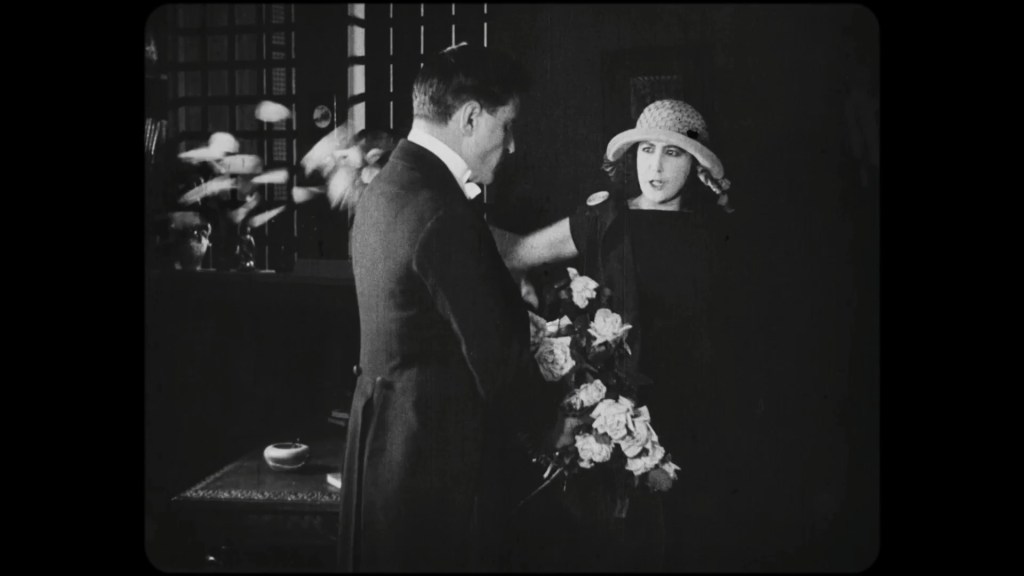
A ripe melodrama from Italy: after her brother Alfredo secretly steals her husband’s money, Giulia (Leda Gys) must ask help from Roberto, who obliges but then forces himself upon her; after Giulia has a second child, her husband Luciano suspects that the daughter growing up in their house is not his…
At last, a bad film! For the sake of my time and fingers, I’m relieved that I don’t have to write or think as much of Profanazione as previous films. That said, it is only an hour long and packs enough unexpected (which is to say, clumsily inserted) twists to give one enough of a reason to stick with it.
But the problems are manifest from the start. The performances are not bad, as such, but rather obvious: when drama strikes, eyes begin to bulge and hands begin to ascend towards heads and faces. The camera is almost inert, though there are enough neat compositions to ward off aesthetic hunger. What disappoints most is the way that the intertitles do too much work, substituting text for visual imagination.
When Giulia visits her rich admirer Roberto, we read: “Before she crosses the threshold of his house, she feels all the anguish of the sacrifice of her woman’s pride.” [N.B. The original word “orgoglio“ (“pride”) is mistranslated as “watch” in the available subtitles on the stream.] All that we see, with only a second or two to linger, is Giulia closing her eyes outside the gates.
Elsewhere, text invokes complex emotions that widening eyes and static poses cannot. “She seeks comfort for her pain in the love of her children, but in vain”, says a title. We see Giulia in her chair. Another explanatory title. Cut back to Giulia in the same chair. And so on, and so on, and so on…
What keeps the film failing completely is the sheer brutality and narcissism of all its male characters, who bully, ignore, abuse, and exploit Giulia and (later) her two daughters. It isn’t sophisticated fare, but it stops you falling asleep. Faced by Roberto’s brutal advances, Giulia fights with her gun and then with her teeth, then (after she has been violated off-screen) takes the flowers Roberto gives her and thrashes his face with them. It’s an extraordinary set-up, but somehow the crudeness of the surrounding film bled dry the feeling it should have invoked. This film was released in 1924. If it had been an Italian film made ten years earlier, I can’t imagine it being this lacking in atmosphere, feeling, texture. It’s a world away from the great “diva” films of the 1910s.
In Profanazione, the male violence keeps coming. A few years later (how time flies!), Roberto threatens to come to Giulia’s house and see “his” daughter. Giulia drives out of town to ward him off. She breaks down. “How fate is against her…” Yes, and the screenwriters too. For Roberto arrives from the other direction and they drive back together. At home, Giulia’s children (dressed in ridiculously frilly tea cosies) play and crash their toy car: cue the inexplicable sight of Giulia and Roberto plunging off a cliff.
The husband, Luciano, arrives at the scene. The best thing he can do to his insensate wife is grab her and shake her arms. (Weirdly, he’s gentler to Roberto, lying on the other bed.) But wait—Luciano has contracted a rare eye-bulging condition. A stroke? No, he is suspicious! As Luciano is refreshing himself on the details of the plot through various bits of incriminating paperwork wrested from the unconscious bodies, Giulia awakes—and it’s her turn for bulging eyes. (It’s contagious.) Luciano acts “like a madman” and searches documents for evidence. (Not only do his eyes bulge, but his neck apparently swells too much for his collar; perhaps he has a parchment allergy?)
Bits of the film fly by in-between cuts inflicted by time, others by design. Is anger leeching from the frame, between the frames? Is the melodrama so potent it’s causing the celluloid to buckle, break, flee? The film breaks itself into numbered parts, most of the transitions between parts occurring mid-scene. Thus: we see Giulia sitting. End of Part 3. Part 4: Giulia is still sitting! Oh dear, her eyes are closing. The next day. Luciano is pacing. A telegram. Giulia is havering in the doorway again. Roberto is in a wheelchair, too feeble for Luciano to slap him about. “I will wait for you to answer until I die!” The nurse (a nun, by the looks of her) says: “If he has sinned, God will punish him—not you.” Roberto lies about which is his child: he says it’s Mimì to protect his real child (I must have missed her name) from wrath. So Luciano goes home to embrace “his” own child and hits the innocent Mimì. “I’ll keep my child, you keep his!” he screams at Giulia. Great stuff, Luciano.
(I’ve already written too much on the film, but I’ve come this far…)
Giulia stomachs this for a scene, then tells Luciano everything: we see again Giulia hitting Roberto with roses, but no more. (How one longs for the film to do something, anything, visually imaginative with memory, feeling, subjectivity etc.) Does Luciano believe his wife or Roberto? But news just in: Roberto is dead. Giulia’s eyes bulge and she walks slowly away. Upstairs, Mimì “falls into an uncontrollable fit of weeping”. Oh dear, oh dear, oh dear. Giulia lifts her arms and prays; her pose dissolves onto an image of the Virgin Mary. It’s one of the film’s few attempts at complex visual design, and all it can reach for is cheap Catholic tat.
The images of birds in a cage, the children superimposed over them, is so obvious that even Luciano gets the message. He finally forgives everyone. And, complete with a duff subtitle translation that somehow suits the lazy sentiment, we read: “The heart wants what its want” [sic]. Now Alfredo returns from his travels (he buggered off early on in proceedings, having caused Giulia’s predicament in the first place) and confesses his role. It’s a shame that Luciano has now recovered his cool so doesn’t vent some rage on Alfredo, who (for my money) has eased his way undeservingly through all trouble.
The film’s last title waves goodbye with a breezy note: “THE END / Good evening, thank you!” It’s as if it senses that we’ll be in a hurry to leave at the end. I certainly was.
The second part of Day 2 takes us to two very different silent worlds: a haunted fairground populated by marionettes, and a snow-bound urban apartment populated by a working-class family. I confess I didn’t have the time to watch the filmed intros today (or any day) so I cannot tell you about the day’s themes, only reflect on the films themselves and how they (one, at least) link to previous films in the festival…
Die Grosse Liebe einer kleinen Tänzerin [Das Kabinett des Dr Larifari] (1924; Ger.; Alfred Zeisler and Kictor Abel)
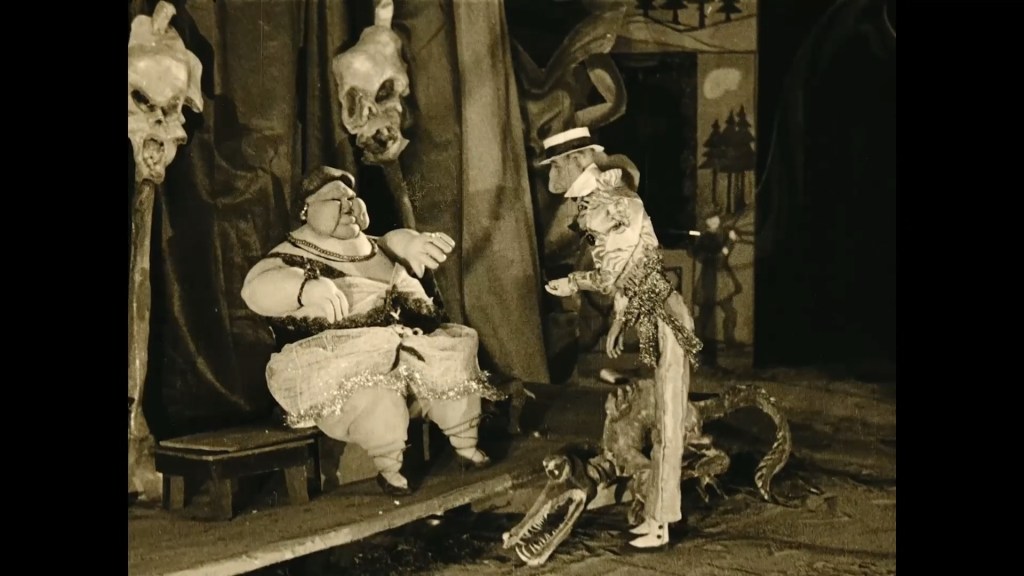
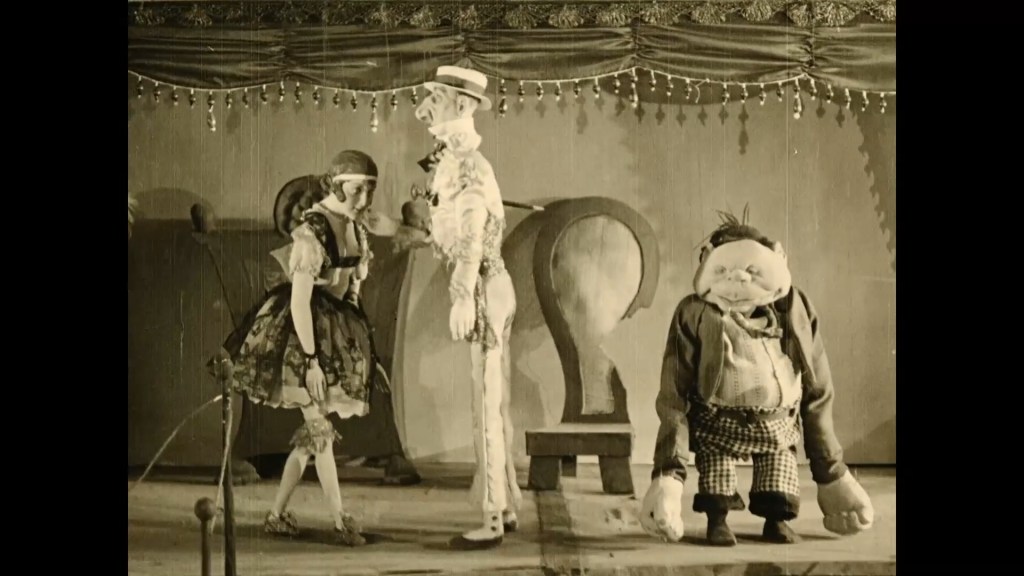
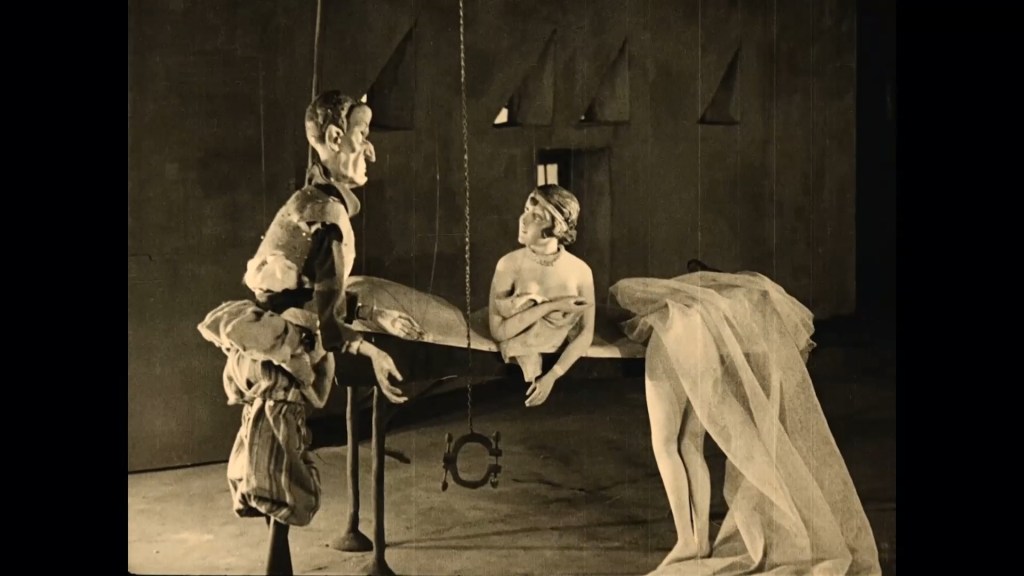
This is a terrifying film. Though the film’s given title (The Great Love of a Little Dancer) offers little sense of its content, it’s alternate title (The Cabinet of Dr Larifari) is a clearer signal to its style, mode, and method. Here is a nightmare version of a nightmare film: a doll’s hallucination of Dr Caligari.
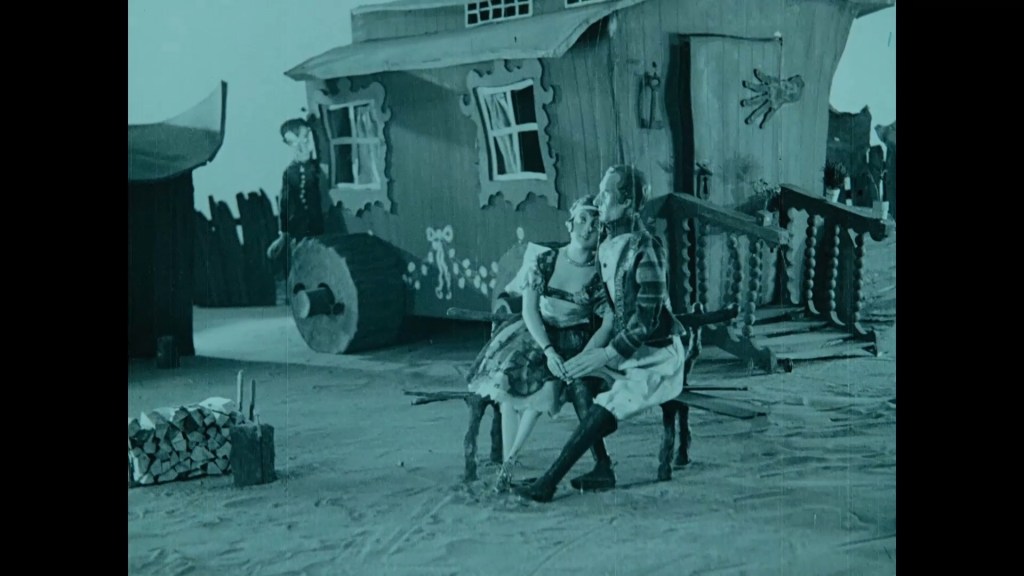
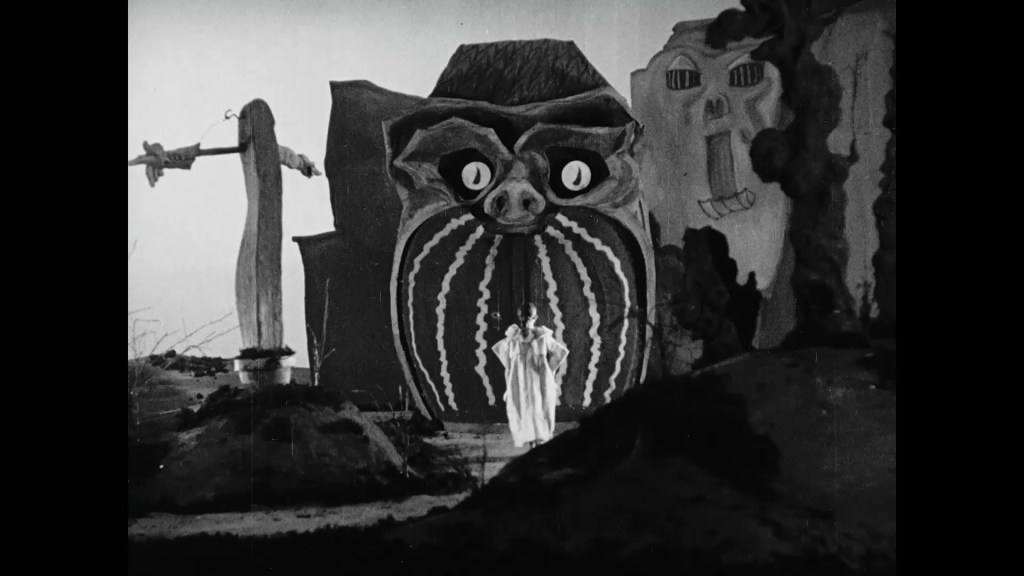
The world is immediately recognizable. Recognizable yet different. A distorted version of the distorted sets of Caligari. It’s a misremembered recreation of the earlier film. It’s a dream recalling details but not the whole, or the whole but not the details. Where are we? Glimpses of a city behind the fair. We are on the fringes of another reality.
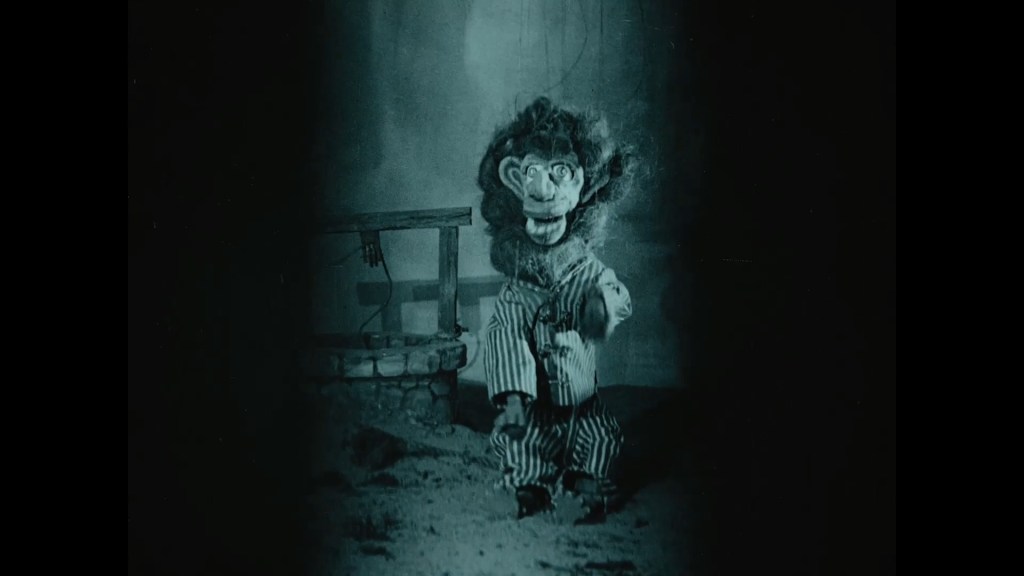
Here are grotesque figures. Distended torsos, bloated bodies, elongated legs, scrunched faces, squished heads. Spiderweb lines tingle from their limbs up to the top of the frame. Mr Adolar is a thin, pinched voyeur. Esmerelda is not grotesque, tough her gentle smile is just as carved as Adolar’s smirk. Adolar tickles her chin. My skin crawled. Everyone walks slowly, awkwardly. Which is to say they do not “walk” as such. They are led, guided, controlled. The awkwardness is inherent in this world. Like the painted sets of Caligari—where even light and shadow are unable to move, to escape that dreadful, fixed world—the dolls of Larifari move without will. They move slowly, unable to provide their own momentum.
Larifari stares jealously. He always stares jealously. He can’t help it. Jealousy is furiously inscribed in his face. His face has no other expression, no other purpose. He is there to be jealousy.
There are characters with extendable legs, jack-in-the-box spines, punch-bag faces.
Here is Leonidas, Esmerelda’s line-tamer lover.
And here is his lion. A talking lion with possessed eyes. A terrifying companion. A companion who follows with an absurd leaping step. Like a giant flea.
Larafari is frightened and so falls into a bucket. Low comedy turns sinister. Larafari swears eternal revenge. Of course it will be eternal, he cannot change. His motives are as fixed as his face, his spine.
Superimposed vision of Larafari in Esmerelda’s room. A curse: Every man who comes near her will have their head literally turned. His words come in a jumble of rearranging letters. Yes, the text is animate: but the letters march and wheedle like dolls; even punctuation performs jerky, awkward, acrobatics.
Here is a man like a mashed pumpkin who lifts weights. Here are Knockenmus and Bruchspinat (Bonepulp and Brokenspinach). The names are ciphers of a childish nightmare. They are an infant’s plate of mashed food come to life.
The curse takes hold. The head-turned victims must visit Professor Mordgeschrei (Pr. Deathknell), the Miracle Doctor. Why must they visit him? Why is there no other recourse? Because! Because there is no reality beyond the frame. There is no city beyond the fairground. As in Caligari, there is no escape. The film gestures to a space beyond without ever suggesting it exists as a reality. The outside world is a painted flat, a model. The sky is painted. The horizon is an infinite impossibility.
Dolls with backward heads twitch and writhe. The doctor’s lair opens its moustache-mouth door. The doctor assembles himself: it is Larafari! Esmerelda reveals her second face: one of fixed terror. There can be no transition between expressions. Each is fixed, with the threat of permanent fixity. Transition is for the living.
He decapitates then re-capitates the circus folk in a crude head-swap operation. (Even the grammar of the frame aids and abets him: masking the heads in three dreadful vignettes, surrounded by darkness.)
Meanwhile the lion is being tortured by its tail trapped in the door and endlessly elongating. (Yet I can’t bear the thought of it escaping, of coming in, of appearing in the scene in order to “help” me.)
Esmerelda is naked. Her stiff hands cover herself. Is she tied down? I cannot tell. But it matters not. A different logic is at work.
Larafari has a saw. He approaches.
Thank god we don’t see the operation. It is an unthinkable process.
Esmerelda is sawn in half, but still she takes care to cover her breasts. What dignity is left to her?
The lion attacks Larifari and makes him scatter his limbs. Is he dead? Or can he escape the limits of his own construction?
Esmerelda has lost Leonidas. In despair, she commits suicide by falling off the bed and shattering.
But it’s all a dream! Or is it? No, it’s all a film. The dolls are put back into their Piccolo Film coffin.
As I said, this is a terrifying film.
Just Around the Corner (1921; US; Frances Marion)
The Birdsong family live in a poor district of the city. The widowed Ma has a heart condition which will soon kill her. Her son Jimmie is a young lad on the cusp of manhood. Her daughter Essie is dating a young huckster, Joe. Ma hopes Essie will marry, and worries for both her and her son providing for themselves when she is gone. The film is an interesting counterpart to Yes and No: more successful in some regards, less in others. There are no stars here, the most famous name being the film’s author-director. But the emotional success of the story, manipulative though it is, crept up on me slowly and surely.
Yes, this film has “Scenario and direction by Frances Marion”. Another woman’s name at the head of a picture, adapted from a story written by another female author. And the film has the same intelligent female eye for detail, meaning, for social pressures.
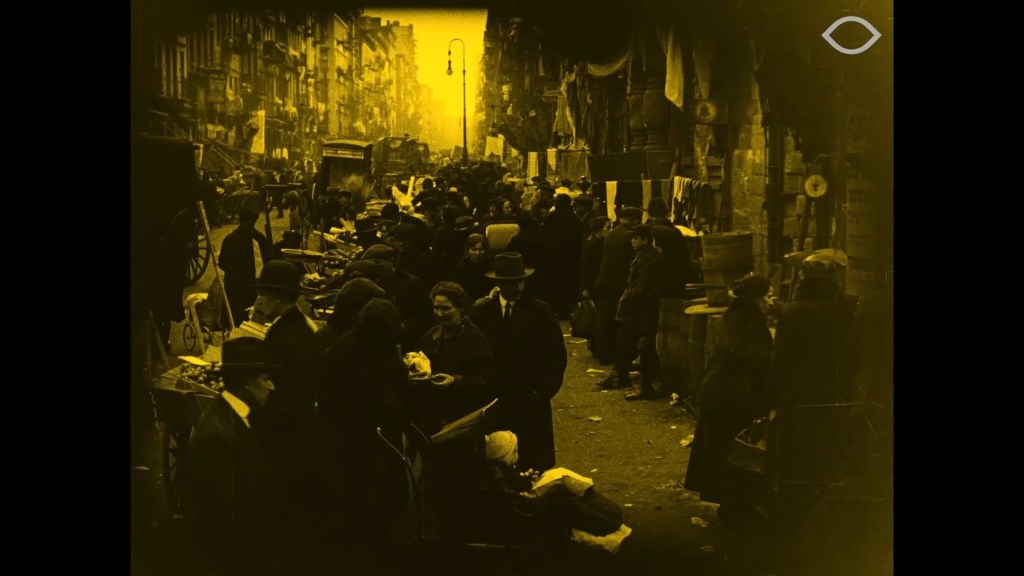
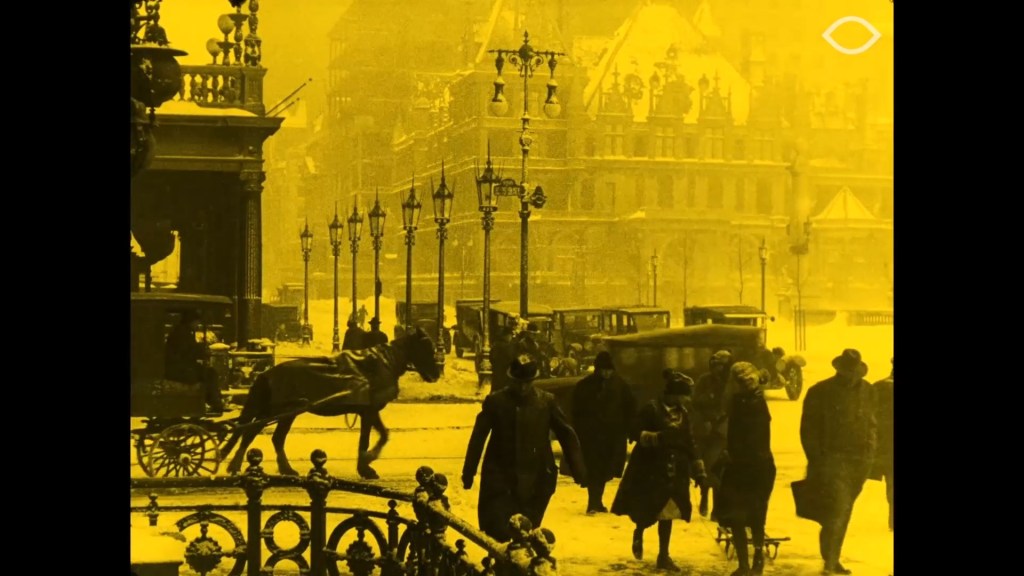
Here are glimpses of the city streets. Real faces, real bodies, wrapped up. Rich photography, clothed in rich tinting.
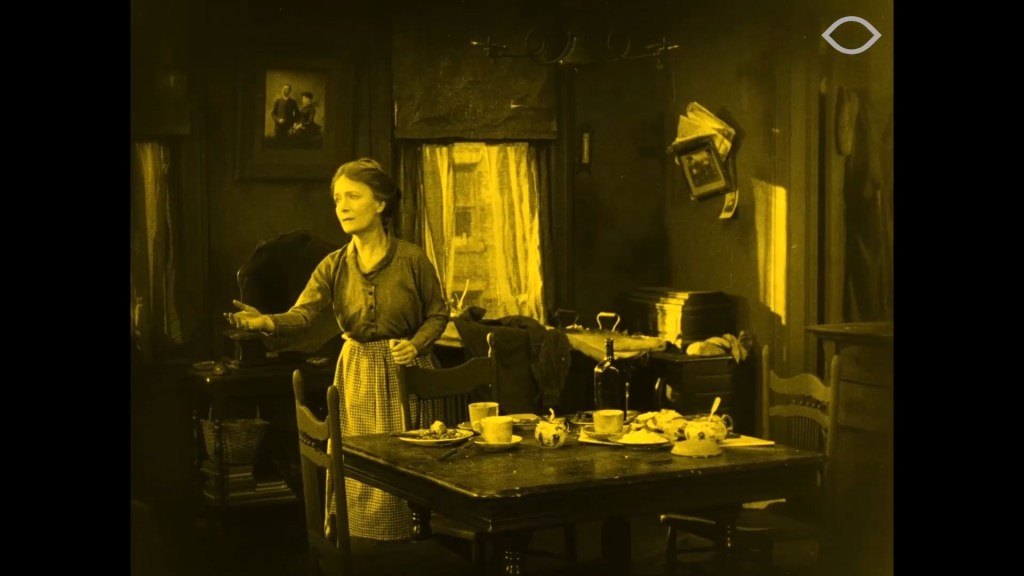
Ma (Margaret Seddon) can frown and smile at once; love and worry are one and the same. As with Norma Talmadge’s character of Minnie, it is the moments when Ma is left alone that move me. There is her pain when Jimmie leaves without kissing her goodbye, and her gladness when he returns and they embrace. (And there, in a picture frame on the wall, is a photo of her with her lost husband. It’s never highlighted, but there it is, the past—her past—present in the background.)
The film’s painted title designs are most tasteful than Yes or No.
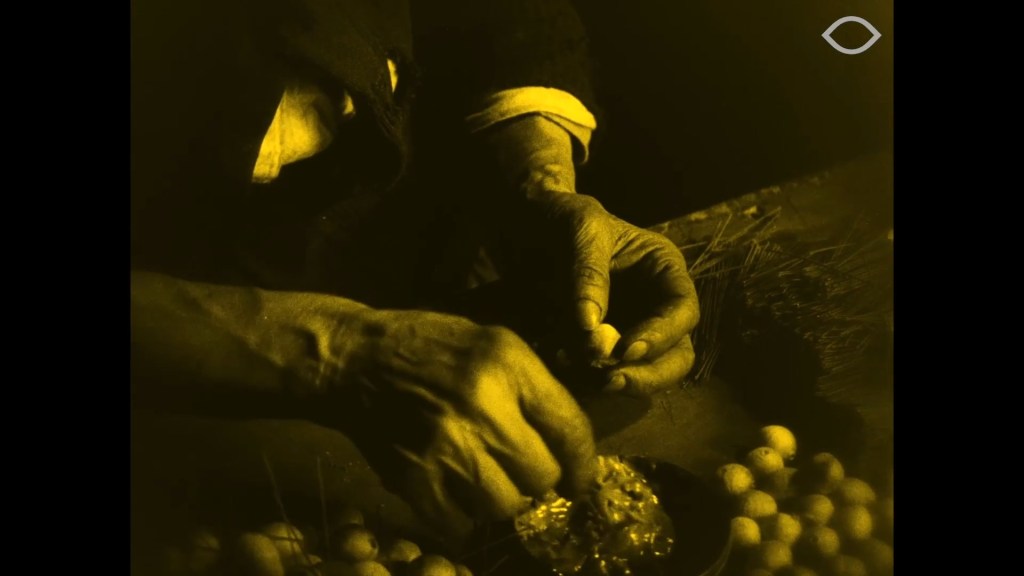
Essie works in a flower shop. The lighting is beautiful, but the work is visibly hard. (I recognize the same real hands that are in the flower shop scenes of Kirsanoff’s masterpiece Ménilmontant (1924).) The texture of hands roughened, hardened, darkened by labour. The texture of human skin. Real faces. A curious sensation: the sheer beauty of the photography and tinting, and the harshness of the work on screen.
This is a film that knows how its world—our world—is run, and who runs it: the boss evades the law by getting his women to work at home on Saturdays. The boss is also predatory. Jimmie tries to be a man. His gait is forced. He looks absurd. He is trying to help. The boss feigns a punch. Jimmie recoils. Essie placates the boss. The world runs as ever.
The print is superb, but here is the first sign of real decay. The films mottles, becomes blotched and bleached. Decay flickers over Jimmie’s face when he tries to stand up to his boss. He is trying to look like a man, to make time artificially speed up. But here is the real sign of passing time: the boy’s face is being eaten away by the death of celluloid. His face is long eaten away by now.
Ma is at the window. A capsule of sadness. (I wished the sight of her here had lingered, her loneliness is so tragic.)
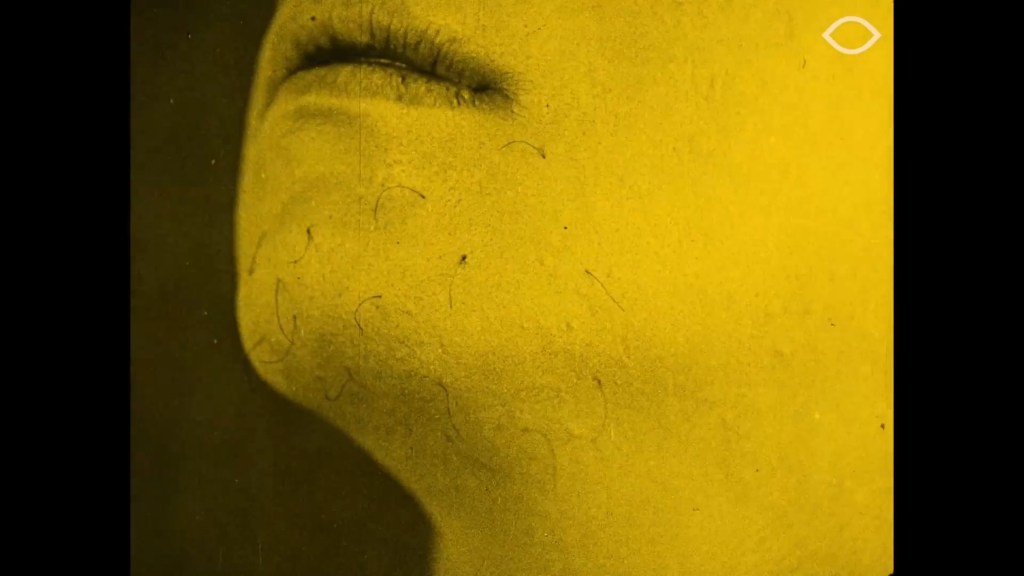
Jimmie tries to force himself to be a man. He shaves. Essie: “What are you shaving Jimmie, your eyebrows?” It’s a great line, followed by an intrusive, weird closeup of a few hairs on the boy’s chin.
Lulu is Essie’s friend, but we distrust her immediately: she’s dressed up, judgemental of Ma. Her carelessness is hurtful. When she disparages Ma (“You certainly forgot the ‘Welcome’ on your doormat, dearie”), she insults us. When Lulu gets Essie a job as an usherette at a theatre, Ma is upset: “It’s night work, I’m afraid of it”. There is something unsaid here, an experience unrelated by Ma. It’s a nod to the position of women and their exploitability. We’ve already seen how Essie’s boss behaves. Nothing is spelt out, but it’s there, lurking outside the safety of the frame.
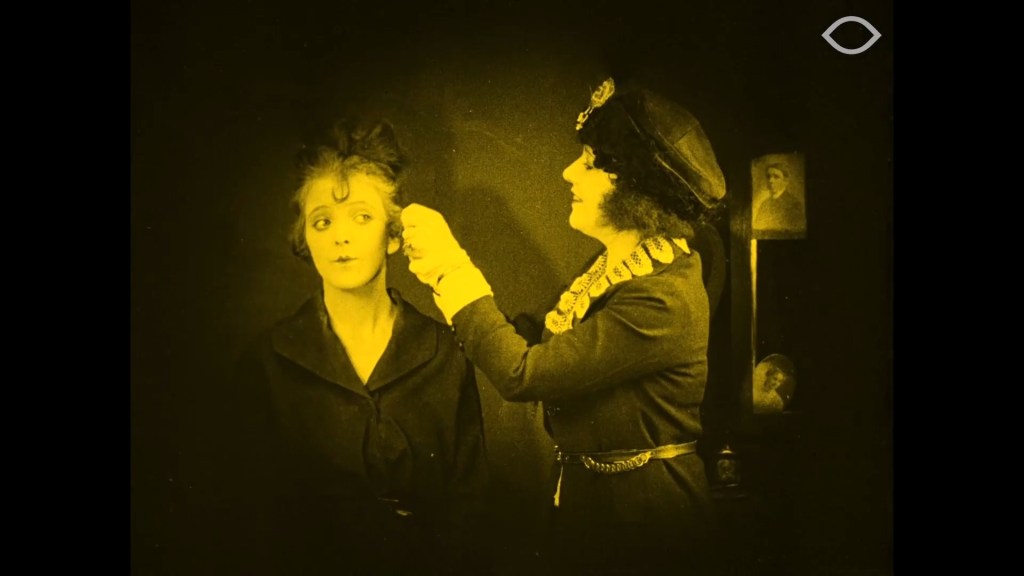
Lulu makes up Essie for her role, and Ma frets again: “It’s not about lipstick—it’s what it might lead to.” It sounds absurd, but Ma speaks as a figure from an earlier generation, the generation voiced in Griffith’s Biograph films, where fears of being a “painted woman” and all that might imply are explored in numerous scenarios. It’s also a worry about how men will read Essie. Ma wants to obey one set of rules (voiced by her, but set by men) to not fall foul of another set of expectations (again, set by men). And on the mirror behind Essie is a photo, indistinct, of her father.
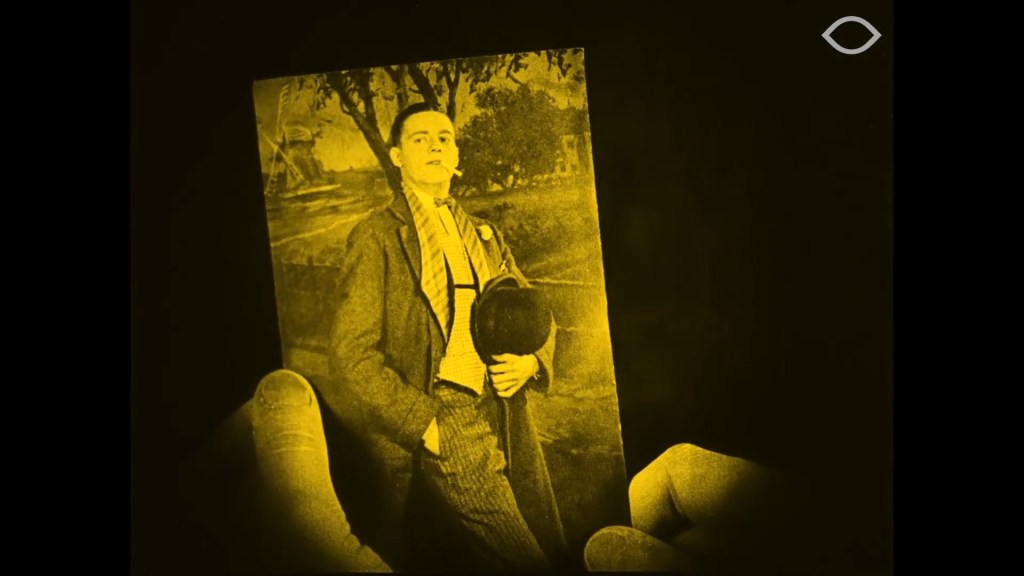
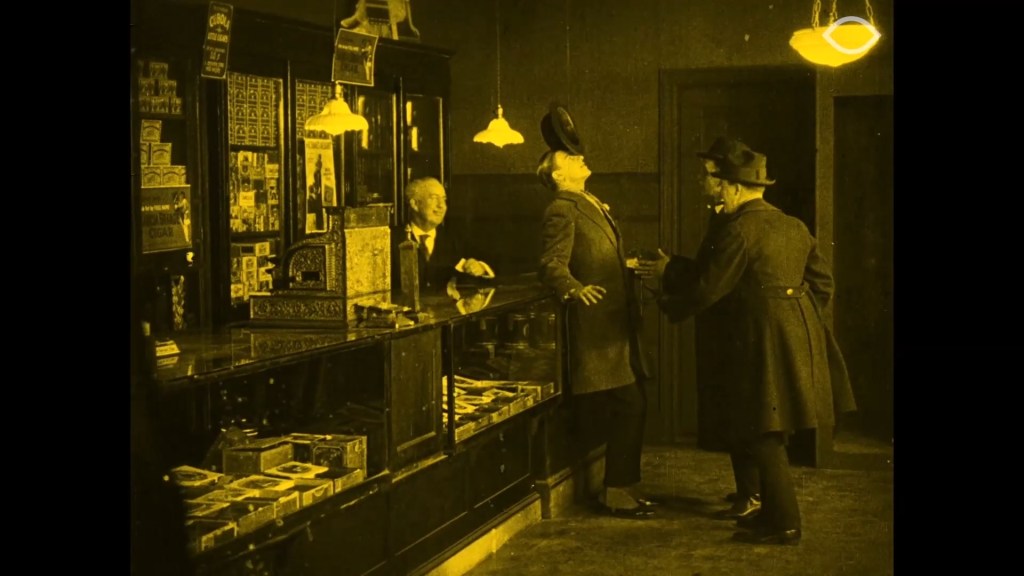
Now we meet Essie’s boyfriend, first via a photo she has of him. It’s a ludicrous pose, a ludicrous look. He is comic, but is he more than that? He first appears in the flesh trying to impress his peers by balancing a hat on his nose. Now he’s hawking tickets at inflated prices to a man in a shop. He’s a wrong’un, no doubt.
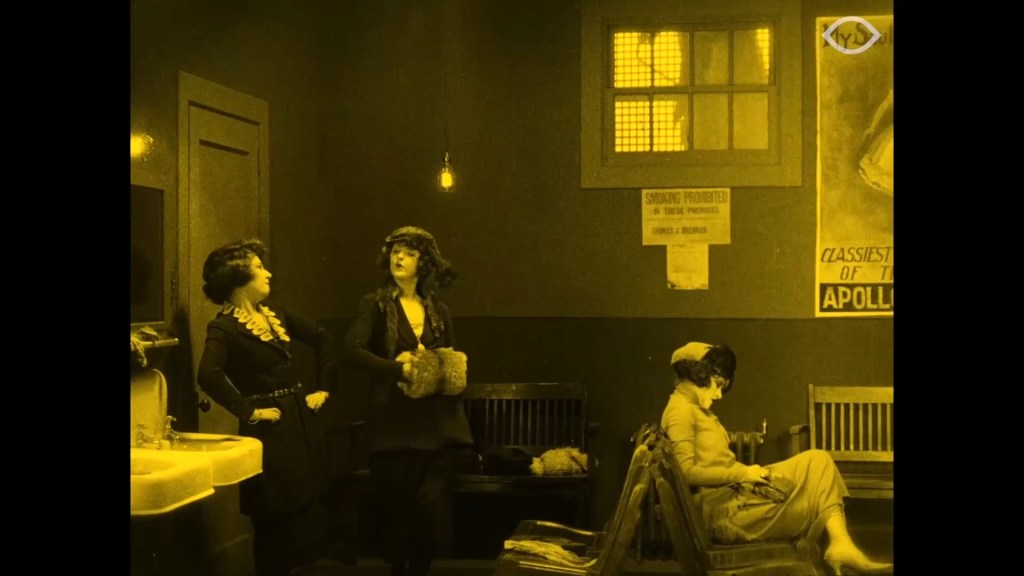
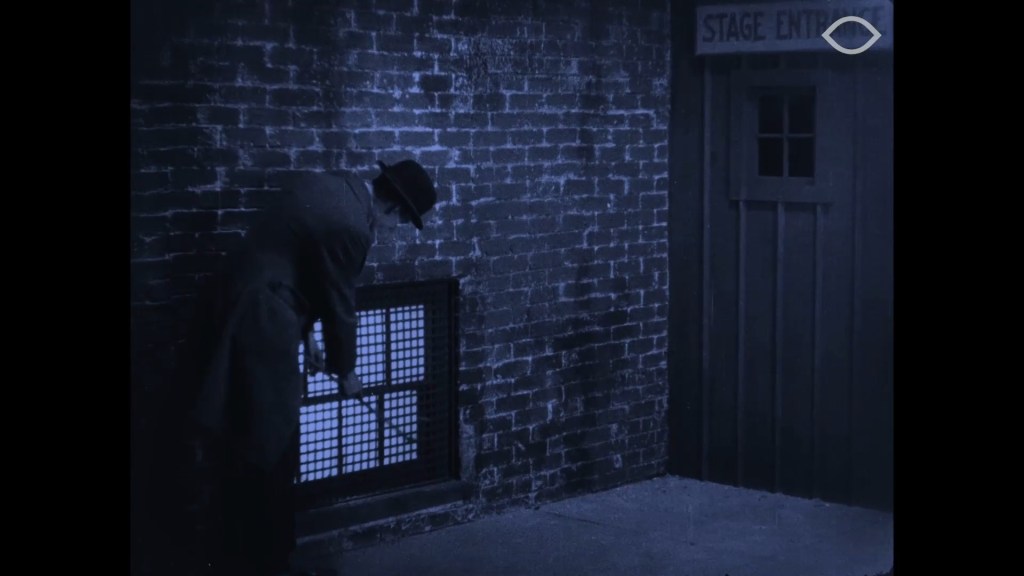
We are in the changing room of theatre. It’s a feminine space, but it’s overlooked by the male space of the dark street alley—where men can tap the caged window to get there attention.
Essie is taken to “a sixty-cent restaurant”—a cost-based denomination that Balzac would have appreciated, describing a life through a balance sheet of daily costs and expectations. (Balzac: “We only resent spending money on necessities.”)
Will Jimmie come home to meet Ma for the first time? Ma hopes so. Her children are out but she tells her neighbour and cries because she is happy. Like her frowning smile, her joy is expressed through a means shared by sadness.
Joe avoids all talk of marriage. He whistles as Essie leans in to press him on the issue. His character is played for laughs, at first, but it’s clear that the laughs are expressive of his entirely superficial nature: he laughs off all responsibility. His laughter grates, his lightness irritates, angers.
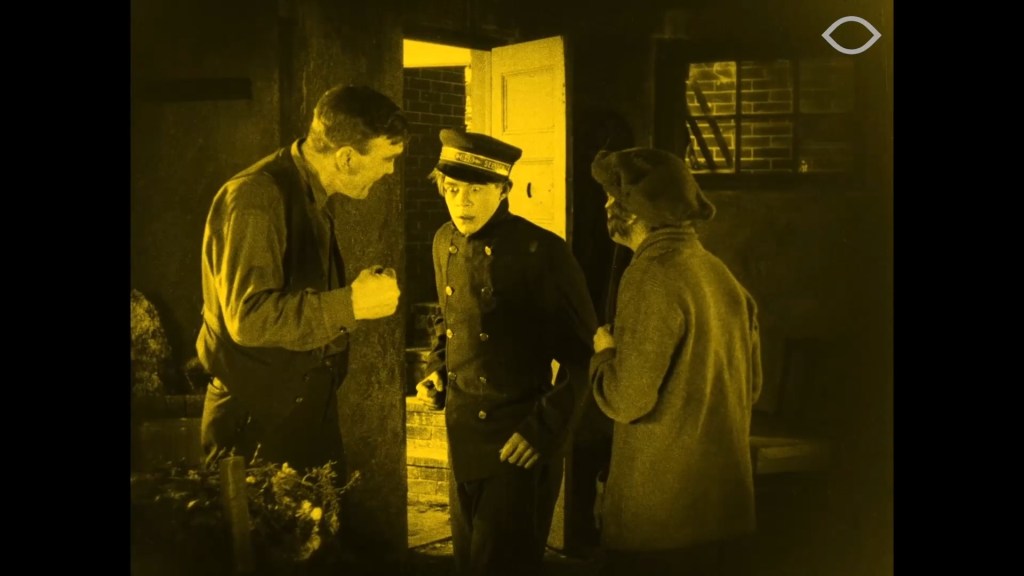
When he reaches the Birdsong apartment, Joe stops at the entrance. He says he has a celluloid collar and worries: “the fireside ain’t no place for me. I might blow your mother to smithereens!” It’s a good line (though I now resist laughing at anything this foul character says or does), but I immediately think of Jimmie’s face blotched with decay. The character refers to the medium that captures his life on screen: a life that is flammable, dangerous, at risk of instant disappearance.
And yes, of course he runs off without coming in. And it’s so hurtful. We’ve already seen him flirt with another woman; he lies, cheats, he’s a coward. The film is squeezing my outrage gland. It’s difficult to resist.
“Winter is beautiful to fur-wrapped you and me…” an intertitle states. An interesting assumption about our class, compared to the characters. Winter is beautiful and harsh on screen. It’s real snow, real snow piled up on the streets. It looks beautiful but we see what it means to have to slip and slide across the street and huddle in doorways and shops to keep warm. Essie doesn’t want to put on a warm coat because it doesn’t look fashionable—fashionable, that is, accord to men’s tastes—and because it’s not the done thing to have a cold.
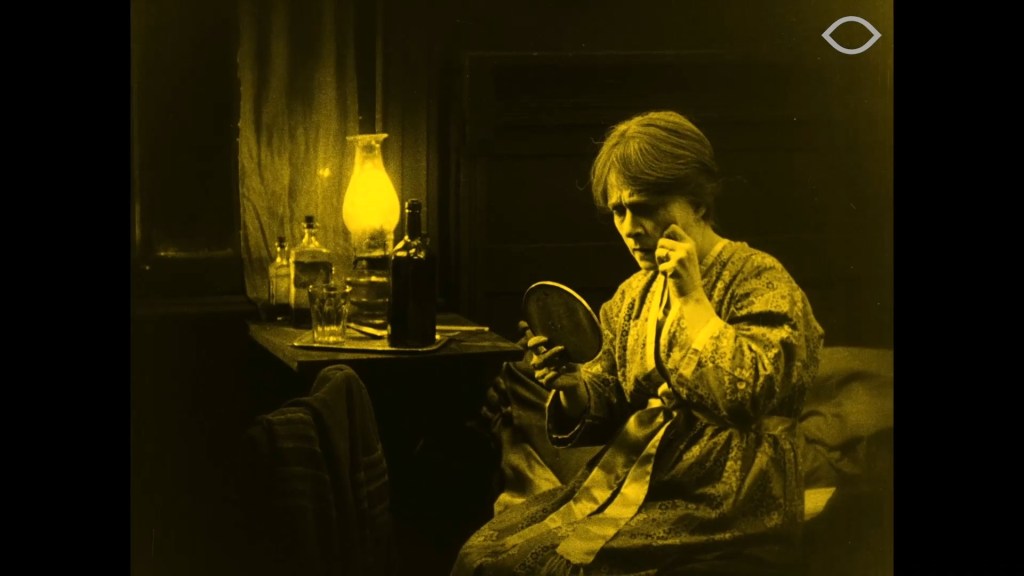
Ma is on her own again. Her whole body sinks under weight of her illness, her sadness. She is alone with a lamp, putting on rouge to look presentable to the boyfriend who will surely never turn up. It’s another tragic little vignette, so telling.
Where are Joe and Essie? They are dancing in a competition, and Joe blames her for losing. He ignores her requests, and she knows it—yet still she tags along, and I hate Joe all the more for it.
Ma and Jimmie are at home. She imagines Essie’s “beau” as like her husband, and the image of her son’s future. It’s a weird dynamic, imagining all the male figures in her family as father-figures. But I take it to be the depth of her feeling for her lost husband. Everything links back to him, to the loss of him. It’s this sense that takes hold of the last scenes, and is so moving. She has led a whole life up to know that we never see, but now we glimpse something of it, its intensity, its depth.
Ma is on her deathbed. It’s the only time we see her with her hair down. It looks darker, looser. Jimmie worries about her, saying she looks “queer”. In fact, I think she looks young—her hair falling over her shoulders and the pillow. Yet she looks afraid, too. (And yes, I’m welling up at this point, and even now, rewriting my notes.)
Essie is running through the snow to chase Joe. Ma has said that it would kill her not to see him now, of all nights. She has forgotten her coat, but it’s too urgent to go back. She chases Joe down. “Let her die”, he says, and my god finally Essie slaps him.
I was already in the grip of the film, but when a stranger offers Essie his coat on the street and she brings him back home… well, yes, I was crying in spite of my reservations. It was nice to see an act of unapologetic kindness on screen. The stranger sits down on the bed, holds Ma’s hand. “Ain’t she pretty?” Essie says, and the stranger strokes Ma’s cheek. (Even as I type this, my description sounds mawkish. No doubt the film is mawkish, but I’ve given up pretending I had “critical distance” at this point.) “It’s a strong hand like Papa’s was, Essie. It makes me feel so good.”
The new family have dinner, the stranger being the kind of male presence lacking in these women’s lives: kind, gentle, unthreatening. “You are just like their father—big, strong and friendly…”, says Ma. It’s another glimpse of Ma’s past, long gone—and it’s such a gentle scene, her death. You can’t help feeling she deserves this last illusion, that the sensation of the stranger’s hand on hers has been years in coming.
The final scene—of the spring in which we see Essie married to the stranger—is a little comic and a little sad. It is homely. Yes, we’ve arrived at home at last—but there is Ma, just a photograph on the wall, absent—just like the photograph on Ma’s wall of her own husband, absent.
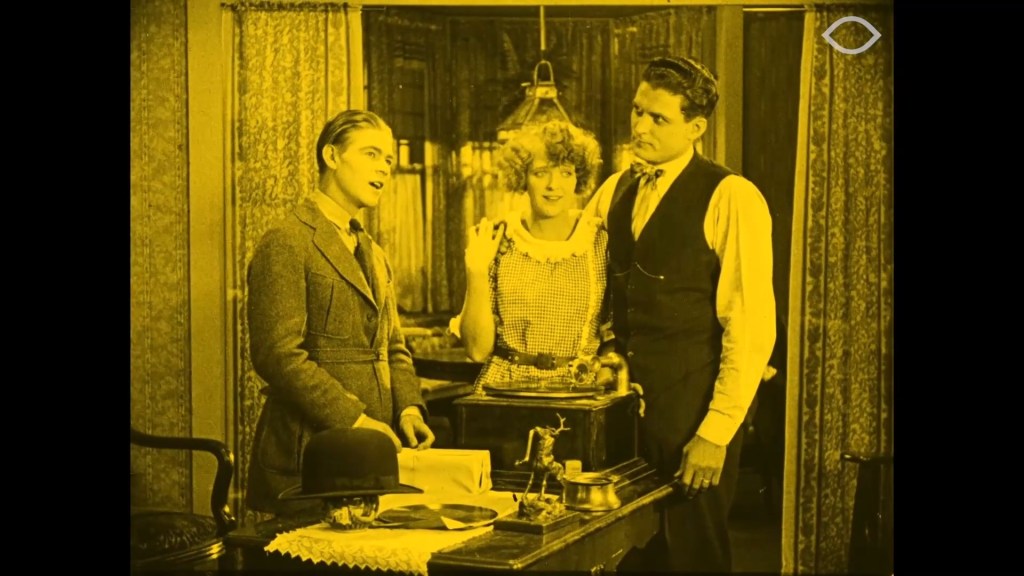
The last moments of Just Around the Corner make an interesting companion to Yes or No. As in the latter, in Just Around the Corner Essie puts on a record. They sing together. But there is no complexity here, no ambiguity. Yes, there is sadness, but it’s a neat kind of sadness. There is no hesitation about what the film has meant, or what the new family means. The future is settled, uninteresting. Yes or No offers doubt and leaves you thinking. Yes or No is a more sober film, if a less moving one than Just Around the Corner.
The first part of Day 2 is devoted to Norma Talmadge, with a short from 1912 and a feature from 1920.
Mrs. ‘Enry’ Awkins (1912; US; Van Dyke Brooke)
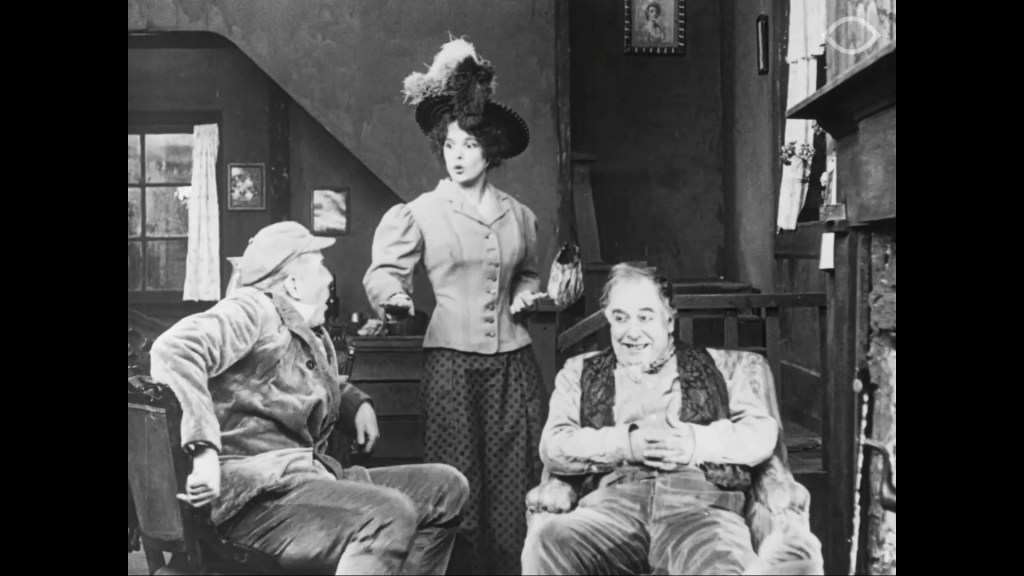
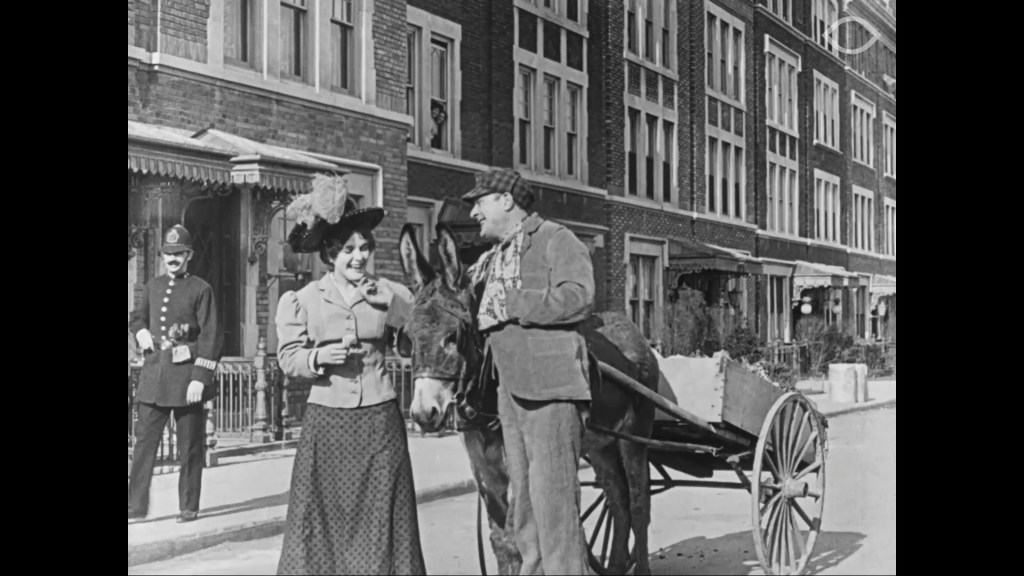
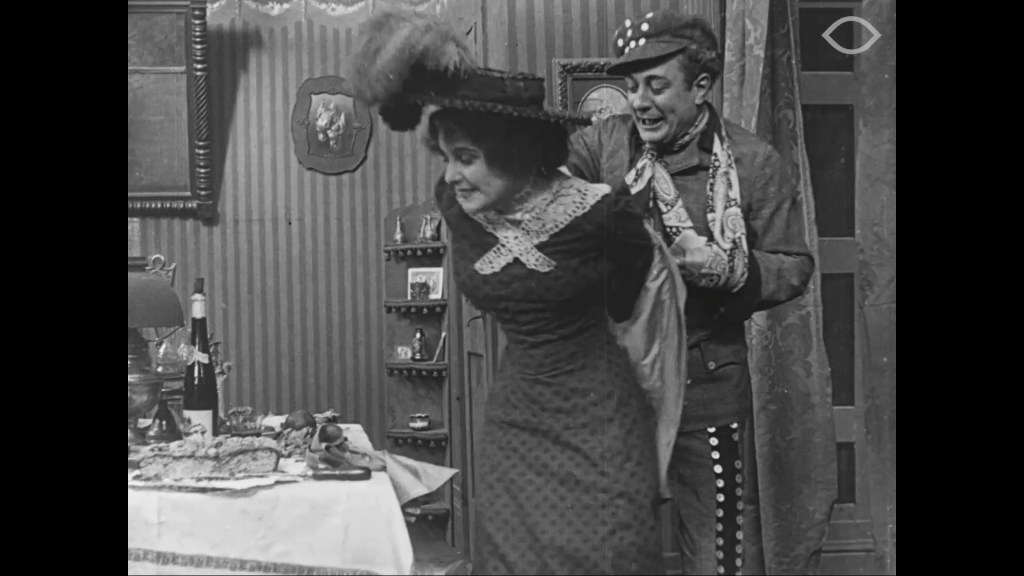
Norma Talmadge is surrounded by a motley collection of men: her father (a gout-ridden drunk), her father’s friend Bill (a rough who’s happy to punch down), her lover Henry (not without charm, but his arm-in-a-sling suggests not the strongest), her father’s doctor (who manages to reconcile father and daughter, even if he can’t stop the father drinking). It’s Talmadge who dominates every scene she’s in: force-feeding her father, slapping Bill, dominating Henry. The film offers a series of snapshots into a working-class life, fast-forwarding through an unspecified period of time. Is it days? Weeks? Liza is at home, on the street, at home, at a theatre; she is making Henry jealous, she is marrying him; she feeds her father, she is estranged from her father, she is reconciled with her father. There are several suggestions that we are in London: the policeman’s uniform, the selection of street views, the fashion. When I say fashion, I mean trousers: Bill’s dog-tooth pair that he wears to take Liza to a variety show, Henry’s pair with a double row of buttons that he wears for his wedding to Liza. (There are more buttons on his cap; a budget pearly king). It’s a curiosity. A few pages from a Victorian novel, whole chapters missing, with glimpses of a life imagined. Talmadge’s eyes are more intelligent than the film from which she stares out.
Yes or No (1920; US; R. William Neill)
Norma Talmadge plays two roles: Margaret Vane, a rich society woman with a husband suffering from overwork and a heart condition; Minnie Berry, a poor working-class woman whose husband, Jack, works too hard (for Mr Vane) to spend time with his wife. Both women are pursued by ne’er-do-wells: the lounge lizard Paul Derreck woos Mrs Vane, the dodgy lodger Ted Leach woos Minnie. Which wife will say “Yes” to their wooer, and which “No”?
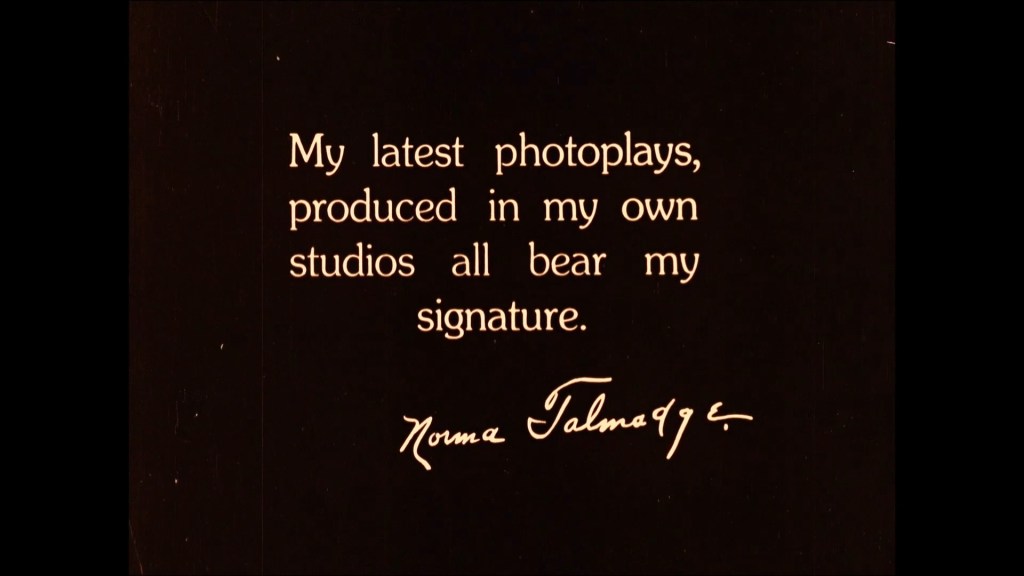
The film’s opening titles are revealing: they wear their moral message on their sleeve, they are aesthetically dubious, and they foreground the status of Norma Talmadge. It’s a mark of her prestige that the most significant title of the credits is her own boast of personal quality control. She signs the title with the signature signature-style of a D.W. Griffith or Cecil B. DeMille. It’s a nice reminder that there were powerful women in Hollywood who could hold their own against the big male names of the industry. Of course, the film is also “presented by” Joseph M. Schenck, Talmadge’s husband. The family feel is completed by the fact that Minnie’s sister Emma (who is also Margaret’s maid) is played by Natalie Talmadge, the sister of Norma Talmadge. (And yes, to extend the family machinations, the sometime wife of Buster Keaton, Schenck’s employee.)
Margaret has a luxurious home, filled with everything soft, luxurious, and fluffy one can imagine. This includes a ludicrous little dog, a kind of animate powder puff. (Silent it may be on screen, but you can sense how irritating is its bark.) In her world, even the flower her admirer gives her is luxurious: not just a single flower, but a huge sprig, almost as tall as Margaret.
It’s almost a relief to go into Minnie’s home. Almost, because it is crammed, albeit with life. Children scamper messily, dinner is always on the boil, washing always needing doing. Talmadge lets Minnie be more expressive, more open, more sympathetic, than Margaret. Makeup and hair ally us with Minnie. As Margaret, Talmadge sports a blonde wig that looks faintly intimidating; one cannot imagine stroking her hair. Minnie’s hair is Talmadge’s own; it is pulled back naturally, a little untidily, practically; one longs for her husband to reach out and show her some tenderness.
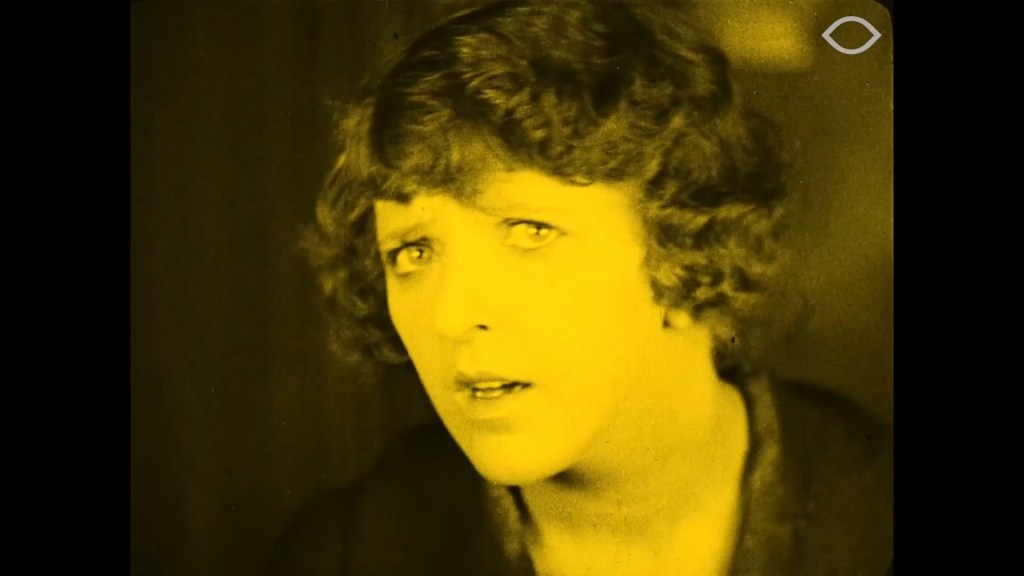
Yes, Talmadge allows herself more room for expression with Minnie—but it’s so deft, so subtle, so telling. She finds a book for her husband, gives it to him; she smiles at his closeness, and when he leaves without a kiss or a touch, she holds her pose while letting her face and body give a kind of sigh, of tiredness, of sadness. When she thinks, we see her think, and sometimes her glance brushes past the camera as her eyes move across the scene. You want to offer her a smile, to tell her it’ll be alright in the end. Goodness, yes, Talmadge is magnificent: the way she looks when no-one but us can see her. Minnie’s husband leaves for the evening and her face falls; he comes back to kiss her, and her face lights up. When the lodger touches her arm after giving her a gift, she is alone and feels her arm where he touched her: as if remembering what physical intimacy was, or might be—and whose intimacy she wants.
But for all these magical little moments, the film is a frustrating watch. Frustrating, because the film plays out exactly according to its set-up (and allegorical names) suggest. Frustrating, because Talmadge’s subtlety is surrounded by clumsiness. I’m thinking principally of the intertitles, most of which have text superimposed over crass painted designs.
If I had no text of my own and simply shared the film’s titles with you, these background images would tell the whole film: I can’t think of a film which so earnestly spells out everything in this same way.
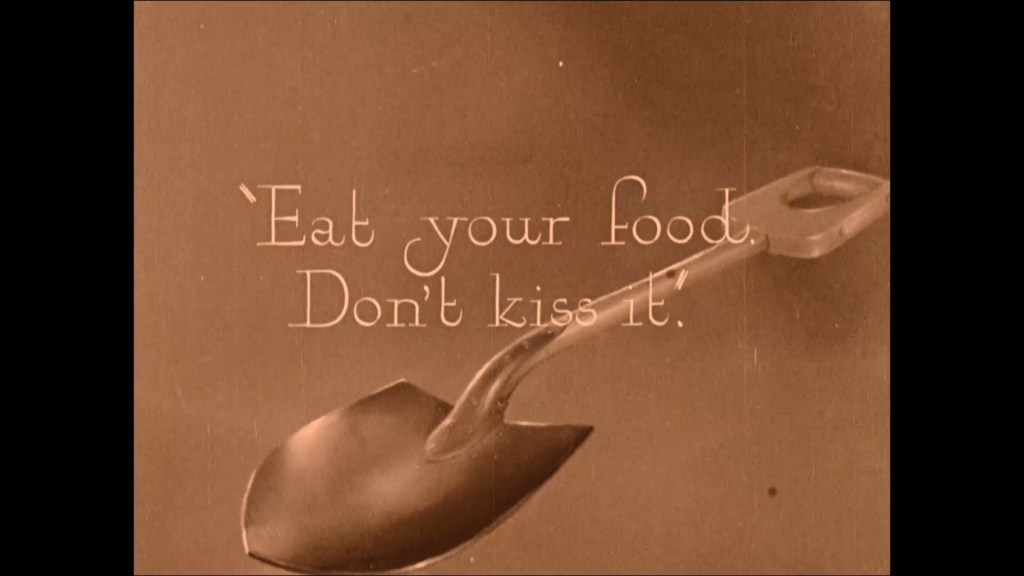
Mr Vane’s doctor is introduced with a doctor’s bag under his name. Fine. But do we need to see a knife and fork on a table under the title announcing that dinner’s ready? Or a movie ticket in a title saying they’re off to the movies? Minnie’s brother, Tom, speaks his mind, but is he so bolshy that he needs a lit bomb under his words criticizing their boss?
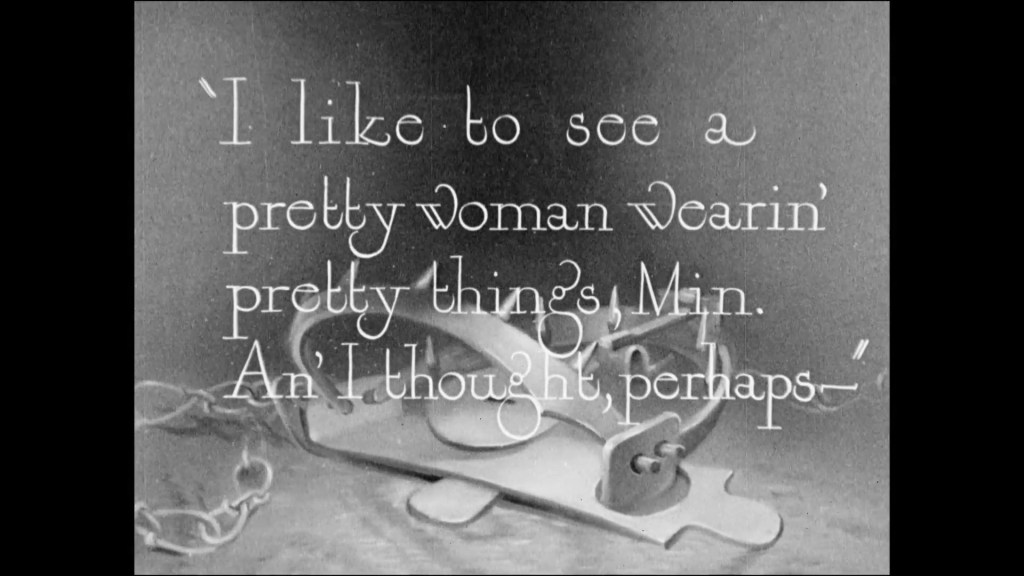
The ne’er-do-well characters have it worse. It isn’t enough that Paul Derreck wears a sinister smoking jacket or kisses Margaret’s hand in a way that makes your flesh creep. No, his words are imposed over images of mantraps, chains, or—and here my mouth literally fell open with disbelief—an image of Satan lurking in the shadows. Really? Yes, really.
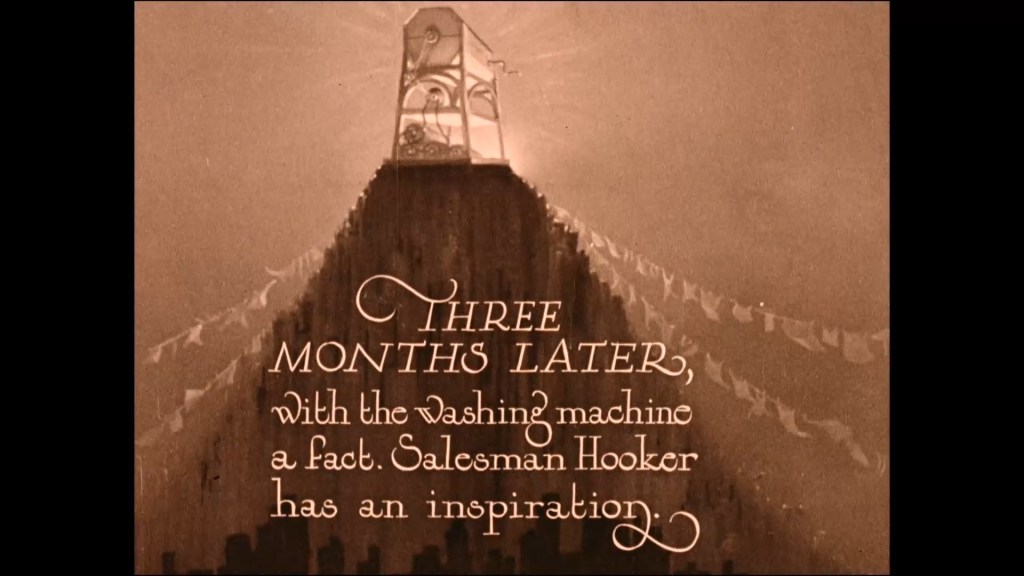
And Minnie’s husband doesn’t get off the hook, either. His dreams of designing a washing machine give rise to fabulous visions of their golden future. The film doesn’t show us a pie in the sky, but it might as well: a washing machine on a mountain, blazing bright over the metropolis. Mythical domes dreaming in soft clouds. I can do without this sort of thing, thanks.
The film, too, eventually (to paraphrase a contemporary author) puts down the needle of insinuation and picks up the club of statement. When things get serious and Jack rescues Minnie from the (by now) openly sexually aggressive Leach, it’s fists to the rescue: Leach is pummelled, then unceremoniously dumped down a staircase, and the film isn’t even interested to know if he’s crippled for life. Meanwhile, Margaret leaves her husband for Paul, which is the final blow to the husband’s heart. He dies, and Paul is revealed “not to find the widow as attractive as the wife”. After threatening to kill Paul if he doesn’t marry her, the pair fight and Margaret is left in her false paradise of a home. Emma is still there, still sympathetic. But she too takes her leave. There is a ghost of a kiss between widow and maid. It’s the only sincere kiss in Margaret’s story, and it’s barely made. (A different film and a different director might have made this moment more loaded.) The kiss is gone, the maid leaves, Margaret picks up a gun. Fade to black. Title: “The world soon forgot the death of Margaret Vane.” For once, the words of the title do the talking: it’s a blunt, sad, brutal transition.
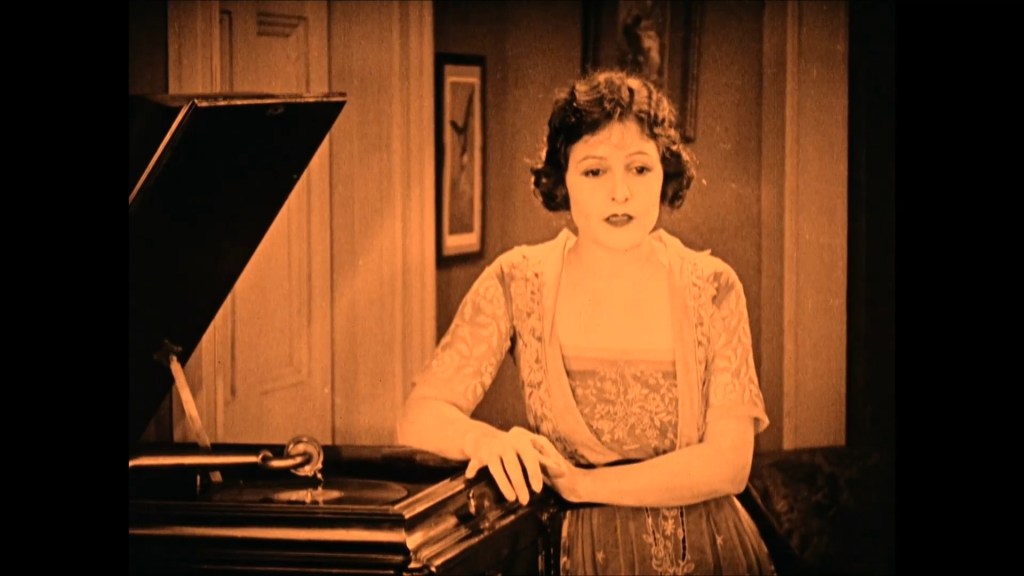
And what a relief that the title designs fall away for some of the most intimate moments of dialogue at the end of the film. Their absence is part of why the final scene is so delicate, so uneasy. The Berry couple live in a new apartment, well-furnished (but not excessively so, like the Vanes’). The children are happy, playing with their uncle Tom. And the married couple? “There wouldn’t be much unhappiness in the world, Min—if all women were like you”, says Jack. “Perhaps they would be—if it wasn’t for the men”, Minnie replies. It’s an intelligent reply, whose weight of meaning is lost on Jack. For him, it’s a matter of men “guessing” women: “I’m glad I guess right”, is how he concludes his philosophy. Minnie goes to the record player and puts on a record: “Happiness” is the song. The music plays. She smiles. She looks over at her sister and the sister’s boyfriend, snuggling on the sofa. Her smile extends, then fades. She takes in a deep breath. Before she exhales, there is a cut. We see Jack, his eyes wandering without object, smoke rolling in his mouth, his fingers drumming his knee; he almost turns to look over his shoulder. Cut to black. Fade in: The End. This scene is one of the film’s finest. Jack and Minnie stay locked in their own thoughts—hers clearly deeper than his. Each are poised for some expression of thought that is never given.
I have never been to Pordenone and I’m not there now. This fabled silent film festival invariably takes place in what is usually week one or two of the first term of the academic year. Though I no longer have any academic post, I still work at a university and the same difficulties of taking leave apply. I can’t swan off to Italy during one of the busiest weeks of the year. However, I can swan off to the internet and pay to see a selection of the films being shown at the festival. So, for the first time, I have. What follows is based on my notes, taken “live” when watching Day 1’s programme. Both were part of the festival’s “Ruritanian” theme, of tiny nations somewhere in central or eastern Europe – on the borderlands of history, where weightier forces forever threaten to impinge…
Dalla Villa Reale di Rjeka (Montenegro) (Italy, 1912)
Ranks of soldiers gaze awkwardly at the camera. Peasant faces squint in the light.
The camera sits on a bleached promenade. In the distance, ranks of uniformed men march (not quite in step). They have medals on their chests. A tiny swarm of photographers caught between the parade and the ranks lining the road. Men in extraordinary hats and women in restrictive dresses walk by.
There is saluting. There are moustaches. Shakos. Badges. Swords. Plumes. Top hats. Bicornes. Men fumble with the trains of women’s dresses. A woman wipes her face with a white glove. We cut to the same cast of characters, now processing past a distant row of buildings. They are walking from right to left, this time. Awkward jump cuts. The camera repositions. The dark ranks of soldiers are a blur. Dignitaries smile and gossip. They salute the soldiers with their right hand while they look left at the camera. In the foreground, an old man shuffles into frame. He takes off his hat, looks curiously at the camera. A younger man takes him by the arm and hurries him off screen. Who are they?
Now Prince Danilo and Princess Xenia test a new car designed to transport the wounded. Their names are out of an operetta but soon they really will be at war. She is a Red Cross nurse, but her servant carries her plush fur coat beside the car. Her Highness does without, and the car drives off. The vehicle whizzes around, the camera cutting and restarting. Attendants in hooded greatcoats smile.
Prince Peter is meeting the Italian and Austrian military attachés. In two years, his country will be at war with Austria-Hungary, and thereafter Italian troops will land in the Balkans to gain a foothold for the Allies (and try to steal some of Albania). The Austrian and Italian officers smile and nod. The Austrian looks impeccable. His hat is slightly taller than that of his counterpart.
And here is King Nikola I. He stands by a kind of shed. He shakes hands with the Austrian. (In three years, the Austrian army will knock Montenegro out of the war and end Nikola’s dynasty.) Nikola is a white-haired, black-moustached man. Though he has clearly been better fed, his face resembles that of his peasant soldiers. He stands smilingly, awkwardly. He scratches his nose. The attachés smile and everyone looks at the camera. They are gone.
Aides smoke and salute and shake hands. A man walks up three steps, vanishes, then reappears at the top of the steps. A last glance. They are waiting. The film ends.
Sui gradini del trono / On the steps of the throne (Italy, 1912)
A drama of the heir to Silistria, Prince Wladimiro, who is kidnapped by the politician who rules as regent. A double takes his place on the throne, before the plot is unmasked and the real prince restored to the throne. I wonder if I will have less to say about this hour-long feature film than a five-minute short? It is less mysterious, less atmospheric than the short…
The first scene is, like most of the film, taken in a single medium long shot. It is toned dark brown. The prince is in elegant white. He leaves. The conspirators lean in over the table. They get a medium close-up and the tinting changes just for them. It’s a warm amber, the same as that used for the intertitles that have just told us of their conspiracy. It’s as if they are allied to the text. Has the text prefigured their plan, or is the plan a prefiguration of the text?
Gorgeous detail and contrast whenever Princess Olga is on screen in her first scene. The lovers meet, and the moonlight on the ivy makes me long for celluloid.
Lighting and tinting make the creases in Prince Wladimiro’s trouser leg deliciously dramatic: he receives the news of his enforced trip to Paris by taking a step forward. His rear leg balletically straightens behind him. The shadows on his white trousers crease in tension.
The villains wear black, the hero white.
Uniforms are a fancy dress halfway between centuries. Frogging, feathers, fur.
Pinprick sharpness of exteriors in natural light. Silent sunlight on silent foliage is the most beautiful in visual culture.
In Paris, the Prince’s apartment is toned dull brown. The close-up of Olga’s portrait is tinted pink; quite literally a rose-tinted memory.
Paris nightclub. A black man and white woman dance a peculiar step. She has a huge dragonfly-wing decoration on her hat.
A mirror dance with changing tints. Disorienting cuts within this space, but a neat intercutting of Chichito—the Prince’s lookalike—being courted by the regent’s agent, Sobieski.
The Prince’s card introduces him as “Marquis Beauregard”: he himself is playing a part in Paris. (If this were a Ruritanian film by Lubitsch, more would be made of this.)
Weight, thickness, texture of the dancer’s apartment. She is called Thaïs. It’s a nod to Anatole France, to Massenet, to a kind of glamour beyond the film’s budget. What is the character’s real name? She does not have one. The film gives her her part, she takes it.
Chichito’s mark of villainous distinction is a pair of sideburns. His first act to transform himself into Prince Wladimiro is to shave them off. The actor in both roles is marvellous at suggesting subtle differences between them: the angle of the shoulders, his gait, his grin.
But Chichito also has a fabulously showy pose as he orders Thaïs away to guard Wladimiro. His leg tenses as the Prince’s did when sent to Paris.
Superb intertitle: “We’re in the middle of an unsolvable mystery!”
The Old Armorer’s look to camera at discovering that “Wladimiro” lacks the duelling scar possessed by the real Prince. In a film with few close-ups, this close look out at the audiences creates a connection, a sympathy, between character and spectator. I immediately worried for him, and in the very next scene when he is shot I was rightfully outraged. And when, gravely wounded, he is dumped in the river, the tinting changes: it’s the same deep amber as the conspirators’ close-up earlier in the film.
The villains in Paris are dispatched in a pleasing manner. The gruff guard brutally stabbed by Thaïs, Sobieski suffering the very fate he arranged for the Prince: falling victim to his own trapdoor, taking the Prince’s planned place as victim of a bomb. More doubling, mirroring, substitution.
Finally, the coronation scene neatly mirrors the Montenegrin scenes of Dalla Villa Reale di Rjeka: the same wondrous hats, the lines of courtiers making way for the new king. And the same sense of fiction, of only just rescuing happiness from what waits in the wings.





























 The Realm of Silence