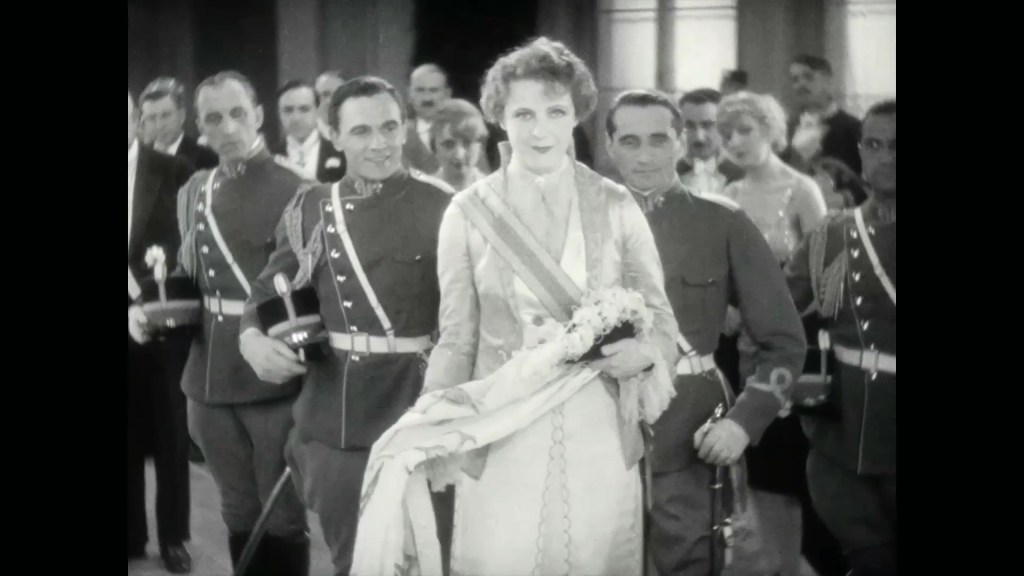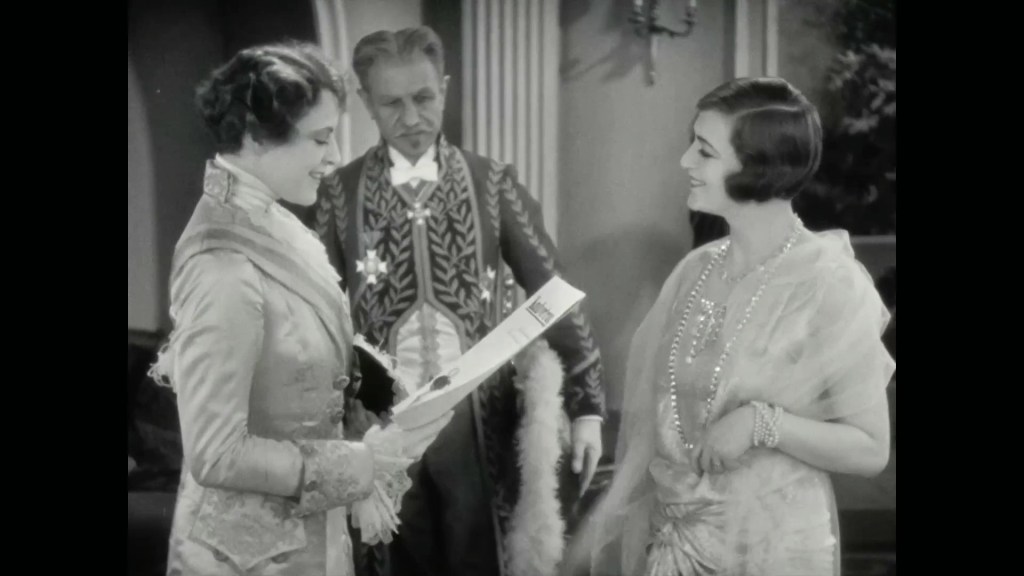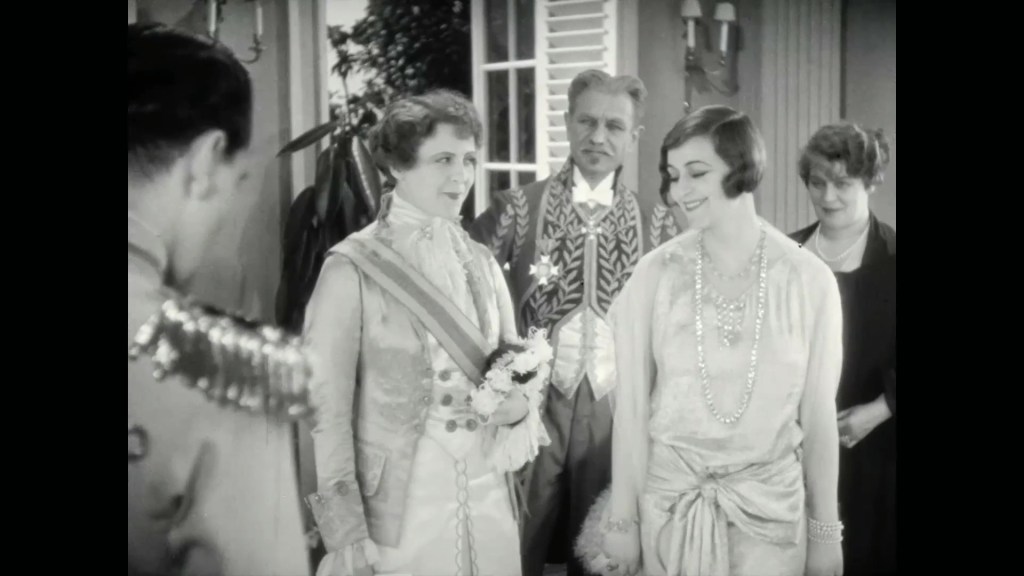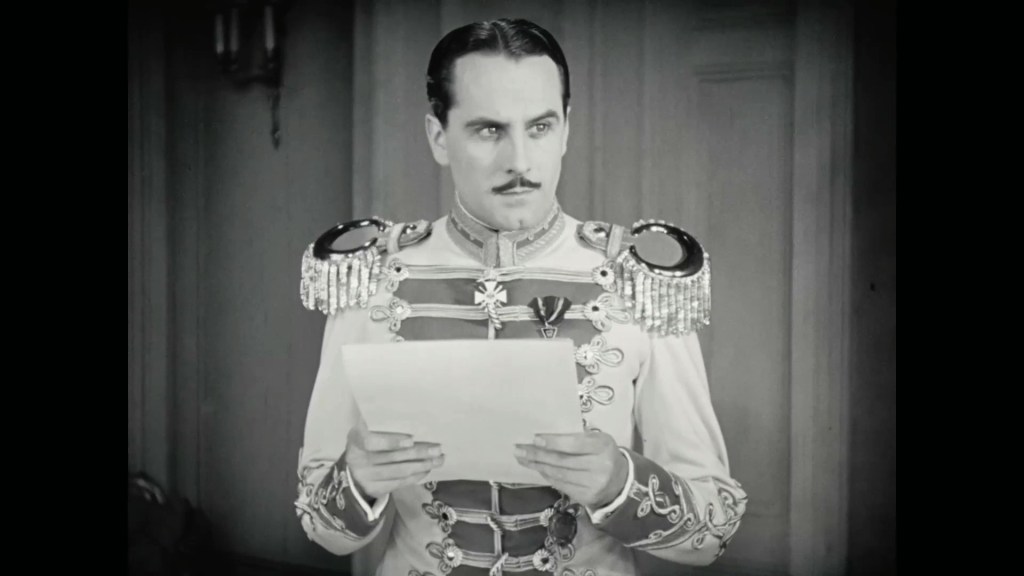
Pordenone from afar (2025, Day 8)

Day 8 is our final day of films from Pordenone, and it’s another busy schedule. Our first programme takes us on a journey from the Middle East to South America and eastern Europe, from haphazard observations to machine-tooled propaganda. Our second programme gives us a comic fantasy and a comic reality, taking us from wartime Ruritania to postwar America. It’s a great range of films, and they appealed to me in unexpected ways…

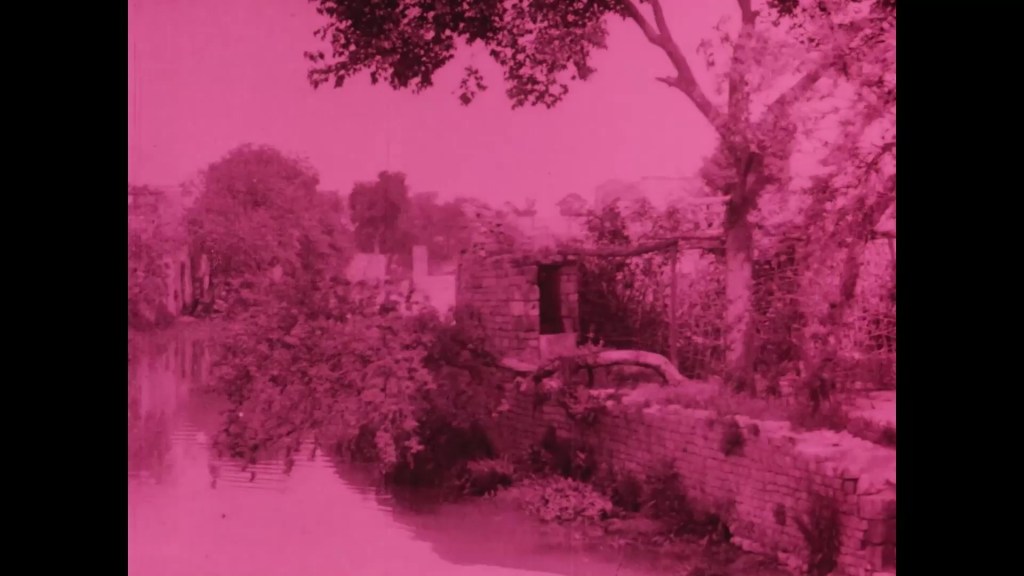
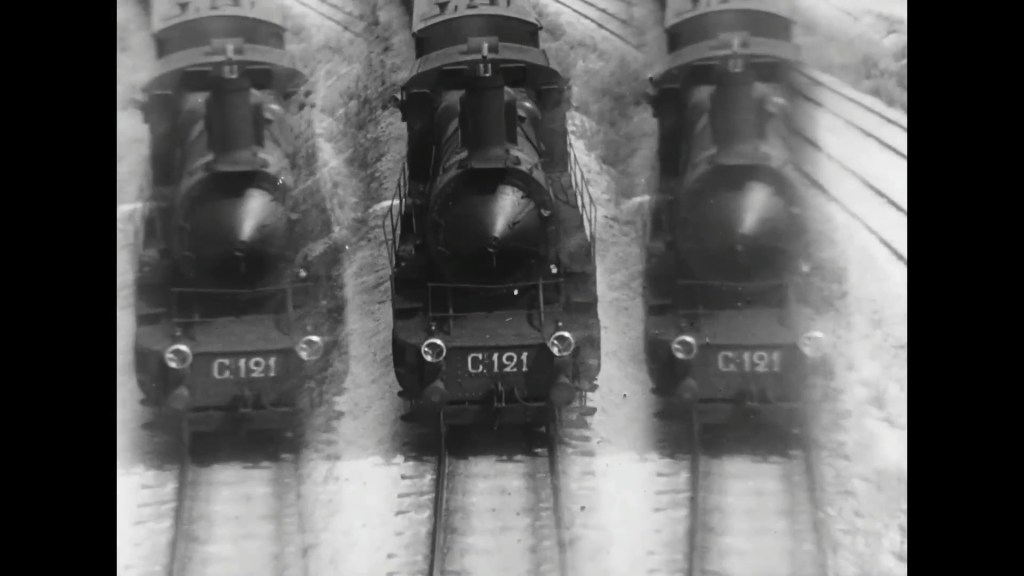
Aleppo (c.1916; Ger.; unknown). Camels kneel and rise. Soldiers and civilians mill around. Awkward looks at the camera. Views of the city, of a cemetery, of ruins, of waterways, of Arab children. It’s very beautiful to see this faraway land, and this faraway time, so calmly recorded. But of course this is 1916, and the world is at war. This is a Syria under Ottoman rule, and the European men in tunics and caps are the Turks’ erstwhile German allies, still confident in victory. These uniforms and trucks, these crowds of Turkish soldiers – they are all part of some other continuity, some other subject. The film cannot but admit that something is going on elsewhere, something unnamed, something momentous. In this other place, everything is decidedly not calm. But here are the boys and their donkeys, and the old men and their pipes, and the ruins of epochs long gone. This is a world in waiting, then, getting on with life somewhere between ancient history and the crucible of the twentieth century. The film ends, and in the fade to black, history surely intervenes.

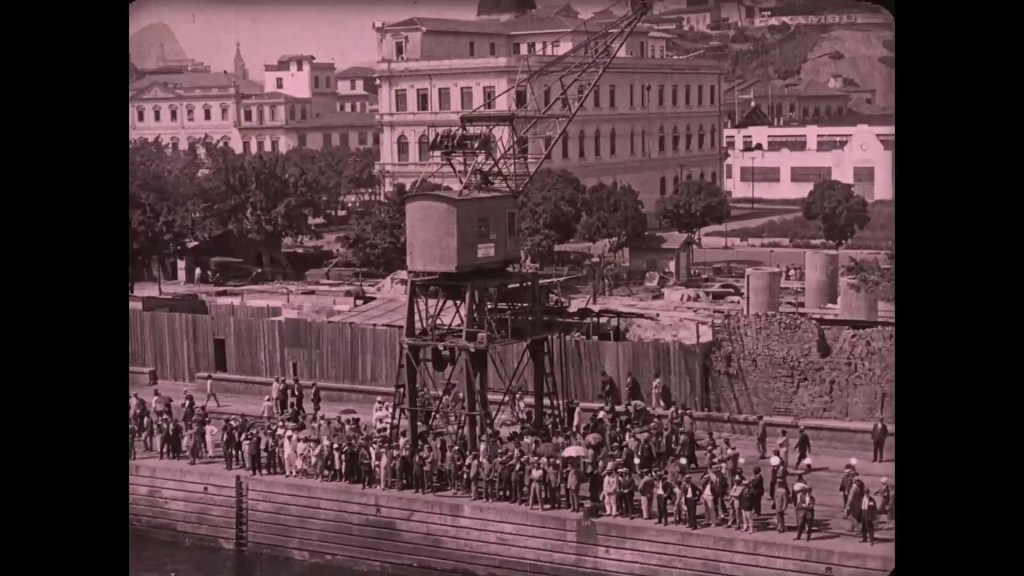
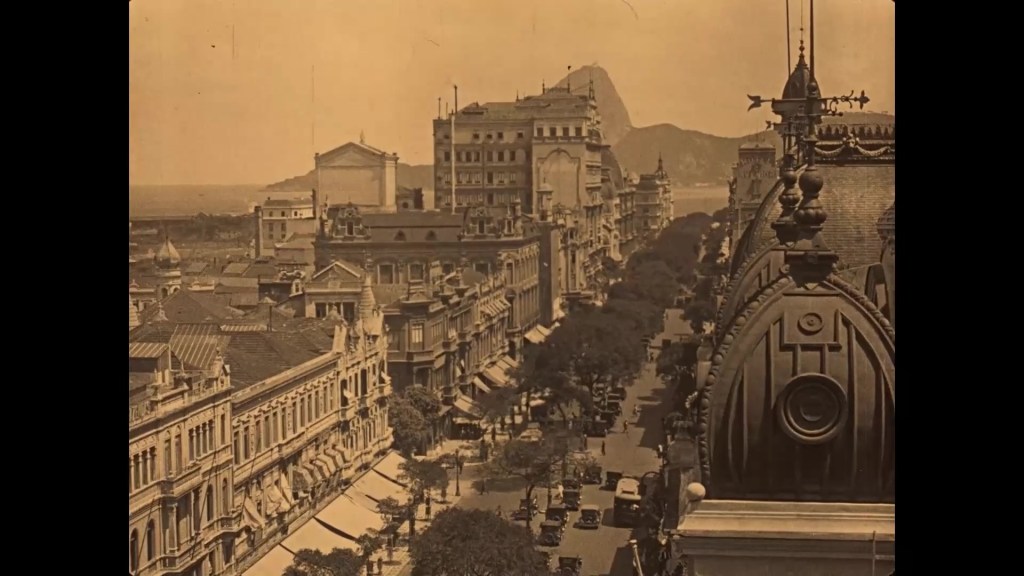
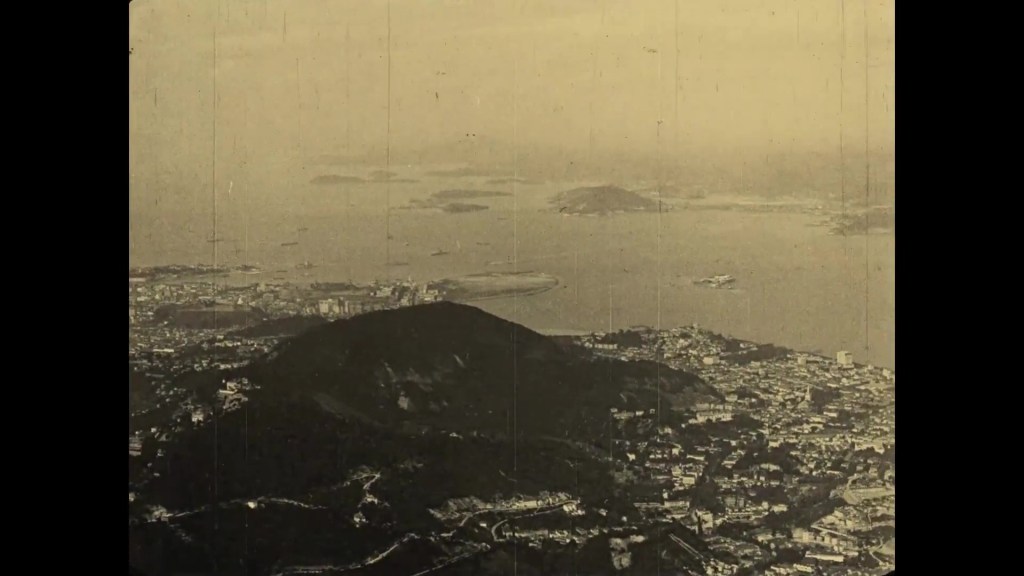
La Capitale du Brésil (1931-32; Br.; unknown). Fed information by title cards, we arrive by sea. The camera slowly bobs with the ship’s passage through the waves. Crowds await us. The camera is on the shore and onboard. Our view changes with the ease of a page turned in a travel brochure. From the rooftops, we see sunlight fall over the streets of Rio de Janeiro. The camera pans over the coast, the mountains, the distant houses. The world goes about its business. The beaches are crowded, the waves lap over the shore. Cable cars and light railways take us up the mountain of Corcovado, and – after so easy an arrival – we glance down towards the distant city, the huge arcs of hills, the bay. At sea again, we take the ferry and glide past beautiful islands. Then to the institutes, museums, gardens – the taming of this wildness. Then to views of sport, from rowing to football and tennis, and the Jockey Club. Crowds of men and women beam at the camera. A sea of hats and smiles. We visit the gold club, the polo club. A smiling, hatted, patient, affluent crowd. Life stretches out amiably before them. We are tourists, and they are showing us the life to which we might aspire. It’s very bourgeois, very decorous, very charming. (There is little life.) The last we see of this world is the patient spectators of a peaceable game, watching their world play out. The film stops, and they are swept away into the past.

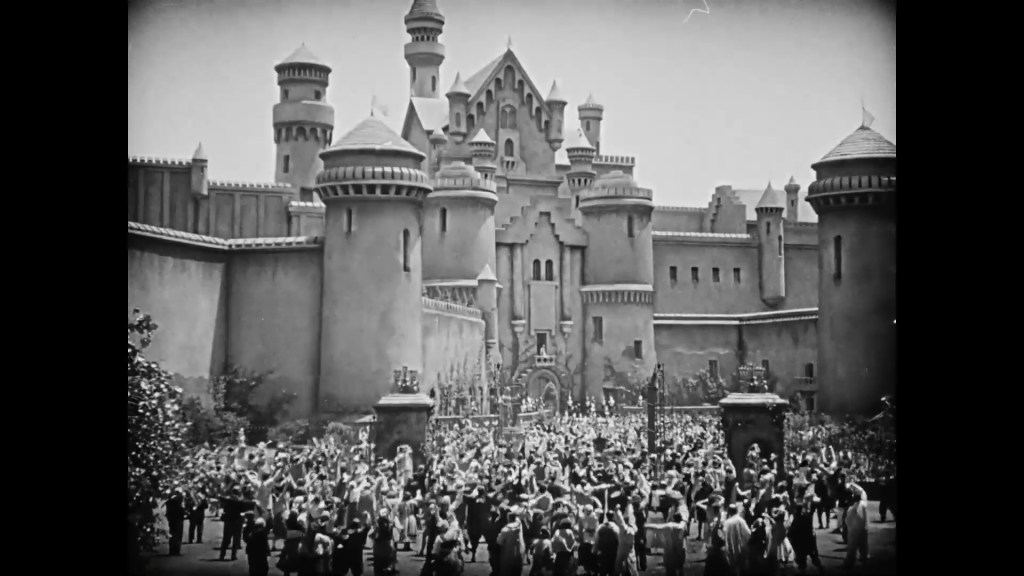
Narysy Radanskoho Mista [Sketches of a Soviet City] (1929; UkrSSR; Dmytro Dalskyi). A swirl of images, an advancing tractor, swaying fields of wheat, piles of vegetables. Here are forests, and the trees being felled. Here is produce and fuel, and here are the men and women, and the trains and ships, and the factories. “From all sides of Ukraine…”. Trains arrive at Kharkiv, and Kharkiv is at work. The streets, viewed from new buildings. This is a past that is very busy. They like to think they are building the future, and perhaps they are. “The future belongs to us!”, and the film cuts to a dinosaur skeleton, to museums of ancient artefacts, to statues and books. “This all belongs to the workers”, and the workers study and read. But such a film leaves its viewers little time to think. All the thinking has been done for us. The film is merely the precis of a conclusion already written and approved. It is all madly exciting, madly busy, madly optimistic. The past here surges with energy. There is no time to dwell or to reflect. Everything is happening now. “Not a step back from the current pace of industrialization!” Slogans fill the screen, and the workers work at insane pace, in insane numbers, across every conceivable facet of production. With a last surge of statistical overachievement, the film ends. But it might just as well have gone on forever.

The whole thing reminded me of the montage in Fragment of an Empire (1929), wherein the factory workers convince the newcomer of the benefits of the Soviet system. But as I wrote about that film, the unending montage of Sketches of a Soviet City is unconvincing as any kind of argument. Indeed, it isn’t an argument so much as an unceasing statement: a statement of achievement, a statement of intent. The film is organized into a series of visual slogans, interspersed with written slogans. Though it has momentary glimpses of real life, the film bundles everything together into a package of remorseless optimism that loses sight of the human beings it claims to represent. The pleasure one takes in this film a century later is not the message so much as the glimpses of people and places it contains. These pleasures are fleeting, since the film is in such a mad rush to boast about how these people are being mobilized toward ever greater productivity. Everything is a resource to be moved, pushed, pulled, dug up, processed, transported, melded, welded, stacked, cemented, launched, turned, electrified. It’s impressive, but it quickly becomes exhausting. Unlike Aleppo, this film is at least up front and explicit about its political context. But there is more real life, both in its spatial randomness and temporal slowness, in Aleppo than in Sketches of a Soviet City. For all its avant-garde technique, the Soviet Ukrainian film is less enticing as a vision of progress, and an enticement to visit (or at least admire) than the bourgeois world presented in La Capitale du Brésil.

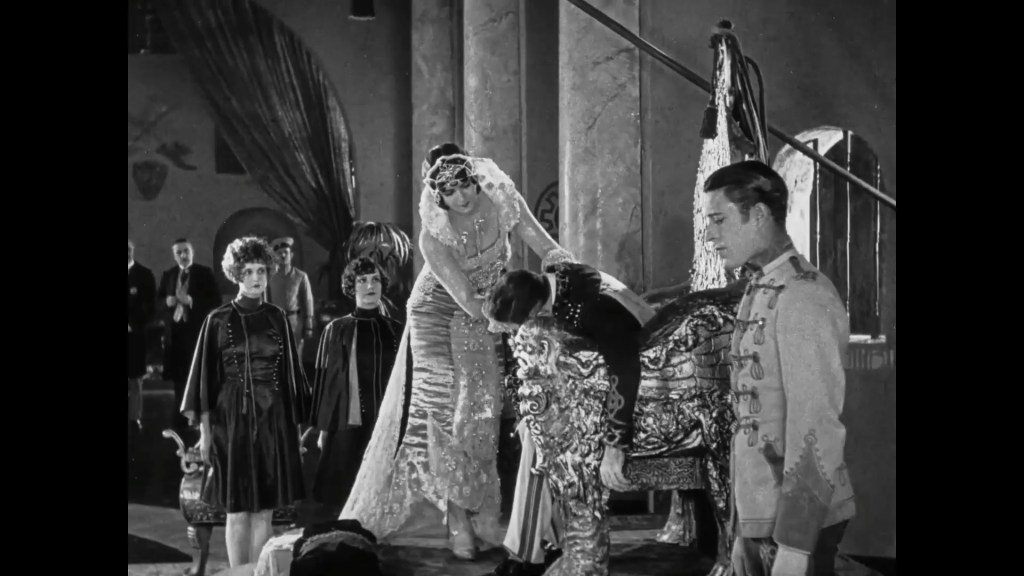
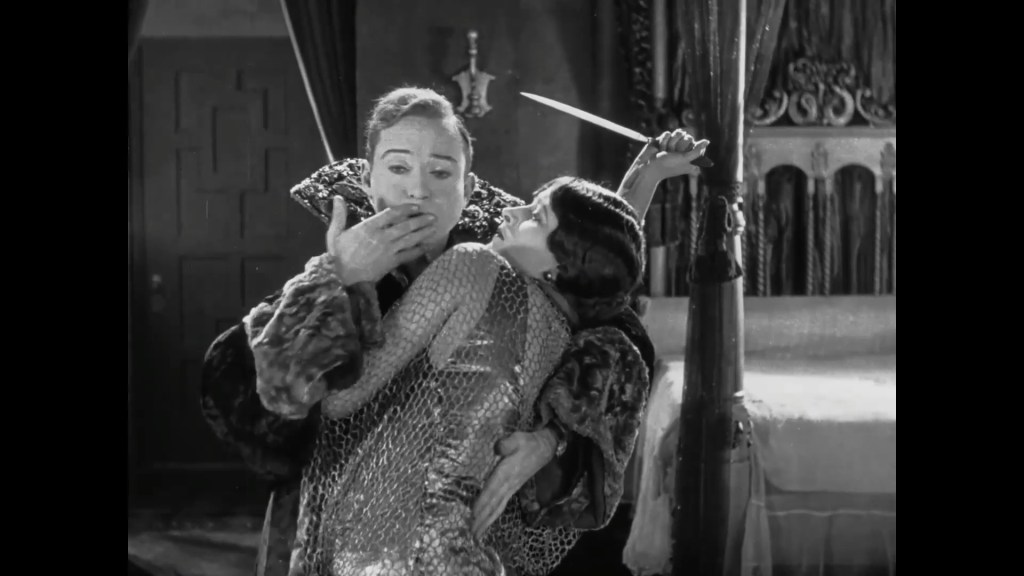
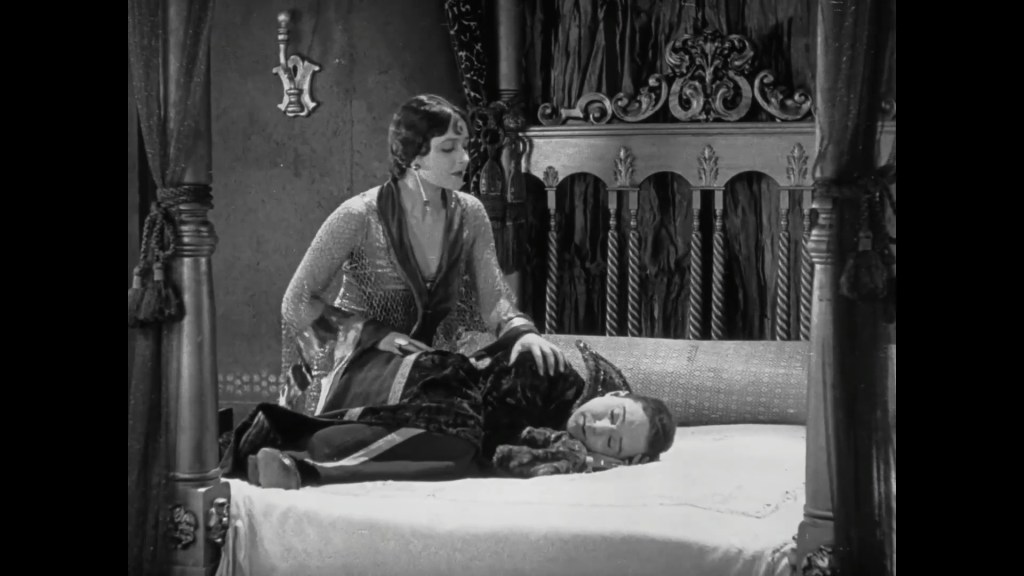
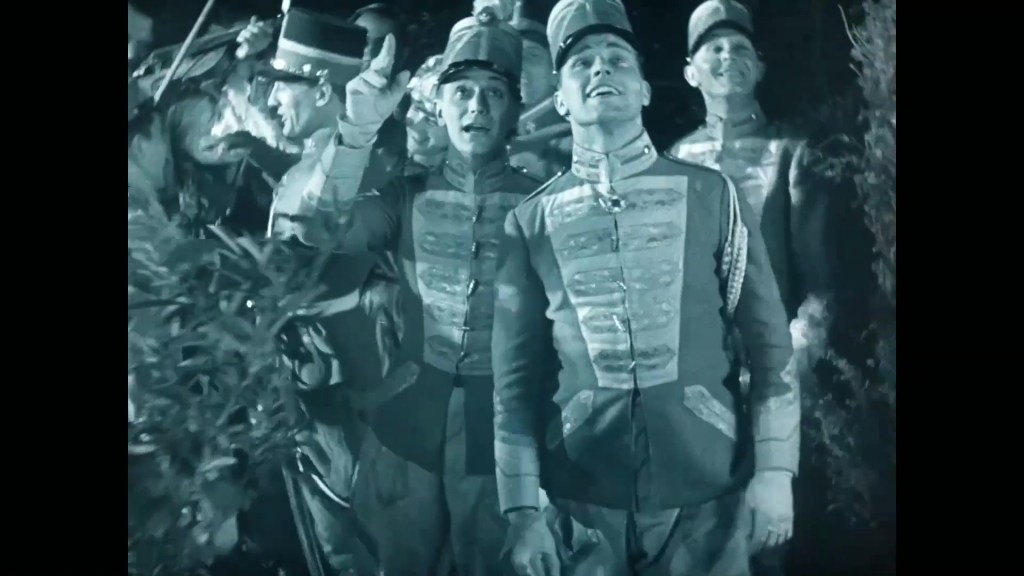
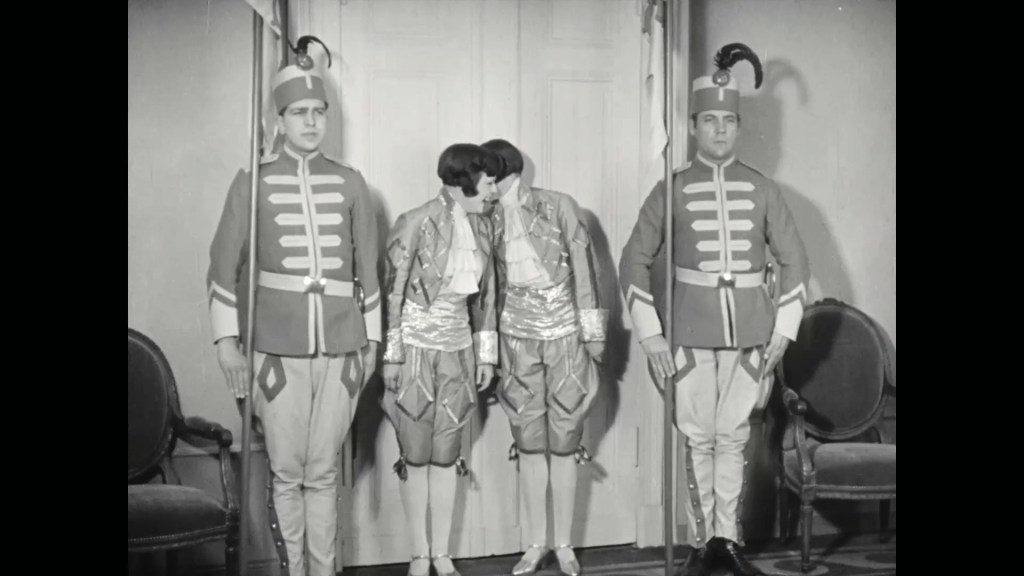
So to the day’s second half. We begin with the half-hour short, Soldier Man (1928; US; Harry Edwards). Harry Langdon is the soldier the army forgot. He has been left behind in “Bomania” after 11 November, not realizing the war is over. He stumbles around, fleeing phantom enemies, confounding local peasants. Meanwhile, King Strudel the 13th of Bomania (also played by Langdon) is fighting revolution, secretly being fermented by General von Snootzer. The Queen of Bomania hates the King for his drunken loutishness. The King is duly kidnapped and hidden in a remote barn, to be killed in due course. But the King’s loyal courtiers encounter Harry and recruit him to impersonate the missing monarch. He does so but is immediately the target of an assassination attempt by the Queen. However, it turns out that he’s a better kisser than the real King, so the Queen is disarmed. Things turn suddenly romantic, but Harry is tired. He goes to sleep on the King’s bed and wakes up in his real home with his real wife. He is a common soldier, after all, and the war is over. THE END.

I confess that I’ve seen very little of Harry Langdon in my life. The handful of features and shorts I have seen left me curious, but clearly not curious enough. So I was very glad to see him here, exhibiting all the curiosity I remember. He’s not quite a child and not quite an adult. He seemingly has sex appeal, but of an innocent kind. His appetites are easily assuaged: all he really wants is a bite to eat and a place to kip. In Soldier Man, I love the way he traverses the world so harmlessly. His gun is broken, but when he fixes it it’s only to shoot a scarecrow. When he takes cover behind a cow, he pauses to marvel with curious pleasure at its udders. He is about to paw at the suspended teats but withdraws his hands before any kind of groping might take place. The cow bends its neck to look at him, so he smiles – so innocently and friendlily – back at the animal. It’s a curious, charming, silly, almost sad little moment. It’s all incidental, puncturing the chance of threat, denying the danger of physical contact. It’s making nothing out of something.

Though Langdon also plays the King, his double, this character is swiftly bundled off screen before Harry arrives. There is no attempt made for Harry to meet his doppelganger, to see the kind of man he might otherwise have been (aggressive, selfish, sexual, powerful). It is the innocent Harry who wears the outsize royal robes, and we might wonder how they can be outsized when they were made for his other self – for him. It is as though he is figuratively smaller than his own doppelganger, so that even identical clothes do not fit. His royal regalia are superfluous to his needs. He offers his crown to a courtier, as a vessel for him to vomit in – since Harry is so innocent he cannot think of another reason why the man should bow forward. Somehow, perhaps by sheer lack of arrogance, the Queen is seduced by him. Harry is hardly interested in her at all. She tries to kiss him, to distract him from her dagger, but he’s too busy eating a biscuit to have his mouth and lips ready. He doesn’t flinch away (he’s too obliging, too unquestioning, too accepting), but apologetically motions that he has his mouth full, insists upon chewing his food properly before swallowing. His kiss is successful despite himself, and when he retreats to the royal bed it isn’t for an act of consummation with his Queen but to curl up into a ball and go to sleep.

The very title of Soldier Man is a curious conjunction of roles and titles, and a syntactic separation of those two ideas of “soldier” and “man”. It’s a very charming film, and its lightness belies the oddness of Langdon’s persona. It’s not sentimental, which is a bonus, and allows Langdon the chance to wander innocently through at least two different genres of film. There is the war drama, which the film immediately removes all possibility of pomp or danger; and there is the Ruritanian drama, with its crowd and court and mistaken identities, which the film makes immediately absurd and parodic. It’s quietly radical, gently ironic. When Harry awakes, we wonder what the meaning of his dream might be. Does it have a meaning? It’s a fantasy in which the dreamer does nothing more than wander aimlessly, ignoring all possibility of heroism (in the war drama) or romance and power (in the Ruritanian drama). The dreamer wants nothing more than to continue sleeping. When he wakes, he seems as innocent of the real world as of his fantasy. Yes, indeed, this is a curious film. It makes me want to see more Harry Langdon…

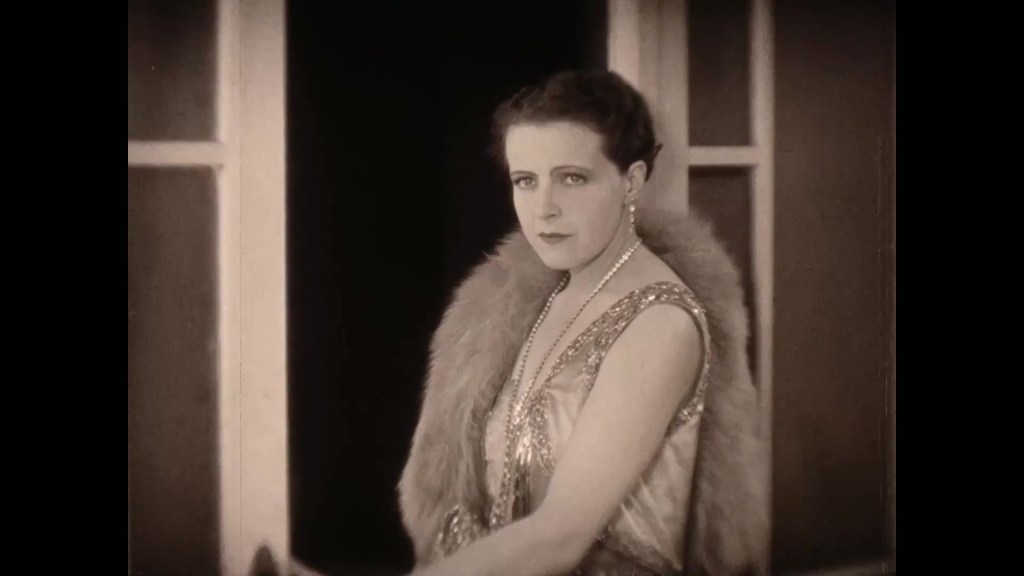
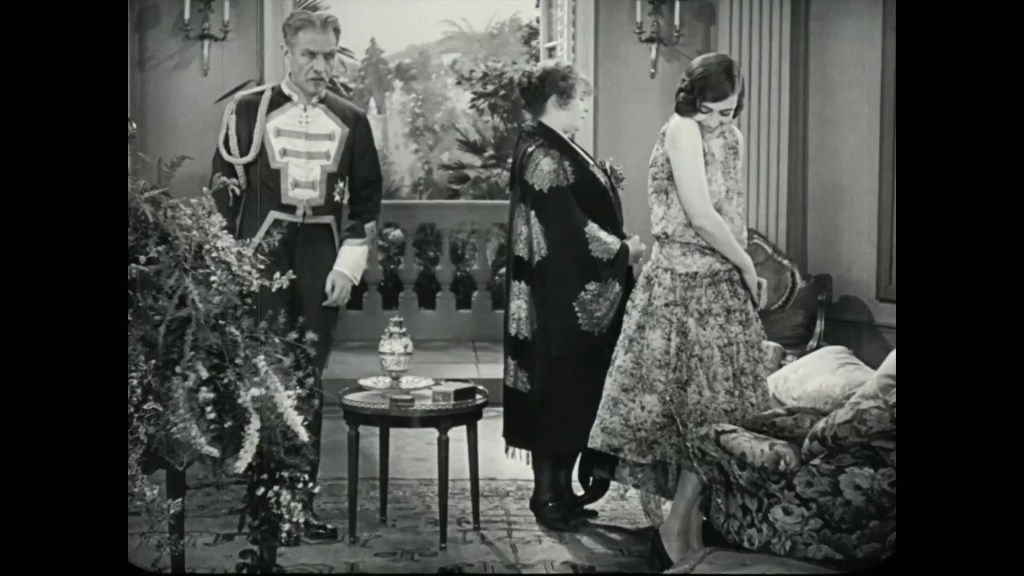
After Langon’s short, we begin our main feature – and our last: Are Parents People? (1925; US; Malcom St. Clair). James Hazlitt (Adolphe Menjou) and Alita Hazlitt (Florence Vidor) are a married couple on the verge of divorce. Their daughter Lita has been called back from school to hear the news of the separation. Lita plots to find a way to “cure” her parents’ symptoms. At school, Lita’s roommate Aurella (Mary Beth Milford) has a crush on both the film star Maurice Mansfield (George Beranger) and on the local Dr Dacer, who is also the object of Lita’s affection. When Lita’s parents visit the school, each offers her a different vacation option – but she prefers to stay at home. When a teacher finds photos and letters to Maurice Mansfield, she accuses Lita of being the culprit – and plans to expel her. Mansfield is shooting a film nearby, and takes an interest in Lita – but she arrives home to discover she has been expelled. Lita pretends she is the culprit in order to ensure her parents have to meet and discuss her future. Mansfield is summoned to Alita, and he assures her he has never met Lita – and proceeds to flirt with Alita. Lita seeks refuge with Dacer, who doesn’t realize she is in his home until the early hours of the morning. When Lita returns to her parents the next day, arguments and accusations ensue. Lita seeks solace with Dacer, who is wooed by her charm, and the Hazlitts manage to reconcile their differences (at least for now). THE END.

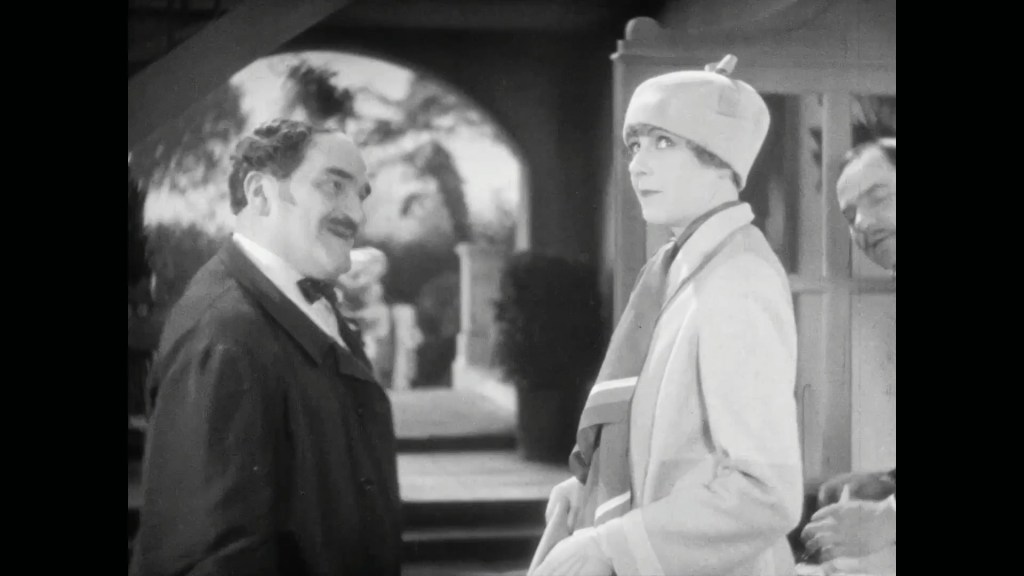
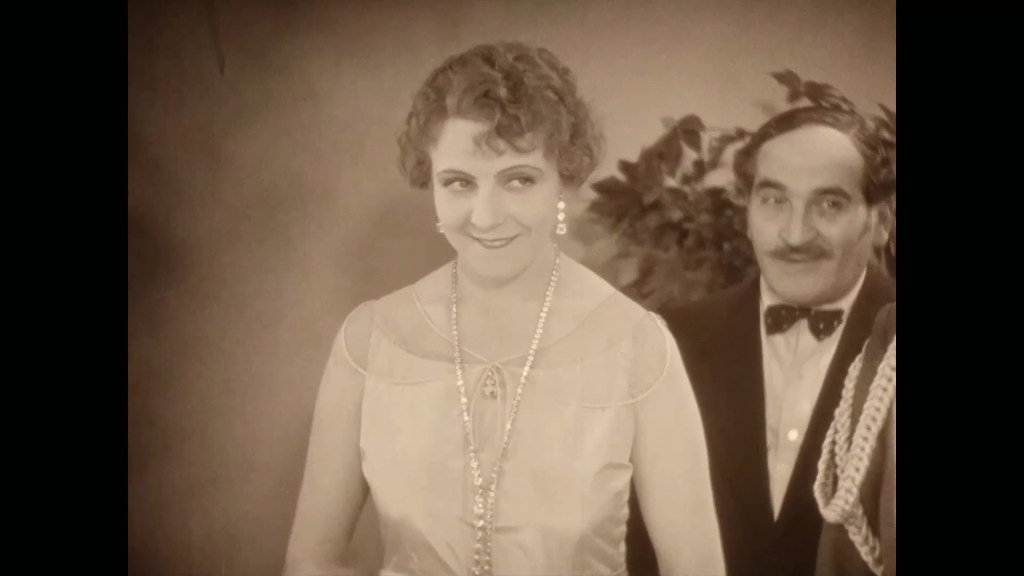
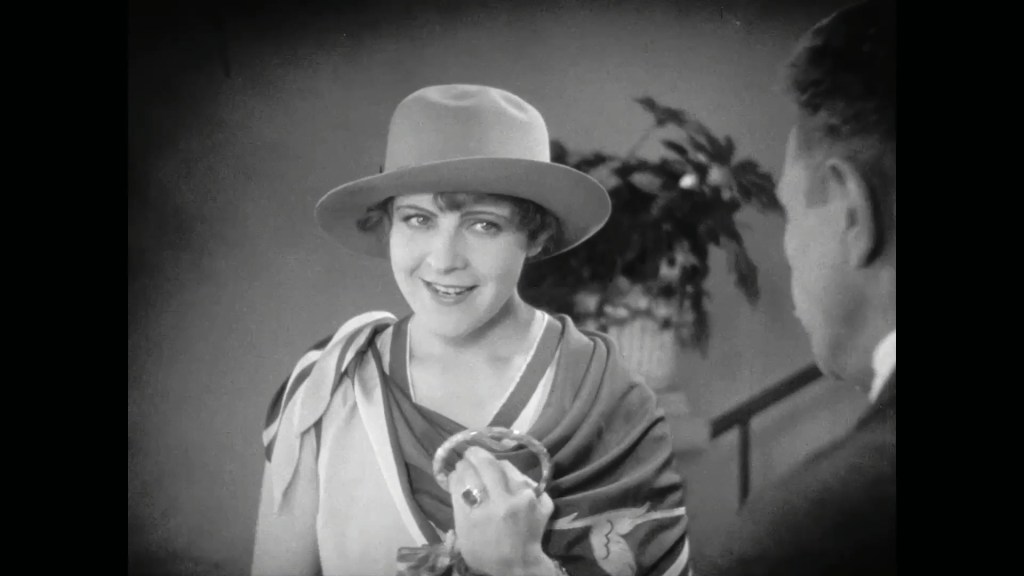
Well, this was a diverting film. It has a simple setup, and it delivers a well-directed and well-played result. I always enjoy watching Adolphe Menjou, and his interactions with Florence Vidor – as the pair bicker, argue, flirt, joke, and reconcile – are both amusing and poignant. (Florence Vidor, by the way, was the wife of director King Vidor. Curiously enough, the pair had divorced shortly before the production of Are Parents People? One wonders quite how she felt filming such scenes.) As Lita, I found Betty Bronson very charming and engaging. But there is little depth in her character, just as Dacer – and Lawrence Gray’s performance – is a bit flat. Though George Beranger has fun parodying a pretentious film star, acting out a whole film and trying to seduce Alita, his character is likewise paper thin. And this rather sums up my reaction to Are Parents People?, which was restricted to being charmed. I cannot say that I was moved, nor that I laughed a great deal. It was all very… pleasant. In comparison with the only other Malcolm St Clair I’ve seen, A Woman of the World (1925), Are Parents People? seems rather tame and unremarkable.

That said, it is certainly fluently and sensitively directed. Though there are no really striking images, the drama plays out nicely through small details, especially some very good cross-cutting between the two parents. Their actions and reactions mirror each other, creating all kinds of subtle little parallels and contrasts. And much of this takes place without dialogue. The opening sequence is ten minutes of wordless action, through which we grasp the whole drama through glances and editing. When there is dialogue, it is often short and snappy – echoing the back-and-forth repartee of the editing. But St Clair isn’t Lubitsch, nor is this script one of any depth or lasting resonance. Its charm is only so charming, its amusements only so amusing. I’m glad I’ve seen it, but I suspect my memory of this film will quickly pale.

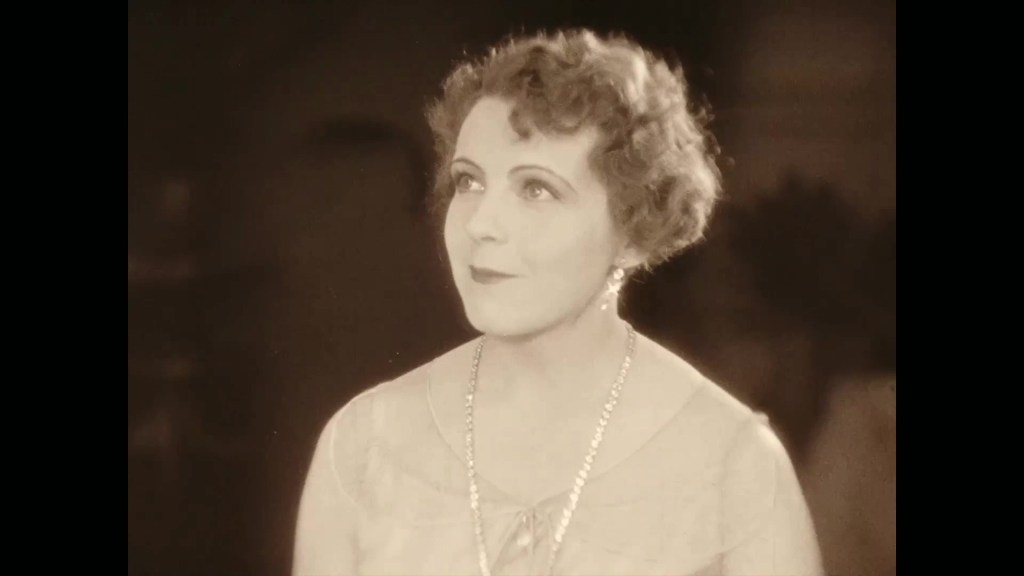
In terms of the presentation, it’s a shame that Are Parents People? survives only in a 16mm copy, which is very soft to look at. Though it is nicely tinted, the amazing pictorial quality of many of the films shown earlier at Pordenone (and even the other films in Day 8) show the gap in preservation status. If this is a visually downbeat way to end the online Pordenone, it is at least a reminder that so much of film history is lost to us, and what remains is precious. Music for the first three films of Day 8 was by Mauro Colombis, and for Are Parents People? by Neil Brand. The all-piano soundtrack here was very good, though I cannot but note that past editions of Pordenone online have ended with orchestral (or at least ensemble) scores. Combined with the lesser visual quality of the film, and my reservations about the film itself, it felt like a slightly limp way end to the festival. But hey, we can’t always end with a bang, and I’ve enjoyed so much already – so I shouldn’t complain.

My experience of Pordenone from afar in 2025 has, as ever, been absorbing and exhausting. There is no other festival that offers so much, and of such diversity. We’ve traversed the globe, and we’ve traversed the era. The emphasis is not on presenting masterpiece after masterpiece but about widening our appreciation of the silent era as a whole. In this, Pordenone is unique. Even the online material, which is but a tiny fraction of the festival offered on site in Italy, is a tremendous cross-section of people, places, themes, genres, and contexts. One can only be exceedingly grateful for so much marvellous, and so much entirely new, material. For a single ticket, the quality and variety of films Pordenone offers online is exceptionally good value. Bravo to all involved in this amazing festival.

Paul Cuff

Pordenone from afar (2023, Day 6)

Day 6 takes us to Germany, or rather to a Ruritanian kingdom. Ruritania has been a theme at Pordenone both this year and last year. In 2022, I wrote about Anthony Asquith’s The Runaway Princess (1929), starring Mady Christians. This year, we get another film starring Mady Christians, directed by Fritz Wendhausen—the man credited as “co-director” of The Runaway Princess. (Since The Runaway Princess was an Anglo-German co-production, this credit is perhaps a case of the German version of the film being handled by Wendhausen.) We also get a bonus “actuality” of Balkan dignitaries from 1914 (very much along the lines of a 1912 film shown last year). So—off we go…

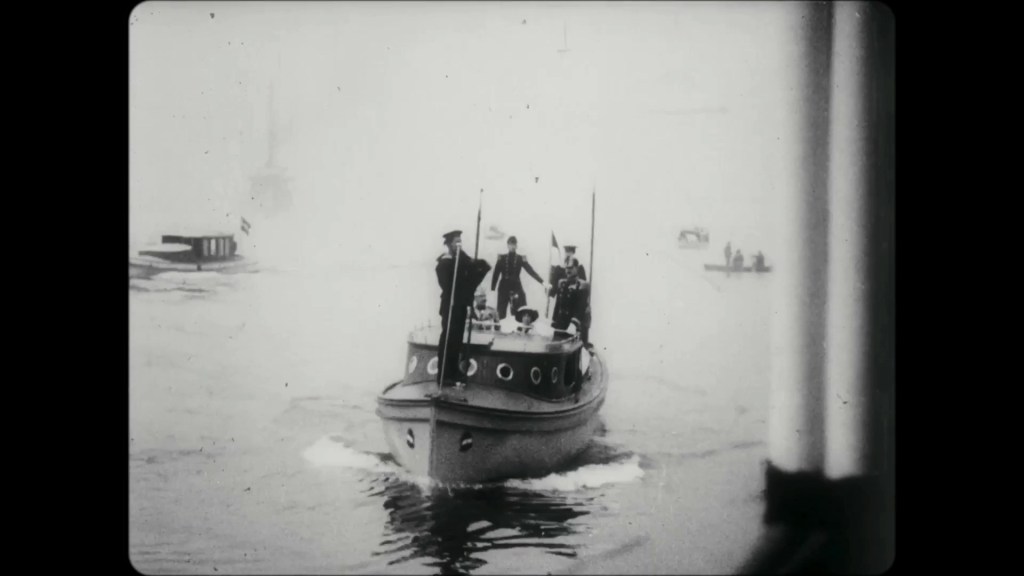
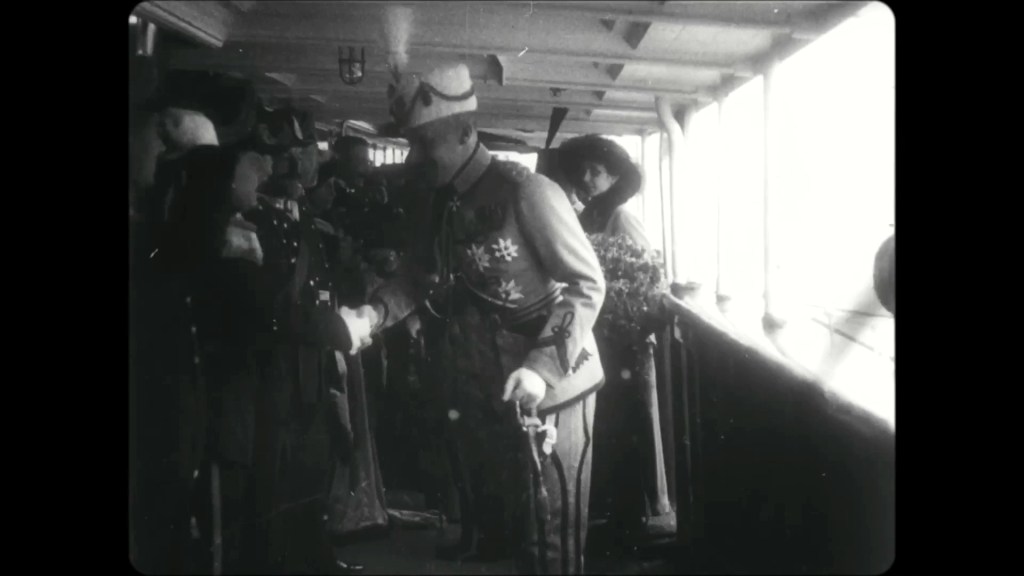
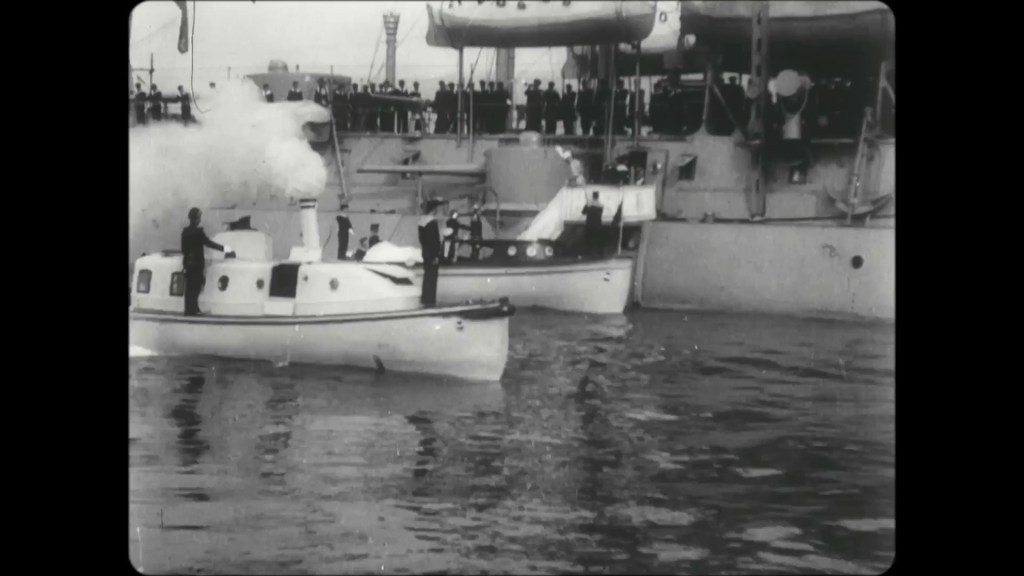
[Ankuft des Fürstin Wilhelm I. zu Wied in Durazza (Albanien) März 1914] (1914; Fr.; Anon.). The delegation from Iran. Crowds of children. Fezzes. Dignitaries in warm coats. Soldiers march, a little out of step. Troops of children in uniform. Fezzes in different tones. The flag of Albania raised for the first time. Smoky seas, naval ships, dignitaries in big hats. Medals. Sashes. A plumed hat rubs against the underside of the deck’s awning, so the prince must stoop. Awkward salutes, handshakes. Tiny little steamboats gleaming white next to enormous cruisers. Parades of flag-bearers. An old man sweeps muck from the red carpet. The film ends. (There’s a small theme in early cinema actualities that should be written about: the people seen on screen who clean up after the people we’re supposed to be concentrating on. They’re always at the edge of the frame, or enter after the main event has passed. The film catches them from the side, or turns away just as they enter the frame. Here, the film ends just as they are beginning their work. But there they are, or were, toiling away in the margins of history.)

Eine Frau von Format (1928; Ger.; Fritz Wendhausen).

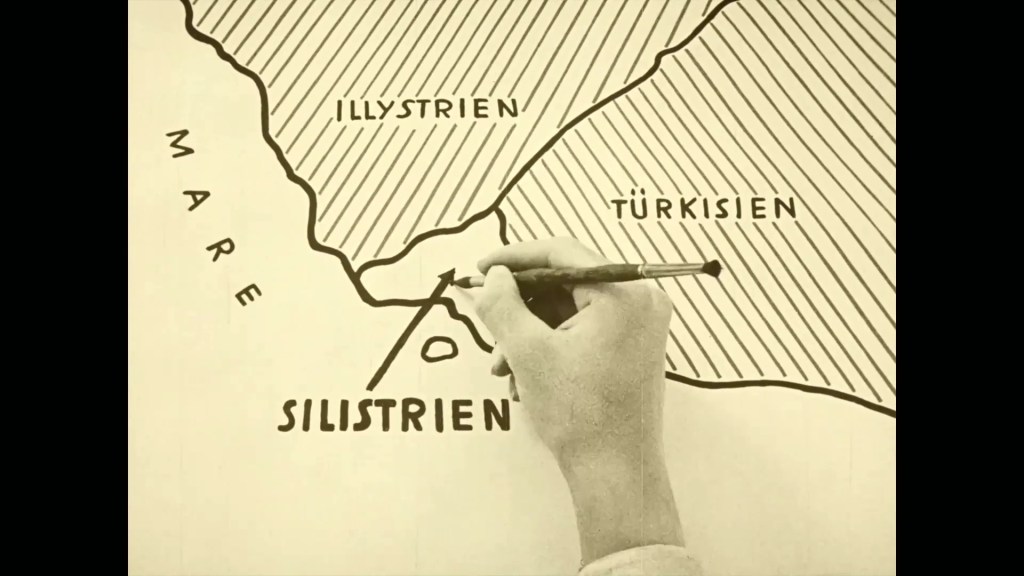
A German film with French titles. “Somewhere in Europe”, we find the realm of Sillistria. A charming way to illustrate the film’s fictional location: a hand draws a map with a brush. We see Sillistria, sandwiched between two other fictional kingdoms, Thuringia and Illyria.

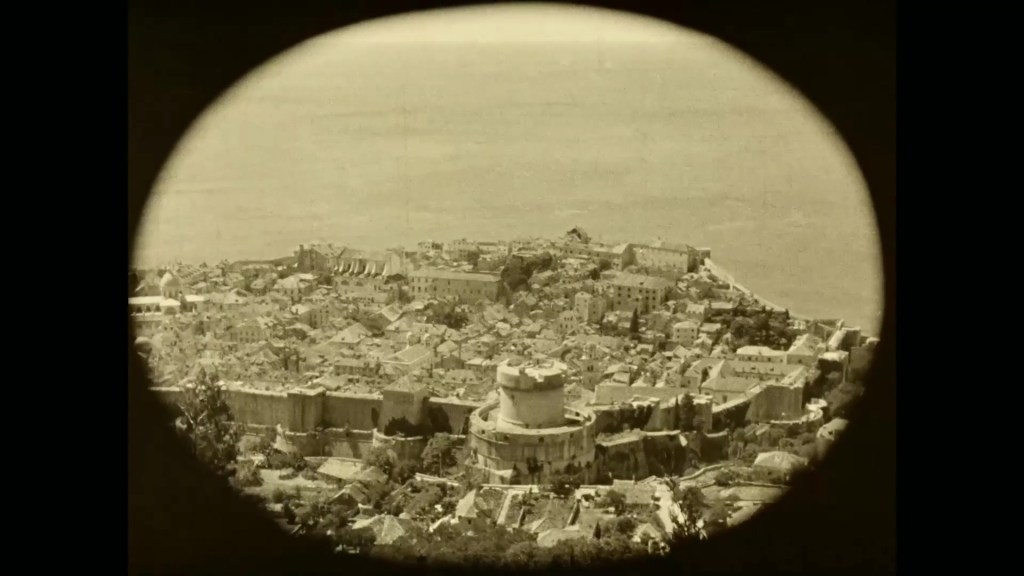
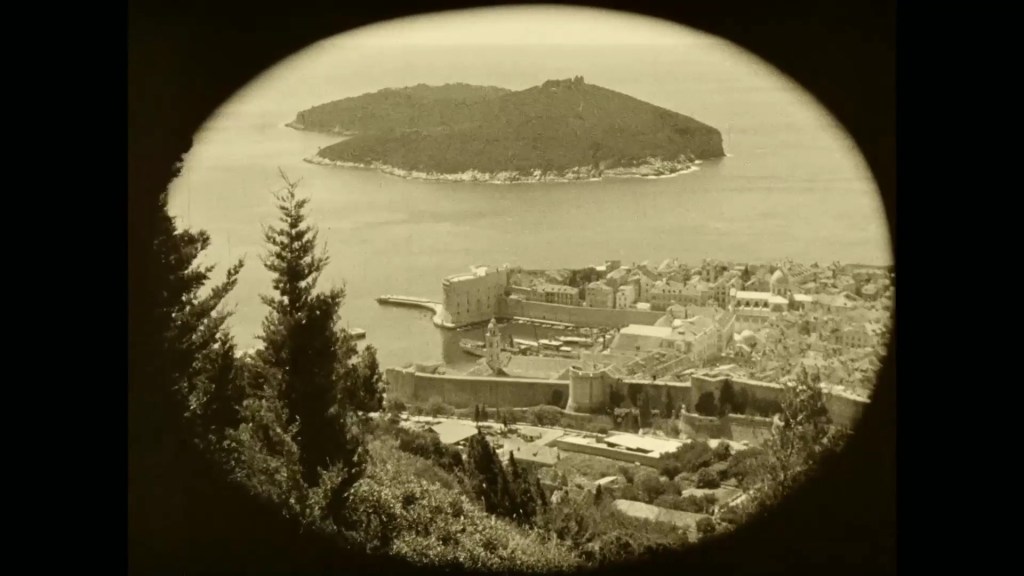
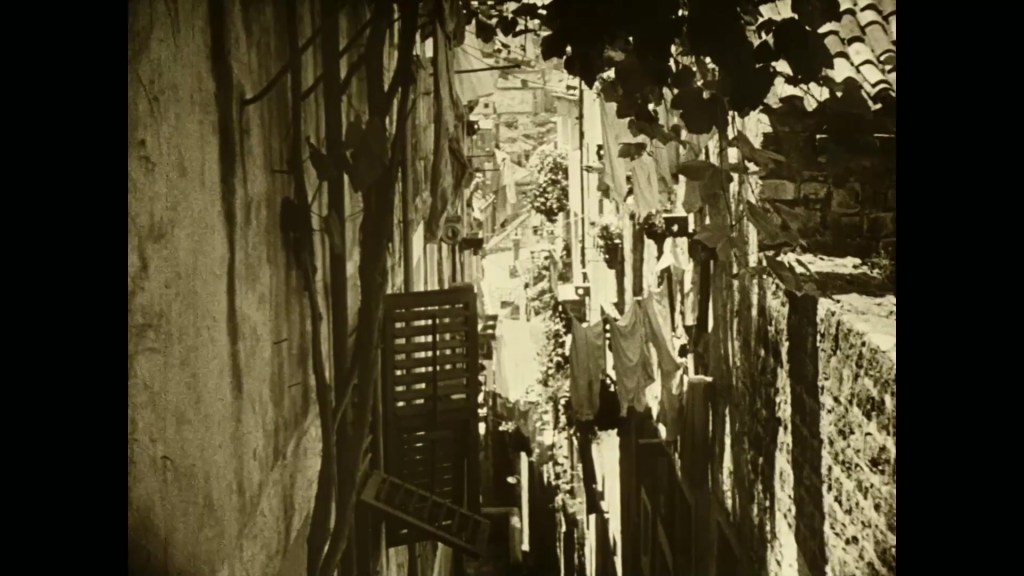
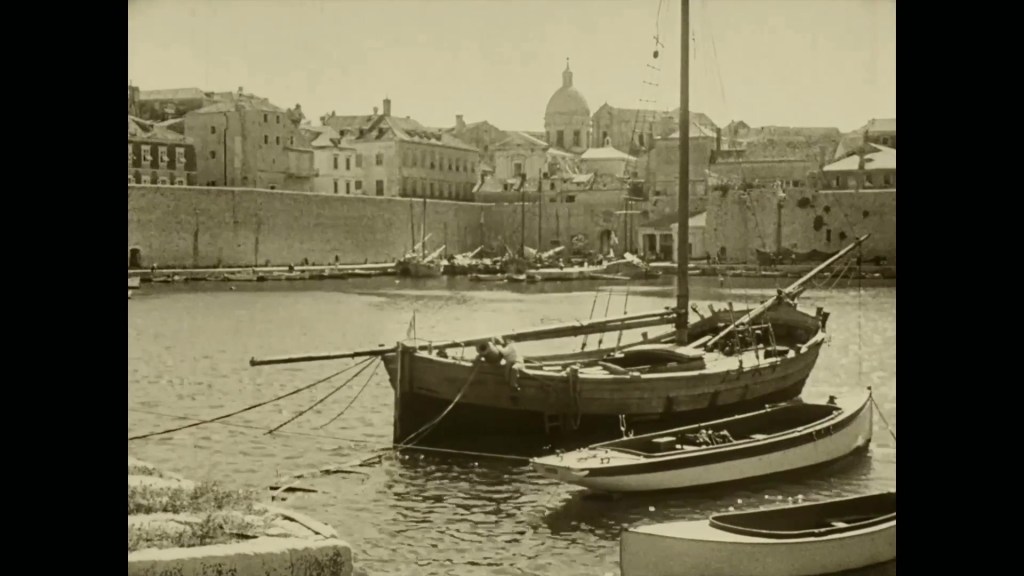
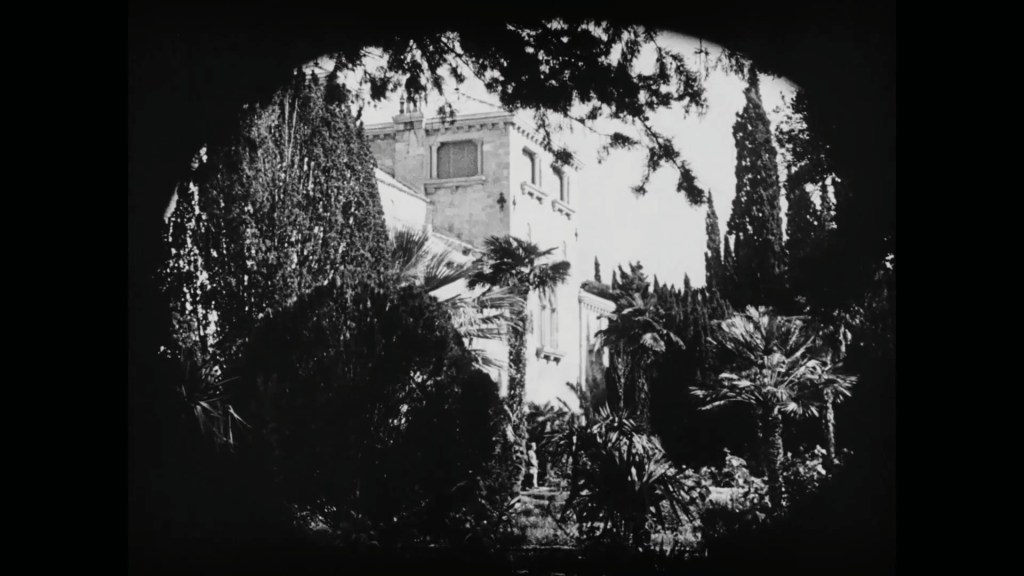
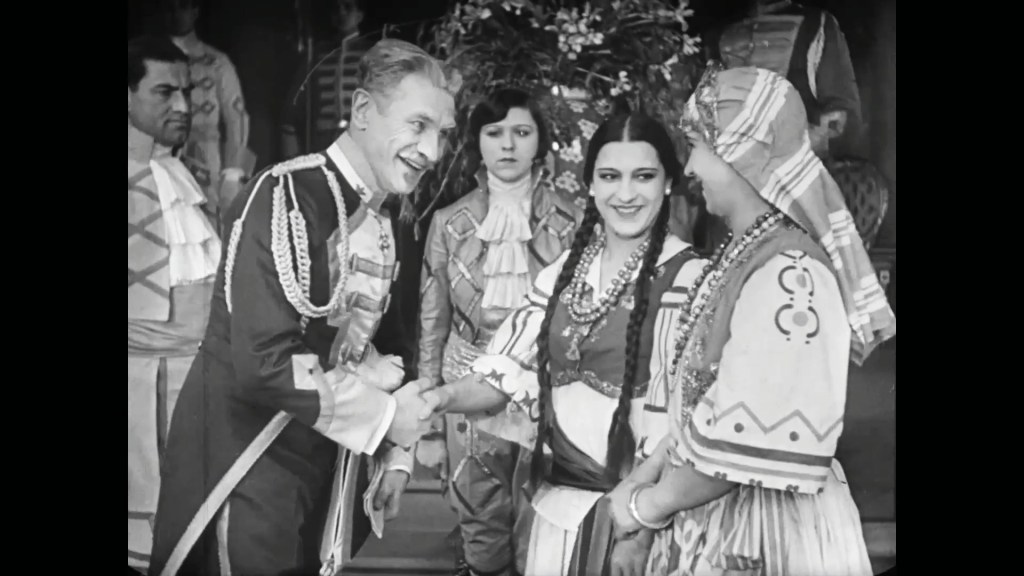
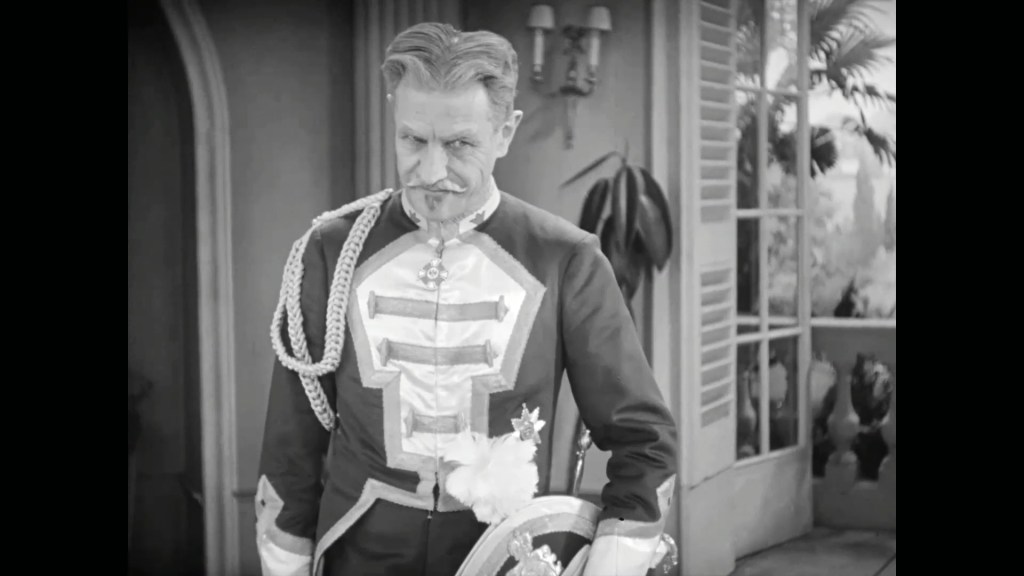
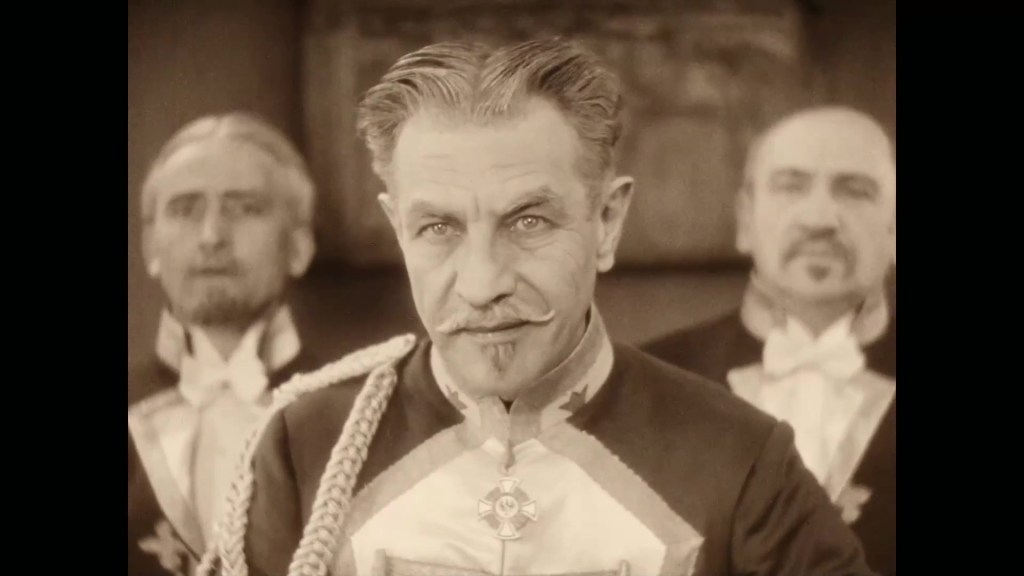
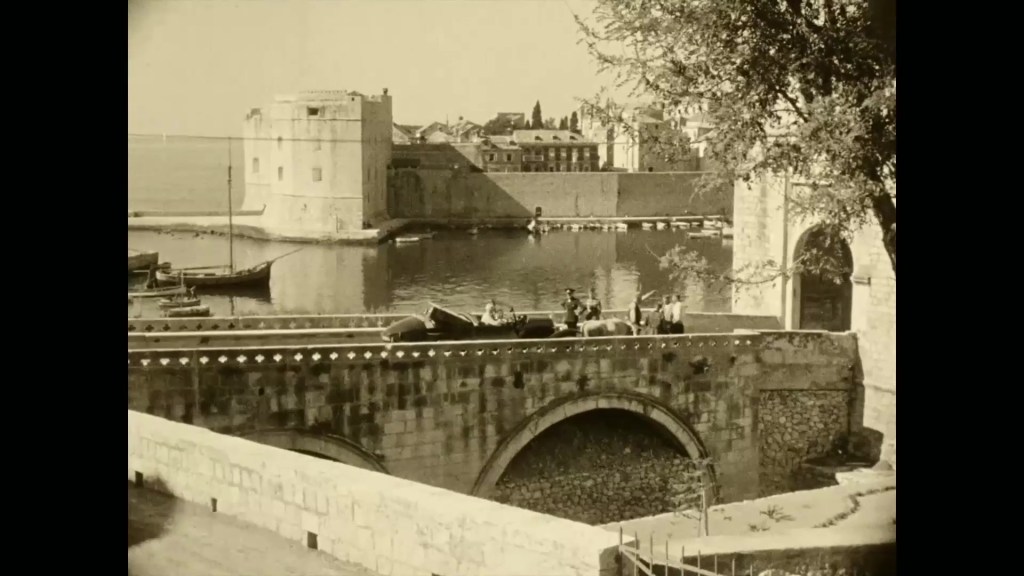
A gorgeous shot of an obscure city on the coast. (The real city of Dubrovnik must remain nameless.) Sillistria’s “fleet” consists of three small boats, the “army” of a handful of men and a cannon. The residence is a lovely villa. The Chancellor (Emil Heyse) arrives in splendid uniform. The local women in “traditional” costume, a kind of blend of east and south European, vaguely Balkan, vaguely Slavic, vaguely Turkish.

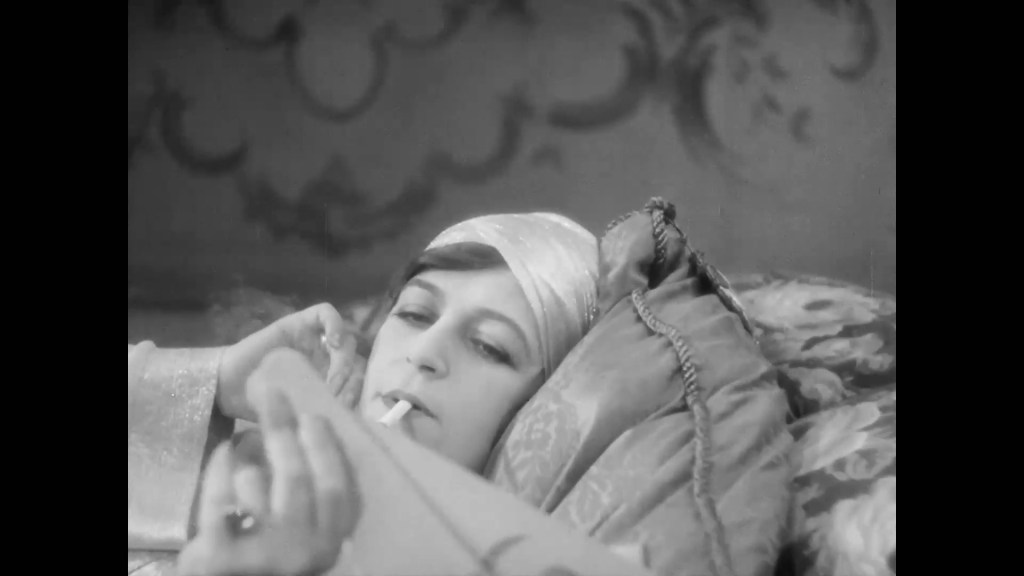
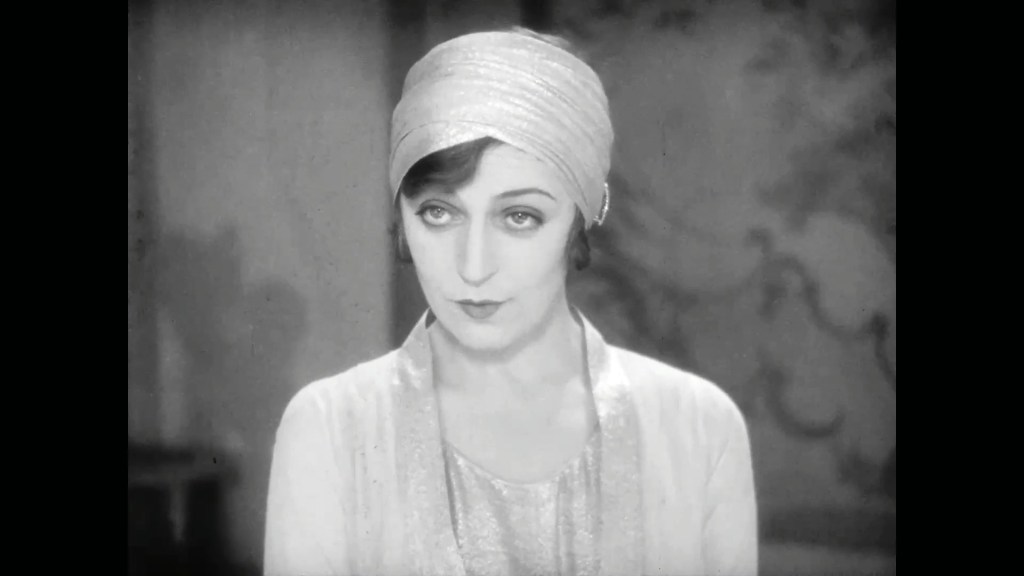
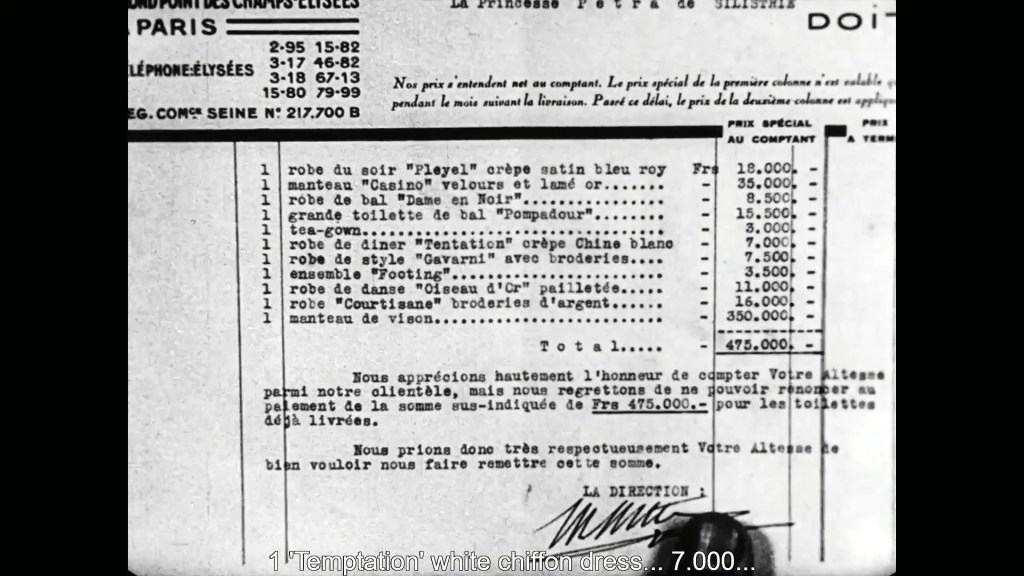
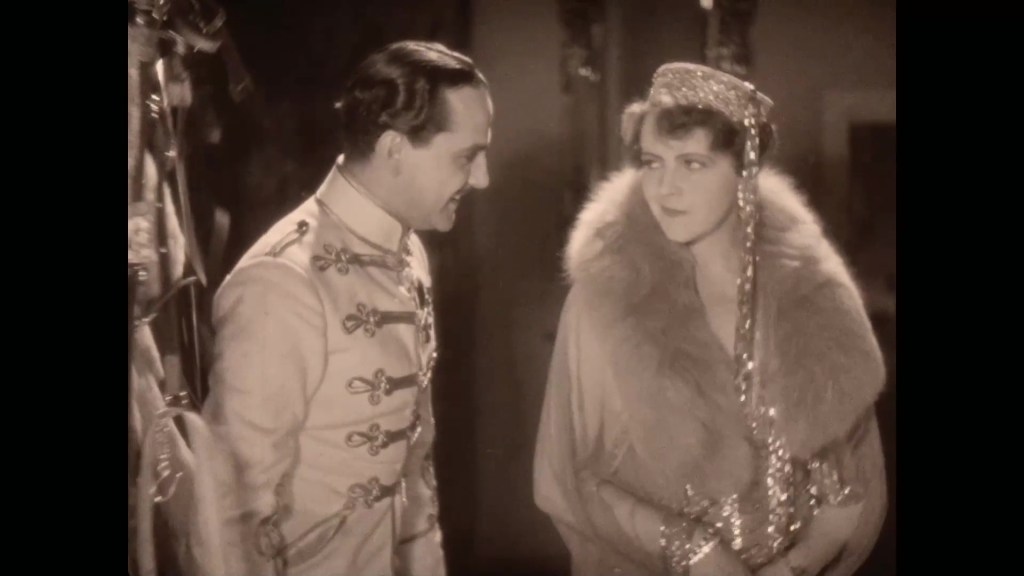
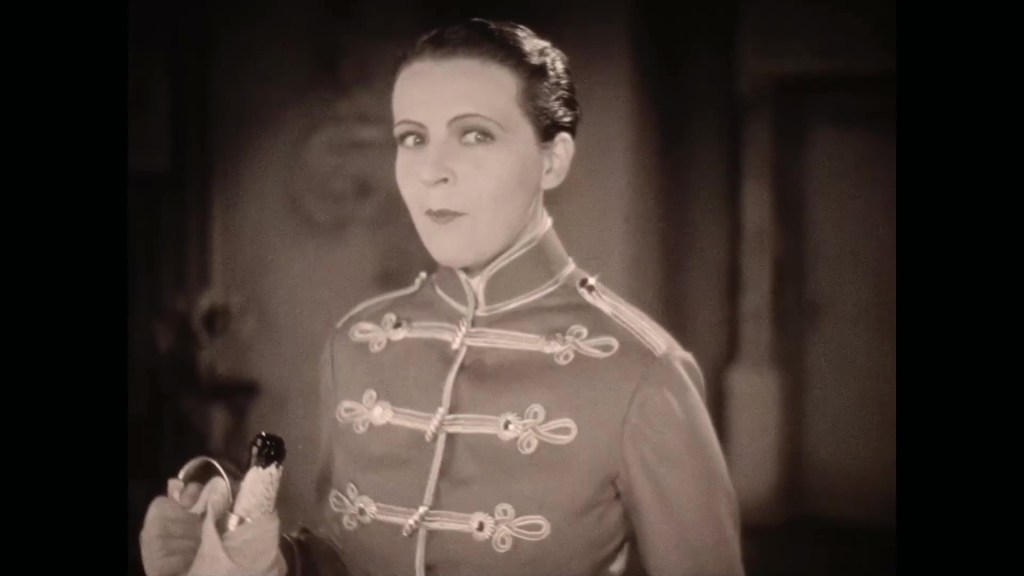
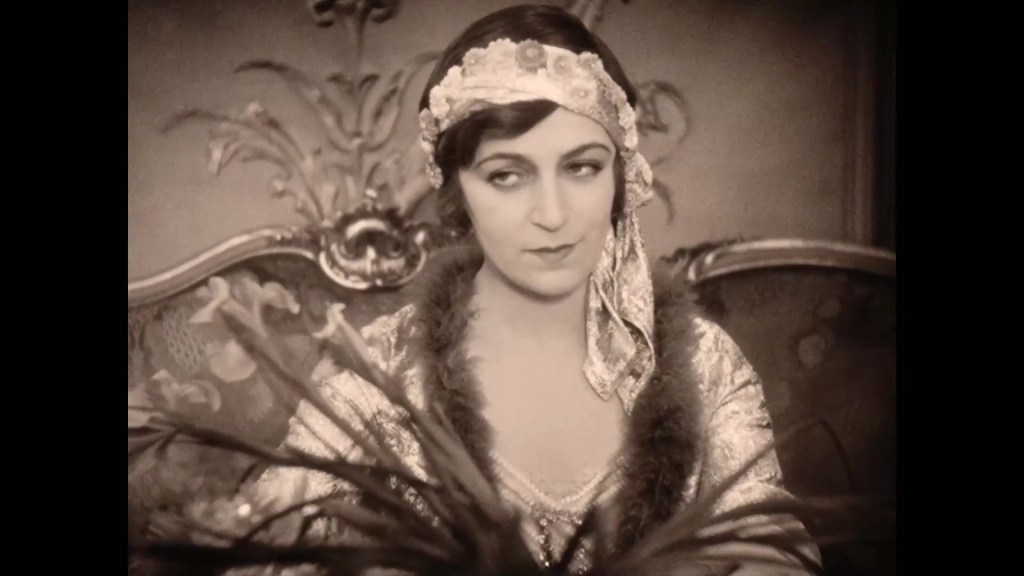
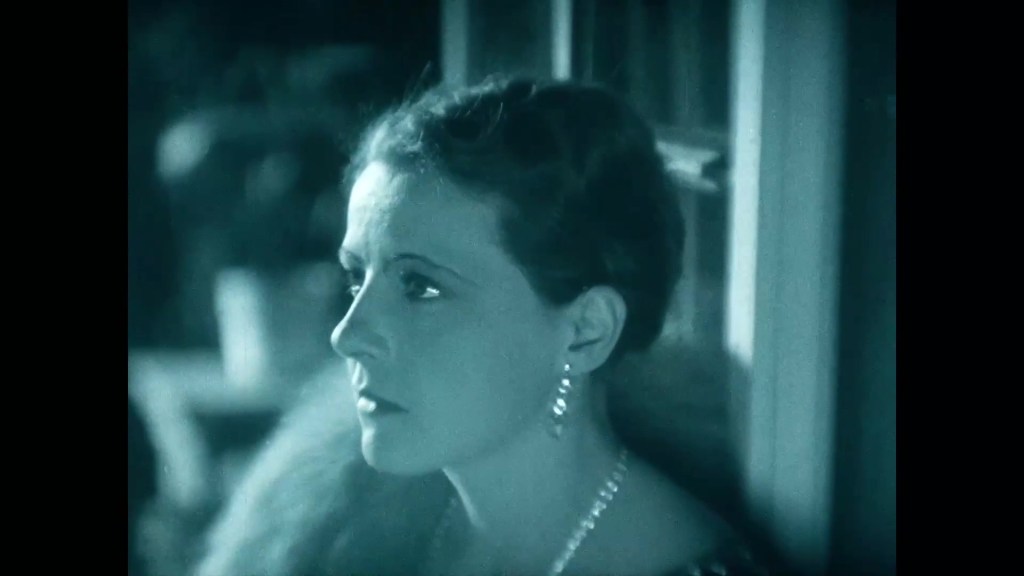
Princess Petra (Diana Karenne): a lovely close-up revealed when she lowers her fan. She is cool, languid. Eyes that move expressively, assuredly. She smokes. A modern Princess for an ancient kingdom. We are told about Thuringia and Illyria, to which the Princess is determined to sell an island, Petrasia. The Chancellor threatens to resign. “You want me to have to walk around naked?” she asks, a twinkle in her eye. She shows him her bills. The Chancellor kisses her hand, shrugs, laughs.

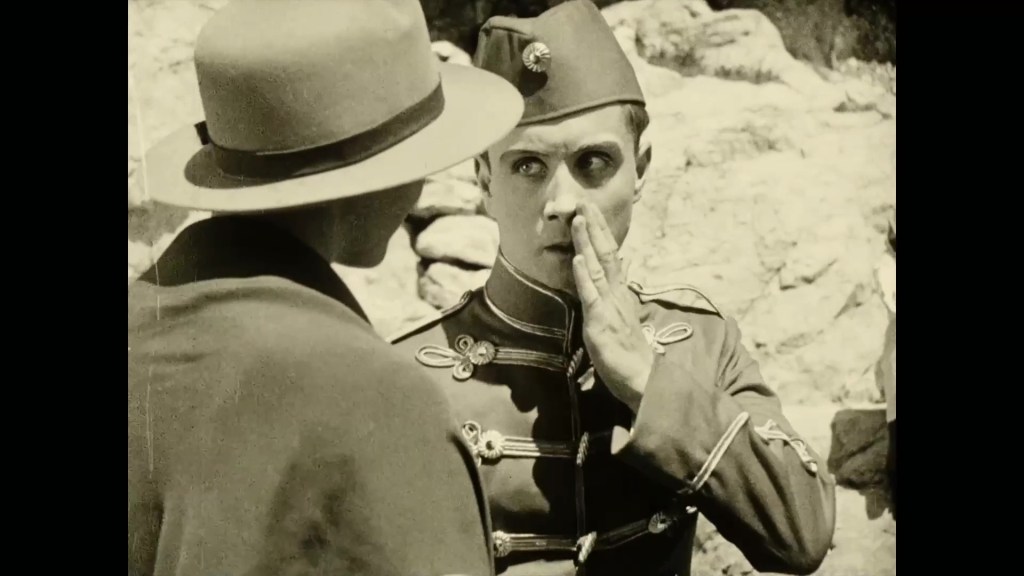
Count Geza (Peter Leska) from the kingdom of Illyria. The attendant (Hans Thimig) is full of sly winks.

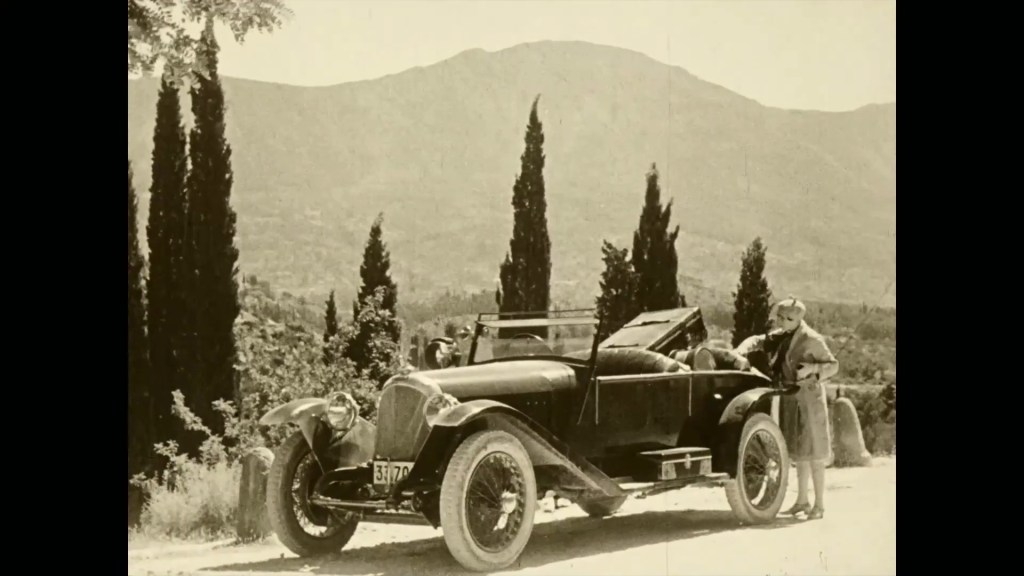
Now we are introduced to Dschilly Zileh Bey, special envoy of Turkisia (Mady Christians), broken down on the road into the city. Gorgeous scenery, a map (this time professionally printed) of the fake kingdoms. How to find her way around here? She offers money to a local, who tows her car with his bull.

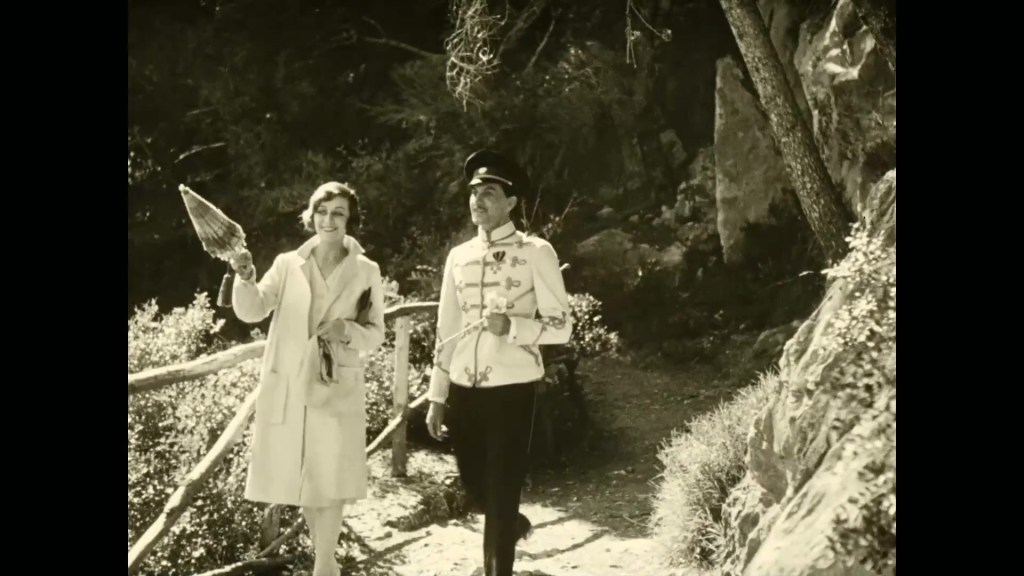
In the court of Sillistria, Count Geza flirts with the Princess. The arrival of Dschilly causes chuckles and consternation. Elegant tracking and lift shots of her entry into the hotel. And a panning shot of her disappointed glance round the paltry room. The “bathroom” is simply a portable metal tub. Dschilly looks the most modern of all the characters: her smoking, her fashionable beret, her elegant yet simple dresses and shawl. And the modernity of her knowingness, her visible intelligence. Here’s a woman who knows what she wants and will find a way to get it. Charming, yes, but direct too.

Her arrival at the court. She and the Chancellor exchange mutually curious looks. (Then again, Christians always has a half-suppressed smile.) Smiles and great curtesy to her “rival”, Count Geza.

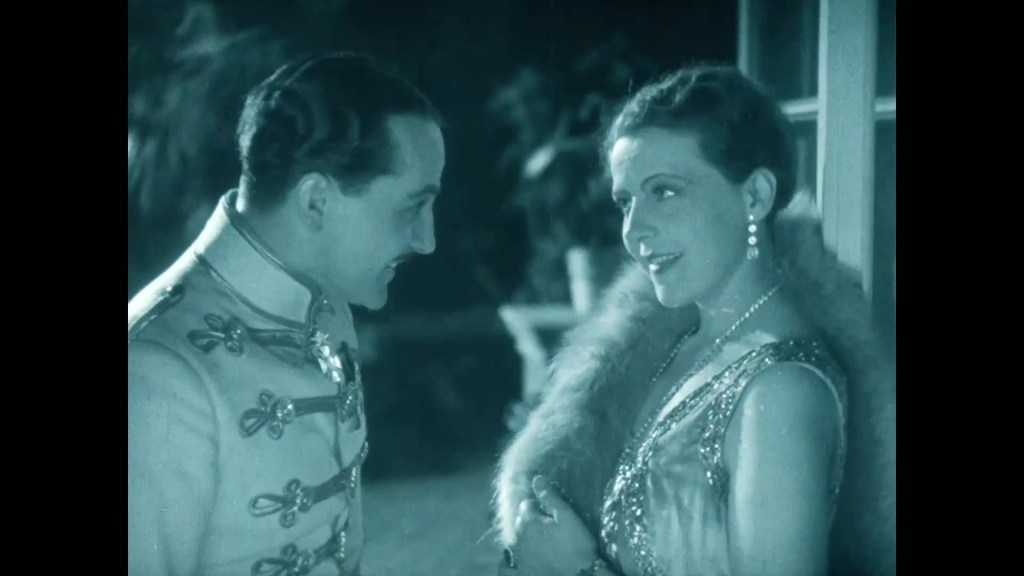
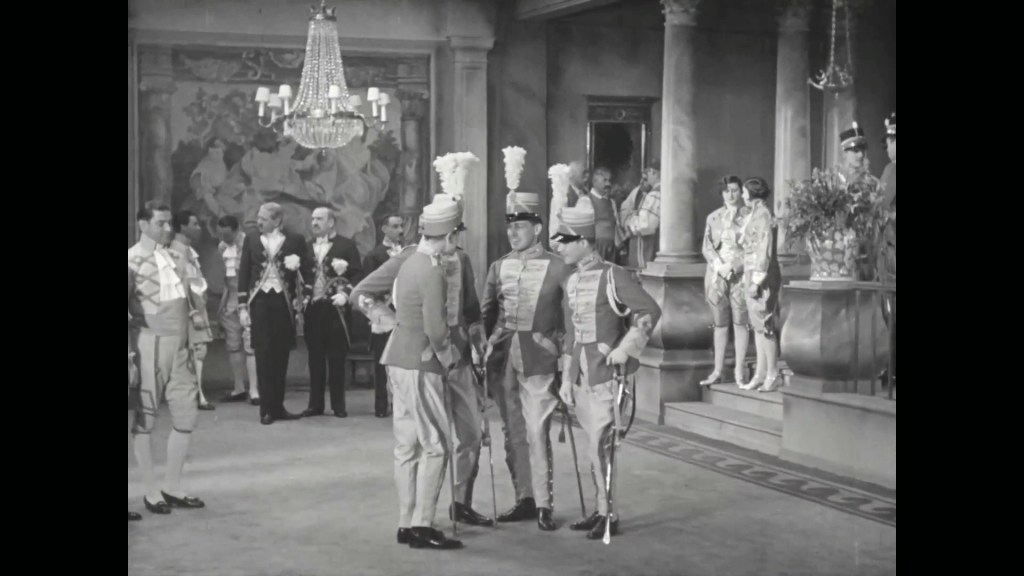
That night a soiree (tinted a lovely rose). The comic adjutant is here again, grinning and flirting and taking a sneaky drink as he serves the ambassadors. Geza and Dschilly are dancing, the camera following their movements on the dancefloor. Thence to the gardens, a quick kiss on the hand. But Dschilly wants the island. Geza wants to advance his career. The stakes are set out. (On his way out, Geza plays a sly trick: he tells the concierge that Dschilly does not wish to be woken.)

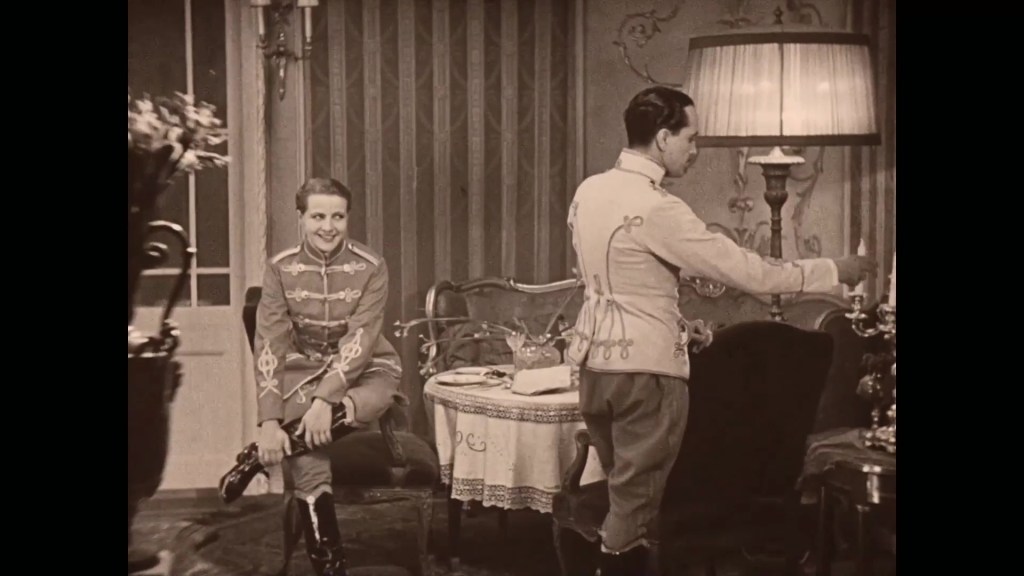
So the Princess is left waiting, and all doubt Dschilly’s qualities as an ambassador. Only Geza turns up, and begins smarming with the Princess. Attended by female servants in page attire (very charming, very ’20s), they prepare to set off together. Dschilly wakes and is angry at the trick, but soon that familiar smile breaks out: she has a plan. She demands to speak to Her Highness.

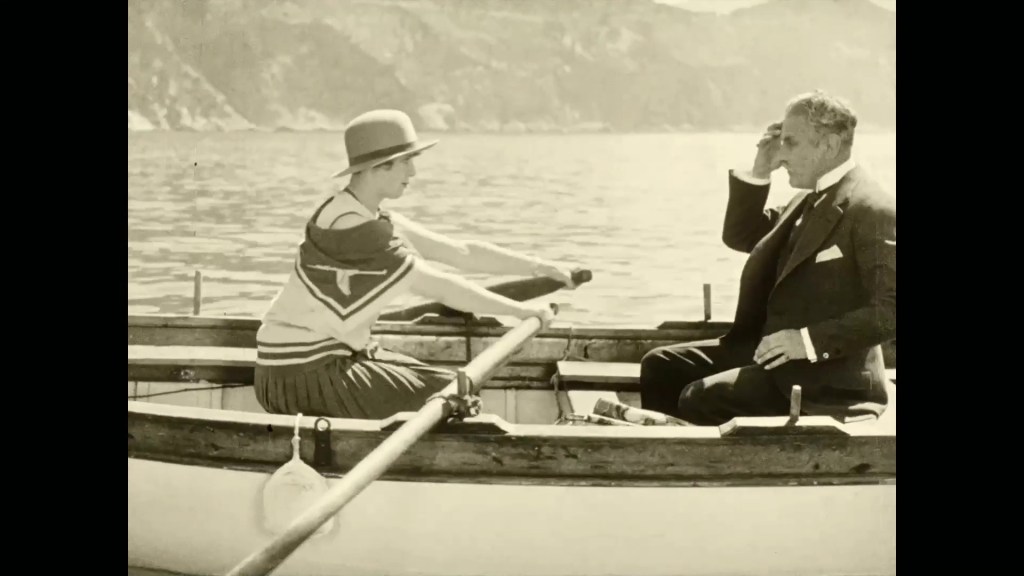
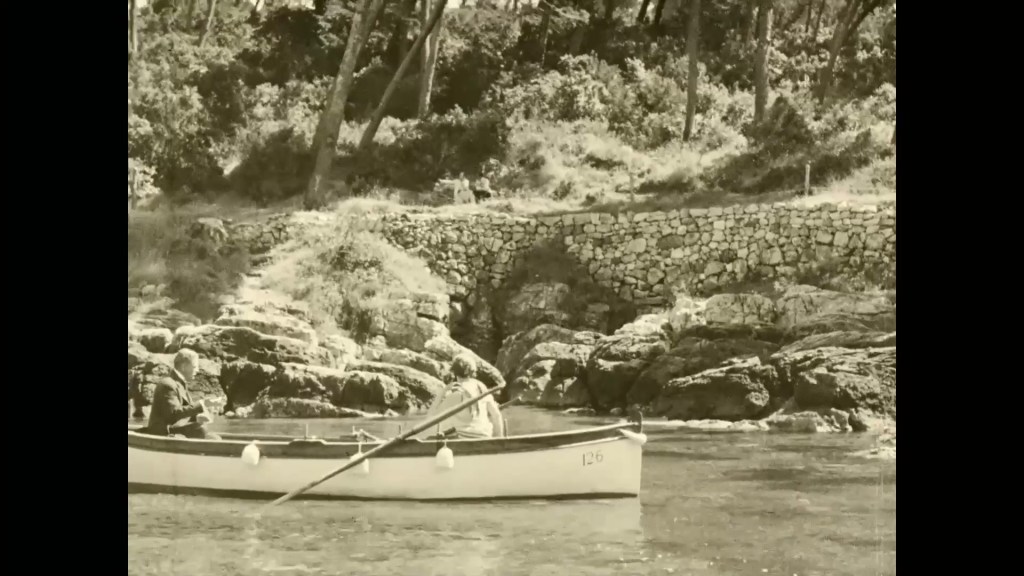
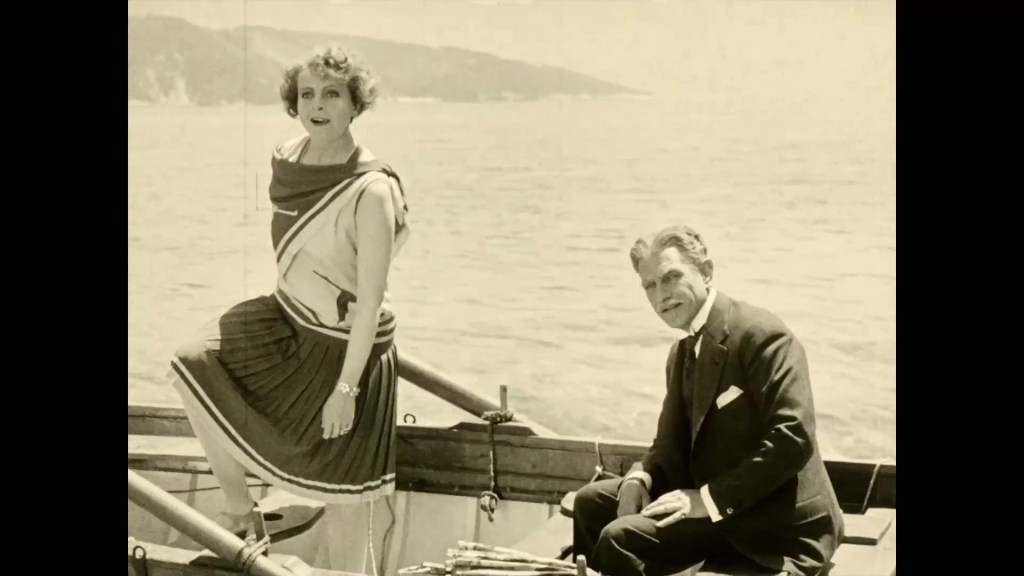
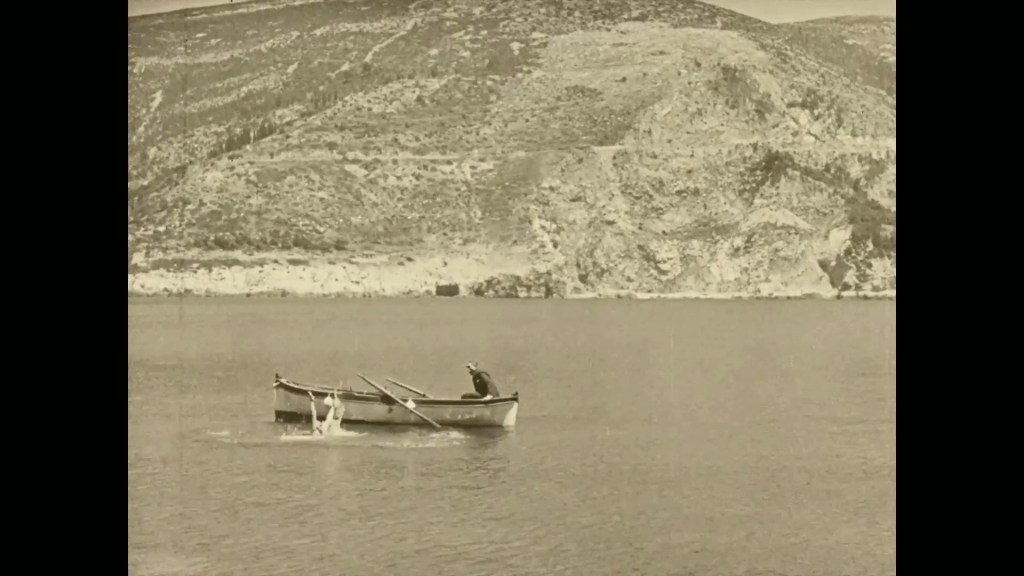
After a trip on the little yacht, Geza gets the Princess alone on the island of Petrosia. But the giggling adjutant is in the background, so too the Chancellor. Dschilly waits at the little quay, but she makes friends with the gossipy attendant and he spills information on the Count’s planned assignation that night. She and the Chancellor then row around the island, Dschilly doing the rowing. She assures him that tonight Count Geza has his reception. The conversation brings them around the island within sight of the Princess and Count. Dschilly leaps into the water to feign drowning. The Count rescues her and gets her ashore. He insists on rowing her back to the mainland. Dschilly sits up, soaking wet and ever so charming. She flirtatiously says that this is her response to his own scam that morning.

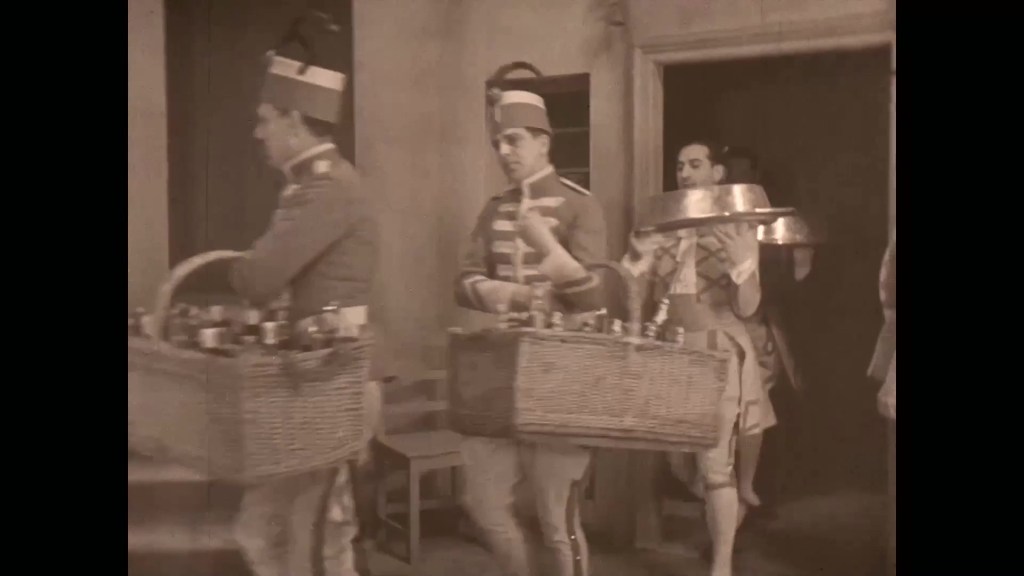
That night, the Count prepares for his lady. The door rings. The attendant answers, only for a huge supply of food and drink from the court to arrive for the count’s official reception. The attendant keeps having to answer the door as more and more people arrive, guests for the full-blown diplomatic reception that Dschilly has mischievously pulled forward by a day. Soon, dozens of high-ranking guests are swarming into the Count’s residence. The next moment, the crowd is upon him—and he had dismissed all his servants for the night. So Dschilly organizes a team of officers to serve the drinks. Meanwhile, the Count orders his attendant to remove all the candles. But he is spotted by Dschilly, who suspects another scheme. The Count is wrestling with a fuse box. The lights go out and, after a meaningful exchange between Geza and Dschilly, the guests are forced to leave.

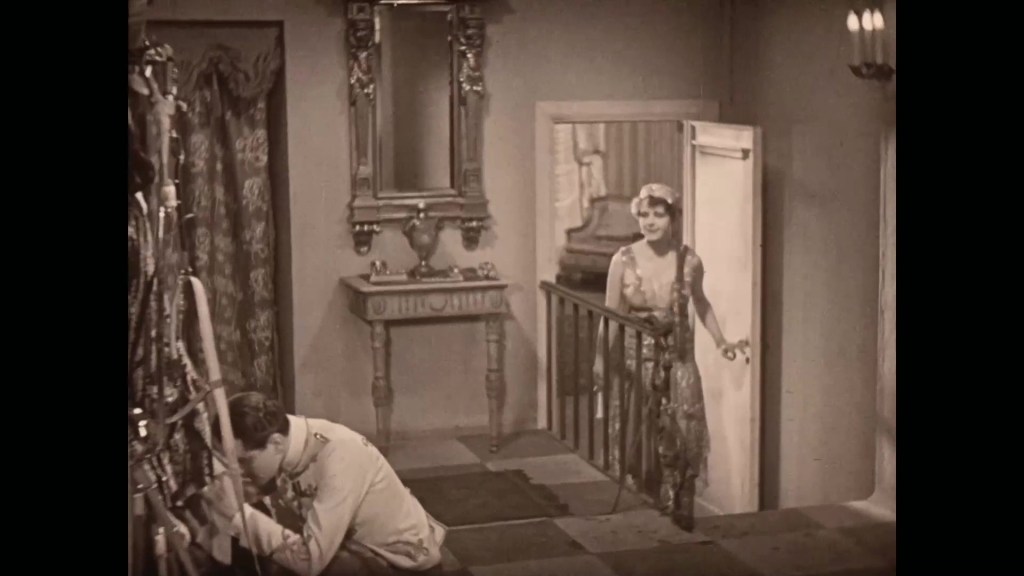
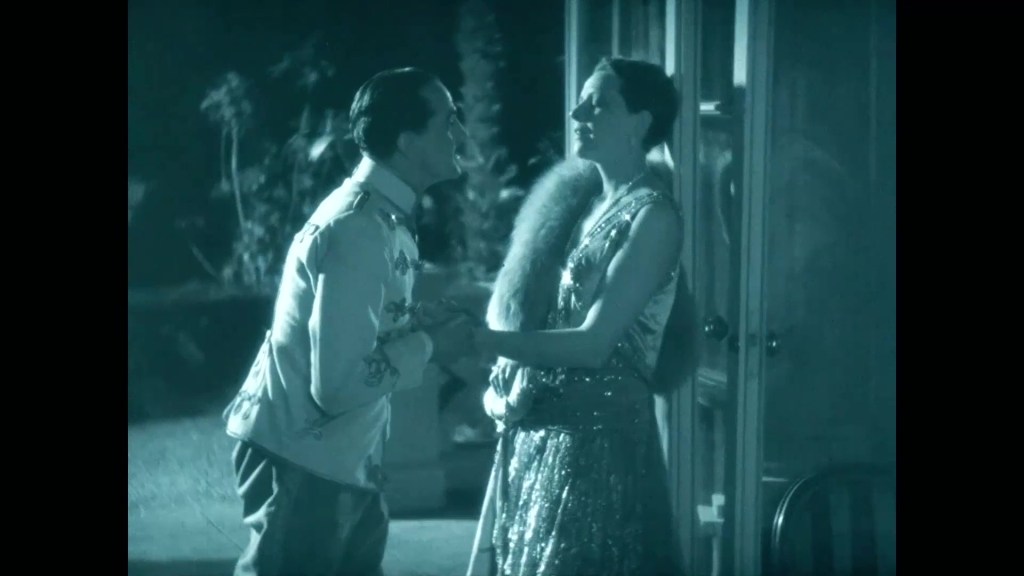
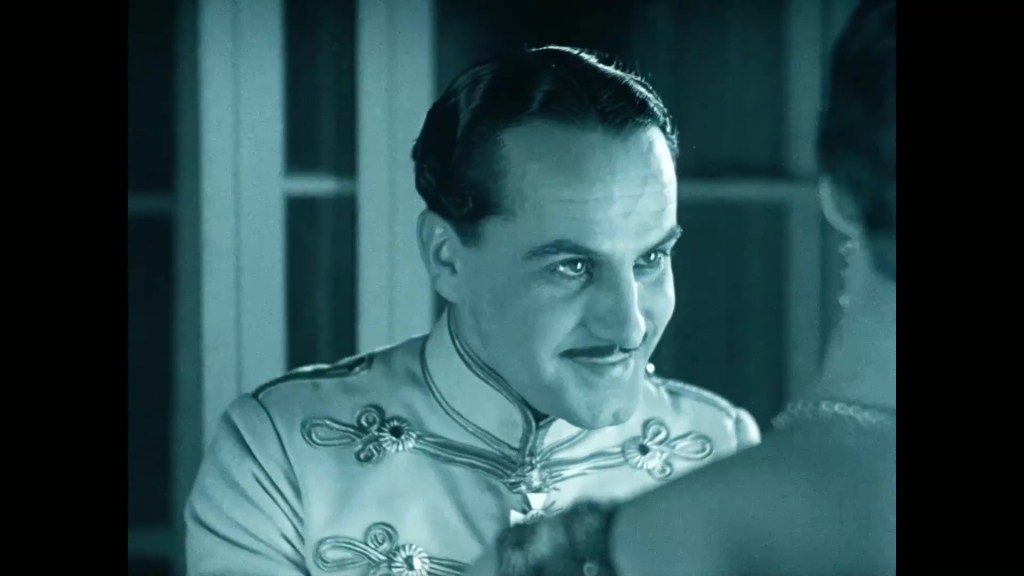
At last, the Count’s guest approaches: it is the Princess. But the attendant who serves them is… Dschilly, delightfully made up and dressed as the real thing. She can barely contain her smirk as she serves, “accidentally” catches his hand with a match, and frustrates his flirtatious dinner. The Princess leaves and the two rivals are left together. Outside, a group of officers with music and gypsy dancers arrive. One of them soon finds the Princess’s shawl, but it is Dschilly who takes it away with her. Before she leaves, Geza confesses that he loves her. Dschilly smiles in rapture but then accuses him of saying the same thing to the Princess. She says she will be his wife—if he gets her the sale of the island.

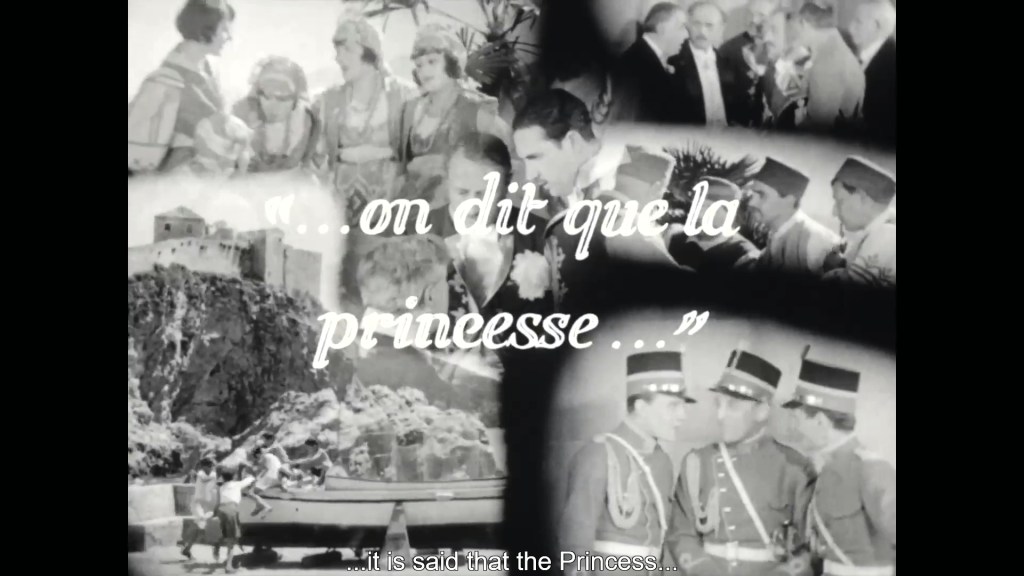
But rumours are flying—via superimposed text and split-screen—about the Princess and the Count. The Princess demands the truth from the attendant, who admits that Dschilly was also at the Count’s residence. Angry, the Princess decades to withdraw the sale of the island.

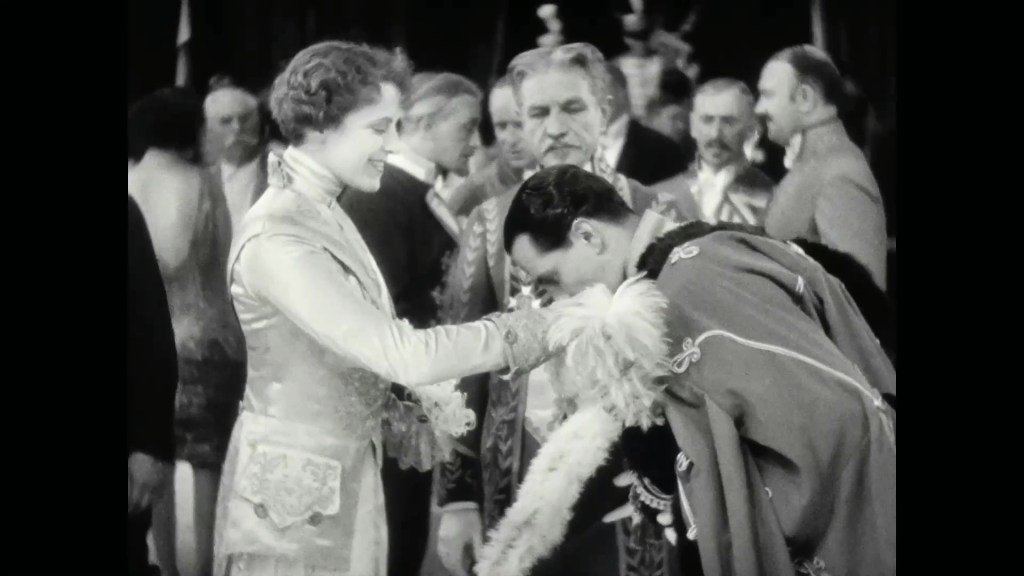
The official hearing of the ambassadors’ withdrawal. The Princess enters in her regal finery. But as she prepares to strip them of their positions, Dschilly unravels the Princess’s shawl from her sleeve. Consternation… until Dschilly says she gladly accepts the gift that had already been given to her by the Princess. It’s her trump card: the Princess sells the island to Turkisia, “so ably represented” by Dschilly. But in private Dschilly gives the contract to Geza, announcing to the Princess that they are soon to be married—and that she will be giving up her career as ambassador. We see the happy couple, with the grinning attendant in the back seat, driving away. Naturally, it is Dschilly who sits at the wheel. Fin.

Day 6: Summary

I wrote last year that The Runaway Princess was meagre fare. Eine Frau von Format is hardly more substantial in terms of plot, characterization, or emotional depth. In all these respects it is simple and superficial. But it has the advantage of both budget and location over Asquith’s film. It looks prettier, has more to display and displays it more lavishly. Costumes, sets, and glimpses of the real Balkan exteriors are a tremendous advantage. So too the fact that the expanded cast gives more of a chance for more performances to bounce off each other. Mady Christians is always watchable, always charming, always doing something: a sly smile, a flash of the eyes, a sudden movement that implies thought and cunning—even emotion. She gets to play alongside Emil Heyse and Peter Laska and Diana Karenne—and clearly has a fine time doing so. The cast is uniformly excellent, full of precise and meaningful characterization. (Even a minor figure like the hotel manager, played by Robert Garrison, gets several little comic turns.) The direction is clear, the photography is lovely, and the tinted print looks gorgeous.  (The piano accompaniment by Elaine Loebenstein is also very good.)

But the film is all surface. Eine Frau von Format is charming but not moving. And it’s funny but not biting or satirical or meaningful. Wendhausen’s direction is skilled without enhancing or adding to the story. There are a few nice tracking shots, but they are more used to reframe the action or move from long- to medium-shots. Little meaning is added by any of them. Wendhausen tells the story with perfect skill, but nothing more. He was no Lubitsch, nor was he a Stroheim. This Ruritania has none of the sheer fun or sophistication of Lubitsch’s fantasy kingdoms, nor any of the emotional depth or satirical bite of Stroheim’s.

But is it fair compare such a film to the greatest examples of the genre? Am I undervaluing the film? I should say that Eine Frau von Format is certainly about female agency, about how a woman can use intelligence and wit to negotiate power structures and achieve her goals. Mady Christians is superbly clever, and managing her performance to be so charming and sophisticated while also showing such cunning is wonderful. But there are no great depths to her character. She softens just once, reveals some sense of her inner life just once: when Geza confesses his love for her. Her charm melts away and she looks vulnerable for an instant, then smiles in a way that reveals inner joy. It’s a great moment, but fleeting. Soon the charm resumes, and the film has no means to explore—no interest in revealing—the inner depths that might lurk inside its characters. So, yes, I did enjoy Eine Frau von Format—up to a point. It’s a first-rate second-rate film.

Paul Cuff

Pordenone from afar (2022, Day 6)

Day 6 takes us back to the fictional worlds of Ruritanian kingdoms, and to the streets of 1920s London thanks to this British-German co-production from Anthony Asquith…

The Runaway Princess (1929; UK/Ger.; Anthony Asquith)

On her 21st birthday, the Princess of Lothen Kunitz runs away from her palace to avoid enforced marriage to a stranger. She goes to London with her old tutor, where she tries to earn a living—but is caught up in a fraud scheme…

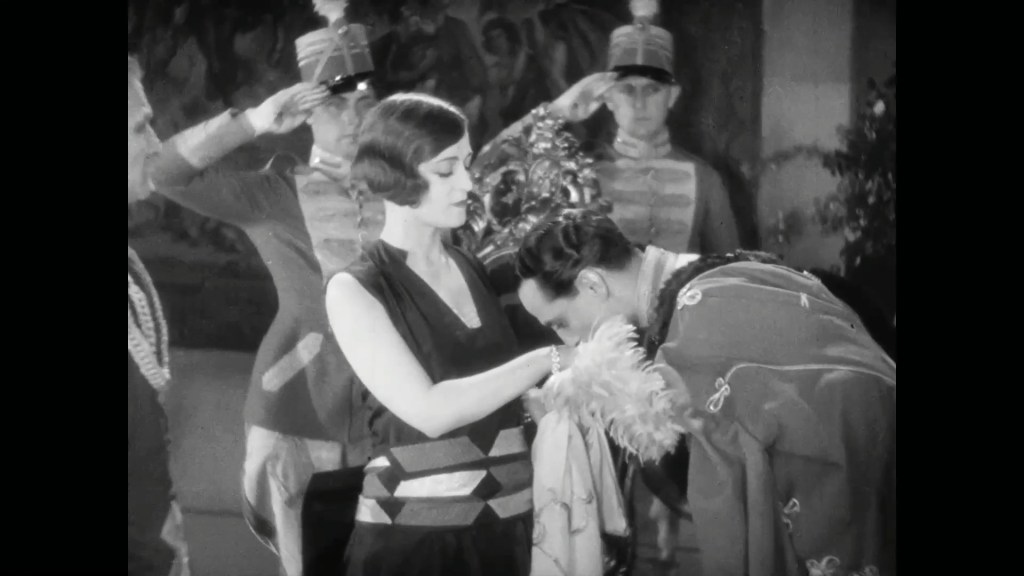
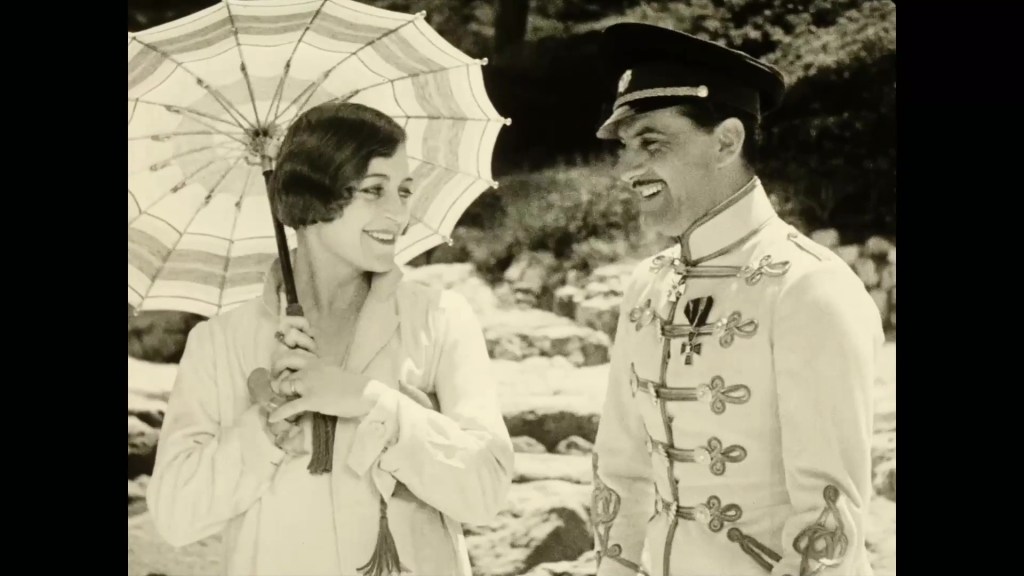
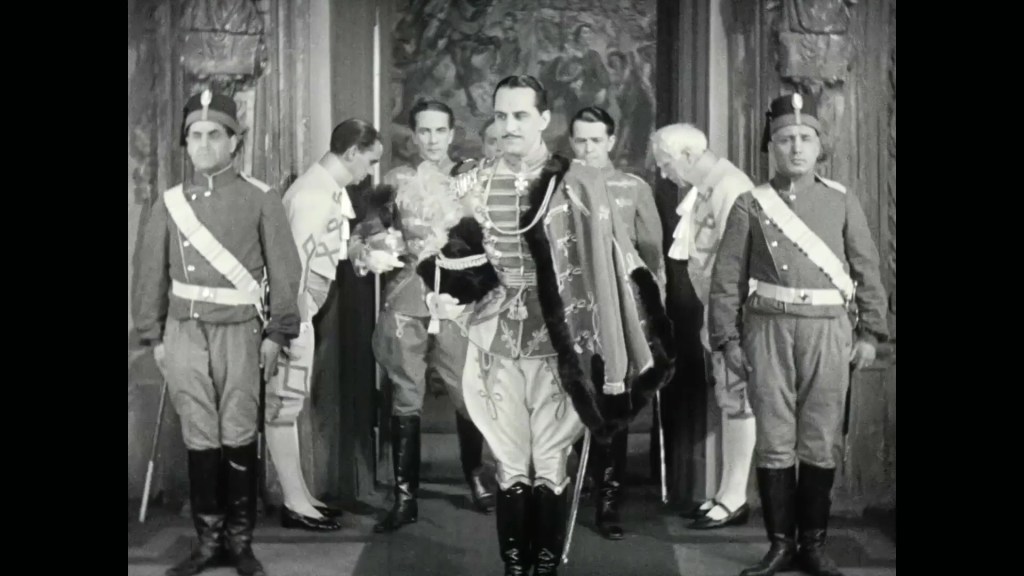
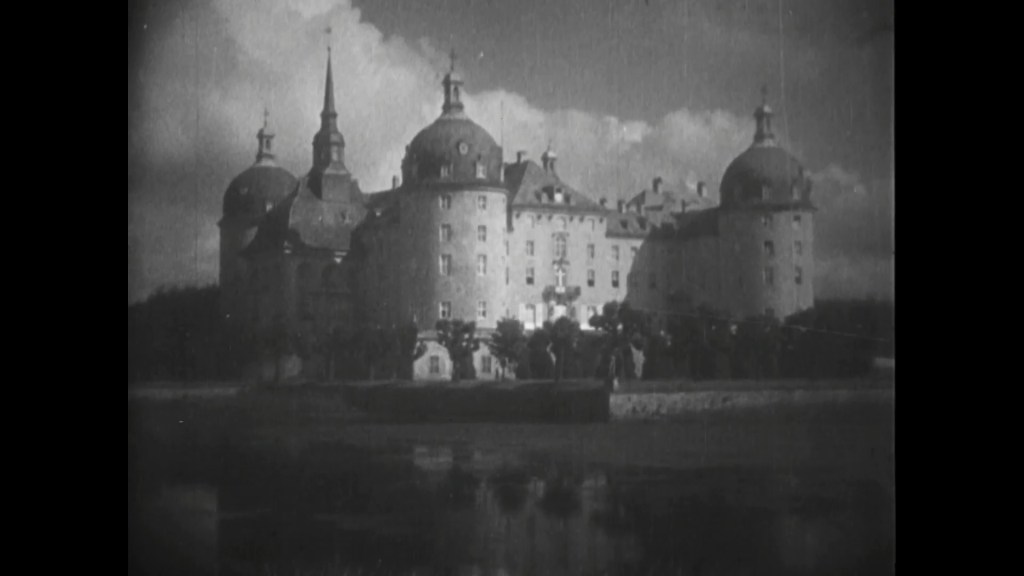
The camera tilts down to reveal a grand castle, somewhere in central Europe. Tops hats are raised to a banner bearing the image of the Princess. It is Priscilla, who is thus preceded by her symbolic trappings. When we finally see her, she is surrounded by courtiers and hussars. (Hussars always look the most gawdy, hence their appearance in all the Ruritanian films streamed thus far from Pordenone; though here I note that they are wearing British-style lacing on their tunics rather than the more continental style frogging. (I have a longstanding interest in nineteenth- and early twentieth-century uniforms, but I’ll try and spare you further observations on this topic.)

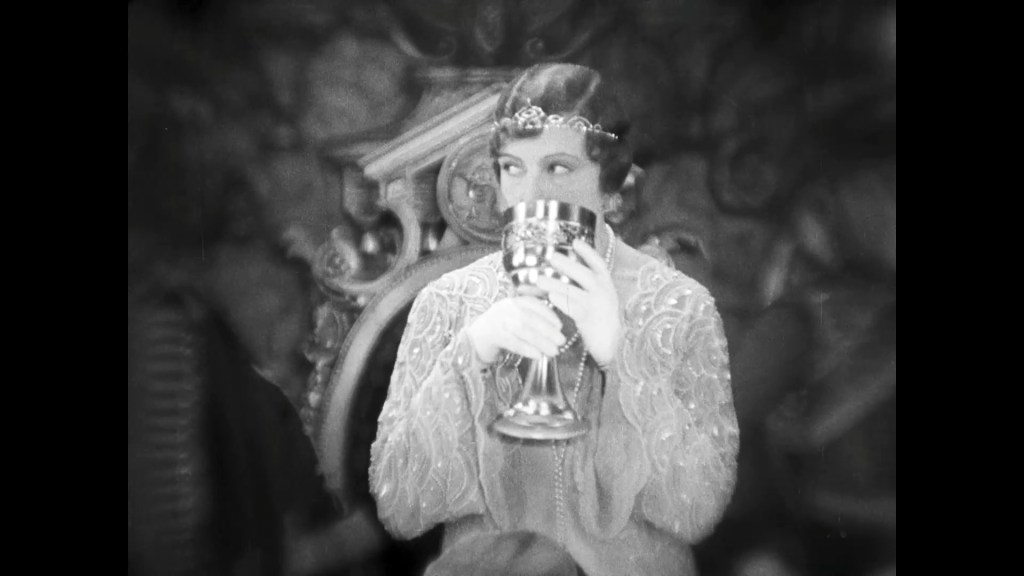
Priscilla is presented with a goblet. She tries to take a good swig of the contents, but her chaperone intervenes. There is a nice gag with the courtiers dealing with the birthday gifts being offered to the Princess. She hands one large item to her aide, who passes it to their right to an usher, who passes it to their right to another usher. The usher looks hopefully to his right, but there’s no-one there, so he tries to hand it back to someone on his left. The aide eventually takes it back, disappears for a moment, and looks furtively behind him once he’s dumped it behind the dais.

A girls’ choir step forward and a singer fluffs her line. The princess tries not to laugh. Sympathy and embarrassment. We feel the awkwardness and absurdity of the occasion.

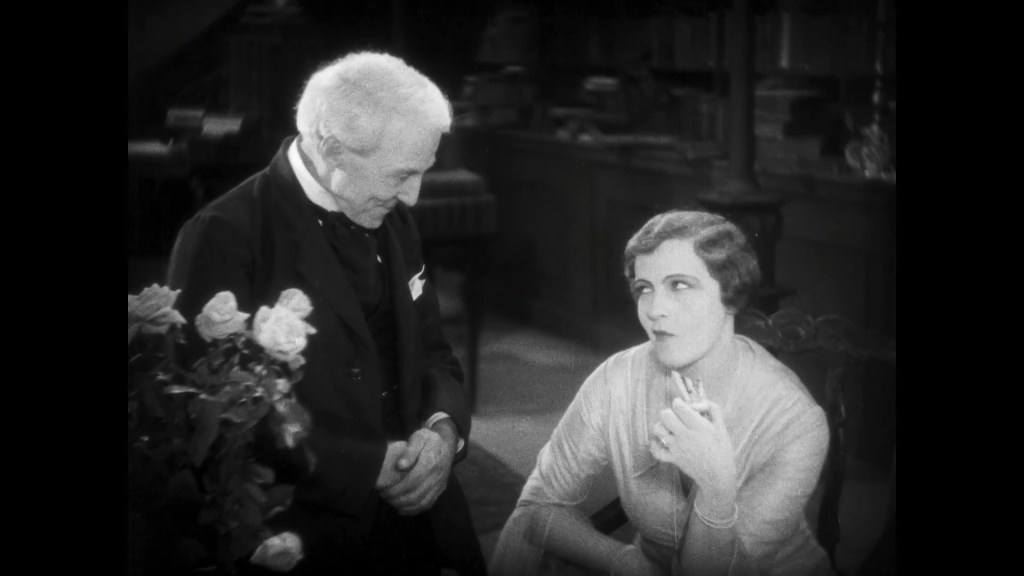
Fritzing is a faithful old tutor to the unhappy princess. Fritzing commiserates with Priscilla in the confines of a large library-cum-study, where she would clearly rather spend her time. They discuss her future, and she says “I wouldn’t marry a prince for anybody.”

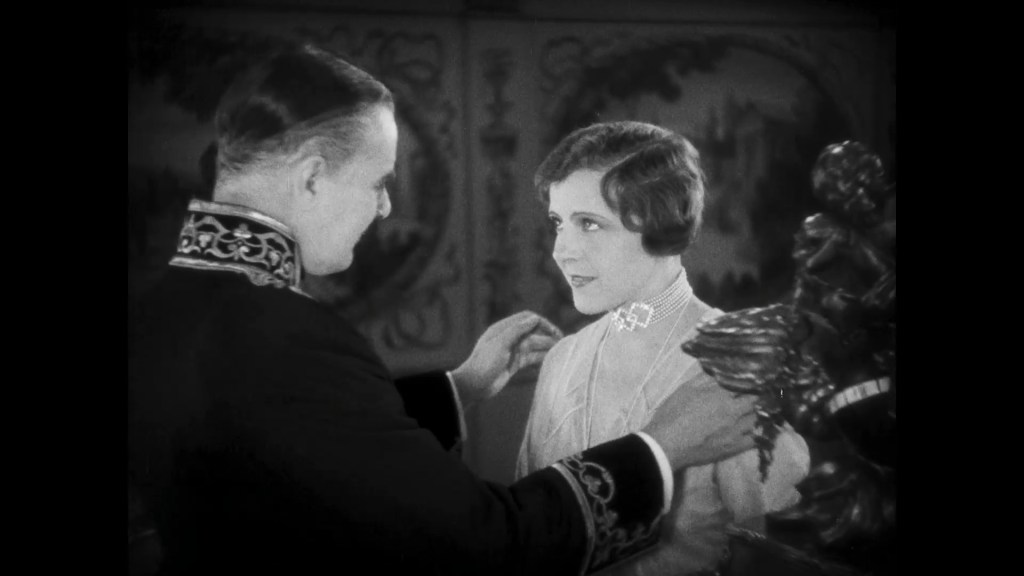
Cue the Grand Duke, her father, giving her a necklace: and an ultimatum. The necklace has been given to all princesses when they come of age: it’s an engagement gift. She must marry the Crown Prince of Savona. The necklace is tight around her throat. Outside, she tries to tear it off: but the courtiers are all around and she must feign contentment.

She plans an escape, sending luggage to Amsterdam. Her packing is interrupted for a bicycle lesson, to take place under the eyes of a stern chaperone.

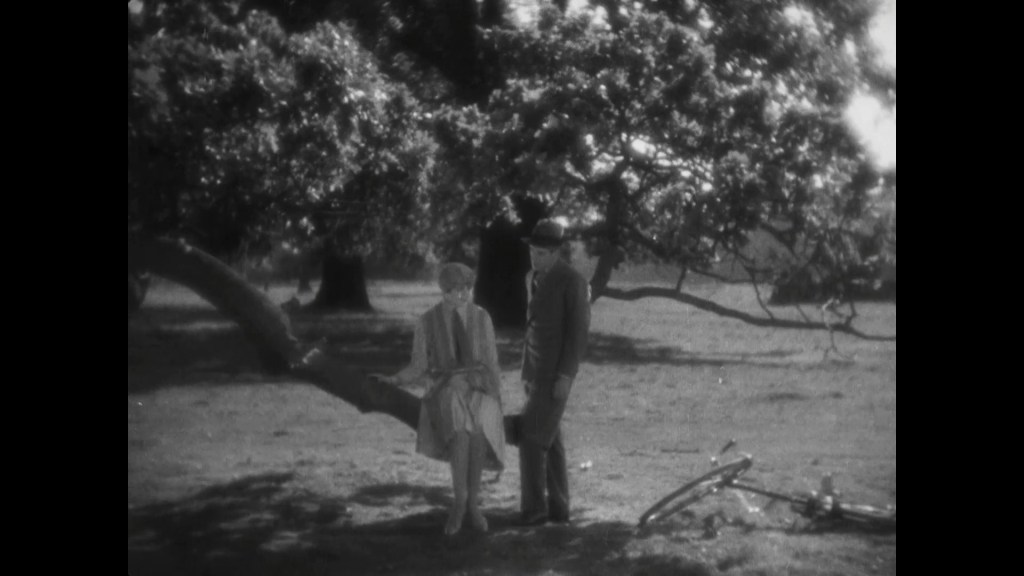
But Priscilla tears off into the woods, where she (quite literally) bumps into a stranger. Under boughs of crushed-focus light and shade, they share a few moments of tranquillity. Then the chaperone intervenes and they are parted.

When the Prince is announced the next day, the camera tracks in grandly and we see only the back of the man’s head. (And yes, I think the eventual pay-off is spelled clearly enough at this point.) Where is the princess? The Grand Duke must improvise: “the joy of her betrothal has caused the Princess to have a breakdown”: cut to the bicycle tyre being repumped as Priscilla and Fritzing ride away to the train station.

But on the train things start to go awry. They are the victim of money forgers, who substitute a duff £5 note for their own currency. And the stranger from the woods is following them, too—and recognizes her face from the newspaper. Also on board is a detective, investigating a gang of fraudsters—who assumes the stranger is likewise on their trail.

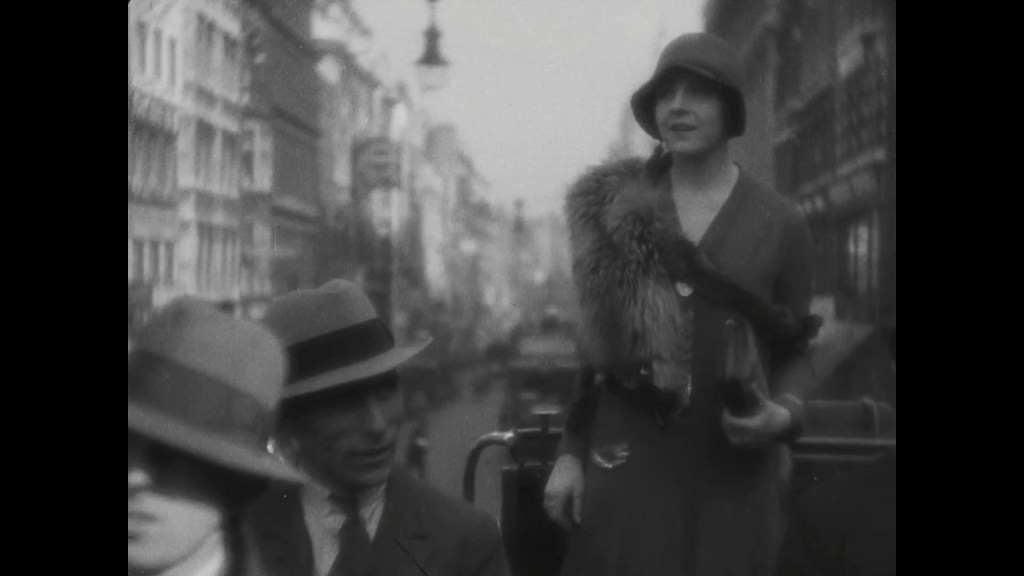
Then we are in London. And it’s a London of wonderful business and bustle and crowds. The budgetary constraints creating the kingdom of Lothen Kunitz confine that world to two or three spaces. But in London the streets are the camera’s to roam. The excitement of London excites the camera, which can now track and cut and look at the life of the city.

The stranger is still following Priscilla: half-mocking her efforts to get a job. Frankly, his persistence is creepy and I’m not surprised Priscilla is keen to prove him wrong. (If she called the police, the rest of the plot wouldn’t work, which is a shame.)

The race to get a job with another applicant is intercut with a dog race: it’s a neat joke but appears out of nowhere and there’s nothing else like it in the film. (Only when you look at other Asquith films can you see a context: the same kind of intercutting trick is more startlingly used in A Cottage on Dartmoor [1929] when cannons roar into life in a rapid montage of anger and violence in a barbershop.)

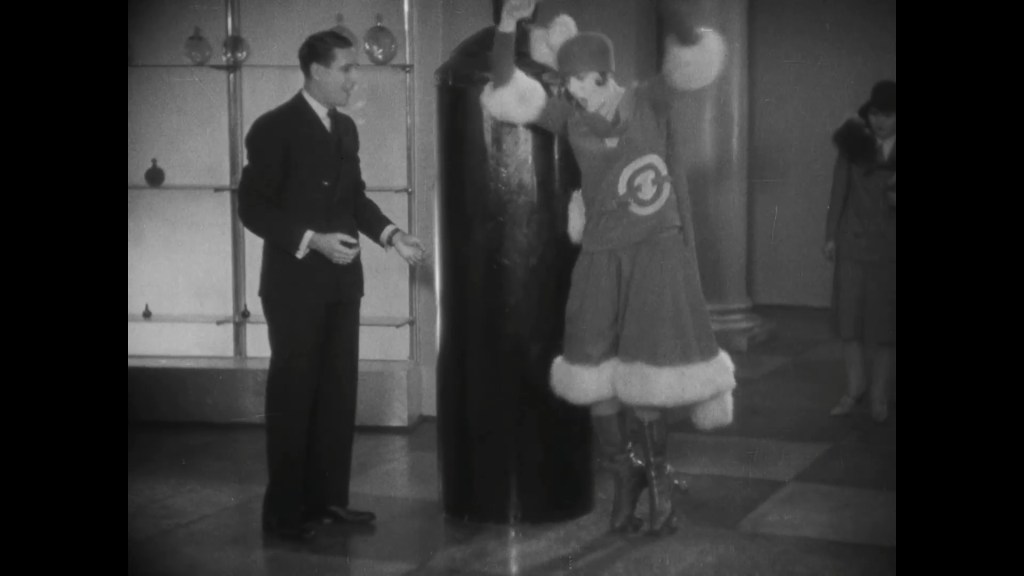
Priscilla ends up inserting herself into a modelling role, putting on skates and a dress as the “sportif” model—ending up plunging straight through and past the catwalk into the lobby. It’s a parody of her desire to be in control, trying as she did in Lothen Kunitz to have control over what she does and what she wears.

When she gets another job, she ends up being employed by the crooks. When her first failure ends in two of them shouting at her, there is a brilliant montage of faces—framed closer and closer—bearing down on her. It’s a more successful sequence of stylishness than the dog track scene, having more direct purpose and effect within the scene.

Then the smartest of the fraudsters works out that Priscilla is so blithely trusting that they can pay her with fake notes and get her to distribute their currency for them. The detective and the stranger are nosing around, observing notes and getting closer to their goal. At least, the detective thinks so—having earmarked Fritzing and Priscilla as the masterminds.

At every turn, Priscilla bumps into the stranger—who I wished she’d slap. Instead, she tries to show off her job success ordering everything expensive on the menu at a restaurant. (“Princess?” one waiter asks another. “Film star!” the other asserts. It’s much like the link made explicitly at the end of Hans Kungl. Höghet Shinglar: the Ruritanian figure as glamorous star, for whom different rules might apply.)

The film comes to a climax as the criminals are grabbed and the princess has to reveal her real name—as does the stranger. And yes, the stranger turns out to be the Crown Prince of Savona.

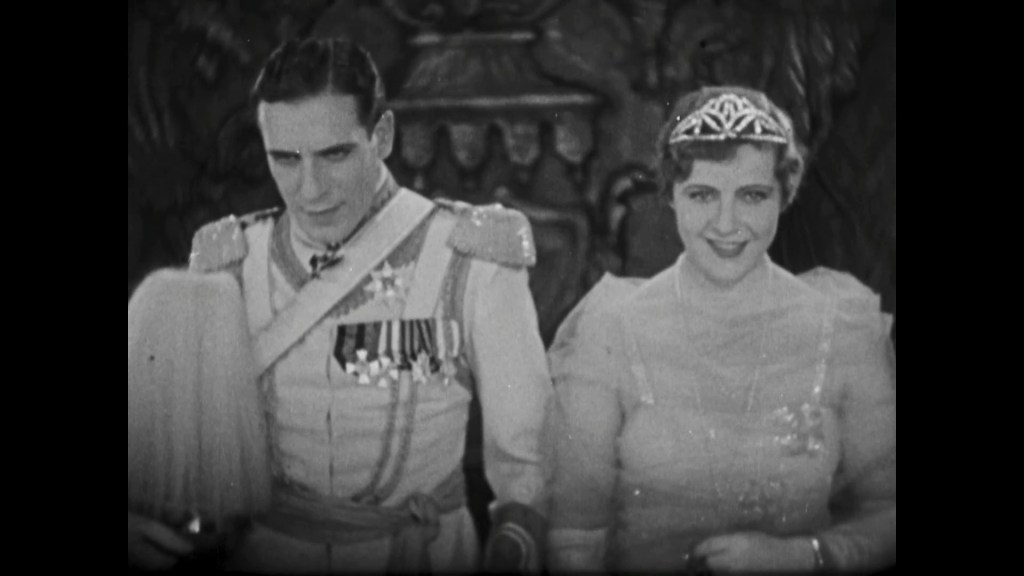
The royal couple appear at the end, endlessly nodding to an invisible throng of well-wishers. They look happy, but are they? The last shots of the film exactly mirror those at the start: but now the banner being saluted contains an image of the couple, and the camera tilts up from the castle to the sky.

It’s meagre fare, this film. With similar aspects to Hans Kungl. Höghet Shinglar, The Runaway Princess falls short in every point of comparison. It’s not as stylish, not as charming, not as inventive, not as clever. The finale of Hans Kungl. Höghet Shinglar questions the very material of Ruritanian fantasy, whereas The Runaway Princess returns to where it starts. If there is any question of ambiguity at whether the couple are now merely trapped with each other rather than on their own, it is only a hint: the film wraps up so quickly there is no time to think. The relationship between Nickolo and Astrid is much warmer, more developed, and more convincing in Hans Kungl. Höghet Shinglar. In The Runaway Princess, the “stranger” is given no substance at all, and his presence is only bearable given that we know Priscilla seems to like him. And even though she does like him, his stalking her from country to country is still difficult to accept without any scene of real warmth of engagement between them across the entire film. The Austrian actress Mady Christians is very good as Priscilla, but Paul Cavanagh is given so little to work with he can hardly do anything for his character. The Fritzing character is likewise very thin: not the complex character of André in Hans Kungl. Höghet Shinglar (or, in anther Ruritanian example of the period, the tutor figure Dr Jüttner in Lubitsch’s The Student Prince of Old Heidelberg [1927]). In terms of style, there are moments when Asquith has fun (the dog race gag, the quick cutting of close-ups in the argument) but even these stand out awkwardly against the pedestrian pace of much of the film. It’s worth noting too that the print used of The Runaway Princess was not in the best shape. There were sections of what looked like 16mm subbing for 35mm elements, and the film clearly hasn’t been restored recently. I’m still glad to have been shown it, but it’s one of the weaker films to be streamed this year.

Paul Cuff
Pordenone from afar (2022, Day 4)

It’s back to Ruritania for Day 4: a slice of slapstick with Stan Laurel for starters, then a main course of Germano-Swedish romantic comedy…

Rupert of Hee Haw (1924; US; Percy Pembroke)

“The Plot”, explains the opening title: “A Princess is engaged to marry a king—but she loves another—This makes it an original story.” Stan Laurel plays a sozzled King, together with the lookalike who brings chaos to the court…

All the Ruritanian trappings are here: the uniforms, the palace sets, the tapestries, suits of armour etc. In fact, the settings have the best recurring jokes. When the King is drunk, the set itself behaves as if drunk: a wall moves back and forth to confound him, then acts as if it was innocent. When the King shoots the cuckoo clock, the suit of armour raises its arms in shock. When the King reappears later in the film, another suit of armour thumps him unconscious. And all for no apparent reason. The King’s fiancée, the Princess, gets her own recurring gag: whenever she is slapped on the back or knocked over, huge clouds of powder (or dust) billow from her clothing. It’s as if she’s fossilized, or she’s wearing a museum costume.

The chaos spreads through the court. A general’s hat reacts every time the King sneezes. First the hat leaps into the air. So the General takes off the hat. The King sneezes and the hat’s plume leaps into the air. The General re-affixes the plume. The King sneezes and the General’s hair leaps into the air. What’s wonderful is that the General looks so nonplussed at each turn, turning around as if to spot how the gag’s being done.
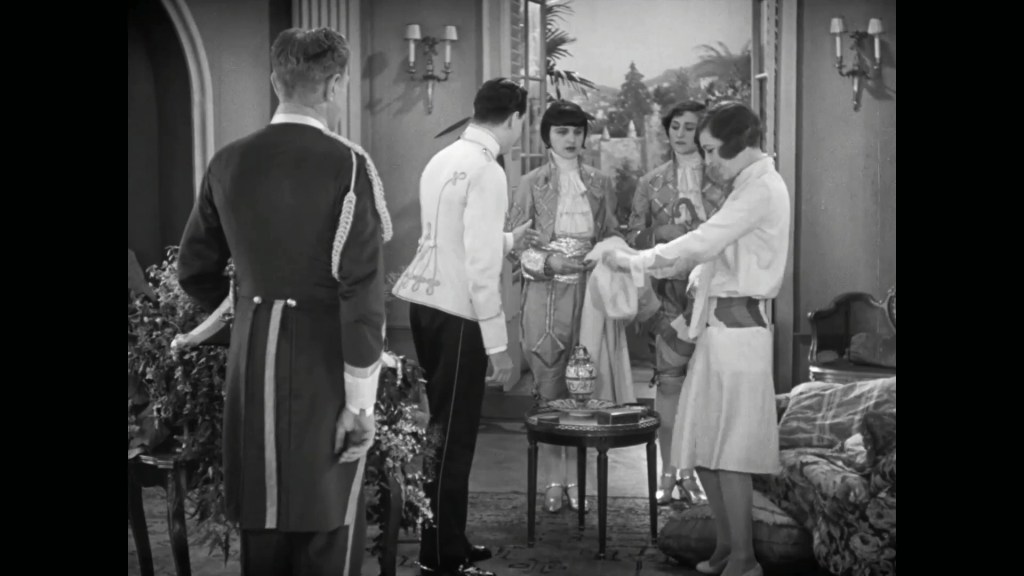
The film takes apart every social formality it can get its hands on. Displays of etiquette become slapstick routines: lines of saluting courtiers turn into front-facing, sideways-kicking brawls. Signs of rank are treated with contempt, articles of uniform defaced and used against their owners.

I quickly lost sense of what the plot was, and so did the film. It swiftly becomes a chaos of banana skins, pratfalls, abrupt changes of fortune, arse-kicks, bits-with-a-dog, incompetent duelling, and callous announcements of deaths and misfortunes. There’s a subplot involving a letter but frankly I had no idea what was supposed to be happening. For Rupert of Hee Haw, the Ruritanian genre is merely a fancy-dress box into which the performers dive and emerge in a chaos of tropes. For only 23 minutes, it feels rather baggy—like the costume doesn’t quite fit the film.

Hans Kungl. Höghet Shinglar / Majestät Schneidet Bubiköpfe (1928; Swe./Ger.; Ragnar Hyltén-Cavallius)

Nickolo Grégory is an aspiring young barber, raised in the trade by his grandfather André. He falls for Astrid, the granddaughter of hair tonic millionairess Sophie Svensson. The millionairess thinks her granddaughter should marry Count Edelstjerna, the closest thing to royalty she can find. But André has a secret, which is that Nickolo is the long-lost Crown Prince of the kingdom of Tirania—and a king worthy of Astrid (and her grandmother). But how will they reclaim the crown, and can they trust the agents sent to help them?

This is an absolutely charming film. It has a charming script, a charming cast, charming performances, charming photography. Its lightness of touch was a very pleasing change from yesterday’s feature, Profonazione, as was its sophisticated staging and camerawork: nothing showy, but imaginative when needed and making the most of its resources.

I’ve commented on title designs more than once in the features from Pordenone this year, and do so again now. Here, the title designs gesture at the secret “royalty” of Nickolo’s family, and the aristocratic pretensions of Sophie’s family.

But everything in this film is well designed. When André sees the hair tonic bottle produced by Sophie Svensson, the shape of the bottle dissolves onto the shape of the castle she has bought with its proceeds of its fabulous success.

Design matches aspiration throughout. André keeps the “thousand-year-old iron crown Tirania” in a secret case behind a mirrored cabinet door. The door is decorated with filigree that matches that used on the film’s intertitles: his secret is hinted at in the very design of the film’s narration. Likewise, when Sophie and Count Edelstjerna are discussing his plans to marry Astrid, Sophie has eyes only for the Count’s signet ring. The Count, too, has eyes only for the portrait of Astrid. Everyone’s aspiration is expressed through knowing gestures, comic transferences. Even Astrid’s rival for Nickolo’s heart, Karin, flirts with Nickolo by a kind of proxy: letting him continually fashion and refashion her hair. Hair itself becomes the means of access to various spaces: Astrid herself eventually invites Nickolo to the Svensson castle to cut her hair.

The rivals in romance play out in a lovely dance sequence in a wood beside the sea. It’s a cliché to expect beautiful coastal landscapes in Swedish films, but here is another. The camera views the circling lines of dancers from the festive Midsummer tree. It swirls and tracks, at one moment keeping pace with the dance, at others stepping aside to let others swirl around it. Couples swap, interact, tease, and reunite.

Nickolo and Astrid slip away on a rowing boat to an island. The film gives us gorgeous close-ups of the two leads—Brita Appelgren and Enrique Rivero—and we see them stood against sea and sky. The characters are falling for one another, so we must fall a little for them too.

The plot literally sails into view at this point: a large ship from Tirania, bearing the nation’s flag. Nickolo reveals he never knew his parents, since he was rescued from revolution in Tirania by André when he was an infant. Meanwhile, from shore, André secretly signals to the boat, crewed (we now learn) by people intent on conning money out of the old man. It signals that the plot will become more convoluted before the truth is revealed…

First, Sophie must be convinced of Nickolo’s worth. When she sees him shingling Astrid’s hair at the castle, he throws him out: a beautiful gag involving deep staging that shows off the scale of the castle and the scale of Sophie’s ambition. Nickolo is pushed through a never-ending series of doorways, all in the same shot, by the endlessly aggressive Sophie. Shingling is all the rage, but her hair-growth fortune takes it as an insult. (The film’s Swedish title makes the issue clearer: literally, “His Royal Highness the Shingler”, as does the German title “His Royal Highness the Bob-cutter”, something missed in the given English title. Nickolo specializes in a speciality of 1920s women’s fashion: the bob cut, a style inimical to the older generation of Sophie and her long hair-growth tonic industry.)
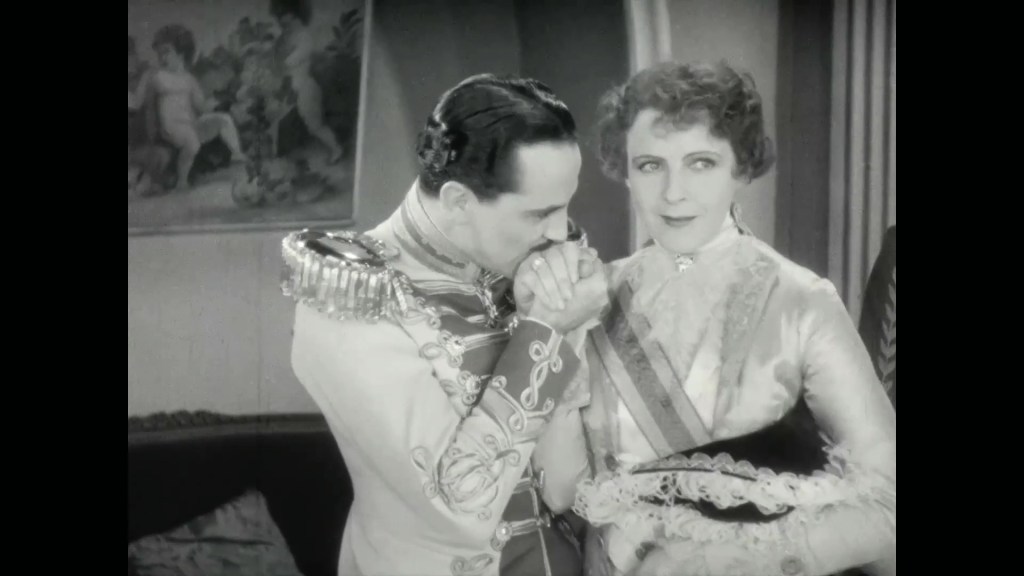
The agents extort money from André to help stage a coup and restore the dynasty, but he must get more funds from Sophie. He brings the ancient crown and unboxes it before Sophie’s goggling eyes. The pomp of ceremony is delightfully undercut as Sophie reaches out to touch the crown and André slaps away her hand and snaps shut the box.

The flashback to the story of revolution in Tirania is a lesson in how to maximize minimal budget of space and time in a montage. Guards in fezzes and Greek-style fustanella skirts swarm through palace corridors. Huge curtains billow. Gun barrels recoil. Flashes through windows. Soldiers pile on each other. An infant is handed to the young André, the King’s barber. The film uses only a handful of single-scene sets, but clever lighting, staging, and a wind-machine transform them into a microcosm kingdom, a time and place of drama and mystery. Drama and comedy blend in the story’s telling and reception: André having too much fun relaying past events, Sophie being too moved (and too ravenous) at the prospects of a royal future for her granddaughter and herself. Sophie has a fabulous vision of Nickolo and Astrid on the throne, dressed like dolls, crowning her as Queen Mother. (Karin Swanström, as Sophie, is superb and steals every scene she’s in.) André shows her the deeds to the dynasty, another written/visual symbol of aspiration to match its comic brethren: the ornate titles, the hair tonic bottle, the signet ring—even the modes of hair.

There follows a further complication of plot: not knowing her immanent fortune, Astrid wants to be abducted and escape with Nickolo onto the Tiranian ship, which falls into the plans of André and Sophie—and the Tiranian agents.

The machinations of the finale are set up in a complex series of intercutting spaces. In the barbershop: Nickolo, his female client Karin (jealous of Astrid), Astrid (jealous of Karin); elsewhere: two strangers that Astrid phones, pretending to be speaking to the Count, to make Nickolo jealous; finally, the Count himself, who is actually in the barbershop, snoozing in a booth.

I simply don’t have the time to describe the complexities of what happens in the next scene that night. There are ladders, lies, false abductions, real abductions, subterfuge, disguises, piles of money, pistols, hidden figures, speedboats, faulty engines, races to the rescue… It’s like a scene from P.G. Wodehouse orchestrated by Franz Léhar.

The best twist is that the villains’ ship is filled with other young men who have been told they are the Crown Prince of Tirania, each with a thousand-year-old iron crown of Tirania and the deeds to the throne. The villains kidnapped five orphans when the kingdom fell, and fobbed them off on perfect strangers whom they would later extort for profit. “We easily found five idiots”, the crook explains, “sorry—five patriots”, he corrects himself. It’s a delightful way of undercutting the absurdities of Ruritanian pomp—it takes a dig at the characters’ ambitions, as well as ours for expecting a fairy-tale ending. And why (the film surely asks us) should we favour the right of an exiled king to stage a coup d’état? The country’s name suggests Tirania was a tyrannical state, not a democracy. Why be nostalgic for a world of monarchical whim and caste-bound deference? As with Rupert of Hee Haw (though in a far more sophisticated fashion), Hans Kungl. Höghet Shinglar invites us to question the precepts of the Ruritanian genre on which it is founded.

Yet we do get a kind of fairy-tale ending, albeit one that is magnificently, showily mercantile: The couple marry and create their magical kingdom, a barbershop in Paris: “Grégory & Cie., Salon de Coiffure”, complete with the mythical Tiranian crown and royal accoutrements as part of the décor. Neon signs overlay the screen, the final marker of aspiration triumphantly stamped upon reality itself. Everyone gets what they want, including Sophie, who plays her part in the fantasy of the “king’s” barbershop alongside André. Sincerity didn’t suit them: they are better here as knowing performers. Why try and reclaim a real throne when one can simply create a fake one that’s more worthwhile?

It’s an ending that acknowledges the falsity of nationalist delusion. Balkan immigrants and Swedish merchants set up their own world in central Europe. It’s also a reflection of the film’s own hybridity: a German-Swedish co-production with a French-Chilean leading man and a German-Swedish cast. Better to be a cosmopolitan in Paris than an autocrat in a tiny kingdom. How nice to leave a film grinning from ear to ear.

Paul Cuff