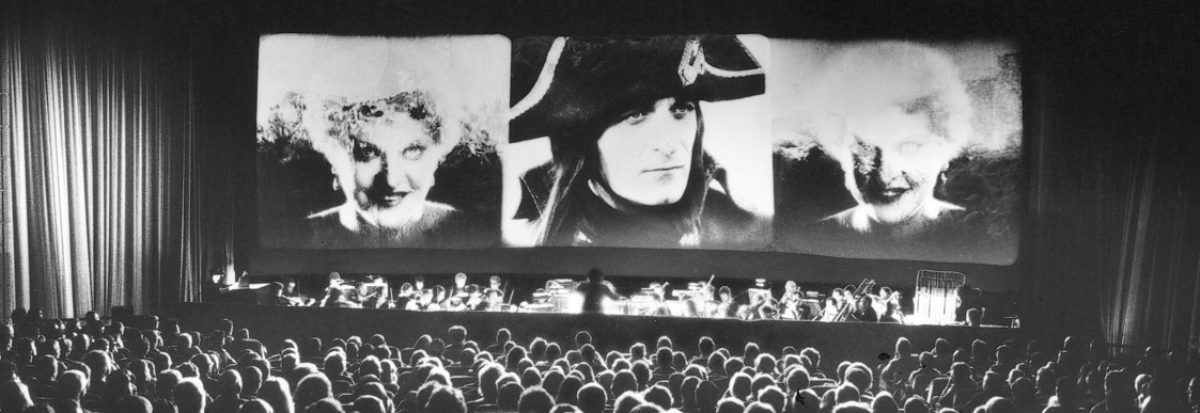
Ilya Ehrenburg: history, memory, cinema (2/2)

This week, the second part of my exploration of the life and work of Ilya Ehrenburg. Though my excuse for writing this is Ehrenburg’s connections with the films and filmmakers of the 1920s-30s, I am also interested in the memoirs as a work of reflection on this period. As I recorded in my last piece, they offer an amazing glimpse of the interwar world – and of what that world meant in retrospect.
Part 2: Later years

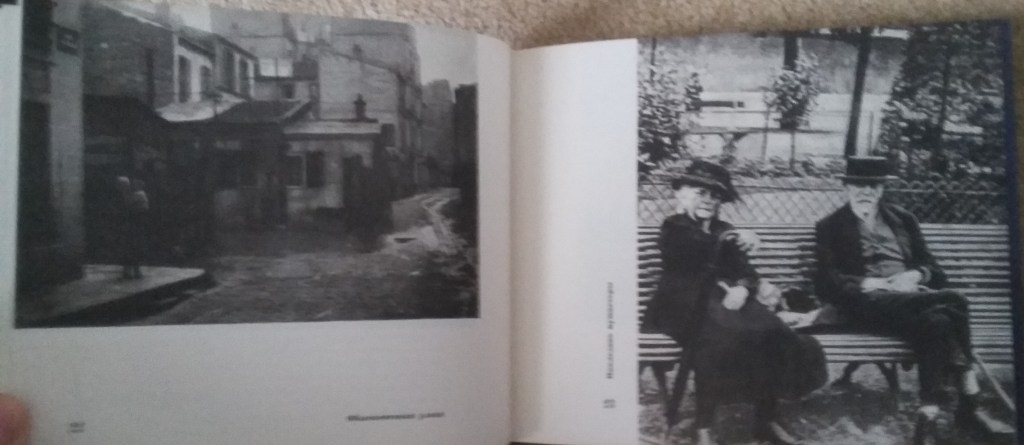
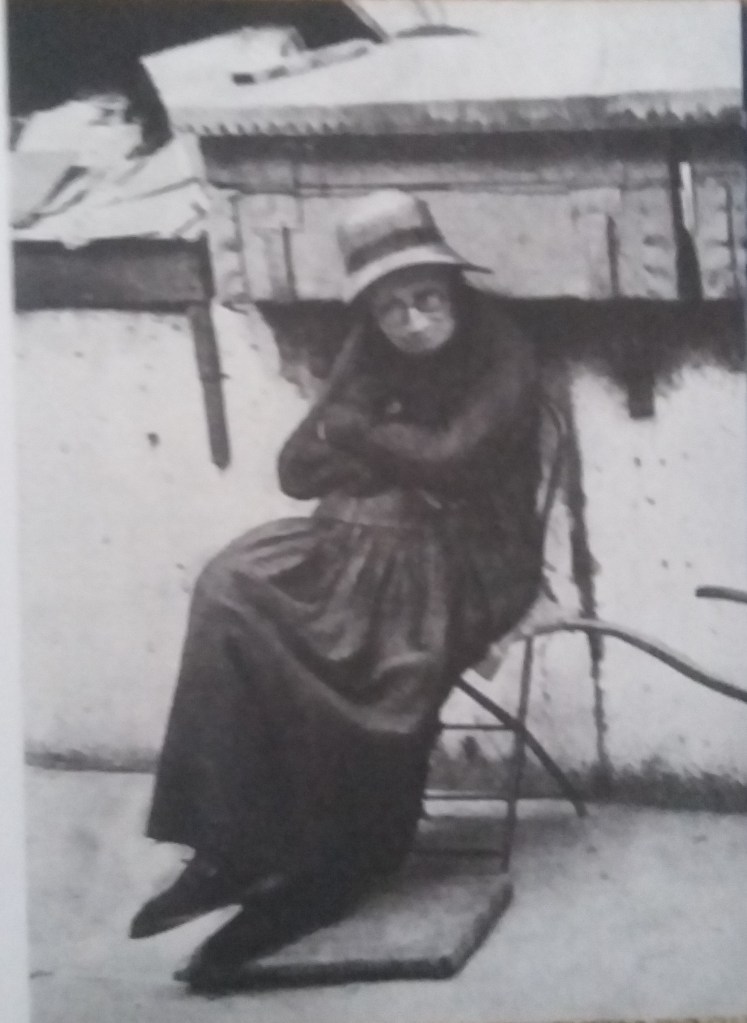
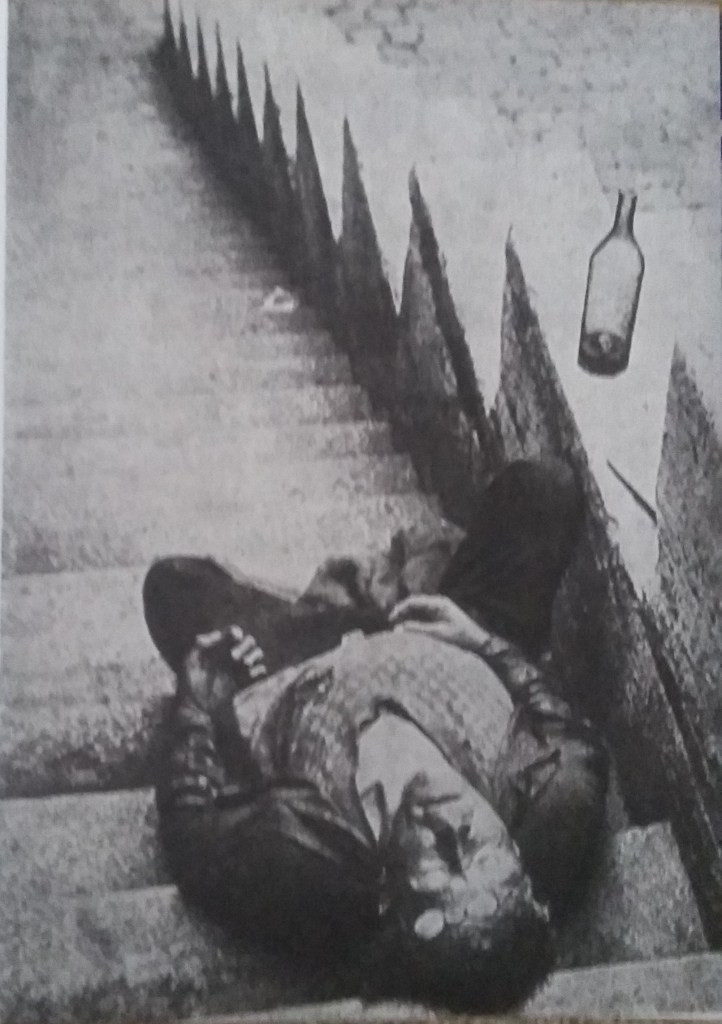
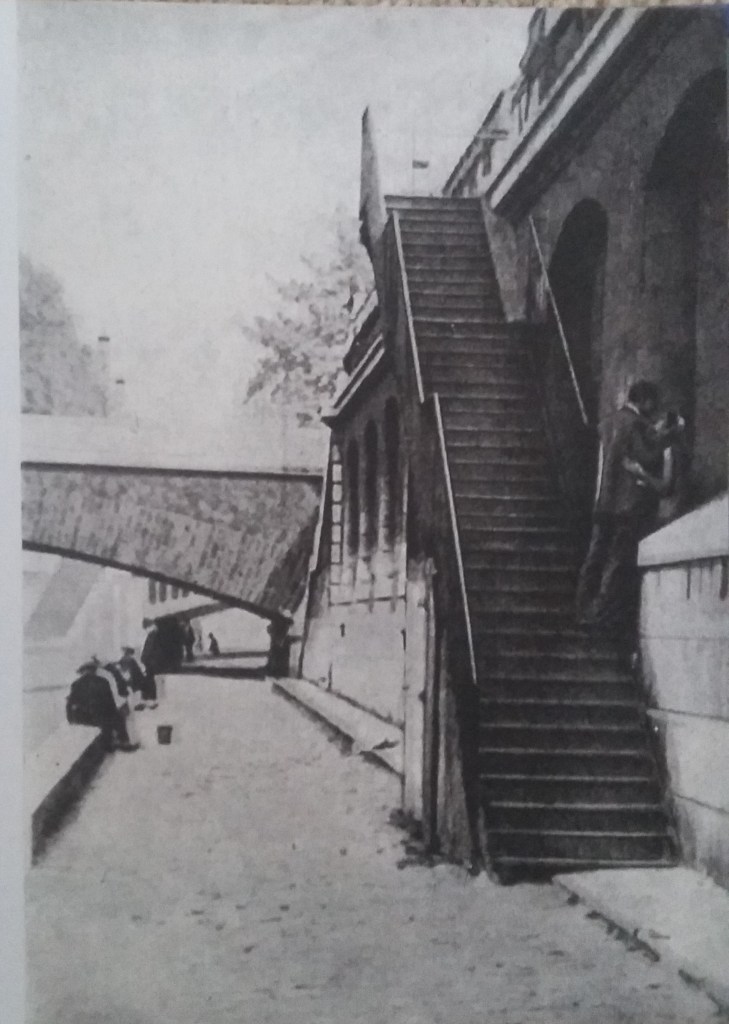
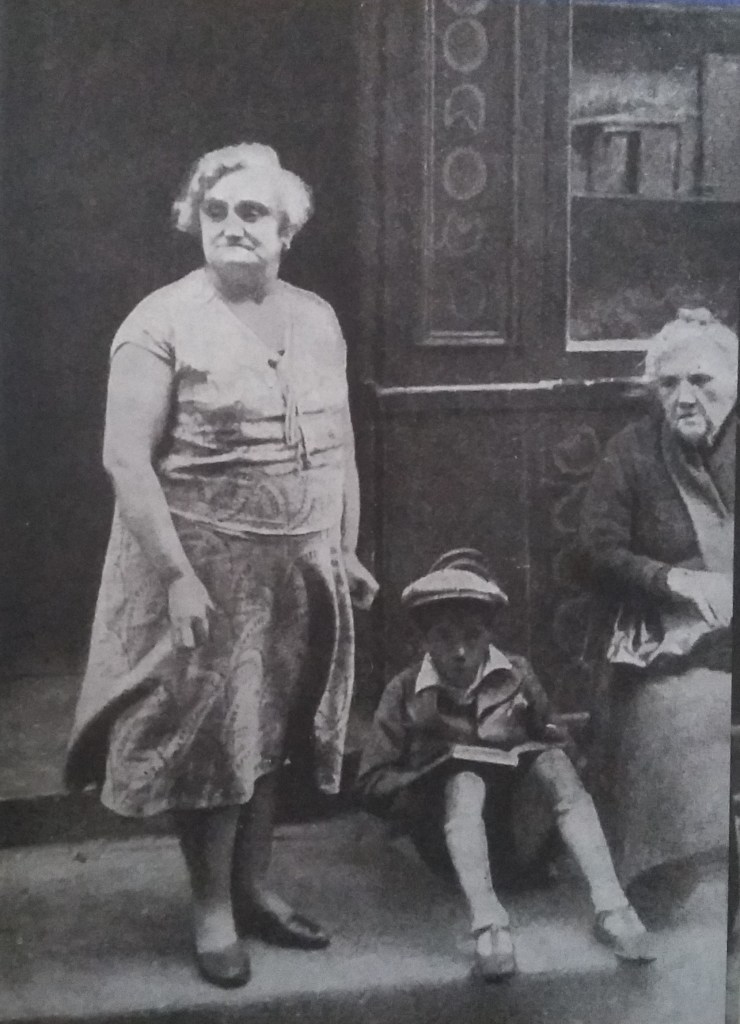
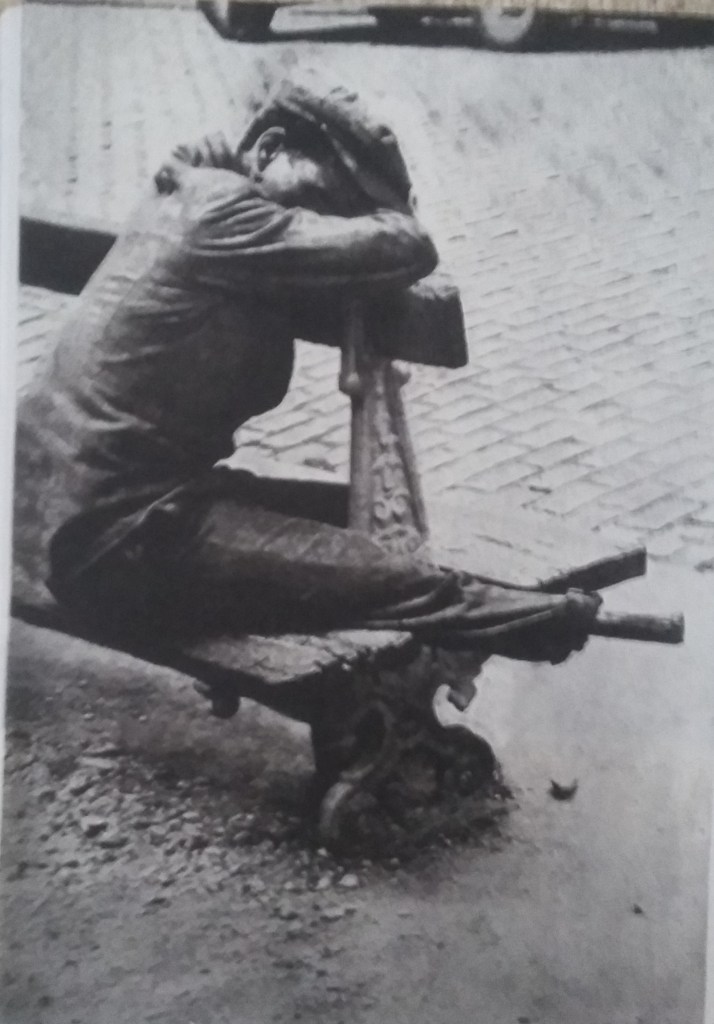
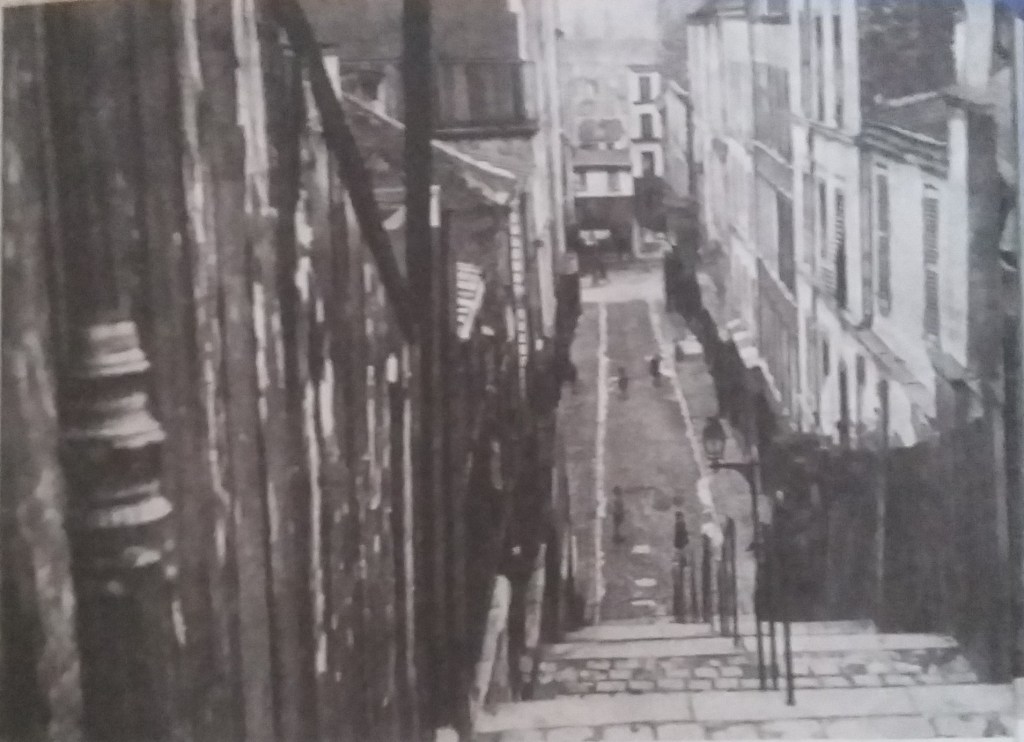
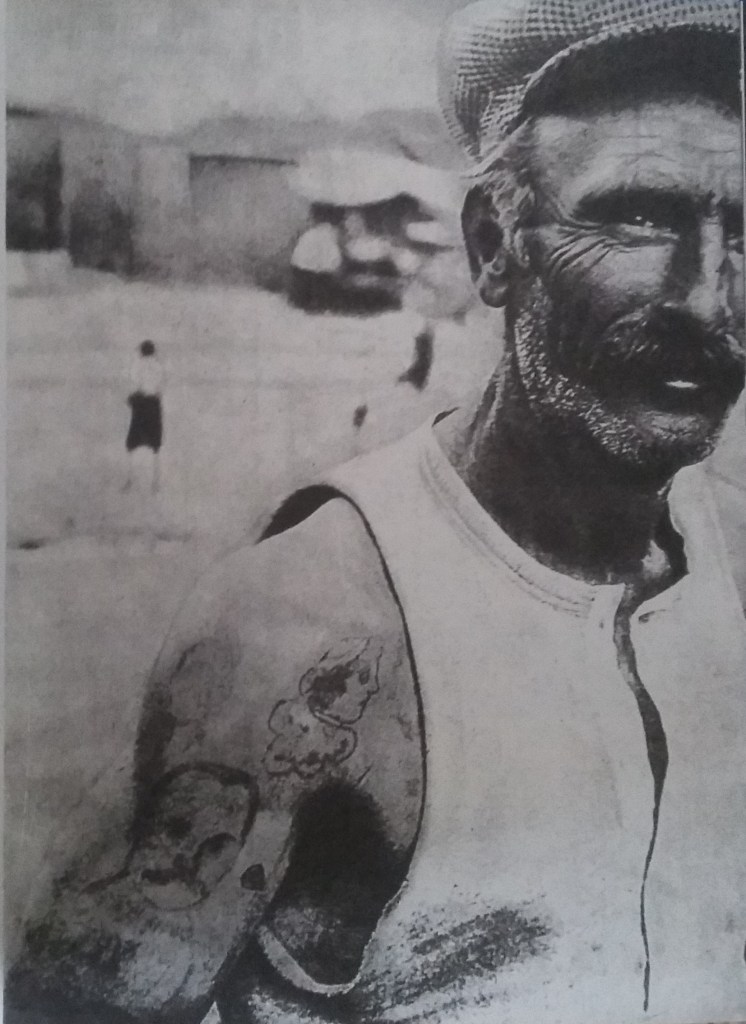
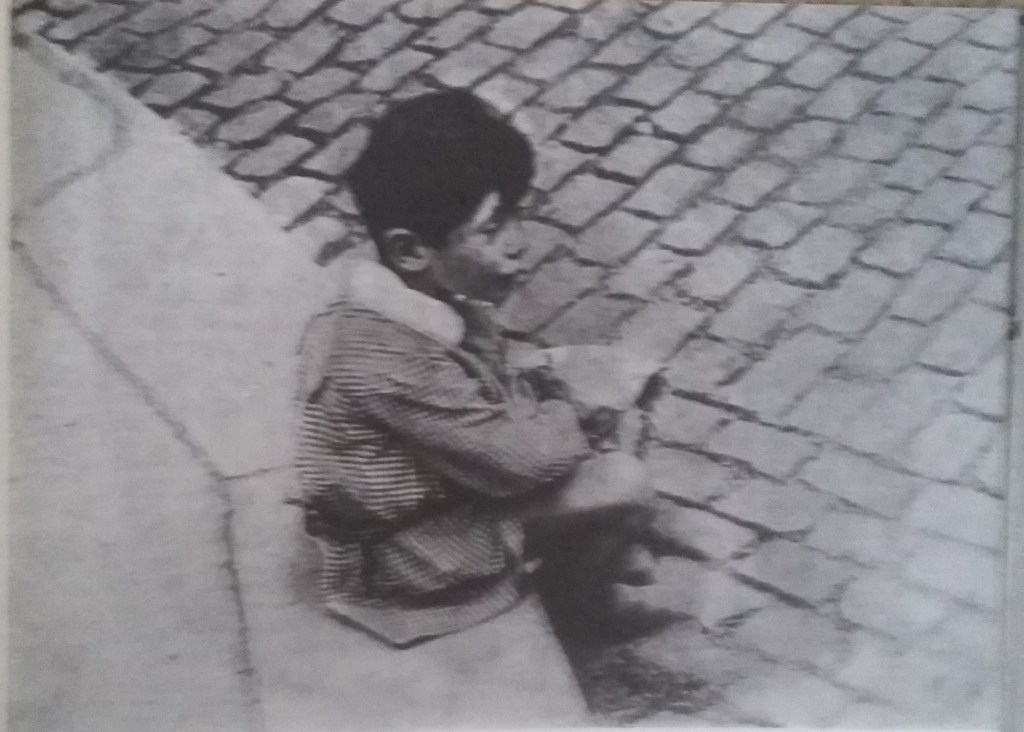
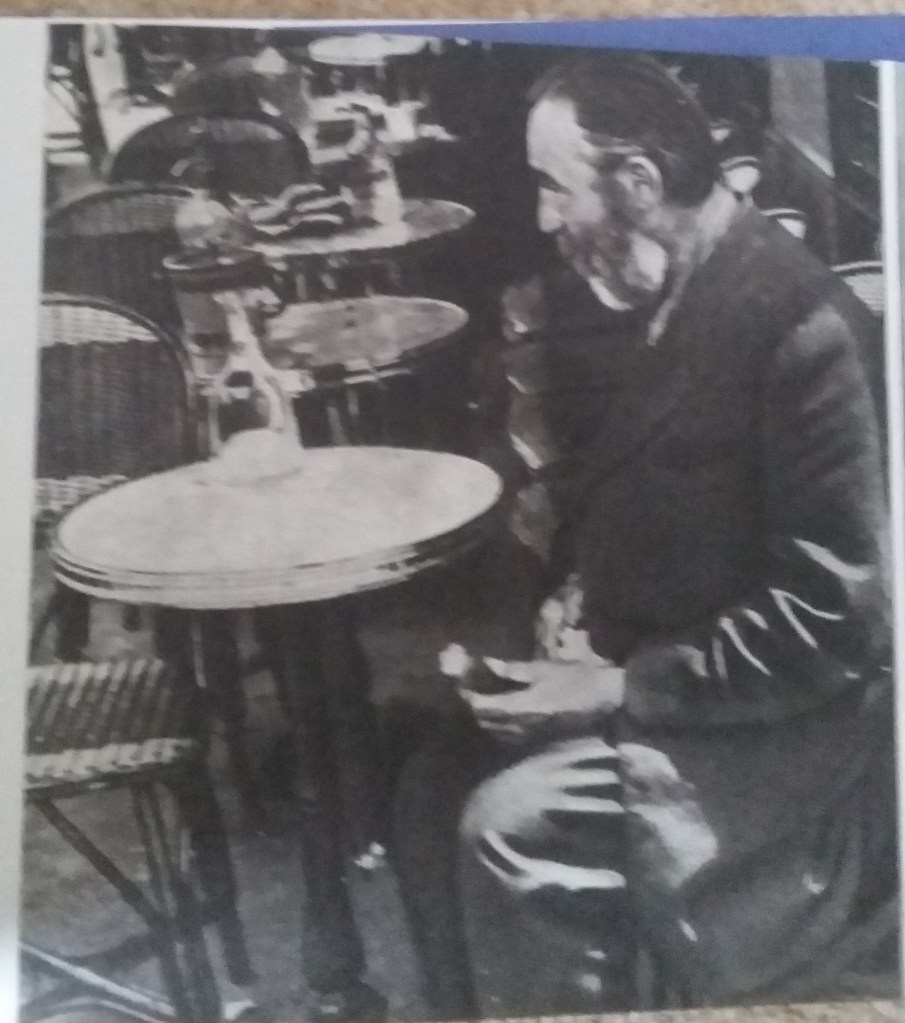
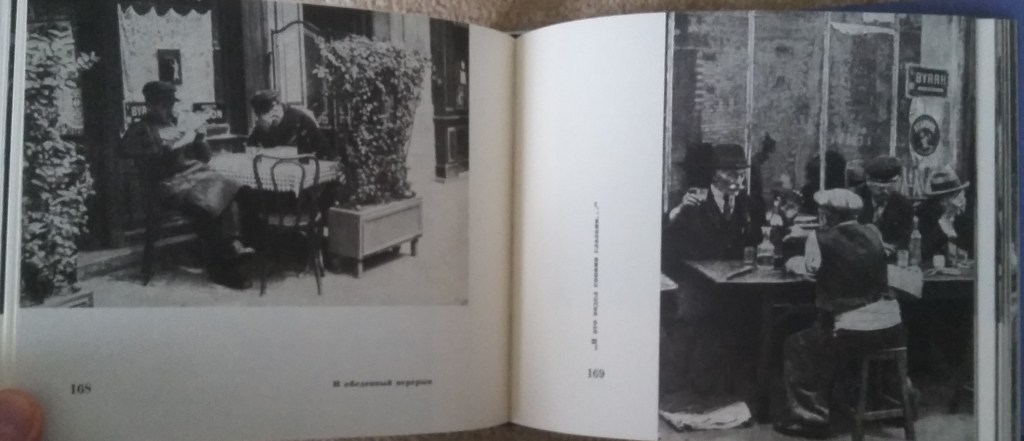
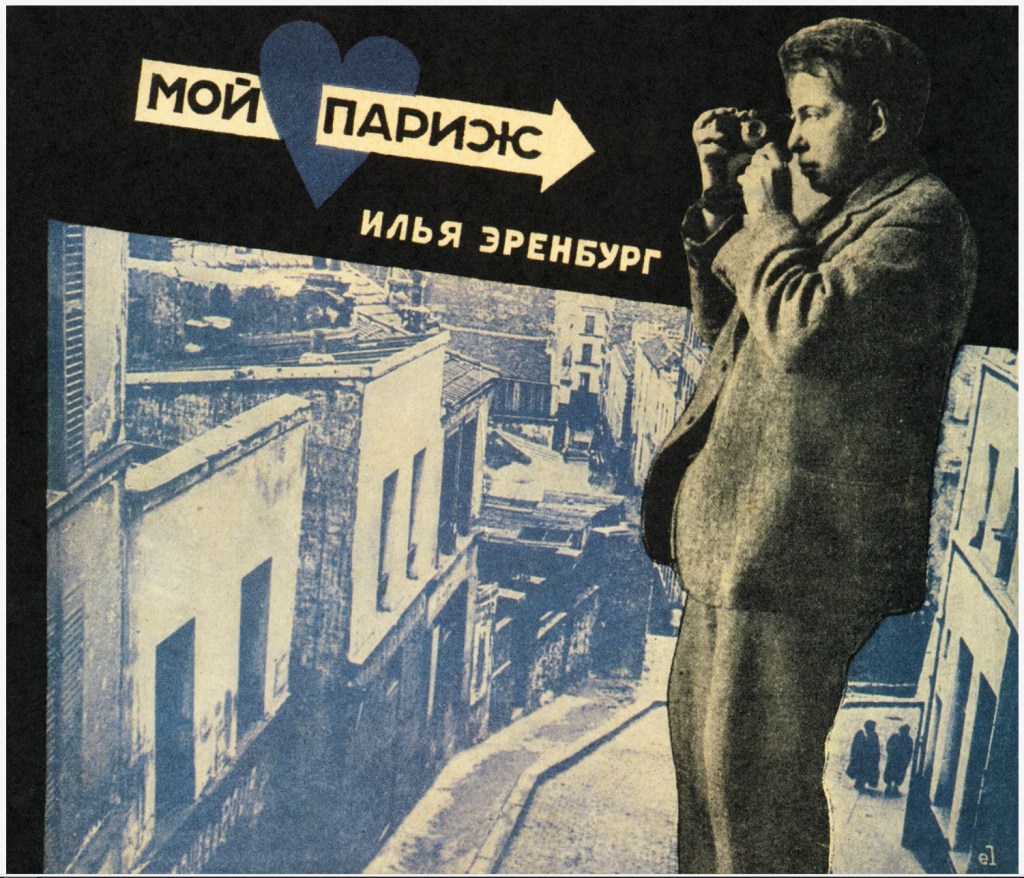
As a kind of coda to the Paris of the 1920s, I want to start by mentioning Moi Parizh (My Paris), a book that Ehrenburg published in 1933. It is a photo album-cum-essay, a visual and literary walk through Paris, the city that Ehrenburg loved so much. But this visual and textual exploration is far from touristic. Ehrenburg is interested not in the facades of great buildings, or even in the great and the good who inhabit them. He is interested in those who sleep rough, in those who survive in the poorest neighbourhoods, in those who live lives that go otherwise unrecorded in history. Ehrenburg knew poverty firsthand, and his snapshot (sometimes covert) images of Paris reveal not just the subjects of his camera but the knack of the observer who knows where to look. These images are often uncomfortably intimate in their portrayal of homelessness and destitution. But they are not exploitative, and there is a kind of tenderness in the way Ehrenburg seeks out the corners of the city to find life – young and old, active and inactive, abled and disabled – going about its business, or doing nothing at all. My Paris is as beautiful as Dmitri Kirsanoff’s Ménilmontant (1926), one of my favourite films, where the street scenes attain a poetry founded in reality. Whereas Kirsanoff tells his story purely through images (with no intertitles), Ehrenburg offers a parallel text commentary on his photographs. Here is a representative passage on the Seine:

It all begins on the steps, where the unfortunate ones sleep. They sleep on stone as on a bed of feathers. They also sleep on the riverbank. They’re particularly keen on wandering under the bridges. It’s cool there in the summer and there’s shelter from the rain. Shadows mill in the gloom. Some like the Pont d’Auteil, others – Pont Alexandre III. Neither eyes nor rags can be clearly distinguished. Life is defined by sounds: a loud dog-like yawn, curses, groans, grunts and the sinister hoarseness that suggests the nearing of the end. The bridges of Paris – old bridges and new bridges, with the thundering metro, with moustachioed Zouaves – join the two banks: the Bourse and the Académie, the markets and the Sorbonne. They have different names. Trains clatter over some, dreamers stroll on others. From below they are all alike; they are shelter and quiet. Beneath them live those who no longer have the strength to cross from one bank to another. […]

The stairways to the Seine are not just a certain number of steps: they are light-headedness and fate. Down leads poverty, and down leads love. Anyone who has loved in Paris knows the damp fog that rises over the Seine, the sorrowful cries of a little steamer and the quivering of the shadows. Lovers kiss, pressing each other against the handrails or sliding down; they, too, wander beneath the arches of the bridges. No one is surprised – love, everyone knows, is homeless.

The Seine also has other admirers. These don’t try out the steps. They pause on the bridge, then plummet like stones. Who’s to say why they preferred the cold of the water to gas or the rope? Some are hurled down by hunger, others by grievances, others by love. […] As for the Seine, it’s not to blame for anything: a river like any other. It’s a gate as well. A gate left open. People sometimes leave through it. Then hooks crawl along the sandy bed. The dreamers, meanwhile, keep strolling up and down the embankments. (My Paris, 7-8)

Reading My Paris, you can understand why Pabst’s production of Die Liebe der Jeanne Ney did not satisfy Ehrenburg. The contemporary reality from which he wanted art to emerge is more potent in his text and images than in Pabst’s drama. It is not just that Die Liebe der Jeanne Ney did not contain the reality of Ehrenburg’s fiction, it is that the film did not contain his experience of contemporary life. The author does not record if he knew or saw Ménilmontant (perhaps it was among the films he brought to Russia in 1926, cited last week), but one senses that aspects of it would surely have appealed.
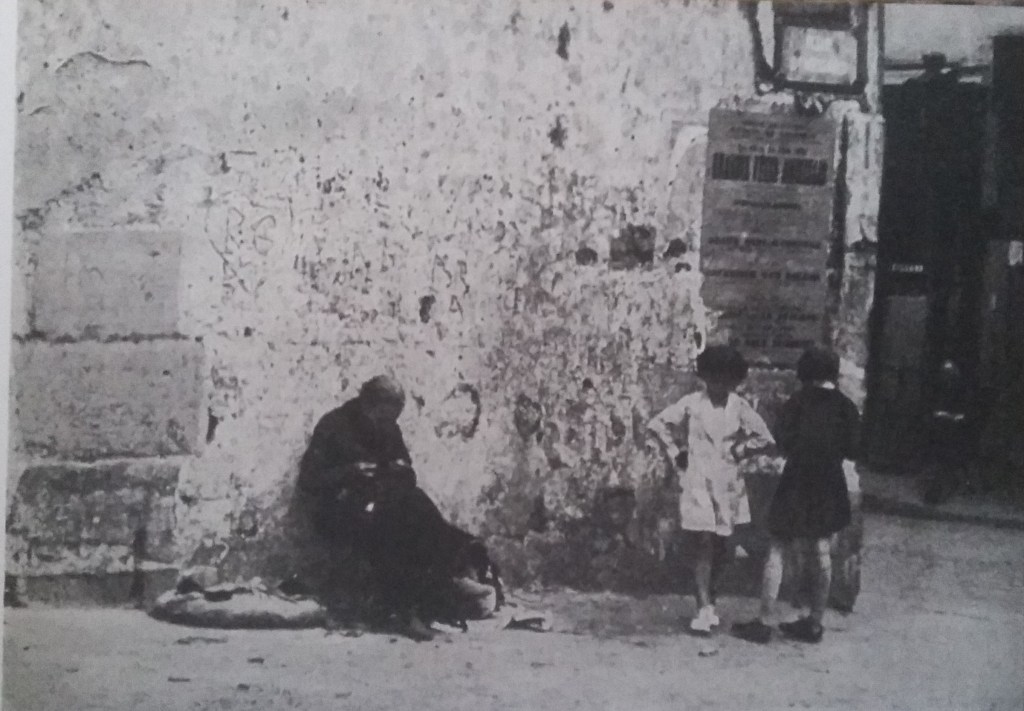
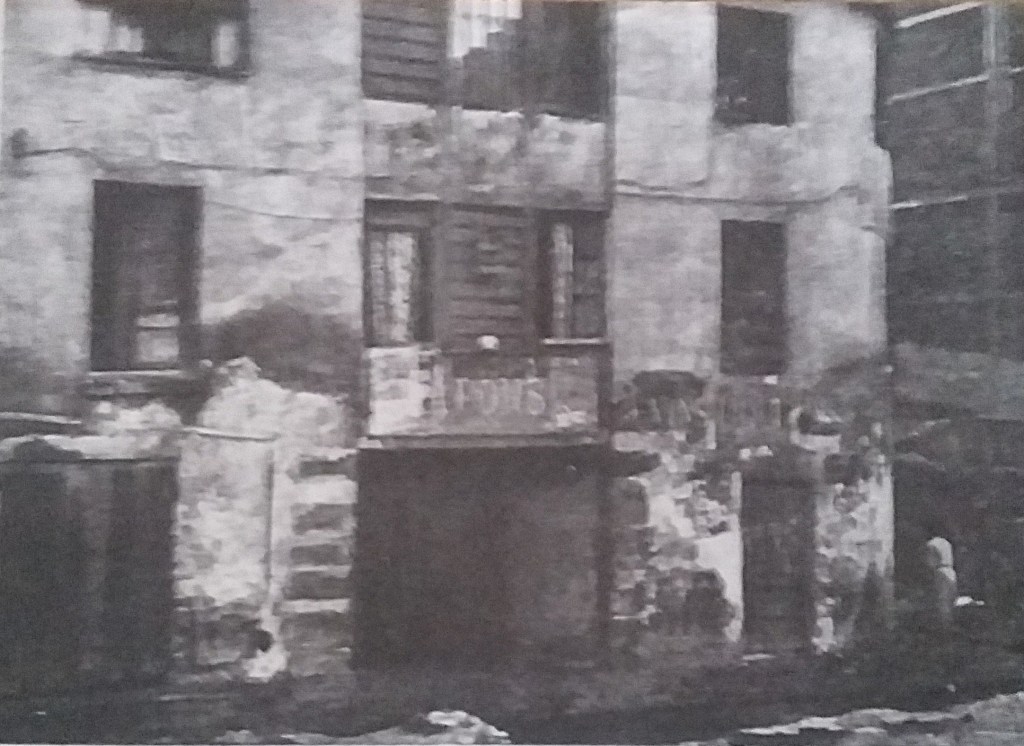
In Ehrenburg’s memoirs, the streets of Paris take on a more personal meaning in retrospect. In the late 1950s/early 1960s, the act of recalling scenes from these spaces is clearly as moving for Ehrenburg as it might be for us to see his images of My Paris another half-century later. “When I come to Paris now I feel inexpressibly sad – the city is the same, it is I who have changed; it is painful for me to walk along the familiar streets: they are the streets of my youth” (I, 66). The retrospect of the memoirs – and the way this perspective inflects its record of the past – noticeably sharpens later volumes. Like other great works of recollection, this book is as much about the act of memory as memory itself. As I have written on this blog many times, the distance between ourselves and the past is one of the major reasons that the world of silent cinema is so potent. One senses from the silent images of My Paris a world that is both incredibly tangible and irrevocably absent.

This sense of distance opens out in the later volumes of Ehrenburg’s memoirs. After 1930, the idealism that motivates so much of the art and artists he recalls is whelmed in political realities. This shift can be felt in his references to cinema. Increasingly, politics redefines – and prescribes – the boundaries of art. Ehrenburg talks about meeting Lewis Milestone, another Russian Jewish exile, who regales him with anecdotes about filming All Quiet on the Western Front (1930): “[Milestone] told me that during the shooting the producer Carl Laemmle came to him and said: ‘I want the film to have a happy ending’. ‘All right,’ Milestone replied, ‘I’ll give it a happy ending: Germany shall win the war’” (III, 127). This rather pointed comic story is followed by a grimmer conclusion. Ehrenburg recounts being present for the exhibition of All Quiet in Berlin in 1931, when Nazi agitators release a hundred mice into the cinema in protest at the film’s anti-militarism (III, 201). Political pressure within Hollywood likewise forestalls Milestone from adapting one of Ehrenburg’s novels in 1933 (IV, 9-10). The times are changing.

Ehrenburg travels through Austria, Czechoslovakia, and Romania. By the time he returns to Moscow in 1935, his homeland is in the grip of an increasingly paranoid and controlling Stalin. Creative freedom in the arts is being squeezed. Ehrenburg has a fleeting encounter with filmmaker Alexander Dovzhenko, who has just been summoned by Stalin. This ominous summons is now the norm. Stalin’s “suggestions” to artists are euphemistic instructions, to be obeyed on pain of disfavour, arrest, or death. Under these conditions, expression and innovation are stifled. As Ehrenburg puts it: “If a writer or an artist does not see more than the numerical ‘mass’, does not try to tell people something new, as yet unknown to them, then he is hardly any use to anyone” (IV, 98).

The Spanish Civil War begins. Ehrenburg leaves Russia for Spain. Art is a solace, a comfort, sometimes a distraction. Besieged in Madrid, he watches Chaplin films (IV, 145). But the knowledge of the future haunts Ehrenburg’s pages. He knows their cause is doomed, just as he knows the fate of his friends and comrades. These are volunteers from Russia and the east, men like him who have led extraordinary lives in pursuit of their beliefs. “Of all these men, I was the only one to survive. [One] was killed by an enemy shell. As for the others, they were destroyed for no reason at all by their own people” (IV, 176). It’s a devastating line, the fulfilment of the threats already being made to artists like Dovzhenko.

When Ehrenburg returns once more to Moscow in December 1937, the “great purge” is underway. His daughter tells him about countless arrests, disappearances, executions. Conversations between them must be conducted in whispers for fear of reprisal. Ehrenburg’s homeland is now an alien, threatening place. “I was totally bewildered; I felt lost, no, that is not the word – crushed” (IV, 190). It is with a strange sense of relief that he returns to war-torn Spain. But the Republican cause is near its end. In January 1939, Ehrenburg is one of the thousands of refugees fleeing across the Pyrenees into France. During the retreat, his party must abandon or destroy their baggage. Ehrenburg finds himself forced to burn his own books (IV, 231). It is an image with chilling resonance.

He returns to Paris, where he remains when the Second World War begins. During this period of the Nazi-Soviet pact, Ehrenburg finds himself a neutral, if anxious witness. He is in Paris when the Germans enter. He recalls more voluntary destruction of equipment, of documents. So much polluted smoke enters the sky that the rain turns black. “This, too, had to be lived through”, he observes (IV, 260-1) – and the brevity of his words make the depth of his recollected emotion stronger. Ehrenburg leaves the city he loves above all others. His nation not yet at war, he finds himself travelling back to Russia via Berlin. A Jewish Communist, Ehrenburg negotiates his way through Hitler’s capital city feeling “like a live fox in a fur shop” (IV, 266-7).

The fifth volume of his memoirs, called simply “The War”, is also the shortest. This is despite Ehrenburg being in a state of ceaseless activity, travelling among the Russian forces and writing accounts of all aspects of the war in the east. As I wrote in the preamble to my previous post, Ehrenburg also collected eyewitness accounts of atrocities committed by the Germans and their allies. In his memoirs, one senses the exhaustion of these years, and that much of what he saw or heard was beyond description. Often, he records details in passing that resonate more than a longer description could. He recalls once holding in his hand a bar of soap made from the rendered flesh of murdered Jews (V, 30). It’s an image, an idea, so grotesque that Ehrenburg need not say more. He admits later: “I find that to explain all I have seen and lived through is beyond my powers” (VI, 107). If Ehrenburg is sometimes reticent to speak of himself directly, or at great length, he offers a glimpse into his mindset of these war years. Again, he describes himself as a kind of romantic who is forced to reorient himself by the world around him:

By nature as well as upbringing I was a man of the nineteenth century, more given to discussion than to arms. Hatred did not come to me easily. Hatred is not a particularly creditable emotion and is nothing to be proud of. But we were living in an epoch when ordinary young men, often with agreeable faces, with sentimental feelings and photographs of the girls they loved, had, in the belief that they were the elect, begun to destroy the non-elect, and only genuine and profound hatred could put an end to the triumph of Fascism. I repeat, this was not easy. I often felt pity, and perhaps I hate Fascism most bitterly because it taught me to hate not only the vile inhuman idea but also its adherents. (IV, 267)

I have read only fragments of Ehrenburg’s wartime journalism, and his memoirs are reluctant to quote much of his own work save occasional poems. This wartime material, written to appeal and inspire the Red Army in its fight, has a quasi-infamous reputation for its propagandistic rhetoric and invocations of violence. On this, I simply haven’t read enough to comment – and it’s rather beyond the scope of this piece to do so. All I can say is that the memoirs offer a painful and moving retrospective of the man he was. One senses that the older Ehrenburg resents not what his younger self did or wrote but why he had to act as he did and write what he did. As in the passage cited above, hatred did not come naturally to him – but come to him it did.

Having written about this enforced hatred of the war years, Ehrenburg’s post-war work – as witness, as journalist, as cultural ambassador, as promoter of peace – is even more striking for its empathy. His encounters of those who survived the war and its genocides are among the most affecting in the memoirs. In one extraordinary passage, Ehrenburg meets a Russian girl from Kursk who loved a German soldier during the war. Knowing Ehrenburg’s propagandistic vilification of German manhood, the girl tries to explain how she could fall in love with the “enemy”. To do so, she tells him that her feelings were like those of Jeanne Ney. Ehrenburg in turn reaches for film to try to explain his own feelings. Unable to pity this girl in the immediate context of the war, years later he recalls seeing Hiroshima mon amour (1959). Seeing the heroine’s affair with a German solider, and her subsequent mistreatment by her vengeful community, Ehrenburg finally comes to understand the life of the woman from Kursk (V, 98). Even as an artist, one might understand the world better only through the art of another.

Again and again, Ehrenburg returns to the idea of art as a universal requirement for human communication. Having been absent from much of his daughter’s life, it is only decades later when he reads her novel that he understands her childhood (IV, 59). As ever, this desperately moving personal admission is swiftly passed over in favour of encounters with others outside his family. In one such, Ehrenburg is approached after the war by a young woman who had survived the siege of Leningrad. She gives him her diary to read, and Ehrenburg is astonished at how often the woman wrote about what she was reading:

When the girl came to fetch her diary, I asked her: “How did you manage to read at night? After all, there was no light”. “Of course there wasn’t. You see, at night I remembered the books I’d read before the war. This helped me to fight against death”. I know few words that have affected me more deeply; many a time I have quoted them abroad when trying to explain what enabled us to hold out. Those words bear witness not only to the power of art, they are also a pointer to the character of our society. (VI, 13)

Ehrenburg continues to travel, viewing the material destruction of the places he knew – and the first efforts of reconstruction. Revisiting Kiev, he sees the house where he was born in rubble. Then he visits the ruins of the enemy. In Nuremburg, he attends the trial of Nazi war criminals. In one of the most extraordinary passages in the memoirs, Ehrenburg is sitting in the gallery when suddenly he sees Hermann Goering looking up at him. He realizes that Goering recognizes him as the infamous Jewish Bolshevik that Goebbels attacked personally in the Nazi press. Suddenly all the other men in the dock are looking at him. Cinema makes an uncanny appearance in this scene, too. The Nazis in the dock are shown footage from the concentration camps. Ehrenburg watches their faces, and records seeing Hans Frank, the Governor-General of occupied Poland, weeping (VI, 34-5).

But there is little catharsis. As Ehrenburg writes, the events of the war years were not a singular instance of barbarity but a symptom of broader attitudes that did not die out in 1945: “The attempt has been made to present fascism as a stranger who accidentally intruded on decent civilized countries; but fascism had generous uncles, loving aunts, who to this day enjoy good health” (III, 207). After 1945, he continues travelling, writing, organizing. He visits the USA for the first time. Here, he observes the segregation of black Americans. At one function, Ehrenburg grows thirsty and invites an architect to whom he is talking to a bar to get a drink of water. The architect makes excuses and leaves. Someone explains that the architect would not be allowed into the bar, which is for whites only. “I found myself lacerated by someone else’s humiliation”, Ehrenburg writes. “I no longer wanted to drink nor, to be quite candid, did I want to live” (VI, 63-7). On another occasion, a woman tells him how a white man demanded that she – a “half-caste” woman – be thrown off a whites-only bus. The conductor placated the angry white by pretending that the woman had dark hair because she was “a Jewess”. The woman relaying this story to Ehrenburg explains how terrifying she found the experience. “It was then for the first time that I felt ashamed of being a Jew”, writes Ehrenburg; “I wished I were a black Jew” (VI, 69).

Proselytizing for peace as he travels across the new and old worlds, Ehrenburg returns to Russia to find another wave of purges underway. Among countless others, figures from the Jewish resistance to Nazi occupation now find themselves on Stalin’s blacklist. Ehrenburg’s friends sleep with a revolver on their bedside table in case there is knock at the door in the night. The gun is not for the intruders, but for themselves (VI, 277). Everyone, including Ehrenburg, called Stalin “The Boss”. This term was not used from familiarity but from fear. “In the same way Jews in the past never pronounced the name of God”, Ehrenburg writes. “They could not really have loved Jehovah: he was not only omnipotent but pitiless and unjust” (VI, 302). Ehrenburg was glad to have lived long enough “to know the cruel truth” about Stalin and that “millions of innocent people had perished” on his orders (V, 45-6).

But this did not lessen his faith in socialism, nor his desire to name and confront social injustices. And I must conclude this (already rather long) piece on a more positive note. Put simply, Men, Years – Life is an astonishingly rich and rewarding account of the first half of the twentieth century. But more than the events or people it covers, I was moved by Ehrenburg’s generosity of spirit – and moved by his optimism, in spite of the events he experienced, for new ways of human co-operation. As his post-war reflections (in particular) acknowledge, it is through experiencing other cultures that we understand one another and realize our commonality. For this reason, the imposition of borders and boundaries is both counterfactual and counterproductive:

Culture cannot be divided into zones, like cutting a cake into slices. To speak of western European culture as separate from the Russian, or of Russian culture as separate from the western European is, to put it plainly, a sign of ignorance. […] Only dwarfs use stilts, and the people who shout about their national superiority are those who are not quite sure of themselves. (VI, 109)

As with culture, so with wider relations between peoples. “Solidarity with the persecuted is the first principle of humanitarianism”, he writes (VI, 127). Here, too, cinema becomes part of Ehrenburg’s hope for younger generations. He cites his love for Vittorio De Sica’s Ladri di biciclette (1948) and meets many of the new Italian directors who would define the coming decades (VI, 175-7). New ways of seeing, and new ways of exploring human experience, offer new avenues for mutual comprehension.

For all the horror and misery Ehrenburg witnessed across his life, his memoirs conclude with a message of hope for the future. It is also, one senses, a hope that he feels is necessary to maintain, regardless of circumstances. As he himself admits, there is a strain of romanticism in Ehrenburg that I find deeply sympathetic. He has faith in art and in the people who strive to produce it, to engage with it, to learn from it. It is faith not only in the value of art as aesthetic creativity, but as a way for societies to understand the spiritual needs of human beings. “I believe that without beauty to satisfy the spirit no social changes, no scientific discoveries will give mankind true happiness. The argument that in art both form and content are dictated by society, however true, seems to me too formal” (VI, 338). Having lived through dictatorships, censorships, genocides, Ehrenburg recognizes that art represents a kind of freedom that is beyond classification – or control. The very act of writing his memoirs is itself, surely, a mode of release, of escape. It is also an act of hope. “Who knows, perhaps something remains of every one of us? Perhaps that is what art is”, he writes (IV, 151). Art might only be a “something” of ourselves, but through it we can reach out to one another – across culture, and across time. By the end of the sixth and final volume, this is exactly how I felt about Ehrenburg – a voice, and a person, reaching out to me.

Paul Cuff

References

Ilya Ehrenburg, Men, Years – Life, trans. Tatania Shebunina and Yvonne Kapp, 6 vols (London: MacGibbon & Kee, 1961-66).

Ilya Ehrenburg, My Paris, trans. Oliver Ready (Göttingen: Steidl, 2005).

Ilya Ehrenburg: history, memory, cinema (1/2)

This week, I talk about Ilya Ehrenburg (1891-1967), a writer whose work I discovered through silent cinema. I’m a huge fan of G.W. Pabst’s Die Liebe der Jeanne Ney (1927) and was curious to read the novel on which it was based. After a long search, I tracked down an English edition of The Love of Jeanne Ney from 1929. Given the price tag of my copy, I was worried I would regret my purchase of this utterly obscure novel. But within a few pages, I was totally won over by the style and tone of the author. By turns humorous and brutal, charming and satirical, cruel and romantic, the novel is a superb read. Ehrenburg’s voice so appealed to me that I looked up what else he had written. It became apparent that the man was prolific, publishing numerous novels, reams of poetry, volumes of travel journalism, war reports, speeches, reviews – all in different languages: Russian, French, German, Yiddish… Of this ungraspably extensive bibliography, I found that none of his non-journalistic work was in print in English. Some of his wartime work remains available, in particular his report on the Holocaust in eastern Europe: The Complete Black Book of Russian Jewry, a collection of eyewitness accounts compiled with Vassily Grossman.

This situation was very different in the 1960s, in the post-Stalin cultural “thaw” (a term Ehrenburg popularized), when the author’s work was widely discussed in the anglophone world. It was in this period that he wrote his memoirs. Finding decent copies of all six volumes of this work was difficult, but I love a challenge. From bookshops across the globe, I amassed them all and read them across the course of last summer. Quite simply, Men, Years – Life (1961-66) is one of the most extraordinary memoirs I’ve ever read. It is almost unbelievable what this man experienced: from imperial to post-Stalinist Russia, from trenches in Spain to the skyscrapers of New York, from the cafes of Paris to the battlefields of the east, from writing poetry in garrets to making speeches at peace rallies, Ehrenburg experienced almost every conceivable facet of the early twentieth century. That he did not perish in the revolutions, civil wars, world wars, genocides, and multiple purges that he experienced is miraculous. “I have survived”, he writes in his opening pages, “not because I was stronger or more far-seeing but because there are times when the fate of a man is not like a game of chess played according to rule but like a lottery” (I, 7). As the title of his memoirs indicates, Men, Years – Life is a personal record of his era through the people he encountered. Amid his generosity to innumerable writers, artists, and fighters he met, the major events of Ehrenburg’s personal life sometimes slip in through devastatingly brief asides. (Thus, in passing, do we learn that his first wife leaves him for another man, with whom she raises their daughter Irma (I, 186).) If nothing else, it is an amazing record of the first half of the twentieth century, a time when “history unceremoniously broke into our lives by day and by night” (III, 89).

This week’s post, and my subsequent post, is a selected tour through some of Ehrenburg’s life and his relationship with cinema: cinema as culture, cinema as literary adaptation, cinema as a way of seeing the world.

Part 1: Early years

Ehrenburg was born in Kiev, a subject of the Russian Empire, to a Lithuanian-Jewish family. His first memories are of an era that would bring an unceasing flood of cultural shocks and revelations. “The twentieth century was under way”, he writes: “I remember one of our visitors telling us that soon a ‘bioscope’ would be opened and that they would show living photographs” (I, 30). For the adolescent Ehrenburg, the new century means other forms of revolution, too. He becomes involved in political activity associated with Bolshevism. Aged seventeen, he is arrested and exiled.

He arrives in Paris in December 1908, knowing barely any French – just an outré vocabulary drawn from the plays of Racine. With his unerring knack of finding extraordinary people wherever he went, he soon meets a raft of other local or exiled figures – from Lenin (“his head made me think not of anatomy but of architecture” (I, 69)) to Blaise Cendrars (“he was the yeast of his generation” (I, 170)), not to mention fellow avant-gardists Picasso, Modigliani, Rivera, and others. The writers and artists among them would meet at the Café de la Rotonde, a restaurant in Montparnasse where “we would gather […] in the evenings to drink, read poetry, make prophecies or simply to shout” (I, 171). Living in what amounted to almost debilitating poverty, Ehrenburg became a poet “because I had to” and a journalist “because I lost my temper” (I, 178). When he could afford it, he went out. In 1911 he attended the (in)famous premiere of Le Martyre de saint Sébastien, D’Annunzio’s stage collaboration with Debussy. He records being “infuriated by its mixture of decadent aestheticism and a kind of scent shop voluptuousness” (II, 128). (He didn’t realize it, but Abel Gance was there on stage, playing one of the extras.) Later, in the company of the painter Diego Rivera, Ehrenburg encountered a new kind of artist for the age:

Once at a small cinema Rivera and I saw a film actor I had never seen before. He smashed crockery and daubed elegant ladies with paint. We guffawed like everyone else, but when we had left the cinema I said to Diego that I felt afraid: the funny little man in the bowler hat exposed the whole absurdity of life. Diego replied: “Yes, he’s a tragedian.” We told Picasso to be sure to see the film with Chariot: that was the name the French gave Charlie Chaplin, as yet entirely unknown. (I, 199)

Then came the Great War, “a grandiose machine for the planned extermination of human beings” (I, 184). Ehrenburg volunteers to fight Germany but is rejected by the army doctor as unfit (“One cannot with impunity prefer poetry to beef for a period of three or four years” (I, 161)). So he becomes a witness, watching the old order disintegrate – and the violent forces this process unleashes. Europe’s civilization is merely a set of clothing now shed, its philosophy abandoned for bloodlust. For Ehrenburg, it is a swift and uncomfortable revelation. “I realised that I had not only been born in the nineteenth century: in 1916 I lived, thought and felt like a man from the distant past. I also realized that a new century was on its way and that it meant business” (I, 185). Europe was stepping “into the dark ante-room of a new age” (II, 101). And from the west, American culture floods in. When the US enters the war in 1917, the newspapers gush over the prospect not merely of American soldiers but American culture: “They extolled everything – President Wilson and Lilian Gish, American tinned food and the dollar” (I, 219).

After the war, Ehrenburg returns to the east. This part of his memoirs is among the most personal, since there was not enough political or cultural stability to sustain his creative life. Having always considered Kiev as his “home town”, in 1919-20 Ehrenburg realized how contingent the idea of “home” might be. “[The] Romans […] used to say Ubi bene, ibi patria: where it is good, there is your motherland. In reality, your motherland is even where it is very, very bad” (II, 75). Russia and much of eastern Europe was in turmoil. Kiev was at the centre of a civil war and changed hands several times. “Sometimes I felt as if I were watching a film and could not understand who was chasing whom”, Ehrenburg writes: “the pictures flashed by so quickly that it was impossible to see them properly, let alone think about them” (II, 80). Cinema here becomes a metaphor both for vision and for bewilderment – a kind of impediment to vision. Like silent films that were projected at faster-than-life velocities, lived history did not behave according to clock time.

The chapters that follow read like the flickering images Ehrenburg describes, passages of events so bewildering and terrifying that it is staggering that the narrator survived to narrate. Only when, for six months, the Red Army occupies Kiev is there a window of stability – at least for Ehrenburg. But even this interval is surreal, since he is charged with supervising “mofective children” (i.e. “morally defective” children). It was a form of re-education for the socialist utopia that beckoned. “The discrepancy between our discussions and reality was staggering”, Ehrenburg observes (II, 83-90). Utopia is postponed. The Reds are swept away. The Cossacks arrive. There is a pogrom. A disorganized medley of murder, mutilation, rape. As a Jew, Ehrenburg moves from hiding place to hiding place. Captured, he narrowly avoids being “baptized” (i.e. thrown into the ice-covered sea of Azov) (II, 95). He is among a flood of refugee in the Crimea, where he is starved and abused for being both a Jew and a Red. Then typhus strikes. His wife is a victim. She survives, but in what state?

After Lyuba’s temperature had gone down, a complication arose: she was convinced that she had died and that we were for some reason forcing a life after death upon her. With the greatest difficulty I got food for her and cooked it, my mouth watering, while she repeated: “Why should I eat? I’m dead, aren’t I?” One can easily imagine the effect this had on me; yet I had to go to the playground and play ring-a-ring-o’-roses with the children. (II, 101)

There follows a series of interventions random, comic, and horrifying. Ehrenburg escapes from the Crimea on a salt barge that he realizes is slowly sinking. He finds refuge in Georgia, then goes to Moscow. Having been nearly murdered by the Whites (for being a Red), Ehrenburg is now arrested by the Reds (for being a White). He is imprisoned, than released. Vsevolod Meyerhold invites him to head the organization of children’s theatre in Russia. But in 1921 Ehrenburg leaves Russia. He goes via Riga, Danzig, Copenhagen, and London to Paris – only for the French authorities to expel him to Brussels for being a suspected Bolshevik agent (II, 186-8). He travels to Berlin and witnesses the febrile uncertainty of the Weimar Republic: “The Germans were living as though they were at a railway station, no one knowing what would happen the next day. […] Everything was colossal: prices, abuse, despair” (III, 14). In a beerhall in Alexanderplatz, Ehrenburg hears the name of Adolf Hitler for the first time. Visiting Italy soon afterwards, he sees uniformed fascists.

These surreal shifts of fortune make even the most bizarre filmic narrative of the 1920s seem realistic. Ehrenburg records that the White general who instigated the pogrom in Kiev later became a circus performer, in which role he encountered him in Paris in 1925 (II, 92-3). This reads like a detail from a film by Stroheim or Sternberg, or a scene from a Joseph Roth novel. The people and events that swirl around Ehrenburg here are those whose shadows are caught in the films of the period. I’m thinking of the newsreels, those glimpses of real people and places, but also of the fictions whose strangeness is hardly less compelling. One is tempted to describe this section of the memoirs as a record of modernity at its most frenzied and fragmented, but Ehrenburg defies such labels – either as a (contemporary) protagonist or as a (retrospective) narrator. He describes himself as a “rank-and-file representative of pre-Revolutionary Russian intelligentsia” (II, 150) who understood the turmoil of 1920-21 in apparently old-fashioned terms:

We ridiculed romanticism but in reality we were romantics. We complained that events were developing too swiftly, that we could not meditate, concentrate, realize what was going on; but no sooner had history put on the brakes than we fell into despondency – we could not adapt ourselves to the new rhythm. I wrote satirical novels, had the reputation of being a pessimist, but privately nursed the hope that, before ten years had passed, the whole face of Europe would have changed. In my thoughts I had already buried the old world, yet suddenly it had sprung to life again, had even put on weight and was grinning. (III, 58)

This conflict between imagined and lived worlds, between ideals and realities, defines much of Ehrenburg’s experience of the post-1918 years. He finds himself in a world of film, radio, automation, mechanization: “I felt that the rhythm of life and its pitch were changing” (III, 93). In Paris, the artists of the 1920s “wanted to turn the world upside down, but the world stood firmly on its feet as ever” (III, 91). He meets a new generation of filmmakers: René Clair, Abel Gance, Jean Renoir, Jacques Feyder, Jean Epstein. In the cinema, he sees The Pilgrim (1923) and The Gold Rush (1925) (III, 92-3). Cultures mix and mingle. In a Paris bar, Ehrenburg overhears someone asking their friend: “Is it true that Potemkin is a better actor than Mosjoukhine?” It turns out that the man “had heard something or other about the success of Eisenstein’s film and thought Potemkin was the name of an actor” (III, 96). Similarly, finding himself in a disreputable beerhouse in Moscow in the summer of 1926, Ehrenburg overhears an argument. It ends with a girl shouting to another youth (who is covered in blood): “You needn’t try so hard. Harry Piel – he’s the one I like!” (III, 108). Later, in the UK at a PEN Club meeting, Ehrenburg is mistakenly introduced to his audience as Pabst, “the outstanding Austrian film director who had made that excellent film, The Love of Jeanne Ney” (I, 117).

These eclectic encounters should remind us that film was very different before it became “film history”. Ehrenburg meets it out of context, in translation, in argument, in slang, in misattribution, and in simple error. The modern reader may feel out of kilter, recognizing names, dates, and titles only with difficulty. But it is also curious (and curiously touching) evidence of how cinema muddled along within popular culture. The neatness of filmographies or encyclopaedias of this period do not do justice to the pell-mell realities of lived history. For the inhabitants of the past, silent cinema was a moving feast – part of a complex, multicultural diet.

Ehrenburg also does more than witness cinema. In 1927, he revisits Penmarch (in Brittany) with the artist László Moholy-Nagy to make film about Breton fishermen – but the project remains unrealized (III, 122). The always on-the-move Ehrenburg is also a go-between for other filmmakers. In 1926 (the same summer, presumably, that he overhears the drunken argument about Harry Piel) he is asked to export extracts from French films “given to me by Abel Gance, René Clair, Feyder, Epstein, Renoir, Kirsanoff.” He shows them in Moscow, where many Soviet filmmakers see the experiments of the French avant-garde for the first time. So “enthusiastic about the cinema” is he that Ehrenburg writes a pamphlet: Realization of the Fantastic. But he also states that “in point of fact, I did not like German films of the Caligari type and the people I really admired were Chaplin, Griffith, Eisenstein, René Clair” (III, 124). Ehrenburg befriends Eisenstein and later hears him speak on film and art at the Sorbonne in Paris (III, 136). But it is Clair’s Paris qui dort (1925) that he says characterizes his experience of Paris in the 1920s (III, 131).

I close this week’s piece with the work that inspired it: Die Liebe der Jeanne Ney, based on Ehrenburg’s eponymous novel of 1924. One can sense in its pages the wild emotional extremes of the post-war years, as well as the streak of romanticism that the author admitted filled his mindset. He calls it “my sentimental novel”: “a tribute to the romanticism of the revolutionary years, to Dickens, to enthusiasm for the plots of novels, and to my (this time non-literary) desire to write not only about a Trust concerned with the destruction of Europe, but also about love” (III, 57). Ehrenburg’s brush with a suspicious, reactionary French bureaucracy in 1921 surely colours his novel. The authorities in Paris (and just about every authority figure in the novel) are depicted as cruel, rapacious, sadistic. These characteristics might seem exaggerated, but given what Ehrenburg had gone through they are hardly surprising – or (one feels) inaccurate. The novel is startingly brutal but also incredibly tender. It is a story where love can (and must) survive violation and death.

The German film adaptation of 1927 retains the essentials but makes notable changes. The ending is markedly different. In the novel, Jeanne is repeatedly raped by Chalybjew – a sacrifice that does not save Andrej from being executed. In the film, Jeanne fends off Chalybjew, who is captured – thus allowing the release of Andrej from prison. The novel ends with Jeanne carrying on Andrej’s revolutionary activities, her memory of their love sustaining her life and work. The film ends with Jeanne imagining Andrej’s release (and, presumably, their future together).

Pabst’s production could never depict, let alone imply, some of the events in the novel – but its changes to the story became the subject of controversy about the conservative/nationalist politics at Ufa. Indeed, the film’s greatest political attack came from Ehrenburg himself in 1927. Through the German communist Wieland Herzfelde, he had been brought into contact with Pabst and invited to watch the filming. He accompanied the production to Berlin and Paris, where he encountered exiled White Russian soldiers among the extras, observed Pabst bullying tears from the star Édith Jéhanne, and marvelled at the crew’s futile efforts to film bedbugs in close-up. When shown the finished film, Ehrenburg couldn’t contain his mirth: “it all looked different, in details and in essentials”; “one moment I laughed angrily, at another abused everybody” (III, 128). He wrote a newspaper article claiming that his novel had been butchered. When Ufa failed to respond, Ehrenburg’s comments were expanded into a seven-page pamphlet that attacked the company for being reactionary and the film for being a betrayal of real life.

In retrospect, Ehrenburg writes with much more tolerance of Pabst’s film. Indeed, in his memoirs he spends more time talking about the in-between moments of the production than the film itself. On set, his favourite actor was Fritz Rasp, who plays the villain Chalybjew:

Rain set in, the shooting was constantly put off, and Rasp strolled with me about Paris, whirled in roundabouts at fairs, danced himself to a standstill with gay shop-girls, daydreamed on the quays of the Seine. We quickly became friends. He played villains but his heart was tender, even sentimental; I called him “Jeanne”.

We met again in later years, in Berlin, in Paris. When Hitler came to power in Germany things grew difficult for Rasp. He told me that during the war years he had lived in an eastern suburb of Berlin. SS men had entrenched themselves there and were shooting at Soviet soldiers from the windows. I have already said that Rasp looked like a classical murderer. What saved him was my books with inscriptions and photographs where we figured together. The Soviet major shook him by the hand and brought sweets for his children. (III, 127)

I love Rasp on screen, and I love this anecdote. It’s rare to hear any details about such relatively minor figures of the silent era – character actors who never play the lead, but whose faces one always encounters and delights in recognizing. Here, then, is Fritz Rasp, cavorting about Paris in 1927 with a Bolshevik, being sentimental and silly. Ehrenburg’s account of Rasp in 1945 also makes a nice counterpoint to the famous story (also set in 1945) about Emil Jannings waving his Oscar at American soldiers to convince them he was on their side.

But already the spectre of the 1930s is upon us! This means the coming of sound, and it means upheavals of a more urgent nature. Though this blog is (after all) devoted to the era of silent cinema, Ehrenburg’s life and memoirs are too fascinating to leave off at this point. And his engagement with art and artists, including film and filmmakers, continued sporadically through the rest of his life. I am interested not only in the events of the interwar years, but also how these events were seen in retrospect. This will be the subject of my next post.

Paul Cuff

References

Ilya Ehrenburg, The Love of Jeanne Ney, trans. Helen Chrouschoff Matheson (London: Peter Davies, 1929).

Ilya Ehrenburg, Men, Years – Life, trans. Tatania Shebunina and Yvonne Kapp, 6 vols (London: MacGibbon & Kee, 1961-66).

Music for October (1928; USSR; Sergei Eisenstein/Grigori Aleksandrov)

Until recently, it was most common to see silent Soviet films via the versions circulated by Mosfilm or Gosfilmofond that originated in the late 1960s-70s. There is a familiar kind of soundtrack: a giant orchestra, crammed into a thin mono recording. In these confines, the music seems to warp and wobble rather than reverberate. The scores tend to be aggressive, brooding, threatening—with the noise of real gunfire thrown in for good measure. They often sound like cobbled-together Shostakovich (and sometimes are) but more often feature music by a composer you’ve never heard of whose name is uncertainly transliterated from Cyrillic into the Latin alphabet in the “restoration” credits. (Did the composer of the 1969 score for Vsevolod Pudovkin’s The End of St Petersburg (1927) wish to be called “Yurovsky” or “Lurovski”? I still don’t know. Confusingly, his son—the conductor Michail Jurowski—went by a different spelling, as do the conductor’s own sons, also both conductors.) Some of these Soviet recordings have very effective, and affecting, passages. The opening few minutes of Alexander Dovzhenko’s Zvenigora (1927)—in a restoration from 1973(?)—is among my favourite in all Soviet cinema: super slow-motion riders pass before a screen of trees, as a hushed, yearning pulse of music flows beneath. Image and sound grip you instantly. It’s a hauntingly beautiful opening shot. (The rest of the film rather loses me.)

But the film historian is on dodgy ground with these 60s-70s versions. The way these copies are curated for our use severely interferes with their historical status. Where are the original credits? Are these the original titles? Is there any missing footage? And what of the music? Were scores assembled especially for the films? Was the music original or arranged? Was it any good?

These questions are commonly asked about many works of musical theatrical history. Take opera, for instance. I was recently relistening to Halévy’s La reine de Chypre (1841). No single edition of this grand opera is “definitive”, in the sense that it underwent continual editing throughout its time on stage. Even during rehearsals, music would be cut or added or rewritten. Sometimes, this complex, often last-minute work was too much for Halévy himself, so he outsourced parts of the orchestration (or even the composition itself) to an assistant. New arias were inserted at the behest of singers, new passages of intermediary music at the behest of stage managers. And all this was without any of the score being printed in full. The “performing edition” of the work would exist across a wide range of documents: parts for the orchestra, the conductor, the composer. Many of these would be notated only in shorthand, overlaid with numerous manuscript corrections or instructions from conductor or composer as they worked on the production. Once the run of performances had ended, this array of paperwork would end up in various collections, often being scattered in the process. If the opera was produced elsewhere, it would undergo further changes and produce further paper trails. Even if all of this paperwork survived, the result is a kind of collective palimpsest with competing and conflicting evidence for what the score should be. Thus, there are always editorial choices to be made with historical material. The musical content of La reine de Chypre shifted across time, never being the same from one season to the next. So when the opera was “restored” in the 2010s, there was a huge range of choice regarding what music to include or exclude from the recording. (There would also, inevitably, be budgetary considerations: recording all the various possible numbers, even for an appendix on a bonus CD, would dramatically increase the cost of the project.) So when a new “performing edition” was created and then the recorded in 2017, a lot of music that survived in various sources was excluded (the overture, the ballet, the gondoliers’ chorus…).

This complex textual history is paralleled in the world of silent film music. Even if an original score existed, its survival is subject to all the same processes as might affect an opera score: different editions of the film for different markets, or for subsequent revivals; paperwork for different scores produced by different musicians for different cinemas etc. It follows that the question of a silent film’s musical restoration is as complex as that for its visual restoration. But how often does the same level of attention get paid to the music as to the image? And how often is this issue of musical reconstruction even acknowledged or addressed by the studios who own the films or the companies that release them on DVD? Whereas the Palazetto Bru Zane release of La reine de Chypre on CD in 2018 is accompanied by a fabulous book, including essays on the work’s genesis, reception, and textual history, most silent films do not get anything like this kind of documentation. Instead, there is the familiar blurb boasting “original versions” of this, and “complete restorations” of that. The word “original” and “complete” are rarely qualified, and even in cases where they are most appropriate, they never tell the whole story.

In relation to October (1928), the work of Edmund Meisel (1894-1930) and Bernd Thewes (b.1957) is an interesting case in point. Thankfully, the Edition filmmuseum DVD (2014) is as good as it gets when it comes to documentation. All the issues mentioned thus far are addressed, qualifying the selling point of this edition as featuring “the original orchestral score by Edmund Meisel”. As Richard Siedhoff writes in the liner notes:

[O]nly the torso of Edmund Meisel’s body of film music survives. Not only was the archiving of films and music not common practice at the time, but with the ascendancy of sound films, interested in the music of silent film composers waned precipitously. In the few cases where the ‘original music’ for silent films has survived at all, it is only as piano sheet music or as incomplete, handwritten orchestra parts. Musical directors in cinemas used the piano music as ersatz scores, since they were easier to work with than full scores. So full scores were almost never printed and when a film was no longer in distribution, the orchestra parts were stored somewhere or sometimes simply destroyed. […] [W]hat we have of [Meisel’s] film music comes from piano sheets, for which new instrumental arrangements have been written, and which have been adapted, re-arranged, lengthened and re-defined for longer versions of a film.

This is an orchestral score for October, but one whose orchestration has had to be rearranged by a different composer. It is both a score by Edmund Meisel and a score by Bernd Thewes. Not having a complete picture of how Meisel arranged his music, we must give credit to Thewes for filling out the sound world that survives on Meisel’s extant staves. What we have now likely offers a much better listening experience than for audiences in 1928. As Siedhoff writes of Meisel’s scores: “Prepared in a great hurry at the time, they are riddled with mistakes. Working from them in live performance must have ranged from torture to total chaos.” And while Meisel worked with Eisenstein’s approval on both Battleship Potemkin (1925) and October, Eisenstein would ultimately break off contact with the composer over the presentation of October (claiming Meisel had it projected deliberately slowly to aid his music).

So, talking about the way this music sounds when performed is a complex issue. I do no propose to write a piece on the whole film and score: it would exhaust me to write it as much as it would you to read it. Besides, while the film is a baroquely dazzling exercise in filmmaking, it wears me out after about 45 minutes. The images are always superb, but the drama loses me. This is where music can make such a difference. The Meisel/Thewes score for October kept me engaged musically even when my interest in the drama dwindled.

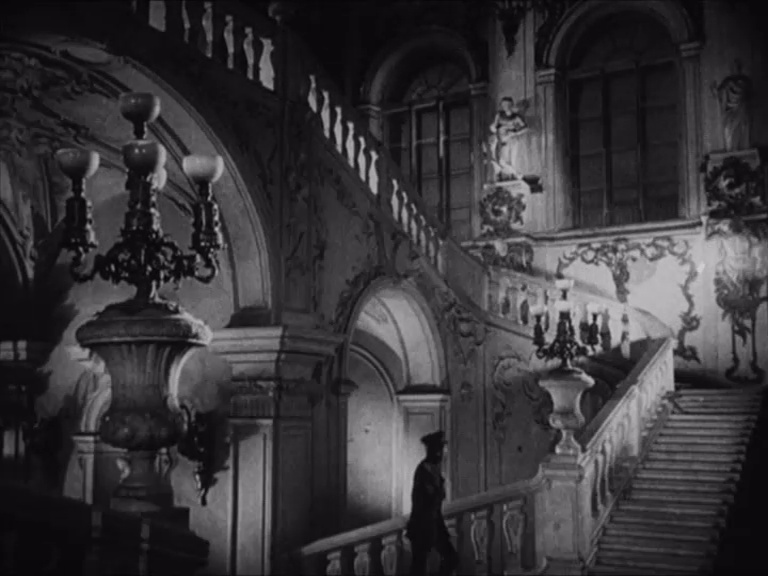
I want to write about the sequence which seemed to me the best combined use of image and music in the film—or rather, the scene where this combination gave me the greatest pleasure. It begins about 25 minutes into the film and shows Kerensky, the head of the provisional government, heading into the Winter Palace to assume his office.

We see three men, their backs to us, advance down the hall. The shot is slightly undercranked, so that they seem to waddle at speed rather than walk or march. The first shot doesn’t show their faces, and in the second shot they are so small as to lack features. Eisenstein makes them tiny in the palatial spaces, miniscule dictators. Meisel knows the scene for what it is: it’s comic, absurd, playful. It’s also repetitive and surreal. We see the endless columns, the endless arches, the endless steps, and the figures’ endless movement along and up, and up—and up. So Meisel spells out a musical beat that is both steady, banal, but almost too fast: it’s as though we can hear the men waddling at speed through the score. And Meisel/Thewes knows exactly how to get the best out of the rhythm. Below pizzicato strings, the main two-note figure of this section is played on the trombone, an instrument whose low, slightly bluff sonic roundness gets a lot of use in comedic film scores. The performance (I cannot speak of the score as written or notated) plays this up: there is a certain sliding in the transition between notes, giving this simple beat a sense of being out of breath, ever so slightly out of balance. The shape of the beat (descending phrases: one-two, one-two, one-two-three-four) suggests a kind of effortful trudge as much as a triumphant march.

Then, as we cut from a title (“The dictator”) to a closer view—but again from the rear—the strings take up the two-note step of the beat and the trombone and brass start to warm up into a kind of fanfare, supported now by the martial crash of drums. The trio of generals ascend the stairs.

Another title: “Commanders-in-chief…”. So now the strings develop the beat into a melody, albeit equally simple and just as repetitive. They are supported by the snare drums and, deep below them, the great blast of the tuba. It’s a pleasingly bombastic development of the initial musical idea, but it’s still deliberately simple—you can spell out the one-two-three-four of the beat, the tuba joining in for the first and third note. The tuba has the same role as the trombone in the first few bars of the scene, only it now amplifies the pompous oom-pah, oom-pah rhythm of the generals’ footsteps.

For the generals are now ascending a giant marble staircase, and Eisenstein distends the time it takes them to climb. First we have a long shot from the right side, looking left; then a title completes the information begun in the previous text: “…of the army and navy”, before a view from the left of the staircase repeats the same pattern of movement. Up the stairs they go, as the music builds in volume. (Another title: “Prime Minister”). Eisenstein cuts closer, but again so that we see only the backs of the commanders. At this point, the snare drums double their speed below the rhythm of the brass, as if to say: keep going! keep going! The trombones are now given a delicious upward swing to keep step with the drums’ quickened pulse.

Having cut closer, Eisenstein then cuts further away: the officers are still ascending, and it becomes clear that he’s making them repeat the same steps as at the end of the previous shot. As he does so often in October, Eisenstein uses montage to make successive shots overlap in time: space is made subservient to time. Just as we start to appreciate how elaborately the upward march of the generals is developing, an intertitle cuts in: “And so on, and so on, and so on.” But the text, too, becomes a visual joke: you read it from top to bottom, each line successively indented so that the phrases take the form of steps. Disconcertingly, you are reading the text from left to right, top to bottom, while each line moves further to the left as you go down: the way we read the text is moving in the opposite direction to the way the figures are moving on screen. It’s an extraordinarily complex visual/textual joke, and a brilliant way to make the intertitles graphic in a meaningful way.

Cut back to the stairs, now viewed from another angle, and this time we see the generals from the front for the first time. We cut from the stairs to the statues that overlook the figures. Stone hands hold out crowns of laurel, and the cutting seems both to join in with the march but also break it, or even to anticipate its culmination at the top. “The hope of the Fatherland and the revolution—” a title announces, and the statues are seen from below, from disconcerting angles, mirroring one another, as if they might topple over us. After the next title: “A.F. Kerensky”, we finally get a close-up of a human face. But this too is disconcerting, threatening, surreal. For it breaks the rhythm of ascent, the continuity being built up (however playfully) in the previous shots: here is Kerensky glowering down into the camera, leaning brow-first into the lens, the angle of his head and the side lighting transforming his face into a kind of arrow pointing at us. Eisenstein cuts to the statues bearing laurels, and a train of thought seems to dance across the screen—for Kerensky breaks into a smile, but a smile made sinister by the deep shadow in which it is formed.

And now—well over a minute into the sequence—we finally see the top of the stairs! A line of lackies looms from the shadows in this cavernous space, a space which—though we have seen so many shots of its details—surreally escapes our full comprehension. How exactly is the staircase arranged? Is there one set of steps, or are two sets of steps facing each other? And where are the steps leading? How high have we climbed, how many flights of steps?

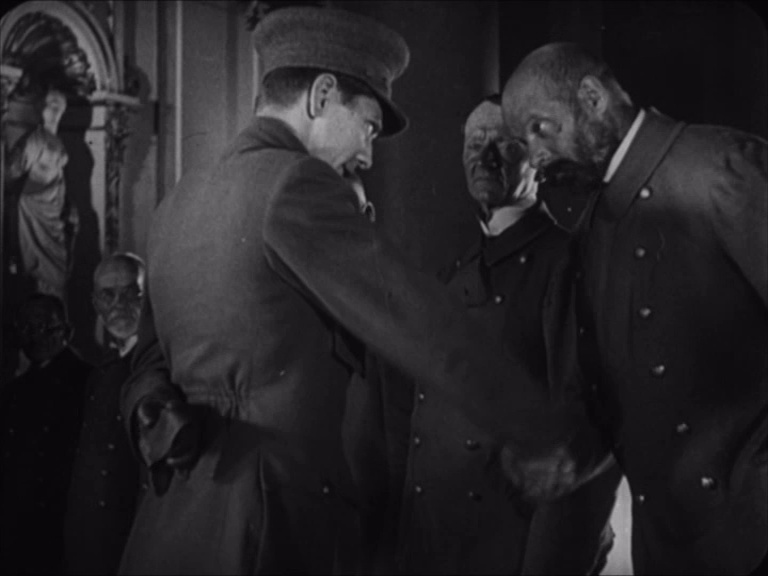
“The Tsar’s lackeys”, a title announces. (And the film’s titles are always faintly sarcastic, mocking, whenever they aren’t slogans or exclamations or punctuation points.) A large man, whose uniform bulges with his bulk, steps forward—and the statues seem to look down on him, the statuary of the imperial past, the dark columns made defy gravity by the camera’s tilted angle. There are salutes seen from close, from afar, from close; time overlaps, gestures overlap, formalities pile into one another, pile onto one another. Their handshake takes an age, it’s captured in one, two, three, four, five different shots—emphasizing the lacky’s subservience, Kerensky’s effort to look imposing, and (cumulatively) the sheer awkwardness of a handshake that lasts this long.

Kerensky moves on, and the musical rhythm shifts once again. It grows in subdivision, the same foursquare beat now marked with the tuba spelling out all four notes in the bar. And listen to the strings in conjunction with the added brass: there’s such a glorious swing to the way the music is played, sounded out. The bright notes of a glockenspiel punctuate the rhythm; the notes are like shining medals, buttons or baubles catching the light. And it’s a marker of how beautifully orchestrated the sequence has become: listen to the sense of acoustic depth here, from the dark blasts of the tuba, through the swell of strings, the rasp of snare drums, up to the gleam of the glockenspiel. It’s such an intelligent piece of musical texture. You sense both the cavernous space of the hall, the near-dark extremities of the palace—and also the sheen of manservants’ buttons, the jingle of medals on the lackey’s chest.

“What a democrat!” the title says, as more handshaking takes place. Every servant is greeted, every servant nods happily to the next. The shaking is seen in close-up, from a distance, from close-up, from a distance… It’s an endless sequence made even more endless the way time and space overlap, the way the editing repeats and moves restlessly back and forth. And all the while, the orchestra is growing in volume, warming to its swing. It’s still the same, simple idea: four ascending notes that are repeated (one-two-three-four, one-two-three-four), followed by a three-note phrase that rounds off the tune. Thus, even the music (like that earlier intertitle) spells out the steps and (in its last three-note phrase) a kind of subservient bow, a satisfied execution of an about-turn before the four notes of the march climb once again. Both the visual and the musical halves of this scene could be extended forever, ad infinitum. Only the little variations keep it all building: visually, there are the various stages of the staircase, the titles, the lackeys that give the repetition a kind of crescendo; and musically, the tempo shifts and orchestration build the simple motif into a great movement of sound.

Finally, Kerensky has shaken hands with everyone, and the two commanders take the final steps behind him. Listen how that last three-note phrase of the melody now becomes a five-note phrase in the brass: one-two-three, four-five—and then a six-note phrase: one-two, three-four-five, six. It’s a simply delicious little development; the steady step of the music is becoming a skittish skip, as though the march is about to break into a dance. It’s ludicrously infectious.

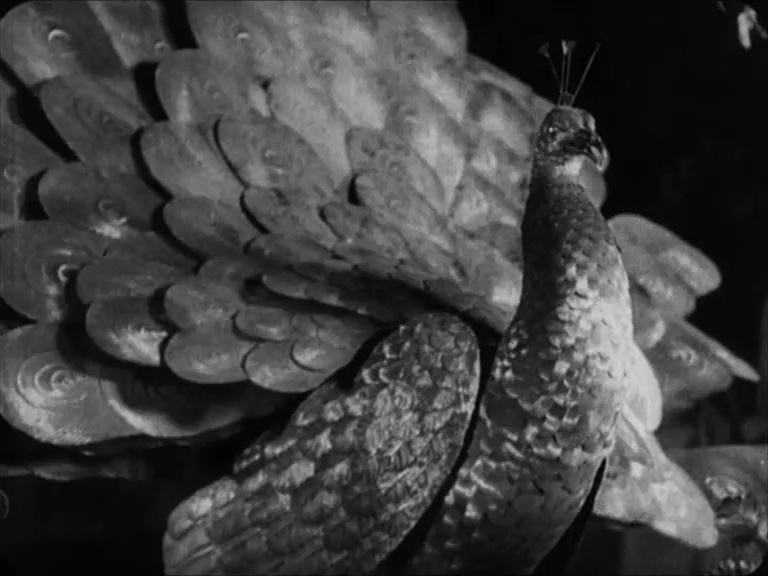
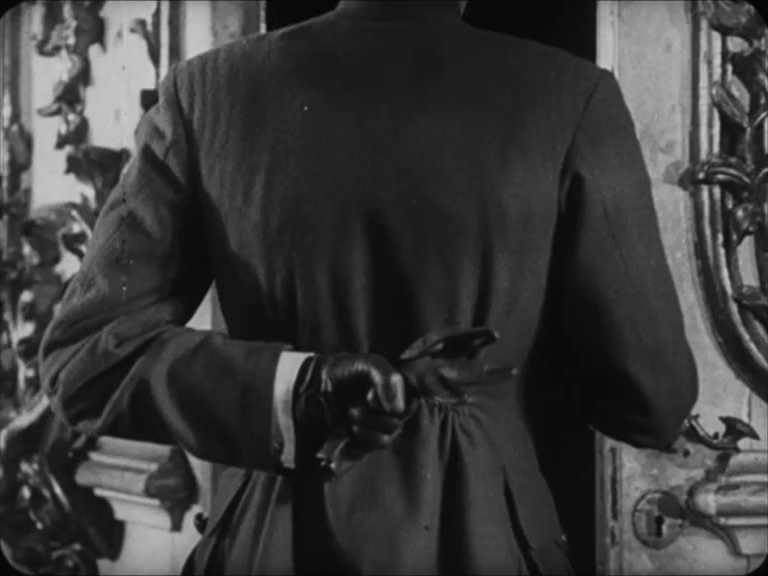
“The democrat at the Tsar’s gate.” Kerensky approaches the doors to the inner palace. The anticipation is both built and suspended through editing: Kerensky’s hands clasped behind his back; shots of coats of arms on the door; shots of lackeys nodding, winking to each other; shots of Kerensky’s boots; shots of the generals; and then—in a dazzlingly strange cutaway—we see a spectacular mechanical peacock unfurl its wings, then spin around to show us its backside. Even the bird’s movement is split, repeated, made gloriously weird—close-ups of wings, feathers, feet, face—and rhymes with the turning heads of the servants, the spinning salute of the lackey, the upturned faces of the commanders. The gates open across one, two, three, four shots (wide shot, closer shot, close-up, tighter closer-up; in each shot the movement of the door is pushed back a few frames to be seen again), and the music now slows—the beat is the same, but the tempo slows by at least half. The musical march sinks back into the tonic with an ecstatic sigh—of relief as much as anything. You realize how tense this sequence—visually and musically—had become. How much longer can out satisfaction be denied? Just as the generals are climbing the steps, the music has been chromatically climbing its way through the march, creating a tonal tension that needs resolving—and is only resolved in these final bars, when we see the gates open and then shut behind Kerensky. The last bass note is allowed to extend out over the final images of the scene: the massive locks of the gates, the image of the sealed doors. In one sense, it’s like the echo of the shutting doors reverberating through the palace. But because this is a purely musical resonance, it attains a heightened sense of strangeness. It’s a kind of afterglow, a dark, ominous extension in sound. This kind of moment doesn’t exist in a paper score; it exists only when music is performed. It’s emotive, intelligent, brilliant musicmaking.

The whole thing reminds me of another joke built on similar musical-dramatic ideas in Offenbach’s La Grande-Duchesse de Gérolstein (1867). At the end of Act 1, the little state is preparing for a pointless war with its neighbour. The sword belonging to the Duchess’s late father is ceremoniously carried before the assembled forces. She sings an area, “Voici le sabre de mon père”, accompanied by the chorus. Offenbach repeats the individual blocks of the line: “Voici le sabre, le sabre, le sabre, le sabre de mon père!” The Duchess points to the sword, sings several lines to the same melody, before the chorus likewise repeats the main refrain several times to the same text (the libretto merely describes their line as: “Voici le sabre etc.”). Then the Duchess picks up the sword and repeats the exact same musical passage she’s just sung, with only moderately different words, before handing the sword to her favourite soldier. The voices of the chorus don’t even get this much variety, now repeating their first chorus wholesale. The joke is in the repetition, and in the banality of the tune extended ad infinitum in ludicrous martial pomp. But the best bit is at the very end of the act, when the soldiers are marching off to battle. “You forgot my blessed father’s sword!” the Duchess cries, whereupon the poor chorus must strike up the same melody again. Offenbach and his librettists (Henri Meilhac and Ludovic Halévy) are making the same joke, to much the same end, as Eisenstein and Meisel. Film and operetta give us martial music and pompous scenery, continually inflated and endlessly repeated, to highlight the paucity of the ideology that underpins them. Puffed up with its own vacuity, it becomes bathetic.

Having now watched this sequence about forty times, and listened to it about a hundred times as I write, I grow more and more impressed by how well it’s put together. The Meisel/Thewes score makes a tremendous impact, and is by far the best way to experience this film. The soundtrack for the DVD for October was recorded at a live screening of October in Berlin in 2012. There is often something disconcerting in live recordings of music for silent films (I’ve written about this issue elsewhere). But this recording is excellent. You get the sense of excitement in the orchestra at the climaxes—the great benefit of live performances—with minimal acoustic interference from the performance space. Indeed, the only such instance is at the final’s final chord when there is a great burst of cheering and applause—which is a lovely way to end the experience at home, and links your own enjoyment of the film with that of the audience in 2012. It reminds us that what we’re watching was and is meant to be experienced as a live event, performed by musicians and theatre staff, in front of a large audience. It’s why I love silent cinema.

Paul Cuff