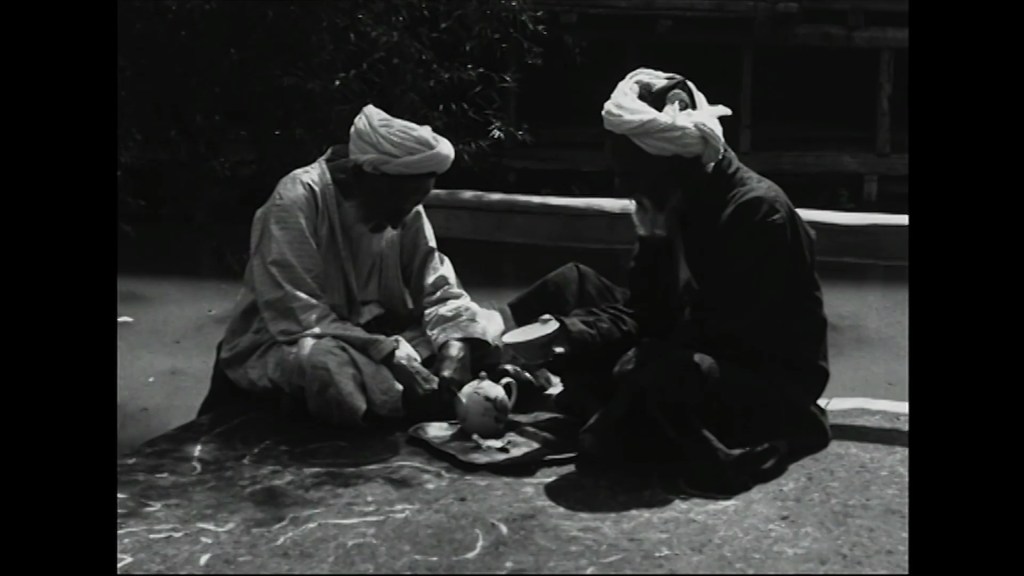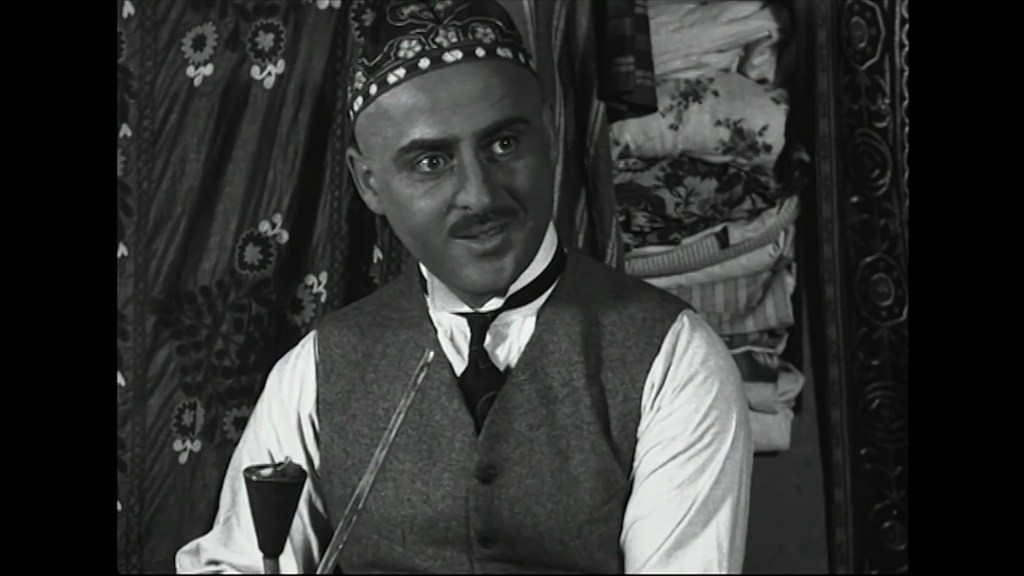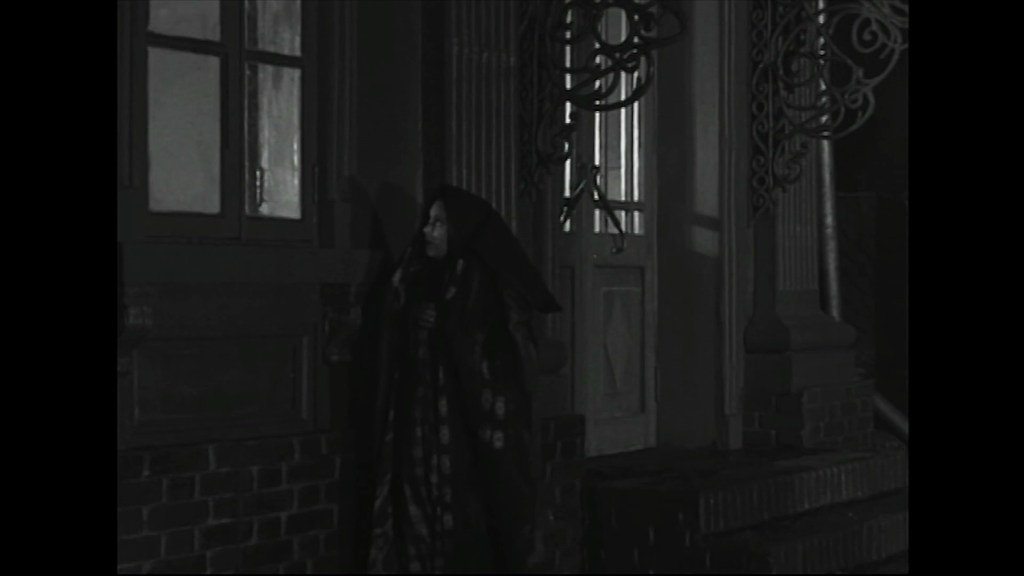
Oblomok imperii [Fragment of an Empire] (1929; USSR; Fridrikh Ermler)

This week’s film has been sat on my shelf for a few years, and I decided to watch it because of a passing reference in a book I was reading. This was the final volume of Sergei Prokofiev’s diaries, which cover the years 1907-1933. I will certainly be writing a post about these amazing books, since they contain many fascinating references to films and filmgoing in this period. Prokofiev was a keen filmgoer, but very rarely notes the exact titles of what he has seen. An exception is Oblomok imperii [Fragment of an Empire], which the composer worried was too provincial a film to be shown outside Russia. Though this comment is hardly an endorsement, it reminded me that the Flicker Alley DVD/Blu-ray edition of the film remained in its wrapper. A few days later, I unleashed it from its cellophane and put it to work…

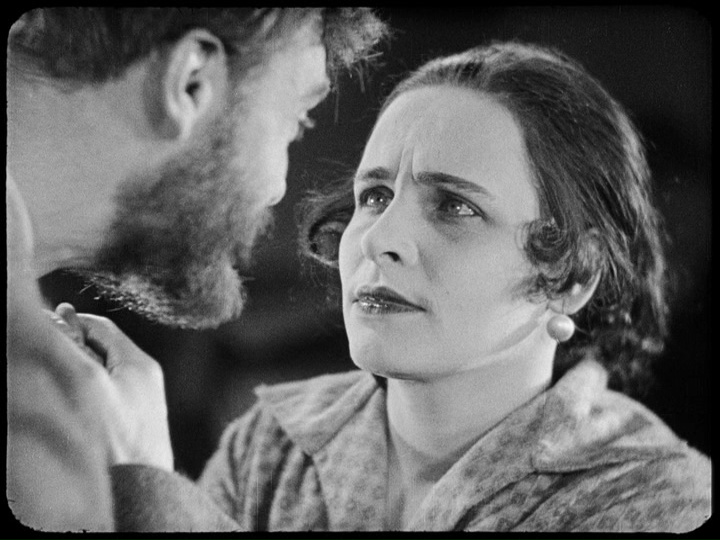
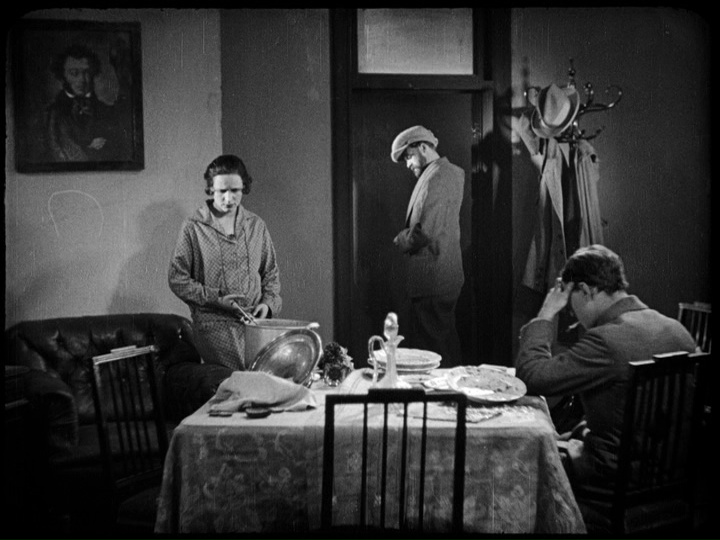
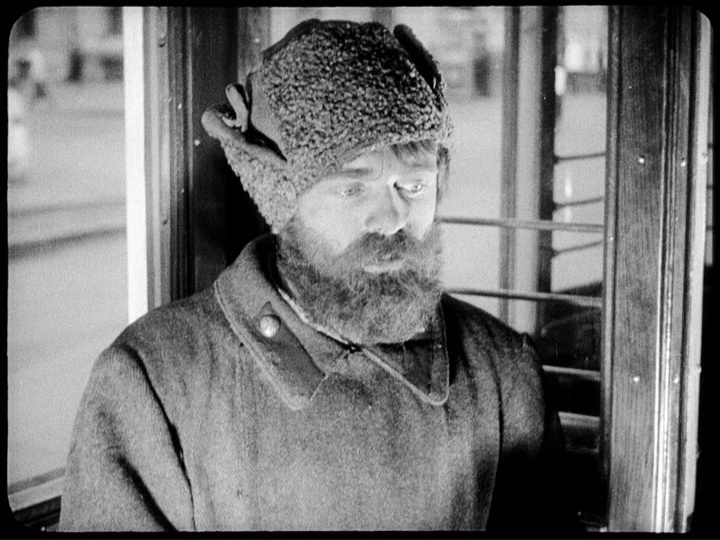
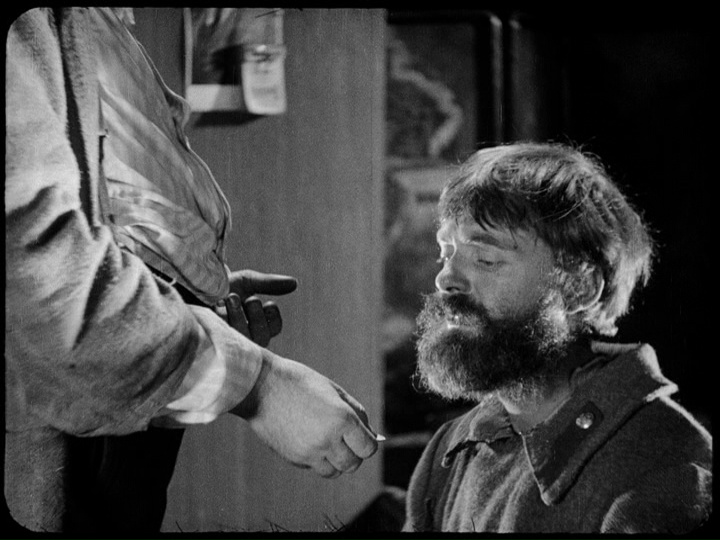
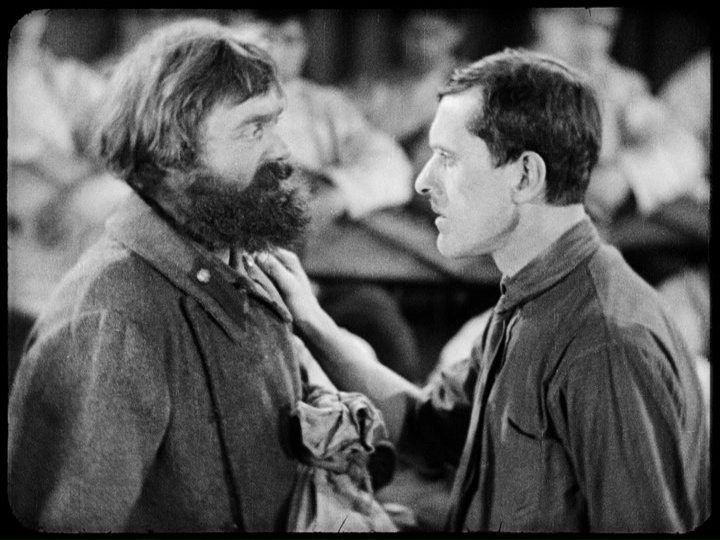
During the Great War, non-commissioned officer Filimonov (Fyodor Nikitin) suffered severe shellshock and lost his memory. A decade later, he lives in isolation in the countryside near the old front line, knowing neither his own name nor what has happened to his country since 1917. One day he catches a glimpse of his wife (Liudmila Semionova) on a passing train. This triggers a partial return of his memory, which is further restored by other reminders of his wartime trauma. At last remembering his name, he decides to leave the country for the city and find his home. Journeying back to (what was St Petersburg but is now) Leningrad, Filimonov is overwhelmed by the material and (especially) socio-political changes of the world he knew. Bewildered and alone, he finds help from a former Red Army soldier (Yakov Gudkin) whose life he had saved during the war. At a new factory, Filimonov slowly embraces the Soviet way of life – and re-encounters his wife, who had long thought him dead. Though she has remarried a pompous cultural worker (Valerii Solovtsov), she is clearly unhappy – and Filimonov looks forward optimistically to the future.

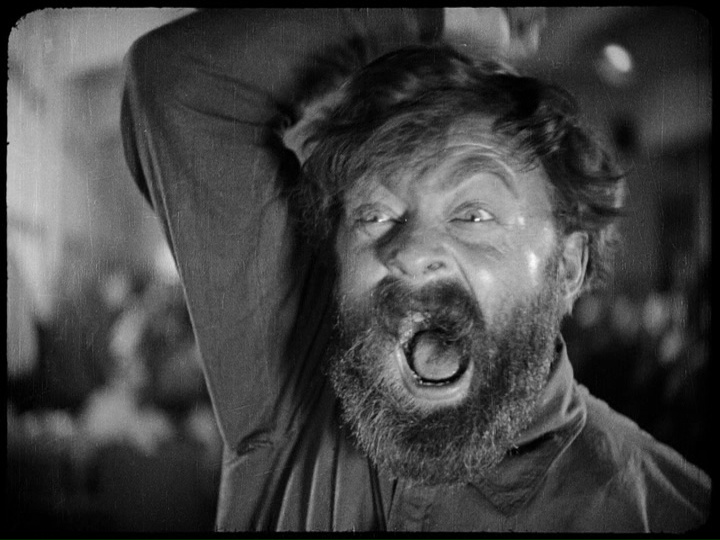
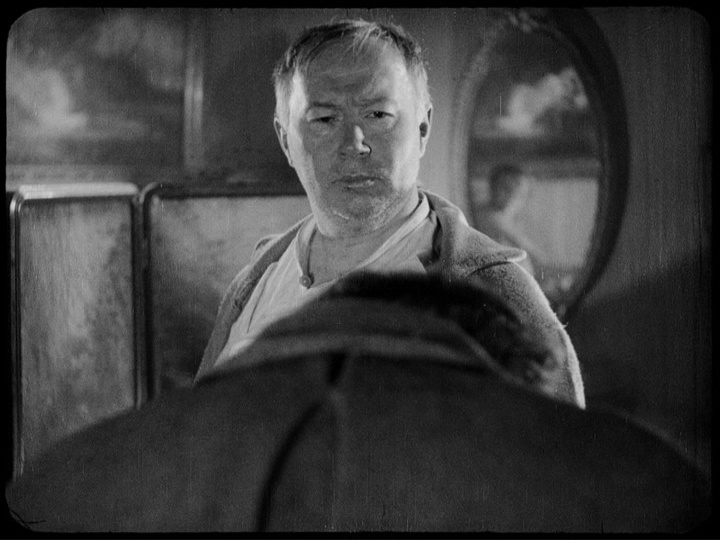
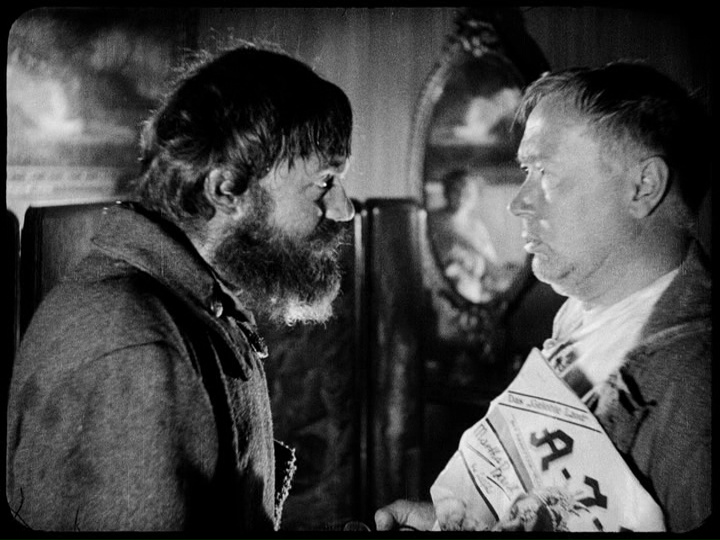
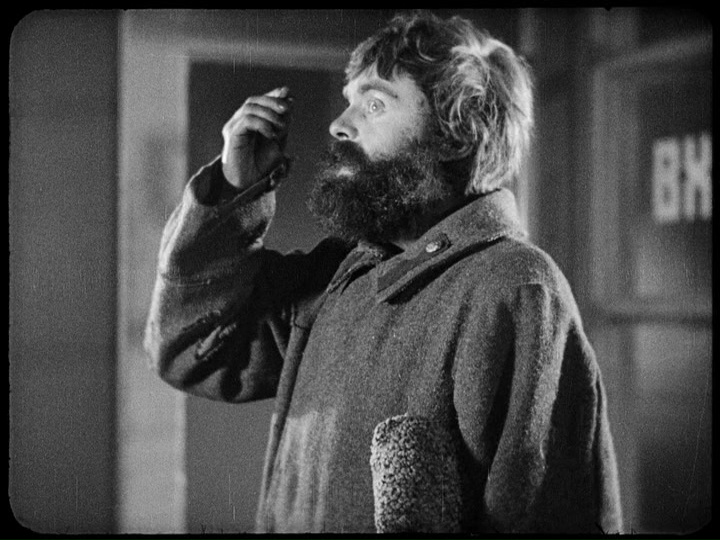
Though Fragment of an Empire is a work of propaganda for the state, it focuses its themes through a remarkable portrait of one man’s subjective trauma. Fyodor Nikitin is the heart of the film, and his performance is one of the most astonishing in Soviet cinema of this era. I found his vulnerability and tenderness (especially in the early portions of the film) absolutely heartbreaking, just as his bouts of violent hysteria are genuinely frightening to watch. When he is in the factory, more and more confounded by the attitude and organization of the workers, he repeatedly screams: “Who is the master?!” Caught in a medium close-up, his arm raised above and behind his head, his face contorted with insane confusion, Nikitin is simply terrifying: at once contained by the frame and threatening to smash it to pieces. (God how I want to see this on a big screen!) I’m not surprised to read that Nikitin seemed to become genuinely unhinged on set, with Ermler supposedly having to threaten him with a pistol to coerce him back under direction. I can hardly remember so vivid a performance of emotional trauma, nor one that – even at its most furious – is always somehow sympathetic. Even when he is screaming and raging, this man is pitiable, vulnerable. He is surely one of the most human, and humane, figures in early Soviet cinema.
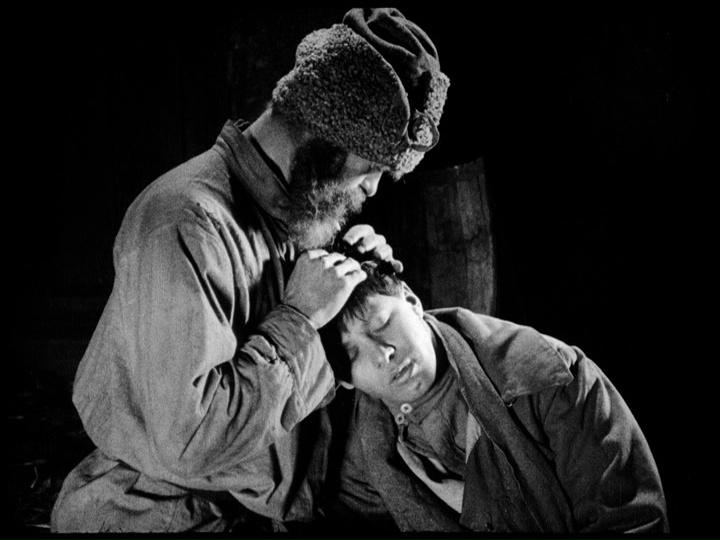
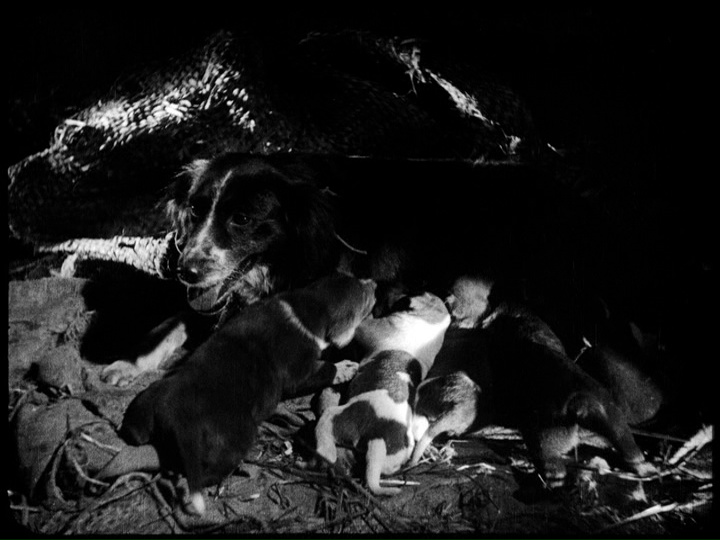
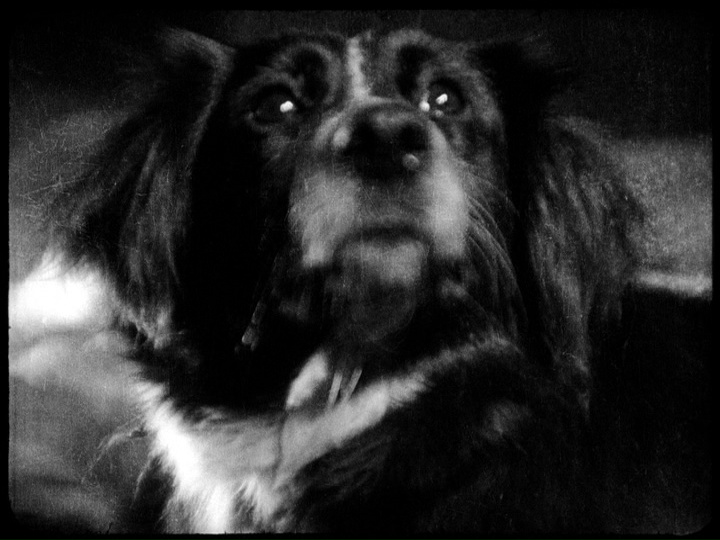
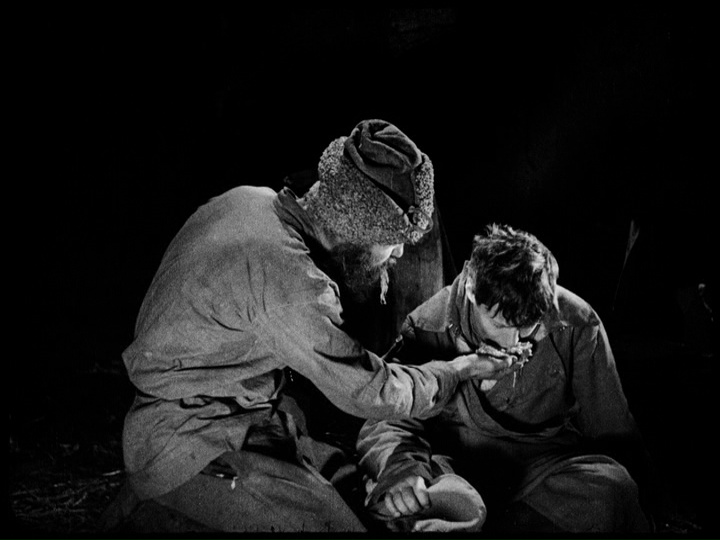
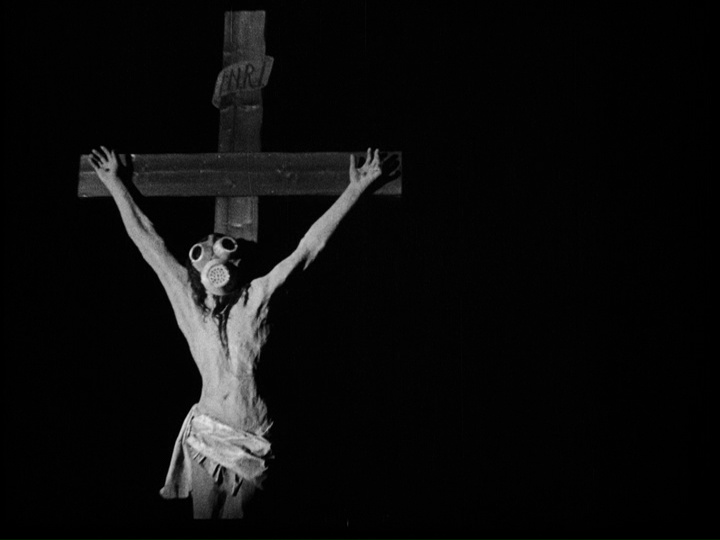
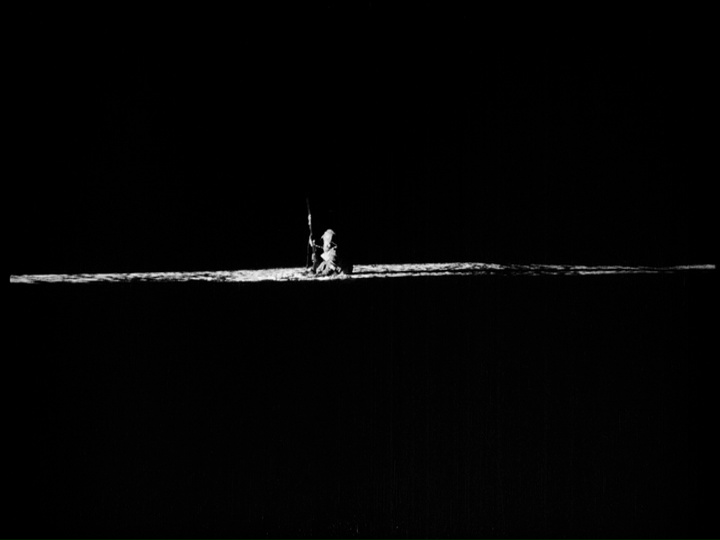
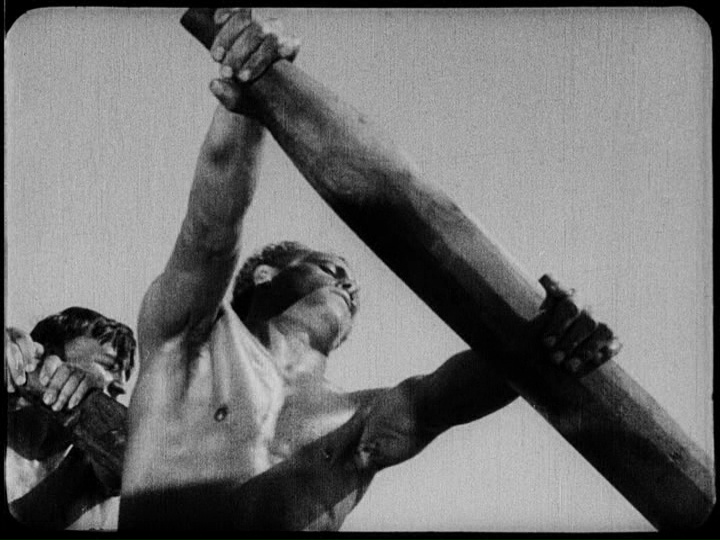
Of course, Nikitin is placed in the middle of an absolutely extraordinary series of scenes and images. The early scenes in which we glimpse Filimonov’s returning memories contain some amazing moments. I love the images of the frontline at night. Spotlight beams crisscross the black expanse of no-man’s-land, and two soldiers from opposing sides slowly approach one another. It’s an image of startling, surreal intensity. The richness of the film’s restored image – those impenetrable blacks, those searing highlights – makes such moments all the more effective. Of course, the famous (and famously censored) sequence of the gasmask-adorned crucifix is just as strange and unsettling, but it is part of a rich, dreamlike landscape of monstrous images. The way the enemy later appears with the train, likewise silhouetted in the harsh beams of spotlights, is just as nightmarish. And the scene in which the wounded soldier suckles from the dog, and the desperately poignant close-ups of man and beast, are simply astonishing. The war appears as a series of terrifying vignettes cut into the darkness, a darkness both real and metaphorical. These scenes are flashes of memory, of trauma, from a history that is too vast and too overwhelming to remember – or to see – in its totality.
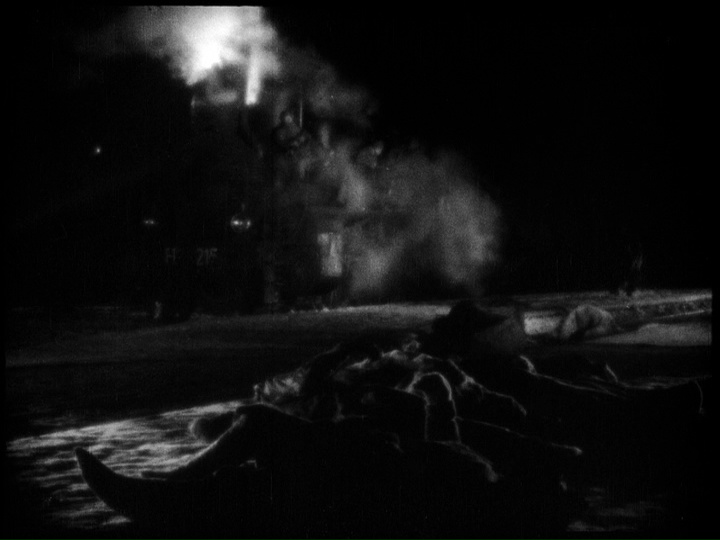
Elsewhere in the opening half hour of the film, Filimonov’s involuntary flashbacks are dazzling – quite literally dazzling, since the rapid cutting between evocative images is a shock for our senses, too. I love the sewing machine than turns into a machinegun, and the way Filimonov seems to generate the very montage of the film with his manic turning of the wheel. But I think that when this sequence eventually morphs from a subjective memory to an outright lesson in propaganda (cutting between the two officers from either side demanding their men fire on the two figures), the sequence loses its edge. Setting out to emphasize the inhumanity of the officers on both sides, it loses rather than gains emotional depth. And while the cutting between spaces and people is complex, it doesn’t have the same poetic motivation as the earlier memory flashes: it has become an exercise in intellectual montage. Compared to the similar sequence of the laughing gas in Dovzhenko’s Arsenal (1929), in which there is likewise a scene of officers threatening their own men, Ermler is less hallucinatory, less strange. By the end of Dovzhenko’s sequence, we seem to have lost touch with a continuous reality altogether. Unlike the growing nightmarishness of the gas sequence in Arsenal, Ermler’s combat sequence becomes all too comprehensible.

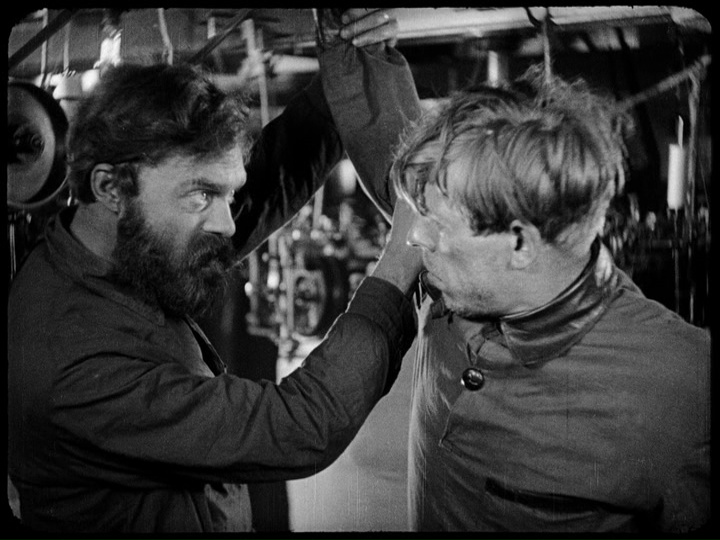
Likewise, the scene in which Filimonov demands, screaming, to know who the “master” is ends with a long montage sequence that tries to answer his question. We see a kind of cross-section of Soviet Russia, its workers and fighters and factories etc. It is impressive for its leaps between similar images (wheels, cogs, hands etc) but it really doesn’t have an argument. It’s a kind of statement of might that just gets more insistent, not more complex or convincing. When it ends and the worker asks Filimonov (and, by extension, us) “Understand?”, we cannot answer: there is nothing to understand. The rapid montage hasn’t made an argument or an effort to answer our question, it’s simply given us a slap. Filimonov – the focus slowly pulling from the background of the factory to his face in the foreground – is breathing heavily and dishevelled, but he starts to grin. Though the film would have us believe he has now finally woken up to the marvels of his new life in this new reality, he resembles a man who has not so much found his sanity as fully embraced his insanity. His grin turns into a laugh, and he hurls himself at his comrades, kissing and hugging them like… well, like a madman. Everyone is so nice to him, and he looks so ecstatically happy, that the scene works – but the pleasure it gives in showing Filimonov released from his torment is (for us, a century later) tinged with a different kind of emotion.


This sense of ambiguity is part of the film’s fascination. While Ermler offers some superb sequences and images, the film is often so convinced of its own effectiveness as propaganda that it simply overlooks the possibility that we might think differently. Our sympathies – especially as viewers nearly a century later – are liable to wander from the official line. Filimonov’s questioning of the Soviet world might encourage us to question it too. And the more he becomes convinced by this new world, the more he becomes a different person. His final line, which is also the final line of the film, is delivered straight to camera: “We still have a lot of work to do, comrades”. Immediately following the violent altercation between Filimonov’s ex-wife and her husband, there is an implication that personal change must accompany social change. But with Filimonov himself, this change is also a loss. The way he now appears before us – his beard neatly trimmed, his clothes neatly worn, his hat neatly fashionable – makes him a different man than the one who initially went in search of his wife. He resembles the other workers, the men and women he had found so alien and threatening, and he now echoes the way they speak. Yes, he has grown up, he has awakened, he is no longer hysterical. But there is a nagging sense that something else has happened. It is as if Filimonov has been uncannily replaced. This new Filimonov is a sinister doppelganger of the man we used to know. His last line is both an encouragement and a threat.
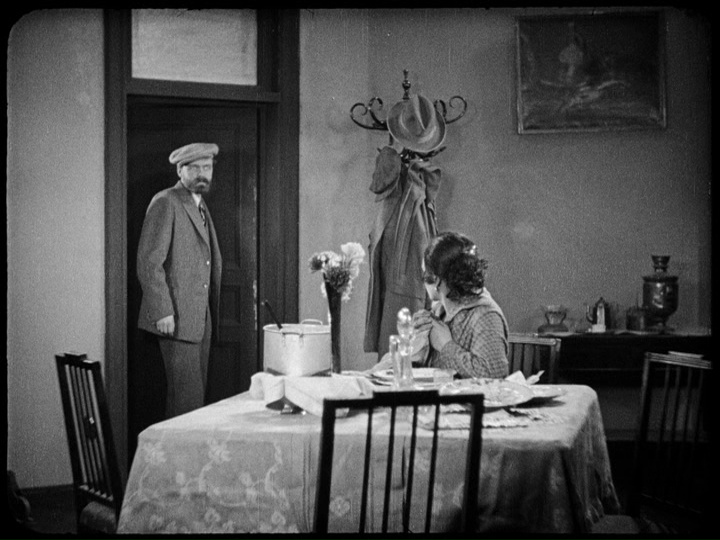
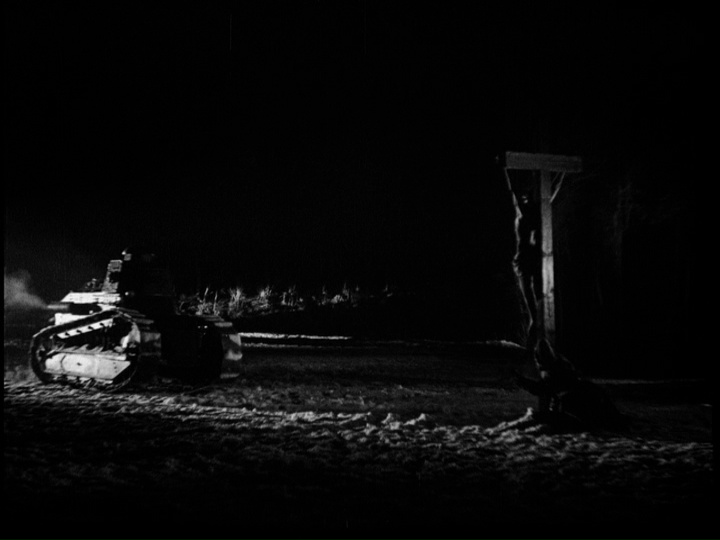
Part of this weird emotional effect is due to the original music by Vladimir Deshevov, as transcribed for piano in this recording by Daan van den Hurk. There are some superb sequences of sound and image interacting, often in ways you don’t expect. Take the early flashback sequence in which we see the Russian soldier praying before the crucifix. Visually, the image of Christ wearing a gasmask is jarring and surreal. Illuminated against the dark night sky, this figure of compassion becomes one of threat. But the soldier prays anyway, and Deshevov’s gorgeous, slow chorale throughout the start of the sequence gives a powerful sense of pathos and pity. If the image of the tank crushing both crucifix and soldier ends the scene with a grim punchline (demonstrating both the lack of mercy in war and a lack of religious authority to protect), the preceding music deepens the empathy we feel. As throughout, the score provides a degree of humanity that the images either cannot quite achieve or deliberately do not wish to achieve.

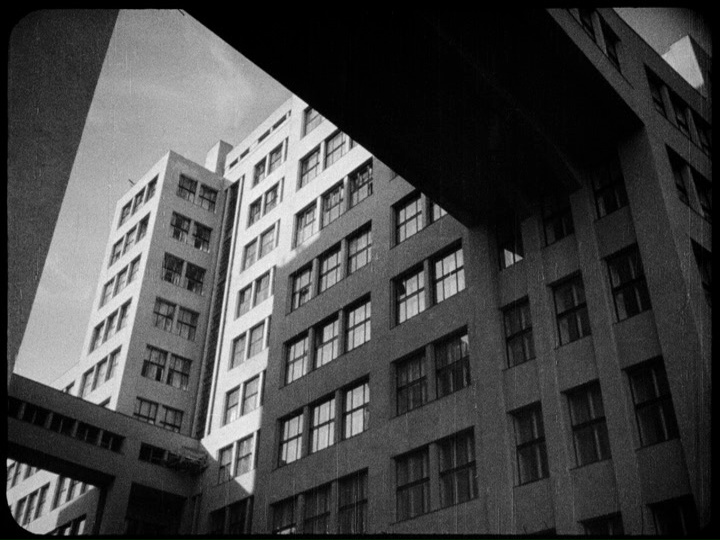
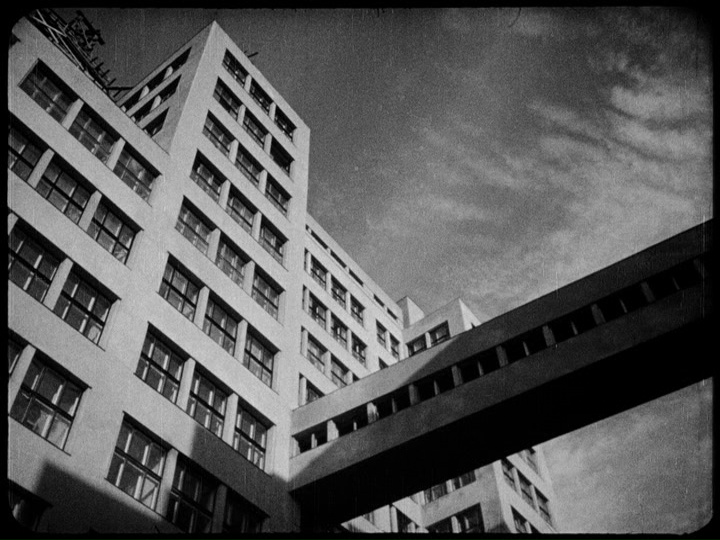
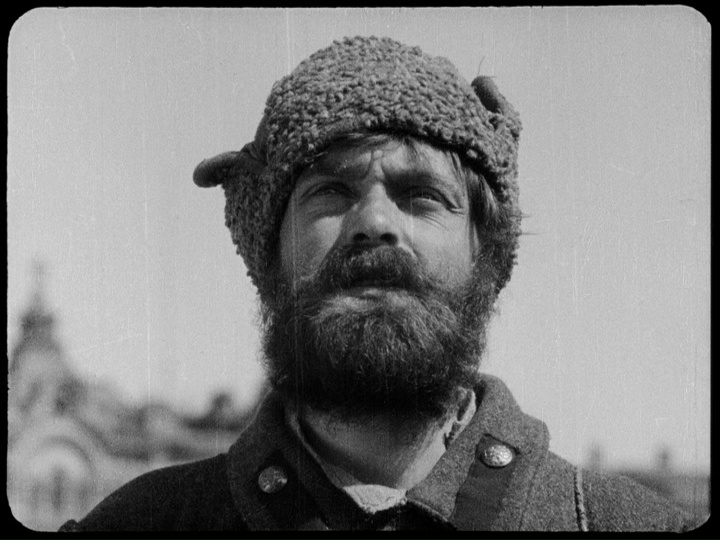
When Filimonov emerges from the tram onto the streets of Leningrad, his absolute disorientation is made the subject of bursts of rapid montage, mobile camerawork, and a delirious repetition of images. Deshevov’s music is like a kind of panic attack in sound, with its repeated, threatening, bustling, grandiose, rising progressions. The sequence is the first of many times that the film seeks to show off what has been achieved by the Bolsheviks while Filimonov has been away. But what the music does is make this very act of showing off almost terrifying. It is too upbeat, its tempo too rapid, to offer anything in the way of comfort or consolation. It is alienating rather than accommodating. This music makes you feel pity for Filimonov’s confusion, the confusion of a man as yet unconverted (and unconvinced) by Soviet Russia. The effect of alienation becomes ours as much as his.

There are later iterations of this kind of “look what we have achieved!” montage. They culminate in the above-mentioned sequence in which the worker demonstrates (via the grand montage) where the “master” is. The dense chromaticism of the music becomes almost unbearably tense, and resolves not in a complex transformation but in a sudden full stop (accompanied by the cut to black that ends the montage). There then follows a passage of scampering, major-key jollity, interjected with an almost religiose chorale motif, that is as weirdly unsettling as the preceding chromatic tension. It’s a brilliantly odd, unexpected way of ending this scene of conversion.

The fact Deshevov’s score seems subtler, wilier, than the film made me curious about the origins of the music and the man. Deshevov (1889-1955) was the same generation as his more famous compatriot Prokofiev, but unlike the latter he remained in Russia throughout the Revolution. Like Myaskovsky and Prokofiev (and their younger compatriots Popov and Shostakovich), Deshevov became part of the mainstay of Soviet composers who worked under the increasingly strict guidelines meted out by Stalin. He would compose much orchestral music (including several ballets), as well as chamber work and piano music. Ermler’s commission to write an original orchestral score for Fragment of an Empire was a rare instance of collaboration between a major director and composer in this period of Soviet cinema. Ermler was hugely impressed by the result. “I am afraid that people will go to listen to the music, not to watch the film”, the director told Deshevov in 1929. “So be it! I am delighted.” Yet the music was barely discussed at the time and remained seldom heard since, especially because copies of the film itself were dispersed, dismantled, and/or destroyed.

The present restoration of Fragment of an Empire was completed in 2018 after a collaborative project by the EYE Filmmuseum, Gosfilmofond of Russia, the Cinémathèque Suisse, and the San Francisco Silent Film Festival. From what I can glean, the new restoration was presented with Deshevov’s orchestral score for the first time in October 2018 at the Mariinsky Theatre in St Petersburg. Per the programme notes for this performance, the score was restored using “the set of orchestral parts retained in the theatre’s library” by composer Matvei Sobolev. Deshevov’s score was performed again at Pordenone in October 2019 with Günter A. Buchwald conducting the Orchestra San Marco, Pordenone. The essay for this festival screening details the history of how Ermler commissioned Deshevov and the subsequent neglect of the music. (Sadly, this essay does not clarify if the 2019 performance used the same musical edition prepared by Sobolev in 2018 – but my assumption is that it did.)

Yet the Flicker Alley release from 2019 confuses this picture. The blurb on the back of the DVD/Blu-ray box states: “The film is accompanied by a choice of two musical scores: a brilliant new score composed and performed by Stephen Horne and Frank Bockius, and an adaptation of Vladimir Deshevov’s original piano score performed by Daan van den Hurk.” It’s curious, but I suppose understandable, that the modern score takes precedence over the original. But why refer to the latter as the “original piano score”? Isn’t this a piano transcription of the original orchestral score? Flicker Alley make it no clearer within the booklet for their release, since the credit section therein refers to “Vladimir Deshevov’s original score” being “adapted and performed by” van den Hurk. Van den Hurk’s own statement in the booklet refers to Deshevov’s other compositions for solo piano and the film score being “a worthy piano concert piece”. But on the very next page, Stephen Horne and Frank Bockius refer to van den Hurk’s work as “a piano transcription of the original score”. This, surely, is closer to the mark. But neither here nor anywhere in the Flicker Alley release is it mentioned that Deshevov’s music was written for and performed by an orchestra in 1929. Nor is there any acknowledgement that this orchestral score had already been restored and performed with the 2018 restoration of the film. (Even the audio commentary soundtrack on the Flicker Alley release, I note, uses the modern score as its background music, not Deshevov’s – further evidence of how his score is subtly deprioritized on this release.)

So what are we listening to on the Flicker Alley soundtrack? Since the wording is so vague – deliberately so, it seems to me – throughout the release, I’m not even sure if van den Hurk’s work was a transcription of Deshevov’s orchestral score or based on a piano reduction prepared by the composer or another contemporary musician. Even if it was based on a piano version by Deshevov, this does not entitle it to be called or understood as the “original score”. Some context is required here with these terms. For example, Deshevov’s contemporary Prokofiev began most of his compositions on the piano, even if they were to end up as orchestral works. When he was working on ballets, he would often suspend work on finishing orchestration to produce a piano transcription for the sake of his stage performers. In advance of their productions, Prokofiev’s collaborators would need a sense of the overall structure (and timespan) of the music in order to build the choreography, prepare the staging, and begin rehearsals. Several of these transcriptions exist, but even if some or all of this music for piano predates the final orchestrated version, this does not mean they should be understood or received as the “original” scores. In the case of Deshevov’s music from 1929, he may well have written some of the score for piano before orchestrating it. But to advertise this as the “original score” would be to entirely misunderstand the nature of composition and performance practice. The orchestral version is the original score, no matter if it was the end result of a complex process of drafting, redrafting, and instrumenting. But all this can only be supposition, since Flicker Alley do not offer any details about this process of “adaptation” – and never once admit that Deshevov’s score for Fragment of an Empire was written for orchestra.

Why should we care about this? Because finding out information about silent cinema, especially silent film music, is already difficult enough. Original materials and resources are difficult to find and difficult to interpret, so it is vital to be honest and transparent about all aspects of restoration. I try always to bear in mind (and be honest about) the factors that have shaped the way I see silent films, especially on home media. All too often, however, marketing muddies the waters. It directly impacts how silent films are received by new audiences and new scholars. Of all the information available online or elsewhere, it is the DVD blurb that gets endlessly repeated. When the Flicker Alley edition of Fragment of an Empire won a well-deserved prize among Il Cinema Ritrovato’s DVD Awards in 2020, for example, the release is credited as offering “the recreation of Vladimir Deshevov’s original piano music from 1929”. This text hasn’t been generated by Chat GPT, but by the human curators of a prestigious festival. What hope have the rest of us if misleading information just gets copied and pasted from the marketing? Confusion, if not outright misinformation, rapidly filters through to writing on the film, which in turn generates more confusion and/or misinformation. So please, please don’t gaslight me.

I regret spending so much time writing about the accompanying text of this release. Not only is it a grand old waste of my time having to write what the liner essays should have said straight up, but it also means I have less space to talk about the music and the film. Let me be clear: the restoration presented by Flicker Alley is visually superb, and regardless of the score I am exceedingly glad to have it. What’s more, I absolutely loved Deshevov’s music, and it makes Ermler’s film all the more complex and compelling. But however good the piano transcription, I would so much rather listen to this score in its original form: for orchestra! Here’s hoping that it will be performed live in the future and, as I never tire of hoping with such things, released on home media.

Paul Cuff

Bonn from afar (2025, days 5 and 6)

Day 5: Buddenbrooks (1923; Ger.; Gerhard Lamprecht). I was very excited when I saw this on Bonn’s line-up. A new restoration of an unknown Gerhard Lamprecht film? Yes please! A silent adaptation of a Thomas Mann novel? Yes please! Lavish sets and settings? Yes please! Are you a resident of Germany, Austria, or Switzerland? Y—! Oh… no. Well, no film for me today. No Lamprecht, no Mann, no lavish sets, nor even the comfort of living in an appropriately central European country.

To be fair, I knew this was coming, having seen the dreaded asterisk on the programme that denoted access to the online version was limited by copyright according to region. As the festival’s co-curator Oliver Hanley said to me after the festival last year, there are sometimes occasions when compromises must be made. This is an exciting new restoration of an important work by a major director, so it’s clearly worthwhile being programmed, whatever limitations there are for streaming it. I don’t resent the good folk of Bonn being able to see this film in situ at the price of we folk from afar not being about to see this film online. One really can’t complain: this online version of the festival is still, miraculously, free, and there are plenty of other films on offer. At least I am now aware of the existence of the restoration of Buddenbrooks. Hopefully it will do the rounds, so to speak, and appear somewhere where I can attend or view online. So, on the fifth day I rested.

Day 6: Shakhmatnaya goryachka (1925; USSR; Vsevolod Pudovkin/Nikolai Shpikovsky). Today’s short film takes us to Russia, and to a delightful directorial debut. Pudovkin’s first film is a comic skit about the titular “chess fever” that grips the Hero and distracts him from his impending marriage with the Heroine, only for her to end up in the arms of chess champion Capablanca and be won over to the game – and back to the Hero.

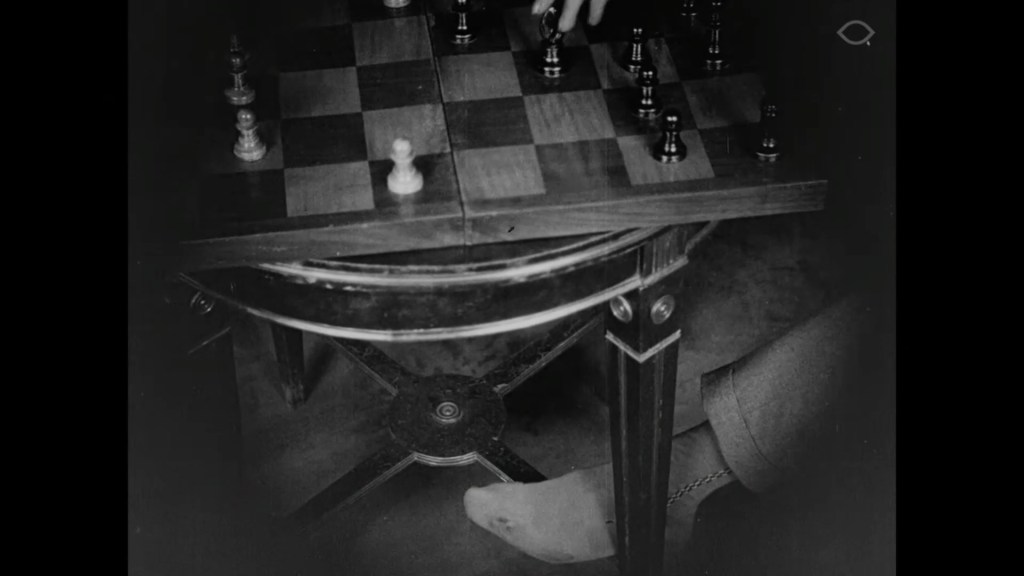
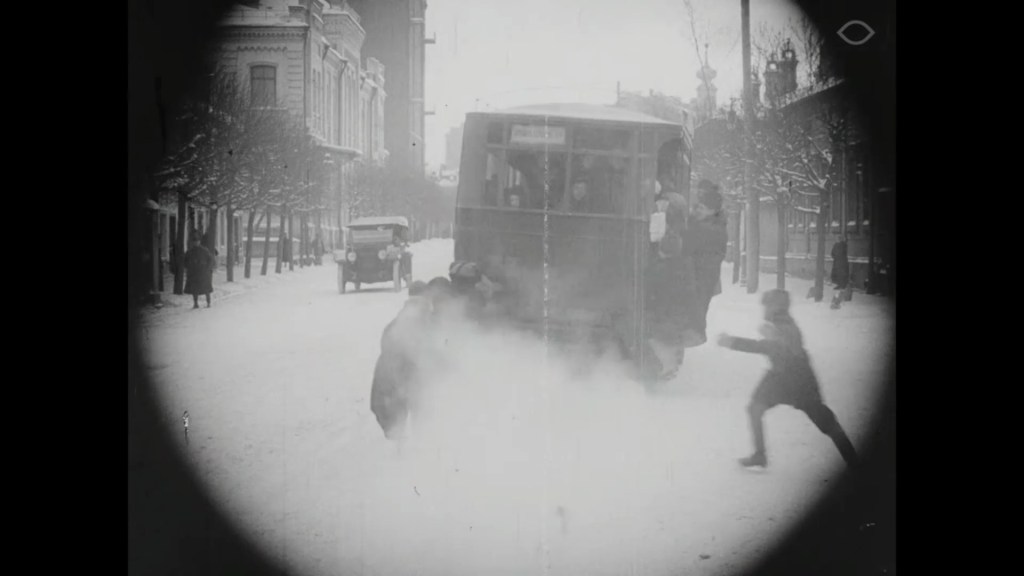
I’ve seen this film before, but so long ago that I felt like I was discovering it for the first time today. I’d forgotten how packed with marvellous gags it is, taking advantage of every kind of space and movement. Though Pudovkin is famous for his later propaganda films, and especially for his dramatic use of montage, Chess Fever shows his playfulness and skill exercising numerous cinematic techniques for comedy. See how the shot/reverse-shot of the feet underneath the chess table creates the impression of two players, only for a wider shot to reveal a single player with mismatched socks swapping sides to play against himself. Or the brilliant use of reverse-motion when the Hero is irresistibly drawn backwards down the pavement into the chess shop. Then there is a deliciously Keaton-esque snowballing of gags when the Hero has his books of chess problems thrown out of the window. An officer arrests a man for stealing a ride on a bus, but is distracted by the unexpected arrival of the chess problem from above. We have already seen other people being pleased to find these papers rain down on them, but here the gag is developed. The film cuts from the distracted officer and the man he’s supposed to be arresting to a shot of another bus. We see another bus passing by, and one, two, three, four, five men clung to the side. This looks like the climax to the gag, but the film delivers one final, knock-out gag: behind the bus is an entire line of punters who have affixed a rope to the bus and are sliding along behind it.

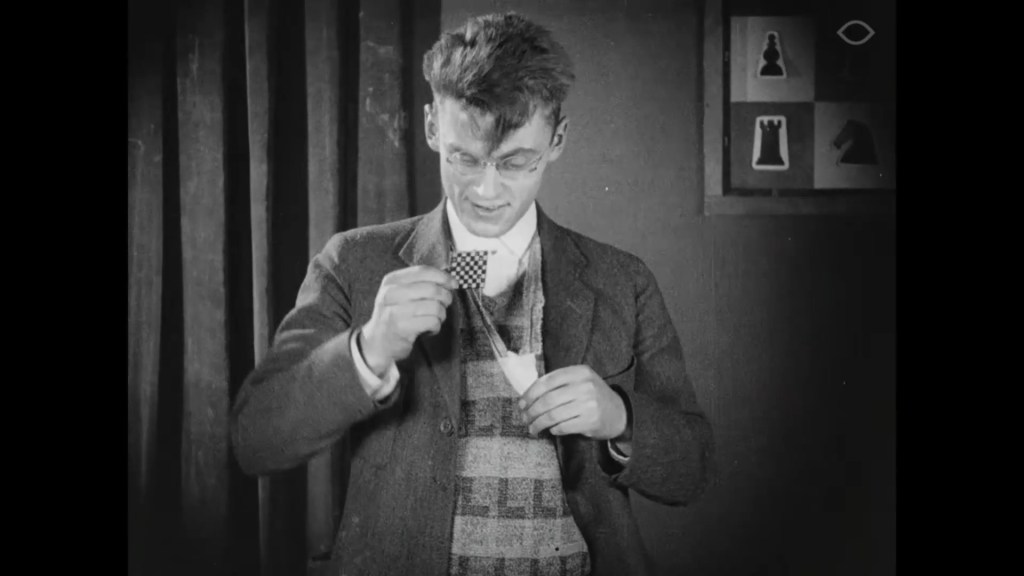
The titular “chess fever” of the film is everywhere. Not only does everyone reveal themselves to be a fanatic, but the feverishness becomes embedded in the patterns on screen. The chess board’s chequer pattern is everywhere about the Hero’s person: his sock, hat, scarf, handkerchief. And this pattern is everywhere around him, too, from the floor tiles that the Hero finds himself moving across like a chess piece, to the series of ever-tinier chequered items of merchandise and apparel that the Hero jettisons in the river. The tiniest board is kept for last, however, when – having thought he had lost all his chess sets and now cannot play with his converted bride – he remembers his emergency set kept in a pouch around his neck. He withdraws this absurdly small board, and the lovers play micro-chess before passionately embracing.

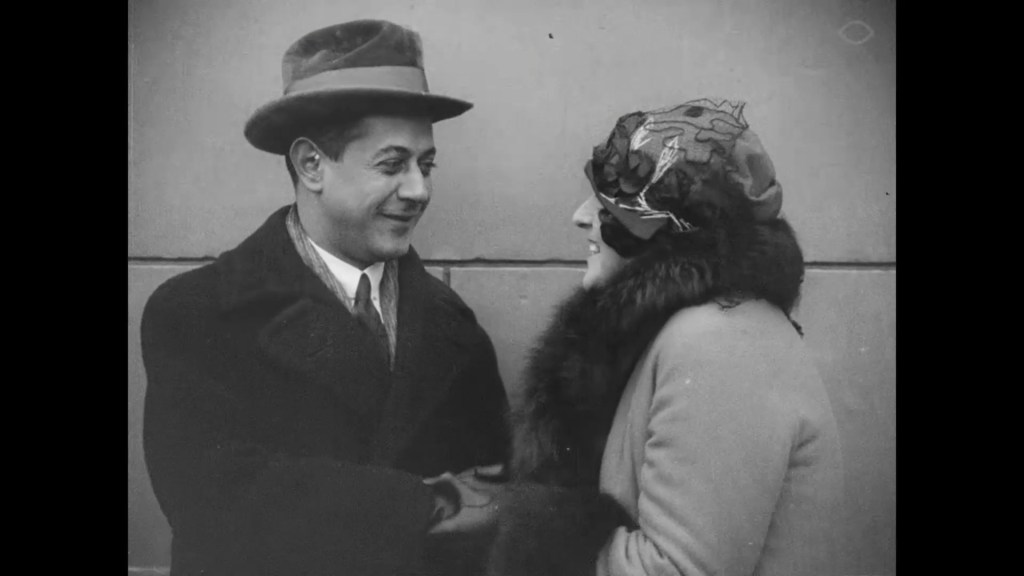
As a side note, I also enjoyed the cameo from the real chess champion José Raúl Capablanca. As it happens, I’m reading Sergei Prokofiev’s diaries at the moment. Prokofiev was a chess fanatic and befriended Capablanca in his teens in St Peterburg, before the Revolution. In fact, Prokofiev actually played and beat this future world champion in 1914 during a chess championship. For this reason, it was delightful to see the opening close-up of Capablanca, looking a little playful, a little awkward, a little amused. (Rather appropriately, my writing of this paragraph was interrupted by the postman, who has just delivered my latest Prokofiev purchase: the sadly out-of-print 1960 recording of Semyon Kotko, which is, I’ll have you know, ladies and gentlemen, the only uncut recording of this opera currently on the market.)

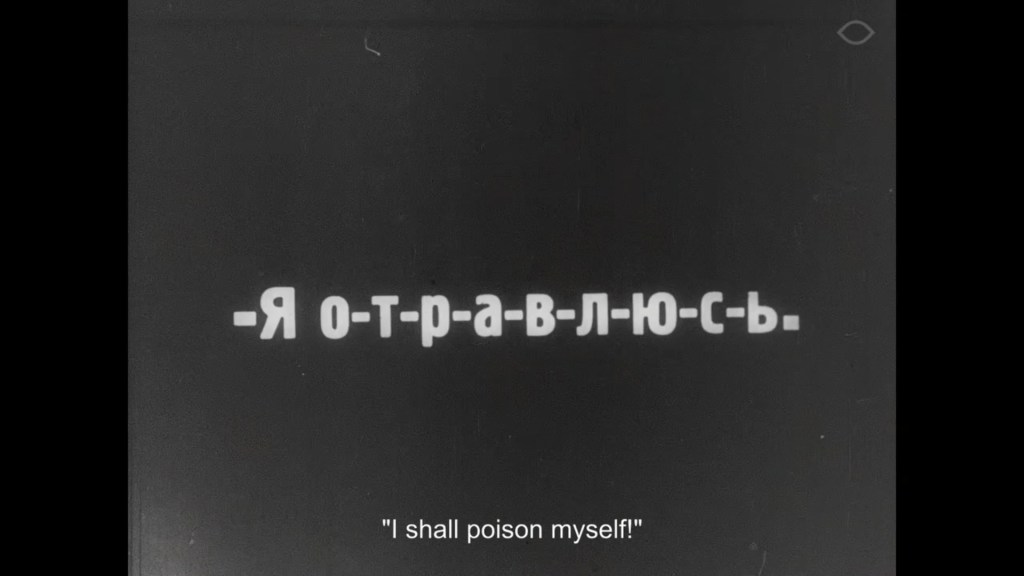
The music for this presentation was by Sabrina Zimmermann and Mark Pogolski on piano and violin. This was tremendous fun. Full of life, wit, melody, irony, and energy. I loved the citations of La Forza del destino when the Hero finally arrives, late, to his fiancée’s side – and later when the Heroine goes to buy poison to end her own life. The operatic behaviour of the characters is itself a kind of parody of the fatalistic Russianness of pre-Soviet cinema à la Evgenii Bauer et al., and the music lives up to the bathos. Throughout, the score kept pace with the film’s sudden shifts in gear, changes of tone, and slights of hand. Though only 25 minutes long, the film demands dozens of swift manoeuvres from any accompanist. Zimmermann and Pogolski produced a little gem of a performance, fully worthy of the film. This soundtrack was recorded live, and I enjoyed hearing the murmur of distant laughter. It wasn’t so loud as to be distracting, but just enough to make me feel I was sharing part of the performance.

What else to say? This is a brilliant film, presented here with a perfect musical accompaniment. Whatever disappointment I had over missing Buddenbrooks was swiftly forgotten in the pleasure of seeing Shakhmatnaya goryachka in such a great performance. Bravo!

Paul Cuff

Pordenone from afar (2024, Day 4)

Day 4 and we return to Uzbekistan for “The Leper”. Knowing only the title of this film, I didn’t quite know what to expect. I was prepared from something troubling, and boy did this film deliver…

Moxov Qiz (1928; USSR/Uzbek SSR; Oleg Frelikh). In an old quiet town in Uzbekistan, Colonel Karonin helps oversee the locals with the aid of Ahmed-Bai, his translator. Ahmed-Bai’s only daughter is Tyllia-Oi, who one night dances to entertain Karonin’s guests. She catches the eye of Igor Karonin (the colonel’s son) and of Said-Vali, the son of Said-Murad, the richest trader in town. Said-Vali tells his father that he wants to marry Tyllia-Oi but is told that she is only “copper” compared to the gold and silver of other women. Nevertheless, Said-Vali can buy his way through the problem and the marriage takes place. Tyllia-Oi tries to impress her husband by wearing Russian-style clothing (like him), but he angrily demands if she is a whore or a Muslim – then attacks and (we presume, via an ellipsis) rapes her. Meanwhile, Ahmed-Bai takes a second wife into his home to help manage in his daughter’s absence. His older wife, sad and dejected by her husband’s new bride, visits Tyllia-Oi. Seeing the bruises on her daughter’s arms, she realizes that Tyllia-Oi is being beaten by her husband. In desperation Tyllia-Oi sends a note to the colonel’s wife, but it is intercepted by Igor, who is gleefully delighted by the prospect of her vulnerability to his advances. Igor sneaks into Tylllia-Oi’s room and (again, via an ellipsis) rapes her. Months pass, and Igor must leave for Moscow for a new posting. When Said-Vali tells this news to his wife, he sees her troubled reaction and – accusing her of infidelity – attacks her with flaming brands. The marriage ends up in a religious court, and Tyllia-Oi is forced to leave her husband and return to her father’s home. Ahmed-Bai calls his daughter a slut and blames her for the social shame that ends his job and forces them to move. In their new home, Tyllia-Oi’s mother dies. Ahmed-Bai is now an estate manager, but his authority is mocked by the workers. Tyllai-Oi’s stepmother encourages her husband to beat Tyllia-Oi, but she flees home in search of Igor – whom she finds (eventually) with another woman. Homeless, Tyllai-Oi is pursued by other men and finds herself wandering alone. She eventually reaches an isolated lepers’ “village”: a series of tiny caves in the desert. The lepers surround her, and she flees in terror, only to encounter a party of men who – thinking she is a leper – beat her to death and leave her body in the road. END.

An amazing film. Both brutal and compassionate, it is everything that Santa (Day 2) was not. Having now read the brief essay by Nigora Karimova,  I find that Moxov Qiz is based on a Frech novel by Ferdinand Duchêne, set in Algeria. It was adapted by Lolakhan Saifullina, and her screenplay transposes events to the Uzbekistan of pre-Revolution Russia. The wider context certainly shapes the political drama. This is a small town, with its petty affairs and small briberies, its minor officials who are little kings of their realm. The tension between local (religious) power and central (national) power is everywhere in the film, with Tyllai-Oi at the centre. I wonder how the rivalry between Russian (i.e. outsider) power and the local leaders played to contemporary (especially Uzbek) audiences in 1928? I can easily imagine many of these tensions remaining in place in the Soviet era. Even if the broader political scene was different, people would surely have maintained some of the personal beliefs and behaviours evident here. When Igor asks Said-Vali about his relations with his wife, for example, he replies that their “custom” does not allow any such questions to be asked. How many husbands might say the same in 1928? (Or in 2024…) I admire the film’s willingness, keenness even, to show the male control at every level of society, from the political (the Colonel, the mullahs) to the personal (the father, the husband). The women bear the brunt of much of the manual labour, and we often see Tyllai-Oi’s father lounging around waiting for service from his wife (or wives) or daughter. The political and the personal meet in the Sharia court, where the wider expectations of religious law determine Tyllai-Oi’s fate. The court (rightfully, it must surely seem) grants a divorce to the couple, but in forcing her back to her father this decision ultimately causes even greater harm. (The judgement also gives her condemnation as a woman and a wife the full force of religious taboo.) And beyond the courts, in the wider social landscape, men are only too eager to judge and prey upon Tyllai-Oi once she has left the confines of marriage or family. It’s a grim picture of social stricture.

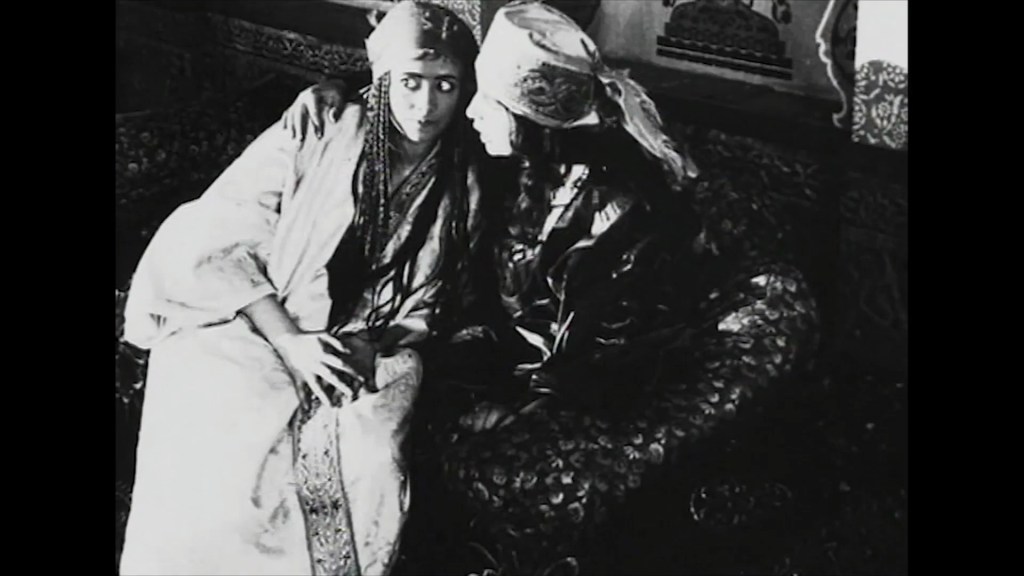
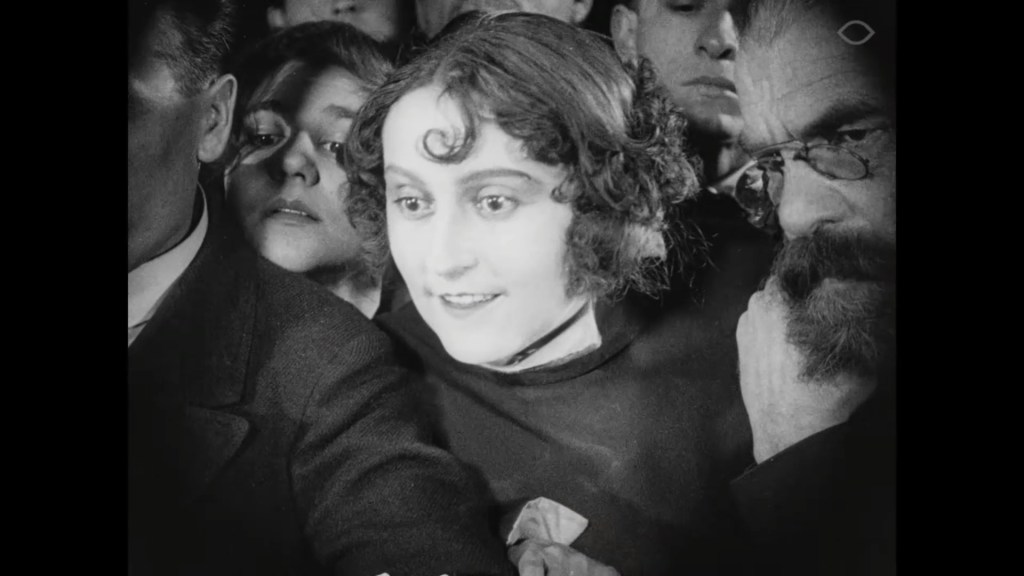
At the heart of the film is Rachel Messerer as Tyllai-Oi. This is, as far as I am aware, the first time I have seen this actress and she’s superb. She is incredibly striking on screen, and the film knows just how to frame her to make the most of her eyes, her glances over the shoulder, her looking and being looked at. Obviously, the film is silent – but there is hardly any dialogue (i.e. speech-based intertitles) to convey Tyllai-Oi’s thoughts or feelings. Everything therefore relies on her face, her gestures, the rhythm of her body on screen. Her one notable line of speech is that desperate note for help, written on a piece of material. It’s like a title in itself and, ironically enough, it is a message that never reaches its intended destination. She herself becomes a kind of readable text when her mother sees the bruises on her arm. In a film scripted by a woman, it’s interesting that the only people who seem to read each other sympathetically are a mother and her daughter. The men are not willing or able or interested enough to want to understand the women. Superficially, Said-Vali interprets his wife’s troubled look about Igor’s departure correctly: she does have a relationship with Igor. But this “relationship” is itself based on exploitation and abuse. Tyllai-Oi is a victim, not a perpetrator, of a betrayal of trust.

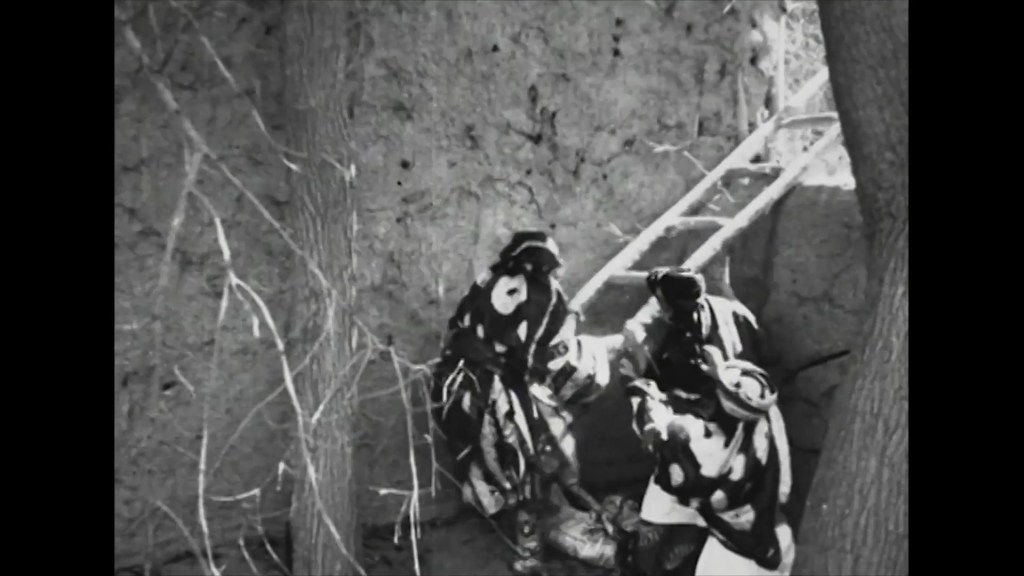
This is all the more moving for the few moments when Tyllai-Oi has a sense of privacy, or solidarity with another. We first see Tyllai-Oi upside-down, laughing, descending a tree, and this rare – even unique – scene of her joy is one shared with her mother, away from Ahmed-Bai. Later, she briefly enjoys the company of children and animals – but it is a fleeting moment of private pleasure, set in the midst of evens that will expel her from family, home, and society. She has no other form of personal expression in the film. Her dance, near the beginning, may make her smile – but it is an activity that is demanded of her by her parents, and it attracts the lusty attention of men, two of whom (Igor and Said-Vali) will exploit and abuse her. The camera seems to shake a little in time with the movements of her dance, as though we are sharing her bodily rhythm – but this, too, is contained within the montage by wider shots of Tyllai-Oi surrounded by the male audience. Later in the film, all her actions are commanded by or interpreted negatively by men. When she tries to dress to please her husband, he beats (and possibly rapes) her. When she is on her hands and knees, dusting his boots before he leaves the house, he doesn’t even look at her. When she writes a letter, Igor uses it to exploit her situation and rape her. All this places our sympathies firmly with Tyllai-Oi, with her mother perhaps being a secondary point of compassion. Everything in the film is geared to expressing the restrictions and limitations being placed on women in general, and Tyllai-Oi in particular.

More broadly, it must be said how good the film looks. Compared to the other Uzbek film this week, Ajal Minorasi (Day 2), Moxov Qiz is much more visually sophisticated and articulate. It also has more to say, and more depth to give to its main female character. Shot on location, it makes brilliant use of the town and the landscape around it. It also makes these spaces mean something. The film opens with a lovely montage of flowers, marshes, trees, streets, sunlight, musicians, people basking in the sun – but this idyll is short-lived, a moment of peace before the intrigues and tensions are laid out. The shady streets become threatening when Tyllai-Oi is fleeing her husband or her family, just as the open spaces of the landscape we see during the falcon hunt become a forbidding wilderness by the film’s end. The last sequence, in the rocky desert far beyond town, is a bleak and forbidding landscape. There is nothing for Tyllai-Oi here, and nowhere else for the drama to go. A sparse, brutal end to this brilliant, disturbing film. A real discovery for me.

Paul Cuff

Pordenone from afar (2024, Day 2)

Day 2 of Pordenone takes us to Uzbekistan for serial-style adventure, then to Mexico for bursting-at-the-seams melodrama. These films were totally unknown to me, and exactly the type of thing you would hope to encounter at a festival…

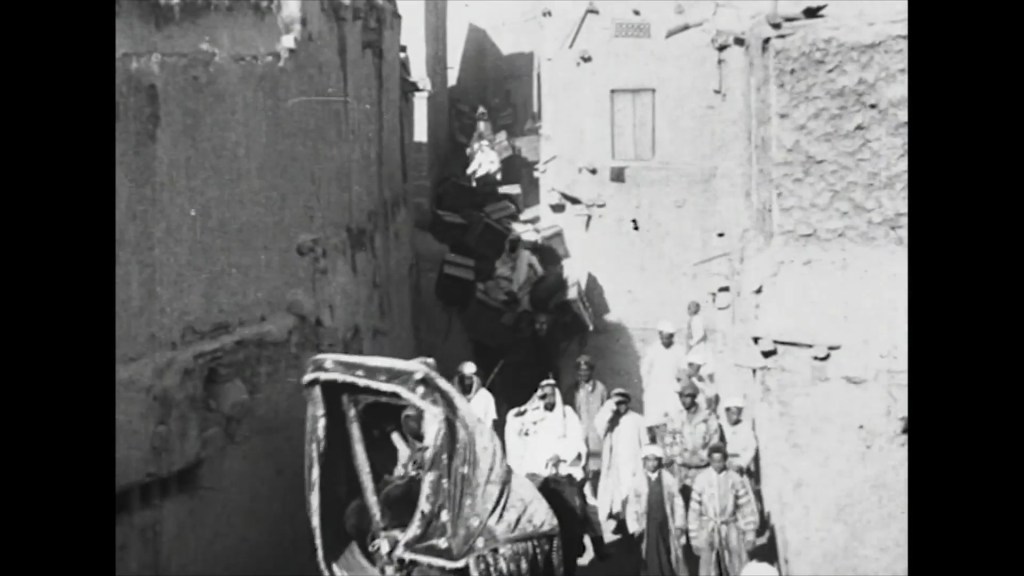
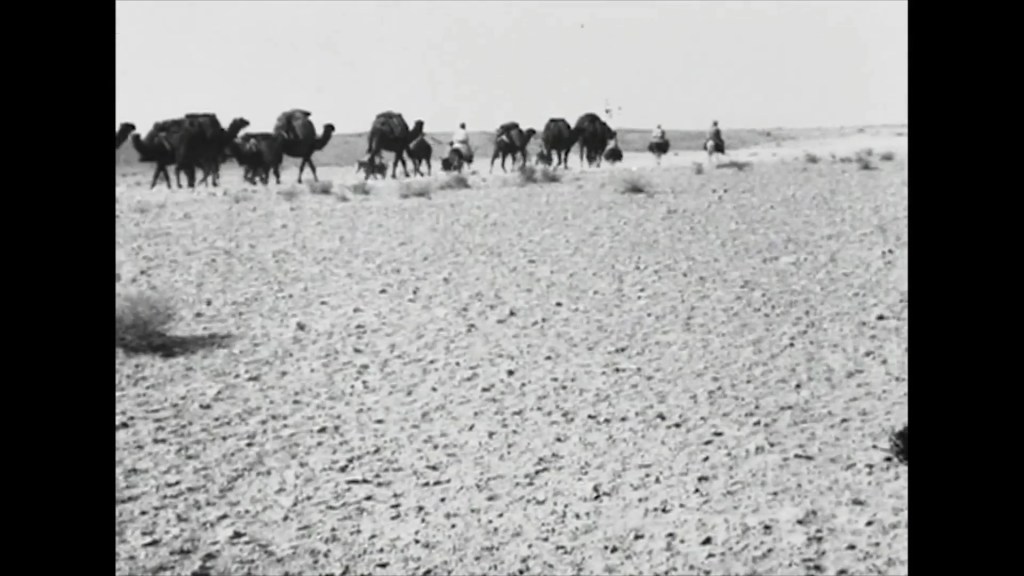
So, Ajal Minorasi/Minaret Smerty (1925; USSR/Uzbek SSR; Viacheslav Viskovskii). “The Minaret of Death” is a great title. Based, the credits promise me, on an ancient legend of Bukhara from the sixteenth century. Jemal (Nadia Vendelin) from the Khanate of Khiva and her Arab sister Selekha (Valentina Baranova) are travelling from Bukhara to Khiva, sent by Jemal’s uncle Khalmurad. En route, the caravan is attacked by Kur-Bashi, “Ataman of the thieves” (H. Abduzhalilov). The two women are captured, where they encounter Gyul-Sariq (Olga Spirova), who is herself in love with Kur-Bashi – and jealous of his attempts to woo the women. Gyul-Sariq offers to help the women escape, which they do – swapping their horses for camels to cross the desert. Meanwhile, Kur-Bashi is warned against Gyul-Sariq’s involvement in the escape and orders her death. In the desert, the knight Sadiq (Oleg Frelikh) is watching the road to Khiva, where he encounters the exhausted Jamal and Selekha. In Khiva, Jamal gives Sadiq her necklace as a token of thanks. Months later, the Emir of Bukhara (A. Bogdanovsky) arrives with his son Shahrukh-bek (Iona Talanov) to celebrate a raid against Khiva. Among his captured prisoners are Jamal and Selekha. A contest is held to determine the winner of the prisoners. Sadiq is among the horsemen who compete, and he wins Jamal. But Shahrukh-bek fights Sadiq and recaptures Jamal to be “the queen of my harem”.  Selekha manages to get hold of a knife and tries to enlist the help of Sadiq. A Persian love potion is prepared to make Jamal submit, but Selekha goes to the Emir and tells him that Sadiq’s prize woman has been stolen by his son. Shahrukh-bek kills his father and blames Jamal. But the reign of the new emir is unpopular, and Sadiq rallies the local men to rally against Shahrukh-bek. His army attacks Shahrukh-bek’s fort, but it is too strong. Sadiq tries to negotiate, demanding all the prisoners be let free. But Shahrukh-bek sends his enemies to be hurled off a minaret. Happily, the women save the day, rebelling against Shahrukh-bek’s guards – and Sadiq is able to rescue Jamal on the precipice, from which Shahrukh-bek is hurled. END.
What a delightful oddity this film is. It feels like a multi-hour serial condensed into the space of a single episode. Months suddenly disappear in-between scenes. Characters are kidnapped, rescued, kidnapped, rescued, and imprisoned once more. Emirs come and go, armies assemble then vanish. There are traditional dances, harems, sudden accumulations of crowds, glimpses of deserts giving way to rivers and fields, strange buildings, swords brandished, cavalry charges. In the way of many serials, the whole thing veers from stodgy inertia to breathless action. Schemes are enacted before they’ve been properly elaborated, while deaths and betrayal suddenly switch the narrative to new directions.

Redolent of numerous (western-produced) serials set in the east, Ajal Minorasi has the great benefit of being shot on location in Uzbekistan. The towns, landscapes, and people look pleasingly unpolished. Everything has a dusty, sun-bleached reality that contrasts with the highly contrived drama playing out on screen. The film has a charming feeling of being scripted on the hoof and shot on the fly. There are marvellous glimpses of real faces and lives amid the hoopla of villainy and heroism, and though none of the lead performers have characters with any depth the two female leads have real presence on screen. The experience of watching this film was at once exciting, confusing, and confounding. I’m not sure when I would want to sit through it again, but I’m glad that I have.

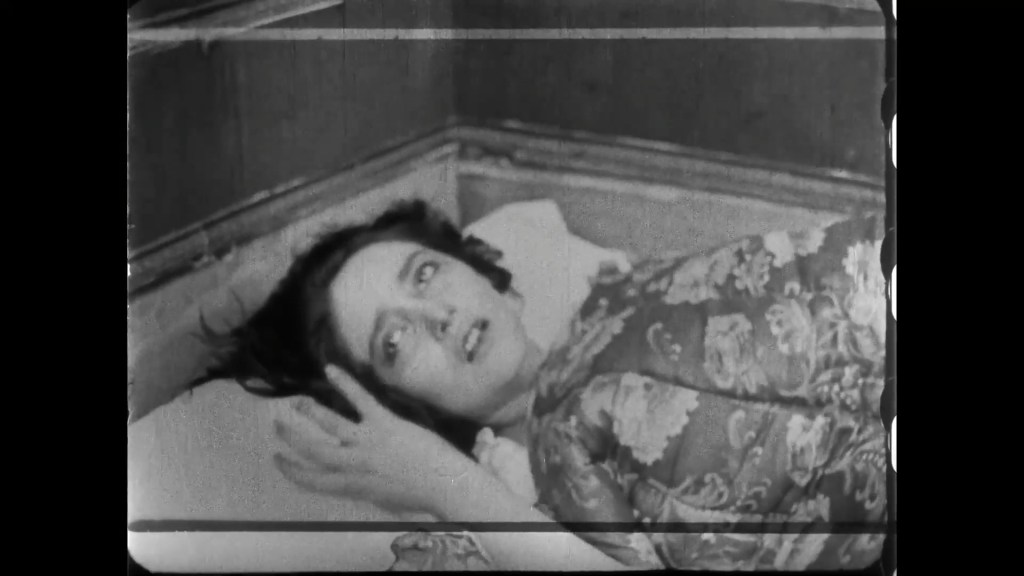
The second part of Day 2’s programme beings with Abismos (1931; Mx.; Salvador Pruneda), one of Mexico’s first films with synchronized soundtrack – but the latter appears not to survive. The fragment presented here has a piano accompaniment by José María Serralde Ruiz. As such, it is a curiosity: a sound film rendered silent by the exigencies of time, transformed into a new viewing experience in a silent festival. A woman approaches a prostrate figure on a bed. We see a bottle in his pocket. He is drunk. She tries to raise him. Another scene, at breakfast. (Already, we take it that the woman is the mother, the inert boy her son, and here at table an older daughter and the father.) A conversation unfolds, in silence, an awkward confrontation with the son. Another scene, an interior confrontation with a lawyer(?), then a cutaway to paperboys on the street. Something has happened, and the police come to confront the drunken youth. Now the son is behind bars. Flashbacks, fire, drink, guilt – and more conversations unheard. It ends.

Next, a fragmentary short: Como por un tubo o el boleto de lotería (1919; Cl.; unknown). A charmingly ramshackle, mischievous title sequence. The stars awkwardly superimposed behind a production logo, and another man – half-buried in straw – holds up a cardboard sign to credit the production company. On the streets, our main character is knocked out by a villain, who steals a baby and substitutes the unconscious man in its place. There are little groups of onlookers: are they extras or just curious bystanders? Glimpses of the sea, of streets, of the past. A series of peculiar incidents: a political speech, delivered for real then mocked by the comic; a brawl, a blackeye, a bit with a dog. The end.

Finally, our last feature of the day: Santa (1918; Mx.; Luis G. Peredo). The opening title announces the “first part of the triptych: PURITY” with “symbolic installations by Norka Rouskaya”. Wow. Symbolic installations? (“Actitudes simbólicas”) Yes please. Hit me! The film begins, seemingly in medias res. Marcelino, a soldier, mounted, on his way to Mexico City. (The screen warps and wanders in the frame. It’s like we’re viewing the film reflected in the depths of a well.) The girl waits, gestures. The men ride past. “Abandoned!” Four months later, “her sin revealed”, the girl – Santa – is ejected from her home. Her mother lectures her at great length (over the course of two titles) about Santa’s wickedness. Her mother says she is “smeared” with her daughter’s foulness.

Part Two of the triptych: Vice. And here are our first symbolic installations. The dancer, writhing with flowers in a park. It’s a very brief installation, for here we are in the metropolis: Mexico City. And here is Chapultepec. (Touristic views of the park, the streets.) Santa heads to Elvira (whole areas of backstory skipped, missing). Santa behind bars, praying for a return to her home and family. Hipólito the blind man (Alfonso Busson). Months pass. Santa gets close to Hipólito, who tells her his life story. (A single shot of an impoverished home.) Santa and “El Jarameño”, the matador, “make their lives exult”. Plenty of bizarre titles about female inconstancy, and Santa betrays El Jarameño while he is busy mauling cattle. He returns, finds Santa together with a lover, but his knife gets stuck and a painting of the Virgin Mary tumbles into view – triggering “his religious fanaticism”. Oh dear, now Santa is back to her “ways of vice”. Hipólito loves her. He pours out his heart in endless intertitles, says he is a monster to look at. Seconds later, Santa has gone through another lover – Rubio – and “under the attack of an insidious evil, [she] has become an alcoholic”. (We see her sipping wine with a reprobate.) Santa is rotted by sin, by crime, by the kitchen sink, and so the third part of the triptych, “Martyrdom”, begins.

Abandoned by all, sick, miserable, “useless”, Santa turns to Hipólito to help recover “the holy deposit”. (I think the film means her soul, but it sounds rather less sanitary.) He takes her to share his simple home (and boy servant). “We are all your slaves!” he says, to do as she wishes. She has an attack of piety, clutches his knees, has a brief repast, glugs back wine. A doctor calls. Santa has an incurable disease that needs an expensive operation. Oh dear, oh dear. Now she’s in bed, writhing, feeling that someone’s removing her bones, wanting to be buried by her mother in her home in Chimalistac. The operation. Lengthy procedural wrappings. Time passes. Hipólito waits. A crisis, just as she’s being stitched up. Bloody bandages. Oh dear, oh dear, she’s dead. Hipólito collapses over her body. She’s buried in her village. Hipólito tends her grave. The sun sets. Hipólito runs his fingers over the inscription on the tombstone and prays for her soul. END.

Well, what can I say to all that? The film is so rife with melodrama it appears to be coming apart at the seams. The image itself buckles and warps, the frame shifts awkwardly. The copy is fragmentary and hurtles forward at an even greater rate of dramatic velocity than Ajal Minorasi. The intensity of the drama is exacerbated by the state of the print: it’s like the film is fast-forwarding through Santa’s life, racing towards its inevitable conclusion. In this sense, I found it a far more gripping film than Ajal Minorasi, which seems almost stilted by comparison.

Yet I can’t deny that Santa is in many ways a cruder film. The way it’s staged and edited feels utilitarian, awkward, heavy-handed. There are far too many titles, which (when they are not explaining what we have just seen) are overloaded with information that the surrounding scenes do not – or cannot – register. It’s like paragraphs from a pulpy novel have been pasted onto the screen, regardless of the film’s visual world. The tone of these titles, too, veers madly between stilted exposition, religiose moralism, and pretentious verbiage. The “symbolic installations” (or what survives of them) are weird interruptions, failed attempts to elevate or exteriorize feelings that the film simply cannot express.

Elena Sánchez Valenzuela is a beautiful Santa and has a world of emotion in her eyes – but the film has no way of allowing us access to those depths, to the reality of her experience. Indeed, the film goes out of its way to suppress any alternative interpretation to the narrative other than that expressed by the titles. In this way, the whole film feels like some dreadful piece of Catholic propaganda made flesh. The woman is blamed at every stage of the way, condemned by her unalterable nature, an original sinner who must live out the awful consequences of her actions. Santa has a dreadful life, then dies a dreadful death. The film is based on Federico Gamboa’s eponymous novel of 1903. Gamboa is described as a “naturalist”, but I wonder how the tone of the novel compares with the film. Is it as moralistic? Does it judge and condemn Santa in the same way? Where are its sympathies, and what is its diagnosis?

If Santa is a crude film in all these senses, it is – perhaps because of its crudity – absolutely compelling. I was gripped by the mad pace of it, by the intoxicating brutality of its drama, by the ludicrous exegeses of its titles, by the peculiarity of its “symbolic” pretensions, by the textual (and textural) instability of its images and sudden ellipses of the fragmented print. Part of its success for me was the piano accompaniment by José María Serralde Ruiz: full-hearted, sincere, dramatic. Bravo.

So that was Day 2. A well-travelled day. I’m not sure how many silent films shot on location in Uzbekistan or Chile I have ever seen, and I’m very happy to have glimpsed these worlds on screen. Santa, too, offers some amazing views of Mexico City (even though they are entirely unintegrated into the narrative). In all these films, the sense of time and place vividly creeps over the images. It’s there in the faces, in the texture of the locations, in the light and dust of the streets and fields. Even at their crudest, they were interesting to watch. The only film that I didn’t get much from was Abismos, perhaps because of its peculiar status as a sound film without soundtrack. I can see (or assume) its historical value, but next to even the most fragmented of the other films it was oddly lifeless. But it was only a few minutes long, and it fitted with the rest of the programme, so I mustn’t complain. Day 2 took me to places I’d never been, and I’m grateful for the experience.

Paul Cuff