In 1921, Paramount set up what they called the European Film Alliance (EFA). It was staffed mainly by ex-UFA employees and designed to be a US foothold in the German film industry. It would guarantee US rights for German exports, as well as produce and distribute films. Thanks to the exchange rate at the time, they were 300% cheaper to make in Germany than in the US. The system was designed to bypass import restrictions: even if they were financed with US money, the films they produced were made in Germany and thus didn’t count as imports. All of which brings us to one of the major films made by EFA…
Das Weib des Pharao (1922; Ger.; Ernst Lubitsch)
The orchestral prelude sets the scene. The music is the original score, by Eduard Künneke: it’s music that is big, lush, flavoured with orientalist harmonies. The film’s main theme, first spelt out quietly in the strings, then loudly in the brass as the main titles appear. We are promised a drama in six acts. Everything suggests scale, length, expense…

The darkness splits open: a huge set of curtains part to reveal grovelling subjects. It’s a great effect, teasing us with the outside world, with the promise of mighty sets yet to be fully revealed. Cut to the Pharoah, Amenes: it’s Emil Jannings, looking meaty, immense, shaven. Here’s his chief advisor, Menon, played by Paul Biensfeldt—and played in a slightly arch, slightly camp, slightly comic fashion. He hands a scroll to Amenes. There follows the rather silly business of the intertitle showing us the hieroglyphic document, before a dissolve reveals the translated text. (Here’s the plot, folks…) King Samlak of Ethiopia wishes an alliance, and offers his daughter Makeda to Amenes for his wife—to seal the deal. Amenes chuckles. Menon joins in, but a little too much—a swift look from the Pharoah makes him cut his joy short.


Meanwhile, the construction of the treasury has gone awry. The chief architect, Sotis, enters to tell the bad news, begging for mercy (and time) for his workers to complete the job. But Jannings raises a threatening eyebrow, and the architect exits.
Outside: the conditions of the workers are causing unrest. Look at the way the womenfolk spill down the steps, beneath the huge walls of the city. Here’s the film’s budget on show: bricks, mortar, and extras. Hundreds of women crash like a wave at the bottom of the palace steps, then ascend; then stop; then recoil at the presence of the Pharoah. As the orchestra rumbles to silence for a moment, the crowd falls to its knees. A woman ascends the steps: “Think of the children!” she begs. The Pharoah, magnificently isolated in an iris-framed close-up, looks imperiously indifferent.


A priest advises him to make a sacrifice to the gods. Cut to a simply gorgeous interior, tinted red. Smoke trails drift up through the massive space, swathed in shadows. It’s a fabulous image, beautifully lit—an orientalist painting come to life. But when it comes to the business of what goes on inside such a space, the scene immediately loses some of its impact: for Lubitsch must cut closer to the fawning of Jannings & co. on the floor, holding silly poses. The sets are more impressive, more affecting, than the action here.

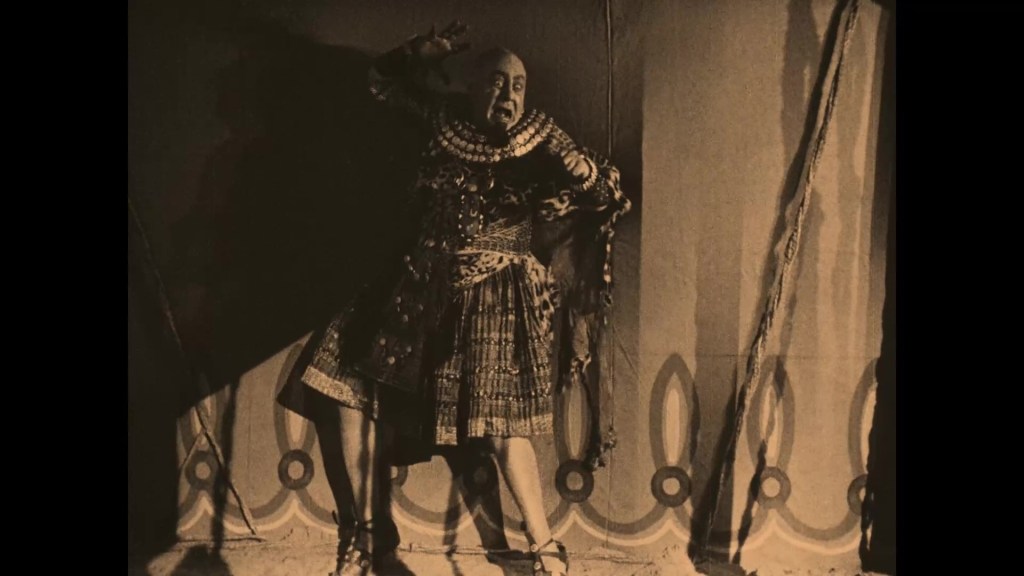
So, to the king of Ethiopia: Paul Wegener in (yes, it was inevitable) blackface. Wegener is a large man, and this is a large performance: the king is made comic, almost grotesque. His huge wig makes him a kind of dark lion, and with the huge feathers in his mane, and his body swathed in beads and patterns, he is eye-catching in every sense. His daughter Makeda is surrounded by maids. It’s a deliberately comic scene, and it is as though Lubitsch is trying his best to enliven these otherwise cardboard characters.


Cut to the river, where one of Makeda’s servants, Theonis (Dagny Servaes), is gathering water. On the river comes Ramphis and his crew. The music makes this more beguiling than the image suggests: for Künneke’s orchestra glitters and shimmers, suggesting both the rhythm of the oars and the light on the water (neither of which Lubitsch makes much of).
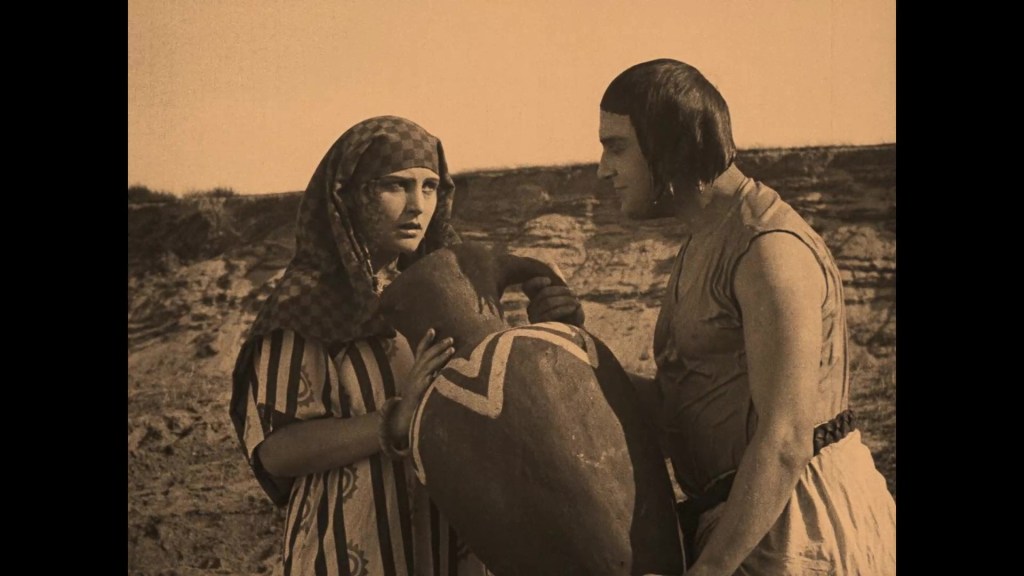
Ramphis (Harry Liedtke), a worker on the treasury, swims ashore—so taken is he with the beauty of Theonis. And the music swells and gives this faintly silly scene some heft. For it’s difficult to take Liedtke’s haircut and the slightly stilted performance of Servaes quite seriously. Theonis is like a walking sculpture: beautiful but awkward, moving to hold a pose. Ramphis is big, bold, recognizably human—but too showy, with no finesse. These two contrasting performances stand awkwardly next to one another on screen. It’s flirtation of a kind, but brief and unconvincing. Much of the ensuing material is missing, so we get stills and superb music: Ramphis and Theonis escape together and it’s the end of Act 1.
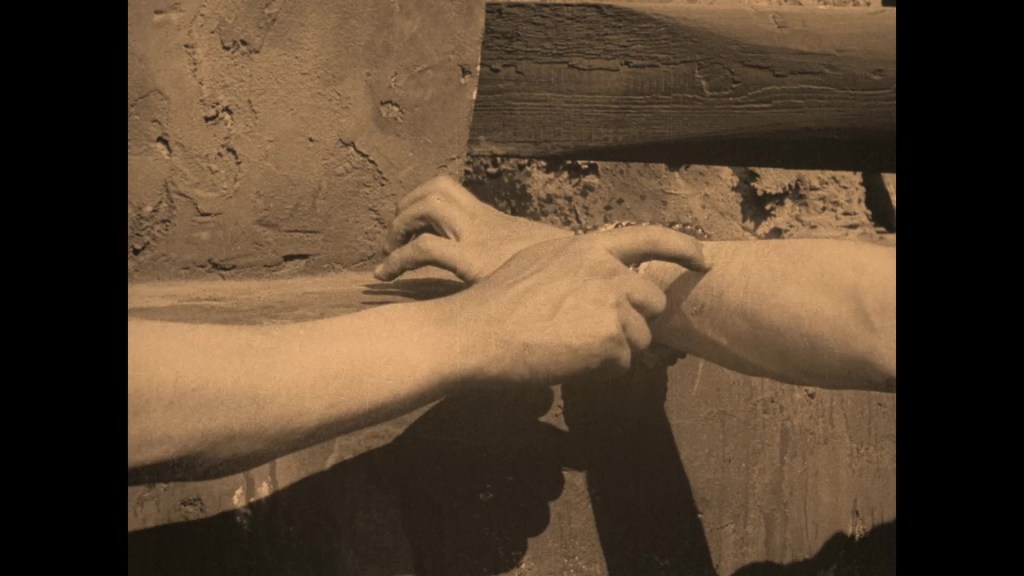
Ramphis’ father Sotis reluctantly brings accepts the Greek girl, and here—in this miniature sitcom of father, son, and new girlfriend—is the first glimmering of Lubitsch’s “touch” in this film. “Do you not even want to look at her?”, asks Ramphis, tickling his father’s arm. It’s a silly, sweet little gesture in the midst of all the massive sets, massive crowds, massive orchestral exoticism.
Speaking of which, here they are again: the exterior of the palace in all its massive glory, the crowds watching King Samlak’s arrival. Are we in a Fritz Lang film? Touches of DeMille, of Griffith—but perhaps the touches of campness in Biensfeldt and Wegener help to undermine the pomp of it all. For Wegener is very funny (if only he weren’t in blackface), his exuberance itself the point of this sequence: the two kings don’t quite get on. Jannings is reserved, gloomy, sinister. Wegener is all grand gestures, huge steps, swishing cloak (and what a fabulous piece of costume is the cloak). Cue massive crowds, huge throne rooms; living tableaux; piles of gifts. (Look at our budget! Look at our designs! Look at our extras!)


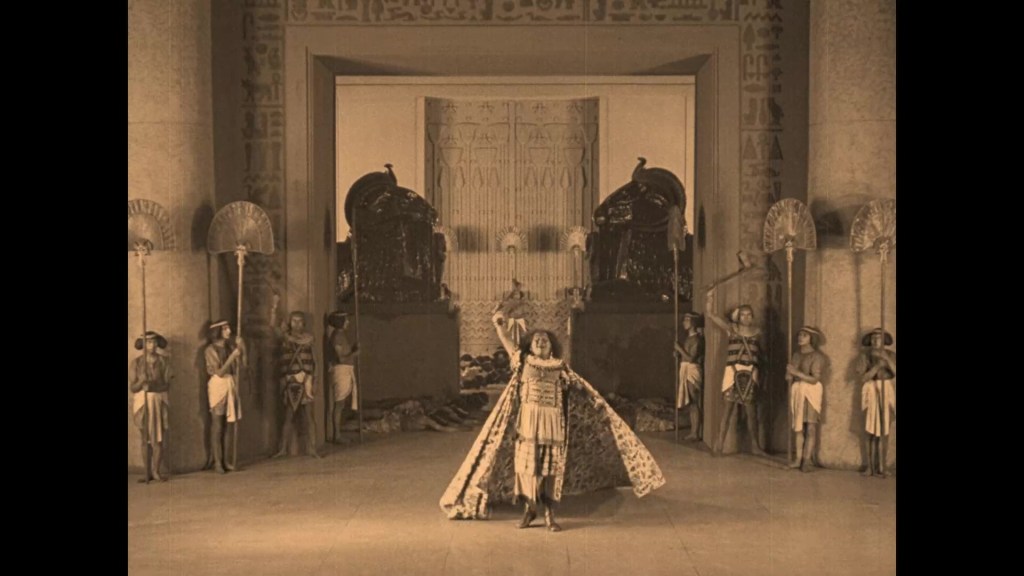


Thank goodness for the next scene. It’s all rather more Lubitsch, in the way we might come to understand him: two lovers under the eyes of a stern parent, flirtation over a boardgame. The music is also more relaxed, swinging into a lilting, almost music-hall style beat (Künneke’s strength was comic musical theatre, after all). But it’s also over all too swiftly, and feels underdeveloped. (Lubitsch would fashion a whole scene and several jokes out of this kind of set-up in later films.) Sotis is falling asleep, so the lovers wander off into the streets.
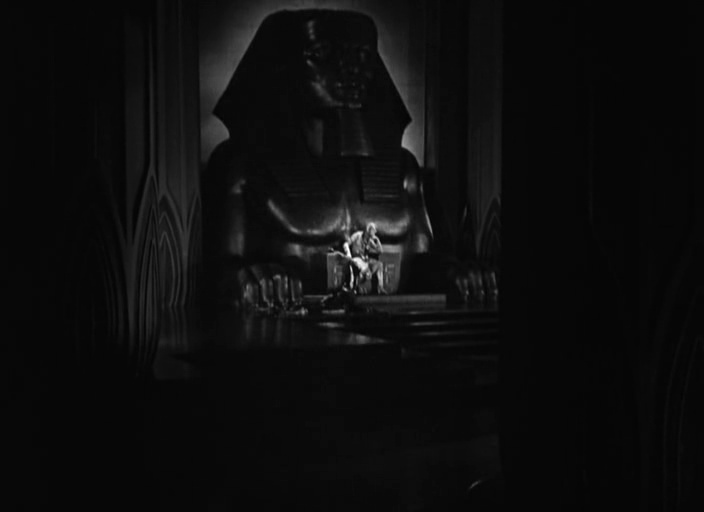
Meanwhile, the Ethiopian royals are interested in the treasury looming out of the gloom—a huge Sphynx head, that also overlooks the next scene of Ramphis and Theonis. Again, Künneke’s music makes the scene more than it is: the “love” scene simply isn’t intimate or moving. More successful is the approach of the lovers to the treasury, which (we have already been told) is a capital offence. They are caught and brought before the Pharoah, who immediately falls for Theonis.


I say “falls for”, for that is a literal description of the plot turn: but it’s a look of almost comic lust that overcomes Jannings as he gazes at the girl. It’s one of many instances where the performers (and, as ever, the music) are working hard to tell you what’s happening when there is so little emotional nuance to make you feel what’s going on. End of Act 2.
The musical introduction is simply gorgeous, more moving and enthralling than what’s on screen. What’s on screen is the Pharaoh’s attempted seduction of Theonis. He offers to spare Ramphis’ life if she will submit to the Pharoah. The girl throws herself against the wall. The Pharoah falls back, looks sad (well, frankly, he looks constipated). It’s like watching an opera, only the characters aren’t singing. That’s the issue: the emotion isn’t coming from the performers. They are gesturing correctly, moving correctly, doing everything that you should expect: but it all seems like they’re going through the motions. They’re not transmitting anything. There is no depth. It’s all surface. The wonderful music makes this all the more apparent: the score is doing all the real work, fashioning all the real emotion. Which is fine, but shouldn’t we be getting something from the screen? More than just the great lighting, the great sets, the great show of composition and shadow? You can’t just blame Jannings for what’s happening: it’s Lubitsch’s fault too. Can he help it? Surely he can, for both the historical setting and the performance of Jannings works much better in Lubitsch’s earlier Anna Boleyn (1920). In that film, the king’s smile means so much more: the fear that his smile instils. To be a woman and smiled at by Henry VIII is a kind of death sentence. It’s a fantastic way of uniting a kind of Lubitsch “touch” (the suggestive smile) with the historical drama (the lethal consequences of the smile). In Das Weib des Pharao, there is no complexity or nuance. I believe in Henry VIII as a character, but I do not in the Pharoah Amenes.


Here is Jannings, moping in the gloom, then moping in the dawn. The sun rises. We see the real sun, then the effect of the light entering the Pharoah’s chamber. It’s beautiful, but it’s—what? It’s superficial. What is the effect for? It makes me think of a scene change in act one of Verdi’s opera Jérusalem (1847), which consists of two minutes of music, a musical depiction of sunrise (in the score, the number is simply called “Le lever du soileil”). The scene is not in the original, Italian, version of the opera (I Lombardi¸ 1843). The French version of the opera was refitted for the sake of the bigger budget, bigger stage, bigger effects at the Paris Opera. Verdi wrote the sunrise scene in Jérusalem purely for the sake of the set designers showing off how they could produce a lighting effect on stage. As it happens, Verdi also takes spectacular advantage of the expanded orchestra he could use at the Paris opera: wonderful, deep blasts of sound from the trombones (not in the orchestra for the Italian version of the score) underpin the sunrise sequence, allowing it to both blaze and boom at the same time. But despite how great the music is, it’s there purely to show off what’s on stage: nothing happens in the scene other than the visual effect. So too in this scene in Lubitsch’s film. There’s no point to this other than to show time has passed: it’s there really to show off a lighting effect. And the lighting effect is great, don’t get me wrong. But what’s it doing? What’s it bringing? It’s cool to look at, and Künneke does something similar to Verdi in his orchestration of this sunrise, but it doesn’t make me feel anything. It’s just stuff happening.

The execution is about to take place, a huge edifice to lower a giant slab onto poor Ramphis. Again, it’s great to look at but not dramatic enough. There’s no real tension (unlike, for example, Griffith’s famous execution sequence in Intolerance, made several years earlier), and the plot swiftly moves on: Theonis accepts the Pharoah’s deal. So the Pharoah half-mopes, half stumbles to his new bride and mutters “I love you!” in one of the least convincing “I love you”s I’ve seen in a while. Again, it’s not Jannings’ fault: what can he do with this script? It’s all gesture, as cardboard as the characters. It moves correctly, is constructed correctly, but has no nuance, no depth, no feeling.

So too with the next scenes, of Ramphis being taken away, of the Ethiopians’ anger, of the marriage itself: beautiful lighting, great music, but… To paraphrase Wagner (writing on grand opera, the genre of Verdi’s Jérusalem), it’s all “effects without cause”. So too with Ramphis at the quarry, where he’s sent in punishment. Nothing here convinces, despite the scale: the fighting is perfunctory, the weapons too well designed for their silhouette (nice crescent!) and not for their usage (crap swing!). Weirdly, the sight of half-naked workers with silly haircuts wielding clubs reminded me of nothing more than the early scenes of Carry On Cleo (1964). Lubitsch finds some great angles to show off the scenery, but the film has already lost me emotionally—I simply don’t care that Ramphis escapes.
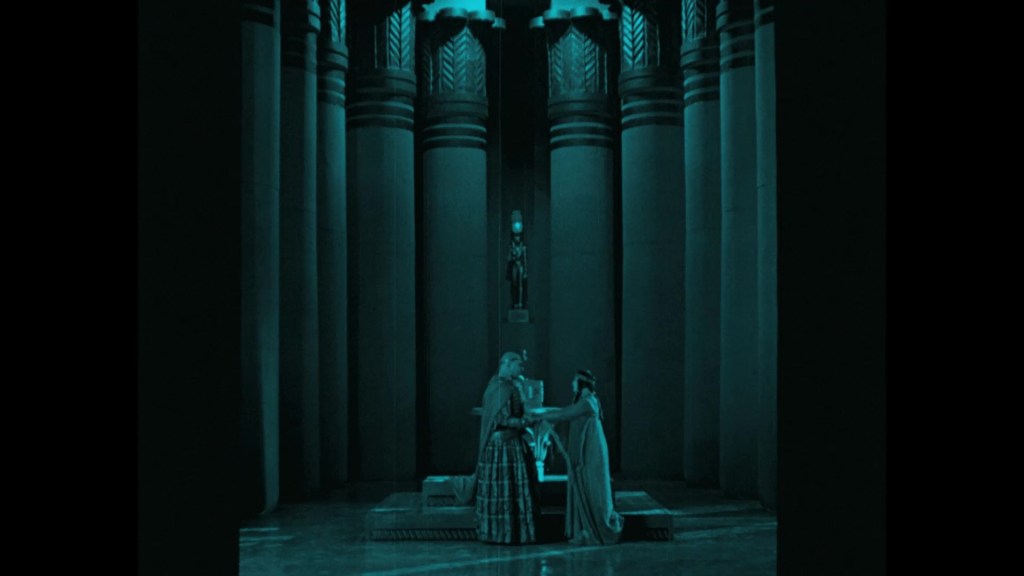

The new queen goes down well with the populace: she eases tensions by embracing the worker’s child earlier shunned by the Pharoah. But now the Ethiopians are invading, and the treasury workers are rebelling. Time for Jannings to start ramping up his performance. He’s obsessed but weakening, powerful yet grovelling before his desires. (Künneke’s music belongs to a far better film in these scenes, or at least to an opera where the Pharoah might sing convincingly—even if the words are tripe. Here, it is only Jannings falling about on set. It’s not the film’s silence that’s the problem, but the fact that it doesn’t utilize it fully.) So jealous is he that when Theonis refuses to swear loyalty even unto Amenes’ death, he entombs her in the treasury. The Pharoah then forces Sotis to show him the secret entrance, then blinds this poor architect so no-one else will ever be shown how to find it. It’s all pretty gruesome, but even that fails to entice. The stakes get higher, and so do the number of extras: every spare hand is crowding the screen as the Egyptian army is led out.


Ramphis finds his blinded father, but I am not moved. The armies fight, but I am not moved. Amenes is defeated, but I am not moved. Ramphis finds his way into the Treasury, but I am not moved. But yes, I am obliged to say how well-lit it is here—this chiaroscuro tomb, this incredible set, those steps cut out of the night, that glowing bier laid out at the base of the image. But what’s the point when the drama is now so unenthralling? Ramphis lifts a knife to kill his former lover, still believing her to have betrayed him. What can Harry Liedtke do to make this scene work? Not this, not those bulging eyes, not that moribund gesture. No, no, no. The story seems to want to become a kind of savage epic, but it has nothing of the sustained, brutal horror of Lang’s final scenes of Die Nibelungen: Kriemhilds Rache (1924)—though Kriemhild herself looks rather like Theonis does at times in Lubitsch’s film, with those long plaits and cool demeanour. So we watch Ramphis turn into a leader, hide the population from the Ethiopians, then launch a winning attack—and we feel very little. End of Act 5—and I’ve already lost track of where the other acts went.




The “judgement of the dead” on Amenes. It’s another fabulous image: the stillness, the smoke, the silhouettes, all back-lit perfectly. So the old pharaoh is obliterated from public memory and Ramphis is proclaimed the new king. But Amenes is back! He’s not dead, and now Jannings stumbles back in a new guise: the dishevelled, comic, grotesque remnant of nobility. (He’ll play this kind of part infinitely better, in an infinitely better film, Murnau’s Der letzte Mann, in 1924. That’s the kind of film that makes best use of Jannings. See also Sternberg’s The Last Command (1928).)
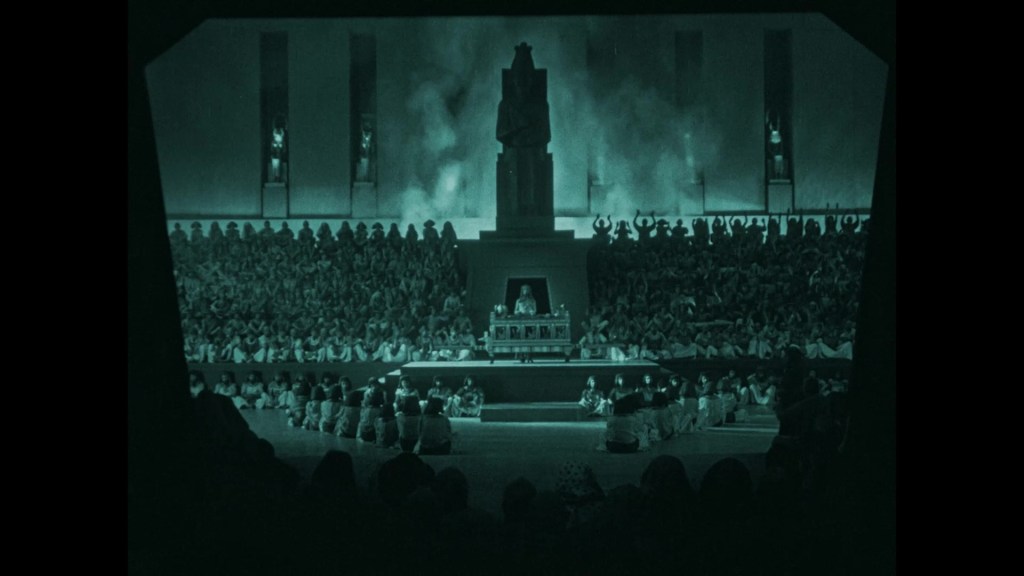
Amenes shows up in time for the giant celebrations, made spectacular in the scale of sets lit by torchlight and tinted pink and green. But who believes him? Machinations take place, gestures are made. Ramphis responds with even broader gestures, broader eye-bulges. He must make way for Theonis’ true husband. She acquiesces. The crowd reacts. They don’t like it one bit!


The denouement wants to be Shakespearean—the usurped king returned, the queen defiled and stoned to death with her lover, the restored king dying and falling from the throne as the crown is placed on his head—but it’s a strangely underwhelming ending. Everyone dies, but I’m not moved. I’m not even shocked, as in Kriemhilds Rache, which is similarly brutal to its main cast but with far more bite, more purpose, more panache. So Jannings lies dead at the base of the dais, and the orchestra thunders out its main theme. ENDE.


Das Weib des Pharao is an interesting film, historically. A flagship production for EFA, it remains a startling instance of Germany making a Hollywood-style ancient spectacle along the lines of DeMille. Indeed, this German film received its world premiere in New York in February 1922—it’s Berlin premiere was in March. But despite its scale and the effort put into its exhibition, Das Weib des Pharao was only moderately successful in America.
I looked to see what coverage the film got in Variety, which does indeed relay the release of “Loves of the Pharoah”(as Das Weib des Pharao was renamed for the US market). Lubitsch made his first trip to America for the film’s premiere, but it didn’t go well. In an article titled “German director, Lubitsch, regarded unkindly, he says” (I love that “he says” in the title!), we read: “Following a long conference among Famous Players officials and his friends, Ernest Lubitsch, the German director of ‘Passion’, ‘Deception’ and other foreign film spectacles, sailed for home, giving as his reason he was regarded as an unfriendly person and an enemy of the American actor” (Variety, 3 February 1922, p. 45). The article cites “unpleasant, if not threatening” letters and phone calls lodged against Lubitsch, so it’s no wonder he didn’t bother to attend the premiere. Interesting to note that at this time Lubitsch is known as a director of “foreign film spectacles”, the article citing Madame DuBarry (1919; released in the US as ‘Passion’) and Anna Boleyn (1920; aka ‘Deception’) as his most noteworthy films. The piece continues: “His decision again brought to light the situation as to German films here and the very slight effect they have had on American conditions. Bookings of ‘The Cabinet of Dr. Caligari’ have been only $78,000 up to last week, and the comparative flop of ‘Passion’, ‘Deception’, ‘The Golem’ and others has been commented on” (ibid.).
Clearly, Das Weib des Pharao was up against some stiff competition. It was also being reshaped for the US market. Variety reveals that “Loves of the Pharoah” has “been given a happy ending by the simple expedient of leaving off the epilog” (ibid.). In March, Variety reports that the film was “running continuously noon till midnight, played to almost $8,500 in five days, at 50 cents top matinees and $1 nights” (3 March 1922, p. 46). But it was also up against Rex Ingram’s The Four Horseman of the Apocalypse (1921), which was still raking in nearly $40,000 per week—a whole year after its premiere. Stroheim’s Foolish Wives (1922) was also in cinemas, making steady (if not spectacular) money.
Das Weib des Pharao stands as a testament to the ambition of Paramount’s European enterprise, and to its failure. EFA only lasted one year, going bankrupt (amid much scandal) in 1922 after producing just five films, none of which had the hoped-for success. The failure of EFA to establish a US base in Germany led to a different strategy, one that would reshape the industry landscape by the end of the 1920s. Rather than take Hollywood to Europe, Europeans would be lured to Hollywood: cue the great wave of European talent arriving in Hollywood from the mid-1920s onwards. Including, of course, Ernst Lubitsch.
By the time he arrived, the kind of cultural feedback loop (Hollywood influencing Germany influencing Hollywood) exemplified by Das Weib des Pharao was already bearing fruits. DeMille’s The Ten Commandments (1923) was surely influenced by the set design and scale of Lubitsch’s film. Having just now refreshed my memory of DeMille’s film (see below three images from the film), it makes a curious companion piece to Das Weib des Pharao. The Ten Commandments is (spoilers alert) sanctimonious guff of the highest order. It’s worth stating that Lubitsch’s film is free of the nasty, preachy ideology of The Ten Commandments. You might want to read the violence and mob mentality of portions of Das Weib des Pharao in terms of contemporary politics in Germany or elsewhere, but the film surely has no real interest in complex analogies or political subtlety. If it does, it’s so superficial as to be without impact. If this is me finding another “lack” in the film, I much prefer its lack of politics to the puritanical, vengeful grudges that DeMille’s film nurses against its characters. The Ten Commandments certainly has a message, but it’s one of the crudest imaginable.


The score for The Ten Commandments was written by Hugo Riesenfeld (1879-1939), who had also compiled the music for “Loves of the Pharoah” in 1922. Riesenfeld was an Austrian composer who had emigrated to America in 1907, becoming a prolific composer and arranger of silent music scores. Among many others, he wrote music for films by DeMille, Raoul Walsh, James Cruze, Frank Borzage—but his most famous (which is to say, most heard) score was for Murnau’s Sunrise (1927). I presume that Riesenfeld may well have compiled his score for “Loves of the Pharoah” without Lubitsch’s supervision. (Though he would have the chance to consult the director when he arranged the music for Lubitsch’s last silent film, Eternal Love (1929).) Riesenfeld’s score for “Loves of the Pharoah”, like that version of the film itself, is not available for study—and I can find no information whether the music survives or not.
However, what does survive is the score Lubitsch himself commissioned from Eduard Künneke (1885-1953) for the film’s German release. Like his contemporaries Franz Lehár (1870-1948), Oscar Straus (1870-1954), and Emmerich Kálmán (1882-1953), Künneke was famous as a composer of operettas. And though these composers’ chosen genre remains classed as “light music”, each of these figures were superb craftsmen. (For me, Lehár is one of the supreme musical talents of the early twentieth century.) By 1920, the symphony orchestra was the most amazingly diverse instrument, and just because a composer specialized in “light music” didn’t mean they handled the orchestra any less well than a composer of symphonic or operatic works. Künneke achieved his greatest hit with Der Vetter aus Dingsda (“The Cousin from Nowhere”) in April 1921, so his engagement on Das Weib des Pharao later that same year was when he was at the height of his popularity. His score for Das Weib des Pharao shows his talent not merely for sumptuous orchestration and “big” sound, but also for lighter, more lyrical sections—even a moment or two of comedy. Though Künneke would write music for German sound films (including adaptations of his operettas), Das Weib des Pharao would be his most substantial film score—and, indeed, his longest purely orchestral work. (Anyone seeking to hear more Künneke could do no better than find his few other orchestral works: a charming piano concerto and his orchestral Tänzerische Suite from 1929—the latter a purely delightful example of Weimar-era popular dance music.)
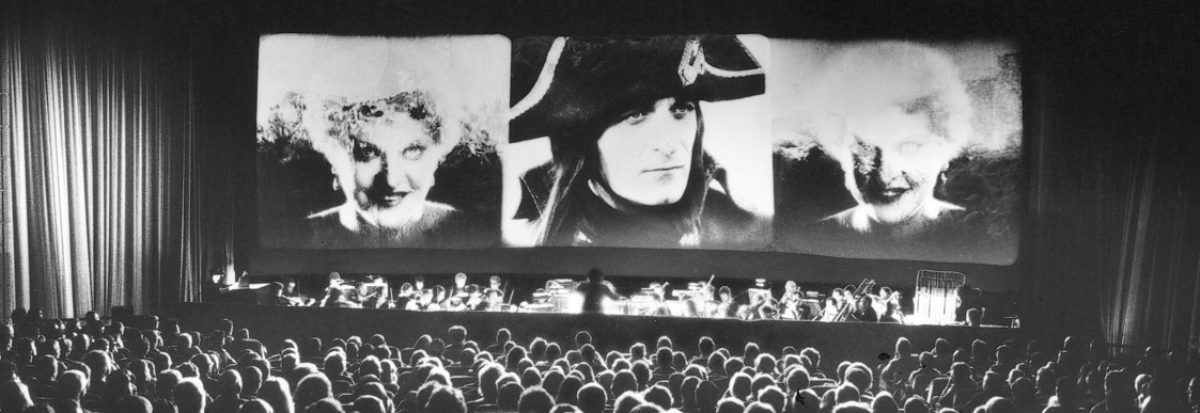
A final word on the 2008-11 restoration of Das Weib des Pharao. The German Blu-ray is a superb presentation of the film, coming with a huge range of language options for its titles (all of which are coded as subtitles, but designed to appear as full titles on the screen—all rendered in the appropriate style and colour). The image and sound quality are excellent, and this is an exemplary version of a silent film on home media. And one of the most interesting extras on the disc is a filmed concert of the main feature, allowing you to experience Das Weib des Pharao as a primarily musical event. You can see how complex is the interaction of conductor, players, and image—and how the notations of the score are modified to align sound with image. I wish all major releases of silents had this option: it reminds us that this isn’t a soundtrack but a performance, that the context for the music was in its live presentation before audiences. This version of Das Weib des Pharao is (excluding the Vitaphone soundtrack for Eternal Love) the only release of a Lubitsch silent with its original musical score. How many others survive, and how many other companies will take the trouble to record the music with such care and attention?


I’ve made my views clear already, but just to reaffirm: Das Weib des Pharao isn’t a great film. It’s great to look at, but not to sit through. I’m very happy for others to write about the sophistication of its design, its use of crowds, the influence of (for example) DeMille and (more generally) Hollywood staging and lighting on this German film made with American money—all this is true and interesting, but what counts ultimately (at least, for me) is that the film isn’t affecting, moving, enthralling. Without a genuinely emotive human drama at its centre, all the many fine qualities of this production are for nought.
Paul Cuff

 The Realm of Silence