Der Geiger von Florenz was the sixth film directed by Paul Czinner and the third to star Elisabeth Bergner, whom he later married. It’s also the first of Czinner’s silent films to be released on Blu-ray. Given that my last experience of Czinner’s silent work was the shoddy copy of The Woman He Scorned (1929), I was keen to see his work in high definition. I was also intrigued to see Elisabeth Bergner as the lead, a very different star to Pola Negri.

First, the plot—and yes, as ever, I spoil everything. The young Renée (Elisabeth Bergner) is deeply attached to her father (Conrad Veidt) and deeply jealous of her stepmother (Nora Gregor). After numerous petty squabbles, Renée is sent away to a ladies’ finishing school in Switzerland. There, she rebels against her teachers and runs away, disguising herself as a boy in order to cross the border into Italy. While roaming the streets, she encounters an old violinist and asks to play his violin. As she does so, a car pulls up and the artist (Walter Rilla) and his sister (Grete Mosheim) are entranced by the image of this beautiful young player. Renée goes with the siblings to Florence, where she becomes the subject of the artist’s paintings. The painting of the anonymous “Fiddler of Florence” is published and seen in a newspaper by Renée’s father, who seeks out his missing daughter. Renée’s identity as a woman is revealed, as is the mutual attraction between her and the artist. Renée’s father arrives in time to bless the couple.
At a little over eighty minutes, the film is a seemingly simple drama: light, charming, faintly silly. But it has plenty of telling details that cumulatively make for a surprisingly complex engagement with the complexities of desire and gender.
The daughter/stepmother jealousy plays out in the very first scene: at her father’s desk, Renée substitutes a photo of her stepmother for her own—and destroys the image of her rival. At the dinner table, she replaces her stepmother’s choice of flowers with her own enormous bouquet, which she then moves to try and block the conversation between father and stepmother. The rivalry is then played out through two rival dogs: Renée feeding her own dog, which then ends up attacking the stepmother’s dog under the table. The whole trio tries to placate the dogs, one of which bites Renée’s father—the two women gather round with medical boxes, bandages etc. It’s a comic sequence, a snowballing farce than ends up with everyone chasing around the house.


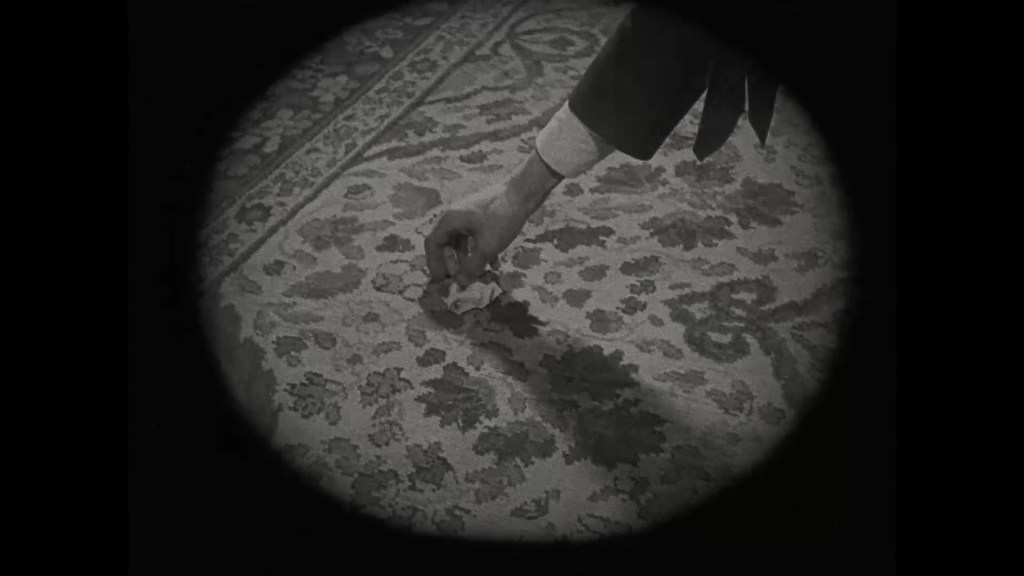


All this is told through images. But when Renée sees her father alone outside, clearly depressed, she commits her thoughts to her notebook. The film then offers us a lot of contextual information through this written text, then through two flashbacks. We see Renée on holiday with her father in Italy, where she embraces him and says that “If you weren’t my father, I’d marry you”. Then, when her father spots the woman who will become his second wife at the next table, Renée keeps moving her parasol to block their eye contact. It’s the same trick she pulled with the flowers earlier in the film, and the history of their fraught daughter-father-stepmother relationship confirms the impression that it’s effectively a love triangle. Outside, the stepmother joins the father. She issues him an ultimatum: either Renée goes, or she does.


Renée’s desire for her father is epitomized in the next scene, when her father comes to say goodnight. Renée eagerly pats the bed, but her father pulls up a chair. Renée is visibly crestfallen, and the sustained close-ups of her face in the ensuing conversation show the waves of emotion passing over her. Bergner’s face is wonderfully expressive, her eyes beautifully lit: they seem huge, and you seem to fall into them in these close-ups. Indeed, much of the film is spent watching Bergner’s expressivity. Her performance is incredibly animated. She’s scheming, or emoting, or running away, or hurling herself away in shock or fear or despair or delight. The framerate of the film is faster-than-life throughout, apart from one section of slow-motion. Thus, Bergner’s movements are all exaggerated. It’s as though the film itself shares the energy and ferocity of her teenage emotional life. Even in these close-ups in her bedroom, her face becomes the sight of tremendous emotional activity—condensed in her luminous eyes.


Promised another Italian holiday if she behaves, Renée tries to make things up with her stepmother. We see her in the next scene approaching her rival as if attempting to seduce her: she creeps along the wall, nervously—or is it flirtatiously? Then she helps make a punch, urging her stepmother to make it stronger and stronger. So they get very rapidly tipsy and start to dance with each other. Enter Renée’s father, who is offered cups of punch by both women. He pushes away Renée’s hand and drinks from his wife’s cup. Renée hurls her glass of punch at her stepmother. There’s a kind of savagery in this action: the violence of the gesture contrasting with the primness of the weapon.


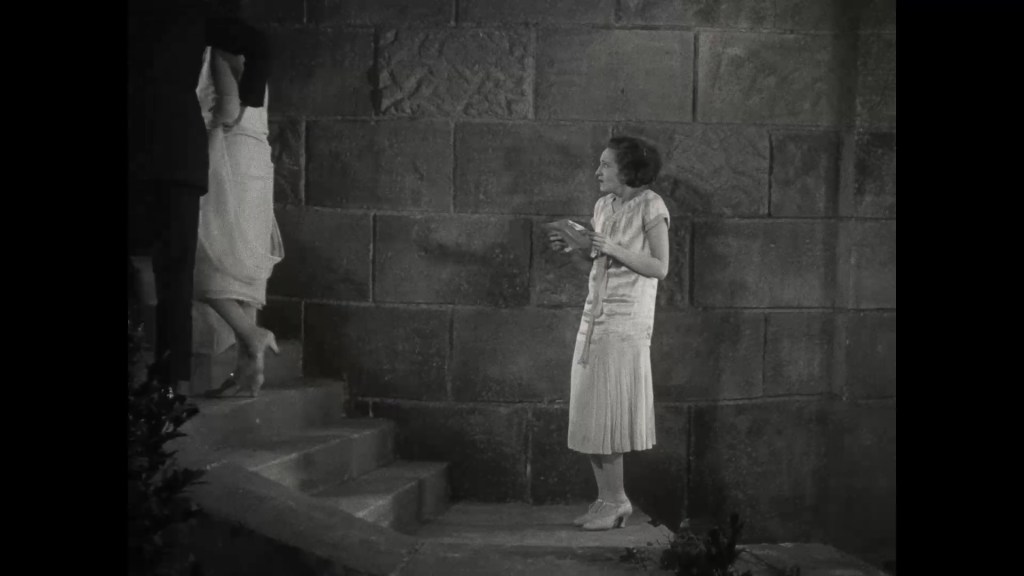
So Renée is sent to Switzerland, where we see her writing of her sadness at her confinement. The film has skipped forward here, for Renée has already made an enemy of her tutor. We see her wipe away a chalkboard announcement of her punishment and draw instead a caricature of the tutor. In another riff on the dog theme seen in the opening scenes, Renée has better command over the tutor’s dog (called Fellow) than the tutor herself. Renée waits for a letter from her father to rescue her, but instead a letter arrives that says she must stay put. Perhaps Czinner was conscious of how much letter-writing (and thus letter-reading) there has been in the film in this section, for he provides a gorgeous visualization of Renée’s emotions as she reads here. She is on a bench in parkland and the wind whips the trees all around her as she wanders forlornly back and forth across the grass. It’s a lovely scene, and a relief that Czinner finds a way of visualizing feeling again, not having to rely on more text.


At night, Renée escapes—wearing an extraordinarily eye-catching plaid outfit and hat. Thankfully, after failed attempts to cross the border to Italy via train and road, she is able to swap clothes with a young peasant. In male clothing, she crosses into Italy and roams freely along the beautiful mountainside roads. For such a short film, Czinner gives plenty of time to Renée’s wandering here: we see the landscapes around lake Lugano in dazzling sunlight. The haze of the vistas interacts beautifully with the grain of the filmstock. You can understand why Czinner lets the film’s plot meander here, it’s lovely to look at—with Bergner’s tiny figure, dressed almost as if from a previous century, providing scale and narrative punctuation to the landscapes.


She eventually encounters a beggar playing a violin by the roadside. Convincing him to lend her his instrument, she begins to play—just as a motorcar draws up alongside. The driver and his companion seem to take a fancy to this strange figure, dressed in peasant clothes, striking a pose from another age. The man is an artist and wishes to paint the “boy” violinist. Renée readily agrees. There follows a lovely (and again, surprisingly lengthy, given the film’s short length) segment where the camera sits behind Renée and follows her journey to Florence. It becomes a travelogue documentary, the film simply cutting as it wishes to segue from one view to the next. It’s always fascinating to glimpse the real streets of the 1920s, with ordinary people moving aside for the car and glancing at the camera as it passes.


But the levels of artifice are foregrounded in what follows. At his glamorous estate in Florence, the artist is transformed from an apparently old, grey-haired man into a youth. For the grey of his hair, and that of his female companion, is merely the dust of the roads. Renée is startled by their transformation, just as she is frightened when the artist demands that “he” too must be scrubbed clean. Renée’s own transformation into the suited “boy” is greeted with curiosity by both her hosts. She is an object of fascination and flirtation by both the man and woman. They are siblings, but Renée doesn’t discover this until she has already fallen for him. She poses as the “fiddler”, and Czinner turns the posing into a lengthy sequence for Bergner to express her fidgety, restless character. She cannot stand still, and the artist grows irritated. So Czinner makes this frustration into a little marvel of cinematic magic: the camera is over-cranked, thus slowing the film for us in projection. Renée’s restless movements become a strange dance, the film finally finding a way of slowing her down, of capturing her for our gaze.


The peculiarities pile on, however, as the artist’s sister grows jealous of his new muse. It’s the artist’s turn to be offered two cups of punch, and when he chooses Renée’s, his sister throws her drink at Renée. This reverse of the scene with Renée and her stepmother reminds us of the weirdness of the film’s emotional path. Renée seems keen to be adopted by what she takes as an older man, only to find him a young man. The artist thus attracts her as an image of her father, then wins her over as a different kind of male figure: Renée transfers (at least some of) her affections from a familial to a romantic object.


But the film isn’t as neat as that sounds. For the brother-sister relationship of the artist and his sister is also weirdly intense. Renée sees them embracing in the garden and it’s not just her who wonders just how close this couple might be. And the sister not only flirts with Renée when she is disguised as a young man, but also reveals Renée’s femininity by placing her hand on Renée’s breast and embracing her. Thus, wherever you look, the film offers unusual and interesting couplings, or the potential of unusual and interesting couplings. Besides, what kind of disguise is Renée’s outfit? And for what do we or the characters take her? She is androgynous by virtue of her clothing but also by her age: she is not quite a woman, not quite a man, not quite a girl, not quite a boy.


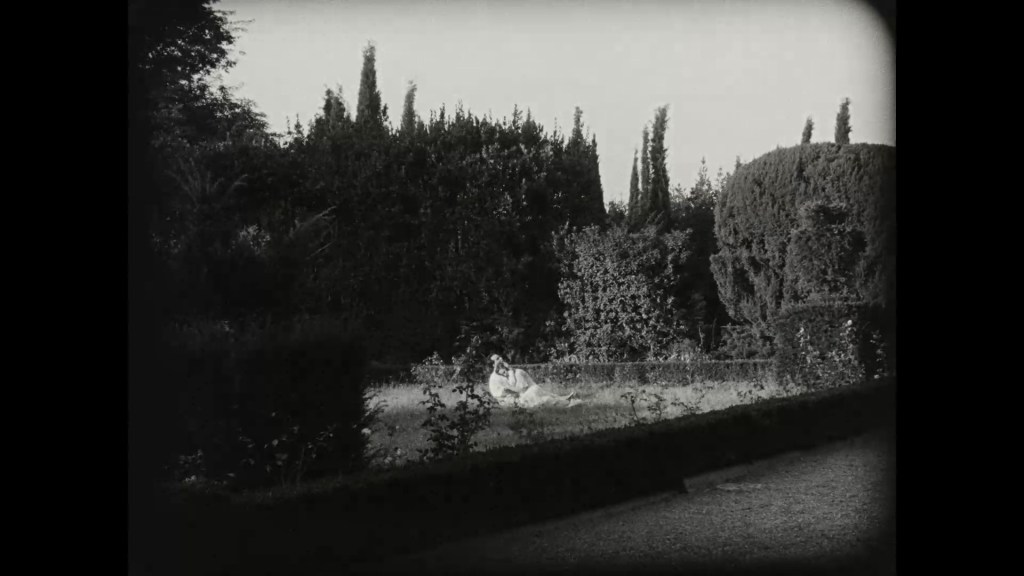


The word to describe all this is doubtless “queer”. It’s a queer film whose brevity and lightness allows it to get away with a complex play on the ambiguities of gender and familial/romantic feeling. A contemporary reviewer in the UK said that Der Geiger von Florenz possessed a “somewhat unusual theme” (Kinematograph Weekly, 7 October 1926), which is a very British way of saying “queer”.


The impression of queerness, however lightly worn or exercised, made me curious about both its director and star. The English-language Wikipedia page suggests that Czinner was gay, but that “despite” this factor his marriage “proved a happy and personally and professionally enriching one for both partners.” Well, that’s very interesting—although the “citation needed” at the end of the paragraph casts its contents into uncertainty. (His sexuality is not mentioned in other available sources.)

So, is there anything autobiographical hidden in Der Geiger von Florenz? It’s worth observing that Czinner himself was a child prodigy on the violin. Can we read the “boy” Renée, attracting the attention of an elder male lover, as a version of Czinner’s early life? One can only conjecture. What is curious is that the film itself offers no more convincing context to Renée’s musical talents and thus narrative journey. At no point in Der Geiger von Florenz are we told that Renée is musical or can even play an instrument. Her ability to play is a seemingly spur-of-the-moment decision, one which immediately propels the plot into a new direction.
Looking for some kind of context for Der Geiger von Florenz, we might turn to Czinner’s other silent work with Bergner. As in Der Geiger von Florenz, the Bergner characters in Nju (1924), Doña Juana (1927), and Fräulein Else (1929) are all dominated by complex relationships with older men—husbands, fathers, or lovers.


Of particular note is Doña Juana, a film which I’m now dying to see. The latter also stars the legendary Max Schreck as Bergner’s father, who sends her out into the world dressed as a boy. From what I can tell, the film reworks many of the themes of Der Geiger von Florenz, providing a happy ending—unlike the suicides that the Bergner character commits at the end of Nju, Liebe (1926), and Fräulein Else. These stills from the German magazine UHU (December 1927) certainly whet the appetite for Der Geiger von Florenz—not just for Bergner in the role, but for more location shooting, this time in Spain:


All of which brings us to Elisabeth Bergner. A lot has been written about her in German and almost nothing about her in English. This is surprising, given her career path: from acclaim as a young stage star in Germany, a flourishing film career followed by exile to the UK, a move to the US in WWII, then a return to various projects on stage and screen across the world until her death in 1986. She led a fascinating life about which I want to know more. (And, to be honest, in the time it has taken me to finish this piece I’ve embarked on a project about Bergner so have developed a little obsession. This will be the subject of another piece, another time…) She was certainly bisexual, perhaps more interested in women in men, and one cannot help but wonder how her marriage with Czinner worked. They were both Jewish and fled from mainland Europe, marrying to cement their relationship—and presumably their careers. But as to one might call the practicalities of their marriage, much remains unknown. In many studies on Czinner-Bergner, we’re in a world of unspoken truths, of sly hints, of euphemisms and ambiguities. It’s a world of mysterious “travelling companions” and of “intimate friendships”. It makes everything tantalizing and nothing certain. But it should certainly inform our viewing of their films, and Der Geiger von Florenz in particular.

I should also make clear that the Blu-ray of this film was released in Germany in 2019, without English subtitles. As explained in the opening credits, the original negative for Der Geiger von Florenz no longer exists. The 2018 restoration used a (shorter) negative of the film, which had been prepared for the film’s export to the UK, supplemented by extracts from exports prints from Russia and the US. Thanks to a little more digging on the ever-useful filmportal.de database, I learned that Der Geiger von Florenz was originally 2260m, divided into “Five Acts”. The 2018 restoration runs to 81 minutes at 24fps, giving it an approximate length of 2243m, so very close to the original length. This slightly surprised me, as the film seemed to have some very sudden transitions between scenes, as well as some odd glitches in continuity. (The reviewer of the Kinematograph Weekly noted this when the film was released in the UK: “Continuity is jerky, probably due to cutting” (7 October 1926).) I’m thinking especially of the scene when Renée decides to run away from her school in Switzerland: the dog flashes past in one shot but doesn’t reappear until later in the scene. Perhaps the restoration was forced to cut between two different continuities across prints; or perhaps the error was always in the film. Ditto my sense of the sudden transition between scenes, especially in the first part of the film. At the end of one scene, Renée is in bed, then she is suddenly outside sipping punch with her stepmother. Is this the same night, or the next? Soon after, when she is given the letter notifying her of her forced emplacement in Switzerland, we cut straight from her holding the letter to her in Switzerland, weeks later, writing in her notebook in a field. At the very least, I would expect a title to prepare us for this transition. The film was originally in five “acts”, so surely this transition would have had a new “act” title card here? As it stands, the continuity is so swift it’s startling. The 2018 restoration has recreated all the original intertitles in the original font—but it has no division into “acts”. I’m guessing the lack of domestic print material leaves no indication of where the acts may have started/ended, so they have not tried to recreate this element. It’s not a substantial loss, I suppose, but it does make a difference to the rhythm of the film.
I wonder also if having a clearer structure might have encouraged the score to behave differently, to shape its overall structure a little more clearly. For this 2018 restoration, a new score for quartet (violin/mandolin, cello, piano/organ, trombone) was written by Uwe Dierksen. It’s perfectly fine, but far too busy for most of the film. It is chromatically restless, occasionally spiky, sometimes outright sinister—not exactly descriptors of the film itself. More surprisingly, the score makes no effort to match the music being performed on screen. Neither the scene where Renée plays her violin, nor the scene when her stepmother plays the piano, is matched in the new score. Would it really be too much to ask that a film called “The Fiddler of Florence” should feature the odd section for solo violin? The original music for Der Geiger von Florenz was by Giuseppe Becce, one of the most prominent film composers working in Germany in the silent era. Alas, this score is one of many that do not appear to have been preserved or survive. A shame, as I would love to see the film with a more sympathetic, a more charming and romantic, score.


Paul Cuff

 The Realm of Silence
One thought on “Der Geiger von Florenz (1926; Ger.; Paul Czinner)”