This week’s post has been written by Devan Scott, host of the superb “How Would Lubitsch Do it?” podcast. As anyone familiar with this series will know, Devan is not only an exceedingly knowledgeable devotee of Lubitsch but an active participant in researching and promoting the director’s work. Here, he writes about the discovery of an alternate version of The Student Prince in Old Heidelberg and the light this copy sheds on the film’s production and exhibition across 1927-28. So, without further ado, I now hand over the reins to Devan…
The Student Prince in Old Heidelberg – also known under the title Old Heidelberg – has been an obsession of mine ever since I first watched it a half-decade ago, and I attribute this to the fact that it exists at a unique intersection between three interests of mine.
First: it is not only a film by Ernst Lubitsch, greatest of all directors of romantic comedies, but a great film. It is, as far as his American canon is concerned, an unusually simplistic bit of melodrama: a young, cloistered prince experiences the world for the first time and winds up in a doomed romance with someone below his station. There’s very little of Lubitsch’s trademark high-society gamesmanship, but it’s brilliant anyways because of his singular ability to shade every single gesture with the lightest of brushstrokes. It’s a swooning film of large gestures, but it’s never only that.
Second: the version of the film I first encountered features an orchestral score composed by Carl Davis, greatest of all retrospective silent film composers. In typical Davis fashion, it is a brash, boisterous marvel of a thing, with an uncommon sensitivity towards the film for which it has been composed. It interfaces with the film as readily as any of Lubitsch’s own gestures, and this collaboration across time has resulted in a masterpiece.
Third, and the focus of this blog piece: outside of the odd 35mm screening here or there, the film has solely been available in the form of a telecine of the 1984 restoration by Kevin Brownlow and David Gill, for which Davis wrote his score. Released on laserdisc by MGM/UA Home Video in 1993, and occasionally broadcast since then, this telecine is a wholly inadequate representation of a work of such magnitude. (Retroformat recently posted a different version of Old Heidelberg. Though this version matches the cut restored by Brownlow/Gill, it derives from a heavily cropped 16mm print that is unfortunately inferior to the laserdisc.)
And so it came as a pleasant surprise that one day, out of the blue, a high-definition version of the film suddenly appeared on the Bundesarchiv’s digital platform. (Credit to Anthony on my Discord server for spotting this.) Per the opening title card, this version derives from the archives of the Museum of Modern Art (MoMA) – and features a distinct title. Whereas the widely circulating Brownlow/Gill version credited itself simply “Old Heidelberg”, this version was titled “The Student Prince in Old Heidelberg.” Though a problematic transfer of an unrestored print, the improvement it offers on the laserdisc is obvious:
Clearly, the logical next step for me was to line it up with the laserdisc version so as to create an ideal hybrid video synchronized to the Carl Davis soundtrack. This is the point at which certain kinks made themselves known: it quickly became apparent that these two versions of the film featured often wildly divergent shot lengths and, in the case of the MoMA version, greatly extended sequences with distinct footage.
My initial suspicion was that this was an alternative negative, possibly struck for overseas territories; this suspicion was echoed by the many extremely helpful folks who generously responded to my various self-indulgent emails on the subject. (In addition to this blog’s proprietor, Dave Kehr, Peter Williamson, Scott Eyman, David Neary, Stefan Drossler, Jose Arroyo, and Matt Severson all contributed information and guidance to this piece.)
Further analysis of the film made it clear that – with a few exceptions involving alternate takes and a few extended or truncated scenes – the bulk of the changes were related to two elements:
New location footage of the real Heidelberg, Germany, totally absent from the earlier version which featured footage exclusively shot in the Los Angeles County area.
Norma Shearer’s performance, which has (compromised logistics of quick-and-dirty reshoots permitting) been largely reshot to the tune of at least fifty new distinct replacement shots. Only a few of these feature any other performers: the vast majority feature her and only her. (Note the production design inconsistencies in the example below (see images), which indicate pick-up photography done after principal had wrapped.)
The aesthetic implications of the first additions are limited: there’s a greater sense of verisimilitude around Heidelberg, the entrance to which is rendered with significantly more grandeur. A fine set of additions, but the fabric of the film is not fundamentally altered.
Shearer’s reshoots, on the other hand, have fascinating knock-on effects on the film’s form. She hits her emotional beats with far more emphasis in the new footage, and the rhythms of the performative edits are far more generous – geared to give her time in which to land those beats. The results are a mixed bag: certain beats cut through with more clarity, but (though this could be my own familiarity bias towards Old Heidelberg) at other points Shearer risks embodying Rawitch a little too closely.
The most interesting by-product of this new coverage is the way that scenes otherwise covered in long master shots have been broken up with somewhat more conventional coverage in the form of close-ups. Whether the motivation for doing so was to better highlight Shearer’s performance or to better suit the limited nature of pick-ups (it’s easier to recreate a set if the background is cropped and out-of-focus), the impact in the newer version is that the camera direction subtly changes whenever Shearer is on screen. There’s a slightly out-of-character (for Lubitsch) cuttiness, and Lubitsch was rarely one to lean on close-ups to make subtle emotional beats emphatic anyways. For example, in the below scene (see images) there is a common occurrence: a cut breaks up the final wide shot with a close-up, extending the scene and more forcefully punctuating the emotional beat.
As is probably clear at this point, this is no A-negative/B-negative situation but an updated version of the film assembled at a later date. What we know about the circumstances of the film’s development, production, and post-production cycle is in some ways illuminating and in others a contradictory fog-of-war situation…
The film’s origin lies with MGM’s purchase of the rights to the operetta The Student Prince (1924), itself based on Wilhelm Meyer-Förster’s play In Old Heidelberg (1901), itself adapted from his novel Karl Heinrich (1898). William Wellman and Erich von Stroheim were at various points either attached or courted before Lubitsch – on loan in the midst of his move from Warner Brothers to Paramount – landed the project. Both Shearer and Navarro were reportedly insisted upon by the studio.
Principal photography wrapped up by early May 1927. Lubitsch’s desire to include footage of the real Heidelberg led him to decamp to Germany to record b-roll material there in mid-May. This is where things become hopelessly convoluted. Various sources, including The Exhibitor’s Herald and Picture Play, all seem to agree that John Stahl undertook reshoots in Lubitsch’s absence, but the details of these reshoots are contested: the Herald (August 1927) claims that these involved retakes of Shearer, and that additionally Paul Bern and Fred Niblo also took turns at the helm before Lubitsch resumed control when he returned from Germany. Picture Play (October & November 1927) claims that certain “love episodes” were “tempered”.
A frequently-made claim involves Stahl reshooting the film’s major “love scene” in particular. An odd claim, considering that this scene – the one in the moonlit field – is one of the few featuring Shearer that is virtually identical between the two cuts. Could this claim be referring to a later, far more subdued (and heavily reshot) scene in which Karl and Kathi kiss on a sofa before a fade-out (the sole time in the film that we’re invited to infer that the two have consummated their romance)?
Confusing matters further, Meyer-Förster and MGM were embroiled in various legal battles throughout 1927 over naming rights: various trade publications refer to the film in early 1927 as “Old Heidelberg” before transitioning to “The Student Prince” thereafter. Meyer-Förster’s lawsuit and appeal – though both rejected – would seem to have something to do with this name change, as reported in Picture Play:
[T]he author of “Old Heidelberg” took occasion to make some unpleasant remarks about the filming of his play. His contention was that the picture had been made without his permission. It seems that this had necessitated a change in title, and so “Old Heidelberg” will come to the screen as “The Student Prince”, thus linking it up with the recent musical version of the famous German play.
Whatever the provenance of the various shoots, the film premiered in September 1927 in New York and entered general release in January 1928. MGM’s continuity cutting report, filed in June 1928, would appear to indicate that the later “The Student Prince in Old Heidelberg” cut – complete with reshoots – was what entered general release that year. By 1936, MoMA had acquired the nitrate print of “The Student Prince in Old Heidelberg”, with a copy landing at the Bundesarchiv in 1970.
This version, however, seems to have been lost to film history at some point between MoMA’s acquisition and its resurfacing this year. Virtually everything written about the film – at least, what’s publicly available – is based on the “Old Heidelberg” version. To take one example, in a text from 2017 that continues to accompany screenings, Kevin Brownlow states that Lubitsch’s on-location footage taken in Heidelberg never made it into the final cut of the film. (This text has been reprinted at recent screenings of the film.) Yet the existence of “The Student Prince in Old Heidelberg” cut – and its apparent status as the definitive released version – clearly indicates that this is not the case. Additionally, prior to my inquiries it seems that neither the Bundesarchiv nor MoMA had any information regarding this version and its distinctiveness: it appears to have fallen through the historical cracks until now. I look forward to a more detailed account of the two versions and their provenance, once more investigation has taken place.
Just as interesting are the numerous unanswered questions: did the Old Heidelberg cut ever see significant screenings in 1927? Perhaps this was what premiered in New York in 1927, or maybe it was relegated to overseas showings? Why did this version, almost certainly lesser-seen, eventually become the only widely-available one? Who or what instigated the Shearer-centric reshoots? It’s tantalizing to imagine that they were an Irving Thalberg initiative, given his relationship with Shearer. How much of the new footage was directed by Lubitsch? These questions vary in terms of knowability, but they’re fascinating to contemplate.
Happily, the resurfacing of “The Student Prince in Old Heidelberg” cut has set gears in motion that might lead to a full restoration (and release) of the film. This should include the tinting scheme detailed by MGM’s continuity report of 1928. While most of the film remains monochrome, blue is indicated for nighttime scenes and lavender for the death of the king and its aftermath.
There remains the question of whether Carl Davis’s score can be made to synchronize with a different cut of the film. My own (amateur) synchronizing of the two versions indicates that Davis’s work could be adapted for the new cut without many compromises. (Some looping and grafting fixed most of the holes, but the different pacing of various scenes meant an increase of speed by as much as 10%.) I can only hope that such minor changes to the score/recording might be possible for any future (official) restoration.
Whatever happens, this is an exciting time to be one of this film’s fans. When unencumbered by the ravages of a decades-old laserdisc transfer, The Student Prince in Old Heidelberg is a film of immense emotional power, and one of Lubitsch’s great silent works.
By the start of the 1920s, Ernst Lubitsch was not yet thirty years old and he stood at the top of the list of German directors. He was working with extraordinary speed and skill, producing seven films in 1919 and a further five in 1920. He was making shorter comedies, longer fantasies, historical epics. One month, he was working with a small cast on location in the Alps. The next month, he was constructing elaborate sets in the studio, or herding hundreds of extras through parkland. He was trying his hand at everything—and succeeding. In July 1920, he embarked on “A historical drama in six acts”. The script was by his regular collaborators Hanns Kräly and Norbert Falk, the cast was led by Emil Jannings and Henny Porten—both of whom had starred in Lubitsch’s various productions of the last year. With the aid of UFA’s clout, enormous sets—a tournament ground, palatial exteriors, half a cathedral—were constructed in Berlin-Tempelhof. Kurt Richter and Ferdinand Bellan took charge of the designs, Hans Poelzig the props, Ali Hubert the costumes. Four thousand extras—mostly unemployed—were gathered to populate the scenes. The budget was 8,500,000DM. We can glimpse Lubitsch on set thanks to the trade press, which followed this huge production with interest. Thus can we see him, shirtsleeves rolled up in the summer heat, standing on a pile of timber, presiding over the rising walls of his sets. And there he is, observing the arrival of Friedrich Ebert—President of Germany; Jannings and Porten gather for a photo, but Lubitsch keeps his eyes on the volatile crowd he has assembled—will they start a riot? (Kreimeier, The Ufa Story, 58-59) Evidently, Weimar politics is seething at the fringes of this film; but the film itself, its vision of distant history, foreign history—what lies therein?
Anna Boleyn (1920; Ger.; Ernst Lubitsch)
Opening titles. The colour is c.1920 green and the font is c.1530 gothic.
We are at sea. A marvellous close-up: Anna bobs up into frame, then down out of it again. The motion of the sea is comic, but unsettling. The cabin throws Anna around, has her at its mercy. (And of course the first close-up detaches Anna’s head from her body, something that prefigures her fate; it contains the beheading that the last scene of the film denies us.)
Henry Norris greets her at Dover. We are ashore, with fine sets, fine crowds, glimpses of masts. The courtyard of the Norfolks’s house is full of texture, the house with paintings. Anna is kissing Henry Norris, who dashes off, leaving her at the window, still happy and untroubled.
At court, chez Queen Catherine and Princess Marie. A room of stern women, impeccably dressed. They await the King, the prospect of whom produces looks of fear on the women’s faces.
Henry VIII: Emil Jannings, cutting up a great slab of meat. (I thought of making a joke about this first appearance of a “giant ham” on screen, but decided against it; you can make your own.) And this is as perfect a piece of casting as you could want. As a performer, Jannings is ambition personified, appetite exteriorized. He’s utterly uninhibited. Look at how well fitted he is to this costume, to this part. Look at him drink from that enormous flagon of ale. Look at him feed his jester. (Paul Biensfeldt plays sidekick to Jannings here, as he does in the same way in Das Weib des Pharao; he’s all camp obeisance, playful subservience.) See the look of angry boredom that comes on his face to hear of the queen. And look at the enormous pie, out of which comes a white-clad wench for Henry to carry off.
The throne room is coldly formal. Banners, halberds, windows shaped like blades. The king must be summoned. The jester does his part, singing a comic song about poor Catherine (as Henry kisses his pie-wench). Biensfeldt has a marvellous turn, his face going from smug self-satisfaction at his witty song to mortal terror as the king takes the joke badly. He’s whipped and left whimpering as Henry storms out.
Enter the king into the queen’s room. He rolls his eyes at her chastisement, but then sees the tail of a dress caught in a door: it is Anna. He opens the door. Anna retreats, bows. The king looks over his shoulder. The roomful of ladies-in-waiting look back at him. He slams shut the massive door. He’s all smiles, now, as he approaches Anna—and Anna can’t help but smile a little, too. Nor can we, as Henry flirts with her, for Jannings’ performance is so winningly—how to put it?—apparent. It’s very Lubitsch, in fact, this transparency of desire, this delight in open expression of appetite. “Is the lady afraid of me?” She demurs. “You won’t run away from me again, then?” Henry kisses her hand, opens the door for her to leave. “My niece”, Norfolk explains. “A beautiful niece”, says Henry. Lubitsch ends the scene with black masking that descends from the top of the frame. It’s like the camera itself is winking. What can I say, other than that the scene makes me smile, that Jannings makes me smile, and that a “historical drama” film that can make you smile like this has something about it?
Exterior scenes. Henry with the queen but his eyes are roving elsewhere. Look at him strum his knee impatiently. Anna plays ball in the park. She accidentally hits the ball too far: it hits Henry, who comes over. “You would have lost your head— —if it wasn’t so beautiful”. Note the double extended hyphen. I’ve talked about punctuation in silent titles before, and here is another example of the way it functions to emphasize the intonation of speech we cannot hear. Henry starts with a threat, only to offer a complement. It’s the whole film in a sentence, in a grammatical pause. Henry is a comic flirt and a deadly threat. His smile carries this double meaning. So Henry plays ball with Anna. The ball goes into a bush. Anna runs to the bush, Henry too. (And pause here to observe how beautiful the greenery looks on screen: bright, eye-popping detail of sunlight amid the dark leaves.) The king steals a kiss. (Just now, the jester pops up from the bushes as a witness. He functions for the film as he does in court: to appear and offer an ironic commentary. Here his knowing look is a kind of nod to the audience, as if to say: “we all know what’s afoot here!”) The pair emerge; the queen faints; Anna is shunned.
Norris writes to Anna that he will come to her that night, in a black cloak. So Anna waits. A black-cloaked figure climbs in through a window. It’s the king! Anna recoils. Henry’s smile is eager but threatening. (Look how he’s framed: the sculpture around the recess is of fruit. You can see a pear and grapes in the corner of the frame. It’s a visual nod to hunger, appetite.) Anna pushes him away. The king purses. He will have her, he says, even if it costs him his crown. Norris sees the king slink away, and though Anna begs him to stay he runs away. Norris’s readiness to think ill of her goes against him. Anna takes against him, says all she’d have to do to be queen of England is say: “Ja!”
The king tries to write a love letter but cannot get past the first line. He screws up the paper and storms out. When we next see his handwriting, it is a letter to Catherine saying that he will divorce her. The royal couple argues. He thrashes the table. The queen sees Anna, motions her away. I wish Henny Porten were better able to move me. For despite the pressure from the King and her uncle—their faces either side of her shown in an uncomfortably close masked shot—her performance doesn’t win my heart. But perhaps it isn’t all her fault. Does Lubitsch give her enough time alone on screen? Does he give her an extended close-up? She needs time alone on screen to show a subtler, deeper range of emotion. Without this, she must endlessly swoon, bow her head, close her eyes, go limp. But these are theatrical devices. They might catch my attention in the back rows, but on film they are indicators of emotion, not emotion itself. She is told she must take the crown, that her duty is to provide England with an heir to the throne.
A sinister, beaky priest announces the divorce. But a fatter priest, emissary of the Pope, comes to spoil Henry’s plan. Henry is comically bored by Catherine’s entreaties (he leans back in his chair, in splendid isolation, isolated further by the circular masking). And he stands proud, defiant, against the anxious faces of the court.
Norris hears the news. It is too late. (And neither his performance nor Polten’s in their shared, brief moment of mutual grief are moving—and this is a problem for the film.)
The wedding day. Guards ensure the crowd cheers. Huge castle walls. Sinister forests of pikes. It’s a threateningly full world on screen. As the King descends, the crowd cheers—then falls silent for Anna. The soldiers motion. The crowd cheers. Henry raises an eyebrow in triumph and turns to Anna: “See how they cheer you?” It’s another moment when we delight in the performance, here a double kind of performance—for the king knows as well as us, as Anna must too, that he’s lying through his teeth. And we can admire the crowds, and the jumble of houses, the cobbled streets, the sunlight and shadow. Look how Lubitsch frames the approach to the cathedral, and the interior itself: it’s painterly, symmetrical, austere. A riot breaks out as the wedding takes place. Princess Marie enters and shouts abuse at the new queen.
Anna is unhappy, and she carries her visible distress into the wedding feast. Henry eats, then looks to his bride and whispers something in her ear. There is no title to spell it out, but the next scene takes place in the bedroom. In fact, the bed we first cut to is Norris’s. He has been wounded in the riot, but now the jester brings a gift to him and says that Queen Anna wishes him a speedy recovery. Only after this glimpse of the bed she would rather share does Lubitsch cut back to the bed Anna is obliged to occupy: the King’s. Henry awaits. He’s all smiles. He asks her if she’s happy. “After all, I’m the Queen of England”, she says. But she looks terrified. We know why, and the awfulness of what she must go through is implied well enough. But I don’t think it’s reticence or the worry with tone that prevents Lubitsch going further. There are no telling close-ups of Anna or Henry: their scene plays out a single mid shot, and Henny Porten gives us all the signals of distress. But it’s not as affecting, nor as chilling, a scene as it might be, should be, and it’s the limitations of the film—of Lubitsch, at this point in time, in this genre—that make it so.
The next day, Henry flirts with Anna in front of his male courtiers by approaching her with a dagger and surreptitiously cutting her thread as she works on her needlework. They laugh at her surprise, but it’s a marvellously sinister scene. Smeaton reads a poem to Anna; the jester gurns in disgust; the king kicks him aside. Norris enters but Henry bids him leave. Smeaton observes Anna’s look toward Norris, and the jester warns Anna to beware of Smeaton.
Outside, Smeaton tempts the king to hold a spring festival to lift his spirits. The king kicks the ground, until the idea of women in scanty costumes seems to appeal. His face contorts into a comically grotesque grin. And when the festival takes place, the king amuses himself with one of the female dancers. Smeaton tries to seduce the queen, who faints and is carried back by the king (who has unceremoniously dumped his dancer to the floor).
Anna is pregnant, and the look on Henry’s face when he is told is one of immense self-satisfaction. (But even while all this is going on, I feel the film has already played its hand. It has nothing more to add to what’s already been shown. The look and feel are of an impeccable, traditional staging. It’s what you might see on stage, or at the opera, but without the benefit of singing. If only this film was given an orchestral score for its Blu-ray/DVD release. The piano score is entirely inadequate to the scale of the production. More elaborate music would surely help.)
But… it’s “——— ein Mädchen ———” You thought the double extended hyphen was significant? Well check out these bad boys: no less than six double extended hyphens! Now that’s what I call emphasis. It’s a nice little detail amid the extraordinary scenes around it: the crowds, the exteriors overlooked by enormous place walls. The design is simply exquisite: everything looks so real, so weighty, so textured. But the king is furious at the news of a girl, and orders the cheering crowds to be sent to the devil. Anna herself swoons at the king’s reaction, swoons in a way that is entirely gestural, superficial, unmoving. She doesn’t get to have any fun. Unlike Emil Jannings, whom we see now flirting with a lady-in-waiting, Lady Jane, then being gloved and booted by four servants simultaneously (a delightful image, the king spreadeagled, the servants bustling around him). And the king leaves his child to cry while he flirts with lady Jane again. Anna is goaded by her uncle, who says she must fight to maintain her position.
The hunt. Wide open spaces, horses everywhere. (But not a patch on the menace, the strangeness of the hunting scene in Der Student von Prag (1913).) The king at rest. The woods are so beautifully photographed, it’s a shame the drama itself is less enticing. Anna encounters Jane, whom the king believed her to be when she kissed him.
Smeaton goads Norris before the king, and then sings a taunting song before them both. Norris fights Smeaton, but Smeaton takes his revenge by telling the king of Norris’s love for Anna—and lying to say that they are still lovers. The King goes to look at his infant and asks Jane if the child bears him any resemblance. Anna breaks the pair up just as Henry is getting touchy-feely with Jane, but Jane says she’s only serving her as Anna served Catherine. (The film makes Jane the pushy, manipulative, ambitious counterpart to the innocent Anna.)
A joust, and yet more fabulous set design: the jousting courtyard a kind of pit overlooked from all sides by huge galleries. There is a plot to kill Norris in the joust, and Anna’s reaction to his being struck convinces the king of her guilt. It’s all very… unmoving, uninvolving.
So Henry takes up with Jane, and makes her uncle assist in getting Anna to confess her guilt. Her uncle, it should be said, is fantastically sinister: a permanent scowl, narrowed eyes, lank greying hair. At the trial, Smeaton accidentally indicts himself and is taken away for torture. There’s a brilliant shot, looking down a dark corridor, as Smeaton is led to the chamber: the huge doors open, and his destination is illuminated, as are all the tools of torture on the wall. Smeaton confesses and is then dragged away. And when Anna demands Smeaton confess before her, her own doors are flung open to reveal the hanging body of Smeaton at the back of the scene. These two moments—of the torture doors opening, and now of Anna’s doors revealed the hanged man—are the most concise, chilling moments in the film. There should be more of them!
Anna awaits her fate. She swoons, falls into the arms of a priest, bangs at the doors. And it’s all less moving than those two shots of Smeaton’s torture and death. Anna is led away by men in black hoods, and the film ends as she walks off screen to her the block. ENDE.
Reviewing this film was a strange experience. I had seen it once, many years ago, and never felt a particular urge to revisit it. But I remembered Jannings’ smile, that hungry smile, which spelled desire and fortune and death all in one. It wasn’t until I found myself invited onto the wonderful How Would Lubitsch Do It? podcast that I returned to the film, and it was both a pleasant surprise and a mild disappointment. A pleasant surprise because Jannings’ smile was still there waiting for me, and a mild disappointment because I had forgotten what a trudge are large portions of the film.
What’s lacking—I feel, now—is an emotional vent for the film’s melodrama. Preparing for the podcast, I relistened to Donizetti’s Anna Bolena (1830). The main protagonists—Anne, Henry, Jane (Anna, Enrico, Giovanna in the Italian)—undergo the same historical crisis as in Lubitsch’s film. Anna is likewise an innocent victim of scheming, though Jane is a slightly more complex character in the opera. And Henry is given much less time in the limelight, and (unlike Jannings) he cannot raise a laugh—even an ambiguous one. The setting of Act 3, scene 3 (the last in the opera), is the Tower of London. Outside is the noise of crowds cheering King Henry and his new bride, Jane Seymour. Inside, Anna appears. She is in a state of delusion, imagining that today is her wedding day to the King, and that the cheering is for their marriage. It’s a scene of extraordinary coloratura singing, one in which all the pent-up rage, fear, and longing pours out of Anna and fills the auditorium. Where is there anything like this in Lubitsch’s film?
This question reminded me of something that Andrew Britton wrote about melodrama and “the woman’s film” (“A New Servitude”, 24-63). He describes the mode of such films: dramas centred on women, where “the excess of the heroine’s intensity” becomes the dominant subject (37). Thus, he draws a direct comparison between film melodrama and the historical operas of Donizetti. “[T]he metaphor of persecution” in film melodrama is a direct inheritor of “the classical operatic theme of the heroine’s decline into madness and delusion”:
the echoes of the convention of the ‘mad scene’ are especially pronounced in D.W. Griffith’s melodramas with Lillian Gish, which are in themselves one of Hollywood’s main links to the nineteenth century. Gish’s hysteria in the closet in Broken Blossoms (1919) and the baptism of the dying child in Way Down East (1920) are, in effect, mad scenes, and in the famous sequence with the bouquet of flowers in A Woman of Affairs (1928), the convention passes from Gish to Garbo. (39)
All of which is to say that this “mad scene”—per Donizetti or Griffith—is precisely what’s missing from Lubitsch’s film. Lubitsch doesn’t give Henny Porten the scope accorded to Gish by Griffith. Porten clearly had a wider range of performance than shown in Anna Boleyn. In Lubitsch’s Kohlhiesels Töchter (1920), filmed within the same year as Anna Boleyn, Porten plays two sisters—Gretel and Liesel—and this dual role offers her far more scope to show off her range. She’s by turns exuberant, clever, subtle, violent—and always funny, always eye-catching. It’s a more “operatic” performance in many ways than in Anna Boleyn (albeit more Rossinian farce than Donizettian tragedy), but the exaggerated comedy style of the film provides ample frame for this to work. Lubitsch was clearly more successful in producing emotion in comedy than in drama.
If this is obvious to us now (just as the comparison between Lubitsch and Griffith seems ill-conceived), it was not in 1920. With its multimillion budget, Anna Boleyn was the kind of prestige historical drama with which Germany might rival the Hollywood productions of the period (see Eyman, Ernst Lubitsch, 70). Oddly enough, the history depicted was itself a source of debate in the German press. From some quarters, there was controversy at the idea of putting so much money into the depiction of non-German history on screen. Hanns Heinz Ewers wrote that German films should concentrate on German history and myth (e.g. his own Der Student von Prag). But Lubitsch wrote back in the press, saying that “The history of all nations belongs to the world!” (qtd in Hake, Passions and Deceptions, 123). Quality was what mattered, and a German film of this scale could hold its own on the international market. Whatever their opinions of the film, the domestic press was agreed that Anna Boleyn set down a new standard for the scale of German cinema.
Indeed, it was precisely this sense of scale and quality that led to Lubitsch being called “The Griffith of Europe” in the US (Eyman, Ernst Lubitsch, 71). Anna Boleyn was duly imported and retitled “Deception” for its North American release. The reviews highlight many of the themes I touched on above. “As entertainment it is slow going”, said a critic in Variety, “but as a vivid historical document it is valuable.” If the picture “dragged”, the performances made it worthwhile:
Emil Jannings (an American, by the way, who has studied under Rinehardt [sic] in Berlin), gave an amazingly capable portrait of the loose, merry, sensual Henry. Than his performance, nothing better has ever graced the screen. Equally effective was Henny Porten. The first view of her reveals a woman without much claim to beauty, but the distinction and power of her portrayal get to you. It is not her fault that she has not epitomized Anne Boleyn as her co-star has the king. The sympathy here is thrown to Anne. History’s record hardly Indicates she deserved it. (Leed., “Deception”, 40)
Aside from the remarkable claim that Jannings was American(!), and the casual insult thrown at Henny Porten, you can sense the same reservations viewers today have about the film. Jannings has character and material to get his teeth into; Porten does not. More pertinent in the Variety review is the subsequent comment about the film’s likely commercial fate: “Its success in anything but first run houses in larger towns is doubtful” (ibid., 40). This prediction proved accurate. In the wake of the Great War, various groups were campaigning against the presence of German films on American screens. Variety mentions that “Passion” (i.e. Madame DuBarry, 1919) and “Deception” went down well better when “no mention was made that these films were made in Germany” (10 June 1921, p. 33). But even this was not enough to save them outside the big cities. Even those German films that proved a “hit in New York” still “flopped in out-of-town territory”—“Deception” included (Variety, 25 November 1921, p. 44). But the film still made an impact in influential places. As of 1924, “Deception” was one of Mary Pickford’s ten favourite films (Howe, “Mary Pickford’s Favorite Stars and Films”, 29). And it would be Pickford who was instrumental in luring Lubitsch to Hollywood…
It is a great irony of Lubitsch’s career that the films that convinced Hollywood of his worth—Carmen, Madame DuBarry, Anna Boleyn, Das Weib des Pharao—are among the least known, the least liked now. Of the little that is written on Anna Boleyn, most of it is devoted to context rather than text (e.g. Hake, Passions and Deceptions, 114-38). Historians write around a film when they have no interest in diving into a film.
Would better music help? And what of the original score from 1920? The DVD/Blu-ray features the 2006 piano accompaniment by Javier Pérez de Azpeitia, which (at least when experienced at home) lacks the presence and scale of the film. In 1920, there was an orchestral score by Hans Landsberger. Landsberger had written the music for Der Golem (1920) earlier that year, which had been greatly praised in the press. It was not an assemblage of existing music, but an original score. “If you have heard Der Golem with this music by Landsberger”, a contemporary said, “you can no longer imagine it with any other.” Landsberger created “striking and memorable” themes for the main characters, using them individually or in counterpoint like contrasting leitmotivs. The reviewer praises Landsberger’s “original” orchestration, his “melodic richness and unerring way of building up dramaturgical tensions” (“Der Golem”, 1-2). This score was reconstructed and performed (and possibly recorded) in 2021, which sadly postdates the (re)issue of the film on Blu-ray in both Germany and the UK. Maddening! Why can’t companies wait a few months for better elements to become available?
Given the success of Landsberger’s music for Der Golem, it’s surprising that I cannot find any contemporary press review that discusses his work for Anna Boleyn. Neither the short reviews in Vorwärts (“Filmschau Anna Boleyn”, 4) or Vossische Zeitung (My., “Anna Boleyn”, 4), nor the much longer pieces in Film-Kurier (L.K.F. “Anna Boleyn”, 1-2) and Das Tage-Buch (Pinthus, “Aus dem Tage-Buch”, 1634-36) so much as mention the composer’s name. The Film-Kurier piece even lists members of the audience—politicians, figures from the arts and film (including Pola Negri)—to emphasize the scale of the gala premiere, but still doesn’t mention the presence of the orchestra or music. Curious, and disappointing. Such is the lack of information on the music, I have no idea if it survives in any form whatsoever. I’d love to hear it and see if it makes a difference to the film.
For its release as “Deception”, Hugo Riesenfeld assembled another score, most likely a compilation rather than an original work. (I note, in passing, the existence of another opera, Saint-Saëns’ Henry VIII (1883), that shares much the same plot as Lubitsch’s film. I have listened to three different versions of this, including a recent reconstruction of the original, longer version of the score—but I still find it a little dull. Nevertheless, it would be a possible source of musical borrowing for a contemporary film composer.) Whatever its nature, the score for “Deception” goes without detailed mention in the press. In Variety, adverts for the first run of screenings in New York say that Riesenfeld “is to stage a special show to precede the film” (29 April 1921, p. 44), which suggests one of the many theatrical embellishments meted out to films for their prestigious first run. (For its US premiere, Das Cabinet der Doctor Caligari (1920) had its narrative reframed by scenes with dialogue performed before/after the film.)
How far could a good orchestral score save Anna Boleyn from its own dramatic limitations? The beauties of Eduard Künneke’s music for Das Weib des Pharao didn’t make me like that film any more—indeed, it tended to exacerbate the deficiencies of the drama. Perhaps no-one mentioned the Landsberger score for Anna Boleyn because it was a dud? Maybe one day it will be unearthed, and we will have the chance to judge for ourselves. It will be some years before I have an urge to watch Anna Boleyn again, but a new score would make me revisit it sooner…
Paul Cuff
References
“Der Golem, wie er in die Welt kam: Ufa-Palast am Zoo”, Film-Kurier (30 October 1920), pp. 1-2
“Filmschau Anna Boleyn”, Vorwärts 64 (16 December 1920), p. 4.
Andrew Britton, “A New Servitude: Bette Davis, Now, Voyager, and the Radicalism of the Woman’s Film” (1992), in Britton on Film: The Complete Film Criticism of Andrew Britton, ed. Barry Keith Grant (Detroit: Wayne States UP, 2009), 24-63.
Scott Eyman, Ernst Lubitsch: Laughter in Paradise (New York: Simon & Schuster, 1993).
L.K.F. “Anna Boleyn: Die Festvorstellung im Ufa-Palast am Zoo”, Film-Kurier (15 December 1920), pp. 1-2.
Sabine Hake, Passions and Deceptions: The Early Films of Ernst Lubitsch (Princeton UP, 1992).
Herbert Howe, “Mary Pickford’s Favorite Stars and Films”, Photoplay 25.2(January 1924), pp. 28-29, 105.
Klaus Kreimeier, The Ufa Story: A History of Germany’s Greatest Film Company, 1918-1945, trans. Robert & Rita Kimber (California UP, 1999).
Leed., “Deception”, Variety (21 April 1921), p. 40.
My., “Anna Boleyn”, Vossische Zeitung 610 (15 December 1920), p. 4. NOT ISSUE 612, 16 DEC
Pinthus, “Aus dem Tage-Buch, Anna Boleyn”, Das Tage-Buch 51 (31 December 1920), pp. 1634-36.
In 1924, the German director Robert Wiene was lured to Vienna by the Austrian company Pan-Film. This was one of the country’s leading production companies, with a distribution network that covered a large portion of central and eastern Europe. But the Austrian industry was struggling (especially in comparison with its mighty neighbour Germany), so the recruitment of Wiene—one of Germany’s most successful directors—was designed to bolster their status and generate a number of quality commercial productions. Accordingly, Wiene was appointed “Oberregisseur” and given a large degree of freedom. He stayed for three years and directed five films. Only three of these survive, Orlacs Hände (1924) being the most well-known. But the film with the most cultural clout was undoubtedly Der Rosenkavalier, made in 1925 and premiered in January 1926.
This was an adaptation of Richard Strauss’s opera of the same name, first staged in 1911. Strauss’s original librettist Hugo von Hofmannsthal was hired to write a screenplay as early as 1923, and Strauss to adapt his score to the film. Although Hofmannsthal remained the accredited scenarist, his screenplay was in fact almost wholly rejected by Wiene, who wrote his own treatment with the Austrian scenarist Ludwig Nerz. Hofmannsthal’s treatment had significantly reworked the plot of the opera, whereas Wiene and Nerz actually stayed reasonably close to it (albeit with some significant changes). But Pan-Film were keen to emphasize the proximity of film and opera. After all, it was a considerable coup to have one of the world’s most renowned composers create a film score. So the names of Strauss and Hofmannsthal were mobilized prominently in Pan-Film’s publicity, as was Alfred Roller, the set designer—who was also the original set designer for the opera in 1911. What’s more, the film premiered on 10 January 1926 in the Semperoper, Dresden’s prestigious opera house—the very venue where the opera Der Rosenkavalier had premiered on 26 January 1911—with Strauss himself conducting the hundred-strong orchestra. Released across Europe later in 1926 (with Strauss reprising his role as conductor for the London premiere in April), the film was a critical success—but subsequently disappeared from public view. Various, incomplete, versions were revived from the 1960s onwards, but it wasn’t until Film Archiv Austria undertook a major restoration in the early 2000s that the film could be seen in anything like its original form—complete with a reconstructed version of Strauss’s score. The restoration was premiered in 2006—once again in the Dresden Semperoper—and released on DVD in 2007.
All that said, is the film any good? Well, not particularly. Which is to say, the music is superb, but the film itself has some significant drawbacks. My usual habit is to go through a film chronologically, but I don’t think that would reap a great deal of reward with Der Rosenkavalier. Instead, I’d rather concentrate on its personnel and weave my thoughts around how the film deals with character and tone. So:
Princess Werdenberg, known as the Marschallin (Huguette Duflos). The central character of opera and film, the Marschallin, is a married woman whose husband—the Marschall—is permanently away from home in the army. Her lover is a younger man, Octavian, who brings her happiness but whose youth she knows will one day lead him away from her. The film provides us with more backstory to the Marschallin, offering in the opening scenes a flashback to her youth in a convent. We see her forced to accept an arranged marriage to Prince Werdenberg. Her wedding day is also the day on which her husband leaves to take command of the army. The Marschallin looks like a Velasquez, wearing a gorgeous white dress with rather fin-de-siècle curled motifs running down its flanks. She looks beautiful, but also awkward, stiff, uncertain. The camera keeps its distance, as though proximity—sheer physical closeness—is alien to the mood of the scene. The flashback gives us a glimpse of the pressures on her to look and act a certain part, whilst simultaneously being denied the warmth of human connection from her husband.
But though this flashback signals the Marschallin’s melancholy in the present, the effect is not fully felt on screen. It is certainly indicated in titles and telegraphed with gesture. But Duflos offers no depth or complexity of feeling, nor does the camera offer any close-ups to seek out more. The Marschallin is the heart of the opera and should be the heart of the film. But Duflos and Wiene offer only surfaces, flat pictorial representations of melancholy, not melancholy itself. Strauss’s music is fully alert to what should be being conveyed on screen: all the feeling is in the music, not in the images. The film cries out for some close-ups, for some expressive way of externalizing the Marschallin’s complex emotions. But Wiene’s scenario even cuts the most intimate scenes from the opera, where the character’s subjective thoughts are explored.
In the opera, at the end of Act 1, the Marschallin is once more alone with Octavian. The morning routine has wearied her, and she begins to reflect on the passage of time. Her aria-cum-monologue, “Die Zeit, die ist ein sonderbar Ding”, has the following text:
Time is a strange thing. / When one lives heedlessly, time means nothing. / But then suddenly, one is aware of nothing else. / It is all around us, it is also inside us. / It trickles in our faces, / it trickles in the looking glass, / it flows through my temples. / And between me and you / it flows again, silently, like an hourglass. / Oh, Quinquin! Sometimes I hear it flowing— / ceaselessly. / Sometimes I rise in the middle of the night / and stop all the clocks, all of them.
Under these last lines, Strauss uses harp and celesta to mimic the sounds of a clock. Their high, metallic notes strike thirteen times. It’s a chilly pulse, chiming through the orchestra. It’s a premonition of death, of stillness—and the music comes to a halt at the thirteenth stroke. It’s a beautiful, heart-breaking moment. The Marschallin voices her thoughts (and fears), but the real poignancy is in the way the orchestra articulates her subjective mood. It’s not just those thirteen chimes—that seem to come from within the Marschallin’s imagination, not from any real clock within the external scene—but the melancholic tone and texture of the orchestra. Strauss’s sound world is suspended in a kind of autumnal half-light, so that even when it dances to the rhythm of a waltz its tone is gently nostalgic—as though it knows that the dance must come to an end, or has already come to an end. Even when the Marschallin tries to convince herself (in subsequent lines) that the passage of time is all part of God’s plan, the orchestra is not convinced. The orchestra is all-knowing, and its early twentieth-century mindset is subtly at odds with the eighteenth-century mindset of its character. The passage of time is already apparent to us, as the world on stage is a rococo past at odds with our present—be it 1911 or 2023. Indeed, the waltz themes of the opera are deliberately at odds with its historical setting: the waltz was a nineteenth-century mode, and (while still being in use in new compositions in the 1910s) already a kind of old-fashioned musical idiom by the time Strauss wrote Der Rosenkavalier in 1909-10. Act 1 of the opera ends with Octavian leaving the Marschallin’s room, and the Marschallin realizes that she forgot to kiss him goodbye. The curtain falls as she looks at herself in the mirror. For all the apparent lightness of the opera’s treatment of love and sex, there are much deeper strata of meaning and feeling at work throughout.
Where, where in Wiene’s film is there anything like this? Yes, there are moments where we see the Marschallin look pained or sad, but they are so fleeting, so superficial. When she sees Octavian kissing a young woman (Sophie) at the tavern, she looks hurt—but no more. It’s not just that the performance is awkward (it is), it’s that Wiene’s camera doesn’t react. There is no movement, no proximity, no expression. For a director best-known for the most famous expressionist film ever made—Das Cabinet der Doctor Caligari (1920)—Der Rosenkavalier film lacks any sustained externalization of feeling in sets, in lighting, in performance, in camerawork. One of the only times in the entire film we see the Marschallin alone is after her husband has (unbeknownst to her) triumphed on the battlefield. In her room, she remembers the kiss Octavian bestowed on Sophie in the garden. She says she knew this time would come, that she had tried to hide it from herself… Strauss’s music makes magic of this scene, but the visual equivalent is bereft of magic. The Marschallin clutches her dog and swoons a little on her chaise longue. There is no sustained close-up, the camera (as throughout the film) hardly wishing to move beyond a medium close shot of the performers. And Duflos herself is hardly the most subtle performer here, looking pained but never convincingly sorrowful. We should be more moved, infinitely more moved, here. The music is crying out for a more convincing, a more filmic, moment of expression. Oh, for a different director, or for a script that allotted more room and more power to the close-up.
Count Octavian (Jaque Catelain). It doesn’t help that the Marschallin’s young lover is played by Jaque Catelain. In real life, Catelain was the lover of Marcel L’Herbier, who gave him leading roles in many of his silent features during the 1920s. Catelain is an acknowledged “weak point” in L’Herbier’s filmography. As Noël Burch puts it: “Boasting an unsettling androgynous beaty but lacking ability as a mime or comedian, this star resembles a kind of wooden Harry Langdon, charmless and humorous, as stiff as a shopfront mannequin.” (“Ambivalences d’un réalisateur ‘bisexuel’”, 204.) Catelain’s androgyny is at least a potential advantage for his role as Octavian: a lover younger than the Marschallin who can convincingly disguise himself as a maid for the plot’s various subterfuges. In the opera, all three members of the central love triangle are played/sung by women: the Marschallin is a dramatic soprano, Octavian a mezzo-soprano, and Sophie (Octavian’s subsequent lover) a lyric soprano.
But even if the sexual ambiguities of the original opera suit Catelain superficially, he still needs to convince us through performance in the film. The opening scenes immediately present us with the problems that continue throughout the film. Octavian’s arrival, through the Marschallin’s window, and meeting with her in the early hours are awkward, stiff, contrived. Duflos and Catelain move round each other, pulling poses, throwing back their heads, clasping their hands. Nothing about them suggests the physical, let alone emotional, attraction for the lovers. Nor does the camera. It remains motionless, just keeping its distance and watching the performers go through the motions. “There are no words in the world to tell you how much I love you…” Octavian says to the Marschallin. Fine, but how about a performance to tell her—to tell us—that you love her? Clasping and twitching and grinning and moving awkwardly doesn’t do it.
Even less convincing is Octavian’s subsequent flirtation with Sophie: there is nothing in his body or face that suggests genuine desire or feeling, let alone the complexities of being torn between his old and new love interests. I’d say that the music saves both these scenes—and my god, the music is beautiful—but it doesn’t. The music in fact underlines how compromised are the performances, and how inadequate is the direction in lifting the film above a series of gestures without deeper meaning.
Baron Ochs auf Lerchenau (Michael Bohnen). The best performance in the film is in the part of the impoverished Baron Ochs, the Marschallin’s cousin who wants to marry Sophie and thus inherit her dowry. In this role, Michael Bohnen is far more engaging a presence than Duflos or Catelain. He had every reason to be, for he was a professional baritone and had played the role of Ochs on stage: this was his part, and you can tell. We first see him in bed, buried under a mountain of blankets. When he gets up, his character is fully formed, convincing, human. Bohnen knows how to put on a pair of round spectacles and make it funny. And Ochs’s servants—impoverished like their master—are likewise more human and interesting than the powdered servants who staff the Marschallin’s apartments. Ochs’s chief servant is hairy, gruff, always chewing, stifling his giggles; and the stableboy looks pleasingly gormless, countrified, confused.
See how these scenes have a kind of life and vitality not seen in many other places in the film. And listen how—at last—music, image, and performance work in accord. Strauss’s elegant waltz theme as Ochs has his servants dress him underlines the contrast between the Baron’s aristocratic pretensions and his impoverished state. Just as Ochs reads the letter, a delightful waltz—orchestrated to resemble a hurdy-gurdy—strikes up. It is the stableboy, playing a hurdy-gurdy in the yard, a group of cats feeding near his feet. Once more, the waltz is suggestive of Vienna—Ochs’s destination—but performed on a peasant’s instrument, a rural counterpart to the orchestral strains of the melody heard in the Marschallin’s aristocratic world. It is Ochs’s exuberant presence and performance that makes his appearance in the Maschallin’s world such a relief: here at last is someone who conveys emotions, even if they are comic rather than tragic. Bohnen makes his eyebrows twitch, he wriggles with delight, dances with glee, puffs himself up with pride and arrogance. He enlivens every scene he’s in. It’s as though he’s being directed not by Wiene but by Lubitsch. He also gets the only proper close-up in the film: when he roars with pain, having been wounded in a brief swordfight with Octavian. It’s a marker of the film’s emotional range that the only time it deigns to provide a real close-up is for a crude expression of pain, and never for the subtle pangs of melancholy, sadness, or love.
Sophievon Faninal (Felicie Berger). Sophie is the daughter of a parvenu bourgeois, whose fortune as the army’s provisioner has made her desirable to the impoverished blueblood Ochs. Octavian encounters her at an open-air dance, where he takes pity on her because she is being shunned as a newcomer. Berger is very pretty, and appropriately youthful (given the need to contrast her with the older Marschallin). And I think her performance—girlish, slightly gauche—looks all the better for being opposite the utterly unconvincing Catelain. Catelain’s facial expressions in his first scene with Sophie make him look like a chipmunk: he’s all goggling eyes, silly smile, bared teeth, trembly little gestures and ticks.
The centrepiece of the film has the same issue. Here, Octavian has been nominated by the Marschallin to act as “Rosenkavalier”, giving a silver rose to Sophie as a promise of Ochs’s betrothal. The scene is as musically beautiful as any in the film. The descending motif of the rose—spelled out by harp, celesta, triangle, and glockenspiel—has an unearthly, otherworldly texture. In the opera, the rose theme is a counterpoint to the similarly high notes of the chiming clock in the Marschallin’s monologue in Act 1. The lovers have their own kind of time signature in their theme, floating high above the rest of the orchestra. Their music is piercingly lovely. But the film cannot match it. Catelain’s performance in the rose-giving scene is unmoving in every sense: stiff, awkward. Berger’s performance is as natural as the circumstance allows: she is meant to be awkward, shy, smitten. But surely there are subtler, more emotionally revealing, ways of rendering this encounter: to reveal the love beneath the formality. The contrast between music and image is again evident in Octavian and Sophie’s final meeting in the extended ball sequence at the end of the film. They meet, knowing that they can surely be together at last. And the music is as meltingly tender, as gentle, and rapt as the scene demands. But the scene doesn’t work on screen. Berger is perfectly good here: her hesitancy, her disbelief, her restrained joy. But Catelain is dreadful: he can’t hold his body naturally, can’t suggest any kind of emotion with his arms, his posture, his face. Thus, the climactic emotional scene between the lovers is a dud.
Annina and Valzacchi (Carmen Cartellieri and Friedrich Féher). These two minor characters appear only in a few scenes in the film. Either their roles are somewhat underwritten or there may be some missing fragments of the film that would give greater prominence to them. Early in the film, hoping to reveal the Marschallin’s affair, Annina engages with “Her High Apostolic Majesty’s Commission” for morality, a group of bewigged old men. (In the opera, there is none of this: Annina and Valzacchi are employed by Ochs to find “Mariandl”, the name given by Octavian when he is disguised as a maid.) The “Commission” likewise isn’t developed much in the film, but they get a lovely, slightly cumbersome waltz in the score: the tempo relents, as though the fuddy-duddies of the Commission are circling in slow-motion. In the opera, Annina and Valzacchi are niece and uncle; in the film, they are unrelated and form the third romantic couple to find happiness in the final scenes. Do they have inner lives? The film doesn’t, can’t, will not, show us.
The Marschall (Paul Hartmann). We never see or hear this character in the opera. The Marschallin’s husband is permanently absent from her life, hence her lover and her sense of loneliness. For the film version, we see the Marschall in a flashback of his wedding to the Marschallin. Strauss accompanies the scene with martial music: trumpets and timpani thump out a repetitive melody; it’s a march rather than a dance, a fanfare for a different kind of ceremony—not a wedding. It’s a simple and effective means of underlining the total absence of sentiment in this marriage. The Marschall’s music dominates the scene, obliterating any joy his bride might have felt.
But the film complicates our impression of the Marschall, for we subsequently see his military campaign, together with his frustration at not hearing from his wife. Strauss’s martial music gives the character a sense of pomp, but also of activity and passion. (The way he bosses the army is also played for laughs: he gets them all up early and on parade because he’s jealous of the letters they get from their loved ones.) The film wants us to feel sympathy for him, but Wiene’s direction is not sympathetic enough. The camera never bothers to find filmic ways of emphasizing the Marschall’s mood. We just watch him wander around looking stiff and uncomfortable. That said, perhaps the only time Wiene uses effectively dramatic lighting in the film is when we see the Marschall alone in his billet, the firelight casting shadows around him. It makes him look all the more lonely, angry, isolated. But (as ever) Wiene never makes much or more of this. No close-up, no development of character. Yet again, I can only find fault with the direction: why doesn’t it do something with its material?
The film brings back this character in the climactic sequence, a masked ball set in and around the Marschallin’s estate. Everyone is in disguise, trying and succeeding to lure Ochs into a compromising situation in order to break his engagement with Sophie. The final scenes unite three couples: Octavian and Sophie, Annina and Valzacchi, the Marshall and Maschallin. Ochs, meanwhile, slinks away in shame… Thus, the film offers a neat tying-up of ends that the opera eschews. (In the latter, the Marschallin relinquishes Octavian to Sophie, but she is left alone at the end. The Marschall never appears.)
Hofmannstahl, Strauss, Wiene. The tensions between the film’s three major “authors” are evident in its original release. The Dresden premiere was conducted by Strauss on 11 January 1926. Despite his decades of experience at the podium, Strauss has never accompanied a film projection: the film had to be stopped twenty times during the performance because Strauss was concentrating on his musicians and not the screen (Jung & Schatzberg, 126). A critic said that Strauss had “torn the film to shreds” to preserve the continuity of his musical performance. By the time of the Berlin premiere, just five days later, the experienced cinema musician Willy Schmidt-Gentner had taken over the duties at the podium and rearranged the music to better its synchronization with the film. (Strauss merely sat in the audience.) The film was a great success, much bolstered by the score and the fame of its author—as well as the supposed involvement of Hofmannsthal as scenarist.
Hofmannsthal himself was initially full of praise for Wiene, persuading Strauss to approve the project on the basis of the director’s success. But when he saw Der Rosenkavalier on the screen, Hofmannsthal described it as “the most dilettante and clumsy film imaginable” (qtd in Jung & Schatzberg, 123). This was partly sour grapes at having his scenario rejected, but I cannot but agree that the film is less than the sum of its parts. The direction of performers is one thing (if you can’t make Catelain a better actor, you can surely film him differently), but the direction of action is another. The music is a supple, shifting tapestry of themes. It’s charming, wistful, melancholic, joyful, exciting. But Wiene’s direction is flat, static, unimaginative. The camera never once moves, hardly ever cuts close to the performers. (I could understand if they were actually singing: close-ups in broadcasts of live opera are often quite awkward. But this is an opera which suffers none of the inconvenience of operatic performance.)
More recently, it has been argued that Wiene “tried to replace what is essential for an opera—namely, the arias—with what is outstanding in a silent film—namely, the opulence of the images” (Jung & Schatzberg, 129). But “opulence” is not enough. You can have “opulence” on stage. Alfred Roller’s sets for the film are “opulent”. (It was Roller—ever the perfectionist—who picked the exterior locations for Ochs’s estate (Hartmann, 78-79).) Sets and costumes were modelled on eighteenth-century patterns, and Wiene clearly sought to replicate some of these directly in his compositions (see Krenn, 31, 223-41).
But none of this is a substitute for the voice, or the function of the voice in opera: i.e. a carrier of emotion, a means of emotive expressive. Arranging “opulence” before a camera isn’t the same as filming something in a way that conveys meaning or emotion. Why can’t Wiene match the sensuous dimension of the music in the way the scene is shot? It’s not as if silence cannot be expressive, as though images cannot conjure subjective moods, feelings. Wiene’s direction is—at best—old fashioned, shunning the innovations evident in any number of other German productions of the time. I can imagine an infinitely more interesting film being made in 1925 by Murnau or Lubitsch. In 1928-29, Hofmannsthal himself hoped to remake Der Rosenkavalier in Hollywood with the backing of Lillian Gish (Krenn, 90-95). In the 1930s, Lubitsch wanted do adapt the opera, hoping to cast Emil Jannings as Ochs—he was still planning an adaptation shortly before he died in 1947 (Eyman, 243, 357). There was and is a great film to be made out of Der Rosenkavalier, but Wiene’s is not it.
Finally, a few words about the restoration of Der Rosenkavalier. Material for this 2006 restoration came from the Bundesarchiv Filmarchiv (Berlin), the Narodni Filmovy Archiv (Prague), National Film and Television Archive (London), and the Österreichisches Theatermuseum (Vienna). In the gorgeous book that comes with the DVD, there are images from these prints to show the qualities and limitations of each (Krenn, 139-63), and there are several obvious moments when the print source switches mid-scene. (I also note that the English-language print clearly had more elaborate title designs than the others; rather than subtitles, the DVD uses digital replicas of the text for each language option. It’s a shame that the nice painted title designs couldn’t be reused.) And though the reconstruction of the film from these various sources is clearly a labour of love, visually it leaves a lot to be desired. Many of the scenes are scratched, flickery, and soft. The film once looked a lot better than it does now. There was also more of it. Der Rosenkavalier was originally 2996m long, equating to 115 minutes at 22fps. The 2006 restoration is only slightly shorter, running to 109 minutes (at the same speed), but the final scenes are missing and must be replaced with stills and fragments from the film’s original trailer (clearly in worse condition than the rest of the footage).
But the music is superb, and again we hear the superb work of Bernd Thewes in the reconstruction of the score. As ever, various sources had to be used to rebuild the score—and lots of creative decisions had to be made to achieve synchronization. The music was recorded at a live performance of Der Rosenkavalier in September 2006 at the Semperoper, Dresden—the very location of the film’s premiere in January 1926. The DVD presentation starts and finishes with footage of the musicians—Frank Strobel conducting the Staatskapelle Dresden—taking the applause of this live audience. It’s a great way to feel involved in the occasion, and sense something of the original excitement in the collaboration of Strauss with cinema. It’s also appropriate to close with an image of the orchestra, for Strauss’s music is certainly greater than Wiene’s film.
Paul Cuff
References
Noël Burch, “Ambivalences d’un réalisateur ‘bisexuel’. Quatre films de Marcel L’Herbier”, in Laurent Véray (ed.), Marcel L’Herbier. L’art du cinema (Paris: AFRHC, 2007), 201-16.
Scott Eyman, Ernst Lubitsch: Laughter in Paradise (New York: Simon & Schuster, 1993).
Rudolf Hartmann, Richard Strauss: The Staging of his Operas and Ballets (New York: Oxford UP, 1982).
Uli Jung and Walter Schatzberg, Beyond Caligari: The Films of Robert Wiene (New York: Berghahn Books, 1999).
Günter Krenn (ed.), “Ein sonderbar Ding”, Essays und Materialien zum Stummfilm “Der Rosenkavalier” (Vienna: Filmarchiv Austria, 2007).
In 1921, Paramount set up what they called the European Film Alliance (EFA). It was staffed mainly by ex-UFA employees and designed to be a US foothold in the German film industry. It would guarantee US rights for German exports, as well as produce and distribute films. Thanks to the exchange rate at the time, they were 300% cheaper to make in Germany than in the US. The system was designed to bypass import restrictions: even if they were financed with US money, the films they produced were made in Germany and thus didn’t count as imports. All of which brings us to one of the major films made by EFA…
Das Weib des Pharao (1922; Ger.; Ernst Lubitsch)
The orchestral prelude sets the scene. The music is the original score, by Eduard Künneke: it’s music that is big, lush, flavoured with orientalist harmonies. The film’s main theme, first spelt out quietly in the strings, then loudly in the brass as the main titles appear. We are promised a drama in six acts. Everything suggests scale, length, expense…
The darkness splits open: a huge set of curtains part to reveal grovelling subjects. It’s a great effect, teasing us with the outside world, with the promise of mighty sets yet to be fully revealed. Cut to the Pharoah, Amenes: it’s Emil Jannings, looking meaty, immense, shaven. Here’s his chief advisor, Menon, played by Paul Biensfeldt—and played in a slightly arch, slightly camp, slightly comic fashion. He hands a scroll to Amenes. There follows the rather silly business of the intertitle showing us the hieroglyphic document, before a dissolve reveals the translated text. (Here’s the plot, folks…) King Samlak of Ethiopia wishes an alliance, and offers his daughter Makeda to Amenes for his wife—to seal the deal. Amenes chuckles. Menon joins in, but a little too much—a swift look from the Pharoah makes him cut his joy short.
Meanwhile, the construction of the treasury has gone awry. The chief architect, Sotis, enters to tell the bad news, begging for mercy (and time) for his workers to complete the job. But Jannings raises a threatening eyebrow, and the architect exits.
Outside: the conditions of the workers are causing unrest. Look at the way the womenfolk spill down the steps, beneath the huge walls of the city. Here’s the film’s budget on show: bricks, mortar, and extras. Hundreds of women crash like a wave at the bottom of the palace steps, then ascend; then stop; then recoil at the presence of the Pharoah. As the orchestra rumbles to silence for a moment, the crowd falls to its knees. A woman ascends the steps: “Think of the children!” she begs. The Pharoah, magnificently isolated in an iris-framed close-up, looks imperiously indifferent.
A priest advises him to make a sacrifice to the gods. Cut to a simply gorgeous interior, tinted red. Smoke trails drift up through the massive space, swathed in shadows. It’s a fabulous image, beautifully lit—an orientalist painting come to life. But when it comes to the business of what goes on inside such a space, the scene immediately loses some of its impact: for Lubitsch must cut closer to the fawning of Jannings & co. on the floor, holding silly poses. The sets are more impressive, more affecting, than the action here.
So, to the king of Ethiopia: Paul Wegener in (yes, it was inevitable) blackface. Wegener is a large man, and this is a large performance: the king is made comic, almost grotesque. His huge wig makes him a kind of dark lion, and with the huge feathers in his mane, and his body swathed in beads and patterns, he is eye-catching in every sense. His daughter Makeda is surrounded by maids. It’s a deliberately comic scene, and it is as though Lubitsch is trying his best to enliven these otherwise cardboard characters.
Cut to the river, where one of Makeda’s servants, Theonis (Dagny Servaes), is gathering water. On the river comes Ramphis and his crew. The music makes this more beguiling than the image suggests: for Künneke’s orchestra glitters and shimmers, suggesting both the rhythm of the oars and the light on the water (neither of which Lubitsch makes much of).
Ramphis (Harry Liedtke), a worker on the treasury, swims ashore—so taken is he with the beauty of Theonis. And the music swells and gives this faintly silly scene some heft. For it’s difficult to take Liedtke’s haircut and the slightly stilted performance of Servaes quite seriously. Theonis is like a walking sculpture: beautiful but awkward, moving to hold a pose. Ramphis is big, bold, recognizably human—but too showy, with no finesse. These two contrasting performances stand awkwardly next to one another on screen. It’s flirtation of a kind, but brief and unconvincing. Much of the ensuing material is missing, so we get stills and superb music: Ramphis and Theonis escape together and it’s the end of Act 1.
Ramphis’ father Sotis reluctantly brings accepts the Greek girl, and here—in this miniature sitcom of father, son, and new girlfriend—is the first glimmering of Lubitsch’s “touch” in this film. “Do you not even want to look at her?”, asks Ramphis, tickling his father’s arm. It’s a silly, sweet little gesture in the midst of all the massive sets, massive crowds, massive orchestral exoticism.
Speaking of which, here they are again: the exterior of the palace in all its massive glory, the crowds watching King Samlak’s arrival. Are we in a Fritz Lang film? Touches of DeMille, of Griffith—but perhaps the touches of campness in Biensfeldt and Wegener help to undermine the pomp of it all. For Wegener is very funny (if only he weren’t in blackface), his exuberance itself the point of this sequence: the two kings don’t quite get on. Jannings is reserved, gloomy, sinister. Wegener is all grand gestures, huge steps, swishing cloak (and what a fabulous piece of costume is the cloak). Cue massive crowds, huge throne rooms; living tableaux; piles of gifts. (Look at our budget! Look at our designs! Look at our extras!)
Thank goodness for the next scene. It’s all rather more Lubitsch, in the way we might come to understand him: two lovers under the eyes of a stern parent, flirtation over a boardgame. The music is also more relaxed, swinging into a lilting, almost music-hall style beat (Künneke’s strength was comic musical theatre, after all). But it’s also over all too swiftly, and feels underdeveloped. (Lubitsch would fashion a whole scene and several jokes out of this kind of set-up in later films.) Sotis is falling asleep, so the lovers wander off into the streets.
Meanwhile, the Ethiopian royals are interested in the treasury looming out of the gloom—a huge Sphynx head, that also overlooks the next scene of Ramphis and Theonis. Again, Künneke’s music makes the scene more than it is: the “love” scene simply isn’t intimate or moving. More successful is the approach of the lovers to the treasury, which (we have already been told) is a capital offence. They are caught and brought before the Pharoah, who immediately falls for Theonis.
I say “falls for”, for that is a literal description of the plot turn: but it’s a look of almost comic lust that overcomes Jannings as he gazes at the girl. It’s one of many instances where the performers (and, as ever, the music) are working hard to tell you what’s happening when there is so little emotional nuance to make you feel what’s going on. End of Act 2.
The musical introduction is simply gorgeous, more moving and enthralling than what’s on screen. What’s on screen is the Pharaoh’s attempted seduction of Theonis. He offers to spare Ramphis’ life if she will submit to the Pharoah. The girl throws herself against the wall. The Pharoah falls back, looks sad (well, frankly, he looks constipated). It’s like watching an opera, only the characters aren’t singing. That’s the issue: the emotion isn’t coming from the performers. They are gesturing correctly, moving correctly, doing everything that you should expect: but it all seems like they’re going through the motions. They’re not transmitting anything. There is no depth. It’s all surface. The wonderful music makes this all the more apparent: the score is doing all the real work, fashioning all the real emotion. Which is fine, but shouldn’t we be getting something from the screen? More than just the great lighting, the great sets, the great show of composition and shadow? You can’t just blame Jannings for what’s happening: it’s Lubitsch’s fault too. Can he help it? Surely he can, for both the historical setting and the performance of Jannings works much better in Lubitsch’s earlier Anna Boleyn (1920). In that film, the king’s smile means so much more: the fear that his smile instils. To be a woman and smiled at by Henry VIII is a kind of death sentence. It’s a fantastic way of uniting a kind of Lubitsch “touch” (the suggestive smile) with the historical drama (the lethal consequences of the smile). In Das Weib des Pharao, there is no complexity or nuance. I believe in Henry VIII as a character, but I do not in the Pharoah Amenes.
Here is Jannings, moping in the gloom, then moping in the dawn. The sun rises. We see the real sun, then the effect of the light entering the Pharoah’s chamber. It’s beautiful, but it’s—what? It’s superficial. What is the effect for? It makes me think of a scene change in act one of Verdi’s opera Jérusalem (1847), which consists of two minutes of music, a musical depiction of sunrise (in the score, the number is simply called “Le lever du soileil”). The scene is not in the original, Italian, version of the opera (I Lombardi¸ 1843). The French version of the opera was refitted for the sake of the bigger budget, bigger stage, bigger effects at the Paris Opera. Verdi wrote the sunrise scene in Jérusalem purely for the sake of the set designers showing off how they could produce a lighting effect on stage. As it happens, Verdi also takes spectacular advantage of the expanded orchestra he could use at the Paris opera: wonderful, deep blasts of sound from the trombones (not in the orchestra for the Italian version of the score) underpin the sunrise sequence, allowing it to both blaze and boom at the same time. But despite how great the music is, it’s there purely to show off what’s on stage: nothing happens in the scene other than the visual effect. So too in this scene in Lubitsch’s film. There’s no point to this other than to show time has passed: it’s there really to show off a lighting effect. And the lighting effect is great, don’t get me wrong. But what’s it doing? What’s it bringing? It’s cool to look at, and Künneke does something similar to Verdi in his orchestration of this sunrise, but it doesn’t make me feel anything. It’s just stuff happening.
The execution is about to take place, a huge edifice to lower a giant slab onto poor Ramphis. Again, it’s great to look at but not dramatic enough. There’s no real tension (unlike, for example, Griffith’s famous execution sequence in Intolerance, made several years earlier), and the plot swiftly moves on: Theonis accepts the Pharoah’s deal. So the Pharoah half-mopes, half stumbles to his new bride and mutters “I love you!” in one of the least convincing “I love you”s I’ve seen in a while. Again, it’s not Jannings’ fault: what can he do with this script? It’s all gesture, as cardboard as the characters. It moves correctly, is constructed correctly, but has no nuance, no depth, no feeling.
So too with the next scenes, of Ramphis being taken away, of the Ethiopians’ anger, of the marriage itself: beautiful lighting, great music, but… To paraphrase Wagner (writing on grand opera, the genre of Verdi’s Jérusalem), it’s all “effects without cause”. So too with Ramphis at the quarry, where he’s sent in punishment. Nothing here convinces, despite the scale: the fighting is perfunctory, the weapons too well designed for their silhouette (nice crescent!) and not for their usage (crap swing!). Weirdly, the sight of half-naked workers with silly haircuts wielding clubs reminded me of nothing more than the early scenes of Carry On Cleo (1964). Lubitsch finds some great angles to show off the scenery, but the film has already lost me emotionally—I simply don’t care that Ramphis escapes.
The new queen goes down well with the populace: she eases tensions by embracing the worker’s child earlier shunned by the Pharoah. But now the Ethiopians are invading, and the treasury workers are rebelling. Time for Jannings to start ramping up his performance. He’s obsessed but weakening, powerful yet grovelling before his desires. (Künneke’s music belongs to a far better film in these scenes, or at least to an opera where the Pharoah might sing convincingly—even if the words are tripe. Here, it is only Jannings falling about on set. It’s not the film’s silence that’s the problem, but the fact that it doesn’t utilize it fully.) So jealous is he that when Theonis refuses to swear loyalty even unto Amenes’ death, he entombs her in the treasury. The Pharoah then forces Sotis to show him the secret entrance, then blinds this poor architect so no-one else will ever be shown how to find it. It’s all pretty gruesome, but even that fails to entice. The stakes get higher, and so do the number of extras: every spare hand is crowding the screen as the Egyptian army is led out.
Ramphis finds his blinded father, but I am not moved. The armies fight, but I am not moved. Amenes is defeated, but I am not moved. Ramphis finds his way into the Treasury, but I am not moved. But yes, I am obliged to say how well-lit it is here—this chiaroscuro tomb, this incredible set, those steps cut out of the night, that glowing bier laid out at the base of the image. But what’s the point when the drama is now so unenthralling? Ramphis lifts a knife to kill his former lover, still believing her to have betrayed him. What can Harry Liedtke do to make this scene work? Not this, not those bulging eyes, not that moribund gesture. No, no, no. The story seems to want to become a kind of savage epic, but it has nothing of the sustained, brutal horror of Lang’s final scenes of DieNibelungen: Kriemhilds Rache (1924)—though Kriemhild herself looks rather like Theonis does at times in Lubitsch’s film, with those long plaits and cool demeanour. So we watch Ramphis turn into a leader, hide the population from the Ethiopians, then launch a winning attack—and we feel very little. End of Act 5—and I’ve already lost track of where the other acts went.
The “judgement of the dead” on Amenes. It’s another fabulous image: the stillness, the smoke, the silhouettes, all back-lit perfectly. So the old pharaoh is obliterated from public memory and Ramphis is proclaimed the new king. But Amenes is back! He’s not dead, and now Jannings stumbles back in a new guise: the dishevelled, comic, grotesque remnant of nobility. (He’ll play this kind of part infinitely better, in an infinitely better film, Murnau’s Der letzte Mann, in 1924. That’s the kind of film that makes best use of Jannings. See also Sternberg’s The Last Command (1928).)
Amenes shows up in time for the giant celebrations, made spectacular in the scale of sets lit by torchlight and tinted pink and green. But who believes him? Machinations take place, gestures are made. Ramphis responds with even broader gestures, broader eye-bulges. He must make way for Theonis’ true husband. She acquiesces. The crowd reacts. They don’t like it one bit!
The denouement wants to be Shakespearean—the usurped king returned, the queen defiled and stoned to death with her lover, the restored king dying and falling from the throne as the crown is placed on his head—but it’s a strangely underwhelming ending. Everyone dies, but I’m not moved. I’m not even shocked, as in Kriemhilds Rache, which is similarly brutal to its main cast but with far more bite, more purpose, more panache. So Jannings lies dead at the base of the dais, and the orchestra thunders out its main theme. ENDE.
Das Weib des Pharao is an interesting film, historically. A flagship production for EFA, it remains a startling instance of Germany making a Hollywood-style ancient spectacle along the lines of DeMille. Indeed, this German film received its world premiere in New York in February 1922—it’s Berlin premiere was in March. But despite its scale and the effort put into its exhibition, Das Weib des Pharao was only moderately successful in America.
I looked to see what coverage the film got in Variety, which does indeed relay the release of “Loves of the Pharoah”(as Das Weib des Pharao was renamed for the US market). Lubitsch made his first trip to America for the film’s premiere, but it didn’t go well. In an article titled “German director, Lubitsch, regarded unkindly, he says” (I love that “he says” in the title!), we read: “Following a long conference among Famous Players officials and his friends, Ernest Lubitsch, the German director of ‘Passion’, ‘Deception’ and other foreign film spectacles, sailed for home, giving as his reason he was regarded as an unfriendly person and an enemy of the American actor” (Variety, 3 February 1922, p. 45). The article cites “unpleasant, if not threatening” letters and phone calls lodged against Lubitsch, so it’s no wonder he didn’t bother to attend the premiere. Interesting to note that at this time Lubitsch is known as a director of “foreign film spectacles”, the article citing Madame DuBarry (1919; released in the US as ‘Passion’) and Anna Boleyn (1920; aka ‘Deception’) as his most noteworthy films. The piece continues: “His decision again brought to light the situation as to German films here and the very slight effect they have had on American conditions. Bookings of ‘The Cabinet of Dr. Caligari’ have been only $78,000 up to last week, and the comparative flop of ‘Passion’, ‘Deception’, ‘The Golem’ and others has been commented on” (ibid.).
Clearly, Das Weib des Pharao was up against some stiff competition. It was also being reshaped for the US market. Variety reveals that “Loves of the Pharoah” has “been given a happy ending by the simple expedient of leaving off the epilog” (ibid.). In March, Variety reports that the film was “running continuously noon till midnight, played to almost $8,500 in five days, at 50 cents top matinees and $1 nights” (3 March 1922, p. 46). But it was also up against Rex Ingram’s The Four Horseman of the Apocalypse (1921), which was still raking in nearly $40,000 per week—a whole year after its premiere. Stroheim’s Foolish Wives (1922) was also in cinemas, making steady (if not spectacular) money.
Das Weib des Pharao stands as a testament to the ambition of Paramount’s European enterprise, and to its failure. EFA only lasted one year, going bankrupt (amid much scandal) in 1922 after producing just five films, none of which had the hoped-for success. The failure of EFA to establish a US base in Germany led to a different strategy, one that would reshape the industry landscape by the end of the 1920s. Rather than take Hollywood to Europe, Europeans would be lured to Hollywood: cue the great wave of European talent arriving in Hollywood from the mid-1920s onwards. Including, of course, Ernst Lubitsch.
By the time he arrived, the kind of cultural feedback loop (Hollywood influencing Germany influencing Hollywood) exemplified by Das Weib des Pharao was already bearing fruits. DeMille’s The Ten Commandments (1923) was surely influenced by the set design and scale of Lubitsch’s film. Having just now refreshed my memory of DeMille’s film (see below three images from the film), it makes a curious companion piece to Das Weib des Pharao. The Ten Commandments is (spoilers alert) sanctimonious guff of the highest order. It’s worth stating that Lubitsch’s film is free of the nasty, preachy ideology of The Ten Commandments. You might want to read the violence and mob mentality of portions of Das Weib des Pharao in terms of contemporary politics in Germany or elsewhere, but the film surely has no real interest in complex analogies or political subtlety. If it does, it’s so superficial as to be without impact. If this is me finding another “lack” in the film, I much prefer its lack of politics to the puritanical, vengeful grudges that DeMille’s film nurses against its characters. The Ten Commandments certainly has a message, but it’s one of the crudest imaginable.
The score for The Ten Commandments was written by Hugo Riesenfeld (1879-1939), who had also compiled the music for “Loves of the Pharoah” in 1922. Riesenfeld was an Austrian composer who had emigrated to America in 1907, becoming a prolific composer and arranger of silent music scores. Among many others, he wrote music for films by DeMille, Raoul Walsh, James Cruze, Frank Borzage—but his most famous (which is to say, most heard) score was for Murnau’s Sunrise (1927). I presume that Riesenfeld may well have compiled his score for “Loves of the Pharoah” without Lubitsch’s supervision. (Though he would have the chance to consult the director when he arranged the music for Lubitsch’s last silent film, Eternal Love (1929).) Riesenfeld’s score for “Loves of the Pharoah”, like that version of the film itself, is not available for study—and I can find no information whether the music survives or not.
However, what does survive is the score Lubitsch himself commissioned from Eduard Künneke (1885-1953) for the film’s German release. Like his contemporaries Franz Lehár (1870-1948), Oscar Straus (1870-1954), and Emmerich Kálmán (1882-1953), Künneke was famous as a composer of operettas. And though these composers’ chosen genre remains classed as “light music”, each of these figures were superb craftsmen. (For me, Lehár is one of the supreme musical talents of the early twentieth century.) By 1920, the symphony orchestra was the most amazingly diverse instrument, and just because a composer specialized in “light music” didn’t mean they handled the orchestra any less well than a composer of symphonic or operatic works. Künneke achieved his greatest hit with Der Vetter aus Dingsda (“The Cousin from Nowhere”) in April 1921, so his engagement on Das Weib des Pharao later that same year was when he was at the height of his popularity. His score for Das Weib des Pharao shows his talent not merely for sumptuous orchestration and “big” sound, but also for lighter, more lyrical sections—even a moment or two of comedy. Though Künneke would write music for German sound films (including adaptations of his operettas), Das Weib des Pharao would be his most substantial film score—and, indeed, his longest purely orchestral work. (Anyone seeking to hear more Künneke could do no better than find his few other orchestral works: a charming piano concerto and his orchestral Tänzerische Suite from 1929—the latter a purely delightful example of Weimar-era popular dance music.)
A final word on the 2008-11 restoration of Das Weib des Pharao. The German Blu-ray is a superb presentation of the film, coming with a huge range of language options for its titles (all of which are coded as subtitles, but designed to appear as full titles on the screen—all rendered in the appropriate style and colour). The image and sound quality are excellent, and this is an exemplary version of a silent film on home media. And one of the most interesting extras on the disc is a filmed concert of the main feature, allowing you to experience Das Weib des Pharao as a primarily musical event. You can see how complex is the interaction of conductor, players, and image—and how the notations of the score are modified to align sound with image. I wish all major releases of silents had this option: it reminds us that this isn’t a soundtrack but a performance, that the context for the music was in its live presentation before audiences. This version of Das Weib des Pharao is (excluding the Vitaphone soundtrack for Eternal Love) the only release of a Lubitsch silent with its original musical score. How many others survive, and how many other companies will take the trouble to record the music with such care and attention?
I’ve made my views clear already, but just to reaffirm: Das Weib des Pharao isn’t a great film. It’s great to look at, but not to sit through. I’m very happy for others to write about the sophistication of its design, its use of crowds, the influence of (for example) DeMille and (more generally) Hollywood staging and lighting on this German film made with American money—all this is true and interesting, but what counts ultimately (at least, for me) is that the film isn’t affecting, moving, enthralling. Without a genuinely emotive human drama at its centre, all the many fine qualities of this production are for nought.
To begin, a confession: I’ve never got on with Bizet’s Carmen. I think I’ve listened to Bizet’s Ivan IV more times than to Carmen. Even for exotic scoring, I’ve more often revisited Djamileh, the one-act opera Bizet wrote immediately prior to Carmen. (In general, I can live my life without castanets and tambourines, thanks.) That I simply don’t find Carmen moving, that I find the music all verve and no magic, is, I know, an absurd, sacrilegious view. It’s why I’ve never been tempted to go and read the Mérimée novella on which the opera is based, and why I have no great investment in pursuing all the cinematic renderings of the story. That said, I have seen Cecil B. DeMille’s Carmen (1915), which lives in my memory only as being beautifully lit and tinted; and also the Chaplin parody of DeMille’s film, Burlesque on Carmen (1915), which I remember being tiresome even at two reels. I’d be curious to see the Raoul Walsh adaptation from 1915, starring Theda Bara, but alas it is lost—presumably forever when Bara’s back catalogue went up in flames at the Fox studios vault fire in 1937. Jacques Feyder’s version from 1926 is on my “you really should watch this” list, though I have listened to the original orchestral score by Ernesto Halffter (which is very nice, and not based on Bizet). All of which is to say that I had never done more than speed through a very grotty print of the US version of Ernst Lubitsch’s film adaptation of Carmen on youtube. However, when a new restoration of the original German version of the film was shown, I thought I would revisit my impressions (and prejudices). So here goes…
Carmen (1918; Ger.; Ernst Lubitsch)
The story is French, the setting Spanish, but here is CARMEN spelt out in German titles. And here is Pola Negri as Carmen, introduced in the credits with a wonderful shot of her in the half-light, as if just emerged from the curtains in our darkened cinema. She is half facing the inner world of the film, half looking out at us. She’s smiling, or is she smirking? Already she is the self-confident, knowing gypsy figure—alluring, teasing, self-assured. But just as the image beings to fade away, her mouth straightens; the teeth still gleam, but it’s no longer quite a smile. What is that look? As if in answer, here is the next title: Harry Liedtke as Don José. His introductory image has none of the playful ambiguity of Negri as Carmen. José stares fixedly beyond us, away from us. His chin is almost tucked into his neck. He frowns. He looks pissed off. He’s less dynamic. He seems stuck in his expression. In her introduction, Negri seems capable of movement; her very pose suggests she’s ready to issue a sarcastic comment or give us a pinch. Liedtke seems fixed, unyielding. His is the last on-screen character introduced, for next we are given a shot of the director himself, Ernst Lubitsch. He’s in his study, smoking. He doesn’t look up from his script, but he knows we’re there. Lubitsch the comedian and actor is quietly promoting his dramatic credentials: the serious author, the well-read filmmaker. (Some day, I will write a post on silent directors who open/end their films with images of themselves: it’s an interesting device.)
So to the drama. José arrives home from leave to his fiancée Dolores. We are dumped into the plot immediately. (Though it’s already changed aspects of Mérimée’s novella, making José more respectable at the outset; even Bizet’s opera doesn’t show us José’s home life.) Lovely warm tinting: brighter yellow for exteriors, warmer amber for interiors. It’s a way of making northern Europe look like southern Europe.) The household is full of laughs and smiles and kisses; but a huge crucifix looms over them on the wall (José looks at it briefly as he stretches and grins). The lovers are supposed to be watching the stove, but are too busy kissing; the mother smells burning and rushes over. (A comic scene, but the setting of the stove is darkly mirrored later in the film when Carmen and José melt lead.)
“José is the darling of the village”, we are told: everyone gathers around to hear his tales. He’s a different figure from the one we have seen in the credits: for now, he is animated, laughing, smiling. But a message arrives announcing his promotion and demanding his immediate presence with his regiment. “Will you stay faithful to me, José?” asks Dolores. He and his mother laugh, but—well, we know what story this is. Even the question implies an alternate answer.
We cut straight to Seville, where José is on guard—and Lubitsch is showing off the size of his sets and numbers of extras. A grand parade of children precedes the adults, then a military band. Impressive scenes of bustle and crowds around the tobacco factory that overlooks square. (The scene goes on a while with marching back and forth: it’s ostensibly for the on-screen crowd’s benefit, but it’s for ours too.)
There’s Carmen, at the heart of a group of women on the balcony of the factory. Lubitsch cuts immediately to José reading a letter from Dolores, warning him about local women. From the balcony, Carmen drops her comb and is swiftly surrounded by men wanting to help. In the orchestral score, her theme strikes up like a slap—the same slap she gives to a man who tries to flirt too much with her. Now she’s beside José. Did I say “beside him”? No, she’s more than that: she’s overlooking him, right up against him. She drops a flower from her garland so that it tumbles over his arm onto the floor. He picks it up (but only when he thinks he’s unobserved) and inhales it, stuffs it into his face, then into his tunic. He’s lost already.
Inside the factory. Another huge crucifix on the wall, overlooking the rows of women along the work benches. Carmen receives a note from “her cavalier” asking her to meet him at night. The note is snatched by another woman. Carmen is furious, more so when the woman says everyone knows what sort of woman she is. Carmen clambers over a table, hurls herself into the fray. Lubitsch cuts to the exit: women pour from the factory door. It’s comic how long the camera stays to watch them. (The music too is an endless repetitive flow.) They plea for help from the guards. Carmen is being tussled between women and half undressed by their clutches. She’s ordered by José to follow him. “I’m happy to follow you!” she says, her face opening into a hungry smile.
The holding cell. Carmen calls José “her golden officer”. When José comes to take her to gaol, she presses herself against him. It’s a fabulous performance, the way she flirts with him as her hands are tide, as she bites the flower from his tunic. “Let me slip away and I will love you unto death!” It’s as much a threat as a bargain.
Carmen runs away, down endless sets of steps, ahead of the guards. The locals guide the pursuers the wrong way. (Another divergence from book and opera, where Carmen is freed by José; in Lubitsch’s film, she escapes by her own cunning.) Hands still tied, Carmen removes the barricade to a gate with her teeth. She enters the den of Garcia. (He has bedraggled long hair, a huge black eye.) The den is tinted a murky pink—a pink that’s hardly pink, that might once have been pink. The wash of colour suggests old warmth, sweaty warmth.
José is reprimanded. How could “a strapping fellow” like him be given the run around by a mere girl? (The officer hasn’t met Carmen, clearly.) He is stripped of his rank.
Carmen thinks it worth helping José in prison. The news of his arrest is brought by a street urchin, a young girl whom Carmen kisses and cuddles brusquely. (It’s one of the few moments in the film where Carmen exchanges a kiss without any kind of bargain or ulterior motive.) At the prison, Carmen flirts her way past the guard, with cat-like rubbing and winks. Negri’s performance is big. She gets laughs from the sheer glee of her characterization: it’s outrageous what she, what Carmen, can get away with. Already she’s inside the guard’s room, climbing all over him. A wonderfully silly close-up of the guard who is left open-mouthed at being kissed by Carmen. Besotted, he dutifully delivers a package to José from Carmen. José opens it and inside cake finds note to use file included to saw through bars. Carmen has laid out all the directions for his escape, disguise, and flight to safehouse, while she distracts his guard.
That night, more comic antics with the guard and Carmen. She smothers him, bounces on his knee. It’s a ludicrous scene, but the performances sell it: Negri starts as a kitten clambering over her master, but by the end of the scene the guard is the kitten and she’s feeding him bits of food. (Meanwhile, in the cell, a superimposed vision of José’s fiancée, who appears and then dissolves away; she gently reaches for his sleeve; it’s unexpected and oddly moving. José too is shaken.) The guard returns to Carmen and reports that José snores like a rat. Carmen reacts and the whole tone of the scene is changed: she hurls him aside, throws his papers in the air, storms out. She is angry with him, but also at José for ignoring her plan for his escape.
Back in José’s hometown, Dolores tells José’s mother that she will visit Seville, from whence they have had no news from José. The scene is again dominated by the crucifix on the wall behind the women.
Carmen is summoned to dance before Colonel Rodrigues at his headquarters. Garcia’s wife drags her from bed, winks and nudges her—they’ll be well paid.
The night of the feast: a tracking shot back from the heart of crowd (the Colonel) across the boisterous scene—but not much more is made of the camera move. (The camera can afford to be static when Carmen herself dominates the film.) José has been released and is now on duty for first time; on the way in, Carmen sees him and mocks his low rank. Her smile is beginning to carry more meaning than mere comedy. The prison guard was a comic figure and her insults to him can be discarded; but what of her slights to José? Carmen performs her dance: it’s a whirlwind of gestures. She occupies the frame, stretching her limbs as if to touch every part of it. Legs spread, arms spread, twirling, standing on a table above the crowd. An officer takes her away into corner where they embrace. But Carmen tells his fortune: “beware of back haired girls for they will bring you death”. (The orchestra slides into a strange harmonic no-man’s-land.) José sees her leave under amorous eyes of another man.
Later, José is disappointed to discover a woman waiting for him at the gate is his fiancée, Dolores. He’s guarded, fobs her off.
A tavern, filled with smugglers. Carmen will be part of their plan to smuggle goods past the city gates.
Meanwhile, José is reluctant to meet his fiancée—and now it’s Carmen’s turn to appear in superimposed vision, smiling next to him; he ducks out of his meeting with Dolores—and goes to the smugglers’ tavern. Carmen approaches and launches herself onto his face. It’s a kiss like a slap. She’s sat on the table and she dominates the scene, as ever. The way she throws her head back in laughter is exhilarating. (See how Lubitsch makes the dynamics of the scene more interesting by cutting back to the lonely-looking Dolores in the other tavern.) Now Carmen resists the advances of José, bending her back. But the call to barracks sounds, and Carmen now wants him to stay—a wonderful fanfare from the orchestra, it’s as threatening and weird as the push-and-pull of their physical back-and-forth on screen. Carmen says José might “get a spanking” if he’s late, and laughs: but he takes it seriously as an insult. Look at the way their arms wrench back and forth: a suppressed sexual violence in their gestures. Carmen is triumphant with her gang, as Lubitsch cuts back to José’s sweetheart, still waiting in the other tavern. An older soldier tells her that José is on guard at the gates this night.
By the gates, Dolores approaches and José looks dead behind the eyes when she kisses him. Carmen and the smugglers approach. Carmen laughs from the undergrowth, approaches hands on hips—taking up space within the frame again. She mocks his sweetheart; José grabs Carmen by the wrist. The smugglers look on, amused by Carmen’s game. The couple half-fight, half-embrace. José is on his knees, kissing her feet. She has won. And so the smugglers approach. José spots the danger, but Carmen wrestles him away, forcing herself upon him in a rocky alcove. “I am no longer an honourable soldier, Carmen!” “Sweets regards await you tomorrow”, she says, running away.
(Meanwhile, Carmen’s place in town has been found by a soldier, who reports this to the officer from the feast.)
In the market the next day, José struggles to pay for some food for Carmen. She loads him up like a camel (a crescent helmet instead of a hump) and takes him back to her place with the Garcia clan. Carmen gives the old woman a bottle of spirits and chucks her out. A game of cat and mouse. But who is the prey? Their kisses are violent. She wants to read his fortune, prising open his fingers to paw his palm. (Outside, the officer is on his way.) But instead she decides to pour lead to read the future in its shape. They go to the stove. The tinting is red. It shows us fire but foretells blood. They pour a portion of lead into water. They reach into the bucket to retrieve the resultant shape: it’s a gleaming conglomerate of bones, a cross stuck in its side, a skull grinning at its centre. Carmen and José each hold one end of the lump of portentous metal. They share a close-up, each looking in trepidation at each other. Carmen says the signs bode ill and warns him not to die because of her. It’s uncomfortably intimate, this sharing of fate. But now José says he’s so happy he doesn’t care and makes Carmen dance. She leads him about the room; he gives up playing his guitar, he cannot keep up with her. The camera takes in her weird dance as the officer approaches from the street, passing the drunk old woman on the steps. He walks in on their embrace. She says the good little doggie must beg before its master, which infuriates José. Carmen lifts the sword into his hand. The soldiers fight, and she too aides José in the blows exchanged. The officer falls. It is unclear who issues the fatal blow.
Carmen and José flee. He is wounded. They go to the smugglers. The corner he is given is dingy, dark; the wall looks as though it has spatters of dark mould or blood upon it. Is the smuggling life not good enough for him? What do you expect, Carmen says, given that he’s a murderer now. And the close-up of her saying this, cool, detached, is chilling. (The score hushes to a rumbling bass note, to sparkling shards of Carmen’s melody.) Carmen is so cool, smoking her cigarette. “So go” she says, opening the gate to José, who says they should go their separate ways if they cannot lead a different kind of life together. But he pauses in the gateway. His arms open wide, his performance so unlike her coolness—so much less convincing than her when going “big” in performative terms. (But this makes sense on screen: José is always a weaker character, less reliable, than Carmen.) Negri’s naturalistic now, walking with a manly swing of the shoulders. She goes back to the smugglers, smokes a cigarette, plays cards with them. Cool as anything.
At night, the seashore. Packages being brought onto the land. A marvellous sea, spilling over the rocks. A thin line of smugglers carrying boxes and barrels. It looks genuinely dangerous. There is Pola Negri, wading through the angry, milky tide. (An extra glances at the camera—and surely those behind it—as she passes, as if to say she only just made it, or even to chide the director for making them risk their lives.) Lovely silhouettes of the smugglers against the cave entrance and rocky path up the hillside.
Here is Carmen. And there is José, lying in a stupor. Carmen says she must go to Gibraltar on business. (José is so desperately uninteresting; you can see why Carmen is only after his utility; how could he ever match up to her?) They walk a little way over shards of rock. José begs, clenches his hands. “I am a free gypsy child”, says Carmen, and anyone who tries to force her hand “has lost the game”. José reminds of his sacrifices: an abandoned mother and fiancée. Carmen shows annoyance, but concern too: where will this game end?
The bay of Gibraltar. Carmen in a brilliant little hat, waist sash. Carmen is flirting with another officer, getting him to light her cigarette. Back to José, lying on a rock, looking not bored but boring. Carmen is flirting with the officer. She shoves his face down toward her feet and smokes her cigarette: it’s a fabulous moment.
Later (and what has happened in between?), Carmen is outside with the officer. She exchanges amorous glances with the champion bullfighter, Escamillo. A close-up of each: frank inspection. (In the orchestra, the woodwinds purr.) She approaches, lets her eyes linger, then walks on by. She gets Escamillo to follow her. She’s dressed up. Is she a little too vulnerable like this? Yes, she looks almost nervous in his company. The score flutters, ghosts its themes, her theme. There is something off with the music, and with her.
In a rocky pass, the smugglers shoot down riders. The passengers emerge from the carriage. It’s Carmen and her officer beau, now her victim. He is led away. José leaps in to kiss her. Her arms go limp. He’s such a drag now. He handles her briskly, going off to defend the officer. A pathetic burst of fellow-feeling toward a soldier? He ties his hands, places on the blindfold. But the offer finds his way to one side, cuts the ropes on a rock, escapes, brings reinforcements. The soldiers arrive in numbers. A gunfight. Carmen takes aim, fires. In the fight, José is wounded. The smugglers flee. One hurls himself to his death rather than surrender. (The stakes are being raised in the drama. It’s no longer a case of flirtation with danger, or choices leading to future danger: Lubitsch’s film shows us banditry, whereas Bizet’s opera merely suggests it in dialogue.)
Seville, the day of the bullfights. José is scraggy, groggy, in his stained corner bed. Where is Carmen? She is dressed up to the nines. Escamillo has invited her to ride in his carriage. There is a medium close-up of José: he finally looks convincingly deranged, dangerous. He grabs her and plonks her down onto his grotty bed. A short of the two of them: he is at his worst, she at her best. She looks bored with him. He knows she’s betraying him with a bullfighter. “Yes!!” she shouts. He threatens her with a gun. “Shoot!!” she cries, stretching herself out across the door: occupying space again. He grovels like a dog burying his head into the corner of the room.
The bullfighters’ parade. Carmen triumphant in Escamillo’s carriage. Lubitsch cuts between Escamillo and Carmen in church, keeling before an altar, and José and a smuggler in his grotty corner. The smuggler says he can’t stand seeing Carmen “betray” José. Carmen looks vulnerable (yes, vulnerable) in Escamillo’s embrace. “May the Madonna protect you”, she says, and promises to meet him here after the right. She totters. She’s become a schoolgirl. The bullfight, intercut with José stumbling into witness Carmen at the ringside. Escamillo victorious. He salutes the crowd, salutes Carmen, is given her fan.
José is by the curtains at the rear of the stands. (Think back to the opening credits: there, too, he was stood in front of black curtains.) There is Carmen. José peeps out from behind the black curtains. Now she must go from vulnerable to—what? Defiant? Yes, but she looks afraid. Even her angry rebuttal of his embraces is nervous. She trembles. She looks round. “Yes, I love him—as I never loved before!” Their last embrace, José and Carmen. The knife appears from behind her back. We watch her face as she receives it. It’s a horrible, protracted scene: we watch her life ebb out of her body across the duration of the shot. She falls. Even in her last moments, she’s occupying space; her death is a slow-motion dance, her arms stretching out to fill the frame. (Even the sight of Carmen’s armpit hair here is itself a kind of marker of her kind of femininity.) On the floor, on a heap of dirt, her eyes are open but twitching. José hurls himself onto her body and weeps. ENDE.
This was a film that I wasn’t expecting to find gripping, but gripped I was by the end. I aim to re/watch more Lubitsch silents for this blog, but I’d cautiously say that this is my favourite of his silent German dramas (as opposed to comedies). As with Anna Boleyn (1920), it’s a film where Lubitsch’s “touch” is visible in the way it highlights drama through comic touches, by allowing heightened performances to dominate. In Anna Boleyn, it’s the smile of the King (Emil Jannings) that spells doom for his subjects: his desires dominate his world and its inhabitants. In Carmen, it’s the sheer expressive freedom of Pola Negri that will bring about her character’s death. The chief pleasures of both films are these central performers, for which Lubitsch allows space to develop. In Carmen, Negri’s fabulous expressiveness totally dominates the film. It’s fun to watch her having fun, fun to watch her manipulate others. (Describing it as such, you can see how the narrative might have been recrafted into a comedy.) That no-one else can get close to Negri’s on-screen panache is fitting. José’s rising fury is a reaction against her own self-assertion of independence; it highlights his own reliance on her, his weakness and vacillation.
I must also mention the new score for this restoration, by Tobias Schwencke. It is more than merely “fitting”. Though it uses the main themes from Bizet’s Carmen, it accentuates the film’s differences with Bizet’s opera and makes it an independent work. Over the restoration credits at the start, the music gently rises—whispering the main theme, as though it were a memory, or a foreshadowing. And over the end credits, after the brutal ending, the music is a strange, gentle lullaby, a music box rendering of Carmen’s theme. I found it weirdly moving. And moving in a way that I have never found the Bizet opera: perhaps I need to see an operatic Carmen to appreciate her presence? Thanks to Pola Negri, I have an interest in Carmen.
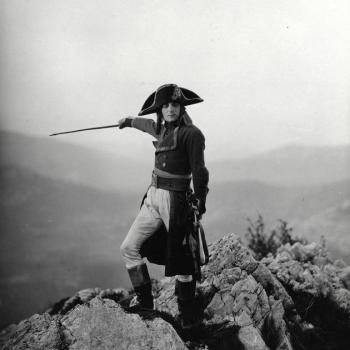
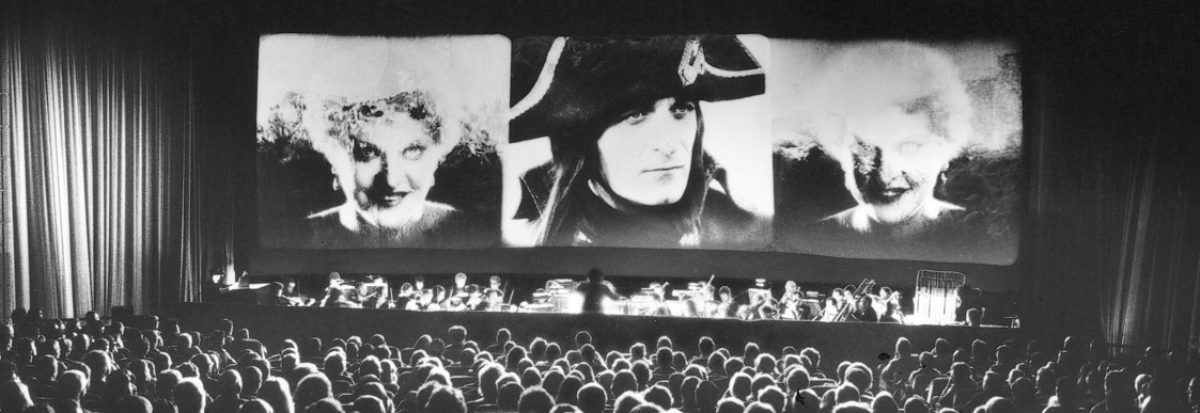


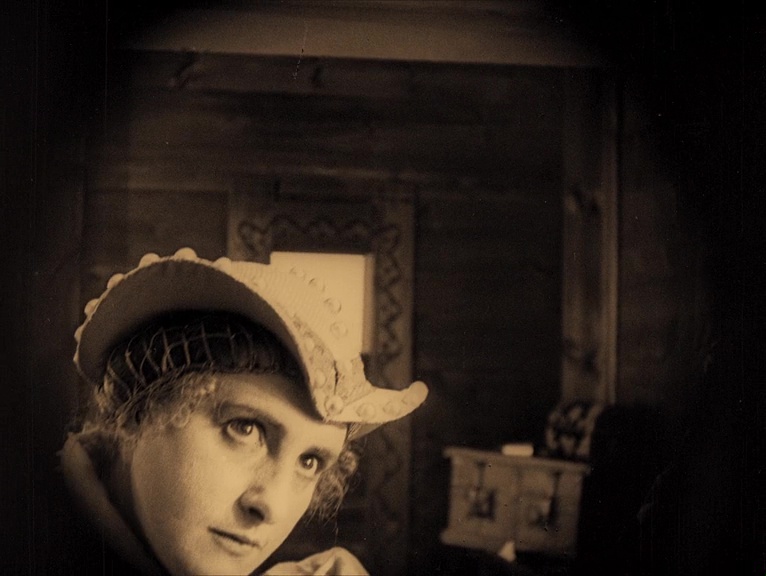


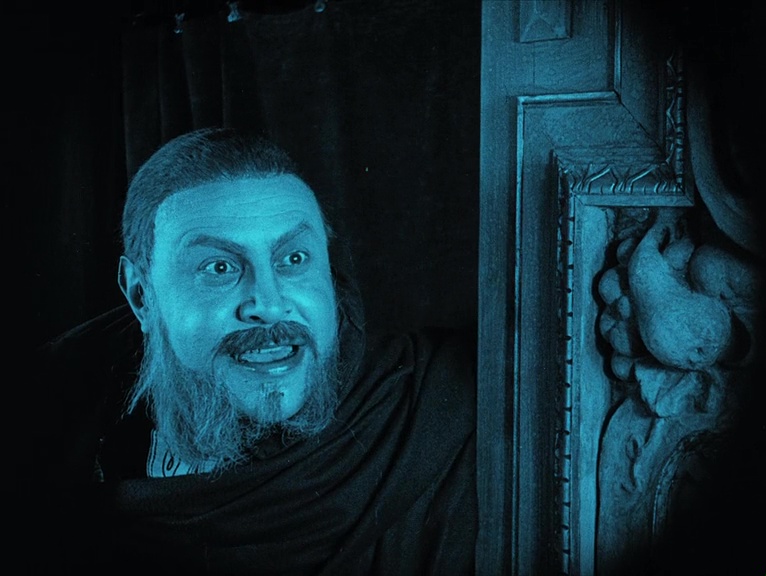


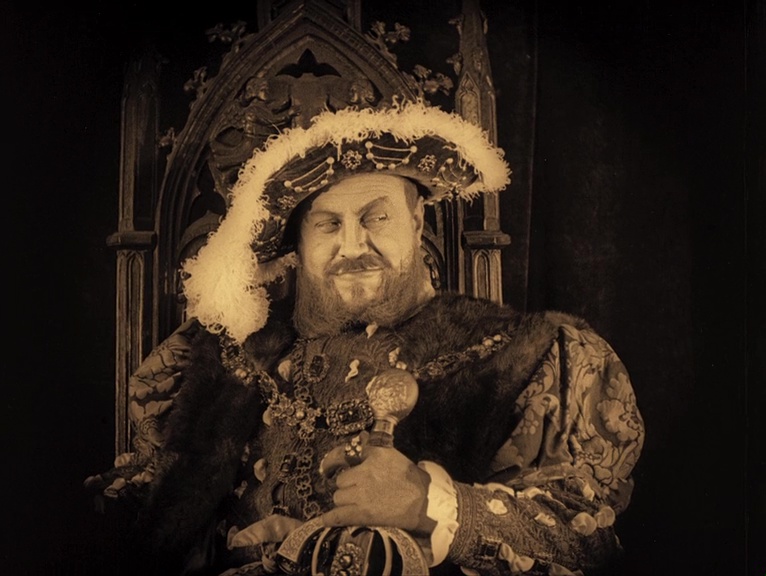


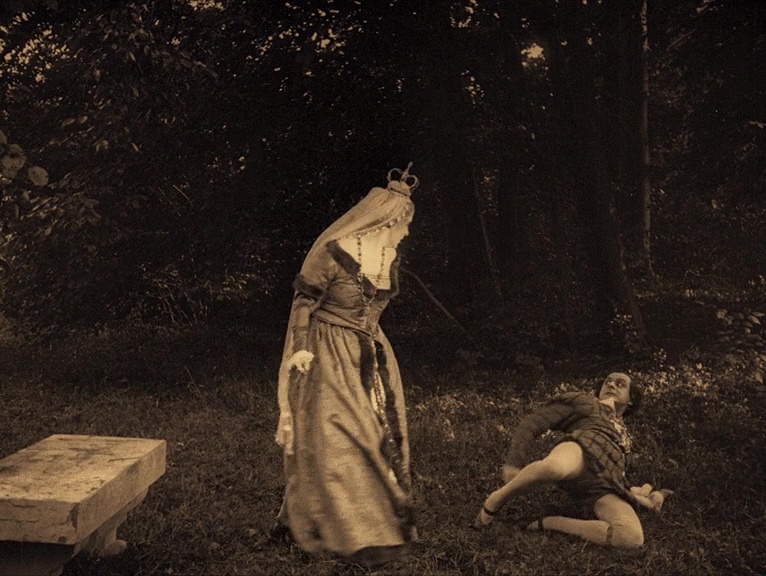


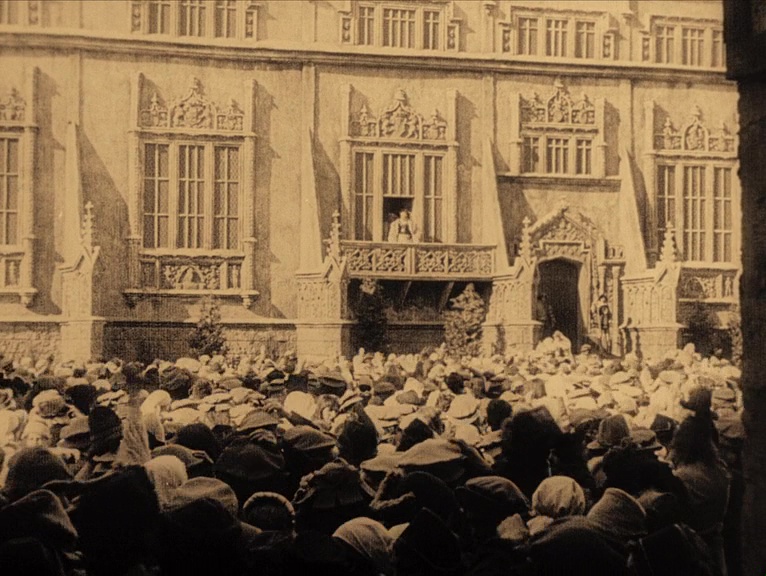

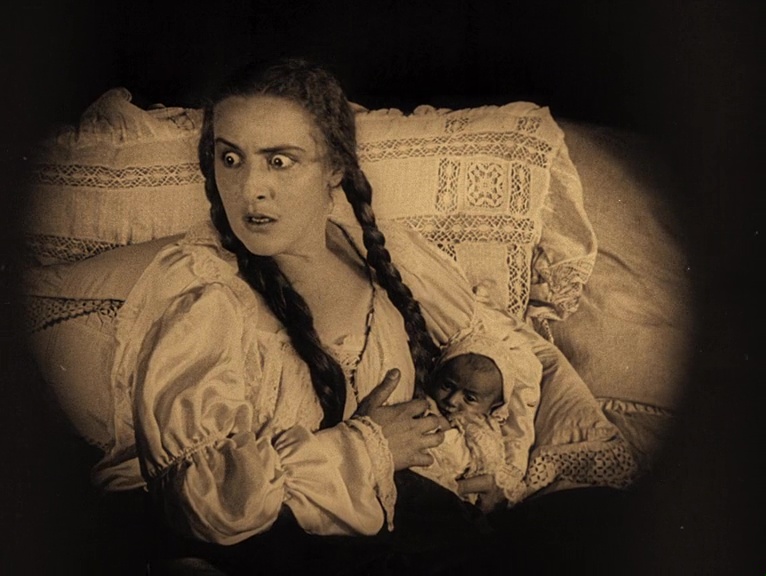


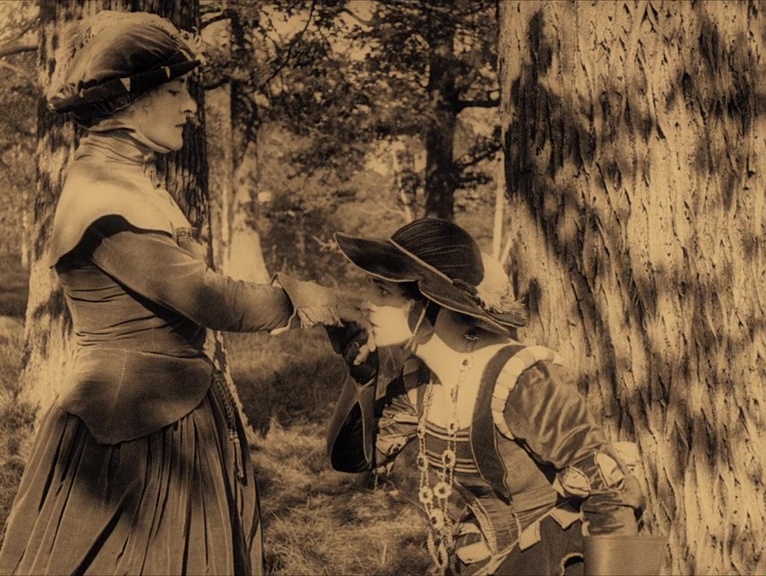
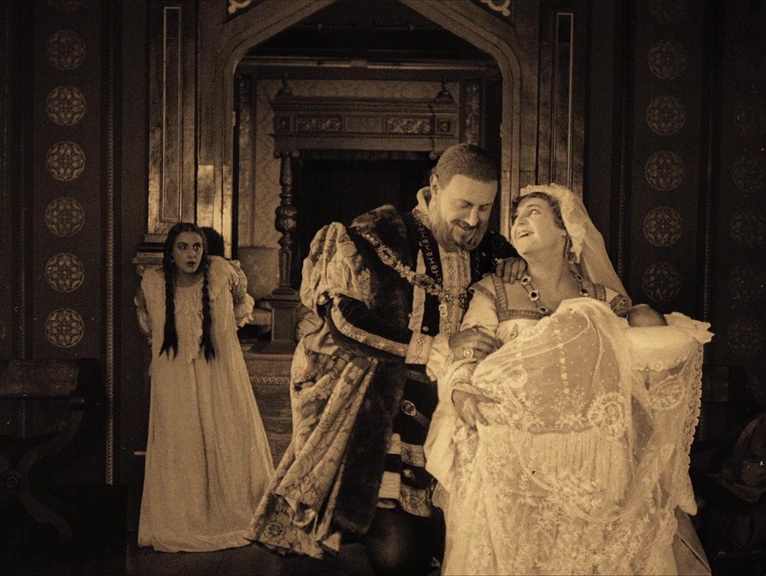
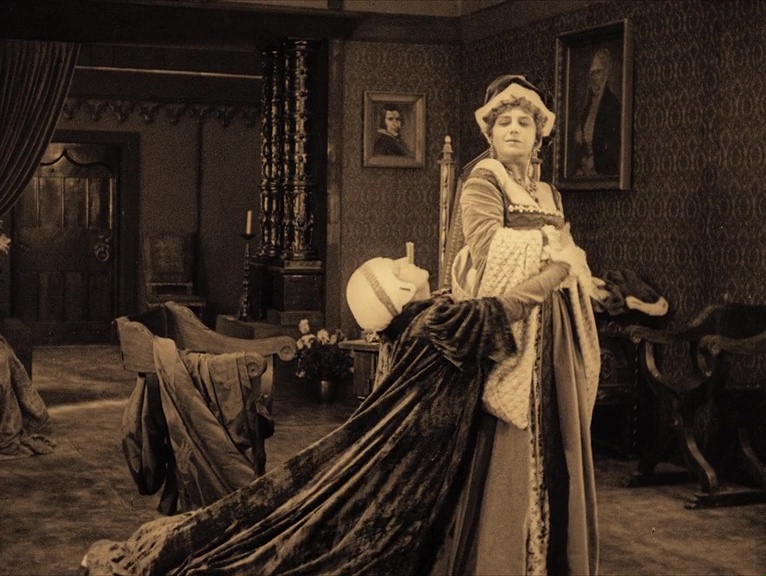


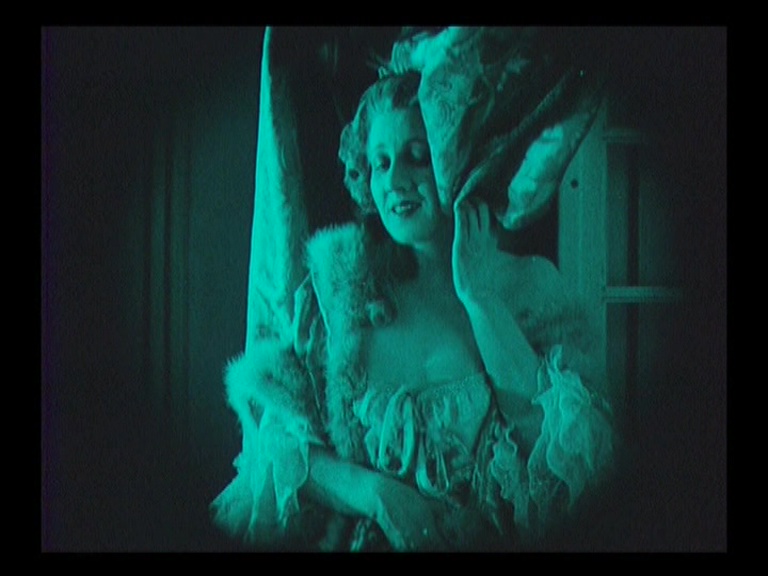


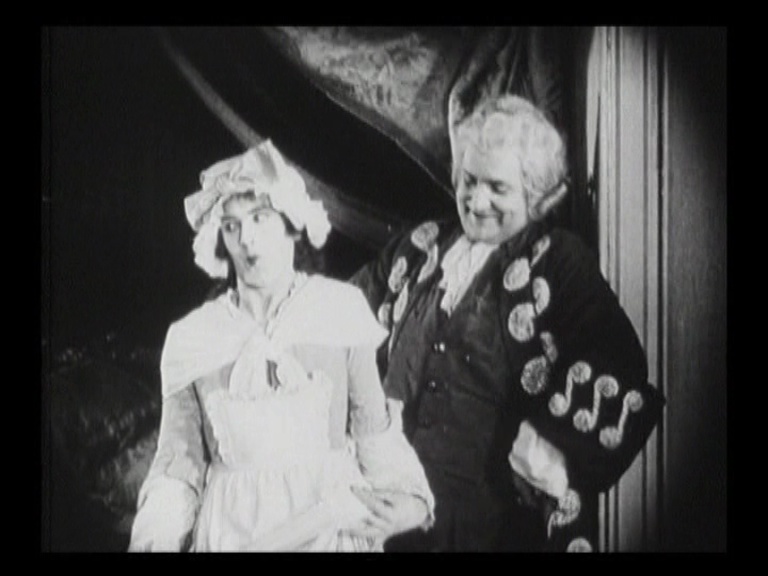


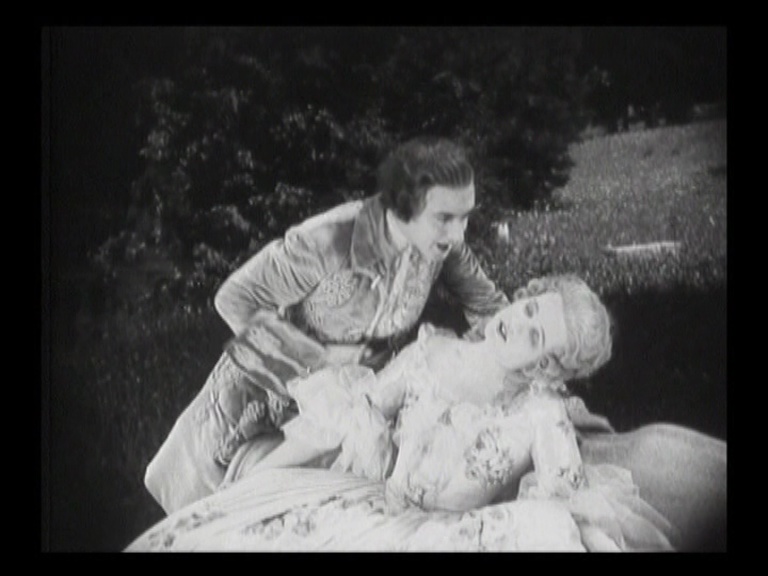


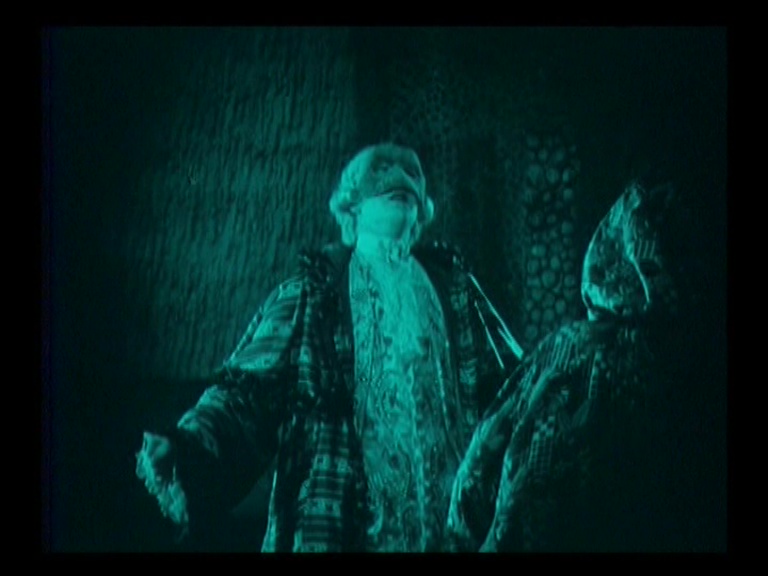


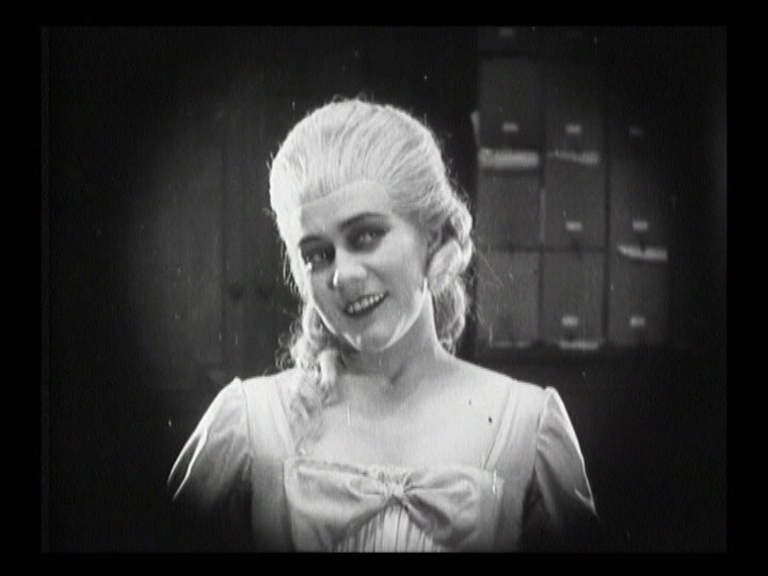


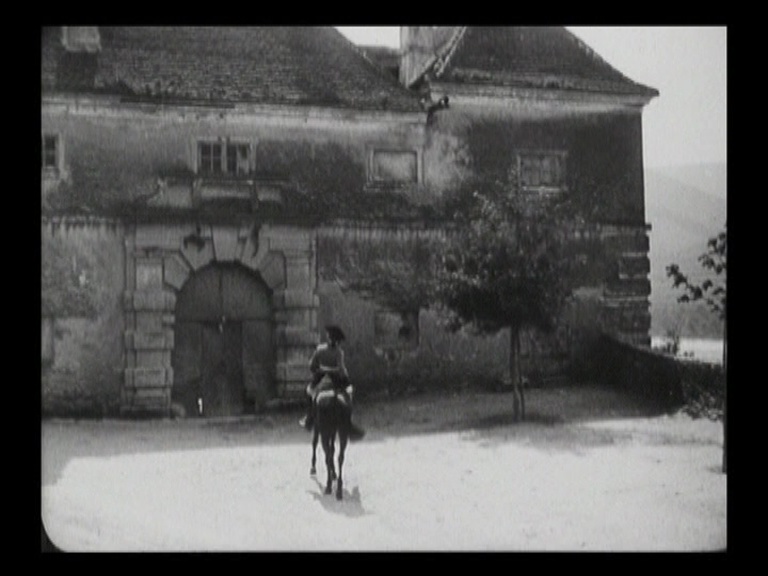
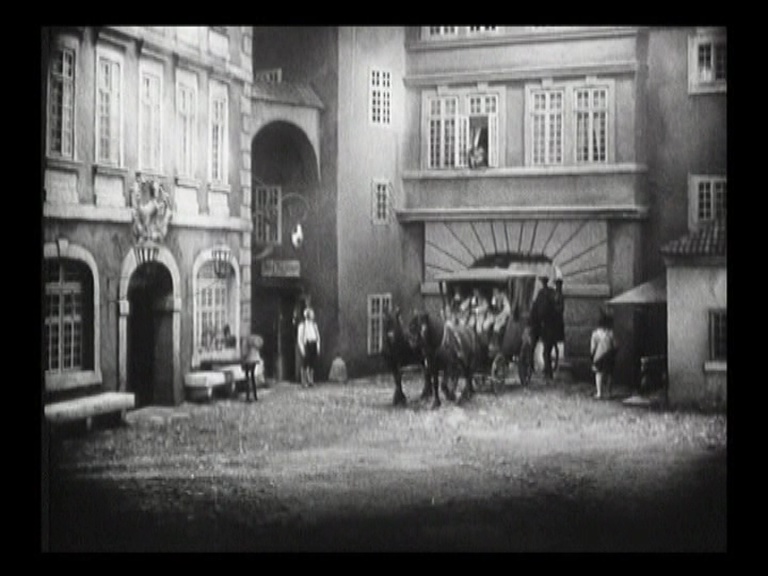


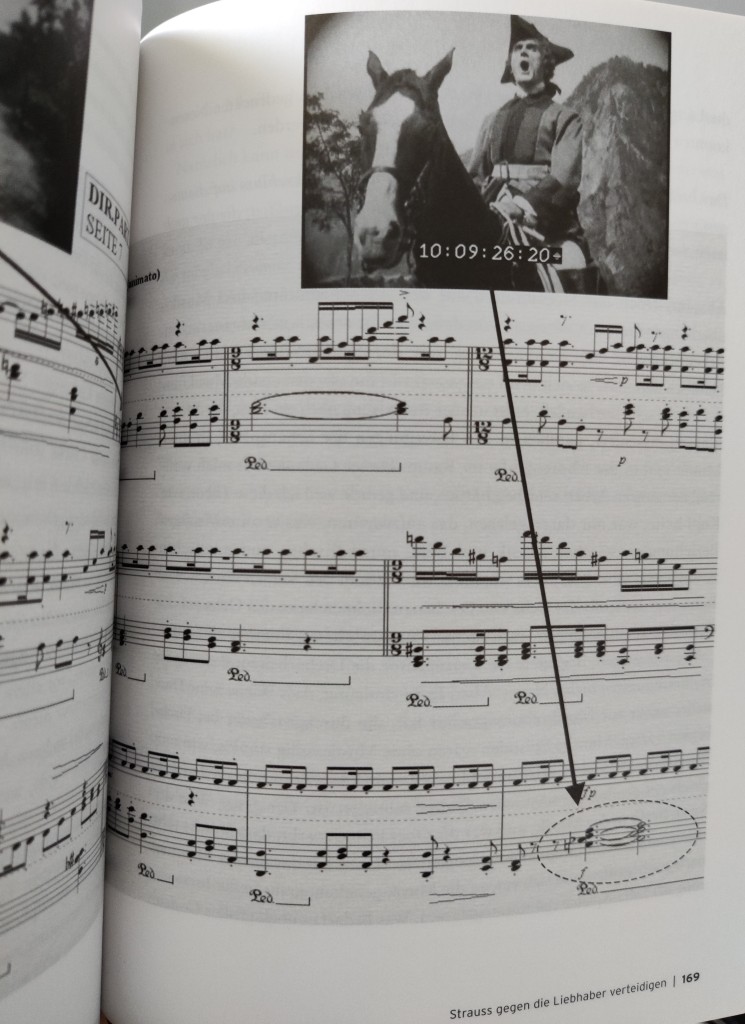


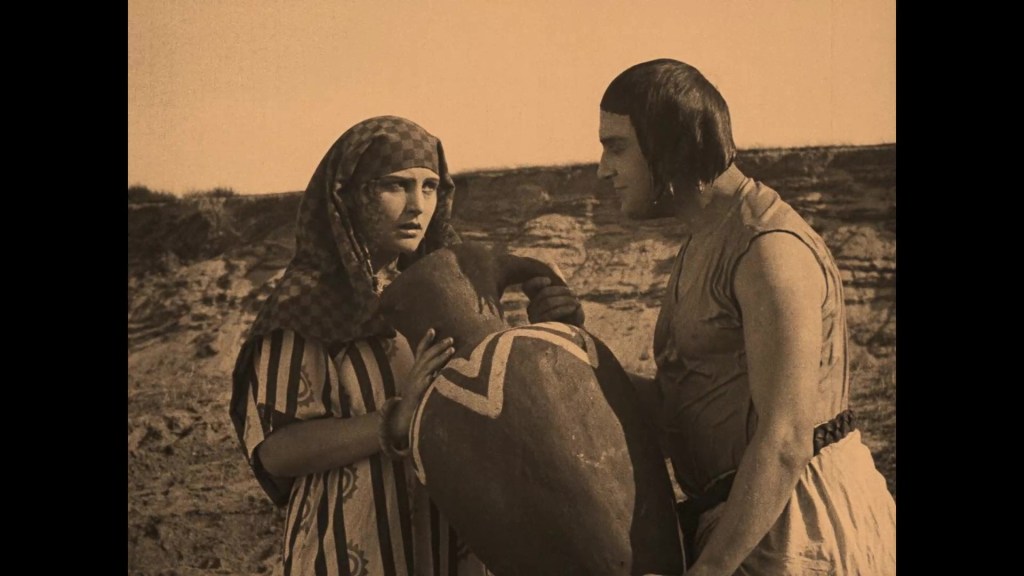
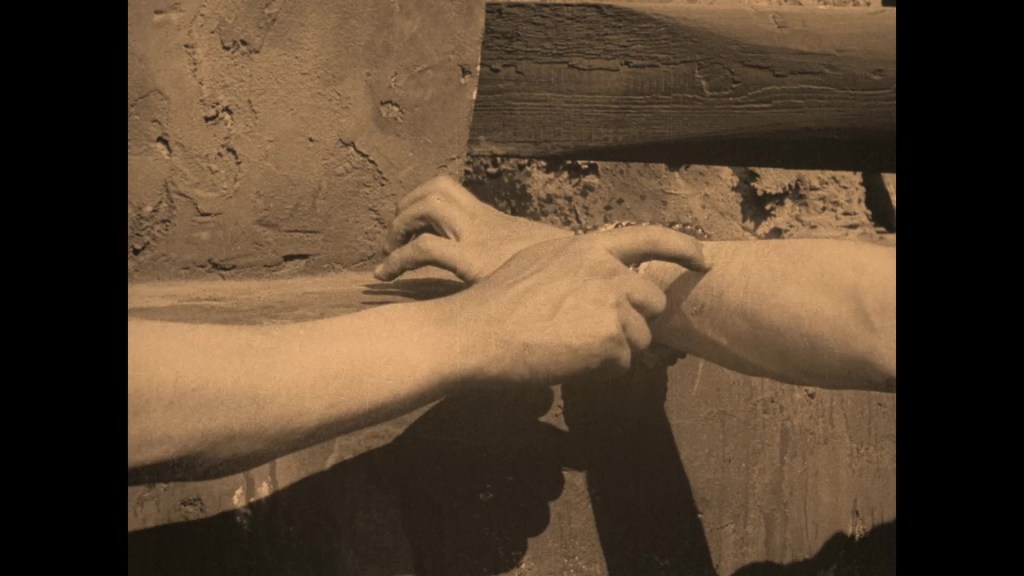


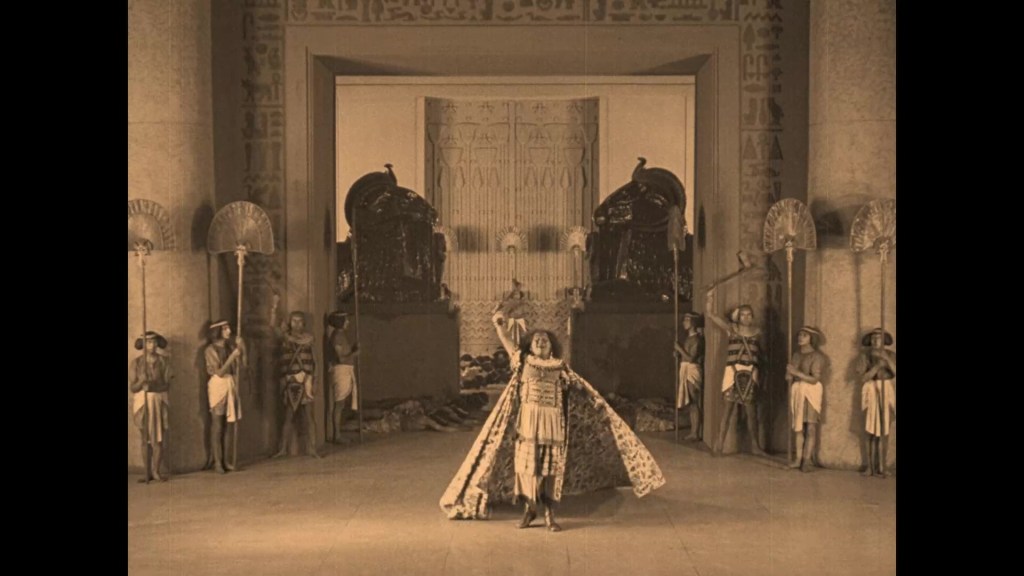


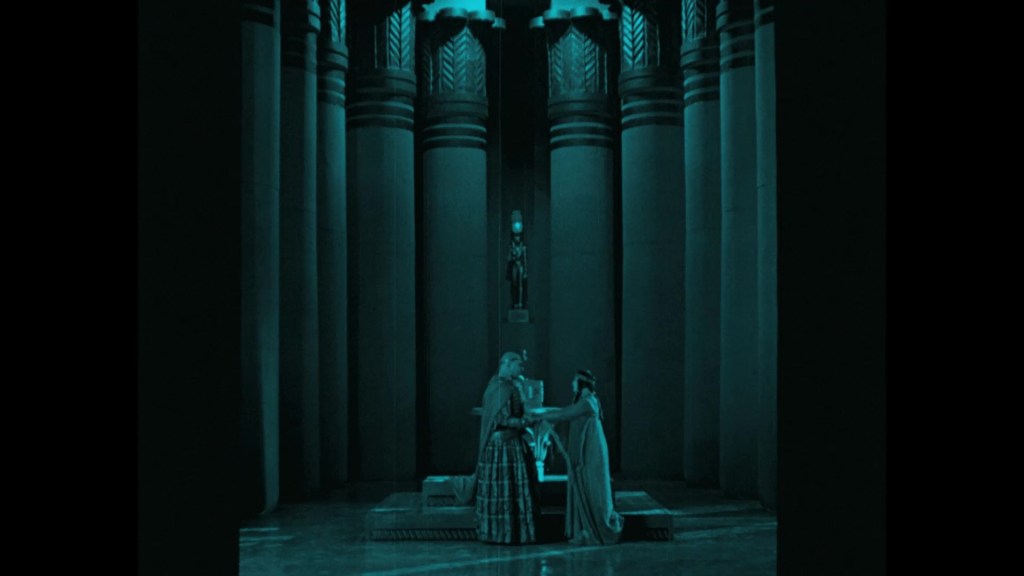


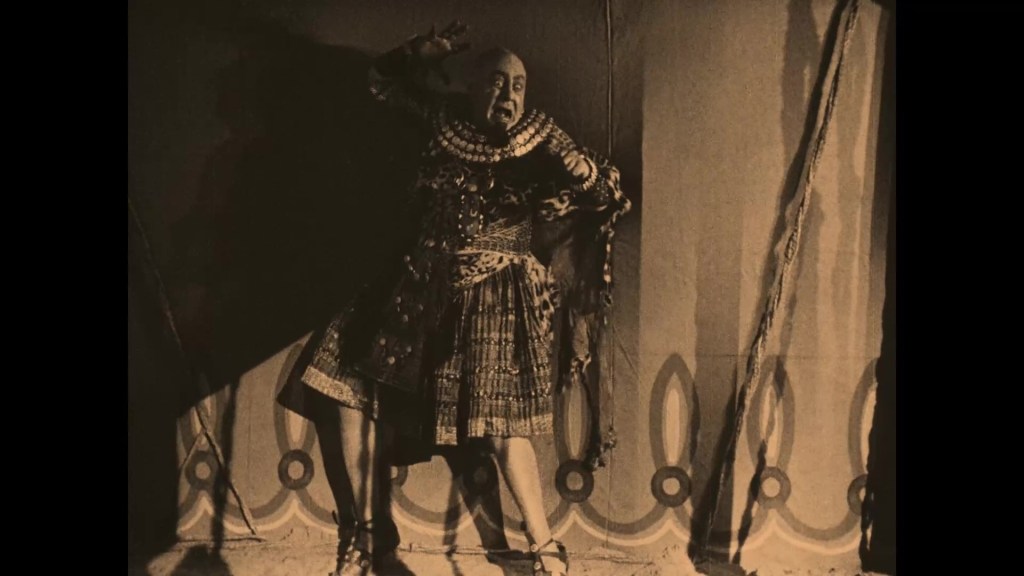


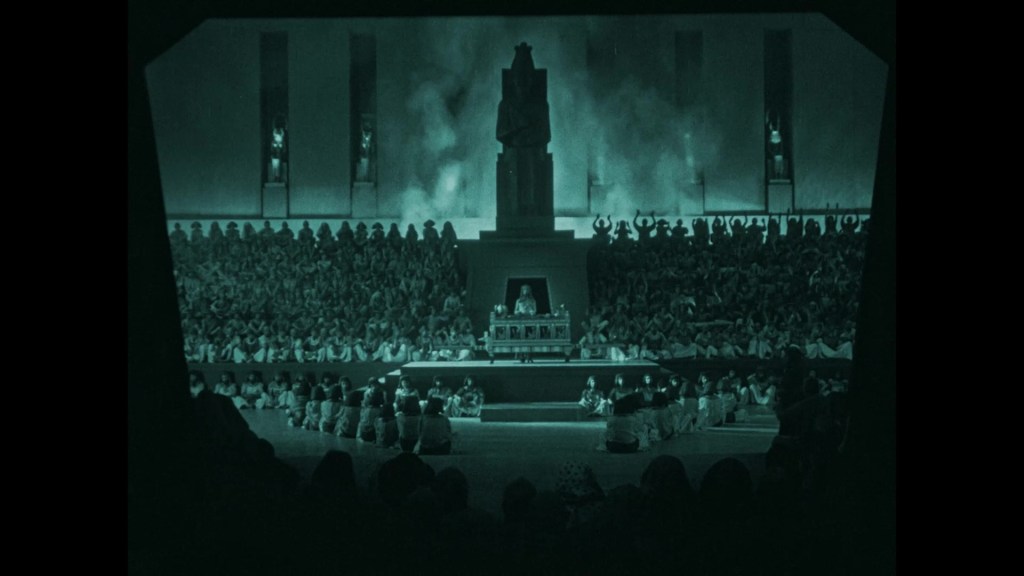


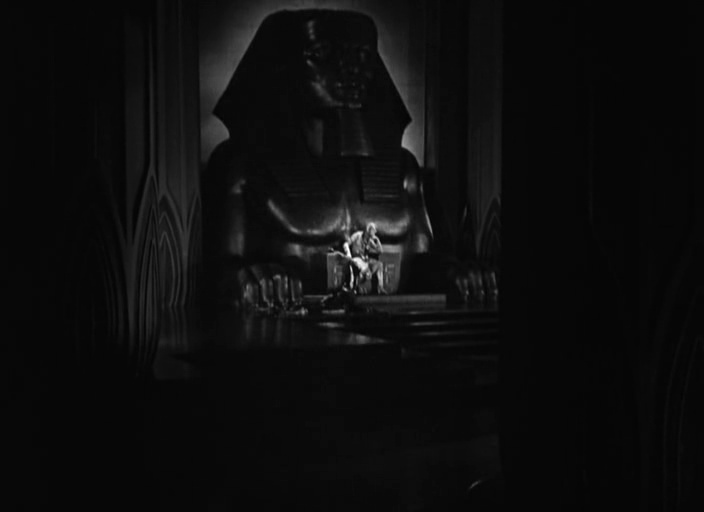


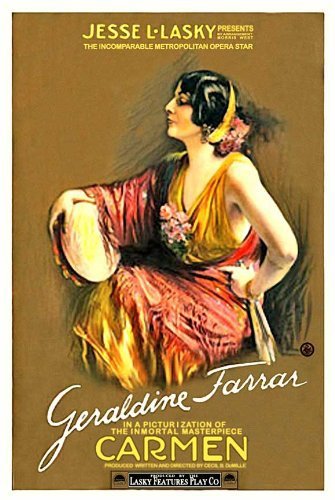
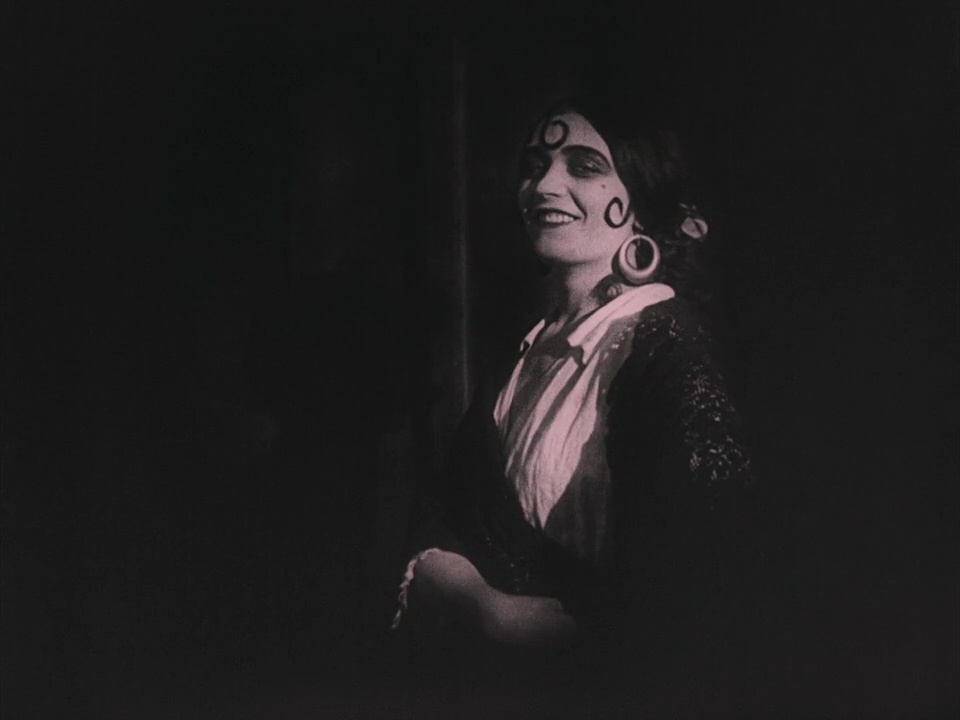


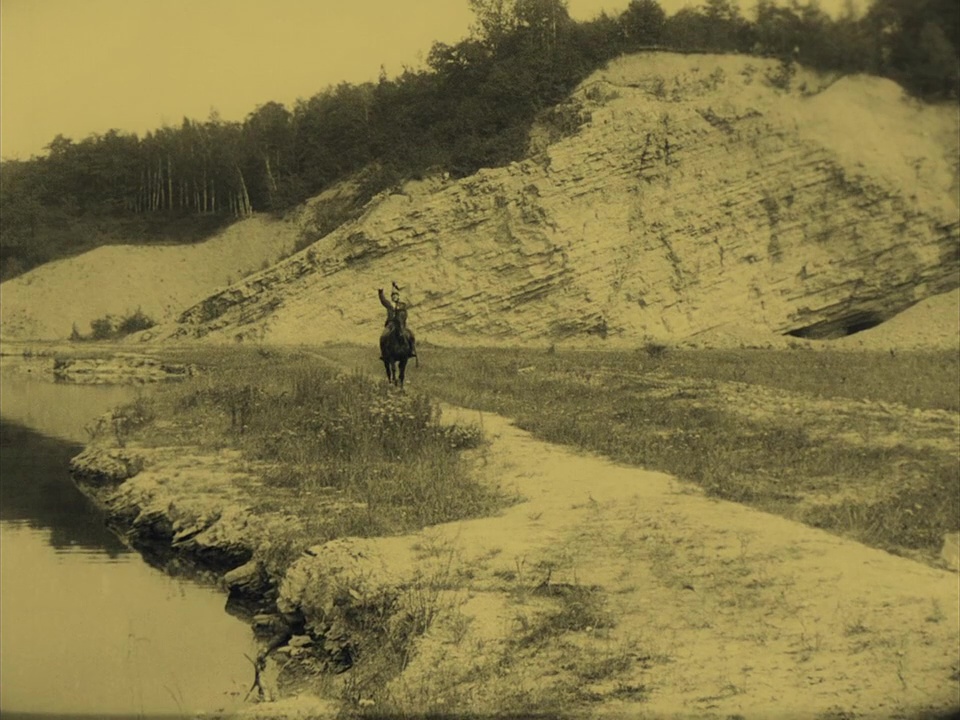


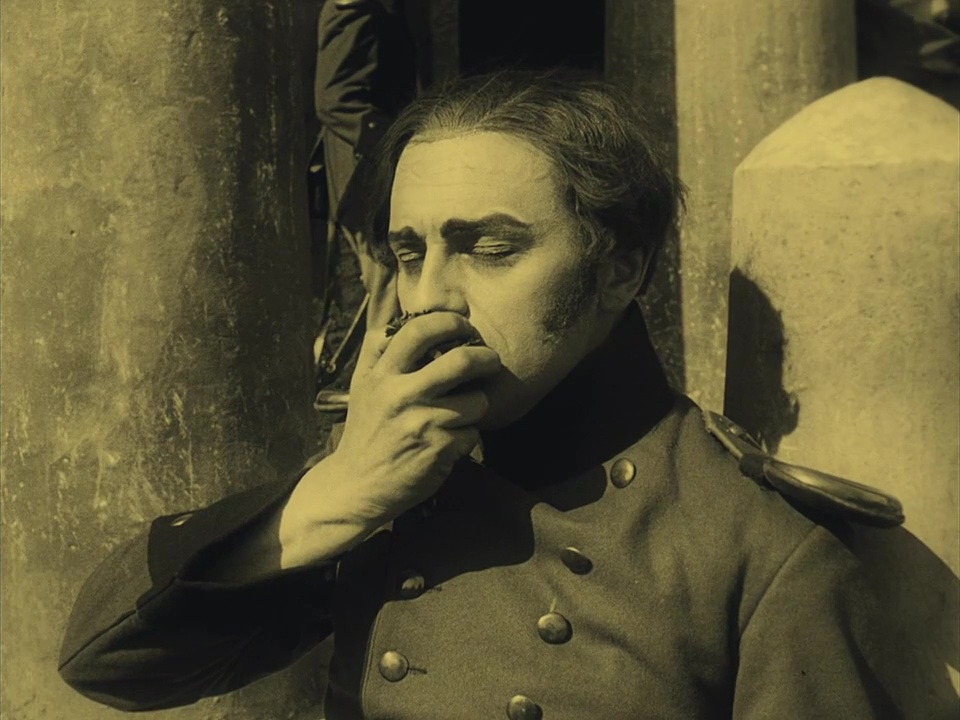


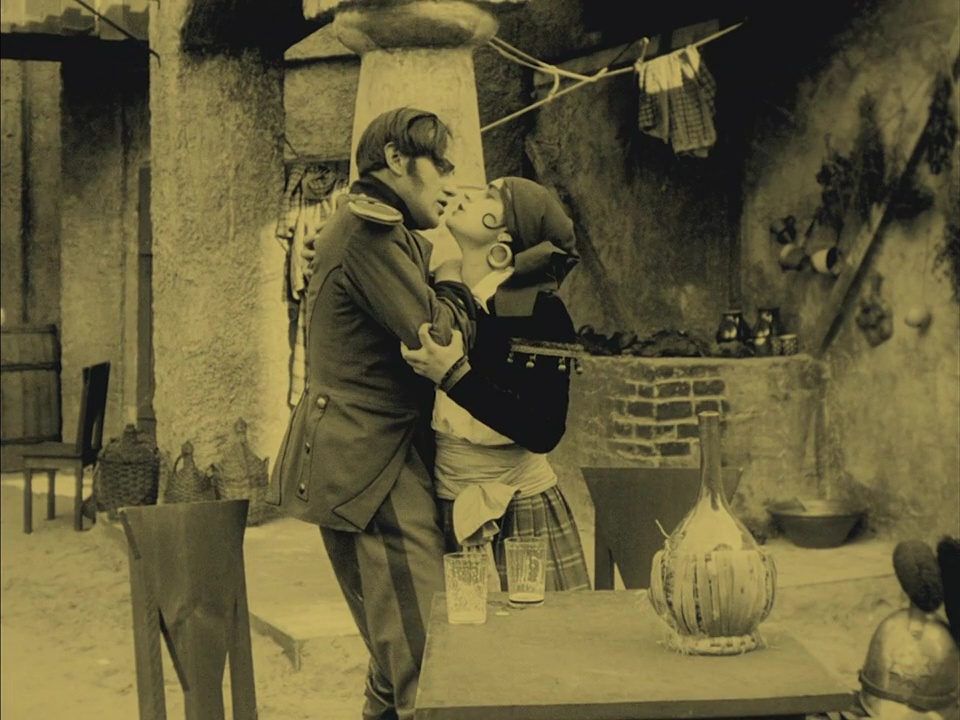


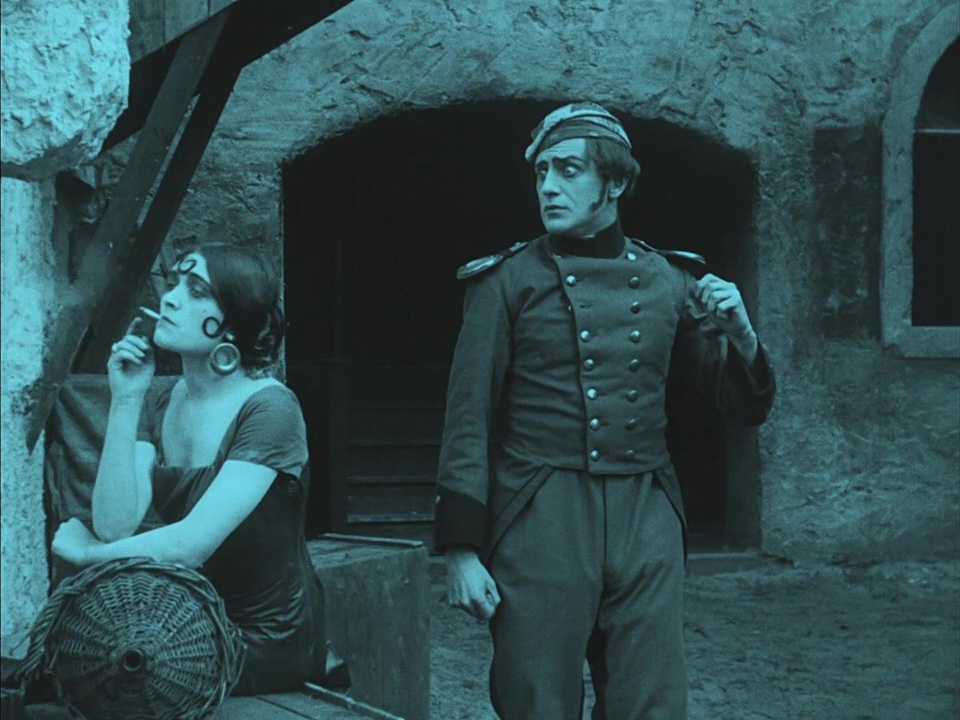


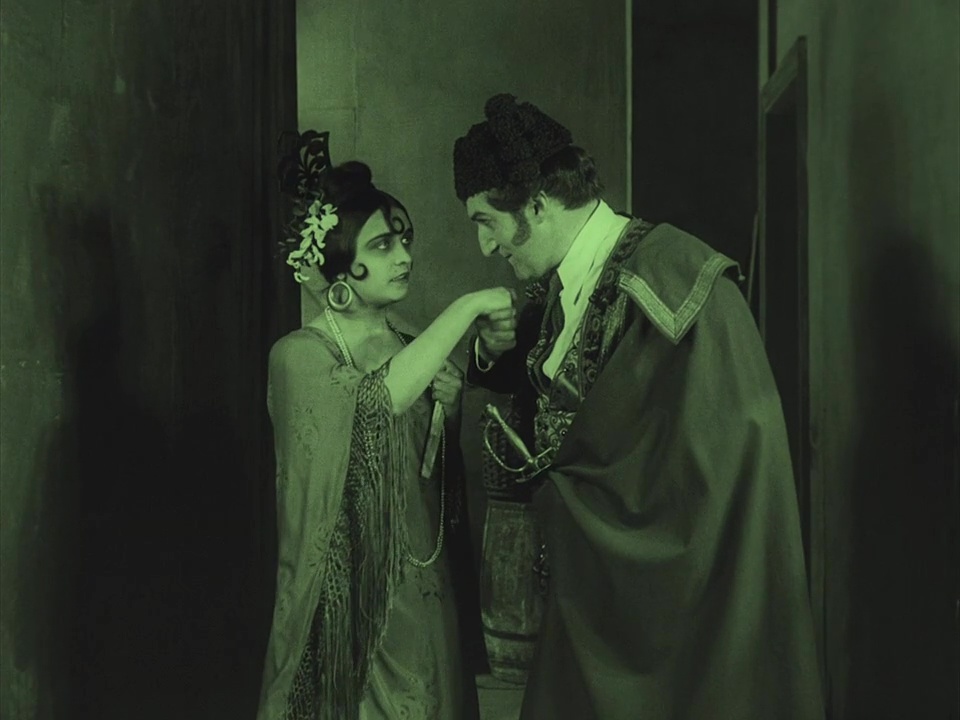
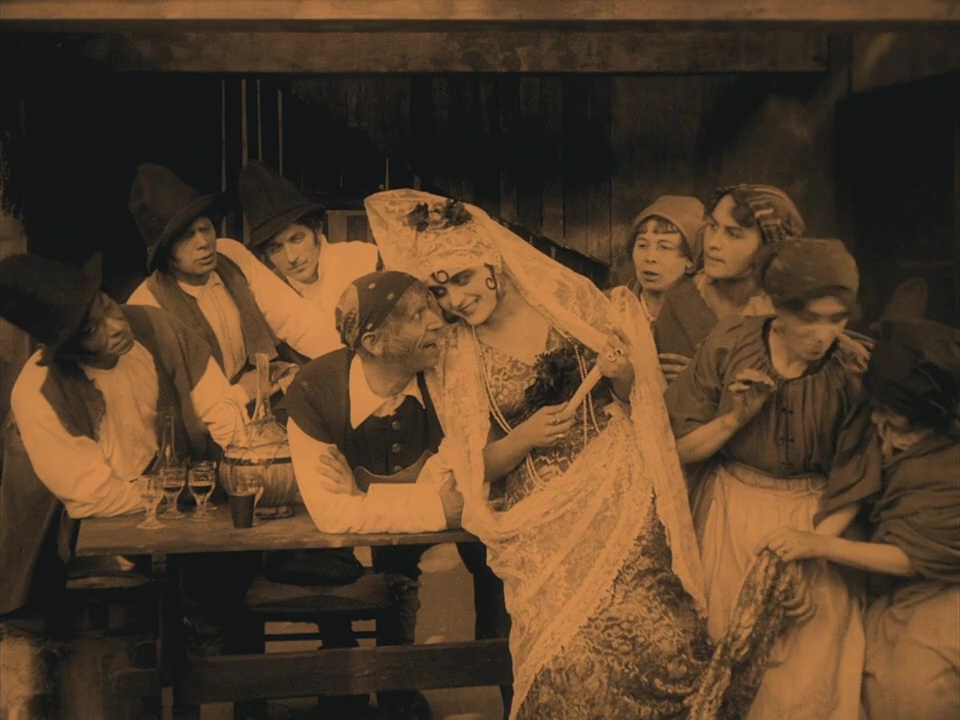


 The Realm of Silence