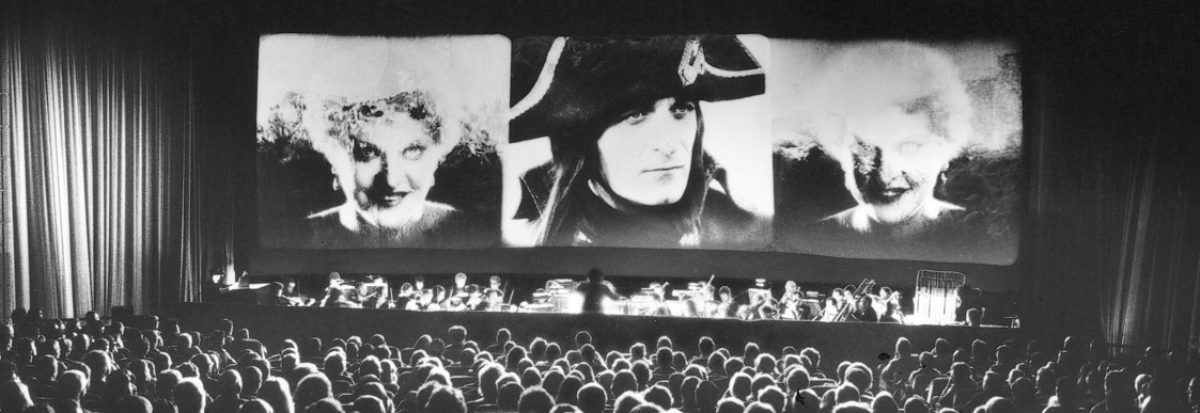
Pordenone from afar (2023, Day 1)

This time last year saw me start this blog with ten days of posts attending the Pordenone silent film festival from afar. This year, I’m once more not making the trip to Pordenone. It’s the same reasons: time, money, and the budgeting of annual leave across the year. But yet again I am inexorably drawn to the idea of Pordenone, and what follows is the first of another ten daily posts about the online version of the festival. Day 1 sees a two-part screening. First, an hour-long programme of slapstick shorts (with music by Daan Van den Hurk). Second, a feature film western (with music by Philip Carli). We’ve barely a moment to lose before the next films are upon us, so for goodness’ sake keep reading…

Le Torchon brûle, ou une querelle de ménage (1911; Fr.; Roméo Bosetti). The wife serves the husband a meal. The husband objects to the meal. The situation snowballs. Crockery is thrown. Then furniture. Soon the husband is ripping cupboards off the wall and hurling them out of the window in fury. (Down below, outside, two policemen are slowly but inevitably buried in the defenestrated wreckage of the home.) When the entire room is broken in pieces or hurled out the window, the couple turn on each other with bare hands. They role around on the floor, down the hall, down the stairs, into another room, out the window—where they land on top of the policemen. They keep on rolling: across the street, under a car (still fighting), under a horse and cart (still fighting), through a mob of merchants and shoppers (trashing a stall en route), down the street, down a manhole, into the sewer. Then a wonderfully bizarre twist: the film is reversed and the couple whizz back up the manhole and out into the street, up a set of stairs, up the road, over the broken pile of furniture (before the eyes of the disbelieving policemen), then hurl themselves through the air back into their apartment. The end. A charming, silly, anarchic, violent piece of slapstick. And a neat comment on the escalation of an argument that can quite literally go nowhere but return to its source—presumably to begin again the next day.

Rudi Sportman (1911; Aut.-Hu.; Emil Artur Longen). A man and woman sit outside a tennis court. The man irritates the woman, the woman irritates the man. Presumably frustrated by his inability to smoke and read the paper in peace, the man begins the next scene trying to get on a horse. He does so backwards, forwards, falls off, remounts, then is jettisoned by the horse. Frustrated again, the next scene shows him trying and failing to ride a bicycle. The woman from the first scene ends up being run down and chasing the man away with a stick. The man (still dressed in frock coat, shirt, and tie) now bunders onto a football pitch, where his attempts to enter the game end in him being chivvied and kicked and beaten by the players. Enthused (and presumably suffering from the debilitating effects of his various falls and beatings), he next tries hurdles, then tennis. (All the while, there are glimpses of a lost European world in the background: the buildings, the officials, the way of life… What happened to those young men playing football in 1914? What became of the lads diving into the pool to save the hapless rower? Did the boat attendant become a military attendant?) The man’s enthusiasm sends him stumbling, falling, summersaulting—and leaving. Next to the rowing pool, where he swiftly ends up in the water. Reprimanded by the attendant, he finds solace in the final scene with the woman—a man in drag, who might or might not be his other half, who now seems both pleased that the man has been severely injured and pleased that he has returned to her. She gives him a kiss, licks her lips, and the film ends.

At Coney Island (1912; US; Mack Sennett). It’s familiar Mack Sennett fare: two alternately grinning and gurning men fight over a woman. Around them, the swarm of life: real life in 1912 Coney Island, with groups of Keystone players dotted around, embodying grotesque families, arrogant fathers, scurrying girls, violent adulterers, and a midget policeman. A chaotic mess of desire sends men and women scuttling into fairground rides, and (just as quickly) out again. Wives chase after husbands, children scream. Couples illicit and singles jealous hurl after one another down terrifyingly unsafe rides, stopping only to shake their fists at each other, gurn, jump up and down in fury. Soon a kind of turquoise dusk descends. But why should continuity concern anyone in this madcap world? The dancehall is a light rose, the tent a bright orange. Time passes, but the men keep chasing their desire—and I’ve hardly had time to unpick who is being chased by whom, or whether the policeman is after the father or the lover or the child, when the film ends.

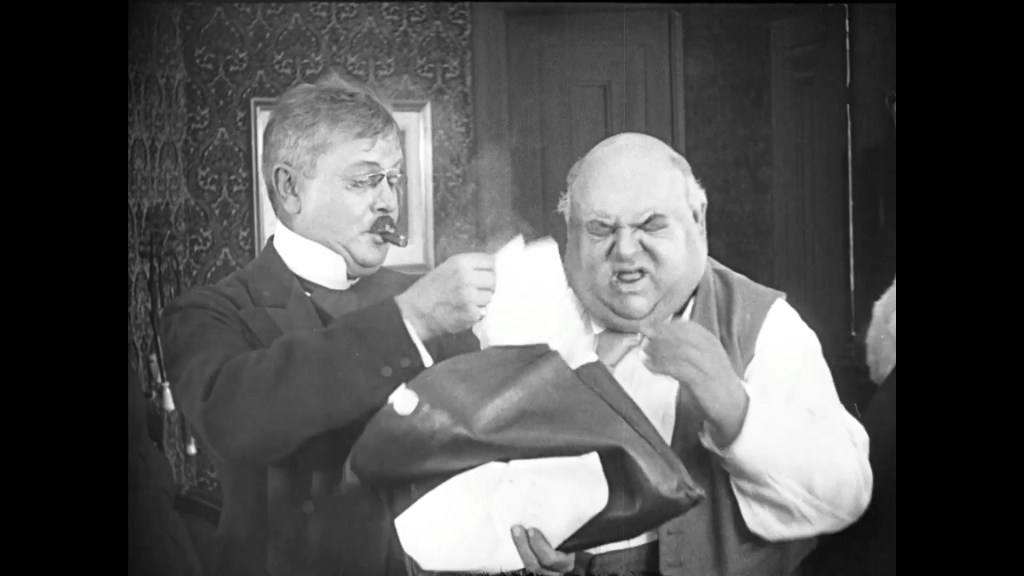
En Sølvbryllupsdag (1920; Den.; Lau Lauritzen Sr.). “Their Silver Wedding Anniversary”. Already the title bodes ill. The wife wakes Mr Taxman with the news of their anniversary. In his separate bed a little way from the wife, the Taxman—a walrusy sort of fellow—yawns, turns from gurn to grin, kisses his wife, and mourns their lack of money. Talk is of money, but it soon escalates: “You’re a lazy, fat, spoiled bastard—so the woman from the culture centre says”, his wife informs him. “And you are an old, mean, sleazy sea-goose. That what I say!” Soon these two heavy-set middle-aged people are out of bed and shouting at each other. In tears, the wife leaves home. Chuntering, the Taxman goes back to bed. Cue a passing brass quartet. They troop up to the Taxman’s house and start blasting him a serenade. Whereupon… he weeps! It’s weirdly touching, this comic scene: a reminder of time past and passing, of regret and age and loss. But it’s also funny, for soon the emotion shifts gear: the Taxman throws a jug of water out the window to chase away the band. A visitor to the taxman (now deemed a lawyer in the title). He relays an offer of 25,000Kr from an uncle, but only on the condition that the agent reports that the couple lead a harmonious life together. The husband leaves the agent with a large case of cigars, a glass, a soda siphon, and a whole bottle of spirits. He goes on “The Wild Hunt for the Silver Bride!” (Meanwhile—and this is a lovely touch—we see the agent contemplate the bottle, turn it away from him, then give up and slowly fill his glass to the brim. A tiny dash of soda later, he settles down to his drink.) Where is Ludovica? She’s gone on a trip. We follow the jacketless husband through the streets of Copenhagen—these glimpses of a century-old world are always so beautiful—and into a women’s meeting, where he tries to silence the speakers at the podium so he can yell for Ludovica, only for the entire hall of women to run him out. (Meanwhile, the agent pours a second and third glass—and by the third he misses the glass with the soda altogether.) The man meanwhile charges into a women’s bathing area and peers into each and every booth, only to be chased and ejected yet again by a crowd of women. (A fourth glass goes down the agent’s throat.) The man returns home, finds his wife in tears on the stairs, and hurries her in. The agent, now drunk out of his head, sits giggling in the chair where we left him. But he can hand over the cheque, amid blasts of cigar smoke, to the old couple. “Remember: you can’t buy silver for gold!” a final title reminds us. (And a final treat in the last title: an animated logo for Nordisk Films, complete with real bear atop a globe.)

From Hand to Mouth (1919; US; Alfred Goulding). Harold Lloyd is The Boy, “hungry enough to eat a turnip and call it a turkey”. We are introduced to various kinds of will (people and objects). Will Snobbe gets my favourite intro: “His head would make a fine hat rack”. Meanwhile, outside, the Boy, amid scenes of poverty. (How long since scenes of outright poverty and hardship were the mainstay of American comedy?) He gazes longingly at a cheap restaurant. He puts on a napkin, takes a think bone out of his pocket, and chews on it. The Boy steals a biscuit, which is then stolen by a child. He chases the child, retrieves the biscuit, but the child is so cute he gives it back to her. Meanwhile in the lawyer’s office (the lawyer being called Leech, of course), the will is being fought over. Snobbe and Leech are in cahoots. The plot proceeds. Child and Boy (now friends) find cash, buy food—only to find the money is counterfeit. (They have also befriended a dog with a broken paw, who—just as they drop their unpaid-for food—drops his unpaid-for food.) Boy meets Girl, who rescues him from arrest. Cue various lost wallets, found wallets, biffed policemen, angry policemen, a kind of whack-a-mole sequence with the Boy popping up between two manholes, and a high-speed chase that mashes the Boy’s chase into the plot handed down from Snobbe to his ruffian underlings. At night, the Boy accompanies them on their robbery. A delightful gag about opening a window (assuring the band he knows how to jimmy open the window, the Boy systematically smashes it with a crowbar) is accompanied by a little gag in the titles: an anthropomorphic moon looks at the dialogue on each card, then appears to laugh at the payoff. Of course, the house being robbed is the Girl’s, and the Boy (after trying to eat the entire larder) soon takes her side in the robbery. Via a dazzling chase (Boy lassoing a car from a bicycle, which he then rides without steering), the Boy tries to summon the police to help him. None are interested, so he summons them via a series of vengeful acts: he hits them, insults them, hoses them down, vandalizes a police station (then reaches through the smashed glass to pull a cop’s nose)—until dozens of officers are pursuing him to the villains’ lair, where they treat the baddies to some good ol’ fashioned police brutality. Boy and Girl arrive just in time to scoop up the inheritance from the lawyer and chase out Snobbe. A lovely final scene shows Boy and Girl, with street child and dog-with-broken-paw, eating a hearty supper. A final longing look of love, as the Boy sneaks a spoonful of her pudding. An absolute delight of a film.

Cretinetti che bello! (1909; It.; André Deed). “Too beautiful!” a title announces, and it needs to do so to clarify the almost inexplicable events that follow… A man in an absurd wig and jazzy waistcoat is invited to a wedding, so he dons an enormous top hat, clown shoes, and powders his face with an inch of powder. Now with monocle and cigar, he marches along, looking so beautiful he attracts women (all men in drag) from his house, a gelato stall, and a park bench. At the wedding, more women (most of whom are again men in drag) fall for him, including the bride and the women of both families—who chase him outside, through a park, and tear him—quite literally—to pieces. Horrified and disappointed, they run off. But the pieces start moving around and eventually reanimate themselves, so that Segnor Cretinetti delightfully comes back to life and jigs with glee. A joyfully silly film, and a nice way to round off the programme of shorts.

Next, our main feature presentation…

The Fox (1920; US; Robert Thornby).

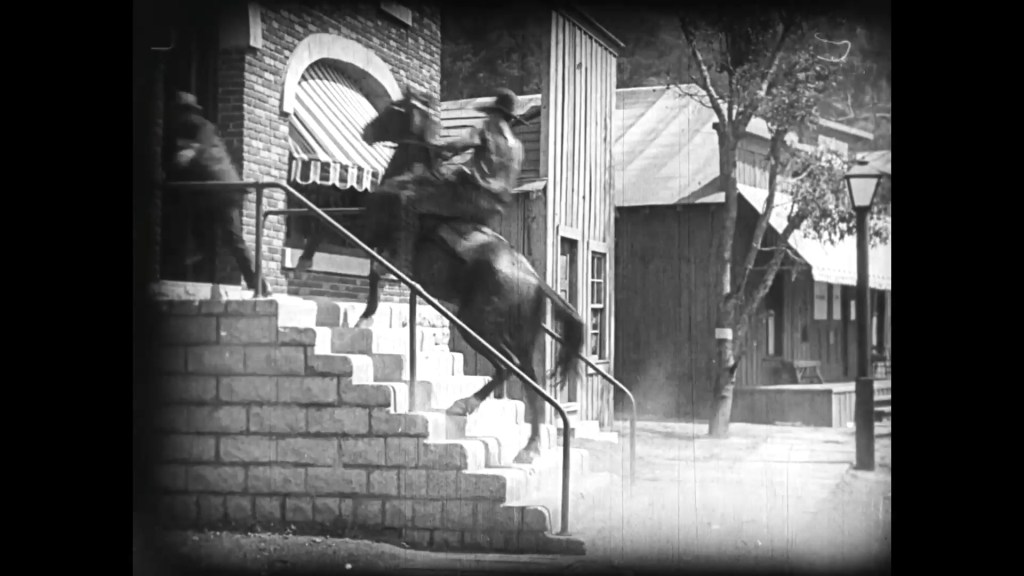
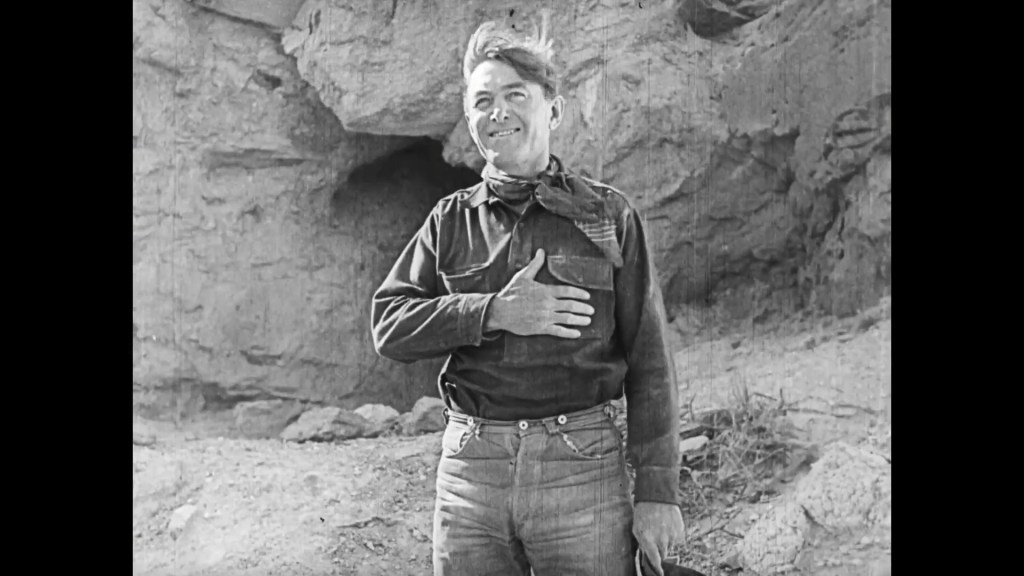
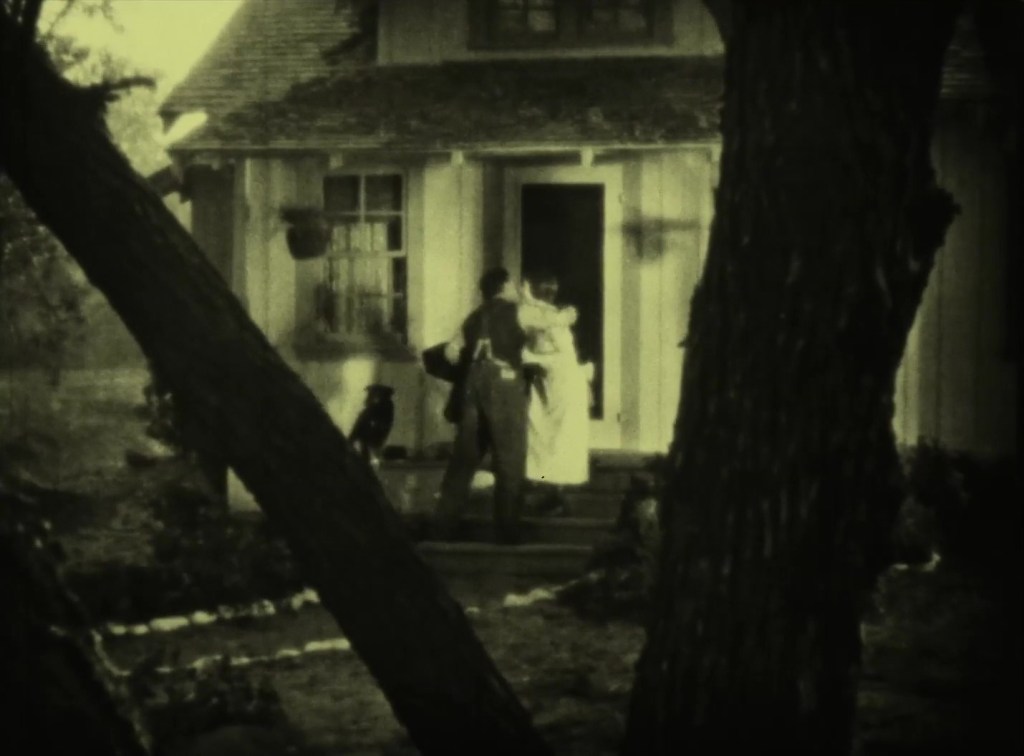
A sleepy town on the edge of the desert. Suddenly, an eruption of violence, horses and cars and lassoes careering through the streets. The Sheriff is called for, violent gangmen are everywhere. Enter Harry Carey as Santa Fe. (“They didn’t know where he came from, and they didn’t care.”) He sees a bear tamer threaten a child. Cue fistfight, the tamer using the bear for self-defence(!). Santa Fe chases off the father, only for the child to chase him. The child admits the man wasn’t his father. “He found me, just like you”. The two outsiders make friends. One mishap with the law later, and the child is effectively adopted—they are put in the same cell together. But the Sheriff’s daughter Annette pleads for Santa Fe’s good nature. The old sheriff offers Santa Fe a job. But the child remains in jail as a “hostage”, to make Harry more liable to do the Sheriff a favour. First, Santa Fe takes a job as a porter in the local bank. (Carey is very funny here, and throughout: the way he playfights, the way he tries to kill a fly, the way he holds a duster.) But Santa Fe’s here to spy on the goings on behind-the-scenes at the bank. Coulter, the dodgy president, enlists the help of his clerk Farwell to take the fall for his own emptying of the bank’s funds.

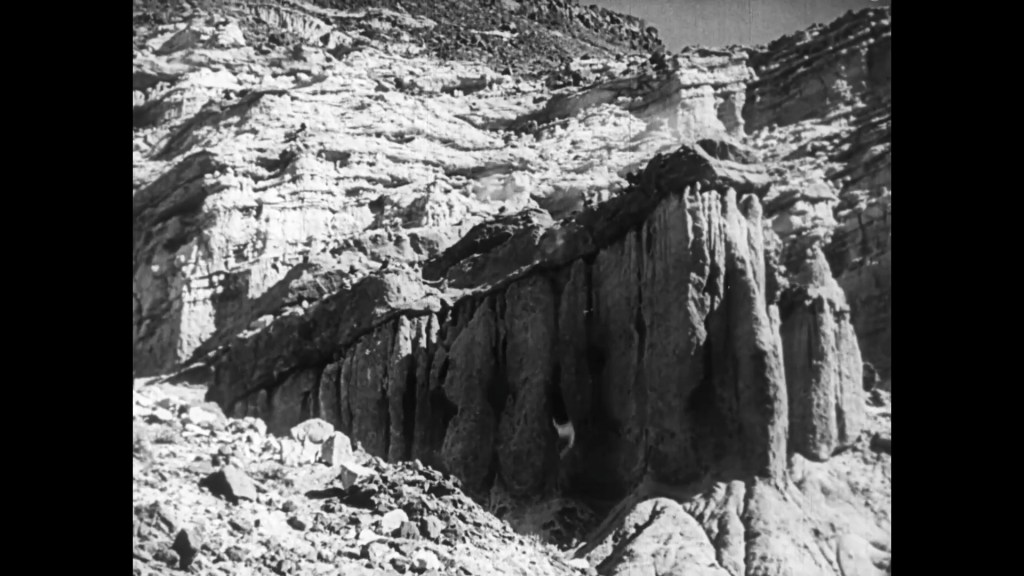
Meanwhile, Santa Fe is at a restaurant—carrying stacks dishes, rushing with the precarious skill of a comedian. In the desert, Farwell is captured under false pretences (all according to Coulter’s plan). In the restaurant, Santa Fe prepares a surprise for some gang members: mustard in their coffee. But to his surprise, they love it: “Now that’s good coffee!” But a fight nevertheless ensues, with hurled furniture and crockery. “Can you only fight?” the Sheriff asks, bringing him back to the jail. Now the gang, drunk, barge in and start a fight in a store. But the Sheriff arrives, only to be bested by the gang. (In this section of the film, there are some very nice low-key lighting for the night scenes. And a nice shot of Santa Fe in jail, beautifully lit, highlights on the bars and his shoulders—the same light that catches the flies buzzing in the foreground.) Santa Fe comes to save the day, gun in hand, and earns the respect of the Sheriff and Annette. His esteem warrants him a better hat and a sturdier pair of trousers: he slowly starts to look the part of the cowboy rather than the hobo. He heads into the desert to chase the gang and the missing clerk. He finds the “Painted Cliff Gang” hideout in the desert cliffs: a kind of “city”, hidden from the outside world. He finds and rescues Farwell, then returns to the town. Santa Fe reveals that he is a government agent and offers his full support.

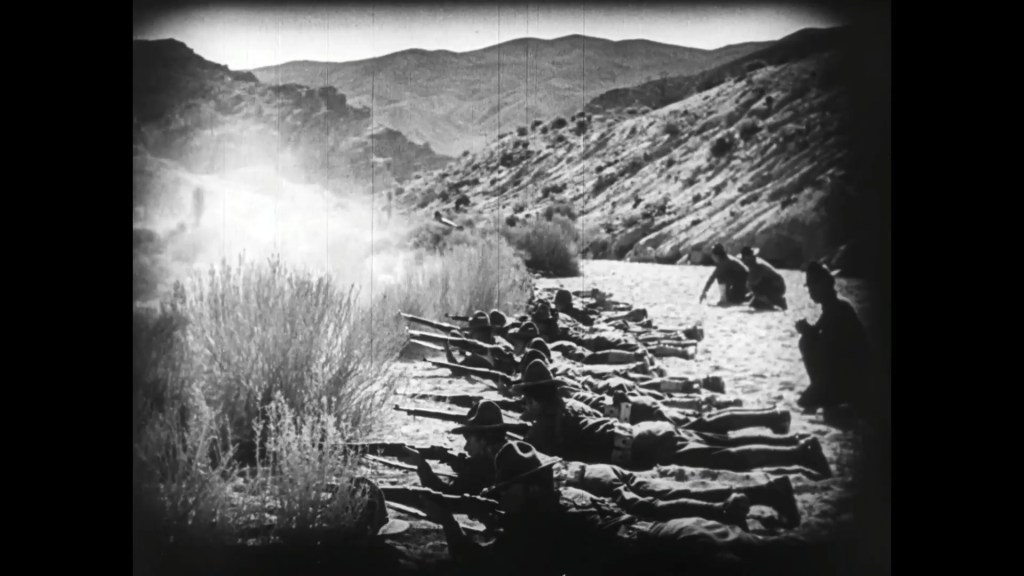
So, to the desert, where the gang—armed with Lewis machine-guns—fight the forces of town and law. They are waiting for the cavalry. And they arrive in style, these “Veterans of the Argonne”. Hails of bullets, falling bodies from cliffs, sticks of dynamite, Santa Fe climbing cliff walls, a huge explosion, the charge of the army, machine-gun fire sawing through a bridge support, “waves of lead and cold steel”. The bad guys are marched off and the cavalry chase after Coulter. But it’s Santa Fe who finds him, and the missing funds. Various happy endings ensure: Farwell marries the sheriff’s younger daughter, while Santa Fe goes off with Annette and the child—who Santa Fe hopes to enlist in the army. The makeshift family ride off into the desert. The End.

Day 1: Summary

A breathless start to the online festival. I found the hour of slapstick from across the globe an absolute delight. Even the least cinematically interesting (Rudi Sportman) had the delight of its real locations in a lost world, a lost time. Pratfalls in the foreground, history in the background. And talking of comedy, I was surprised by how many comic touches there were in The Fox. It was the first complete Harry Carey film I’ve ever seen, so a real treat. And a surprise, too. For I could imagine Buster Keaton or Harold Lloyd playing a similar role to Carey’s “Santa Fe” (the outsider hiding his physical abilities while timidly wooing the girl of a patrician figure), and the stray child could be a companion for Chaplin. Even the way Carey flirts, or looks longingly, is a little comic—comic in the way he’s so shy, and turns away when the girl catches him lingering. I like the way he slowly accrues the imagery of the cowboy: first the gun, then the hat, the jeans, and finally the all-action heroics of the finale. He moves from smart outsider, impressing with his deft touches and wit, to become the lawman and gunfighter of physical action. A solid, compact, oddly light film. (I admit, I’m not much for westerns—and I did prefer the slapstick to The Fox today.) A lot to see, but all new to me. And no time to dawdle! It’s only day one and already I feel the schedule nipping at my heels…

Paul Cuff

The Signal Tower (1924; US; Clarence Brown)

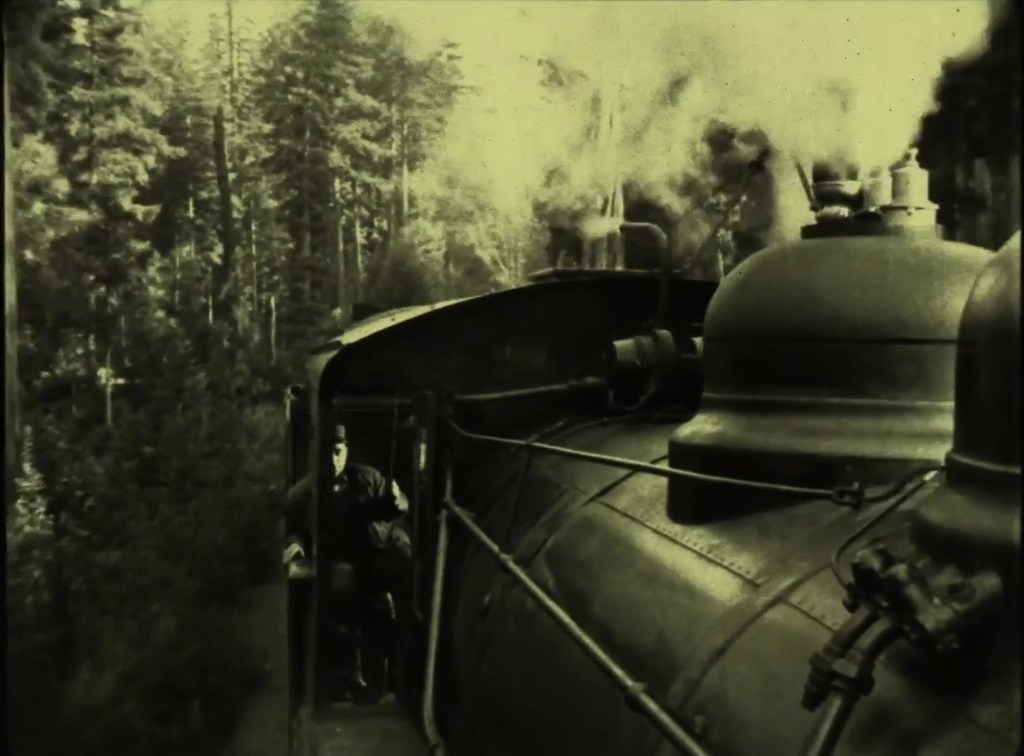
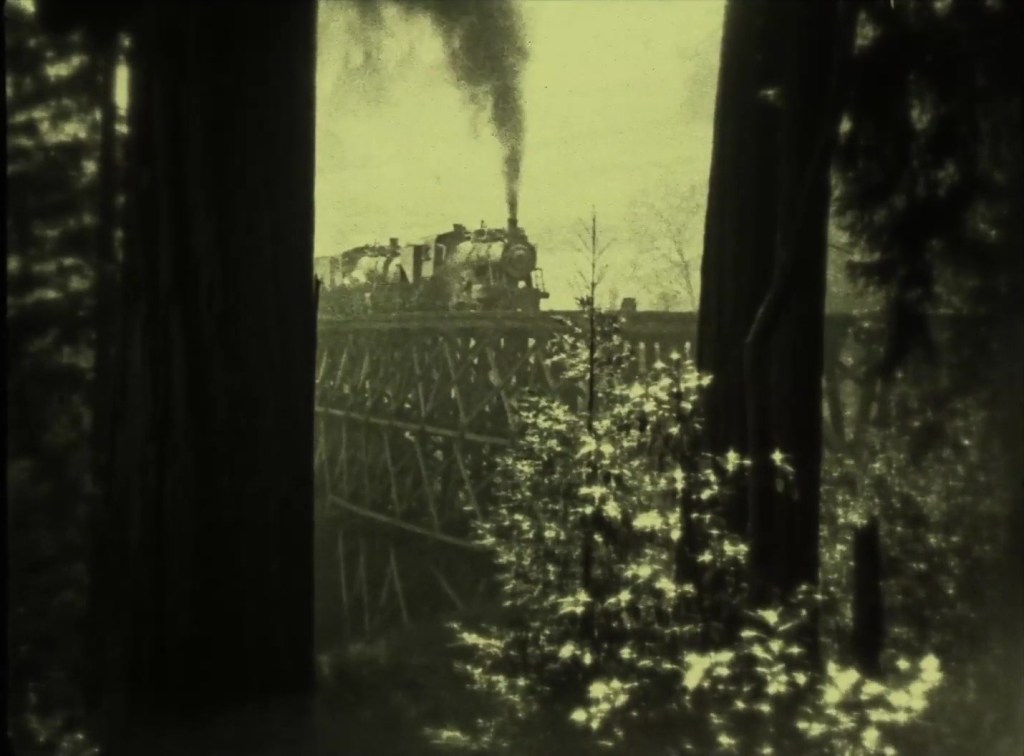
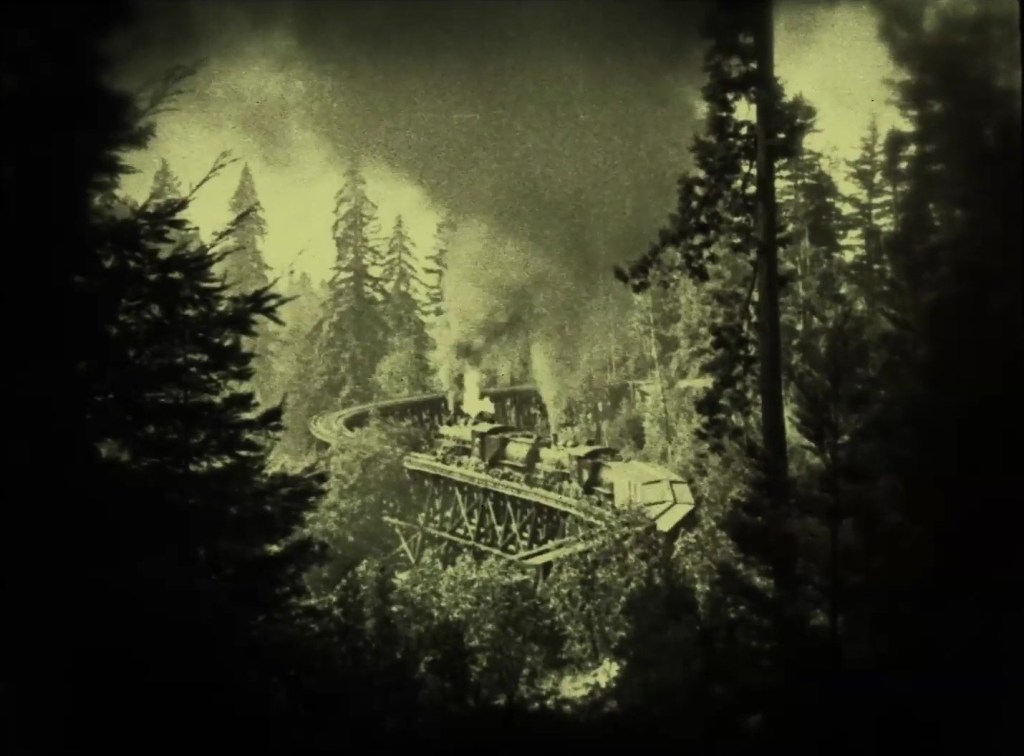
In 1923, budding director Clarence Brown signed a contract with Universal Pictures. After working on the courtroom drama The Acquittal (1923), he persuaded studio boss Cale Laemmle to fund a production set on a remote railway in the mountains. The film was to be an adaptation of a short story by Wadsworth Camp called “The Signal Tower”, published in the Metropolitan Magazine in 1920. Brown and his team headed to Mendocino County, California, where much of the film would be shot on location. The cameraman was Ben Reynolds, who had filmed all of Erich von Stroheim’s Universal films up to this point—and had recently finished shooting Greed (1924). Brown and Reynolds made the most of their setting, combining the mechanized world of the trains with the natural beauty of the mountain forests. Released in August 1924, The Signal Tower was acknowledged for its technical sophistication and boosted the profile of Brown—who would soon be called to work with bigger budgets and bigger stars.

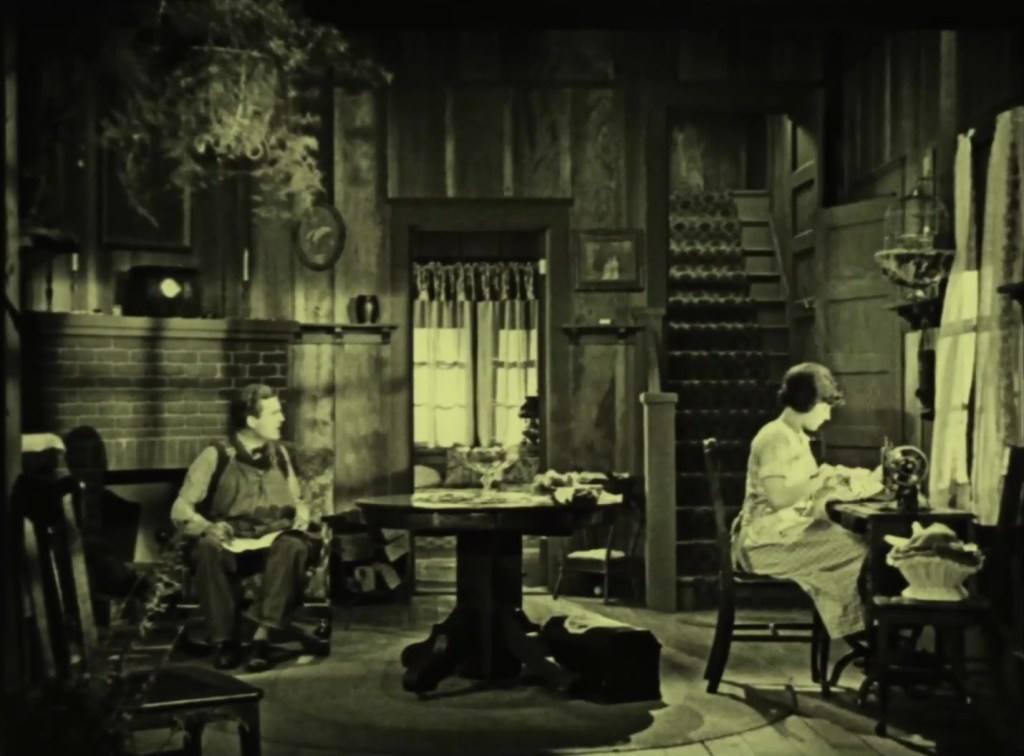
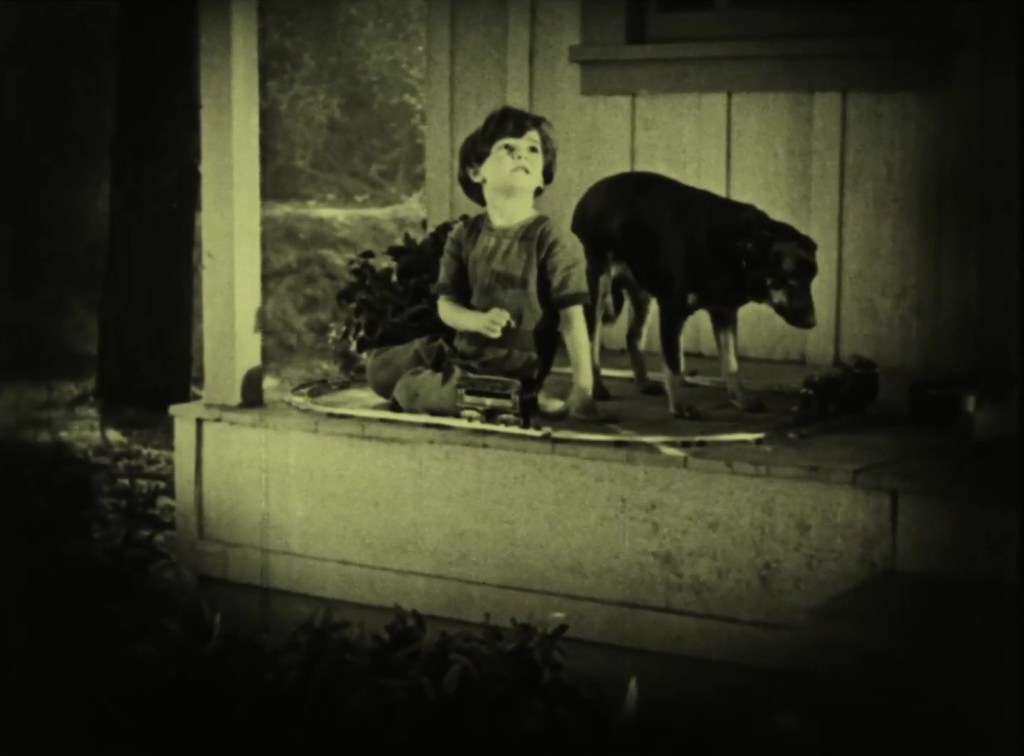
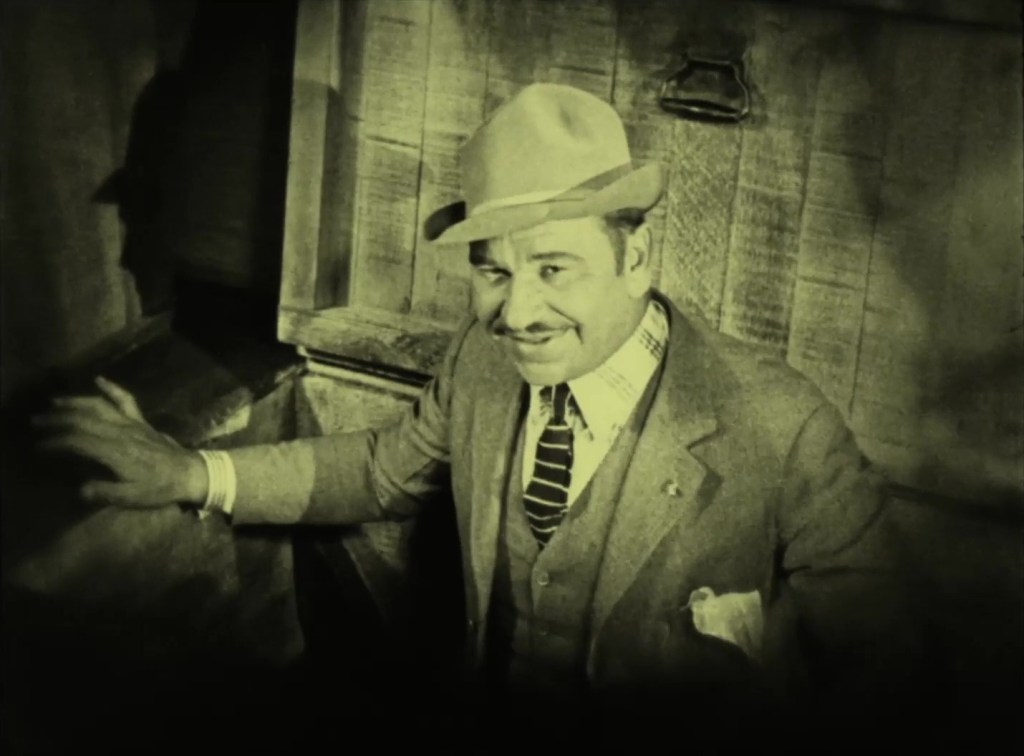
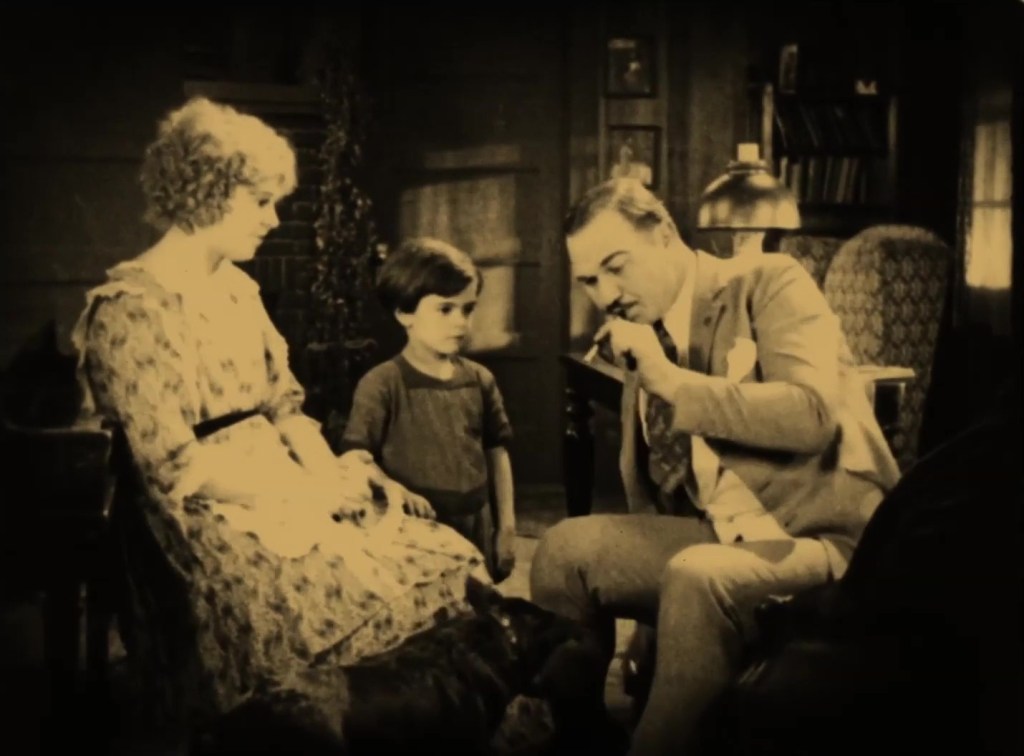
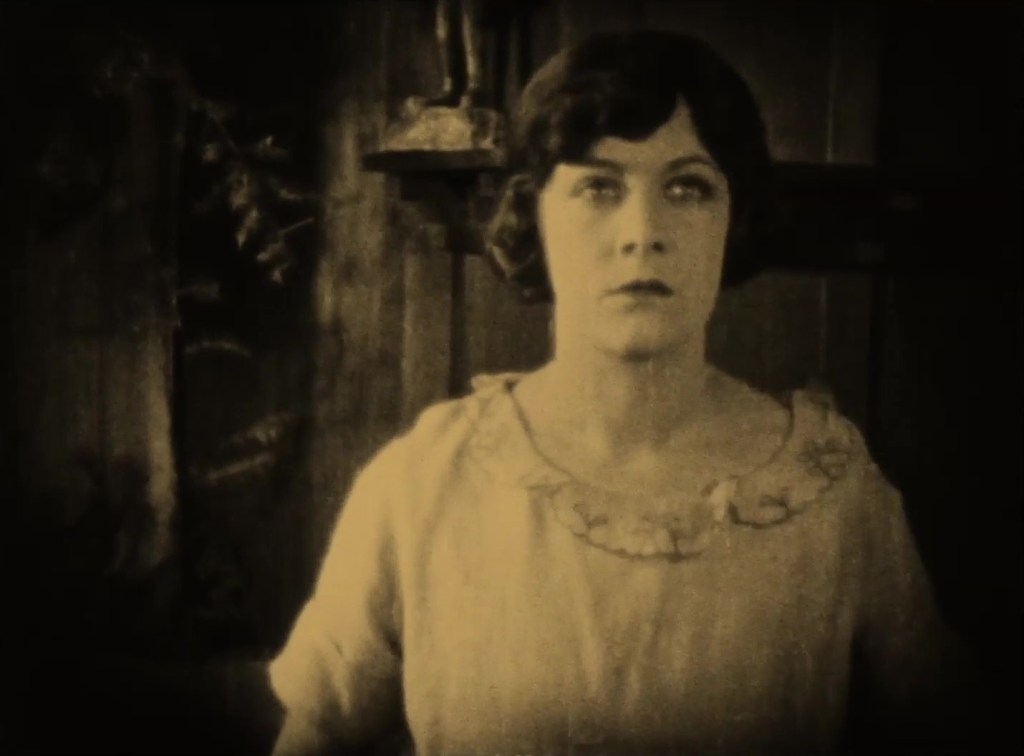
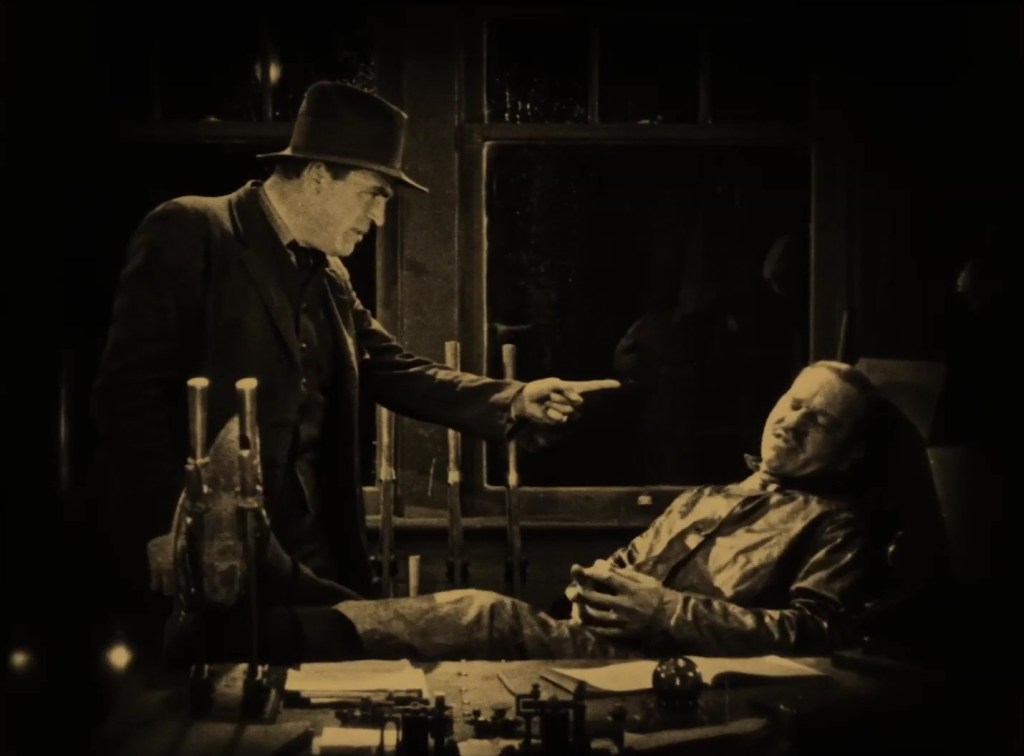
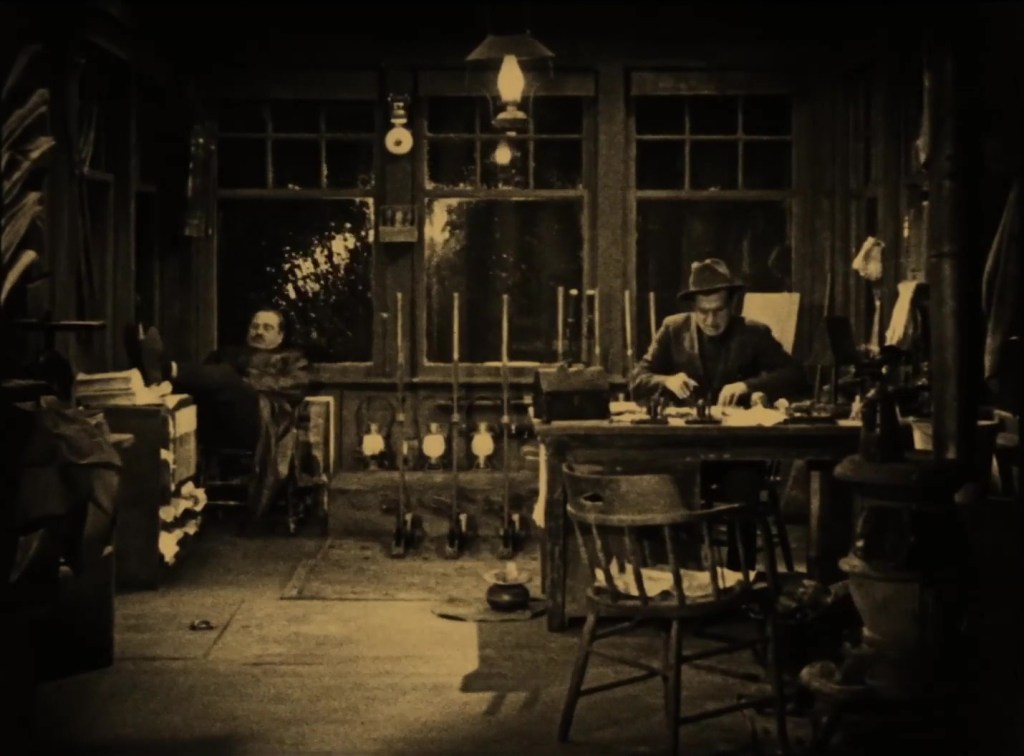
The story is simple. David Taylor (Rockliffe Fellowes) lives in a remote house in the Mendocino Mountains with his wife Sally (Virginia Valli) and child Sonny (Frankie Darro). He works from midnight until noon in the railway signal tower at the base of the mountain, while his old coworker (and reliable lodger), “Uncle” Billy (James O. Barrows), operates the noon to midnight shift. When Billy is pensioned off to New York, his replacement is the caddish Joe Standish (Wallace Beery), who also becomes their new lodger. Cousin Gertie, who is staying with the Taylors, takes a shine to Joe—but Joe has eyes for Sally. At first David doesn’t believe that Joe has bad intentions, but when Joe makes a move on Sally he is ejected from the Taylor house. During a stormy night, Joe turns up drunk for his shift, so David must remain behind to try and derail the carriages before they smash into another train. Joe takes the opportunity to invade the Taylors’ home and try to assault Sally…

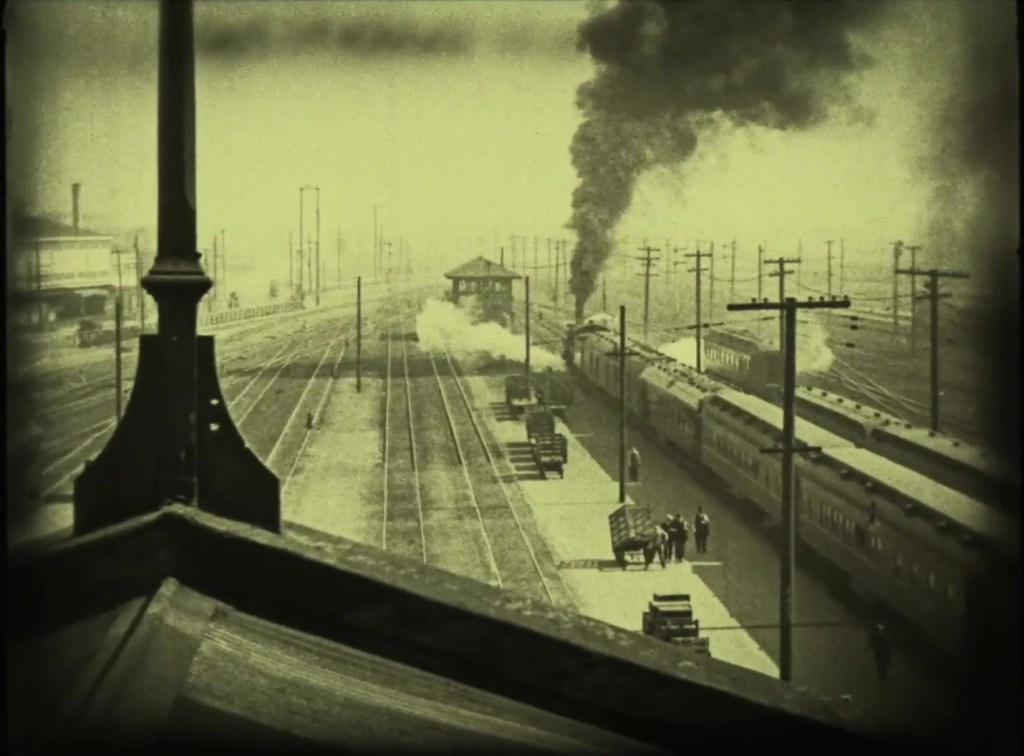
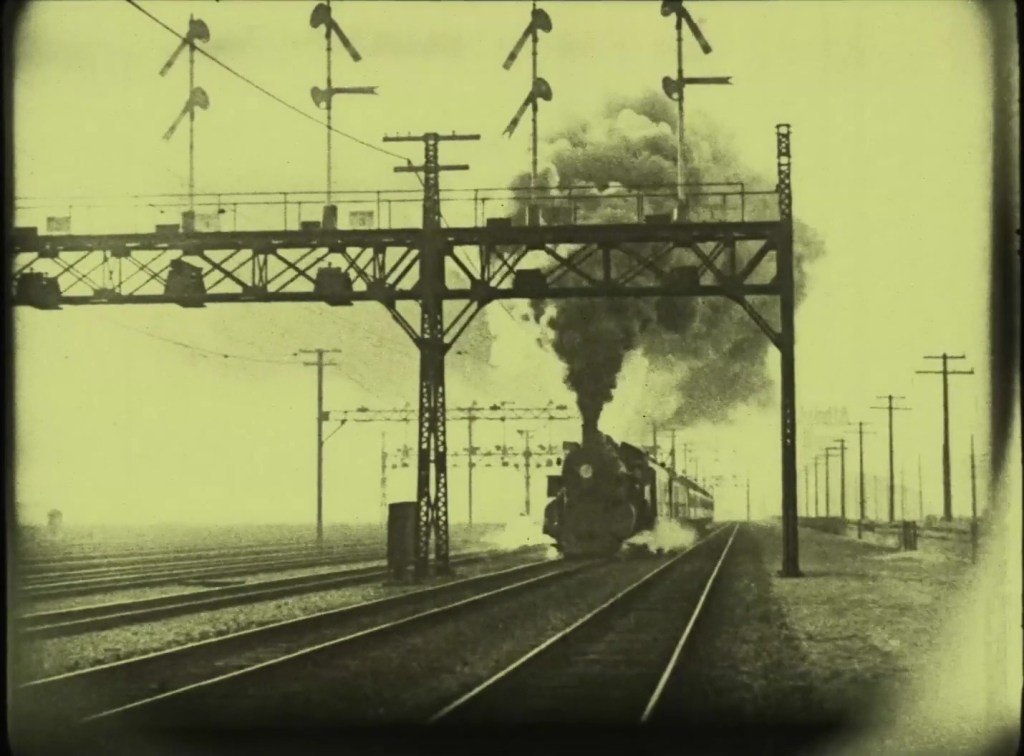
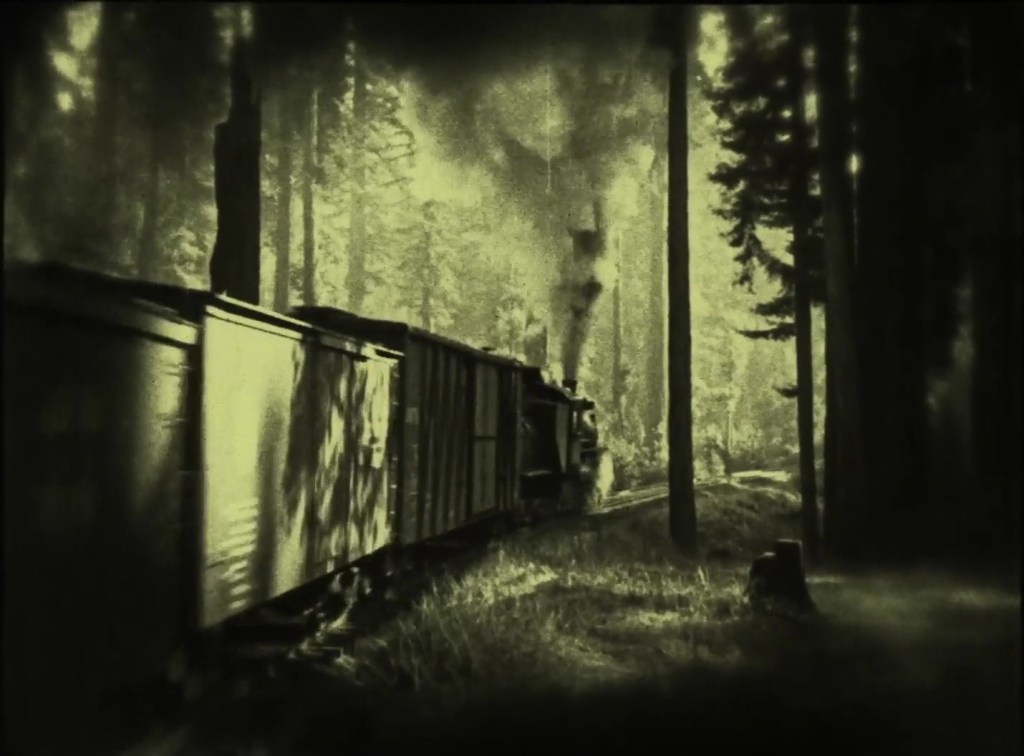
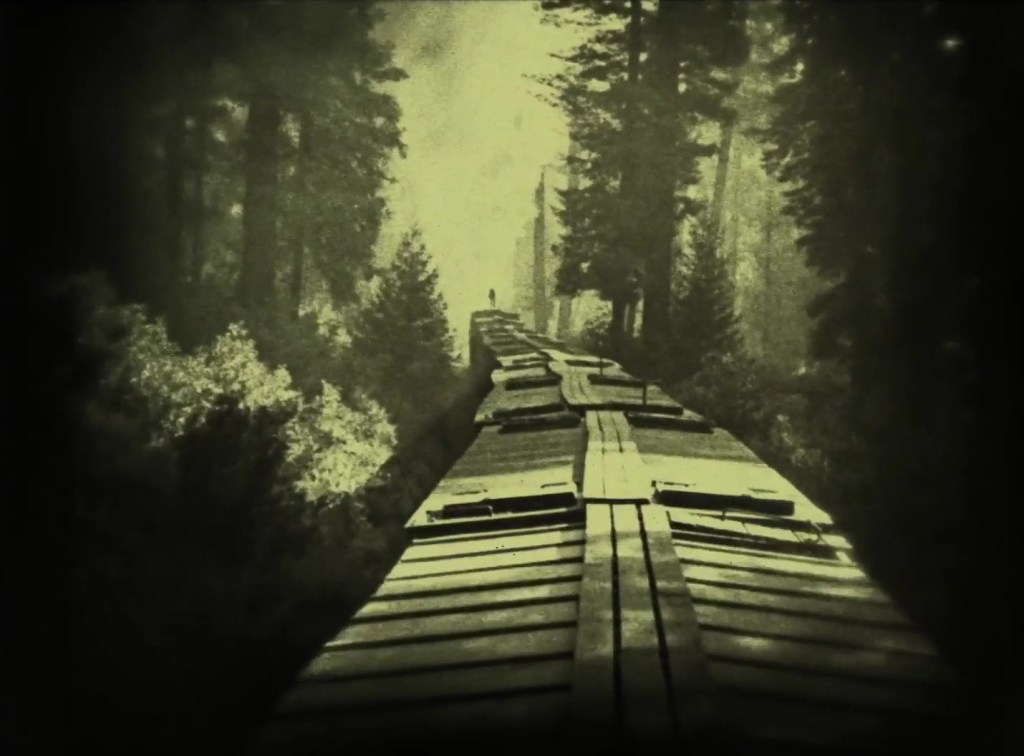
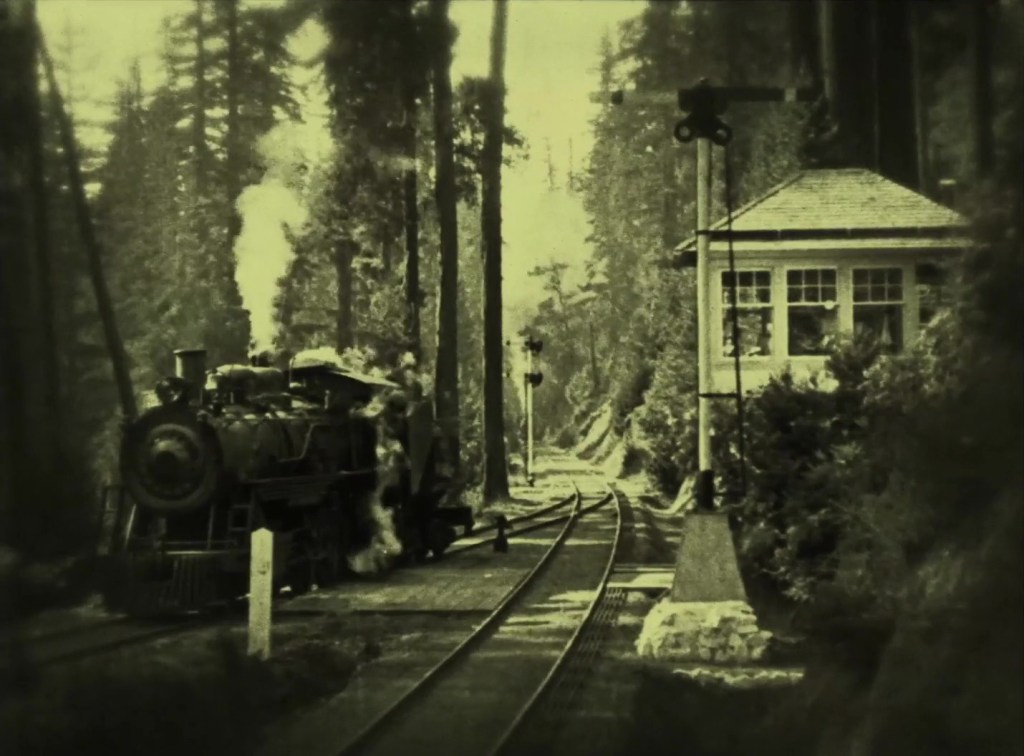
The Signal Tower may have a conventional narrative, but Brown gets the most he can out of the theme of a family under threat. What struck me throughout was the use made of location shooting. The first few minutes of the film consist of a lengthy series of shots showing the way the trains move through the mountainous, forested terrain. Regardless of one’s cultural interest in steam trains (Brown loved them, having an engineering background), the trains are nevertheless of dramatic importance in this sequence: they used to show the gradient of the land, the difficulty of passing from one section to the next, the nature of the track and how it is managed by the signal towers.

I have rhapsodized often enough about sunlight filtering through trees in silent films—but this is another beautiful example of how natural light, combined with deft composition and subtle tinting, produces a glorious vision of the remote forests. Brown related to Kevin Brownlow how he and Reynolds got up at 5 a.m. to photograph the first trains coming through the mountain forests with the sun rising behind them and filtering through the trees (The Parade’s Gone By…, 145). The effort was worth it.

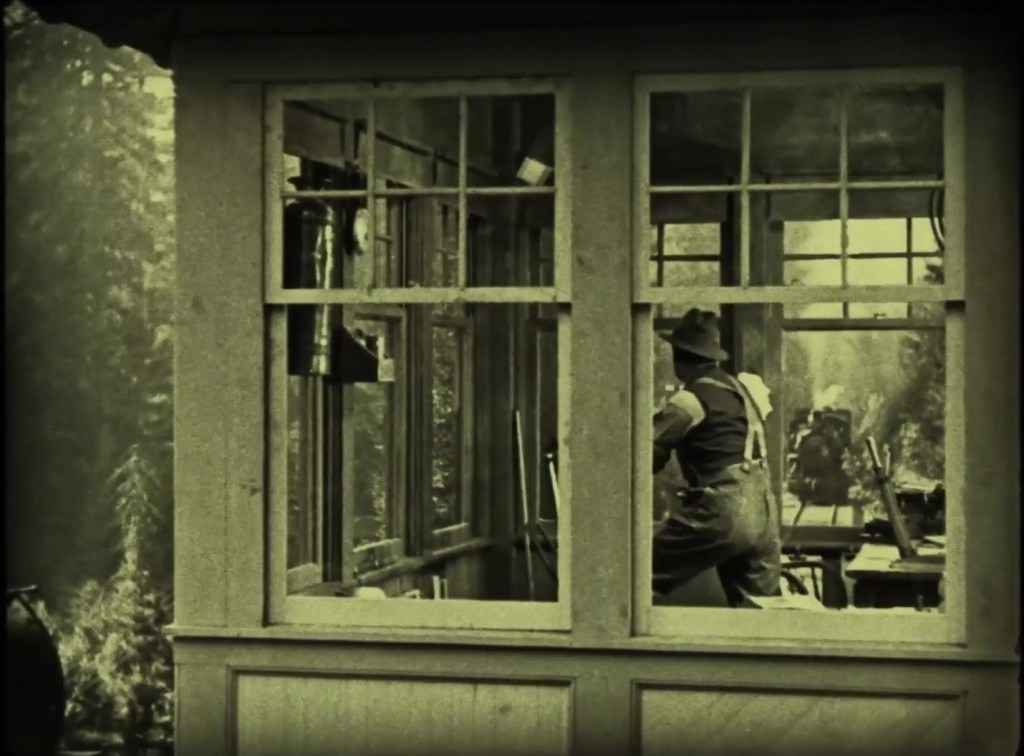
See also how well the film integrates its titular setting into this landscape. After following the track and trains, we see the signal tower itself. We see outside it, inside it, through it. The glass windows surrounding the raised cabin offer a perfect integration of interior and exterior space. Brown took great lengths to get this set right, even fitting amber panes of glass to the tower when the exposure from natural sunlight was too much (ibid.).

The only other major interior setting in the film is the family home, just across from the signal tower. A title describes David’s home as the “terminal point” of his world. It’s a place of refuge. The interiors are a cosy den: the glowing hearth, the comfy chairs, the freshly-baked cakes.

But viewed from outside it feels very different. Brown shows us exteriors view of the house many times across the film. In some shots, the camera is closer to the bridge. We see David cross the stream at the end of his shift: it’s an image of comfort, of retreat. But look again: other shots are taken from further away. The camera lets the dark trees intrude on its view, emphasizing the isolated setting of this refuge, its vulnerability. And our perspective is influenced by the wording of the title that introduces us to David’s wife Sally. We read that she is “unconquered by the stagnant loneliness”. “Stagnant loneliness” is a fabulous phrase, one that hangs over what we see. It swiftly invites us to question David’s own mental image of home and work. Clearly, however well she copes, Sally is aware of the isolation of her home and the threat of external forces.

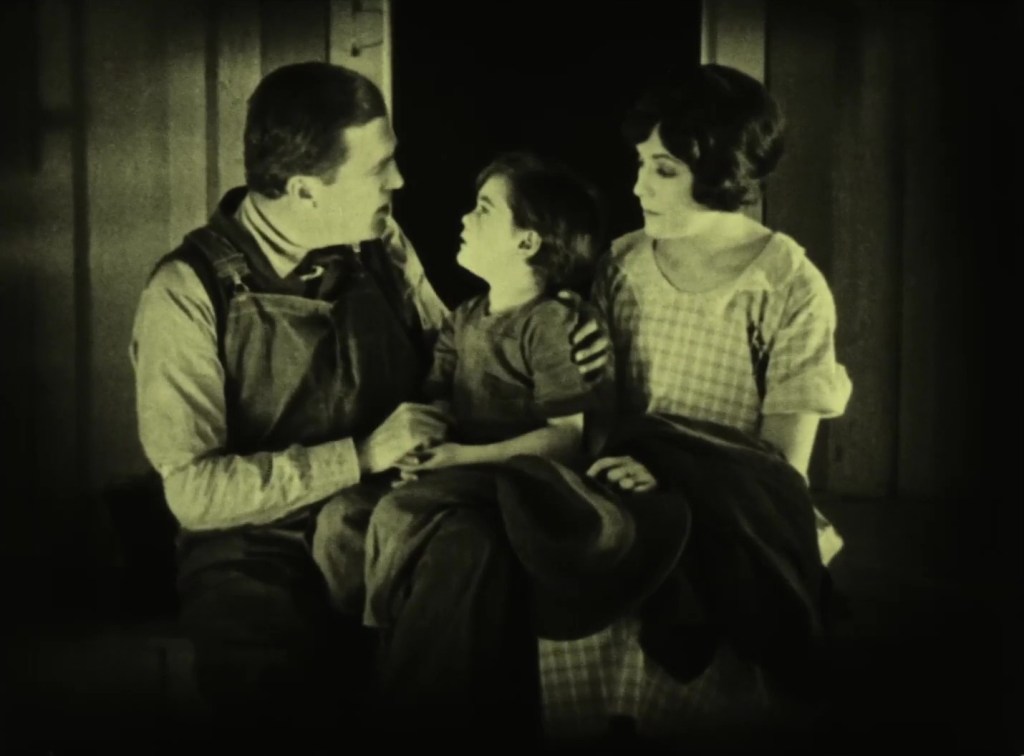
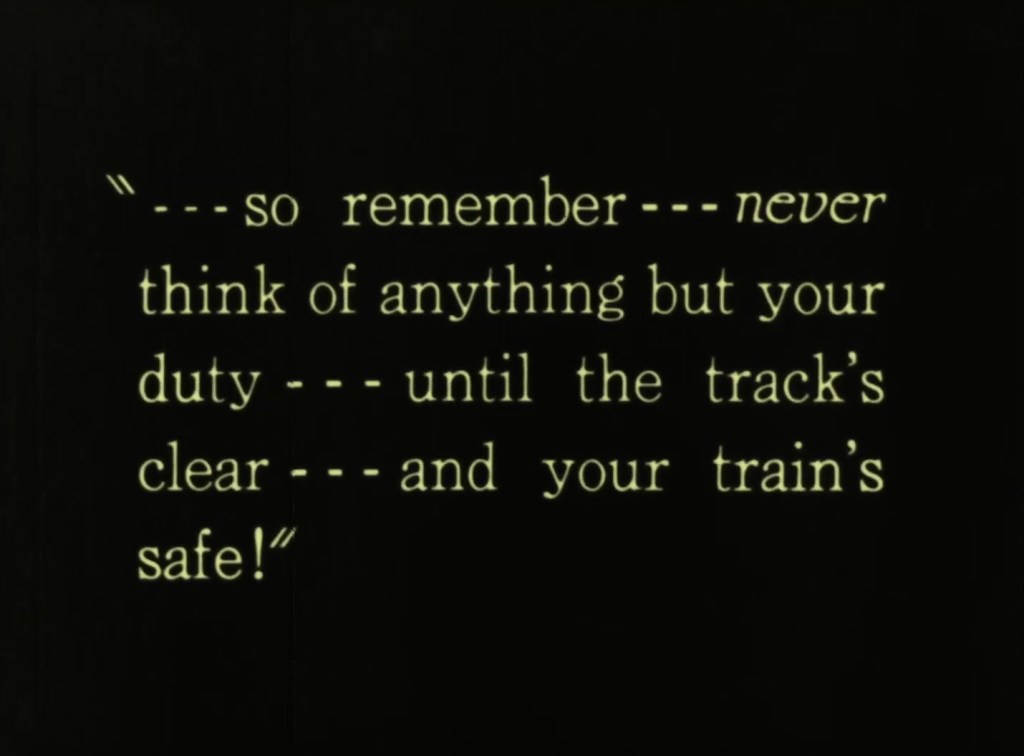
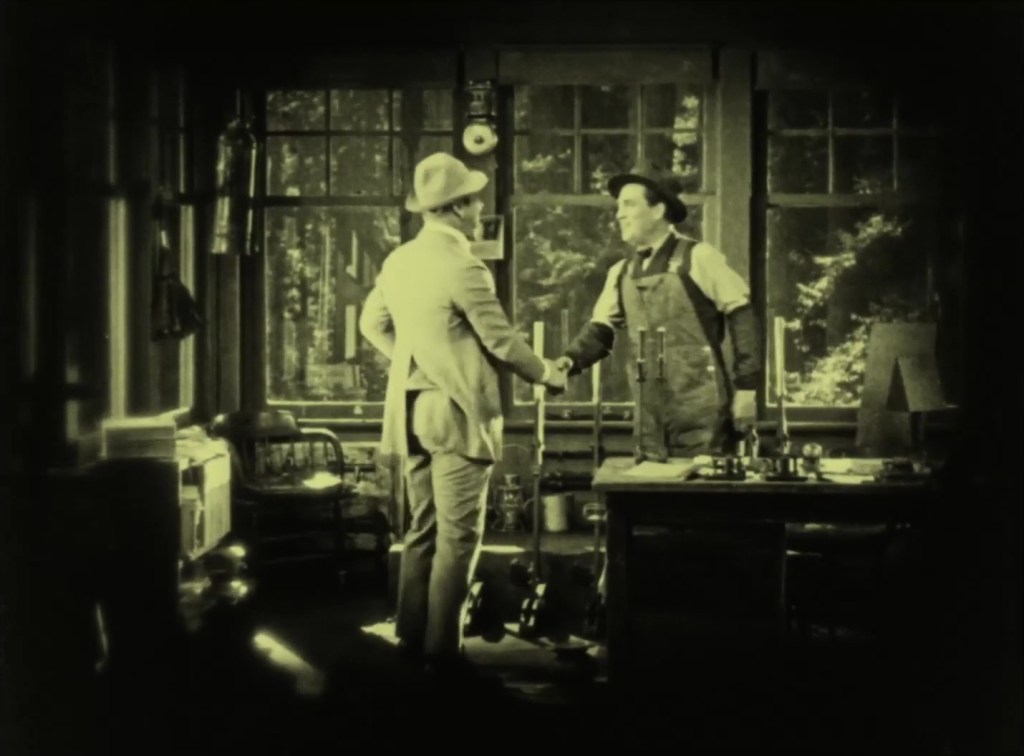
It is this tension between what characters see and what we see that characterizes much of the drama of The Signal Tower. The film is about a man whose duty it is to see danger, but who spends the first half of the film ignoring the warning signals from his own family. The film even makes David spell out the idea of duty taking precedence over everything else to his son. He tells Sonny that a signalman must know his line is clear before he can perform any other function. The seriousness of this idea is underlined by a flashback/fantasy sequence of a train crash (told with models); it’s quite a terrifying vision to impart to a child. But, of course, this warning David issues to his son about duty is the very conflict he himself faces at the end of the film. And though David is a reliable and dutiful man, he is also shown to be blind to other forms of danger. Immediately after the story of the signalman who forgot his orders, David once more goes to work. Look how Brown frames the family’s farewell: the group’s embrace is in the background, far enough away that it almost seems out of focus; while in the foreground, two dark branches threateningly cross the composition. It’s a curious, odd perspective—almost as though someone is watching them from the edge of the woods. There are threats lurking that David does not suspect.

If the rural isolation is sinister, the actual villain of the film turns out to be urbane. Wallace Beery’s Joe is an object of consternation for David when the former turns up for work in dapper suit, shoes, and hat. He looks totally alien to this environment.

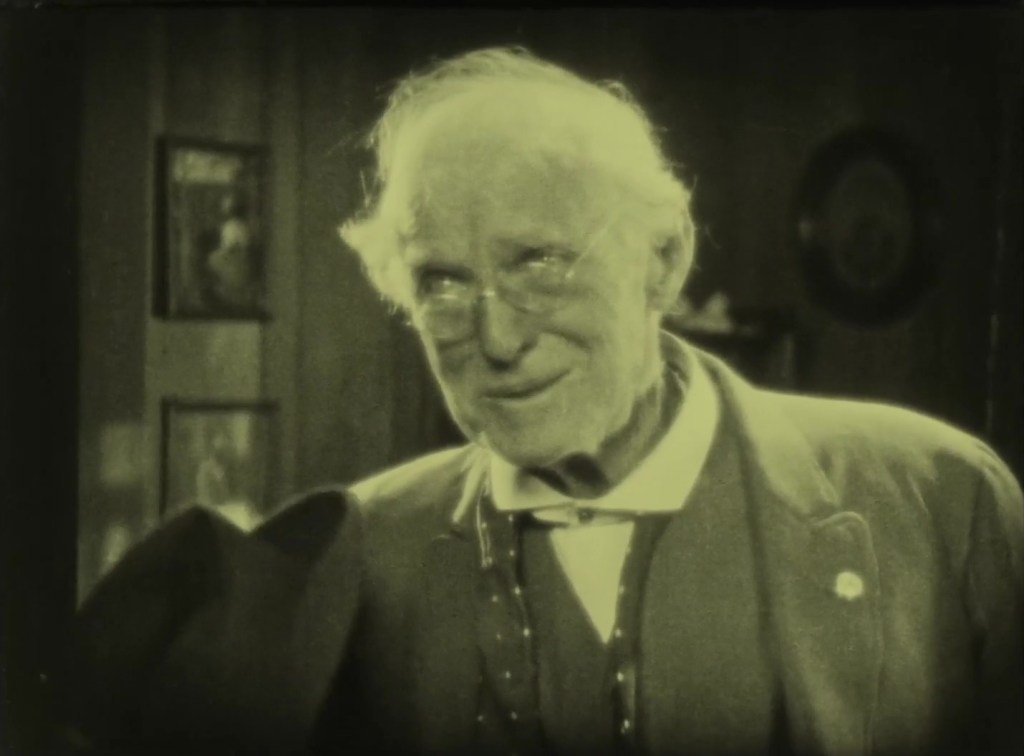
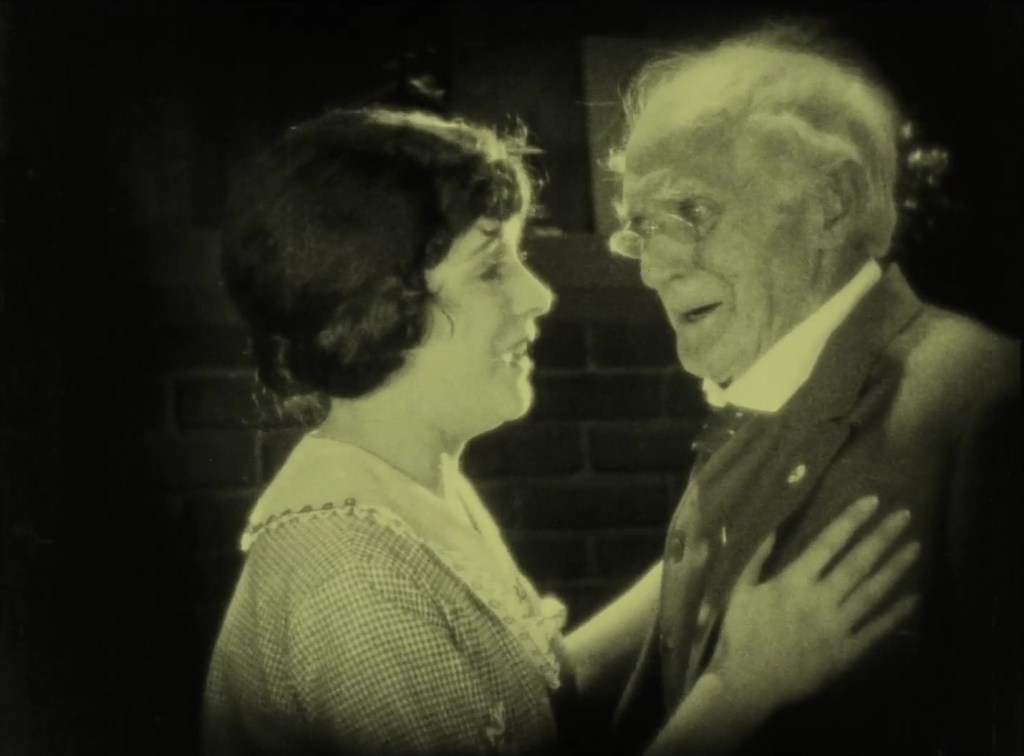
His position within the family home, as the Taylors’ lodger, is likewise conspicuous—more so, since their last lodger was the elder Billy. Sally says Billy has “been like a father to us all”, and Billy himself has all the attributes of a loveable, rural oldster: the white hair, the little spectacles, the pipe, the stoop, the odd gait, the gentle smile. (He even gets the soft-focus treatment to make him look more huggable.) The film plays with how sinister Joe might be, since he is the subject of comic flirtation from Cousin Gertie when he first moves in. Joe’s magic tricks and fondness for Sonny offer a superficial air of innocence—but the way David keeps reassuring Sally that a man who likes children etc is “usually on the level” increases our suspicion (if not David’s).

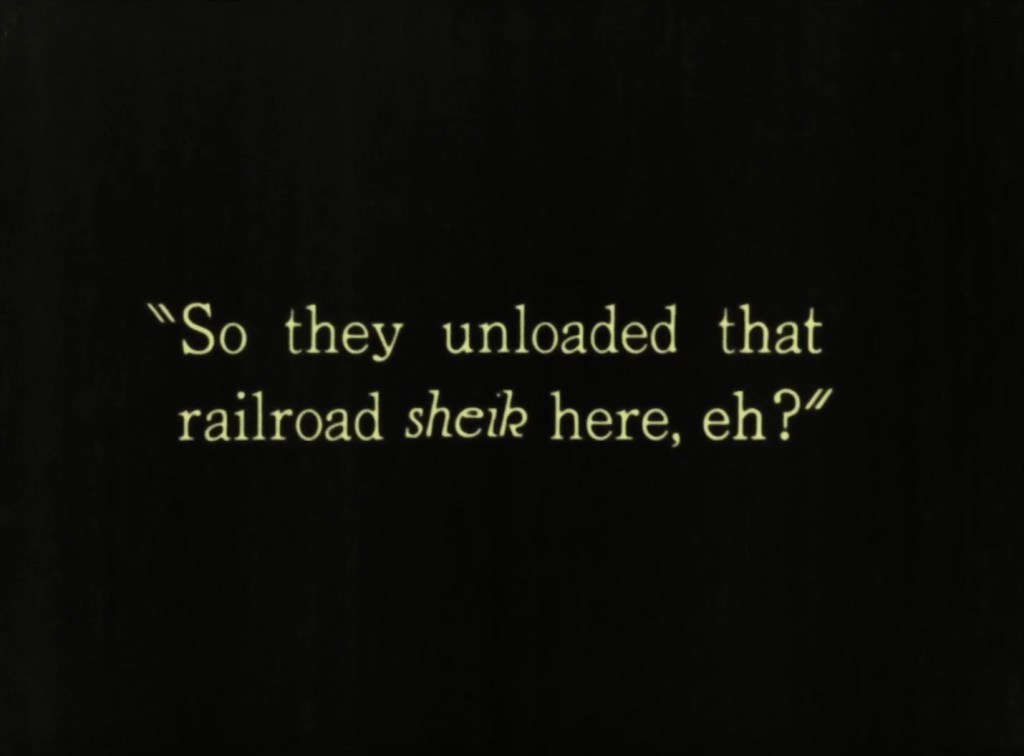
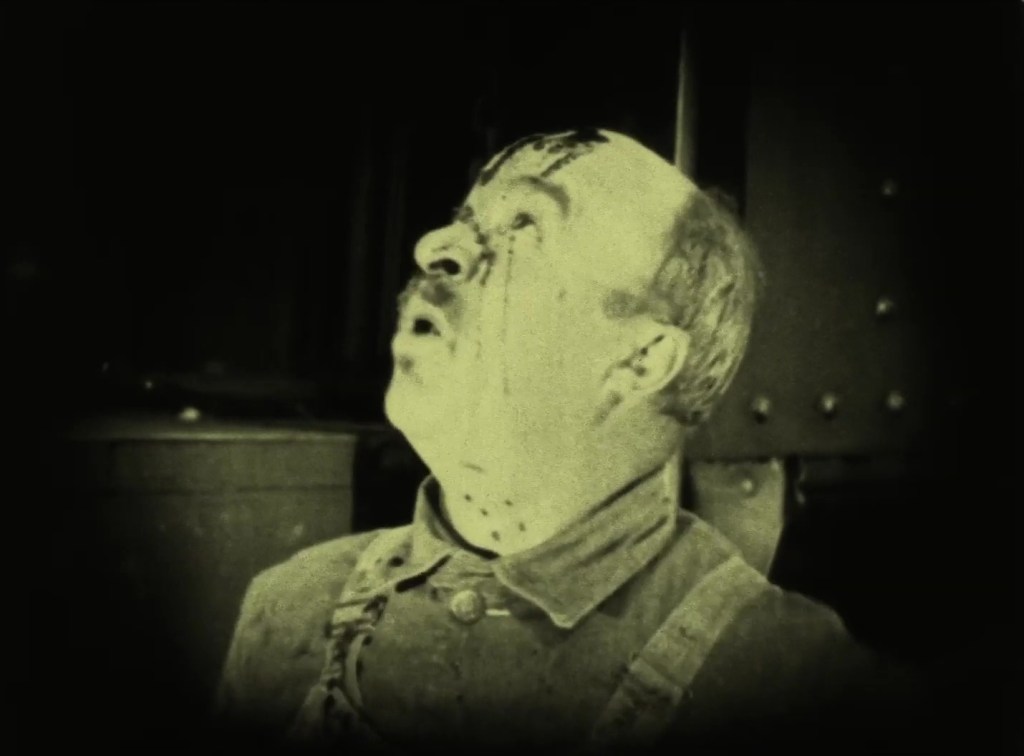
The film offers us another external perspective when David and Sonny have a conversation with a passing engine driver, their friend Pete (J. Farrell MacDonald). Pete already knows Joe’s reputation and refers to him as “that railroad sheik”, the title italicizing the latter word for added emphasis. It’s another visual signal for us, the audience, to observe. We know by now that we shouldn’t trust Joe, but David seems oblivious to the warning signals. He blithely says that this “sheik” will be lonely now that Cousin Gertie is leaving. When Pete is about to ask David what this means for Sally, he is suddenly interrupted. A dribble of dark liquid falls over his forehead and face. It’s a strange, totally unexpected moment. Brown holds the close-up of Pete for several seconds and we’re left in the dark as to what’s going on. The sinister apparition of dark, sticky liquid could be a moment from a horror film—but what might be blood turns out to be engine oil, spilled by Sonny who’s playing in the engine. The shock becomes a moment of comedy, but it doesn’t quite diffuse sinister sense of threat that Brown creates with the image.

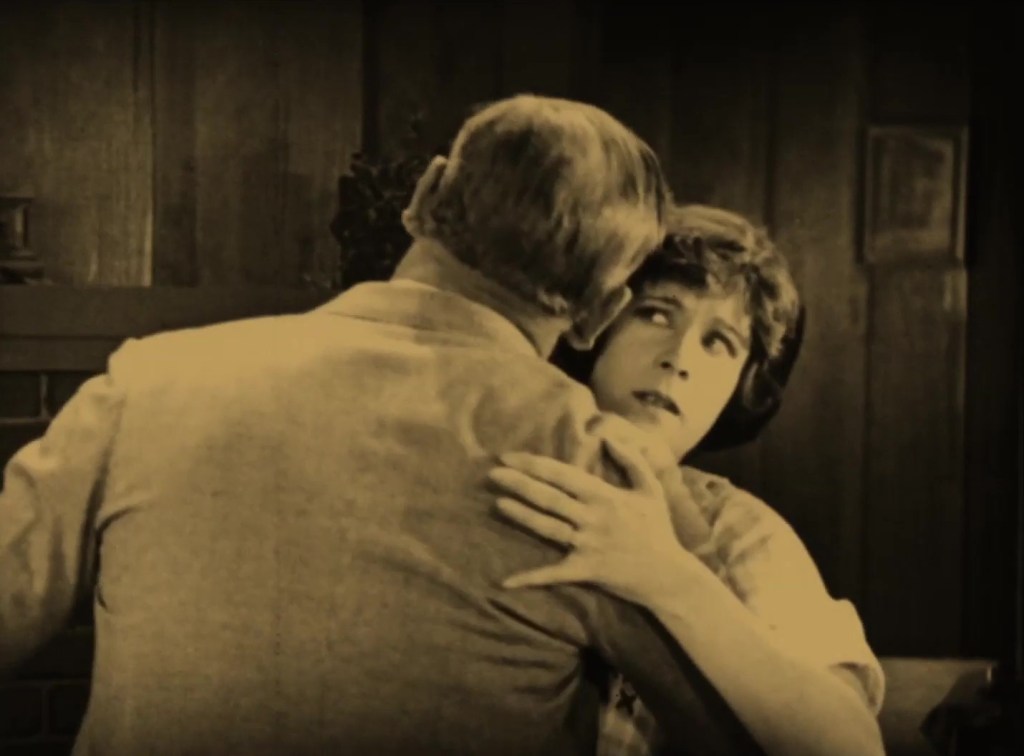
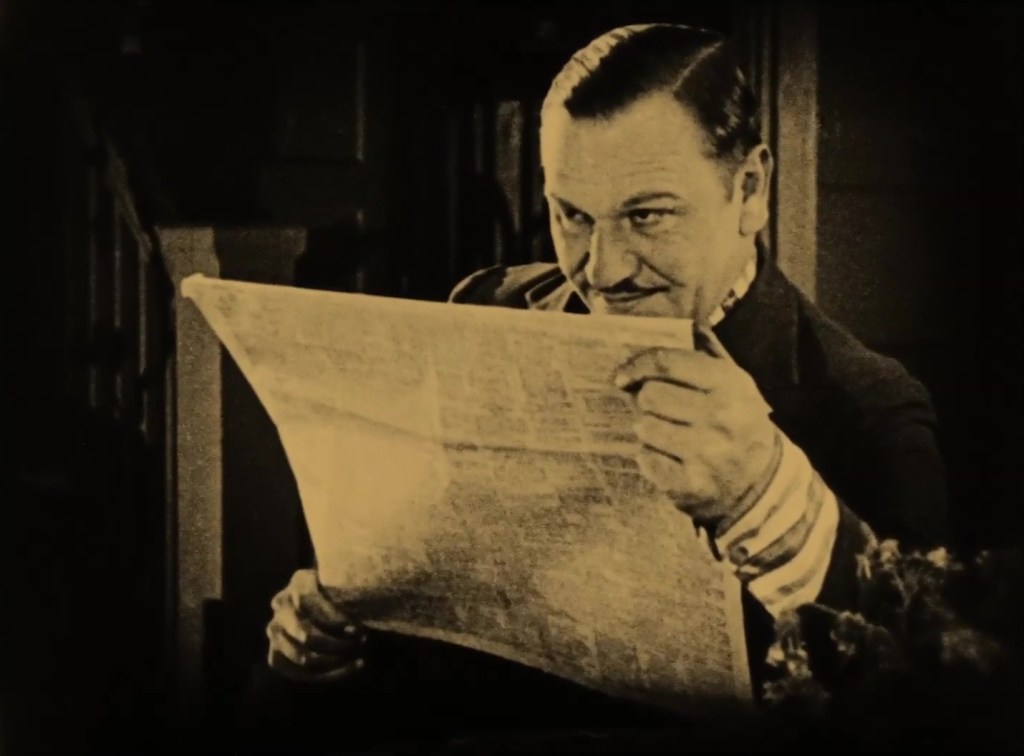
The scene is a kind of premonition, borne out by subsequent events. That very night, indeed, Joe makes his first move on Sally. And “move” is the right word, since Brown uses a tracking shot for the first time in any interior scene in the film. In a neat shot/reverse shot, the camera slowly recoils before Joe and creeps up upon Sally. It’s a threatening movement, and draws us uncomfortably closer—and closer—to Joe. His flirtations (especially with Gertie) have been mostly comic or ineffectual, but now the physical threat of his intentions is revealed. Beery can do bluff comedy, but the sheer bulk of the man makes him an imposing screen presence—especially when, as here, he fills the screen. His prim little moustache—like the stripes of his shirt or the gleam of his shoes—at first gave him an appearance of comic misplacement in this remote, rural environment. But now—as Joe looms in close-up—the moustache seems to emphasize his mouth, the curve of his lips, the broadness of his face as a whole.

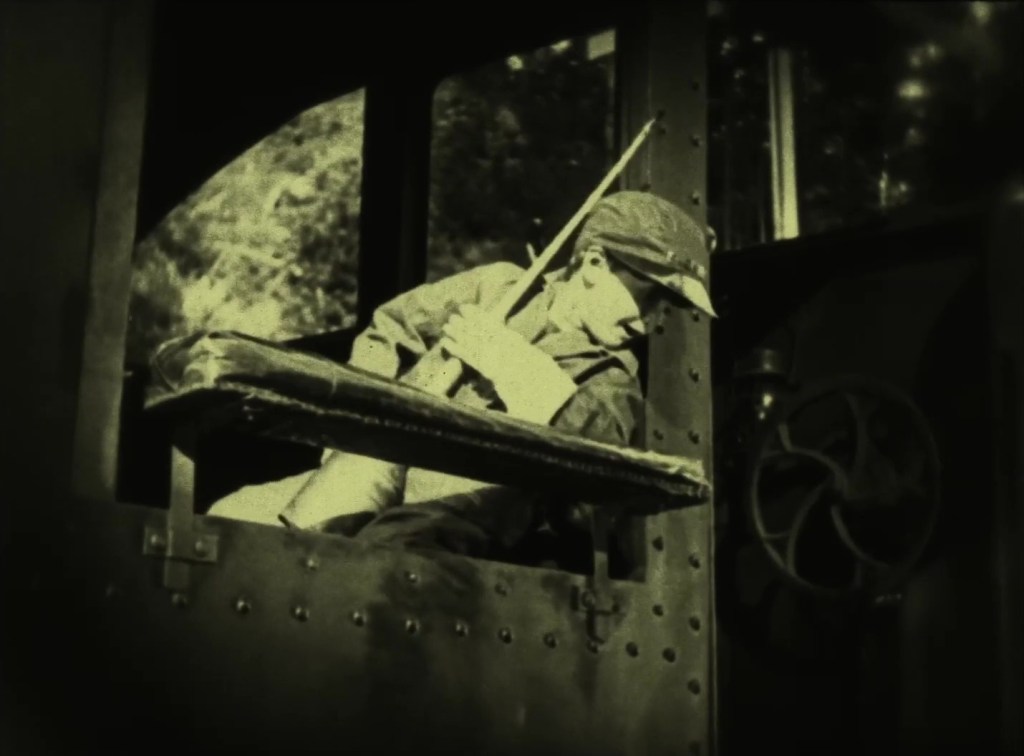
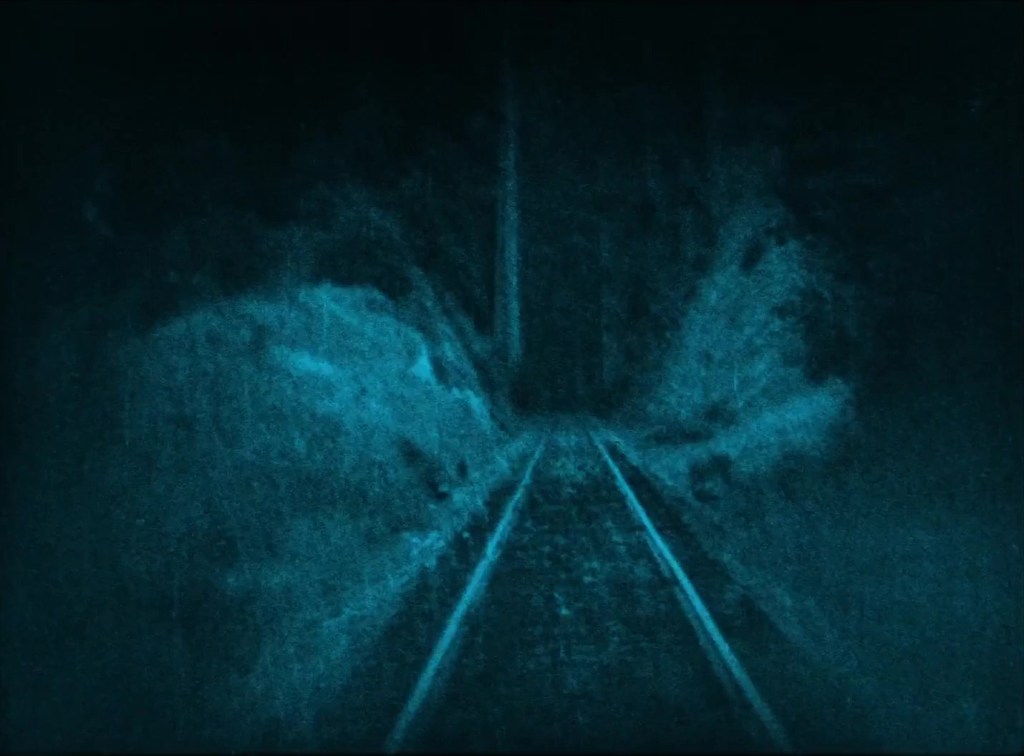
These tracking shots presage the external danger of the last sequence. For this nighttime climax, Brown mounts the camera low down on the front of the engine: we hurtle though the dark landscape at breakneck speed. These tracking shots are exuberantly wild. We can hardly make out the terrain through which we plunge. Only the pale streaks of the tracks guide us through the gloom. It’s like all the menace of those slow tracks in the earlier scene with Sally/Joe are now fully unleashed. The external threat of the runaway train bearing down on David carries the horrible power that threatened—and, in the final scenes, threatens again—Sally and Sonny.

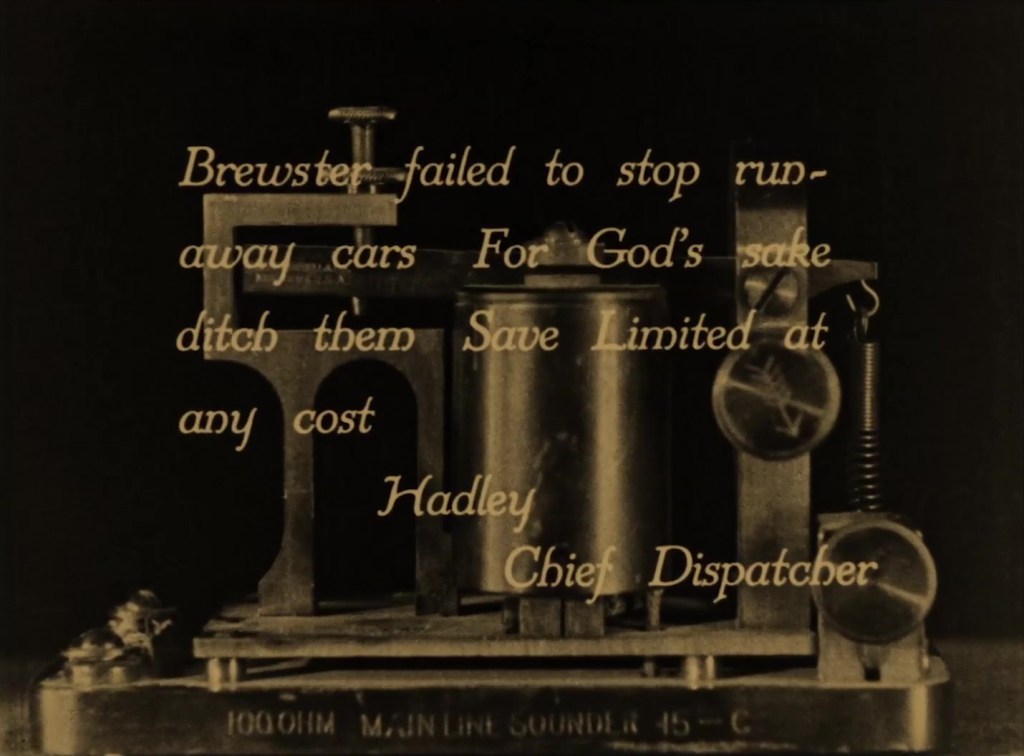
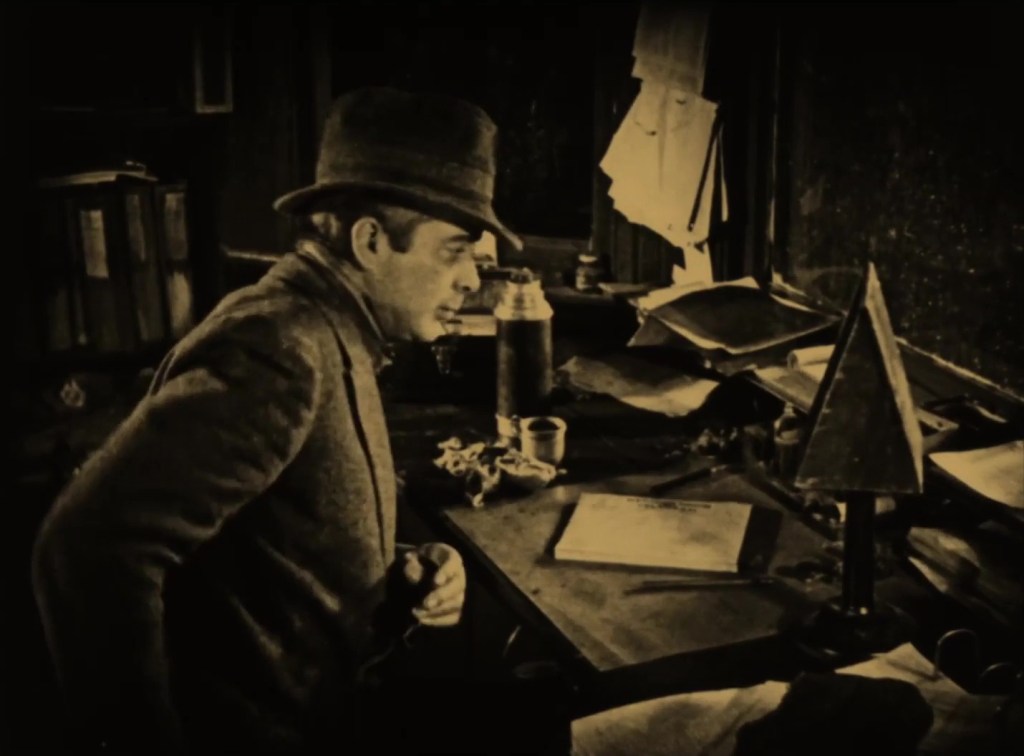
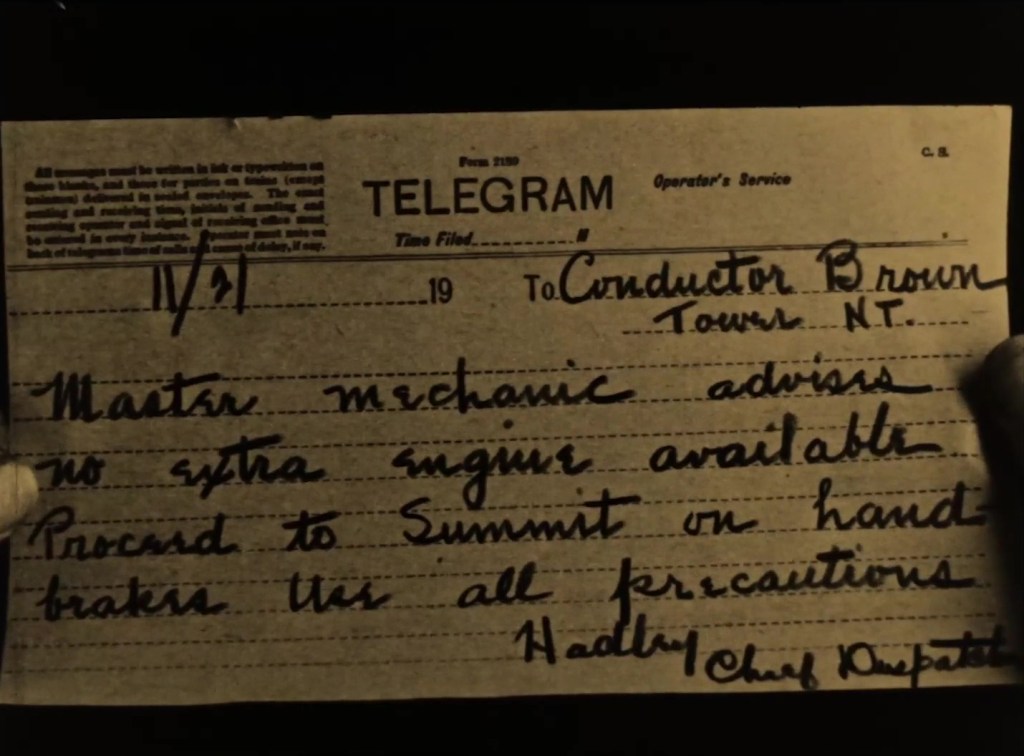
The intercutting of Joe’s attack on Sally and David’s desperate attempt to break the line and derail the runaway train is further complicated by the complex series of cutaway to different spaces. We see glimpses of telegrams from the various signallers, switchmen etc of the railway, together with the operatives themselves. You get some sense of the network of information going back and forth, as well the physical actions at ground level. Amid the skill of this sequence is a notable appearance on screen of Clarence Brown himself. We see him in the role of an anonymous signalman who tries (and fails) to stop the runaway train before it reaches David’s position. If there is irony in this first appearance (the film director as powerless agent), Brown’s second on-screen apparition is more subtle. For the author of one of the telegrams sent between the signallers at the end of the film is called “Conductor Brown”, a neat alternative name for director Brown. If David has been blind to the danger of Joe, here he takes care to receive instructions from the higher authority of conductor/director.

Indeed, it’s also noteworthy that David himself does not (cannot) come to the rescue of Sally herself. This is clearly the right moral decision (one life against the dozens or hundreds on the colliding trains) but presents the possibility of the price he must pay for duty. If “conductor Brown” appears in the telegram to issue clarification, the director Brown works to hide the climax of the struggle between Sally and Joe. This is revealed only later in flashback, so even when the runaway train is successfully derailed there is still tension hanging over David.

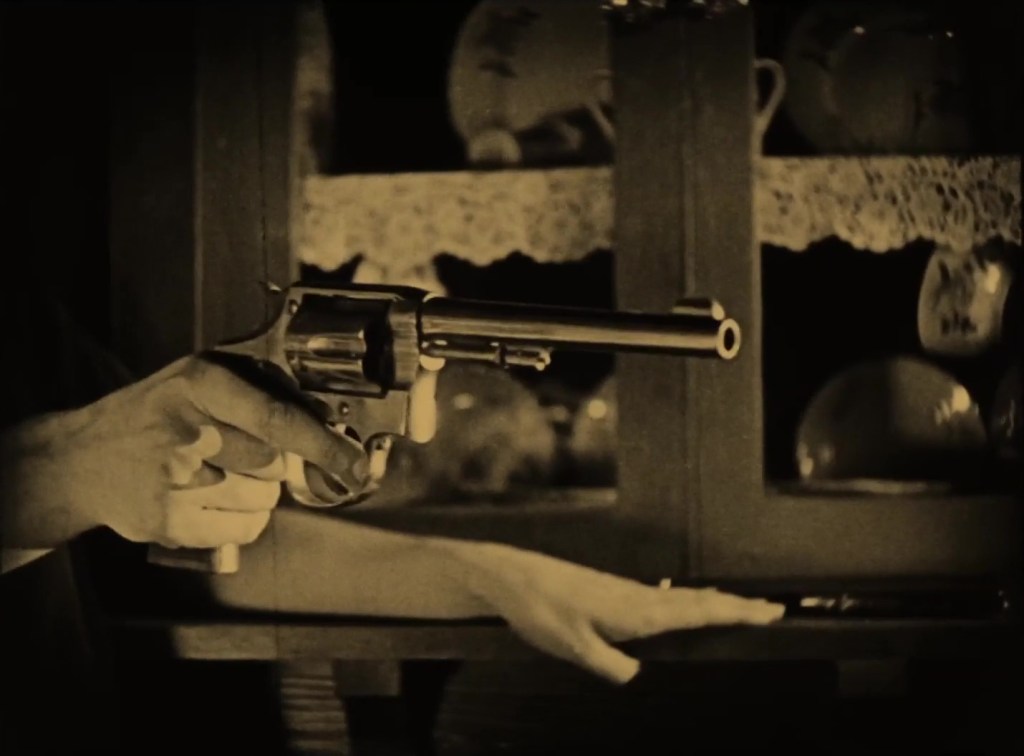
What saves Sally is actually the fact that Sonny ignored David’s instruction. David gave Sonny an unloaded gun to take back to the house, to make Sally feel reassured. But unbeknownst to him, Sonny also takes one bullet and loads the gun. What will save the day is also a foolhardy decision. There is a scene of comic tension when Sonny plays with the loaded gun, pointing it into his own face to look down the barrel. Thus, even the way the film finds to rescue Sally is through David’s blunder and Sonny’s near-disastrous recklessness.

When Sally arrives and relates how she shot Joe, the relief is subtly undermined in the way Brown frames the last shots of the family. Rather than the warm comfort of the home (which has itself been violated by Joe’s brutish assault through windows/doors), the family is reunited outside the signal tower, in the dark and the pouring rain. It’s a bracing kind of reunion, with father and mother and son being soaked in the cold. According to Gwenda Young, there was to have been another shot here:

Brown offers a final shot of the restorative embrace among husband, wife, and child, but he obscures our view by placing a hulking train in the foreground. It was a mark of Brown’s succinctness that he could encapsulate the film’s core theme of human (and familial) vulnerability in the face of the inescapable encroachment of modernity using just one shot. When Brown’s boss Carl Laemmle Sr. viewed the film, he was reportedly baffled by this scene, regarding it as a deliberate (and perverse) attempt to obscure, symbolically and visually, the ‘view’ of the restored family. Interestingly, his son Junior instantly understood what Brown was trying to achieve, and on his insistence, the shot was retained. (Clarence Brown, 44-45)

But I can’t see this shot in the 2019 restoration. Young derives her information from an interview Brown had with Brownlow in 1966, so perhaps this was a false memory—or this particular shot is missing from the current restoration.

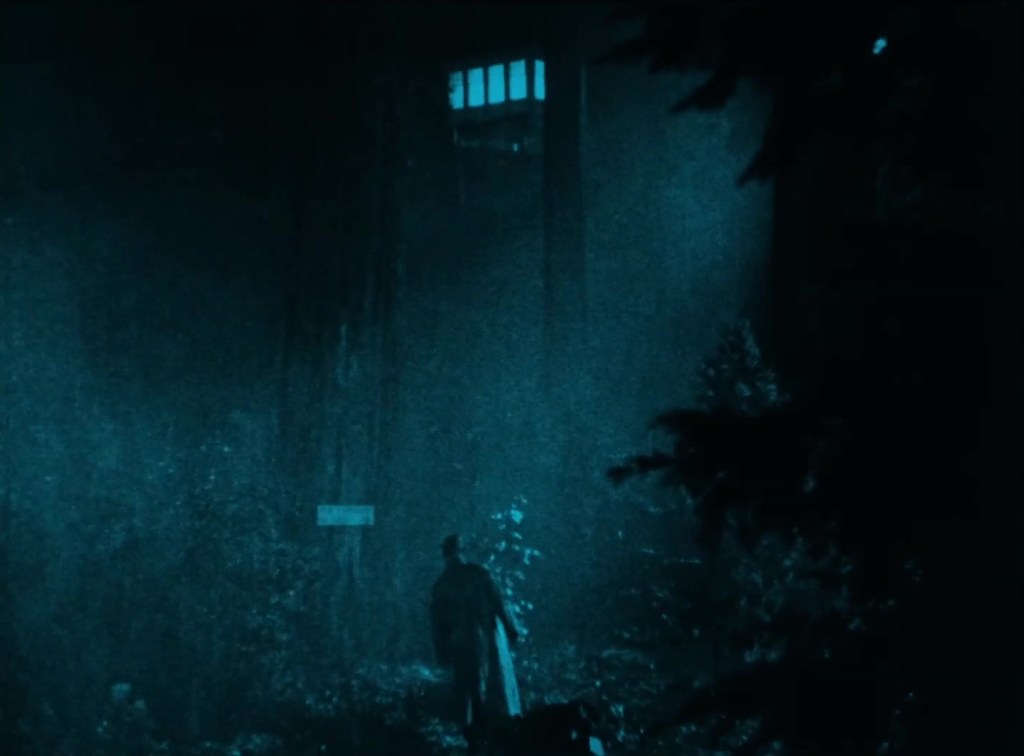
What the surviving film does offer, however, is an even more threatening final image. Though we have seen the flashback to Sally shooting Joe, the film closes with an image of Joe escaping into the sodden forest. It’s a wonderfully expressive image, presenting a kind of vortex receding from foreground to background: the layers of tangled, sodden undergrowth and foliage lit by lightning or obscured in the dark. Successive layers of trees narrow our view: they form a kind of natural iris, leading the eye to the rear, where a circular gap in the leaves reveals Joe. The way he is framed here—his dark body against the dim blur of the clearing beyond—makes him the focus of the shot; but you realize that he’s looking at us, turning to give us a last glance. What really makes the shot is the way you can see Joe’s breath billowing out in the dark: it’s such a fantastic detail to include. It makes him a smouldering beast, retreating into the night. This final image is hardly comforting. The family is reunited, but the villain survives. Sally is saved from any guilt at having killed a man, but at the price of sending him out into the world once more. The family seem oblivious to Joe’s presence in the forest. Only we can see him, and he us. There’s an odd kind of complicity in this exchanged glance: we acknowledge Joe, just as Joe acknowledges us.

This 2019 restoration—from Photoplay Productions and the San Francisco Silent Film Festival—was based primarily on a 16mm print released in 1928 as part of Universal’s “Show-At-Home” series, with missing/damaged shots from another 16mm print of this same version. The restoration notes say that the film was originally 6207 feet, 6162 feet of which have been preserved in this version. The print looks very good, and I often forgot I was watching something from a 16mm source rather than 35mm. There are some scenes of inferior quality, but overall the texture of the image is very good, most especially for the exteriors.

The music for this restoration was written by Stephen Horne and performed by Horne and Martin Pyne. These two players swap between four instruments: the main part is for piano, with sections accompanied by drum kit, flute, or accordion. The main combination of instruments is piano and drum kit, which produces a marvellously evocative tone and timbre for the film. Listen to the opening sequence, the way the drums are about to evoke the texture and timbre of steam and mechanical movement, while the piano takes up the melodic line. The melodies are inflected with a slight ragtime lilt, which is a delight. Horne includes passages for flute (associated with Sally and the home), while Joe’s introduction gets accordion—a nice surprise, carrying a louche suggestiveness in its sliding wheeze. Altogether, a very effective accompaniment.

So there we are. The Signal Tower. A good film. And it’s certainly a more complex film than its story might suggest. Gwenda Young calls The Signal Tower “the first of Brown’s more personal films” (Clarence Brown, 45). Brown creates a rich sense of place, using and framing its locations in expressive ways. His careful compositions and camera movements make us question the assumptions of David. There are many deft touches that change our perspective on events and characters. But what it doesn’t offer is a wider perspective: there is little sense of the outside world this particular place. The Signal Tower uses its setting for drama, not social critique.

For example, David’s 12-hour shift sounds pretty brutal, but he never complains and seems to function perfectly well. Within the film, there is scant acknowledgement of how/when Dave or Sally (or Sonny) actually sleep. Sonny is put to bed once, and Sally spends one night(?) with him—but I was left curious as to how the 12-hour shift pattern works in a practical sense. The organizational hierarchy that demands its employees work like this is likewise never interrogated. Even when David’s long shift would potentially influence his behaviour/actions in the climactic scenes, the film doesn’t pick up on this. He is forced to work for more than twelve hours after Joe quits, but nothing is made of his (presumable) exhaustion as he battles the elements, the rails, and the spectre of Joe’s attack on Sally.

But if the film doesn’t offer a more complex social world, its concentration on the central drama makes it very effective.

Being familiar only with Brown’s later silent films (from The Eagle (1925) onwards), I am now very curious to see more of his work from this transitional period in the early/mid 1920s. In particular, I long to see a good quality version of Brown’s The Goose Woman (1925). I know that the film has been restored and shown in recent years, including with a piano score by Carl Davis. Here’s hoping that this and other neglected Clarence Brown films from the 1920s will get a proper release.

Paul Cuff

References

Kevin Brownlow, The Parade’s Gone By… (New York: Alfred A. Knopf, 1968).

Gwenda Young, Clarence Brown: Hollywood’s Forgotten Master (Kentucky UP, 2018).

Home media releases of The Sheik (1921; US; George Melford)

This piece is about the various incarnations of The Sheik on home media formats. I write it out of curiosity and out of frustration. Curiosity because the differences between copies of silent films always interests me. Frustration because the object of my curiosity is obscured by the usual opacity and vagueness produced when historical artefacts become digital commodities. Let me explain…

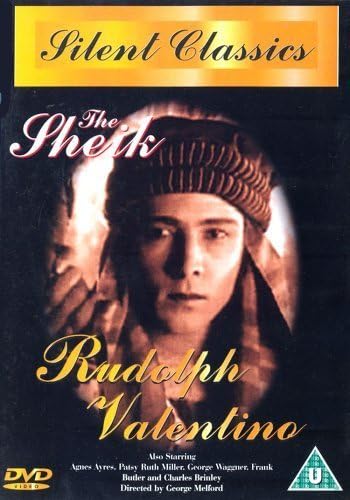
Some years ago, a course on which I was teaching assistant (i.e. seminar tutor) scheduled a screening of The Sheik. Curious as to what copy we would be showing, I looked at the departmental copy: it was the DVD version released in the UK in 2004 by Instant Vision. It presents a monochrome version of the film with a soundtrack of… No, in fact I can’t even remember what the soundtrack was like. What I do remember is that it was such poor quality, visually and musically, that I couldn’t bear for any student on the course to experience the same in this way. (My general rule with screening material is that if I couldn’t sit through it, then neither should my students.) So I looked for alternatives.

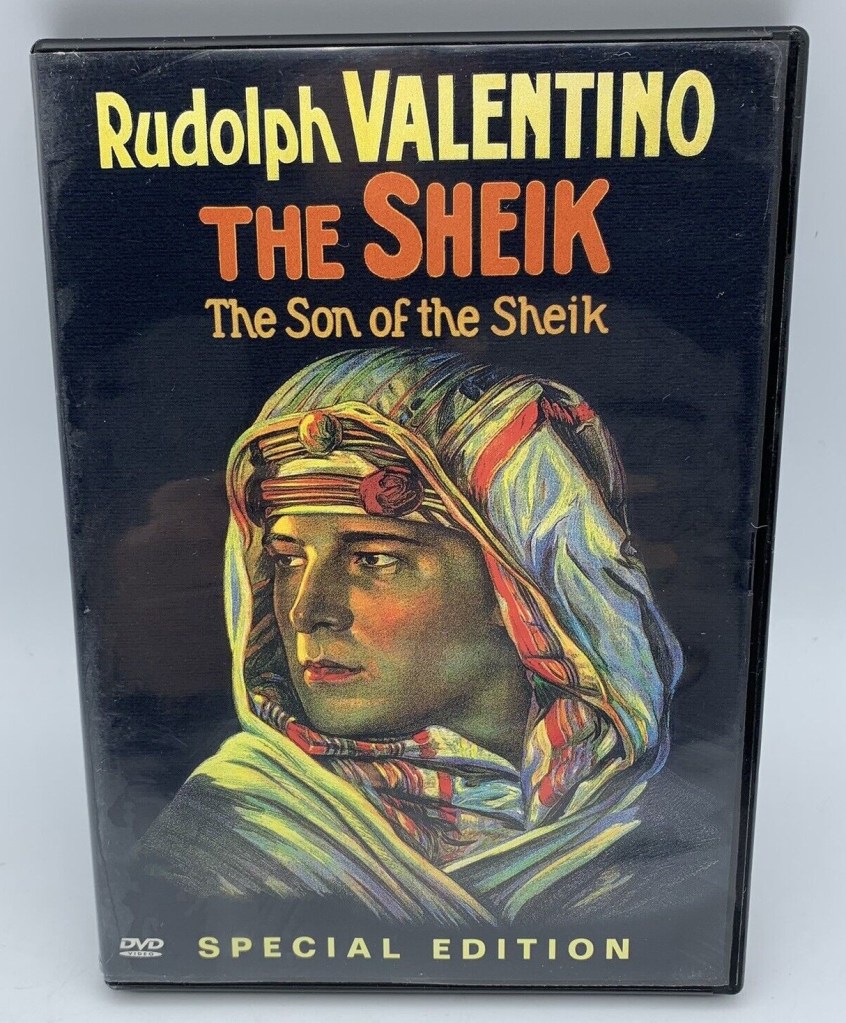
Thankfully, there was at least the DVD produced in the US by Image in 2002. This presented a fully tinted version of the film. However, the score was by the “Café Mauré Orchestra”. Those inverted commas are there for a reason, since this “orchestra” is in fact composed of MIDI (Musical Instrument Digital Interface)-based synthetic sounds—as arranged and performed by Eric Beheim. Though the music choices used (but “used” doesn’t do the MIDI justice: should I say the music is sampled? digitized? synthesized? appropriated? co-opted? press-ganged? harvested? made vassal unto?) are appropriate, the sound of synthetic music rather undoes the benefits of the music itself. Put bluntly, MIDI soundtracks sound cheap. It’s the DVD producers saying: “Listen to how little money we’ve spent on the music! You’ll be amazed!”

So I ripped the DVD and set about compiling my own soundtrack, one that used various nineteenth- and early twentieth-century pieces—including a nice orchestral arrangement of “Kashmiri Song” that Valentino’s character sings in the film. (I even used a couple of the cues from the Beheim score, only these were sampled from actual orchestral recordings.) It worked well and the students enjoyed the film. (More importantly, I enjoyed the film. There are few more maddening experiences in life—well, my life—than sitting through a silent film accompanied by bad music.)

The years passed. I no longer taught on the course that included The Sheik. (Or, for that matter, on any course.) So I was mildly curious when a Blu-ray of the film was announced in 2017. I was poised to buy it, if for the only reason that I try to buy almost anything silent that comes out in a good edition. But then I saw that the score was for theatre organ and my heart sank. (I know, I know, I’m a snob: but really, I just don’t enjoy sitting through over an hour of theatre organ music.) I also considered that my interest in the film was such that I had no real desire to actually buy the Blu-ray. My teaching days seemed to be over, so buying the Blu-ray to try rescoring the film again seemed pointless. I wouldn’t be watching the film, and nor would anyone else. So I passed. Of course, I should have bought the edition anyway. Kino often let their licenses expire, leading to a huge number of titles going out-of-print. Thus, The Sheik duly went OOP.

Paramount then announced their own edition of The Sheik would receive a Blu-ray release in November 2021. Still curious, I searched to see what information I could find about the restoration. I found an interview with Andrea Kalas, who leads Asset Management at Paramount. According to Kalas:

We looked around the world for best sources and Film Preservation Associates graciously loaned us a 35mm black and white print. We also had a finegrain which turned out to have a better overall picture quality, but the print turned out to be great for the intertitles. […] The original frame-per-second cadence was 22fps. The fine grain we used had been ‘stretched’ to 24—essentially by adding frames. With the help of the lab, Pictureshop, we went back to 22fps. […] We had a continuity script that was a critical guide to the digital tinting and toning we added – which was the way the audience in 1921 would have seen it.

The Paramount restoration promised to run to 66 minutes, nine minutes shorter than the Kino Blu-ray and a full twenty minutes shorter than the Image DVD. Kalas’ talk of reversing the stretch-print process of one of their source prints was reassuring—but if the film was “returned” to 22fps, why was the runtime so short?

All of which led me to some basic questions about The Sheik that no home media edition had addressed: How long was the film when shown in 1921? What projection speed was used? What print material survives? Thankfully, the American Film Institute database has some excellent material that is readily accessible. Here, I found that the original length of The Sheik was 6579 feet, which equates to 2005m. (IMDB.com states that the film ran to 1818m when shown in the UK, but I am less inclined to trust IMDB than the AFI when it comes to any film of this vintage.) Even if projected as fast at 24fps, 2005m would be 72 minutes. At 20fps it would be closer to 87 minutes. So how did the previous home media versions of The Sheik relate to this 2005m print, and at what speed did they run?

Well, here are the various incarnations (not including the infinitude of grey market rip-offs) and their runtimes:

  • Paramount VHS (1992) = 79 minutes
  • Image DVD (2002) = 86 minutes
  • Flicker Alley (made-on-demand) DVD (2015) = 76 minutes
  • Kino Blu-ray (2017) = 75 minutes
  • Paramount Blu-ray (2021) = 66 minutes

Maddeningly, nowhere on any single home media release does any company—Paramount, Image, Kino, or Flicker Alley—actually state what the length of their copies are in metres. As a result, we must second guess frame rates and go through each edition to try and work out how they compare to one another…

Though there are some minor textual differences between the copies (the Image DVD, for example, is missing one or two intertitles), the basic material remains consistent through these various home media incarnations. One notable exception is the Paramount VHS, which presents different intertitles to the later DVD and Blu-ray editions. The home media review for The Sheik on silentera.com states that the VHS used the re-edited and retitled version of the film, not the original. It’s ironic that the visual quality of the titles presented on the VHS is often superior to that of the DVD/Blu-ray editions: the titles in the reissue print are uniformly strong, sharp, and legible. It’s a shame that many of the original titles have not survived in such a state: after the very high-quality images of live action in the film (especially on Blu-ray), it’s a shock to have to squint at the slightly blurry wording of the titles.

The differences in runtime across the above home media editions are due overwhelmingly to the different framerates applied to the print sources. Deciphering the various video files of these editions has not proved easy, but I can offer an informed estimate of the rates for each. The Image DVD uses the slowest speed of 18fps, the Paramount VHS uses 20fps, Flicker Alley DVD and Kino Blu-ray use 21fps, and the Paramount Blu-ray uses 24fps. Kalas states that the film originally ran at 22fps, though my impression viewing the versions of the film that run to c.75 minutes at 21fps is that this seems perfectly life-like. (It may be that the projection speed used in 1921 was 22fps; but Kalas doesn’t go into any detail about this issue in the interview.)

I’ve checked the Paramount disk and (shorn of new opening/ending credits) the film does indeed last 66 minutes (and nine seconds) and runs at 24fps without any repeated frames. At 24fps, 66 minutes equates to an approximate print length of 1830m. That’s still 175m (6-8 minutes, depending on projection speed) short of the film as seen in 1921. Some of this might be accounted for in the length of intertitles, but it’s still a not insignificant amount of material for such a short film (nearly 9% of its length). I’ve also checked the Paramount Blu-ray against the Kino Blu-ray. It appears to be exactly the same restoration. And I mean exactly the same. The same tints and tones, the same titles, the same scratches and damage. The only difference is the framerate and the soundtrack. I can only presume that Paramount’s centenary restoration of The Sheik was completed by 2017 and Kino simply licensed this version to last until the actual centenary of the film, whereupon Paramount could release their own edition. But why on earth does the Paramount Blu-ray transfer this same restoration at 24fps?

The decision is even stranger when you consider that the soundtrack for Paramount’s Blu-ray—a synth score by Roger Bellon—is the same as the one on Paramount’s VHS thirty years ago. Although Kalas claims the music was “commissioned in 1990 as part of a celebration of Paramount’s 75th”, the VHS edition from 1992 bears a copyright date of 1987 for the soundtrack. (According to various reviews of older home media editions, The Sheik was first released on VHS by Paramount in 1988. I’ve not been able to find any VHS from 1988, only the edition from 1992.) Kalas adds that Bellon’s music “really stands up”, which again begs the question why transfer the film at 24fps when the soundtrack was arranged for a version of the film that ran at 20fps? Another issue with the Bellon score is that it never uses the “Kashmiri Song” that is cited in the film’s intertitles and sung by Valentino on screen. This may well be because the intertitles of the VHS version (for which the score was composed) are from the reissue print, which changes the wording of the Sheik’s song—and thus loses the context of the original song. (While no substitute for a real orchestra, the theatre organ score by Ben Model for the Kino edition at least quotes the “Kashmiri Song” at the appropriate moments.)

Paramount are not alone in sidelining the complex issues and inevitable compromises of film restoration in their home media salesmanship. But in the past I have been irritated by the way some of their press releases muddy the waters of what editions are being presented on Blu-ray, and how they relate to the films as originally presented in the silent era.

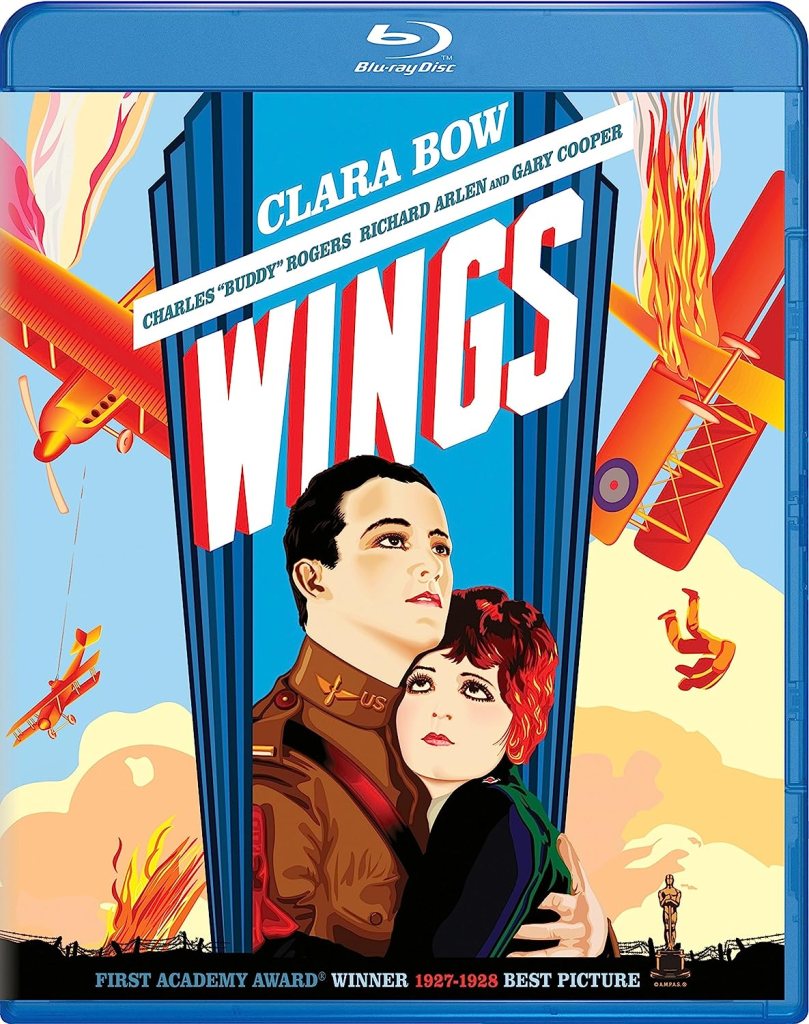
For example, their 2011 Blu-ray release of Wings (William A. Wellman, 1927) was announced with a press release that detailed how they had restored the original score composed by John Stepan Zamecnik (plus the numerous sound effects that were a feature of the film’s initial release). This “newly-restored” soundtrack was announced as the culmination of great effort:

the film’s original paper score was procured from the Library of Congress and recorded with a full orchestra […] Musicians with expertise in silent film music were chosen to recreate a truly orchestral experience.

Note the references to physical artefacts and institutions: paper score, material archive, real musicians. They echo the dual boast of historical sources and modern technologies: celluloid prints scanned using HD software, sheet music from 1927 recorded in 5.1 Dolby Digital Surround sound.

But there is a good deal of ballyhoo (if not bullshit) here. For a start, the only surviving hard copy of the music for Wings was a conductor’s short score, bearing just two or three staves of information. This document lacked details of orchestration, and the structure of its cues did not match the montage of surviving prints. The task of re-editing the score was further hampered by copyright issues: Paramount could not include (or could not afford) several of the musical works originally quoted at length by Zamecnik. And the reorchestration of this music was performative as well as editorial. Contrary to the press release, Dominik Hauser’s arrangement of the “orchestral” score on the Blu-ray is not performed by an orchestra, but instead consists of an assembly of MIDI sound files. The only real musician audible on the soundtrack is Frederick Hodges, whose solo piano interpolations were needed to bridge gaps in the “orchestral” score. Whilst the Paramount edition includes an alternative soundtrack of Gaylord Carter’s organ score, it does not offer Carl Davis’s orchestral score, which was recorded with real musicians for the Photoplay restoration of Wings in 1993. This latter version has never received commercial release.

The spin around Paramount’s release of Wings made me more suspicious than I might otherwise have been when it came to their release of The Sheik. My heart sinks that in 2021 Paramount offered a less satisfying presentation of their own centenary restoration than Kino presented in 2017. (I might add that the Kino edition included an audio commentary track on the film by Gaylyn Studlar, which the Paramount edition lacks. Even if Paramount had been willing and able to reuse this commentary, they would have had to speed-up the track by 114% to match their 24fps presentation of the film.) I have no particular fondness for The Sheik as a film, but even just as a historical document it deserves to be treated with respect. It’s great that Paramount decided to restore and release this silent film on Blu-ray. But why then make choices that lessen its impact?

Paul Cuff

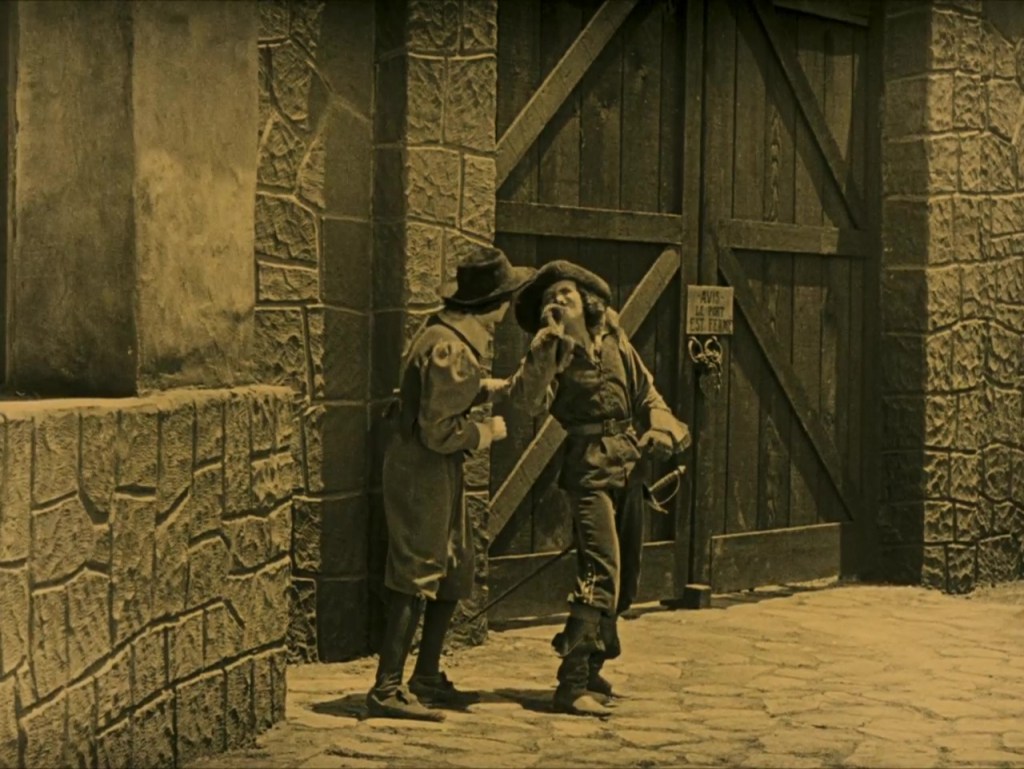
The Three Musketeers (1921; US; Fred Niblo)

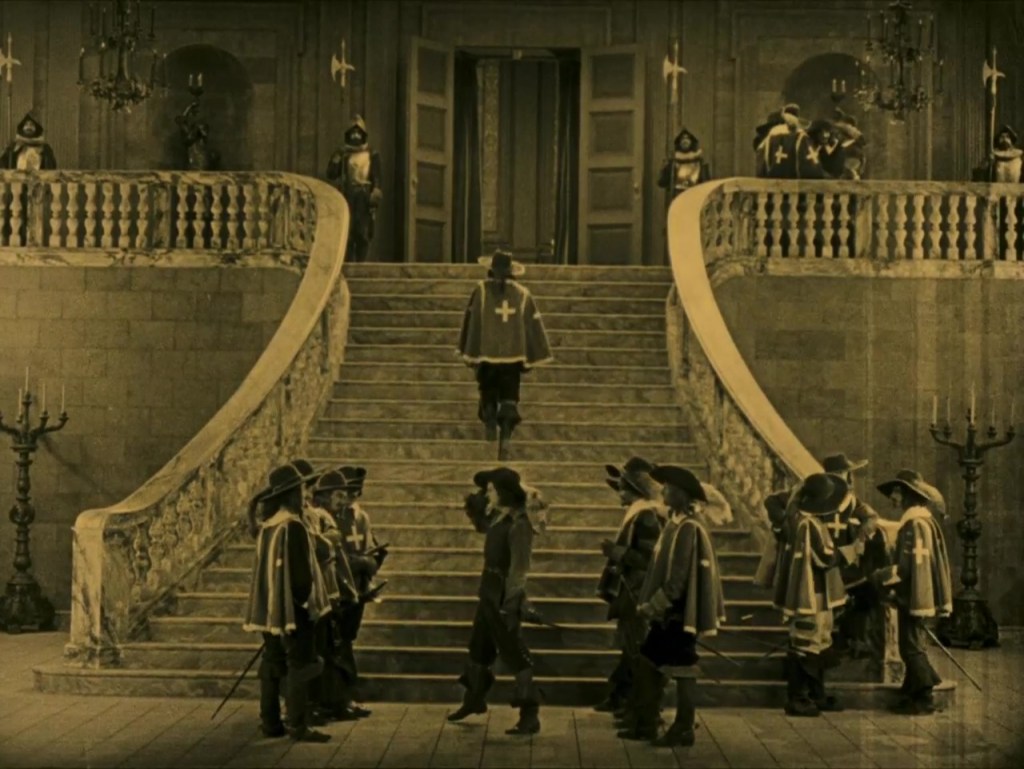
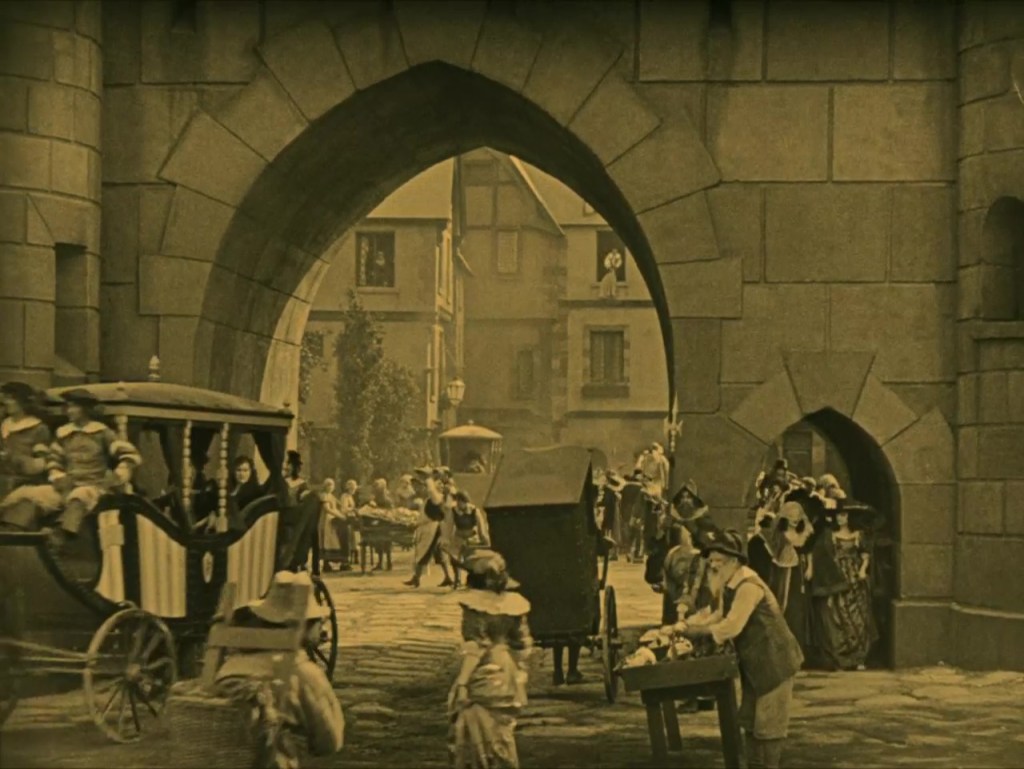
Don’t make this film! That was the advice of exhibitors, producers, and advertisers to Douglas Fairbanks when he mooted the idea of making a costume picture. He asked around his friends and peers, figures in the studios, and even commissioned a survey to get a wider sense of popular opinion. Everyone said no. “Having made sure I was wrong,” Fairbanks later wrote, “I went ahead” (qtd in Goessel, The First King of Hollywood, 257). The film was an adaptation of Alexandre Dumas’s Les Trois Mousquetaires (1844), and Fairbanks pulled out all the stops to ensure his production matched the scale and sweep of the original tale. Lavish sets, big crowds, gorgeous costumes, plentiful stunts… The total production costs were almost $750,000—a staggering sum for 1921. But the film was a huge success and reeled in $1,300,000 to Fairbanks’s company, as well as large profits to United Artists and any number of exhibitors who had booked the film. The success of the film encouraged Fairbanks to make even bigger costume films. The decade saw him embark on the huge productions like Robin Hood (1922) and The Thief of Bagdad (1924), films which dwarf even the scale of The Three Musketeers. So how does the latter rank alongside Fairbanks’s other swashbuckling films of these years?

Rather well, I think—but with some reservations. The film was directed by Fred Niblo, and in visual terms it feels rather safe and stolid. Fairbanks spends the film leaping, dancing, skipping, and hurling himself about the sets. But the camera barely moves, barely even dares offer anything in the way of dynamic editing. It’s as though Niblo is afraid of losing sight of the bigness of the sets, or of any kind of visual movement detracting from the movement of the performers.

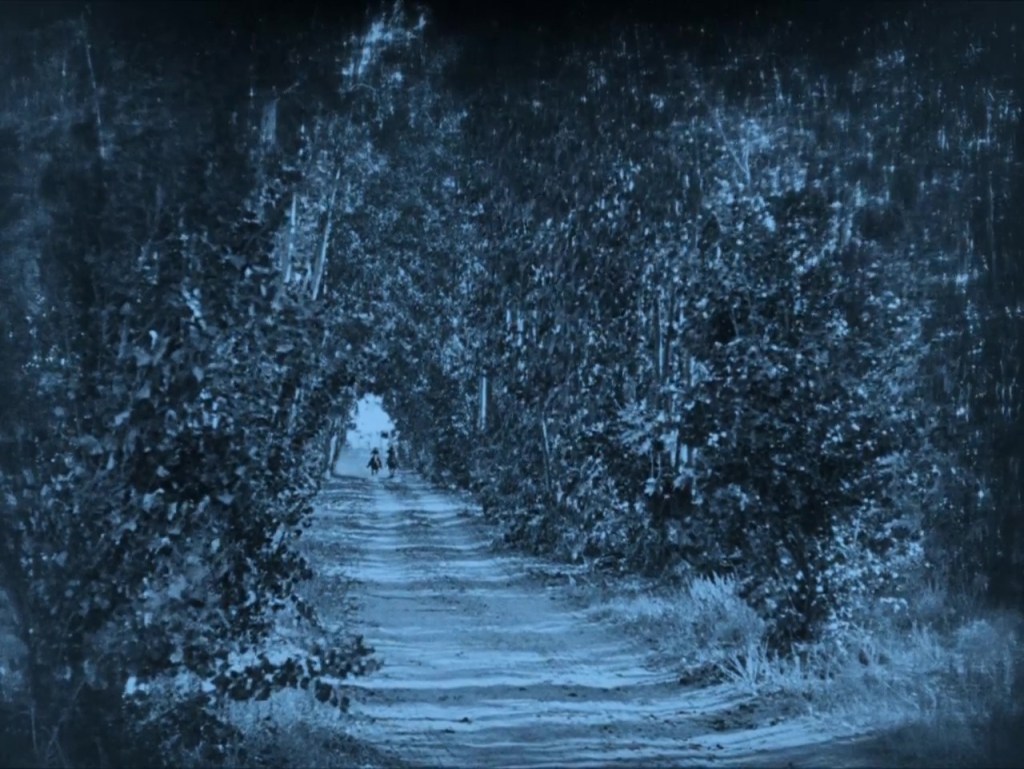
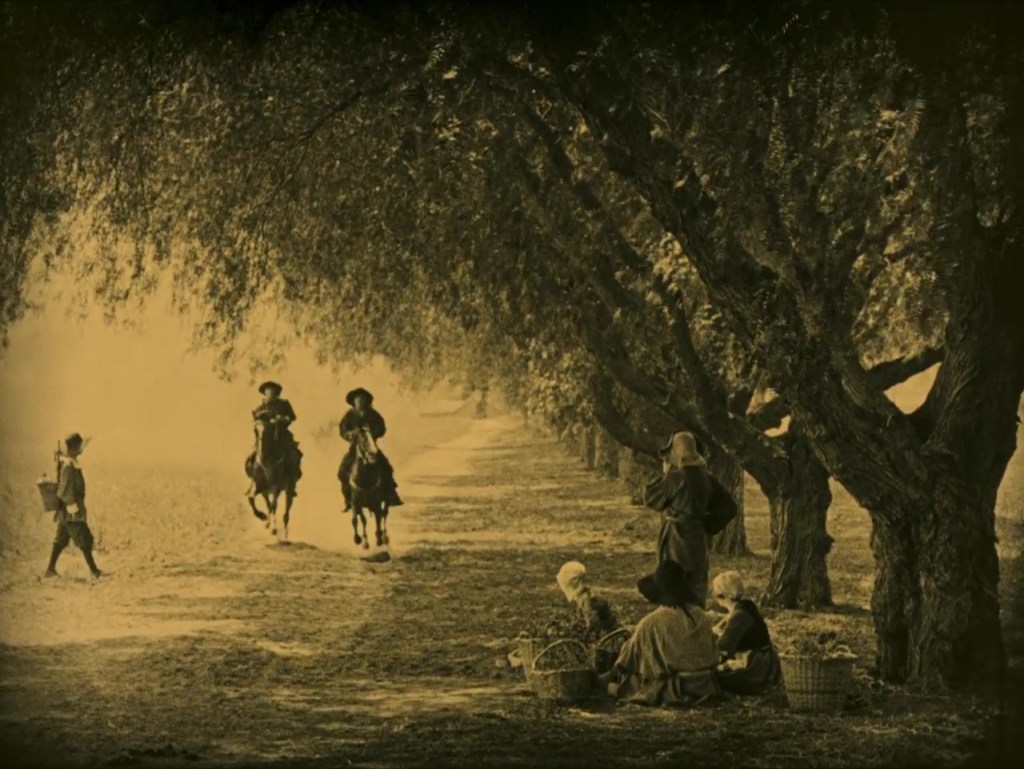
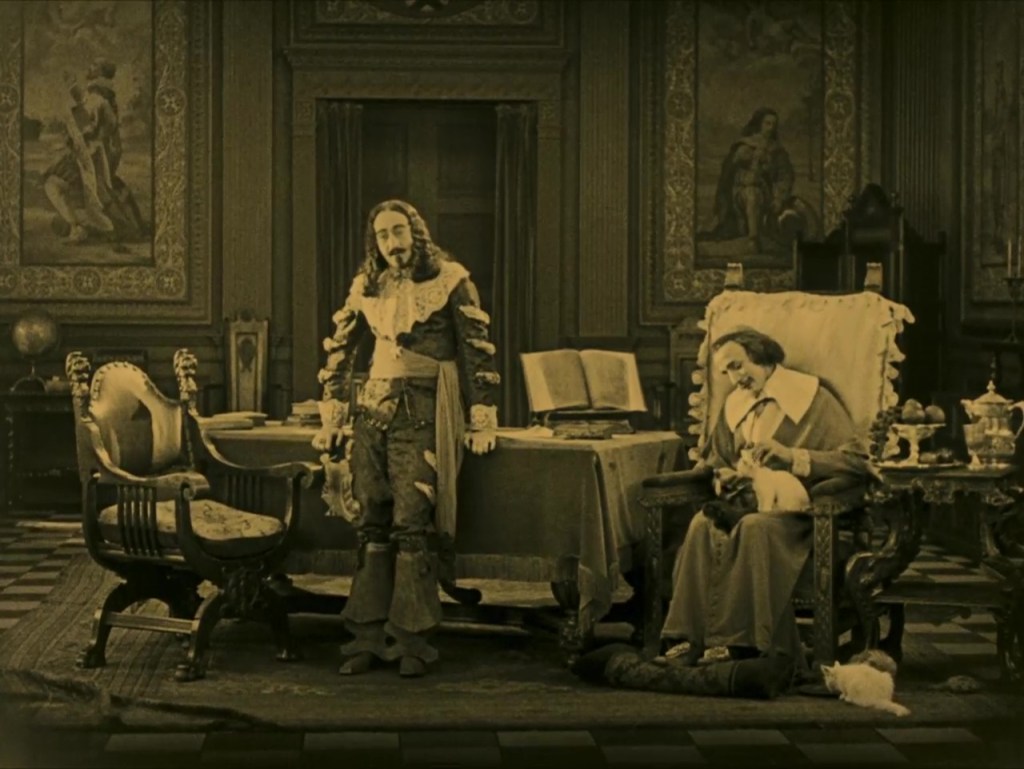
Niblo wasn’t known for his imagination, even in his earlier films. Kevin Brownlow writes that “Niblo’s style was usually lifeless”, producing “his usual series of cardboard pictures”—as evidenced in the Fairbanks vehicle The Mark of Zorro (1920) (The Parade’s Gone By…, 414). Only in the interior scenes with the various courtly intriguers—Richelieu, Queen Anne, King Louis—does Niblo offer closer shots, details that develop character or situation. (For example, Richelieu is seen petting cats, and we later get close-ups of his hand pawing/clawing at the arm of his chair, much like a cat plucks at a piece of carpet.) But the photography is strong, and there are some lovely exterior scenes in the countryside. Niblo gives us a good number of vistas down tree-lined roads, and you sense the scale of the journeys—the distances—between D’Artagnan’s home in Gascony, the city of Paris, and the remote ports of France and England.

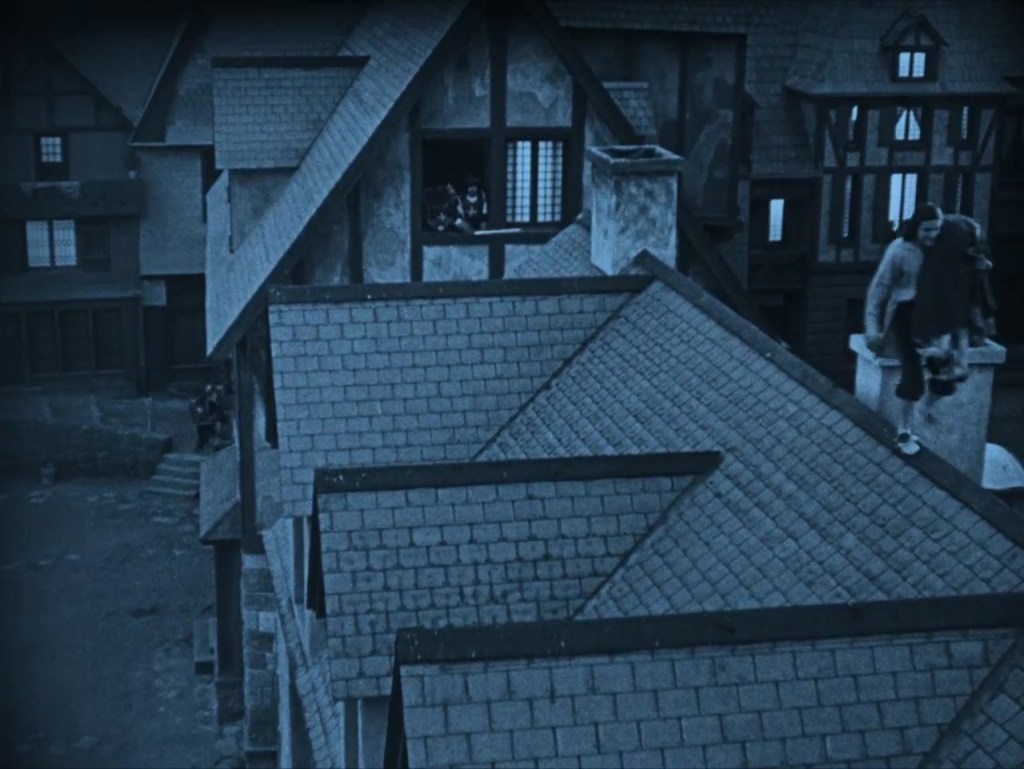
And even if I have reservations about the direction, that’s not why we’re watching The Three Musketeers. It’s Fairbanks who is the life and soul and purpose of this film. I couldn’t wait for him to appear (the opening scenes setting up the intrigue are very stilted and slow). And as soon as he does—sat legs akimbo on the floor, listening to his father’s tales of Paris—I’m grinning as he grins, and marvelling at everything he does. He makes even the simplest actions look balletic, and the most complex feats of strength look simple. He leaps onto and off horses, backwards and forwards; he jumps up walls, climbs over rooftops, jumps from battlements, swings from windows, slides down bannisters—and all with elegance, with style, with joy.

We are told early on that he’s been taught to do everything with pride, to accept no defeat, to fight back at every opportunity. And so he does, crossing swords first with the Cardinal’s guard Rochefort, then with the Musketeers, then (alongside the Musketeers) with the rest of the Cardinal’s men. Look at the way he evades the latter, first by hurling himself around with sword in hand, then by sheer pace. When he runs from a mob of them in once scene, he skips in glee when he knows they can’t catch him. It’s such a lovely detail, and makes us marvel not merely at his physical prowess but the lightness with which he uses it.

I must also mention Fairbanks’s moustache. This was the film that inspired him to grow it, and he kept it for the rest of his life. It gives him a more continental look, but it also makes his face more complex, more interesting. It’s like a punctuation mark or accent for his smile. The film doesn’t offer that many close-ups of him, but there is one gesture that he makes several times in the film. It’s when D’Artagnan senses something is awry, or that he’s scented a clue to the intrigue. He rubs his nose on one side, as if to suggest he’s got a sniff of something interesting. I don’t think it quite works, and it’s an awkward equivalent of something that could be done by or with a close-up. It’s not as subtle a trait as used in The Thief of Bagdad. There, Ahmed (Fairbanks’s character) makes a clasping gesture with his hand to signal desire. The gesture is used to signal his urge to steal purses etc, but then—in a brilliant touch—to signal his desire for the Princess. But Raoul Walsh frames the gesture much more convincingly than Niblo does its equivalent in The Three Musketeers. There’s also a striking visual equivalent for the olfactory sense suggested by the gesture in the earlier film. In The Thief of Bagdad, when Ahmed smells freshly-baked bread, Walsh cuts via a focus pull from Fairbanks to the loaf of bread. It’s like a different sense takes over from the visual until the visual can reassert the reality of the scene to reveal the source of the smell. It’s such a lovely moment, and there isn’t anything as sophisticated or visually inventive in The Three Musketeers.

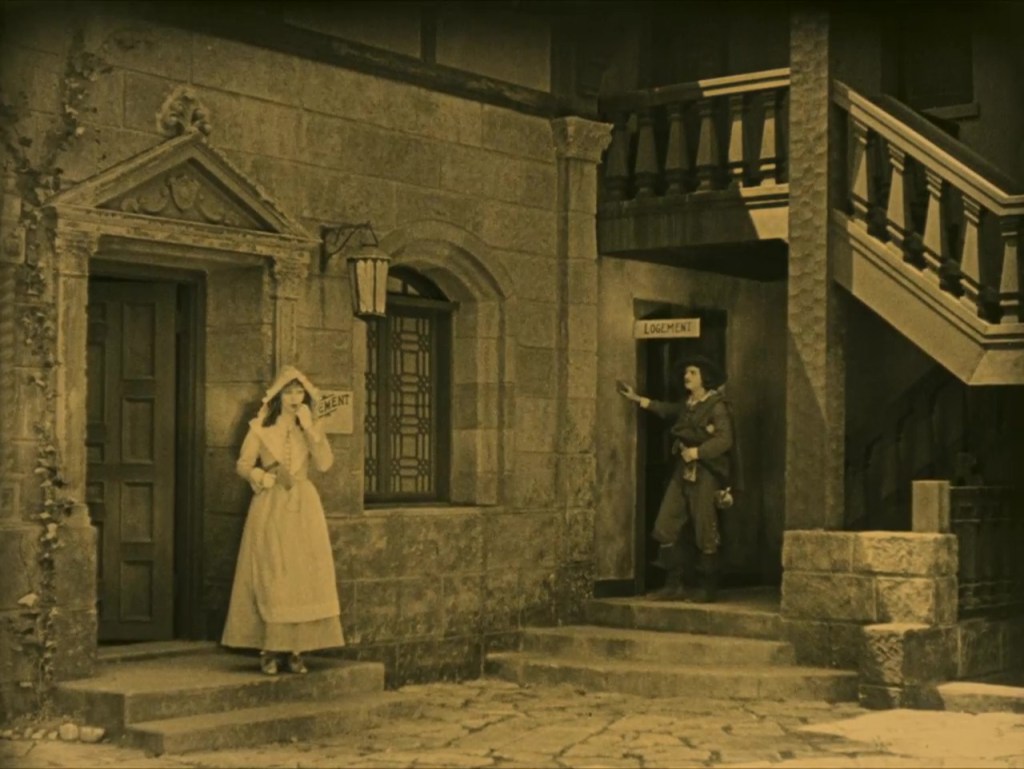
Beyond the more daring tone of The Gaucho (1927), Fairbanks’s on-screen involvement with women tends to be more comic, innocent, and flirtatious than sexual. His romantic gestures—kneeling, spreading wide his arms, pressing hands to heart—are earnest, old-fashioned; even a kiss is a rarity. In The Three Musketeers, D’Artagnan falls for Constance Bonacieux (Marguerite De La Motte). The way it’s done is charming: she drops her ball of thread, and he picks it up. From two different directions across town, they wend their way toward each other, following the thread. But she snips it off, and he loses track of her. Then, when he finds her again, he is looking for lodging. Two neighbouring houses have signs offering accommodation. Constance goes first in to one house, so D’Artagnan bounds up to the door; but then Constance goes into the next one, then back again. What to do? Bold and direct, D’Artagnan simply asks her which house she lives in—and goes in. It’s a lovely sequence, and its tone is comic, the romance having a rather childlike element. Later on, when D’Artagnan chases after Constance in the palace, Captain de Tréville leads him by the ear back to the King: Fairbanks is a naughty child, whose knees we then see tremble as he is presented to King Louis.

Elsewhere in the film, the sexual politics of the novel are elided or softened. (Care was certainly required to make the source material acceptable to the censors, but you sense that Fairbanks wasn’t interested in romantic melodrama so much as adventure.) Milady de Winter (Barbara La Marr) and D’Artagnan exchange flirtatious glances early in the film, and D’Artagnan will eventually surprise her in bed in order to retrieve the diamond broach she has stolen from the Queen—but (unlike in the novel) they never get involved. Even the affair between the Duke of Buckingham (Thomas Holding) and Queen Anne (Mary MacLaren) is remarkably chaste. King Louis himself (Adolphe Menjou) is jealous of the Queen’s private affair, but his jealousy is not emotionally complex (and hardly inflected with sexual interest).

Indeed, the King’s emotional moods—his jealousy, anger, suspicion—are mainly focused on the figure of Cardinal Richelieu (Nigel De Brulier). De Brulier is the most perfect imaginable casting: his gaunt cheeks, long face, distinctive nose, and narrowed eyes. He would reprise this same role alongside Fairbanks’s older D’Artagnan in The Iron Mask (1929), as well as in two sound adaptations of Dumas’s novel. As mentioned before, he is a feline presence on screen. His thin profile, his shoulder-length hair, and his floor-length robes give him a feminine air. Indeed, he spends more time on screen with the King than the King spends with his wife—and he is surely a kind of devilish substitute. There is something almost flirtatious in the way Richelieu needles the King about his Queen. Later in the film, when D’Artagnan flatters Richelieu to delay his scheme to murder him, De Brulier’s performance grows subtly camp. Richelieu suddenly comes over all coy and flirtatious. The handkerchief he has been holding is a signal to his guard to shoot D’Artagnan; but once D’Artagnan begins flattering him, he swiftly withdraws it, and it becomes a kind of girlish accessory. Richelieu is always a magnetic presence on screen. And I can imagine a different director, in a different kind of adaptation, making more of De Brulier than in this film.

D’Artagnan himself enjoys the boys’ club atmosphere of the barracks and the all-male rooms of his friends. Much of the middle of the film is light on plot, instead setting up the relationship between the musketeers. We see how they get by with no money, gambling, borrowing, bluffing. (There’s a nice scene where they successively blag their way into the kitchen of two monks and cadge a free dinner.) It sets up a pattern that would be repeated in Robin Hood, Fairbanks’s next film, where Robin embraces the all-male company of his “merry men”. In that film, Sherwood Forest becomes a giant playground for the antics of Fairbanks and co., who leap gleefully around their idyllic world like ballet dancers. In The Three Musketeers, there isn’t quite the same sense of scale—but the central group of four male friends is the focus of much of the film’s jollity and camaraderie. It’s all very charming, but it lacks emotional depth. Only in The Iron Mask does the friendship of these characters come to mean and feel more: that whole film attains greater weight by being about ageing, and by the sense that there can be no sequel.

The new Blu-ray of The Three Musketeers is by the Film Preservation Society, who also produced the 2021 restoration of the film. Visually, it’s a great treat to look at. The lavishness of the costumes and scale of the sets really comes across. As well as looking sharp and rich and textured, the image benefits from the warm amber tints for the daytime scenes—and subtle blues for the nighttime scenes. Noteworthy in particular is the recreation of the original Handschiegl colour process. When D’Artagnan leaves Gascony, his horse is described as “buttercup yellow”. All the villagers en route and in Paris point and laugh at this extraordinary animal, so much so that when D’Artagnan arrives in Paris he immediately sells the animal to buy a hat. It’s a running gag for several scenes, and one which was visually inexplicable in monochrome restorations of the film. Thankfully, a fragment of a first-generation 35mm print was discovered in 2019 that revealed how the gag was supposed to work: via the Handschiegl process, the horse was quite literally coloured buttercup yellow. The 2021 restoration had digitally recreated the effect, based on the surviving 35mm fragment, and suddenly all these scenes make sense: the film was always designed to have this additional colour element, and all the on-set performances are geared towards this post-production effect.

Finally, I must mention the film’s musical score. It’s a habit among many labels—especially, it seems to me, North American ones like Image and Kino—to describe the soundtracks of their releases in unhelpful terms. As I have written elsewhere, reading in the DVD blurb that the release contains the “original orchestral score” is no guarantee that the soundtrack actually features an orchestra (Cuff, “Silent Cinema”, 287-93). Too often you have to read the small print to discover the truth, e.g. “original orchestral score, arranged for solo piano”. The back of the Blu-ray for The Three Musketeers states that the 2021 restoration is “graced by an orchestral score performed by the Mont Alto Orchestra”. Pause for a moment to consider the word “graced”. Yes, we are indeed more than fortunate to have the “orchestral score”, and it must be an orchestral score because it’s performed by an “orchestra”. Surely! Right? But the small print, in this case the liner notes by Tracey Goessel, make it clear what this actually means:

The Louis F. Gottschalk score, orchestrated for a large ensemble, would have been heard with the road show release, and is available on earlier DVD releases. Rodney Sauer of the Mont Alto Motion Picture Orchestra has created a score consistent with what would have been available to a smaller (in this instance, six-piece) group of musicians for the film’s general release.

Ah. Oh dear. So the “orchestral score” with which this restoration is “graced” is not actually written for or performed by an orchestra. It’s a score compiled from existing material, arranged for a six-piece ensemble. Fine. Disappointing, but fine. You clearly have a budget, and you have to stick to it. But what about the claim that the Louis F. Gottschalk score is available on earlier DVD releases? (I note that it doesn’t “grace” those earlier DVD releases.) Well, the back of the 2004 Kino DVD of The Three Musketeers states the following: “Original 1921 score by Louis F. Gottschalk, arranged and performed by Brian Benison and the ‘Elton Thomas Salon Orchestra’.” Don’t you just love the inverted commas around the name of the “Orchestra”? Because of course this “orchestra” is not an orchestra. The “Elton Thomas Salon Orchestra” is a euphemism for one man and his synthesized MIDI files. So, no, “the Louis F. Gottschalk score, orchestrated for a large ensemble”, is not available on earlier DVD releases. It’s never been available because no-one has ever used an orchestra to record it. I’ve listened to the synthetic version on the Kino DVD and I in no way consider myself to have heard “the Louis F. Gottschalk score, orchestrated for a large ensemble”. I wish I had heard it, but until I’ve heard it performed by “a large ensemble” (does this mean an orchestra, even a small one?) I reserve judgement.

Back to the 2021 restoration of The Three Musketeers, it doesn’t help clarify matters that the Mont Alto Orchestra calls itself an orchestra in the first place. The orchestra’s homepage—their equivalent, I suppose, of the DVD small print—describes them as “a small chamber group”; the roster of musicians’ biographies numbers just five. Even in the 1620s (the time Fairbanks’s film is set), a group of five or six people would blush at calling themselves an “orchestra”. The musicians we see on screen playing for the royal ball at the end of the film (there are about ten of them) form a larger group than we hear performing on the soundtrack. A century later, a small court orchestra might expect to field twenty players, while the larger ones double or treble that number. By the 1820s, a symphony orchestra was beginning to be standardized and you would hope to have forty or fifty players. By the 1920s, you might have a hundred or more players for larger orchestral or operatic works. Film orchestras of the era varied in size according to their venue, but the premieres of big films like the Fairbanks super-productions of the 1920s would have been big events with musical accompaniments to match.

As Jeffrey Vance documents, the premiere of The Three Musketeers was a lavish event, featuring a spoken prologue and “a full orchestra” performing the score (Douglas Fairbanks, 120). Though Vance judge’s Gottschalk’s score “particularly weak in the action sequences, and utterly unable to capture the comic aspects of the action”, he also reminds us that “Fairbanks’s increased involvement with the music and exhibition of his productions began with The Three Musketeers” (ibid.). For Robin Hood, Victor Schertzinger arranged a score “for eighteen players” (ibid., 145). The cover of the 1999 Kino DVD (the soundtrack of which was replicated for the 2004 reissue) says its restoration features “the Original 1922 Musical Score in Digital Stereo”. Of course, you must read the small print on the back to see that Schertzinger’s multi-part score is performed not by an orchestra but by Eric Beheim on “a MIDI-based synthesizer system”. Schertzinger’s score (as Vance says) certainly sounds repetitive, but how can I properly judge it as synthetic pulp rather than orchestral fibre? The way to make these scores more musically viable is not to reduce them, but to expand them—reorchestrate them to make the best use of the original material. Finding a compromise too often means doing something cheaper and less complex. (As a sidenote to this, the 2019 restoration of The Thief of Bagdad uses Mortimer Wilson’s original orchestral score. This version was broadcast on ARTE a couple of years ago but has not yet received any home media release. Wouldn’t it be nice to have all Fairbanks’s silent epics restored complete with the music that their creators intended to hear?)

The Sauer score for The Three Musketeers is perfectly good, although it often lags behind the pace of the action and can never capture the scale of the film. Six musicians can’t conjure a sound world as rich and detailed as the visual sets and crowds of extras. You need an orchestra. You need something that will sweep you up in the adventure of the film. This six-piece band can only gently suggest that you might like to come along. And although the more intimate scenes in the film don’t obviously cry out for a full orchestra, I do confess that my heart sank to hear Sibelius’s heartrending Valse triste (op. 44: no. 1, 1903-04) in the reduced circumstances of a six-piece band. Only a small portion is used in the scene where Buckingham and the Queen meet for the first time, but I wasn’t moved by the scene or even by the music—I was moved by the plight of what should be a full string section of forty or more players reduced to a single violin and cello.

But much of this is, I’m sure, down to my individual taste/snobbery. I know orchestras are expensive beasts, and that hiring them and recording them is beyond the budget of most labels. I don’t mind a score for a small chamber group, but please call it a score for a small chamber group. If it isn’t being performed by an orchestra, you’re not offering us an orchestral score.

I’m sorry to have gone on so much about the score, but I do get fed up with labels overpromising and underdelivering. The Three Musketeers is still a lot of fun, and looks as good as we can hope on this new release. Here’s hoping a new restoration of Robin Hood will follow…

Paul Cuff
References

Kevin Brownlow, The Parade’s Gone By… (New York: Alfred A. Knopf, 1968).

Paul Cuff, “Silent cinema: Material histories and the digital present”, Screen 57.3 (2016): 277-301.

Tracey Goessel, The First King of Hollywood: The Life of Douglas Fairbanks (Chicago: Chicago Review Press, 2015).
Jeffrey Vance, Douglas Fairbanks (Berkeley: California UP, 2008).

Pordenone from afar (2022, Day 8: part 2)

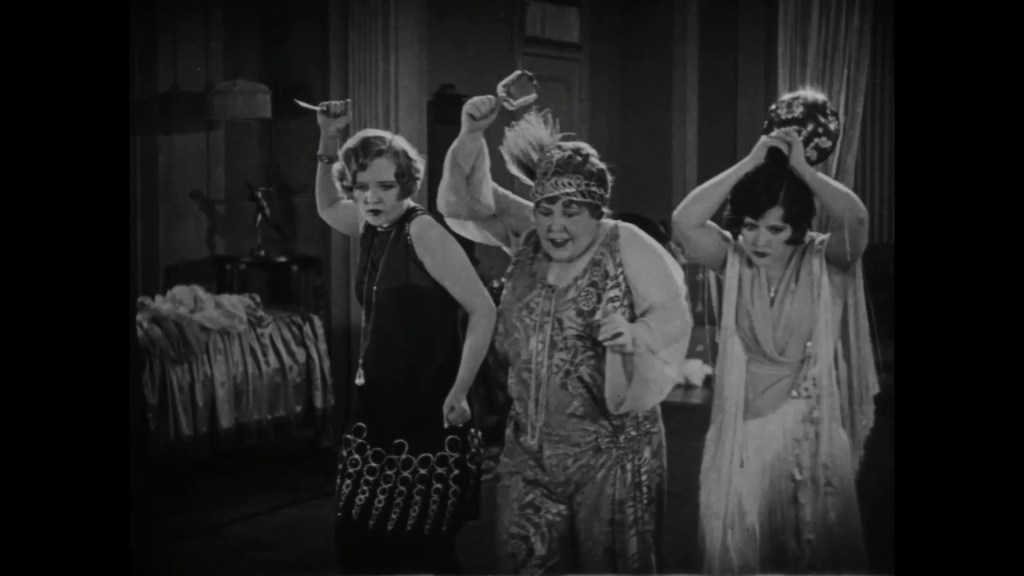
It’s the final film of the (streamed) festival, and also a chance to reflect on the experience of going to Pordenone without going to Pordenone. We end on a silly, giggly, frothy, funny note with what the programme described as “a saucy bedroom farce”…

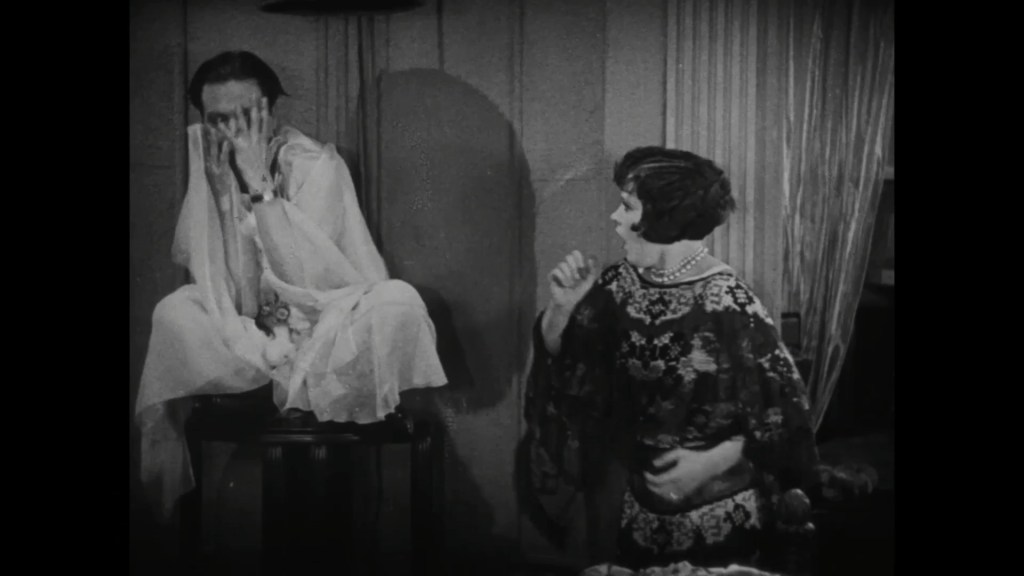
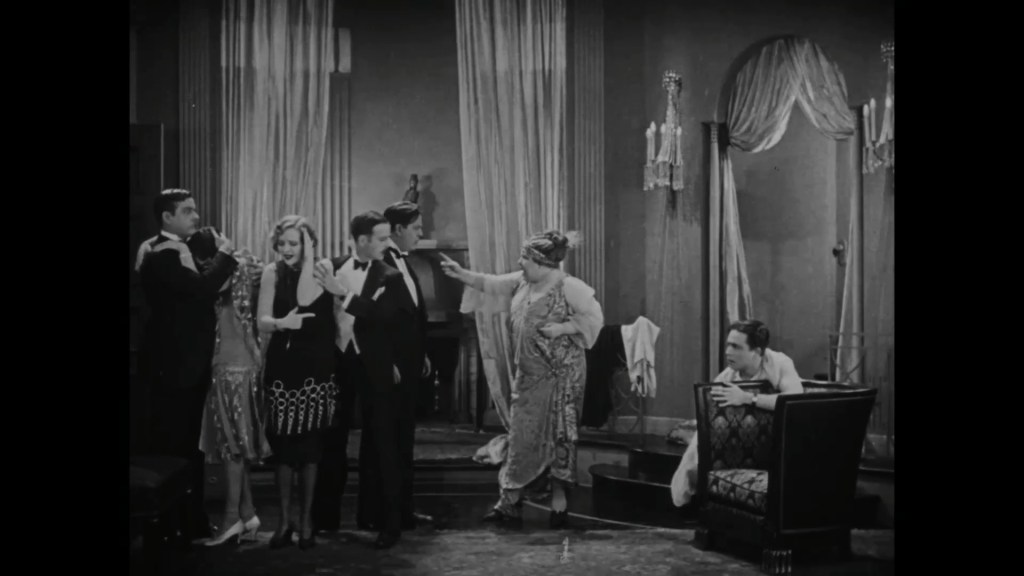
Up in Mabel’s Room (1926; US; E. Mason Hopper)

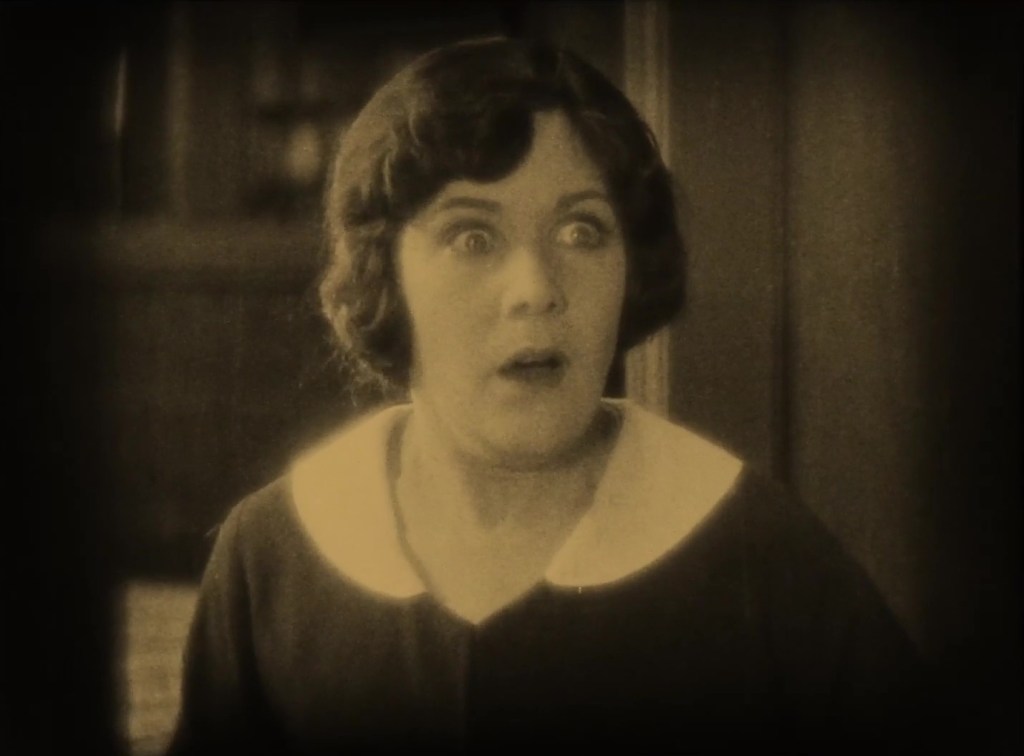
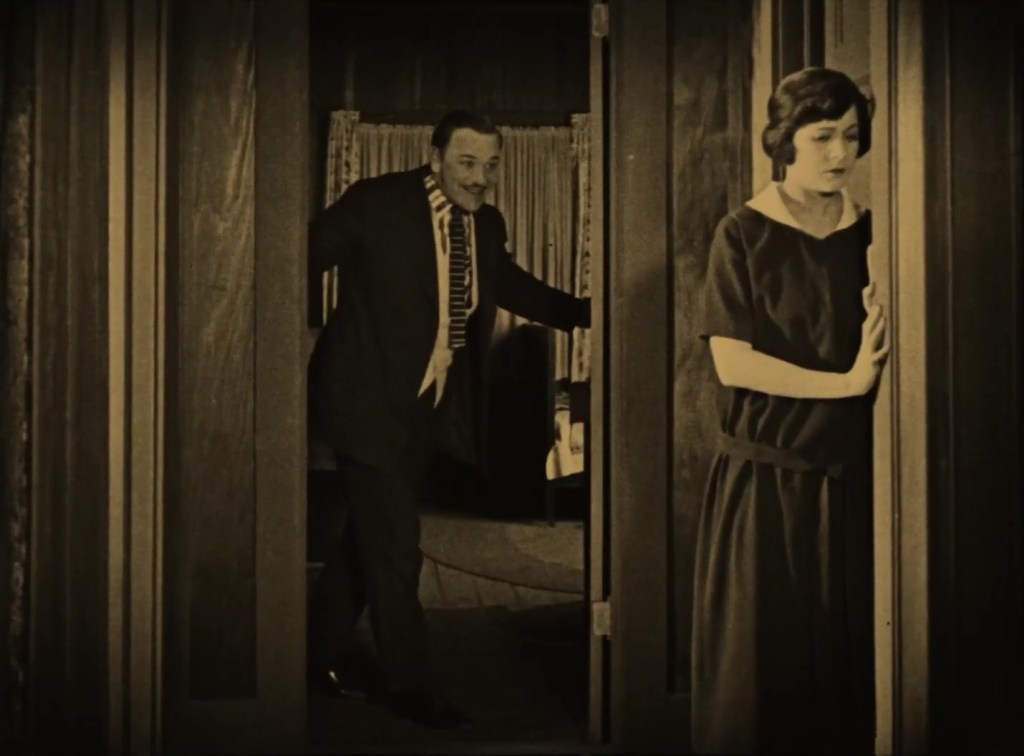
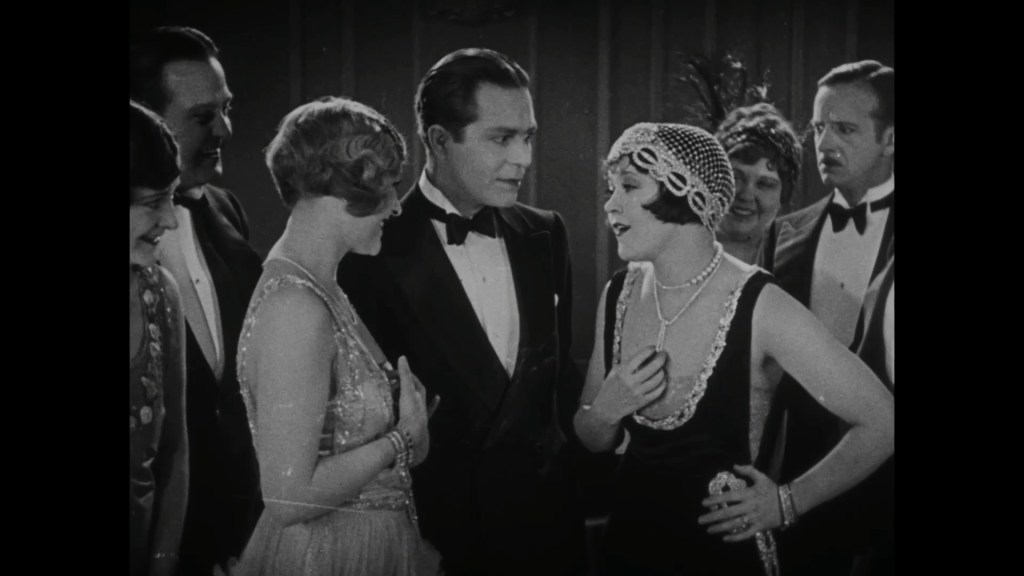
The tone is set straight away, with Mabel on a cruise ship with a crowd of five gentleman callers. The wind is blowing on deck and she manages to flash them all before falling headfirst into her room. Yes, she has men at her beck and call, but it’s her ex-husband Garry she wants back. (“You mean to say you’re going to scramble the same egg again?” her maid asks.) Mabel caught Garry in a ladies’ lingerie store buying something he wouldn’t explain. “Sounds like a movie”, quips the maid. Indeed. (Or a P.G. Wodehouse novel, which this film increasingly resembles; or, I suppose, vice versa.) But Mabel reveals that Garry was merely buying her a gift—a black lace negligee with his embroidered dedication to her—and has kept it ever since the divorce. (“And to think he never got to see me wear it”, she sighs sadly.)

Enter older siblings Leonard and Henrietta. She is the subject of a series of fat jokes about her penchant for chocolate; he is subject to the jealousies of other men for his existing friendship with Mabel. He reveals that Garry is now posing as a bachelor and his “marriage” is a hidden secret. Mabel’s face pouts in thought. Already she sees opportunities to win back Garry.

Cut to land, and to the offices where Garry works as an architect. Next door, his friend Jimmy is overwhelmed by telephone calls; he grabs all the receivers and shouts into them at once. And here are our other set of characters: Alicia, Jimmy’s wife (always suspicious); Phyllis, “unmarried but not unwilling”; Arthur, besotted by Phyllis but too shy to pop the question. Everyone is sleek and neat, the women bedecked in fluffy furs around shoulders and necks. The early scenes also introduce us to the farcical mode of much of the film: office corridors serve as conduits for mistaken identities and quick escapes, for flirtations and flights. Phyllis is all over Garry; Arthur is jealous of Garry. Garry is invited to Jimmie and Alicia’s wedding anniversary (of course, they’ve only been married six months, but their celebration is a “precaution” against divorce, which is as easy to catch as the common cold).

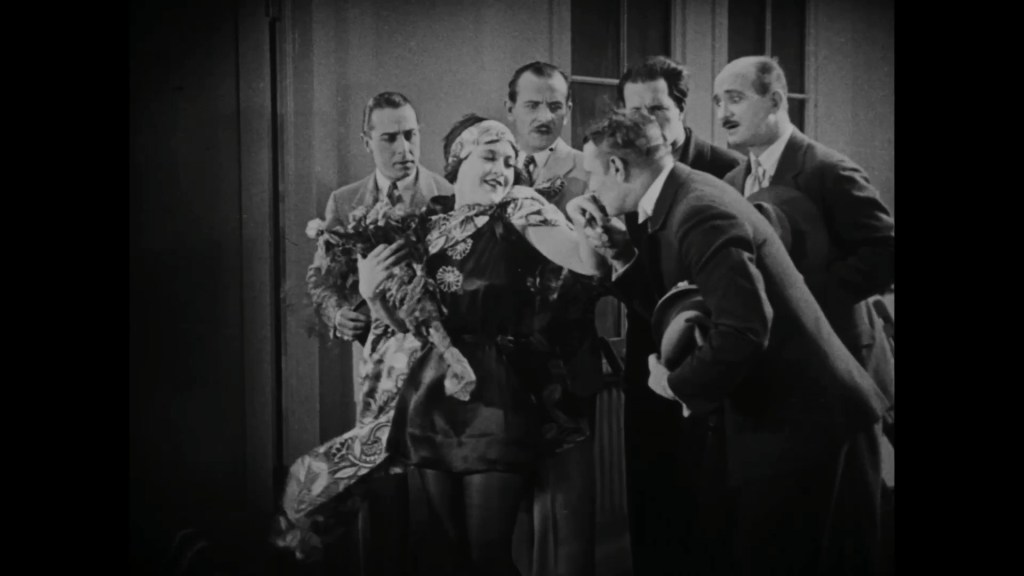
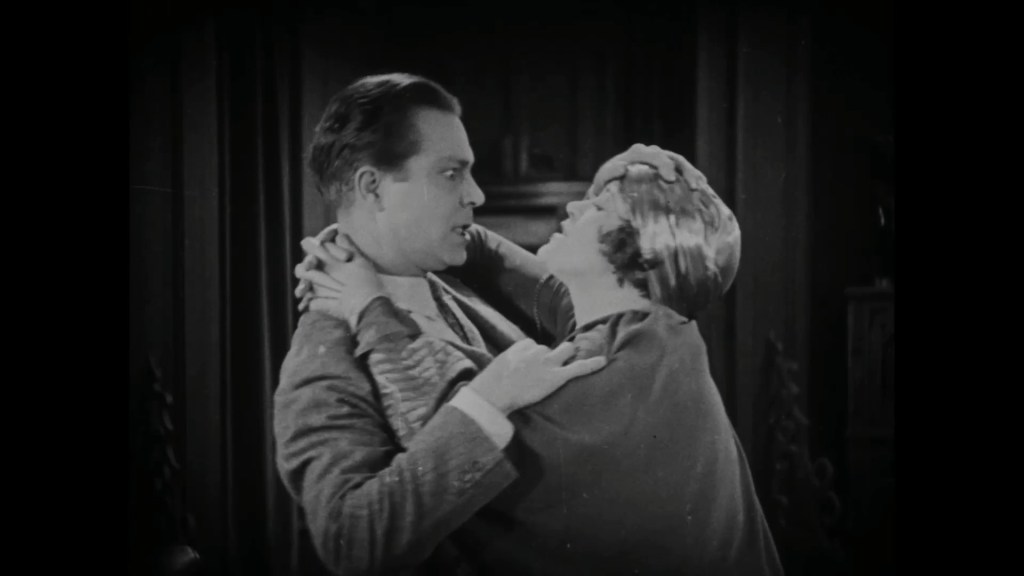
Into this mix comes Mabel. She immediately sets about seducing Garry. She forces herself into his arms, trying to get a kiss—her hands tighten around the back of his neck. “Well if you won’t kiss me, I’ll kiss you!” But Garry resists: “You’re not my wife any more! You’re my widow!” She climbs all over him, steps on his feet and they walk awkwardly a few steps then fall over. In front of his secretary, Mabel stuffs Garry’s face into her bosom and makes him drunk on her perfume. Garry is thought “pure” by his new friends, and he worries Mabel will make everyone think him “a swivel chair sheik”.

The El Rey Night Club. A party. Scanty chorus of girls. Leonard is Jimmy’s uncle and he tells Garry he’s brought a “snappy number” with him: and, yes, it’s Mabel. She grabs Garry and dances with him. Her embrace is a strangle hold. (“We’re supposed to be dancing… not wrestling”, Garry complains.) The only thing that would stop her marrying him again, she says, is if another girl beat her to it…

Garry can see the plot approaching fast. He also finds out that Leonard thinks Mabel’s ex was a wife-beater and a thief, that he would force the ex to remarry her—unless it turned out he was married to someone else. Phyllis having broken up with Arthur, Garry takes Arthur’s engagement ring and pursues the first woman he sees: this turns out to be Phyllis, who is already keen on Garry. Mabel is surprised but immediately resourceful: she tells Garry she’ll send Phyllis the signed lingerie Garry gave her. She publicly badmouths her ex in front of everyone. Garry fumes. Leonard and Henrietta want to give Garry and Phyllis an engagement party. Close-up of Mabel, pouting and squinting: she has a plan…

Mabel first visits Garry at his apartment, makes instant friends with Garry’s butler Hawkins, then steps out of her coat into a very revealing little dress and makes herself at home. Phyllis turns up, also in something frilly, fluffy, and revealing; Garry hurls Mabel behind a screen and tries himself to flee upstairs, but Phyllis catches him to say goodnight (“I adore you Garry. You’re so innocent and pure…”). Mabel listens in and starts hurling her clothes over the screen to be discovered by Phyllis. First it’s her coat (Phyllis is concerned); then her shoes appear beside the screen (Garry pretends they’re novelty ashtrays); then more and more clothing appears, down to transparent underlayers. Phyllis storms out, then Mabel calls to Garry. She pretends to appear in all her glory and hurls down the screen—but after reducing him to a pulp of nerves, she reveals she has kept on her top layer and walks triumphantly from the door.

It’s the house party hosted by Leonard and Henriette.

Garry and Hawkins have their plan. There’s a fantastic little scene in which they both try to visually describe the “intimate” garment they must steal. Garry tries first and is immediately caught by Mabel, then by Phyllis—who takes solace back with Arthur.

Mabel now starts flirting with Jimmy to make Garry (and Alicia) jealous.

Hawkins turns up with a stolen garment to give to Garry, but it’s the wrong garment; Garry is now caught by Phyllis, who faints and is taken up to Mabel’s room, where Garry is now hidden under jer bed trying to catch the right piece of clothing.

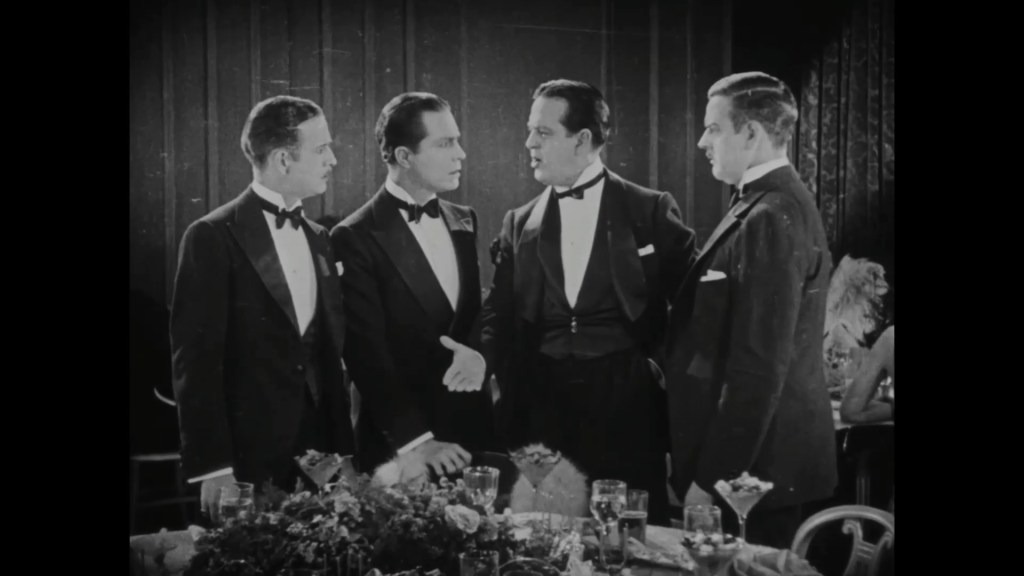
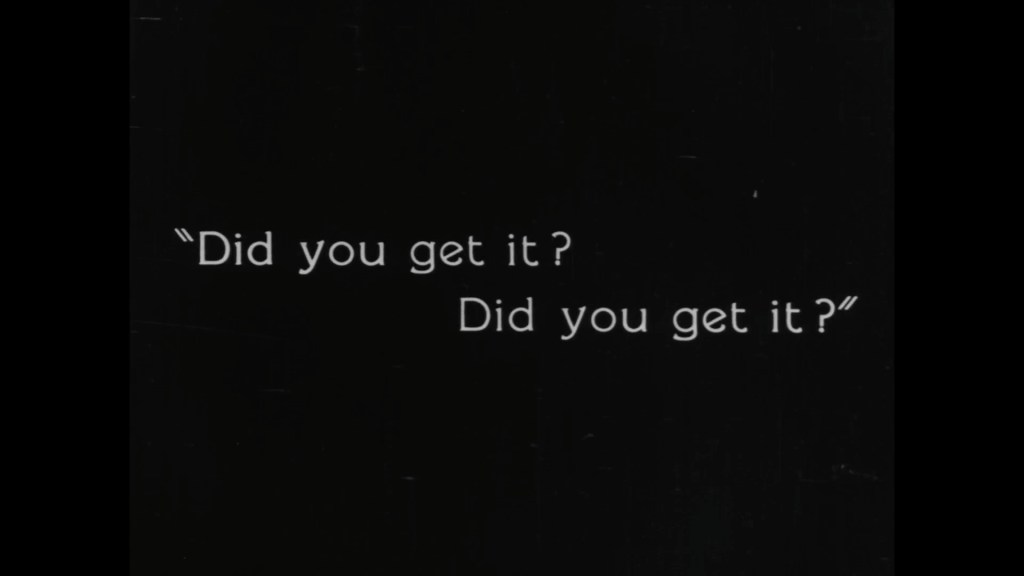
The farce gathers pace: all the men are sequentially caught in possession of the nightie, and the house butler keeps directing jealous woman to their other-halves who are all “up in Mabel’s room”. There, Hawkins and Garry bump into each other from respective hiding places: questioning titles cross the screen to meet each other: “Did you get it?” But the real negligee remains hidden. Trying to escape out of Mabel’s window, they are spotted and the cry goes out that there are burglars. At last the negligee is found but Leonard and Arthur shoot at the supposed burglars, forcing them back into Mabel’s room.

Everyone is now convinced the burglar is in Mabel’s room: Mabel, Phyllis, and Henrietta climb the stairs from inside, while Leonard climbs in from outside—the garment having by now been dropped outside at Arthur’s feet. All three men now hide inside under the bed and the three women sneak in through the door; there’s a great scene as the groups go back and force from hiding place to hiding place. Leonard is caught, but Garry and Hawkins escape through the window to try and recapture the negligee—bumping into a hose on the way down and soaking Garry’s clothes.

More farce in the other rooms: Jimmy goes into Garry’s room, where he is mistaken for Garry by Mabel who flirts with him; Alicia sees this and storms off. But as Arthur now has the negligee, Mabel has to sneak into his room—and a suspicious Phyllis finds her there under Arthur’s bed. Mabel has captured the negligee and put it on under her dress.

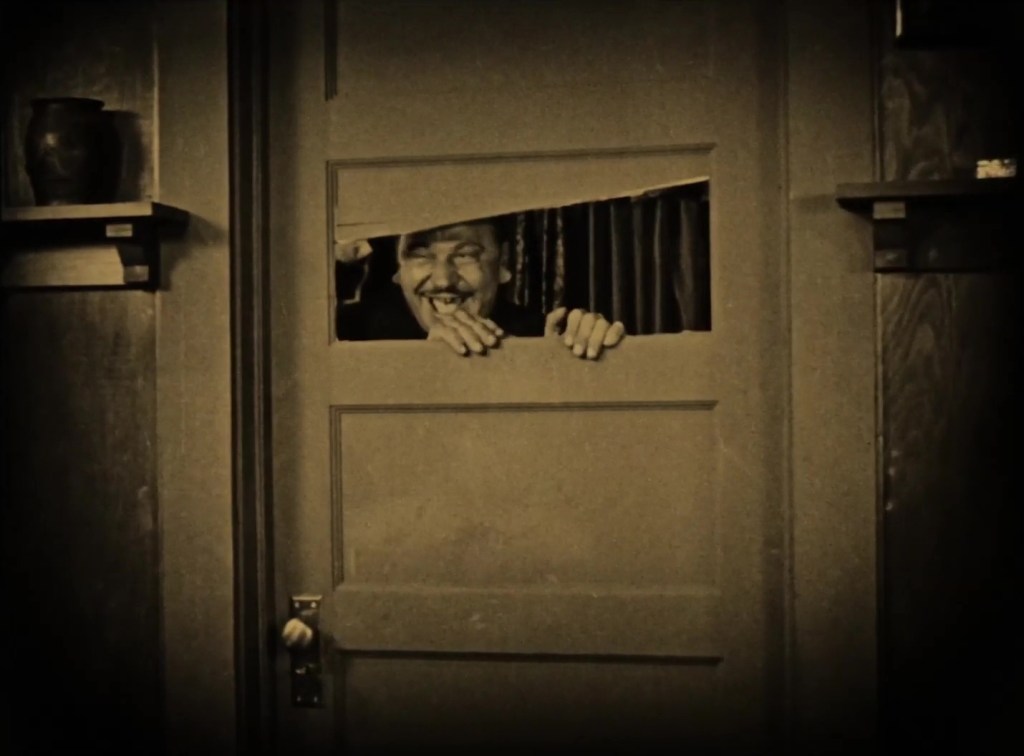
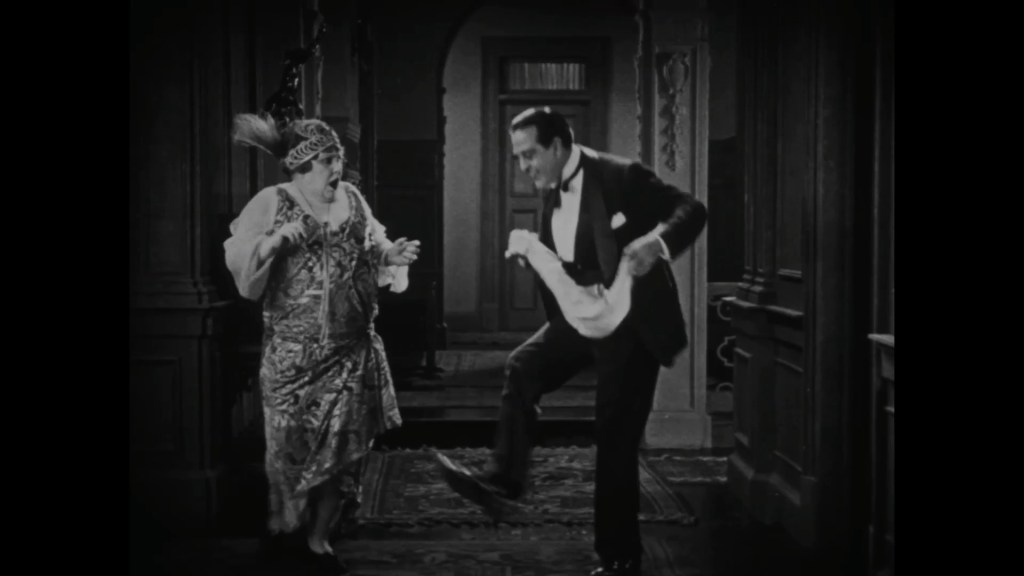
Meanwhile Garry is down to underclothes after his watery escape. To avoid detection, he climbs back up to Mabel’s room to get back to his own; but Mabel catches him in her room wearing her night dress and pretending to be a lamp. Hawkins is then caught going upstairs by the whole household; he says that Garry is yet again “up in Mabel’s room”, where everyone now goes. The butler interrupts the siege: a telegram for Mabel saying that her divorce is void due to a technical reason. Garry and Mabel are still married! Everyone bursts in. Mabel’s negligee and the telegram explain the whole story. The married couple embrace, but a shower of shoes from their well-wishing friends knocks out Garry; he falls into Mabel’s arms; she looks to camera and winks, then is herself struck by a shoe. She kisses the prostrate Garry, and the film fades to black. The End

I was worried after the first half hour of this film that the flippant, knowing tone (and the endless quips of narrational titles) would grate after a while. But when the action and dialogue took over, I shed my reservations and thoroughly enjoyed myself. It’s a Wodehouse novel come alive. And even the titles became more visually inventive. There are small fonts to indicate a whisper, large ones for shouting—and wiggly, trembling text to indicate a scream. Though the camera is static throughout, the editing is snappy and the film mobilizes everything it can to quicken the pace while providing clear continuity across multiple spaces. Marie Prevost steals every scene, every shot she’s in: winking, pouting, flaunting, seething, rolling her eyes. It’s one of the most outrageously enjoyable (and clearly, self-enjoying) performances you can imagine. Up in Mabel’s Room is also the first film streamed to feature an orchestral score. (Though there is a brief appearance of other instruments in the soundtrack for The Lady, they disappear after a single scene: why bother providing them if you’re going to take them away so soon?) Günter A. Buchwald’s jazzy score is excellent. The restless, peppy theme for Mabel breaks out each time she outthinks and outacts her competitors and husband. I imagine it would be great fun to see and hear performed live. Which brings me neatly to…

Pordenone 2022: Online festival round-up

So, what are my impressions of the festival in its streamed format? It’s my first experience of Pordenone and I’m very glad to have participated. For accessibility, it’s a tremendous new feature of the festival (and others like it). Technically, I had no issue with any of the streams. It took a minute to learn how to amend the format of the subtitles to make them unobtrusive (the default mode gives them an opaque background that blots out part of the screen), but apart from that I have no complaints. The 24-hour period to watch the films is much appreciated, as watching them “live” would be virtually impossible for me given that I’m fitting a festival into a normal working week. As it was, even seeing all the films on offer was a hectic fit. I skipped all the filmed introductions to the films, which I regret—but I really couldn’t spare the time. The variety of the films themselves—from 1912 to 1930, from Hollywood to Slovakia—was good, with enough of a sense of the running themes (Ruritania, Norma Talmadge) to get a sense of the festival. The music was very good, though I greatly miss seeing it performed live. I never feel the need to comment much on piano scores: put simply, much less can go wrong with them than with orchestral scores. They are adequate, often more than that. But I do miss seeing and hearing performers and orchestra, and I’m aware the live festival had many more large-scale performances than the streamed selection. I’m also aware of the films I missed. Among the many not streamed was Abel Gance’s La Dixième symphonie (1918). As anyone who glimpses at my publications page will realize, Gance is my specialist subject. I’ve never seen La Dixième symphonie with an audience and I would love to know how the screening went at its live projection.

More generally, I feel that both “experience” and “participate” are odd verbs to use (as I did at the outset) to describe me alone, sat or stood by my monitor, hundreds of miles from the festival. The option to add comments or stars to review or rank the films was there, but I didn’t “participate” in this either. Yet how strangely moving it was to see among these signed reviews the name of a university friend whom I’ve not seen since, and to know that they were somewhere in the world—also, I presume, sat at their monitor in the gloom. How different it is to peer at a monitor and glimpse another’s existence, than to encounter them at a festival and talk. I’ve attended a festival, yet I’ve gone nowhere and seen no-one. Much of my writing in recent years has reflected on the experience of live cinema, and I feel guilty having proselytized on behalf of liveness while never having been to a festival. But it’s a matter of time and—more so now than ever—money.

What does appeal to me is writing, and I don’t suppose I’d be able to (or want to) take notes during a live performance as I have when viewing these films at home. Writing these entries has been time-consuming. But the writing has also given me more of a sense of purpose and meaning in “participating” in a festival. I may not have been to Pordenone, but at least it’s given me the final push to start this blog and write a regular piece on silent cinema. I hope to keep it up, with a fresh film or related subject each week or so.

So, thank you Pordenone. Perhaps one day we’ll meet in person.

Paul Cuff