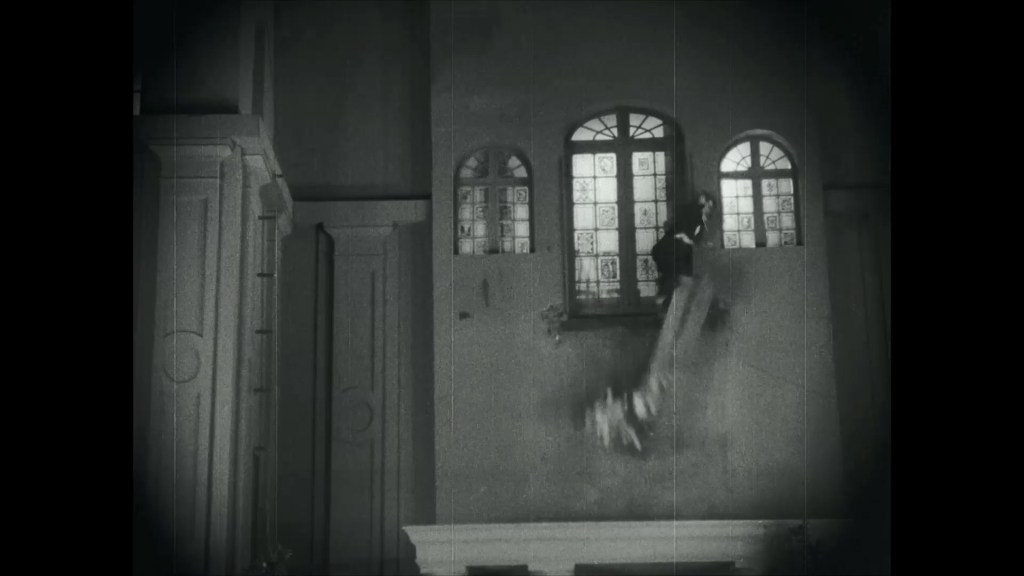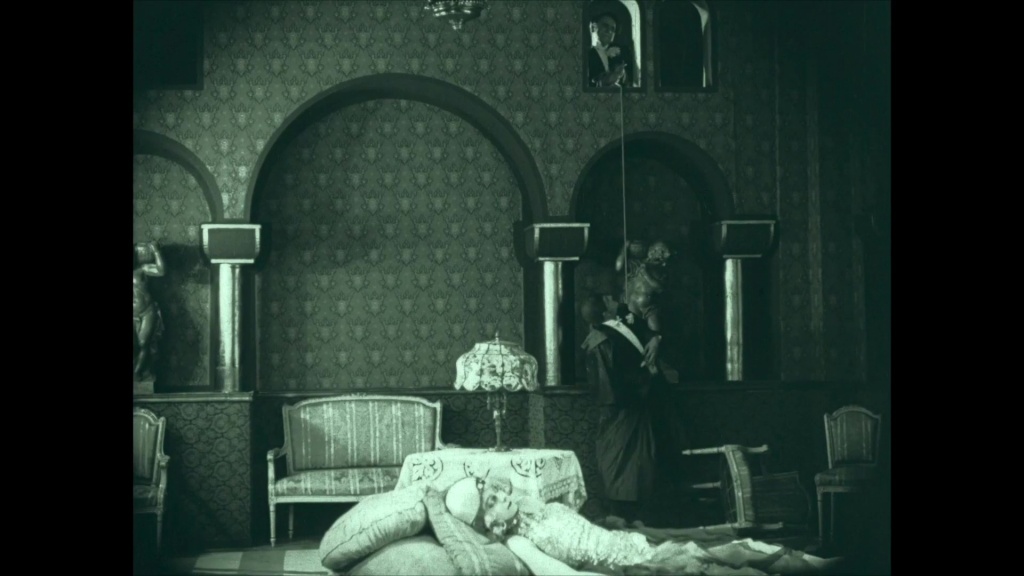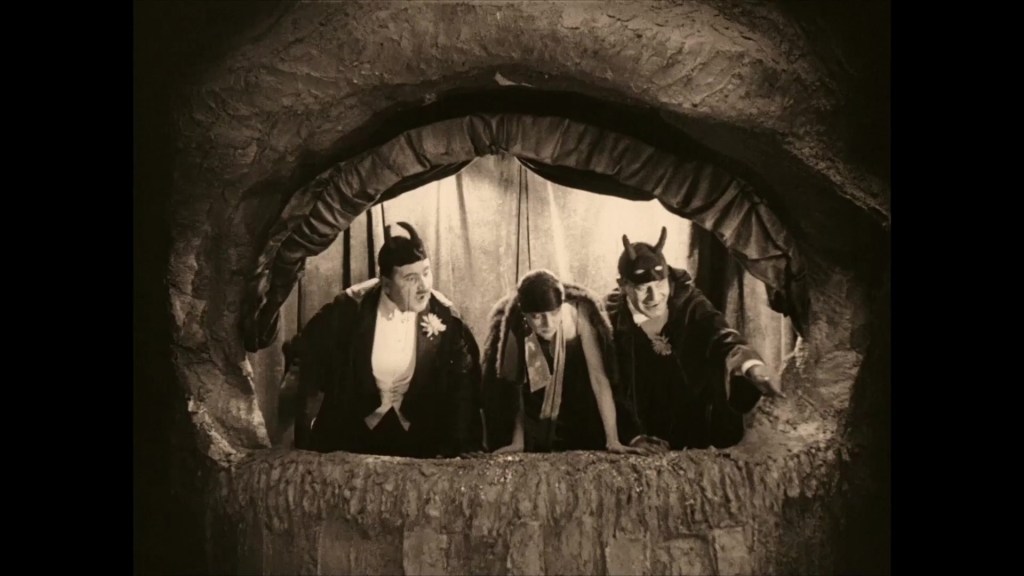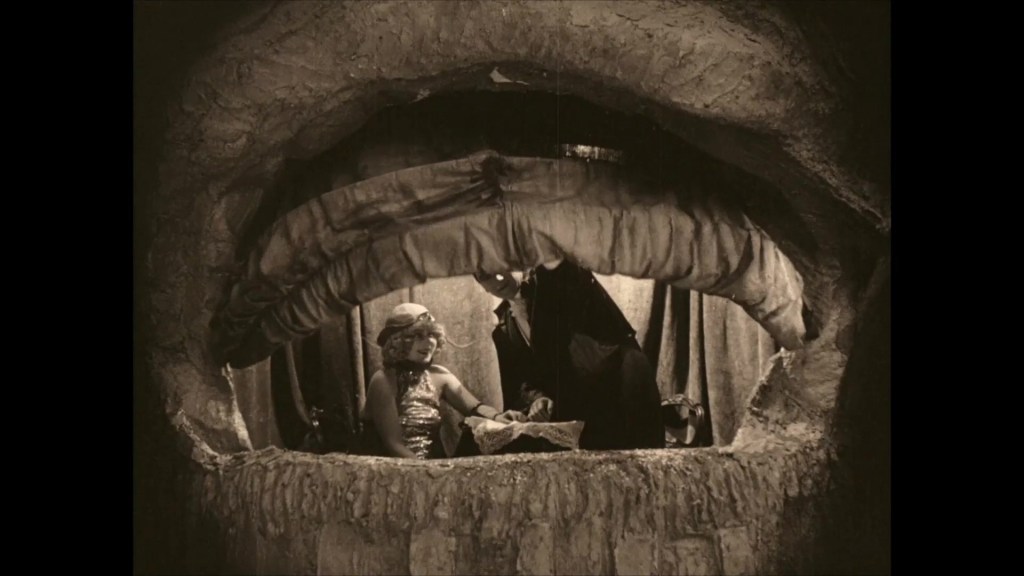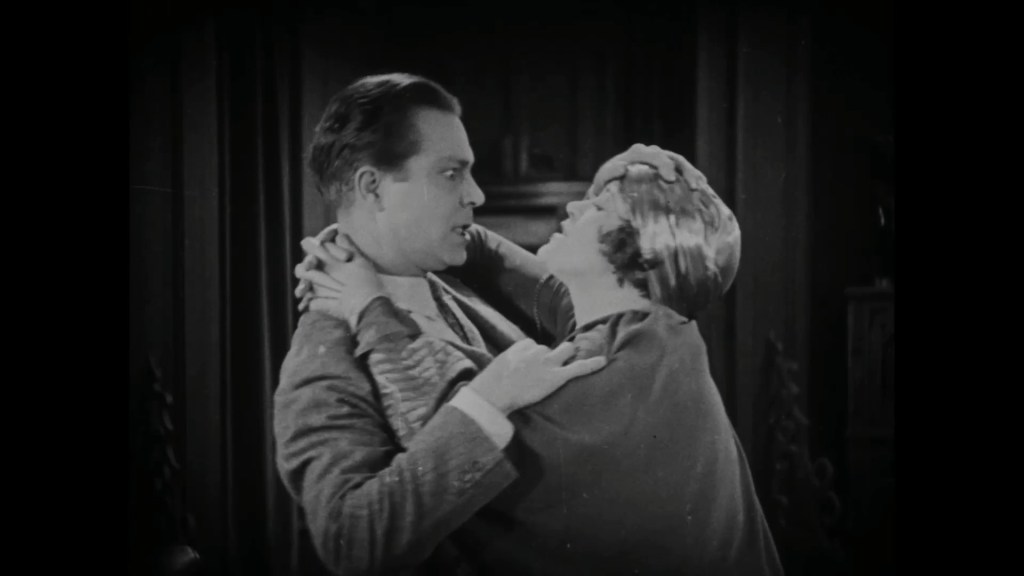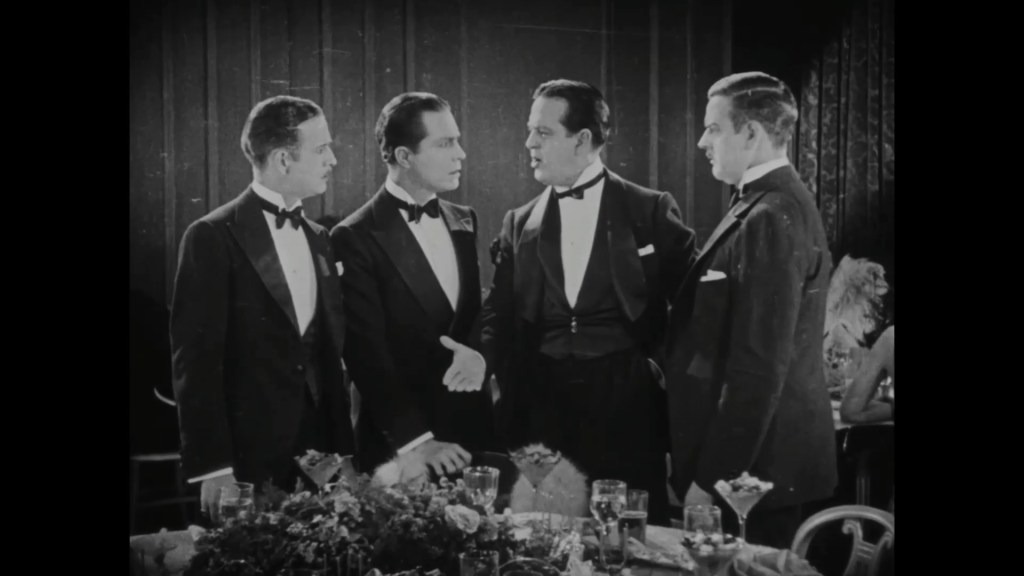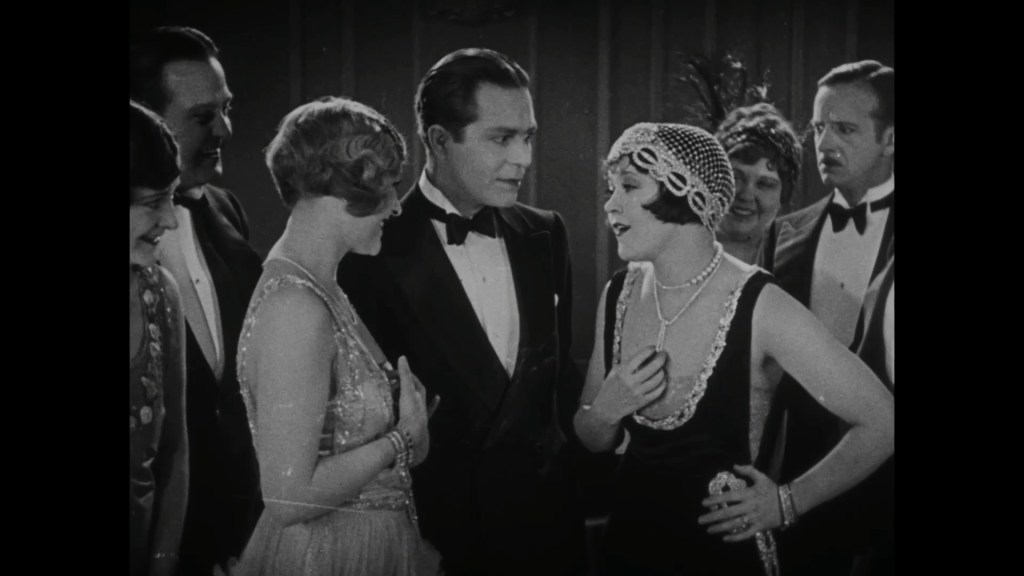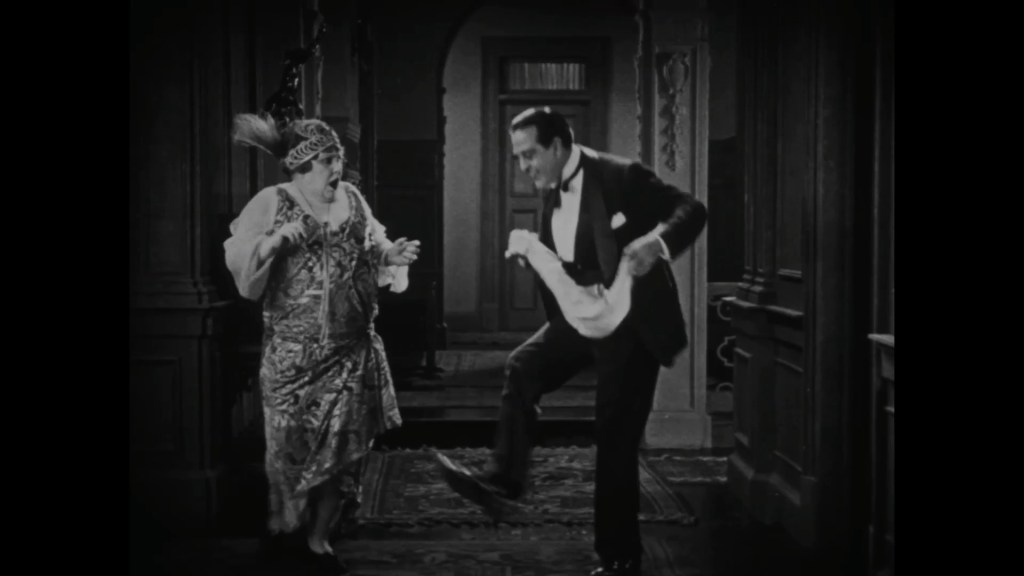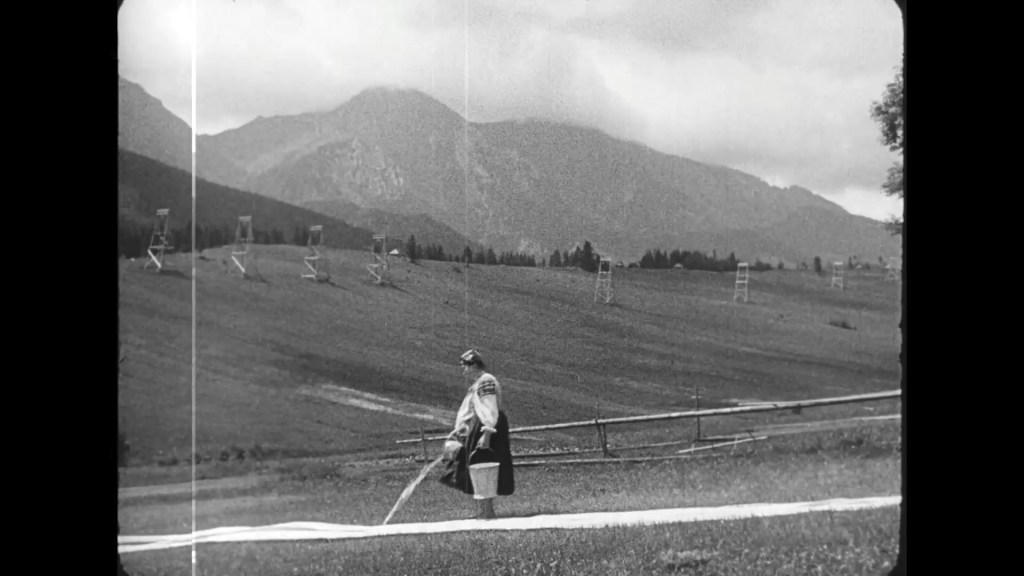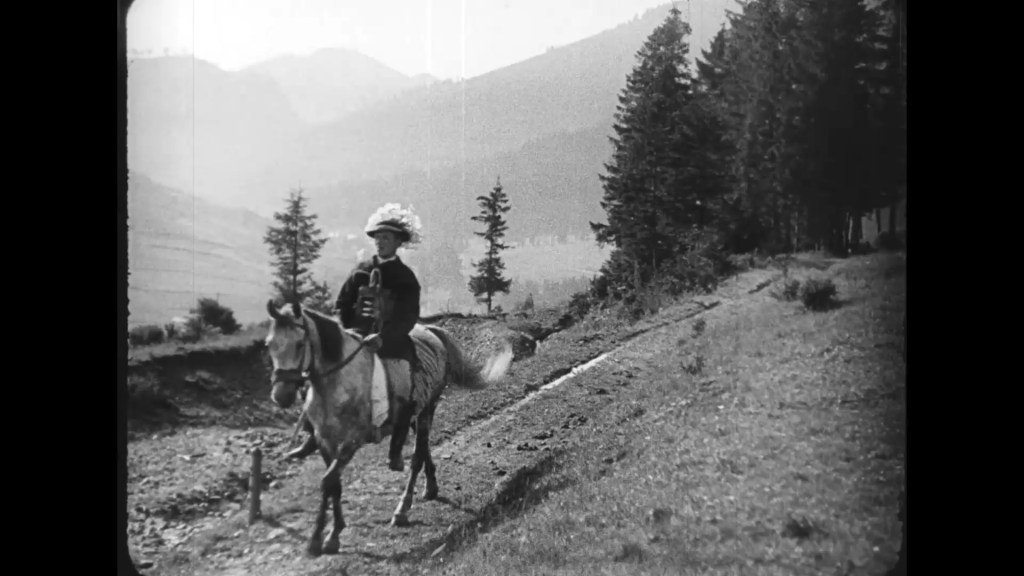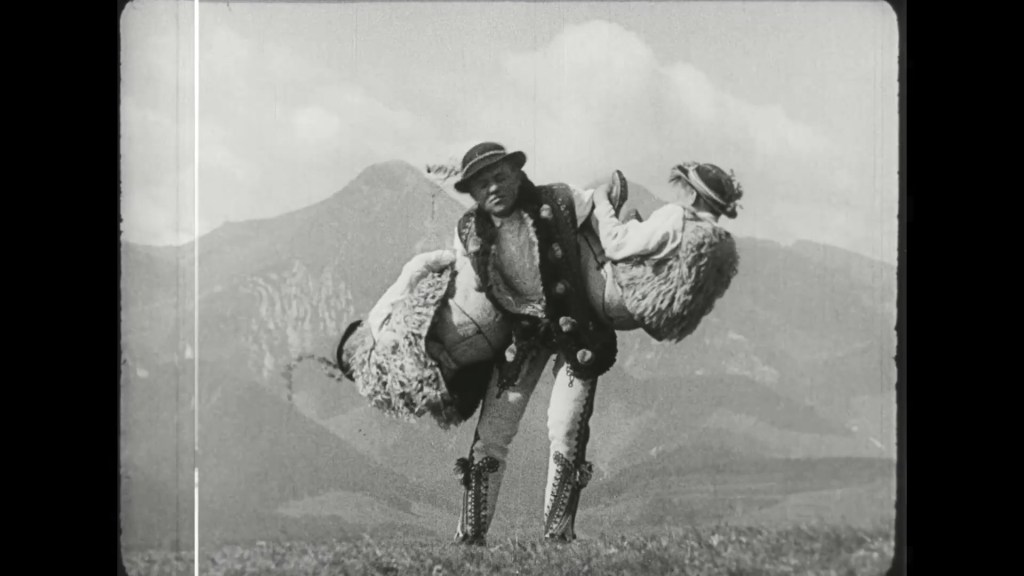
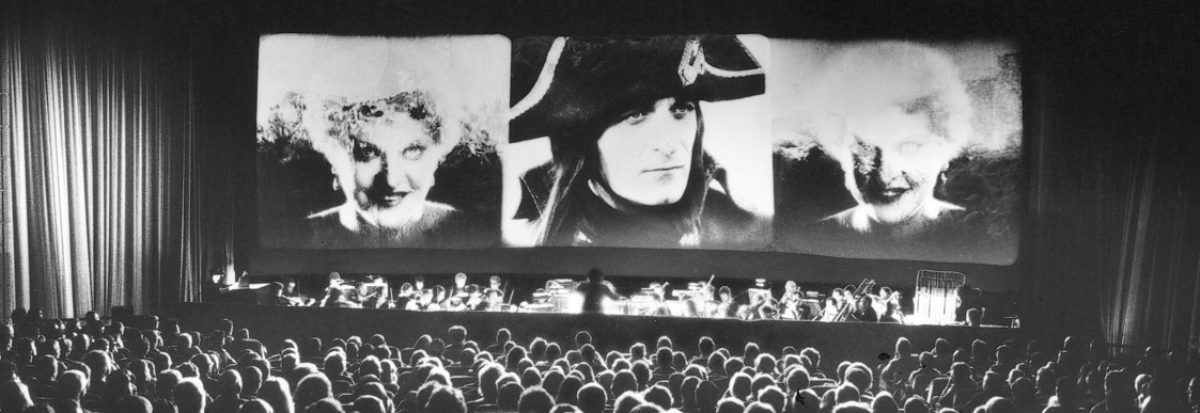
Pordenone from afar (2023, Day 5)

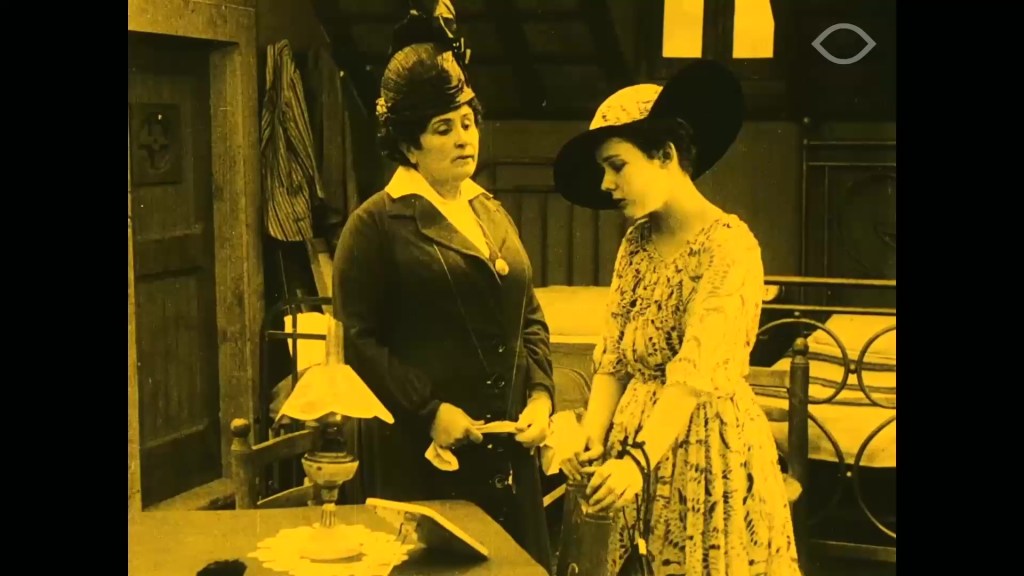
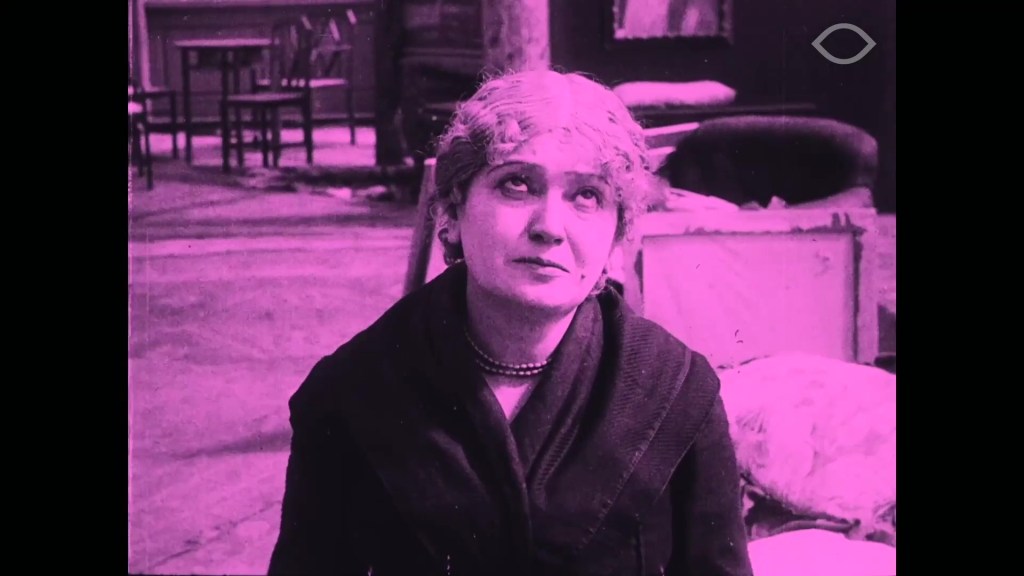
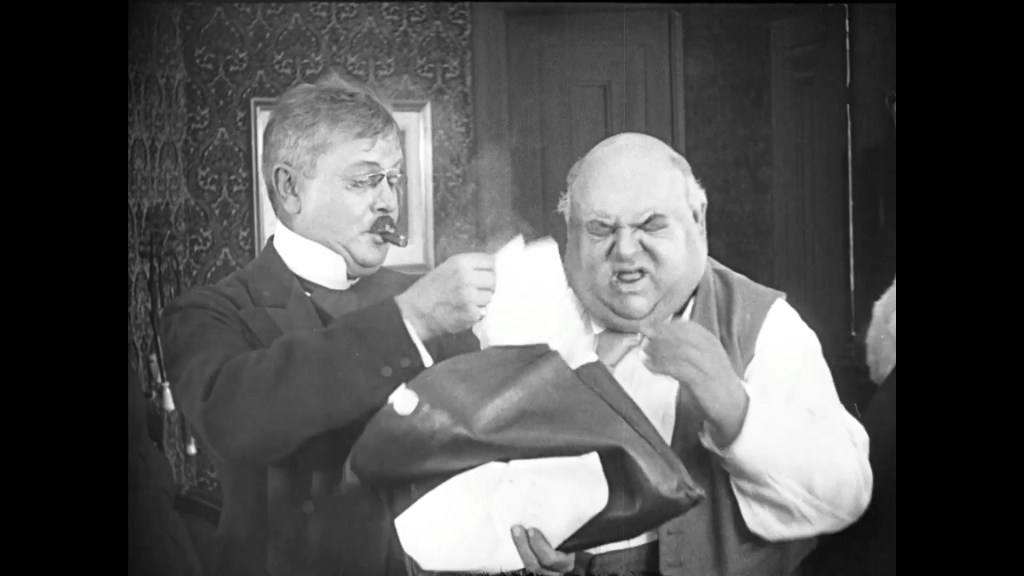
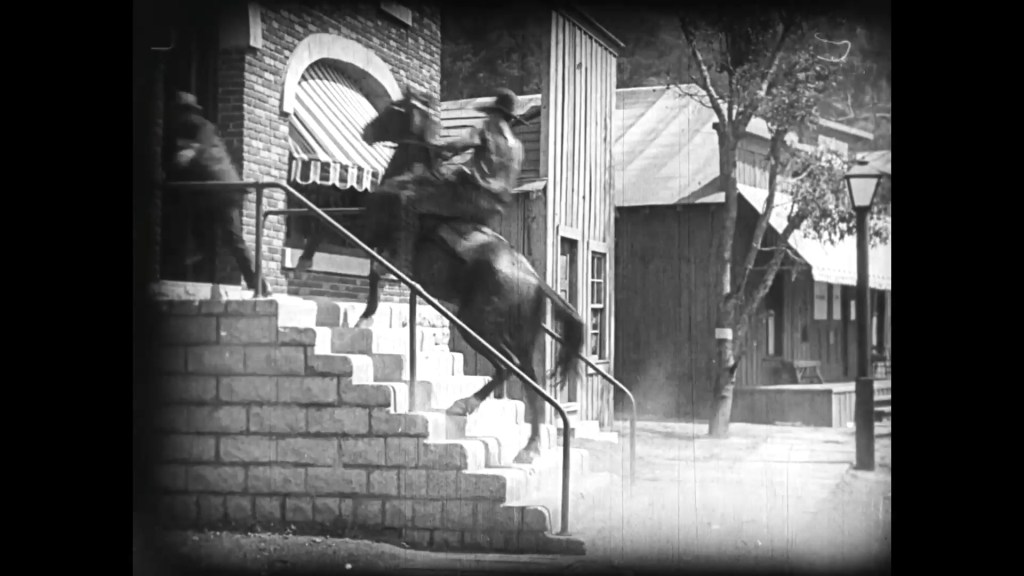
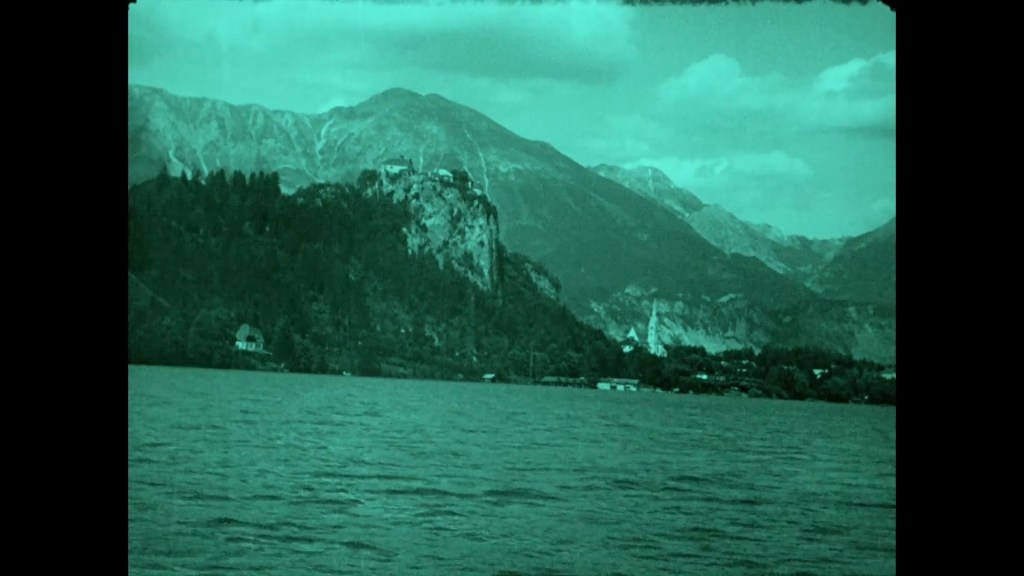
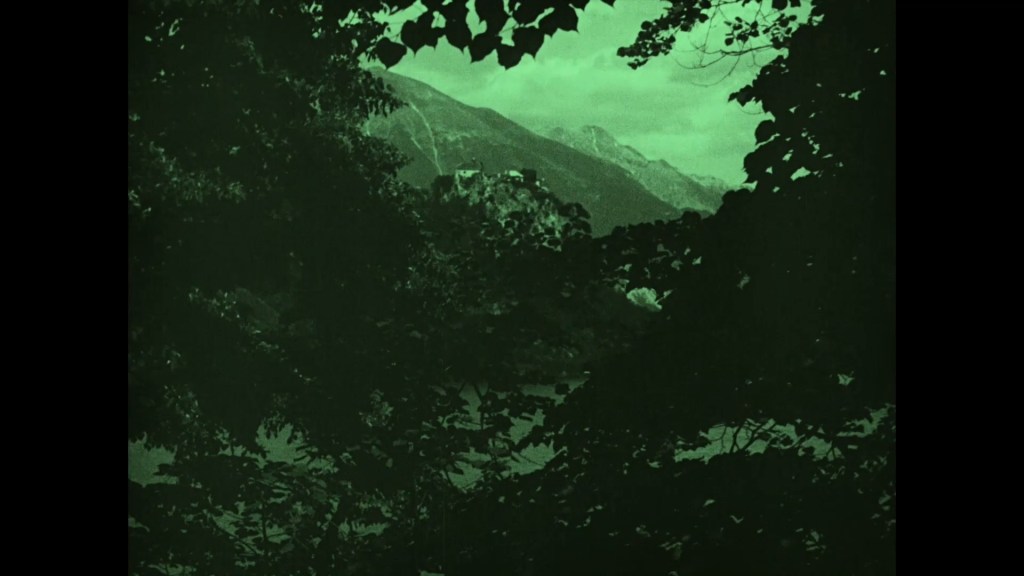
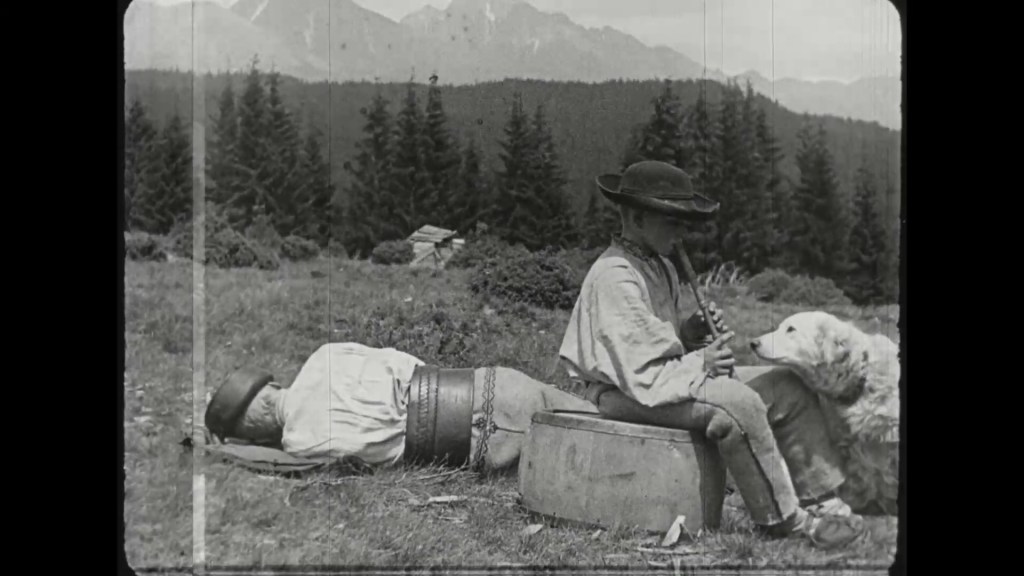
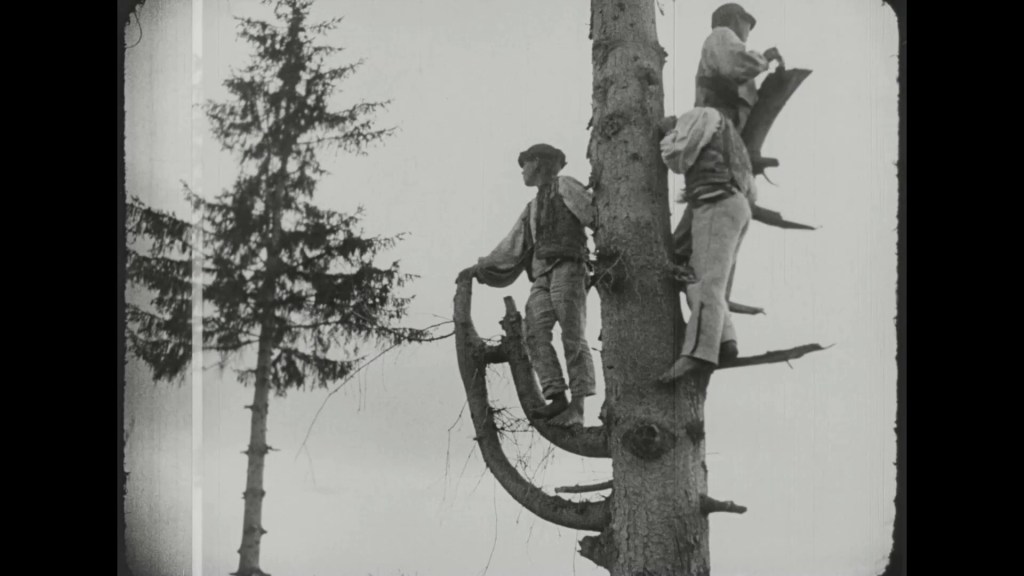
Day 5 brings us both closer to home (well, my home) and further afield than we’ve been so far. Closer to home because today’s programme consists of nineteen British films preserved in the collection of the Filmoteca di Catalunya. Further afield, because these are the oldest films being streamed from Pordenone this year: we begin in 1897 and go so far as 1909. And further afield in another sense, since many of the films recorded events happening far beyond British shores. So, as well as visiting the south coast and Surrey, we go to the north of England and Scotland, but also to Spain and Sri Lanka…

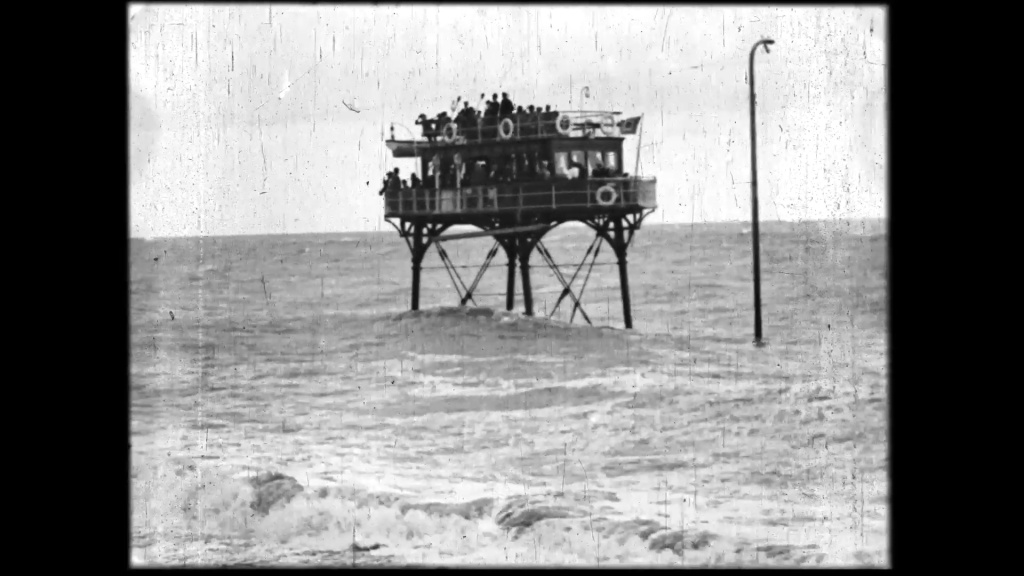
Brighton Seagoing Electric Car (1897; UK; George Albert Smith). Waves breaks amid a downpour of cellulose scratches. Our eyes adjust to the past. Foaming surf, grey seas. The blank sky of a century-and-a-quarter ago. And we behold the strange, dark form of the “electric car”: an open bus of sightseers, moving slowly above the water. The population of the past, specks of faces, waving arms. The past looks back at us, beyond us, to the land behind the camera.

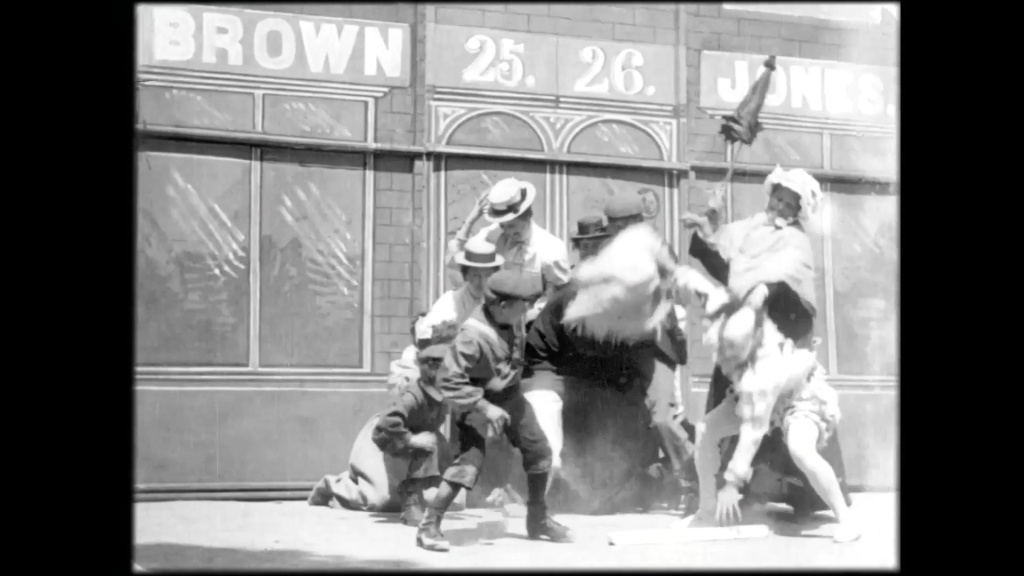
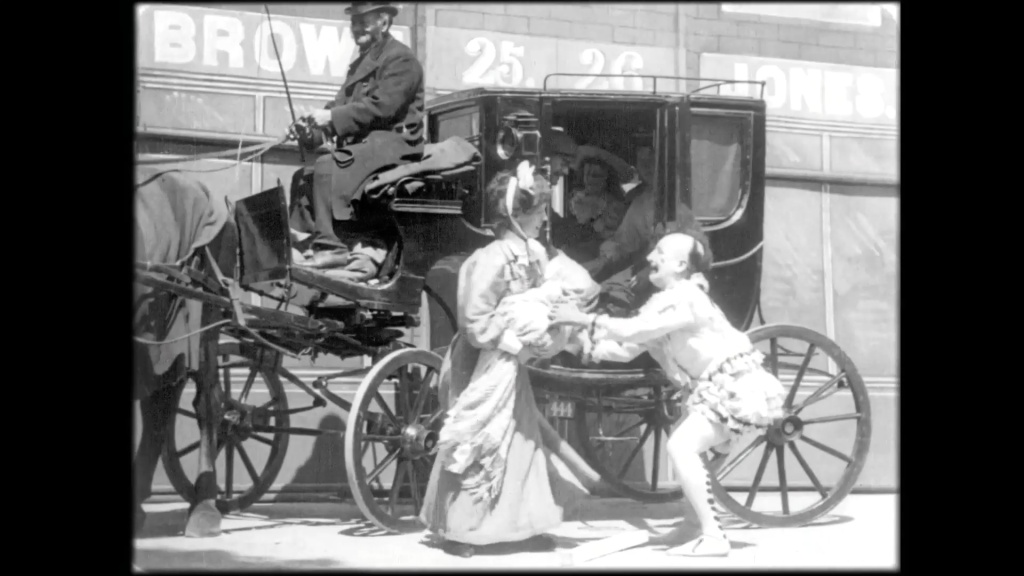
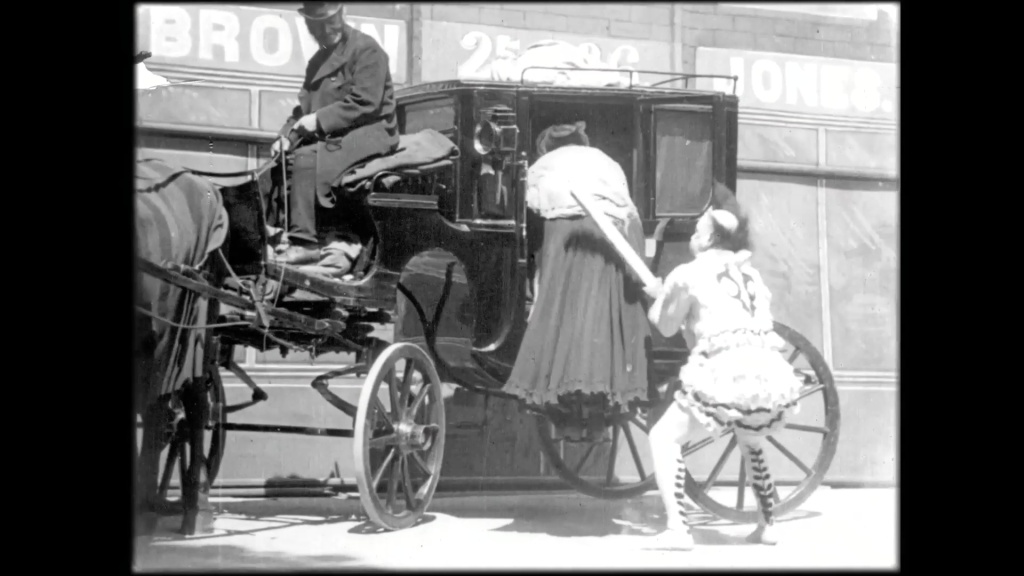
The Inexhaustible Cab (1899; UK; George Albert Smith). A capering clown, a carriage, a canvas street front. The clown ushers his passengers—Victorians all—into the cab. More and more step in. Men, women, boys, girls. The clown joshes with a woman, shoves her in, chucks a child on the roof. The carriage disappears. The occupants are left in a pile. The old woman beats the clown with her umbrella.
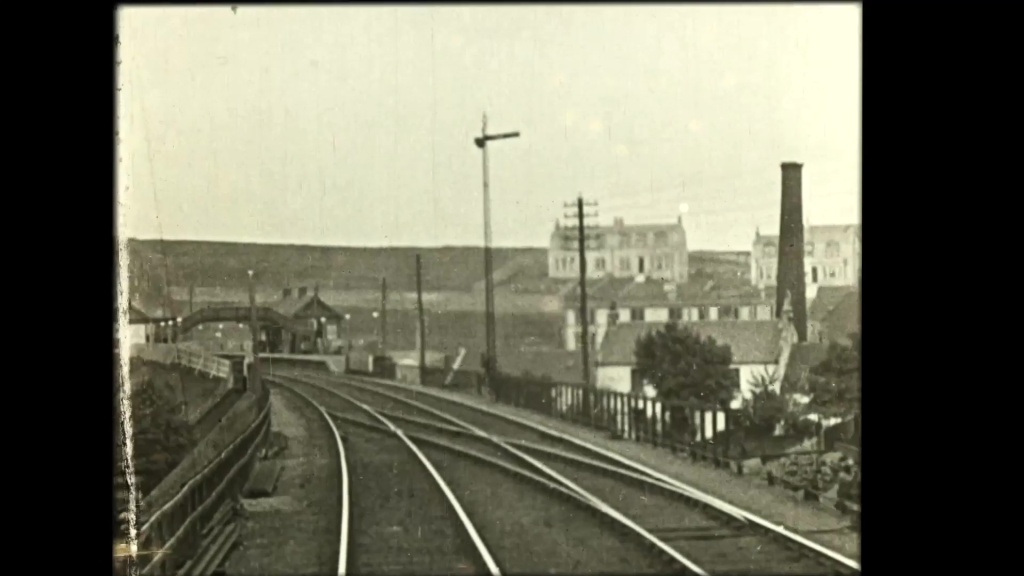
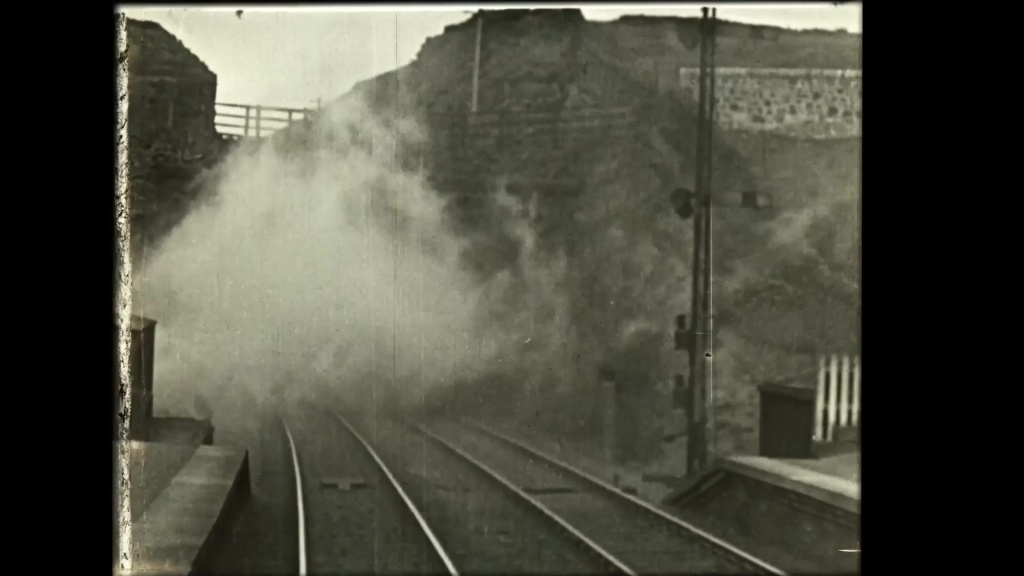
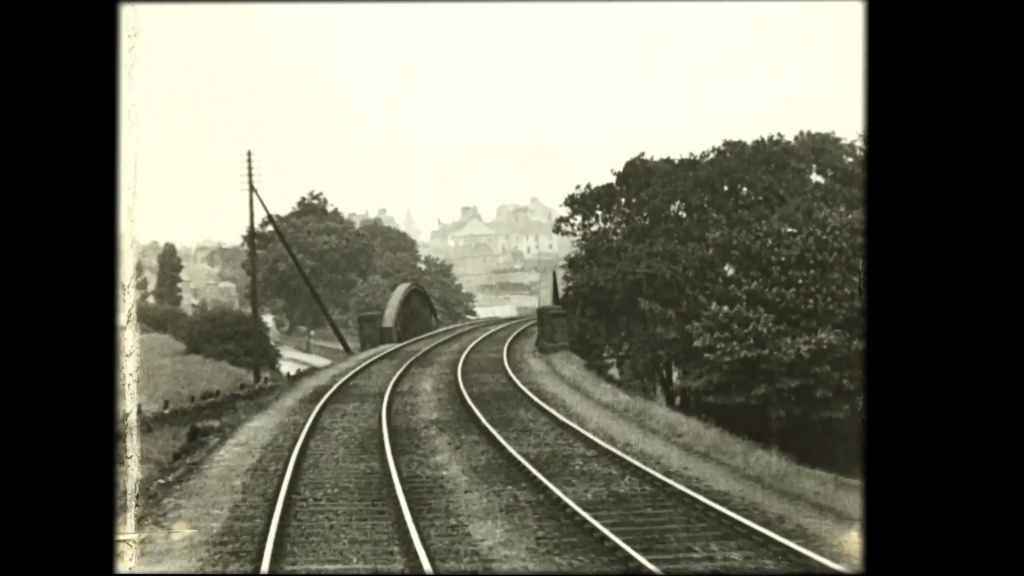
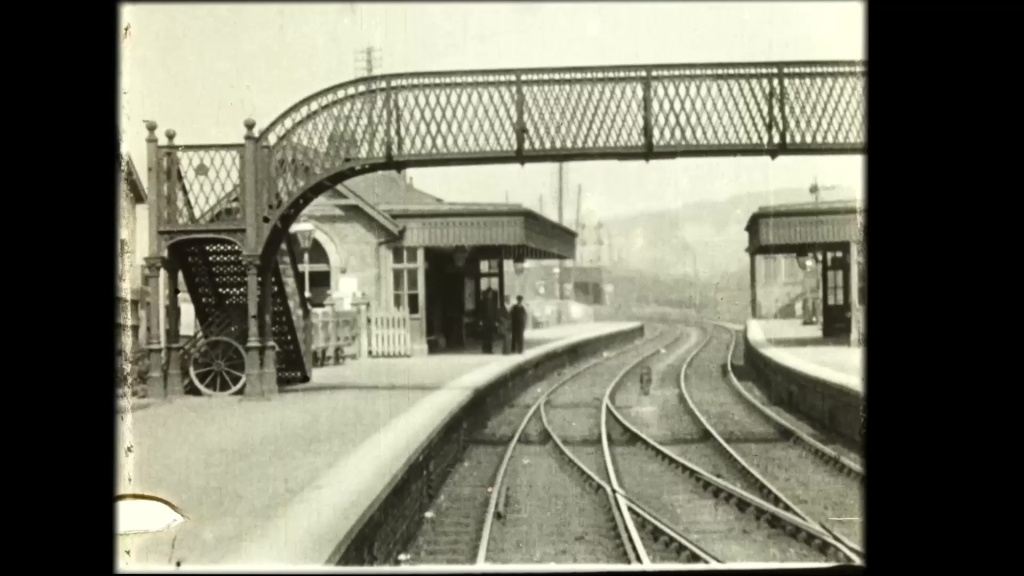
Dalmeny to Dunfermline, Scotland via the Firth of Forth Bridge (1899; UK; Warwick Trading Co.). The past is slow. The frames crackle with debris. Frames disappear (we plunge into the dark). People stand by, watching us. The camera is mounted at the front, we see the tracks move under us. We pause to let a train pass in the other direction. (Who is behind those windows? The glass is dark, the interior invisible. The past keeps its secrets.) The Firth of Forth Bridge, long, long ago. The beams and girders close in on us. Time skips. We move through a small, uninhabited station, into a cloud of steam and smoke. (It’s a beautiful moment, a haunting transition—for we never know with such a film when it might end, where we might emerge.) Into a tunnel, through it. Gleaming coast. A bleached sky. (The tinting clings to the trees, the shadows of the rails, the side of the walls.) Fields and trees. The silhouette of a town suddenly appears. (And I do mean suddenly: it’s like the exposure suddenly recovers, as when your eyes adjust after walking from bright sunlight into a dark room.) Where are the people here? Here are two: two workmen on the track in the tunnel. They are just silhouettes, shadows. We cannot see their faces. Do they see us? They move aside and let us pass. We approach the station. Two figures await us in the light. But the light eats them up. The film dissolves their faces in the glare of ancient sunlight. The lens is about to bring them into focus when the film stops.

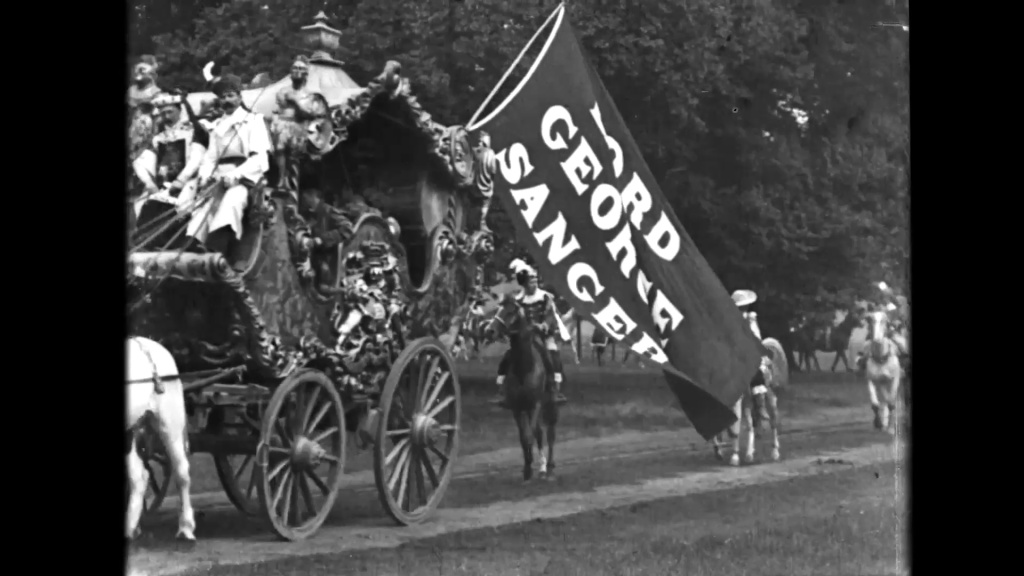
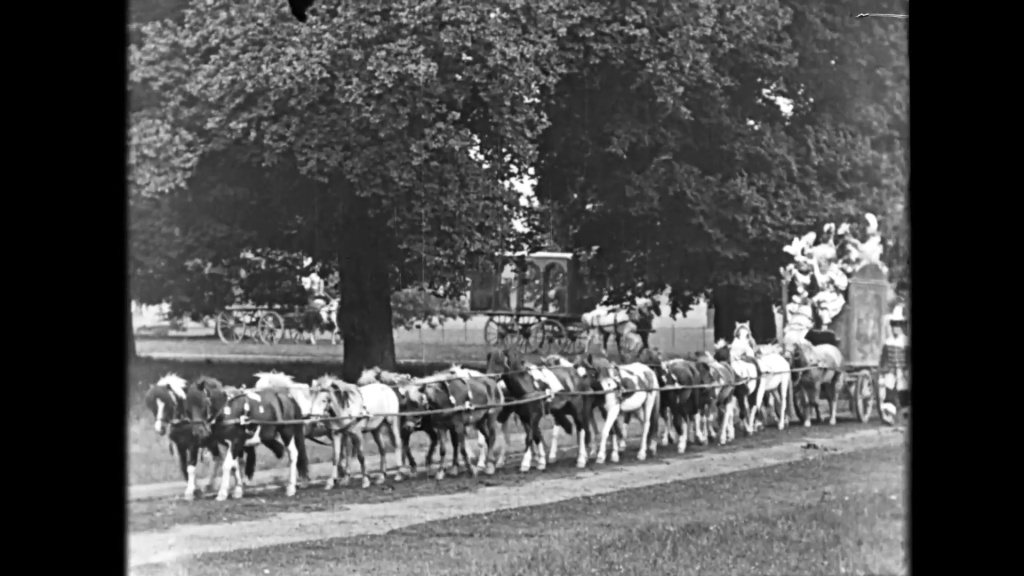
Review of Lord George Sanger’s Circus by the Queen (1899; UK; Warwick Trading Co.). Twenty horses pull a carriage loaded with performers. Another dozen horses draw the next, surmounted by a band. Huge flags. Camels. Two horses pull an even larger brass band. (The horses struggle under the sheer weight, slipping on the muddy road, their awful effort captured forever.) Ever larger carriages, more absurdly decorated. A black man stands atop a horse. A flotilla of boats (their carriage wheels and horse legs peeping from below their painted skirts). Fake beards. A moving forest of trees. “Lord George Sanger” (the biggest flag yet). Elephants, ridden by non-white performers. No-one is watching them but us. The dark, distant trees stand still.
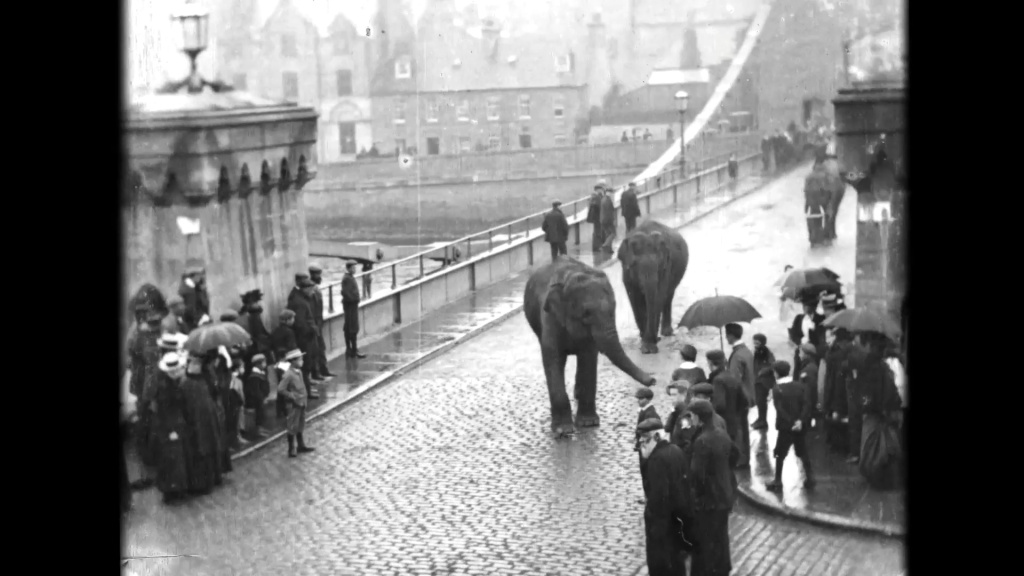
Sanger Circus Passing though Inverness (1899; UK; John McKenzie[?]). The circus again, now riding past spectators. Unattended elephants scamper along the cobblestones. Unattended camels hurry past a gaggle of unattended children. Flat caps. Umbrellas. The cobbles gleam with rain.
The “Poly” Paper Chase (1900; UK; Warwick Trading Co.). A man trailing shredded paper hurtles past. Through a muddy field, more runners pass, slipping and sliding. Long shorts, long sleeves. Edwardian sportsmen. Moustaches. Determination. A series of streams, muddy expanses. The men leap into water made to feel all the colder by the overexposed celluloid. The trees are bare. The film frame itself seems to shiver.

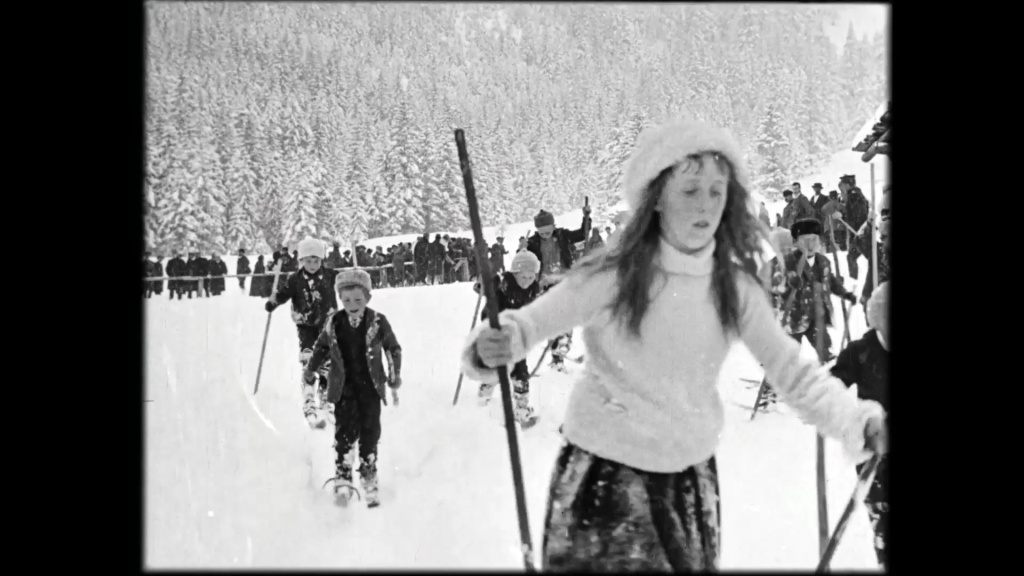
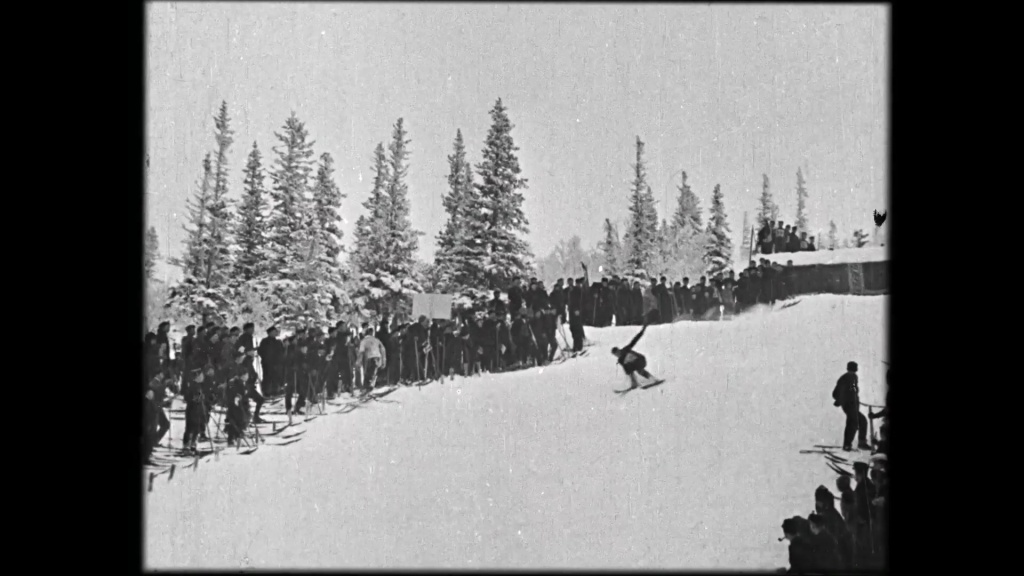
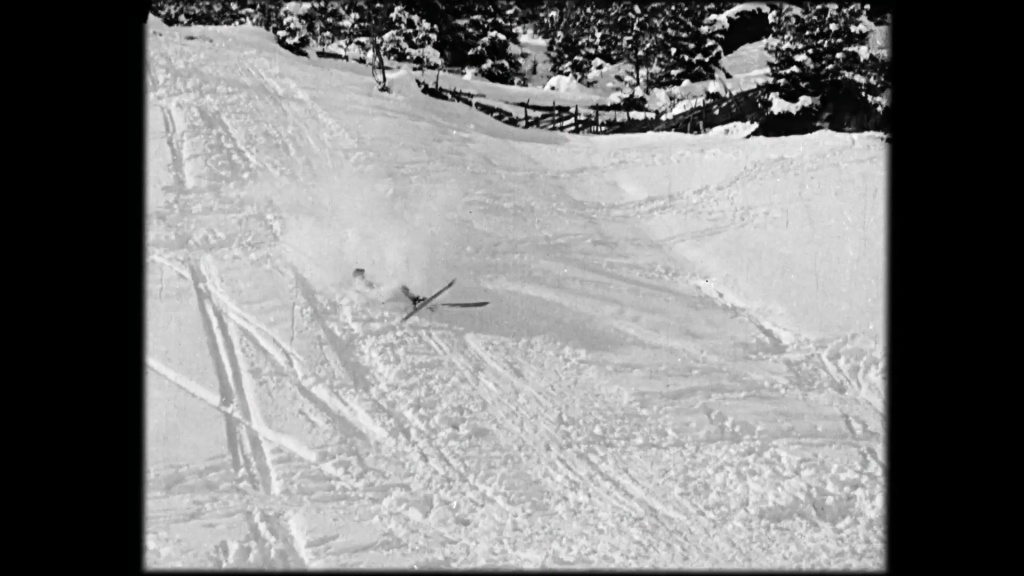
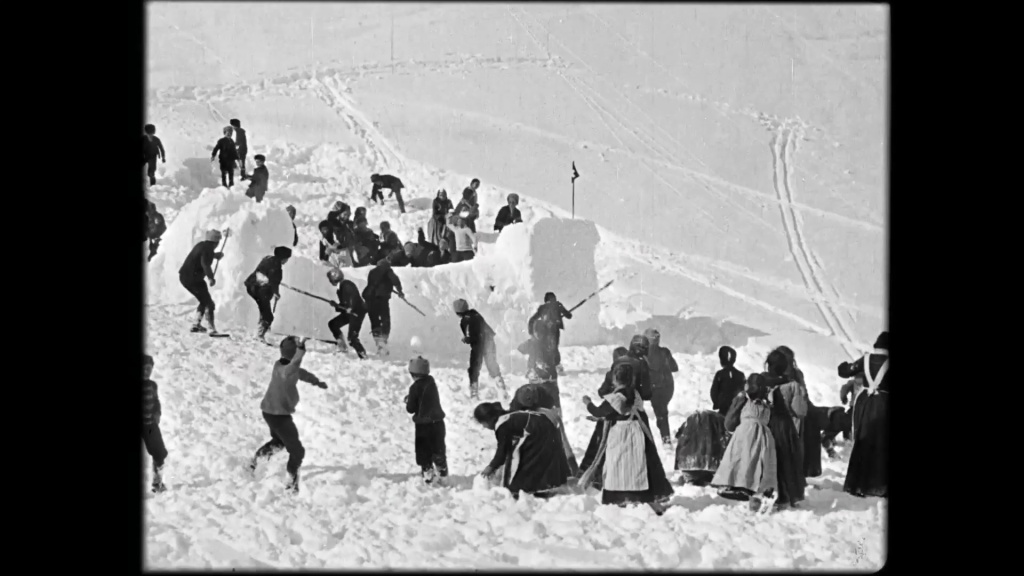
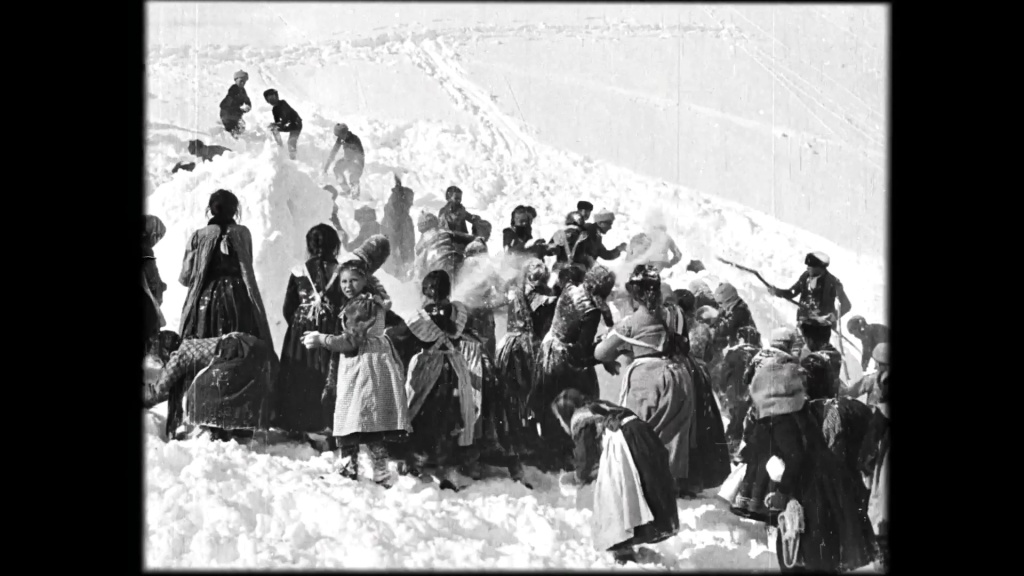
The Wintry Alps (1903; UK; Frank Ormiston-Smith). So, to winter. A snow fight. A fort made of snow. The camera is impassive. We see sled tracks in the distance, across the slope. The fort is attacked with poles. The crowd in the foreground consists mostly of girls and women, but the sticks and poles are wielded by boys and men. The film cuts closer. A chaos of snowballs. A girl glances behind her, towards us. The scene ends. A children’s ski race. Young faces tense with concentration, or with breathless smiles. The troupe move past us. We see them again, then lose them forever. A slope. Adult skiers. Someone falls. A new view: a ski ramp. Skiers jump. We see them take off here, and land in another shot taken further down the slope. A crowd looks on. Another slope. Skiers sliding and falling. It is pleasingly amateur, imperfect, eager. Very few keep upright down the steep gradient. A final figure lies in the snow. Just before he stands, the film ends.
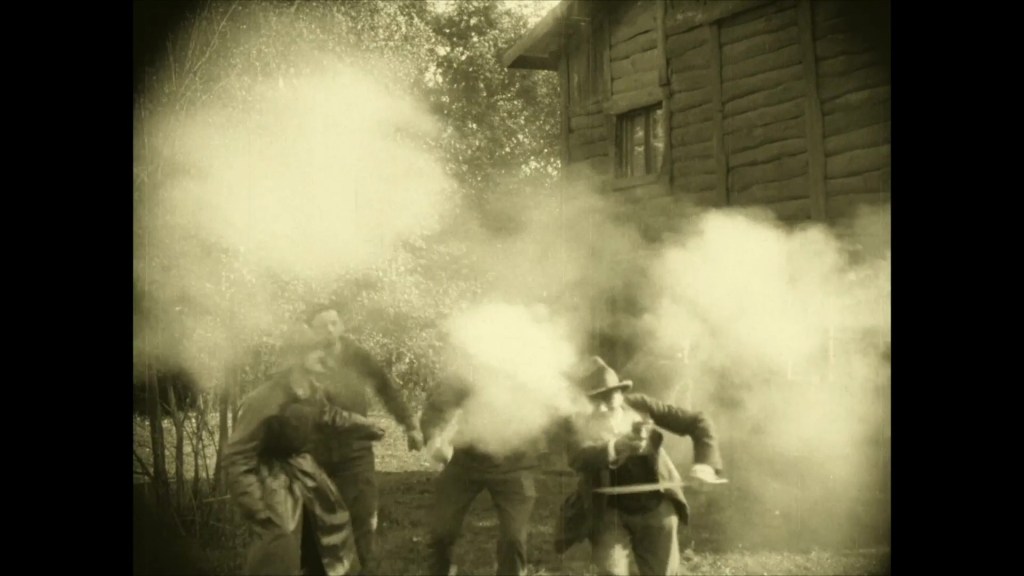
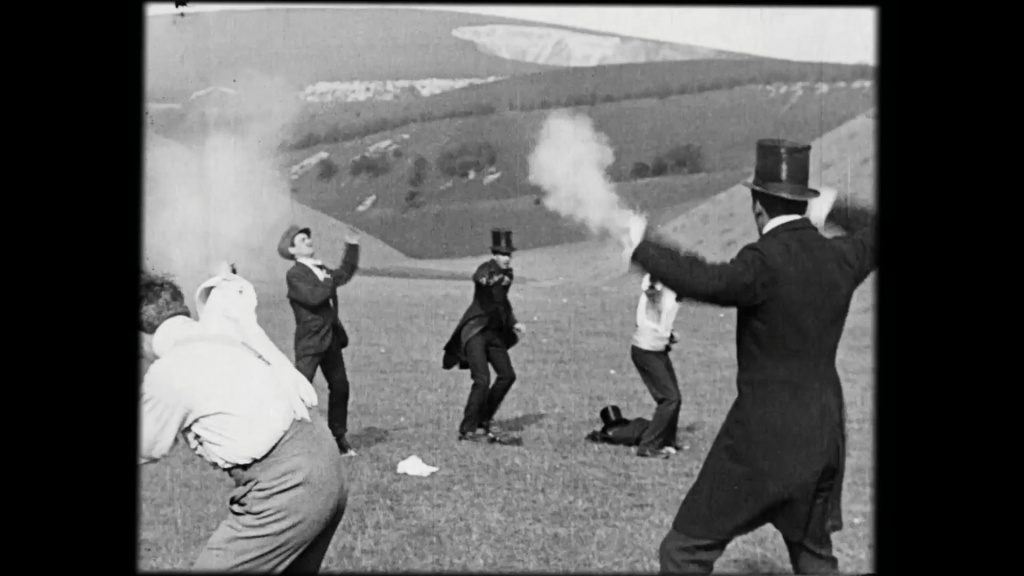
An Affair of Honour (1904; UK; James Williamson.). Two men overlook a windswept patch of sea. Top hats, moustaches, goatees. A fight, a thrown drink. An exchange of cards. A change of scene: now, distant chalky hills. A treeless valley. The two men, the two seconds. Clumsy disrobing, clumsy practising. How will this end? Shots fired. The second shot in the foot. Another round. A witness is gunned down. Another round. The doctor is killed. Another round. The other second is killed. The only other witness runs away. The two duellers observe the field strewn with dead. They shake hands. (The film presages a marvellous film by Max Linder from 1912: Entente Cordiale, in which two nervous duellists fire multiple shots and kill all the witnesses, as well as birds in the sky and trees. They are so overjoyed to be alive that they run off ecstatically together.)

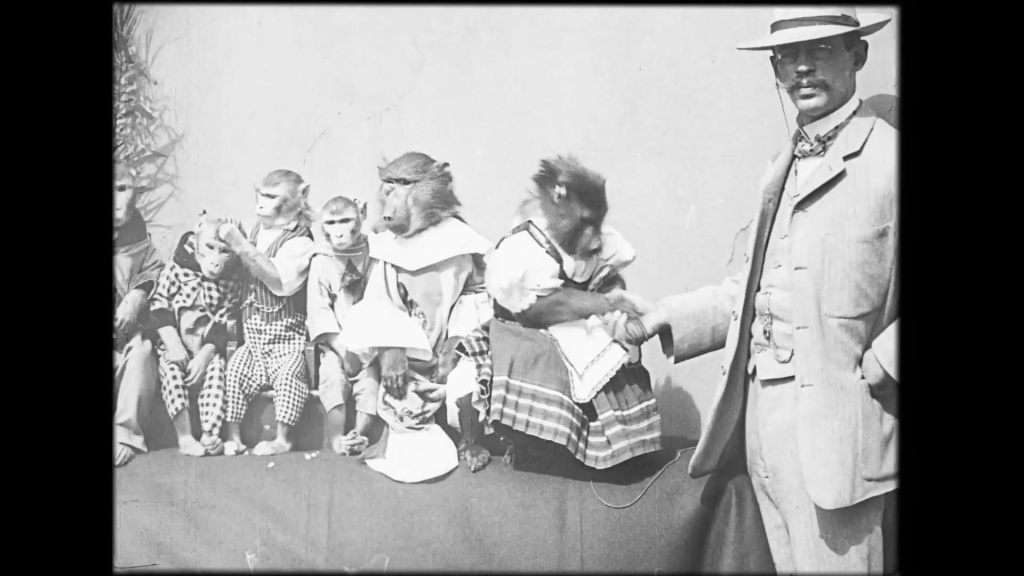
Perzina’s Troupe of Educated Monkeys (1904; UK; Charles Urban Trading Co.). A table filled with monkeys in clothes. A man in a Panama hat and linen suit oversees them. He sports a sinister moustache and pince-nez glasses. The camera pans up and down the hairy ranks. We see a monkey made to do a solo. It looks anxiously over its shoulder. The film ends.
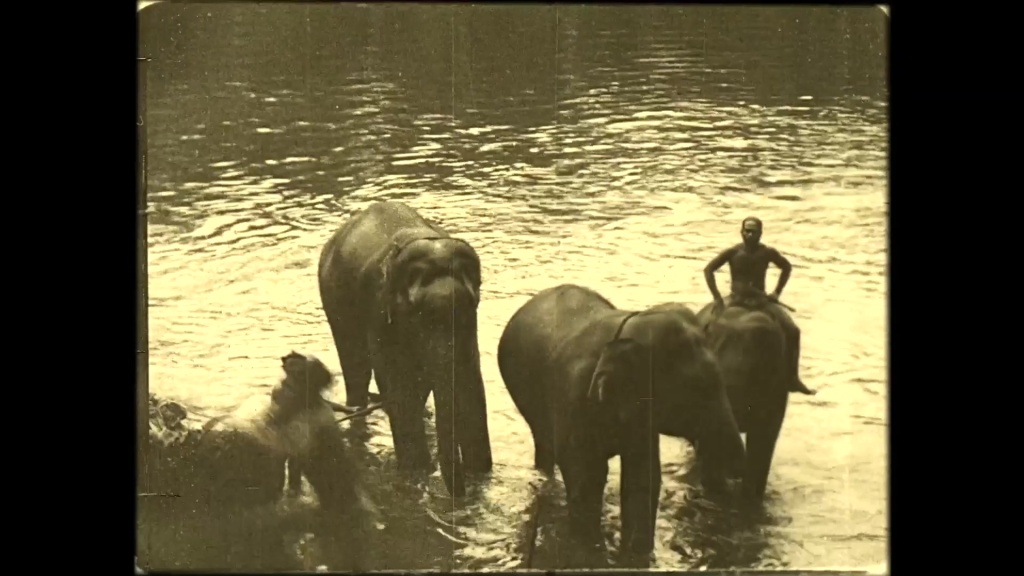
Elephants Bathing in Ceylon River (1904; UK; Harold Mease). Elephants and locals in the river. The locals sit atop the elephants. One of them is rubbing down an elephant’s brow, scratching behind its ear. The elephant lies on its side in the water. The Sri Lankan waters gleam with a warm yellowish tint.

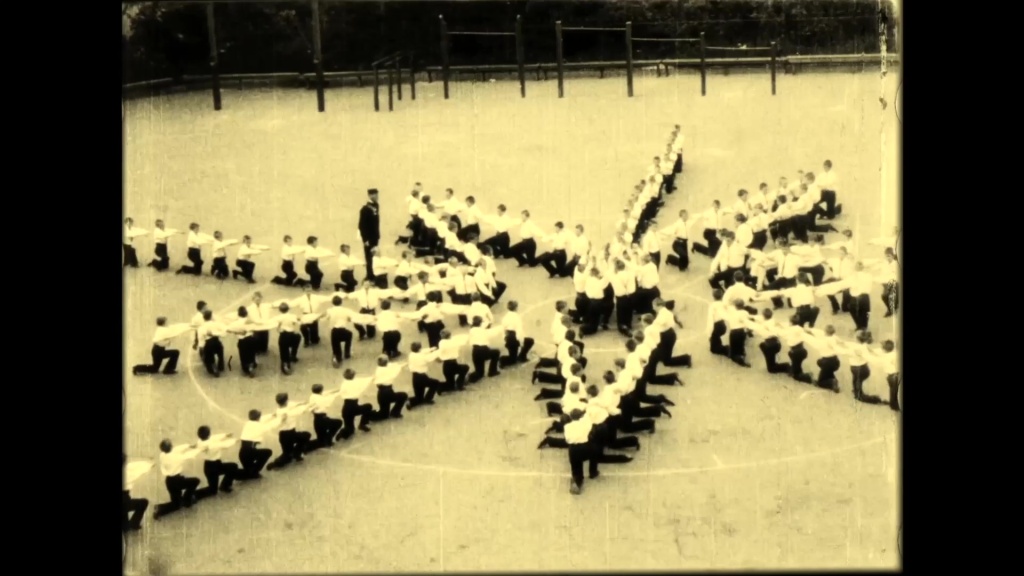
[Drill of the Reedham Orphans] (c.1904-1912; UK; Urban Trading Co.). A square. An audience. Women with floor-length skirts. Big hats. The children perform gymnastic routines in dark trousers and white shirts. An adult in uniform looks on from close by. He stands at the centre of their manoeuvres. They form a cross, a star, stand on one another’s shoulders, file past, form a moving circle and counter-spinning spokes.
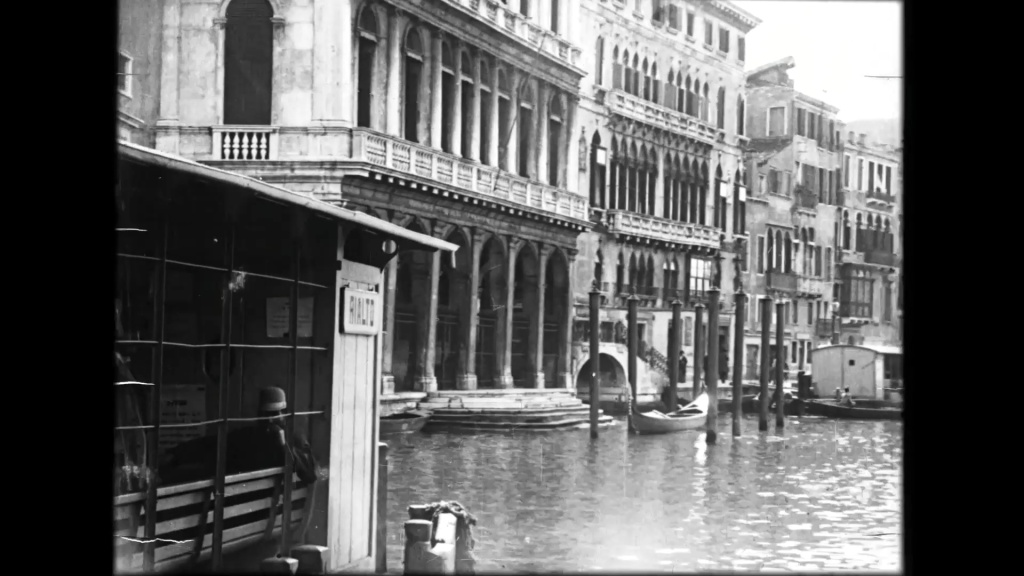
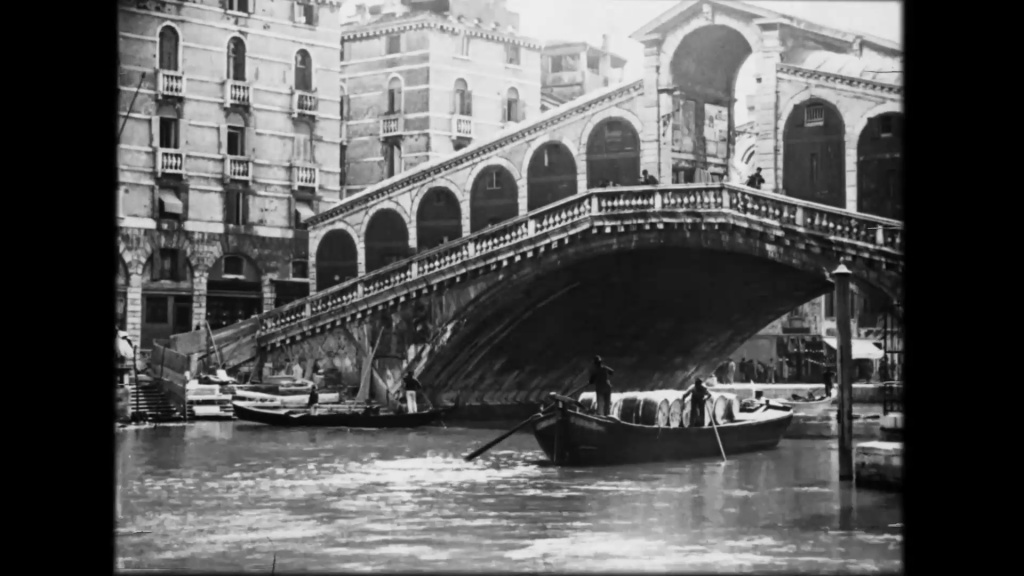
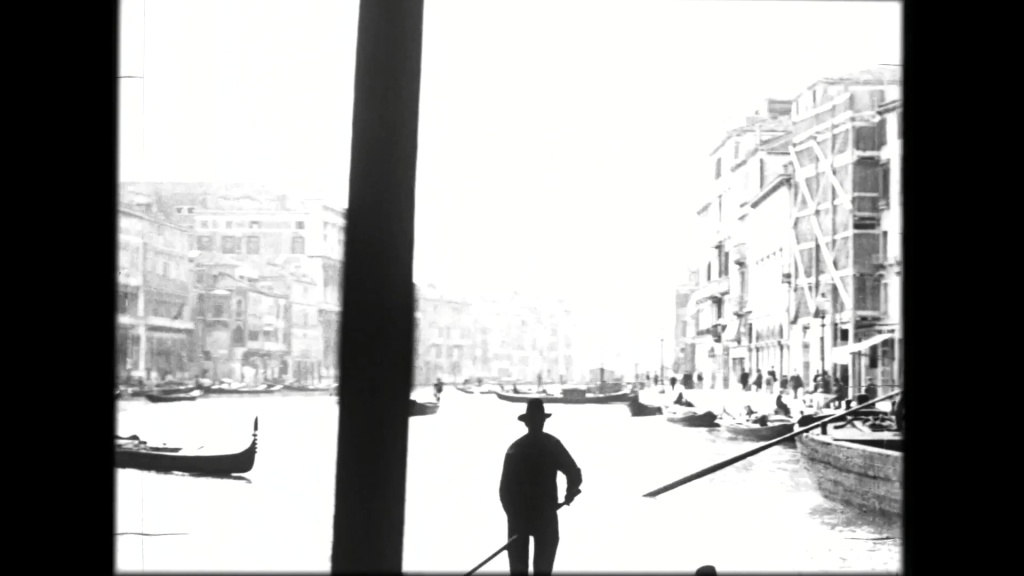
Venice and the Grand Canal (1901?/1904?; UK; Urban Trading Co.). The camera floats towards the Rialto bridge. In front of us, a boat loaded with barrels. A few passersby stop look down at us. A boat passes in the other direction. Gondoliers silhouetted against the bright waters, the overexposed sky. The camera draws close to another boat. A man is sitting, looking at us. Just as we are about to glimpse his face, he gets up. The film ends.
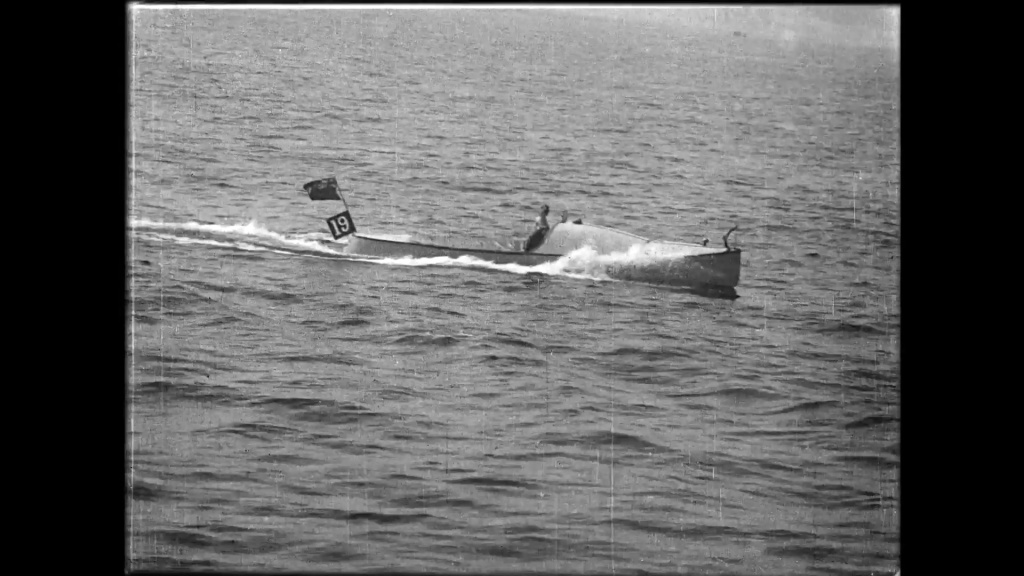
Edge’s Motor Boat. The Napier Minor (1904; UK; Urban Trading Co.). Monochrome waters. A sleek white boat, bearing the number 19 and the British flag. Another boat cuts through the waves. The edges of the frame ripple with wear-and-tear, like a watermark of time.
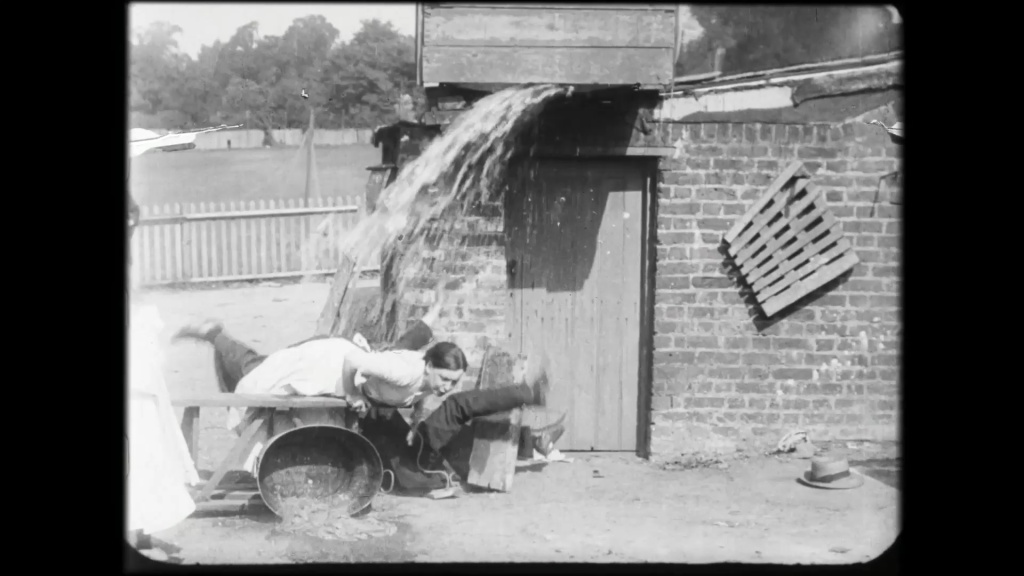
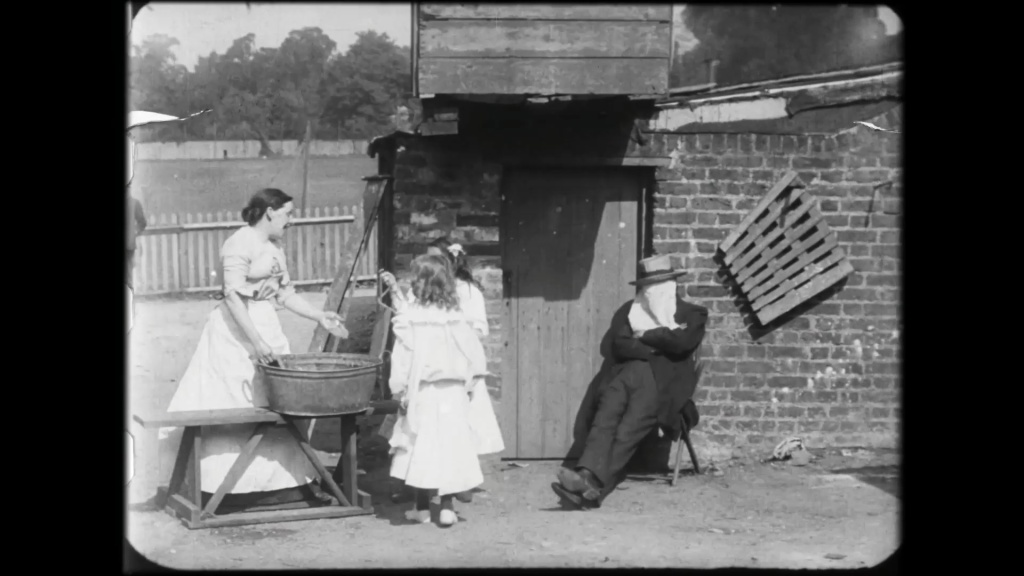
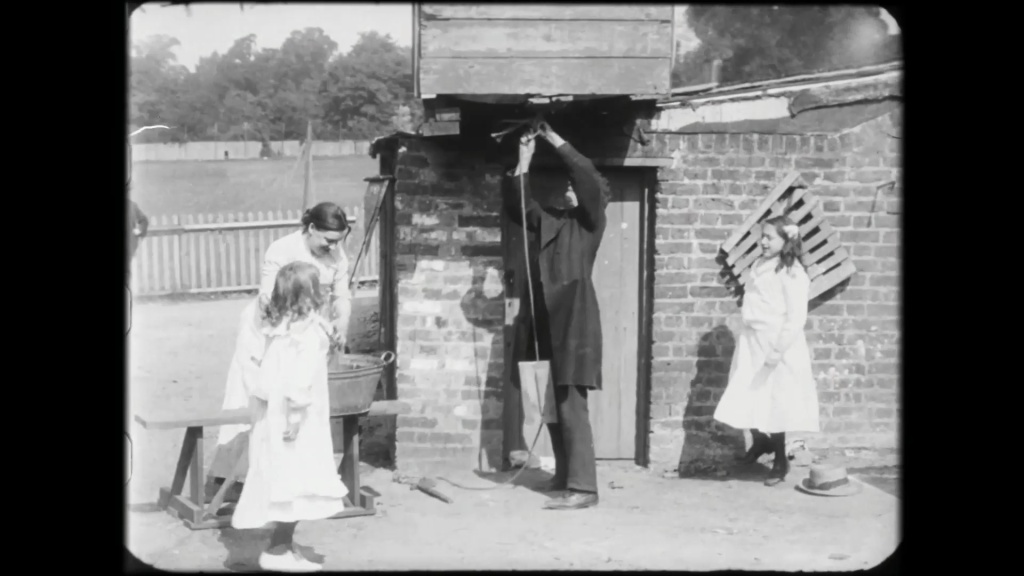
Fixing the Swing (1904; UK; Alf Collins). A family: the woman washing, the man snoozing with his face under a handkerchief. The girls wake him. He shouts angrily. They want him to make them a swing. They pass him rope and seat. He starts hammering moodily into a wooden overhang. (Just on the edge of the frame, in the background, a man watches the scene unfold.) The woman makes encouraging faces. The children dance in anticipation. The swing is made. The father shows its strength by sitting on it. It collapses, wrenching off the wooden beam above: water cascade over the family.
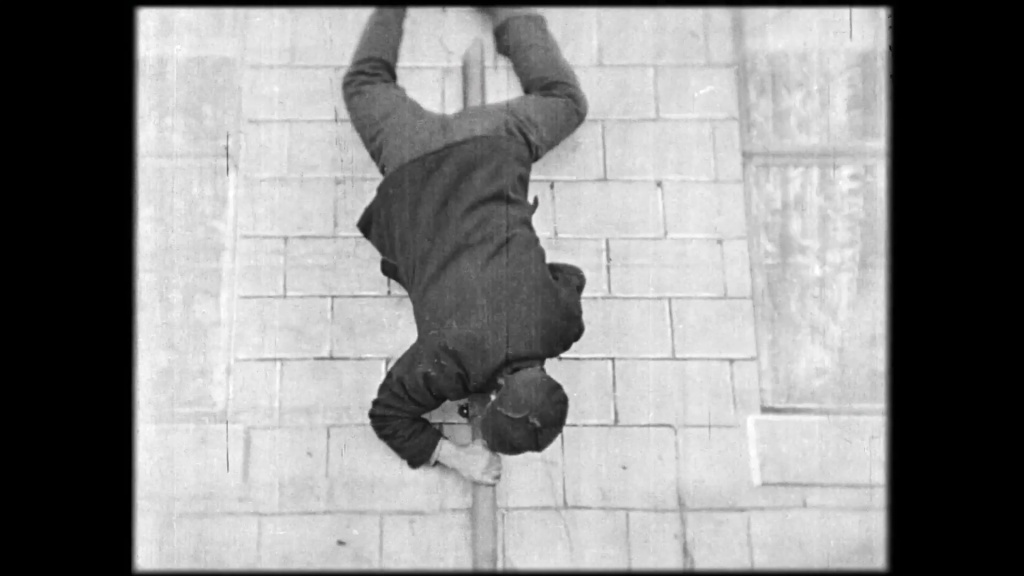
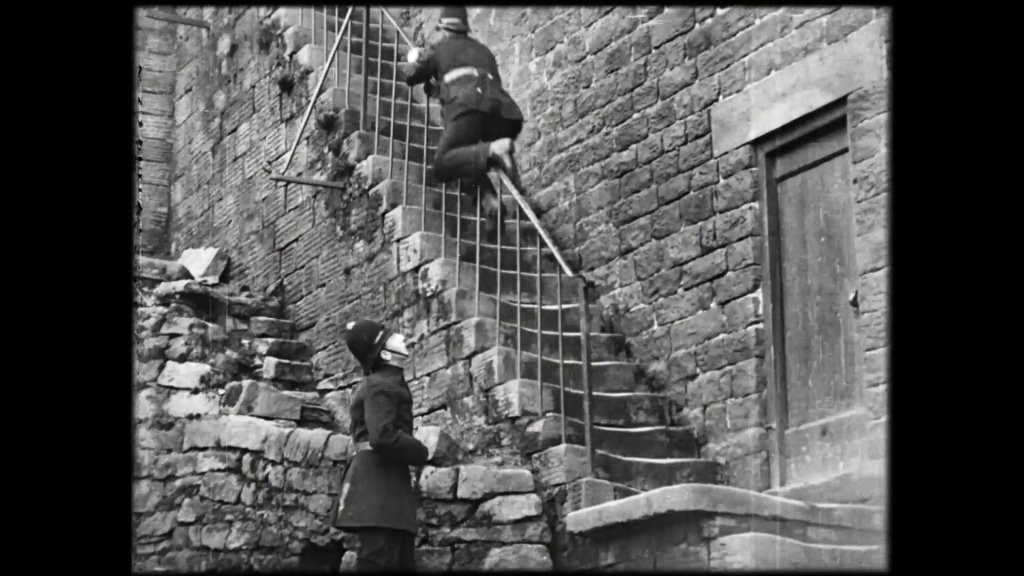
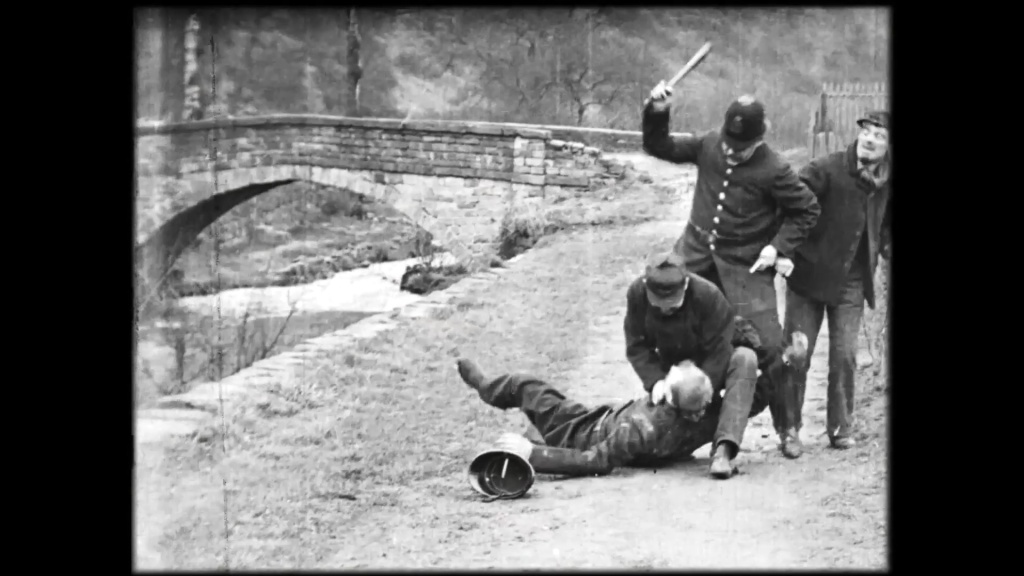
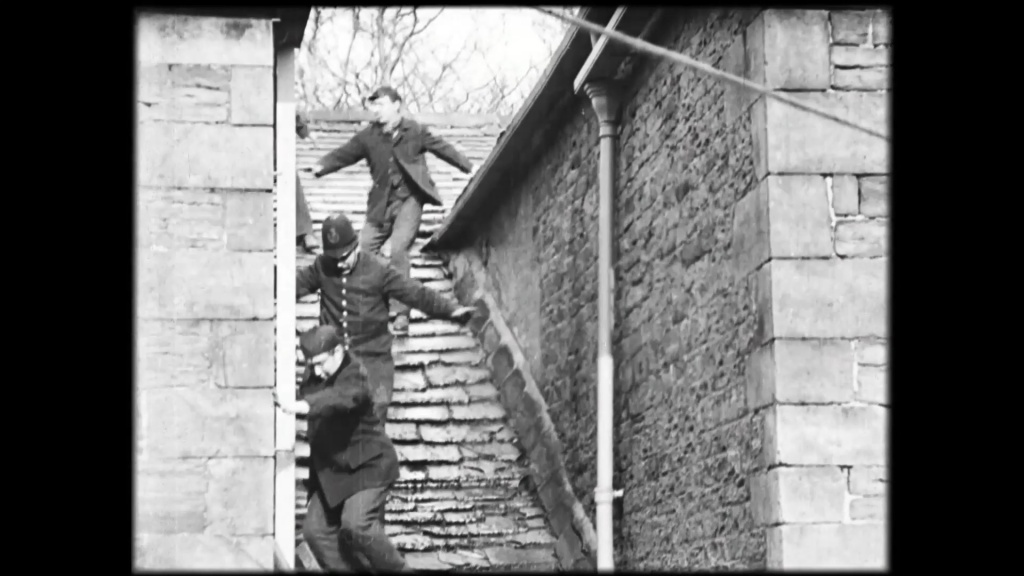
Eccentric Burglary (1905; UK; Frank Mottershow). The title bodes well. Two burglars, tumbling over a wall. They try the shutters of the house. They try clambering on each other’s back. Then the film helps them: the footage is reversed, and we see the burglars miraculously leap up to the first storey window and enter. Two policemen approach. The film aids them also and they slide up the ladder. A chase ensues over the rooftop. The camera miraculously looks down at the wall (or its recreation). Men climb up towards us. Locals stop in the background to watch the action unfold, smiling, as the performers now miraculously ride in reverse backwards up a hill with horse and cart. The horse vanishes between frames. The burglars flee, now tumbling backwards up a hill. The police slide up a banister, leap backwards over a gate, over a tree. But nothing can beat a good old-fashioned truncheon. A quick knock on the head and the film ends.

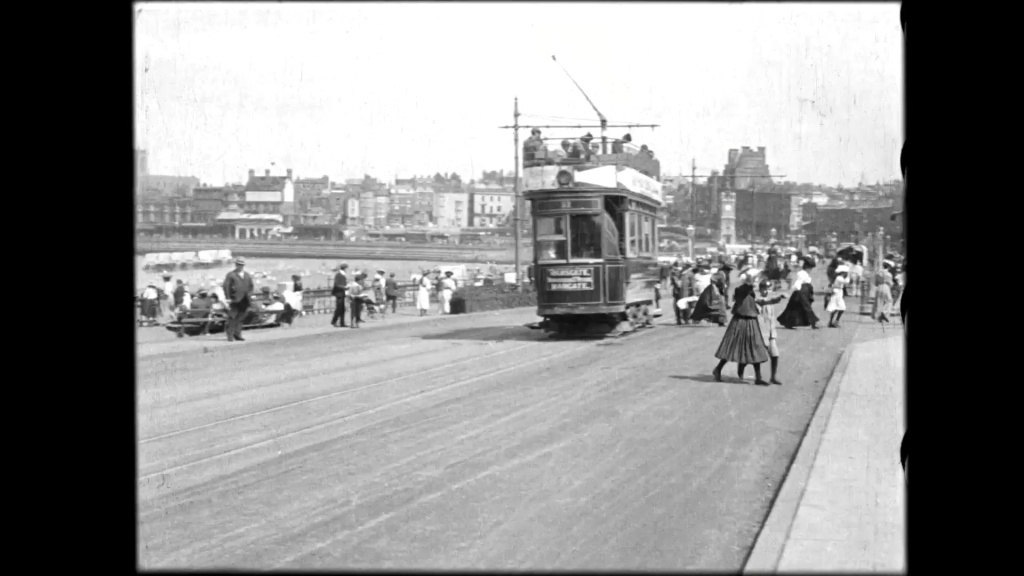
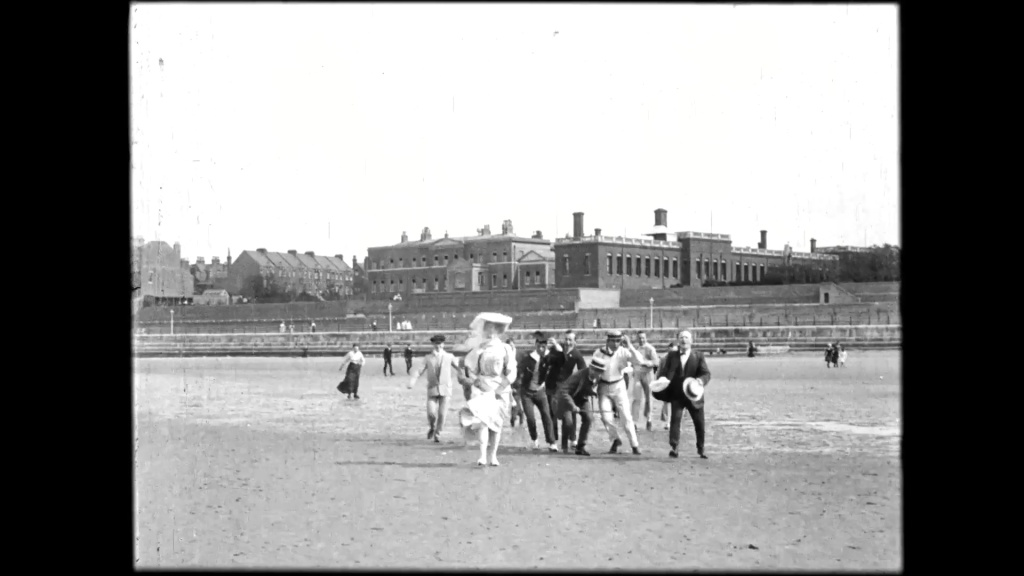
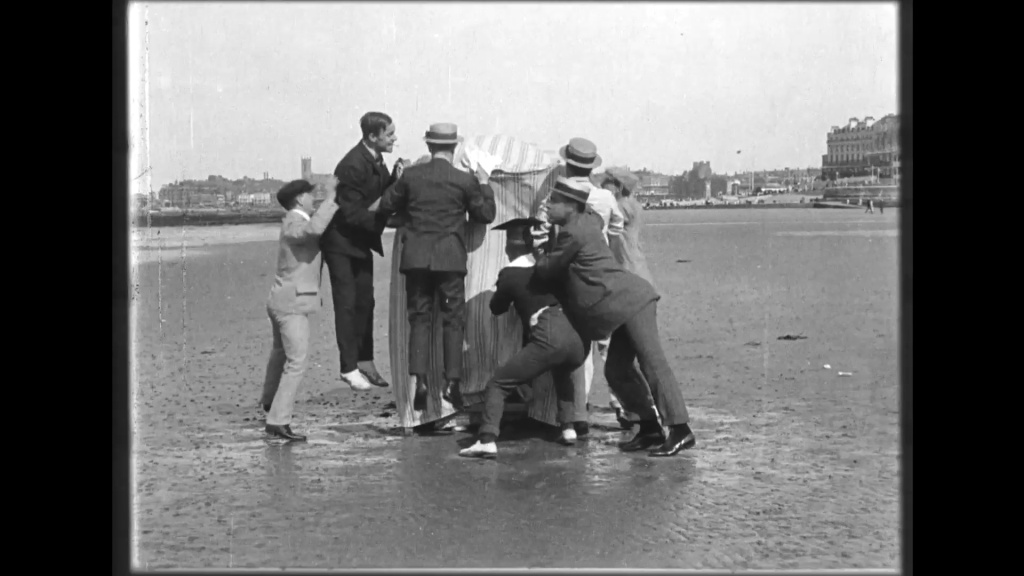
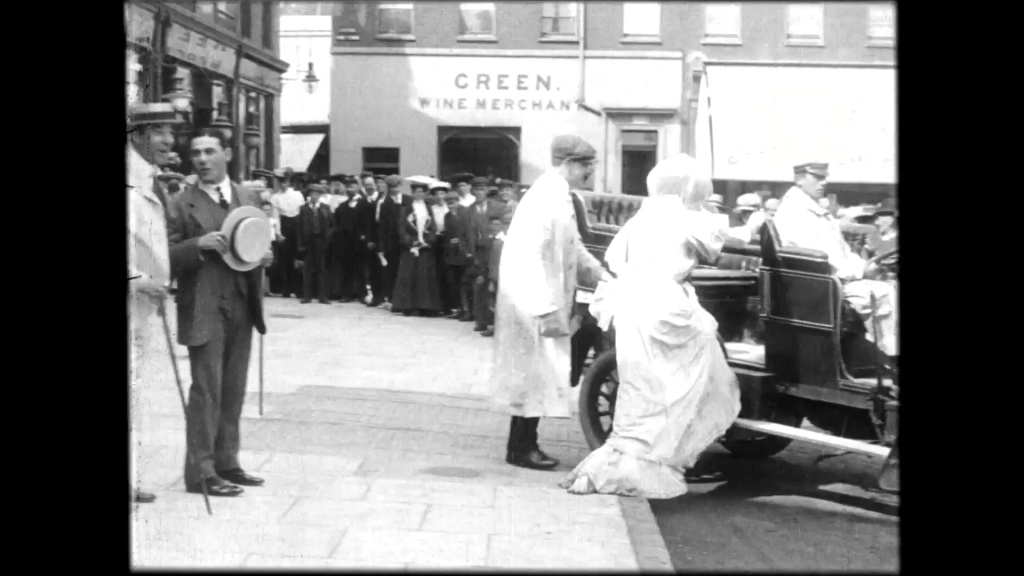
Her Morning Dip (1906; UK; Alf Collins). A well-dressed woman, white dress, hat, and veil, attracts two eager men. (A crowd gathers in the background to watch the film being made. They do not interfere with the action, even as it turns into a car chase.) We end up on the coast, at the seafront. Real life goes on all around us, and our eyes are drawn at least as much to the surroundings as to the two cars that now pull up in the foreground. (Coachloads of day-trippers. A girl and boy walking together, the boy eagerly pointing ahead.) Several more men are now following the woman, a comically leering mob desperate to catch a glimpse of her ankles. She goes into a bathing tent and the mob clamber all over it. The tent flaps eventually part, and from it walks an old bald man in bathing costume. Followed now by a huge crowd of smiling onlookers, he camply tests the waters and hops like a kangaroo into the waves, pursued by laughing children.

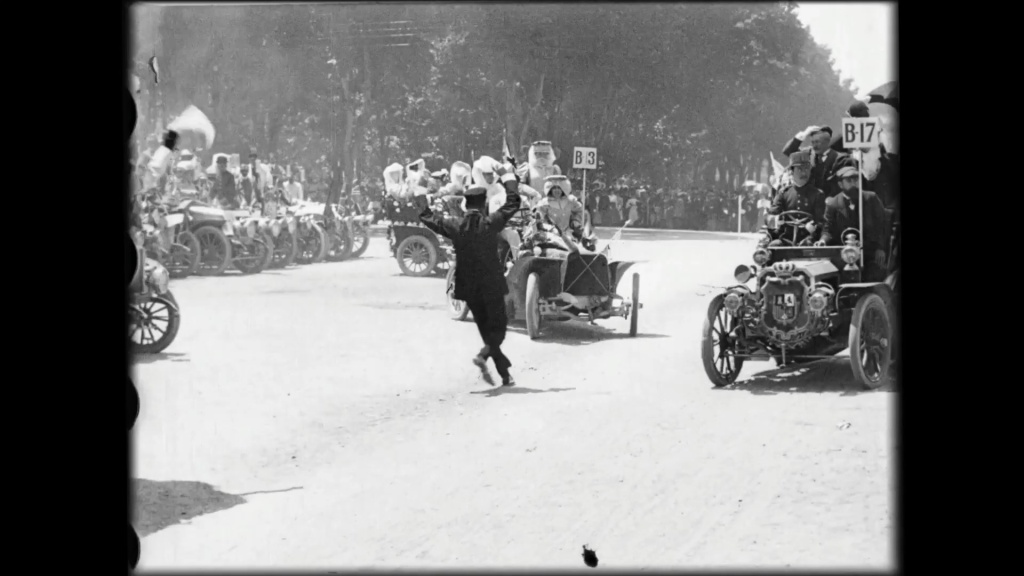
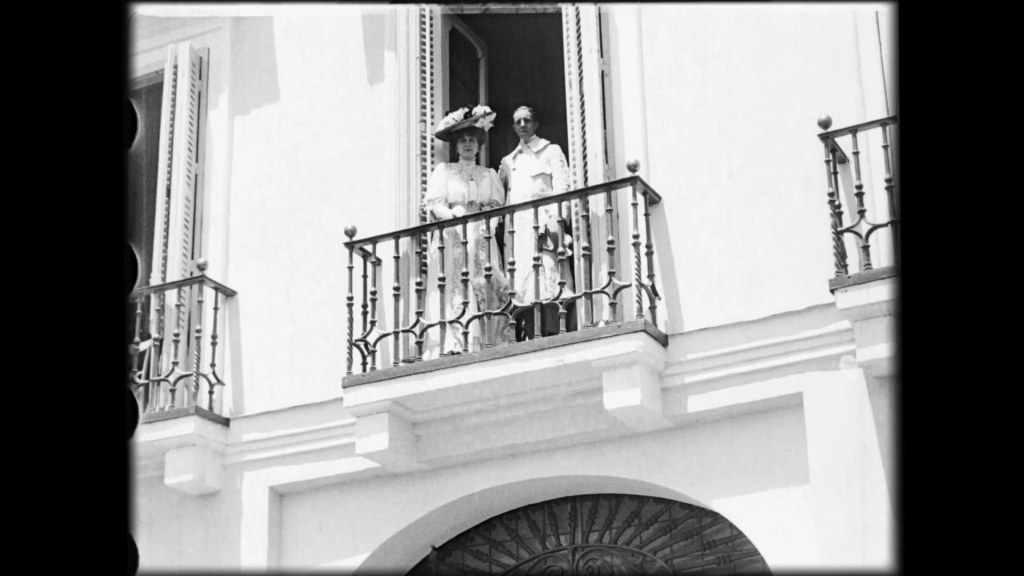
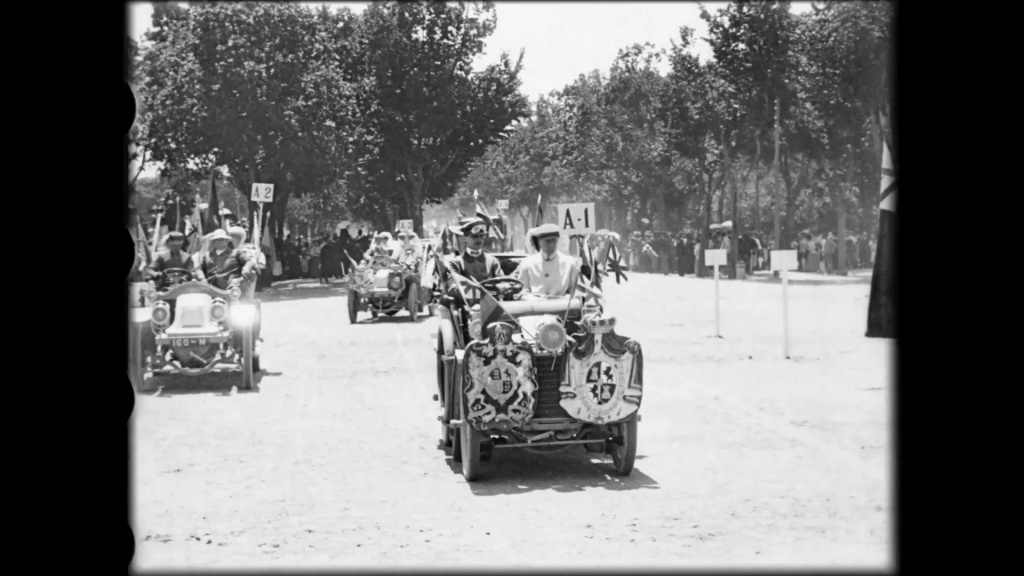
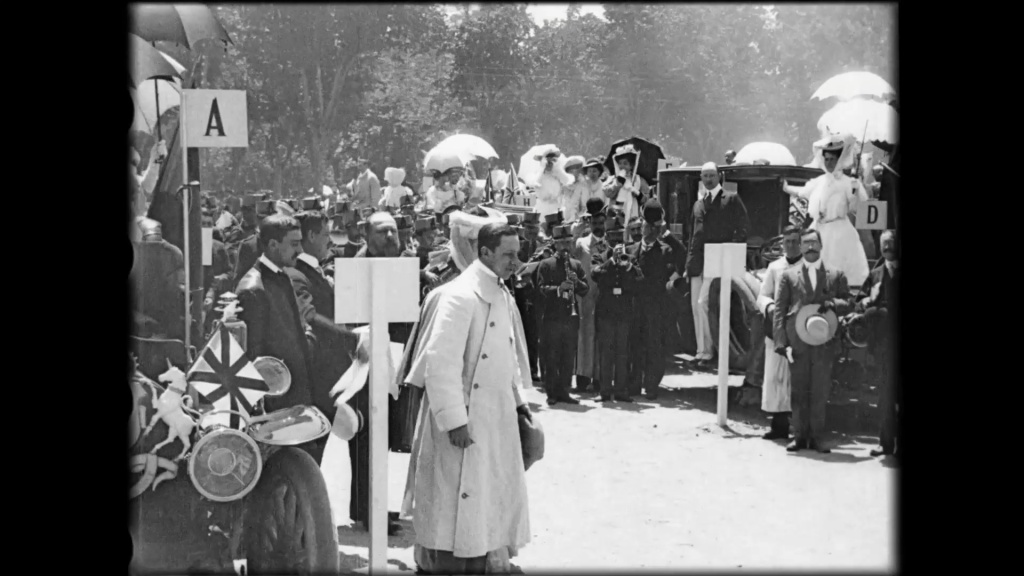
The Royal Spanish Wedding (series): Automobile Fête before King Alfonso and Princess Ena (1906; UK; Félix Mesguich). A southern sun. A motorcade of people in hats, the vehicles decked out in flags and umbrellas. The other vehicles covered in flowers. One car is halted and reprimanded. Another breaks down. Men and women stand to gesture—to us? to an unseen crowd? Great clouds of exhaust fumes rise into the hot sky. A brass band plays as the fleet of cars stands and watches others pass by. Women in huge hats and veils hold umbrellas up to offset the heat. A driver is handed a glass of water. From a balcony, the royal couple stand and watch.
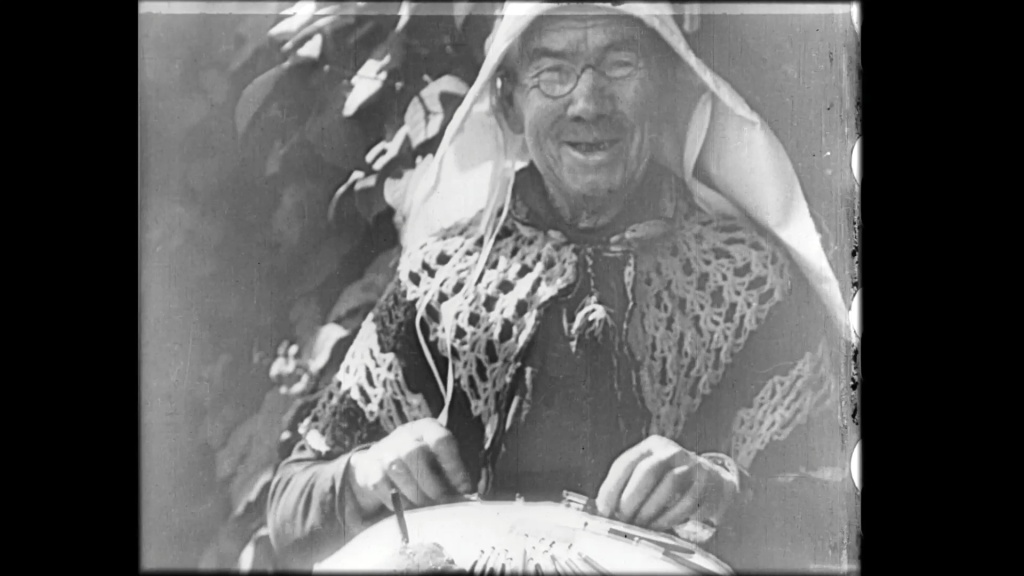
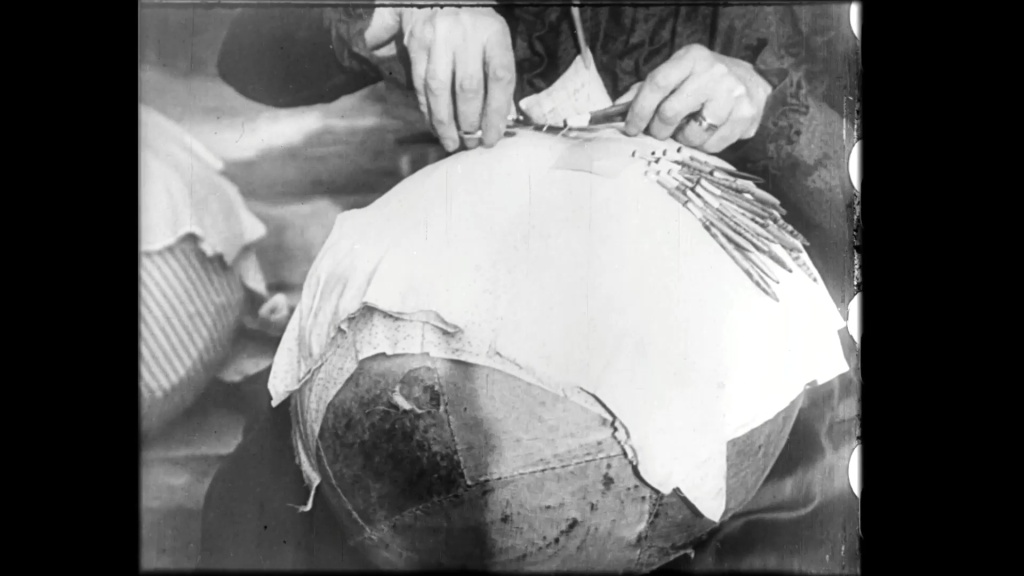
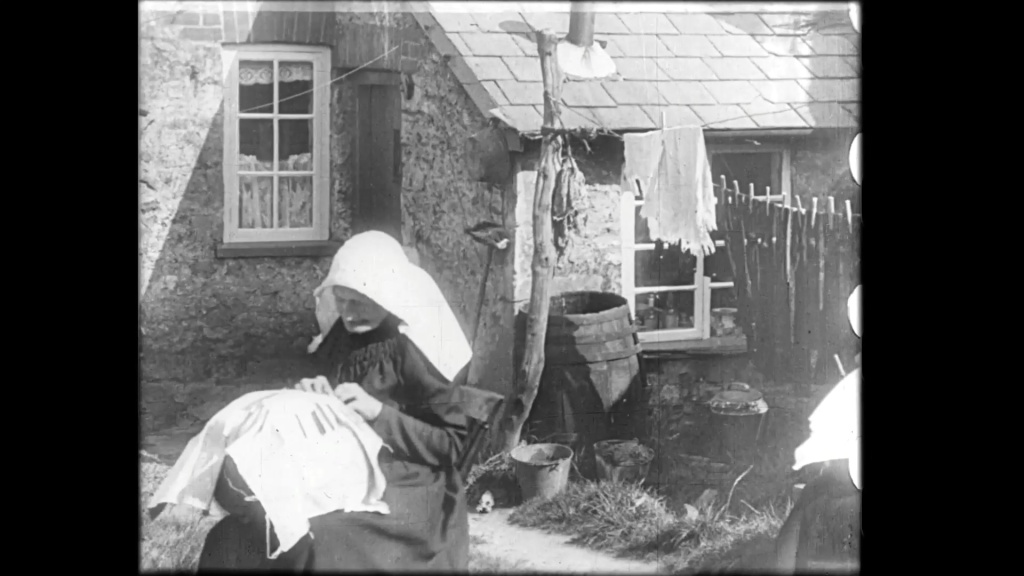
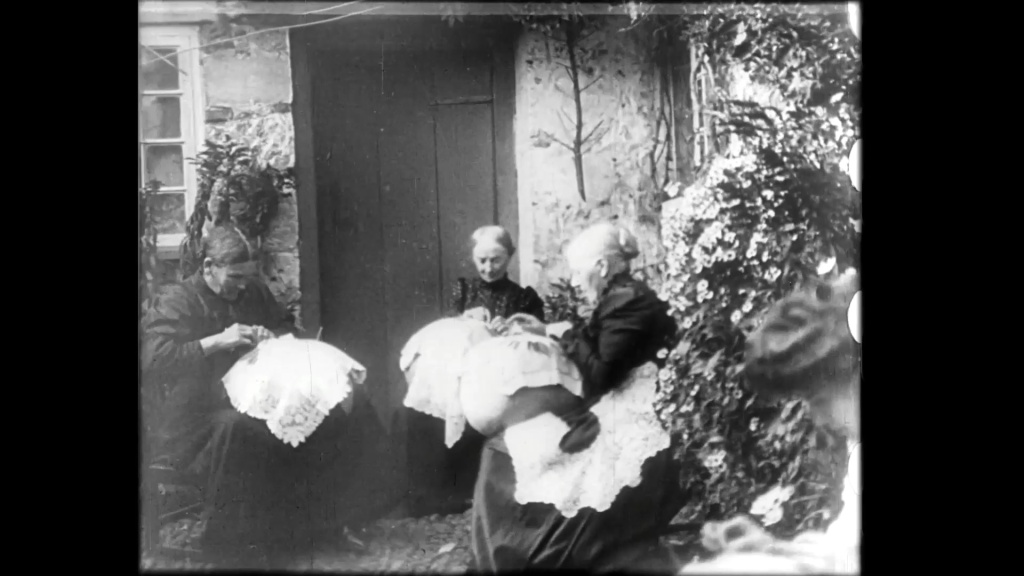
Lace Making (1908; UK; Cecil Hepworth). Outside a small house, women are at work. Their hands move with impossible speed over the lace. (A cat walks up to a woman, its tale raised in greeting, and rubs by a skirt.) The oldest woman makes uncertain eye contact with the camera, then immediately looks down. We see other women’s faces. A woman with lopsided glasses holds our attention. She’s talking to us, smiling and jokes. The camera holds on her for a long time. It’s immensely moving, this immediacy of the past, and these lips speaking to us in silence. It is the suspended life of the past. Another shot of the leather ball over which the lace is made. In this close-up, the cameraman’s shadow falls into frame. Just as we watch the woman’s hand make the lace, we see the cameraman’s hand crank the camera. It’s a spellbinding detail. Just as we admire the amazing lacework in close-up at the end, so we admire the work of the camera. In a final shot, the group of older women walk towards us. Just as the woman with glasses is about to reach us, the film ends.
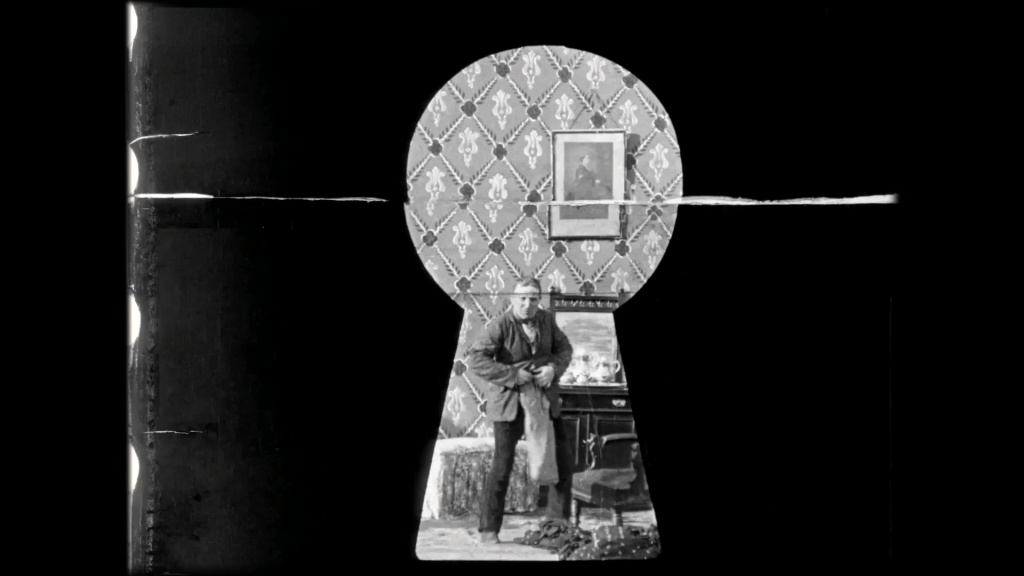
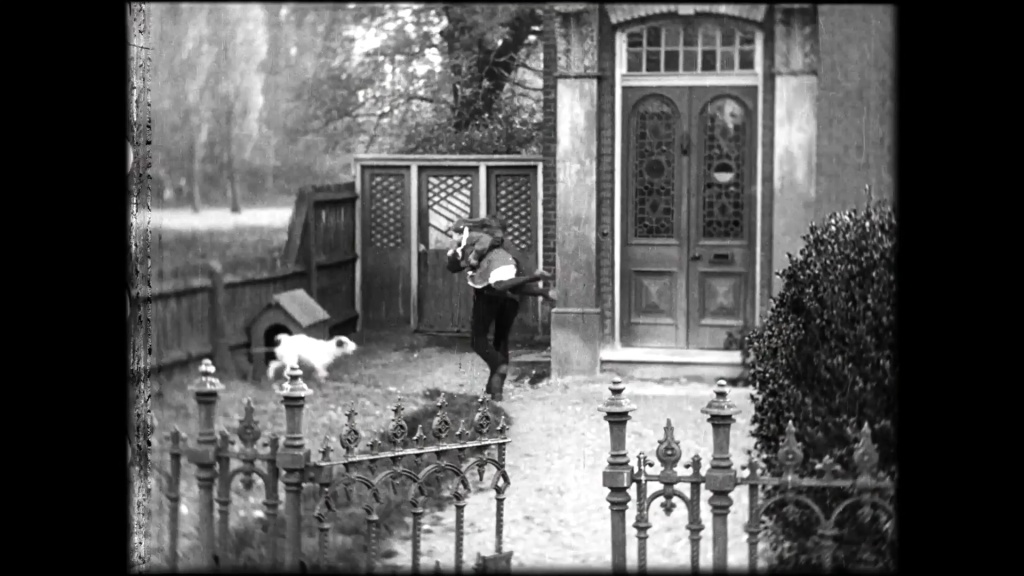
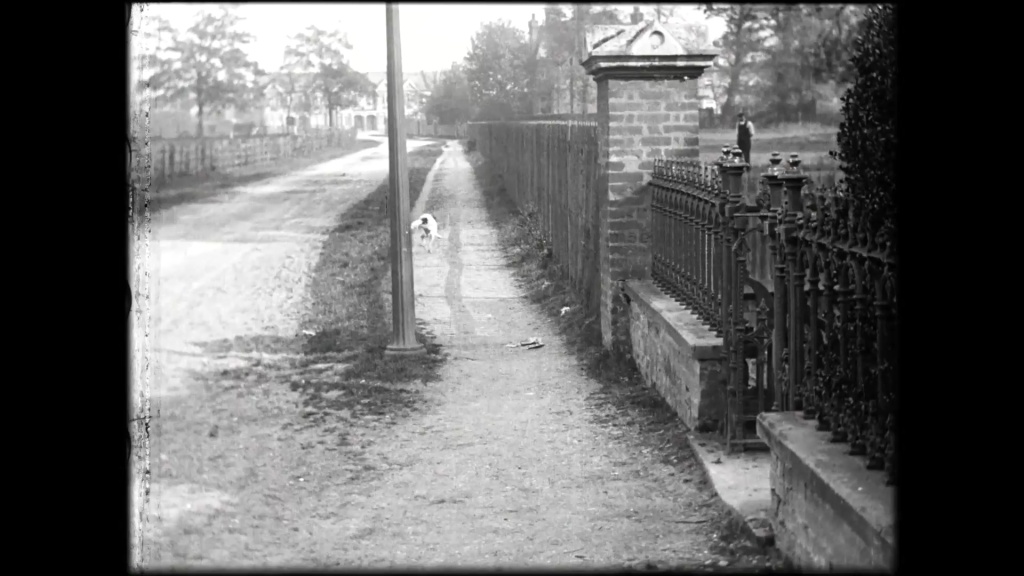
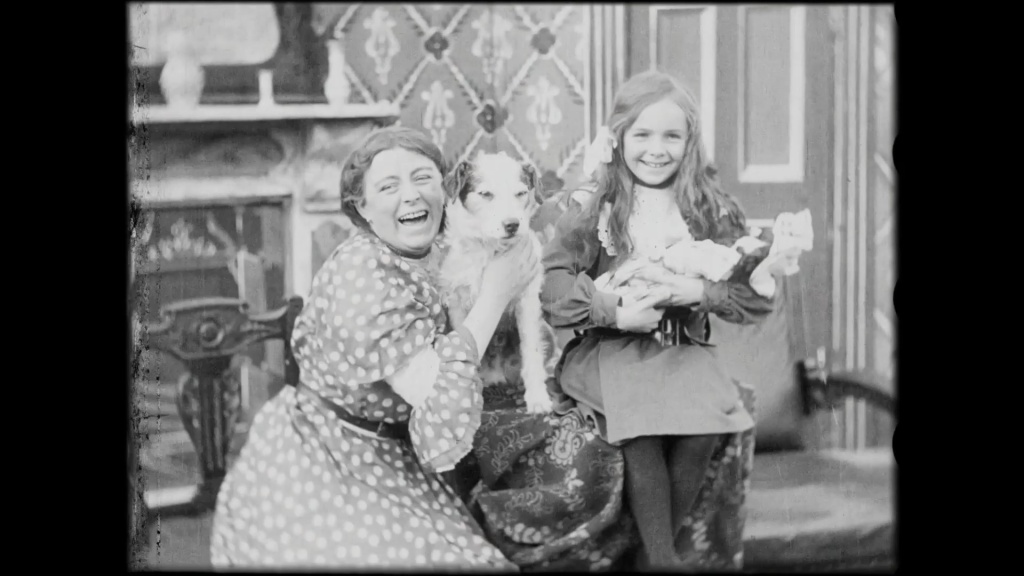
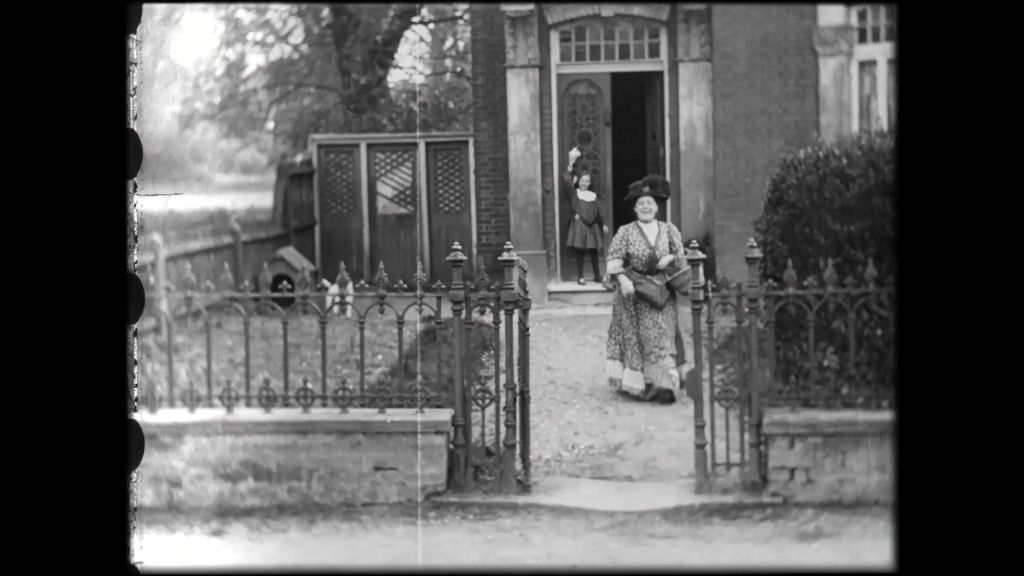
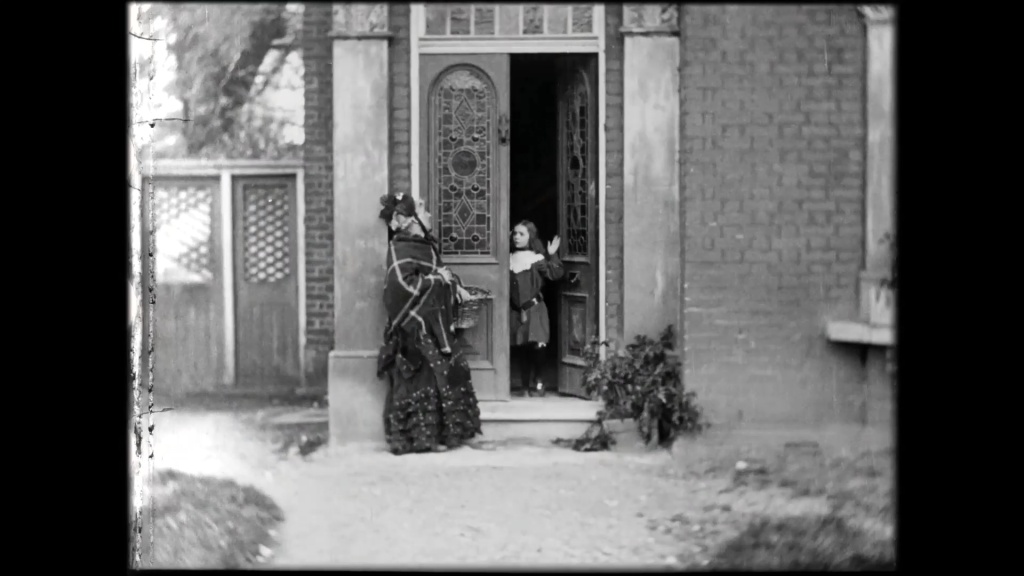
The Robber’s Ruse, or Foiled by Fido (1909; UK; A.E. Coleby). Mother and daughter, a well-appointed room. The mother leaves, under the eyes of a suspicious older woman outside. (At one side of the frame, a dog observes the scene.) The child, home alone, answers the door to the apparently fainting old woman. She helpfully offers her a glass of spirits, but then the intruder disrobes to reveal himself as a man. Through a keyhole, the child observes him begin his nefarious work. The child escapes into the garden but is caught and brought back and tied up. The dog barks, breaks free, runs—summons a policeman. (Front the little gardens of the terraced houses, women stand by and watch the filming take place.) The burglar is foiled, the dog joining in with the policemen in wrestling the man to the ground. Mother, daughter, and dog are eventually reunited before the camera. The child grins delightfully right at us, as happy to have her mother and doll and dog today as she was in 1909.
Day 5: Summary

What an absolutely delightful programme. I wrote on Day 2 of the delight in seeing the background world of Wilhelmine Germany in Harry Piel’s films, and here we have a much wider and more deliberate looks into the world as it was at the dawn of the twentieth century. The “actualities” are especially wonderful. Dalmeny to Dunfermline is an utterly captivating film. I love early cinematic documents like this, where the camera glides through the past. (And yes, it helps that I love travelling on public transport and sitting gazing out of the window. It’s an exquisite pleasure over any distance of travel.) The deserted streets are haunting and beautiful, the glimpses of faces who look in surprise or suspicion at us, the sense of never quite knowing what’s coming next. Even the glitches in continuity, the nibbling of decay at the frame—all these things convey the past and the passage of time, and our place in history too. Then there are the utterly unexpected moments of surprise for us. In Sanger Circus Passing though Inverness, there is a moment when one of the elephants trotting unattended along the street turns to its left toward the little crowd watching it go by. The animal reaches out with its trunk towards one of the children. I found this little gesture, lost long ago and recaptured here, absolutely heartbreaking. It’s a gesture of curiosity, of fellow feeling, of one creature reaching out to another. It’s beautiful and sad, and it invites other questions from our own vantage point in time. What was the fate of the elephant? Where was it born? Where did it die? Were elephants buried? And what became of the child? He must have come of age during the Great War—did he survive? Did he remember the elephant that reached out to him that day in 1899?

The “fiction” films are just as capable of delight, but a kind of delight rooted in the haphazard, on-the-fly method of filming. In all the films—fiction or not—there are bystanders who look with bemused curiosity at the actors performing or the film crew filming. Real life c.1900 is everywhere in a way that intrudes delightfully on any pretence of fiction. The performers themselves are part of the life and time we see on screen; it’s just that they’ve stepped out of the crowd for a moment to do a turn. Then the cameras will stop, and they’ll step back into the crowd, into the life that the bystanders are living, into the time and culture that they share with everyone on screen. I’m sure I could go on about these films—and many other such early productions—forever, for they captivate and intrigue in a way that many later fiction films cannot. So, what a privilege to watch them, with a lovely and sensitive piano accompaniment by John Sweeney. Another great day at Pordenone—from afar.

Paul Cuff

Pordenone from afar (2023, Day 4)

Day 4 takes us back to Germany and the company of Harry Piel. This time, we’re following the adventures of the director-as-star himself on screen. He starred as “Harry Peel” in several films, the first of which was Der große Unbekannte (1919). He returned to the character in Das schwarze Kuvert (1922), the first of a trilogy of films with recurring characters and overlapping narrative. As Hemma Marlene Prainsack and Andreas Thein explain in the festival catalogue:

In the 1922-23 season, Piel reappeared as Peel in […] Rivalen (working title Der gläserne Käfig) and Der letzte Kampf (also known as Der Elektromensch), all based on scripts by Alfred Zeisler and Victor Abel. Here’s where things get complicated. While making Das schwarze Kuvert, his company declared bankruptcy, and no ads, articles, or documents position the film as the initial offering in a series. We know from the German programme booklet that the character names in Das schwarze Kuvert differ from those in Rivalen, but in the sole surviving print of Rivalen, from its Russian release, not only are the character names identical, including for minor roles, but there are two direct references to Das schwarze Kuvert: the dogs Greif and Caesar reappear in Harry’s boudoir, and when his beloved gazes into her mirror, she sees Harry exactly as he appears in the earlier film. In addition, the Russian version of Das schwarze Kuvert starts with a title card clearly stating it’s ‘Part 1’, and ends with ‘to be continued’. (116-18)

In Das schwarze Kuvert, “Peel loses his money in a London banking crisis and moves to the Alps; there he falls for a rich industrialist’s daughter who’s subsequently kidnapped by order of a nefarious physicist” (ibid.). Though he rescues her before the end of the film, at the start of the second film—today’s feature—we find our character with plenty of unresolved crises. I provide all the above info because the oddness of the film that follows can only by explained by some reference to what came before (and what was meant to follow). The London setting of the first film also helps explain the anglophone names of all the characters—though doesn’t clarify exactly where the sequel is set…

Rivalen (1923; Ger.; Harry Piel).

The film credits itself being presented into “seven adventurous acts”. I’m sold. Bring them on… But before they even begin, we are given a star portrait of the director Harry Piel as his screen avatar “Harry Peel”. Piel looks languidly toward the camera, though his pose suggests he is halfway between actions. It’s a pose that will soon end. This man will soon get to business…

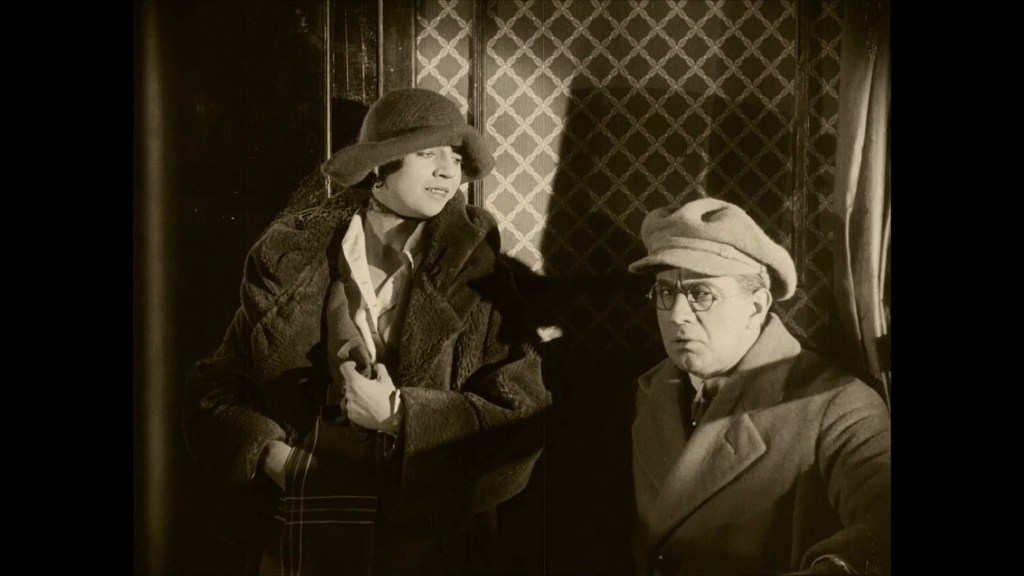
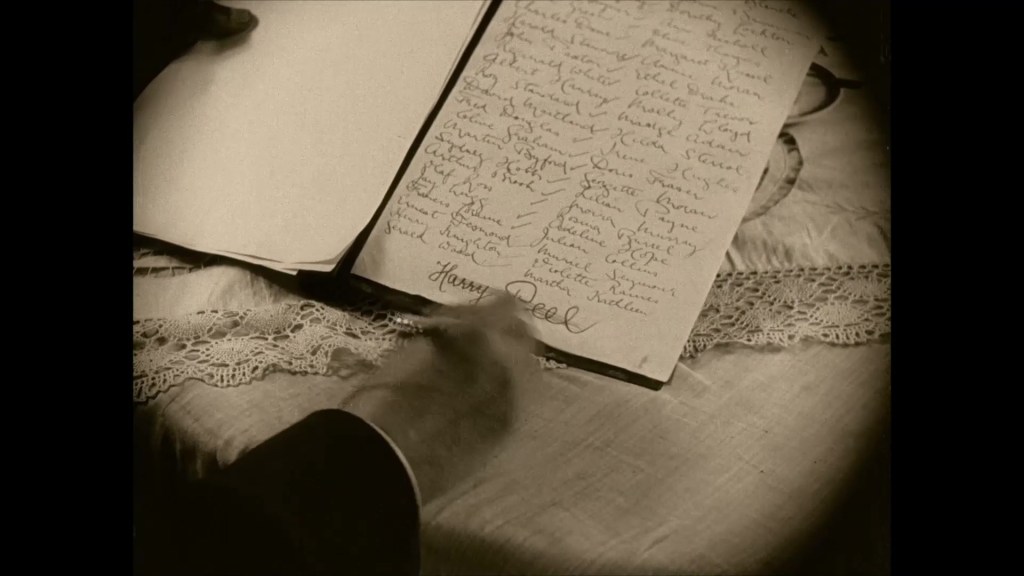
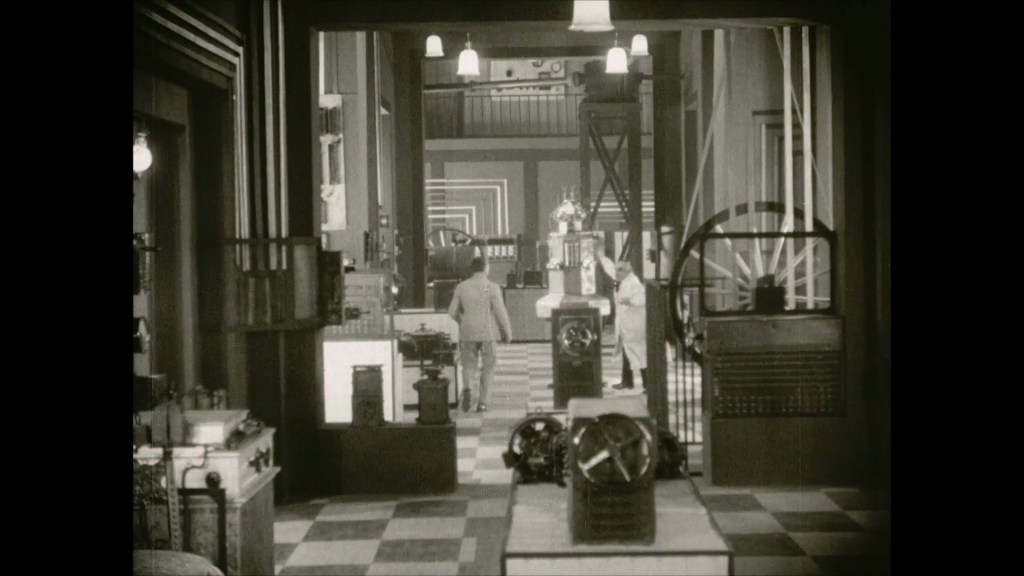
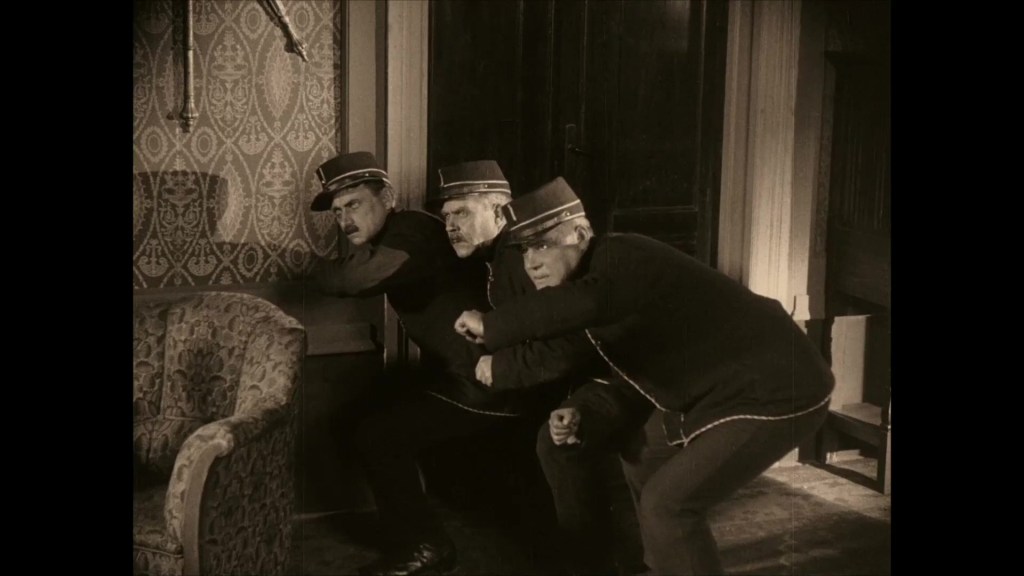
Act 1. The Evans electrical plant. Evans’s rivalry with the evil Ravello, both over their electrical inventions and over Evans’ daughter Evelyn, whom Ravello wishes to marry. Here is Ravello, in a sinister cap, smoking moodily. And here is Julietta, a former dancer and Ravello’s agent/companion. Contrast Julietta’s swarthy good looks with Evelyn’s fluffy, curly blondeness. She looks absurdly pampered. (And already, you have the sense that the film is here to have fun and entertain rather than create real characterization or suspense.) A fancy-dress party at Evans’s. Evans doesn’t want Harry Peel at the ball. Evelyn does. She writes his name on the guest list. He crosses it out. Meet Chilton, one of Ravello’s stooges. And in Ravello’s lair, a posse of uniformed footmen. Chilton’s lab, like a mainstream version of Jaque-Catelain’s lab in L’Inhumaine (1924). Only here the centrepiece is a delightfully silly robot with cute, illuminated eyes and a kind of metallic skirt. “He walks!” they cry, as the seven-foot robot lurches slowly forward. Chilton spots an ad for the masked ball, it’s theme: “A Party in Hell”.

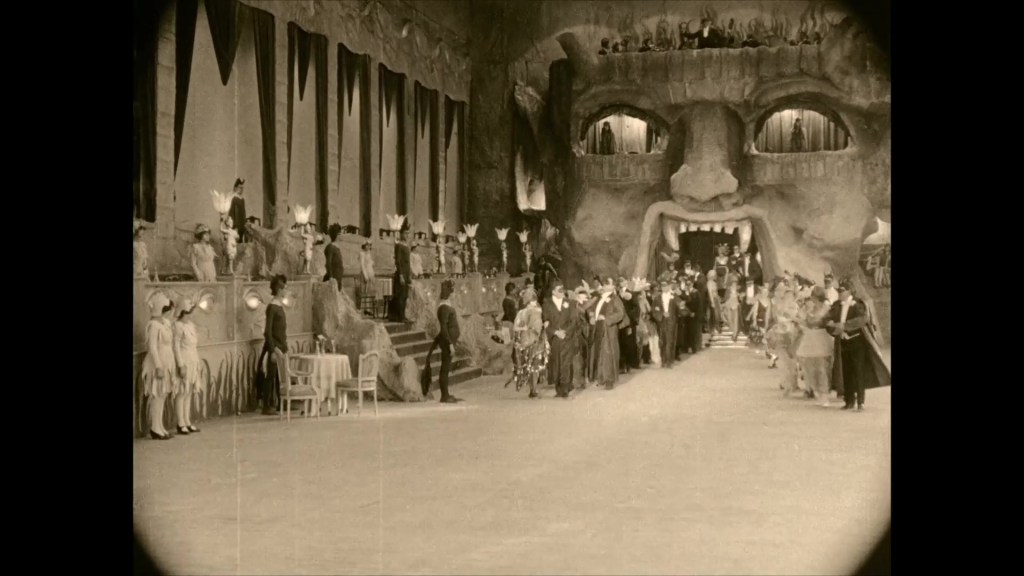
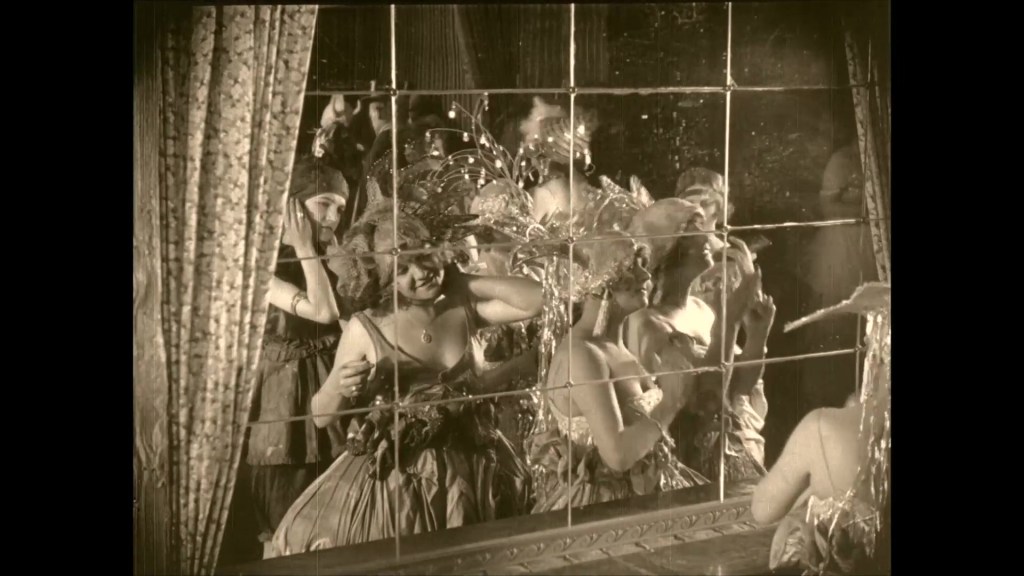
Act 2. The party. Elsewhere in town, at the Trocadero, Julietta awaits Ravello—but he has spurned her for a “conference”. In fact, his masked gang are on the move to the Evans’s ball. They rob guests Hoppel and Poppel (both suitors of Evelyn) of their invitations, so Ravello gain access. (And as Ravello arrives, Julietta is spying on him.) The ball. A marvellous set. A kind of comic version of the sacrificial temple scene in Cabiria (1914), complete with guests in masks and horns. Cue comic japes with Hoppel and Poppel, dashings back and forth—into the “blue room” (tinted thus), where Ravello threatens Evelyn, only for Harry to rescue her via a series of hazardous leaps and bounds, followed by a lasso. Ravello foiled and ejected, Julietta once more observes the goings on…

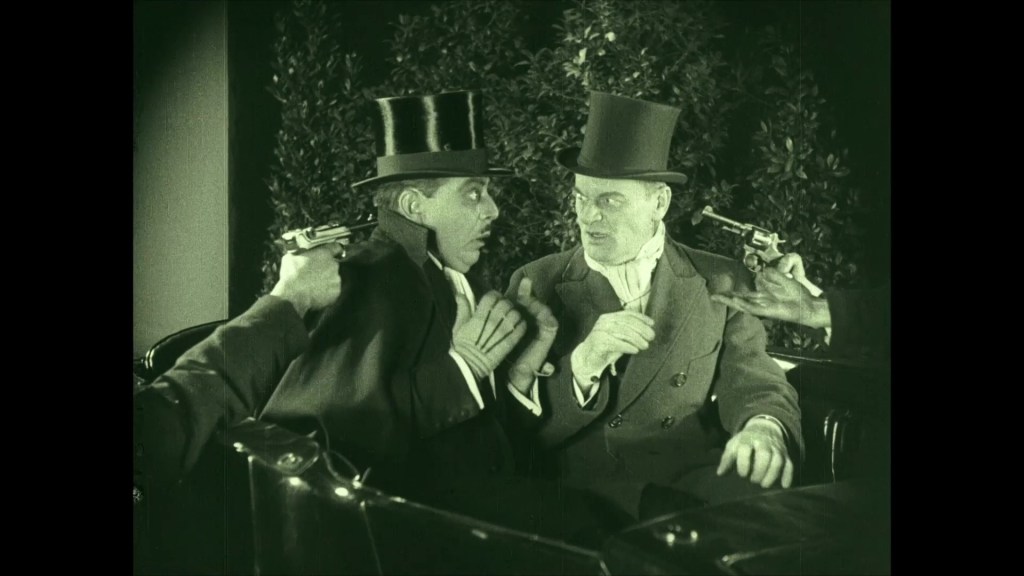
Act 3. While the party carries on with devilish dancing, Julietta appears and demands an audience with Evelyn. (But she demands this from Hoppel and Poppel, who by now are delightfully drunk.) Chez Ravello, Chilton is scheming. And soon the party is surrounded by sinister goings-on: Ravello’s gang are dragging something, sawing something, loading something. The silhouette precedes the surprise delivery: it’s the robot! The guests flee, but then Evans steps forward. He clutches at the robot’s arms—and is electrocuted! Harry steps forward, only to see Evelyn being approached by Ravello’s agents. (Should this all sound delightful, it is—but a part of me is already longing for the danger to be less silly, the villains more villainous, the hero less one-dimensional…)

Act 4. Julietta wishes to aid Evelyn. But meanwhile, the robot grows supercharged, and the entire dancehall is a nest of lightning bolts as the robot wanders free. Partygoers flee, as a fire begins to burn. Harry sets off in pursuit of Evelyn in the car. Cue high-speed car chase, Hoppel and Poppel bungling alongside. A retractable bridge—and Harry’s car plunges into a lake! But he escapes and makes his way to Ravello’s house. Here, he sees Ravello takes charge of the wrapped-up body of… Julietta! Ravello says she will never again leave the house without his permission. Harry is captured changing into some dry clothes. He escapes and finds Julietta, with whom he makes a break for it. Cue: secret doors, amazing leaps, fistfights, chair fights, trapdoors… (Yes, all easily executed; no, the danger is swiftly thwarted.)

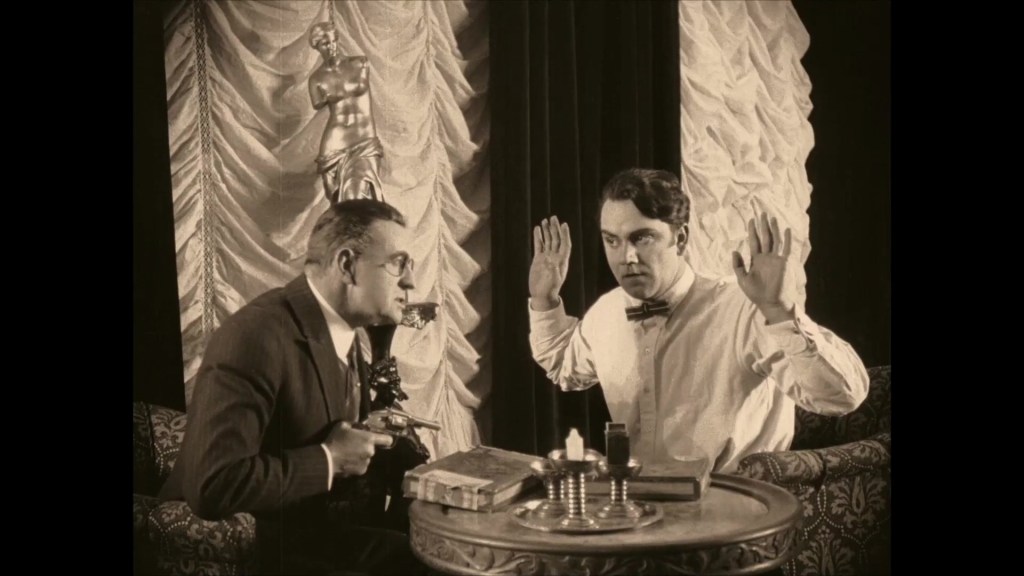
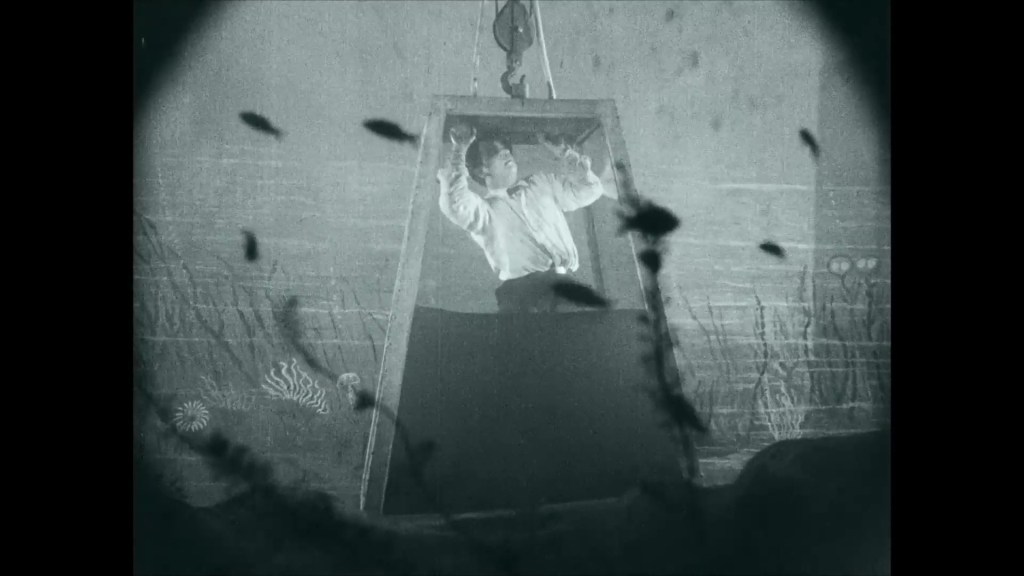
Act 5. Juletta is captured and Harry is taken aboard Ravello’s secret weapon: a submarine! Eveyln, meanwhile, is safe at home. But Harry awakes to find himself in the submarine. “You weren’t expecting this surprise, were you?” says Ravello. No, and nor was I. (Lovely shots of the moonlit lake make me long for a world where any of the action really mattered, or one where the outside world was allowed a greater role on screen.) Julietta is guarded by Artos, but Artos is in league with Julietta—and as soon as Ravello leaves, takes her outside (apparently for a romantic supper). Now Harry plots his escape—glimpsing occasionally into the camera as he cuts the ropes around his wrists and ankles. He smashes a window, and the water starts to pour in. He fights and bests a dozen submariners (of couse), then runs to freedom. Meanwhile Hoppel (or is it Poppel?) takes Evelyn for a drive. Mid-escape, Harry is surprised by a group of boulders that come alive and capture him again! (This is the apex of the film’s silliness, the gang of boulders looking like Monty Python’s vicious hang of Keep Left signs.) Harry is lowered in a glass cage into the lake (and below the surface, we get a cute—but unconvincing—glimpse of a studio seabed with glass tank placed before the camera to provide live fish and bubbles). Julietta and Artos observe the strange goings on…

Act 6. Hoppel (or is it Poppel?) and Evelyn arrive at the lakeside and see Harry’s smashed car in the water. They encounter Artos and Julietta, but are observed by Ravello, who takes Julietta into the submarine. From the porthole she sees Harry in his submerged cage. “As soon as you agree to marry me, Harry Peel will be set free.” Dastardly! The comic sailors guarding the breathing apparatus of Harry’s cage go off to meet some other comic sailors, leaving Harry to suffocate. They arrive back just in time to dredge him up.

Act 7. Retrieved from the lake, Harry dunks his erstwhile captures and swiftly scales a cliff. He steals a horse from the bad guy’s hideout and sets off. He vaults through Evans’s window and finds Evans and an explanatory note from Evelyn about the forced marriage to Evans. Another high-speed car ride—but is it too late? (Hoppel and Poppel, meanwhile, wander about with bouquets, each hoping to find and marry Evelyn. Their plotline grows evermore irrelevant.) Harry rescues Evelyn, but Ravello escapes. The bribed priest tells them that the marriage is legally binding. How to get Ravello to give up his bride? Evans wants to find a way, Eveyln wants to find a way, Harry wants to find a way. But… “Ende”! Noooo!! “The story continues in the next Harry Peel film: Der letzte Kampf”. Damnation! An end that isn’t an end…

Day 4: Summary

Well, what can I say? Rivalen was a colossally silly film. A kind of supercharged serial, only with far more jokes and much less real suspense. I did enjoy it, but on an entirely superficial level. Gabriel Thibaudeau provided enthused accompaniment on the piano, but what kind of tone does the film expect from its score? It is adventure, it is comedy, it is episodic… it is oddly meandering. The problem I had is that I simply lost any sense of dramatic tension, no matter how far the film ramped-up the thrills. It all felt a bit… safe. I love a good serial, but I’d prefer one in which the villains were more threatening (more capable of real and actual damage to life and limb)—and the heroes had more of a personality, even if this were mere obsessiveness. Harry Piel is certainly a committed screen presence, but I’d be hard pressed to say anything about his character. He runs about, he leaps, he dives, he can fight. But there’s nothing more to him than the dash needed to overcome various obstacles. Even his supposed love interest in Evelyn is unconvincing on both sides. The film isn’t quite funny enough to be a comedy with action, nor is the action sophisticated or threatening enough to be an action with comedy.

Audiences at the live Pordenone will get much more Piel than us online folk: live, there are multiple Piel films from across his career. Online, there are the three I’ve covered so far. Rivalen is closer to Das Abenteuer eines Journalisten than to Das Rollende Hotel, but I still much preferred the 1914 film to either of the later ones. It had more of a sense of the real world, and more of a sense of danger and threat. But wouldn’t I want to see the sequel to Rivalen? Well… I suppose so. But only if Der letzte Kampf developed the characters or strengthened the drama presented in Rivalen.

All that said, I repeat what I said yesterday: that seeing a film like Rivalen is one of the great strengths of a festival. Piel shows us a different side to popular German cinema, a more boisterous, outdoorsy, silly, playful cinema than perhaps we are used to. In this sense, I am indeed very glad to have seen Rivalen and the earlier Piel films. I have a sense of him both as star and director, and I would genuinely be curious to see what else he did. If nothing else, Piel proves what novelties lie outside our experience of film history. We should hope to find more like him.

Paul Cuff

Pordenone from afar (2023, Day 3)

Day 3 takes us to Italy in 1917, from whence come two fragments and a feature film—all preserved in unique prints from the Eye Filmmuseum, Amsterdam…

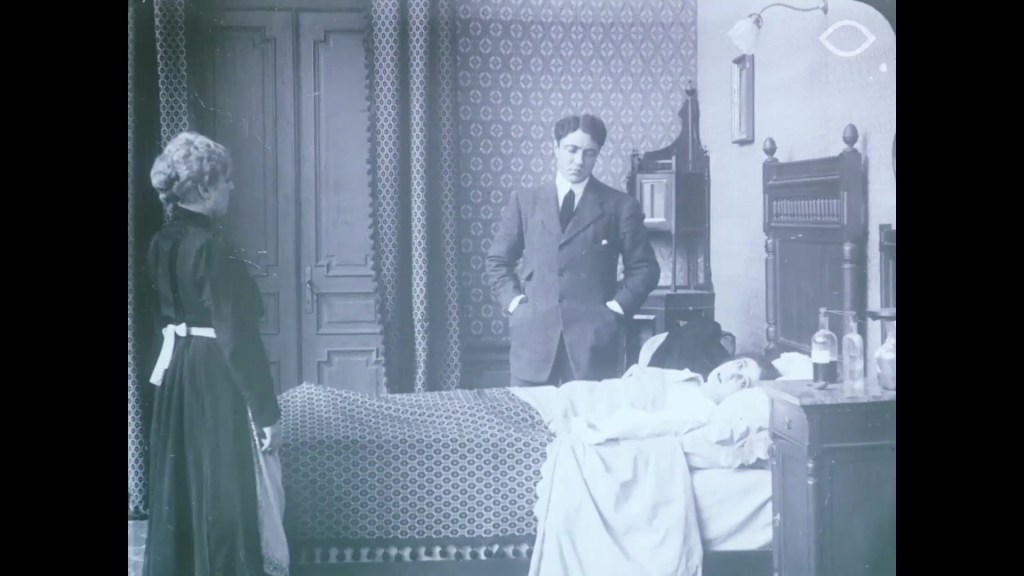
La Vita e la Morte (1917; It.; Mario Caserini). It is life and death, or the first act of it. We begin with the drama underway. Choices have already been made, fates motivated. An untrustworthy figure bends beside an inert woman. There are references to Gautier’s letters, which Leda carried with her. Here are a mourning husband and child, mourning prematurely. The screen’s bluish wash is a kind of mourning, so too the faded richness of the blacks. The screen has been washed with passing time. Paul lifts Leda’s inert body. Fragments of Leda’s boat, washed ashore. A gleaming coastline, dipped in pale blue. “Poor Leda.” But at the house in Lausanne, Leda pants in bed. (Her eyes roll towards the camera. We see you, Leda.) Paul stands sinisterly over her, warning a servant not to let Leda escape. (The framerate is palpably slower-than-life, as though the fragment were dragging its feet, anxious to extend what remains of its runtime.) Paul is pleased to overhear sailors saying that Leda is dead. The gates are toned green, washed ochre. A glimpse of park or gardens behind bars. Paul’s servant is drunk, sitting guard over a disconsolate Leda. The husband reads a letter fragment from Gautier to Leda. Perhaps her death was best for them all? The child delivers flowers to mama’s grave: the water’s edge. Child and nurse turn to walk away. The film ends. An intriguing, evocative fragment—preserved in this Dutch print and nowhere else. You can find the whole plot on Pordenone’s online catalogue, but the magic is here: the fragment invites us to imagine the lost parts of the film, or simply to contemplate its loss, and ours.

[Italia Vitaliani visita il regista Giuseppe Sterni per discutere del suo ruolo in “la Madre”] (1917; It.; Giuseppe Sterni?). A studio. The director, lost in concentration. Curtains are opened. Nitrate decomposition enters, followed by Italia Vitaliani. She takes off her coat. The director brings her over towards the camera, shows her the screenplay. (A close-up of the title page.) He opens the script, begins to read. Vitaliani settles to listen. The film ends. It’s a truncated trailer for the feature we are about to watch, a glimpse behind the scenes. Yet it is also a staged performance, an invitation to see the relationship between author and actor—and the chance for the author to be an actor.

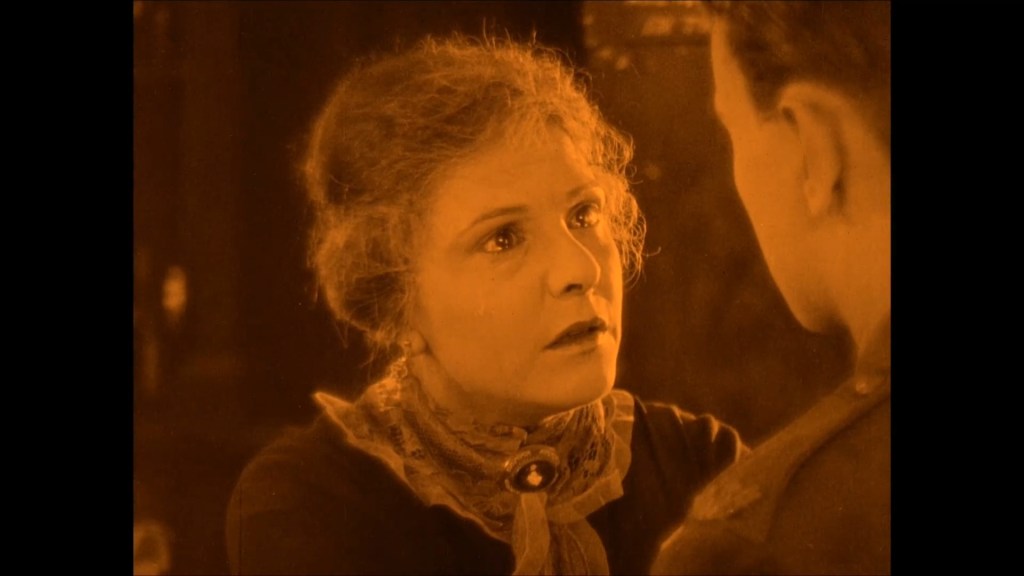
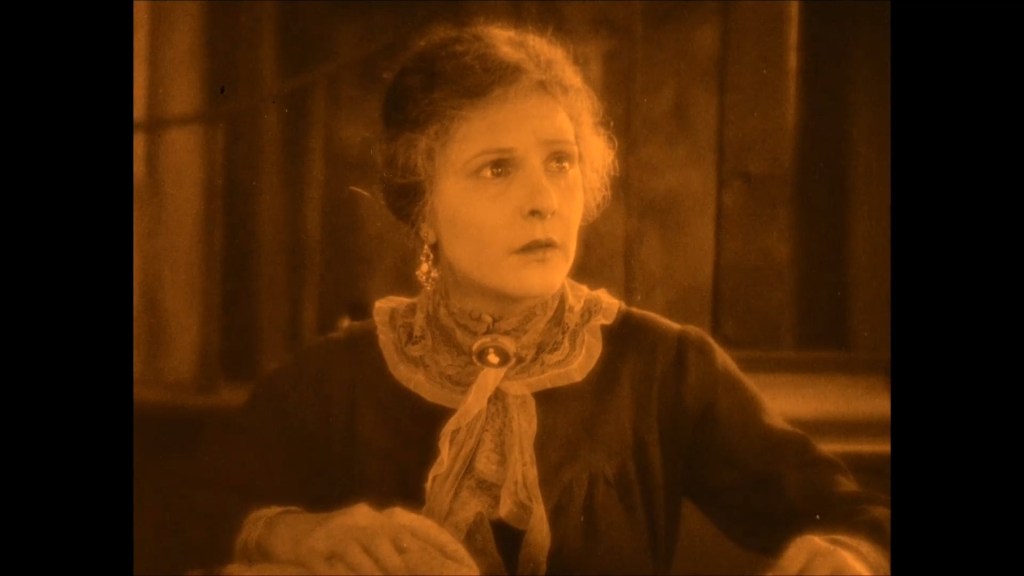
La Madre (1917; It.; Giuseppe Sterni). The two lead characters, in their own tableau: a young painter, Emanuel, and his mother. (And we recognize them both from the previous film: Emanuel is played by the director himself, while the mother is Italia Vitaliani—made to look older with her greyed hair.)

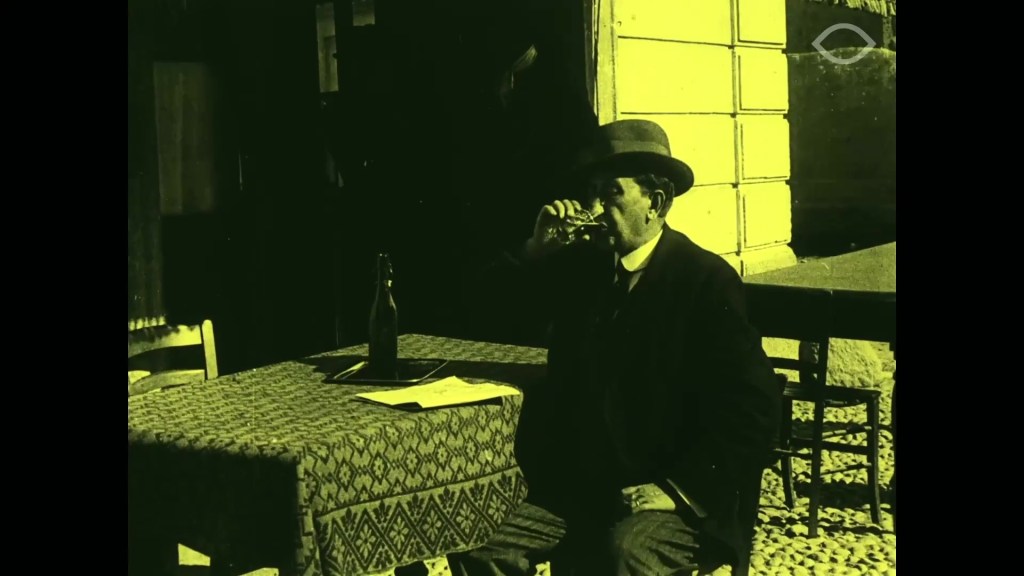
Part One. The dark interior of the Roan’s village bakery. But Mrs Roan’s son prefers painting to baking. Outside, glimpses of a sun-filled street. The dark shadows of an awning. The texture of an old wall, fragments of ancient posters. The sunlight is harsh, the shade thick: it is all palpably real, palpably parched.

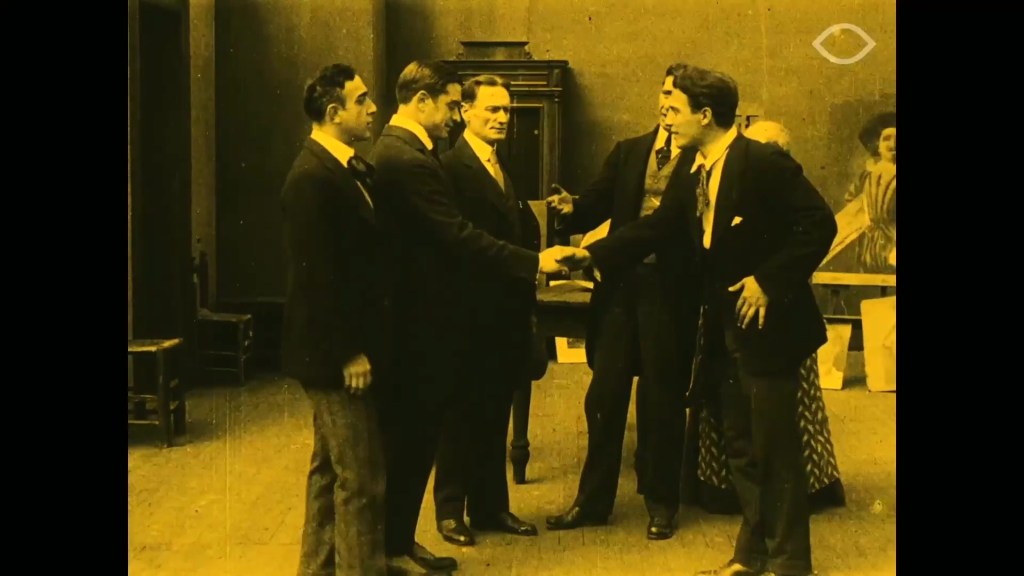
A visit from an artist and connoisseur, to appraise a painting found behind the wall of the local church. The group are invited to Emanuel’s studio. The men’s faces are ambivalent. They say Emanuel lacks the resources to be a painter. But there is an offer to share the artist’s studio. Emanuel’s mother says he should go, that she will stay and earn money. Two days later, he leaves.

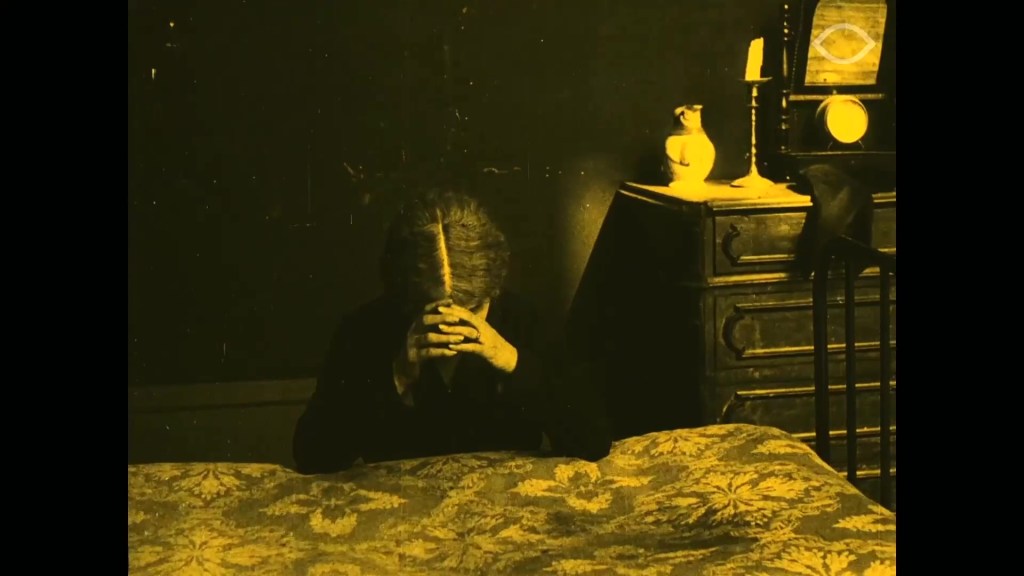
The mother, alone. Her room. Dark walls, small patches of light. She kneels to pray at her bedside. A quiet tableau of devotion, of moderate means, of private emotion. (Shared, of course, with us.)

A few weeks later, she makes the journey to town to see him. The world of rural transport, c.1917: a donkey and cart, a wait at a train station.

Emanuel’s work has been rejected for not sticking to known rules. He cannot pay his model.

Mother arrives. On the steps, a small black dog drowsily raises its head. Mother shuffles upstairs. She enters the studio, presents the two artists with some carefully wrapped bread—and some coins for Emanuel. (Now a letter from Isabella, his model, who returns a ring and says she cannot visit him again on instruction of her mother.) The artist explains that Emanuel is ruining himself over Isabella. Emanuel goes to see Isabella, but his conscience gets the better of him and he cannot offer the money given him by his mother to keep in Isabella’s good books (or the good books of Isabella’s mother). Mother stays with Emanuel, to “protect him” amid the temptations of the town. (Unspoken thoughts, unvoiced rivalries, unmentionable acts.)

Part Two. Emanuel is a success, but Isabella has “stolen” his heart from his mother. She arrives, the mother shuffles away to wipe away a tear in private. It’s another little tableau, this image of the heartbroken mother. But Vitaliani doesn’t overmilk our sympathies: hers is not an outlandish performance, but a disarmingly simple one. And her moments of solitude are just that: moments only.

Emanuel returns after a night out. He is well dressed these days, but he can hardly walk this night. His mother appears. He laughs off her concern. She warns him off Isabella, saying that she will ruin him. Emanuel grows cross. His face looks down in a scowl. Hers—in a patch of light, made gold via the tinting—looks up, and the camera sees her grief, invites us to empathize. Later, Emanuel is asleep in bed. His mother tiptoes in to tuck him in and kiss his brow.

“Make him listen to the advice of his sad and grey little mother!” she begs of Isabella and her mother the next day. Isabella laughs her off, says she’ll go but that Emanuel will beg her to return.

The son, before a mirror. He barely looks at himself: it is for us to see the two of him, his two roles, his two choices. His mother awaits, expecting him to reject her in favour of Isabella. “Do you really love her?” she asks. “Do you love her more than your unhappy mother?” She is his inspiration, he replies, the only one capable of sustaining his success.

That afternoon, as Emanuel contemplates his latest portrait, news comes from Isabella that she and her mother will never see him again until his mother apologizes. Mother tells him Isabella will ruin him. She struggles with her son, even grapples with him physically. The elder artist enters. “You need inspiration? She’s right in front of you!” Yes! He will paint his mother! He blacks out the painting of Isabella and begins feverish work on capturing his mother’s praying form.

Six months later. Back in the village, Mother Roan is beneath a large portrait of her son. She goes through his childhood clothing, an old photo, a shoe… A pain in her belly. She stumbles against the dresser.

Meanwhile, Emanuel’s portrait of her is nearly complete. He sends her a letter: the painting will be his greatest success. She is overjoyed but clutches her chest.

The exhibition: Emanuel’s maternal portrait wins the prize. The camera pans from the portrait through the empty gallery, pans right to left until it meets the incoming crowd; then pans left to right back toward the painting. The film cuts from a close-up of the image to the real sight of the mother prostrate in bed.

That night, he sends her word that he will be with her the next day. But no sooner does she read his words than she collapses. The next day, she is helped up and into a chair to receive first a doctor then her son. She wants everyone to hide her “grave news” from Emanuel. Emmanuel walks through crowds of locals who greet him like a returning hero. He is feted all the way home, where his mother is helped to her feet to see the crowds outside rejoicing for her son. No sooner than they embrace does she sink into a chair. “Now I can die happy.” The crowds cheer for Emanuel outside. He goes to the window to greet them. While he is at the balcony, his mother stands—then falls slowly back into her chair. From the green tinting of the outside view, the son returns to the burnished gold of the interior light and falls weeping at his mother’s side. (Her features are almost lost in the patch of light that illuminates her head: it’s as if she were already somewhere else, already effaced.) Two girls enter with a crown of laurels for the artist. He takes it and lays it at his mother’s feet. “Rest in peace”, he says—and we cut to an image of him before her angelic tomb. The End.

Day 3: Summary

A curious trio of films. The fragment of La Vita e la Morte certainly intrigued me and made me want to see more. Leda is played by Leda Gys (clearly, she stuck close to her on-screen persona, or at least her screen name). We saw Gys at last year’s Pordenone in Profanazione (1924). I thought the later was perhaps the weakest film of the 2022 streamed films. I was more intrigued by La Vita e la Morte, though I recognized Gys’s big, rolling eyes at once—her performance style didn’t seem to change much in the seven years between these films. It’s always fascinating and moving to watch a film in a state of ruin. And with such lucid filmmaking—each shot a tableau with its significance carefully laid out in deep composition—it is easy to be drawn into the glimpse into this lost on-screen world. But I wonder if the whole would live up to the promise of the fragment?

The staged prelude to La Madre was a lovely way to segue to the main feature. Even the existence of the former is historically interesting. I have a fondness for these promotional scenes of filmmakers that presage their own work. Someday I will write a piece on such appearances in the silent era—it’s a curious little theme in the 1910s, when directors became more prominent in the marketing of their productions.

As for La Madre itself, it’s a well-made film. And it’s a well-performed film. But I can’t say I wholly enjoyed it. The sympathetic piano accompaniment by Stephen Horne was a strong compliment, but I was never quite moved. Vitaliani’s performance is subtle, realist even, but the plot is so obvious that it’s difficult to be drawn entirely to her. It reminded me of Henri Pouctal’s Alsace (1916), in that another major theatre actress (in the French film, Gabrielle Réjane; here, Italia Vitaliani—a relative of Eleonora Duse) plays a dominating mother who forces her son to break off a romantic relationship with the “wrong” woman. But whereas Pouctal’s film pushes that plotline to the extreme of the mother essentially getting her son killed, in La Madre it is the mother who dies to prove her point.

Besides, La Madre takes too long to give any firm indication that the mother is right about Isabella. The first scenes with Isabella suggest noting more than young love being thwarted by interfering parents. Only when she laughs at the mother’s pleas does Isabella reveal herself to be less than a victim. But even then, Emanuel’s partygoing is never clearly linked with Isabella: only Mother insinuates that the one is the cause of the other. Unlike Alsace, where the mother’s rivalry with the daughter-in-law is pushed to insane, murderous extremes, in La Madre the rivalry is all rather tame. The mother is too self-pitying for us to feel so much pity for her.

So, in viewing La Madre, I fell back on the other pleasures of the film: the realistic settings and real streets, the rich textures of costumes and environments, the warm tinting and toning. It’s a simple, effective rendering of the story it wishes to tell. Is La Madre a great film? No. But the point of festivals like Pordenone is to show us things we would never otherwise see, and to enrich our understanding of the silent era as a whole. I have seen, I have learned; I am content.

Paul Cuff

Pordenone from afar (2023, Day 1)

This time last year saw me start this blog with ten days of posts attending the Pordenone silent film festival from afar. This year, I’m once more not making the trip to Pordenone. It’s the same reasons: time, money, and the budgeting of annual leave across the year. But yet again I am inexorably drawn to the idea of Pordenone, and what follows is the first of another ten daily posts about the online version of the festival. Day 1 sees a two-part screening. First, an hour-long programme of slapstick shorts (with music by Daan Van den Hurk). Second, a feature film western (with music by Philip Carli). We’ve barely a moment to lose before the next films are upon us, so for goodness’ sake keep reading…

Le Torchon brûle, ou une querelle de ménage (1911; Fr.; Roméo Bosetti). The wife serves the husband a meal. The husband objects to the meal. The situation snowballs. Crockery is thrown. Then furniture. Soon the husband is ripping cupboards off the wall and hurling them out of the window in fury. (Down below, outside, two policemen are slowly but inevitably buried in the defenestrated wreckage of the home.) When the entire room is broken in pieces or hurled out the window, the couple turn on each other with bare hands. They role around on the floor, down the hall, down the stairs, into another room, out the window—where they land on top of the policemen. They keep on rolling: across the street, under a car (still fighting), under a horse and cart (still fighting), through a mob of merchants and shoppers (trashing a stall en route), down the street, down a manhole, into the sewer. Then a wonderfully bizarre twist: the film is reversed and the couple whizz back up the manhole and out into the street, up a set of stairs, up the road, over the broken pile of furniture (before the eyes of the disbelieving policemen), then hurl themselves through the air back into their apartment. The end. A charming, silly, anarchic, violent piece of slapstick. And a neat comment on the escalation of an argument that can quite literally go nowhere but return to its source—presumably to begin again the next day.

Rudi Sportman (1911; Aut.-Hu.; Emil Artur Longen). A man and woman sit outside a tennis court. The man irritates the woman, the woman irritates the man. Presumably frustrated by his inability to smoke and read the paper in peace, the man begins the next scene trying to get on a horse. He does so backwards, forwards, falls off, remounts, then is jettisoned by the horse. Frustrated again, the next scene shows him trying and failing to ride a bicycle. The woman from the first scene ends up being run down and chasing the man away with a stick. The man (still dressed in frock coat, shirt, and tie) now bunders onto a football pitch, where his attempts to enter the game end in him being chivvied and kicked and beaten by the players. Enthused (and presumably suffering from the debilitating effects of his various falls and beatings), he next tries hurdles, then tennis. (All the while, there are glimpses of a lost European world in the background: the buildings, the officials, the way of life… What happened to those young men playing football in 1914? What became of the lads diving into the pool to save the hapless rower? Did the boat attendant become a military attendant?) The man’s enthusiasm sends him stumbling, falling, summersaulting—and leaving. Next to the rowing pool, where he swiftly ends up in the water. Reprimanded by the attendant, he finds solace in the final scene with the woman—a man in drag, who might or might not be his other half, who now seems both pleased that the man has been severely injured and pleased that he has returned to her. She gives him a kiss, licks her lips, and the film ends.

At Coney Island (1912; US; Mack Sennett). It’s familiar Mack Sennett fare: two alternately grinning and gurning men fight over a woman. Around them, the swarm of life: real life in 1912 Coney Island, with groups of Keystone players dotted around, embodying grotesque families, arrogant fathers, scurrying girls, violent adulterers, and a midget policeman. A chaotic mess of desire sends men and women scuttling into fairground rides, and (just as quickly) out again. Wives chase after husbands, children scream. Couples illicit and singles jealous hurl after one another down terrifyingly unsafe rides, stopping only to shake their fists at each other, gurn, jump up and down in fury. Soon a kind of turquoise dusk descends. But why should continuity concern anyone in this madcap world? The dancehall is a light rose, the tent a bright orange. Time passes, but the men keep chasing their desire—and I’ve hardly had time to unpick who is being chased by whom, or whether the policeman is after the father or the lover or the child, when the film ends.

En Sølvbryllupsdag (1920; Den.; Lau Lauritzen Sr.). “Their Silver Wedding Anniversary”. Already the title bodes ill. The wife wakes Mr Taxman with the news of their anniversary. In his separate bed a little way from the wife, the Taxman—a walrusy sort of fellow—yawns, turns from gurn to grin, kisses his wife, and mourns their lack of money. Talk is of money, but it soon escalates: “You’re a lazy, fat, spoiled bastard—so the woman from the culture centre says”, his wife informs him. “And you are an old, mean, sleazy sea-goose. That what I say!” Soon these two heavy-set middle-aged people are out of bed and shouting at each other. In tears, the wife leaves home. Chuntering, the Taxman goes back to bed. Cue a passing brass quartet. They troop up to the Taxman’s house and start blasting him a serenade. Whereupon… he weeps! It’s weirdly touching, this comic scene: a reminder of time past and passing, of regret and age and loss. But it’s also funny, for soon the emotion shifts gear: the Taxman throws a jug of water out the window to chase away the band. A visitor to the taxman (now deemed a lawyer in the title). He relays an offer of 25,000Kr from an uncle, but only on the condition that the agent reports that the couple lead a harmonious life together. The husband leaves the agent with a large case of cigars, a glass, a soda siphon, and a whole bottle of spirits. He goes on “The Wild Hunt for the Silver Bride!” (Meanwhile—and this is a lovely touch—we see the agent contemplate the bottle, turn it away from him, then give up and slowly fill his glass to the brim. A tiny dash of soda later, he settles down to his drink.) Where is Ludovica? She’s gone on a trip. We follow the jacketless husband through the streets of Copenhagen—these glimpses of a century-old world are always so beautiful—and into a women’s meeting, where he tries to silence the speakers at the podium so he can yell for Ludovica, only for the entire hall of women to run him out. (Meanwhile, the agent pours a second and third glass—and by the third he misses the glass with the soda altogether.) The man meanwhile charges into a women’s bathing area and peers into each and every booth, only to be chased and ejected yet again by a crowd of women. (A fourth glass goes down the agent’s throat.) The man returns home, finds his wife in tears on the stairs, and hurries her in. The agent, now drunk out of his head, sits giggling in the chair where we left him. But he can hand over the cheque, amid blasts of cigar smoke, to the old couple. “Remember: you can’t buy silver for gold!” a final title reminds us. (And a final treat in the last title: an animated logo for Nordisk Films, complete with real bear atop a globe.)

From Hand to Mouth (1919; US; Alfred Goulding). Harold Lloyd is The Boy, “hungry enough to eat a turnip and call it a turkey”. We are introduced to various kinds of will (people and objects). Will Snobbe gets my favourite intro: “His head would make a fine hat rack”. Meanwhile, outside, the Boy, amid scenes of poverty. (How long since scenes of outright poverty and hardship were the mainstay of American comedy?) He gazes longingly at a cheap restaurant. He puts on a napkin, takes a think bone out of his pocket, and chews on it. The Boy steals a biscuit, which is then stolen by a child. He chases the child, retrieves the biscuit, but the child is so cute he gives it back to her. Meanwhile in the lawyer’s office (the lawyer being called Leech, of course), the will is being fought over. Snobbe and Leech are in cahoots. The plot proceeds. Child and Boy (now friends) find cash, buy food—only to find the money is counterfeit. (They have also befriended a dog with a broken paw, who—just as they drop their unpaid-for food—drops his unpaid-for food.) Boy meets Girl, who rescues him from arrest. Cue various lost wallets, found wallets, biffed policemen, angry policemen, a kind of whack-a-mole sequence with the Boy popping up between two manholes, and a high-speed chase that mashes the Boy’s chase into the plot handed down from Snobbe to his ruffian underlings. At night, the Boy accompanies them on their robbery. A delightful gag about opening a window (assuring the band he knows how to jimmy open the window, the Boy systematically smashes it with a crowbar) is accompanied by a little gag in the titles: an anthropomorphic moon looks at the dialogue on each card, then appears to laugh at the payoff. Of course, the house being robbed is the Girl’s, and the Boy (after trying to eat the entire larder) soon takes her side in the robbery. Via a dazzling chase (Boy lassoing a car from a bicycle, which he then rides without steering), the Boy tries to summon the police to help him. None are interested, so he summons them via a series of vengeful acts: he hits them, insults them, hoses them down, vandalizes a police station (then reaches through the smashed glass to pull a cop’s nose)—until dozens of officers are pursuing him to the villains’ lair, where they treat the baddies to some good ol’ fashioned police brutality. Boy and Girl arrive just in time to scoop up the inheritance from the lawyer and chase out Snobbe. A lovely final scene shows Boy and Girl, with street child and dog-with-broken-paw, eating a hearty supper. A final longing look of love, as the Boy sneaks a spoonful of her pudding. An absolute delight of a film.

Cretinetti che bello! (1909; It.; André Deed). “Too beautiful!” a title announces, and it needs to do so to clarify the almost inexplicable events that follow… A man in an absurd wig and jazzy waistcoat is invited to a wedding, so he dons an enormous top hat, clown shoes, and powders his face with an inch of powder. Now with monocle and cigar, he marches along, looking so beautiful he attracts women (all men in drag) from his house, a gelato stall, and a park bench. At the wedding, more women (most of whom are again men in drag) fall for him, including the bride and the women of both families—who chase him outside, through a park, and tear him—quite literally—to pieces. Horrified and disappointed, they run off. But the pieces start moving around and eventually reanimate themselves, so that Segnor Cretinetti delightfully comes back to life and jigs with glee. A joyfully silly film, and a nice way to round off the programme of shorts.

Next, our main feature presentation…

The Fox (1920; US; Robert Thornby).

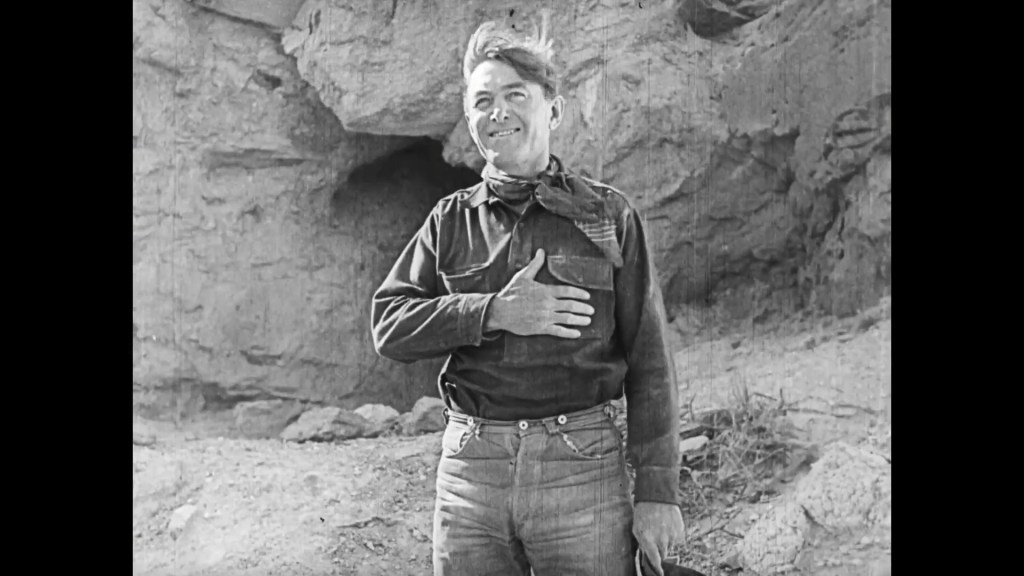
A sleepy town on the edge of the desert. Suddenly, an eruption of violence, horses and cars and lassoes careering through the streets. The Sheriff is called for, violent gangmen are everywhere. Enter Harry Carey as Santa Fe. (“They didn’t know where he came from, and they didn’t care.”) He sees a bear tamer threaten a child. Cue fistfight, the tamer using the bear for self-defence(!). Santa Fe chases off the father, only for the child to chase him. The child admits the man wasn’t his father. “He found me, just like you”. The two outsiders make friends. One mishap with the law later, and the child is effectively adopted—they are put in the same cell together. But the Sheriff’s daughter Annette pleads for Santa Fe’s good nature. The old sheriff offers Santa Fe a job. But the child remains in jail as a “hostage”, to make Harry more liable to do the Sheriff a favour. First, Santa Fe takes a job as a porter in the local bank. (Carey is very funny here, and throughout: the way he playfights, the way he tries to kill a fly, the way he holds a duster.) But Santa Fe’s here to spy on the goings on behind-the-scenes at the bank. Coulter, the dodgy president, enlists the help of his clerk Farwell to take the fall for his own emptying of the bank’s funds.

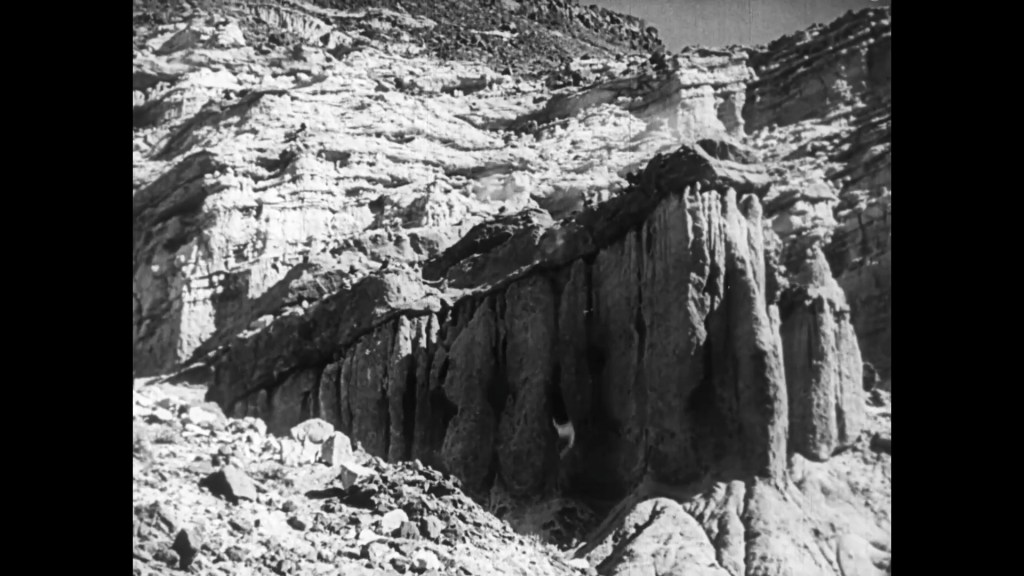
Meanwhile, Santa Fe is at a restaurant—carrying stacks dishes, rushing with the precarious skill of a comedian. In the desert, Farwell is captured under false pretences (all according to Coulter’s plan). In the restaurant, Santa Fe prepares a surprise for some gang members: mustard in their coffee. But to his surprise, they love it: “Now that’s good coffee!” But a fight nevertheless ensues, with hurled furniture and crockery. “Can you only fight?” the Sheriff asks, bringing him back to the jail. Now the gang, drunk, barge in and start a fight in a store. But the Sheriff arrives, only to be bested by the gang. (In this section of the film, there are some very nice low-key lighting for the night scenes. And a nice shot of Santa Fe in jail, beautifully lit, highlights on the bars and his shoulders—the same light that catches the flies buzzing in the foreground.) Santa Fe comes to save the day, gun in hand, and earns the respect of the Sheriff and Annette. His esteem warrants him a better hat and a sturdier pair of trousers: he slowly starts to look the part of the cowboy rather than the hobo. He heads into the desert to chase the gang and the missing clerk. He finds the “Painted Cliff Gang” hideout in the desert cliffs: a kind of “city”, hidden from the outside world. He finds and rescues Farwell, then returns to the town. Santa Fe reveals that he is a government agent and offers his full support.

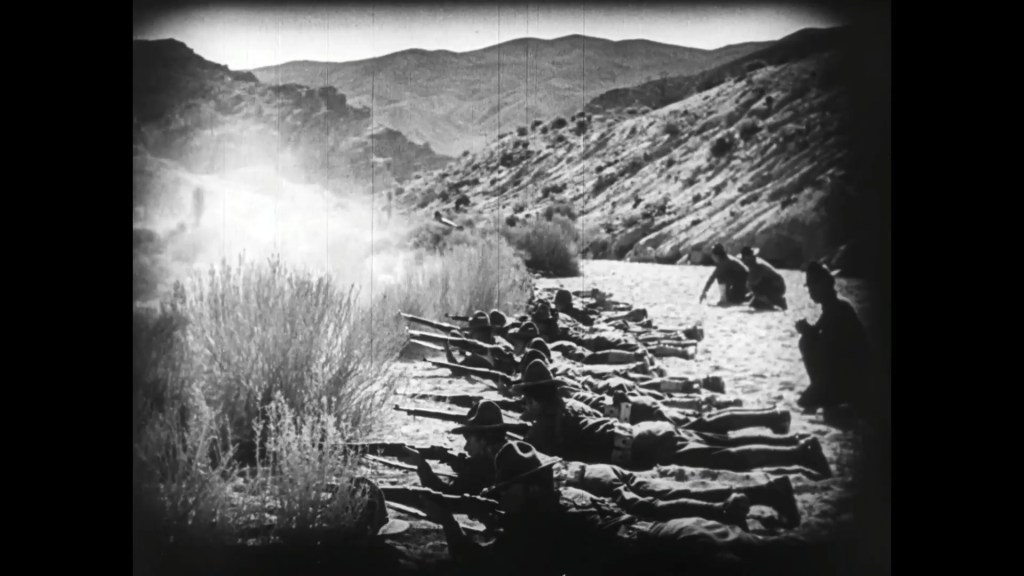
So, to the desert, where the gang—armed with Lewis machine-guns—fight the forces of town and law. They are waiting for the cavalry. And they arrive in style, these “Veterans of the Argonne”. Hails of bullets, falling bodies from cliffs, sticks of dynamite, Santa Fe climbing cliff walls, a huge explosion, the charge of the army, machine-gun fire sawing through a bridge support, “waves of lead and cold steel”. The bad guys are marched off and the cavalry chase after Coulter. But it’s Santa Fe who finds him, and the missing funds. Various happy endings ensure: Farwell marries the sheriff’s younger daughter, while Santa Fe goes off with Annette and the child—who Santa Fe hopes to enlist in the army. The makeshift family ride off into the desert. The End.

Day 1: Summary

A breathless start to the online festival. I found the hour of slapstick from across the globe an absolute delight. Even the least cinematically interesting (Rudi Sportman) had the delight of its real locations in a lost world, a lost time. Pratfalls in the foreground, history in the background. And talking of comedy, I was surprised by how many comic touches there were in The Fox. It was the first complete Harry Carey film I’ve ever seen, so a real treat. And a surprise, too. For I could imagine Buster Keaton or Harold Lloyd playing a similar role to Carey’s “Santa Fe” (the outsider hiding his physical abilities while timidly wooing the girl of a patrician figure), and the stray child could be a companion for Chaplin. Even the way Carey flirts, or looks longingly, is a little comic—comic in the way he’s so shy, and turns away when the girl catches him lingering. I like the way he slowly accrues the imagery of the cowboy: first the gun, then the hat, the jeans, and finally the all-action heroics of the finale. He moves from smart outsider, impressing with his deft touches and wit, to become the lawman and gunfighter of physical action. A solid, compact, oddly light film. (I admit, I’m not much for westerns—and I did prefer the slapstick to The Fox today.) A lot to see, but all new to me. And no time to dawdle! It’s only day one and already I feel the schedule nipping at my heels…

Paul Cuff

Pordenone from afar (2022, Day 8: part 2)

It’s the final film of the (streamed) festival, and also a chance to reflect on the experience of going to Pordenone without going to Pordenone. We end on a silly, giggly, frothy, funny note with what the programme described as “a saucy bedroom farce”…

Up in Mabel’s Room (1926; US; E. Mason Hopper)

The tone is set straight away, with Mabel on a cruise ship with a crowd of five gentleman callers. The wind is blowing on deck and she manages to flash them all before falling headfirst into her room. Yes, she has men at her beck and call, but it’s her ex-husband Garry she wants back. (“You mean to say you’re going to scramble the same egg again?” her maid asks.) Mabel caught Garry in a ladies’ lingerie store buying something he wouldn’t explain. “Sounds like a movie”, quips the maid. Indeed. (Or a P.G. Wodehouse novel, which this film increasingly resembles; or, I suppose, vice versa.) But Mabel reveals that Garry was merely buying her a gift—a black lace negligee with his embroidered dedication to her—and has kept it ever since the divorce. (“And to think he never got to see me wear it”, she sighs sadly.)

Enter older siblings Leonard and Henrietta. She is the subject of a series of fat jokes about her penchant for chocolate; he is subject to the jealousies of other men for his existing friendship with Mabel. He reveals that Garry is now posing as a bachelor and his “marriage” is a hidden secret. Mabel’s face pouts in thought. Already she sees opportunities to win back Garry.

Cut to land, and to the offices where Garry works as an architect. Next door, his friend Jimmy is overwhelmed by telephone calls; he grabs all the receivers and shouts into them at once. And here are our other set of characters: Alicia, Jimmy’s wife (always suspicious); Phyllis, “unmarried but not unwilling”; Arthur, besotted by Phyllis but too shy to pop the question. Everyone is sleek and neat, the women bedecked in fluffy furs around shoulders and necks. The early scenes also introduce us to the farcical mode of much of the film: office corridors serve as conduits for mistaken identities and quick escapes, for flirtations and flights. Phyllis is all over Garry; Arthur is jealous of Garry. Garry is invited to Jimmie and Alicia’s wedding anniversary (of course, they’ve only been married six months, but their celebration is a “precaution” against divorce, which is as easy to catch as the common cold).

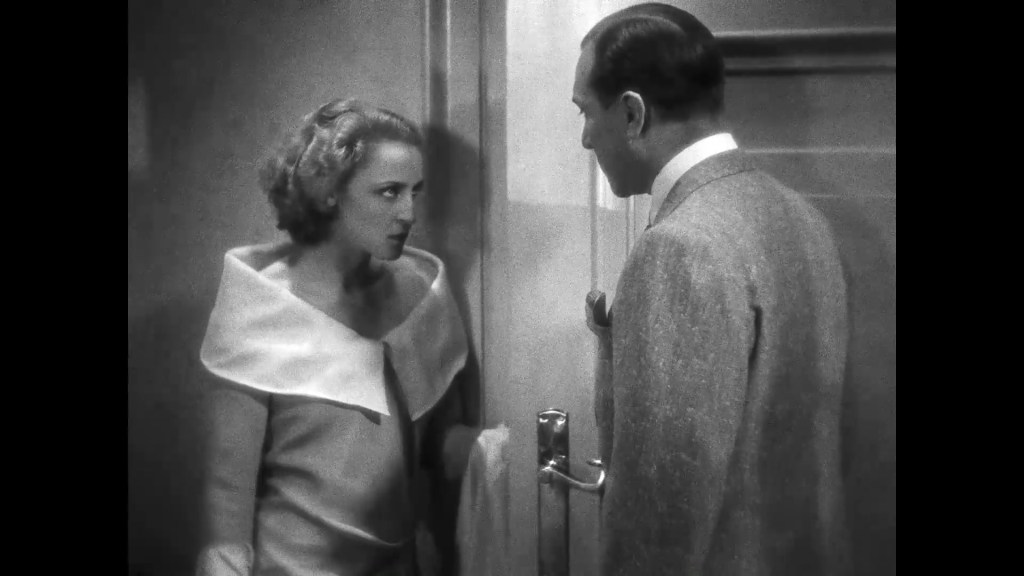
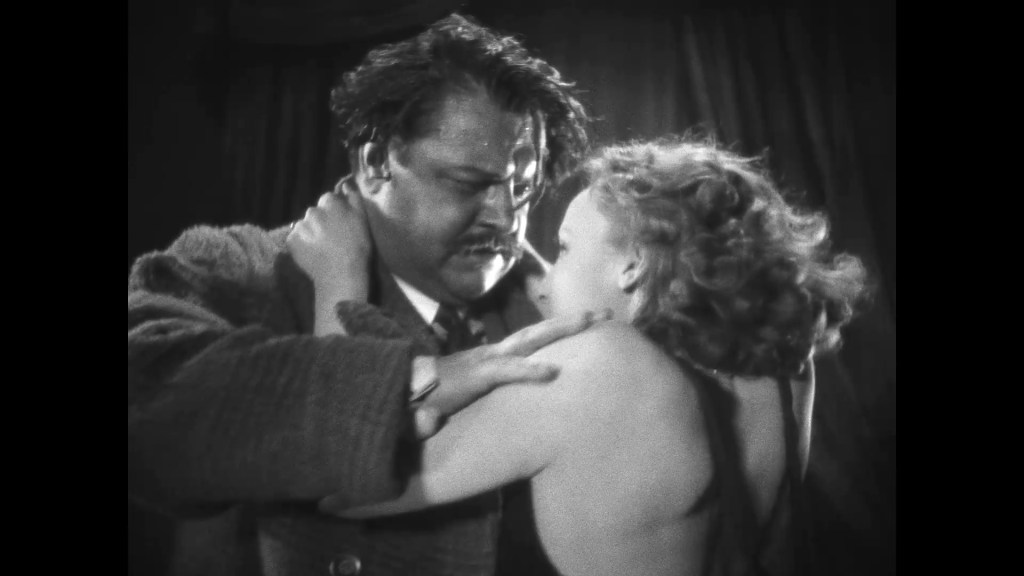
Into this mix comes Mabel. She immediately sets about seducing Garry. She forces herself into his arms, trying to get a kiss—her hands tighten around the back of his neck. “Well if you won’t kiss me, I’ll kiss you!” But Garry resists: “You’re not my wife any more! You’re my widow!” She climbs all over him, steps on his feet and they walk awkwardly a few steps then fall over. In front of his secretary, Mabel stuffs Garry’s face into her bosom and makes him drunk on her perfume. Garry is thought “pure” by his new friends, and he worries Mabel will make everyone think him “a swivel chair sheik”.

The El Rey Night Club. A party. Scanty chorus of girls. Leonard is Jimmy’s uncle and he tells Garry he’s brought a “snappy number” with him: and, yes, it’s Mabel. She grabs Garry and dances with him. Her embrace is a strangle hold. (“We’re supposed to be dancing… not wrestling”, Garry complains.) The only thing that would stop her marrying him again, she says, is if another girl beat her to it…

Garry can see the plot approaching fast. He also finds out that Leonard thinks Mabel’s ex was a wife-beater and a thief, that he would force the ex to remarry her—unless it turned out he was married to someone else. Phyllis having broken up with Arthur, Garry takes Arthur’s engagement ring and pursues the first woman he sees: this turns out to be Phyllis, who is already keen on Garry. Mabel is surprised but immediately resourceful: she tells Garry she’ll send Phyllis the signed lingerie Garry gave her. She publicly badmouths her ex in front of everyone. Garry fumes. Leonard and Henrietta want to give Garry and Phyllis an engagement party. Close-up of Mabel, pouting and squinting: she has a plan…

Mabel first visits Garry at his apartment, makes instant friends with Garry’s butler Hawkins, then steps out of her coat into a very revealing little dress and makes herself at home. Phyllis turns up, also in something frilly, fluffy, and revealing; Garry hurls Mabel behind a screen and tries himself to flee upstairs, but Phyllis catches him to say goodnight (“I adore you Garry. You’re so innocent and pure…”). Mabel listens in and starts hurling her clothes over the screen to be discovered by Phyllis. First it’s her coat (Phyllis is concerned); then her shoes appear beside the screen (Garry pretends they’re novelty ashtrays); then more and more clothing appears, down to transparent underlayers. Phyllis storms out, then Mabel calls to Garry. She pretends to appear in all her glory and hurls down the screen—but after reducing him to a pulp of nerves, she reveals she has kept on her top layer and walks triumphantly from the door.

It’s the house party hosted by Leonard and Henriette.

Garry and Hawkins have their plan. There’s a fantastic little scene in which they both try to visually describe the “intimate” garment they must steal. Garry tries first and is immediately caught by Mabel, then by Phyllis—who takes solace back with Arthur.

Mabel now starts flirting with Jimmy to make Garry (and Alicia) jealous.

Hawkins turns up with a stolen garment to give to Garry, but it’s the wrong garment; Garry is now caught by Phyllis, who faints and is taken up to Mabel’s room, where Garry is now hidden under jer bed trying to catch the right piece of clothing.

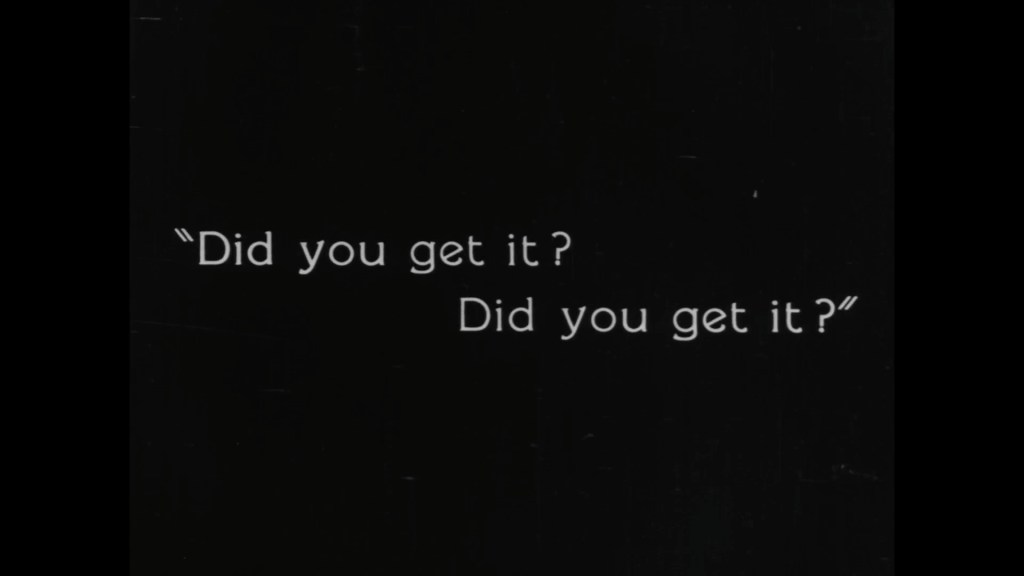
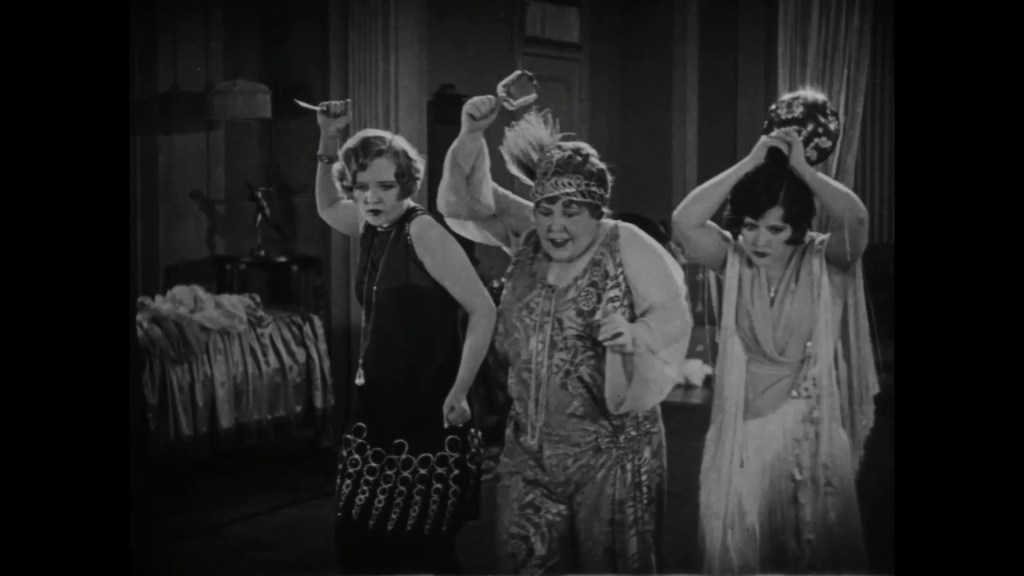
The farce gathers pace: all the men are sequentially caught in possession of the nightie, and the house butler keeps directing jealous woman to their other-halves who are all “up in Mabel’s room”. There, Hawkins and Garry bump into each other from respective hiding places: questioning titles cross the screen to meet each other: “Did you get it?” But the real negligee remains hidden. Trying to escape out of Mabel’s window, they are spotted and the cry goes out that there are burglars. At last the negligee is found but Leonard and Arthur shoot at the supposed burglars, forcing them back into Mabel’s room.

Everyone is now convinced the burglar is in Mabel’s room: Mabel, Phyllis, and Henrietta climb the stairs from inside, while Leonard climbs in from outside—the garment having by now been dropped outside at Arthur’s feet. All three men now hide inside under the bed and the three women sneak in through the door; there’s a great scene as the groups go back and force from hiding place to hiding place. Leonard is caught, but Garry and Hawkins escape through the window to try and recapture the negligee—bumping into a hose on the way down and soaking Garry’s clothes.

More farce in the other rooms: Jimmy goes into Garry’s room, where he is mistaken for Garry by Mabel who flirts with him; Alicia sees this and storms off. But as Arthur now has the negligee, Mabel has to sneak into his room—and a suspicious Phyllis finds her there under Arthur’s bed. Mabel has captured the negligee and put it on under her dress.

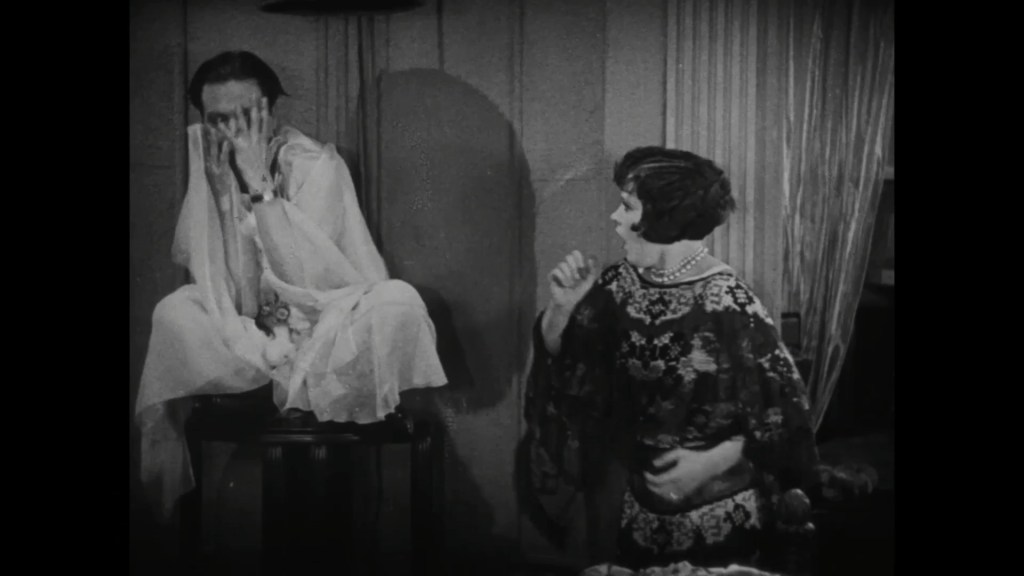
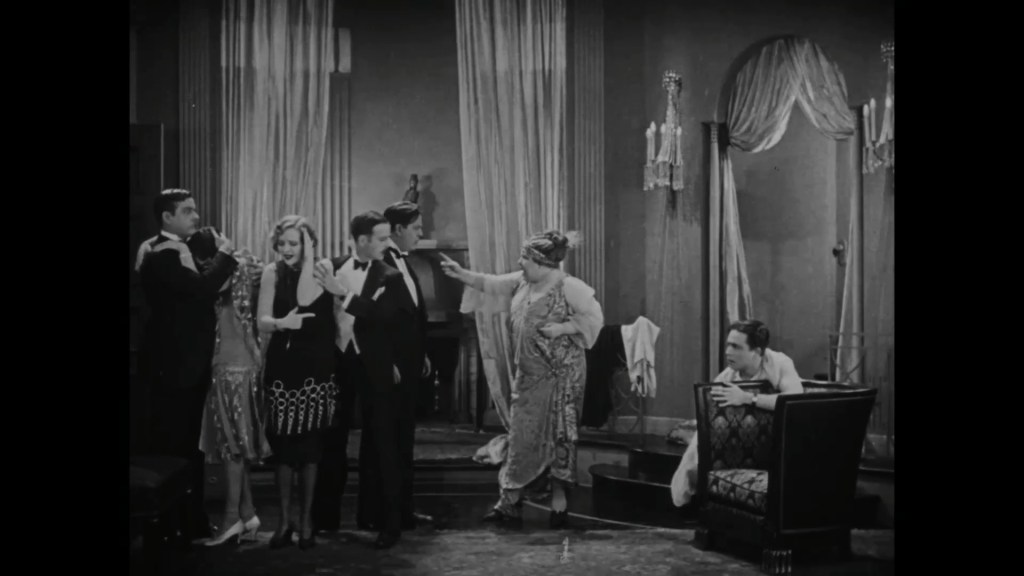
Meanwhile Garry is down to underclothes after his watery escape. To avoid detection, he climbs back up to Mabel’s room to get back to his own; but Mabel catches him in her room wearing her night dress and pretending to be a lamp. Hawkins is then caught going upstairs by the whole household; he says that Garry is yet again “up in Mabel’s room”, where everyone now goes. The butler interrupts the siege: a telegram for Mabel saying that her divorce is void due to a technical reason. Garry and Mabel are still married! Everyone bursts in. Mabel’s negligee and the telegram explain the whole story. The married couple embrace, but a shower of shoes from their well-wishing friends knocks out Garry; he falls into Mabel’s arms; she looks to camera and winks, then is herself struck by a shoe. She kisses the prostrate Garry, and the film fades to black. The End

I was worried after the first half hour of this film that the flippant, knowing tone (and the endless quips of narrational titles) would grate after a while. But when the action and dialogue took over, I shed my reservations and thoroughly enjoyed myself. It’s a Wodehouse novel come alive. And even the titles became more visually inventive. There are small fonts to indicate a whisper, large ones for shouting—and wiggly, trembling text to indicate a scream. Though the camera is static throughout, the editing is snappy and the film mobilizes everything it can to quicken the pace while providing clear continuity across multiple spaces. Marie Prevost steals every scene, every shot she’s in: winking, pouting, flaunting, seething, rolling her eyes. It’s one of the most outrageously enjoyable (and clearly, self-enjoying) performances you can imagine. Up in Mabel’s Room is also the first film streamed to feature an orchestral score. (Though there is a brief appearance of other instruments in the soundtrack for The Lady, they disappear after a single scene: why bother providing them if you’re going to take them away so soon?) Günter A. Buchwald’s jazzy score is excellent. The restless, peppy theme for Mabel breaks out each time she outthinks and outacts her competitors and husband. I imagine it would be great fun to see and hear performed live. Which brings me neatly to…

Pordenone 2022: Online festival round-up

So, what are my impressions of the festival in its streamed format? It’s my first experience of Pordenone and I’m very glad to have participated. For accessibility, it’s a tremendous new feature of the festival (and others like it). Technically, I had no issue with any of the streams. It took a minute to learn how to amend the format of the subtitles to make them unobtrusive (the default mode gives them an opaque background that blots out part of the screen), but apart from that I have no complaints. The 24-hour period to watch the films is much appreciated, as watching them “live” would be virtually impossible for me given that I’m fitting a festival into a normal working week. As it was, even seeing all the films on offer was a hectic fit. I skipped all the filmed introductions to the films, which I regret—but I really couldn’t spare the time. The variety of the films themselves—from 1912 to 1930, from Hollywood to Slovakia—was good, with enough of a sense of the running themes (Ruritania, Norma Talmadge) to get a sense of the festival. The music was very good, though I greatly miss seeing it performed live. I never feel the need to comment much on piano scores: put simply, much less can go wrong with them than with orchestral scores. They are adequate, often more than that. But I do miss seeing and hearing performers and orchestra, and I’m aware the live festival had many more large-scale performances than the streamed selection. I’m also aware of the films I missed. Among the many not streamed was Abel Gance’s La Dixième symphonie (1918). As anyone who glimpses at my publications page will realize, Gance is my specialist subject. I’ve never seen La Dixième symphonie with an audience and I would love to know how the screening went at its live projection.

More generally, I feel that both “experience” and “participate” are odd verbs to use (as I did at the outset) to describe me alone, sat or stood by my monitor, hundreds of miles from the festival. The option to add comments or stars to review or rank the films was there, but I didn’t “participate” in this either. Yet how strangely moving it was to see among these signed reviews the name of a university friend whom I’ve not seen since, and to know that they were somewhere in the world—also, I presume, sat at their monitor in the gloom. How different it is to peer at a monitor and glimpse another’s existence, than to encounter them at a festival and talk. I’ve attended a festival, yet I’ve gone nowhere and seen no-one. Much of my writing in recent years has reflected on the experience of live cinema, and I feel guilty having proselytized on behalf of liveness while never having been to a festival. But it’s a matter of time and—more so now than ever—money.

What does appeal to me is writing, and I don’t suppose I’d be able to (or want to) take notes during a live performance as I have when viewing these films at home. Writing these entries has been time-consuming. But the writing has also given me more of a sense of purpose and meaning in “participating” in a festival. I may not have been to Pordenone, but at least it’s given me the final push to start this blog and write a regular piece on silent cinema. I hope to keep it up, with a fresh film or related subject each week or so.

So, thank you Pordenone. Perhaps one day we’ll meet in person.

Paul Cuff

Pordenone from afar (2022, Day 8: part 1)

It’s the final day of streaming, and with two feature films to cover I’ve decided to dedicate a post to each one. First up is a film which bowled me over completely, and about which I will gush unapologetically…

The Lady (1925; US; Frank Borzage)

Working-class music hall singer Polly Pearl marries a wastrel aristocrat who abandons her on their honeymoon in Monte Carlo, leaving her alone and pregnant. When the husband dies, Polly’s former father-in-law arrives to claim custody of the child, but she sends the boy away with a foster family, knowing that she may never see him again…

We’re back in the company of Norma Talmadge, in a film directed by the great Frank Borzage and a script by Frances Marion. “The Lady” is an aspirational title that bar manager Polly had always hoped to attain. The title introducing “the Lady” makes way for a close-up of a woman’s hands wiping beer and froth from a bar. The transition lays bare the conflict between hopes and reality at the heart of Polly’s life.

British soldiers stumble into Polly’s “English bar”. The sergeant is drunk, his comrade sober. The drunk petulantly squirts Polly with a soda siphon. “That’s a ‘ell of a way to treat a lady!” she says. There’s laughter from the clientele: “Can you imagine Polly Pearl callin’ herself a lady!” It’s a cheery introduction, but a hurtful one. The laughter is friendly, but we know what kind of life she must have led. It’s a nice detail in the film’s titles that the word “lady” is often on the last line, or is even the last word, of the text: the tail of the “y” is elongated in the same way as the first “y” of the first “lady” in the introduction.

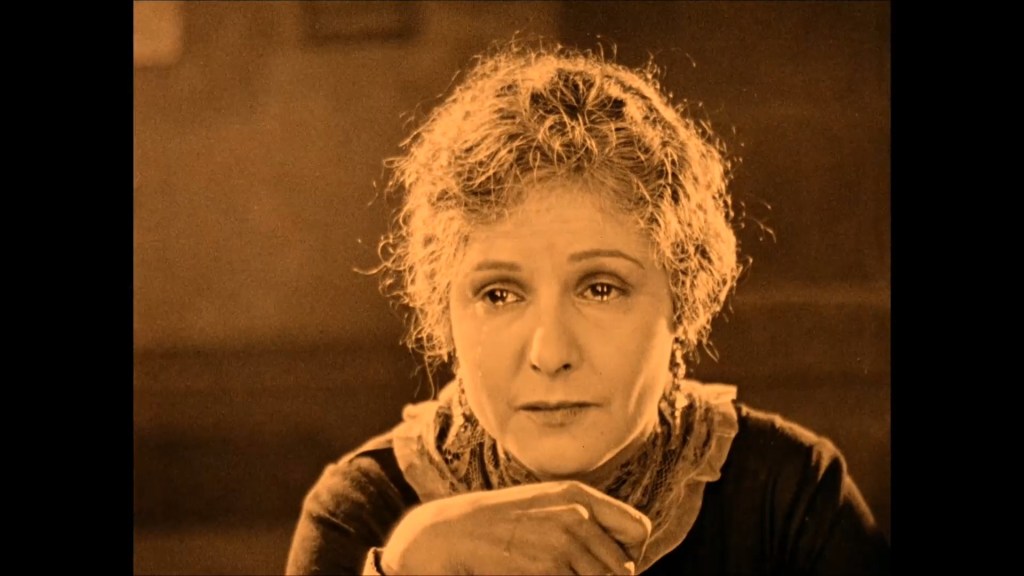
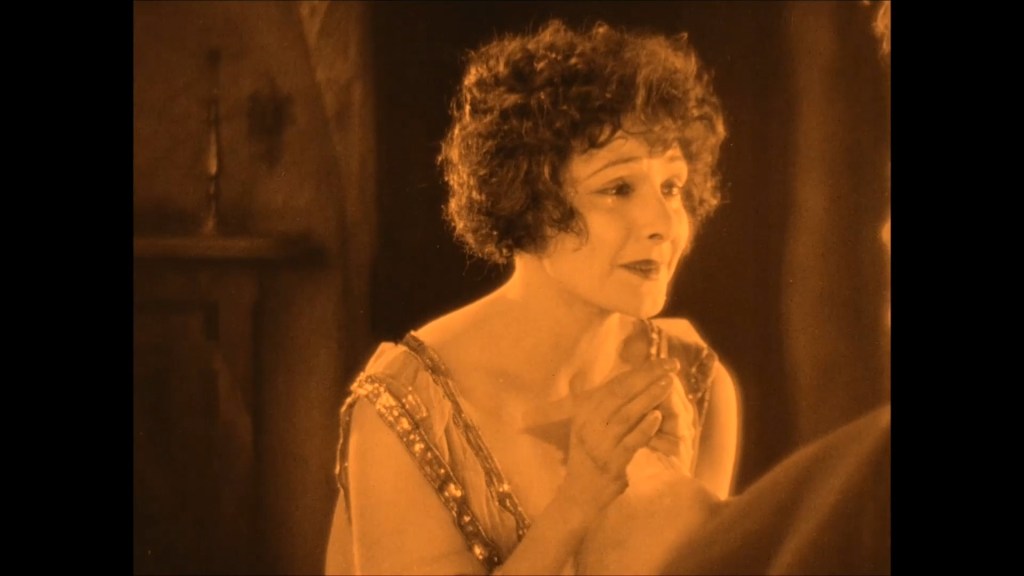
A kindly face on another table. Mr Wendover was born in the same town. Polly hasn’t been home for fifteen years. The close-ups of Talmadge are beautiful. Her grey hair forms part of her gentle back-lit halo. Wendover calls her “Madame Polly”. He shows her photos of their lost far-off hometown. A montage of preserved glimpses of home. There is a lengthy close-up of Talmadge with tears in her eyes. It’s an extraordinary intimacy between the camera and her face. She once “dreamed of being a lady”. Wendover sees her emotion. “You must have had an interesting life. Tell me about it, won’t you, Madame Polly?” he asks. It’s a mark of his respect that the “y” of the “you” and “Polly” have the elongated tails of “lady”.

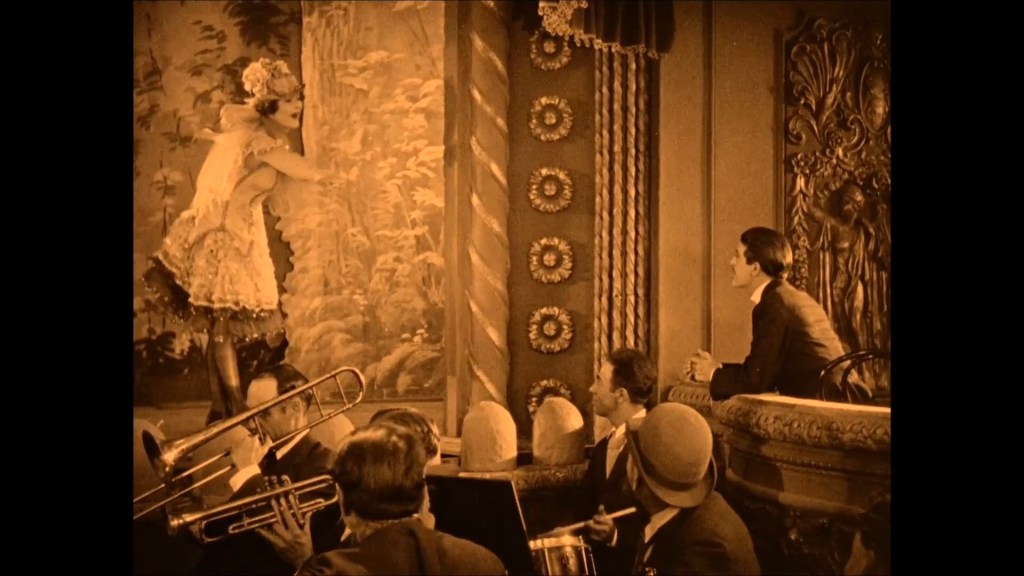
Twenty-four years earlier, in London. Here is Polly frolicking on stage, a different person entirely—her body, her face transformed, filled with energy and life. From a box at the side of the stage, Leonard St Aubyns gazes at her in rapture.

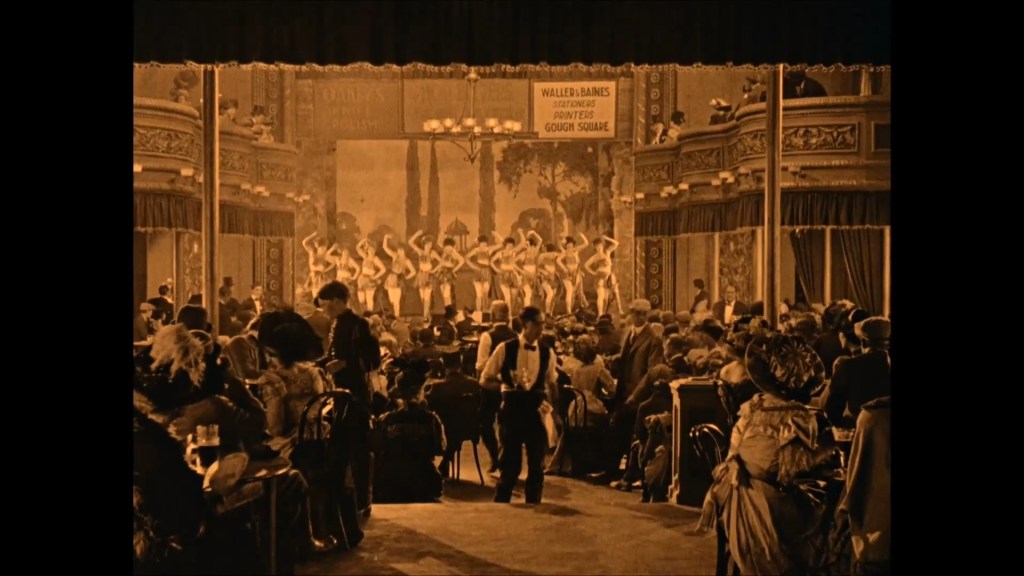
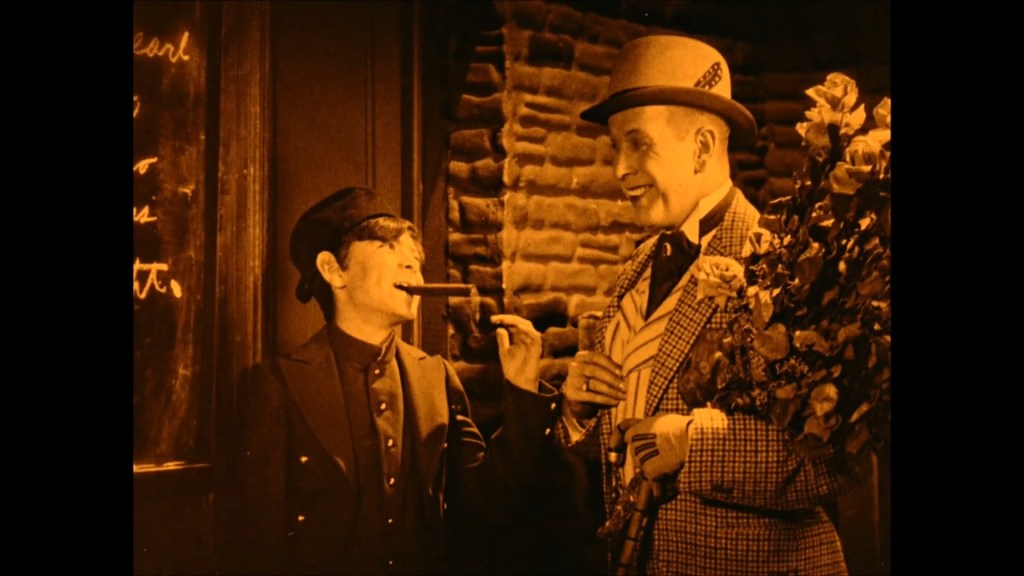
Music hall life is brought to the screen with a dozen lovely comic touches. Look at the boy who stands on guard at the stage door, letting in no-one—until he’s bribed with a cigar by a flash dresser. The man even lights it for the boy, who stands there puffing contentedly.

Polly’s friend Fanny makes insinuations about her relationship with St Aubyns. She makes a fuss over the roses he gave her. “Can’t you see diamond lizards in his eyes?” Fanny asks, gesturing to her own spangle on her dress. Polly says she can’t pay, Fanny says she’s “too afraid to pay for it”—and she means paying with her body. “Some day I hopes to be nice”, Polly replies, and Fanny laughs at her desire to be “a lady”.

The flash dresser is Tom Robinson, a bookmaker who comes with flowers for Polly but makes do with Fanny. He looks the latter over. “Oh well”, he says “—seein’ as how the outfit’s paid for—” and off they go. It’s a funny, sad series of exchanges, and it’s strangely moving when all the other characters have gone and it’s just Polly and St Aubyns alone backstage. There’s no title here, but you can read her lips—“I love you”—and see that he does not return her words before they kiss.

(Outside, Fanny asks Tom: “Sorry it’s me not Polly?” He pauses, then says: “I’ll tell you after the ride.” It’s a great line, but it also undercuts the sentiment of the surrounding scene—and we’ll see that this couple’s kind of honesty is perhaps more long-lasting than other relationships in the film.)

The stern father of St Aubyns arrives and offers to pay Polly to send his son away. Immediately he tries to put a price on her, the most devaluing thing of all. For he’s convinced his son is wasting all his money on her, something she fiercely denies. Polly shows him the marriage ring, which she keeps hidden in her blouse. “Not another penny until you return home—alone”, the father says to his son. What is Leonard’s reaction? He sits sulking on a chair. It’s hurtful that his first thought is for money, not for Polly. And it’s moving how optimistic Polly is, saying she’d love him all the same if he were poor. And Leonard rashly announces a honeymoon to Monte Carlo, which makes her cry for happiness.

The last sight of the London world: the theatre boy stumbles in, sucking on the remains of the cigar. We see the world through his befogged eyes: everyone is distorted and squished. It’s a comic touch, but it’s also strangely sinister.

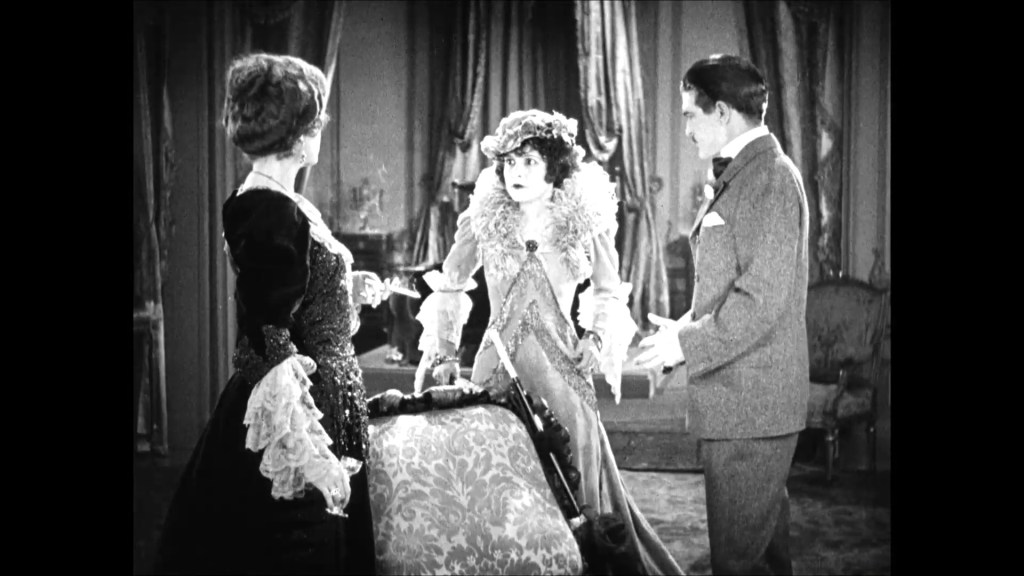
For now we’re in Monte Carlo and already Polly’s life is unravelling. Leonard is gambling and losing, and flirting with a well-dressed woman called Adrienne. Polly laughs at the woman’s pretensions, but Fanny and Tom (still together) warn her she’s after her husband. Leonard is kissing Adrienne’s hand and gets irritated when Polly approaches. She tries to be friendly with Adrienne but the latter snubs her.

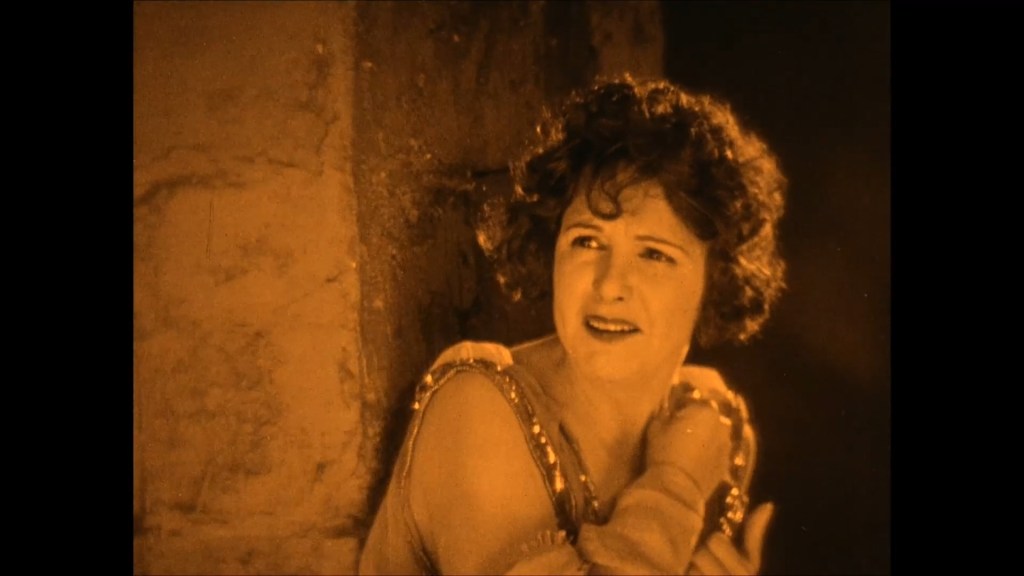
It’s at this point that the print begins to disintegrate before our eyes, just as Polly’s relationship disintegrates. We see fragments, glimpses of Polly’s heartbreak. Leonard “can’t stand the riffraff you associate with”. But Tom and Fanny prove their worth, comforting Polly who now has the courage to confront Leonard in the hotel. Polly finds him locked in an embrace with Adrienne. The latter remains cool and smokes instead of replying to Polly’s questions. Infuriated, Polly hurls herself at Adrienne. Her violence is less damaging than what Leonard says next: “You common little trollop! … My father was right! I was a fool to marry a guttersnipe like you!” And there is that elongated “y” in the last word of the text, its long tail grimly echoing the “y” of “lady”. (It’s such a clever little visual trope to use, this simple “y”—and every time it calls us back to the main title and the idea it summons.) Polly stands there, hope draining from her body—as the film warps and bleaches around her.

Marseille, months later. Polly stumbles through dark streets into a tavern. She sits and asks for tea, to the shock of the waiter and owner. Madame Blanche sees Polly’s vulnerable state and pounces, black arms gleaming with sequins, holding her neck and pouring alcohol into her. Polly realizes what kind of place it is: drunks, sailors and women intermingle. She flees in fear but collapses outside and is carried back in.

There is a cut to an astonishing reveal: Polly is in bed, playing with an infant’s foot, the rest of the baby concealed under the sheet. Its tiny fingers wrapped around her thumb. But in comes Mme Blanche. “You pauper, lyin’ in bed like a lady!” Mme demands Polly dance and sing for her customers to earn a living. (The censor would clearly not allow Polly to become a prostitute, but it’s the closest the film can get.)

So Polly is on stage, melting hearts. She refuses money from a customer of another kind. Mme is angry that Polly only smiles for her “brat” and not for her customers. But the baby clutches at Mme’s fingers and her heart softens a little.

Just as Polly is settling into some kind of safe existence, an agent sent by the elder St Aubyns arrives and writes to London that he has found “the grandson”.

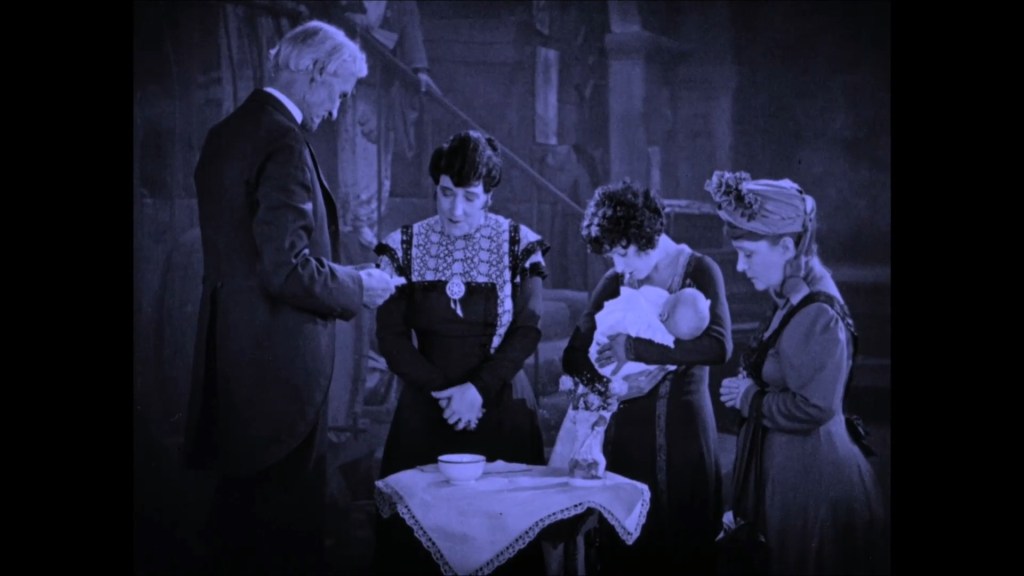
Rev. Cairns, an English man of the cloth, baptizes the child: the boy is called Leonard. Is it her way of recapturing the past? Or reclaiming the future? A boy that might grow up to be better than his father. A moment of solemnity in the tavern/brothel when Cairns quotes the line “and lead us not into temptation but deliver us from evil”. One of the girls laughs, another has tears in her eyes.

St Aubyns arrives. Polly sees him and realizes why he’s come: we see all her thoughts in her face. St Aubyns announces that Leonard is dead and that he has come with a court order of custody “on the grounds that you are unfit”. (Again, the “y” of “you” is the elongated “y” of “lady”.) We can read her lips: “You hypocrite”, she cries, as he gestures with contempt at the world he sees around him. She must fetch the child. She paces the room, going back and forth from cot to door, turning in indecision. “He’ll ruin him like he did Leonard”, she says, and begs Mrs Cairns to take the child away with her—to somewhere where even Polly can’t trace them.

(Cut back to a woman trawling for clients in the tavern. She tries St Aubyns and his agent, but is treated with stuffy contempt: so she sticks her tongue out at them and knocks the old man’s hat over his nose. It’s the kind of reaction we all want to give St Aubyns.)

Polly issues her last hopes to Mrs Cairns: “give him your name and bring him up like your own—a gentleman.” She kisses her son goodbye. “Promise me you’ll be to him all that I hoped to be.” Finally: “Don’t let him know that his mother—wasn’t a lady.” It’s a devastating little moment. And when Polly runs back to the tavern, we see everything on her face: grief, shaken into triumphant defiance as she thinks of outwitting St Aubyns. She says she’ll sing whilst they’re waiting. As Mme Blanche and Mrs Cairns prepare for the child’s departure, we see Polly sing: the desperation of her performance, as she tries to hold back her fear while singing. When she knows the child is safe, she is laughing and crying and almost insensible as confronts St Aubyns: “damn you” she says, and strikes him just as she struck at Leonard’s lover. She collapses.

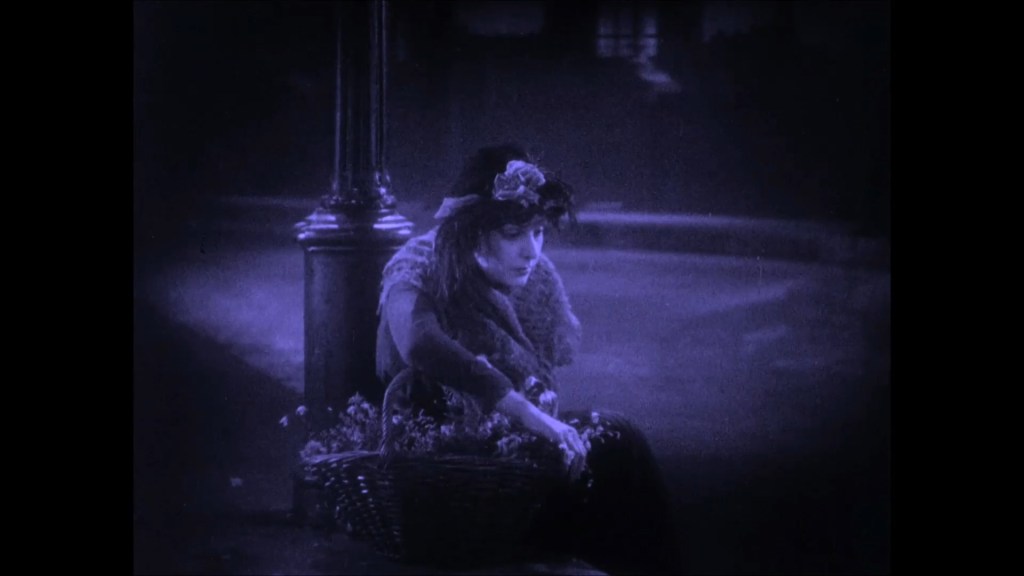
And when we see her again, five years later, it’s as if she has hardly been able to pick herself up from the ground. Here she is, searching the streets of London for her child. Talmadge breaks my heart as this older character. Her face has become older; it’s not disguised, it’s all in the performance. Her face has become less mobile, slower to reveal its expressions. The emotion is held in the eyes. Her restraint is so touching. And the lighting, the dark streets, the faint wash of violent tinting—it’s a perfectly, perfectly sad scene. Polly is selling flowers. A child stops and talks to her. She asks him his name. An angry father moves him on. Polly and her soggy little garlands are moved on by the police.

Tom and Fanny appear, in a car. They are still together, all these years later. Polly tries to sell them a flower. She flees in shame, then changes her mind and calls out after they are gone. Truly, Talmadge is glorious. Look at her face in the long close-up after the car has gone; a whole series of emotions and exhaustion, and Borzage lets it all play out before he cuts to a wider shot. Another child and mother appear. “What might your name be, me lad?” Before he can answer, the film deteriorates again. She still waits to find Leonard. A passing policeman says: “If I was you, I’d give up waiting for that young man” and pats her on the shoulder. He leaves, and there is another extended moment at the end of a scene when it’s just Talmadge on screen. These in-between moments, when action is left behind, are made to tell.

We are back to the present, in Polly’s English bar in Marseille. “Life’s done for me, but some’ow I go on—and on—” she says. Acts of kindness have kept her going. Mme Blanche died and left her money, which enabled her to buy this bar.

But here is an act of selfishness. A brawl erupts, the British sergeant drawing a pistol. His comrade grabs it but is punched away, accidentally firing as he falls back into Polly’s arms. The sergeant is dead. The police arrive.

And, yes, the young man in Polly’s arms is her son. You realize it instinctively, even before she sees his soldier’s identification tag: “Leonard Cairns”. He’s unconscious, asleep like a child in her arms. Talmadge has another extraordinary solo performance in medium close-up. She looks again at the name tag. She can hardly believe it, as we might not. The film plants this miracle at her feet, at our feet—and all at once she realizes what has happened, that he has killed a man, that she might lose him again. “He’s my boy!” she cries to Mr Wendover, and somehow not hearing her words at this point is enormously moving. (Why is that so? There’s always a distance between us and these silent figures. The best silent films invite us to cross this threshold, and when this happens there’s a kind of connection made all the deeper for the time and space it traverses. So yes, we can read Norma Talmadge’s lips—mouthing the rediscovery of her lost son, nearly a hundred years ago—and discover her words again, spoken inside our own heads.)

Already the police are here. Leonard is alive, struggling to open his eyes. When he recalls the fight, he grieves the death of his friend: “we were buddies”, he carried him across No Man’s land. Another region of grief and loss opens up. Polly tries to convince Leonard that she fired the lethal shot: “You know, my lad, that I shot him. It means nothing to me—you’re so young—and need your chance.” (Yes, an elongated “y”, linking his chance with her longing for a different life.) Leonard looks at her with wonder, and they are eye to eye. Polly asks Mr Wendover to back-up her claim—she is staring at him, desperate to give her boy a chance. But Leonard refuses to let her take the blame: “There are some things a gentlemen cannot do.” And Mrs Cairns’s promise to her is fulfilled—another emotional payoff in this astonishing scene.

“But it’s the most wonderful thing I ever heard of—”, Leonard says, that Polly should try to save him, a stranger. “But you’re not a stranger—why—I—” (she pauses, and it’s agony!) “—I have a wonderful memory of a son like you”, she goes on, and a tear falls from her cheek—the most perfect moment, in this most perfect scene. Even the “y” of “you” links him to her, which is matched in his response: “And I have a memory of a wonderful mother like you”. She puts her hand upon his cheek. It’s not quite a caress, it doesn’t dare to be. But when he turns to leave, she asks him: “Do you mind if I kiss you—in memory of my boy?” They embrace, and it’s a kind of fulfilment of the miracle.

He marches out of her life, escorted by the police. Her hand wipes the bar, as in the opening shot. And I didn’t think the film could pull any more emotional punches, but somehow it does. Mr Wendover says he won’t leave France until Leonard is freed. Polly is thankful her son is a gentleman. “And do you know why he is a gentleman?” Mr Wendover asks. “Because his mother happens to be—” (her hand stops wiping the bar) “—a Lady.” She looks up at him. And there is her face, her face that has carried the whole film, smiling at the realization that she may be loved. It’s another perfect moment, in a film full of perfect moments. Dissolve. The End.

The Lady will be one of those films that I won’t be able to describe to someone else without welling up. (This happens with a few other silents. I remember giving a lecture at the London Film School and almost breaking down mid-sentence when I tried to describe the ending of Sjöström’s Ingeborg Holm [1913]. I wasn’t expecting it, but there it came, the wave of emotion, and my voice cut out in front of a roomful of strangers.) Talmadge is of course the star and holds the film’s huge emotional weight, but the whole thing is wonderful. The cast are uniformly excellent, the script has a wonderful balance of the tragic, the comic, and the miraculous. It sets things up that you don’t immediately spot, then knocks you over with them at the end. And despite the damage at various points, the print is absolutely beautiful to look at. The lighting is superb, the sets are atmospheric, and all united with the gorgeous tinting that brings warmth and texture to the world on screen. I’ll be thinking about this film for years to come, and no doubt still blubbing when trying to describe it to strangers. Many thanks for this, Pordenone.

Paul Cuff

Pordenone from afar (2022, Day 7)

Day 7 brings us the film I was most looking forward to seeing among this year’s streamed content. (Pause to consider what a foul phrase is “streamed content”.) It’s also the film that most conflicted, confounded, and confused me.

Manolescu (1929; Ger.; V. Tourjansky)

Manolescu and Cleo con their way through European cities, stealing and defrauding as they go, on the run from the law and her ex. Will she escape him? Will he escape his own lifestyle?

I have great difficulty in writing about my feelings for this film. For a start, I made no notes when watching it: Manolescu was the one film I wanted to concentrate on entirely, without pen or paper to distract my eyes even for a moment. To write this review, I’ve had to go through the film again and my thoughts are even more complex now that I see again how rich is the look and feel and design of the film. But my reservations are still there. So here we go—with due warning of sexual violence in the content…

Paris. Smouldering nightscape. A descending camera over the rooftops. A homeless man on a bench. Nightclubs ejecting revellers in the early hours. Mosjoukine as Manolescu in his finest night attire.

But Manolescu is back home and exercising by 7 a.m. The curtain is drawn. Outside, a studio Paris so fabulous the camera can drive elaborate routes through its impeccable geography. Here are cars and people, dark streets, neon signs.

A letter from the Club: Manolescu owes them 82,000F. Paris rejects him, so he obeys the neon suggestion outside: “Adieu Paris / Visitez Monte Carlo!”

The station. Steam and smoke. And Brigette Helm, smoking and sultry. She is Cleo and Manolescu stares at her and takes the neighbouring compartment.

Jack arrives to say farewell to Cleo but is being observed. His agent warns him off. He leaps onto the train, but then leaps onto another train in the other direction. The police board the train to Monte Carlo and inspect passports.

Manolescu tries to get into Cleo’s room, first by stealth then by force. The police arrive and Cleo realizes she needs protection, so she pretends to be asleep in Manolescu’s room. The police go. He locks the door, then the door to Cleo’s apartment. He paws her, forces her back onto the bed. She pushes her back against the compartment wall, closes her eyes, waits to submit. It’s a horrifying scene.

Now there are astonishing landscapes. Glorious sun and shade. Gleaming cliffs. Gleaming hotel facades.

Cleo has given Manolescu the slip and gone to her hotel. Manolescu follows. At reception, he pretends to be “Count Lahovary” to get better service. He cons his way into Cleo’s room. She’s in the bath. She demands he leave, again and again. He waits outside. She dresses. She confronts him. Eye to eye. The most astonishing shot, held for a long time: her eye the focus of the whole world, staring at him in a kind of wilful fury. His face. Gleaming eyes. A smile fades. “What do you want from me?” His answer: he grabs her, kisses her breast. They writhe together. She reacts with hatred. The camera tracks closer. They stare at each other like animals. They kiss, his hands around her throat.

They are together, laughing, running, exercising in the sun, riding, boating. Their embrace amid the sheets. The camera begins to spin. Their whirling faces dissolve onto the gleaming whirl of a roulette wheel. Casino life.

At the hotel, Jack arrives with a huge bunch of flowers. He’s like a bear. His hair in grizzly flight from his enormous head. His moustache a black lightning bolt under his nose. He enters. Manolescu hides on the balcony at Cleo’s instruction. Jack and Cleo. Their embrace turns into a kind of fight. She wrests herself away, giddy. Hatred disguised as decorum. Fear and panic. Pretence. (On the balcony, Manolescu peers into the neighbouring room: a rich old woman storing her jewels. An idea.) Jack leaves to dress. Cleo and Manolescu. What is she thinking? (Really, what is she thinking?) They kiss. There’s something animal in them. Jack walks in. There is a fight of amazing savagery: punches hurled in close-up, fury in the eyes, fury in the bodies. More animalism. Cleo flees, but only into the corridor to get help. The police arrive and drag Jack away.

Manolescu promises they’ll stay together. “We stay together?” she replies. “Could you then offer me the life I am used to living?” Taken out of context, it’s an extraordinarily revealing question. The life she’s been living has been one of enforced companionship and criminality. (And sure, he’ll give her that.) But what the question is taken to mean in the scene is one of finances: could Manolescu provide her with enough money to live the way she wants. So he steals the rich woman’s jewels in the neighbouring room.

Title: “That’s how George Manolescu’s life as a swindler began.” (Really? Wasn’t he already fleeing debts in Paris? Isn’t he already a rapist?)

Their life of crime and money fraud. Manolescu cheats his contacts and wins out.

Jack in his cell, his agent promising him to help with Cleo.

London. Neon signs. Pearl theft. Shots of faraway places. Newspaper headlines across the world: Manolescu’s thousand disguises, thousand crimes.

A nightclub. Cleo staring at another man. (No-one can stare like Brigitte Helm, no-one raise her pencil-thin brows so intently, no one narrow her eyes with such intensity of willpower.) A rift is opening.

Jack is released. Back at the hotel, a fight between Manolescu and Cleo. He taunts her with the prospect of living a life of poverty. (Has the film lost all sense of orientation? Isn’t he the one supposed to be afraid of losing her?) He grabs her arm. Let me go, read her lips, and again and again. But he just wrenches hold of her, and they swirl. A grotesque parody of a lovers’ dance.  He leaves. She weeps on a bed. (Again, what is she thinking?)

Jack arrives. She manages to half raise herself. He approaches, furiously. She has her back against the wall. It’s the same framing and pose exactly as the rape scene in the train. (How can the film be this intelligent in knowing how men treat Cleo, and yet proceed to treat Cleo as though she is the problem, the cause of men’s violence?) She somehow wrestles him into an embrace. She is squirming, desperate. She is on the bed, half-weeping, half-writhing into a new shape to enable her to survive. (God, Helm is magnificent: look at that face between her arms, raised to hide the shifting of her face, her train of thought, her pulse of cunning.) Jack looks bewildered. His eyes flashing under the breaking tide of black hair. She raises herself. He tries again to summon the will to strangle her. Their arms. Hers, bare and pale; his, thick and dark in his coat. Look at her shoulder blades, tensing, shifting. His face, gleaming with sweat. And now its her turn to strangle him into a kiss. His fury ebbs. His enormous face turns into that of a child, beaming at last with mad happiness. They have wrestled and a weird, mad pact resolved. She falls away from him, exhausted. “I’m so happy you’re back with me!” he says: the strangest line of dialogue after the preceding scene, one of the weirdest, most uncomfortable survival/attempted murder/seduction scenes I can recall.

Then Manolescu returns. Cleo between two brutes. Jack hurls a sculpture and hits Manolescu in the head. He falls. Cleo over his body. “Murderer!” she rasps, and Jack turns to leave—a giant lumbering from an inexplicable scene of defeat.

Cleo phones for the police. But look at Manolescu, on the floor. From the back of his head, in the shadows: that isn’t blood seeping from him, it’s electricity. Sparks are bubbling from his brain onto the carpet. The camera falls into them. The screen is the pulse of an electric sea. A vision of a courtroom. Faces and benches in the negative: black and white reversed. It is terrifying. The whole screen flickers uneasily. The electricity is still seeping, pulsing through his brain. Only Manolescu is in the positive: his face in profile in a scene of (literal) negativity. The crowd turns as one to stare at him. The judge rises: “Robbery… swindling… forgery…”. Manolescu stands: “Cleo… all… because of… you…”. The camera turns Manolescu on his side. He is no longer standing; he is in bed. A world of white. And Dita Parlo. She is Jeannette, a nurse with the warmest smile in the world. The film will take her side, the side that says “Cleo: all because of you” and blame Cleo for Manolescu’s own decisions.

Nurse and patient are falling for one another, but here is Cleo: “I am not to be blamed for what has happened… please, forgive me.” (The contradiction is clear, but what does the film want us to make of it?) “This is your doing!” shouts Manolescu as he sees another headline revealing his criminal work.

So Cleo departs and Manolescu and Jeannette go to the Alps to recuperate from his head injury. But Cleo visits: “We belong to each other”, she says, “I would never let anyone else have you!” “I hate you!” he hisses, and again hands and eyes are wrestling with fury. He rejects her. She catches sight of Jeannette. The two women look at one another. Cleo is contemptuous. (That raised brow, that narrowed eye.)

New Year’s Eve and Jack is drinking alone when Cleo turns up. Yet as soon as they embrace, Cleo is reluctant: “What abut Manolescu?… I have betrayed him.” Literally, this might be true—the police are on Manolescu’s trail, but how on earth are we expected to take Cleo’s logic? For now she is turned away. She is alone in the corridor, her black silhouette cast behind her on the wall. She walks away. The shadow lingers, then slips down and down the wall until it’s gone.

New Year’s Eve in the Alpine cabin. Manolescu and Jeannette and their host are having a party when two police agents arrive. Manolescu begs them to wait ten minutes so he can toast the New year with his lover. They acquiesce. Happy New Year drinks and deluded happiness. Then Manolescu must reveal the truth: they are here to take him away. Jeannette collapses beneath the Christmas tree. As he departs into the night snow, she runs outside and stands crying out that she will wait for him. This is the last image: a screaming woman, attacked by the howling night storm, pledging her love to a monster.

So that’s the film. And I’m very conflicted about it. I love Ivan Mosjoukine, I think Brigitte Helm is astonishing, and I’m a fan of Tourjansky. It’s a film made by UFA in 1928-29. This was the summit of silent filmmaking in Europe. This film has everything going for it. And it is indeed technically brilliant, sumptuous to look at, amazingly well preserved and presented, filled with spellbinding scenes and moments. But there is something at the heart of the scenario—and in turn, of the characters—that simply does not work, that is in fact exceedingly nasty. Even giving the brief synopsis at the start of this review was a struggle for me, for I gave the kind of synopsis you might see online for this film. Here is a different synopsis: Cleo is enslaved by her rapist, only to be blamed for his life of crime and rejected in order for Manolescu to “redeem” himself with a better woman.

After that early scene on the train, in which Manolescu decides he has a right to have sex with Cleo for “protecting” her, everything else is sullied. No matter how much I could talk about how fabulous it looks, about how great the performances are, I cannot get over the way the characters are conceived and conceive of each other and of themselves. The only way of making it make sense is to accept that Cleo falls for Manolescu despite the fact that in their very first scene together he imprisons her and then rapes her, then recaptures her again once she tries to escape. The unspoken condition that the film thinks it establishes—and which the film assumes somehow justifies Manolescu’s actions—is that Cleo sells herself. But she doesn’t sell herself in that first scene. There is no bargain, no conversation. We know nothing about her before she enters the train, other than that she is afraid and is hiding something. Over the course of the film, it’s clear what kind of life she’s led: but being subjected to the whims of male violence in order to live in relative luxury invites our (or at least, my) deepest sympathy, and deepest anger towards her exploiters. But for Manolescu and for the film, her associations make her the criminal. In the astonishing fantasy trial scene, among all the words used to describe him (“Robbery… swindling… forgery”), the word “rapist” is not mentioned. When the electricity starts seeping out of his head, I half wondered if the film was about to flip a switch and condemn Manolescu: were we about to watch him being dragged into hell? But no, his own self justification begins—and the film is complicit in constructing a redemption for this awful man.

The final section of the film is him finding a better woman than Cleo to love. All the film’s judgement falls upon Cleo, who is expelled from Manolescu’s life and then from Jack’s. Manolescu’s fate is to go to jail, but Jeannette awaits him. Are we really meant to sympathize with Manolescu? I find this utterly incomprehensible. If the film was about how awful Manolescu is, and how Cleo manages to find redemption and escape her life, then this review would be nothing but praise. As the film stands, I am alienated by the scenario. Is it the screenwriters’ fault? Is it a fault of the original novel, on which it is based? Or do we make some giant leap of faith and assume the film is somehow suggesting we do in fact take against Manolescu from the start, and that we should ignore the whole of the rest of the film’s story of a man pushed into criminality and then finding redemption?

I wish I could write a more coherent review, but the film compels and appals me in equal measure. I so wanted to love this film. It’s an extraordinary piece of work and a deeply uncomfortable watch.

Paul Cuff

Pordenone from afar (2022, Day 6)

Day 6 takes us back to the fictional worlds of Ruritanian kingdoms, and to the streets of 1920s London thanks to this British-German co-production from Anthony Asquith…

The Runaway Princess (1929; UK/Ger.; Anthony Asquith)

On her 21st birthday, the Princess of Lothen Kunitz runs away from her palace to avoid enforced marriage to a stranger. She goes to London with her old tutor, where she tries to earn a living—but is caught up in a fraud scheme…

The camera tilts down to reveal a grand castle, somewhere in central Europe. Tops hats are raised to a banner bearing the image of the Princess. It is Priscilla, who is thus preceded by her symbolic trappings. When we finally see her, she is surrounded by courtiers and hussars. (Hussars always look the most gawdy, hence their appearance in all the Ruritanian films streamed thus far from Pordenone; though here I note that they are wearing British-style lacing on their tunics rather than the more continental style frogging. (I have a longstanding interest in nineteenth- and early twentieth-century uniforms, but I’ll try and spare you further observations on this topic.)

Priscilla is presented with a goblet. She tries to take a good swig of the contents, but her chaperone intervenes. There is a nice gag with the courtiers dealing with the birthday gifts being offered to the Princess. She hands one large item to her aide, who passes it to their right to an usher, who passes it to their right to another usher. The usher looks hopefully to his right, but there’s no-one there, so he tries to hand it back to someone on his left. The aide eventually takes it back, disappears for a moment, and looks furtively behind him once he’s dumped it behind the dais.

A girls’ choir step forward and a singer fluffs her line. The princess tries not to laugh. Sympathy and embarrassment. We feel the awkwardness and absurdity of the occasion.

Fritzing is a faithful old tutor to the unhappy princess. Fritzing commiserates with Priscilla in the confines of a large library-cum-study, where she would clearly rather spend her time. They discuss her future, and she says “I wouldn’t marry a prince for anybody.”

Cue the Grand Duke, her father, giving her a necklace: and an ultimatum. The necklace has been given to all princesses when they come of age: it’s an engagement gift. She must marry the Crown Prince of Savona. The necklace is tight around her throat. Outside, she tries to tear it off: but the courtiers are all around and she must feign contentment.

She plans an escape, sending luggage to Amsterdam. Her packing is interrupted for a bicycle lesson, to take place under the eyes of a stern chaperone.

But Priscilla tears off into the woods, where she (quite literally) bumps into a stranger. Under boughs of crushed-focus light and shade, they share a few moments of tranquillity. Then the chaperone intervenes and they are parted.

When the Prince is announced the next day, the camera tracks in grandly and we see only the back of the man’s head. (And yes, I think the eventual pay-off is spelled clearly enough at this point.) Where is the princess? The Grand Duke must improvise: “the joy of her betrothal has caused the Princess to have a breakdown”: cut to the bicycle tyre being repumped as Priscilla and Fritzing ride away to the train station.

But on the train things start to go awry. They are the victim of money forgers, who substitute a duff £5 note for their own currency. And the stranger from the woods is following them, too—and recognizes her face from the newspaper. Also on board is a detective, investigating a gang of fraudsters—who assumes the stranger is likewise on their trail.

Then we are in London. And it’s a London of wonderful business and bustle and crowds. The budgetary constraints creating the kingdom of Lothen Kunitz confine that world to two or three spaces. But in London the streets are the camera’s to roam. The excitement of London excites the camera, which can now track and cut and look at the life of the city.

The stranger is still following Priscilla: half-mocking her efforts to get a job. Frankly, his persistence is creepy and I’m not surprised Priscilla is keen to prove him wrong. (If she called the police, the rest of the plot wouldn’t work, which is a shame.)

The race to get a job with another applicant is intercut with a dog race: it’s a neat joke but appears out of nowhere and there’s nothing else like it in the film. (Only when you look at other Asquith films can you see a context: the same kind of intercutting trick is more startlingly used in A Cottage on Dartmoor [1929] when cannons roar into life in a rapid montage of anger and violence in a barbershop.)

Priscilla ends up inserting herself into a modelling role, putting on skates and a dress as the “sportif” model—ending up plunging straight through and past the catwalk into the lobby. It’s a parody of her desire to be in control, trying as she did in Lothen Kunitz to have control over what she does and what she wears.

When she gets another job, she ends up being employed by the crooks. When her first failure ends in two of them shouting at her, there is a brilliant montage of faces—framed closer and closer—bearing down on her. It’s a more successful sequence of stylishness than the dog track scene, having more direct purpose and effect within the scene.

Then the smartest of the fraudsters works out that Priscilla is so blithely trusting that they can pay her with fake notes and get her to distribute their currency for them. The detective and the stranger are nosing around, observing notes and getting closer to their goal. At least, the detective thinks so—having earmarked Fritzing and Priscilla as the masterminds.

At every turn, Priscilla bumps into the stranger—who I wished she’d slap. Instead, she tries to show off her job success ordering everything expensive on the menu at a restaurant. (“Princess?” one waiter asks another. “Film star!” the other asserts. It’s much like the link made explicitly at the end of Hans Kungl. Höghet Shinglar: the Ruritanian figure as glamorous star, for whom different rules might apply.)

The film comes to a climax as the criminals are grabbed and the princess has to reveal her real name—as does the stranger. And yes, the stranger turns out to be the Crown Prince of Savona.

The royal couple appear at the end, endlessly nodding to an invisible throng of well-wishers. They look happy, but are they? The last shots of the film exactly mirror those at the start: but now the banner being saluted contains an image of the couple, and the camera tilts up from the castle to the sky.

It’s meagre fare, this film. With similar aspects to Hans Kungl. Höghet Shinglar, The Runaway Princess falls short in every point of comparison. It’s not as stylish, not as charming, not as inventive, not as clever. The finale of Hans Kungl. Höghet Shinglar questions the very material of Ruritanian fantasy, whereas The Runaway Princess returns to where it starts. If there is any question of ambiguity at whether the couple are now merely trapped with each other rather than on their own, it is only a hint: the film wraps up so quickly there is no time to think. The relationship between Nickolo and Astrid is much warmer, more developed, and more convincing in Hans Kungl. Höghet Shinglar. In The Runaway Princess, the “stranger” is given no substance at all, and his presence is only bearable given that we know Priscilla seems to like him. And even though she does like him, his stalking her from country to country is still difficult to accept without any scene of real warmth of engagement between them across the entire film. The Austrian actress Mady Christians is very good as Priscilla, but Paul Cavanagh is given so little to work with he can hardly do anything for his character. The Fritzing character is likewise very thin: not the complex character of André in Hans Kungl. Höghet Shinglar (or, in anther Ruritanian example of the period, the tutor figure Dr Jüttner in Lubitsch’s The Student Prince of Old Heidelberg [1927]). In terms of style, there are moments when Asquith has fun (the dog race gag, the quick cutting of close-ups in the argument) but even these stand out awkwardly against the pedestrian pace of much of the film. It’s worth noting too that the print used of The Runaway Princess was not in the best shape. There were sections of what looked like 16mm subbing for 35mm elements, and the film clearly hasn’t been restored recently. I’m still glad to have been shown it, but it’s one of the weaker films to be streamed this year.

Paul Cuff

Pordenone from afar (2022, Day 5)

Some real central European kingdoms today, as we visit Slovenia and Slovakia with a short travelog and a long ethnographic documentary…

Kralj Aleksander na Bledu (1922; Yug.; Veličan Bešter)

The title gives it away: here is King Alexander I of Yugoslavia visiting Bled. In fact, the land precedes the monarch and is far more interesting.

Here are turquoise mountains and skies and lake. Trees in the heat of celluloid haze. Cliffs, spires, sails. The camera wobbles, turns its neck with difficulty. It feels the motions of the waves. It is being operated unsteadily. It cuts. Pans. Repeats. Now we have our feet on land. Green gliffs and peaks viewed through trees. Higher still. The turquoise lake. Then the chateau, orange; closer, further away; then green.

Suddenly, dismounted hussars march towards us in a vivid orange tint. The film sheds its colours and indiscipline (and yes, much of its inexplicable charm). A train approaches and the men, now neatly arranged in monochrome, await the King. An anonymous little man in officer’s uniform marches one way, then another. It’s the King, apparently. A dog ignores him and scurries, nose-down, over the tracks. The King inspects the troops, their eyes straining right. The film ceases.

Po horách, po dalách (1930; Cs.; Karel Plicka)

The title is from an old folk song, “Over Mountains, Over Valleys…”—and this is where the film goes. It is the past, caught before it disappeared. It is the people, caught before between two world wars.

Trees tremble in the wind. Sheep appear, guided by men—their trousers the colour of the grass, their shirts the colour of the clouds. Children’s faces against the sky. Children whistling, playing the pipes. A dog nestling against his knees.

The film moves at the pace of life in the mountain pastures. The sheep pen closes. The sheep press close. Clouds move in the distance. The shepherds eat. Look at the texture of their clothes, faces, hats. Sun and wind and cold have given them their complexions, complexions whose grain settles into the texture of nitrate.

The men make mugs, vessels, belts. They put on their shoes, they wind the straps. This is the way feet have been bound for centuries, millennia even. They mould sheep cheese in wooden presses, grinning as they reveal dairy reimagined into ducks.

A village. Women dressed for church. Children as miniature adults, the same clothing, following the same steps.

Musicians play extraordinary tubas on rocks. They dance. Violins play. (And surely we’re missing a great deal by having just a piano accompany the film. Imagine the effect of the instruments on screen being played in the theatre.)

Strange rituals, games, all under the vast sky, against the hazy mountains. Girls play horses. Boys play carts.

A bagpiper at the centre of a moving throng of children dancing, waving, clapping. Extraordinary athleticism of diving, tumbling, wheeling, climbing. Bodies writhe and wriggle and flex. And all against the vast landscape. Children become frogs, animals, insects with multiple limbs. Boys become barrels. They are watched by little sheep, who must wonder at the strangeness of human beings.

Corpus Christi. Swathes of people pressed together. Banners. Poles.

A cradle in the fields. A mother and daughter sing a lullaby to the infant.

But now the men and women are marching with rakes and symbols. Women dance around their landlord.

By the Váh River. Geese wander. A woman washes. Bride and bridesmaids. The bride in close-up, but the camera sees her enormous costume—a peasant girl dressed like a cross between Queen Elisabeth I and an Aztec deity; she stands facing the camera, then in profile. She is grinning, embarrassed. Carts pile high with guests, cushions. There is a manpowered merry-go-round at the centre of celebrations. The operators must get as dizzy as the occupants.

An Orthodox pilgrimage of Slovenes into Russia. Banners, endless genuflecting and crossing. Beggars, old men, priests, women sat on the grass. The past and its people mill about. Ancient old men, tiny boys. Men with hair and pipes. Men who are all hair, creases in their face. A crucifix is wreathed in flowers. Boys climb a wooden frame and ring a bell several times their size.

A farm. It is Sunday. Families walk. A bride is dressed. We watch her headdress assembled. Peasant faces, too sincere to smile. Sandalled feet over ancient cobbles. Past the churchyard, overgrown with tall grass. Figures in white sit among the crosses. Prayers are said above the graves. The land looms over the tombs, over the kneeling mourners.

An ancient piper. Tiny children with blonde hair, straw hair, hair like fresh grass. A group sits on a knoll, their feet higher than the rooftops below. Mothers and children sway. Boys prance and dance, leaping with unbelievable athleticism. The boys become men, who dance in the smoke of a fire. A sword dance of lethal precision and timing. The musicians bite on huge pipes as they play their violins. The band marches forward, the dancers recoil.

Hemp is being made, under the eyes of a matriarch with rake, pitchfork, and sickle. (The flies crawl on her warm arm.) There is embroidery. The striking patterns of the women’s dresses being made by their hands. A child watches her mother sow. Cloth is washed, beaten, hung to dry.

“Studies of folk clothing and types”. Bodies and faces and smiles under that great sky. Grinning and shyness.

Children’s games. Inexplicable routines.

The Belan Alps. The shadows of clouds rush over mountain pastures. Rivers sparkle. Rock gleams. Clouds pass over dark peaks. Stunning views, grass banks follow the immense folds of rock and earth.

And there before it all are the farmers, cutting and harvesting the grass, sharpening blades, spinning wool, processing flax. Wooden tools, wooden looms. Dexterity passed down over centuries. Highlanders’ music, costumes. A horse and rider against the astonishing backdrop. Sheepskin jerkins, men dancing. Beechwood chopping: boys are woodsmen, axe, and tree at once. Men are lifting one another, twirling around, fighting on benches, barrelling down the hill in ones and twos, and threes, and fours. Children lifting other children with just their legs. These are bodies with years of labour already in them. Cows wander past the twirling acrobatics of the shepherds. A game called “train engine” in which bodies are the carriages and engine. But how many of them have ever seen a train? “Strength in the legs”, “Strength in the hands”, “Pulling tomcat”. “Flipping the boys over on a stick”, “Doing the horses”, children riding atop children riding atop children. “Tying to the stick”, children turned into knots. Adults carrying bundles of children across a grassy ridge, behind them the mountains. The film stops, but it could go on forever—if history were not inevitably to intervene.

What am I to make of all this? The film has a hypnotic rhythm to it. Everything is presented with very little comment. Filmic interventions are chiefly noticeable in the details: when the people step forward for the camera. But in these instances, you can sense the real emotions: embarrassment, amusement, awkwardness, reticence. Yes, the people are performing for the camera, but they’re clearly performing for each other as well. There is a rough-and-ready feel to even the most elaborate scenes. And everything takes place before the immense landscape, on natural stages that both ground the inhabitants and stretch beyond them. These are lives led on unending swathes of grass, under enormous skies. This is not the managed poetry of a Dovzhenko, but a looser assemblage of faces and landscapes. People and places determine the film’s shape, its rhythm. And I love watching these silent folk in these silent spaces. The majesty of a tangible reality, removed from our grasp and set apart from our time.

Paul Cuff
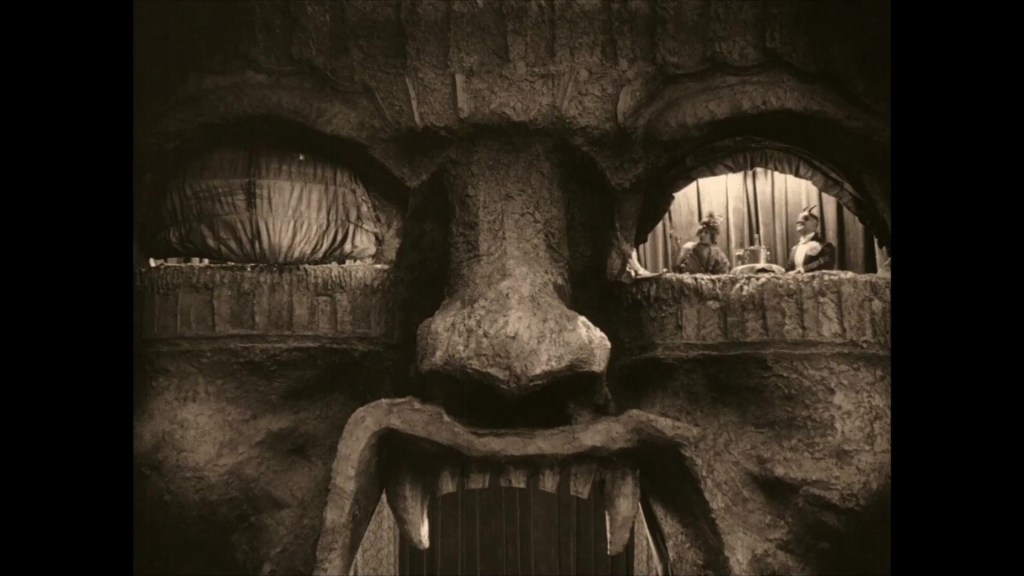
Pordenone from afar (2022, Day 4)

It’s back to Ruritania for Day 4: a slice of slapstick with Stan Laurel for starters, then a main course of Germano-Swedish romantic comedy…

Rupert of Hee Haw (1924; US; Percy Pembroke)

“The Plot”, explains the opening title: “A Princess is engaged to marry a king—but she loves another—This makes it an original story.” Stan Laurel plays a sozzled King, together with the lookalike who brings chaos to the court…

All the Ruritanian trappings are here: the uniforms, the palace sets, the tapestries, suits of armour etc. In fact, the settings have the best recurring jokes. When the King is drunk, the set itself behaves as if drunk: a wall moves back and forth to confound him, then acts as if it was innocent. When the King shoots the cuckoo clock, the suit of armour raises its arms in shock. When the King reappears later in the film, another suit of armour thumps him unconscious. And all for no apparent reason. The King’s fiancée, the Princess, gets her own recurring gag: whenever she is slapped on the back or knocked over, huge clouds of powder (or dust) billow from her clothing. It’s as if she’s fossilized, or she’s wearing a museum costume.

The chaos spreads through the court. A general’s hat reacts every time the King sneezes. First the hat leaps into the air. So the General takes off the hat. The King sneezes and the hat’s plume leaps into the air. The General re-affixes the plume. The King sneezes and the General’s hair leaps into the air. What’s wonderful is that the General looks so nonplussed at each turn, turning around as if to spot how the gag’s being done.
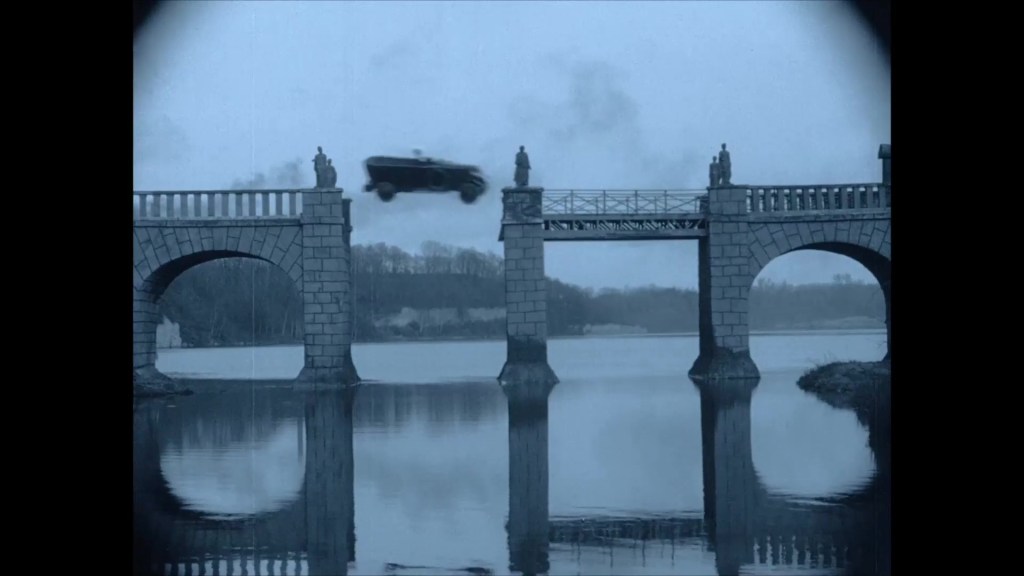
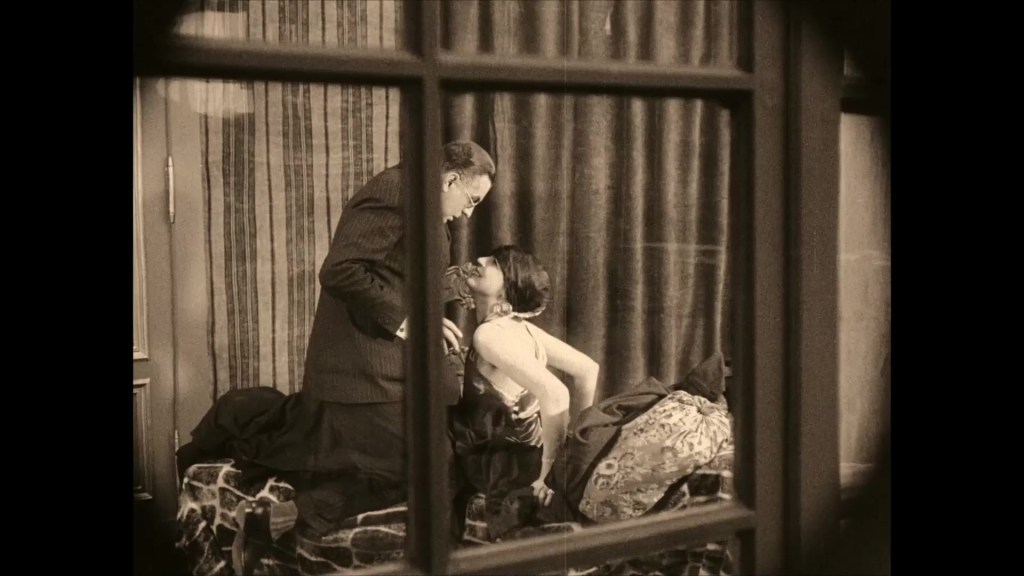
The film takes apart every social formality it can get its hands on. Displays of etiquette become slapstick routines: lines of saluting courtiers turn into front-facing, sideways-kicking brawls. Signs of rank are treated with contempt, articles of uniform defaced and used against their owners.

I quickly lost sense of what the plot was, and so did the film. It swiftly becomes a chaos of banana skins, pratfalls, abrupt changes of fortune, arse-kicks, bits-with-a-dog, incompetent duelling, and callous announcements of deaths and misfortunes. There’s a subplot involving a letter but frankly I had no idea what was supposed to be happening. For Rupert of Hee Haw, the Ruritanian genre is merely a fancy-dress box into which the performers dive and emerge in a chaos of tropes. For only 23 minutes, it feels rather baggy—like the costume doesn’t quite fit the film.

Hans Kungl. Höghet Shinglar / Majestät Schneidet Bubiköpfe (1928; Swe./Ger.; Ragnar Hyltén-Cavallius)

Nickolo Grégory is an aspiring young barber, raised in the trade by his grandfather André. He falls for Astrid, the granddaughter of hair tonic millionairess Sophie Svensson. The millionairess thinks her granddaughter should marry Count Edelstjerna, the closest thing to royalty she can find. But André has a secret, which is that Nickolo is the long-lost Crown Prince of the kingdom of Tirania—and a king worthy of Astrid (and her grandmother). But how will they reclaim the crown, and can they trust the agents sent to help them?

This is an absolutely charming film. It has a charming script, a charming cast, charming performances, charming photography. Its lightness of touch was a very pleasing change from yesterday’s feature, Profonazione, as was its sophisticated staging and camerawork: nothing showy, but imaginative when needed and making the most of its resources.

I’ve commented on title designs more than once in the features from Pordenone this year, and do so again now. Here, the title designs gesture at the secret “royalty” of Nickolo’s family, and the aristocratic pretensions of Sophie’s family.

But everything in this film is well designed. When André sees the hair tonic bottle produced by Sophie Svensson, the shape of the bottle dissolves onto the shape of the castle she has bought with its proceeds of its fabulous success.

Design matches aspiration throughout. André keeps the “thousand-year-old iron crown Tirania” in a secret case behind a mirrored cabinet door. The door is decorated with filigree that matches that used on the film’s intertitles: his secret is hinted at in the very design of the film’s narration. Likewise, when Sophie and Count Edelstjerna are discussing his plans to marry Astrid, Sophie has eyes only for the Count’s signet ring. The Count, too, has eyes only for the portrait of Astrid. Everyone’s aspiration is expressed through knowing gestures, comic transferences. Even Astrid’s rival for Nickolo’s heart, Karin, flirts with Nickolo by a kind of proxy: letting him continually fashion and refashion her hair. Hair itself becomes the means of access to various spaces: Astrid herself eventually invites Nickolo to the Svensson castle to cut her hair.

The rivals in romance play out in a lovely dance sequence in a wood beside the sea. It’s a cliché to expect beautiful coastal landscapes in Swedish films, but here is another. The camera views the circling lines of dancers from the festive Midsummer tree. It swirls and tracks, at one moment keeping pace with the dance, at others stepping aside to let others swirl around it. Couples swap, interact, tease, and reunite.

Nickolo and Astrid slip away on a rowing boat to an island. The film gives us gorgeous close-ups of the two leads—Brita Appelgren and Enrique Rivero—and we see them stood against sea and sky. The characters are falling for one another, so we must fall a little for them too.

The plot literally sails into view at this point: a large ship from Tirania, bearing the nation’s flag. Nickolo reveals he never knew his parents, since he was rescued from revolution in Tirania by André when he was an infant. Meanwhile, from shore, André secretly signals to the boat, crewed (we now learn) by people intent on conning money out of the old man. It signals that the plot will become more convoluted before the truth is revealed…

First, Sophie must be convinced of Nickolo’s worth. When she sees him shingling Astrid’s hair at the castle, he throws him out: a beautiful gag involving deep staging that shows off the scale of the castle and the scale of Sophie’s ambition. Nickolo is pushed through a never-ending series of doorways, all in the same shot, by the endlessly aggressive Sophie. Shingling is all the rage, but her hair-growth fortune takes it as an insult. (The film’s Swedish title makes the issue clearer: literally, “His Royal Highness the Shingler”, as does the German title “His Royal Highness the Bob-cutter”, something missed in the given English title. Nickolo specializes in a speciality of 1920s women’s fashion: the bob cut, a style inimical to the older generation of Sophie and her long hair-growth tonic industry.)

The agents extort money from André to help stage a coup and restore the dynasty, but he must get more funds from Sophie. He brings the ancient crown and unboxes it before Sophie’s goggling eyes. The pomp of ceremony is delightfully undercut as Sophie reaches out to touch the crown and André slaps away her hand and snaps shut the box.

The flashback to the story of revolution in Tirania is a lesson in how to maximize minimal budget of space and time in a montage. Guards in fezzes and Greek-style fustanella skirts swarm through palace corridors. Huge curtains billow. Gun barrels recoil. Flashes through windows. Soldiers pile on each other. An infant is handed to the young André, the King’s barber. The film uses only a handful of single-scene sets, but clever lighting, staging, and a wind-machine transform them into a microcosm kingdom, a time and place of drama and mystery. Drama and comedy blend in the story’s telling and reception: André having too much fun relaying past events, Sophie being too moved (and too ravenous) at the prospects of a royal future for her granddaughter and herself. Sophie has a fabulous vision of Nickolo and Astrid on the throne, dressed like dolls, crowning her as Queen Mother. (Karin Swanström, as Sophie, is superb and steals every scene she’s in.) André shows her the deeds to the dynasty, another written/visual symbol of aspiration to match its comic brethren: the ornate titles, the hair tonic bottle, the signet ring—even the modes of hair.

There follows a further complication of plot: not knowing her immanent fortune, Astrid wants to be abducted and escape with Nickolo onto the Tiranian ship, which falls into the plans of André and Sophie—and the Tiranian agents.

The machinations of the finale are set up in a complex series of intercutting spaces. In the barbershop: Nickolo, his female client Karin (jealous of Astrid), Astrid (jealous of Karin); elsewhere: two strangers that Astrid phones, pretending to be speaking to the Count, to make Nickolo jealous; finally, the Count himself, who is actually in the barbershop, snoozing in a booth.

I simply don’t have the time to describe the complexities of what happens in the next scene that night. There are ladders, lies, false abductions, real abductions, subterfuge, disguises, piles of money, pistols, hidden figures, speedboats, faulty engines, races to the rescue… It’s like a scene from P.G. Wodehouse orchestrated by Franz Léhar.

The best twist is that the villains’ ship is filled with other young men who have been told they are the Crown Prince of Tirania, each with a thousand-year-old iron crown of Tirania and the deeds to the throne. The villains kidnapped five orphans when the kingdom fell, and fobbed them off on perfect strangers whom they would later extort for profit. “We easily found five idiots”, the crook explains, “sorry—five patriots”, he corrects himself. It’s a delightful way of undercutting the absurdities of Ruritanian pomp—it takes a dig at the characters’ ambitions, as well as ours for expecting a fairy-tale ending. And why (the film surely asks us) should we favour the right of an exiled king to stage a coup d’état? The country’s name suggests Tirania was a tyrannical state, not a democracy. Why be nostalgic for a world of monarchical whim and caste-bound deference? As with Rupert of Hee Haw (though in a far more sophisticated fashion), Hans Kungl. Höghet Shinglar invites us to question the precepts of the Ruritanian genre on which it is founded.

Yet we do get a kind of fairy-tale ending, albeit one that is magnificently, showily mercantile: The couple marry and create their magical kingdom, a barbershop in Paris: “Grégory & Cie., Salon de Coiffure”, complete with the mythical Tiranian crown and royal accoutrements as part of the décor. Neon signs overlay the screen, the final marker of aspiration triumphantly stamped upon reality itself. Everyone gets what they want, including Sophie, who plays her part in the fantasy of the “king’s” barbershop alongside André. Sincerity didn’t suit them: they are better here as knowing performers. Why try and reclaim a real throne when one can simply create a fake one that’s more worthwhile?

It’s an ending that acknowledges the falsity of nationalist delusion. Balkan immigrants and Swedish merchants set up their own world in central Europe. It’s also a reflection of the film’s own hybridity: a German-Swedish co-production with a French-Chilean leading man and a German-Swedish cast. Better to be a cosmopolitan in Paris than an autocrat in a tiny kingdom. How nice to leave a film grinning from ear to ear.

Paul Cuff